The podcast "What's App, at Aling Panipunan Rebooted" delves into Philippine history, focusing on independence days and sovereignty. It discusses crucial events like the 1898 declaration of independence and the implications of the Treaty of Paris. The hosts explore the concept of sovereignty, detailing the transition to Filipino independence in 1946. Emilio Aguinaldo's significance and the choice of June 12 as Independence Day are highlighted. The episode also introduces the enigmatic figure of Mr. L. M. Johnson, an American who signed the Declaration of Independence, sparking curiosity about his role in validating Philippine sovereignty. The podcast aims to unravel historical complexities and engage listeners in Filipino history, promising more insightful episodes to come.
Transcription
2028 Words, 12044 Characters
What's the first thing we remember when we think of grade school history class?
Our exams had us memorizing dates and names of treaties, but there's so much more to
learn about our history and the world we live in.
Welcome to What's App, at Aling Panipunan Rebooted.
I'm Sieg Dantanko, a TV reporter and podcaster.
And I'm Sab Schnabel.
I'm a historian and a comedian who has worked for Carlos Seldran, the National Museum of
the Philippines and the Guggenheim in Venice.
We're here to reboot your history class.
Look at it from a different perspective and recast their lead role, make it grittier and
realer.
We're going to go over the history we think we know, zoom in and enhance.
This is not your regular Aling Panipunan class.
For our first episode, we'll take a closer look at our independence days.
Yes, plural.
More after the break.
Since this is our pilot, we'll introduce you to something we'll be doing every episode,
a segment we call Pearl of the Orientation.
In Pearl of the Orientation, we talk about what was happening in the rest of the world
during key points in our history.
So Sab, what was happening in 1898 when we first declared independence from Spain?
In 1898, H. G. Wells published War of the Worlds, a landmark novel that greatly influenced
the science fiction genre.
Madame Curie, the first woman to win the Nobel Prize, discovered radium.
Radium has enabled so many advances in the medical field, including x-rays.
It's considered a cornerstone of cancer treatment.
To help you contextualize what the Philippines looked like back then, in the 1890s, it still
took up to 40 days to get from Europe to Asia.
So you know the world was a different place.
Yeah, the world was a bigger place then, and older powers were starting to fade.
The Spanish Empire, which encompassed most of the world for so long, was suddenly weak.
So the Filipinos saw their moment and decided that this was the time to launch another rebellion
and declare ourselves independent.
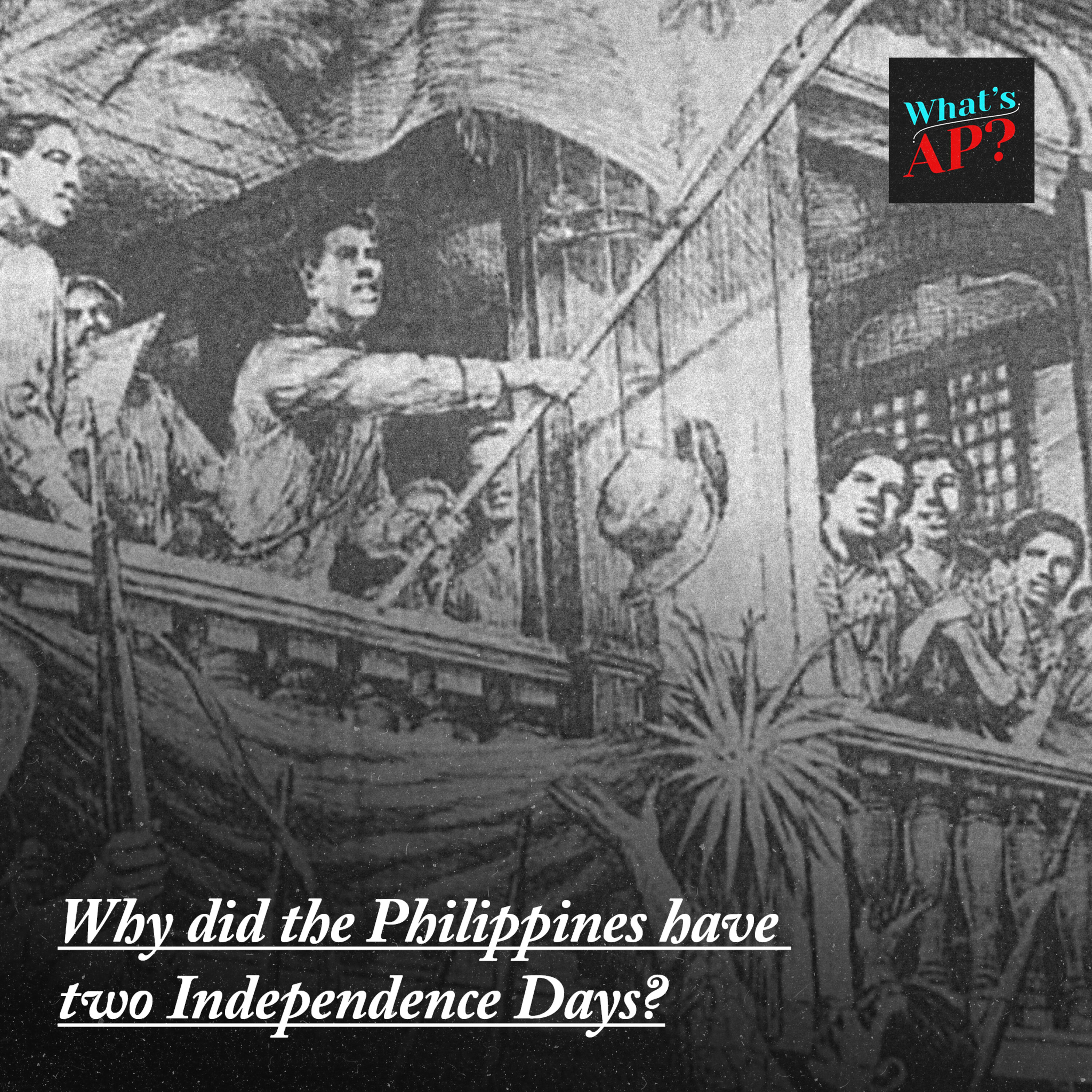
We're all familiar with the image of June 12, 1898, the White House in Kauit, Aguinalda
standing in the balcony and waving a flag that looked a lot like the one we know today.
It had the white triangle, and in it, the sun with eight rays, three stars to symbolize
Luzon, Visayas and Mindanao, and the red and blue fields.
In this version, though, there was a face on the sun.
So we did have a flag.
Take that colonial justification.
This particular flag was sewn by Marcella Marino Agoncillo and Lorenza and Delfina
Herbosa Natividad.
As the Constitution was signed by our brave forefathers, and this one random white guy
more on him later, our flag was raised proudly to the tune of La Marsha Nacional Filipina.
Picture the rebels kicking it with the Ewoks and celebrating the takedown of the evil
empire in return of the Jedi.
But as we were declaring ourselves a sovereign nation, the U.S. had bought us.
The 1898 Treaty of Paris put Guam, the Philippines, Cuba and Puerto Rico under the "protection"
of the United States.
America paid the Spanish $20 million, or, in 2018 money, that's over $609 million.
After comparison, some other places that the U.S. bought are, most of the Midwest.
It was sold to the U.S. government, doubling the size of the country in the Louisiana purchase.
That was $15 million at the time, or $253 million in 2018.
There's also Alaska, which was $7.2 million, or roughly $103 million in 2018.
But that's a lot of numbers.
Basically the U.S. bought us for roughly 50 percent of what Avengers Endgame made at
the box office in their opening week.
And so while we thought we were taking the reins of our republic, the rest of the world
saw only the transaction from the Spanish to the Americans, even though we did have
a flag.
And not just a flag, but a constitution and a government.
See, while we thought we had already declared our independence in 1898, it wasn't enough.
In the second episode of Puma Podcast's TED Talks, XSC spokesman Ted Teth talks.
See what we did there about four aspects of sovereignty.
The word "sovereignty" refers to four aspects.
First, a state that is sovereign has rights or power over a particular territory.
Second is accountability and responsibility over a population.
Third is there are specific authority constituted.
And fourth is that other sovereign states recognize the state as sovereign.
And boom goes the dynamite.
We had the first three, but not the fourth, arguably the most important.
While we were declaring our independence, it was self-determined.
The rest of the world considered this territory under the sovereignty of the Spanish.
So when they signed the treaty with the Americans, that sovereignty passed from one to the other.
So while we knew we were independent, the rest of the world did not recognize this happening.
This is why on things like Game of Thrones, they keep saying "rightful king" because they have sovereignty.
So, after the longer than you think it is Philippine-American War, our two countries entered a tentative peace.
We were not ostensibly a colony, but a protectorate.
What's up with that?
The U.S. and its colonialism is really its own episode.
If we are not, we Filipinos were not finished.
We just tried a different tactic.
If arms were not going to work, diplomacy would.
President Manuel El Quezon successfully lobbied the U.S. president at the time, Franklin D. Roosevelt,
cajoling him and the rest of the United States into committing to withdrawing from the Philippines and leaving us alone.
Also, they were dealing with the Depression at the time, so it seemed like a good idea to downsize.
And the Tidings-McDuffie Act was signed in 1935.
This gave the Philippines a ten-year transition period with our full independence to be declared on July 4th, 1945.
So, 1935 to 1945.
How has our world changed since 1898?
Well, the War of the Worlds was turned into a radio play and freaked out the English-speaking populace
who thought aliens were invading for real.
Radium, the element that won Madame Curie's Nobel Prize, turned out to be terribly toxic.
It killed her and dozens of other people.
As the glowing green color was so popular, it had been used to make paints and wallpaper.
It's still the color we think of as nuclear green.
So, 1935.
The Tidings-McDuffie Act was signed and put into law, setting the clock.
Ten years to Filipino independence, and then the Japanese invaded.
And so our independence was again thwarted, this time because of World War II.
World War II had huge repercussions for the Philippines, but the events of the war are too much to get into.
For our subject today, what we need to know is that while most of the fighting ended in 1945,
our independence was not given to us until 1946.
On July 4, 1946, the Philippines was declared independent,
with General Douglas Ayshal return MacArthur himself saying,
"With this ceremony, a new nation is born. Forty-eight years ago, the mantle of American sovereignty fell over this land and this people.
It was the beneficent sovereignty of a liberator.
Pledge to be withdrawn as soon as the well-being of the people would safely permit.
America never wavered in that purpose.
America today redeems that pledge."
Once again, our flag was raised over the flag of our colonizers.
This time on the grandstand in front of the Rizal monument, a gift from our benevolent protectors.
We share July 4 as our Independence Day for almost 20 years, until 1963.
In 1963, President Justado Macapagal signed Proclamation No. 110 to declare,
"The establishment of the Philippine Republic by the revolutionary government under General Emilio Aguinaldo
on June 12, 1898, marked our people's declaration and exercise of their fight to self-determination, liberty, and independence."
Emilio Aguinaldo gets a bad rap, and there is a lot to say about that.
It deserves its own show, and in fact, there are shows about it.
Famously, Lord Divera's Bayani Ogangster on TV5.
We'll definitely do an episode sometime down the line on this hype beast for the Philippines,
but in the end, his legacy started us down the path to independence,
and that was recognized properly by Macapagal.
Macapagal said, "July 4, seen tantamount to the celebration of Philippine's subjection to and dependence on the United States,
which served to perpetuate unpleasant memories.
The celebration of Independence Day on June 12, on the other hand, would be a greater inspiration to Thief."
And so 65 years after that first flag was raised in front of that house in Kaui Cavite,
it was raised again to commemorate that revolution.
The house was gifted by Aguinaldo to the Filipino people.
Newspapers quoted him as saying, "to perpetuate the spirit of the Philippine Revolution of 1896
that put an end to Spanish colonization of the country."
He died a few months later in 1964.
His house is now a museum in Kaui.
Every June, there's a ceremony commemorating our Independence Day.
The one we chose, anyway.
This being Filipino history, which is so weird and wonderful,
we wanted to end every show with a weird thing about this story that we loved.
And for this one, we will tell you the story of the stranger.
Remember that white guy we mentioned at the beginning?
Yeah, he signed our Constitution.
That's right.
On our Constitution, amongst the forefathers of the Philippines,
is the signature of Mr. L. M. Johnson.
He's described as a citizen of the USA, a colonel of artillery,
but there are many conflicting reports.
Some people say he was working for the Filipinos, some say the Americans.
The Americans deny this, but there is evidence from books like the Philippine Insurrection against the US
that it was important to Aguinaldo that an American was present,
the implication being any American would do.
Some sources say L. M. Johnson was a colonel working for FDR.
Others cite letters from Johnson pledging his loyalty to Aguinaldo.
What we do know was that he was born in America and went gallivanting around the world.
He popped up in Chile and China.
Some reports say he was a soldier, a hotelier,
a film producer.
Sources are kind of sketchy about his life,
but what we do know is that he signed her Declaration of Independence.
My suspicion is that Aguinaldo used him to validate our Constitution.
And as an American, he was recognizing our sovereignty, that word again,
a bit like "this white guy signed it and he stands for all white guys."
Yes, reversing the trope before it was cool.
Johnson was supposedly a colonel, a fact that Americans like to deny.
So they can be consistent in their stance that they did not recognize Philippine independence.
Aguinaldo made sure that he had someone who was white,
hard copy, paper trail, in person, witness our independence.
So of course, the Americans painted him as a nobody who was not official,
held no official titles, and played up the sketchy, nomad aspect of his life.
Sources for Johnson's exploits are hard to find and even harder to prove.
And so, the stranger will live on as the mystery white guy who signed our Declaration of Independence,
a testament to our weird relationship with the United States.
Something we'll be exploring a lot on WhatsApp.
Atalimpanipunan Rebooted.
Thanks for listening. I'm Sabh Shnabel.
And I'm Siege Tentango.
Class dismissed!
We've got more episodes coming your way.
Subscribe to WhatsApp atalimpanipunan Rebooted on Spotify, Anker, Apple Podcasts,
Stitcher, or wherever you listen.
Join the discussion and check out our favorite history memes.
Follow us on Twitter @historyrebooted on facebook.com/historyrebooted
and on Instagram @history.rebooted.
I'm on social media @SiegeTentango.
And I'm at Sabh Shnabel on Twitter.
That's Sabh S-A-B-S-N-A-B-E-L.
My name has been a problem throughout my high school life.
This episode of WhatsApp, Aralimpanipunan Rebooted, was produced by Pauline Reyes
and edited by Nina Toralba, a Puma podcast.
Podcast Summary
Key Points:
Introduction to the podcast "What's App, at Aling Panipunan Rebooted" with hosts Sieg Dantanko and Sab Schnabel.
Discussion on the independence days of the Philippines, including historical events and key figures.
Exploration of sovereignty and the Philippines' transition to independence.
Mention of the Tidings-McDuffie Act of 1935 and Filipino independence in 194
Emilio Aguinaldo's role in Philippine history and the declaration of Independence Day on June 12, 189
The mysterious figure of Mr. L. M. Johnson, an American who signed the Philippines' Declaration of Independence.
Summary:
The podcast "What's App, at Aling Panipunan Rebooted" delves into Philippine history, focusing on independence days and sovereignty. It discusses crucial events like the 1898 declaration of independence and the implications of the Treaty of Paris. The hosts explore the concept of sovereignty, detailing the transition to Filipino independence in 1946.
Emilio Aguinaldo's significance and the choice of June 12 as Independence Day are highlighted. The episode also introduces the enigmatic figure of Mr. L.
M. Johnson, an American who signed the Declaration of Independence, sparking curiosity about his role in validating Philippine sovereignty. The podcast aims to unravel historical complexities and engage listeners in Filipino history, promising more insightful episodes to come.
FAQs
In 1898, H. G. Wells published War of the Worlds and Madame Curie discovered radium, which had significant impacts on science and literature.
The Treaty of Paris in 1898 placed Guam, the Philippines, Cuba, and Puerto Rico under the 'protection' of the United States after purchasing them from Spain.
The Philippine-American War led to a tentative peace where the Philippines became a protectorate of the U.S., eventually leading to a transition to independence in 1946.
World War II delayed the declaration of Filipino independence until 1946, even though most of the fighting ended in 1945.
Amongst the forefathers of the Philippines, the signature of Mr. L. M. Johnson, a mysterious figure, is found on the Constitution, with conflicting reports about his background and affiliation.
The Tidings-McDuffie Act of 1935 granted the Philippines a ten-year transition period towards full independence, with the declaration of independence set for July 4th, 1945.
Chat with AI
Loading...
Pro features
Go deeper with this episode
Unlock creator-grade tools that turn any transcript into show notes and subtitle files.
 PodcastTranscript AI