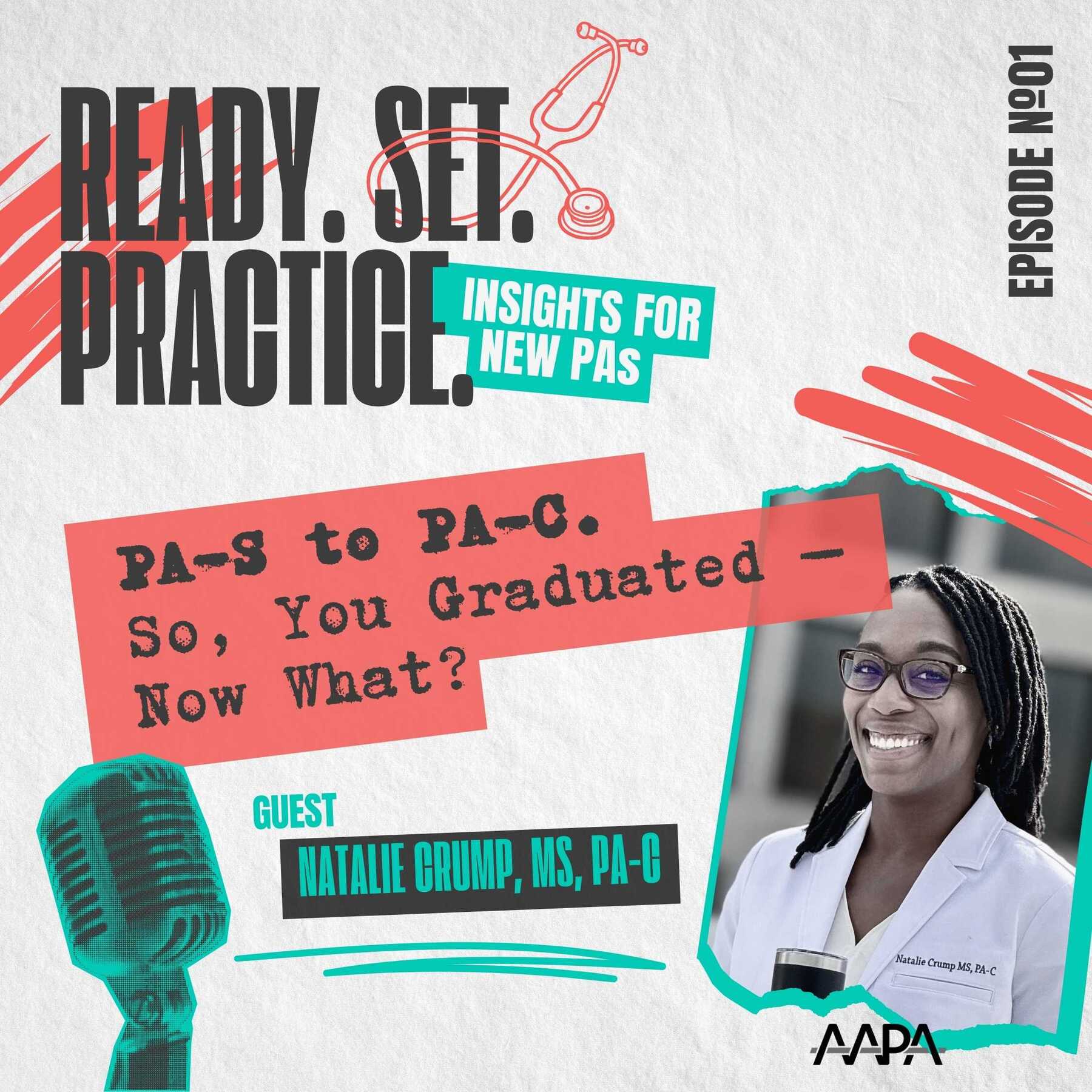
Episode 1: PA-S to PA-C. So, You Graduated — Now What?
31m 29s
This podcast episode from ReadySet Practice features Dr. Jennifer Orozco-Cold and PA Natalie Crump discussing the transition from PA school to clinical practice. Natalie shares her experience as a working parent navigating PA school, job searching, and early career steps. She highlights the importance of leveraging personal networks and rotations to find opportunities, using resources like the AAPA salary report for negotiation, and prioritizing job satisfaction over salary. Key advice includes staying organized with licensing and credentialing documents, understanding the costs and timelines involved in becoming board-certified, and choosing a specialty that aligns with personal passion to ensure long-term fulfillment. The conversation underscores that while financial stability is important, finding a role that feels meaningful and engaging is crucial for a successful and rewarding PA career.
Welcome to ReadySet Practice, insight from new PAs, the podcast designed to guide you through the transition from PAs School to clinical practice. I'm Dr. Jennifer Orozco-Cold, the Chief Medical Officer at the American Academy of Physician Associates. In each episode, we'll explore the many factors that shape your early career from understanding your roles and responsibilities, to navigating professional challenges, developing personal leadership, and advocating for both your profession and your patients. Join us for expert insights and real-world advice tailored to new PAs stepping into practice. In today's episode, we're diving into one of the biggest transitions in a PAs journey, going from PAS to PAC. You've graduated, but now what? How do you find the right job, navigate credentialing in licensure, understand employment contracts, and set yourself up for success in your first role? To help us break it all down, I'm joined by PA Natalie Crump. Natalie is a dedicated physician associate with a background in women's health and reproductive medicine. She's also a past AAPA student academy president and has served on the AAPA Board of Directors. Her experience as a new PA and her passion for mentorship, make her the perfect guest to share insights on what to expect after graduation. Natalie, welcome to the podcast. Thank you, oh my gosh, such a great intro. Thank you so nice to be here. Thanks for having me appreciate the invitation to speak on this. I think it's super important that we provide a road map as much as we can. Well, I'm excited that you're here and you and I have known each other for some time. So let's start with quick introduction for our listeners. Tell us a little bit about yourself and your path from PA school to your current role. How has that transition been for you? Yeah, it's been one for the books. We'll put it that way. Yes, hello podcast listeners. My name's Natalie. I'm a PAC. I did my training in PE school at Rocky Vista University in Parker, Colorado. But before becoming a PA, I was a researcher in fertility preservation for the University of Colorado. And that's where I say I got bit by the bug to want to practice reproductive medicine. So I used to preserve fertility for cancer patients, male and female before they embarked on journeys that would otherwise in their fertility earlier than they would have hoped. And then I left that field decided to go to PA school and during my didactics was like, who knows if I want to go back to that will see. And then as soon as we did reproductive inequality, I was like, yes, so this is home. And so I am married. I went through PA school with three kids. My kids at the time were all like elementary school middle school so busy. This is me going through Askees and a parent teacher conference. This is me sitting on site line games and studying for interpretation exams like it was all out mayhem, but got through it. Thankfully, and started transitioning into the workforce by actually having one of my first jobs be created for me, a position at the University of Colorado doing women's health. And that was a very gracious opportunity. I had being able to go back to women's health, but it wasn't R.E.I. It wasn't the program of chronology and infertility just yet. So the transition was swift. It had to be because I was a working parent. And so I needed to make sure I was able to graduate successfully, pass parents successfully and ensure of a job. So that way I could be able to be a contributing factor in my household. Absolutely. And we're going to we're going to talk more about that journey specifically being a parent. I can't it, you know, I'm a parent. I have a lot of kids I'm married and but I wasn't during PA school. So navigating that during PA school and then finding a job and all of that transition you moved. I mean, you know, you've done so much. So I can't wait to talk about that. How about let's back up for just a second though. Tell us a little bit about your job search. Oh, yeah. Well, I like how do you even begin to start looking for a job. So I'm like type A plus in personalities. If you had to categorize. And so we graduated from PA school in November, which meant January, I started studying for pants January of that year. Even though this the exam was November right because you can't take your pants into graduate. And at that same time was when I started pretty much prioritizing the specialties right because as a PA were trained broadly, which is a beautiful thing and that gives you a lot of leeway to be able to choose the specialty that you desire to work in. The great mentors at the time that said you can either prioritize salary location or fit you can prioritize those three. Sometimes you hit all three and that's, you know, amazing. But sometimes you end up getting two of the three or one of the three and then you have to figure out kind of what is your line in the sand. So for me, looking in January, I immediately reached out to people I knew. So I started not on the job market because I feel that you have a better chance sometimes at getting the interview when someone knows you when you have a direct personal relationship or like a third degree relationship. You know someone who knows someone knows someone or you've rotated with this clinic before. So that's where I initiated the search or kind of dwindling down the specialty. I knew I didn't want to do bones ever. So like ortho was never on the list. I knew that pediatrics was pulling at my heart, but unfortunately from a PA perspective, I needed to make a certain dollar amount. So again, priority for me was salary in order to support my family. I did two rotations and I loved it, but I just knew that I'd have to do something else to make that makes sense for us. So January started looking reaching out to contacts. Do you know anyone who's hiring started asking my rotations, my preceptors at the time because I still had a whole nother six months or so rotations to get through. But once I was able to do that, I kind of landed on women's health and that's kind of where I just like at that point narrowed my focus and very much just only reached out to those providers in that specialty. So I didn't really search for a job on the open markets. I don't have as much experience there, but I do know and can tell you that if I had at the time, which I do now, didn't then a LinkedIn, I would have for sure used that too. I think LinkedIn of the sites you could use to look for jobs. Yes, you could use indeed. Yes, you can use some of those other sites. And no, I'm not being paid to put their name out there, but you know. But I think if you start, you know, searching and you can see who are your connection points. It's easier that way. I always told students, because I now teach. I like to like to have one intro that should have referred medicine for my key school and I always tell them the riches are in the experiences of your rotations, get really comfortable doing well, creating an opportunity to like continue that relationship beyond just through like four to six weeks. Yeah, absolutely. And, you know, I think such good advice. And sometimes you said something in there. Sometimes it's helpful to determine what you don't want. And that will lead you down the path of what you do want, right. And there's a lot of students who are going to PA schools in different states. So they're thinking, oh, well, I can't use my three-sector and, you know, my rotations, because they're in this state and I'm moving back to another. And, you know, I think the general consensus is that there's lots of resources. LinkedIn is a great one. AAPA has a huge PA job source board. The AAPA Salary report is very, very helpful when you're trying to navigate that. So, yeah, on salary, it's very interesting because I agreed to go back to school to be a key because I was already in my career as a researcher. I was fine. I've been in research for four years. Like, I was very, very happy. However, I know I wanted to do more clinically and I chose to be a PA both for time of training, but also for what our profession offers, the field is a very wonderful ability for you to do what you love, but it not consume your life, right. Like, we all want to be very intrinsic and patient care delivery. We want to use our brains with all the science packed in it, but we don't want to be bombarded or, you know, take such a sideline out of life to go after some of the other degrees that take a longer time. We'll say that when you're thinking about salary, using the AAPA Salary report, as well as like the Bureau of Labor and Statistics has report for salary for your specialty is helpful at navigating the negotiation because your employers are going to look at that also. And sometimes they may not know that other PAs in your specialty make X amount. And here's where they started as a new grad. Like, you can kind of use that to make sure you're at least hitting what I call the basement. We don't accept a salary that's going to set us back as a profession and I like want to stress that like don't let them go in and low ball you use your resources, do the research and present this and then you add on and as well, here's my blah, blah, blah, blah, blah. Don't be afraid to at that point to your own horn. I like to say I, I did that in an academic setting, but in an academic setting academia is very prescribed if that makes sense, like it's very regimented, there's just this is how much it pays because this is what cyber. Anyways, this is how much it pays because essentially this is what they've allotted for I knew that going into the first position I had and so loved it did really well had a great time, a great experience I was able to do exactly what I wanted because I use my network and they created position exactly the way I wanted it to. Salary was always a sticking point because I was like, I used all those great stats and I had all that and they were still like, yes, so here's where we are and I was like, okay, grateful working employed not dealing with the gap, you know, and it takes some time to get credentialed, so do figure that into your plan. You graduate with your your K degree, you take pants, you get board certified, now you have to get your medical license, now you have to get DEA, those are all costs that you have to eat or make a plan for ahead of time, so think of that. But then once I was in the position, really loved it, but when I was I can I say poached the something right word. And I was approached to go back to REI Reprecognitive College in infertility, I knew at that point I had to make a stance on, here's where I'm moving, like if you want me, here's where I'm moving with, like I'm, here's my bottom line, if you can't make it, I'll just stay, right, I don't want to go with changing a job so soon in my career, which was never my intention. I thought in my head I get into women's health, stay general for like a year or two, and then eventually transition to a specialty, but it came up a little bit sooner, so at that point, I like made a decision to advocate for myself, it worked out really well, and I've been with this position going on three years in September. So, yeah, absolutely, and we could have a whole podcast just on salary alone and the salary salary negotiation, I think, as you mentioned, knowing your worth is key, but also informing yourself with data, so whether it's the AP salary report or other types of data that are out there. Also understanding your region, your specialty, your state, there's a lot of factors, right, do I work rural, am I on call five times a month, like what are the factors that are into determining salary, and that's, you know, when you first, you know, mentioned in the beginning, you were talking about, you know, what is most important to you, so back up, take a deep breath. You know, I used to tell, so I'm, I was director of advanced practice for a very long time, and people always came and said, I want more money, right, who doesn't, I want more money. But I used to say to people, they'd say that, and I, my next question was, are you happy, do you enjoy what you're doing, and it's so critical, and I, when I mentor students, and I'm sure you do too, I see people chasing the money train. And they're just miserable in their role, like they don't like the specialty, they don't like taking care of their patients, and I encourage students, you know, really calculate out and think about what you want, and I guarantee you the money will show it down the line, whatever it is, but don't go chasing the dollars. If it really is about what you do, enjoyment, and what you do, right, and ask taking care of patients, so that it's great that you said that because that was literally my determining factor of should I move from general immense health to repricabin a chronology. When I was a researcher, I lived to help my patients preserve fertility, and I loved the science, and I was really entrenched in the research, and I missed that when I was in general immense health. So while they approached me, it wasn't, and it wasn't a difficult ask, I was like, yeah, of course, of course I'll conduct infertility. And now that I'm here, like just yesterday, you know, yesterday was a very busy day for me. My collaborating physician is out of the office, so I'm holding it down so low, and it's just she and I as the two providers in this clinic, but a very busy space. And yesterday I got to confirm a positive pregnancy for a couple who have been trying for years, like years that they didn't think they could, and when I was able to do that, and that is crying, and mom is crying. And then two patients before them, I had to do a really difficult procedure, and the patient was so grateful, I felt like I wasn't working. And if you can get into a specialty and it not feel like work, you've know you've gotten into the right spot. Like so think about that, I guess during your rotations, if you're in a rotation, and it's like drudgery, you're like, I do not want to get up for this. Like that's not the one for you, just stage left, and don't do that. But if it's the one that like, for me, keeps me up, I like saw something else, you're like, oh crap, I got a Google this, or like, what is the like most recent counseling on this? Or like, how do I work this up? Or like, what? Like, those are the ones that you want to stay in because this PA is real life long learners, which is also a really great benefit, but it's fun to learn what you want to learn. Like you got to enjoy the aspects of the job. So I think that first and foremost, do you like it? Step one. Right. Yes. Do you like it? This is what I want to do. It brings you purpose and meaning for your life and the rest will follow suit over time. And we, you know, again, we could talk about journeys along the way, and there'll be so many things that you experience, and my my life went from what I thought I was going to do to how the heck did I end up here, right? And, and I couldn't have called that in a million years when I first started out as a PA, so you don't know where that journey's going to take you. And all you can do is enjoy what you do, give back, think about why you got into medicine, and that will help guide you. Let's, Natalie, let's talk about a couple of things. And I know again, we, we can keep going here, but I want to talk about two things, one about organization, because there's a lot, it's overwhelming as a new commission to get your license. And I got to take my boards, and I got a, maybe I have to move, I have to get licensed credential privilege. These are really, it's overwhelming. And so one, how do you deal with that and how, what is your advice. And then I want to talk about your role and kind of stepping into that role when you first get out of, out of school. And now you're this PA, right? And so, yeah. Let's talk about the beginning, which is how the heck do I get organized. And then I want to talk about your role. You take things out of your head, and you put them on a tangible, reliable organization source, such as a note on your computer, I have a note on my phone, it's actually under locked, so you have to use my face to open it, but it says post grad. And I started this because you have to know from a licensing perspective, when your licensing are sent, setting and expiring, so you can know when to renew them. So I have on there my, so on this note, both on my computer, as well as like copies of all of my licenses, I have also them on my phone, always handy, because you want to make sure that if you're asked of it right away, you can access it. When you're applying for jobs, your most important thing they'll need are your NPI number. And if you have a DEA or not, and you need to provide those numbers. So in your medical license number, I will say I'm licensed into states. I got my licensing California after being licensed already in Colorado, but they have different dates now to so I have to put all of that there. I was also licensed for drug license in two different states as well. Keeping them organized is just putting the number, the date that they were issued in the date that they expire in a handy place where you can access it. I recommend creating a folder on your computer or wherever you access things that literally just says like post grad or all the things that you need. So when you're going for jobs, they're going to ask you for your like patient logs that you did as a PA student, right. So all the times that you had to come back and like chart on your like patients as a PA student, they're going to want to see how many times you were interacting with the patient and did X Y and Z. Like when I had to get credentialed at a hospital, you have to provide for them, okay, how many surgeries to do see how many pap smears that you perform, how many X Y and Z. So in PA school, while you're getting your NPI, which if you don't know, you can get an NPI number as a student, but get your number and then just keep it all in a folder. So I organize everything in folders and I have backups on backups. So I have it on my phone. I have it on laptops. I have it on my iPad, everything crosstalks. And I have calendar reminders of when things sunset and when they're due. I need to actually do it from a AP membership. Apparently it laps. And I'll tell you the other backup is the APA for students. No, they got portfolio. So portfolio. You can put everything in there, automate calendar. There's all kinds of features. But again, whatever works for you. Do it. So do the portfolio, because I think you can also use it in a crosstalks with your NCCPA certification. Yeah. When you're having to log your CMEs, like when I go to conference and I log my CMEs because of portfolio, it automatically knows what I did when I pull up my NCCPA. So yes, I think use the peer portfolio, use your own like physical something so you can have access to your documents. And then it's always readily available when asked for it, but you're never in the in the dark about what you have when it's due where you are in that process. I also created email folders. Again, I'm type a plus. I have email folders of all my correspondences with jobs at that time with the credentialing departments with the state medical boards to license to know kind of where things were happening. Yeah. So so good. And organization is the number one thing because it's a lot. And I'll tell you, it's very easy to get frustrated too. And I'm sure you experienced this. They will ask you for the same thing over and over again over and in the same organization. You'll say, why do you that to HR? And they're like, well, we need it over here. So just don't get frustrated. Um, just realize it's sort of part of the process. And your own ACLS. Yeah, your ACLS, your BLS, your pals, like, you don't know when those sunset keep those in a folder. I had a PA friend. She's a really wonderful RIPA, I'm her name is Shaina. And she said she has a sunshine folder and I was like, what is that? And she says along your journey, you're going to feel frustrated. Your first five years as a PA, you feel like you know what you're doing, but there's a very steep onboarding because we're learning what we need to learn for that specialty. So she had a folder of all the comments are like, nice things patients would say or like interaction she had. So she looks at it when things get tough and she's like, oh, I remember. So that's her sunshine folder. So I thought it was really cute one to share that. I need to do that. I need a sunshine folder. Well, let's talk about that role, right? You mentioned that transition, which, you know, I think sometimes when I'm you're a seasoned PA like myself, right? I'm considered a dinosaur now, but you forget what it was like. The heart it is. And I think medicine, even from me 20 plus years ago, there was no EHRs, you know, there was, there was nothing and we thought it was hard back then, but I imagine. And I know it's even harder now with how much medicine has changed in the last 20 plus years. And so tell me a little bit about how did you handle stepping into your new role and maybe what advice you have for students, because it's such a learning curve. So let's start with when I was a PA and OB-GYN, it was wonderful, great experience. I had an opportunity actually to hold the page for the residents who were going through the euro. Guine of rotation, which is a very heavy rotation for them from surgery. So I was able to assist with answering call for their ER, right? So when they're having guidance, consults in the ER. And so honestly, the imposter syndrome is going to be there. And I think the way to combat it is the same way you do any anxiety, you just over prepare. And not to the point where it becomes like pathologic or, you know, I don't want you to exhaust yourself or think you can't do it. But I think what I was able to do was just read everything. It took me forever to prep my notes in chart and all of that. But it's because I want to be so thorough. So I used up to date constantly. I asked friends. I had mentors there at that position. It was very, very busy. It was a very steep learning curve to go in and navigate. Sometimes high acuity for patients in an obstetric setting that I was able to do it. I remember having nightmares about the EHR. Like we used Epic. And I remember having a dream that messed up a click or didn't do a bite. And I was like, this is ridiculous. But the way that you are able to transition is you use all of that great grounding from PA school. All of your notes that you took for that specialty, the time that you spent with those preceptors, the things that you've known that special to be. And if it's a newer specialty for you or something that you did maybe only once, I, what I did was just took the time to reeducate. I found resources. I joined the professional organizations for that specialty. So I joined ACOG. I joined the AP constituent organization APOG. Like all the things that I could get my little hands on to make sure that I was supported in any question I may have had clinically. And then from a medical decision making being in front of patients, you guys do that into your blue in the face in PA school. So that one isn't as tough. And what I always found really helpful is the vulnerability that I shared. So I would share with patients and my colleagues. I don't know as much about this. Can you teach me? Can you show me? I haven't seen this yet. Can you walk in with this? Oh, I like cannot find the cervix. Usually I'm able to. Can you come in and do this with me? I don't feel ashamed at all of still being in the learner position. Don't feel ashamed of asking questions. Don't feel like you have to know it all. Be okay saying. I don't know what I don't know. And I haven't seen what I haven't seen. Would you mind walking me through this? Also one point about job search and this important piece is finding and making sure they onboarding for your positions is really going to support you. I have pre-subbed patients or students, and I've always said to them, if the onboarding for that job is not long enough, or is not going to support you, it's not going to give you a good foundation to do well. And it's just going to frustrate you and burning out really on. So when you're interviewing positions, you want to always ask them, have you worked with a PA before. What do your PA's do? What's their scope? Like, how is this going to impact me? And then what does the training look like? Like, what does it look like for me and you to talk? Because as a new grad, you still have to have a certain number of hours. I think each PA license is usually like this per state, where you're directly having monitored. Like someone is like, I hate to say supervising because we're collaborative, but someone is actually like going over your notes with you. You have like a communication with your collaborating physician where you're able to talk about that for at least the first, I don't know, 120 hours is what I have in my head for how it was with Colorado. So that transition, plus being a mom was actually pretty interesting. I threw into that mix, moving states. So within 18 months of being a PA, I left the job I started with started a new role and then moved to California shortly thereafter. First off, I don't advise any of that. Let's just be very clear. Not something I would, you know, you don't move when you first become a PA and bring children. Yeah, I mean, it's really not for the thing that heart praise God, but I think that what I did help myself with is I stayed organized. So even in the new role, even though I had experience in rebook of medicine, there's still a lot to learn because now I'm not a researcher. I'm the clinician. I'm helping you. I'm doing the procedures. I'm doing what needs to be done. But I will say the bigger night and day for me was the onboarding with this position was so much longer was so much more hand holding in it felt so much better because then when they let me go, I was sailing and there have been minimal issues. So I think that's to be. So such good advice to and I, you know, I think you have to ask, right? I think a lot of people make assumptions that they're just going to have some beautiful written onboarding yeah or six months or a year. And a lot of places are not like that. And a lot of places don't put the resources. So ask. You mentioned talking to, you know, the collaborating physicians talk to other people in your interview process, ask this talk to the practice administrator, ask to talk to the PAs and maybe MPs or the nurses that work there get. Get your their opinion on what it's like for them and what is a day to day look like. I think a lot of and I think there's different generations and different points along your career where you feel comfortable, right? And so you sit on that struggle of I want to demonstrate that I know it also don't. And, you know, when when you work in a new specialty to I think outline the topics that you want to cover and you want to learn about to piece mail it out, right? You can't learn everything in weeks time. And when you encounter patients at night, that's what I used to do if I saw a new patient that had a new disease that I wanted to know more about at night. Because it was so fresh, I went home and looked at it, right? And I used up today and some other resources to say, I need to revisit that or what was, you know, the up to date protocol or medication. And I, and say, hey, can we talk about this? Can we talk about patients? Yeah. And what's really nice is your collaborating physicians will appreciate, hey, our research is I looked at this. Do you have any other insight like anything else? Have you seen this? What do you do? Now you have their experiential learning plus what you've read and you combine that with what you saw and now you've just like accelerated your knowledge and understanding and how you approach something. So 100%. Absolutely. Medicines a team sport, right? No, I can't tell you how many times I was like, hey, I need you to come see this patient. So whether it was a physician in the office or somebody else, I was like, I need you to take a look and put your second set of eyes here. Validation, like I know I, like I know what I know, but like maybe you've seen this and I just happened so can do it. You just put your eyes on this for me real quick. Well, I was going to say one other thing I did do that I like totally missed was in PA school. I went to P school. COVID happened midway through P school for me. So a lot of things that I wanted to do couldn't do for various reasons. One of those was really practicing IUD insertions and I knew going to OB that I would need to do really well that so I googled because I'm type a a program that sent me a pelvic model and it was an online like a synchronous course for a little bit and then it was a synchronous of them. Having us demonstrate putting in an IUD with this pelvic model using a speculum and all of the things. So I took I paid for that. I forget who it was through I probably have to find it and send information to you, but they sent it to me. I got like CMEs for it, but then I was also able to practice and demonstrate that skill. And I still have all my practice IUDs both, you know, all of them from the major form of that produced them to be able to help support and now use those as my teaching for students when they come in like I have all of that. So I just like, you know, advocate it for what I needed knew where my deficiencies were. I think that's another important part is know where your blind spots are. Know where there are things that you're like I haven't seen this as much. I want to read up on it and then self educate. Yeah, such such good advice. So well, we're coming to the end of our time here. So I'm telling you what is maybe the one piece of advice that you'd give to a new PA as they enter the workforce. It's going to be okay. Just literally tell yourself it's going to be okay. Like you're going to be nervous. Nelly, there are going to be a lot of things that the transition from P student to PAC is that you are no longer. Like you are the decision maker like the medical decision your differentials all that is you and sometimes that can feel overwhelming because you want to be so right and get it so perfect at least that's my experience. And so I would just say it's going to be okay. And don't expect to build Rome in a day like it's going to take time like give yourself that time like I still have to remember I've been in my position now for a while, but there's still things that I still need to brush up on. It's like Rome was built in the day like empires do not come overnight like you really have to like do your due diligence, but know that it's going to be okay. So I think that would be my biggest advice. Keep encouraging yourself keep telling yourself those things because in the world of medicine, as you mentioned from how it was years ago to what it is now it is it is a lot. Your patients are going through a lot, but the more you can give yourself that assurance and say it's going to be okay when you step into a room that patients going to fill your calm instead of your anxiety because patients will fill that your energy will go ahead of you. So if you're nervous about something before you enter that patient room or write that note or whatever you need to do just take a deep breath and say it's going to be okay and it's only going to make me better like it's never a loss always lessons never losses. Well, Natalie, thank you so much for sharing your perspective with us and it sounds like you are the queen of your empire you are a super clinician super mom and super leader super friend and it has been so fun chatting with you today and you know I'm just so grateful for all that you've done and sharing with students and it's an amazing time to be a PA and you've given them so much insight. So that is a wrap for this episode of ready set practice insight for new PAs we hope you found these insights helpful as you navigate the start of your PA career don't forget PAs can claim your CME by visiting learning central thanks for listening and we'll catch you next time on ready set practice.
Podcast Summary
Key Points:
The podcast focuses on guiding new Physician Associates (PAs) through the transition from school to clinical practice, covering job searches, credentialing, contracts, and early career success.
Guest PA Natalie Crump shares her personal journey, emphasizing the importance of networking, using resources like LinkedIn and the AAPA salary report, and prioritizing personal fit and passion over salary alone when choosing a specialty.
Practical advice includes staying organized with licenses and certifications, advocating for fair compensation, and ensuring job satisfaction by aligning work with personal interests and values.
Summary:
This podcast episode from ReadySet Practice features Dr. Jennifer Orozco-Cold and PA Natalie Crump discussing the transition from PA school to clinical practice. Natalie shares her experience as a working parent navigating PA school, job searching, and early career steps.
She highlights the importance of leveraging personal networks and rotations to find opportunities, using resources like the AAPA salary report for negotiation, and prioritizing job satisfaction over salary. Key advice includes staying organized with licensing and credentialing documents, understanding the costs and timelines involved in becoming board-certified, and choosing a specialty that aligns with personal passion to ensure long-term fulfillment. The conversation underscores that while financial stability is important, finding a role that feels meaningful and engaging is crucial for a successful and rewarding PA career.
FAQs
It's a podcast designed to guide new Physician Associates (PAs) through the transition from PA school to clinical practice, covering roles, responsibilities, professional challenges, leadership, and advocacy.
Leverage personal networks, rotation preceptors, and professional connections. Use resources like LinkedIn, AAPA's job board, and specialty-specific contacts to find opportunities that align with your priorities.
Prioritize salary, location, and fit with the role or specialty. Use data from sources like the AAPA Salary Report to inform negotiations and ensure fair compensation.
Create a centralized system (e.g., digital notes, folders) to track licenses, certifications, and expiration dates. Use tools like AAPA's Portfolio and set calendar reminders for renewals.
Enjoying your work leads to greater job satisfaction and purpose. It makes lifelong learning more engaging and helps you provide better patient care, which can outweigh focusing solely on salary.
Refer to the AAPA Salary Report and Bureau of Labor Statistics data for your specialty and region. Use this information to advocate for fair compensation and understand your worth in the market.
Chat with AI
Loading...
Pro features
Go deeper with this episode
Unlock creator-grade tools that turn any transcript into show notes and subtitle files.
 PodcastTranscript AI