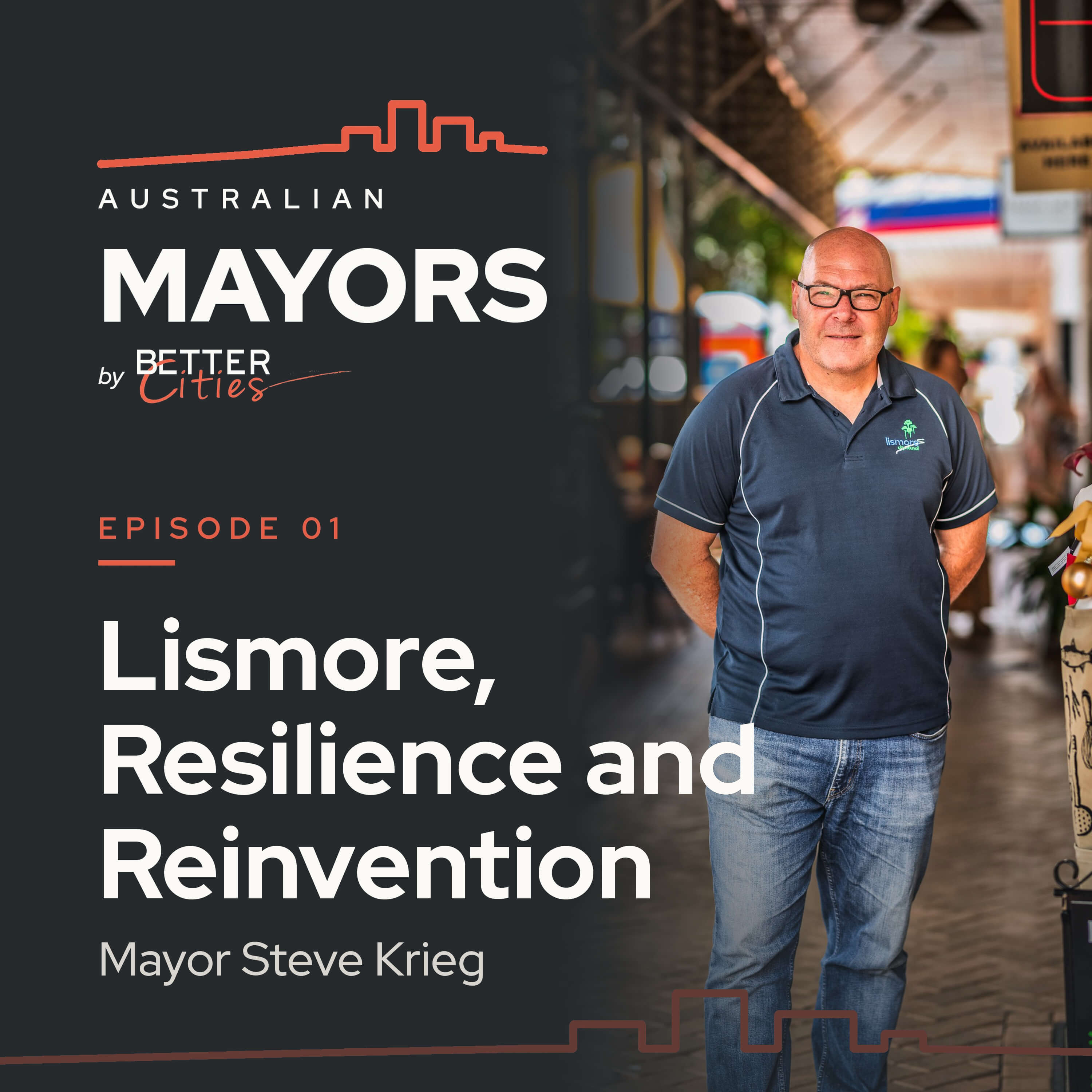
Episode 1: Lismore, Resilience and Reinvention | Mayor Steve Krieg
from AUSTRALIAN MAYORS
28m 11s
Mayor Steve Creek of Lizmore City Council led a remarkable recovery and transformation following the catastrophic 2022 floods, which occurred just 48 days after he took office. Despite immense challenges—including loss of personal property, community trauma, and a lack of prior growth plans—Lizmore has rebounded through collective action, strategic planning, and strong community engagement. The council has prioritized rebuilding infrastructure, revitalizing the CBD, and redefining the city’s future as a dynamic economic and tourist destination. A major goal is to grow the population to 60,000 by 2040, driven by affordability, access to education and healthcare, and proximity to major airports. Key obstacles include funding gaps, inflation, and delays in infrastructure projects such as a flood-resilient sewage plant and pump station. To overcome bureaucratic hurdles, the council advocates for a centralized disaster recovery model, inspired by Queensland’s Reconstruction Authority, emphasizing efficiency and speed. The city is actively pursuing private investment through investor forums and fast-track approvals, with ambitions to expand retail, tourism, and events. Looking ahead, Lizmore aims to become a model for regional resilience, balancing recovery with sustainable growth, and fostering a vibrant, inclusive community where young families and businesses thrive.
Welcome to Australian Mayors, the Better Cities podcast that discusses the opportunities
and challenges facing Australian regions, cities and towns.
I'm your host Dan Barr, I hope you enjoy these conversations with Mayors from around the
country.
Episode 1 features the mayor of Lizmore City Council, Steve Creek.
As most will know, Lizmore and the beautiful Northern Rivers region around it are still
recovering and rebuilding after the devastating floods of 2022, when the Wilson's River
rose to a record 14.4 metres and swept through the heart of the city.
The floods occurred just 48 days after Steve was sworn in as Council Mayor.
Steve had to evacuate his own home and business while leading his city through the worst flood
in its history.
Since then, he has been re-elected, has overseen one of the largest rebuilding programs ever
taken on by an Australian Council, and has set his sights on growing Lizmore to 60,000
people by 2040.
Here's my conversation with Mayor Steve Creek.
Welcome, Steve.
Thanks, Dan.
Thanks for having me on.
Absolutely.
Pleasure.
I will talk a little bit more about what's going on with Lizmore City Council and the difficult
times of the community shortly, but I think you've got a really interesting journey that
you've been on from young boy in W.A. to eventually finding yourself in Lizmore.
So, you're able to share a little bit more about that?
Yeah, grew up in W.A. as you mentioned, born and raised over in the West.
My dad didn't have a dad, he's still alive, I'm a Julia, a school teacher, and so we traveled
around a little bit grew up in a little town called Harvey, which is front, dairy, orchard,
amazing, amazing place, and then over to another town called Maraging, and then the last four
or five years, my schooling in Perth, and my dad tells the story, and I'm showing my age
terribly, Dan, but he got a job at Freeman Tool High School back in 1987, so he used to
watch the America's Cup Coats failing out of Freeman Tool, which was pretty cool.
But as all fathers do, they push their bits to be the best that they can be, and I, after
school, I've seen two years working on on sheep and wheat properties, ensuring things and
driving headers and just having the time of all our life, and dad is an initial trait,
as a diesel mechanic, and then went on to become a school teacher and work in the W.A.
education department, so he was very strong-wielding in myself, getting a further education, and
so I thought, well, if that's what you want me to do, I'll do it, but I'm going to move
to Newcastle to do it, so across the country, what was the job behind that, behind the Newcastle
school? I had a few mates actually doing it as well, and so it was just one of those things
where stars aligned, and for whatever reason, I found myself on the east coast of Australia,
I had a mate that got married in Lisbon, which was the first time I came here, and over
my journey as a school teacher, I ended up getting a job in Casino, which was only twenty
five kilometers from Lisbon, but settled in Lisbon on the northern rivers here, to 2006,
14 years school teacher, I found myself in a predicament where I was sort of thinking,
do I really want to do this for the next 30 years or do I want to change? So the opportunity
came up to, like by F.A. and Lisbon? Yeah, the Fainers, I like it. Ah, local, I'm locally
famous. Well, that, but we put on everything, we got into it very close, nineteen and a half
years in the hospitality industry, met so many good people. Yeah, so that sort of led me
to be where I am today as the mayor. When we bought our cafe Lisbon was a very vibrant,
active city we had, I think it was seven thousand university students living on our Lisbon
campus at Southern Cross University. We had three night clubs operating in the CBD, all
the clubs were open and busy. It was just a really good place to be.
When things happened over the journey in, in regional centres, the direction of the council
wasn't about growth, wasn't about prosperity, wasn't about making things, you know, supportive
for business and got to a point, we had the twenty seventeen flood, which was the first time
that our LED in Lisbon had overtopped. Ah, that caused a lot of stress and anxiety in our
community. That was probably the trigger point for a whole lot of Lisbon business owners
to really start thinking what direction Lisbon's headed. It wasn't until about twenty twenty,
that we really started talking and I talked in a collective manner, that a me being here
wasn't my doing, it was a large group of people behind what eventually waited in December
of 2021 to put me here, but there was a lot of discussion we'd had, business closures,
we'd had nightlife dying at university student numbers were dropping off and we were aware
COVID was just kicking off around that twenty nineteen, they were all famous, we know that,
but we didn't really see any sort of plans in place to grow the city. And so, 1998 was
the last recorded growth year for our city, population wise, so it would be very stagnant
and so group of us just sat down and basically said it's time for us to either put up or
shut up, we love where we live, we love the city, we love the local area, we either do
nothing and watch our family or we get in and have a crack. So December of 2021, it was
an extended council to them because of COVID, so that was a five year turn, so we got
elected December the fourth, I think it was, of twenty two, one for three years.
And then which was great, good news and you thought you're going to have a soft landing,
but then forty seven days later, yeah, devastating floods. Those first forty seven days were
pretty tumultuous as well to be honest. Okay, well you'd be learning, you'd be learning
everything as you go. Yeah, very much so, we wanted to come in and again collectively,
the way we have a preferential volume system, I think it is for our council, so the idea
was that we put together a group of fits big people, even though we've only got eleven
sales. Yeah, and very much around name association, but our goal was to get the majority. Okay,
yeah. And we were told that we were mad, it's never been done in any other council in Australia,
a little at least more, I think the most, any one group has ever got was four, civil
council council, we managed to get the six out of the eleven, and then we came in with
a clear mandate, we wanted to revitalise our CBD, we wanted to fix the roads, all like
our way system was an absolute mess and there was a lot of talk about special rate variation.
We're already dealing with pretty high rates and so we as a collective group of business owners
thought they must get better willing. So in that first 47 days, we had a change of general
manager and there was a lot of us. You've already got high rates, but the service
provision and the basic things, the roads rates, CBD activation were all kind of a level
that you weren't happy with as well, so it makes it a really difficult situation for you
getting out of there. And there's a small business owner. The first thing
is costs are escalating, you've got to look at your wages, that's usually the biggest
expense in business. So for us, our pay-and-date was, let's look at the business more, okay,
what's our wages structure, how many staff we carry, is there any way that we can stream
on our operations, yet still do good services, but as you say, yeah, we didn't really get
a chance to even look at that. December 4th, everyone's going out onto Christmas breaks
and school holidays. So I mean, our first council meeting properly was in early February
and then the flood ahead at the end of February. So yeah, there was really that up.
Yeah, and I don't think, I mean, I've driven into town and people appointed are to like
where it got to, and for me, it's unfathomable. You can't even imagine how that, and I just
think, I'd like you know, obviously the imagery that came out around at home was shared
broadly, but it's kind of like, unless you're relatively local, it's probably gone.
not unnoticed, but it's certainly the severity of what's happened and how long it's taken to
get close to being back on, on if it has kind of not been appreciated.
Yeah, no. And we've got some markers up into our now and we get a number of visitors through.
And yeah, as you say, people really can't comprehend the smell of the devastation until you can actually
see for yourself. Yeah, I look back at different things on a regular basis. I have the opportunity
to just speak at a conference next week, so I'm doing a little PowerPoint around it and that always
brings back the memories of just how bad it was. But again, I relate it back to my life story that
working on farms as a school teacher and as a small business owner, you've got two options. You
can lie down and be able to well, but we can roll these blades up and get in just and do the best
to fix things. Yeah, and that's where we as a community did with the support of the country.
We just jumped in and did our best to clean up and get things back on track as effectively as
we could. And on going now, we're coming up to five years in February since since the flood, we've
still got a long way to go in our recovery journey. But we're also changing the narrative around
what people think of you as well as that. And as well, we're much, much more than our flood town.
We want to be known as a critical economic driver for the state and a great tourist
destination as well. I think we'll be able to be able to come and explore all the wonderful
natural resources that we've got. Beautiful. Well, that's the thing, it's stunning plates.
So we'll just circle back on that. So what are the major challenges? And they may seem obvious,
but over the next 10 years, obviously, very building and you know, you've done a great job.
I'm still trying to understand how you could deliver such a huge capital works program
from where it's more in that, but yeah, what are the major challenges over the next 10 years
for not just Council, but also the community as well? It's just about rebuilding the confidence,
to be honest with you. There is a lot of emotional trauma still in our community from residents
that lived through that event, but it's also changing the way people view this more. From
externally on talking, we have set ourselves in the last little while. We've just released
our local strategic planning statement, which outlines some really aggressive and ambitious
targets as far as our population growth, our economic journey as well. And we're doing everything
that we can as a Council to encourage investment into this more, to encourage developers.
We, our little internal model is that we're the city of yes. We pinch that for a lot of that.
Yeah, very good. Yeah, yeah. So if you have a vision, if you have a drain, if you have something
that you want to see, if you can develop, come to Lisbon or we'll do everything we can to help
you succeed in that expertise. But again, like you touched on our capital works program, that's
another thing that we are selling terribly proud of. It's, at first in the country, we've developed
the factory recovery portfolio. It's all that embedded into our Council, but it's almost a separate
entity in a lot of ways. And that they are a specialist group of engineers and accountants and
all sorts of people that are just dedicated to working through the relentless paperwork of
grant applications and acquittals and all of the sorts of guidelines and rules and responsibilities
that you've got to go through. I'll give you an example there. We've, we've had to go through
13 different funding bodies for over 200 grants. And everyone of those funding bodies have different
rules regulations as regards their their expectations. So, so our team has been able to navigate through
that and have done an outstanding job in delivering the capital works that we we need after the 22th
month. Yep. And I think like we talked about the capital works program, but effectively also what's
going on in Lisbon is a redistribution around where different land uses are obviously, you know,
considering the CBD, considering industrial land being put elsewhere, new urban release areas.
So it's effectively, whilst you're rebuilding, you're also redistributing how the how the entire
town is set out. So that's a challenge in its own right as well. Yeah. So again, I think it's
the first program at least in New South Wales where the state governments, helping us with our
precinct planning we called it. We've got some 750 odd homes that have been brought back by the
state government and biggest bidect program in the country by by a mile. But we don't want to be
left as a council with that burden of 750 vacant blocks that all you do is is mow them once a month.
Yeah. All turn it uses that we have identified. We've already got businesses looking at
at building industrial and commercial streets. And again, so yeah, it's a bit of re-imagining what
Lisbon looks like into the future, what we can offer to investors. But of course, it it revolves
around the impacts of that flood as well and making sure that people's well-hearing safety is
at the forefront of these decisions. So it's a real balancing act. There's no doubt about it.
So we talked about the challenges and the flip side of that is obviously the opportunities
over the next 10 years and you can kind of touch on that around confidence. I think that's really
interesting for people to choose. Well, obviously to have the jobs that they need to support
themselves, but also potentially young families to choose, Lisbon will come and start their
lives as well. So yeah, what do you say is the main opportunities over the next 10 years?
Our greatest asset is our affordability, to be honest with you and people we all talk about the
coastal pressure on housing. Lisbon for my way of thinking is perfectly like A to G,
graphically, as far as we're an hour from the Cool and Gather Airport, which is an international
airport, two hours from Brisbane Airport. But more and more and more importantly, I guess we're
30 minutes from Bowerna with 35 minutes from Bowerna. But where we're positioned, we've got all the
natural duty of rainforests and waterfalls as well. So you get the best of everything here. And as
he said, we're doing our best to attract those young families who can't maybe afford to
spend 1.3, 1.5 million on a house at Lanark tea. We can't afford to live at Lisbon, but we've got
an outstanding health network here. We've got all of the essential services that any family
would need as far as top quality education. The schools, the university, the health network,
the industry. So we've got a lot of things here as well, but we are looking at that bigger investment
base. We would love to get a hotel group to have a look at Lisbon or a reduce or an IHG brand.
We want to grow our retail precincts. So over the next 10 years, we're actively pursuing those
those avenues, the general manager of the council and myself are holding forums where we actually
held an investor forum at McQuarry Street at Parliament House, it's been months ago. Thinking that
we might get four or five interested parties and we actually had a waiting list. We had 50 people
and a wait list. There is interest. Yeah, so no, you're right, because it's just when I think about
Lisbon, effectively, you're remaster planning the entire town. So all the things that have organically
grown over the last hundred and whatever years and have had that flood impact. All of a sudden,
you've got all these grand shoots, industrial sites, open release areas. So I could appreciate what
there'd be strong interest from the investment community. And we're doing everything at a council
level. We've been an example. We've got an investor looking at building a short stay accommodation
near our hospital. And normally you're looking at 12 to 8 months, if you're lucky to get that
D.A. through council, we've got to approve through a council meeting in 67 days. Yes, so yes,
very good. That's good. So I reckon that you'll be probably the main, one of the major experts
in Australia in terms of your understanding of other levels of government and the strong partnerships
that you need with the state and federal government to be able to deliver the local services that
you need. There's very few councils in Australia that can go at a line. And so, yeah, do you want to
talk a little bit about how important the role of your key stakeholders, not just your state and
federal government, but also increasingly probably the private sector as well? Yeah, we rely heavily on
the private sector and that have been very good and very supportive of August 14th Council
direction. But you're right, it's certainly it's one of the legacy pieces from from dealing
with the disaster like we have is it's the links and and and the reliance on state and
the federal government. We're very blessed in a lot of ways, our our state member is also
the the minister for disaster recovery to know Safin. Yeah. So they have have her as our local
member is certainly in a bandage. She can open some doors down and look for your straight
with with the ministers that we need to get in touch with. The feds are a bit more of a challenge
to be honest. They tend to have gone their responsibilities back of the state, which I think
as as time goes on, post the disaster, it tends to be a little bit more difficult to to navigate
through, especially the federal system. As time goes, go away from the disaster. Yeah. Yeah.
So it's it's about for me and for for Liz more it's about looking forward and and where we want
to see our city but it can't change the past then and there's still a lot of infrastructure works
could be carried out. Our sewage treatment plant, which was designed as a flood resilient
asset. No. Still no work started on that and the longer that takes we've actually taken that back
off a state government agency because we believe that council can deliver that restoration work
in a lot more efficient and timely manner. But our biggest problem, some of our bigger infrastructure
rebuilds either just finishing their planning or just starting construction and some the four
and a half of years on, inflationary pressures has seen the ground monthly effectiveness
certainly reduced. So in a classic example of that out, we've got a big pump station here.
We've got the money to rebuild that and make it a far more resilient and a better and more
effective flood mitigation project. But we don't have enough money to make it what it should be.
We're $9 million short. So we can only install two pumps instead of the recommended four pumps.
Okay. It's only due to time, inflation, the cost of goods has all increased over the last
three or four years. So we're currently actively seeking an extra nine million dollars so that we can
we can make this asset as effective as it can be. There's all sorts of stories like that.
But again, like I said at the start, you can either winge and moan and lie down or you can roll your
sleeves up and get in and have a go. So we've had a trip to Canberra, we've been to Sydney and we
we think we've found a pathway forward but nothing invited you. Not yet. So obviously there's
as we've discussed, so there's a number of different councils that are looking to learn from
your experience and lose more experiences in terms of responding to major disasters and then
what happens after that and also even from navigating the grant funding perspective. But are there
things that you've seen from around the country or different councils that you think
could be applied in Lisbon or learning from other areas that you've seen that could be valuable
and that you'd like to incorporate? I think the Queensland model through the Queensland Reconstruction
Authority is something that the nation needs to embrace. I look at what they are able to achieve
in a very short time frame compared to the level of detail and the different funding agencies that
we have to deal with. I think being able to centralise all your funding sourcing to one body
like Queensland do by all of their grant applications or disaster funding goes through the QRA
and they do use it. Like I said, we have had to navigate 13 different funding agencies
or with different methodologies which makes it almost impossible to be able to do.
I would love to see that. I know Neema, our National Emergency Management Authority is working on
more of a national approach to that but states, again this is where the politics come into it states
think it could be the greatest things ever in their way, the right way and it's
but it's about getting everyone to agree on best practice and the argument we've used, Dan is
disasters don't stop at borders. So we're only a hundred kilometres from the Queensland
border and we've been how effective their Queensland Reconstruction Authority have rebuilt
many disasters. Our reconstruction authority is probably still considered a very infant
bureaucracy at the moment but we are certainly pushing to follow in the footsteps of Queensland
England and come up with a system very similar to Queensland that you're only dealing with that
one. That's interesting. Our final question is if we come back in 10 years, what do you
want to see? There's more, both in terms of the Council I think but also the region and the
community, what would you like to see? Oh, I think again we're already starting that bounce back.
I would love to see another 10 or 12,000 people that call this more home for a start,
which again will flow onto our retail sector and invite new retailers and new industry to the
area. Our biggest goal is to grow our population at the moment like I said we've had stagnant
growth since 1998. So catching up to the other regional cities around the nation and around
the South Wales is our number one priority. So in 10 years time I'd love a very clean and healthy
five-hundred CBD with a really strong retail sector but also those young families driving our
driving our city forward with their bright and fresh ideas and also we want to be known for our
events capabilities as well with amazing sporting on-quakes. We've got a fantastic art and cultural
space as well. We've kicked off in in 2026 with some amazing events. We've been nominated for
Tourism Awards. We've been nominated for an area to leave it through. So we want to build on that
success and maybe lose more of the city of events as well. It'll be able to reason to live here and
want to stay here instead of driving that area in a half hour up the goal course. So yeah that's
our 10-year plan. Yeah well it's a beautiful place and to be honest I think when I look at it through
the lens of you know helping other cities out it's very impressive what you've been able to achieve
over the last five or four to five or four years really so congratulations to yourself and
and the council and the community. Probably wrap it up there but it's been an absolute pleasure
Steve. I really appreciate it and keep up the really good work and lose more. Thanks Dan.
We hope you enjoyed this episode of Australian Mass. Any references made are available in the
show notes. Remember to subscribe and leave a lot for future episodes.
Podcast Summary
Key Points:
Mayor Steve Creek led Lizmore City Council through devastating 2022 floods that occurred just 48 days after he took office, requiring immediate emergency response and recovery efforts.
Despite the disaster, Lizmore has maintained community resilience, re-elected its mayor, and launched a major rebuilding and revitalization program, including infrastructure upgrades and strategic land-use planning.
The council has set an ambitious target to grow the population to 60,000 by 2040, reversing decades of stagnant growth and positioning the city as an economic and tourist hub.
A key challenge is securing sufficient funding for critical infrastructure projects, such as a flood-resilient sewage treatment plant and a multi-pump flood mitigation system, currently $9 million short due to inflation and delays.
Lizmore has established a “city of yes” approach to development, actively encouraging private investment in retail, hospitality, and residential sectors through targeted forums and fast-track approvals.
The council draws on Queensland’s Reconstruction Authority model as a blueprint for streamlining disaster recovery funding, advocating for a national framework to reduce bureaucratic complexity.
Strong partnerships with state and federal governments, especially through the state minister for disaster recovery, have enabled critical support, though federal engagement remains challenging.
The long-term vision includes a vibrant, sustainable CBD with strong community engagement, tourism development, and a reputation as a safe, affordable, and forward-thinking regional destination.
Summary:
Mayor Steve Creek of Lizmore City Council led a remarkable recovery and transformation following the catastrophic 2022 floods, which occurred just 48 days after he took office. Despite immense challenges—including loss of personal property, community trauma, and a lack of prior growth plans—Lizmore has rebounded through collective action, strategic planning, and strong community engagement. The council has prioritized rebuilding infrastructure, revitalizing the CBD, and redefining the city’s future as a dynamic economic and tourist destination.
A major goal is to grow the population to 60,000 by 2040, driven by affordability, access to education and healthcare, and proximity to major airports. Key obstacles include funding gaps, inflation, and delays in infrastructure projects such as a flood-resilient sewage plant and pump station. To overcome bureaucratic hurdles, the council advocates for a centralized disaster recovery model, inspired by Queensland’s Reconstruction Authority, emphasizing efficiency and speed.
The city is actively pursuing private investment through investor forums and fast-track approvals, with ambitions to expand retail, tourism, and events. Looking ahead, Lizmore aims to become a model for regional resilience, balancing recovery with sustainable growth, and fostering a vibrant, inclusive community where young families and businesses thrive.
FAQs
The 2022 floods were devastating, with the Wilson's River rising to a record 14.4 meters, causing widespread damage. Mayor Steve Creek had to evacuate his home and business, and the floods triggered a major recovery effort, including rebuilding infrastructure and shifting the city's long-term vision.
The council launched a comprehensive recovery program, including a large capital works initiative, a dedicated recovery team, and a focus on revitalizing the CBD and improving flood resilience. They also restructured land use and planning to support future growth.
Lizmore aims to grow its population to 60,000 by 2040. This is being achieved through strategic urban planning, attracting investment, promoting affordability, and creating a strong economic and lifestyle environment for families and young professionals.
Key challenges include ongoing emotional trauma in the community, inflation-driven cost increases, delays in infrastructure projects like the sewage treatment plant, and the need to secure additional funding—such as $9 million for a flood-resilient pump station.
The council actively hosts investor forums, promotes the city's affordability and natural attractions, and offers a 'city of yes' approach to development. They are seeking partnerships with hotel chains, retail developers, and industrial investors to grow the economy.
The state government provides significant support, including 750 homes through a major reconstruction program. However, federal funding remains challenging due to bureaucratic complexity and shifting responsibilities, prompting a push for centralized disaster funding models.
Chat with AI
Loading...
Pro features
Go deeper with this episode
Unlock creator-grade tools that turn any transcript into show notes and subtitle files.
 PodcastTranscript AI