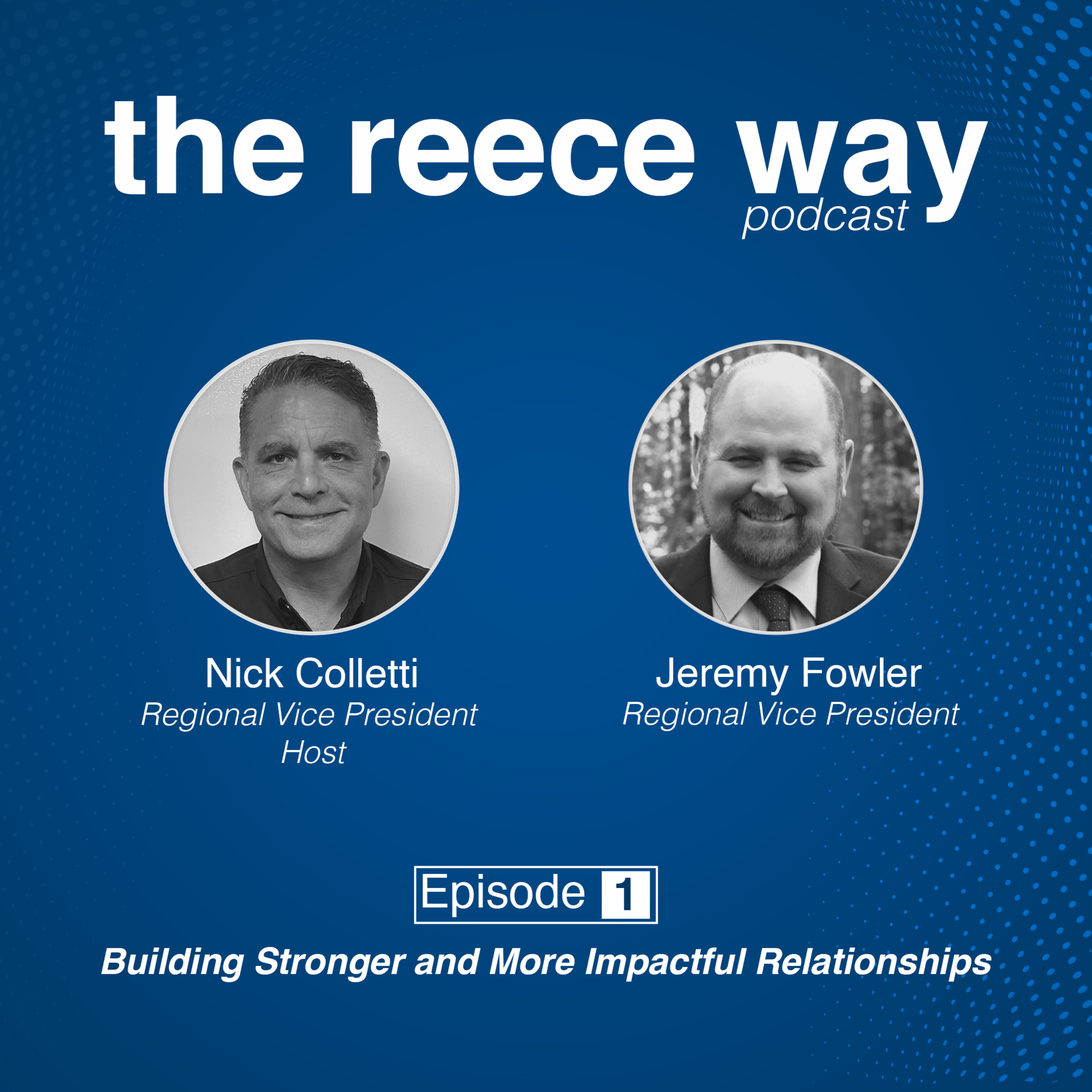
Episode 1: Building Stronger and More Impactful Relationships
from The reece way
16m 26s
The podcast highlights how a simple, customer-first question—“What are the three most important things you look for in a vendor?”—serves as a powerful foundation for sales conversations. This question builds trust, reveals true customer pain points, and guides the entire sales strategy by identifying core priorities like inventory, pricing, and service. Through follow-up understanding questions, sales teams uncover nuanced meanings behind responses, enabling deeper insights and personalized solutions. These conversations are structured with a clear agenda, ensuring alignment and preparation. Critical to the process is the use of Salesforce as a real-time, accountable tool that captures call details, tracks progress, and enables seamless cross-team follow-up. The episode emphasizes that the most effective sales calls are not just about closing deals, but about deepening customer relationships through transparency, listening, and actionable results. Ultimately, the approach combines empathy-driven questioning with operational execution, proving that sustainable growth stems from understanding customers’ true needs and delivering measurable value—both during and after the call.
(upbeat music)
- You're listening to the Reese Way podcast,
the show that brings you real stories and tips
on creating customers for life.
I'm your host Nick Caletti,
and today we're talking about asking understanding questions,
the three most important things
that our customers value and vendor.
I'm joined by Jeremy Fowler,
the RVP for our Atlanta operations.
(upbeat music)
So Jeremy, I was fortunate enough
to come by and see your doorbell branch last week,
and I was really impressed with the operation.
So tell me how things are going,
and more importantly,
what are some of the key initiatives
that you and your team are working on?
- Yeah, great question.
Obviously last quarter of the big initiative was inventory,
and one product, one location,
and then having a clean, close to the end of physical year.
With the start of the new month and the new year,
our focus is renewed, right?
So we continue to focus on AMAA efforts.
Obviously we know it's an integral part of our business
and the health of our business,
and the only way we're gonna grow in the marketplace.
Also working on Salesforce integration, right?
We've got the new Salesforce rolling out
and working on integrating that into our daily activities
and really focusing on that customer-centric look.
It's funny that this is happening now as well,
but a big thing too is,
is we're actually focusing on our microsections
with selling the Reese Way
and really building the capabilities
amongst not only our outside sales team,
but our branch manager team as well.
And what are the three most important things
is a huge topic of those discussions?
- So tell me a little bit more of that.
I guess certainly now that we're able to get back out
in the market again, kind of post-COVID,
you're certainly getting into your routine again
from Tuesday to Thursday of being out with your sales folks.
Explain to me a little bit about maybe some of the things
that you guys are seeing out in the market with your customers
and how are you utilizing some of these techniques
and maybe talk about some of the results
that you guys are having as a result of using these techniques.
- Well, I think this question,
what are the three most important things to you in the vendor
is one of the best understanding questions
that we can start a call with.
I challenge our team with starting each call.
I mean, each call, once we've built rapport with the customer
and we've gotten into that,
understanding the customer phase
to really focus on this question
because really it leads the conversation from there, right?
It's just a question that really lowers the defenses
of the customer and allows you to really build upon
what's important in their business.
It gives you opportunities to find pain
and really drill down on that.
And also it gives the customer the opportunity
to really be truthful, right?
As we know with understanding questions
and the customer's more likely to be truthful
than a typical selling question
where the customer could tell us not the truth, right?
They could lie to us and such
because they build those defenses.
But as we all know with any sales call,
it's all important to have that agenda.
And I think when we lead with this question
and we know we're gonna ask this question,
listen Nick, as well as anybody
that there's only three or four of these answers
that are gonna be told, right?
It's gonna be inventory, it's going to be price
and it's going to be service in some form or fashion, right?
So when we ask this question,
it really allows us to build the whole sales call out.
It allows a customer to think that they're leading
the conversation and that we're concerned
with their needs, which we are, right?
But it also allows us to plan accordingly
in order to make sure that the call is seamless
and we can get the most out of it as well as the customer.
>> Yeah, I think it's a great point
and let's dig into that a little bit.
As you talked about some of the three things
that the customer's value is important.
Certainly the world we're in with commodities right now
are challenging.
I think our customers are certainly looking
to trust somebody out there right now
and certainly part of our values
are building that trust with a customer.
Can you give me some examples of some times
where you've shared some data, some information,
some category management intel that we worked really
hard to gather and stay connected with our vendors
that really built that trust with your customer base
and how did that impact the rest of the call
and maybe even the relationship?
>> Yeah, now you bring up the supply chain update.
I mean, that's a great tool
that the category management team puts together
and really we use that on almost all sales calls.
It helps us to lead the conversations as well.
Because again, when we're talking about that understanding
question of what are the three most important things
that you look for in a vendor,
we know that inventory is gonna be one.
We know the supply chain has its struggles right now.
So it helps us really lead that conversation
and that's obviously a pain point for not only us
but for the customer as well.
But the supply chain update, it allows us to also
to start a differentiated as a company, right?
So once we hand that, the conversation usually leads to,
hey, we're working on this from a corporate level
and a category management level
that we've built this whole team
that really they're focused on building those relationships
with our key vendors as well as we're double down
in the local market to really also have
those same conversations to make sure that we are doing
everything in our power to get our peos
for our ties and get material here as fast
as we possibly can, right?
So it's a good way for us to introduce a GPRSV
and really differentiate ourselves
from our competitors in the marketplace.
- Yeah, you had a really good point
because I know a lot of our customers today
do have pain points, right?
They have things that our competitors are typically
maybe not being able to give them data.
So talk to me a little bit about more, you know,
the information that you use to drill down
and kind of peel back the onion a little bit
on the pain that they're feeling
and how do we utilize that from an RVP standpoint
all the way through to the inside sales
and how do we capture that?
- So obviously we know pain is an extreme emotion, right?
And it's one which can control a lot of our decisions
and as far as decision making is going.
But when you focus on pain, it's really again,
once that customer gives you that trigger word for pain,
it's one in which we just double down
on the understanding questions, right?
We continue to ask more understanding questions.
It can be as simple as what's that impact on your business,
right?
And what it does, it just allows it to faster in them
and really start to think how that has impacted
their business, making matters worse.
So it gives us a great opportunity to again
insert what we're doing differently,
how we differentiate ourselves as a company
and as a team in order to help offset
that pain for them, right?
That's when we start to really add value
is when we can eliminate that pain from their business.
- Yeah, I think you make it great point
and obviously you hit on trigger words.
Obviously as we're differentiating ourselves
and we're showing ourselves in a different light,
a lot of that goes, separates from selling questions
to understanding questions.
So hit on that a little bit and how you guys utilize that
to benefit the call, but also to enhance
the relationship of the customer.
- Yeah, I think to bring it back
to one of the three most important things
you look for in a vendor, that's what makes it so powerful.
I think I alluded to it earlier, right?
Where it allows you to really sit down
when you're working on your agenda for the call
and knowing where the customer's at.
It really allows you to play the call out on your head, right?
To really start to think about, hey, if he says inventory,
which I know he's gonna say,
this is what my GPR SV statement's gonna be, right?
And I'm gonna look for those trigger words
to really insert the value we have to add.
So it really allows you, because you know the playbook,
it allows you to really focus on that call upcoming
and really focus on the details
of where we can start to differentiate as a business,
whether it be a rapid delivery service
or it be a novo, something that a novo allows us to do
from a stockroom standpoint.
So what it really does is just gives you an opportunity
to really plan for the call unlike most cases
where we just go in there and fly by the seat of our pants
and drop some biscuits off and thumbs up head down the road,
right?
Anything I can do for you today.
It really adds value to the customer.
It shows them that you were prepared
and ready for the call.
But yeah, same thing with trigger words, right?
Like like, or a certain material, anything like that.
And it's just another opportunity
to ask an understanding question,
which I think it's important once you hear that trigger word
to ask to double down on the understanding questions.
Ask another one, because what you're assuming they're saying
may not be actually what they mean.
You know, just the other day,
I went on a call with one of our outside sales guys
and to Robert's plumbing and we sat down with the owner
as well as the purchasing manager.
So it was one where it was interesting.
So I asked that question to both of them, you know,
also let me step back because I think it's important
to understand too that you can't ask this question
until we've built rapport with the customer, right?
We've got to make that first step first.
So those understanding questions don't come into play
until the report is built.
Otherwise, it'll feel blocky.
And that understanding question could be misconstrued
as a selling question.
But after we've gone through the building report,
introductions and really just talking about the business
and the state of the union and where it's at,
you know, it allowed us to ask that question to both of them.
What are the three main things you look for in a supplier?
And it was funny that, you know, to each one of them,
their answers were different,
especially in the ranking, right?
What was number one for them?
But even so, most of their answers were the same
in a sense, just worded differently, right?
And it was ranked differently.
But then what I found out as I asked
more understanding questions, I almost broke it apart
because they both said pricing.
Now pricing was down on the list for both of them.
which was a good thing, right?
But it also meant different things to them, right?
And that was where the understanding questions
continued to go, right?
You got to make sure you fully understand
what the customer's saying when they say pricing
or when they say inventory.
What does inventory mean to you?
Explain to me a little bit more what that looks like.
Because what I found out is to the owner,
the definition of inventory or the three main important things,
it was a total different definition
and what he meant from the purchasing managers needs
on the inventory side, right?
So, but once you fully understand
and you get the information by asking those understanding
questions to get to the heart of what they mean,
that's when we can introduce a selling question
in a sense of adding value or a service that we may offer,
right, would this be a benefit to you?
That type of deal.
So really, that's where you focus on those trigger words, right?
I think that give you the trigger words
when you ask the question properly,
that you can continue to just build upon that
with understanding questions.
- So I think you hit it right on the head
and obviously you line it out really well
to start the call with an agenda, right?
You walk in with an agenda,
you start working on the relationship with the customer
and then you start jumping into
some of those understanding questions.
As you get through all that process
and you're at the end of the call
and you really established all the things
that you want to establish.
You mentioned Salesforce.
Talk to me a little bit about how you capture
all that information so that it's not only good for you,
but it's good for the rest of the team as well.
- Ah, it's perfect.
So really it's that ultimate accountability piece, right?
But also, again, you mentioned the agenda
and for this particular story with Robert's plumbing,
it was one where we did everything properly.
We met 30 minutes before because obviously in my role,
I don't see these guys on a weekly basis
or bi-weekly basis, so it's one in which
I want to make sure that, you know,
I know any potential roadblocks that may come up
or what their concerns are or what our opportunities are,
what we need to really focus on, right?
So that was the preface to it.
And then during the call, obviously it's taking a ton of notes.
It's not as simple as just asking the question
and letting them speak, right?
It's really writing this stuff down
because what I've also found is that
you may ask that question.
It might be a 20-minute spiel on those three things.
And then once you ask another understanding question,
it may be another 20-minute spiel
from the customer on what that means to them, right?
So you gotta make sure that you've got those points
that you come back with.
And then at the end of that, you know, it's Salesforce, right?
So Salesforce is the ultimate accountability tool.
Nick, you know as well as anybody, the sales call,
listen, that's my favorite part.
I love being in front of the customer.
I love seeing the customer and talking through
and finding ways to ultimately impact their business.
But you know as well as I do,
that that's just the start of the journey, right?
'Cause if you've done a sales call properly,
you've got all the work is still ahead of you, right?
You've gotta leave there and figure out,
all right, how are we gonna make this happen, right?
How are we gonna get this to come to fruition now?
So that's where Salesforce comes into play, right?
It's a great tool that's very easy,
especially from a mobile app standpoint,
from, you know, talk to speech or talk to text,
where, you know, it's loaded in the account.
It's one where at that point, if we do it properly
and we've done it properly,
that then inside Salesforce knows how that call went.
The branch manager knows how well that call went.
The sales manager, the RVP, all the way up to the presidents,
right, and even Sasha for that matter knows
how well that call would be and knows
what our follow-up should be.
So it's that again, it's that ultimate accountability tool
that at the end of the day will make us a better sales
organization, as well as a better customer centric,
because ultimately, that's what it is, right?
It's taking care of the customers.
We've taken the time to spend an hour and a half,
asking these understanding questions
and finding out what the true need for the customer is.
You know, again, that's important,
but, you know, our works after the call, right?
Our work is getting it done.
And that's the tool Salesforce is gonna be
in order to make sure that we hold up our end of the bargain
and continue that building relationship with the customer.
- Yeah, I think you make a great point when you said,
you know, sometimes, you know, we're a little bit separated
from an RVP standpoint, but, you know,
if you really look at it, we're separated
from an inside-sale standpoint.
We're separated from, you know, a president's standpoint.
So I think as you capture that information,
you can really, you know, communicate within the team.
And obviously, it's built around, you know,
the branch owning that customer
as much as the outside salesperson.
So, man, I think you did a great job
getting through a lot of this stuff.
Obviously, your results are indicative of the work
that you guys are putting in.
Certainly, understanding that the customer
is a massive part of what we do,
but I think you made a great point from that standpoint of,
hey, that's just the fun part, right?
The work comes afterwards.
So, and double down on the Salesforce,
I'm sorry to interrupt you, but, you know,
it's funny, you know, I'm guilty of this.
And I've got 10 notebooks sitting around, right?
To where, you know, I was just thinking about that,
you know, and as soon as something comes up,
it's like, I've always got the wrong notebook.
Where did I write that note, right?
Or I wrote it in a short hand.
I'm like, yeah, I think that was for the call, right?
That's where Salesforce is going to make us better
because it's right to the point.
It's right then and there.
You don't have to worry about finding it down the road.
It's available to you and everybody else
that comes into contact with that customer.
So, I'm excited about what it brings to the table.
And as we continue to move forward,
whether it's going to put us at a different level.
- Yeah, well, I think it's a great point.
And certainly it rounds out, you know,
a great sales call, right?
Start with the agenda, finish up with Salesforce.
At the end of the day, you've captured some great information.
And then you can build on asking understanding questions
and really hopefully take that customer
to the next phase and selling the resources.
So, really, really good information about it.
And obviously it's, you know,
there's a reason why you guys are doing so well
in the Atlanta market and keep rocking on.
- Yes, sir, I appreciate your time, bud.
(upbeat music)
- Thanks for joining us this week on the Reese Way podcast.
Be sure to tune in every Wednesday for new content
as we continue creating customers for life.
(upbeat music)
Podcast Summary
Key Points:
Starting sales calls with the question "What are the three most important things you look for in a vendor?" builds trust and lowers customer defenses, leading to more honest and valuable conversations.
This foundational question identifies key customer priorities—typically inventory, price, and service—allowing the sales team to tailor their approach and plan a focused, outcome-driven call.
By asking follow-up understanding questions, sales professionals uncover deeper meanings behind customer responses, such as how "inventory" differs in meaning between owners and purchasing managers.
Trigger words from customer responses enable targeted, value-driven insights and allow teams to introduce specific services or solutions that address real pain points.
The Salesforce integration ensures real-time documentation and accountability, linking call outcomes to actionable follow-ups across all levels of the organization—from branch managers to leadership.
Pre-call planning and post-call follow-up create a structured, customer-centric process that moves beyond surface-level selling to long-term relationship building.
Shared supply chain data and category management intelligence serve as differentiators, demonstrating proactive vendor partnerships and building trust in uncertain market conditions.
The success of the sales process hinges not just on the call itself, but on the post-call work to translate insights into action, making Salesforce an essential tool for accountability and execution.
Summary:
”—serves as a powerful foundation for sales conversations. This question builds trust, reveals true customer pain points, and guides the entire sales strategy by identifying core priorities like inventory, pricing, and service. Through follow-up understanding questions, sales teams uncover nuanced meanings behind responses, enabling deeper insights and personalized solutions.
These conversations are structured with a clear agenda, ensuring alignment and preparation. Critical to the process is the use of Salesforce as a real-time, accountable tool that captures call details, tracks progress, and enables seamless cross-team follow-up. The episode emphasizes that the most effective sales calls are not just about closing deals, but about deepening customer relationships through transparency, listening, and actionable results.
Ultimately, the approach combines empathy-driven questioning with operational execution, proving that sustainable growth stems from understanding customers’ true needs and delivering measurable value—both during and after the call.
FAQs
Customers typically value inventory, pricing, and service. Asking this question at the start of a sales call helps build rapport, reveals pain points, and guides the entire conversation toward customer-centric solutions.
Understanding questions lower customer defenses and encourage honesty. Unlike selling questions, they make customers feel heard and valued, leading to more truthful responses and deeper engagement.
Trigger words like 'inventory' or 'pricing' signal pain points. When identified, they allow sales teams to follow up with deeper understanding questions, uncovering the true meaning behind customer statements.
Sharing supply chain updates demonstrates proactive effort and transparency. This builds trust by showing the vendor is aware of market challenges and is actively working to resolve them for customers.
Salesforce captures real-time notes and insights from calls, ensuring accountability across teams. It enables follow-up actions, tracks call outcomes, and keeps all stakeholders informed for consistent customer service.
Rapport-building establishes trust and comfort. Without it, asking questions like 'what are your top three priorities?' may feel like a sales pitch and could be misinterpreted or rejected by the customer.
Chat with AI
Loading...
Pro features
Go deeper with this episode
Unlock creator-grade tools that turn any transcript into show notes and subtitle files.
 PodcastTranscript AI