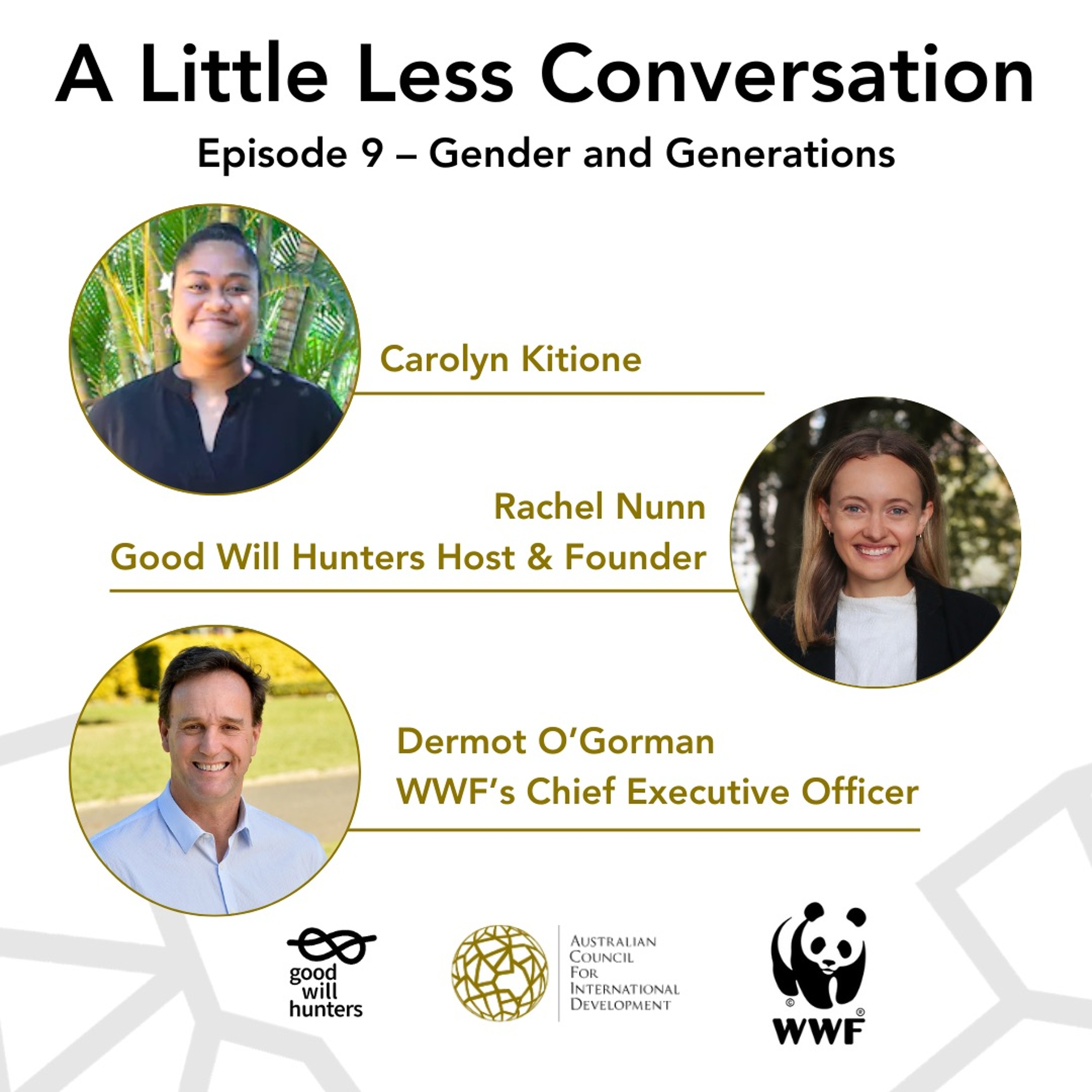
Episode 09 A Little Less Conversation, with Carolyn Kitione
from Good Will Hunters
38m 59s
This podcast episode explores how Australia's international development program addresses climate change, highlighting its critical role in vulnerable regions. Hosts Jess McKenzie and Rachel Mason-Nun, alongside guest Carolyn Kitione from Fiji's Shifting the Power Coalition, discuss climate change as an urgent issue that intensifies existing inequalities, particularly for women and youth. The conversation emphasizes the importance of intergenerational cooperation, where elders serve as stewards of traditional knowledge and young people bridge this wisdom with modern climate advocacy. Practical examples, such as responses to Tropical Cyclones Winston and Harold, illustrate how leveraging local communication networks and traditional indicators (like animal behavior or plant changes) can improve disaster preparedness. The dialogue stresses the need for inclusive, intersectional approaches that involve diverse community voices, including women, persons with disabilities, and LGBTQ+ individuals, in policy-making. Ultimately, the episode advocates for localized, community-driven strategies that strengthen existing infrastructures rather than imposing external solutions, ensuring climate actions are equitable and effective.
(upbeat music) - Hello and welcome to a little less conversation. A podcast series on how Australia is addressing climate change as a function of our international development programme. I'm Jess McKenzie, Chief of Policy and Abicacy at the Australian Council for International Development. - And I'm Rachel Mason-Nun, founder of Goodwill Hunters and a director with Mandela Partners. This series is a collaboration between Goodwill Hunters, WWF and Oxford. - Climate change is the stormy, undercurrent to our daily lives here in Australia, but in many of the countries we work in as development practitioners, it's allowed an urgent drumbeat. To do development effectively, it's increasingly glaringly obvious that addressing climate change needs to be front and center. - And to that end, we're holding the microphone out to those willing to take on the sometimes vexed challenge of speaking to Australia's climate change and development goals, where they intersect and where they deviate, as well as profiling innovative themes and ideas. - One of the things we've learned is that the impacts of climate change affect people very differently by exacerbating existing inequalities. There is certainly the case for women who might find their daily work loads increased, more caring duties at home, having to travel further for drinking water, for example. - And young people are also adversely affected. They might find they have to travel longer distances to be educated, or can't access education at home at all, and also find fewer job opportunities. - We have a wonderful guest with us today from Fiji. Her name is Carolyn Kitioni, and she is a youth leader and learning coordinator with the Shifting the Power Coalition. Welcome, Carolyn. Can you tell us a bit about yourself, please? - Thanks Jessica, as the learning coordinator for the Shifting the Power Coalition, primarily responsible for the communications learning and impact of our work, the Shifting the Power Coalition is made up of 12 partners across seven Pacific Island forum countries, including Australia. We have partners in Fiji, Boganville, Papua New Guinea, Tonga, Salman Islands, and Farnato. - Okay, Carolyn, I have to ask you, what is the role of elders when it comes to climate change? - I think in many Pacific Island countries, we always see the elders in our communities as the stewards of the environment, of the oceans that they live in, and that hasn't diverged much from what we do as a feminist humanitarian actors. There's always the acknowledgement that the work that we are doing now as climate activists is building on the work that have come from feminist leaders, from women and their parents, from, so it's looking back at the genuine understanding what they have done then and seeing how we build on Maui. So when we look at our Pacific elders, we see them as holders of information, traditional knowledge. We acknowledge and respect the knowledge that they have taking us to the point where we now step in as an Internet stewardship role. So it's acknowledging that they play such an important role in the stewardship of our environment, of our oceans. And it's acknowledging that they have done the work to bring us to where we are now. And our role as future elders is to be able to collate all that work into something that we can pass on to the next generation. So we only see ourselves both in terms of elders before us and elders to come that we are all stewards when it comes to climate adjusting, environmental consensus. Because there's so much information that's there in our traditional setting that we have to acknowledge the holders of that information as well. And so while we think that, well, there's always been conversations that their time has gone, it hasn't. We carry them forward with us. And so we always acknowledge that stewardship role that our elders have played in our communities in our Pacific Island countries as well. So I see their role as stewards of our traditional, informational traditional knowledge. I think that stewardship role is so important and it's something that I think the many Pacific Island countries uniquely recognize in a very autumn and profound way. I think building upon that answer, how do you think young people and elders can work together? Because there is an acknowledgement that the knowledge must pass on and that the work must continue. As a coalition, we're always building on an intergenerational approach to the way that we work as well. Because as young women, we're recognizing that a crisis, the climate crisis that we're experiencing is not of our own making, but one that we have to adapt and live with. And there are many structures that don't allow for that for young women to lead, that don't recognize young women's leadership and the current crisis that we're living. And so as a coalition, we understand and we recognize that as we carry on with this work, we are leaning into the legacy of the Pacific women leaders, to guide us and to help us understand where we've come from. It's about the creating a space where all the women and young women can come together and speak to each other because we are reacting to the current crisis differently. And if we can come to a common point where we can address our priorities moving forward, that's the first step to addressing some of the many questions and some of the many situations we find ourselves in within the climate justice movement. It's about learning and defining what intergenerational leadership should look like in this space. And who are we being intentional with when we talk about sharing the space? Who needs to come in? Who needs to be able to take a step back for somebody else to come in? And that's a conversation we're always wrestling with even within the coalition because we have an opportunity as young women to take traditional knowledge that although women have into the climate services spaces, into the more technical spaces that are more readily acceptable for a lot of movement actors at this stage. So it's about being that bridge between our traditional knowledge of the climate services that we're in. And we're constantly having to facilitate the discussion. It may seem a process may seem a bit slow as we work within as we recognize the urgency of responding to the climate crisis. But there is also recognition that when we talk about climate justice, you have to put people at the forefront of the movement of addressing the crisis. So it's about being patient, being persistent about what intergenerational leadership should look like and what the species should be as well. I think your point around the intergenerational transfer of knowledge is an essential one. And I'd love to hear a bit more about that. And specifically, what kind of conversations are you having around how practically intergenerational knowledge is passed down from elders to young people? How do you facilitate that through dialogue, through things together in the community? How practically is that working? Going to go off track here by saying that someone's going to hear this and say, does it really work though? But just to say that within the coalition, it's taken us some time to be able to get some of the more experienced older women in their homes to actually sit and listen to some of the young women. Because people see young people as being too much. People see as being over enthusiastically about our way of work. And both groups from experience see each other as being inflexible about how we advocate for our priorities. But the truth is we've worked in sitting on so many separate ends of the same conversation that we're not seeing that there are actually some priorities that both groups should be able to agree on if you can bring everybody to the same space. So as a coalition, we've developed, and everyone's aware we've had to adapt this to the situation. But we've developed an on-the-math process where we bring in older women and younger women to have a very frank conversation about what some of these priorities are and what some of our next steps are. Because it isn't just about bringing everyone to unload the issues. But it's also about coming up with a real way of recognizing some of the solutions that diverse people have as well. And as we're sitting around that, as we're sitting on our mat having this discussion, then you can hear similar priorities coming up. We want more representation in decision-making spaces. We want the protection of our natural resources. We want women in rural and remote communities to be more present in the advocacy for climate justice. So when we can address some of the priorities that we have in common, that's an entryway into addressing our differences as well. It's a little bit of push and pull and sometimes we have to take a huge step back to give ourselves space and time to process what's happening. But to be honest,
But we also recognize that we're all doing the work for the same thing. We were all working towards the same thing. One of the conversations we've been also having that hasn't been very explicit unless you're in the climate justice or feminist movement is what intersectional ways of work look like. So when we talk about being inclusive, our persons with disability, women with disability in the room with us, are they helping to design the approach that makes sense to them? Does our action reflect their priority as well? When we talk about intersectional approaches, do we see the presence of the LGBT community reflected in the outcomes of our environment process? So it's always having these conversations and understanding that each group of people they have, they're coming with their own experiences, their own solutions. So it's also a way of finding out how we can collate all these experiences into evidence that shapes policy, policy making. So it's a lot of, again, give and take with the different, with the diverse groups represent in the table. But it's also being very clear about what our intentions are as feminist actors in the human-daren space. Carolyn, I love hearing about that intersectionality and the protection of spaces and women being more present in advocacy. That's a great example of how this communication happens. I love taking things into the really practical realm. When we're talking about knowledge being handed down, can you give us an example that you have of where knowledge has been passed on? I'd love to think of a tangible example. So I can't, I can give a broad example to that, but it's not actually my knowledge to share based on what the partners have said. But in Fiji, after T.C. Winston, after Tropical Cyclone Winston hit in 2016, there was a lot of conversations between our Fiji based partners about the kind of knowledge that they already had that would have helped repair the communities better. And so in doing the documentation and the follow-up years after T.C. Winston, the women were telling us that, "Oh, actually, if we had the proper documentation for our knowledge, we could have seen that the science for a big storm was already coming." So they were looking at the bread fruit trees in their community. They were looking at the movement of the animals in their community. And so some of the feedback, some of the feedback that we were getting back from our partners in the community was that, had more people known about the science, they could have definitely prepared better for the disasters afterwards. And they've actually been doing a great job of documenting that. We've had similar stories from our partners in Vanuatu. So in 2015, when Tropical Cyclone had been hit Vanuatu, a lot of the women in the network of our Vanuatu partners were actually not part of the communications or information looper. So they were not getting the updates from their met services, from their climate services as well about what was happening. So what ActionEed Vanuatu did as a partner of the coalition, they were reaching out to their local networks and trying to identify the best way to put the information out there. So they were using local network, local resources. And they were trying to identify what the traditional means of communications was within the village system. And so they would be physically, anytime anyone would have information on changing whether better or changing climate, they would be physically running the information to each village. So they were using what was within. I think that's the work that the coalition has been trying to amplify. We've been trying to look at not creating new projects, new structures, but it's about supporting the infrastructure that already exists within the local networks. It's about localizing what all the biggest stakeholders are trying to say. And so you hear this whole steal from some different stakeholders about, oh, we need to amplify traditional systems. But they're not acknowledging the traditional communications and information networks that are already there in the community. And so what the shipping power does is defer to the partners who are on the ground, who are best placed to understand how communities work. They want to disseminate that knowledge as well. So it's not about creating a whole new structure. It's about supporting and strengthening what already exists. And how do we document that better in a way that doesn't cross the line with these communities, but also respects the tradition that's already in place. So some of the information that's been very specifically shared to us, we can't actually speak to it because again, it's not my knowledge to share. No, it's so fascinating to hear about that and to hear the TC Harold example. And I think what comes to mind for me when you say that is how, at the same time as there is this work taking place, including through the shifting the power coalition, there's a lot of work happening in the humanitarian sector about better localising humanitarian responses. And it's interesting that you mentioned tropical cyclone Harold as an example of where better leveraging traditional knowledge could have elicited better outcomes, both in terms of the warning systems and also the management of the impacts of TC Harold. Can you say more in regards to the humanitarian space and sort of how your work is working adjacently to things happening in the humanitarian sector? So one of the lessons, one of the biggest lessons we've learned from over the years as the shifting the power coalition, you said, sometimes it's about the way the information from the matching climate services has been delivered to the general public. And so taking the queue from some of our local partners, for example, Trans-Saint-Nashine and Fiji, Talitha project in Tonga, Action 8.102, in 102. Following their experiences from multiple cyclones, they've actually established connections with their met services and the climate departments. There's an example that Flora gives every time she makes an intervention. When in the beginning, when establishing a connection with their met and climate services, they've always said, "Just bring one person." But Flora knows that sometimes the voice of one woman is not enough to convince the policy changes that need to happen within that department. So she's always brought a huge group of women to be able to lobby the climate services to change how they approach their communications. And so in understanding how each partner has built that connection with their met and climate services, some of the other partners have also stepped forward to ensure that the climate services in their country as well, when they deliver information to the public, that they are also receiving information from the communities. So following on from T.C. Winston, Transcendent O'Shane in their follow-up with the met services to tell them that their information isn't really working for the community. They've gone back to say, "Well, actually, the community don't want just these technical jagans. They want you to know that their plants are not growing as well, that the saltwater in their community is really affecting agriculture as well." So when you release information as climate services, as the met department, can you please tailor the information you're putting out, delad into a way that helps the communities understand what this means for our food security. What does this mean for our health security? If you're going to tell us that it's going to rain this much, is that going to cut off access to schools? Is that going to cut off access to the recreation centers? So there's always been that ongoing engagement with the metrological services and the climate services department. Because in the long term, as well, we need to look at how our food security is going to be affected. Can the climate services department put out information in a way that makes sense to rural communities? If they're going to put out information that affects coastal communities, what does that mean for highland communities as well? If you're not going to put out information regularly, would you like to be receiving information regularly from our communities instead to shape the way that you do things? So it's about the two-way communication system. And so over the next couple of years, the coalition is actually trialing what we like to call our power systems and is the Pacific-owned women led early warning resilience systems. And what that does is establish strategic networks within both the communities using our existing networks and with the local disaster management office, the climate services department at the national level and the natural logical services to say that you've got this wealth of information, your strategic plans, the met services and climate departments talk about amplifying traditional knowledge. Where are you going to do that? And how are you going to do that if you don't have a connection to the community? So it's about leveraging that community networks to ensure that the commitment that they're Thank you.
towards informing the public, towards preparing or building resilient communities is actually being action because they do have that grounding in the community. I spoke to one of our partners in Congress a few weeks ago, she was saying, "You can't make a commitment at the national level if you don't have your grounding in the community. If you don't have your grounding in the community, who is your entryway into that community? Who are you going to be working with?" And if you identified a partner, why have you chosen to go with that? Supposed to working with another partner. Because we too often, as civil society, we don't see that you don't see stakeholders. We don't see the kind of engagement you expect between women-led organizations who have the community network and the policymakers. And that's what a lot of the lobbying within climate justice and the women's rights movement has been. So ensuring that when we talk about increasing representation in leadership and decision-making spaces, it's about the policies coming out of this space, also reflecting our priorities, our experiences, the recommendations we bring because of evidence from our community. That is our mandate as women-led organizations. We have a clear constituency. You need to come work with us, learn from us. Or we're not going to give you that information, free. For free, you need to also invest in capacity of women's leadership at the community level. And again, if you're going to make commitments at that stage about amplifying traditional knowledge and working with communities, you need to invest in the communities to be able to give you the information that you need to change how you act going forward. Ireland, you've moved just perfectly into my next area, which is all about gender, actually. But I did just want to acknowledge something you said there. I wish everyone who operated at the national level made sure that they were grounded at the community level as well. I don't think that's as common as it should be. So Carolyn, when it comes to gender, something we're hearing a lot about is how climate change affects women more. And I'd like to play a short clip and then hear your response to it. So this is Livinja Navalu, and she is a district representative for the Yassaua district in Fiji, with responsibility for over seven villages. She's spelled out to us exactly how women are impacted in her region. I'm Livinaka. I'm Livinja Navalu, and I'm the district representative for another district in Yassaua, Fiji. So I basically administer seven traditional villages to informal settlements, and I coordinate with 12 results that we have in the region. What women want in my, I will speak in my villages, is my priorities water. We, me and my people, have the right to use safe and clear drinking water. So I need an upgrade of our water system back home, our water sources are drying. So if the Shilling Government can help me build proper water dams, supply us with rainwater harvestings. And my number to priority would be, we are traveling very far to go and to win fish for our normal family meal. So as a mother, I can't even send my children to school. I see climate change impacts from a mother perspective. So where my parents got fish and mud crabs to sell to earn for our education and our living, we don't have that anymore. So if there's a Shilling Government or the mother of the Pacific nation could help us with climate scholarships. And if we are, we will have to move abroad if they can award as climate visas to do this. So this is all a mother or a woman will need back home in terms of the climate change impacts because I want to look after my kids. Yes. At our homes, because there is so much of coastal erosion and due to sea level rise, there has been so much relocation of homes and we are going into relocation. Our main health facility at the moment. We have been in consultation about this relocation for over a past decade and have nothing has been done. So women back home, they are worried. Where do we get our problem medicine? Because our hospitals are washing away. And this is where our relocation and if the Shilling Government can fund community-based initiatives or community-based projects. These are the experiences we've heard as well from some of our network across the Pacific. People have had to travel further out into sea, into open waters to be able to catch fish, to be able to get food for their livelihood for the sustenance of their community, of their families. When we talk about the access to water, everyone has the right access of water. But that's also related to access to health. If you are not getting clean water, that's causing a lot of trouble in our communities right now because lack of access to clean water is affecting their health. And then you already don't have the money to travel out into the health centers. How do you address it in the communities as well? And so when Levin was talking about access to food, we don't even have access to information that tells us what crops would be climate resilient. And then we're talking about water inundation into these farms, into a lot of these coastal communities. Coastal erosion is a real problem in the Pacific. But you don't have any information at all from climate services about appropriate agriculture techniques that will help secure food security for a lot of these communities. And so when we look at the sectoral approach to climate justice as well, a lot of them are working in silos and there's no cohesion. There's no cohesion at the policy level about how to address food security, water security. And a lot of it is very project basis or because that's what we found in the in the coalition because when we are designing our own approaches, our own programs, the feedback that we get from our partners is, oh, this donor partner is focusing only on water and sanitation. But that's not the issue we want to address right now. We want to talk about food security. And so a lot of it is having to work with them. The donor engagement. So when Levin is talking about food security, it reminds me of the conversation that partners are having about what sustainable partnership or what meaningful engagement with donor agencies look like. Because they have no support to address the things that matter. Instead, they're being forced to address what donors want, what governments want. So she's calling out the Australian government on what they're doing for climate partnership. I also have to say that the Australian government over the last few years have really played up what we see as what they call the Wubale partnership. Wubale means family, means community. So it's supposed to identify kinship. The Australian government has enacted like a real partner when it comes to addressing climate concerns in the Pacific. My boss might have some things to say about what I'm about to say next. But she's not here. The Australian government throws so much money at projects, at project leg initiatives that they fail to see or fail to have a conversation with Pacific communities about what we actually need. The community is telling you that they want to do things in this way. And yet the aid money coming through donors is saying no, we actually want you to do things in this way. There is a real disconnect between what communities actually need and what governments, how governments want to address some of these concerns. Because as a coalition of women led, Pacific women led organizations, we also had to look at how we approach what our partners are saying. We've had to look at how we align our resources to their needs over the last couple of months with support from the Australian Pacific climate partnership. They've been supporting our young women's program. And part of that program is to look at how we resource young women in Pacific Island countries. And one of the things we found out through this grant making process is that it's sometimes it's not just about the money. When we talk about resources, we're also talking about the technical expertise, the knowledge that could support some of our initiatives as well. Because we have the network, we have the ideas, we have the solution and the actions. But sometimes we need just a little bit more than money to be able to respond to community priorities. In the Somal Islands, they actually tapped into some of our network in Bogunville and Papua in around what he's building in his tips they can
do that will address climate change priorities in their countries. In Tonga, one way that they've been addressing the one way the young and its network in Tonga have been addressing food security is to be able to link up with other organizations who don't just work in the room in space or in the climate justice movement to say that they would like resourcing in terms of facilitation guides how do you facilitate that community network? So it's not often just about the money. I'm glad Lavigne is calling out the Australian government on that. We also need to recognize that sometimes we do need to have the power and the connection to be able to influence some of these donor agencies into behaving a bit differently when they come out to us. Yeah, Lavigne makes a lot of really good points as well about the access. Because again, when you're working in silos, you forget that everything is actually just interconnected. Lavigne's community don't have access to food because they've had the trouble of further distance. Then that means they need the infrastructure in place to one enable transportation so they need the money to enable that transportation system services. But they also need to identify what's missing in their community to prevent that transportation as well to adjust their accessibility. Which is talking about not having food and it's affecting access to education. That tells you that if you had to redevelop the resources that they have to address other priorities that may not seem like a big deal, but it is a big deal. I think that's really wise and also really good and practical advice, which we love on this show. The last question I wanted to ask you is in light of the fact that you do a lot of field work and spend a lot of time in communities. We'd be really grateful if you could tell us a bit about some of the climate impacts that you're seeing firsthand on the ground. What should our listeners know about what's happening day to day in some of the communities that you work with? With our partners at the Pacific Conference of Churches and Transcendoschene are both based in Fiji. We were fortunate to visit Wooning Donga Law Village in Wooning Donga Law Village in Wooning Donga Law Village because they were the first village to be relocated because of climate change. They were a coastal community. They've now been relocated to a hillside site. As grateful as they are to be moved, that was not an easy one to make. In a lot of Pacific Island cultures, what we do is connect and who we are is connected to our environment, to the oceans. It's why we have animal and plant totems. A change to the environment changes the meaning for what those totems are. What the totems are to us. When they relocated, they went through a huge lifestyle change. They were primarily survived on seafood. Everything about how they operated as a community was related to the ocean. Their homes were built on on stilts. Their diet consisted of seafood. Their economic livelihood was connected to the ocean as well. But when they moved up hillside, they had to learn to farm, which did not come naturally to them. They changed their diet. Because they have to walk two hours from where they are down to the ocean to fish, that's not very feasible. They've had to change their diet. They have to work hard now. They have access to processed food, which is a huge part of the diet right now. That's what they've told us. The diet has changed. The lifestyle has changed. Even the. Nobody, very few people, actually walked down to the old village to continue fishing. They've had to find other ways to both occupy their time and other ways to economically survive as well. And the few times that they've all gone back down to the old village, they can see the water has reached, has covered the graves of their ancestors. Everything is underwater now. The farms that used to be there, places that they buried their family has gone. They can no longer recognize the community for what it is because the water has gone in. People just say, "Oh yeah, but things change. There is people move on." But why would they first move away? They didn't move because they wanted to move because water kept coming in and it kept coming all the way in to the other end of the village. So they were first to move. They saw the same thing in Tonga. They see it mid this year when they had the Hongahab by Volcano eruption, a community or an island that had to be evacuated. They're now almost to Nga Tapu. But that's not their home. They don't have that emotional connection to the land. They have to find new ways of living, very similarly to running down a lot. So when people talk about loss and damage in climate within the climate, it is a wider climate change movement. We're talking about loss and damage and the economic value of that. But they don't talk about what it means for the culture, for the people. People don't acknowledge in these loss and damage spaces that change of the community changes the meaning of the environment of our totems for us. And so that cultural value is not being taken into consideration. And when we were there in Bouni-Dang-Loh last year, you know, they're telling us more people were actually writing songs about what they've lost about what they've had to live behind. And so it's also like me that it's not just about the tangible that gets lost with the climate change, it's the culture. It's a lifestyle that people are that we don't often acknowledge in those spaces. And this is what the communities are telling us that matters to them. And so it's it's heartbreaking for many of us who live and work here, but it's also been a desire to keep us going. We recognize what we lose when we don't acknowledge it. And so we keep going. And so we're being very intentional about how we work, who we work with and the spaces that we that we go to to lobby the advocate for those who can't. Oh my gosh, Carolyn, that was so well said. I think also this is so complicated. Some elders in the community are trying to decide on those village relocations because they don't want the future generations, the youth to be upset with them in decades to come. They're trying to guess at these decisions of what might be the right thing to do and it's just so hard. I'm going to say now that we're going to play a little bit of that recording. Here are some villages singing to their last home. Carolyn, thank you so much for your time today. It has been such a pleasure to hear from you. We've been Rachel Mason-Lun and Jessica McKenzie on the a little less conversation podcast. Tune in again. Thanks and bye for now. [Music]
Podcast Summary
Key Points:
The podcast discusses integrating climate action into international development, emphasizing its urgency in vulnerable regions.
Climate change exacerbates inequalities, disproportionately affecting women and youth through increased burdens and reduced opportunities.
Intergenerational collaboration and traditional knowledge are vital for effective climate adaptation and justice.
Localizing responses and strengthening existing community networks are more effective than creating new systems.
Inclusive, intersectional approaches that involve diverse groups, including persons with disabilities and LGBTQ+ communities, are essential.
Summary:
This podcast episode explores how Australia's international development program addresses climate change, highlighting its critical role in vulnerable regions. Hosts Jess McKenzie and Rachel Mason-Nun, alongside guest Carolyn Kitione from Fiji's Shifting the Power Coalition, discuss climate change as an urgent issue that intensifies existing inequalities, particularly for women and youth. The conversation emphasizes the importance of intergenerational cooperation, where elders serve as stewards of traditional knowledge and young people bridge this wisdom with modern climate advocacy.
Practical examples, such as responses to Tropical Cyclones Winston and Harold, illustrate how leveraging local communication networks and traditional indicators (like animal behavior or plant changes) can improve disaster preparedness. The dialogue stresses the need for inclusive, intersectional approaches that involve diverse community voices, including women, persons with disabilities, and LGBTQ+ individuals, in policy-making. Ultimately, the episode advocates for localized, community-driven strategies that strengthen existing infrastructures rather than imposing external solutions, ensuring climate actions are equitable and effective.
FAQs
The podcast explores how Australia is addressing climate change within its international development program, featuring discussions on intersections between climate and development goals, innovative ideas, and diverse voices.
Women often face increased workloads, more care duties, and longer travel for essentials like water. Young people may have reduced access to education and fewer job opportunities due to climate impacts.
Elders are seen as stewards of the environment and holders of traditional knowledge. They provide crucial guidance and legacy that younger generations build upon in climate adaptation and justice efforts.
It involves creating intentional spaces for dialogue, such as 'on-the-mat' processes, where elders and youth share priorities and solutions, bridging traditional knowledge with contemporary advocacy and technical approaches.
After Tropical Cyclone Winston, Fijian communities noted that observing natural signs, like breadfruit trees and animal behavior, could have provided early storm warnings, highlighting the value of documenting and integrating local knowledge.
The coalition amplifies existing community networks and traditional communication systems, rather than creating new structures, to ensure climate information and humanitarian actions are localized and effective.
Chat with AI
Loading...
Pro features
Go deeper with this episode
Unlock creator-grade tools that turn any transcript into show notes and subtitle files.
 PodcastTranscript AI