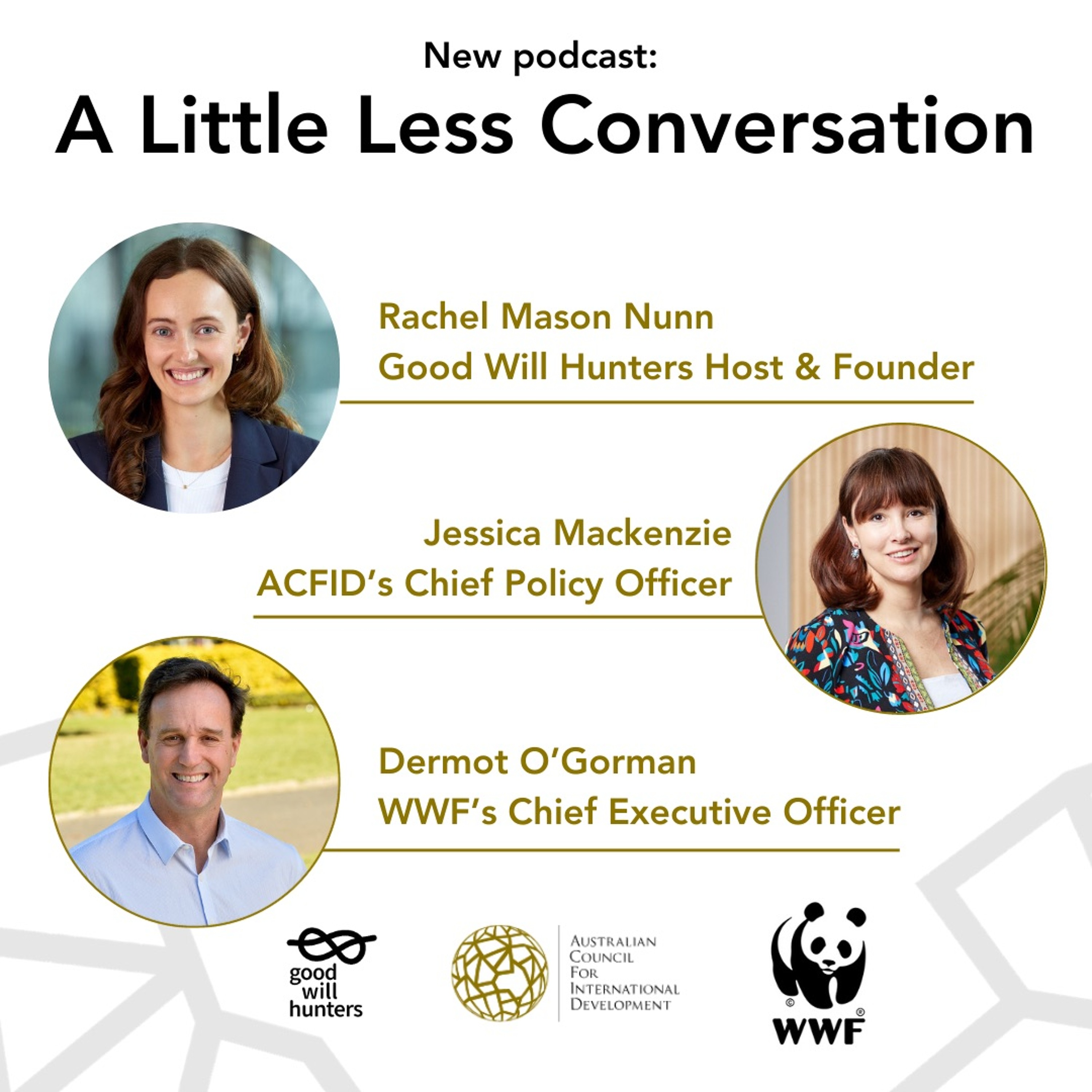
Episode 05 A Little Less Conversation, with Nat Burke and Flora Vano
from Good Will Hunters
39m 58s
This podcast episode explores how Australia is addressing climate change through its international development program, with a focus on nature-based solutions (NbS). The hosts and guests, including representatives from WWF Australia and ActionAid Vanuatu, define NbS as approaches that use natural ecosystems—such as mangroves, forests, and coral reefs—to build community resilience, store carbon, and mitigate climate hazards like storms and erosion. A central example highlights women in Vanuatu using local knowledge to restore mangroves, improving food security, health, and gender equity by empowering women in decision-making and reducing domestic violence. The discussion stresses that NbS must be community-led, inclusive, and context-specific to be effective. However, it is emphasized that NbS are not a silver bullet; they must be paired with urgent global emissions reductions, as ecosystems themselves are vulnerable to climate change. The episode underscores the need for a paradigm shift in development thinking, from exploiting natural resources to sustainably managing them for long-term human and environmental benefit.
(upbeat music) - Hello and welcome to a little less conversation, a podcast series on how Australia is addressing climate change as a function of our international development program. I'm Rachel Mason-Nun, founder of Goodwill Hunters and a director with Nandala Partners. - And I'm Jess McKenzie, Acquid's Chief of Policy. This series is a collaboration between Acquid, Goodwill Hunters and WWF Australia. - Climate change is the stormy undercurrent to our daily lives here in Australia. But in many of the countries we work in as development practitioners, it's allowed an urgent drum beat. To do development effectively, it's increasingly glaringly obvious that addressing climate change needs to be front and center. - At that end, we're holding the microphone out to those willing to take on the sometimes fixed challenge of speaking to Australia's climate change and development goals, where they intersect and where they deviate, as well as profiling innovative themes and ideas. - As the name suggests, we're hoping that Australia is gearing up for action. With climate change being a central pillar of Australia's new international development policy, it's now about how to implement that ambition. We want to investigate the choices that will shape Australia's credibility in the global climate space. - An approach that we've started to see being practiced is nature-based solutions. Nature-based solutions have emerged over the past decade or two as a way to bring together resilience, sustainability, impact, and market opportunities. But there's been some bad press as well, such as carbon market activities that ultimately are detrimental to the environment. To tell us more about the nature of nature-based solutions, we're today welcoming onto the podcast Two Guests. We have Nat Burke, head of social development at WWF Australia and Flora Varnu, country manager for Action Aid Venuartu. Nat and Flora, welcome. - Thanks, yes, great to be here. - Thank you, just great to be here. - Now, before we delve deep into the world of nature-based solutions, let's set up the context. We've been hearing of a thermocrysis facing the development sector. What exactly is this? - So I can jump in on that one. I think when we talk about a thermocrysis, it's really calling to mind the more conventional crises that we think of when we think about development challenges, whether that's conflict or humanitarian settings. Climate change shares a lot of features with these other crises, but it's a permanent issue. It's going to be with us for as long as we can tell, and it exacerbates all of the development issues that we as development practitioners are seeking to address. - Laura, tell me, what exactly then are nature-based solutions? Can you explain them to us? - Thank you, Jess. Nature is part of our life. And when you look at the whole three words, nature-based solution is what we have been missing all along to tackle into the climate change impact that we have. And we are looking far away for a lot of solution, whereas the solution is around us and is with us. It's in our islands. It's in the small island states. It's in our communities. And when we look at communities, our daily life, it's who we interact and talk to it and touch and feel every single day. For example, I will put it this way. Our mother in Aho needs to fit her family, but then she also needs finances to help sustain her family. She will also need food in the garden. And if she is near the coastal area, the problem she will be facing is the high king types, the severe weather that will be coming in with storms, wind and then from her garden landslide. So all this thing impacted her and she will be the one providing for her home, for her community. And therefore the responsibility lies heavily on her shoulder. And for her to survive, she need to think how can she stop having those wind destroying her garden? What are the wind shield? How can she easily just get a stand on a small area and fish, but the fishing ground have shifted because of the climate crisis? So what can she bring them all back? How can she do that? That's where she said, you know, the fish feeds on shells, on little food that they were eating. However, how does the food survive? Let me try and make sure there's food in order for the fish to come near. And then I can do the fishing and I can cook food for my child, nutritious food. So that will help their health risk. They will be healthy. They'll have a good education. You were already making the community being resilient by just looking at the food chain alone. But the women will be putting that because the knowledge that they had for them to survive is what they know best, what they always do. But then when you look at the basis of it, she might be doing it differently on this side of the place, but on the other side of the island, it's done differently. So solutions from each context, it's critical to the context of who lives in that place. They're using those natural ecosystems to solve these problems that she's finding. Yes, pretty much. I am just giving it on a full story, a map way in which when we look at it, it doesn't just because she need to replant mangroves. So then there'll be fishes to feed the family. She might probably be facing domestic violence at home because she's had to get food, but she couldn't get the fish because the fish have shifted. And so she could pitch it up because of that. By using the nature-based solution to be able to sustain the environment and the ecosystem, it also helps her life as a mother at home to make sure that her family is healthy, have an education, and that link back to the nature. It doesn't mean that you have to have a degree to go somewhere and come back. No, that was stress from home. And that was just from the thing that she know best, nature that is around her. That's very well explained. And the fact that the impact of these problems have such far-reaching and multiplier effects as well. So Flora, it sounds like the aim of nature-based solutions are to help communities harness that power that you're talking about of nature so they can build that resilience. And it sounds simple when you give that example, but I'm going to ask you a net, is it simple? I suspect in reality it's actually quite complicated. Maybe no degrees needed, but I don't think it's necessarily simple. If I may, and then not can input on, I'm passionate about oceans. I'm an ocean girl. I think because my island is-- you walk to the end of the island, you see ocean. You walk there, you see oceans. And also part of growing up is a bit harder when you don't have finances to move to get the health service from afar. And therefore, we have to learn on what immediate natural resources we had to stop a bleeding wound. If we were doing heavy work in our garden, we cut ourselves. There's no hospital there. You are up in the bushes. How can you actually faster and get yourself healed? So those are the local knowledge that we were taught to learn the native and how ways of plants. What plants is used for? What type of sickness, your cut, your wound? If you want your hair to grow, if all of these were taught to us from early, early age, and we know them, they're there. But when we got that impact when people will be destroying down forests, like they're cutting it out, we got scared because we know what we have. And then we know that if some of these plants got extinct, how can we take it back? And therefore, in the communities, when people went abroad and come back, they seemed to think that because they fly a plane, they were not a plane, they look cool. They got changes and then they came back and they didn't bother to reinvest back into what we have. That would be some of the challenges that we will say that where they are coming from. But it doesn't mean that it became for me, it wasn't a real challenge. It's just that when they come back or as real men, as mothers, we tell them that you do not forget where you come from. That was from our early age. They will tell us you do not forget where you come from because your survival extinct, your survival is actually depend on where your roots are. So because we are from the island, we know the island best. We can survive in forest, we can survive where we are at sea because we know what to eat, how we can catch it without even some tools that we need. But when we get to see also from other countries, there are some tools, our community also wanted, oh, we also wanted some of these tools because we could see it makes their life easier. And in order to take that, you still need money. You still need finances. And so when you walk together, it's easier. But if you walk into
then that will be a challenge. Because if you will be only one person and then once something happened or once you will, you know, you lift this wall then you are going back to another world who will continue that? Because it's an individual thing. But if it's a collective, it became everybody only, they own it. They own it and they know that if we do, we did not do it well now. Our future, we jeopardize our own future because we are not replanting my growth. The fishes won't be there anymore. And then if you do not put conservation plants for your community, your wildlife, you might probably lose the species that we like to eat, that the legacy that we eat. So a lot of things have to be planned out again and that it's a collective one. So then everyone knows that we keep it, you know, together we will survive longer. But if it's individual, then they already know that this one only in it for the money and then when he's gone, no one wanted to continue it because they were not benefiting. So I think if I look at it, I know you said it's a challenge and I always challenge that type of question in saying that if it takes a village or a community to make something happen, then that's the focus. You cannot say one, but it takes everybody. And I think that's what our law for nature is and we have been doing it and it's working and that is what we wanted to share for everybody to know that it's still alive. And challenges can be there, but we can overcome those challenges. They're not hard to overcome. I think, um, yeah, I mean, Flores, Flores, um, set it brilliantly and, you know, Jess, you asked, is it simple or is it complex or is it both? You know, we've been really fortunate at WWF for the last couple of years to be leading a nature based solutions program in partnership with DFAT, called Clamers by Nature, working with organizations like Actionate and amazing people like Flora. And I guess what I've learned is for a lot of the communities we're working with, in the Pacific and in Southeast Asia, nature based solutions are obvious, right? It's how things have always been done, that that relationship with the natural environment is really well established. For the development sector, on the other hand, it's very, very complex, because it requires a real rethink of the role of the environment of natural resources and ecosystems in the development process. So we sort of had a good 50 years of development primarily being about the use of natural resources. And when we talk about nature based solutions, or whether it's at least when I talk about nature based solutions, what we're talking about is not just the use of natural ecosystems to achieve benefits for people for mitigating climate change, for building adaptation. It's specifically about protecting, conserving, restoring, and sustainably managing those ecosystems that provide those benefits. So when we talk about nature based solutions for climate change, we're either talking about ecosystems that store carbon, or ecosystems that reduce the vulnerability of communities to a specific climate hazard. So Flora was using some examples there around the role of members, and that's sort of the hero ecosystem if you like nature-based solutions. If we just try to rely on, to try to use mangroves to build resilience, it's not going to happen. The actual work of a nature-based solution is protecting, restoring, or sustainably managing the function. And so this is really required a big shift for development thinkers. The other thing that I would be remiss of me not to point out is what nature-based solutions are not. So not surprisingly, I work for WWF. I'm a big fan of nature. And our plant's natural ecosystems are incredible. Forests, mangroves, salt marshes, sea grasses, even soil can store huge amounts of carbon and help to mitigate climate change. Coal reefs, riverine systems, they feed hundreds of millions of people and they can also reduce the exposure of communities and infrastructure to extreme weather. But nature-based solutions are not a syllable lit. They can't do it on their own. We need to remember that climate change is a human and used crisis and it's the communities who contributed the least at the problem who are bearing the worst of its impacts. So let me be really clear. The only way to avoid climate catastrophe is to reduce emissions and decarbonize our economies. Because no matter how impressive a nature-based solution can be, those same ecosystems that are providing the nature-based solutions are themselves impacted by climate change. So it's really important that we understand that it's not about nature-based solutions or emissions reductions that's both. We have to be able to do both. Thanks, Nat. That's excellent context. One part I want to pick up on is you've both mentioned, especially in your comments, Flora, the very gendered element to nature-based solutions and that women in particular stand to benefit from nature-based solutions. Can you elaborate a little bit more on why that is? Thank you, Rachel. When we look at the gender component of it, most projects doesn't allow inclusion into those activities. So when the women are in the communities, one thing they don't own is land. That's the first thing. They don't own land. And because they don't own land, they were only given land that men would say, this is the land that you will work on. And if they wanted to come and hold your comfortable for the land, they can say, if you, you know, walk on this land, and then you can have access to the resources like fresh water, fresh clean water, access to water. Because those are remote villages we're looking at. They're not just villages where you can get a vehicle from point A to point B. You might probably go through three means of transportation before you reach them. And so in their places, because of the patriarchy system that we had in Vanuatu, we are not in decision-making space. So we have been left out in a lot of decision-making and in a lot of resource that government have given through the triple system or through the government system that they put in only to the men. So you could see already we are marginalized from that day we were born as women. That wasn't, we were not part of everything that were happening in the community. And therefore when nature-based solution came into play, the men, they don't like to walk much, but they wanted to see the end result. Sorry, men out there. And they wanted to know that, you know, they can get money and when they ask money, they were given money because they are the head. But so the women are facing it for all these years. And they were seeing women in Australia, women in New Zealand, women everywhere around them, the women are coming up and rising up and are better and they can talk. And for them, they keep on marginalized where they are. And they were told you were just to be the one cooking cleaning, washing. And of course looking after the babies. That's your role, that's your job. And this is the space we give you for garden. You make the garden at the end of the day. You sell your vegetable, the money still comes to me as the head of the house. And that is not what we wanted as women. So when that project came, nature-based solution, we looked at it, we said, okay, we need to be in the decision making of the tribal place. And in order to do that, let's get that into this platform. And let's talk with our male leaders because they don't know this project. We do as women. So we went in and when we start talking, they're saying, oh, so you will, yes, we will be doing, you know, bankruptcy plan and we will be doing this. Oh, and, and then I said, you know, we'll be planting this cropping, intercropping. And this intercropping will help the community this and we'll help here, we'll put money here. And then they were now educating, it's the women educating the male leaders about that. And so they were asked to, okay, now you can also sit in those community meetings where they're only male, to be able to give your thing on what's our tomorrow for the community. Now they were getting in. And the food also became an important aspect for the community. When the droughts and the disasters that we have the recent one, the women have planted some caro patch already in some of those places. They went and just removed the caro and put into the communities that are that are hungry. And then they were like, so you were preparing for this all this time. I said, nature based solution can also be a part of how you respond immediately to for anger issues and food security. And the other stone, but the women have. And you could see that the benefit, and I can talk on those benefits, it's all an own nature. And I would say that without being recognized for that, we would be most of those places where the project I would have this women coming out and speaking strongly. Of course, action, they have run a lot of women leadership in humanitarian crisis.
responses and stuff and also in the DRR component, but within the nature-based one, it's the first one that we did and we could see more respect from the community. That the violence have decreased, no more beating because who are you going to beat? We've given you food, you ask money, there's money, because now the women have it. And that is a transformation that we have started seeing. I think it's really important to understand that this is an excellent example of gender equity and more broadly, in Flora's project with disability inclusion being integrated into nature-based solutions. That's not always the case. And we've been really fortunate to work with organizations like ActionAid and some other backward member organizations to really put that strong emphasis on gender equity, disability and social inclusion in the nature-based solutions programs. And we do this for a couple of reasons. One, we know from many, many years of experience that nature-based solutions are going to deliver better benefits to communities if they're inclusive, like any other aspect of developmental climate adaptation. But we also know that more inclusive nature-based approaches deliver more effective and long-term environmental benefits. We know, for example, WWF has been working in community-based fisheries in the Pacific for decades. And in a lot of community-based fisheries setups, women tend to be excluded from the governance and decision-making around fishing, despite doing 50 to 70% of the actual fishing effort. And so, you know, every officialization see, recognizing that the invisibility of women's fishing efforts in that example is leading to less effective sustainable management. So it's sort of one of those wonderful situations where it's both the right thing to do and the smart thing to do to integrate gender equity, disability and social inclusion into the nature-based solution. I guess more broadly while we're talking about sort of inclusive approaches. Again, you know, the examples that we're sharing today would give the impression that all nature-based solutions are community-based. And they're not. There are plenty of next-based solutions and what I call so-called nature-based solutions that are not involved in communities. The work that we do through throughout programming is very, very much focused on communities. And again, that's for a couple of reasons. We think it's the right thing to do. But once again, we know it's more effective. We know that around the world, you know, 40% of the world's key biodiversity areas are within the lands and territories of indigenous people and local communities. And that 91% of those lands and territories are in good or fair ecological condition. Right? There's been categorically proven that traditional management of ecosystem is consistent with poor quality conservation. From an nature-based solutions to climate change point of view, you know, it's early days of their research. But there was a really exciting piece of research from the World Resources Institute, only a year ago, which showed some case studies in South America where forests managed by indigenous communities are storing as much as twice the amount of carbon as forests managed by other means. And once again, we're seeing these lessons time and time again that these traditional methods supported by contemporary science done in systematic ways can have phenomenal impacts for people, for nature and for climate. I can see why it's win-win-win in many ways. The right things to do and the smart thing to do. And I love that idea of so-called nature-based solutions net. I'm going to be keeping an eye out for that. So you mentioned earlier that there's a climate resilience by nature program. And I know that it's currently a pilot program that brings together partners from across the development sector for nature-based solutions projects. But can you tell me about it in a bit more detail? And I know Flora's working on it as well. Which countries is it working in? And is this kind of program rare? I want to take these ideas and see where it translates to programs that we can all help be involved in in the sector. Yeah, absolutely. So climate resilience by nature or CR by N, as we call it in the shorthand, was launched at the climate COP in 2021. So just over two years ago, it's a default funded program which will initially run over four years. Its objective is really to, well there's a couple of objectives, but its core objective is to support communities in the Pacific and Southeast Asia to use nature-based solutions to build their resilience to climate change while protecting those ecosystems that support them. We're working with WWF offices in Solomon Islands, Fiji, Cambodia, Vietnam and Laos, as well as six other Australian development NGOs and their local partners across the Pacific. So we've got projects like the Action Day Project that Flora manages in Banh Awa too. We're working with Caritas and the Aboriginal Carbon Foundation in Timorless Day, World Vision and said the children are doing some excellent work in Solomon Islands and PNG. So quite focused on the Pacific as you'd imagine, given the Ed Programs focus. Each of those projects are doing different things. Now they're all drawing on the different strengths and strategic priorities of the organizations leaving them. But what they all have in common is that they're supporting communities to sustainably manage, protect or conserve a particular ecosystem that is helping that community to build its resilience to climate change. So in some of the projects, the Australian NGOs and their local partners are working with communities who are interested in engaging in the voluntary carbon market and looking at how that could be established in a really developmental and environmentally sustainable way. In other places where carbon markets either aren't an option or are not consistent with the development aspirations of the local community, the focus is around food production or around sustainable management of a specific commodity. The project that WWF Solomon Islands is doing, for example, is all around sea grapes, which is a form of edible seaweed that fetches a really good price at market is absolutely delicious and is a really important source of iodine, which is really important for maternal health. But also the sea grapes depend on the sustainable management of the nearby mangroves. And so by working with the communities on their sea grape harvesting plans and helping them manage that resource, they're also protecting the mangrove. Laura, I want to hear from you because you helped manage this program, but I'm also really interested. There's so many programs that lots of different donors are coming into the Pacific and suggesting. Is this one that really resonates with communities in your opinion? Because I know there's increased attention from the EU and from the Brits and from the Americans all wanting to scale up their working climate. Is this something that works well from a community point of view? Jessica, I would say that is it. That part of the project is what the community have been crying out for so long and they have been getting out of sort of, I would say like foreign ideas and people assume me. But the way it evolved them is they are not anything new that they are learning. It's just able to help them manage what they already had. It's just those management skills that comes with it. And when there's opportunity where they can also have food on the table, have money that they can use or even kept for disaster, that is something that is close to their heart and they wouldn't even wanted to see it die. They have to grow it because they know their survival depends on it. And they own it. And while we were looking at it from our program, activities where we have been doing, they have been crying out since 2015 to have something like this. And we said, okay, we just, we don't know where, who to fund this because that's a, that's, it's a high need, but we don't see an avenue for it. So we were, as actionate, we were doing the woman led community pays protection tool framework in which they identified their issues and find solution of short, long term. But one of the main issues that keep coming out is food security and how they have seen their island getting smaller because of sea level rise and when the storm comes, everything they've worked for gone. And that keep popping up. And so when we asked them, do you think that would work? They said, how long we wanted it to stay with us for, you know, a fair bit of time. I said, I'm sorry, but this thing have some project timeline and, you know, timelines you have to meet from this one and then they said, "But we wanted it to sustain."
because this is what we've been asking for. And finally, you've bring it to us. And for me to see them put their plan their times two days a week is just to look at that. They just to look at that. And they even cut that around those project sites. They get the disability systems in. And people with disabilities also were part of it. They feel that they've never done something that belongs to them and they've been included. And that opens the opportunity to have them in. They are the one who looks after the sit-panks, the sit-lings. They are the one who looks after where the sit-packs. And then they have it given to the able women to go. Because those terrain are a bit hard. You climb up the rocks. And the cyclone came in, make it more difficult. Those big hoods, they just block some of their pathways to reach where they are doing the project. So the disability sisters, the Wits and Shines, we call them, they thought they said, we've been also wanting it. But we don't know how to express it because we don't know what our other sisters in the community would feel. But that speaks to it. So I would take my heart off on this program because it speaks to the women in the community. And it's what they've been wanting. And I think they've been very vocal about it. But because, well, we don't have a women in parliament. Therefore, our voices are pretty much much analyzed in a lot of these spaces. But from the CSO or like the local NGOs, non-government organizations, that we are in the community. And we are the community, per se. We knew that getting us to get things from there, it's hard because we are not there. Women are not in those places. But we are in the community. So we will make it work for us. And whoever comes, they come to us. So I think that just boosts up our-- I don't know. It's like we are-- it's not like we're building a boundary and saying, like, you're there, we're here. But it's just saying that you want to access this. You come through. We are here. And it just gives us this good feeling that we now can say, no. And now we now can say we own it. At first, it's always for them. I think it's for these people. Maybe it's for this organization. Maybe it's for that organization. Oh, it's a government thing. We don't know. But when you ask about this project, they say, it's ours. Or who funded it? Oh, W-Table, it's ours. It's because. And now they talk. And I feel proud to just hear them talk to those, you know, male leaders and told them that we need you to tell this, say this. And I've never seen them like that aggressive before. Yeah, no, it's inspiring to hear. Thank you, Florid. Yeah, the passion is palpable. It's really inspiring and exciting. There's one more question I wanted to ask, which I suppose is the question to both of you. And now you talked at the start of this episode about how nature-based solutions aren't a substitute for carbon reduction in the path to net zero and broader climate adaptation and mitigation measures. But presumably, if the climate continues to change, many of the nature-based solutions we know will cease to exist or will change themselves, right? So is that a downside of nature-based solutions that you are trying to work with? And there are other downsides that we should be aware of. Yeah, absolutely. So I think what it really comes down, as I said before, is we have to do both. We can't see nature-based solutions as a substitute for the rapid and just transition to phasing out fossil fuels. We need to invest more in renewables. We need to do that in a way that brings all of society along. When we design a nature-based solution for climate change, we need to do that in the climate. We need to be thinking about down-scale climate projections. So if we're relying on a reef system or a forest to provide that resilience or absorb that carbon, part of our-- and this is probably where it goes from being simple to complex, right? So part of our planning needs to involve what's this look like in a 1.5 degree warming scenario? What does it look like in a two degree warming scenario? And it also requires us to invest in the longer term. So nature-based solutions at the moment are very-- a lot of donors are very excited about it. And they're investing in pilots. And that's really important for us to learn. But we need to start seeing a shift from pilots to long-term multi-year funding. But what we're talking about here is ecological change. And that doesn't kind of stick to the project cycle. That needs to be thought about over a 10, 20-year period. As far as downsides go, the devil's in the detail. And nature-based solutions are like any other programmatic model. If you-- to tell you use my term from before, so-called nature-based solutions that aren't actually investing in the protection or sustainable management of an ecosystem, what aren't working with community is to foster that sense of ownership and social inclusion. I'm going to have a lot of downsides. But as I said before, it's not a silver bullet. It's a model that can achieve wonderful things in concert with other approaches. Laura and Nat, I'm so sorry, but we're coming to the end of our time. So I'm going to ask you a very difficult question. And I'm going to ask you to answer to the best of your ability with just a one minute response. And this is really your high-level thoughts. So we've mentioned earlier that there's some controversy surrounding nature-based solutions. And there's been some talk of carbon cowboys who are causing problems in the Pacific. And there's a lot of concerns about green washing out there. What do you think about that and how we can avoid it? I'd like to just say that in order for we to actually survive and being able to be part of this carbon emission lowering it down and also keeping it to 1.5, we know that it's not easy because a lot of things that we will be going against or going for will be a downfall for some of the major players around us. It will affect them big time. But if we're looking at the survival of human beings, the survival of a small island state that we have done almost zero to contribute to what is happening now. And we are the one taking the brunt of it. We will need more of us to be speaking out more. Like any spaces that is critical, we have to be there. Because we need to keep telling the other bigger players that for you, it's about this. But for us, it's my life. You are threatening my life. It's my reality. For you, it's a story. It's a paper for us whether we live tomorrow or not. It comes down to this. So it's more life than that. It's like survival faces, papers and money out there. For me, it's my life, not a story. It's reality. Reality is on the ground that I'm facing. I'm not talking for someone. I'm talking for me because I'm in the islands. Thank you for being so honest. I don't think it gets much more hard hitting than that, Flora. Thank you. I think when we look at the carbon cowboys, the grain washing, there are some relatively simple tests that we can apply to any program or project. The first question is, is this actually going to have a measurable impact on climate? Can we see a legitimate, genuine reduction or sequestration of carbon? And/or can we point to a reduction in vulnerability of communities to a particular climate hazard? The next question is, is this project leaving the ecosystem better than it found it? Is it actually contributing to the sustainable management or protection of the ecosystem? And then the third question. And these are all of equal importance is are the communities and rights holders in that area benefiting from the project. For me, if the answer to each of those questions isn't a resounding yes, then we're not looking at a nature-based solution. We're looking at something else entirely. We're looking at an extractive project like any other. And so there are wonderful examples of nature-based solutions that are making the most of our entry carbon markets. But again, the devils in that detail. And at the risk of sound, I like a broken record. It's not a silver bullet. Wow. Thank you so much for your time today, Nat and Flora. And thank you so much for the work that you do as well. And for your honesty and openness with how you're taking all these solutions forward and how much they really matter. I think it's very powerful for us to hear. Thank you. We've been Rachel Mason-Lan and Jessica McKenzie on the "A Little Less Conversation" podcast. But tune in again. Thanks again. Bye for now. [MUSIC PLAYING]
Podcast Summary
Key Points:
The podcast discusses Australia's integration of climate action into its international development policy, emphasizing nature-based solutions (NbS) as a key approach.
NbS involve protecting, restoring, or sustainably managing ecosystems (like mangroves) to build community resilience, mitigate climate impacts, and provide co-benefits like food security.
Effective NbS require inclusive, community-led implementation, with a focus on gender equity and local knowledge, as exemplified by a women-led project in Vanuatu.
NbS are not a standalone solution; they must complement, not replace, global efforts to reduce emissions and decarbonize economies.
Challenges include shifting development paradigms from resource extraction to ecosystem stewardship and ensuring projects are collective and context-specific rather than individual or externally imposed.
Summary:
This podcast episode explores how Australia is addressing climate change through its international development program, with a focus on nature-based solutions (NbS). The hosts and guests, including representatives from WWF Australia and ActionAid Vanuatu, define NbS as approaches that use natural ecosystems—such as mangroves, forests, and coral reefs—to build community resilience, store carbon, and mitigate climate hazards like storms and erosion. A central example highlights women in Vanuatu using local knowledge to restore mangroves, improving food security, health, and gender equity by empowering women in decision-making and reducing domestic violence.
The discussion stresses that NbS must be community-led, inclusive, and context-specific to be effective. However, it is emphasized that NbS are not a silver bullet; they must be paired with urgent global emissions reductions, as ecosystems themselves are vulnerable to climate change. The episode underscores the need for a paradigm shift in development thinking, from exploiting natural resources to sustainably managing them for long-term human and environmental benefit.
FAQs
The series explores how Australia is addressing climate change within its international development program, examining intersections with development goals and innovative themes.
Nature-based solutions involve protecting, conserving, restoring, or sustainably managing ecosystems to mitigate climate change and build community resilience, such as using mangroves to reduce coastal hazards.
Women often hold traditional ecological knowledge and manage natural resources daily, yet are frequently marginalized; inclusive approaches empower them, enhance project effectiveness, and reduce gender-based inequalities.
Challenges include securing collective community ownership, integrating local knowledge with external tools, and ensuring long-term sustainability beyond individual or short-term financial interests.
Nature-based solutions complement but cannot replace emissions reduction; both are essential, as ecosystems providing these solutions are themselves vulnerable to climate change impacts.
A thermocrisis refers to climate change as a permanent, exacerbating crisis that intensifies traditional development challenges like conflict and humanitarian issues, requiring integrated long-term responses.
Chat with AI
Loading...
Pro features
Go deeper with this episode
Unlock creator-grade tools that turn any transcript into show notes and subtitle files.
 PodcastTranscript AI