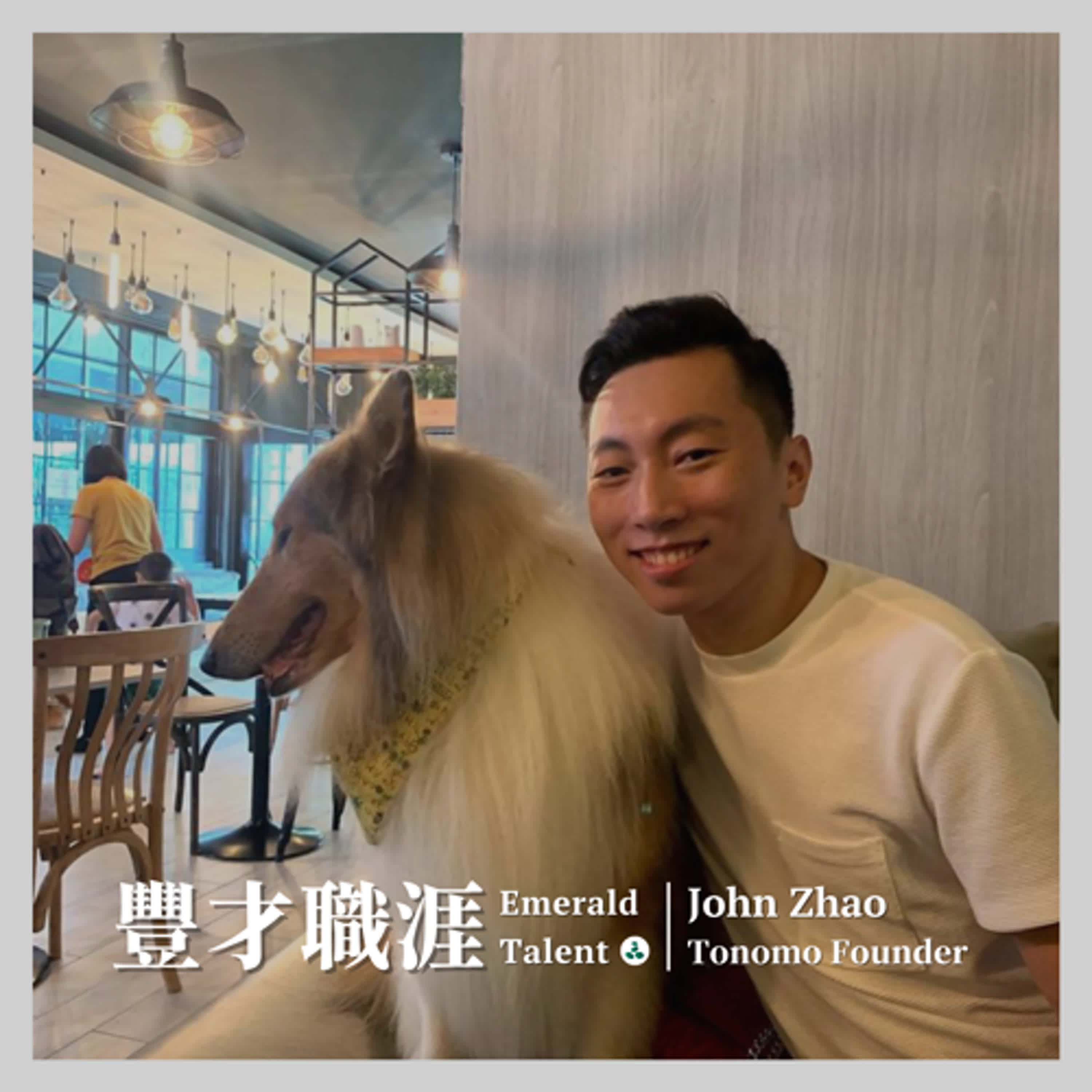
EP7|What I Want Is To Work for Myself And Travel Around The World! U.S. Real Estate Photography CRM Software Tonomo Founder John's Entrepreneurial Story
Hi 你現在收聽的是
風采直牙
Ameral Talent
本節目由風采管顧
Ameral Talent Consultant 製作
我是主持人Jannis
在每個單集中
我會邀請來
被音分賞他們的直牙故事
要讓他們是如何挖掘
自己的風風才華
發展真心喜歡
也擅長的風聖直牙
Let's get my love career with your soul
哈囉大家好
我是風采直牙
Ameral Talent 主持人Jannis
今天邀請到的來賓
是美國的軟體創業家
John
John畢業與UIUC
他在學生時期就開始創業
後續曾經在不同的公司中
擔任過UX Designer
Fundent Developer
甚至還曾經是一個Ecommerce manager
後來他在2020年三度創業
創立了Tonomo
提供專門為美國房地產攝影師
設計的CRM平台
目前團隊有20個人
而且大家都是全員的工作中
團隊成員分佈在美國
歐洲 東南亞
而這樣自己本身也是一位D-Sion Nomad
目前正在台灣數位融木中
那就讓我們來歡迎
今天的來賓
John出場
哈囉
哈囉
謝謝你
歡迎我
我覺得很幸運就是剛好在你在台灣數位融木的時候遇到你
對
也跟聽眾朋友分享一下
因為就是John成小在美國長大
那他比較不擅長中文的表達
所以為了讓大家可以聽到
今天最精彩跟最真實真心的分享
今天的節目會以英文為主中文為福
這樣就可能會穿插
那先跟大家說一聲這樣子
我們現在開始今天訪談吧John
OK
I'm excited
OK
所以第一次的問題是
因為我剛才提到
那其實Tonomo是一個SARS company providing CRM tools
要做所有的工作的工作
但其實工作的工作是不太好提到的
所以Tonomo是一個很難以為我能夠做任何工作
可以讓你分享更多的Tonomo嗎?
對,所以我認為這 all goes back to the business model of how real estate agents work in these different countries
In Taiwan, I've seen 591
You have real estate agents that just take pictures with their phone
Ujoezu
對
And here if you have someone that wants to sell their property or rent their property they can go to any real estate agency you can say "I will help you sell your property" But in the US, in Australia, in Europe and different parts of the world what they have is an exclusive relationship So the agent that wants to sell it, they form one relationship and they say, "Only I can sell your property for you" "Oh, okay" Yeah, the person that sells the property, they're called the listing agent And so the listing agent, the most important part of their job isn't actually to sell the property it's to get home owners to list their property with them to get that contract because selling the property is easy once you get that contract So listing agents, they need to prove to the home owner that "I'm the person you want to work with" And so a huge part of that is they say "Hey, if you work with me, I'm going to invest in getting professional photos, professional videos" "I'm going to do all this really good marketing to help you sell your house" And so because of this relationship in the US what you have is listing agents that spend a good amount of money to invest in creating professional media for every property So if you go on to America's Wu Zhou Yi Make a move on the Wu Zhou Yi This is Wang Zhan Zhao Zilou If you go on there, you'll see that every listing is made with professional photos, videos, and all kinds of very high-end work It's not people that just takes their phone and takes their photos So here is the interesting part because your company, Tsunomu, is actually providing CRM tools to all the real asset photographers So the client they really need to manage is actually all the agents not and customer like all their owner of the house, right? Exactly, so it's a software for photographers to manage real estate agents Oh, okay My next question is what's the pinpoint that Tsunomu really tries to solve? Yeah, so we started this business because one of my previous business partners he went out to San Francisco around 2016, 2017, and he started a real estate photography business and he was one of the first people to really get into this and they built that into a really big business They were doing about $7 million a year They had about 30, 40 employees So you mean actually this job gets trendy in US recent years? Yeah, it's a very new industry So most of our customers today, they did not exist when we started the business It's very new, but what they realized is that when they're trying to build this real estate photography business they were doing everything manually by hand and it was too complicated, it took too much time It was too confusing, there was too many room for error and so what they really needed was software to simplify everything, streamline everything, automate everything and just make this process that would take an hour and make it take five minutes What kind of data they need to manage? Yeah, so a huge part of this is scheduling So real estate photography is complicated because you need to send photographers to different properties So they need a drive there And so a huge part of this is planning logistics which is, okay, you're doing 500 properties in a month and you have these different photographers that serve different areas If someone's in Taipei, they can't drive all the way to a different part of Taiwan So you need to either have a scheduling person that understands each photographer's skill set So some people only do photos, some people can only do videos, some people can fly drone So everyone has different skills, everyone is in different areas and you need to plan out their schedule so that they can get from one job to the next to the next It's like driving Uber or delivering food So there's a huge logistical scheduling component to it and our software automates that entire process So we make it very simple for agents to order what they want and then book a date or a time that the company can accommodate Oh, yeah How cool Thank you You also told me that I was really happy so I got to pay for it So the software will plan, it will look at different geographical locations for each photographer It plans the travel time from one address to the next So it knows, okay, to get from this location to the next one, it's going to take one hour So if this person ordered a job, if they start at one o'clock, they ordered four services It's going to end at 3 pm and then to get to their next address, it's going to take two hours So the next job they can start at is 5 pm So it plans that entire schedule for every single photographer I can tell that this product is really designed for the US domestic market because real astrophotography is a new training job in US and you mentioned that the photographers need to plan all the logistics parts because the US is a real large country They really need to ensure all the details and try to make the process go more smoothly I think this product is really designed for a US domestic market It's interesting, the US is a little bit ahead of this because of some influencers, that's really kind of helped the market develop but we're seeing a lot of customers now in Australia I also curious, like, do you really see this kind of a trend in other countries? Yeah, it depends on the market So these markets where they have this type of exclusive relationship this software is starting to pop up So we're starting to see it in Australia and we're also starting to see it in different parts of Europe where people are looking to the US and they're saying, "Hey, these guys are starting these businesses" We can do the same thing in Italy, in France, in Belgium So those are where we have some of our customers and they're starting to start these companies and they are just winning a huge part of the market So to kind of explain a little bit is that before this software what you had was just a person that says, "Hey, I'll take photos for your house" They're just real estate photographers But nowadays you have for a variety of different reasons You have people that do photos, you have people that take videos You have things like DJI drones that do the drones And so for the real estate agent, instead of having to go to one person for photos a different person for videos, a different person for the drones Instead of having to go to four or five different vendors One company will say, "We will do everything for you" We provide a total solution for you A total solution, exactly So the need for this total solution only started in the last five, six years Because five, six years ago, the internet wasn't good enough Where there weren't really any video People didn't need videos The phones weren't fast enough, though like the internet speed wasn't fast enough The cameras were too expensive People didn't do video, but nowadays Photographers can go out, spend, you know, $500 instead of $5,000 and get a really good camera to do really good videos A lot of photographers are using their iPhones and they could take professional videos And because of this, now videos are becoming more common And also because of things like Instagram, Reels, TikToks People are watching video and they're using that to buy houses That wasn't the case Yes, it's quite interesting
Yes, the owners of the houses start to see the value of real estate photographers. Maybe because of their photos, the owners can sell their houses at a higher price, but you know, actually you founded this company in 2020. It's still the early stage of the industry. Yes, very early stage, I'd say the industry right now is like, if the industry was a person, he would be like maybe 11 years old or so. You know, like still living at home, still can't really. But can easily go to the junior high school like next year. Soon, yeah. Make some girlfriend. Or boyfriend. Yeah, maybe. Yeah. Okay. I want to ask more questions about yourself because I noticed that you become an UX researcher, front end developer and e-commerce manager after founding the first two companies. So my question is, why you decided to be back in a corporate life after having some entrepreneurial experience? So the first company I started was my first time doing entrepreneurship. This was when I was in college and it was a very simple business. It was computer repair business and iPhone repair business. So you started this business and you are UC? Yeah, at UIUC with my friend. And so my friend was the main person that ran the business and I handled some of the marketing side of things. And basically college students, they would go out, they would get drunk and they would break their phones. So the primary part of our business was fixing iPhones. So fixing iPhones. And you have to be awake till the end of the party because you got to collect everybody's broken phone. No, they come to us the next day. So after they break everything, the next day they come to us to fix their phones. And it was a very simple business. So that business, we did pretty well. You know, within a year and a half we were doing about $35,000 a month. The problem with that business is that you can't really grow it. You can't really scale it. It's like running a coffee shop. Your market is just the people around you and that's it. And when I was looking, this was in 2014. So 2013, 2014, you had all these big apps starting to pop up and I just saw, okay, if you really want to make money, if you really want to grow business, you need to get into technology. I wanted to get into tech, but I didn't know anything about tech. I had a degree in general engineering, which is, it's like mechanical, civil, electrical engineering. It's the traditional stuff. I didn't know anything about, you know, how do you build an app? So actually it's more hardware related technology. Yeah, it's more traditional engineering. So I wanted to build an app and I built an app for college students. The way that I went about doing it was I just tried to teach myself how to do design and then I got different work down by different people. I found this guy in India that built the iOS part of the app and I found someone else to do the Android part. And then once we had enough traction, once we had enough people using it, I was able to get other students to help me build it. But that process, I realized that in order for me to get really good at building these technology companies, I really needed to learn the technology itself. So, after that app failed, I took a course online and taught myself how to code. And then I also learned design and so I kind of focused on building these tech products. But I just realized after a while that I just needed to get more experience. I needed to learn from other people before I start my next business. And I think this is true for a lot of entrepreneurs. When they just work for themselves, they don't even know what good looks like. You don't know what good management practices are. You don't know what good engineering practices are. So, I really wanted to learn from other companies that already knew how to do things and just kind of accelerate my own growth. So, that's when I decided to go to Chicago and work for other companies. So, this was around. So, you work for other companies because you want to start your own company. Exactly. Not because you want to get a job. Exactly. Yeah. So, if I think about a career, there's like two parts of it. The first part is you work to learn and then you work to earn. So, first part is about learning and then it's about earning. Yeah. And so, the first part of my career was about just learning as many different skills as I can so that when I do start my next company, I can be set up for success. So, I took a job where I was kind of working in a hyperbrol as a designer and a developer. I was working for a food ordering startup. I worked for a bunch of different companies and eventually I ended up at this hearing aid company and I was working as a developer building the shop, online shop. And I was in a good place, like right place at the right time where eventually they needed someone to run the business side of things because of management changes and everything. And even though I originally joined as a developer, I was promoted to working as the e-commerce manager. So, I managed the online part of the business. So, this is a business that it was actually quite large. So, we did about $40 million in sales each year. $40 million. Yeah, $40 million. This is hearing aid. So, it's for old people. So, we did $30 million in the call centers. So, people would see our ads in newspapers, radio. They'd call directly to the call center. So, we did about $30 million offline and we did about $10 million online. So, I managed the online part of that business and through that I was able to learn a lot about marketing, customer acquisition, a lot of really good management practices. And then after working there for about a year, year and a half in the business side of things, I was, I felt like I had learned everything that I needed to learn. And that's when I decided that I needed to go out and start my own company again. So, I'd spent about four years in Chicago learning, working for other people. And then in 2020, I left to start TANMA. Then, I have two new questions. The first one is because you were the UX designer and I was the front end developer and then transition to the e-commerce manager, right? And then these three jobs are all in different job functions. How did you convince a company to give you that job? You know, because career change is always a journey and sometimes it can be really challenging. But you just made this kind of switch two times within four years. It's hard to imagine how you made it. The companies that I worked for, they're all less than 30 employees. So they're all small companies. Like these small companies, they are all starving for talent. So I think actually if you keep growing, people are willing to give you more responsibility. I think it's actually very easy because even in my company with 20 employees, we're always saying, "Hey, I want to give you more responsibility. Can you learn this or can you learn that?" That smaller companies, you need people that wear multiple hats. That can do multiple functions that are cross-functional. So I think if you want to grow, you want to be looking at these smaller companies to work for because they need multidisciplinary people. The second part is I think when you're looking at a career, most people grow a lot in the first six months or a year and then they stop growing. They don't learn new things and it's like the question of like, "Okay, do you have five years of experience at this job or do you have one year of experience five times?" So when I looked at my career, I was working a lot. I'm actually getting paid to learn. I was learning new skills all the time. So over the four years, I felt like every six months I had a different job because my responsibility kept changing because as people saw that, "Okay, I'm smart and I'm. " And John is capable to do this, do that. Yeah, people give you more things. Give them more jobs. Give them more things to do. Yeah. I think that's true for any kind of company. People see like, "Oh, you can do more. People give you more work, more things to do." Because at smaller companies, there's a million problems to solve. So they're like, "Okay, you can do this. Here's another thing to work on." That was kind of my approach. It was just, "Okay, yeah, I'll just keep taking out more things." And because I had already run a business before, I had run a couple of businesses. They can tell that I wasn't just an engineer. I was coming with other questions. I was giving them suggestions about, "Hey, maybe you can do this." "Okay, maybe you can do this." So they give you more things to do, more problems to solve. But how do you do with boundary? Because when people give you more job than expected, then you're previously expected than maybe you will work overload. That's the question of, "Are you working to earn or are you working to learn?" My perspective of, "Okay, these are great opportunities for me to learn all these different disciplines." Oh, okay. So I'm not taking it from the perspective, "Oh, I'm getting more work to do." I was saying, "Okay, it's like going to college." When you go to college, you're paying the university and then they're giving you work to do it and then you do the work and you learn. But when you have a good job like this, they're paying you and you're learning. So if you take the perspective of like you're just getting paid to learn, then you want to take on as much responsibility to learn as much. Okay, frankly, when you're running a business, you realize you're always going to make a certain amount of mistakes. So you can either make those mistakes working for someone else or you can make those mistakes working on your own business. So I made a lot of mistakes, but I was at least able to do it working for other people's businesses than working for myself. But have you fixed all the mistakes you've made? There's infinite amount of mistakes, but I'm still learning. You're always still learning, but I definitely got through a lot of the early mistakes. And that helped my company grow a lot faster than it would have before. Then my second question is.
is how did you find that actually you are so passionate in building your own company? How and when did you find it? - Yeah. - Yeah, because you studied for the general engineering. - Yeah, I actually hate engineering. (laughing) - Like the first day of a recall, I realized the things. - I realized that like even in high school, I was a good student in high school, but I'm not a good student. I hate going to class. - Are you a good student or not? (laughing) - John. - Compared to all the other engineers, I was not a good student. I think my classmates, they hated me because I barely showed up to class. I was asking the dumb questions. I was sleeping during class. I was just, people don't want me in the group projects. (laughing) I was that guy. So I didn't really like engineering, but I think I had an aptitude for it. I was smart enough to pick it up. So my parents said, "If you can do engineering, just do it." 'Cause it's gonna set you up to get good jobs in the future. So I did engineering because I could do it, but I hated every second of it. I hate math, I hate science. I don't like doing those things. So. - What did you like at that moment? - That's a great question. What did I like? I wasn't sure. - Please tell me the truth. - At the time, I liked playing video games. - Okay. What type of video games? - I played League of Legends in college. - Okay. - That was pretty popular then. - Yeah, the first year of college, I just stayed at my room playing League of Legends all day. - My ex-boyfriend also really into that game. - Oh wow, yeah. - Yeah. - Yeah, so that's what I did for the first year, just playing League of Legends all day and all night. And then at some point, I realized-- - My legendary. - Yeah, I needed to leave my dorm. - Okay. - So I realized that I didn't want to be working as an engineer. And if I had to do that for the rest of my life, I would absolutely hate it. Because of that, I decided, okay, I need to do something else. And frankly, with my grades, I was thinking, okay, it's gonna be hard to find a good job. So I might as well just work for myself. - But you were graduated from UIUC. - Yes. - It's a famous school. - Yeah, it's a very good engineering school. - Yeah. - But I didn't want to do engineering. I didn't want to work a nine to five job. I wanted to travel. You know, I wanted freedom. I wanted to be my own boss. It almost felt like I was kind of forced into entrepreneurship because I didn't really want to work for anyone else. And that's really the only option left. So, hey, we had a business I was working and I was just gonna continue working on that. But in the beginning, when you're starting these companies, it's very unsure. I had a lot of self-doubt about whether I can start a business or not because, you know, like, no one is bored in entrepreneur. I think that's a misconception. It was the first couple of years of doing this, I had a lot of self-doubt about, okay. Am I really fit to be an entrepreneur? Can I really lead people in all these different things? And that's the thing that you have to work through in order to really become an entrepreneur is all that self-doubt and the imposter syndrome. - How do you fix all the self-doubt and imposter syndrome? - Or you're still living with all the self-doubt and imposter syndrome now? - No, not anymore. I feel like I'm 12 years into this. So probably by three or four years in, I hadn't fixed most of that. It's a lot of it is about self-improvement and just growth. There's some really good books about this. There's one book called Mastery, which is about like how you grow and learn new skill sets. But one of the key lessons that I learned when I was growing and doing self-improvement is that no one is cut from a different cloth. And what that means is that you see someone that's extraordinary that has like talent, but they don't have talent. What they have is years of practicing and growing that skill. Once you do that enough, like you grow some of these new skills and you see, wow, okay, I can do this, I can do that. You realize that you develop a growth mindset, which is that you can learn to become better at these things. And you learn leadership is a skill. Talking is a skill. Sales is a skill. All these things are skills and growing a company is a skill. And then after you do it enough, you fail and you learn and you grow, then you say, okay, maybe I can do this. And so it's a gradual process, but if you just keep working on that, that you eventually get there, it's like, if you're learning to dance, the first couple of classes you go, it's you're like, oh my gosh, I can't do this. This is so hard, you can quit. But if you keep doing it after a year or so, it becomes second nature. And that's like one of those lessons that I learned was, when you start something, right, when you start it, that is the hardest it's ever going to be. It only gets easier. It's like when you start exercising for the first time, the first couple of times you go and run, it's so tough, it only gets easier. This is the hardest it's ever going to be. It really kind of empowers you to keep doing it. It only becomes easier, right? And that's the same thing with any kind of self improvement process. - Yeah, before the recording, Ashley, me and John are talking about my mood before really launching the podcast, of the Amaro podcast show in October. Ashley, before really launch the first episode, I was so into the podcast recording process interviewing and I also reviewed the soundtrack edition with the editors. I'm so into this because I really like to invite all the guests to share their stories and I really like podcasting. But when I really launched the first episode that night, I was so depressed when I really looked the data from the close to inside and when I say, okay, maybe just 10 or 20 people listened to the episode. I feel like, oh my God, because I was a podcaster before in 2020, 2021. And at that time, actually, that show is really lucky to be a successful show. But this time, because I'm doing this for my company, and I just can't stop comparing myself to my past self. - You're looking for perfection. - Yeah. - Yeah, and you just gotta look to just get something out there. - So on the first night of launching the first episode, I was so depressed. I just told myself anyways, I just need to go to sleep now and everything will just keep going. I will keep launching new episodes. - And now we're doing this recording by the end of October. So actually, if I already launched four episodes, and today I can still collect some feedback from the audience, they listened to the first episode. That's quite interesting. And I feel really surprised because when I really launch it, I think the episode just has its own life. - And it only becomes easier, right? - Yeah. - Yeah. - It's just like what you shared, it's all about progress. - The beginning is always the hardest. And it's like now, it only becomes easier with every single episode. And then every episode you do, you get better at it. And the next episode becomes better and better. And then you're unstoppable. - Yeah. - Wow, so I'm aspiring. (laughing) Thank you, John. (laughing) Okay, so my next question is, because you mentioned that no one is meant to be an entrepreneur. I know that your team is actually on the fully remote work mode. - So how did you really manage the team when all the members of fully remote work around the world with different times on? I think this is really a challenge to all the founders, entrepreneurs, managers. - Right. The first part I think you need to do is find the right people. And I think that's the toughest part is finding the right people. And by the right people, I mean, people that are aligned. - You know who can help you? (laughing) - Janice. - Amrotellen. Consulting. - So Janice, do you ask people, this is a common question they ask and I hate this question in the US, which is like-- - You mean the interview we ask you? - No, the interviewer they'll ask, why do you want to work for us? Do people ask that? Like why do you want to work for us? - Yeah, I will ask this question. - What do people say? - Various reasons? I want money or I really into this job because of the brand name or-- - Yeah. - Yeah, so for us, we're very just brutally honest. It's like everyone here, we want to work to make money so that we can have freedom in our lives. And that was the core value was like, we want to be free and we're here to make money. That's what it is at the end of the day. And we were aligned on the fact that like, I told my team, like, listen, if you guys do your job well, me as a CEO, my responsibility to you guys is I'm gonna create opportunities for you guys to continue to grow and to make more money. So that's one thing that our entire team is aligned on is like that growth and the possibility to, for them to make their lives better. Because at a lot of other jobs, you're doing work that doesn't really matter and there's no growth opportunity. And that really sucks because it's very demotivating. But at our company, there's people that have double their salary in a year. And so everyone is internally motivated. So it's not that I need to micromanage people. It's just everyone is very motivated at their jobs to do really great work. So that's the first part. That makes managing a lot easier when you don't have to look over everyone's shoulders. And then after that, it's just about figuring out for each person how much management they need. Because we have people that are in their 40s. And those people, they're very senior, they're very experienced.
They don't need to be managed that much. You just need to kind of align on their goals, okay? This is what you're working on, and then they can kind of go off and do their own thing. So I don't need to manage the more experienced people. As long as we're aligned on, we're on the same mission, they're good to go. Now the younger team members, some of the people that are less experienced like in their 20s, they need a little bit more management. But I'm not here to say, hey, did you get your work done? I work more like a coach where I help them accomplish their goals. So we get aligned on, okay, you're making this much money. You're working at this position. What do you want to be doing in a year from now? Oh, they want to grow this. They want to be making this much money. They want to be having this certain job. Okay, you want to do that? Let me help you do that. Let's figure out what skills you need and let's figure out what you need to do to get there. So I work more like a coach to help them get to those goals. So everyone has very, very clear KPIs, like goals of what they need to be doing. Sales needs to be getting this many sales. Marketing needs to get this many leads. Customer support needs to get, you know, whatever it is. And so I coach them on what they need to do. And then that's in general how the management works. But a lot of the younger people that I worked with, we were remote to begin with. Like the person that's doing marketing for me, he lived with me for a year. He lived with you? Yeah, he lived with me. Okay. So the guy that does marketing for me, a very interesting story. I was in Mexico at the time and I was living in a co-living house, which is like a house with like 12 other digital nomads. And one of the guys there, he was I think like 21 years old at the time. He was in Mexico to party. So like every time I saw him in the hallways, he had like a beer with him. He was from Denmark and it was the year right before he was going to go to college. So he was only supposed to be in Mexico for three months. We ended up becoming really great friends. He got a girlfriend in Mexico too. So he was looking for ways to stay there longer. After hanging out with him for a while, I realized he was really smart. So I just said, listen Jacob, why don't you just work for me? So instead of going back to college, just work for me. I'll teach you how to do marketing and you're going to learn more working at a startup. We're going to company than you would in four years in college. And he decided to just just say, okay, let's do this. Wow. Yeah. So in the beginning of Mexico City at the time, we worked for a little bit for a couple of months and we're like, okay, this could work. There's potential here. So we moved to Cancun and we lived as roommates for a year, just hustling and growing the business. And now he's working full time. Him and his girlfriend are still together. Okay. Congratulations. Yeah, exactly. Congratulations. Congratulations, Jacob and Daniel. Okay. And now they're living in Spain together. Wow. Yeah. So Jacob is your first employee. No, he's the first him member. I already had a bunch of employees, but a lot of the people that I met was kind of similar where, you know, we grew the business over four years. So this was two years ago. So already two and a half years into the business. But the marketing person we live together, the sales guy, we also live together for a while when we were living in New York. Is it an intimate process like you have to live with your balls and to see if we can like really a good match? Maybe. Maybe that is not that I'm thinking about it. Because my first business partner, we also did live together in college. You mean the repair business? Yeah. Yeah. Yeah. We were roommates too. But I think that's kind of like how a lot of these businesses start. You meet people that in your life and those people are the ones that become the best like team members. Do you think you are a lucky person? Like you meet all the people and they become your friends and maybe team members and. If you look in hindsight, you'd say, okay, there's a lot of luck. You create your own luck. Have you heard? Luck is when preparation meets opportunity. Yeah. Yeah. I think that's true because if you look in the back, you're like every single person I met that worked for me was a little bit of luck. But looking forward, you see that, okay, for every one person that ends up working for us, there's like 20 that fail. So I'm always going out to try to meet new people, to try to bring people on. But we actually don't have a great rate of hiring people. A lot of the people we hire don't really work out. So I actually feel a little bit unlucky. I wish I had more luck because most of our hires don't work out. They're the wrong fit. They don't have the right skills. There's a lot of different reasons for that. But if you keep going out to these events, you keep meeting people. Eventually find one in 50 people that's a great fit and that makes all the rest of the time worth it. I am a lucky person because I went to a digital nomad event. We just chat for like two or three minutes and I feel like I want to invite you on the podcast. And I just invite you and you say yes. You have a great luck. So maybe we should hire you as a worker. We can have some cooperation together. Yeah. Okay. Then I also want to know why did you choose to become a digital nomad? Yeah. So I always had this picture in my mind that I wanted to just wake up and go to a different country or go to a different place to have that freedom. You have this kind of thoughts when you're in the college or even in your theater. Yeah. In college, probably. For me, there was a big part of my life where I thought that I really wanted to live life on my terms. I was like one of the things that I realized in life is throughout life, a lot of people, they don't make many choices. The society tells them what they need to do. Their parents tell them what they need to do. The media, all these things that says, hey, you need to, you know, go to school, get good grades, go to college, get an education, get a job, work somewhere nine to five. And then 40 years, 50 years later, you retire. And then it's just everyone's telling me what to do. And I wanted the freedom to live life on my own terms. So that was really, really important to me. And being a digital nomad, traveling the world, that just seemed very romantic for me. So that's something that I wanted to try out. And then after being an entrepreneur for a little bit, I was just very motivated to follow my heart. And that kind of pulled me in different directions. But I started my digital nomad journey on accident because when I was working on a ton of them in the beginning, I wanted to take a vacation from Chicago. This is in 2020, which is when COVID happened. And I had a small suitcase, like a carry on. I booked a trip for Thailand. And I was only supposed to be there for two weeks. But COVID happened right at that time, like right when I got off the airplane, Thailand closed down the borders. So like I arrived at 12.30 a.m. And they closed the borders at 12 a.m. Wow. Yeah. So I arrived just in time just by like 30 minutes and my two week trip ended up becoming a two year stay in Thailand. Oh, okay. Yeah. So from two weeks to two years. Yeah, exactly. So that started my journey as a digital nomad where I just took a short trip and it became a long trip. And then I started just kind of traveling to different places. So I just figured out that actually you did three important things when you were in the college. The first one is repair business. The second one is playing League of Legends. And the third one is thinking about what's the meaning of your life. Exactly. And those things are all related because after you do engineering for long enough, you end up hating life. And then after you play League of Legends for long enough, you end up hating League of Legends. Okay. Anyone that plays League of Legends, they understand this. The game is so frustrating. It's so frustrating of a game because you're like one in ten people playing the game and you don't have any control over what other nine people do. And so every game is frustrating because the outcome of the game is totally outside of your control because there's not your only one out of nine people. Don't you think this is pretty much like how the life goes? Exactly. Like you can only control yourself. You can have really control your others. So playing League of Legends ended up a lot like running a startup. Because when you're running a startup, nine out of ten things are outside your control. Yes, I totally agree with this. Yeah. So you really have to learn to control yourself and influence as many things as you can within your area of control. But then a huge part of this is just like playing enough games. So same thing with the running a startup. You know, like this company that I'm running is successful. But to get to here, I had to fail like six or seven times at other businesses. You know, in that way, I'm not really that lucky because I see some people that start their first business and they're already successful. Those people are really successful. But also one of the things that I learned is that everyone needs to go through a certain amount of failures before they get success. So a lot of the people that are really lucky, really early, they get into that same creative state where they don't want to fail. Where like you have one big success and then they think the next thing has to be successful. And then they push the failure, they push the defeat. And when they do that, a lot of people get really stuck because in order to be successful, you have to fail. You can't grow without failing. And when you're afraid of failure, you never truly grow. So a lot of these blessings end up becoming a curse and a lot of the curses end up becoming a blessing. Wow. Oh my god. This is today's Jingju. I don't know how to say this in English. Jingju. Jingju. "Jong" (true) Today's highlights. Today's highlight, wow. Yeah, today's highlight. We still have more time. There's more highlights.
highlights. Okay, the last highlight is, you know, in this podcast show, Amarotell and podcast, actually, I will bring you a lesson message. A truly lesson message. It won't become a curse. Before we do the recording, actually, I will pick a tarot card for my podcast guest. And I will try to figure out what's a card want to tell you? The message is especially for you. So I will only disclose when the interview is almost completed. Wow, I'm excited. But the end of the podcast show. Okay, so. So it's a challenge. Yeah, here's the card. Let me show you first. Can you read the Chinese part? I'm not so sure if you can read traditional Chinese. I can read like a couple of these words. Then you'll see the New Year's Cup. I don't know the last two words. Wenzhen. Yeah. Your dream is to be sure. And then I don't know the rest. Huibei. Ni. Huibei Ni. Shixian. Shixian. Okay. Beautiful. But you can't read the English part, right? Yeah. Of course. I'm not sure if I write the sentence with the right grammar or wording. But that's what I mean. Every step you take is steady. Your dream will definitely be realized by you. The night of coins. Yes. How? Thank you. You're welcome. So the tarot card that I picked for you is night of coins. Actually, if you can read the Chinese part, because I wrote your every step you take, your dream will definitely be realized by you. Do you know this is very poetic? Because this is night of coins. I just have to say Chinese. Because I have a little difficulty in English. Because it's because you take the money. The money is the one that's very stable. The one that's very stable. It's very functional. True abundance. It's pretty much like a cash cow. The night rides a cash cow. Cash cow. Okay. And Niou's is the way to walk. It's very stable. She won't just walk very fast. But she's very stable. I also said this message is pretty much aligned with what you've shared in the interview and the show. Wow. Just like you say, everything is keep progressing and you will just grow. I love it. Yeah. Just because you go to the Hengwen Street. So you won't be able to finish it. So you will definitely realize your dream. Just manifest. Perfect. So do I get to keep this? Yeah. This is for you. Amazing. This is going on my shelf. Okay. Yay. Then that would be one of my chiefs. The founder of Tonomo John just puts the blessing card in the shelf. I need your autograph on this card. Okay. Yeah. I'm also pretty happy that you like this message. I will say you deserve it because you're definitely on your way. When this podcast becomes like world famous, I'm going to have your autograph and say I was on episode nine. Okay. Look forward to that day. Okay. So thank you, John. And we're going to finish the interview now. Okay. Thanks, John for sharing your amazing career story with us. And then thank you for your support. Thank you. Thank you for your support. Bye bye. Bye bye.
 PodcastTranscript AI