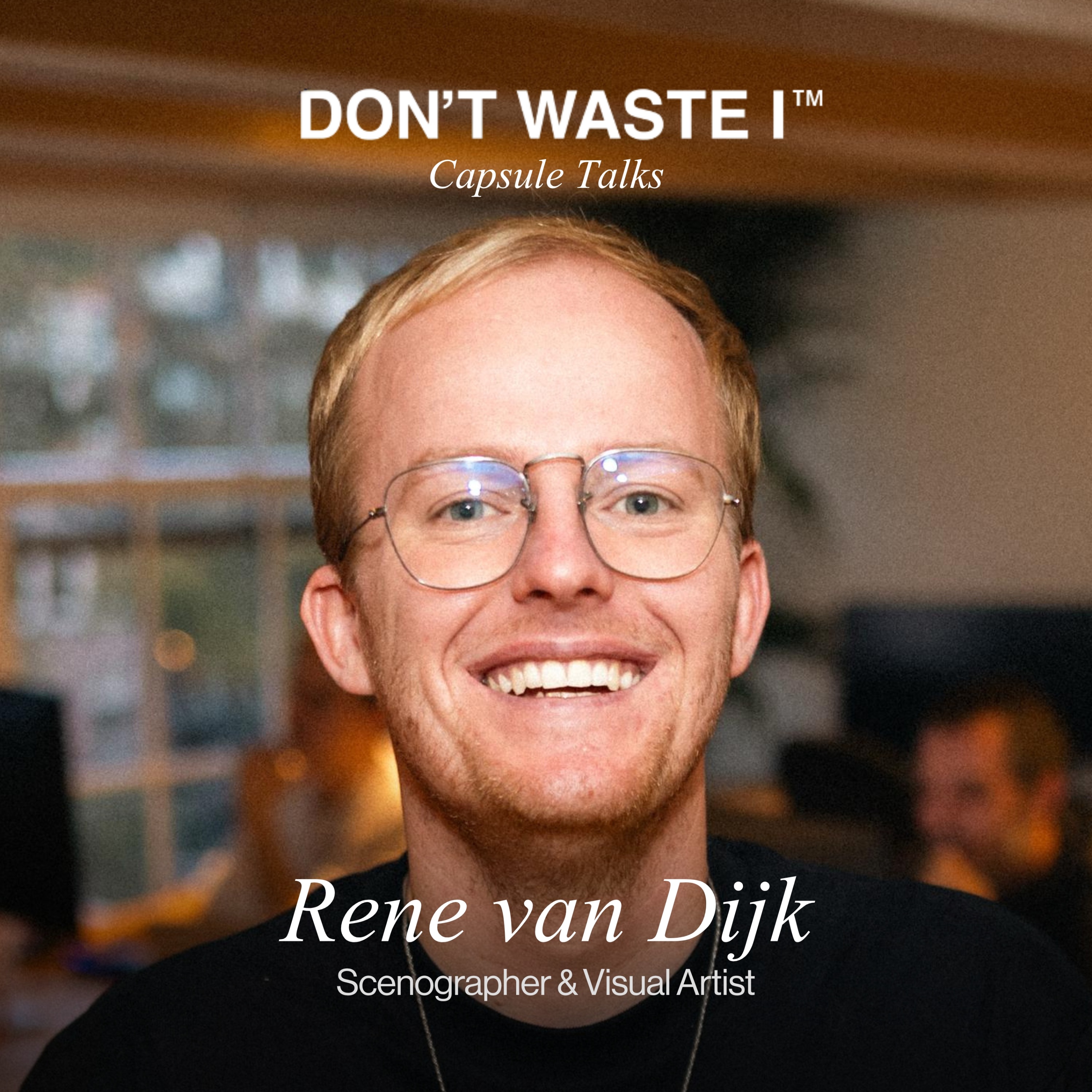
EP35: Rene van Dijk On Live Worlds: Scenography, Scale, and Decisions Under Pressure
from DON'T WASTE I: CAPSULE TALKS
50m 0s
The speaker, a visual artist and show director in the electronic music industry, shares his journey from a rural childhood in the Netherlands to creating large-scale visual experiences for major artists and festivals. Initially drawn to gaming and animation, he pivoted to live visual projection and VJing, learning through hands-on experimentation and early small-scale projects. A period of personal crisis led him to travel, including a transformative solo trek in the Himalayas, where he gained clarity and shifted his artistic focus from anger to adding beauty to the world. His career grew slowly through incremental steps and learning from mistakes, eventually leading to significant collaborations. He highlights the challenges of production deadlines, the importance of intuition under pressure, and the role of clubs and festivals in creating communal, immersive experiences that connect people. The narrative underscores themes of self-discovery, resilience, and the pursuit of meaningful impact through art.
Just take some time, you'll get there, it's okay. I'm like, "Yeah, I fucked up bigger shows than you have to. Relax with it, and everything will come." And that's also something that I'm now very chilled about. I just walked off a lot of. Behave yourself myself that I didn't like. And also, I got into touch with myself a lot more and started to really think of the okay, but if I want to make a difference, how am I going to make a difference instead of being angry at the world? Would they live in a city, but they live on that old? They don't really see a community or they don't see nature and I think clubs have the power to really make that connection. How do we go from a small intimate space where we feel safe to a stadium where we have thousands of people and we still get that experience? I think that's something that we do with this studio really well. You're listening to Don't Play Style's podcast, and I'm your host, Bastia. Every week, as you're done with designers, the founders, athletes and cultural leaders to uncover the systems behind their work. How do they communicate with themselves and the world? What are their rituals, their failures and the mental models that turn wasted potential into the losing impact? These are capsule stories, sharp, raw and built the movie forward. What happens when learning takes place in real time without the safety of pause, reset or a second take? Today I'm Joemperine Van Dyke, founder of René.studio, scenographer and visual artist working at the intersection of music, light and large-scale life experience. From rural beginnings in the north of the Netherlands to shaping visual world's for artists and festivals like Camel Fett, Charlotte Witt, Adria Tick, Tomorrowland and brands like Louis Vuitton and Montclair. In this conversation, René speaks about learning by doing, failing under pressure and trusting intuition when there's no room for error. We talk about life decision making, walking away from clients, solitude in the Himalayas and why shared experience still matters in the world obsessed with speed. Let's listen to his story. Good day, René. Welcome in the podcast. How are you? Yeah, thank you. Yeah, I'm doing really well. Can you describe where you are? Yeah, I'm an Amsterdam. Amsterdam West, just in my office at the moment. I was live-free thinking you were at the moment? I was going well. It's the end of the year. Things always slow down a little bit, which is super nice. Yeah, so, it's actually the last week of work. Mom was going on holiday for two weeks. But one more show this week and we're preparing for that a little bit. But it's all pretty chill. We don't have to work late nights and stuff, so we're doing well. Has it been chill the whole year or just this week? Now, it's been chill in periods, I would say. I think we have a lot of ups and downs. But in general, the whole year has been quite busy. But we had a lot of fun with it, so it's been okay. Yeah. Can you describe a little bit what it is that you do and what an up is for you and what it down looks like? Yeah, so I would say for origins and more of a visual artist, we're now a little bit much to you, the diggers. So you can now see that I do a little bit more of our direction and show direction. And I do a lot of operating during live events. So we mainly work in the electrical music scene. We work with a lot of artists that are a bit more towards techno. And we create a visual and light shows for them. We also do it for festivals, but it's a little bit less at the moment. I think what an uplook for me in this business is when we're able to create a show that makes an impact for the people that are watching it, but also makes an impact for the artists. I think that with our work, I think that's with almost everyone you speak to. I think we're our worst critics, that's for sure. But I think beside that our worst critics are the artists themselves, mostly or it's the management or the creative people behind those artists. I think they're in like the second place. So it's us, then them, and then I think you get the crowd. Yeah. So I think when we're in an opera, just means that the artist is having a really good show. He sees that the crowd is reacting to it. Of course his music is very important to it, but the sound is important. And when that is okay, then generally they're happy. And then for the crowd, it's more about giving them a feeling that they're watching something that is a whole. And I think creating a setting where people can dance and maybe let go of the everyday troubles of the world. So to say, I think that's when it's an up. And I think when it's a down, a down is, I would say is more bound in the three production phase of our projects where we estimate something that isn't quite right. And we have to work a lot harder to make a deadline. And I think for us, maybe it's for other businesses too, but to think for us because we have an event, we have a gig, we have a show, it should be patent. It's going to be on that day, at that hour. And there's no question about it. It is going to happen. We will never be in a situation where we will say, I will move the event a week later because we are not done with our job. It just means that the show won't be as what we promised or as good as we thought it was going to be. So it takes for us the downer is mainly in that spirit before the show of actually making sure that we get it finished. Of course, a downer can also be after a show if it didn't go well. But I think most of the time we would at least still have the feeling that we've done everything. So we can feel sad for a day because I've made some stupid mistakes in my life doing shows. But the most of the time after the day, and you could put it aside and say, "Yeah, okay, next time we can do this in this better." Can you share your roadmap where you're from till now? I'm brought up in a small village in the north of Holland. My dad had a tulip farm. So I was brought up on a big estate, playing outside my entire youth I would take. And I think it was when I was around 14, 15. I got into gaming a little bit. So I was done with playing in the mud. I was done with playing with horses. And I wanted to do gaming, but game and obsession of mine. But at the certain moment, I had to find out when the school was finishing, I wasn't very good at school. Like, I was really not good at school. But I had to choose something for what to do, what type of direction. And now I was into gaming. So it was like, I think a lot of people do that in that direction because it was quite a new profession. And I came there with the expectation of, "Hey, I like games why not to go and make them?" But I still had to make a portfolio to even to get into the school. That was the first proper time that I did something creative in my life. I think I had a few games where you could create your own gaming map, basically. So I made a few of those maps, and then I brought those with images to the school. So, hey, I want to make games. Apparently, that was enough for me to get into it. And in the first three months of the school, I was a good teacher who was like, "Hey, yeah, we can program in 3D and we can start with that, but actually, guys, maybe it's a good idea." If you want to know how a human moves or how somebody, you know, how motion is going, maybe it's good to start with a stop motion film, then you guys can explore a little bit of how you go from second zero to second ten in that movement. What do you have to do to get there, flam by flam that you get this idea of motion? So I did that and I loved that. I was mesmerized by stop motion. I loved creating tiny, because there were a manquettes back then, tiny worlds where we would have this character in and it was moving along. I loved that aspect. And that was the only assignment during the period which evolved animation in that sense. And then we got into 3D programs where we had to model our hand, and I was slowly finding out in that year that a lot of 3D artists in the gaming industry are actually working on a C for 4 years or are working on this particular piece on a character for that many years. I would say production line. And I didn't get any chances to work in animation anymore. So I switched. And in that period, I was of course, I was in Amsterdam. And I was the first time from me being outside of the countryside. So I went into clubs, I think, for people that are living in Amsterdam and bit my age was like the whole thing to do. So I think I was there every day of the week if I could be. They had some projections on the walls sometimes. Also at other parties, I went to videos from Bangladesh in the day a lot. And they also had a VGA. And because I was obsessed with the motion, I quite liked the aspect because we were making a world like on a monke and filming with it. I saw it in the literal space. So for me, a really impressive aspect that you had a room and suddenly you had a projector in it and then you were making a new world inside of that existing building. That was something that I really enjoyed. And of course, it was a beat match to the music. It went with the flow of the music. I wanted to do that myself as well. And yeah, I think I got like a small beamer from somewhere. And somebody was in a bar back in the days, 15 years ago. Somebody at the bar was like, yeah, okay, bring your projector, do some projections for all this. And DJ playing like super small scale. But I was so excited about it. I think it was the first time that I really like doing something. And apparently then I go all in. I've noticed that I do that with my life. Well, I realized that later on, but for now, I think I went all in with the aspect. I started to find small opportunities for me to project and to use video in a space mainly with music. It was very early days of projection mapping. So like what you're seeing now in China and Dubai, the LEDs freeze with 3D visuals on and they're prospectively fitting with the space. Back then, that were the first steps. The software wasn't really there yet. I think we still had almost like a use illustrator on a beamer itself and draw outlines on a building. And then we had an idea of how things were or taking a picture from where the projector was standing. I found it out much later, but yeah, it was a bit wolf, a guy that was my age. And we worked together on this. And we did a lot of experimentation. We built stages to get like white foam and to sculpt stages out of it. And then we'll project. on it. So everything evolved a little bit in that way. And it grew so rapidly, I would say, not that we made like a lot of money, but for us, it was a lot of money back then. And I think I hated school. Like I really didn't, I'm not good at school. I'm not good at following assignments. I'm not good at making homework and it was not my thing. So after doing animation for a year at that school, I also decided to stop. So I never finished it. And I decided to go straight to work and basically try and become a VJ at parties. And then we did that for a while, which was amazing. We got into building projections quite a bit, which was a super funny story in the sense that our first projection mapping on a building was actually on a black building. And I don't know for people that are knowing to use projectors. It's not a very good idea to project on a black building, but it was a new building of the rabblebunk and some sort of sustainability building. And yeah, we still did a projection. It actually went quite okay. That game was a little bit off a little bit. Let's say an opening to get into the business a bit more. So we started to project on basically everything. I think in the end, we did a commercial for Bjorn Borch to project on a shoe line that they had. Yeah, we did a lot of parties and stuff like that. And I think I was still clubbing for days a week as well with that. So the clubbing was still there. I was only working a bit. I think that was my early career. And then yeah, I think it was 24 or something. And I think I started to question a little bit about life, about how life is project, how it's conceived, how you perceive it. Like what's the point in life? It's a 24. I was like what's the point in life is it's bigger life pressure is basically that made me a very conscious person. I would say very motivated to improve climate. I didn't agree with how capitalism is basically slightly maybe destroying the world in some senses. I got to be quite political in that way. I started to go a bit more to spiritual side of things of trying to get to know yourself. And I think there again, if I do something with my full attention, we decided with the small business that we had, which was running really well. We did amazingly, but we decided to only take customers on that would actually be sustainable and would be ethical. And we didn't notch on it. I think in two or three months time, we didn't have any customers anymore. Like we had nothing because we couldn't attract any sustainable companies. Sometimes we found a charity to do something for, but we made such a hard cut. It sort of destroyed everything that we had but okay, I think that was a perfect moment for us to say, okay, we're gonna stop. And I actually decided to go and travel for a bit. So I traveled to Nepal, I traveled to Asia. And I spent some time there. I didn't do anything to create. I basically walked in Himalayas for a few months, which is a long story on itself. But I ended up in Scotland, also at the three-tatter, where I again did a lot of workshops and trainings. And I settled down a bit more where I felt I think a bit more to myself. And all the world's problems weren't only on my shoulders as this young boy of 24/25. So I wanted to do something creatively again. And I think that was the biggest change in my artistic settings. That for the first time I started because we had commercial jobs that we did back in the day. And now I just wanted to do something that came from me that wasn't linked to big brand or something like that. And I thought for me personally, the best to be creatively free, the best environment for that is still the festival of club environment. So I created a new show, owned up everyone that I still knew from back in the day. I actually wrote personal letters to potential clients and stuff. And I think I sent around 50 festivals with Kena Kama Fiji, if you guys. Eventually there was only one festival that said yes, that I knew from back in the day. I think I also did my last show with them a few years before that. And they were like, okay, if you want to do a new visual show go for it, it was with a particular type of techno, I would say it was a bit more underground. It was with DVS1 and a bit more Berlin sound and something that I loved that type of music anyways. I made a story and an official show with that. That was picked up by somebody else that did parties and Amsterdam, which were quite iconic. I would say they were called reactor and catharsis. And I did two or three years shows there. But from there, the ball got rolling. So then again, after a year or something, I was picked up by a club in Belgium, Kompos Club, which did the residency as all their official shows there. And they grew bigger and they took me along with doing bigger shows. And suddenly it was a split second. All the shows were really big and I needed more free lenses and the show got even bigger. And I always wondered a little bit of a side story. When I started working with my early careers and even now, I was getting less now. But I was always like, why am I not getting these type of jobs? For example, I wanted to build a projection or I wanted to work for an artist and I wanted to create visuals for that. And I was always like, why am I not having that now? Why am I not getting it? A few years later, when I would get the job, I would only then finally understand, okay, this is actually, if I would have got that job two years ago, I would not be able to actually do the job. I would not have the skills to actually, like I learned everything myself and there was never somebody that pulled me anything. So I only learned from making a lot of mistakes. So for me to get like an artist in my early careers, like I would have failed so badly that they would not be happy with me. So my experience or like my career path went super slow, like with very incremental small steps, where I could still make mistakes, but it wouldn't get rid of my whole career. So I think only after I went to a bit of personal development, making stuff that I really like myself, I think I got into a situation where I was working for these bigger events. We were going into the tens of thousands of people and there I was picked up in a very random way, which I was the wit as a Belgium techno artist. I was doing at Composs, I was doing their label might and I got this pack of visuals from them. So I wasn't allowed to use my own visuals and I did use my own visuals in combination with the visuals that they were having. And after the show they just came to me and said, "Hey, we like your work" and we started. Yeah, basically from there they emailed in two weeks later, "Hey, do you want to work for Charlotte?" And I think that was for me such a big account, also such a big artist to work with. But I needed a lot of skills before that to actually to do this successfully. And yeah, I worked with her for four years. Yeah, and now we're here. You mentioned Himalaya and that it was a story on its own. Yeah, I think it's a bit stereotypical maybe, but you're this backpacker and you go and travel to the other side of the world to try and find yourself. But if I'm completely honest, I think the club environment going there for three, four days, a week, staying awake quite a lot of the times for three, four days a week. I think it also with the uses of substances, of course. And I needed a little bit of a break. And at least in the city for a while, and I wanted to just see Nepal as an "Hey, the images of the Himalaya's look beautiful. I wanted to go and track and walk, but I had no time limit when I started walking there. I had an iPhone and an old one, and I think I put it on airplane mode for around six or seven weeks. And the phone was still full when it was off airplane mode because I didn't use it. There was no moment for me to wake up or to go to bed. There was no moment for me to go and walk and to not walk. And of course, I had a path, a route that I was following. But there was no pressure on any side of having to do something. And I think that the amount of peace in the periods really gave me so many insights, but also really connecting with nature and connecting with yourself. I think that maybe changed something in me. I even like just before that I trained with Wim Hof. He was early days Wim Hof and I did the training with him. I had a period of walking barefoot and I had a period of walking in the Himalayas with only a sweater on 5,000 meter high. I only had a t-shirt on basically. So even those challenges came in a bit, but you can walk off a lot of, yeah, I've seen it. I think just movement is important for your health, for every aspect of life, but I think also being on mountain tops and being able to see for miles, seeing nature so far away, I think is also very good for your mental health in that sense. So yeah, it was just a period where I just walked off a lot of the behavior of myself that I didn't like. And also I got into touch with myself a lot more and started to really think of, yeah, okay, but if I want to make a difference, how am I going to make a difference instead of being angry at the world? Do you have to be angry at the world or can you add beauty in the world? And I think that is something that I want in my work. And it's a very difficult thing to have your environmental protestor. You're off to go and kick against the things that aren't good for it, but to say to yourself that you make a type of art which is worth making just for people to see an extra bit of beauty in the world. You can discuss about this for a long period of time, but I actually think it's an important thing and I think it's maybe something that's very undervalued in our society at the moment. When is it allowed to make something that is nice for other people to look at and what value do we put on it? Yeah, basically what is it worth? What is beauty worth? It's super easy to make things to put a price on something, but it is very hard for me to say because obviously I fly a lot, right? So we get a question a lot of, okay, but you're not very good for the environment because you fly a lot. There's two things, and I help an artist to create their vision to have people and experience where they let go of everyday life. And for people to experience a bit more is also a good thing. I think my project is to try
and connect people with themselves and with nature. I could see that a lot of people are lost in the connection by living in cities and stuff like that. They live in a city, but they live on their own. They don't really see a community or they don't see nature and I think clubs have the power to really make that connection and to add something beautiful in there that stems from nature's actually a really nice thing. Yeah, I don't know if I made my point, but it's a hard one. You mentioned that you didn't have a mentor and that you needed to learn everything through failure and you concluded yourself that your career path went quite slow as it comes to growth. Could it also be that it's quite the opposite and that it's quite steep? It doesn't feel like it because 15 years feels like a really long time and I actually think if I now look at the younger, let's say the generation that's now starting lose 20 to 25, I think they have an immense amount of tools on their hands. They have an immense amount of, let's say, data that's online that you can teach yourself. There's so much of it online these days that for me, it feels that it's a bit easier to learn everything at the moment and I still don't feel that I had a lot of talent. So I look at other people that actually do have talent and they can fly really quickly, really high like I know a few people that are in the job for two, three years and they work with people that I probably cannot touch in my career. So in that sense, it feels really slow. Yeah, but it feels very stable and so that's the other end. I don't feel like I'm one day flying, that does a trick for somebody one day and then I don't have any work so I feel very comfortable with that. But yeah, I don't know, for me, it feels really long. Yeah, 15 years, yeah, it feels really long. When you talk about talent, you probably point out a creative talent. You can imagine that people who are just in the business and work with these clients that when everything goes well, there's the result. But when it doesn't go well, what is your opinion on this perspective? Yeah, I think that's the case. And I know I'm really not old-time on the 35, but I sometimes feel old in the sense that people that have been doing it for a few years and like, hey, just take some time, you'll get there. It's okay. I'm like, yeah, I fucked up bigger shows than you have show, relax a bit and everything will come. And that's also something that I'm now very chilled about. I don't have a specific job that I would like to have when I was younger, I was winding myself up. Why am I not working with these big artists? I'm really good at my job. I want to have it now. And now looking back at it, I'm like, yeah, no, you actually couldn't do the job. And that's also now for something like, okay, yeah, I would still like to work maybe with this and this artist, but I don't have it yet. So that's probably something why I don't have it. And that's okay. Maybe I'll have it in five years. Maybe I'll do something else in five years. I think that's the relaxation of it. And what we've seen a lot in the business with stability is that especially the last few years, like I always worked on myself. I was alone and I worked with freelancers. Now we're more of a grown-up studio. But for, I think if door closes, then another one opens. I think that's a really big one also with clients that we're working with. Yeah, we have a relation of clients, of course. And I'm getting a bit more relaxed. I can still feel sad if a client leaves here because that just happens. But I'm becoming quicker with getting to peace with it. And yeah, trusting the universe a little bit that something else will come there. And it's quite often the case that if you're super busy with one thing, you don't have space to add another. So you first need to lose the thing that kept you busy just to create a space to do something else. And most of the time you don't see that yourself. You get wind up with all these mental things in your own brain, but I think if you were able to look from it from a distance, then it always works like that. When you look back at your time in the Himalayas, was it wise to do? It's a very important thing, of course. It fascinates me that it's something you apparently cannot do at home. It's quite often the case that people have to leave to be able to go into that space. So I think it's important for people and was supported for myself to not be surrounded by things that I knew. It's stepping into the unknown and being comfortable with that, becoming comfortable with it. I think the first few weeks of my traveling wasn't actually that comfortable. The first day of tracking was amazingly funny, by the way, because I was with the boss. I went to the first destination to start walking and I stepped out of the boss and I brazed my ankle, but quite badly. And I was stepping on it and I was like, "I shit, this hurts quite a bit." But I was like, "No, fuck it. It's probably going to be fine." So I walked to the first village and then I couldn't walk for two weeks. So I was stuck in a village, not the main village. I was stuck in this tiny village, but there was nothing there. But I couldn't actually walk on my ankle. That was the start of my hiking in the Himalayas. So that also meant I had to really slow down. And I think that also made me aware in a really nice way, maybe aware of how, okay, if that wouldn't have happened, I probably would have walked through the Himalayas without looking at anything. And I think those two weeks of being in one place was like, "Oh, okay, maybe I should do this in every village I come to at least have a few days or stuff like that." And yeah, and I think I was a necessary, even that was a necessary step. Those two weeks, what did you do? And nothing. No, I didn't do anything because I couldn't do anything. I literally couldn't stand on my feet. I got to know local people there a little bit. I think after one and a half week, one of the guys, he was like, you know, with the best exercises for the ankle is to actually go and walk mountain. So I think he made me walk up a hill to show his school, but that was like a walk of few three hours or something. But it was a mountain, so it was just uphill. But they said that it helped. And they brought me to his spring, their natural spring. Let's go there was also a walk of I think two, three hours or something. So those tiny bits helped a little bit, even though I think, yeah, I had no clue what to do with my ankle. But beside that, I kept the journey. I kept the journey where every hour I would write down how I would feel. It's like a Buddhist practice. I did that for a few months actually, but I was quite busy with that. So every hour you would just now down and do I feel happy? Do I feel sad? Possibly, why you feel happy? Why you feel sad? I still have the books somewhere, but I've got this book full of little notes of how I feel. And I think a line of key all techniques became visible where I was still in one place. There was no external things to make me feel a certain way and still at the moment I was feeling happier than another moment. And with another moment I was feeling sad, but there were no external triggers to trigger that emotion. So I think also with that became very apparent that for me how I feel has quite often nothing to do with outside world. And I don't know really where it came from. Like why I was feeling sad to on a certain moment in the morning or while I was feeling happy. I couldn't really find a direction on it or not really like pinpointing up, okay, this is the case. But it did manipulate my emotions a bit because I could visibly see if okay, this is actually how I am from the inside. Maybe don't take too much note because it will pass. Yeah, if I would feel sad after a few weeks, I was like, yeah, okay, I feel sad now, but if I look at my diary, then we could see here, I felt sad, but then apparently I feel happy again. So it's passing. So that's what I did with my time for two weeks. And today do you know the answer about your emotional shift? No, it's like the weather that's passing. So no, I don't have it. But I think it's a bit of a, it's a bit of a muscle that you have to train. I would say that now I'm a lot less conscious about how I feel than how I was back then, but I still think it wasn't good training. I think also maybe what we're talking about maybe with the post-curses to get to try and make stuff that is for myself. And I think, yeah, that was especially for the igniting of my career very important to make stuff that I wanted to make in the way that I wanted it. And I expressed my work also with how I felt or with homes that I saw or things like that, but it was a lot of inspiration. You don't see that in I work currently, but that's okay because I'm quite happy and I don't have maybe so many mental problems. So yeah. What did you unlearn or let go of in the Himalaya that moved you forward to the point of today? So kids, question actually. We'll get back to that. So they're unlearned, Jesus. That's a note. Do you feel responsible for this generation and the next? How would your answer be different than when you were 24? Yeah, I think then I would really wanted to solve it. So I think that was the problem. I felt that I had to, yeah, I really solved the world problems. And I think now that's not so much the case. Now I hope that I found out in one way, but it feels a bit sad, but the more way I found out that I cannot solve the world's problems, that's for one. I think that's a big one to realize, but you can still do your best to be a kind person to do the small things that still be there. So I think that's maybe reflecting in my work a little bit or at least with the clients that I have, yeah. That's hard one. How did 15 years of music and night life shape you as a designer more than formal education could? I think to understand spaces and see how their work you have to be in them. I think to understand music on an event, you have to be in them. For me personally, I am unable to learn anything in class because it's not practical. It's not in the real world. So it doesn't make sense. I also, I cannot learn from textbooks. So I have to experience things in life. And then I will understand how it works. For me, it was very important to experience the night life to see hundreds, I think, probably now thousands of shows to be in a club three, four days a week. Even though I wasn't working in it so much, it actually did help a lot in how I experience spaces, how I would feel at certain moments what would trigger me in specific times at an event that knowledge of just being an experiencing is super helpful. And I think that's still something that I carry with me now is those early days of, yeah. because now in the events
are super big, right? We're now talking about the produce shows for 50,000 people or a two-monger's but the experience that you're having to be in a small club with 300 people with just one strobe light and a DJ, then there's a gathering of people that everyone wants to experience. But they also want to experience that when they go to a giant concert with 10,000 people. So it's trying to translate that bit. It's also very specific to how something is looking because obviously I've got a VJ background. We make images for events later on we started, I started to do more set designs and with this set designing we're able to shape the space. So we're able to use video in the space and light but quite often very early on already in the designs it was more using video as a light source. What I liked the most about my work is that when you are having a screen in the space you can see the reaction of the people. That's the same with when you're a music artist, when you play a song in a space where you have a crowd you see the reaction and that's something that I think is very valuable. Instead of somebody sitting at home watching a television and watching a commercial, if you're into commercial making you never see the reaction of people, it's played on their personal device in their own space and you're never there. And I think being in a space where you're chasing the space and you see the reaction of people, that's something that I love the most I think. But if we then bring it back to now, like what I find fascinating is that we now are using video in all shapes and forms like super long or whatever and you can play with light sequences above ground and just with color we can set a tone in the space and communicate something that we like and give an intensity or give a vibe to it. And it's not so much about me trying to find a video of somebody standing on a mountain and looking at sunset. If you put that on the screen in a rave, that's not giving you that much of an emotional link. It's much nicer if the setup, the set design is dissolved in the architecture of the space and you can still give that feeling of somebody that's on a mountain looking at sunset. But you don't have to do it by setting the image you can just do it by colors and by intensity and stuff like that. What project defined your early confidence and which one nearly broke it? I think the confidence we had an event in Belgium, it's called the rave levels. It's for like between 15 and 20,000 people. And I think that were one of my first really big shows. It was a concert hall on the space so you could hang in everything. Also the budget was so huge that you could basically come up with any idea and was probably possible. So it was a lot of LED screens. It was very technical because of course I like to make images but at the same time we have a lot of technical entities to actually operate all those screens. But those shows went quite well. And I think that's where I got the compliment that we actually beside be creative and making videos and coming up with ideas for the set design and stuff like that. We could also execute it technically. I feel we can actually hold those things. And then there was a show with Charlotte with where we were meant to, yeah, I think we were working a year together or something. And she had a big signature show closing, Brooklyn, Puppet Belgium. It's her hometown or home country. I think it was the first time that she was closing her main stage on a crossover festival like that. And I think everything went wrong in that show that could possibly go wrong. And after having really big shows that went so well, having a show where like it wasn't necessarily anyone's fault but we just had technical equipment that wasn't working. It was so simple as that. But I think in total the music was maybe off for 15 minutes. The visuals weren't in sync anymore. They had that went wrong. And then the day after, yeah, we were all super upset but luckily the team was super super tight so we drank it and waited to say on the night itself. But the next day we still went to the festival. And then to see shows that actually went really well, that was mainly the most difficult part. Then be in a space the next day to just to see shows that are amazing and go at things that was difficult. And once again, I think I made a lot of small mistakes just for me to learn. And I think I made really stupid mistakes. It didn't break me but it was just super stupid. Also again with Charlotte with so I have to give Sean credit also for the team. They gave me a lot of space to sometimes make mistakes. But the failure that I was the most embarrassed about we did overdrive tour which were like returning scenes. So shit cool. We already did a season with it. And we were into our second year of doing the show and we made a new show and we went to Mexico and the show is starting and everyone is pressing play and she plays a trick. And all those screens were on black because I put like a frame in the first check of the show for me just to know the screen from because I was a bit scared. And like I had screens are not on so there's something on and the opening of the show is important. So I have a lot of stress with trying to find out why the LED screens weren't on. So we were checking cables and we were having communication with people on stage to say is there anything in the process and what and I was checking my outputs on the computer and it all seemed fine and stuff like that. But it was just a master fader on the video output. So something very basic that you have a bestie zero to 100 videos on videos off. I put all the screens off before the show because else sometimes if I click on something wrong on the software then you would have seen it on the screens. Then one that sort of turned that off. But yeah, the beginning of the show you do have to turn that on just to see video but it was just a fader on my media controllers. Something very simple, very basic. And I think that all in all took four minutes or something. So there was four minutes of no LED screens just because I just didn't look at it. Yeah. But yeah, it should happen sometimes. That's the thing to make things. Listen, leave me. When these moments happen, how do you communicate with yourself? Luckily, you're in show, right? So there's also no time to talk about it. The only thing is that I felt really embarrassed and I put the faded up and I think I actually said because they were like, oh, the screens work again. And I think I actually made something up. Yeah, was something technically in the computer that was wrong. And I think it was only in the evening, maybe even later that I dared to tell anyone to say, yeah, it was just like a fader that I personally didn't put up. It took me a while to tell that. But yeah, for myself, you were operating at that time. So you don't have time to think about it. So that makes it super easy. It's okay. There was a problem now. It's solved and that's it. There's no other thoughts possible. It's one of the jobs where you're in such a hyperfocus doing show. That's it. Yeah, makes it really easy. Afterwards, I just felt silly for a really long time. Yeah, that's it. You are in a hyperfocus at such a moment, but I can also imagine that a lot of people in your shoes would have frozen. Yeah, I don't know how other people would do with it. I also once made a call with Cord Challa, also with Charlotte. Technically, something was not right. And we had time code that was not running. But it's an hour and 15 minutes for the show. And we would brief that if the show wouldn't start on time, it would just go off our set. So I made a judgment call at that show. It was the first Cord Challa show where we didn't have time like either possibility to have everything time coded and that possibility to do everything life. And the time code wasn't working. And the show had to start. And I made a decision to the technical director's and stuff of came just start the show. And then I started the show manually, which definitely wasn't the best solution, but for me, it was more important to start the show to do the entire show because I also couldn't think about myself, "Hey, I'm gonna have this fixed in five minutes, ten minutes, or thirty minutes, or whatever." I had no idea what the problem was. So I had no estimation of how I could get it fixed. So yeah, I just started the show. But we had a discussion about that after which with the team. And they felt that I should have just delayed the show until the problem was fixed. I was more of the feeling of now we should just run the show because else we would have less offer show like we would maybe miss five or ten minutes, which meant one or two tracks in the show. You're very in the moment you have to make decisions. And you just do it. And sometimes people agree with it. It's sometimes not, but it's not really an option. I don't think it's for many people possible to freeze or to become in the size of I think you're not in this job anyway. If you have that ability to say to not make a decision, yeah, it's not possible. What is the moment when you felt generally proud of yourself? This is quite a nice thing. I think I felt proud on many occasions to be honest. I've had a lot of shows where I felt proud. I think I'm quite good at being excited about my own success. If it goes well, you already have a crowd which is super excited and happy with the show. But it's not that you're sitting in an office and you finished the video and you delivered it to a client and then that's it or whatever. And then having to open up a bottle here, you've got a crowd that's in a party mood. You've got an artist which is super happy. So then the hours after that or the day after that is super nice feeling because it's very team orientated. And yeah, everyone gives a hug, which is a bit more like a band. So that makes it very easy. And then the day after you get the videos or you get the edits from the camera people and then you're looking at the feeders like, "I had it looks nice." That's actually celebrating success happens a lot in that sense. This shame is, yeah, if it doesn't go well, then of course we maybe celebrate a little bit less, but in general we do the lots. For example, this year we did a show in front of the pyramids in Giza. I think location-wise, there's nothing cooler. Although the venue was a little bit off of the pyramids, you could still see them super clearly. It's a very surreal place to be and to do a show with. So I think that's one of my fondness memories. I think it was also really could show it was a new type of show then.
we did with the Atlantic. Yeah, that was super nice. But also with Charlotte, with close lowlands, of course, in Holland, because I'm from Holland's lowlands, was a thing, was also super nice. Technically, we had a festival in Belgium where we were doing something very technically advanced, where we were tracking lights behind the screen and the lights were on motion. They could go left so right up and down so the LED was transparent and the visuals were in sync with the lights that were going through the LED screen and we think that the visuals were moving with it. Like for us, that was a massive celebration of something that we worked on for a long time and we made it work. So I think I can easily call up 100 moments that are super nice for sure. Yeah. When you create for DJs like Camel Fett, Charlotte DeWidt, Adria Deek, festivals like tomorrow land and luxury houses like Louis Vuitton, how do you keep your artistic voice in tech across all these different clients and what is something that people never see or talk about, what you do? Unsensifficult question. Because it's quite a broad spectrum of clients that you just mentioned and I think for some of these clients, we have maybe less of an artistic voice. I think if you're looking at luxury brands like Louis Vuitton, we are working for their vision because they've already got a very clear one and I think we are executing their ideas and with that, we're really trying to make what they want. And that is completely okay because it's still super high, it's super difficult to make somewhere super proud of being able to do that. But I think our strong point many comes from being super flexible and being able on a very last minute to create stuff. I think generally our clients are always coming with us, quite last minutes with problems and where the ones that can solve it. So I think that is something that we have. And I think for the unseen part of the collaborations that we have with artists is in a way, I think that is the question that everyone has is trying to find out what somebody wants. Of course, like if we're talking about an adiatee or a Charlotte, we are helping them with their brand. It's not that we are having our own artistic practice and that we want to sell our own product. Like we are making sure that their brand, their way of communicating during events or whatever is suited to that thing and that they're getting uplifted and that they're becoming bigger. And I think that most difficult part is to like if we talk now about an apple, then my apple in my mind is already looking differently than your apple. Maybe you're thinking in words and I'm actually already having a green apple inside me. But when I'm asking you the question again of, Hey, do you want a green apple? It might be that you're wanting more with scratches or with a leaf on top or something like that. The unseen part for us is to find out the stuff that people don't like and most of the time clients only find out what they do like when they see something that they don't like. So we do a lot of R&D and presentations just to get to the bottom of what they want and that's the most difficult part. Unfortunately, we throw away a large amount of stuff that we make. I think also for us to try on an adiore and to see what works and doesn't work. We're already a few ideas further. Sometimes we can be spot on. I'm walking outside. I've got an idea and we're sketching it out and in a day there's this plan of a set design and we're giving it to a client and they're super happy. But I think from the outside what also happens is that we're maybe on idea nine or idea 10 and we're still not there. And I think that this stuff people don't really see and that we don't really get to talk about. Having human skills with a studio is very important. Being able to communicate with managers which have a different opinion or different thoughts than to maybe have an artist themselves different end goals so to say. So to being able to talk in different languages to find out what they need. What do you do to refill your creative energy? Silence, exercise or something else? I don't think it's like it's ever empty. The gate of the doesn't go away. I think you just have to maybe find times where you're not doing it so much but honestly like repetitive stuff really works for me. Go and do accounting or something like that, something that's outside of creativity that's something that I do to give it a bit of a rest. And I think what is important. I don't schedule any times to be creative either. Especially with creating set designs and stuff like that. It's when I get an idea. It's not I scheduling but choose day morning 10 a.m. to have an hour of brainstorming on a project that's not working. So I don't do that at all then if I don't have any ideas where I don't feel like working then I just go and do some other jobs. I don't really have to refill my creativity. It's there. You just have to find the time when it comes out. Do you have daily rituals or routines that keep you grounded? I don't. I go very well on not having a daily routine. I get more really easily when I'm daily routine. I think pale technologies where I try to think so I take a get a bit scared if this too much. If it's not there. Yeah. I go daily well and have them to take a fly early in the morning and have them to go to the other side of the world. I really like traveling as well. I really like to be on the roads. I really like to have every day a bit different. So yeah, the routine is not very. Apart from my sleep, I sleep really well and really long. So during the week if I don't have shows I quite easily can go to bed at like half past 10 11 and wake up at 9 a.m. 12 hours of sleep is amazing for me. I think that's maybe also why creatively I'm doing quite well because I have a lot of sleep. Shall we do some do or die questions? Yeah, cool. Yeah. Are you more rational or emotional? Emotional. Are you more on strategy or intuition? Intuition? Talker or listener? Oh listener, I think. Hope. Team sports or individual sports? Inregials. Trust you've got instinct or follow the advice of a trusted mentor. Oh, that's changed a little bit lately but I do still really go on instinct. Work with a highly talented but unpredictable team member or a less skilled one but reliable. Less skilled one but reliable for sure. And why for sure? Having to be able to trust somebody is worth everything. Skills is something that people can learn. The character is something that people have for a doubt. Yeah. Push for radical innovation in every project risking client relationships or adopt a more client-friendly approach that might stifle the innovation. We go for the first one. Pioneer an untested innovative method that could redefine the industry or perfect existing techniques. I think the first one. Which one truly drives your work at its core? Nature or technology? Okay, can I make a split for this? I think the studio is very much on technology at the moment. Personally, it's nature. Bigger spectacle or deeper emotion? I would love to say deeper emotion but at the moment it's spectacle. Thank you. Those who are the do-o-die. What inspired you lately and why? I think I'm lately really into looking at a lot that light fixes itself but it's especially on Instagram. I think just product in a more provenance space is something that I get my inspiration from now. I think actually architects and interior designers are obviously really good at making this space hole and I think we can still in the event industry a little something from it because they work a lot with small details. It's very micro light from us. Everything is very big and very from a distance but it's actually really nice to get inspired by somebody that puts in attention on where a screw is placed and I know it's not a lot to do with my work but it's an amount of detail that's in those products that fascinated by me. It's a really nice thing at the moment. Do you have any dreams? I would still like to work with a big artist like Lady Gaga or something. We are now working for very electronic music artists mainly DJs that are on stage. There's not a lot happening of course so we need to show it down it. But one of the dreams is that we would like to work with a musician or a band that has a very multi-faced show where there's dancers. There's outfit changes. There's a story that goes on in the songs. That's something that I would still very much like to work in because the depth of creating shows like that feels for me somewhat more complex because working with a team where you have to have all those small sort of show cues. Yeah it's something that I would like to do and of course shows like Lady Gaga and stuff are amazing and at one point it still be part of those shows will be amazing. Someone likes to have the Lisa? Yeah exactly. Yeah like that or a London grammar or a bit more bite. Yeah definitely. Thank you for today, Enne. Thanks. Cheers thanks for inviting me. That was my conversation with René. What stays with me is his understanding of learning as something that happens inside the moment not in hindsight, not in theory but under real pressure with real consequences or in pure silence of nature. His story shows that growth doesn't always arrive when you expect it but often arrives deeper because of delay, solitude and self observation. A reminder that intuition is built through repetition. That responsibility is earned slowly and the beauty and emotion still matter especially when everything is moving fast. If this conversation resonates I have one small favor to ask. Can you please rate the podcast and also share with one person in your world who really needs it right now? That's how these stories travel. That's how we skill creative impact together. Thank you for listening and till next week. you
Podcast Summary
Key Points:
The speaker transitioned from a rural upbringing and early interest in gaming to becoming a visual artist and show director in the electronic music scene, creating immersive visual and light experiences for artists and festivals.
A period of personal questioning and travel, including a transformative solo trek in the Himalayas, led to greater self-awareness and a shift in artistic focus toward creating meaningful, beauty-driven work rather than reacting angrily to the world.
The career path was built incrementally through self-teaching, learning from mistakes, and starting with small-scale projects, which eventually led to major collaborations with prominent artists and large-scale events.
The speaker emphasizes the importance of intuition, learning by doing, and handling pressure in live events where there is no room for error, while valuing the power of shared experiences in club and festival environments to foster community and connection.
Summary:
The speaker, a visual artist and show director in the electronic music industry, shares his journey from a rural childhood in the Netherlands to creating large-scale visual experiences for major artists and festivals. Initially drawn to gaming and animation, he pivoted to live visual projection and VJing, learning through hands-on experimentation and early small-scale projects. A period of personal crisis led him to travel, including a transformative solo trek in the Himalayas, where he gained clarity and shifted his artistic focus from anger to adding beauty to the world.
His career grew slowly through incremental steps and learning from mistakes, eventually leading to significant collaborations. He highlights the challenges of production deadlines, the importance of intuition under pressure, and the role of clubs and festivals in creating communal, immersive experiences that connect people. The narrative underscores themes of self-discovery, resilience, and the pursuit of meaningful impact through art.
FAQs
René is a visual artist and show director who creates visual and light shows for electronic music artists and festivals, primarily in the techno scene.
He started with an interest in gaming and 3D animation, but switched to visual art after discovering stop motion and being inspired by projections in clubs, leading him to become a VJ and projection artist.
He traveled to Nepal and walked in the Himalayas for months, disconnecting from technology to gain peace, connect with nature, and reflect on how to make a positive impact through his work.
An 'up' is when he creates a show that impacts both the artist and the audience, allowing people to dance and escape everyday troubles, with the artist having a good performance and crowd reaction.
He learns from mistakes, viewing them as incremental steps in his career, and after a show that didn't go well, he reflects for a day and then moves on to improve next time.
He believes clubs can connect people who may not see community or nature in cities, creating shared experiences that foster a sense of belonging and beauty in the world.
Chat with AI
Loading...
Pro features
Go deeper with this episode
Unlock creator-grade tools that turn any transcript into show notes and subtitle files.
 PodcastTranscript AI