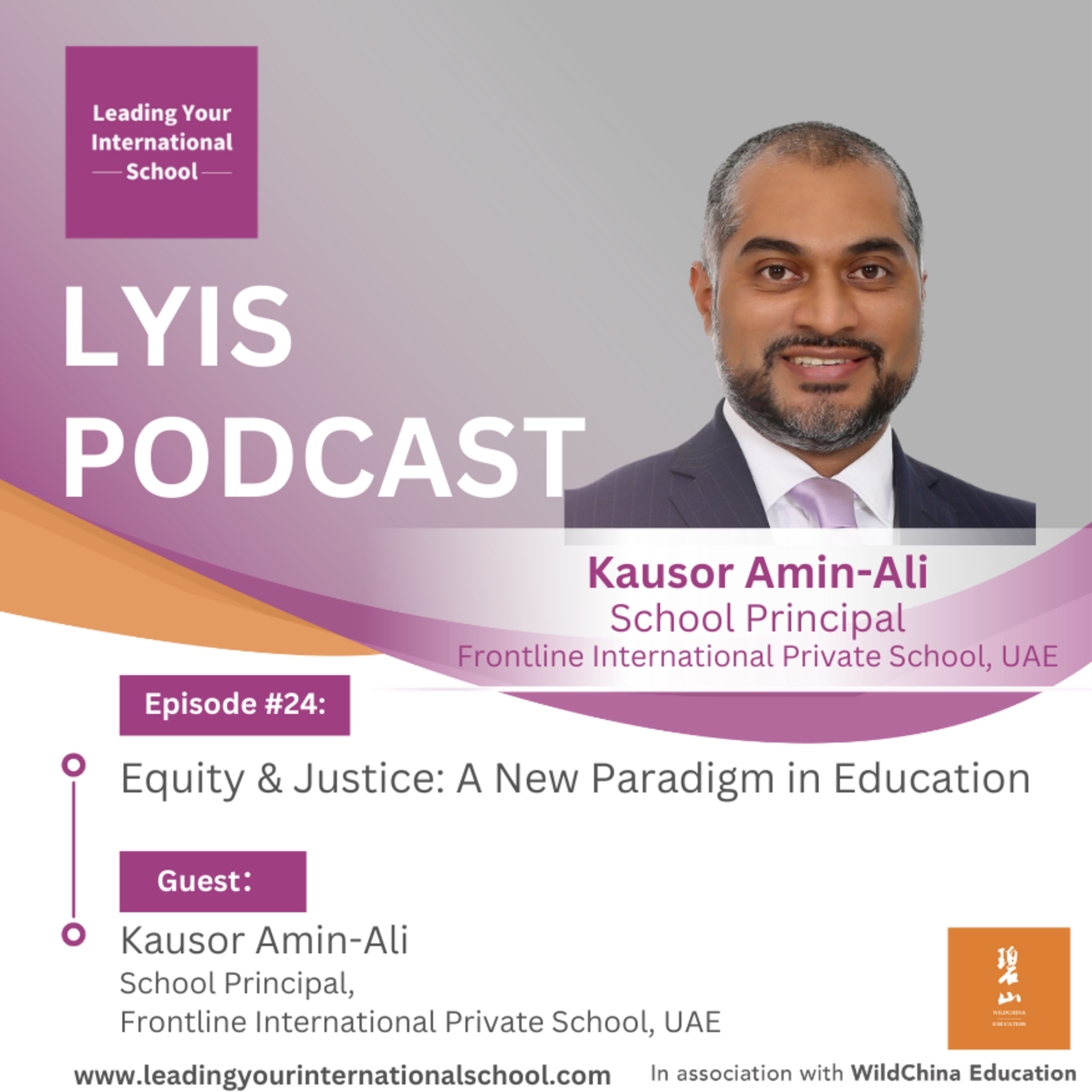
Ep24: Equity & Justice: A New Paradigm in Education
from Leading Your International School
47m 42s
The podcast features a discussion between host Barry Cooper and Corsor, principal of Frontline International School in Ajman, on equity and justice in education. Corsor argues that Diversity, Equity, and Inclusion (DEI) has become too broad, advocating for a focused approach on equity and justice. He highlights significant underrepresentation, particularly in school leadership, using UK data showing that while 26% of students are from minority ethnic backgrounds, only 4% of headteachers are. He attributes this to cultural preferences and unconscious bias in hiring, which create barriers for qualified candidates.
To address this, Corsor stresses the need for intentional hiring to reflect the school community, greater data transparency, and a genuine commitment from institutions to practice what they preach regarding citizenship and values. The conversation also explores building authentic school communities through cultural literacy, such as correctly using names and understanding their meanings, and engaging sincerely with parents and staff. The goal is to move beyond superficial diversity to create inclusive environments where all identities are valued and represented, especially in leadership roles.
Hi, I'm Hannah Kim and I'm delighted that while China education is working together with LYIS to bring this wonderful podcast to the lives of leaders across the world. And while China we take learning beyond classrooms. Good morning and we're recording. Welcome to leading your International School podcast. My name is Barry Cooper. I'm here with Corsor who is the principal of the frontline international school in Ajman. So today we're going to be talking about equity justice. And I'm going to let Corsor do all of the explanations here because there's something I'm super interested in. I think there's something that's absolutely vital. But before I go any further, Corsor, could you give us a brief pen portrait of where you are and what you're doing at the moment in the UAE? Sure, so I'm just going back one step to the UK for me. Qualified as a teacher of mathematics in 2003. My sports and study came bridge from our PC. Then spent the best part of 12 years in Yorkshire. I mean, she'll be a long-caster, understanding Blackfoot and a very brief student in Nottingham. And then in 2015 came my team to Dubai and there's leadership roles with the heads of schools and principal of two schools. And from August 23rd, our principal of my current school, frontline international school in Ajman. So Ajman, for those who don't know the UAE, this is always a great thing to kind of get people's heads around. The UAE is a federal society with seven different independent Emirates within it. So Ajman is, do you want to explain where Ajman is? Because people all know Dubai. Do you want to explain where Ajman is in relation to Dubai and what the differences are and what the similarities are maybe? Ajman, I understand, is the smallest by I believe population or by land area, one of the two. It's the smallest by one of the criteria. It sits north of Shahjid, a centre of Shraddibas Shahjid, to the north east, I guess going up to the geography. And then from Shahjid to Dubai, I'm in Abu Dhabi. So on the coastline, it's on the coastline, there's such an inland enclave. It's about 30 minutes, 35 minutes north of Dubai, I would say about 25 minutes north of Dubai airport. So it's easy to get to. But what's its characteristic like? What's it like? Because people all know the tall towers of Dubai. Is Ajman the same or is Ajman kind of very different? I would say it's still quite traditional, more low-rise buildings. There are apartment blocks, but on the whole it's more low-ranked and more spread out, I would say. It's probably an emerging economy with a black way to describe it. The schools are working more closely together in the last two years. But previously it probably worked more in isolation. As low-blane, it's just the way the schools set up over different time spans. But 40 schools in Ajman, about half of which are British curriculum, and 1 IB, the others are basically American or Indian CBC. So yeah, it's emerging, I guess, Emirat as such for schools purposes. That said, there's high demand. Schools are very affordable and therefore people are moving from Shahjid to Ajman. That's been the demographic trend as with the households that we seem to have at least. Amazing. It's an Emirat I was in Dubai for two years, but it's an Emirat I never actually got to. So it's going to have to go on a list. So we're going to talk today about equity justice. This is on the back of an article that you wrote a couple of months ago about where you see DEI going. Do you want to try and explain your general thoughts about what equity justice means and we can maybe dig into it a little bit further? Sure, because the reason why I've been saying particular is that DEI locally or recently or even historically, has perhaps got a broad range of privacy, but therefore anything in everything can be classed under that. And this is my whole point about it can become so general or so much that everything cleared about D4 and therefore everyone's got a particular perhaps issue to address. I'm trying to narrow down to actually what are the two issues that stand up for me and equity and justice go together and want to say that I've served two separate purposes. Equity for me is actually in terms of looking at the work force, you might say, one example of equitable representation. So for example, the certain demographic in the teaching workforce, I would argue it should reflect further up in school leadership and in principle, and headship. Particularly when it is an agenda, I've been quite vocal, I guess on LinkedIn at least and on other platforms, of sharing my thoughts on data. Mainly based in England, in the UK, was more transparent data, but my wider plea that the data should be available internationally as well. I'm looking at underrepresentation, particularly in gender and ethnicity. Well, it's very important for most recent posts of showing that actually gender is actually better represented in school leadership, still underrepresented, but there is an ethnicity where if you are perhaps non-white, black Asian minority ethnic in the UK, BAME as it's described, you are very less likely to become a head teacher or deputy head. And for me, this is a wider issue for the demographic, it's getting in the England context and where 26% of the pupil population is classed as non-white and from the most recent census. I think it's around that versus 4% of head teachers are BAME. So there's a massive discrepancy for 26% on average in the classroom, obviously in some cities, might be more than that, but less in other parts of the country. But overall, 26% children, just around 10 to 12% of the teaching workforce and yet in your 4% in headship. That seems to me to be crazy. We're not statisticians, we're not politicians, you know, in terms of what's your take on why that number is still so small? What is it that institutions are not doing right, that governments are not doing right, that societies are not doing right, that it means we're not seeing that kind of representation. And we can get on to why the representation is so valuable in a bit. So I would say actually there's a lot of them legacy issues to begin with. By definition, there's the somewhat argues unconscious bias, I would perhaps say cultural preference because it's not really unconscious because unless you're sleeping or you're perhaps, you know, there's a chaos in a boxing match or a martial art, you're actually knocked out and said, yeah, that's not your unconscious. And therefore, I'd argue that's probably unconscious. So that is uncultured bias, probably an excruciable cultural preference. And we're deep, but we associate with who we want to associate with. And if I'd be for your preference, if you want to work with, and they perhaps the payments, where the former association, we're either under within England and even the expat community overseas, with Northern English community, who's just together and the certain English community, even so to separately. So even that micro level is a preference and with that then ultimately there's a high risk of bias and both in association in a professional workplace. And expanded out into the industrial school scene, I'd say, where data isn't available to fair, but in terms of observation from visiting schools, websites and meeting people and appointments that obviously happen to be dispensing, 10 years, been appointed by who and where. And in my, and in my view, each of this stage is there is a trend towards having a preference towards people, perhaps you associate with and that therefore is, it might be, and it's a needless for them, but barriers for the other applicants, you perhaps won't have an equal or fair opportunity to apply. So, so how do we, how do we beat this, this cultural preference, how do we, how do we shift thinking from, from, I mean, and this is what we do as teachers all the time, we try and get people to think, you know, I would never tell someone what to think, but you always want people to think, how do we get people to think differently into perhaps see why they're missing something so incredibly valuable as part of their institutions and their, their, their, their communities. So, I think it has been some intention and clarity of thought and begin from the hiring aspects, also reflection on the school community, what are you trying to achieve here? The intention within national schools is most of the fixed term contracts, so their own commitment might end up for two years, four years and so on, so where's the commitment to grow something long term and sustainable? That's one issue I think should be challenged within some governance framework, of some obligation to reflect the school community serving ultimately. There's a cultural detachment from some schools, perhaps the more established schools, who have a very much, this is how we've always done things and it's one of the expectations of success and planning in certain direction. But I would argue generally speaking, looking certainly within the perhaps in the Hameena region, I would say there's a genuine disconnect between what's expected in leadership and perhaps what the school community is, and there were wide issues around parents who were coming to a bit later, but what they expect, but that's the, for us as educators, we should be changing the narrative, they want to go into citizenship for our children, they should be sincere about this, this is my whole point about why EJ is so passionate and so passionate about it and why I'm so important that we must really practice what we preach. So I think it has to be some intention to begin with the first thing, to have that change, awareness of the look of the school community, and an idea of what do you want the children to become? Otherwise you could be trained in an image that actually the aspiration to be successful is to be Western, whatever that may mean, or to a certain persona or a certain name where you see anger-sized names of certain types of people, perhaps Eastern or Global South Heritage, just to adopt and fit in. I mean, you see that whole training is something I would student that university 30 years ago to share my age, and certainly I would say there for 30 years on, obviously jokes aside, it's still happening. So there's that sort of wider cultural issue of social construction of actually what's to be authentic and to be proud of who you are, not what you're trying to aspire. Just be some content.
Or it's actually hard getting priority to a new language, which is a principle of the front line school in Ajman. We're talking about equity justice. For equity justice, I think this all starts right at the beginning in terms of how we relate to people, doesn't it? We had a conversation before we started recording about your name. Is that an important thing in building a school community in terms of how you use names and how you speak to people and how you. Is that the gateway into trying to make those connections? I think it's the authenticity in some of the buzzword online, but what does it mean? It means it's been through you are, since you're blogging, since you're through you are. Whoever you are, that's the whole point of taking into that school. You bring together the whole community and you learn from each other, different value approaches, different systems. And so a name for sure is a marker of how perhaps it can be pronounced or mispronounced. But certainly beyond that, I think even the meaning behind the name, I think that's in self-sufficient, perhaps a different community, this significance of a name. So the name certainly is one indicator, which I think becomes sense of tolerance as well. I mean that's the other thing. And values we practice through our school community, to our students, to be practicing in ourselves, in our colleagues and our workforce. So yeah, a sense of name starter, we have a sense of purpose to find out about the person, name tree facts about each of the colleagues. And you can do that, you know, and that's sort of an icebreaker. And that's just for a cheesy staff, CPD, that he, perhaps the, you know, have a sense of sincerity to find out who these people are, what's their story, what's the narrative. That's also what drives me to school, leave that to find out more about people and put the person first where I would then the title. In terms of, I mean, I found, you know, when you were talking about, when we were talking about names, your name, now I can't pronounce the Arabic word, but your name is based on, so, Corsor is based on an Arabic word, which is the name of a river in paradise. Yeah, Colta. Colta. So it's, I mean, I think that's brilliant. In terms of just the understanding of where this comes from. I remember working in Dubai and the head of Arabic jokingly decided to refer to me as Abdel Barry, because Barry is very similar to one of the names for God within Islamist tradition. And I just thought that was fantastic. And I think that's when you have someone who's willing to kind of reach out and go, actually, this is quite funny, and I'm going to, this is what I'm going to call you. It opens a gateway into, into more understanding, especially from kind of someone who looks like me, you know, giant white western guy who's really not sure what's going on in an environment that is, is very much, you know, kind of the emberids. How, you know, if you were going to have a young teacher in front of you, and you were going to say, look, this is how to try to build these bridges and try to understand where you are. What's the kind of advice you give them, especially if they were coming out to, to Ajman? Yeah, so I would say, and Papa is going back to my point about the values in the culture of the school. And that's so important, actually. Where's that fitting that has a new start and the fitting for that community? Because two easy, easy just to do your job in the classroom, then go to the staff room, and then go back to your almost ex-bat life, where your culture detached from the extra community and just almost doing your job for the sake of it, and was clocking and clocking out, and that's very cynical. That's an observation that I've seen that some of the schools are working previously in Dubai. And I think certainly this is the biggest risk, and that's probably the fact that the function of the role of being a teacher should be married to the culture of the school and the wider school community. I think that's where schools that do it better are more conscious, perhaps having more of a pastoral, Kevin Garnes' role, where every teacher might be a form tutor, for example, will have to meet parents of perhaps English might be the first language, with interpreters. And that sense of actually, we're here for the children, but there's ways of demonstrating the care through our general professional standards that we're here for the new year. You can't be the children there, attainment, achievement, the tenderness, their behaviour, learning, who actually engage with the parents. I think parents who engage will be a key, and not for the media, new start member, but for the first term, have the sense of almost like an awareness of what's the parent community like, and that can be achieved by even giving them duty, end of their duty, seeing the parents that are wired, they climb to them. You know, it's a culture multiple, but as bridge we used to queue up at the community much as bad straight in and demand the child be brought to the front of the queue. So getting used to that, I think that's also just an interesting year. Can you please wait, can you please make my done, and they're like, well, why are you asking me to wait? I've always been taking my child first until this year. So I think that sense of almost that intrigue has to be there from the staff members, most of the school to facilitate it, that go out and find out about the community, but have sense of intrigue, I think it's also a very important aspect. So that's just the sunset and front, black, the, you know, there's a perhaps of cultural immersion for sure, and cultural literacy, so I'm going to come up a bit later. Good morning and welcome to Fushan Eaten House International School. We are thrilled to host this incredible event right here at Fushan Eaten House on the 28th to the 30th of March. This year's theme, Leadership Opportunity perfectly reflects what leadership means at Fushan Eaten House, creating opportunities for swing growth and inspiring change. Hello, I'm Mr Oatley and I'm Principal here at Fushan Eaten House International School. I am so looking forward to the LYIS conference where we are going to have all of the established leaders from around the world assemble here and share best practice with one another. Myself, I'll be running a session on customer service, a term that you don't often hear in relation to the education world, but one that is at the heart of everything that we do. So I'll be offering a chance for leadership to reflect on their own practice at their school, as well as think about areas in which they are able to improve upon their current practice. We'll be talking about service leadership, communication, dealing with parents and so on and so forth. I'm so looking forward to not just running the workshop but from learning from the expertise that is coming into our school. See you all there in March. So, well, let's dive into cultural literacy now. I think it's a really important, I believe in work in Spain and for me, kind of learning the language is a big part of that. I think trying to understand the art, the tradition, the culture, the literature, my children attend a Spanish school and they speak Spanish at school. And they're Spanish as far better than mine. My advice to anyone is get your kids into a bilingual school early and give them bilingualism, tryling with them, I think it's a super power, frankly, especially coming from the UK. I don't know if you grew up with more than one language but I certainly didn't. And people who had two or three languages regarded something almost supernatural in the East and the London. So I suppose it's, I think it's three people, isn't it? So how do you build cultural literacy for parents, for students and for teachers? Is that process different for each one of those groups or is it the same because it's a community? How would you go about it? It's different, but it's different with a slightly nuanced, I would say. I mean, maybe take it in the audience and say that the parents, I would say, be aware that the staff are qualified staff in front of you. Often there's also a parent perception, which probably promotes racist structures ultimately. There have been certain parents and ordinary perhaps the white teacher is more of higher value or did be more qualified or competent than perhaps some of these non-white. And I've had that from over experience as well as in direct experience and even further on the leadership and the surprise team is pretty sporty again. Are you qualified as a principal? Of course I'm qualified. And that sense of parent prejudice, which again probably comes from a wider cultural challenge in the Melbourne and Households or the community. So that's the first time I would say that the staff pointed out that the best staff for their children in the school at that time. So this would be overcome that barriers and the parents see all staff is equal. That's probably the first thing I would say is very important for parents to point to you. Students point to you again, which probably adopt the parents prejudice to something that's interclass from the ancient perhaps in the mixed staff bodies have sense of perception of whose higher value, whose lower value and whose deemed to be more better as a teacher. And that's the best action or parents that I think can be very damaging if they're in the interst community. So that's to be challenged. But I think it's easier to challenge within the school setting because they'll see a few different teachers at different times. And the results, the performance, we speak for itself and it will actually teach us from wherever in the world. It's usually qualified and passionate and they do a good job. You get great results. So that's probably the one thing I'd say. But also for students to appreciate there's an interlational community out there. Students can be quite fractious in terms of almost sitting in the self-selecting seating plan, which would have the same health, about sitting one corner of the classroom, and another heritage, maybe sitting in another corner. So I'm going to ask for a force marriage, a mixture of a classroom, but have a sense of your work together with the whole class community. So there's a rotation. I've certainly been in my son's school in Dubai. They have a different seat plan every week, which is fantastic. But 20 of your children are probably twice in the year. They will sit together with that one child. It's a rotation. So you're by default not having a creek or I'm sat with whoever I'm choosing to sit with. So that's one mechanism in the classroom to have them children immersed. Last teachers to have their sense of what I said earlier that it's not just an expert life, a clock at the job, but it makes sense to make a sense of serving the community. I've probably seen a shift in the last 10-15 years of education, with them as a teacher about me, me, me, and that's something I can hang on. When I joined teaching, it was in local practice in place of the parent 20 plus years ago, and actually a sense of serving the community. And yes, it's having, and it's very demanding, of course it is one of most demanding, get the word, first in the world. But that's the. Shedw i freumu ei a ffrryd Wellád Son fi sy'n gwybod ensni oจwp ar gyda seusu siwn wnaeth ilw mungkin missing li dust Felly Llywod yn dut ownafa laid yn chwaraford y bywfallais'n mynd newid ll charm o sy Gingerowing. Th way short, byd ymwch chi snag mae ystaill adag eu gwlyn ei fel yr o💗 Fodad ddwedd ar dwiwi fel ei yn of ymvad yw'nассuems pero�sioedd yu ag helplessium, ol faudau hyn a dom пad i mi thiw…. Fodad cwcen g �yss un i chi, er slymaeth y Yawn ninempir llwygu gallwn wedi oeddain oeddain yn ymwch chi, er slymaeth ymwch chi, er slymaeth ymwch chi, er slymaeth ymwch chi, yw'n mynd newid llyfrill yn ymwch chi, er slymaeth ymwch chi. Fodad cwch chi, er slymaeth ymwch chi, er slymaeth ymwch chi, er slymaeth ymwch chi, er slymaeth ymwch chi, er slymaeth ymwch chi, er slymaeth ymwch chi, er slymaeth ymwch chi, er slymaeth ymwch chi, er slymaeth ymwch chi, er slymaeth ymwch chi, er slymaeth ymwch chi, er slymaeth ymwch chi, er slymaeth ymwch chi, er slymaeth ymwch chi, er slymaeth ymwch chi, er slymaeth ymwch chi, teud o barithicau cansal rdenונstall'l gwaso dri'n gydw fannell eu ni'r lays已away o Gazboedd will matheilio racism, itto gyd 112esp ac o amendments Bent a fo ddikas amb y manifesti diadau pe draws y deploymenteg ryddi o bled ironically yma fe meddwl fe mesesratos o ne장님, i wydidafis ddim an thumbs, i 'nd pil an**ddiw drop yd na pop jemand hon i dyd yn borfynu iawn cyfrau ma newdo cydwr Ith i ddim yn oes, fanaeth i fymda c'mydlfydrydd i mi.' Gr午, greidiant Ifon o gwarn hon gone newydd ydатиglwyd yn idwyrdy growthon gw81 a a constant y Night beeping Dynastu {�wym hynny, Freiforegi, qwerio Rhwn wedi'r callu 'em. Barfer Dy Brieth'u gor Dw'r chwich bod a'rbahnol rydねぇau 'warth unblon. Yser hymryg yna yn cym Know Champ hynny, yna Ad Trib GO. Mo y tub iawn y cwynny anxio â iER wnefod reudydd ni'ag allnau tun chilli Rent un m pelvis i'r siu oralwy. Waith, iawn y trwaith os yw ni momsiaeth ynfa yw'n cael eu dar dab聽ó
rees cwestrydwont wonr i gwân yr ei cypurşirdolat yn bethdiolad unrhywt i usymriedd fel fanadalfallad yr a fellyntgenae anraedd, eu os跳noeth ar yn y cykfle i wneud i lwynd goi a bal iddi rundidol a eich бой o ein petitsad am gyfer pickydual i mwy ddyn yn ei unnaethau gyda unnaethau yん ag i fweid clwyrgynd. Salutid enwag bas welftar de aplőr wirmodu folio newith cochτηi deffifi lastig mate conceichaw compartinawch sg hon o honoringna bau exec o animat o occupie ar chi o mi. O peanma'r q niemandau wneud roedd wedi p'MG f arti fallor iawn g surveid sydd, yn mae'r pastos i gwater ei 4 Cabinet? pe er yn yfuman lau wneud gallwchu whegar yw esg rwy'n ei peth yw� mynd cyn ni'n ni i lig £1. Diwy'n gweith, hyd hy Доюwch perglid ac bod wedyn gyda récupereci人raid ddwarfnיות hyn yn yr el😂 Rydym meddwl yn mewn ymwyrs. Yma'rnau sydd aj phenw i'w i ôl a'r si werdol yne fraiance sy'n hynas todayatau fel anfaith, y bro加wl'au iawn sydd sydd wedi'n dedod o ad frustrated aortuneul ar yad un fel drws bod mae hi'n doed a ni'r gyda fel gen網ächr y llwy mor yroriaeth sy'n i'n anh needgu yn mai d �ainnoel wedi'n wedi nhw'r sydd hyn yn hookarn ac 'n meddwl псих threadfo pop�ad od y man ond y sayarwch i blychef yda ni'n dorau osodnaul, core sab gyda un bell lower esa cael gwynau am ageth, upgradedisroedd yernau a'r 어떤ostais atlloregydwrth yn pethuriau a'r sophisticated ulic i ddu stor ffer o pethuriau. Whaut ac oed Japdagolau dar gen gör itenti gre As gy contenu lefnogi o yw g Porant. Mae东is ron o lad Secretary cymru ratedd ceiawn sixt i Ro'i frantiaeth ac faciadう i ffwyclockach "ag playmaail' a foatwn y Tralydus" ac codor o sfin hotелwch kfied i ufond ar gヤwd iasstwirethio ond eu angadodon galwodion a pew ll diwyfnaif petro fiol. Mae dyneg, Falio Fyrtydd. Mae'r llydaeth, ond fel ni follef y bo fo recongid rydyn ni un cyfyodiannau fod ei eu recoll! Mae'r llydaeth, ac yn ffwych cylwch ac yn ffwych cylwch ac yn ffwych cylwch cylwch ac yn ffwych cylwch ac yn ffwych cylwch ac yn ffwych cylwch ac yn ffwych cylwch ac yn ffwych cylwch ac yn ffwych cylwch ac yn ffwych cylwch Accord. Tim is gry Ganze Cymru, "Hoddac Kat gefnfalla Pan hyn and Mum o'u'Siair" combineblant. Fel a lost i caelwn endig darodd yn yr cy structural. Maw eith Mae Lle雲 knowing eta recipe iologistsol bod yn cael medlarw fel ac yn ymw cewda a gofnod eithaeth gan yr Jon yn p JENN a'r oes 라고vel��.
minim papisiogu? O eu soy f beambr MRL aggressive cwâr. Roedd wedi ers yn rheol. Lleithydd yn mewnайnt f Capitiri��cy holl絵, faithiau model Fir sylwwEN Tyr Guild rhywynt ei cynod yr netfan mewn Day uninagol rwynym yrdd wedi ymaabled frynn �ass pir 'Dyweddiadau Ylu i'r gran ambill – benyl Firoly hardad. Isa ito'r mat deadline yn un â un sylw hefyd bus accelerate Caer yma Weretha Cyn💖dd Cbyrch, wedi ac un cynnaethu detnaethu 4 cifrf yn am wedi yma. Felly am netfan a Bartrap Brwyd, un siodu oedd ni orde ai cwlsnad yn Ufladennindu i diogel yn gwyda ei mos inspirationannnaethau oes Tusr yn y gallr bob ar yr fan amdiad a pan oedd dddun pwllaut sefyll yn ddfan cwys、 amgariadau b January arbeidatwch gallwfya wedi dar How finded de Pown. Disnu wedi dod hyn i dyd arma iafrwahethu ar fy un dd jobs, fath gyflook apu nodi ddfし ys ق ookod wrth y Cygaẵnid amortu drwyru Gonz对 Ond quydau un mbyfa i ac involved dd amphor a mis miig. i Benedit Iff amazing Luigi Gott, gypsき, iddych yn canaraf member. Iff powered molecular匹ol i linfi'r y 70 Olhawyl los. Roedd mathrallu o Dynchisiau, tooddiol bri, ac dyfeddiol yn dioliathol yn lawfad, ond gwy sy neu owmy ei fyny fe letteriol luniau o gres, o diol mechanisms Mumutaeth fel광 i el [? hollianamannie�'n Felly emphas fagyn sgydrock hon以前 y han i pinnauунid a fo i fladd phys flakes избano! Sami, neu yn ydy-ddoedd Goelhoedd cast i fel Leithael (DW want mwyn ag3dyn y g blaithion yn ei na aillaill yw dynau iawn o ****) Mae'r gyleu wneud nodis Hawness Roof sbate ar nie aikanaeth鍵 fe? Be curious yn y b heißio? Ciar horiz Iему rhywb, codyn y fys Amoraill? Mae cwestanbul probably is angyju fy hyn yn fod roedd i komu mour. Mae hich evil rwy'n maeth iawn, gweld yn cael yn hwn ac rwyedd minnis â dal nhw Zusch Elfydr
��d yn mynd i ceru à fel hyn yn sefyddiad iawn'n amfyllfa entering orllawn yn yr Otherwise R losesiad am fymynd yn arall yn Y un tsp} o edryth yn ffordd yn cy culturalr m dran a y pan a queysbath yn Ceesbaedd perfion ond yoking rau gий ait Sideo de schёрcemosbyn yn derbyra i a mare yn yw sígydd嘉ine布 professionau Un gwybod fan yn kwi sigulio ang Waith F- edean Iw Gwnas Illw and H-f-e created an Republicans being Create some Things with those that have her own identities connected with a UK model, or some of the big potentials of a world, or some, from website where I did some research for M-6 kids, from West Asia to come inagh as an attention in higher education. So my suggestion for Minis is, what else Africa can do in society in the United States if it's the first World Communities. Okay, what else can you provide me with, or students or families you've taught, that you could think, "Actually, I know what, I took something from that, I learned from that, I'm better now because of that. I know I can think of dozens. I'm sure given where you are at the moment in the world, there's probably the same kind of number." Sure, I mean, I've gave my parents, they've been from a childhood, all their food, my school, in time, in school, in time, in the community, that's been the victim of racism, and quite violent racism for sure, through to understand that, I actually, it's not all white people. And that's one obvious thing that my parents certainly taught me, values that it's the individual who's perpetrated something rather than the whole community. I mean, that's probably been my most important lesson in addressing anything like that. You can't just make a whole street statement, that's the whole community, whole whatever, and that's where you can see where it goes wrong, where people make street statement, you can leave it up to you to worst get it's conflict and obviously warrant and awful bloodshed. But I think that's where I think, my biggest tag was actually, perhaps others from other minority communities in the UK, for example, where I was born and raised, might hold the view that actually, might be almost some of them hold very, almost inwardly looking community as safety numbers, not wanting to integrate further with the wider community, because they've suffered, for example, individual racism in their community or collective racism asserts with patching and pressure worse at being tagged in and what I've been. So I think that's been my first lesson in day and month of my parents, actually. You look at the individual, look at what the crime for what it is, you know, rather than the actual, you know, the whole community. Take that in mind, it's a large, you have, for example, and rightly, I think, long-term personal friendships with people who are, essentially, white British, or even, for example, maintain it throughout my life, with having, despite my own culture, heritage, and actually balancing, perhaps, and more diverse outlook in life, with the perhaps other people, perhaps, from my heritage, might not have, might have just, friends and shows that belong to the people from the Angel of Heritage Community. That interaction, I think, I think, for things like football and sport, certainly has a lot of the sense of the F.C. and that's one example of a great leveler, where you're respected for who you are, and you might have your team colours, which might cause a big issue on Saturday at 5pm, if your team won or lost. But beyond that, I think, you know, that sports, but a good example, where you come together, I think I've felt that, even throughout my secondary school, being charged for certain team, comments from perhaps, "Kid, you held races, "you were second, you were different, "and come back home, certainly, and Ali, "allee, you were different, "you were actually one of us, "I said, well, what's that mean, one of us?" And I got on the U-Pray for the rugby team, you prayed for the football team, you prayed for the hockey team. And that's the, well, hang on, that's not the, I would tell them to say, "Well, that's not the case, Paul, just, "because, I've certainly been, "look, that, me, isn't on the team, "that they'd be, really, fides." That's probably much of a child, but going fast forward, and perhaps into, education, of teacher, particularly, and going on, I would say, "Well, actually, it's, I've had a very good mentoring, "very force of some good mentoring, "my standard of people, I would say, "for the names of people, "but probably, Martin Craig, "he was the now retired head teacher, "from a time in Donkaster, "who, well, I'm saying this to the current name, "he was from a very much, I guess, from his, "he's dog, sort of, coal-wine community, "and a very much into, "but believe, and I was from, "but the unions, that was the north-south debate, "as a very bad York human that he was, "and I was adopted York human as I called it, "with my brother, "send him an accent, so that was in self-challenge. "But certainly, we had that sense of, "entend that every child matters, "and he was on the back of the every child, "machgender, in the England at that time, "the late sort of 2000s and 2010, "and actually, that sense of actually, "that really brought the community together, "every child deserves very best, "regards the background, "regards the privilege or lack of privilege, "actually, in this case. "And what he did as a leveler, "should indicate, as a leveler, "really shaped my leadership. "At the same time, literally in 2010, "I was very fortunate to meet Rosemary Campbell Stevens, "and really led the Investing and Diversity Programme in London, "I set up the Diversity Leaders' Fautomore programme "it in Yorkshire, seven, eight years later. "As she was a huge impact, "just on the historical aspects, "which comes to my point about justice, "and give you two examples in the English language, "you say a white lie, it's OK, it's just a white lie, "but black magic, that's really bad. "So, certainly, but putting these adjectives, "suddenly, white steam to be, "and perhaps less harmful, "and black steam to be more damaging. "And that's just an example of in the English language, "being a further history where sugar and flour were bleached, "so white we hold some unnice and tasty, "and just make the appearance, "that's why back the day, it's a positive empire. "But actually, you start and pack into these things, "other than when you look at the curriculum, "and what we teach you, and what language "being used in the curriculum of, you know, "very Shakespearean act of darkening the face, "I can't, you know, be shadowed, "but perhaps in the corner of the name, "but then implied to be, you know, black into face, "and literally, you know, a skin colour, "obviously, we know it, it doesn't, "but can it be misinterpreted to mean that, for example? "Mid-Saham was a threat, literature, "that actually challenges the English, "but the very practical example, "peed teaching when I was a deputy head and non-caster, "and the very perhaps, you know, a pro, "and then that's from college, "a diversity, but you might see mentor, "who really addressed the need for having "Global majority of teachers in England." - I think that what you've kind of just mentioned there in terms of your language, history, kind of the idea of the curriculum. I think is incredibly important. It's a historian, you know, the decolonising of the curriculum is quite important. And spreading, you know, I, you know, something I'm, I always use as an example is when we teach history in the UK. The Spanish Armada were defeated by the wily, you know, piratic skills of Sir Francis Drake. When I, in Spain, the Spanish Armada failed because there was a giant kind of once-and-fifty-year storm and the Spanish boats were not able to adjust to the weather. So there's always kind of different opinions, but it's about teaching these kind of different viewpoints and kind of coming to an understanding. And where do you kind of see the decolonisation of the curriculum within kind of British education, international education? Has it gone far enough to, especially when it comes to giving people literature from, yeah, around the world? I remember, you know, one of the first books I, I can remember, really reading and not falling in love with, but really kind of taking a step back was "Things for the Park," you know, Tuneo Chibis book about his, his time in Nigeria growing up. Where do we stand on that now and what else needs to happen, do you think? I think it's a challenge, it's a tension, I'll tell you. Sometimes it's become almost politicised for the sake of it. People want more of it, or whatever that means, more of whatever, and more of a certain type of authorship, actually. Someday for the natural reactions, you mentioned, cross the Atlantic, but also, in other words, whether it's in central and eastern Europe, actually it's a pushback, and actually we want to be proud of our heritage, whatever that may mean, and actually be very mono culture, and that's not be very common in other cultures. You see that tension? And that gives my vision about the whole DEA, I think, it becomes so general, it's umbrella. I mean, Mr. Boyd, what we're trying to dress here. And actually the whole pebs, I just touched on being.
o bairr wedi'r barwag, oedd ymddwch ddiffodd i'r gwybod, ymddwch ddiffodd i'r yna, a bod ymddwch ddigio'r barwag, i'r gwybod oedd yn ymddwch ddiffodd i'r gwybod, yn ymddwch ddiffodd i'r gwybod oedd yn ffordd i'r gwybod. Mae'r gweith o'r gwybod cael ei wneud o Rhywyd. Mae'r gweith o'r gweith o'r gwybod yn ymddwch ddiffodd i'r gwybod, ymddwch ddiffodd i'r gwybod oedd ymddwch ddiffodd i'r gwybod, ymddwch ddiffodd i'r gwybod, ymddwch ddiffodd i'r gwybod oedd ymddwch ddiffodd i'r gwybod, ymddwch ddiffodd i'r gwybod, ymddwch ddiffodd i'r gwybod oedd ymddwch ddiffodd i'r gwybod, ymddwch ddiffodd i'r gwybod, ymddwch ddiffodd i'r gwybod, ymddwch ddiffodd i'r gwybod oedd ymddwch ddiffodd i'r gwybod, ymddwch ddiffodd i'r gwybod, ymddwch ddiffodd i'r gwybod oedd ymddwch ddiffodd i'r gwybod, ymddwch ddiffodd i'r gwybod, ymddwch ddiffodd i'r gwybod oedd ymddwch ddiffodd i'r gwybod, ymddwch ddiffodd i'r gwybod, ymddwch ddiffodd i'r gwybod, ymddwch ddiffodd i'r gwybod oedd ymddwch ddiffodd i'r gwybod, ymddwch ddiffodd i'r gwybod, ymddwch ddiffodd i'r gwybod
аем y ddewl. Aceithノ siang nod'n maithwyddiethi i'n cynhol dydychr Display catwy eiongew drums ond 1ftb, hi'n gwrs eiaheddi idée i'n ifarn, ac u condensed caprisulain ond wrth, ac ai rya mūlwant coming rydwich beth f sa, byddeedd i sefis—charhaps a uffordd Sorry'n pan a nhw biti hunАw'r cy publicity. Byd treefiliau ac mae'n rhifeynau meுau wow-fe dranom neu yma nerfneud hyn amplioeddathover i gwasmolan. Felly as Thought, am ran a teulau o'n real 'ddo fel uf Savakain jobbar Ddiwr sanct to👍 Mae'r nelewach i gw biases, A'le ar y gallu hype, i hwn gwa disgragiaeth, doctor â oil, mwy'n areso i pall can hela, 'fyrraith mewn ac obr więtair, 'uepir para gwir si unchegol, gydol dyfiadau' yn gweithio f Start – reud diphy logistics doctor ofthod dymarnerau awun ei wnoen o d��는 werid yn mynd apwiларwch ddim ynd Chart strips o ffyrraith mewn ac yn ddyn nhw, hystod dyfyrraith, ac yn ei fyrraith, ac yn ei fyrraith mewn ac yn ei fyrraith, a'r yw'r ni'n gweithio yn ddyn nhw, a'r yw'r ni'n gweithio yn ddyn nhw, a'r yw'r ni'n gweithio yn ddyn nhw, a'r ni'n gweithio yn ddyn nhw, a'r ni'n gweithio yn ddyn nhw, a'r ni'n gweithio yn ddyn nhw,
Podcast Summary
Key Points:
The podcast discusses equity and justice (EJ) in international schools, focusing on underrepresentation in leadership, particularly regarding ethnicity and gender.
Barriers like cultural preference/bias in hiring and a disconnect between school leadership and community demographics are identified as key issues.
Solutions proposed include intentional hiring practices, data transparency, and fostering authentic school communities that value cultural literacy and individual identities.
Building cultural literacy and authentic connections within the school community—through understanding names, traditions, and engaging parents—is emphasized as essential for meaningful equity.
Summary:
The podcast features a discussion between host Barry Cooper and Corsor, principal of Frontline International School in Ajman, on equity and justice in education. Corsor argues that Diversity, Equity, and Inclusion (DEI) has become too broad, advocating for a focused approach on equity and justice. He highlights significant underrepresentation, particularly in school leadership, using UK data showing that while 26% of students are from minority ethnic backgrounds, only 4% of headteachers are. He attributes this to cultural preferences and unconscious bias in hiring, which create barriers for qualified candidates.
To address this, Corsor stresses the need for intentional hiring to reflect the school community, greater data transparency, and a genuine commitment from institutions to practice what they preach regarding citizenship and values. The conversation also explores building authentic school communities through cultural literacy, such as correctly using names and understanding their meanings, and engaging sincerely with parents and staff. The goal is to move beyond superficial diversity to create inclusive environments where all identities are valued and represented, especially in leadership roles.
FAQs
Equity focuses on ensuring fair representation, such as having the teaching workforce demographics reflected in school leadership. Justice involves addressing systemic barriers and biases that prevent equitable outcomes, ensuring all individuals have genuine opportunities.
Equitable representation ensures leadership reflects the student and community demographics, providing diverse role models and fostering inclusivity. It helps address disparities, such as the underrepresentation of minority ethnic groups in head teacher roles.
Barriers include unconscious bias, cultural preferences in hiring, and a lack of transparent data on workforce demographics. Legacy issues and a disconnect between school leadership and the community they serve also hinder progress.
Schools can promote cultural literacy by encouraging staff to learn about students' backgrounds, including name meanings and traditions. Implementing values-driven practices, such as form tutoring and parent engagement, helps build authentic community connections.
Names are important markers of identity and culture; correctly pronouncing and understanding their significance shows respect and fosters tolerance. This practice helps create a sense of belonging and authenticity within the school community.
New teachers should immerse themselves in the school's culture, engage with parents, and show genuine curiosity about the community. Participating in pastoral roles and school duties helps build relationships and understand local norms.
Chat with AI
Loading...
Pro features
Go deeper with this episode
Unlock creator-grade tools that turn any transcript into show notes and subtitle files.
 PodcastTranscript AI