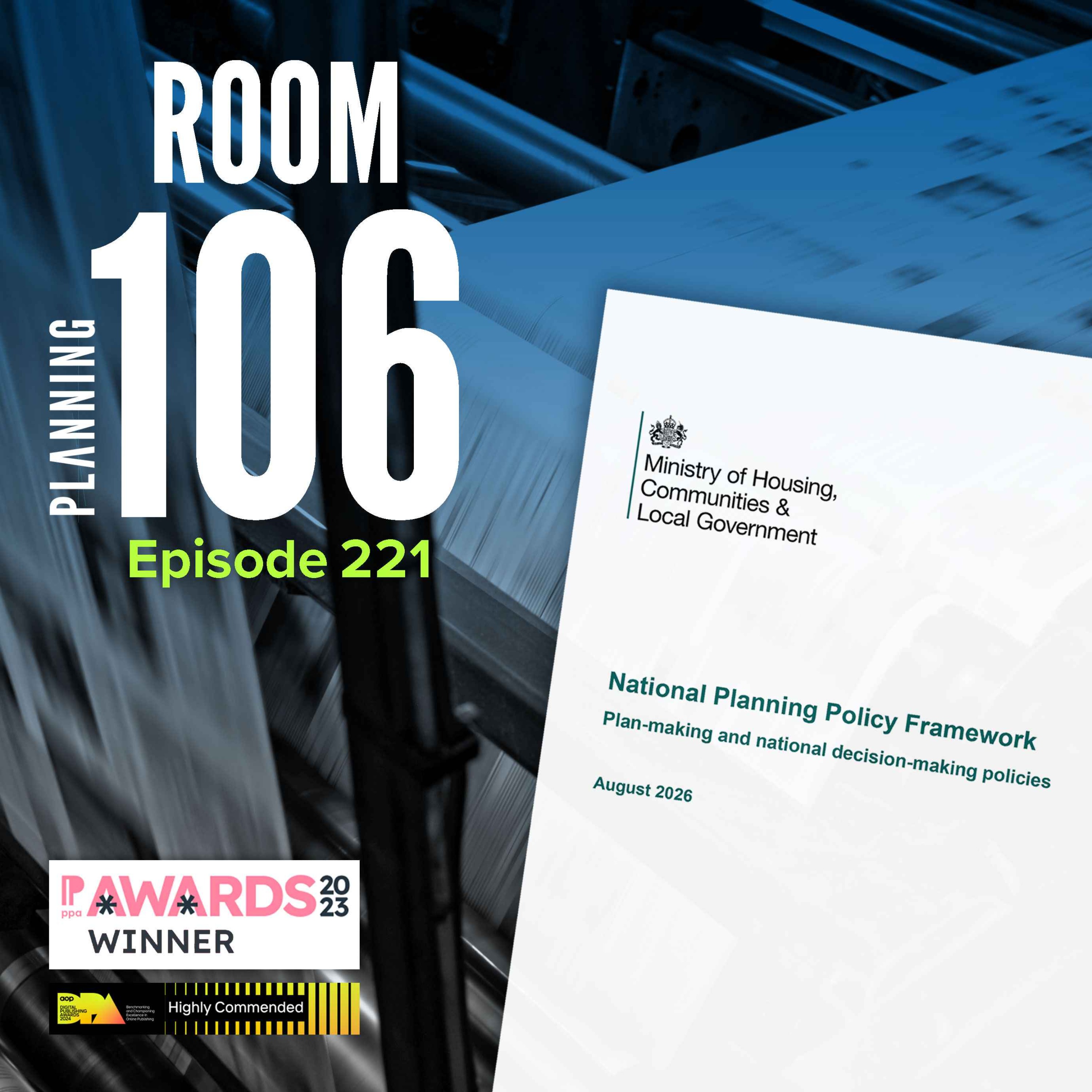
Ep221: Your 40-minute guide to the rewritten National Planning Policy Framework
39m 20s
The final National Planning Policy Framework (NPPF) marks a significant departure from previous versions, introducing a structured, rules-based system divided into decision-making and plan-making policies. A central shift is the revised presumption in favour of development: within settlements, proposals are to be approved unless adverse effects outweigh benefits; outside settlements, only specific types of development—such as agriculture, brownfield redevelopment, or those meeting unmet needs—are permitted, especially near well-connected stations. The framework strengthens densification policies, encouraging reuse of underutilised sites and limiting redevelopment scale, while removing the requirement for local authorities to justify greenbelt changes in all cases, particularly around stations. Transitional arrangements have been softened for local plans, and the minimum period for spatial development strategies has been extended to 25 years. Key changes also include a revised heritage impact test that now considers positive heritage effects, with greater weight given to harm to designated assets, and a removal of the draft's proposal to allow cash contributions instead of on-site affordable housing. The government has also dropped several contentious policies, including the refusal of poorly designed developments and permissive development in national parks. These changes, while aiming to increase certainty and support growth, have sparked debate over balancing development with environmental and community character. Additional developments include a new category for very large strategic sites and mandatory consideration of traveler needs in planning. Meanwhile, regional mayors will gain powers over developments of over 150 homes, and a high court challenge has emerged over a Greenbelt housing proposal. The framework remains under scrutiny, with ongoing appeal decisions expected to clarify its practical application in the coming months.
Welcome to Room 106. I'm John Gagan from Planning Magazine.
Every week we descend into Room 106. The dungeon of despair were all the latest
planning announcements and decisions are issued to extract the key information for you.
In this episode, we'll unsurprisingly be discussing last week's publication of the final version
of the new and heavily rewritten National Planning Policy Framework. The last week's episode
involved a fairly quick first take overview of the new framework. This week, we're going to devote
almost the entire show to it, including discussing the transitional arrangements for local authorities,
new requirements for densification of developments, significant changes to the long-established
presumption in favour of sustainable development and revisions to the Heritage Impact Test,
plus policies on green belts decision-making, local planmaking and strategic planning.
We'll also be around at the other key non-MPPF news from the past week to make sure you're
fully informed on all the goings on in the sector. Time to join a couple of my colleagues
inside the forbidding walls of Room 106 to find out more.
This week, Room 106 is deluged with paperwork from the new NDPF and the government's
consultation response. I'll speak firstly to our technical editor, David Jua, who has undertaken
the Hurt Gillian feet of trying to summarise the new framework with some help from colleagues.
And here he is. Dave, must you see? Hi Jua, nice to see you too.
How was NPPF week for you last week?
Well, it was long and it was intense, but it was also very interesting, so we'll
mix three of emotions. So I've got used to now with successive NPPFs coming out in the last
few years. Yes, particularly in the last few years. Every year, it seems there's an update,
even you draft or final version. That's right. It's like an annual event, isn't it?
It is, yeah, and it's always a roller coaster ride trying to cover it.
Today's moving on to discussion of the new framework. Let's start by highlighting the general
principles in the new NPPF and how it structured. What are the key changes here?
Well, it is a very different document, Jua, I think that's fair to say. It's a radical change,
and as trailed in the consultation draft in 2025, the new framework has a completely new structure,
pretty much compared to all the previous versions of the NPPF since its first inception in 2012,
and I think the main obvious change is that the new framework contains a mix of
plan-making policies and decision-making policies. So rather than just being labeled a whole series
of paragraphs in different topics, these are all represented as policies, whether they're
related to plan-making or decision-making, and government's thinking on this in its consultation
response document that said the proposed format and structure is actually integral to establishing
a comprehensive set of natural policies on planning matters, and making policy more rules-based
and certainty in the rules-based nature comes through very strongly in the document. That goes
as far as actually for a lot of decision-making policies or the DM policies, actually indicating
in some of them how much weight the government expects particular considerations to be given.
Okay, so what examples are there of that? Well, these are cases where it says it's appropriate
to give substantial weight to certain benefits, and also the limited circumstances in which it
is expected that permission would be refused, that a few policies that explicitly say that,
for example, certain cases for isolated homes, and the government says this standardized approach
will provide greater clarity, while the weight to be given to specific considerations remains
a matter for decision-makers to be determined on the facts of the cases and individual cases,
so it'll caveat there, but again, that drive for certainty, clarity, rules-based nature
is coming through strongly. Okay, structurally we've had a complete
overhaul and this split into decision-making and plan-making, and it's fair to say it's
more prescriptive than its predecessor, right? The nature of the way it's presented, yeah,
and just the use of policies is really trying to explicitly set out what the government
expects in some of these circumstances. Okay, and certainly a fair bit longer than the previous
framework, isn't it? Yeah, we noticed that in the draft version last year, didn't we, John,
where the document was indicating significantly greater length than the 2024 and previous version,
so fair to say that certainly a feature about the increased length. Yeah, what about the
all-important transitional arrangements for the document, which give local authorities a chance to
some time to adapt to this radical rewrite? Well, in terms of implementation, for planning
applications, so for development management officers, the new document is enforced well from,
it's already enforced from last Monday, the 17th of August, 2026 when it was published,
come to true effects immediately, and in fact, we've already seen at least one appeal decision
issued in the last week quoting from its new policies and reflecting the fact that it's now
enforced. I think that was a housing proposal in Essex, where a meaningful housing scheme has
got through on the back of New MPPF. And what about plan-making? Yeah, well for assessing the
way to be given to local plan policies, the transitional arrangements have been slightly softened from
those outlined in the draft. The implementation section of the framework says policies or parts
of policies that are materially inconsistent with the policies and the new documents should be
given at very limited weight. So fairly strict, but the draft had actually proposed that as soon as
the document was live, local plan policies that in any way inconsistent with national decision-making
policies in the MPPF should be given very limited weight. So this materially inconsistent and also
the option whereby, by parts of policies, rather than policies of the whole, that has softened
it, and that change has made the response to concerns that the policy has drafted was
bit too hard-edged and could apply too broadly according to the consultation response document.
So a little bit of pragmatism coming through there, I think, in the way the framework is coming
to force for plan-making policies. Okay, the government has made great play about how the new framework
will provide more in-principle support for development, and what it's described as a more explicit
presumption of favour of development in certain locations. Could you tell us a bit more about this
and how the updated presumption favour sustainable development will work? Yeah, sure. Well,
I think, first of all, it's probably, we've been hearing, one of the headlines, which is that
this is another pro-growth framework. The government supports growth, what's their encourage,
development, some more homes to be built. This framework reflects that in it sort of principles,
and certainly the presumption in favour of development in itself remains. It's just that it's now
taken forward in a slightly different way and across a few different policies. So there's like an
introductory policy policy S3 that sort of introduces the notion of presumption favour of sustainable
development and retains that existing principle proposals, which are called with various development
plans should be approved without delay. But beyond this, this is where you start to get two strands,
and so, first of all, policy S4 covers development proposals within settlements, and it says that
these would be approved and that the benefits of doing so would be substantially outweighed by
any adverse effects, and that includes in relation to other policies in the framework.
And it could be, for example, where a proposal would have a substantial adverse impact
in relation to allocation or safeguarding a plan for particular uses or to the application
of certain policies. So standard wording, that's geared towards development within settlements.
So we're getting into an approach on where the presumption applies depends on the exact
location of the development. Right, which is obviously a big change from the previous framework.
And what about development outside settlements? How does the new presumption work for that?
Yeah, well, this is where it gets really more interesting. So secondly, policy S5 covers
development proposed outside settlements. And this one sort of has the starting point coming from
the opposite standpoint. So it says only certain forms of development should be approved in such
locations. So when you first read it, you start to think, well, this is like a sort of green
bow or countryside policy. It's saying, you know, starting point should be no only in these certain
cases. But then you look down the list, and it is quite an extensive list. So it's got things
like development for agriculture, redevelopment of brownfield land, development, rural businesses
and services that need to be outside settlements, some of these very relatively non-controversial,
some of classes of development that were already outlined as acceptable in previous versions of
the framework. But then one of the big changes is in part H of this policy. The development within
and me is a big deal.
walk in distance of a well-connected station, the annex of the document that defines what the
classes are read as a well-connected station and you know gives the distance from the station at
10 minutes walking time and well-connected means that it has to have at least four trains or
trams in each direction per hour and so they're certainly quite area as we met into that policy but
in principle that that's quite a big fundamental change in that policy being brought in and secondly
very crucially in part J of this policy development that would address an evidence and met need
including where the council cannot demonstrate a five-year housing plan supply and where
development would be physically well related to an existing settlement that is now also under
this guise of the exceptions so a reminder the policy says only certain forms of development
should be approved at such locations so this addition in part J it includes that so obviously
decision makers after them still go through the assessment of whether the benefits of doing so
would be substantially outweighed by adverse effects but that development's class where it's
oppressing an evidence and met need is within those exceptions it can't be approved in such
locations also I should add that it comprises major development for freight and logistics
purposes so underlining the importance of those industries that the government attaches in the
document okay so there's a lot of definitions here for planners to get to grips with
like particularly the definitions of a well-connected station and the reasonable walking distance
criteria which includes 800 meters distance and 10 minutes of walking time so how exactly are
decision makers meant to apply this so as I mentioned what the document says is that these
developments were the exceptions are listed they they should be approved and that's the benefits
of doing so would be substantially outweighed by any adverse effects the development proposals
which do not fall within one of the categories set out in the policy they should only be approved
in exceptional circumstances and that's where the benefits for the proposal were substantially
outweighed the adverse effects including to the character of the countryside and in relation
to promoting sustainable patterns of development so you know that's quite a strict approach but
you could argue that it does actually open up the possibility for development proposals to be
approved in the exceptional circumstances it doesn't define it any more than that where benefits
have actually outweighed this effects but it does introduce that potential for development to get
through even where they don't meet one of these criteria what it does say this sort of suite of
policies as policies F4 and F5 both say that benefits of development are likely to be outweighed
by harm in situations where proposals fail to comply with one of the national DM policies which
state that development proposals should be refused in specific circumstances so it's linking it
to other policies where they say explicitly that development should be refused so things like the
isolated home or some certain situations it remains to be seen through further analysis
how many of those policies there are it might be that there's relatively few but there is a link
there but I would just highlight me talking the other day John in the case book podcast that the
previous presumption in the 2024 NPPF explicitly listed a series of policies that should be considered
in concluding on that balance and those included a whole range of things like sustainable
location design quality making the most effective use of land some of those are still mentioned
but they're talking about those developments that might not even necessarily fit into one of the
categories like where there's none met needs so it's quite nuanced the way this presumption is
going to apply the way the tilted balance might tilt in certain scenarios so a lot of interesting
appeal decisions and committee decisions to come up in the next few months interpreting
this I'd say John yes I'm sure going to hear a lot more in the next few months about how decision
makers are applying this significantly revised presumption and we'll be keeping a close
eye on it in our news coverage you mentioned earlier about the changes to the structure of the
document and the division into decision making and plan making policies one big issue before the
draft was published last December was whether these decision making policies would be statutory or
not and before it published the draft the governments that they'd make these policies non-statutory
which caused some probably some criticism in the sector what's the latest with that well as
tried in the draft John there's policies non-statutory for now it's fair to say I know there's
been a lot of debate about this and there are certainly pros and cons to start to tune on statutory
approach the government says it's listened to the arguments foreign against instead of all these
issues and that the matter will essentially be kept under review so basically the government is
going to see how this goes and to see if this approach to introducing the policies provides the
clarity that it's hoping for the explicit approach whether it provides a sufficient nudge
to provide that certainty for all stakeholders and what it says is should a decision be taken
to progress that to tree NDMPs the government will ensure that scope is clearly defined supported
by guidance and transitional arrangements and that their role in relation to development plans
is set out clearly to provide certainty for decision makers and communities so quite interesting
that they're setting out exactly what they're going to do in the scenario that these policies to
do get introduced implying potentially that they are still seriously considering it and sort of
teeing up what actions they need to take to do that so not certain but perhaps that's an
indication of where they're thinking yes but certainly for now they're seeing how this
suite of policies and this approach goes this is virtually the NPTN. Yeah it certainly sounds
that they're keeping the option open of going for statutory DN policies so that's another thing
to look out for yeah another headline change in the new framework is are the policies on urban
and suburban densification we discussed in last week's episode which was our first take on
the new NPPF the minimum density requirements around busier train stations but the document is also
seeking to boost density levels in other areas isn't it yeah that's right a lot of this was
trialled in the draft john decision making policy L2 and making effective use of lands
called for substantial weight to be given to various types of proposals that reuse existing sites
including specifically for those that remediate land make better use of underutilised land
by tempered uses make use of air space with existing development and also provide sensitive
redevelopment or additional development within existing plots including but not limited to
mansard reef extensions so the explicit reference to mansard reef extensions lives on john
some years after it was introduced by the previous government but what this policy also does is
while opening up the possibility of additional development in existing plots it also places
limits on the scale of redevelopment within residential curtailages and says schemes should not
occupy more than twice the footprint of all the existing buildings on the site and following
development would retain at least 50% of the non-developed area within the building curtailage
and I think very much linked to that approach in policy L2 L3 as well sort of to use which says
whether natural or makes these developments within settlements should increase the density
in the area where they are proposed new text added since the drafts clarifies that the only
exception to this should be where there is a clear justification that this is either inappropriate
or not possible and the policy says that while an area's character should be taken into account
of decisions this should not preclude development which makes the most of an area's potential
so I think that's a clear indication of another nudge approach john on encouraging
density, mixed-use schemes, residential schemes, upping the density in existing urban areas
like the most of existing brownfield land which is you know possible in some areas it can be
challenging in other areas and then perhaps also taking this approach forward in SPD things
like that sometimes it could be politically contentious in other situations it can be a very
fruitful way of tomating or housing numbers certainly actually coming through from this is that
the government's trying to nudge a council's and stake orders towards this sort of approach.
Right well this is clear support for increased densification isn't it and that's a pretty
big change for the previous framework and presumably this is going to be quite controversial
I see that the Conservatives have already accused the Labour government of introducing
what used to be termed garden grabbing. Yeah I think there's always so it's going to be
the challenge in terms of striving to get that balance between
optimising density and looking at the impact on an area's character, and assessing what
that character is, how much it needs to be preserved or taken into account, and the government
in this framework, I think is still recognising that. There's a role for the area's character
to be taken into account, really trying to encourage all actors in the planning system
to make sure that the potential of the area is making the most of that opportunity for
development in urban areas. Okay, and sticking to controversial policies,
what about Greenbelts? What does the new framework say about that, and in particular, the
greybelts designation that was introduced in the previous framework?
Yeah, while not surprisingly, the new MPPF takes forward the greybelts concept introduced
in 2024, and this includes the policy that certain greybelts proposals should be not
regarded as inappropriate development in the Greenbelt. This is on the provider that they
meet and unmet need, that they're in a sustainable location, and for housing proposals that
they meet the golden rules. So those are the rules we know about, that strive for affordable
housing provision, of a certain level, and we infrastructure improvements, improvements
to open space, etc. This approach was previously in paragraph 155 of the 2024 MPPF, and it's
now enshrined in policy GB7 part G of the new MPPF. And additionally to this, the definition
of greybelts in the glossary of the document now removes the exception of areas where
our footnote designation has strict development, so that's designation such as national landscapes,
heritage assets, biodiversity assets, and that sort of thing. What the government has said
is that it satisfied that a separate policy protection for footnote seven area remains
in place, and so it doesn't consider that substantial changes to the greybelts approach
and necessary, it doesn't consider that this footnote is necessary to be retained within
that particular policy. And obviously, the other thing that it's also done in connection
to this policy is say that housing and mixed use development around stations are defined
as well connected, so it's that well connected definition coming in again. Those proposals
will not be considered inappropriate, provides it's an appropriate scale, does not prejudice
long-term development proposals, and again complies with the MPPF's golden rules. So a couple
of key changes and additions to that greenbelts greybelts approach, fundamental nature of
it remains firmly in place. Okay, so the government's saying that these footnote seven, the protection
for these footnote seven areas is specifically outlined as unnecessary because they already
exist elsewhere. Yeah, I think it's a central argument that it's duplicating protection
that's already in place for footnote seven areas in other parts of the framework and
there are other policies that tackle the various designations elsewhere. Okay, the government
say it's not a relaxation, but it's one of those things you can imagine, Michael's concerns.
Of course, as with all the concept of the MPPF, what happens with it in practice in subsequent
appeal decisions, committee decisions, office decisions remains to be seen and will be following
that closely over the coming months. Yeah, absolutely. So we're just going to talk about
greenbelt policy in relation to decision making. What about releasing greenbelt and fire
planmaking? Well, John Policy, GV2 says preparation of the new SDS, that's a spatial development
strategies that don't have a strategic scale, and they should be informed by an assessment
of the strategic role of greenbelt land in the area. It retains the concept of exceptional
circumstances, the exceptional circumstances are still required for altering greenbelt
boundaries in local plans, and that's the policy GB3 of the document. So it's still for
local plans to do that. So the SDS has a high level assessment of the strategic role,
still for the local plans to do the release and to make an assessment of whether exceptional
circumstances are demonstrated. What the MPPF does say is that exceptional circumstances
would include local authority being unable to meet its identified need for development
in full, having examined all of the reasonable options for doing so. One thing it adds is
that, however, where a development plan spatial strategies identified suitable land around
well-connected stations for development, exceptional circumstances do not need to be demonstrated
to justify altering greenbelt boundaries. So that's quite a big change. So it's a big
focus on development around well-connected stations from railway and tram stations, where
those happen to be in the greenbelt suitable for development. Councils don't need to
demonstrate exceptional circumstances, so they don't need to show that there's an
unmet need for development. They can go ahead and put them in development plans, allocate
them if they consider that suitable for development. So that's quite a big, interesting change
in the greenbelt and plan making section. That's a pretty major relaxation of greenbelt
rules there, isn't it? Yeah, for those locations, that's quite a big change.
Yeah, absolutely. Well Dave, thank you very much for that. I'll be shortly speaking
to another colleague about other key areas of the new MPPF. For a digestible roundup
of the key changes in the MPPF, please check the article that Dave has written along
with some help from other colleagues, which is called 72 Things You Need to Know about
the final version of the new MPPF, which can be found on planning with us. Dave, I'm
going to have to leave you now, but I hope you managed to get a well-earned break soon
from your exertions getting to grips with the new MPPF. Yeah, well, it's fortunately
the bank holiday weekend is coming out, so I'll have at least an extra day to have a
breather from dodging the new MPPF. Yes, well, that break will be very well earned, Dave,
I hope you managed to have a good rest. Next, I'm speaking to our senior reporter, Natasha
Norris, about some other major changes in the new framework. Natasha, great to see you.
Good to see you too, John. Firstly, you're going to tell us about what the new framework
says about plan-making. Can you start by telling us what it says about the new system of
strategic planning and spatial development strategies? Yes, readers may remember that they're
planning an infrastructure act introduced a duty for combined authorities, combined county
authorities, upper tier county councils and unitary authorities to prepare a spatial
development strategy or SDS for their area. And these SDSs are high-level strategies prepared
across boundaries. The MPPF consultation draft proposed that these SDSs be expected to set out
a strategy for a sustainable pattern of growth, covering a period of at least 20 years.
But the minimum expected plan period for SDSs has been increased to at least 25 years in
the final framework document. The government's consultation response said this would quote,
"support long-term certainty for planning, infrastructure delivery and investment."
And have any other changes been made to policies around SDSs in the final version of the framework
compared to the draft? Yes, strategic planning authorities show commence preparation of a replacement
or altered SDS, no later than seven years after the current version is adopted, or earlier where
there have been significant changes. This is an adjusted period from the draft, which had instructed
that a replacement should be adopted no later than 10 years after the current version was adopted,
or earlier if there have been significant changes. The government said that this approach
quote maintains up-to-date plans by ensuring that no SDS should be more than approximately 10
years old, while supporting stability and reducing unnecessary burden.
Okay, so that's strategic level planning. What does a new framework say about local plan making?
Perhaps the most significant shift from the consultation draft is the requirement for local plans
to cover a minimum 10-year period. Under the previous MPPF, they needed to cover a minimum of 15
years, and this was also proposed in the draft document. The shorter plan period comes
despite 69% of respondents supporting the retention of the 15-year minimum plan period.
The government said that it had noted the overall support for longer plan periods,
but it pointed out comments suggesting that shorter periods would have benefits of flexibility
and adaptability, evidence being more relevant and up-to-date, and reduced resource burdens on
local authorities. In the draft version, the government had proposed making changes
to the soundness test when local plans were examined. Has it taken forward these proposals
in the final MPPF? No, they haven't. Soundness tests are used at local plan examinations to assess
where the local plans have been prepared in accordance with legal and procedural requirements
and a sound. They must be positively prepared, justified, effective, and consistent with national
policy. The draft and MPPF had proposed replacing the effective test with a new realistic test,
but the government has decided to withdraw this in favour of retaining the status quo.
Okay, and have any other changes been made to the local plan policies that were in the draft
MPPF? Yes, the draft text had said
authority should identify the most appropriate sites for development, but the final version
says local plans should identify just appropriate sites for development. The government says the
tweak was made to respond to concerns that this would place significant burdens on plan makers
and would be inconsistent with the tests of soundness. And as we discussed last week,
the government has also opted not to bar local authorities from setting energy efficiency standards
for new housing that exceed national building regulations, instead a new paragraph in policy
PM 13 outlines the circumstances in which LPAs can set out local energy efficiency standards.
The response document says the government has backed down on this issue following concerns that
the drafts approach could hinder local authorities ability to address climate change in their
areas. And continuing with the theme of planmaking, what have we learned about how housing need
will be assessed under the new MPBF? This has remained largely unchanged from the draft document.
The final document says that housing requirements for individual local authorities should be taken
from strategic level SDSs, whether it exists, and should not be retested during local plan formation
unless there has been a significant change in circumstances. But where SDS is not in place,
the housing requirement figure should be higher than the identified local housing needs assessment
where appropriate, including if more homes are required to meet the needs of neighboring authorities
or where authorities have significant growth ambitions. In addition, the fact that an up-to-date
calculation of local housing need is higher than the local housing requirement should not be
considered evidence of unmet housing need for a period of five years from adoption of a plan,
as long as certain conditions are met. These are that the planning authority can demonstrate
a five-year supply of deliverable housing sites with the appropriate rougher and where the housing
delivery test indicates that the delivery of housing is more than 75% of the housing requirement
over the previous three years. Okay, so if those conditions aren't met, then applicants and decision
makers could consider the fact that the local housing needs are higher to be evidence of unmet housing
need. Yes, that's right. Okay, and another big change in the new MPBF is the overhaul of the
long-established test for assessing the impact of development proposals on nearby heritage buildings.
Can you tell us about these changes? Yes, the test now includes consideration of the potential
positive heritage effects of the scheme. The new MPPF introduces four tiers for assessing
impact on heritage assets, having a positive effect, no effect, harmed the asset and then causing
the total loss. And policy HE5 on assessing effects on heritage assets states that it is the
effect on an asset significant rather than the scale of the development that should be considered
by decision makers. Meanwhile, the new framework revises the weight given to consideration of the
potential effect to the development on a designated heritage asset from great to substantial.
And does this mean the weight given to the effect on such assets has increased?
Well, in the consultation, the MHCLG says the change is intended to improve consistency in how
weighting is applied rather than to signal any change in weighting to be given to the conservation
or designated heritage assets. However, a blog on the new MPPF by consultancy bid wells
points out that even if intended as standardized language, substantial is presented as the highest
tier of weight available. Okay. And have any changes been made to heritage policies since the
consultation draft? A new paragraph three has been added to policy HE6 since the consultation
draft pointing out that any harm to a designated heritage asset will be a matter of considerable
in importance and weight when considering proposals. The consultation response said the addition
is to make the importance of designated heritage assets absolutely clear.
Okay. So some big changes to the heritage impact test there. We're now going to look at some of
the other big changes. We're now going to look at some of the other significant revisions
in the new MPPF, which we'll have to cover very briefly. Firstly, the final framework is introduced
to new category of very large strategic sites. Can you tell us a bit more about that? Yes,
this is a change from the draft, which did not define these. The glossary of the new MPPF
defines a strategic site as a site for residential, commercial or mixed use development,
which would be implemented in multiple phases, have significant infrastructure requirements
and require a master plan. It says that these sites would typically have capacity for at least
1,500 dwellings. And some notable tweaks have been made to national planning policy
related to traveler sites. So what's changed here? Well, the new MPPF incorporates the
government's planning policy for traveler sites or PPTS, which was formally a separate document
that had needed to be considered alongside the framework. The new framework requires plan makers
to consider the needs of travelers in the preparation of SDSs and local plans where SDSs are not in place.
Okay. And finally, can you tell us about some of the other key changes in the new MPPF?
Yes. In relation to design, the phrase in the draft framework and previous MPPF to refuse
development proposals that are not well designed has been dropped. Policy DP3 of the final documents
says instead that proposals should be refused if without clear justification they comfort with
key elements of the design policy or with any explicit design standards that are set out in the
development plan. Meanwhile, the revised framework for the first time states that development
proposals should be designed to address the safety of women and girls. Elsewhere, the final MPPF
confirms the drafts move to direct authorities to refuse hot food takeaways within walking
distance of schools, but it admits the term fast food outlets. As we discussed last week,
the government has backtracked on a more permissive approach it took in the draft to
development in national parks and national landscapes. Another very significant policy in the new
framework that we discussed in more detail last week is the introduction of so-called default
yes for homes within reasonable walking distance of well-connected stations alongside new minimum
expectations for how much housing should be built in these areas. And finally, a proposal in
the draft MPPF to allow developers of medium-sized sites to provide cash contributions instead of
on-site affordable housing provision is dropped. Thank you, Tash, for that run through
of the some of the biggest changes in the new MPPF both compared to the previous framework and to
the draft. And there's a lot more about the new MPPF that we haven't had time to cover
in this week's episode, but there's lots of news coverage on planning resource and in particular
there's a roundup article called 72 Things You Need to Know about the final version of the new
MPPF. Natasha, now you're going to tell us about the other biggest planning news stories
from the last week that aren't from new MPPF. Yes, first up, the government has announced that
regional mayors will have calling powers for schemes of over 150 homes from early next year,
with further powers over large-scale infrastructure to be handed down upon adoption of new spatial
development strategies. In other news, the high court has clarified the application of the
56-day permitted development deemed consent rule in cases where a prior approval decision
is subsequently quashed in what lawyers say is the first time the issue has been explored by the
courts. And finally, Buckinghamshire Council and a campaign group have launched a challenge
in the high court against the Planning Minister Matthew Pennycox decision to approve Charity the
Eplepsey Society's plan for 975 homes and care facilities on Greenbeltland on the edge of the
village of Charleston, Peter. Thank you, Natasha. More details on each of those stories can be found
on planningresource.co.uk. Right, my time in room 106 is up. Natasha, nice to see you,
and I hope to see you down here again soon. Thank you, John. See you soon.
Okay, that's another visit to room 106 wraps up. We'll be back next week to look at more of the
latest planning news stories and to discuss the biggest hot topics in the sector. In the meantime,
don't forget to listen and follow us wherever you normally get your podcasts. And for a daily
bulletin of planning news plus weekly analysis and specialist bulletins, subscribe at planningresource.co.uk.
Our thanks to producers Chudoin and Ingermasden from Haymarket Media Group. And thanks to all for
listening. See you next week.
Podcast Summary
Key Points:
The new National Planning Policy Framework (NPPF) introduces a radical structural overhaul, splitting policies into decision-making and plan-making categories, with a stronger, more rules-based approach to provide clarity and certainty.
A significant shift in development presumption sees stronger support for growth, particularly within settlements under S4 and outside settlements under S5, where only specific, well-defined development types are permitted—especially near well-connected stations—and unmet need is now a key exception.
Key revisions include softened transitional arrangements for local plans, increased emphasis on densification (e.g., through reuse of brownfield land and mansard extensions), the removal of strict greenbelt protections for footnote seven areas, and a new 25-year minimum for spatial development strategies, all while retaining the core principles of sustainable development and heritage protection.
Summary:
The final National Planning Policy Framework (NPPF) marks a significant departure from previous versions, introducing a structured, rules-based system divided into decision-making and plan-making policies. A central shift is the revised presumption in favour of development: within settlements, proposals are to be approved unless adverse effects outweigh benefits; outside settlements, only specific types of development—such as agriculture, brownfield redevelopment, or those meeting unmet needs—are permitted, especially near well-connected stations. The framework strengthens densification policies, encouraging reuse of underutilised sites and limiting redevelopment scale, while removing the requirement for local authorities to justify greenbelt changes in all cases, particularly around stations.
Transitional arrangements have been softened for local plans, and the minimum period for spatial development strategies has been extended to 25 years. Key changes also include a revised heritage impact test that now considers positive heritage effects, with greater weight given to harm to designated assets, and a removal of the draft's proposal to allow cash contributions instead of on-site affordable housing. The government has also dropped several contentious policies, including the refusal of poorly designed developments and permissive development in national parks.
These changes, while aiming to increase certainty and support growth, have sparked debate over balancing development with environmental and community character. Additional developments include a new category for very large strategic sites and mandatory consideration of traveler needs in planning. Meanwhile, regional mayors will gain powers over developments of over 150 homes, and a high court challenge has emerged over a Greenbelt housing proposal.
The framework remains under scrutiny, with ongoing appeal decisions expected to clarify its practical application in the coming months.
FAQs
The new NPPF features a complete structural overhaul, dividing policies into plan-making and decision-making categories. This shift introduces a more rules-based, prescriptive approach, with explicit guidance on weighting considerations and clearer thresholds for decision-making.
The new NPPF is enforced immediately from 17 August 2026. Planning applications and decisions from that date onward must comply with its policies, as evidenced by at least one appeal decision in Essex referencing it.
Local plan policies that are materially inconsistent with the new NPPF are given limited weight. This softens the previous draft’s stricter approach, allowing for more flexibility and reducing the risk of broad inapplicability.
The new framework introduces a more location-specific presumption: development within settlements is generally approved if benefits outweigh adverse effects, while outside settlements, only certain types of development (e.g., agriculture, brownfield redevelopment) are approved, with strict criteria for housing near well-connected stations.
No, the policies are currently non-statutory. The government has acknowledged the debate and will review whether to make them statutory in the future, with clear guidance and transitional arrangements in place if they are later introduced.
The framework removes the exception for footnote-designated areas (like national landscapes) from greenbelt protection, stating such protections already exist elsewhere. Additionally, development around well-connected stations in greenbelts does not require exceptional circumstances if it meets sustainability and scale criteria.
Chat with AI
Loading...
Pro features
Go deeper with this episode
Unlock creator-grade tools that turn any transcript into show notes and subtitle files.
 PodcastTranscript AI