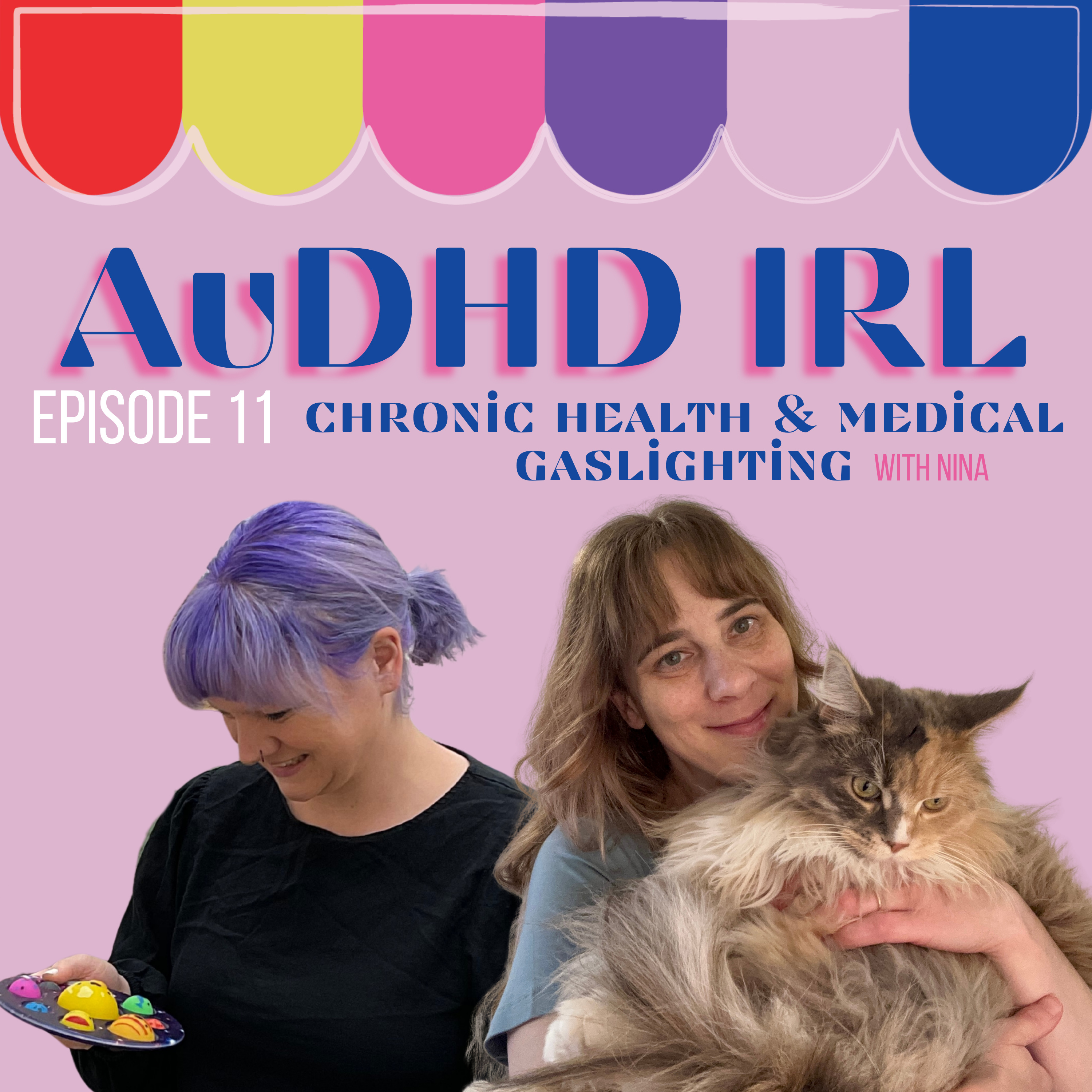
Ep11. AuDHD, Chronic Health and Medical Gaslighting with Nina
57m 50s
In this podcast episode, Nina Bookburn, a provisional psychologist and late-diagnosed AuDHD woman, discusses the intersection of neurodivergence, chronic illness, and medical gaslighting. She explains that medical gaslighting involves the dismissal of symptoms, often attributed to anxiety or weight, a common experience for women and neurodivergent individuals. Nina shares her personal journey, including decades of unexplained health issues like fatigue, gastrointestinal problems, and frequent injuries, which were dismissed until her AuDHD diagnosis. She highlights research showing that 40-70% of autistic or ADHD individuals have connective tissue disorders, such as Ehlers-Danlos syndrome, which can lead to autonomic dysfunction (e.g., POTS) and mast cell activation syndrome (MCAS). These conditions cause symptoms like joint instability, fatigue, and severe reactions to triggers like perfume. Nina emphasizes that the exact biological links are unclear but likely involve collagen weakness straining the nervous system and immune response. Living with invisible illnesses as an AuDHD person requires additional masking and social strain, as symptoms are often lifelong and not visibly apparent, leading to invalidation from others. She advocates for greater medical awareness of these connections to improve care for neurodivergent individuals with chronic conditions.
Oh and back I just forgot something again. [Music] Hi Nina! Hi! How are you? I'm so excited that you're here everyone. We've just had about half an hour of tech dramas of this awful echo. We're looking around at our ears but hopefully this is a better option. We've switched over to Zoom. So there might not be a video today but yeah, Nina, I'm so excited that you're here. We're going to have such a good chat. I am excited for this. Yes, me too. Okay, good. Let me introduce you and then we're going to get into these delicious questions. So, and everyone, Nina Bookburn is a provisional psychologist in the final year of her master of psychological practice. Originally from Germany, she is a late diagnosed autogetched woman and her lived experience with neurodivergence, chronic illness and invisible disabilities shaped her perspective in psychology. Her master's thesis, get this, it's so cool. Ashtag Medical Me Too, the role of medical gaslighter in the healthcare experiences of neurodivergent women with chronic planning, with a very personal labor of love, dedicated to all women, neurodivergent or not, who have experienced medical harm and neglect. I feel like I just, I mean it was a long sentence so I need to take a breath anyway. But I need to take a breath. It's a long title. You have to come and all in, you know. It's so important. What are you doing? It's so important. Okay, she is particularly passionate about the intersection of neurodivergence with chronic illnesses such as connective tissue disorders, M-CAS, disorder, pneumonia and chronic panic, with a special interest in female health, including the challenges, neurodivergent women faced during parrymanipause and menopause. Nina takes a holistic mind-body approach, love that. And outside of psychology, you'll usually find her spending time with her cats and horse, thinking, "Pek, yes," or exploring watercolor painting. Oh, Nina, it's lovely to have you. I'm really, really excited and so honored that I can just download about like my absolute favorite and such an important topic. Yay, I think that's one of my favorite things about this podcast is I ask people what they want to talk about and they get to pick something that they love and so they come in and they're like, "Oh, I get to talk about my thing in fucking hour." It's so good. So my first question for you and for anybody who comes on this podcast is, what is your connection to ADHD? So I guess, you know, I went through life with a lot of health challenges and I feel like a feeling of being othered, you know, a bit of bullying in high school. Lots of funny experiences were, I'm like, "Ooh, okay, maybe I'm just anxious," you know. A difficult thing. And thanks to social media, I went down the rabbit hole and all of my friends and audience deers and ADHDers and so they were like, "Hmm, maybe you should look into ADHD." And so I did and I was like, "Oh, that might explain a lot." So I was like, "They diagnosed that 38 years ago now." And then I thought, "Oh, that doesn't really explain everything and went down the rabbit hole on the autism side." And went, "Hmm, maybe it's ADHD." Yeah, they're in there. Maybe. Maybe, I'm in there. Well, that's great. So welcome to the Audi actually club. I love saying that to people because I feel like we really have this lovely community where we support each other. We get each other. We feel the same each other. And it's nice to meet you, and it's nice to meet somebody else who has that same brain wiring. So hello. Thank you. And yes, yeah, I fully agree. And once you see it, you can't unsee it, right? And it gives you the whole perspective of, "Oh, that explains so much in your life, right?" And that's one of the reasons why this line of psychology, future work is really important to me as well. I'd like to be in that space of the neurodivergent community of helping people explore what it actually means to look back on your life and go, "Oh, we're connecting little dots. There's little pizzas that sort of make the big picture suddenly and you're like, "Oh, interesting." Doesn't it just make it make sense? When you find out this thing about your wiring, you're like, "Oh, everything clicks into place." Yeah, definitely. Big time. Yeah. So you've chosen to info dump about Audi HD, chronic illness and medical gaslighting today. So what is the interest there? Why is it important to you? I'm laughing just because it sounds like, you know, "Oh, half an hour chat," and which is going to tick those all off. And this is such a big topic. We're just going to scratch the surface. But it is so important to me because it's very personal as well. I have, like I said at the beginning, I have lived with a lot of health issues my entire life. And I'm 14 now and I've been dismissed medically for decades without even knowing that I was Audi HD. That adds like another level of complexity on top of everything, right? And the experiences that I've had with the medical community have been atrocious in a lot of ways. And that's partially why I wanted to info dump. And that's why I wrote my thesis on it, you know, because I was like, "Yes, we really need to highlight this." And yes, there's a little bit of knowledge about, you know, women are more often dismissed in the medical community. But what about the intersection with, you know, autism and ADHD and Audi HDs? There was basically nothing when I started my research. It was like two papers maybe. Yeah, not a lot available for the community to read or to understand the topic. No, not at all. And so I really thought, you know, this is so personal. And I was so blessed with the most amazing thesis supervisor. You know, Dr. Rachel Hogg is incredible. And she let me run with my topic completely from start to finish. And let me write it in a really like beautiful first person feminist way, you know, where I applied. Like all the things that we're not supposed to do in psychology, in a way, like dealing with poo-poo'd still. And she was just like, "Go for gold, you know, put your own experience in there, put your lens in it. Don't be neutral, right?" Wow. So you, what your experience is a lived and living one. You were saying you've been, you've lived and you've been living with chronic illnesses. And, and you have been medically gas-led from, from the profession for decades. Yes. So I wonder would that be a good place to start? Like if you told us a little bit more about your own experience there, is that feel comfortable? Yeah, absolutely. So I guess for some people that don't know what medical gas lighting is, although it is really much more common lead as gusty stays. It's really the absolute dismissal, the nile, you know, the downplaying of symptoms, if you're presenting to a doctor. And especially if you're, you know, if you're a female, you're coming to the doctor, you're being dismissed with anxiety, all sorts of, you know, psychological issues. That's very common. That has something that definitely has happened to me. But I think the biggest thing is like from adolescence onwards, I've had things like extreme fatigue and a lot of gastrointestinal issues. Like lots of stupid accidents where I would, you know, spray my ankle then suddenly, at one point I was running around with two spray ankles. Oh my gosh. In hindsight, it's really funny. What do you think about it? But at the time it was horrible. Not even all grades. No. And in Germany, where I grew up, you know, my high school was like a really old school building, like a big stone building and to stare. We're big stone stairs. And it went sort of down several, you know, levels, I think three or four we had. And so I was hobbling down because I had sprained my left ankle. I was hobbling down to a stone stairs. And, you know, having a connective tissue disorder, which I now know. I, yeah, placed my other foot wrong and just heard it pop and then. Oh no. So that was my childhood. Like, you know, lots of weird breaks, sprains, yeah, gastrointestines, all that. And it's just told, you need to eat better, you need to sleep better, you need to do this. Oh, maybe she's on drugs, you know, like all sorts of wild theories that were made, you know, about the adolescent. And can I throw something else in there as well?
point. If for people who grow up not only being a woman but being overweight, like I was a I was a much bigger kid than the other kids in my class and it was often just said to me, oh this kid needs to lose weight. Like that's that's the only thing they would say. They wouldn't actually look at any of the constant tummy issues that I had or the constant bronchitis I had, nothing. It was just you just need to lose weight. And not just as a kid, you know, research participants that I had, all the ones that had like, you know, just, you know, one kilo over immediately. Oh, it's just your weight. You need to lose weight, you know, that's fresher on your joints. That's terrible. Yeah, it's terrible. Terrible. So, but I can't believe you were guessed that it in so many ways. Like they would say, oh, just do this, just do that. And they would dismiss your lived story. Absolutely. And the funny thing is my entire family is from a medical background. So, Dave, Dave brought me in front of really, really great doctors. Right. I'm saying that with excellent marks in case the video doesn't work. Yeah, that's right. Like, Dave, they had great reputations. But again, I think because I came from this medical background, they were again going, no, not our child can't be, right? I don't know. It was even within the family. Wow. Yeah. There was just, I mean, obviously, Dave, Dave, the tests, you know, all my tests came back clear, which is a very common thing. With a lot of, do disorders, I mean, that, you know, have very core occurring with autism and ADHD. It's things like connective tissues, disorders, like I mentioned, illus, danlos syndrome, for those that don't know, that their cluster of disorders that affect collagen, which, you know, provides the structure throughout our body. And symptoms that are associated with it are joint hypermobility, in some cases, you know, you got chronic muskowski, little pain, frequent injuries, like, you know, sprained two adults on one super fun and joint instability, gastrointestinal problems, fatigue, you know, it's, there's a lot that is associated with connective tissues, all of us that people don't realize, actually, it's not just being bendy, it's not just being a little bit, oh, look, you can, you can do the splits. How great. Yeah, it's not a cute quirky little, you're so bendy autistic girl. It's, you know, your lung could collapse or your, you know, you roll your ankles constantly, or, you know, yeah, all those things that you're talking about. Exactly. Like people, I mean, I'm quite lucky I only subluxate certain things, but there are people that have like, fall on dislocations all the time, like they have really extreme types, right? Yeah. I guess in, yeah, in my journey, I knew that I was told that I had growing pains, and that I would grow out of those. Yeah, okay. Yeah. And that's often, you know, what to hear with connective tissues, all of us, oh, I'm just growing, you know, that's what I have, join pain, that's what I have muscle pain. Yeah. Yeah. Yeah. Yeah. Yeah. It can be so dismissive. So it's a lot dismissed. Yeah. Totally. Yeah. Tell us a little bit about the connection between what we affectionately call all the things in, you know, around here in these parts. Tell us about the connection between all the things and autism ADHD. Like where's the research at and what are we saying? Like why is it all connected? Do we know? We don't know exactly why it's all connected yet, I think. That's still a little bit a gray area, but we know from fairly recent research that 40 to 70%. So that's a really big percentage, you know, and that depends on research paper a little bit, I guess, you know, but 40 to 77% of people with autism or ADHD have a connective tissue disorder. Wow. Yeah. Try to use you percentage. And it explains so many things for me, right? Because you hear all the time of like, you know, children with tummy aches, with fatigue, with joint pain and stuff in the autism community. And no one bats an eyelid because the connection is not well known, which is really sad. Slowly we're getting a little bit more traction, but it's not there yet. Yeah. Okay. So we don't know why, but we know it's there for sure. Exactly. And look, if we're having unstable joints and all these lacks collagen everywhere, that means that our nervous system is automatically a little bit more hyper vigilant because our proprioception is a little bit off, right? Because we're constantly, you know, I'm sure that everyone has seen like a ticked-tock video where like someone with autism, one day, ADHD, bumps into a wall, it goes, oops, where's the furniture? Why did I run into the wall and the door and this and that, right? Our proprioception is not quite calibrated 100%. Because we have the lacks points and collagen in it. And if we're constantly hyper vigilant in our nervous system, that means that our autonomic nervous system, this is where the disorder of autonomia thinks like pots come in, right? Yeah. They will eventually appear. Like our autonomic system controls, right? You know, our heart rate, blood pressure, things like that, right? And so when you hear people getting dizzy, born merely fainting when they're standing up, rapid heart rate, fatigue, rainfall, even exercise in tolerance, that's all part of this autonomia. Wow. And can you see like, you know, although we're not 100% sure that that's the wider linkages, but the linkages there, like, you know, we have the lacks collagen, we have the lacks tissues and we're putting such pressure on the nervous system that eventually it just gets into autonomic dysfunction. Totally. It just goes, now I'm out. This is too hard. It's like, no, never mind. I'm just going to say no. Yeah, totally. No, that makes total sense. Yeah. And like, as a bit of a theory in the fields, that makes total sense that we think that's what's going on. And then if we're like having our nervous system dysfunctional a little bit, eventually our immune system is also going to come in and go, my whole body is going haywire. So that's where the lovely mast cells come in. So actually the activation. Yeah, the MCAS. Yes, that's the, which only has been really researched in the last 15, 16 years. So hey, both donkeys are like, no, that's not a thing. That's like, you know, the mast cells are a little bit like the police force of immune system, if that makes sense. Yeah. So when you get into contact with like an allergen, it doesn't have to be necessarily an allergen, I guess. But like anything sort of perfume is a really good example. A lot of people who have MCAS are highly, highly, highly allergic. And I'm saying that again, in quotation marks because it's different from like your conventional allergy allergy. But if someone with perfume comes in contact with me, I will have a respiratory reaction. I might have a migraine, you know, it's really, it's really horrible. And so it means that your mast cells shoot out so much histamine that it's like way, way disproportionate. Like that shooting everything on site, basically like little police officers instead of just arresting the perpetrator. Right. So it's almost like I always, when I explain the amygdala to kids, I'm like, the amygdala is so helpful. It's like the guard dog will often get it wrong and it hits the panic button and just everything is a danger. So it's not that too. It is kind of like that. Exactly. It's just that it's the immune system in like in full force and mast cells are everywhere like, they're in our gut lining, they're in our skin, they're in our lungs, they're in our brain. So you can have one person with MCAS and then another person with MCAS have completely different, you know, symptomatology in a way. Some might have anaphylactic reactions and some are lucky and don't necessarily, you know, risk dying on the floor when someone comes along with perfume. I don't know. It's quite easy. But it is really one of the things that I think is often misunderstood and even sort of what is I'm muddled with, you know, the sensory aspect. It's often to say, ADHD and people, or, you know, you might have just sensory processing issues and it's like, no, they actually physically make me sick. Right. That's a very different thing. Yes. And like 40 to 70% is such a high percentage of all of that kind of occurring in our autistic ADHD. It's like that huge. I really need to take it seriously. Yeah. And I really need to, I think mainstream medicine needs to learn about the connections of all of this. Like, there's so many more, like these are the big ones, right? There are many more, like PMDD is very common cluster thing, right? This autonomy has 13 different types. Wow. Okay. Right. So, pods is like the big known one, but not everyone with this autonomy of will.
famed, not everyone, like with pots will faint. But a lot of times doctors will get keep, I guess, the diagnosis because you don't faint. Right. And if I can't, no, I can't be can't be pots. Like you should be fainting. Okay. Not true. Yeah, there you go. Yeah. And a little bit of not knowing in that case has a big impact because that person not getting that diagnosis, exactly. The invalidity of that and the effect it has on the support they get. That's huge. 100%. Yeah. Wow. Can you tell us a bit about what it's like from your own experience and from the people you've done research with and your friends and all that kind of stuff? Living with invisible illnesses as an autistic or ADHD person, what's that like? Look, not only, I guess, are you being judged, I guess, on being an ADHD, you're also like, I present healthy, right? Like in case the video works, you know, I look quite, I mean, I did put makeup on, much of something. Just because I looked like deafwobbed up otherwise. A bit of a donation. Just a little bit. Yeah. But I don't have an arm missing, right? Like, I don't have any like stormer bags. I don't have anything that would mark me as having invisible, you know, disabilities. But I am extremely, extremely sick. And I have been for the last, like the last three years have been really bad for me because I had a chemical exposure injury at work that triggered like the really bad MCAS for me. Wow. And so I'm pretty much 95% housebound. Wow. And so living with all of this is extremely challenging because people don't like the uncertainty of illness. They want to see an endpoint. Because if you say, oh, I'm still sick, I'm still sick. I'm still sick. Yeah. People will either get sick of hearing it. Yeah. They will keep asking, well, when are you getting better? Oh, have you had any improvements? Like, no, some of the things I have are lifelong. Like, like the connective tissue, does what I can't just make my own collagen less faulty, right? No, no, it doesn't work like that. It does not. No. So, you know, the real life impacts are that you're going to miss out on a lot of social outings, right? You're going to not just have the social impact of, you know, being in an environment with people. So when you're going to a social event, living with ADHD and with chronic illness, you're not just going to have to deal with the impact of your autism or your ADHD masking, you know, all the stress of that. You also have to present healthier than you are, you know, like it's an aid in us. I think we don't want to sit on the couch instead of, you know, socializing with the rest of the family or the friends group or whatever we want to actually participate, right? So it's a lot of strain to socialize. It's a lot of strain to present a certain way. It's like masking on steroids. It is. Yes. So I feel like, there's so much masking going on in terms of, you know, you got your your autism or ADHD, ADHD masking. You got your genital masking, especially as a woman, I think, because we've been conditioned from very early on, you know, be more polite. Don't, you know, don't be hysterical. Definitely not that simple. Yeah. Don't overplay. I don't know. Don't win. Don't this, don't that, right? Yeah. It's very much to be not enough. All of that. Yeah. There's so many different aspects of of masking that we don't even realize that, yeah, come with the combination, the intersection of all of this. Like, yes. Yeah, I'm masking on steroids. I love that. That's really good. Yeah. No, I've never thought that I've never thought about that before, Nina. And I'm really sorry that I haven't considered, you know, all of my, all of my autistic and ADHD people out there who also have the invisible illnesses, the chronic illnesses, the amount of masking that you would have to do just to get through an event or a day or even a text message like how are you today? The pressure to not say I'm still sick. And all right. It's like, I know, I'm good. I'm good. And that whole thing about, like, oh, but you don't look sick. Yes. You don't look sick. Oh, the gaslighting you must get from just from the people in your life accidentally. Accidentally. Yes, definitely. Like, I have, I have energy limiting diseases. So I have a parking sticker, you know, for, oh, God, for disabilities. I can't even talk right now. So I have an ambulance parking sticker. And I don't use it when I don't need it. But I will use it on days that I have to actually leave the house and really struggle walking to the shops. And I do get filthy looks sometimes, I think. Oh, because I look, you know, I'm walking okay. I'm taking I'm taking a parking spot that I might not deserve. Yes. People's eyes, right? Because I'm not in a wheelchair. How horrible. How horrible for you. It's, it's tricky sometimes navigating it. I mean, I think, you know, after a while I got used to it and I was just like, no, I will, I will use it because I actually need it because otherwise I will crash and burn for like days after. And that's another thing with the social outings for people within visible illnesses. We have to save up all our spoons before an event just to make it there. And then chances are that we're not only just having, you know, the sensory overwhelm crash out and the burnout potentially from that. But we might also then literally have like a day in bed or for some people like a weekend bed, like it's intense. The energy crash that comes, which is called post-exertional malaise, you know, like you sort of post the event, you absolutely have no energy in the whole music. You will be in bed. You will. Some people can't leave the bed, some people can't shower, some people can't do anything. Like it's it's intense. Yeah, that sounds really, really intense. So you would have to be really, really careful in your energy accounting in your life of what you spend energy on, what you choose to give spoons to. Exactly. Wow. Yeah. And then to be gas-led about it by healthcare providers, you know, that's like is really hurtful because it question, like it makes you question your severity, um, the validity of everything as well, right? Um, that's a theme that was coming up a lot for many of my participants in my thesis, the self-gas lighting. And it's one of the things that I found the most heartbreaking. Totally. It's not just coming from others. It's become so entrenched inside the person as well. Yeah. Yeah. Because I mean, um, we do that already with, you know, the Audi HD, right? Like, are we really like, oh, are we just a bit, are we just more sensitive to noise than others? But that doesn't mean that we're Audi HD, like, you know, are we? And then you add on top the whole, or well, why shouldn't why should it take this car park, you know, should I, should I walk way, way from the back of the bloody car park to the shops? Like, um, someone with a wheelchair could definitely use it more than me. Um, so that's something where I definitely gaslight myself a lot, I think, because if I'm having a really, really bad day and I can barely walk a hundred meters, but I need to get to the chemist, then I do need that park export. Absolutely. You do. And you deserve a hit. And I wish that you didn't need it, but you do. Yeah. And so, um, some of my participants were questioning their pain levels, um, like, all these things. And that's really, yeah, like things you also get, oh, you're too young to be the sick, right? Oh my goodness. Yes. You're too pretty to be the sick. Honestly. Oh my goodness. That is something that has come out in the research that attractiveness, and again, the weight that all is being judged, especially in women, um, and doctors go, but, but you look to put together, it doesn't need, and you have to be like attractiveness attractive, like conventional attractiveness. But if you, um, are showered, you know, you're closer, you look well put together, and you go to the doctor and you're trying to explain that you are inconsistent, consistent pain. Yeah. Really bad, you know, seven out of 10 or five out of five, five to six used to be my baseline. I'm actually lucky with a lot of treatment that it's a little bit lower now. But wow, if you're saying that to a doctor, there'd be like, but five to six, you should be like, you should look really, really uncomfortable. You should show physical signs, you know. I want you to come in there, looking a bit worse off for wear, but not too much either, right? No, of course not.
- Yeah, looking like deaf, warm, dark, and showered and put together, the psych card willing immediately played, you know. - Yeah, they weren't listening to that. - They weren't listening to that. - Goodness. I'm so mad about this. - Oh. - Yeah, I'm just imagining you must have moments when you're just livid about all of this because you're living it. - Yeah. - And you'd see so much of it, but just hearing a little bit of your story. And I imagine listeners will feel the same. So guys, if you're with me here, you know, reach out and let us know how you're feeling about this because this is making me feel so mad. You know, when I was in my 20s, I got diagnosed. This isn't, I suppose it's an indiscipline illness, but it was a mental health thing. I got diagnosed with quite a hefty big lots of stigma, mental health thing, oh. And I remember going to the pathologist because I had to get blood tests all the time for it. And the pathologist, how dare her? She said to me, oh, you're too young to have that. - Oh, I'm sorry. But I just do, and I can't help it. And now you're making me feel like, you know, there's something wrong with me for having it. - Yeah. - Oh, I'm so sorry that it happened to you. - It's rather horrible. - I mean, that was one small way. I mean, it wasn't small at the time, but like that was so insignificant compared to what you were talking about with the day in, day out. It's just my heart is like breaking for you and everybody out there living within these businesses right now. And I'm really angry at society. And I'm just like, how do we do this better? You know, so maybe can we talk a little bit more about the medical gas sliding? So tell me a bit more. What are some stories that you've heard or some like ways that you see it happening out in the world? - Absolutely. So I think the biggest thing really, and I touched on that earlier, is the pathologizing of especially women's health issues, anything that we go to the doctor with, will we put down to anxiety or stress. Like that is the biggest thing. And I don't think that's a surprise for many people. - No. - We're just so anxious and stressed now. It wouldn't be anything else. - I mean, of course. I mean, my whole world is really, the world is on fire. So I totally understand what people are stressed and anxious. But this is deeply, deeply, deeply ingrained in like, oh, I'm going to go on my soap or soap or my, oh, hey, I was, no, you know, or my soap. - Yes. - That's what I was looking for. The soap box. - So let me bring it. This is your soap box time. It's deeply ingrained in a patriarchy, like, so deeply. Honestly, like, if you think back in history, pre-Patriarchy establishment of medicine, women were the healers, right? Women were the wise women. We saw everything quite holistically, I think. I mean, that I'm just making up now because I don't know if that's true. But I presume that we saw the body pretty politically and we knew the herbs to use and write. And I man came in and you know, ancient grace, beautiful Socrates went, ah, yeah, women. They have the Hephaeuterus. The uterus is wandering around and it's evil, pretty much. And it's eating people like, I mean, honestly, it's, they call it the wandering womb. And that is like the birth of hysteria. Like, yes. And so, the wandering womb had to be fed. Like, it was insane, honestly. And what it boiled down to, it can attach on a bit more delicacies here. - Please, it's for sale. - Yeah. We can put in one thing at the start. - Yeah. - It boiled down to the wandering womb had to be fed with the seed of the man to come down. So, you know, we were already sexualized into oblivion, Beckton. And, you know, the humours, the four humours, all that, you know, if the womb was out of balance, then we were melancholy, we were hysterical, we were all this. - Yeah. - Fast forward, you know, this continues. - We take over medicine, they push us out. We go into the Victorian era, that's where hysteria, you know, is like really big right. And the treatment, I don't know if you know this, but the treatment for hysteria, Beckton, was to go to the doctor and to get an orgasm. - I'd heard this. - Yeah. - It's outrageous. - It's outrageous, right? - Outrageous. - So, let's, funnily enough to the invention of the first bite right up. - Well, good on them. - Did something right, right? - There's a silver lining. - It's actually a silver lining at all. - But yeah, really, we were just subjugated, I guess, to these are anxious and hysterical, lesser beings and medicine was completely based from that point onwards, right, from ancient Greece onwards, on the male as the ideal form. - Yes. - And everything that is female was like a dysfunction of the body in a way. - Yes. - Yes, true. - That's almost like the default. - Exactly. So medicine is anthropocentric, which means based on the male body, like modern medicine, because I'm not counting, you know, ancient medicine where women were at the forefront. So that's where this gaslighting stems from, because this whole bias is so ingrained in modern medicine, and that's why we have this humongous gender paint gap. Like there's lots of research on the gender paint gap, thankfully. But these things come from, I guess, the idea that women are the lesser sex that were unstable, that were unreliable narrators, our own story, and of our own body. - Yeah. - That's outrageous. And what about research for trans and gender diverse people? Is that coming along? Is that a focus there? There is a little bit of a focus. I made a decision with my thesis because it's 10,000 words. It was going to be too hard to fit everyone in, unfortunately, as much as I would like to. And when I publish, I will finally publish eventually, when I'm with better. I would like to actually include a gender diverse sample as well somehow, because I had a couple of research studies in my portfolio that looked at the role of estrogen. And some of them were transgender studies, and they were very interesting, because estrogen, especially because it's fluctuating, right, seems to increase pain levels quite a lot. And so when estrogen was given as a hormone therapy then, transgender people had increased pain levels. And so it was very, very interesting to see the difference. And I think that there needs to be much more research in that area. There is still, yeah, viscosity, I think, unfortunately. - Yeah, yeah. - We've got to do better there, don't we? - Yes, we definitely do. But yeah, it would be really, really interesting to see more on that, especially because, yeah, in those same studies, testosterone was actually shown to be pain protective a little bit. - Wow, all of that is not there. - This is really why, I think, one of the reasons why women are more likely to be diagnosed with all these conditions, because of, thank you, hormones. - Oh my God. - That feels really unfair that testosterone is pain protected. - What the heck? - I know, right? - Yeah, that's partially probably why when men go to the doctor, the doctor will think, "Oh, well, if he's coming to the doctor, it must be really bad." - Do you know where he's? - He's stuck my head, yeah, finally. - Also because there's lots of research on that, that, you know, it's this woman and probably also transgender women, I would say, are much more proactive in seeking medical care? - Yeah. - I know, stereotypical men, I hope I'm not offending anyone though, but the research says it. - They will wait, you know, until half-david audience fall out, until they actually show up and go, "Oh, I should probably seek medical care." - Yeah, yeah, yeah. - Something I love about vulva owners and women, like anyone socializes a woman or as a girl, we actually tried to take care of ourselves. - Yeah, exactly. - Yeah. - Yeah, yeah. I think they're much more proactive and, yeah, but then that can also, again, fall into the category of, "Oh, maybe you're too proactive. Maybe I'm coming along with a binder, Dr. Sondaiberg." - Yes, you're here again and you've got a list. - Yes, oh, and also I don't have time for your list. - Yes, totally. Well, the whole system isn't set up for that because you come in, GPs will say, coming with one issue, otherwise, a book, a double-large, triple session and you're paying through the nose. - Absolutely. - Yeah, oh, gosh, that must be so hard. I'm wondering, speaking of, like, going to the doctor and booking in and working out how long do I need to do this appointment, how do you navigate the healthcare system as someone with multiple chronic invisible illnesses?
Oh, it's expensive. I get not something that is really very much talked about, I think, because Medicare doesn't cover most of the specialist appointments very well. I ended up like I'm so lucky really. In 2024, I found an integrative specialist. He's a GP, but has done lots of extra training on environmental and biological illnesses, like mold exposure, MCAS. He's lime literate. Like all these things are wonderful that have come with a price tag. And yes. Being chronic ill can financially ruin you. Like it's really, really, really tough out there. I haven't been able to work. Yeah, wow. What? What? A long while. And so, yeah, it's centralings not set up, I think, for chronic ill people. I mean, look, it's just missed the mark. Absolutely. When it comes to looking after people within physical illnesses and chronic illnesses. Yeah. It's not good enough. And it's hard enough as an autistic ADHD. I work four days and then try and fit my PhD around that. But I do often have to cancel days because I can't do it. It's too much on my system. And I can't even imagine the extra stuff. Yeah. And I used to, like, before that chemical exposure injury and my absolute crush, like I was working full-time, part-time, you know, part-time during uni, but full-time before that, all the time, despite, like, really bad pain levels and everything. So you can see, like, if you put it into perspective, that the crash was extremely, extremely severe. And there's a lot of grief associated with that too. Like, I was horse riding several times a week, you know? I was socializing and was out, like, I was living life outside of my house. Yes, wow. Yeah. Those are things that are really not possible now. Yeah, I mean, that doesn't mean that eventually one day I might not get back to it, but it will probably look different. Yeah. And I think, like, from a psychological perspective, if we're having clients with any of the invisible illnesses or any of the disabilities, I think grief is an aspect that really has to be honored and validated. I mean, about that. Yeah. I feel like I have a good example, actually. Like, I was on a part of, like, you know, some Facebook groups, psychological Facebook groups. And there was one psychologist asking for advice on how to treat someone with any chronic fatigue syndrome. You know, I don't like calling it chronic fatigue syndrome, but the whole name is always, I always get it wrong. My logic and suppliers and slash chronic fatigue. And she was trying to get this person to, you know, do more and more things, right? Like, she was trying to do behavior activation, like she was asking all these things that were like, "Oh, no, you cannot treat someone with them, me, with like, get basically, you know, like the, the great exercise." Like, that's what, where she was getting at. And I was thinking, "Oh, this is not, no, that's not great." The same with autistic burnout, isn't it? When we try and throw behavioral activation and just do more things, engage more into autistic burnout, like, not, you are digging yourself into the ground. Absolutely. Very similar because the, like, the burnout effect is, is very much aligned, right? You cannot do anything. You need maybe a pooled out room, you know, like, you're just, like, you're just stating, right? That's it. Like, and again, that's where the post-exertional malaise comes in. Like, if you're pushing these people, or like, if you push me to do too much, like, I, any is another thing that I collected along the way, right? Oh, gosh. If I do too much, I will crash and burn. And that's where I think, like, as practitioners, we have to have a very informed lens, right? Yeah. And we have to know if people might, like, when, when, when we're having a client and they're telling us all these symptoms, we need to be able to know, "Oh, could this be one of the two things that we need to do?" And we need to be able to do that. And we need to be able to do that. That's usually the go-to, isn't it? It is, right? But I mean, if they're presenting with all these symptoms, and they don't have any diagnosis, then I don't think that the GP has any idea. Yeah. Oh, no. So, I know there's wonderful GP's out there. I'm very-- Oh, and I know so many good ones, but-- Yeah. And I know so many good ones, but-- Yeah. And I know so many good ones, but-- And I know so many good ones, but-- And that was the catalyst for me changing, that I just don't know what to do with you anymore. Oh, I'm like, oh, OK. That's harsh, but that helped me see, oh, OK. Yeah, you're out of your depth. You don't actually know. And, yeah. So I changed, and then found this wonderful integrative doctor on top of it. And yeah, I like that millions of answers. So chronic persistent Lyme, tonnellaide, infection-- All the things that are really hard to deal with in Australia, because Lyme disease, that we could do a whole nother episode on Lyme disease, because that's still pretty much denied by the Australian government. Overseas acquired, yes, but no, ticks here couldn't possibly. Yeah, wow. Yeah. Tell me about advocacy, because I was just thinking, you could go to the doctor. And you pretty much, like you put this in your notes, you're pretty much the expert in commerce, expert in your own conditions. You go to the doctor, you have to do so much self-advocacy. That must be so draining. It is exhausting. But also, I'm really privileged, I think, because obviously I'm health literate. I can do my own research. I can read the actual research articles, and I can put it all together and go, oh, yeah, I completely understand how ENCERS works, and this and that, and the biological aspect, I am blessed, right? So I feel like a lot of privilege goes into advocacy, because you only know what you know. And so if you're going uninformed to the doctor, you have to rely a lot on their expertise. And I'm not saying that doctors are not experts in their field, of course, they are. But yes, they get, I think, I heard that right, I think they get one or two lectures on e-lost animals. Yeah, I don't even know if they get a lecture on ENCERS, because ENCERS is so new that only now, maybe, do they get something on ENCERS. So how can we expect them to know it all? There's just no way. And so I feel like if we know that we are an Audi HDER, and we have any weird unexplained symptoms, unfortunately, falls on us to really go down the rabbit holes, which, thankfully, we love to do, but it falls on us to do it. And that takes a lot of cognitive energy. And that takes, when you're living with a lot of invisible illnesses, you will have brain fog, you will have cognitive impairments, and you have energy limiting impairments. So it is really difficult to do that, and then to stand up to the expert, right, that it's above you in a way. There's a power of life, right? When you go to a health professional, they say, "I know that this is what I'm dealing with. I want to do XYZ test." That is very hard. And that is confrontational, right? And so that's something that a lot of us, I think, struggle with. But I think it's really important that we do. Yeah, that's huge. Yes. The emotional drain that it takes to have to self advocate and educate your professional. Yeah. That's really tough. Big ask. Big ask. We've already endorsed it. Yeah. And then if we bring into this socioeconomic gender, all these different intersections, it becomes harder and harder, you know, education levels. Like, take someone that didn't have to privilege of a good education and is not health literate. How will they know what to advocate for? Yeah. Yeah, it's very tricky. But I think one thing that I would like people to take away, is to meet your doctor. Just, is a DN headlight and goes, "Hmm, I don't know. I don't.
and think, "This is it. I don't think you could have XYZ it." Then please, be brave and ask what could a differential diagnosis be? Tell me what else it could be. What will you do about XYZ? Put them, or ask them if you're saying you refuse to refer me to an MRI to do this, put it in my notes. Put it in my notes that you refuse to do it. Nice. Yeah. Very hard to do. I know. I know. Yeah. But you could just say, "Sorry, could you just make sure you document that I've asked?" And that you said no today. Oh, yeah. Absolutely. I mean, do it in a nice way. If people need a script, then pop that one away. Yes. That's a great script. Love that. So, yeah, what was the differential line you said? So, you said, "What could the differential diagnosis be?" Yes. Yeah, right? Yeah. Every good doctor should be able to give you one or two things that could be a differential. If they don't, then find a new GP. You don't have to be, like, I felt really guilty because I thought, "Oh, such a nice GP. He's doing a good job all in all." Like, he wasn't. But I felt obligated to keep going back. And I wish that I would have been more, I guess, firm and stood up more for myself. Yeah. I will change professionals if I feel they're not doing me any good. I don't have any hesitations about it anymore. Good. As part of your advocacy, but you only have the confidence that you have because of your experiences and you've grown into that. And so, I'm really listening. I'm listening and going, "I'm not quite there yet." Yeah. And that's okay. You'll get there. Yeah. I wonder what it's difficult to do. Yeah. Yeah. Yeah. Yeah. I wonder, like, looking up little scripts or asking friends for scripts for what to say to the doctor could be really helpful, like helping our little autistic selves who need some words, like, ahead of time and rehearsing those words. Yes, definitely. I feel like especially for us, it'd be really good to take a list in. I know that we said lists are not really necessarily welcome, but just for us, right? Yeah. So we tick it off. We go, "Oh, yes, I spoke about this, I spoke about that, because a lot of times the social pressure of having all the answers will be difficult." Yeah. And also, if you can, and if you think it helps, take a support person with you, right? There's a lot of times the doctor will download on you in the biggest medical jargon, and we're like, "I have no idea what they just said." Or maybe you have a really bad brain foggy day, and you will not take in a word that they said to you, and then you walk out of your appointment, and you wasted your time potentially, because you couldn't write it down, or you can only write it down, but not ask questions. So, you know, we have a support person take the, I think that's a good idea. And I actually think it's okay to ask if you can record the session. Yes, absolutely. Yeah. I mean, I know that some will probably be uncomfortable with that, some doctors, but maybe even then part of it, just where they're giving you an AIS. Yeah, exactly, at least. Yeah. What, even like my doctor is really good, my integrated doctor, we speak about so much, he sends me an updated, you know, summary after each session. Wonderful. Yeah. He will make notes while we're talking, and he will send it to me, like, but that's fantastic. Because it's what we just, you know, new treatment protocol, that's really important, and it's really good. Yeah. Nina, there's so many places we were going to take this today as well. There's so much to talk about in this topic, you know, like being neuroaffirming and trauma informed, the importance of clinicians listening to patients and understanding complex presentations, why conversations like this matter, but you've had one wrap up takeaway written down that I really want to just touch on before we finish, if that's okay with you. And that is encouraging people to trust their own bodily experiences and keep advocating for care. Yeah. Yeah. I really, I really don't want people to go for decades, you know, thinking, oh, like, oh, it's just this. Yeah. Yeah. It's just stress and anxiety. It's just stress. It's just anxiety. Like, really quickly, I like, my initial diagnosis was fibromyalgia, right? And so everything was put down to fibromyalgia. And I was like, yeah, my fibros just flaring up, don't know, but no, it's like, oh, there's lime, there's emcas, there's emery, there's connective tissue disorder, disorder, there's dysautonomia, there's Audi HD. That is a big mountain, right? There's mold illness. Like, I mean, so if you're feeling like there's something going on your body and you think it's not normal, dig deeper, find the answers, go to the doctor that will help you and find answers. If you have to change them, change them. I know that's very easy to say, it will cost money, but your health is really the most important thing. Yeah. And it's all connected to your mental health as well, your sense of identity, how you can function at work, like it's all connected. So, yeah, just power to you, advocate for yourself, ask for help, do what you need to do to get the support you need. I think is what I'm hearing from you. Yes. Yeah. And that's for the undiagnosed. And I think for those ones that are diagnosed and are living with invisible illness as knowingly, be kind to yourself. Right? Like, I know that we all want to do the things and we want to push ourselves and we want to participate in all the events that we can and don't we don't think the most important thing is we don't want to disappoint people. But we have to accept our limitations, I think, and come to chose with them, which doesn't mean giving up, right? It still means you know, you keep striving for for better health. But instead of beating ourselves up because we couldn't participate, we couldn't do the dishes, we couldn't cook dinner tonight, you know. Just show yourself some kindness. I think that people take away. Yes, please. Yeah. All the kindness to yourself. Yes. Exactly. Yeah. Oh, I love that so much. That's a beautiful note to finish on. Thank you so much, Nina. Thank you for being here. Thank you for sharing your lived experience. Thank you for sharing your research knowledge and, you know, the clinical knowledge. I just, I feel like this was a beautiful package for everyone to listen to. So just from the bottom of my heart, huge thanks. Thank you so much. Yeah, I'm good and emotional now. My god, I'm just this whole. Yeah. Then really, really wonderful. And I hope that people take something good away from it. Wonderful. Maybe fans. Yes. Yes. Well, they're just going to go and listen to our outro music. Now we can keep chatting, but just huge thanks. And everyone, I really hope you enjoyed this and getting touched if you'd like to pass a message on to Nina to say thank you. Thank you so much. Bye. Bye.
Podcast Summary
Key Points:
Nina Bookburn is a provisional psychologist and late-diagnosed AuDHD woman whose master's thesis focused on medical gaslighting in healthcare for neurodivergent women with chronic illness.
Medical gaslighting involves dismissal, denial, or downplaying of symptoms, often attributed to anxiety or weight, especially for women and neurodivergent individuals.
There is a strong but not fully understood link between autism/ADHD and chronic conditions like connective tissue disorders (e.g., Ehlers-Danlos syndrome), affecting 40-70% of neurodivergent people.
These conditions can lead to autonomic dysfunction (e.g., POTS) and immune overactivation (e.g., MCAS), causing symptoms like fatigue, joint issues, and severe reactions to environmental triggers.
Living with invisible illnesses as an AuDHD person adds layers of masking, social strain, and invalidation, as symptoms are often lifelong and not visibly apparent.
Summary:
In this podcast episode, Nina Bookburn, a provisional psychologist and late-diagnosed AuDHD woman, discusses the intersection of neurodivergence, chronic illness, and medical gaslighting. She explains that medical gaslighting involves the dismissal of symptoms, often attributed to anxiety or weight, a common experience for women and neurodivergent individuals. Nina shares her personal journey, including decades of unexplained health issues like fatigue, gastrointestinal problems, and frequent injuries, which were dismissed until her AuDHD diagnosis.
, POTS) and mast cell activation syndrome (MCAS). These conditions cause symptoms like joint instability, fatigue, and severe reactions to triggers like perfume. Nina emphasizes that the exact biological links are unclear but likely involve collagen weakness straining the nervous system and immune response.
Living with invisible illnesses as an AuDHD person requires additional masking and social strain, as symptoms are often lifelong and not visibly apparent, leading to invalidation from others. She advocates for greater medical awareness of these connections to improve care for neurodivergent individuals with chronic conditions.
FAQs
Medical gaslighting is the dismissal, denial, or downplaying of a patient's symptoms by healthcare providers, often attributing them to psychological issues like anxiety.
Research shows that 40 to 77% of people with autism or ADHD also have a connective tissue disorder, such as Ehlers-Danlos syndrome.
Loose collagen from connective tissue disorders can affect proprioception, leading to a hyper-vigilant nervous system that may eventually cause autonomic dysfunction, including conditions like POTS.
MCAS is a condition where mast cells overreact, releasing excessive histamine, causing symptoms like migraines or respiratory reactions. It often co-occurs with autism and ADHD due to nervous system and immune system interactions.
They are often told their symptoms are due to weight, anxiety, or stress, especially when tests come back normal, leading to decades of misdiagnosis and neglect.
People may appear healthy but suffer from severe symptoms like fatigue or pain, leading to social strain, constant masking, and others expecting a clear endpoint to their illness.
Chat with AI
Loading...
Pro features
Go deeper with this episode
Unlock creator-grade tools that turn any transcript into show notes and subtitle files.
 PodcastTranscript AI