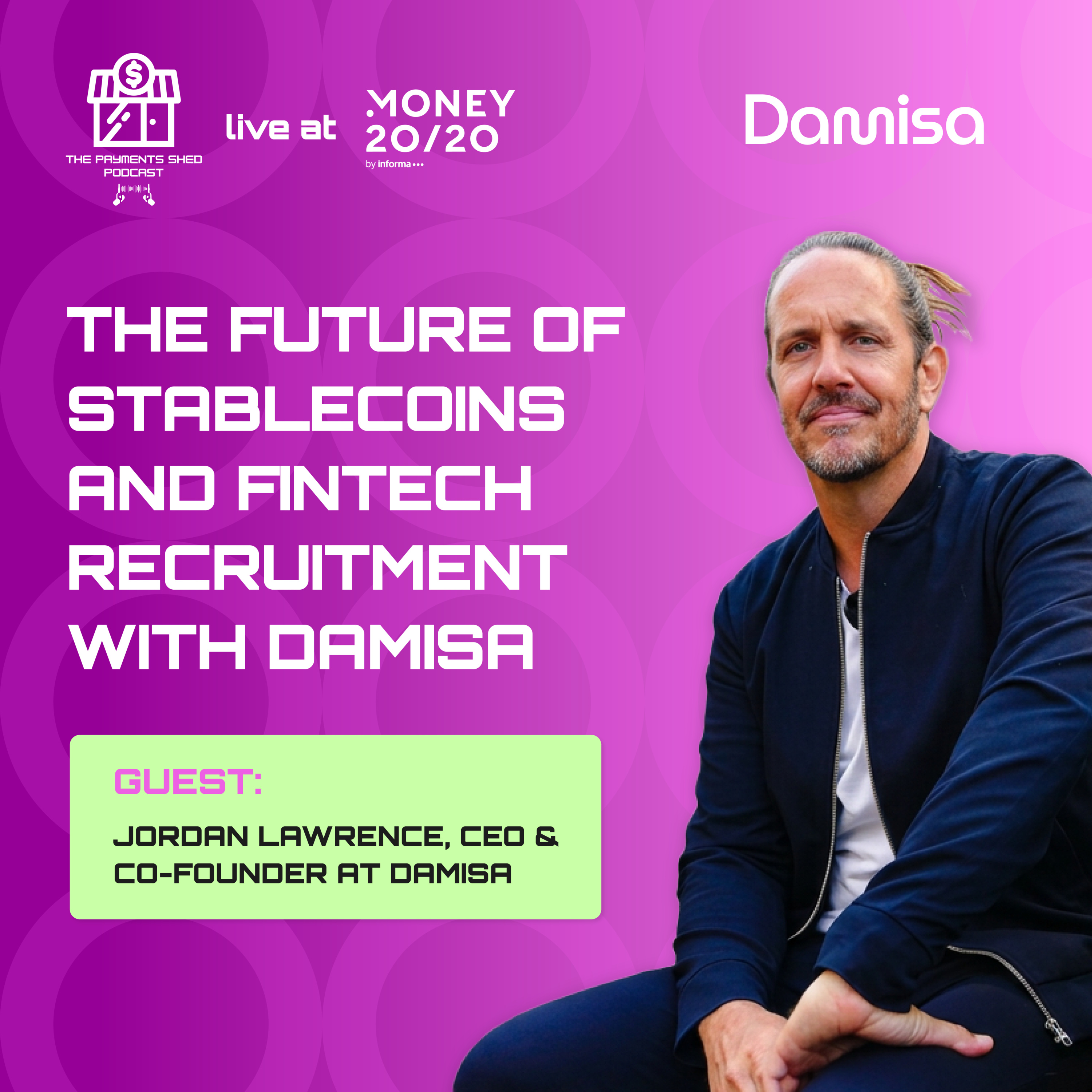
Ep. 73 - The Future of Stablecoins and Fintech Recruitment with Damisa
from The Payments Shed
25m 57s
In this podcast episode, Jordan, CEO and co-founder of Demesa, joins the hosts on a boat in Amsterdam to discuss the strategic and regulatory landscape of stablecoins. He emphasizes that Demesa deliberately pursues licenses across multiple jurisdictions—UK, Europe, US, and Australia—rather than exploiting regulatory arbitrage, because trust and long-term success depend on robust compliance. Jordan argues that the winners in the stablecoin space will be those who build interoperable, regulated infrastructure that others can rely on, especially as governments worldwide tighten controls, as seen in Brazil and Africa.
The conversation highlights that stablecoin business models extend beyond transaction fees. Demesa leverages escrow services that generate yield, infrastructure fees, and focuses on challenging markets where traditional banking is slow or opaque. Transparency is a major selling point, offering full visibility of funds compared to legacy cross-border rails. Looking ahead, Jordan discusses AI agents transacting with each other, which will require human oversight and programmable escrow wallets to ensure trust. He also stresses the importance of building an elite sales team through rigorous training and a strong work ethic, while avoiding the pitfall of conflating stablecoins with crypto, which alienates CFOs. The episode concludes with a "shelf of shame" item: the need to differentiate stablecoins as new financial infrastructure rather than crypto assets.
Welcome to the Payment Shed Podcast, the weekly podcast that dives into the big topics, trends and people
shaping the worlds of Payments, Fintech and Business Leadership, with your two co-hosts, myself, Grant Evans and Justin Hanna.
Welcome to the Payment Shed Podcast live from a boat in Amsterdam, which you believe it.
We are taking the show on the road very literally, or on the water I should say.
And we are joined by Jordan, CEO and co-founder of Demesa and the new sponsors of the Payment Shed Podcast
for season five, round of applause for that one. We're here for it. Thank you for the invite.
It's on the boat today. Yeah, thanks for the invite, great. And what a setting.
Good work for getting this going on. It's held out as well, we weren't expecting to be the case.
We thought we would follow up to the podcast that we did a few months ago. We had you on the show.
We're a bit more of a deep dive today. We're going to put you on the spot a little bit with some of it.
It's a lot warmer now. Well, yeah. We've got a lot going on at the stable point in space recently.
And we thought who better to do a deep dive with than yourself. Thank you.
Without further ado, shall we get into the podcast?
What's great is I lived here for 12 years in Amsterdam to the road.
So it feels like coming back home and drifting around in the water is super nice, right? It's very unique.
It is, yeah. We're just saying that I've been here. It's my eighth money 2020 Amsterdam.
It's actually the first time I've been here. It's amazing, yeah.
So we're going to kick off with the AFSL story, regulation, the arbitrage piece there.
Everyone's talking about how fast things are moving, regulation may be lagging behind the little bit.
You guys have taken a very deliberate route underneath licensing across the UK,
Europe, the US, and Australia as you do some announcement there.
Why take the harder path instead of that regulatory arbitrage that you see so many others going for?
It's a good question. And look, I think the fact is there's so many stablecoin companies now
doing cross-border payments. I think the winner in the end, we think as a team,
the winner in the end is going to be the one who has that infrastructure,
where people can build a payments company on top of your infrastructure.
And I think, you know, the US is dominating the stablecoin space right now with the USCT,
USTC. But obviously it's just a replacement of the petrol dollar.
So other countries around the world are not going to let this happen, right?
There's going to be more stablecoins growing around the world on different chains.
And I think the winner is going to be the one that can not only be regulated in each jurisdiction,
but can also interoperalize, is that the word? Make the various chains and coins interoperable,
basically. Obviously, we're not going to tell you that.
On struggle, we're saying that word, so much interoperable. I just can't say it.
Look, for people listening to Jordan, what does it actually mean to take the license
of a stablecoin? It's a stablecoin rail across more than one jurisdiction.
It's really hard. And I think, again, like if it was super easy, everyone would be doing it.
And so then you have people jumping on your licensing infrastructure for good reason.
It's really hard. I mean, you know, with the last business as well, we had an EMI
from the FCA in London. And they're just, you know, it takes a solid year and a half,
a lot of due diligence on the business, on the founders.
It takes money, capital deposits. So it's not an easy undertaking, right?
And regulations for the right reason.
It's trust. People often say, and we've talked about it last time as well,
you know, why should somebody trust you? And the fact is, they shouldn't trust you.
You just start up, you want to move millions of euros around, but they trust the license,
right? So I think, again, the winner is going to be the one with the most trust,
and that will boil down to licensing.
And we've seen, obviously, me, we've got things like the Genius Act in the US, obviously,
and then we were talking before the show today around the recent announcement,
what's going on in Brazil, right? This is something across the world, right?
Like everything is pinching in a little bit, but it feels like it's for the best
that really is going down that road.
Yeah, I think it's what's going to happen. It's natural.
You got the light, but it's natural because I think, you know, a lot of these countries,
in Brazil, people were using stablecoins to get around the IAF tax.
In parts of Africa, people were using stablecoins to get around capital controls.
Of course, that doesn't unify the existing banking system, does it?
So I think what's going to win is the unification of new rails onto the old rails,
and then if one's going to be happy, because the same money's being made by the government.
And we saw a lot of people going down that jurisdiction, short route,
in the past, do you think, kind of, the bottom is falling out of that play at the moment?
I think it will. I think it's not quite there yet,
because there's still a lot of money to be made in the shady transactions, right?
Where you can layer on and layer on and layer on, and people don't know where it's come from,
but for sure that will have to be drowned out.
Do you think we're moving into a space where only fully regulated businesses will survive?
I think as infrastructure players, yes, there's always going to be these companies that spin up,
go on top of infrastructure, and last maybe one or two years,
maybe get bought up if they're doing things right.
But I think the survivors will be the ones that are most regulated.
By the way, we're probably going to go for the, if we're going this way,
it's the longest bridge known to humankind.
There's a lot of data, I think.
I don't know. No, we're going there.
This is the deepest darkest bridge.
This is why when you film one of five people,
you have to research the route that you're taking in a lot of detail.
So, in your mind, then, what does good regulatory architecture actually look like
versus justifies what's in front of them?
So, I think good regulatory architecture,
again, I think there's a whole trust thing, right?
Without it, you don't really have a business, let's be honest.
So, what does it look like?
License is not only one jurisdiction where you try and passport that all around the world,
but actually where you want to do business, you have a license, right?
Whether you then farm out to other people or keep it yourself,
so you're the only one able to do business in that jurisdiction.
But I think you need licenses in multiple regions
to say that you're actually doing cross-border transactions, right?
Otherwise, you have one license.
You piggyback on everybody else's because of that license,
and you end up in the same regulatory quagmire as everybody else.
Was that the issue we had with acquiring though, or with crypto three or four years ago,
where people just passports, and I think people's licenses,
to kind of run it into the ground?
Well, that's what's happening, isn't it?
Yeah, and I think that's the danger.
If you want to go ahead and get a license in any country
and let other people transact on your license,
you're always running a risk that somebody's, there's a bad actor there, right?
If the EMI's did it in the UK a lot of years ago, right?
And look at the change of regulation there, even this year.
People struggle hard on board customers, exactly, exactly.
Same thing's going to happen, I think.
When we talk about the economics of this product,
and when we talk to stablecoin providers,
they always talk about the destruction of fees,
and how much money businesses can or cannot make.
What is a real business model here?
So fees are one thing, right?
But as we all know, look, there's been several companies open up
with the new payments ideas, but it's a race to the bottom in pricing, right?
So, what can you do after that?
So, for example, Dmitra has a whole escrow service.
We hold the money in escrow's, generating yield, right?
There's money to be made there.
There's infrastructure platform fees.
And then, with Dmitra, we are targeting businesses in established markets
who are going after transactions, let's say,
in and out of very difficult markets.
And there's money to be made there.
I think if you're trying to set up a stablecoin payment company
and you're only moving money between Singapore, the UK and New York,
there's no money in it, right?
And becomes very difficult.
I knew so quite openly the treasury inflow
for the real opportunity right now.
Do you want to part that in a little bit more detail for us?
Yeah, so look, if you're an enterprise business
and you're moving money between even Brazil and Europe,
which is a regular relatively cheap market anyway,
these days, and move money between,
that money, if it's a swift transfer,
will still take a few days to get there at best.
You know, it could go missing for a cross-bonded bank,
so it could take months.
But the reality is, it should only take a week at a most.
Well, if you say, "Okay, that's my flow,"
and I'm happy with that,
you could keep it in a stablecoin treasury account,
take the same amount of time with you're happy with
and actually make money out of the deposit in there.
So you can flip the whole thing on this head
and that should make money out of your payment method.
When we look at the reserve,
and we can play an FTX with this,
and there's scooching on that,
when we speak to the business,
how important its transparency
when it actually comes to the structure?
Super important.
I think that's one of the winning situations of stablecoins
because let's take the African into Europe
or US corridors, right?
The issue is, at the moment, it's very untransparent.
It goes through who knows what a cross-bonded banks.
You don't have any visibility over it.
Whereas if you look at a stablecoin infrastructure,
either we do a transaction out of Africa,
the money's either in a Damesa wallet
or it's in the bank account.
It can't be anywhere else.
It's really transparent.
I think that's one of the wins.
I suppose the less hops in the journey makes everyone
a little bit more happier, right?
That's the word, hops.
Yeah, yeah, yeah.
We've been hearing that term hops a lot recently,
and I like it.
I'm a big fan of it.
But the settlement of finance,
we talked about last time, right?
Getting the money in your stablecoin account
is as good as it being in your bank account.
You know the money's there, right?
And I think that's also, so when you speak about hops,
yes, it needs to be offered
to some point into corporate account,
but actually the settlement is there in your wallet.
That's yours.
Yeah.
And when we talk about the Estro layer
and then we kind of delve into the AI dream
and economy, the kind of overarching stuff,
this is where it all starts to get very, very futuristic.
I'm stablecoin is already a bit futuristic,
and then you put AI on top of it.
So when people talk about AI agents,
transacting with each other, it sounds exciting.
But where does trust actually come from?
And this is an amazing point, right?
I think this is a huge topic
around specifically Estro.
So, you know, there's already KYB, KYC companies.
Now there's no your agent companies, right?
But behind every agent is a human.
So if you're talking about,
you want to buy a pair of socks
and your agent is out there buying the socks for you,
buying from another agent, right?
It's still got to be a human behind it to say,
"I should authorize this transaction."
Or the trust is gone.
I mean, it's how PayPal started, right?
Initially.
There's a kind of layer between the bottom.
in the bot like there was humans in human. So now you've got an opportunity so you have
trillions of transactions sitting in escrow waiting for the humans to say I've got those
socks before the money gets released and of course every single day is generated yield.
So that's also an amazing use case for stablecoins. No one's going to take a bot at age
and let's say attach it to your credit card and say go spend. It's not going to happen
for a long time. In the end it probably will but not now.
He's a kind of like programal escrow account then. Is that kind of what we talked about
here? Was it kind of that smart contract? It's smart contracts over escrow which becomes
a programmable escrow wallet. So again money's gone in when certain milestones are hit those
contracts trigger and money's paid out. Now if again if it's agent to agent that can
very well be my agent has sent the payment. Okay my agent is sent the socks. If we want
to keep talking about socks. And then the t-shirts we're not going to get the t-shirts
of the t-shirts. And then yeah this has happened. I've got the t-shirts great release the money.
That's a smart contract before that is programmable sitting in an escrow wallet.
Where are we already seeing like early use cases at that at the moment and are there any
in play? Cross-border payments with commodities brokers. We're seeing that quite a lot on our
platform and a lot of people are selling houses now with stablecoins, buyer stablecoins
in escrow wallets. We've done a few ourselves at Demesa but if you look at commodities let's say
somebody wants to send $10 million dollars with a gold across the world or sugar or whenever
commodity it is coming out of these non G3 markets. Again you don't know what state it's going to
again. Arrive in you don't know if the gold's been sent. So people are holding the money in escrow.
The gold gets sent, gets ticked off. Thanks very much the gold's arrived. Money gets released
bit of yield. Thanks very much. Let's say when you start that attack on a scrutiny piece and
regulation. Are we kind of going back in time to let it bank infrastructure was just created?
They're just kind of a little bit wrapped up better now than maybe it could have been.
Yeah I think if you look at the financial infrastructure how it has been with banking
and as it is now because the technology wasn't there for everything to be super transparent
and you end up with bad actors, people not trusting the banking system and that's what we are now.
So I think the whole stablecoin layer adds another element of trust which is great. How do you
actually execute businesses on that? Yeah so this is also a very difficult one right when you build
a nascent payment method. You know we've done two things into Mesa I think from learns in the past.
You don't just say okay here's a new way to pay spend three months integrating it. It might work
it might not. Right we've built something where you can actually just do your initial transactions
without having to do any integration. We do the KYB of course and then people can just
transact on our front end on the Dami support tool and then if it works for them up against
their existing payment methods they can do a full integration and I think that that sort of thing
is we'll instigate trust because people can try it out themselves before going into full hog.
So that sort of thing is interesting yeah.
All right George. As we are in Amsterdam the city where you live for 12 years and obviously we're
involved in another good friend of ours PCNC on so long time partner of the show.
We wanted to talk to you about the next elite sales team. We're a sales table partner for a minute.
This is a category that doesn't even have a flavour necessarily right now okay so you've come
from FinTech recruitment. How do you begin to build a sales team in a category like this that most
buyers don't yet fully understand? Yeah so training training training right as always somebody comes
in you need a serious onboarding system and training. Now PCNC you know right has a big
staffing and recruitment arm to it and that is probably one of the most brutal industries in the
world in terms of sales. It's incredibly saturated and so to stand out there you need exceptional
sales people and you know one thing you see from these very aggressive sales industries FX is
one of them right recruitment is another notorious one real estate agents another one.
Yeah it's a different animal to what? Yeah FX that I never come has ever come to
fuel payments because it's always ended up going back to that fact it's like that spiritual hope.
So if you look at those industries that are so evolved right from the onboarding of the sales
people to the training they get they come out of the like the week or two onboarding like
frothed up ready to go ready to sell and they do a great job but I'm not necessarily trying to
replicate that kind of FX style of selling but the work ethic is something that needs to be I think
put into the payments industry to be honest and we've got an amazing opportunity now
as regulation changes to make sure that we've got an elite sales team and to build that we're
actually kicking off something in 2027 which we used to do in the recruitment space but
hasn't really translated into the payments world and that is basically we're going to Cape Town
we've got a house down there near the beach we get 10 very junior sales people anybody wants to
apply doesn't have to be very junior could be experienced if they want but they come into the house
and it's kind of a hunger games of sales right we're the side as us so we're aiming to get kind
of four people out of these ten of the truly elites people who really want to be involved for
the very long term and then we build our own sales team rather than trying to hire someone from
the outside but the network as we all know when their network's gone what do we do then right char
living in the house with these ten people of course highly regulated HR involvement
but yeah what does a great pro-file in sales look like it's good question some people will say I
think like you've either got it or you haven't I don't really buy into that they used to be like
likability instantly right and you know you have this kind of intellectual curiosity where you
want to find out exactly what the customer's doing whether business is doing so you can essentially
sell back to them right but I actually think you can train it in pretty much anyone especially
the world we live in now where you have to appeal to developers mainly right you need to be able to
talk to those developers so a very rounded personality that can pretty basically be in a room
and get on with anybody I think is a really good start and then someone who you know knows what it
takes to make money it's not easy you guys know right to build a startup is a big slug and so you
know not somebody wants to come in and work two hours a day someone who's actually got a serious
work ethic maybe come from a sporting background maybe someone who's come from yeah FX sort of
recruitment who knows you know twelve fourteen hour days on the phone um that sort of thing
so we're in stable island yeah there's 10 of us right how do you sell something
you know your advice for these people how do you sell something to sit between payments
crypto treasury regulation what's your device your advice to these 10 people going into stable
island you see basically who needs it at the moment right there's a very strong ICP we have at
Damesa don't want to say too much the competition is fierce but you see who's using it and who's
and why they're using it so my advice would be if you come into Damesa and you want to sell
you basically see where the use cases are where it's already successful and just work 12 hours
a day replicating that and you will you'll win it's an amazing use case we've got some great
products in a great team um you just need to be on the phone selling it my honest with about the
big customers but tens of thousands of followers only getting that it's on there every single day
talk about their challenges that the ICP is having yeah nice without just pick up the phone all
the time that being prepared to do that yeah and link to this as a sales channel what mistakes
of companies making when trying to commercialize this whole stable quantum structure because I
think for a lot of business they're trying to sell to them maybe selling a dream people maybe don't
understand it so what are they doing right or wrong I think we'll start with the wrong and then
we'll make everyone feel better with the right I think like with the wrong is people are jumping
on this bandwagon of stablecoin payments and talking about crypto yeah right so they're going to
a CFO maybe we've been at the business for 10 years and they're starting to talk about how
you know crypto's going to change your life and they don't make the separation between new
financial infrastructure and crypto and their CFO's brain immediately goes to stable Bitcoin
and one minute it's going to be yeah 100 grand a coin next minute it's going to be 40 yeah that's
I think the main thing people are doing wrong right now and you know then it's really important
to work with a team who understands payments who can talk to the head of treasury CFO head of
payments about payments before they start talking about crypto and I think yeah people are doing
right like that you know we've got an amazing payments team and I think that's why it works
we can talk to a CFO and actually say look we've been in your shoes not necessarily me but some
of the team we've been running big businesses panos one of the co-founders you know head to FinTech
a goda for a long time he can literally go and say to a CFO I've been in your shoes yeah right
so don't worry about what's going on behind these are the benefits yeah yeah I think it's
a real big thing just sales in general you have to be talking about challenges and your questions
haven't yeah that's the most important thing so many salespeople just forget that because the
store business is on cell phone it's a great point they gloss over actually what is the problem
yeah and they just say hey look at all how the great stuff we have totally relevant to
what the customer needs yeah yeah yeah right so we want to get into the reality check of hype
first is what actually happens next with state points as well so if we're going to define
the end state seeing major players now these are master card large PSP's all leaving in
to stable points what is real right now and what is still a bit of hype at the moment
so I think the hype always is coming back to this speed of payment right everyone thinks oh
I've got stable coin payments built into my stack I'm going to get paid immediately forgetting
about the compliance forgetting about the off ramp and the on ramp you know the onboarding
in the first place I think stable coin to stable coin payments of course instant but then trying
to get back into your corporate account can take time so I think people speed we have had
we talk to us about speed, are she interesting and then you call this our last look 12, but like
the front end speed is there, right? Yeah, the reality is the steps then thereafter is not
-Exactly, and that's to your point, the reality is, the payment service provider is and the
big enterprise merchants don't care about speed really, they don't care if the payment takes three days
or one, you know, a lot of the time they care about, are we making money from a treasury perspective
out of the money that is moving around the world? Right? They don't really care about another day
on the payment lag. Do we think stablecoins are placing cards or is it just kind of an overblown
narrative that businesses similar to make what open banking is five or six years ago? That scheme
is going to be no more? No, I don't think so at all. I think cards are always going to have a
future and a place and companies like Calipe and Reap that was just sold for 600 million,
you know, they are attaching cards to stablecoin wallets, which is great. And I think that's never
going to go away and you've got to also think about who in the world is using Bitcoin or stablecoins
to actively pay themselves on a retail perspective. The card uses, it's not many. The underserved
market is the business-to-business space and of course people are making card payments, business-to-business,
but it's more money flow. And all options are supposed to replace them, I think so.
So you want to talk about the large end of prices not being so fast onto me because they're so
cashier and shedding right, it's kind of like some outtips for them. What are these larger end
prices then asking you guys for as it passes in the quantities of programmability like what they
come to you guys with? Yeah, like basically treasury pay. So if you've got money, say payment service
provider is collecting money on behalf of a merchant in Brazil, right? What happens to that money when
they then have to pay out in US or Europe or UK or Australia? They want to be able to keep going or not.
Yeah, they want to be able to when there's idle funds sitting around in those wallets before the
payout or accounts, they want to make money out of it and that's what they can be tossing for.
Everyone's afraid to tell us what their next blocks are in this way, so you can hard drive
telling you guys, yeah, I think that's all right now. Well, I mean, yeah, I think the next thing
you were touched on in terms of futuristic very forward thinking view is the agent piece, right?
You know, we all know the agents are going to use stablecoins, so then how do you monetize that
flow between the agents because they're talking not billions of payments anymore but trillions going on.
So I think people need to start looking into that. And I think as to your point, the treasury
piece tops out, what else can you do? On-chain finance? Yes, you've got all the risk data about
who's paying. We've got this escrow piece, so we know who's paying and who's not. We can start
offering on-chain finance out of those escrow accounts to front-run the payments so people have
more cash flow. Is that where, kind of, we've lasted for three to five years? Is that where
communities from stablecoins wins in general? I think so. I think fueling very large transactions
around the world and giving cash flow opportunity to businesses who need
front-running of those payments, right? From an on-chain finance perspective.
Well, Jordan, thank you for coming on the show again. Thank you so much.
It's a great returning guest on the payment ship. Well, a lot of.
In 89 years, so we've learned a lot, we've learned that bridges are very difficult. Now the
community are a lot of podcasts on a boat. We've really enjoyed the chat, but that also means
you are the first guest ever to bring a second shelf of shame to the table. So have you come prepared
today? I mean, we talked about two last time. I think it was the myth of the speed,
which is just touched on there, and I think then it was crypto is going to solve the underbanked
around the world. So I think if I was to bring a third one, which I've come a little bit
unprepared for, I would have to say, yeah, I think people should stop mixing up crypto and stable
coins and start seeing that actually stable coins are the new financial infrastructure rails
as opposed to the old Fiat rails. What does that know as in marketing? Like how do you, how do you
move when some, I guess, founded on those rails or in that space? Is it the marketing team's job
to move away that mindset? I think so, but obviously it's in some people's not best interest to
move away from that mindset, right? The traditional players, the banks. So I think as you do see the
bank start buying up payment companies that are focused on stable coins to replace that infrastructure,
I think that will change because it's in their interest. At the moment, I think a lot of bad
press goes out there by still trying to push the crypto part, oh, you're making a crypto payment,
no you're not. So I think the shape, the shelf of shame should be, let's start making the difference
between a crypto payment and a stable coin. Yeah, I think like it needs to happen. And we risk
promise of us not to talk about money 2020, obviously we're here on Monday evening getting ourselves
all done for the event. The weather's beautiful. It's beautiful, absolutely. How's this event?
Look, a few guys, you guys busy, working on banks that a few days. Really busy, I mean, getting off,
could drop off at another event now, which is amazing. Yeah, yeah, yeah. So it's very busy,
yeah, it's pretty, pretty back to back all week and we're looking for partners here, of course,
which money 2020 is amazing for, as well as merchants and payment service providers who want to
use, used to meet them. So it's a great event. Your look has been great following the journey
to the east so far. Really exciting to see where it goes. Thank you so much again for being a sponsor
of the payment set on fast. Thank you guys for the event. It's been great. Thank you. Thank you.
Podcast Summary
Key Points:
Jordan, CEO and co-founder of Demesa, discusses the importance of obtaining licenses in multiple jurisdictions (UK, Europe, US, Australia) rather than relying on regulatory arbitrage, as this builds trust and long-term viability.
The stablecoin industry is evolving beyond fee-based models; businesses can generate revenue through treasury yield on escrow accounts, infrastructure fees, and targeting transactions in difficult markets.
Transparency is a key advantage of stablecoins, offering clear visibility of funds compared to traditional cross-border banking, which often involves opaque intermediary processes.
AI agents will increasingly transact with each other, but trust requires human authorization behind transactions, leading to programmable escrow wallets that hold funds until conditions are met.
Building an elite sales team in the stablecoin space requires intensive training, a strong work ethic, and the ability to communicate with CFOs and developers by focusing on business challenges rather than crypto hype.
Common mistakes include conflating stablecoins with crypto, which alienates traditional finance leaders; the future lies in positioning stablecoins as new financial infrastructure, not speculative assets.
Realistic expectations are needed
Stablecoins won't replace cards; instead, they'll complement them, with growth in B2B payments, treasury management, and on-chain finance for large transactions.
Summary:
In this podcast episode, Jordan, CEO and co-founder of Demesa, joins the hosts on a boat in Amsterdam to discuss the strategic and regulatory landscape of stablecoins. He emphasizes that Demesa deliberately pursues licenses across multiple jurisdictions—UK, Europe, US, and Australia—rather than exploiting regulatory arbitrage, because trust and long-term success depend on robust compliance. Jordan argues that the winners in the stablecoin space will be those who build interoperable, regulated infrastructure that others can rely on, especially as governments worldwide tighten controls, as seen in Brazil and Africa.
The conversation highlights that stablecoin business models extend beyond transaction fees. Demesa leverages escrow services that generate yield, infrastructure fees, and focuses on challenging markets where traditional banking is slow or opaque. Transparency is a major selling point, offering full visibility of funds compared to legacy cross-border rails. Looking ahead, Jordan discusses AI agents transacting with each other, which will require human oversight and programmable escrow wallets to ensure trust. He also stresses the importance of building an elite sales team through rigorous training and a strong work ethic, while avoiding the pitfall of conflating stablecoins with crypto, which alienates CFOs. The episode concludes with a "shelf of shame" item: the need to differentiate stablecoins as new financial infrastructure rather than crypto assets.
FAQs
Demesa believes the winner in stablecoin payments will be the one with trusted infrastructure across jurisdictions. Licensing builds trust, and regulatory arbitrage risks bad actors, so they deliberately pursue licenses in the UK, Europe, US, and Australia.
Beyond fees, stablecoin providers can generate yield on escrow-held funds, charge infrastructure platform fees, and target transactions in difficult markets where there's more money to be made. Simply moving money between stable markets offers little profit.
Stablecoin infrastructure offers full transparency—funds are either in a Demesa wallet or a bank account, with no hidden hops. This contrasts with traditional cross-border transfers that can go missing through correspondent banks.
AI agents can transact on behalf of humans, but trust requires human authorization behind each transaction. Escrow wallets with smart contracts hold funds until milestones are met, like receiving goods, ensuring trust in agent-to-agent payments.
Early use cases include cross-border payments for commodities brokers, where funds are held in escrow until goods like gold arrive, and real estate purchases using stablecoins in escrow wallets, with release triggered by milestones.
Demesa plans a 'Hunger Games' style sales bootcamp in Cape Town, where 10 junior salespeople live together and train intensively, aiming to keep four elite hires. They focus on work ethic, intellectual curiosity, and the ability to talk to developers and CFOs.
Chat with AI
Loading...
Pro features
Go deeper with this episode
Unlock creator-grade tools that turn any transcript into show notes and subtitle files.
 PodcastTranscript AI