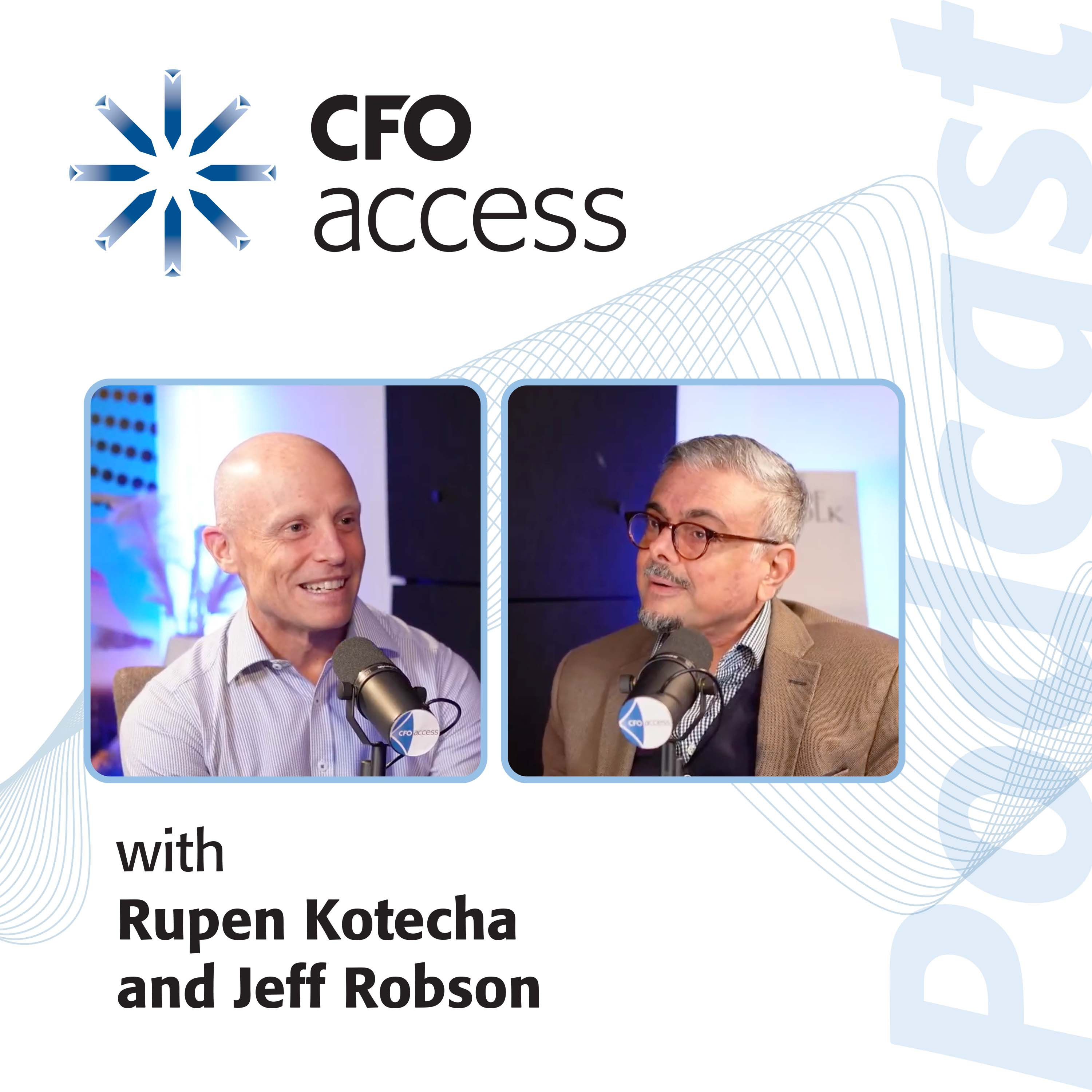
Ep 7. Creating the Future: Insights from CFO and Entrepreneur Rupen Kotecha
42m 14s
In this episode of the CFO Access Podcast, host Jeff Robson sits down with Rupen Kotecha, a seasoned CFO and entrepreneur. They discuss Rupen's early entrepreneurial endeavours, his experiences transitioning from corporate roles to founding WA Leaders and the CFO Centre, and his approach to business networking and succession planning. Gain invaluable insights into the evolving role of CFOs, the importance of laser focus, and how personality profiling can guide career alignment. Whether you're a finance professional or a budding entrepreneur, this conversation is packed with wisdom and practical advice for shaping the future. Rupen Ko...
Transcription
7807 Words, 41680 Characters
Being a CFO today isn't just about crunching the numbers, it's about shaping the future. Welcome to the CFO XS podcast, where we talk to finance leaders who aren't just waiting for the future to arrive, they're creating it. My name's Geoff Robson from Access Analytics. Let's shape the future. Hello and welcome to the CFO XS podcast. My name is Geoff Robson, managing Director of Access Analytics and founder of the CFO Access Networking Groups. In this episode we're joined by Rupert Kotecher, a seasoned CFO entrepreneur and founder of WA leaders. With a career that's taken him from the UK to Asia and now Australia, Rupert brings a truly global perspective to financial leadership. He's worked across multiple industries, founded the CFO Centre and now helps mid-size growth companies thrive through WA leaders. Rupert also happens to be one of the very early attendees of our very own CFO Access Groups back a long time ago now. So it's great to be able to welcome you back if you've come full circle, you're back on now on the podcast. We'll dive into some lessons from his entrepreneurial beginnings, his passion for business and business networking and the power of succession planning and of course a few insights into how he sees the future of the CFO role and how that's might evolve in future. Rupert, welcome to the podcast. Geoff, it's a pleasure to be here. Thank you. Rupert, I just like to start by going a long, long, long way back to when you were 14 and my understanding is you're making fish tanks and this is one of your earliest or your earliest entrepreneurial endeavour. How did that early experience shape your approach to business and finance? Geoff, casting my mind back to when I was 14, what I didn't realise is that those kind of formative years, making fish tanks, breeding fish, selling them actually set the tone for the latter part of my career and from a young age, I understood the concept of making a profit and I was good at selling. So combine the two together, that makes a really strong base for an entrepreneur and I went a little bit crazy coming to Perth, where I set up the CFO Centre business but also doubly leaders and eight other businesses as well. So I thought that the more the better and I caught up with a friend over coffee and he goes "So what are you doing these days?" and I told him that I had all these fingers in all these pies and he said, "Rupert, none of them are going to be a success." And I'm thinking, "What do you mean? One's going to go up, one's going to go down and we'll all be okay." And a year later after that, this thought comes back in my head and I realised that it was right. This concept, what I call split energy, it's like if you're cutting a sheet of metal with a laser, if it's focused, you're going to get a really clean cut, otherwise it's going to be jagged. That's what I was doing for myself because I thought I'd be missing out if I didn't have all these businesses. So I did eventually exit out of all of those and focus. And I think that that is core to a lot of business owners, learnings that focus. Otherwise, you get a jagged edge. The results are not that good. I guess this is a trouble as an entrepreneur. It's so easy to get distracted because you see so many opportunities and you have so many ideas. But how do you manage that and how did you end up deciding which ones to focus on? Yeah, so the key thing is that what's there in front of me? Can we grow what we've already got in front of us? Rather than looking at something else shiny which is shown up on the radar, I think, "Oh, so what happens then is you lose focus on what you've got in front of you?" And the other thing I've realised is, if I think about when I sold out of the CFO center business over two years ago, since then, we've had the biggest and best years in double leaders. We've just finished the financial year and in the 10 years we've been running it, it's the best year ever. I'm thinking why is that? Comes back to this focus because it wasn't split energy. My real focus on it gives the real result. So I bring my mind back back to that. Sure, there is one or two projects they're bubbling in the background, but they're all connected. They're not very individually separate from what we're doing. And so you've been an entrepreneur since age 14, essentially. Do you think it is something that is in your blood you're born with or is it something that people learn or is it a combination of both? What's your view on that? Yeah, so when I was growing up dad and his brothers owned multiple businesses in Kenya, in Africa, and these are multi-million dollar businesses, so the conversation on the dining table from a very young age was business. You know, what's happening where things are at? And I knew from that day that one day I'll be running a business. But guess what happened? Education got in the way. I went up to the UK to study economics and law is a degree. And I thought, hmm, I'm still following that the path of becoming a business owner, becoming a chartered accountant's really good idea. So I went and became a chartered accountant, ended up working in accounting practice. Nice to get bored. I'm thinking, hmm, let's get out of here. Ended up moving to more of a finance person in industry. And every two, three years I'd be moving jobs and my wife would say, it's coming up to three years. Maybe it's time to move. But then yeah, you're right. And because I wasn't satisfied, it wasn't aligned with my profile. And my last full-time corporate job was on the board of British Airways and I thought, that's big job, this, that, and the other, but come two and a half years I'm thinking, let's get out of here. So actually what calls me to stay put in a job is we had three kids, young kids. My wife was at home looking after them for six, seven years. If I jump off the corporate ladder and stop earning money, it might take me a long time to set up a business. I didn't know what business to go into. So I stuck to it until we landed here in Australia and I said to my wife, I am looking not to get a job. It'd be a very easy thing to do. There was lots of offers on the table, but on a set of my own business, that's where the concept of the CFO center came up. Because I could bite-sized chuck myself. It's an easy business for me to start because I know what a CFO does. But what I didn't know was running a business is very different to being a corporate CFO. Absolutely. And did that sort of global experience help in shaping your perspectives on this as well? Is that useful? I really struggled. You know, the first two years of setting up that business, I didn't realise that as a business owner, you're wearing all these hats. I'd British Airways, I had two executive assistants doing a lot of stuff for me. It's like, okay, Rupert, coffee time, whatever. And then it's like, I'm going to make a call, make appointments. That was all upon me. The marketing, the branding, the sales. And it's not an area which I've had much experience in. We had an issue with a CFO brand where there was, the fractional or part-time CFO model was 15 years ago when we landed in Perth and started that. It wasn't that well known. And so the issue was, you'd go along to a mid-tier business and say, look, we've got this concept of a part-time CFO and they'll look at you and think, so what is that? CFOs for big businesses which are listed, not for us. And so it was a very difficult thing for me to position that product in the market. And at the two-year mark, I remember my wife telling me, she goes, maybe you should get a job. This doesn't look like it's going to really go far. And at that point, we were already starting to make headwear and I said, no, no, hang in there. This is going to work. And we got some help from external parties and one of the people who helped me out is actually on the double-a-litres advisory board and helped me position how to go to market. And that conversion rate went from 30, 40% to over 90%. And that's when the business started to scale. We just had to get that position right. These are the kind of problems faced by most business owners. And I realised that. And that's where double-a-litres was born out of that need. My own need was me to have a business for others as well. I'll come back to double-a-litres in a minute because I do want to know more about that. But just in terms of what you're talking about before, with the CFO centre, how did you kind of educate firstly yourself and then educate the market on what a fractional CFO was? Because it wasn't even kind of knowing at that point in time. Yeah. So the concept of the fractional, it wasn't even called fractional at that time. We called it part-time CFO. And people that understood what that meant. A whole new way of educating the market using models. So creating visual models for people to understand and putting feeling into the kind of issues they were facing in the business. And then attaching that feeling to a solution. And so look, if you're facing these kind of problems in the business, then actually it's not the accountant who's going to fix them. It's going to be a CFO where you can't afford a full-time CFO. Guess what? We're going to provide you a part-time version. So someone who's been a CFO many times over comes with the experience. You don't have to train them up. You don't have to pay the full year salary or anything. You just pay a fractional amount. And that's how we started breaking into the market using these visual models. And people got it, people understood. And once you have a few, you get some testimonials, people understand and then it started really flowing. And once it started flowing, then your obviously your wife got on board as well, I'm assuming. No, no, no. She was at home all these years, looking after the kids and actually at the two-year mark, when she said I should go and get a job, a corporate job to support us through that phase, that's when I took up the courage and asked her to get a job. And she got a job at our office hospital. She's still there. So I've said to her, look, you don't need to be working. There's a reason. You've got that job, but she's enjoying it. So she's there now. And in the meantime, we started, I started stepping back from providing the CFO services. I was actually misaligned in terms of myself being a part-time CFO. I was more akin to the marketing, the sales, the running of the business, the scaling. That's what really inspired me and through lots of energy at me. And how did you discover that you really weren't meant to be a CFO, given that you're trained for? You know, all these training and everything in study and experience, obviously. And then you kind of find out, I'm actually better suited for the entrepreneurial side of things. How did you discover that? Oh, good question. So what happened is when I landed here first, I would network a hell of a lot. Because I wanted to get to know the market, get to know a lot of people. And I bumped into a lady who was setting up a people profiling business. And she goes, I'm looking at some support because I've never done this setting up a business. And I said, yep, I'll be interested. So she profiled, tested me. She goes, so what do you do? I said, well, I do this CFO stuff. And she goes, that's not for you. I said, ah, that explains why I used to move every two or three years in corporate jobs back in England. And that explains why I wasn't satisfied with the career I put in front of me. And so I said to us, so what is it I should be doing according to a profile? She said, you're a deal-maker profile. I said, so what do they do apart from doing deals? Well, you'd be good at sales, you'd be good at getting in front of people, you'd be good at creating relationships. I said, ah, that feels a lot more comfortable, which is when I started extracting myself from doing CFO work in the CFO business. And bringing in CFOs with the right profile who wanted to do that kind of work. So they would be a lot more suited to the clients than me going in and doing that work. Was it trivial for you to kind of extract and make the transition from CFO into effectively CEO and deal-maker or, I'm not sure what title you gave yourself, but was that a devial process or you've found that quite easy? It's so easy. Because it's the stuff I wanted to do. The only thing I didn't know was positioning the product in the market, the marketing which goes behind it, it's actually become my passion now. That's what I do in the business. I come up with the ideas, thinking about how to get to market, look at different markets. That's what I love doing. But then I didn't have no idea. Then you came up with the idea for SWA leaders because this is your baby as well, isn't it? Where did that come from and tell us about that as well? Yeah, yeah. So this is where I believe that when business owners get into business, you've got to give yourself the leeway for to let things happen as they happen. Don't be too rigid about, this is how we're going to get to where we're going to get to. Because you might be cutting out a whole heap of ideas out along the way. So go with the flow, with the energy flow, follow the energy. So what happened is my co-founder of the CFO centre based over in Brisbane was on the board of Queensland leaders. He goes to me, this is exactly up here, Ali. And I had no idea what it was. And so I had a chat with the guys at Queensland leaders and they and we talked about, I said, yeah, that's it. You know, creating a community, knowledge for business owners is a big thing because most business owners are good at whatever skill they've come with. So if it's a profession or a product or a service, that's what they're good at. But actually to grow and scale a business, they have no idea. A bit like me setting up CFOs, business and knowing what the CFO product is. But actually to grow and scale that, I had no idea. And that's where a lot of businesses get stuck. And some of them get stuck much earlier on. Some of them get into the millions and they get stuck. Because they don't know where to take their business to that next level. So we then started WL Leaders 10 years ago. It's 10 years this year. And the whole concept is to run a programme to accelerate the growth of these businesses by surrounding them with 20+ experts who provide the knowledge, who provide the connections, and also the mentoring to these businesses in areas which include growth and scale, innovations, strategy and also exit. Because business owners need to be think about creating an asset which they're going to sell or do something with later on. And also becoming part of our, we've got over 150 members really inspiring each other and coming together. So you're never lonely on this journey called business. And that's a big issue. A lot of business owners don't know where to go. They can go to normal networking events, but most people are there to sell to each other. Where do you go where you've got a supportive community? That's what we created. So powerful, isn't it? I mean, obviously, as you know, we are exosanlytic as a member of WL Leaders as well. And we're still quite new, so we're still kind of, you know, working out how it all works. But, you know, already we've certainly gathered a lot of benefits from attending. So thank you for bringing us into that group. Just wondering whether you can share any other stories of, you know, other businesses and their success through WL Leaders. Yeah, yeah. So many stories. So what happens? Jeff is they come on board for the years program and then they, we have a graduation ceremony and then they move into our alumni program. And that's ongoing as well. And at that point, we have a conversation with them at the end of the 12 months. And just check in to see, we've been checking with them throughout the year. But at the end, we want to know what the real impact is. And I tell you the stories are really heartwarming. And we have the story of our company called Corporate Travel Management, who came to leaders. The thinking there was to exit the business in five years. That's what the founder and owner wanted to do. And instead, through the workshops and the mentoring sessions, they got challenged in terms of how they can grow this corporate travel company. And eventually they ended up listing the business. So if you look up on the ASX corporate travel management, is worth just under $1.9 billion. Wow. So this guy had no idea that he could take this business global. And by really prodding him and challenging him, that thinking then led to them listing the business. And that's the kind of story we look and really feel good to that. We were part of that initial journey to get him to think differently. And we see that across the board. People are getting stuck at different tiers in their journey. And if they come to leaders and through, I call it, you get infused with knowledge. So this is not sitting there like a university program, because I'd get bored and walk out. You're infused with knowledge. You're sitting across the table with other businesses, some ahead of you, some behind you. They're inspiring each other. And that's the kind of culture we've created within leaders. That's amazing, isn't it, Dave? I mean, do you kind of like just look back sometimes and kind of, you know, pitch yourself a little bit and go, well, look, you know, all this is happening around me, you know, essentially, we wouldn't be here if it wasn't for me. Yes, so give yourself a pat on the back. And you know, I forget to do that now and again. And I think actually what we've created also helped me in the CFO business, because I've been on the program sitting through the workshops and having conversations with these experts for the last 10 years. So the knowledge in terms of business, that first I thought I was running two businesses side by side. But actually, I was learning from one and putting into the other. And it's only when I look back and I think this is benefited me. I'm a big case study of my own business with what we've achieved. Because business is changing all the time. Now, since COVID, the way we do business, the way we do sales has changed significantly. And if you don't keep ahead of the curve, your business just disappears. Hmm, absolutely. I mean, it is, it is a shame that we don't do this more often, isn't it? Just looking back and looking back at where we've come from. Yes. We always kind of seem to compare ourselves to someone else. And there's always someone that's, you know, better, got more money, you know, done more, done this done that. We go, "Oh, I feel bad because I haven't done all these things." But if we look back at where we've come from, we actually go, "Oh, I've actually done some pretty cool stuff, right?" Yeah, yeah. And you know, Jeff, you make a really good point. So around the dining table, we kind of try and have dinner with the adult kids, I call them now. There's five of us, my wife and three kids. And if it's three times a week, we're together. Then right at the end, we've had our dinner, we're sitting there having a chat. We have a gratefulness exercise. So we go around the table. What are you grateful for? It could be, you know, something which has happened in your day-to-day, or it could be someone around the table. And that forces them to think about being grateful for where they're at right now. Because it's quite easy, like you said, to compare yourself to others out there and think, "Hmm, I'm behind." Actually, in your own personal life, you're doing okay? All right, so what's something that you're grateful for at the next dinner, Rupin? Oh, so I was actually grateful, one of the dinners, the fact that we've got the five of us together, because we hear over a lot of families, once the kids get to that kind of age in their early twenties and mid-twenties, family dinners don't happen. But we're all together, and we still go on holidays together. Five of us. And people are shocked sometimes to find out that your kids are willing to come with you. And I'll tell you why, because I thought about it. It's because I'd set up this fractional services business, which allowed me to have freedom. So I'd be picking them up from school, if my wife was at work, then I'd pick them up. Sometimes I was the only dad there, and then the women there probably thought, "This guy doesn't have a job." But what happened is, on the way home, we'd be having conversations about the day, and I'm connecting with them. Sure, when I got back home, I'd have to do some work. But that created a lot more of a connection with the kids. That even now, if we say we're going on a family holiday, they'll come along. So it's not just that Mum and Dad are paying for them then. These days, they chip in. Oh, this is the CFO, and we're coming back, because if something's free, there's no value attached to it. For sure. Oh, I mean, it's good. It's good. Fantastic. Apart from things we've already talked about, what are some of the other lessons that you've learned along the way? Laser focus was one. Laser focuses. That's split energy. Keep away from it. And the same applies to your relationships, right? Where was in front of you? Give them 100%. If you split the energy and start looking around the room, they know you're gone. Your mind's gone somewhere else. All right. A line product to market. Just making sure that whatever product you've done, there is a market for it, and you're aligned to it. If you don't, I see so many people come up with new ideas. Products not aligned, it doesn't take off. Or sometimes it needs tweaking. So if that works, that's pretty good. Providing exceptional customers' experience. So CX-driven organisations. CFO Centre, one of those. And 00L is definitely one of those as well. So there's actually a test we did when all the owners within the CFO Centre were thinking about, what's the flag we fly? And we came down to thinking, we're not values-driven business. We're a CX-driven business. Customer experience. And there's a test we did to figure out who is naturally aligned with customer experience. And I was the only one in the whole global business. It was naturally aligned. So they kind of figured out and said, what is it you doing so we can replicate it elsewhere? Which worked really well. So for me, exceptional customer experience for everyone coming through 00L, that's a big tick for me. It has to happen every time. And how do you ensure that in the business? How does that work? How do you kind of make sure that is consistent? That's not just you. Yeah, that's a good question. So we had clients in the CFO Centre also attending 00L, the programme. And I remember one of them coming up to me and saying that the culture in both seems very similar. I said, well, it seems like I'm driving it from the top. And when we hire people, it's based on the fact that they are CX-aligned. If customer experience is not part of their build, we don't want them. If it's just the skills that they're coming with, that's not enough for me. They have to be CX-driven. So the team's built like that. And I guess if you CX-aligned yourself, when you sit for an interview, you can see just a few questions and I'll know if someone is CX-aligned. So that is a big flag we fly across all the brands I've been part of. I mean, I think that would also apply to someone who has just CFO and has brought me internal customers and not necessarily interfacing or interacting with the external customers. But as a CFO in a business, you'd kind of deal with many parts of the internal businesses. Does that still apply there? Absolutely. Yeah, so when we did the whole exercise at the CFO Centre, it was external and internal because within the business, there is internal customers. If it's marketing, if it's sales, but they're interacting with each other and they've got to see each other as a customer. So really important that the CFOs we recruited were also CX-aligned. And the ones who won over time, you could see that they want to fit anymore. And eventually, either they left or we had some conversations, then they felt that it wasn't a fit. So that's important. But also, something called with people profiling to make sure that someone coming on board as a CFO or any employee, are they aligned to that job, depending on their profile? If they're not, then it's going to be a hard job for them. So a little bit like myself, I was misaligned for many years from my profile in a corporate job. And sure, we're intelligent beings. We can turn our hand to anything and show up and do the work. But at the end of the day, you don't feel satisfied because you're misaligned. Yeah, it's really about that kind of, what's my unique ability? And one of the things I'm really, really good at and getting involved in that. And what's my passion? What are things I love doing, isn't it? Yeah. And it's one of the tests we run. So when a member comes on board at WLEaders, we have an onboarding session. And part of that onboarding session is we run this personality profiling test for all the members coming on. And at that point, they can see the gaps in their business. Now, I remember orientating one of the members coming on board and they had five from the leadership team who were going to attend WLE Leaders. And through that session, I asked them the question that, "Are you guys struggling with bringing on new business, new revenue?" And they said, "Yes, we are." And they said, "How did you know that? "You haven't even looked at our accounts." And I said, "Well, from the profile of the people you got around the table, you don't have the sales profile." If you don't have the do-makeup profile, you can have the best product. It's not going to work. So they said, "So what about if we go and hire a salesperson?" I said, "Well, they've got to have the do-makeup profile." Otherwise, they'll go and talk, they build relationships. They won't get the deal done in time. Sure, they might bring some business on, but they won't be a property-umaker. Yeah, it's interesting that you could figure that out just by looking at the profiles. Three-minute test. We do that for all our members. And I use it for all our recruits. Please sit this test. Text three minutes. I've actually got some of the WLE's members who have asked me to do it for their teams. And we have a lot of fun because what happens is, when you run the profile test on team members who've got to know each other and say, "Oh, that's why you behave like that." And that's why you're a little bit quirky about this thing. It's their profile. Those profiles get set in individuals between the age of 0 and 7. It's very hard to shift them. So when I was selling fish tanks at the age of 14, that was already built in. But it became dormant through my corporate years because I didn't have to go and do external selling. Sure, internally, as a CFO, I had that. But as soon as I had the opportunity, we could flick the switch on pretty quickly. And it just shows to prove that if you have that profile and you miss a line to it, you're not satisfied. The minute you align yourself, it works. So at home, for example, when we moved over here, we had some flat-pack furniture to build. And we'd profile the kids using this profile test. So I knew exactly which kid to help me. Right? They were young then. One of them would just talk. I'll end up doing the work. The other one would moan because it's not. This is not their gig. And one of them, the right one, would actually build it without looking at the instructions because that's how mind works. She's now in business as well, from her own business. And she'll build the whole thing and I'll just look at her and help her. Put things together. She doesn't work in IKEA by any chance to shoot. She'll be the perfect place for her to be, just flat-packing furniture and assembling it. She runs a social media, marketing, videography, photography business. Okay. And it kind of, what she does kind of aligns with her profile as well. Amazing. So, okay, so is there a profile that would fit that it'd be best suited for a CFO in what sort of personality profile or how would that fit? Yeah. So, if you want a CFO who is personable, then you've got to have a profile where these people like people. Because you get CFOs or pure bean counters, they want to sit in the corner and that's not going to work because a CFO has to communicate with all levels within the business and all departments, all the way through. So, that's a key trait you need to look for. And then the second piece is that they've got to have the thing around numbers because at the end of the day, that's their training. And then they've got to have like a double checker profile where they can look at things and say, "Oh yeah, that's where things are at." So, those two, I would say, are key. CFOs are also more strategic and commercial. So, a little bit of a deal-maker profile is necessary because if they are at a board meeting and they've got some things to put forward, then they'll be able to sell some of those concepts much better if they had a little bit of that sales. They don't need to be full-blown deal-maker, but a little bit of it would really help. So, if you combine two or three of those, that will create a profile of a CFO who can work at a more commercial strategic level, be connected to people and also get things moving in the business because they have their ability to push ideas forward. Okay, and if someone listening to this wanted to undertake this test, is that possible they could do that? Or how would we go about that if we wanted to find out? It's a three-minute test, so I'm happy to help them out. I do at least two, three a month with people saying, "Can I do this?" I've had people who've been aspiring to be going into finance and not sure whether they should stay in practice or whether they should become an accountant working for Woodside, for example, it's very different. And then the profile tests will really reveal which one there are more aligned to. It's interesting because when you did the profile test, if I see the person that you were sitting at with, said, "You're totally unseeable for what you're doing. Go do this over here." The profile, yeah. And for years, so that's why it was like, "I'd get bored and I want to move jobs." And that then shows up in your career history. In your profile thinking, "Is this guy going to stick around?" "Well, I'm not." Because I never kind of didn't know that myself. So hence, this is so important. You know, there's a book which I read years ago having the right people in the right seats on the bus, right? And that's what this is about. Well, how are you going to know you've got the right people in the right seats on the bus, apart from hiring someone and testing the man and then finding out six months later, "Oh, that's not a fit." That'd be me, not a fit. And then I'll take another year and a half to leave. So, okay, so apart from doing the personality test, is there any other advice you would give to someone who's aspiring to be a CFO, like a young person just entering their profession or something like that? So, anyone aspiring to go into a career of that sort, I would say that they should go and spend some time, either internship or get a part-time job and get a real feel of what is it like? What's the culture of working in an environment which is, you know, financially based? Is that aligned with them? Now, funny enough, I did that. Working at PWC back in Kenya. But the role I was assigned to was more of a consultant. And I loved it. Well, what I didn't realize, well, I went back in and did my chartered exams and he was auditing and putting numbers together and thinking, "Well, get me out of this." So, it's really good to figure out whether it's really for you. So, we did that with my eldest daughter. She was kind of thinking, "Yeah, Dad could follow you for a step." I said, "Well, I know some people in their accounting practice. One on you go and spend a week, they'll open the door, you go and work there, they'll give you some toss, get a sense of it." And she walked out. I remember on her last day, I said, "Well, what'd you say?" She said, "Nothing." I said, "Yeah, that's it." You've told me. That's not for you. She's the one who's doing the video and marketing and that kind of business because this wasn't aligned. And the second thing is understand your own personality profile. Really, really important. Because that will then guide you even within finances there's so many different roles. So, which one is a fit for you? Because not everyone's suited to be a CFO. I guess also, different types of CFOs as well. There's a CFO that is more than the dealmaker. There's the CFO that is perhaps more the relationship builder and the CFO that is more the backroom, call it that terrible word, being counter. But you know, it doesn't really want to go out and talk to people. So, there are different kinds of CFOs as well, I guess, isn't there? Correct. And if you align yourself with the right organisation, with the right job role, then you'll feel it's a fit. So, you don't then rule out the whole CFO finance arena. You cannot figure out whether you fit into that and how you fit into that. Again, align to your profile. And there's lots of personality tests you can do out there. But the one we use out leaders, it's literally three minutes, and it tells you the roles which will suit you within that profession. Right. Fantastic. I think more people should do this, because so many people get trapped in roles that they are not enjoying. And do what you were doing, like leave every three years, or even worse, just stay, which is probably much, much worse, because you've been miserable and all the rest of it. So we've talked about WA leaders and networking, that kind of thing. And as you know, CFO Access is all about building a network of CFOs. It sounds like networking is something that's also really, really important to you. Do you have any views on how businesses and particularly CFOs should be networking within their areas of expertise? Taking my mind back to my CFO days, it was a very lonely job, because you're not talking to any other CFOs. And the key thing what I learned from what you've created with the CFO Access Group is there's a community. So one of my profile traits is creating communities. So leaders is a community, and I've done that outside as well with friends. We've got community there. And that community then becomes a support mechanism, but also somewhere where knowledge is shared. So you feel confident about being part of that and supported. I think that's really important for a CFO to latch into that. Even if it's, if they're not part of CFO Access, if there's two or three CFOs who get to know each other and support each other, that's a really good thing. But flying solo with no support around, and I had that when I was at British Airways, that's a tough gig. Where do you turn to for help? And some things you can't go to your CEO and say, oh, and they probably look down upon you and say, so is that something you meant to know? Well, that was really the concept of the CFO Access Group. It's either things you can't talk about with other people in the business, because they're either confidential, or in that case you don't want to be, don't want other people to think less of you, or simply because other people in the business wouldn't understand. So those kinds of things, and it's kind of similar when you're running a business as well, isn't it? The same kinds of issues. So if you don't have that network of people around you, who are you going to, as you say, who are you going to talk to about all these things? Yeah, I think it's really important to surround yourself with the right network, right community. So you can turn to people as I'm when you need it in a confidential way. Hmm, definitely, definitely. And you mentioned, Tom, you're creating community in your personal life as well. Is that obviously not as structured as WI leaders, I'm guessing? But can you share maybe how you go about that? Men community. So men need kind of support themselves. If you think about mental health, like when I was growing up, this whole concept and thinking about mental health was never talked about, maybe it was called something else, but people didn't seem to need that much more of that kind of support in those days. Maybe life has changed, life is much faster. We've got this thing called a smartphone in the palm of your hands, which is probably causing some of these issues. And so what I've realized is that men need men around them to have this kind of community, where you can be yourself, you can. So we've created something which a concept from Kenya called Coroga. And Coroga is literally in Swahili. It means stirring the pop. So we've got a group of 15 of us who catch up, we'll get together once a month, and we bring the ingredients, we go to these particular premises we cook there, the ones who want to have a bit of alcohol, they can have. And it's very kind of. It's not we're not rowdy or anything, but we're just men being men, just having some fun with each other, supporting each other, and having a good time. And then we just go home after that, clear up, and off we go. So that's a community within my own personal life, which once a month is amazing. The other community I've also plugged into is I'm a Freemason. So again, that's a group of people coming together every few months. And that again is another support mechanism and a community which I've plugged into. So for me, I think as human beings, my thinking is we are social beings. And I'm sure some people like their own company, but at the end of the day, when they find the right community to plug into, they'll feel really supported and feel good about it. And just really accelerates whatever it is you're trying to do. And as you say, we have these smart phones that are meant to connect us more, but as you say, I think it does make us less connected. And certainly, you can talk to anybody anytime, for sure, but it's not a face-to-face connection. It's just different, isn't it? Yeah, the depth. And that third dimension is missing from them. Yeah. All right. And so, as CFO, does this also flow across into your personal life, do you see your kids as well? How does this all work? Oh, you know, you can take the CFO out of a job, but you can't mistake the CFO out of me. I can tell you that. So recently, my, we're looking, there's this five of us in the house and we've got three, five drivers and we wanted to buy another car. And because the kids are kind of fighting over, oh, I love that this night. And I said, well, why don't we get a car? And they said, yeah, yeah, yeah, we'll get a car. And then thinking that, what we're data going to pay for it ourselves. Yeah, we'll get a car. And what we're going to do is get some support from you guys. And they said, ah, so what'd you mean by that? I said, well, if everyone chips in, this, this becomes like skin in the game. This is our car, not just they said, ah, so I said, it's only two and a half grand each. We're looking to input two and a half grand. I said, well, for two and a half grand, you're getting a nearly new car. And it's a hybrid as well. That's a really good return on investment, isn't it? No, you've got access to a new car, just two of you can share that. Yeah, that's a good idea. So we got them convinced on that idea. Did it, did it take a financial model, Rupert? The convincing was that, no, just for two, you left, if you went to buy your own car, you're going to pay 10, 15 grand, whatever you got. And then they said, ah, so what about the insurance and the repair? I said, I tell you what, mom and I will pay for the insurance. That's a big number for you guys. And also the repairs. The servicing would, but the fuel you guys pay, what would you mean? We have to pay for the fuel. So no, you're using the car. So you've got to pay for it. And I said, well, we're also going for a hybrid. So that gives you about 1000 kilometers. Ah, okay, sold. That's like a fantastic deal to me, Rupert. Where do I sign up? Can I be part of the family now? There we go. So it's these kind of things come up now and again, where when you've got others contributing, and that's again from that CFO perspective, the return on investment is then seen. If you give something for free to someone, they value it less. It's just the way it is. Of course. We're all the same. I mean, apart from this podcast is free, but it's extremely valuable. Exactly. So all right. Well, thank you so much, Rupert. That's a fantastic story. And I really do appreciate you coming in and sharing everything that you've told us today. And yeah, a lot of really great lessons and insights. So thank you so much for coming in. Thank you, Jeff. It's brought out quite a few stories, which were sitting in the back of my mind for years and years, and we put them on the table. I should start making fish tanks, I reckon. Absolutely. Absolutely. I'd buy one for sure. Thanks, Rupert. Thank you, Jeff. Cheers. Thanks for listening to today's episode of CFO Access Podcast. If you have any questions or any comments about our show, we'd really like to hear those so that we can make our show better. So please drop those into the comments, and we look forward to seeing you next time. Thank you.
Podcast Summary
Key Points:
Summary:
Chat with AI
Loading...
Pro features
Go deeper with this episode
Unlock creator-grade tools that turn any transcript into show notes and subtitle files.
 PodcastTranscript AI