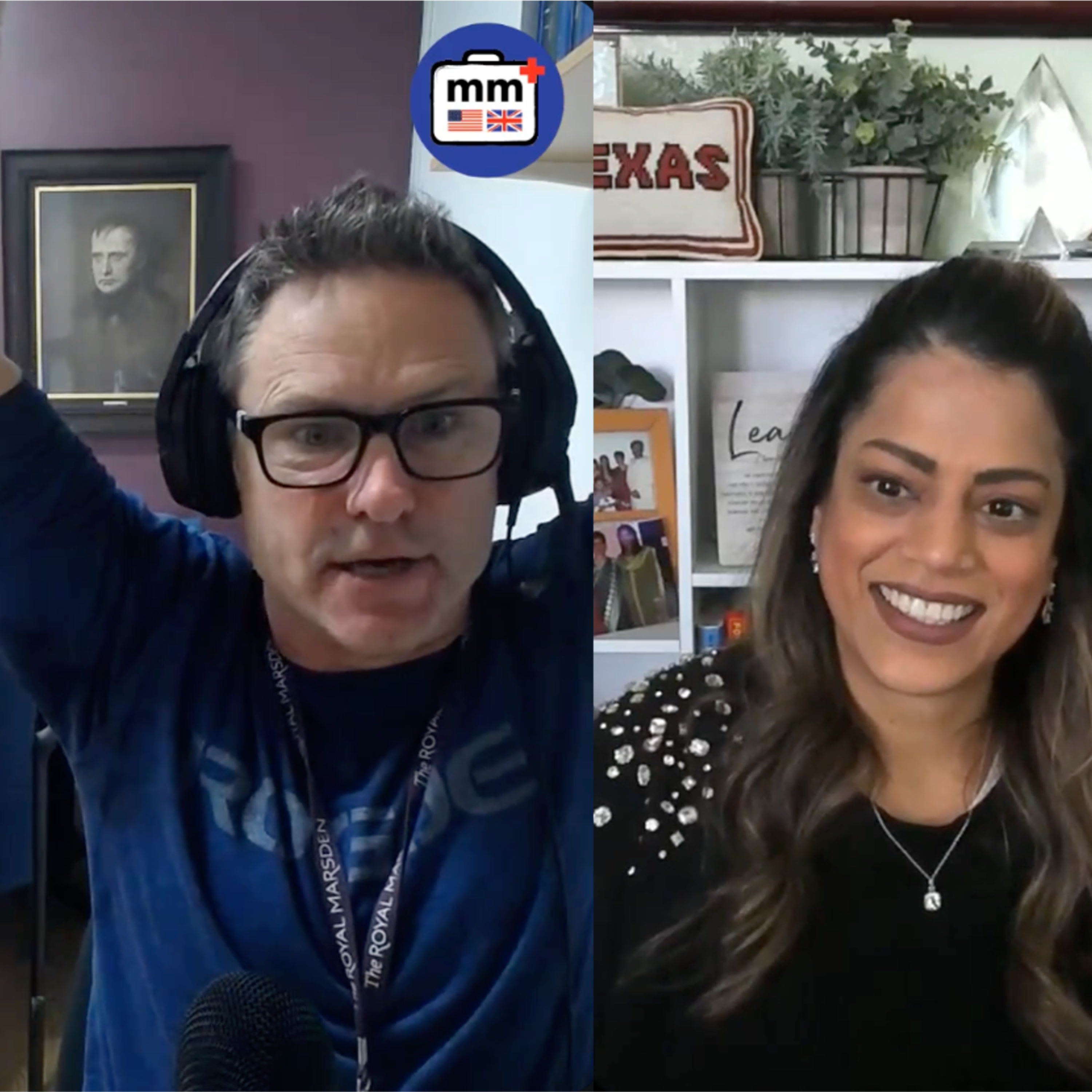
The podcast episode focuses on the recent FDA approval of a subcutaneous formulation of nivolumab (Opdivo Qvantec), part of Project Orbis, which enables administration via injection instead of intravenous infusion. The hosts discuss the CheckMate 67T study, which randomized patients with second-line kidney cancer who had not received prior checkpoint inhibitors to either subcutaneous or intravenous nivolumab. The trial’s primary endpoints were pharmacokinetic non-inferiority, both of which were achieved. Objective response rates were 20% for intravenous and 26.6% for subcutaneous, with overlapping confidence intervals. Safety profiles were similar, with low-grade injection site reactions in 8.1% of patients and minimal neutralizing antibody development. Despite the study’s focus on second-line kidney cancer, the FDA granted broad label approval across multiple indications, including combinations with other drugs, based on the established PK equivalence. The hosts note that in current practice, most kidney cancer patients receive first-line checkpoint inhibitors, limiting the relevance of single-agent nivolumab in second-line settings. They discuss patient preference, noting subcutaneous administration may offer convenience over infusions, though reimbursement and pathway adoption remain key considerations. The approval builds on prior experience with other oncology drugs transitioning from intravenous to subcutaneous formulations, suggesting a trend toward more patient-friendly treatment options.
[Music] Melanoma Matsas is an educational resource and the opinions we express are our own, do not reflect medical advice. If you have questions specific to your own situation, please contact your own clinician. This podcast may be available in both audio and visual, so please check your platform. Hey everybody, welcome to Melanoma Matters. I'm Sutton Epitel. And I'm James Locke and I. So, James, there was an approval last week that we saw in the US, though it was part of Project Orbist, so maybe we'll, maybe it wasn't just in the US, and we can hear more about that. We'll talk about that. And it was for a subcatenias formulation of the drug that we know as Nevolumab, brand name Optivo, and now they have an Optivo Cuvantec, which is the subcatenias formulation. So we thought it was probably a good idea to talk about that, and then checkmate 670 study that led to its approval and across indications and doses. But before we do that, maybe we do a quick fire. I'll give you a choice. You can either tell me about your favorite teacher from like your what we would call elementary time here in the US, the equivalent of elementary grade school, maybe through high school time period. If you have one favorite teacher or you can tell us about that Napoleon picture over your head. So favorite teacher, I went to a school where there were only three teachers. So that would be a choice of three because it's a tiny village school. And so there were only 50 children or something in the whole school. So yeah, yeah, the one that started off on the building that was on the edge of a cliff. And then which it got closed and moved and now it was converted into a hotel. So I don't think it'd be fair to choose one of those three if you see what I mean. Picture of Napoleon. That's a picture of Napoleon, which used to belong to Martin. And I sort of said this a little bit while we were talking to Monty. When Martin died, which is almost six years ago, 10th January, 2019. We kind of went through his office and he had just a load of stuff in here, you know, like journals and all sorts of stuff. So we couldn't keep everything anyway. And so we just kept a few. Actually, there's a few people's thesis up there on the shelf and a few books and stuff like that for sentimental reasons. And pretty much the only other thing that we kept was the picture of Napoleon because maybe just as a sort of reminder of Martin. And I don't know honestly, I should find out. Shouldn't I. How long he had it and who gave it to him and all sorts of other stuff. But I'm not even sure he would actually know the answer to that because there aren't that many people left now. I could ask his wife actually next time I talked to her. She may well not know that. What's ironic is Martin could not be that more physical opposite than Napoleon right. He's fairly tall and. Yeah, yeah, yeah, very large presence and Napoleon was pretty small, right? Yeah, yeah, yeah, yeah. No, I don't know much about Napoleon's character, but I suspect that was quite different as well. So it is it is ironic, but the other slightly fun thing is that when I'm doing meetings on zoom or teams or whatever, just like this, you can see it over my shoulder. And it's always fun. But who knows that it's a picture of Napoleon as well. Whether people get intimidated about it, they're being a picture of Napoleon on the wall is another question altogether. But you know, I mean, there's the whole story of why Martin has it who gave it to him. But the now there's a whole Larkin Napoleon store. The internet is full with. Yeah, well, that obviously isn't true, but yeah, so anyway, that's about as much story as there is, I think. I'm thinking getting rid of this table because we don't really have loads of sort of. In the old days, we're having loads of sort of face to face meetings around that table. We hardly ever use it. See what I wanted to do is to get a corner sofa. I've told you this. Yeah, so I think it would be perfect to have a corner sofa there. I don't know. Do you have so do you have the word sofa in the US or not? What's that? Yeah, you do. Anyway, but no one, no one agrees with me. Who I who was because it would be amazing because it's more comfortable place to see it more, more relaxed. And also, if you fancy to kind of a nap or a thing like that off the lunch, I would get one that was big enough to sleep or. Yeah, I mean, look, you're speaking to Americans, you know how to put these comfy things in their office. Yeah, yeah, yeah, I'm singing. I'm singing to the choir. Yeah, yeah, yeah, we could get all that lovely stuff that has like an Ottoman and you can relax, a good hermit Miller chair with an Ottoman. But the truth is, are you ever going to have time to use that? I mean, it's just going to be more decoration, but you should get that you would enjoy when you have these zoom or two meetings and you have the odd. Seven minutes in mid from one to the other or three minutes and it's not enough time to really crack into email or do anything. You should just get put like a heavy bar or something. Yeah, you could do some reps of something. Yeah, I thought you're going to say pull up bar, but that would be perfect actually because you don't need any time. The problem is pull up bars take a fair amount of. They need to be drilled in pretty well into the wall. So you closing the door. Oh, you would do not do it on the door frame. You do it on the wall. Yeah, or off the ceiling, but I'm not sure I could justify that to the sort of the Marsden's, you know, maintenance department. It's a guy called Mick, mix the key person. If you want something doing you just ring Mick and then I'm not sure I could get it past and that's a bit difficult. So it's legitimate kind of healthcare related, you know, I suppose I could try to make a wellness argument or something, I don't know. It's always ridiculous now. I think we were watching diet. We watched all the die hard films again at Christmas because that's what you do at Christmas, right? There's a lot of films, sorry, it's a certain population of FY for a film that is a whole thing. Yeah, it's not even a question, is it? Anyway, the point is there's all this stuff with Bruce Willis doing all this luck overhand stuff pulling him up and all this sort of they never film it properly in films. It's just absolutely obvious they're not hanging because when you hang your arms are really, really straight and they're all they're all yeah, yeah, yeah, exactly. There's one I don't know if it's one of the later films. There's just some ludicrous scene in a lift shaft or something where he does a maneuver that basically only a professional gymnasque could do. There's just absolutely no way in the world that even someone who was in good shape of fit was a professional gymnasque standard maneuver on a bar. Anyway, that was dark question. Right, should we talk about this study? Yeah, so tell us about checkmate 67T and kind of why it was done. Why why even why are we at the point of meeting a subcutaneous formulation? Yeah, so I mean, there's a few subcutaneous formulations out there now, which have got labels. I think from the patient perspective, it's close to being a no brainer that you can have the option for subcutaneous instead of intravenous in terms of convenience, possibility of having treatment at home and so on and so forth. I guess also from an industry perspective, the anti PD ones and the volume of pembrolism, I'm becoming quite close to the end of their patent life. So there's a sort of a fairly obvious commercial type issue there. And this trial checkmate 67T really, I think the main aim of the trial was to establish the efficacy and safety of subcutaneous and the volume up. So it's a randomized trial comparing subcutaneous to intravenous quick load on the authors. So I think the trial was mainly recruited in central and South America. So a lot of the authors reflect that. And in addition, my friend Laurence Albejus, who works at Institute of Goods, Tupperisi in Paris, was the lead author, certainly on the as main presentation. And this year, I could even do the citation, which is volume 35 supplement to S1013 to S1014. As well as say, we judge George from Rosswell Park and Sergio Brigada. So that's the kind of authorship list. to the chase, randomised trial.
basically in second line kidney cancer where people hadn't had a check point inhibitor. So that's kind of slight quite relevant actually because now, 2025, the standard of care in first line kidney cancer is going to be a treatment regimen containing a check point inhibitor. So there won't be that many patients around the place actually who are kind of suitable for single agent, the volume app which has been around now probably for best part of 10 years and also adjuvant pembrolism as being used. So anyway, so single agent, the volume app. So it's certainly in our practice now 2025, we'd hardly have any patients who are on single agent, the volume app because they're all getting kind of up front check points inhibitor. Anyway, so yeah, so randomised subcutaneous, the volume app and the other kind of slightly interesting thing here and maybe we won't dwell on it is that along with the subcutaneous nivolumab you get this hyaluronidase which is given, I think it's in the same injection and I don't know if you know much about this or not, but you need that for the subcutaneous formulation to become available. And I think in developing these subcutaneous formulations, a massive amount of effort was put into working out exactly what you wanted to do or what you needed to do to make the drug systemically available. Anyway, so the the overall response rate by Bicca, they call it a key powered secondary endpoint of the study. The other end points of the study, the other main endpoint of the study is the pk of the subcutaneous formulation. So, the intermediate and rapid can I ask you, is that what's required when moving from an intravenous formulation to subcue essentially a pk equivalence? What's the requirement to show this drug is like the other? I don't know, I don't know what the regulatory requirement is. And I think that it makes sense, doesn't it, that the pk is necessary? I mean, the the efficacy is all in the way, maybe that's almost more interesting in a sense, because you know, is is response rate? Is that the correct measurement of efficacy? Should it be something else? I don't know. I mean, I personally think response rate is a reasonable surrogate actually in this disease. And the response rate for intravenous nivolumab is extremely well established, but nevertheless, it was a randomized trial. Can I sorry to ask you one more time? Earlier, you said single agent nivolumab. There wouldn't be very many people getting single agent nivolumab because most people are getting up front checkpoint. Yeah, not in our practice. So, but I mean five years ago, before we were using up front checkpoint inhibitors, maybe, but but now that we really have no patients in clinical beginning to simulate to get single agent nivolumab, you'd have needed to have a first line treatment that didn't include a checkpoint inhibitor. So I'm following now what you're saying. I was getting a little confused in my head, but what you're saying is to get second line single agent nivolumab would have meant you didn't see first line checkpoint. And that's just not the practice pattern and you got it. Yeah. And if you weren't giving a first line check points inhibitor, there would be a good reason for that. You had concerns about majoral term unity or something else. And so then, you know, you wouldn't be giving it second line. You wouldn't be giving one no second line. Okay. And I don't mean to interrupt again, but I have more to go. This is the American and we can help. Do you like how I blame the entire like culture of American? Not just it's not a personal fault. It's a whole cultural fault. It says the co-primary PKN points for non-inferiority testing were time average serum concentration over the first 28 days and minimum serum concentration at steady state. So essentially there were these two PK primary end points that were, you know, they were calculating them for non-inferiority. So that's that. Yeah. And that's a good point. Thank you for interrupting. You're kidding. Anyway, so PK kind of tick the box right in terms of non-inferiority. And actually if we look at response rate, and I'm looking at the Esmo abstract, it's actually about 20% for intravenous nevolymab and it's actually 26.6% for the subcutaneous formulation. So certainly not worse. And actually if you'd asked me what I thought the response rate was to intravenous nevolymab, most people will quote somewhere around 25% from the original registration study quite a few years ago. So it's actually, you know, it's kind of close, but it's it looks lower. But go on. Yeah, I mean in this randomized set, it's lower, but as you're saying, most people would have thought it bangs up closer to that 25. I'm just struck by the fact that the lower bound of nevo subcutaneous formulation, the lower bound of that 95% confidence interval is still higher than the median, you know, the the objective response rate, not the median, the objective response rate of IV nevo. That's pretty good. Yeah. Yeah, I don't know. I mean, I think that's interesting. So I mean, may as well just get the numbers out there to say, so for IV nevo, the confidence intervals 15.8 to 26.2. So that's around about 10% confidence interval. And then for subcutaneous, it's 21.1 up to 32.6. A lot you say there's a bit of overlap there. Just in the there is overlap. But to say what you said again, just to be really clear, the 21.1 for the subcutaneous is higher than the response rate to the intravenous. So yeah. So there's a later on other analyses here. For example, median progression free survival. I really don't think that's particularly illuminating or helpful. Development of neutralizing antibodies is an important consideration. I'm not an expert in this area, but that's one of the concerns here that the development of neutralizing antibodies could in principle impair the efficacy of the treatment. So if you look at the again in the table, the percentage of patients develop is developing neutralizing antibodies. It's kind of about 1% or something like that. So one would hope that that's not clinically relevant or significant. You're frowning. I don't even understand this table. The way the abstract is written, the numbers are just banging on across next to you, like ANAs N, and then the next line neutralizing ANAs. I get the neutralizing, but ANAs N 208 50 24.0. I don't even understand these numbers. No, I don't understand that either. I know I was just reverting the neutralizing when I said it. Yeah. I think 208 is the one's the sample size they had it on 50 had it. I don't know. I don't even understand. Yeah. What you just said is pretty plausible. It's not a great table is it? And then the safety, which is the bottom line here, I think again looks fairly similar. It's not very, as you've just said, it's not very easy to interpret table. Yeah. And then the ASCO, so this originally was published at GU ASCO last year. I think that asmo was a later update. What do you call that lifecycle management? Like, if that keeps on giving the in the ASCO abstract, they talk about injections, site reactions of 8.1% low grade and transient. It's interesting to me because you said something at the top of this that this is, you know, kind of a no brainer for patients subcutaneous versus infusion. At some point, obviously, if you get to be using this, if you will get to the point about regulatory approval and how quickly you think you'll be able to do QVantig for your kidney cancer patients, also the line of therapy, maybe you just won't be offering it that much for all the reasons you said. But I'm curious as you talk to patients, are they more averse to a shot? You know, subcutaneous is a shot as patients would sort of interpret it, right? The needle goes in the plunger gets deployed versus an infusion, which we all know is still the start of an IV. But somehow, patients may not interpret that as a shot. I mean, yeah, they both come with a needle prick and so forth and so on. But I'm curious if patients are more averse to the shot version of this than to the infusion, or if it truly is a no brainer to them because the infusion is time and connection. Yeah. Well, in kidney cancer, you know, we haven't really talked about it yet, but the labelled the FDA label has actually brought. So there's this one trial, but actually there's a load of indications and there, including combination indications. So the main kidney cancer indication probably is going to be Nevolumab Plus Cabas Antonyb, which is one of the first line regimens. So the point I was going to make is that a lot of the patients who are
coming to that. Some of them have had had treatment with Pembellism, so they'll know what intravenous treatments like, but some of them might not have ever had any intravenous cancer treatment. So I think with that, as it were, I suspect most patients would go for the shot, rather than the intravenous infusion, just as a sort of gut feeling. But the way I see it playing, and maybe we can talk about reimbursement and that kind of thing in the future, that if we had access to this, at least on the National Health Service, we wouldn't really be making decisions about this. This is slightly wrapped up in reimbursement because. And then come out of our hands and everything. But you bring up to good point that is worth talking about on the basis of this trial, this is second line kidney cancer, I think as you said, it actually has a much bigger approval than that. It is now, do you have the label in front of you, how it's approved, if not, I can pull it out. Yeah, I'm no, I don't have it in front of me, but it basically is really. I'm sorry, we can use an amelanova, that's I guess the way exactly. Yeah, exactly. So that's the point, isn't it? That I guess from a regulatory perspective, this formulation has been benchmarked against intravenous nivolumap. And the FDA, at least, has taken a view there. And presumably, these discussions took place with the FDA prior to even doing the trial that they've now got broad label, including different cancers and in combination with other drugs. Which is kind of interesting, but then I mean, to take a counterpoint on that. Should it be necessary to redo all of your registration trials with a new formulation? I mean, that to me doesn't seem right, actually, I have to say. So I think it feels like it's proportionate, actually. Yeah, I think that's fair. That coupled with the fact that this is not the first oncology experience changing a drug from infusion to subcutaneous with a highly erroneous delivery system. And for the fact check, maybe we can just read off the other drugs that have gone, you know, I think we know, trust who some app comes to mind and others, but it looks like there might be nine of these. I just don't know them off the top of my head. And the, the. So yeah, I don't think you have to redo when this kind of technology of going from intravenous to subcutaneous has been already established, maybe those first few approvals it might have been important. Secondly, I think it's pretty interesting, you know, this is PK. So you're just saying basically it's equivalent to where you have one drug you can plug out one and put in the other. And this will become a regulatory issue. You know, we really interesting to see how quickly payers pick this up in the US. And then it will get on what we call pathways, which is like now the pathways will say, if the cost is not cost prohibitive, you know, perhaps switch out this for that because now you take away the infusion cost, the chair time, the infusion nurse, you know, the 30 minutes plus of nurse time, to being all of that kind of stuff that you would normally charge a pair for an infusion, and you're switching it out for, you know, basically a syringe and five minutes of nurse time or so related as I'm finding the different approvals and the actual label here that we can read out here at the end. Related, I mean, obviously they look at safety. We saw no issues with safety here, right? You were getting to that in the abstract. I lost my trainer thought, sorry. Cut and pause. It was had something to do with nurse time. Oh, you have mentioned to this when we were chatting that I hadn't quite thought about, this is not just a flu shot subcutaneous or intramuscular. This is not a quick, you know, two to five second push is actually a slow subcutaneous push. I mean, I don't have experience with subcutaneous flow pushes like this. So what do you know about these, you know, like what's the likelihood it could actually be done by a patient at home versus needing to be done by a professional versus a machine, a program to pump. Yeah, my understanding and I don't have loads of detail. They actually do quote somewhere the sort of average amount of time, which and I think that the bottom line there was that the majority of infusions, deliveries, let's call them deliveries, were less than five minutes. But in conversations I've had about this, I think most nurses felt it would be quite difficult to do that manually, if you like. And as such, it felt like a pump would probably necessary to do that. So that's an issue. And then the question could a patient do it themselves, well, they need to pump if you require a pump. And so that's doable, I suppose. But it's not going to be right for every patient, obviously. And then that brings up the broader question of does the patient need to come to hospital to have this? Could they have it at home and so on and so forth, which you and I've chatted about a little bit. And do we have any understanding, you know, we have certain drugs that are administered via slow IV push? Demarol would be one, you know, that comes to mind. When we say slow IV push, that's still not three to five minutes. That's not even a minute, right? I mean, maybe for the fact check, we can even put in there like what is a slow IV push? Technically for a nurse, you can grab your research staff out there and have somebody call us. Versus this kind of slow subcutaneous push. This isn't even just slow. This is really right. Like you said, needs a pump because how could you actually develop? Yeah, I think that's beyond the case, the limits of human performance honestly, to give something so slowly from a relatively small volume. Okay. Yeah, over five minutes, I don't think it's doable. Do we know the volume? Now I don't know if the top of my head, but it's from memory, it's not one or two meals, it's more than that. So you're talking about a sort of, if you think about actually giving this thing a reasonably significant, I mean, obviously massive efforts have gone into minimizing the volume, but it's still not one or two meals, it's more than that. We can check that as well. And interestingly, I'm looking at this 670, the randomization, it couldn't have been blinded. Well, obviously, it couldn't have been blinded subcube versus IV, but it was, Juventude was every four weeks and the updivo was every two weeks. IV. So it wasn't even exactly the same administration schedules, schedules, as you say. Go on. I wasn't sure that you did that in my accent, that sounded like someone else's accent. Yeah, I don't have a massive problem with that. I don't think you know, that's the kind of the original Nevolumab schedule is two weeks IV about the same as four weeks over here, we think so don't wait, but again, they run the most drama or anything like that. Okay, here is the official indication. Monotherapy for first-line treatment of adult patients with intermediate or poor risk advanced renal cell carcinoma. I'm sure you have a whole thing thought about the risk stratification here. Following treatment with NevoIPi combination. So it's essentially maintenance therapy for first-line. It's also, oh, it's not indicated in combination with Ipi, so it's not for the NevoIPi portion, it's for the maintenance portion. In combination with Cabo for first-line treatment, Monotherapy for patients with renal cell who've received prior anti-antiogenic therapy. So TKI, or if you have a non-TKI anti-antiogenic, and then Monotherapy for patients with unresectable or metastatic melanoma. Important to notice there, it doesn't talk about adjuvant yet, but let me keep going. Monotherapy after NevoIPi. So again, can be Monotherapy here, it could just be the maintenance part of your NevoIPi regimen, not indicated in combination with Ipi. It's Monotherapy for the adjuvant treatment of patients with completely resected stage 2B and up melanoma. So that's checkmate238 and then checkmate.nzxk, equivalence, and then here comes some other indications in combination with platinum doublet as Nevoadjuvant treatment on small cell on cancer. Boom, Nevoadjuvant treatment. In combination with platinum, chemo, Nevoadjuvant, non-small cell, without EGFR mutations or anaplastic lymphoma kinase, out-free arrangements. Okay, keep going, keep going. More lung cancer indications, anesthetic, non-small cell lung cancer with progression on or after platinum-based chemo, and targeted [BLANK_AUDIO]
mutations should have been treated prior to receiving this, not for used in combination with Iphe that stated over and over on the label. Monotherapy for the treatment of adult patients with recurrent or metastatic squamous cell of the head and neck, after platinum-based chemo, Monotherapy for the adjuvant treatment of patients with a urofelial personoma at high risk of recurrence, after surgery, in combination with cis and gem for first-line treatment of metastatic or unrestractable urofelial carcinoma, Monotherapy for patients with locally advanced metastatic urofelial who have disease progression following platinum chemotherapy or within 12 months of new adjuvant containing platinum, Monotherapy for adjuvant treatment of GE junction cancer or a soft agilic cancer with residual pathologic disease after neoadjuvant chemo radiation, combination with chloroperm, permitting and platinum containing chemo for esophageal squamous cell carcinoma, first-line treatment, not in combination with Iphe for metastatic esophageal maintenance after floor permitting platinum for metastatic esophageal and finally metastatic gastric GE junction and esophageal adjuvant carcinoma in combination with chemo. We can cut all that, that may not be necessary to read all of it, but. Yeah, but I mean the obvious take came there is that it seems like it's most of the indications number one and then the second obvious thing is that the combinations, it seemed like they were quite widespread with chemo and with targeted therapy with the exception obviously of Iphe and so that in itself is quite interesting and I certainly don't know anything about that and I have no idea what the reason for that actually whether that's a decision or whether further data were asked for to get you know and they don't have those data at the moment yeah so it's pretty interesting actually. It's interesting that it can be studied as monotherapy but then approving combination without yeah that's quite interesting and then and then eliminating it be here. I'm going to say read one last statement about subcutaneous and administration with the grain of salt this comes from the sponsors website. Several potential benefits of subcutaneous administration include flexibility for the provider and the patient. It may impact chair capacity, may reduce time spent preparing and administering treatment. That's interesting because as you and I have both said we're not even sure about how you prepare this and inject it with highly erroneous. You know what's that preparation look like? It may also simplify administering treatment for patients with difficult vein access. That's true. We had not actually said that but that's a good point and it can be administered by a health care professional without side of care restrictions so around bagging, white bagging maybe that kind of stuff. I guess the final question I could ask you perhaps in closing, where do you see our future clinical trial designs going? Should we be designing trials with QVANTING or with off patent updivo and then drawing some conclusions? What do we do? I did not. I think you have to have both options included and maybe not even specify. And then providers, patients can choose whichever lipid in the house. I don't think so. I mean that's probably pragmatic because one seems that this is going to get reimbursed. Certainly in the US and people are going to use it and so then I think with the trial design you just need to be practical about that and allow both. I don't see how you could do it really another way. As long as the schedules meet up. Yeah so that's an issue as well which is going to add some complexity I guess but we're just have to set that up as they say. I think I don't think you can easily step. I think if you were trying to stipulate one or the other just to make more difficult to accrue to trials actually which is a bad thing because it's difficult enough already. Last thing as I'm looking at this brand label, Optivo QVante, Nevolamab plus Hyaluronidase and VHI which makes you think this is whatever. Subcutaneous injection, 120 milligrams plus 2000 units per ml and the approved dose is 1200 milligrams plus 20,000 units of Hyaluronidase. So that's a 10 ml subcutaneous injection. So again this goes back to my question at some point I would love to you know hear from patients or have us like actually ask the patients. If we ever have the luxury of like you're saying choice here and it doesn't come down to kind of a regulatory or reimbursement heavy hand decision. I'd love to hear from a patient how they feel about getting a shot for five less than five minutes that is basically 10 ml. That's two teaspoons worth of medicine. Yeah but I think the way it's going to play honestly is that we won't be making these decisions that it's only on the national health service. This will be assuming it's reimbursed and we get regulatory approval here. This will become if you like the sort of defacto and then for the patients who don't tolerate it then they'll get switched to IV afterwards I think. And so what the question will be what is the rate in kind of real world practice of people not being able to tolerate it change to IV? So that brings me to something if you have time to affect before we record a fact check. Maybe you could chat with some of your breast colleagues there. Certainly you guys have switched to the at trust to some of formulation in some. Long time ago. Yeah. So maybe like maybe we're having philosophical questions about something the breast world has already sorted through which is look it's not a patient's choice as much as we'd love it to be a patient's choice it's not. It's a reimbursement regulatory choice. Secondly, what is the percent of patients who can't tolerate who then have to flip out? If it is ever a choice how many times do patients choose or not? As you and I have talked about even this just the idea that some cancer patients really value the interaction with their team and their infusion nurse and the care that coming for an infusion feels like. It feels like an hour or two hours of their every few week time where the healthcare team wraps their arms around them whereas a five minute or less than five minutes of Catania's injection may just feel like another quick quick touch to the healthcare system that doesn't feel as valuable to them as feeling wrapped up in the arms of an infusion etc. Yeah, I think that's a great point. I think the way you said it was lovely as well actually you know the metaphor there and maybe we underestimate all that sort of stuff and anecdotally I think you know lots of patients actually do value that contact and it's kind of in an informal way because they come and see us and a lot of it is quite formal whether we like it or not and maybe if it's like you say just a five minute injection you lose all of that but that's a great question but yeah well I'll maybe chat to some of my colleagues who treat breast cancer because they like you say they've been doing this for a while and yeah see what the feedback is yeah okay we're good. Great well that was a great one thanks for thanks for teaching us about sub-Q and the volumine. Hi everybody welcome to a fact check for Optivo QVantig and we had a couple of things we were chatting about that we were going to check like how many sub-Q drugs have been approved in oncology what is the breast space doing with this or they have they adopted it full stop for everywhere there's a her to trust you some app they've gone to sub-Q and then just what the experience is like that patient round so you did so we should say the date that first of all today's date yeah why very very it's a public holiday it's Martin Luther Cune June or day that's very significant is there something that's happening today I don't know it's Owen's birthday I went I went 40 today happy to be happy Owen. Oh yes. Happy birthday Owen. Check he's never going to watch long enough to see. I'll tell him when I see him I've got my rogue US t-shirt on as well anyway so getting back to sub-cutaneous so I chatted to one of my colleagues last week of the week before about sub-cutaneous trustees and have a set to which they've been using for a little while so it's got approval it's reimbursed here and then I was asking some of these questions you and I'd been talking about you know what's the volume what's the practicality what's the patient acceptability and to kind of long story short um Felicia my colleague told me that 99% of the breast cancer patients are on sub-cutaneous trustees and that and I said what about the 1% and that's people who you know for whatever reason
and don't want to go onto subcutaneous. They've been on IV for a while and they've got a view and believe if you like that the IV is working stuff like that. It's five meals, this formulation delivered over quite a long period of time. If you've been in it, anyone? This formulation, you mean the breast cancer? Yeah, correct. Yeah, so it's five meals and so it's not as much as 10 meals but nevertheless it's not a tiny volume either. Most of the patients are injecting it themselves at home. Okay. And so then I said, well how do you actually really slowly give five meals by an injection? And I think the reality is that it's just going to be kind of very tiny subcutaneous bonuses and of course no one's monitoring the patients doing it at home so who knows whether they're really giving it over five minutes or not. So there isn't precision and that can't be that I think because of the limitations of human physiology. We're actually giving it very, very slowly over five minutes. Go on, you're going to say. Well, it's like you were saying I was looking at the Institute of Safe Practice Guidelines, Safe Medical Practices for IV Push and it technically says exactly what you say. There's like no way to actually adequately simulate or practice this. And maybe you and I talked about this or maybe somebody told me in reality what it is, it's like a little bit of a push than wait. Yeah, yeah, tiny bonuses. I think realistic. Yeah. So that's what's happening. And so then the people who aren't injecting themselves, I mean, let's say they've got agrimetoid or something, maybe that'll be an example, it's difficult. Then a nurse would be doing it. And I think that could either be kind of in the clinic if you like or maybe even at home if it's a, we call them district nurses here, community nurse. And the patients love it. It's the other thing to say. They absolutely love it. So then my next question to her, Alicia, was to say, well, what about that whole thing that you and I talked about, which is the environment of coming up to the hospital, maybe sitting in a chair, talking, getting to know the people on the day unit, other patients. And what she said to me was that actually no one really rude that was disappointed. And you know, what I mean, what I think about that is that of course there'll be some people who do value that. How could you not? Because that's normal for humans. But I guess the upside in the convenience of having subcutaneous treatment will outweigh that downside for a lot of people. And of course this is an anecdote, isn't it? I talked to a colleague, all that sort of stuff. I think the anyway to really nail this is going to actually to get some data from patients gone. I'm excited when we can use it to see because as you have now explained that this is how your colleague is describing it, I wonder if the touch on the patient that's showing up the high hello, the socializing, isn't more for me than it is for the patient. You know, I think, oh, it's the patient who must feel a lot of reassurance seeing us and getting us to lay our hands on them and then approving the treatment of blah, blah, blah. And you're saying, no, no, the upside of like faster, shorter, it outweighs the human touch part of it. I wonder if that human touch frighten isn't just more for me than. So it'll be interesting when we get to use it to see. Yeah, but I don't know. I mean, that's going to be so heterogeneous at the risk of being cliché because I think different people, value different things, different physicians, clinicians, because it's not just doctors, they're so okay. We'll have different relationships. We all know that we will have different relationships with our patients. And so I guess there isn't going to be one size of it. So, but I guess my prediction will be that you put that whole thing together and actually we'll see the same thing in other indications and other situations. Well, actually the patients will say, no, I'd like to do it like this, please. And it's not like they're not going to still have that some of that community for other types of reasons. You know, I mean, they might talk to people in the waiting room, let's say they're still going to come into you in clinic. They're still going to have relationships with their nurse specialists, that type of thing. So I don't think it's going to disappear altogether. Anyway, so it was gone. I was just going to say it was useful for thank you, Alyssia number one, but it was great to get those insights. I think it's really interesting when I think of the relationship with like a GP, let's say you have blood pressure issues or thyroid issues. You really only interact with them a couple of times in a year, maybe once a year. And then the remainder is just over a portal reporting a symptom or asking for a refill or, you know, a winter event, maybe something's happened. It's a very light touch. And in oncology, I, it's just like I've gotten so used to seeing our patients so regularly, even six week dosing, I sort of like to keep a lasso on them a little bit and do labs and then I like to review the labs and speak with them. But more and more, you're outsourcing that. You're having your nurse do that or you're, you know, a pp advanced practice provider, call them in between or clear them. And so with sub q, what I suspect will happen is obviously we'll start the process and we'll start the sub q with them. And then any mild side effects reporting or things like that management will all happen via a portal. Very few visits maybe with a different provider, your nurse or your advanced practice provider. And then you're bound to see them at a scan visit. So now you're going to go down to seeing them, you know, from every three weeks or every month to maybe three, four times a year, just to sort of like review a scan and say, which is perfectly fine. This is how we interface with our GPs and we feel beloved with our GPs. I'm just, I've just been so used to interacting with these patients and their families on a much more routine basis, you know, four times a year. I don't know if I am going to have time to ask them about their dog and the graduation and the holidays. But when you see them every three or four weeks, you get to know them a little bit more as humans. Anyway, this whole thing may be more of a toll for me than it is for the day. I will just not agree with all of that I really do. And it's nice to see people, you know, routinely when you are talking about some other stuff and not it always just being kind of talking about the cancer, that's true. And by the way, is it definitely a lasso that you use like a Ted lasso or lasso? Because we say lasso. And if that's a real bona fide difference, then that's that can you discover it today? Lasso lasso? Yeah, we say lasso. Yeah, it's lasso. And on the two, on the two, on the two, on the end, was there a difference in spelling? I think we might need to do a fact check or a fact check. Yeah, I'll put it in the show. Okay, the other only probably last thing to say is how many subcute drugs there are in oncology? Yeah, we're toxic, ma'am. Yeah, so we don't really know, but it's quite a lot. Atesolism up here. Definitely. Atesolism ab and a little bit of that. I can get it out of here. I think it might only be the four. I think there's growth factor if you can't grow factor. No, no, no, but let's just kind of stick to it. Yeah, yeah, yeah. I think it might just be those four. So, you know, well, there'll be more, there'll be more. That's where we are now. Okay. All right, good job. Good fact check. Okay. [Music]
Podcast Summary
Key Points:
The podcast discusses the FDA approval of a subcutaneous formulation of nivolumab (Opdivo Qvantec), which allows for injection under the skin rather than intravenous infusion.
Approval was based on the CheckMate 67T study, a randomized trial comparing subcutaneous vs. intravenous nivolumab in second-line kidney cancer patients who had not received prior checkpoint inhibitors.
The primary endpoints were pharmacokinetic (PK) non-inferiority, specifically time-averaged serum concentration over 28 days and minimum concentration at steady state, both of which were met.
Objective response rates were 20% for intravenous and 26.6% for subcutaneous nivolumab, with overlapping confidence intervals; subcutaneous showed slightly higher response rate.
Injection site reactions were low-grade and transient (8.1%), and neutralizing antibody development was minimal (~1%).
The FDA granted broad label approval across multiple indications, including combinations, without requiring new registration trials for each cancer type.
Hosts note the shift in practice
Summary:
The podcast episode focuses on the recent FDA approval of a subcutaneous formulation of nivolumab (Opdivo Qvantec), part of Project Orbis, which enables administration via injection instead of intravenous infusion. The hosts discuss the CheckMate 67T study, which randomized patients with second-line kidney cancer who had not received prior checkpoint inhibitors to either subcutaneous or intravenous nivolumab. The trial’s primary endpoints were pharmacokinetic non-inferiority, both of which were achieved.
6% for subcutaneous, with overlapping confidence intervals. 1% of patients and minimal neutralizing antibody development. Despite the study’s focus on second-line kidney cancer, the FDA granted broad label approval across multiple indications, including combinations with other drugs, based on the established PK equivalence.
The hosts note that in current practice, most kidney cancer patients receive first-line checkpoint inhibitors, limiting the relevance of single-agent nivolumab in second-line settings. They discuss patient preference, noting subcutaneous administration may offer convenience over infusions, though reimbursement and pathway adoption remain key considerations. The approval builds on prior experience with other oncology drugs transitioning from intravenous to subcutaneous formulations, suggesting a trend toward more patient-friendly treatment options.
FAQs
Opdivo Qvantec is a subcutaneous formulation of nivolumab (brand name Opdivo), approved for use in various cancers. It offers a more convenient injection option compared to the standard intravenous infusion.
CheckMate 67T was a randomized trial comparing subcutaneous nivolumab to intravenous nivolumab in second-line kidney cancer patients who had not received a checkpoint inhibitor. It aimed to establish the efficacy and safety of the subcutaneous formulation.
A subcutaneous formulation offers greater convenience for patients, including the possibility of treatment at home, as it is an injection rather than a time-consuming intravenous infusion. It also reduces the need for chair time and infusion nurses.
The co-primary endpoints were pharmacokinetic (PK) non-inferiority, including time-averaged serum concentration over 28 days and minimum serum concentration at steady state. A key secondary endpoint was overall response rate by BICR.
The overall response rate was 26.6% for subcutaneous nivolumab and around 20% for intravenous nivolumab. The lower bound of the subcutaneous formulation's confidence interval was higher than the response rate of the intravenous formulation.
Yes, the FDA has granted a broad label for subcutaneous nivolumab, covering different cancers and combinations with other drugs, based on its benchmarking against intravenous nivolumab.
Chat with AI
Loading...
Pro features
Go deeper with this episode
Unlock creator-grade tools that turn any transcript into show notes and subtitle files.
 PodcastTranscript AI