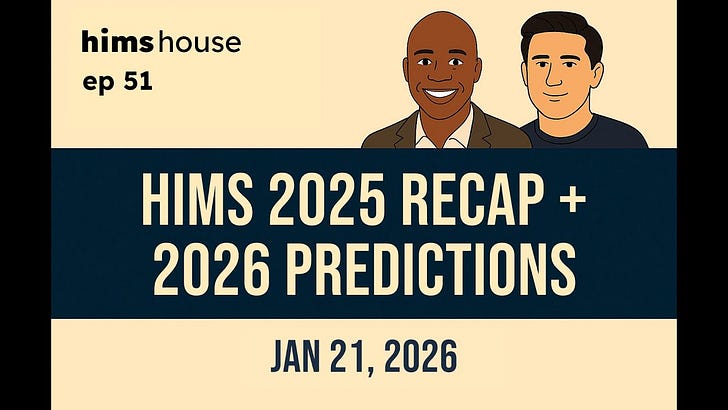
In HIMS House Episode 51, Jonathan Stern and Patrick "Base Side" Lester discuss HIMS & HERS's recent performance and outlook. Key developments include Q3 2025 revenue of $599 million, a $250 million share buyback, and expansions into the UK and Canada via acquisitions. New offerings like testosterone and menopause treatments have launched, alongside a comprehensive weight-loss program. However, revenue growth has notably slowed, with potential low single-digit quarter-over-quarter growth in Q4, raising concerns about meeting long-term targets of approximately 22% annual growth. Competition is intensifying, especially from smaller telehealth providers like Ro undercutting on price, though HIMS & HERS maintain a combined lead in metrics like downloads. The company may pivot toward platform-based branding and subscription models, with future product launches such as cholesterol medications and tirzepatide expected. Overall, while execution risks remain, the stock is seen as having both upside and downside potential depending on upcoming earnings and guidance.
Hems house episode 51, my name is Jonathan Stern. I'm here as always with Patrick Lester who goes by the name base side in the Hems house discord. It has been probably two or three months, so welcome back base side. Lots to discuss today. I want to do at least 2025 recap, thoughts on recent news and state of the company and then hopefully leave some time for 2026 predictions as well. But first, how are you doing? It has been a while. How have you been? I am doing well. Certainly I've not had the high profile I had earlier in the year in the discord, but number of reasons for that. Some changes in my own portfolio, but a lot of it just do the fact that I was working towards retirement. And here it is. So less than anyone thinks I'm kicking back with a cocktail at the beach or anything. I do have a three-year-old who keeps me busy and very sane. Yes, I still have to deal with accidents and things of that nature. So it's not exactly glamorous, but it's good. I'm very happy. So we've had a fair amount of news probably since the last time we did an episode together. I could run through it and then maybe get your thoughts on what is most important or pertinent to talk about or what is most interesting to you. There's the labs launch that happened now two or three months ago. We got testosterone. We got menopause. We had a formal expansion into the UK for weight loss. And now we have hymns branded hymns and hers branded websites and the so-called comprehensive weight loss program in the UK. We got Canada. We got two acquisitions. One of a Canadian company called LiveWell, which enabled that expansion. And then one of a, I think, Boston-based micro-needle company called Urbio. We got Deb Autour as the chief policy officer moving from the board to a formal executive room position chief policy officer. And we have a $250 million share buyback. In the press release there, they sort of indicated that they see an opportunity to repurchase shares at what they perceive to be a discount to fair value. We also got Q3 earnings. So maybe an opportunity to people keep asking if we're going to do a recap. I think we're honestly closer to Q4 earnings than Q3. So we can hit on Q3 earnings. But 599 million in revenue. Margin compression a little bit. I don't know if there's anything else that's worth noting. But yeah, I'll turn it over to you after that. There's probably a lot worth noting. Turn it over to you after that. What stands out there that you'd like to comment on? I would say what I would comment on is some themes that connect a lot of the things you were just saying as opposed to the specifics of any one of them. So my thoughts, I mean, some folks will remember in the discord certainly that I had moved in a more bearish direction over the summer. And there were a couple of reasons for that. One of which turned out not to happen and one of which is still I think an issue today. Start with the one that didn't happen. I was pretty worried that we were going to see some kind of deal between the Trump administration and pharma around MFN and possibly exchange for that a contract basically cracking down on compounders. Number of people, including you, we're skeptical, skeptical of that and you're right. So that should be said. And I confess even to this day, I'm a little surprised that there was not some deal in that direction, especially since some of the folks like Callie means weren't exactly being super friendly towards him. It was back in the day, but nevertheless, you know, it should be stated. Jonathan was right on this one. Well, I mean, I didn't say there was zero percent chances low. I mean, you're more right than I was on this. In your defense though, they said, the war against compounders continues at the state level and in court rooms. And so even though a deal wasn't reached as part of MFN, compounding could still be under pressure in 2026. Well, it should be. Although I would say at this point, if anything was going to be happening soon, it would have happened already. So I think most of that danger, okay. Well, there's the, I didn't mention the Safe Act and now there's something going on in Indiana. So there are a few things to, we can come back to those things. We'll come back to, but you're right. There was no deal in the Oval Office that banned compound. Yes, yes. That said, there was a second thing that caused me to, to really pause my, my position in, in hymns. And that was, I was really concerned about the slowdown in revenue. And to my knowledge, and you can crack me if I'm missing anything, I think that's still potentially an issue. I mean, we're looking at getting Q4 results in a month or so. I've seen some of the estimates that you had and what you thought the revenue might look like for the full year. It sounds like maybe we could be missing at least the analyst estimates. And perhaps at the low end of what the company had given in terms of their own guidance. I'll let you comment on that. For me, the big issue is this, at least the numbers that I've seen suggest that we might see Q over Q revenue dropped to like the 3% range. And again, I'm going to defer to you on this. You may have looked at it more closely. For me, that's a concern. It was a concern back in the summertime. It's still a concern now. And the issue is we've got all of these really interesting things happening, which you just ran through, including international expansions, which I've always been bullish on. Perhaps more so than others. You've got new categories, menopause, testosterone, and some other things during the works, wearables, and so forth. The problem with the new categories, which are great. The problem with the new categories is that typically this company has not really ramped any new categories to the point where they've had a meaningful impact on say the top line for like a year. Now weight loss was a bit of an exception to that. But generally speaking, that's been the how long it has taken. So that leaves me in the short term still concerned about revenue growth. And I think that explains a lot of the poor price action. I think we're at this point where hymns could execute perfectly. You know, they could do buybacks and get those shares it for cheap, just as they said. But it's not assured. There's still a risk there. And when I was in hymns years ago, I felt it was an easy buy. This was before the weight loss. When you were typically getting 80 to 100% year over year growth. And for those who knew I had a reverse engineer, some of the numbers they were putting out there is pretty easy to see that they were essentially a company that was on its way to profitability. It was super easy. And on my goodness, 80 to 100% year over year growth even before weight loss was a dream. We're not in that position today. So that's the big, the big issue to me that connects all those dots that you put out there a few minutes ago is how likely and what is the schedule for ramping towards being that growth company, which they had said when we did earnings a year ago, they gave us that five year projection, you know, of roughly 22% compounded annual growth, 22, 23%. I think got us to the numbers that they gave us for 2030. And we're not looking at that at least as far as I can tell coming out of Q4 rather. Yeah, so we're still in we don't yet have the full story of 2025 yet. I want to know just like just a hammer home, what you said, even many of the most vocal bears two years ago, three years ago, were bullish on hymns back then as you were and you've you've remained bullish or neutral, I think to your cut, like hymns did not have a red year in 2025. Let's remember this stock was odd. It's true. Stock was up 30, 40%. That's reasonable for any stock. It lagged certain data center names, right? It lagged certain space names, lagged certain memory, AI memory names, but but it it was green and it beat it. I'm going for anyone listening. I mean, San disc and it, of course, hymns beat the NASDAQ, right? And it beat the S&P 5. But even two years ago, people like Alan Lutz or of Bank of America were bullish on hymns. He was the biggest, I think, bull on Wall Street for multiple years, at least for one year. And he's, of course, been a little bit more bearish recently. I I want to, well, there are some names on Twitter as well, who we don't have to mention, but who are also bulls for a time. Okay, so so let's let's talk a little bit more about revenue 2030. It's the $6.5 billion figure, $1.3 billion in adjusted EBITDA. Am I remembering it correctly? That that works out to about 22% revenue growth a year. I think that's exactly right. Something like that, 22 or 23. And we don't have the Q4 numbers, but well, well, there's something to talk about actually, which is that the credit card data from Bloomberg was as unpredictable of the revenue as it's been in a long time. I think if you just were to use, right, a simple correlation, it would have missed by like four percent. And there's a lot of missing pieces like the international and things about nature. Well, and there are two, there are I think two posses, maybe three possibilities and we can run through them. Number one is that like the sample was just less predictive this time of revenue for whatever reason. I can I sort of discount that. Second option is that Zava was wildly understated and that I think analysts were expecting like, when him said 25 million, what if it was 30 million, what if it was 40 million? We don't know and they didn't break that out. And so that that may be responsible for part of the difference there. The third possibility of course is deferred revenue, which is just like how they're counting revenue this quarter versus future quarters. Maybe there's a bigger bump for Q3. Hard to know if that bump will translate to Q4 as well or if some of the stuff was counted in Q3 that will not train. It's just so hard to say with deferred revenue because it is a black box company sometimes gives us insight into how they're counting but it continues to be a black box and makes it difficult to predict revenue. In any case, the credit card data was less predictive than usual. If you go off of the credit card data for this quarter, hymns will miss and they, as you were talking about, there will be a quarter over quarter drop in revenue. So even if they don't get a drop in revenue, let's imagine, okay, the numbers, at best, it'll be a couple percent as you were saying, 2%, 3%, which is a long way from what it was a couple years ago. My guess is it won't drop quarter over quarter, but you know, a 2% or 3% revenue gain is a, I mean, it's fine for a normal company, but this is still supposed to be a growth stock and I think it is priced accordingly. You continue to put most emphasis on quarter over quarter, not year over year earth rates, is that right? I know you were earlier in the year. Yeah, and that's still true, mostly because the year over year is, well, it's a little different now. Before the year over year was you were comparing a lot of post GLP1 numbers to mostly pre-GLP numbers, or at least, you know, when it was much earlier in the ramp. And now we're kind of at the back end of that. And so potentially the year over year numbers, if anything, might be a little less, I have to just see what they work because I can't remember, but they might be, they're just not as good a read in my view as Q over Q. And that's been true for me for a while. Now obviously, Q over Q numbers jump around. But I think this stock is priced and people can argue over evaluations, which is fine. My own way is I, you know, I just, if I, if I can look at net income, great, otherwise operating income, I know a lot of people like to look at cash flow and all of those things are fine. But in very back envelope terms, we're looking at roughly 50 cents of earnings a year. And for me, a 50 PE on a forward basis is fine. If you've got, if you're hitting 20% revenue growth, which in theory, they are, if they hit those long term numbers. I think next year, they're going to guide to close to that. How much do you think? I think they'll guide to close to 20% per cent. That was so that's a big question, right? Yeah, I can be very, I want to talk about where we expect them to be in 2026. But let's, let's slow down. Finish this one point because I want to come back to that point. Yes. So, so for me, I think this helps explain, I mean, my point of view is just one of many. But I think you explained some of the reason why the stock has not been performing as well. So for me, a good price for a stock that's growing around 20% with around, you know, the financial profile that this one has would be $25 to $30 right now. And that's assuming it is hitting 20%. But with the risk profile, there's a chance that it doesn't even hit it. And, and, you know, I'm just one person taking over the gigantic rate of salt. Um, you know, and getting it so those numbers are solid, as opposed to we think they're going to hit 20% makes all the difference in the world. I mean, so the stock is in this weird place where I could see it going down to 25. If you get bad guidance or even lower bad guidance, you know, in a month. Uh, and the numbers quarter of a quarter aren't great. I could see it blowing up to the upside. It just, it's just in a lot of risk right now, both downside and upside. So it's really hard to figure out just to confirm not a stock you would ever be short, right? Oh, no, no, no, no, I'm not a big fan of being short anyway. I mean, goodness, I mean, think about whatever people have their own opinions. What's the downside? You know, I don't know what price you you magically decided short the stock. But let's imagine you shorted, uh, hymns at 50 bucks. And now it's 30. Okay. So you made, you know, 30% of your money or something like that 35 or 40 maybe. There's so many other long plays that are going to make that and better. So I just, I'm not a big fan of shorting generally. And there's so many out of the blue things that you can know hymns struck a deal with this form of company or it gets all the thing. And then next thing, know the stocks up to 60 in no time. You're accurate. Yeah. I would avoid shorting something like this, even if you're even if you're bearish on the name. Okay. Let although, yeah. Um, I want to talk about the competitive landscape because I think, I think the fragmentation and the explosion of smaller telehealth that are now undercutting hymns on certainly the price of GLP ones, but probably also other treatments. Uh, is to blame for some of the revenues slow down and the, and the risk to the valuation as well. Going to risk to future growth. I mean, even just talk a little bit about the alt data that we track at hymns house app rankings. We observed hymns as the number one telehealth app really on the planet for, uh, over a year recently surpassed on a daily and weekly, um, scale by row. In fact, I don't think hymns or hers have been, have been above, you know, hymns and hers together. Well, right. So I don't think hymns or hers on their own have been above row, you know, in close to a month. Previously, they were both averaging, I think, ahead of row. At least hymns was ahead of row. Look, when you put them together and you go to sensor tower for like a, uh, estimate of downloads, hymns plus hers is still greater than row. Right. And if, like, if you look at web traffic, hymns plus hers is still greater than row, there's no doubt about that. Um, and there's no doubt that hymns has more revenue than row. And there's no doubt that hymns is the king of telehealth still. However, the competitive landscape, I think, is thickened. And I'm not even talking about row. I'm talking about all of the smaller GLP, that are undercutting hymns on price. And I think they've, haven't they shifted their marketing strategy in response to that? What do you mean by that? Maybe. Well, so forgive me if I'm wrong about this, but what I thought I'd picked up was, and this has been sort of brewing for quite a while, at least a year, an increased shift toward brand and platform and away from specific verticals. So for instance, if you are a GLP one marketer and you're out there marketing, here's how to get, you know, uh, compounded weight loss medications. That's an extraordinarily competitive, uh, vertical these days. I mean, it probably always was, but especially these days. On the other hand, if you're shifting towards marketing hymns platform, which includes an array of solutions for various issues, and you're, you know, partnering that with, uh, wearables and things of that nature, you're not so much, uh, doing a category ad as you are a telehealth ad essentially. What I don't know is how effective those are. So I think I saw somewhere in the discord, some discussion around a possible Super Bowl ad, and that that would be the focus. Whereas last year, the focus was on hymns and GLP one, and we're, you know, fighting the man for you and that kind of stuff. Um, this time, I thought I saw people talking about the possibility of it being more of a platform oriented ad and brand based ad. I think that's right. I think so. Yeah, worth mentioning that, um, member of the community, Jarrett's, he's great. I love him. He named Jarrett's, who goes by Nurse Jarbear or Jarbear RN, something like that on Twitter. Same guy. Um, has done some research in this predicting Super Bowl ad, which would be, I think it would be great, which, uh, a new membership program, which sort of has Deerge's stamp all over it, if we're going to be thinking more seriously about a subscription base, uh, revenue model potentially, as well as product launches of cholesterol, and then the, and, and I think a couple peptides and those that are legal, although I want to talk about the way they do it. I don't really love the, the, the, the, the statin thing. I mean, you can get your, your prescription dance for like two months. Those will be cheap meds, but, um, I mean, they, they have this labs product, right? And if you do, if you do the labs and you register as kneading something like that, it's nice to be able to get it through the hymn's platform. And so, I, I think it's nice, but it will, yeah, I mean, it's just, they're very cheap. So I don't know that, that'll do much for revenue. But, but, um, Teres Epitide. Yeah. And, and, and, and finally, Neurostare bear is predicting Teres Epitide plus B12 is the thing that they're going to roll out. What I'll say is that we know that hymns relies on strife. We know that they rely on strife for GLP once. Uh, and strife, supposedly Teres Epitide is strife's biggest product. They both now, both hymns and strife have these massive campuses in Mesa. I don't know that they're next door, but I think they're like, sorry, Mesa, Arizona. Yeah, yeah. They're like, I didn't know that that's where he was. I knew where they were like three or five minutes away. Um, they may be next door. I don't know. I don't know the map fully. They're very close. The management teams, I think know each other, right? How could they not if they're that close? Yeah. And they're like, uh, hymns is a big customer of strides. And so we'll see, um, we'll see what happens with Teres Epitide. But Jarrett is now predicting that we will get Teres Epitide. I think he's saying in the next week or two. So something, he's going back forever. So I'm, I'm assuming we'll see if his information is right. Here's my concern about this. And yeah, there was a lot there. So yeah, my only concern is, uh, so, so whatever, we ran it. We, uh, hymns ran a, uh, a Super Bowl ad a year ago, and it had, uh, in my view, underwhelming impacts, certainly on credit card data. Um, you're smiling. Well, uh, that's interesting. You, you're right that it didn't inflect. However, um, a couple ad analyzers online, so that it was a top five ad, you had web traffic through the roof, Google trends through the roof. And it was, uh, continues to be the biggest quarter for hymns in terms of GLP ones. Um, yeah, but those were other reasons, I think. Yeah. Well, we're pretty commercial reason why I mentioned it. Commercial dose semiglietate at that point. Anyway, you're right. Credit card did not really inflect like, right. And this is what I don't know. And it's, this is ignorance. Uh, anyone who's listening can take this with a gigantic grain of salt. Um, I just don't know how effective Super Bowl ads are great. You know, the largest, you know, group of eyeballs that you'll ever see, but I just don't know enough about like, okay, hymns runs an ad. You know, we've got this platform that says this and that, whatever it is, people will probably remember him, especially if they do something interesting with the ad. But um, how many, how much traffic does it actually drive? How many, how many subscriptions does it drive? I just don't understand the economics of a Super Bowl ad well enough to know exactly what impact that's going to have. Yeah, I think people are always skeptical about the impact because it's so hard to quantify. All I know is that that ad was talked about all year. Yeah. The FDA was upset about that ad six months later, which like, okay, maybe hymns could have done something differently to let me make the FDA less angry. But in my view, that's sort of a good thing that people are still talking about it. So, uh, well, we'll see. We'll see. I don't know that we'll have an ad this year. I think we'll find out in the next week or so, but you're out there listening. Uh, I'm betting that it is because you're pretty good at nailing things, uh, accurately. So we'll see. Real quickly on the topic of Teres Epitide. Um, any thoughts about that? I mean, it seems like a natural thing to do. My, my, my interpretation. The question would be, um, why haven't they rolled it out already? I think the reason is because of hundreds of other telehealths around the country, yeah, continued to, to sell Teres Epitide. I recently talked to the founder of a smaller GLP1 startup and I mentioned this on Twitter. Smaller GLP1 startup, 90% of his customers that are going through the flow are demanding or asking for Teres Epitide. There's almost no, like, for new customers, there's almost no appetite for some of good tide anymore. People know that Teres Epitide is the premium option. And yeah, it's just, it, it, it is curious that him's has not started selling it. Andrew, of course, said that it's due to dosing. However, hundreds of other telehealths are selling it and making, I think billions. Um, I don't know what the compounded market is. I always assumed there was a legal angle. That was a real explainer, but I might be wrong about them. Yes. The question question is, why haven't they started selling Teres Epitide? That's been my interpretation. I mean, uh, I felt that the, the loop holes, if you want to use that word, you know, the ability within the law to do what was needed was easier with Novo and, and it was just a bit tighter with Teres Epitide. And so it was just a risk reward. Um, but maybe things have changed now. Uh, Novo isn't the same, you know, generic semiconductor is not, you know, business selling as well. It was, it was always true that Teres Epitide was more effective. Yeah. I think even if there is some added legal risk, and I don't know what that means exactly. Maybe there's a risk of Lily suing, right? And there was never a risk of Novo suing. You, you still think Novo won't sue? Is that your, it's a little late in the game for them to be doing it now. Okay. I tend to agree with that. I mean, maybe Lily has indicated to him that they will sue the moment there's an announcement. I don't know. Should be, but they haven't. Maybe they're still holding out hope for a Lily partnership. It seems like Lily doesn't care for him. So I don't know. They don't want anybody who's doing anything. Right. So, uh, uh, weight loss drugs. Yeah. We'll see what happens with Teres Epitide. Andrew said they wouldn't offer it. But I mean, he tweeted something. I think if the revenue situation gets sufficiently dire, that there's going to be added incentive to roll out something like Teres Epitide. And so I think we very well may see Teres Epitide. Uh, but Jarrett says now saying we'll see Teres Epitide. We'll see. We'll see what happens. And Andrew, mentioned Andrew, Andrew, in the last earnings call, I think for the first time, mentioned GIPs that there will be GIPs. And that's Teres Epitide. Yeah. Do you want to explain that why that is? Uh, from a biological, uh, explain the biology. No, I don't want to explain that. Do you, can you, well, where's your, uh, your bio degree? So if I, I'll, I'll take a shot, uh, as an ignorant, non medical person. Uh, I believe, uh, a GLP versus GIP is the number of agonists or something like that. So it's like, Teres Epitide. It's like triple action or something like that. There's an extra thing that's in there, which is why it's more effective. Probably more, uh, I think I've heard some people saying that it is probably stronger against patent claims as well. I know that we, we, no update on this recently. So I'll, I'll tell you that, um, we, I have, we, we haven't had a podcast to give an update, but in power lost the patent dispute with Lily. So, uh, Teres Epitide stands, the crown jewel Teres Epitide patents. I didn't, I actually didn't know that. So that's news to me. But that makes sense. There you go. That's another reason. Uh, I mean, it always felt seem to me like Teres Epitide was, was just tougher illegally. You had more wiggle room with, uh, with some of good time. We'll see. Peptides. Any, any new thoughts on peptides? Have you started injecting Bayside? No. No. No. I'm interested, uh, as an, uh, age, age, older age dude who'd like to, you know, just keep things all working. And so I'm interested in some of the promises that are entied to some of them, but no, I haven't done anything like that. Um, it's an interesting category. Certainly remember some of the podcasts that we did on it. Uh, I don't have a, unlike, because I did tremendous research around the legality of the personalized, um, GLPs, uh, I've done anything like that on the peptides. I just don't have a solid understanding. Or do I really have a solid understanding of the market? I mean, I've seen, yeah, the boosters out there claim, you know, that it's going to be off the charts. Maybe I don't know. I doubt. Let me put it this way. I'm skeptical that that demands off the charts. We'll have to wait and see search entry. I think you'd be impressed by search interest on Google trends. I think, I think you'd be impressed if you went to one of the San Francisco raves, uh, that was peptide rave, but it is, it, it's not clear to me how widespread usages, these things sort of spike first in, uh, communities like San Francisco, cities like San Francisco, and take longer to, uh, uh, spread across the country. And I mean, I'm in New York. And even here, I don't stuck my friends recently. None of them had heard of peptides. So maybe my friends are a little more traditional or less prone to inject themselves with stuff than techies in San Francisco. But, uh, yeah, we'll see. I, I mean, I think Andrew mentioned BPC 157 and some others that he definitely wants to have on the platform as soon as possible. I remember that's one of the ones that's pretty well studied. Probably the most popular sort of illegal peptide, not illegal, but not allowed to compound category two bulk list peptide is BPC 157. And there have been rumors that that bulk's list will be revised soon, though we've not gotten any announcement from RFK or McCary or the FDA on that. So, uh, many are saying it will come soon. Huberman has said it will come, but, uh, still nothing. All right. Well, he would, I would think being a position to potentially know. Yeah. Thanks. Do we want to move to 2026 or anything else about this? Actually, one more thing, one more thing, Bates, I wanted to ask you this. In the Q3 earnings report, Andrew said we are in active talks with Novo. What's, what's going on there? That's funny. I remember talking about this in one of our last podcasts and I felt like the breakup felt like it was a bad breakup between, you know, in a relationship because it was far more emotional than you would expect, um, corporate, uh, people to be when it comes to something like this. You know, whatever this, you don't expect that kind of stuff. And like the press releases came out and I said, wow, that's like a form of girlfriend really hates you. And so it was just bizarre to me. And then here they are again. I was like, oh, bad breakup. It couldn't quite quit on each other, huh? That, that's funny. So I have sort of this, like what's going on here guys? But in a sense, as much as I'm sort of ridiculing it, um, I always felt, and this is a bigger issue. I always felt, and you may, I'm sure you remember this, one of my bull cases and the souring of that particular relationship and the effect in a lot is I'm sure you remember because I felt that there's a lot of really interesting forward-looking stuff that's out there in the medical world that hymns could be part of potentially like peptides. But things that are beyond hymns that hymns is not going to be, uh, the, the company that actually makes things. It's more of a distribution channel. And so what I used to call hymns in those days was potentially a front door for cutting edge healthcare. And you know, it could still be that in the peptides. But there's much bigger in things that are out there. But you have to have strong partnerships. And I felt that, you know, when it came to peptides, I mean, he's going to know peptides better than a novo noris since that's exactly what they're, you know, known for. Um, so there was a much bigger potential partnership that was more than GLP ones. If both sides were committed to a win-win, then, then some really significant things could happen for both companies in a very positive way. So when it blew up, I was just, what on earth? Well, how could you guys let this happen? It was really annoying. It makes sense that they would come back to it since ultimately I think that kind of a partnership is something that does work to both sides advantage. They obviously had a strong disagreement about whether or not hymns should keep compounding GLP ones. In my view, the key issue is both companies need to be committed to a win-win. It's not that one thinks they've got the other one over the barrel. And so they're going to really press it like novo says, you know, you guys are just a distribution channel will give you 5% margins, which isn't going to be enough to cover the marketing. I mean, no, if you really wanted to work both sides need to be committed to win-win, but that includes hymns. And if, you know, not doing the compounded meds as part of it, well, then, you know, is novo willing to sweeten the pot in terms of some of the other things. So because just selling, you know, branded medications with a very tiny margin isn't going to get you anywhere. Novo has got to be on board with making it something that works for both ways. And let's see what the other piece of that is. Once if novo were to happen, or even if it didn't, there's a lot of potential, as you said already in this podcast, you know, hymns is still the biggest telehealth operation out there on a direct consumer basis. And that's valuable. And it's not just valuable to him. This should be valuable to all sorts of potential partners, including device makers, including medications and others. If you can turn hymns into the platform, which seems to be based on what we've already said, maybe with the direction they're going. And having lots of partnerships, not just with novo, I think investors will get excited around that. I know I'm excited around that. So I would love to see that happen. I was disappointed in when that when that partnership fell apart. If they can make it happen, more power to them. I think it's a good thing. Was it curious to include that verbiage in the press release to you? Were they reading of the stock price or do you think it was honest that they were really close to a deal. And so it was worth including or what? Because I only ask this not because I'm particularly perturbed, but because I've seen online many people allege that they are just trying to pump the stock price because there must have been like 30 out of 40 days in the red. I mean, we were at 65 and we were at 45 and we were at 40 and we were at 35 now 30. And so it's like, it's been a, you know, staircase down with maybe four days around Thanksgiving to get excited and not little else, at least from the perspective stock price. And so many investors are frustrated with the management team. That's why I ask. And I know that that's not the only reason there. So if you are the things that have irritated people too, I don't have a problem with this particular item. In some ways it also signals publicly that they're open to doing some deal making. I don't have a problem. I know there are other things that were irritating people too. And I won't speak to those unless you ask me about them. But this particular case, I'm fine with it. All right, let's move to 2026 predictions. Who first? I guess the first since we were talking about it, odds of a partnership with Novo or Lily or another pharma company. Do we have a blockbuster deal sort of like we had with Novo early last year? I think the answer to that's going to be yes a lot. It may be that they all purpose other category. And I think that they're going to be few of them. It's going to be more than one. I think there's going to be a string of them. And what happens to the stock price if we get to his appetite? I don't know. I mean, they'll probably be a short term bump for sure, but I don't know if it's lasting. You don't think that's an extra billion dollars in revenue for 26? I might be. I don't know is the answer. Okay. Pep tags, does that do anything to the stock price? I would need to know more about the real size of that market. And I just don't feel like I understand how big it is. I know people, you know, bull, peptide bulls are out there claiming it's going to be amazing. And as we already discussed, I was like, really, but yeah, hard to know, hard to say. This one's interesting. I think you'll have thoughts other outside of just giving me a number in terms of probability wearables. There was a job post for I think a director of design hardware. Inside the job post, the description mentioned wearables. That means I think one of two things. Director of design, they're going to make wearables. This is a director of design hardware working at hymns. This means one of two things. hymns will be releasing its own wearable, which I think you have to assume is possible part of the road might be part of the road map based on the job description or hymns is partnering with a company like aura or whoop and wants to have a director of design hardware to sort of oversee the project that's happening somewhere else. But it certainly sounds like hymns is mulling, launching its own wearable. Do we get an announcement about that in 2026? And what do you think about that possibility on its own? That's new information for me. I didn't know the thing you just said. I mean, we know that they're interested in wearables, whether or not they do their own branded wearable or if they start using other people's wearables. I mean, the wearables piece is baked in. Is it exciting because it has a hymns brand on it versus somebody else? I guess, I mean, are they really going to come up with something that isn't already out there on the market that would that'd be surprised by that? Yeah, I don't know what it would be either. I mean, they can put the hymns brand on something somebody else is making for it. Agreed, but do you need a director of design hardware to? I don't know. I don't know. International. Do you think we add another country to the hymns portfolio this year? I don't know. That's an interesting question. So I'm bullish on the international. I've always been, I know some people are not so much, but I am. What management has set up into now and I think this is smart. It's not just like, we're going to spray an international presence all over the world because you need to, you know, if you're going to pick a country, you need to get to know it and the marketing what works in that country and it takes time to get off the ground and there's going to be upfront costs and just takes time to come up to scale. So I'd rather go pick three or four countries and which I think they're already out there, you know, Germany, Britain, France, you know, it's the ones that are in the Zava universe, Canada. I thought there was some focus maybe on Brazil, I can't remember. And pick those, if that's the line up and then just focus there, as opposed to going into 20 or 30 countries and trying to, because you're going to end up, you have different laws in all of these different countries. It's just, it's going to take that much longer to scale appropriately. Just pick your best countries, go there first and then then spread from there. Exactly, right. I don't think we need Luxembourg, right? I hope we have some listeners in Luxembourg, but I don't think him's needs to be there just yet. Hems has talked about Japan and Brazil as possible future locales. And I think Australia is possibility as well. Interesting. There's a company called Eucalyptus, which is a massive telehealth company there. Maybe too big for him to acquire, but clearly the model works pretty well in Australia. Okay, finally, let's do financials 2026. I think the analyst consensus is probably in the 2.7 billion dollar range, maybe 2.8 from some analysts. What is it? I guess it's going to be less than 2025 is probably going to be, let's just give the narrowed range that Hems gave, which was roughly 2.35. Got it. So what's the math on that? That higher? If you go from 2.35 to 2.7, you're on your 20%, you're closer to 15%. I believe. I think, well, thoughts on that first and all. I don't like a 30%. I'm sorry, 15% growth rate. I mean, that's you're looking at a stock drop into maybe 15 bucks under those circumstances. I really don't like that. You need to stay about 15. Well, think about it. That would be a we'd be a we'd be a less than $4 billion company. That's, I mean, again, yeah, growth is slowed, but free cash flow, positive investing and all sorts of things for the future. There's other pieces to that like what did the profitability look like? But you're ramping up all these things that I'm a little question. I'm questioning some of the profitability aspects to it too. I mean, 15% growth is like what Microsoft or Amazon gets, you know? So there's your multiple comparison. And it's not 50 or 60 P. Now, I know there's, you know, you can do your discount models and all the rest. But I think it's really important that that him stay above 20 and preferably, you know, closer to 25. But yeah, I think, yeah, I think the company probably guides for 2.7 or 2.8. I've no idea what the stock price does as a result. I think three billion is in is in the realm of possibility. I think 3.25 billion is in the realm of possibility. And I think if him's launches to his appetite, those move from like 25 or 30% probabilities to greater than 50% probabilities. I mean, the difficulty of this year, from my point of view, coming up, is that a lot of the good things that him's is doing, which is doing all the right things to lay down, get the pieces in place for this, you know, future growth ramp, involves a lot of stuff that has short-term startup expense costs associated with them, you know, new categories, you know, going live in new countries, where the revenue ramp, it just takes time. The 2026, we'll see with the guide, could be a really tough year, which is necessary, so the 27 and 28 can be really great in 29. Like this is the path you have to take to hit those 2030 projections, but as as part of that, it's a tough year. That might be what we're looking at. Maybe. In the most recent Bank of America report, Helen said 2026 is going to be an investment year. Well, there you go. He very well may be right, but it sort of caught me by surprise because it felt like 2025 was the investment year. 2025 was the year you raised a billion expanded internationally, paid Moe 50 million in stock, or whatever that deal was, got Dierja, expanded manufacturing facilities to 1 million square feet, expanded in Ohio, bought the new Mesa facility, bought the peptide facility, bought your bio, bought, live well, like it feels like the investments started three quarters ago. I don't think those are mutually exclusive. They're ongoing to be sure, but you know, as we look back on this company in five years, which will be the bigger investment year 2025 or 2026. I'm sure the language differently, perhaps, but it feels to me like 2026 is the year that you need to start executing on some of the investments that you made in 2025. I think this is how you interpret the language. If we don't have a product or tech to get product and tech to get excited about, as a result of Dierja plus Moe in 2026, from my standpoint, that will be a little disappointing. If we don't have peptides at some point, that will be a little disappointing. If we don't have evidence that international is going to be a big part of the business, that will be disappointing. If we don't have like labs powering the platform model, that will be a little disappointing. So yeah, I just don't think those things are mutually exclusive. I think it's just an interpret, how do you interpret it being an investment year? I mean, everything you just said is true about what happened in 2025. But if we go into 2026 and all of those things you just said that you would like to see happen and you're disappointed if they don't, let's say they do happen. You know, but Hymns is really throwing cash into growing things. But on a quarter to quarter basis, you're seeing the revenue not ramp as quickly as you would like to see it. And the bottom line, you adjust it, you would eyes is flat or not certainly growing because they're making all of these investments, then you can say, oh my god, well, revenue isn't doing what it should be and the earnings aren't there. And you're like, well, that's because we're continuing all of these investments. How do you think all these stuff happens? So we're 2026 is the year you had to have, perhaps in addition to 2026, so the 27, 28, 29 can be good years. And so if you're really forward thinking, you're like, that's fine. This is what gross companies do. But you need to make sure there's a payoff at the end. And you got to be ready for the stock onto those circumstances can be really erratic, more so than it has been, which is saying something. Any other thoughts? I guess the only other thing that I wanted to mention is that we still have no marquee celebrity partnership. Ro has Serena Williams and Charles Barkley. Noom. Noom. Was it? Noom has Wilson. What about Sidney Sweeney? Wasn't she in the discord? The big fan. Ahmed has Tom Brady. Yeah. What about Sophia Vergara? I would like to see something like that. But I don't know if that's what Andrew and the management team want, we'll see. Yeah, I don't have no thoughts on that. I mean, they've partnered with celebrities in the past. They've partnered with Gronk. They've partnered with Kristen Bell. The long list. JLo. Exactly right. So maybe, like maybe those didn't pay off in the ways that they expected. And so they know to invest their time in money elsewhere. I have no idea. But it is notable to me that like, it's just it's notable to me that I walk through this subway in Times Square this fall. It was like a mirror maze of Serena Williams and Ro and now they're partnered with Novo with the pill and their app rankings are now ahead of him's and hers and not saying that'll last forever. I'm not saying it's a profitable investment. We have no idea if the unit economics of anything they're doing with GLPs are worthwhile. But I think it's notable. What Ro was doing and what Noom is doing in the celebrity partnership arena. Yeah, there's definitely some strategic thinking and marketing thinking going on the scenes that influences all this stuff that we don't know about. That's frustrating. As an investor, it's frustrating. So I mean, I guess if there's some closing statements, I would get say, on my own behalf and I would love to hear what you think. You know, I've been I've been low key on him's for the last six months or so for a variety of reasons. But the biggest one is uncertainty. I felt far more certain about him's through probably a three year period of being invested in the company until the middle of last year and then coming to upright up until now. The big issue for me is there are too many question marks. Absolutely believe that him's could knock it out of the park, be 100% the stock that all the bulls wanted to be. But there's insufficient certainty there for me. And only speaking for myself, one of the reasons why I haven't really ramped back into into him's is that they're just I have so many other potential investments. There's opportunity cost. But as soon as we lock in some certainty around a roadmap that makes sense, I know that I would be more interested in investing. I bet that would be true for others. So maybe they'll give us some guidance as part of the 2026 guidance that will create some of that certainty. And then if there is, I'll certainly let people know from my point of view. I feel much better about the stock at 30 than I have felt in a long time. I like how bearish Twitter has become. I like how bearish the discord has become. You do. Well, it's annoying sometimes, right. But it suggests to me that the bottom might be near. I mean, to your point, there are some serious risks. And if they don't go him's way, you know, this thing could fall further. I think there's no doubt about that. However, the unbelievable bearishness from certain corners of the internet suggests to me that the sentiment may be ready to reverse. There are. I can't count up the number of catalysts that we've possible catalysts that we've mentioned, whether it's a Super Bowl ad or peptides or tours appetite or partnerships or international expansion or an acquisition that we're not thinking about or awareable, right? Hard to know what these do for the business. Hard to predict for sure what they do to the stock price. But in terms of like thinking about hymns as an important company in healthcare and the future of healthcare for the next three years or five years, I think there's a lot to be really excited about. And I happen to think a lot of those catalysts could be really positive for the stock price as well. The question is not would not be surprised if we're at 50 going into earnings. Oh, I'm going to regret saying that. But I wouldn't. I really wouldn't be surprised. So that's like a month from now. A month from now. I think if here's what here's what I'll say, if if Jared's is right, if Jared's is right about tourism peptides, peptides, Super Bowl commercial, cholesterol, the launch of a new subscription and membership service, I just think the sentiment can flip really fast. And we had a similar rally in Q1 of 2025. And you know, predicting stock price moves, I really will be a fool, right? We're going to be a 20 going into earnings now that I've said all of this. But yeah, don't you have a curse. That's right. I do. But I would not be surprised. That's all I want to say. If we rally here over the next month following, I think I saw in the discord just say, we have not had a positive week, positive week since Thanksgiving. Yeah. So, you know, at some point, at some point, that has to reverse when you have a company that yeah, continues to, continues to think about being an important player in the future of healthcare. Maybe, you know, maybe it doesn't reverse as soon as I'm thinking, but at some point, I think it has to reverse. Well, you could be right. We'll see. Certainly, a lot of people would be happy if you're right. I think for me, I think it'll be after earnings. We need to see what their projections are for the year. I think that's going to be. All right, let's call it there. This is me. 51 Bayside, thank you for being a part of him's house. Did it be here?
Podcast Summary
Key Points:
HIMS & HERS reported Q3 2025 revenue of $599M with margin compression and announced a $250M share buyback, citing perceived undervaluation.
Recent expansions include launches in the UK and Canada, acquisitions of LiveWell and Urbio, new product categories (testosterone, menopause), and a comprehensive weight-loss program.
Revenue growth has slowed significantly, with concerns about potential low single-digit QoQ growth in Q4, contrasting with past high growth rates and long-term targets of ~22% CAGR.
Competitive pressure is increasing from smaller telehealth providers undercutting on price, notably Ro, though HIMS & HERS combined still lead in downloads and web traffic.
Future strategy may shift toward platform and brand marketing (e.g., a potential Super Bowl ad) and new subscription models, with upcoming products like cholesterol medications and tirzepatide anticipated.
Summary:
In HIMS House Episode 51, Jonathan Stern and Patrick "Base Side" Lester discuss HIMS & HERS's recent performance and outlook. Key developments include Q3 2025 revenue of $599 million, a $250 million share buyback, and expansions into the UK and Canada via acquisitions. New offerings like testosterone and menopause treatments have launched, alongside a comprehensive weight-loss program.
However, revenue growth has notably slowed, with potential low single-digit quarter-over-quarter growth in Q4, raising concerns about meeting long-term targets of approximately 22% annual growth. Competition is intensifying, especially from smaller telehealth providers like Ro undercutting on price, though HIMS & HERS maintain a combined lead in metrics like downloads. The company may pivot toward platform-based branding and subscription models, with future product launches such as cholesterol medications and tirzepatide expected.
Overall, while execution risks remain, the stock is seen as having both upside and downside potential depending on upcoming earnings and guidance.
FAQs
Hims & Hers expanded into the UK for weight loss and launched branded websites there, entered Canada, and acquired LiveWell (a Canadian company) and Urbio (a Boston-based micro-needle company).
There are concerns about a potential slowdown in revenue, with Q4 possibly showing only 2-3% quarter-over-quarter growth, which is below historical levels and may impact its status as a growth stock.
Hims & Hers aims for $6.5 billion in revenue by 2030, which implies about 22-23% compounded annual growth from current levels.
The telehealth market has become more fragmented, with smaller competitors undercutting on price, and apps like Ro have recently surpassed Hims & Hers in daily/weekly app rankings, though Hims & Hers still leads in overall downloads and revenue.
New categories like menopause and testosterone are promising but typically take about a year to meaningfully impact revenue, similar to past launches, though weight loss was an exception.
Hims & Hers may be shifting from marketing specific verticals (like GLP-1 medications) to promoting its overall brand and platform, potentially including a Super Bowl ad focused on a membership or subscription model.
Chat with AI
Loading...
Pro features
Go deeper with this episode
Unlock creator-grade tools that turn any transcript into show notes and subtitle files.
 PodcastTranscript AI