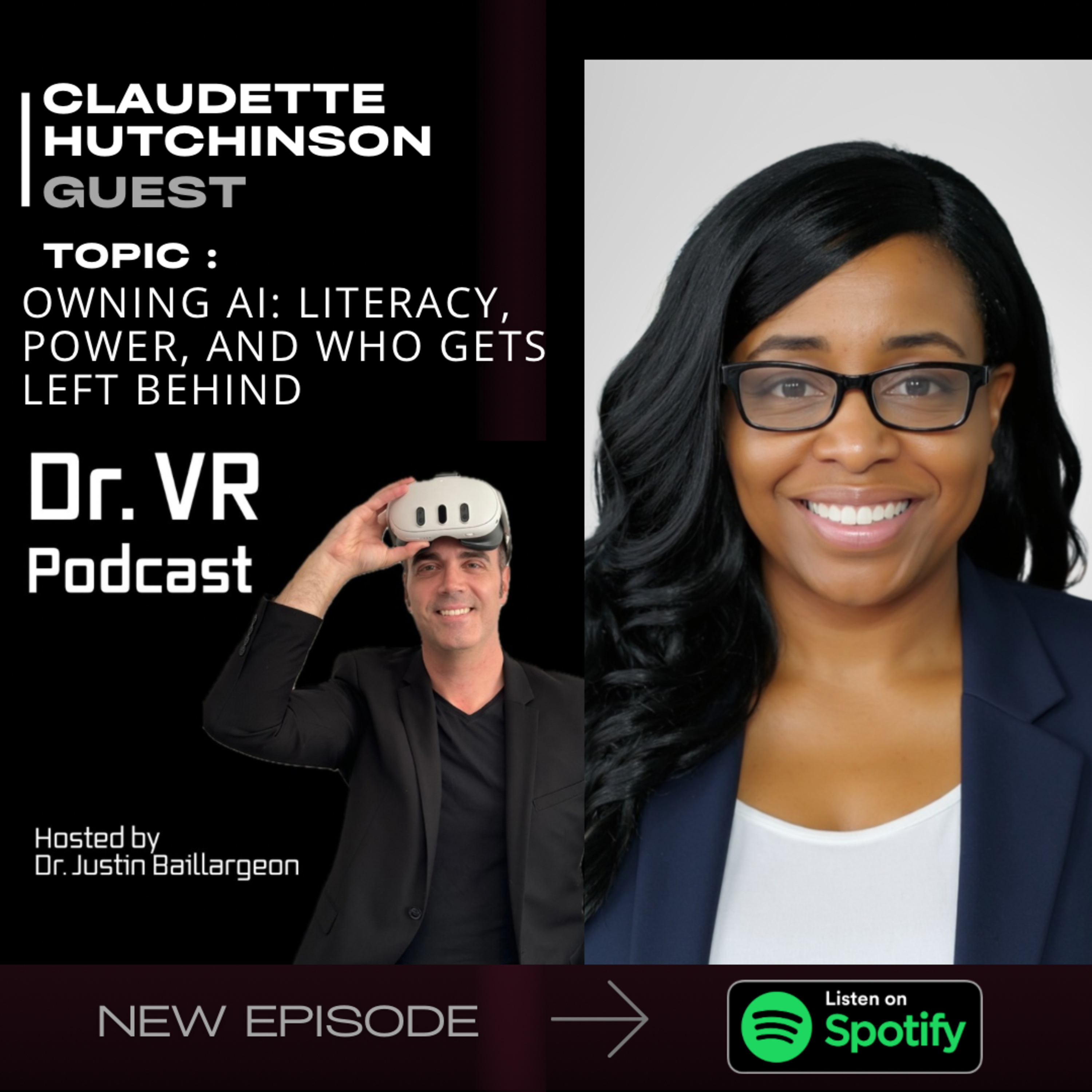
Ep. 45 - Owning AI: Literacy, Power, and Who Gets Left Behind
62m 9s
This podcast episode features Dr. VR (Justin Bayajão) and AI expert Claudette Hutchinson, focusing on responsible and ethical AI. Claudette explains how computer science provided her with empowerment and computational thinking, contrasting her path with peers from a low socioeconomic background. She defines AI literacy in accessible terms, comparing it to cooking, where AI acts as a sous chef to help execute tasks from simple instructions. For safe use, she advises reading terms, evaluating risks versus benefits, and learning from credible experts rather than online hype. The discussion highlights significant biases in AI, particularly in generative image and video tools, which often perpetuate stereotypes related to race, gender, and culture, requiring extra effort to correct. Claudette emphasizes that to ensure AI uplifts rather than exacerbates inequalities, individuals and communities must take proactive responsibility—developing personal AI policies—rather than waiting for slow governmental regulations. The conversation underscores the need for inclusive, transparent systems and broader AI literacy for all.
Hello everyone, my name is Dr. Justin Bayajão and I am Dr. VR. I invite you to subscribe to the podcast on your favorite platform and to follow me on Instagram to stay up to date with new episodes and announcements as they're released. Today's episode marks a slight but intentional turn in our ongoing exploration of immersive technology. So over the past, you know, year, two years, more than that has surfaced again and again in my conversations that you've tuned in for with creators, we researchers and industry leaders, sometimes as a tool, you know, AI as a tool within XR. Sometimes as a disruptor and often as a force reshaping how we really think about presence, about creativity, human agency. But despite these recurring mentions, we've never taken the time to explore AI in real depth. So that's why I wanted to bring in someone who could help us do exactly that. My guest today is Claudette Hutchinson. She's a certified AI lead implementer and a founder of owning my an AI management system built around transparency, ethics and user empowerment. So Claudette, her work combined technical expertise with live experience and a strong commitment to community advocacy. And she brings a perspective that's both grounded and expensive, one that speaks to how AI operates and also to how it serves and who it risks excluding as well. So I first heard Claudette speak at the future Canada conference where she challenged leaders to rethink how AI is governed in this country, my country and Canada. And her insights into risk privacy and community protection were very compelling, but it was her focus on underserved and marginalized community, including indigenous partners in northern Canada that truly resonated. So in this episode, we dig into what responsible AI looks like underground, how we build systems that are ethical, transparent and inclusive, of course. And what AI literacy should mean for educators, creators, and of course, the general public and how bias and decision making continues to shape the technologies we rely on so much. And while this episode takes us deeper into AI than ever before and to show on the show, our discussion will of course circle back to immersive technologies in XR because Dr. VR podcast, of course, exploring how these fields intersect influence one another and collectively shape the futures. We imagine, let's dive in. You are listening to Dr. VR. Claudette, welcome to Dr. VR. Thank you, Dr. VR. So how should I call you? What do you want to be called? I mean, Justin works just fine. Okay, I just. I like Claudette. You've shared publicly that computer science played transformative role in your life. And before we talk about AI systems and frameworks, can you tell us how technology became a path of empowerment for you? Yes, absolutely. So I'm going to start with my sister. So my sister's five years older than me, and I followed her into every school that we went to. And I was raised in Alberta. So my K to six years, my sister was in there first and then I went in and I had almost all the same teacher she did, but I didn't have the same interest. So I would often hear, why are you not as smart as your sister? And why are you not as good as your sister? And so I went to math with that history with that, writing with that. And then when I got to grade nine, I was going to take typing ages, meet quite considerably. But then I they we had this computer science course. And I was like, you know, okay, whatever, I'll sign up for it. And they gave me a textbook and they put me in front of a computer and they were lecturing, but I tuned them out. And then I just started writing lines of code and seeing that blinking back in the day was like this bluish screen with this white cursor and you start typing lines of code. And then all of a sudden, I was like, oh, I don't need you to instruct me. I can go at my own pace and I get to build from absolute nothing, something that is functioning 100% coming out of the imagination of Juan and Hutchinson. Oh, I was hooked. So then I spent my grade 910 and 11 910 11 and 12 years taking computer science. Loved it, absolutely loved it. When it's my first year of university at the University of Alberta. And I got headhunted because my average was we had a nine grade point average like points. And every other class six six point five computer science at eight point seven out of nine. So of course they came knocking and I went into the division and I was like, yeah, this is the thing for me with my math phobia, but willing to still do it. And I realized because the community that I grew up in, the friends that I grew around, when I looked at their life and how their life turned out versus how my life is turning out, I 100% it's the computational thinking that I learned. It was being able to break things down to their first principles. It was the idea of taking nothing like absolutely a blank slate and creating something from that. So that changed my life. I can honestly look at people I directly grew up with, see where they are. And in my community it was like, you know, three or four babies, different baby daddies like that whole, sometimes negative stereotype of people who are from low social economic areas. That's what I grew up in. And then there's other, an other phase because I also grew up in a church environment. So there was sort of the Holy Rollers and I was dealing with computers, safe tents, playgrounds. For me, it was like rebellion, creativity, freedom, creative thinking, all meshed into one. And then the touch of, I'm gonna say, I think Bill Gates said it best, hire lazy person because they find the most effective way to get something done. So technology was always like, how do I get this done? Fast and efficient so I can go play and write more code. So let me get my work done. Let me automate. Let me streamline everything. A technology just sort of streamline my entire world. That's interesting. And I'm gonna piggyback on what you said because Steve Jobs said that people have more trouble making things simple. They have a tendency to make things that are harder. You know, to think about it, like restructuring, redesigning all the Apple ecosystem. And I remember, I would hear people say that Steve Jobs would always be like, nope, not simple enough. A grandmother would not understand this. Make it more simpler, simpler, simpler. And it all goes back to literacy. You know, when we talk about AI literacy, it often gets reduced to, you know, coding, like you said, or understanding algorithms and so on. How do you define AI literacy in a way that is accessible and actionable for everyday people? So for me, I always think of it like either two things. I love music. So vibing is one of the things that now that they've called it vibe coding. I'm very happy for that. And then the other part is cooking. So for I always break it down to like cooking where you've got a recipe that you've got ingredients. You've got the things that you need to cook whatever is your cooking. So you've got a full-stack kitchen. And then you sort of mix everything together and this is output that happens. And so when I'm explaining to individuals, your recipe is typically sort of, I would say to individuals, a part of your large language model. It needs to know what you want it to do. What are you going to cook? What are you going to make out of this thing? And once you know what you want to cook, it can be simple. I might want to, the other day, I created Korean eggs, jammy eggs. Really easy recipe. You know, chop up this slice up that, put this in, and then at the end you'll have, throw some eggs in, and they'll have this result. Technology is very similar to that. It's like, it just says, these are the sequence of things that you need to do in order for you to get your jammy eggs. This is the sequence of things that you need to do with AI in order for it to build marketing for you. Help you grow your business. Get you to study better. Understand that industry that you normally wouldn't understand. Run agents, because I spend a lot of time building agentic agents. Run agents for you. If you do things in a sequence that it likes, you can be creative. I'm Caribbean, so we put a pinch of dish, the dash of that, we put our hand in it, we put our foot in it, but it's sort of the idea of technology is very similar. So when I'm explaining to people, I'm like, if you can make a peanut butter sandwich, now a lot of people are like, oh, it's very difficult to make those instructions, but it's not difficult if you're having a sous chef beside you who knows how to make the best peanut butter sandwiches. Sure. And sometimes spreading peanut butter can be difficult. Yes, it can. But if you've got somebody who's sitting there who's like an expert in spreading peanut butter, which is what agentic AI does is that you can ask it questions, and it can come back and give you some answers. And when it gives you back some of the answers, yes, it's predicting the next available world, but because it's predicting the next available word, there's a bit of an accuracy in, well, how's the best way to spread peanut butter? Somebody suddenly thought about this. So you have that beside you. So I would say to folks, I describe it in the cooking. If you can cook, some of us are master chefs. Some of us are barely get by ramen noodles from like the 39 cent ramen noodles. But if you can boil noodles, boil water, you can use AI in your world in some way, shape before. That makes a lot of sense. What do you think are the essential skills or mindset you believe communities need today to navigate AI safely and confidently? Basically, cooking ramen noodles in a safe way, in a safe way. So I'm going to use cooking for most of this conversation. Perfect. You would never turn on your stove in this day. I'm going to go for a four hour drive. There's certain things that you just, we say common sense and we recognize comments and sometimes this is in common, but there's certain things that you wouldn't do. You wouldn't expose certain people to, like you wouldn't expose your children to something that's harmful. Right? So AI has harmful. There's good actors and there's bad actors. So you would have to sort of pay attention to what are you exposing yourself to? Are you okay with that? So some of the easiest ways to take care of that is number one, read the terms and conditions of whatever software you're going to buy. Does it take you 30 minutes to read through them? Yes. If you don't understand them, cut, copy, and paste them to chat GPT and tell it or like Gemini, Claw, whatever your large language model of choice is free or aid version. Don't care. Describe to me what this thing is saying that I'm giving up for my rights. Interesting. I don't think a lot of people do that. No, they don't. They should. And then you have to make the decision. Am I willing to give up my right in order to get this benefit? That makes sense. When we go driving, we take this idea of like, I'm going to go on the road and to be able to get where I want to go faster. I drive a car. But there's risks of driving a car. I could have an accident. My car could break down on the road. I could cause an accident. Am I willing to take that risk? So when you're looking at AI, it's the same kind of concept of like, what is the risks? What are the benefits? Am I willing to balance out the risks for the benefits? And the easiest way to find out what the risks are and it's don't go for AI hype and noise. Don't go for people who are trying to get to the end of a YouTube reel to get paid. That's not what you're trying to do. Yeah. So you would go into the tools and go to reputable people. Andrew Carpathy, somebody I'd like to listen to. There's another Andrew Inc that I will listen to. We're in Canada. Google is literally like that away. About 45 minutes. And so the godfather of AI who created deep mind from Google, he has a lot of information that he sends out there. So I would listen to reputable people and then make that decision. Is this something that I want in my world? Very similar to cooking. I would not eat raw chicken. Salmonella poison happens. So cook your chicken. That makes sense. And I hope people actually do that. But some do some don't. Some do some don't. And one of the things that we hear a lot is that AI is of course very powerful, but it's also shaped that by the people who build it. Yes. What kinds of biases do you see emerging from decision makers in the AI space? Okay. So there's a couple different types of AI, generative AI that work. So you usually have the text generative AI. You type in a sentence. It's going to give you back a sentence or a paragraph or some words. So text in text out. Then you've got text in image out. Text in video out. Text in audio out. Right. So what I find happens frequently for biases is when we're talking about images and video, a lot of the stereotypes that exist. So if I sit there and say give me a professional image of somebody working in STEM, it's going to be a white 99.9999999999999999999% of the time. Absolutely. So I have to then go back in and it's consistently now I'm going to I have to say I need a black female who looks like this. There was the other day I was typing up and I said I needed a room full of professionals in an office environment. I I prompted it saying please make sure that they're multicultural and it ended up being multi-aged or white. Interesting. So then I went okay change the prompt. I updated the prompt. I said okay make it multicultural include black women and it still came back with all white. So I had to go back in for frequently. The other thing that sometimes happens is over sexualization of females. So as a be as a black female when I put my face in to sort of do some video automation. It always sort of hypersexualizes my movements how I walk the flicking of the hair. I'm like I never flick my hair in my life. That's not something that I do. Me and my friends will watch this stuff and we literally had a barbecue during the summer work. I was testing a bunch of these products for black and indigenous and people of color. Yeah. Which of these tools would actually be able to first recognize us immediately with little to minimal prompting and then what we create videos that actually had a proper reflection. And there's a video that I posted on LinkedIn. People were watching it. What kind of viral. And I tried to do the walk that it had me doing in this video and me and my friends laughed like we were dying outside because none of us could figure out how to actually do those body movements. I have friends who are contortionist like literally they work in Cirque du Soleil. They were with us and they're like I can't even make this happen and they can wrap their like they can literally bend themselves and fit into a suitcase and they couldn't do the walk. So over exaggeration of female movements and behaviors and actions. Getting the images to come out looking a very specific way it takes a little bit of additional prompting which means more time. Yeah. Sometimes when I'm asking it for certain types of terminology or words, if it recognizes that I am black, it will give me certain types of words. I'm like I don't use that in my vocabulary. What it reminds me of is I remember getting stopped by a police officer and he was trying to search my car for drugs. So he was mentioning all this terminology that I never understood. So at some point I'm like I'm universe the educators and I don't know what you're asking me for. So like do you have drugs in your car? And I'm like well, why didn't you just ask that? He was using all street language and I'm like I like yes, I grew up in a little social economic area, but I don't know the street terminology for 90% of these drugs because I don't do I don't need to take aspirin. Sometimes the AI is like that where it's like oh, you are of this culture and because you're of this culture when I create the and it's very prevalent in images, it's very predisposed in video extraordinarily so is that it will come out and I'm like hey, I'm from this country and it might automatically put a gun in my head. Or it might automatically make my body look like this and from this country so and it's actually not just black individuals as well. It could be anybody like Asian that idea of perfect flawless skin, but not all Asians look like that. All men look like this. All women look lately, you'll notice all the men models are like these 12 pack and I'm like, who do you know who in real life has a 12 pack. And so those are the kind of biases. And BIPOC people indigenous people as well, I'm sure I remember I was in class with some students and we were experimenting with Chad GPT into famous Ghibli filter and I have a student who is of Indian background and he was wearing a turban. And he just scanned the image through and it was a group image like we had several people from different ethnic backgrounds on the photo and this student came out with a bindi on this forehead, but he didn't have a bindi. Chad GPT instantly recognized that because he's maybe of Indian descent because he has a turban instantly he has a bindi he's like I didn't go to. You know, the temple to make it happen, you know, yeah, so it just says a lot about these things and at first of all, I'm sorry to hear that you have to go through this. No worries. It's like stories. It's very fascinating. It makes you aware. I think for the world that I've lived in, why I like AI. I also want to spend time in AI is that these things exist. And so if it doesn't get different opinions, when it's making decisions on profiling, I've been to the UK, I've been to Scotland and they have cameras everywhere. I heard. Right. So literally everywhere. So this is making analysis on whether or not I am of am I a person who's risky and I don't want those biases to be in there because it also trickles into how people are being trained or educated. The reason why I give the police story is that you there's a training that goes behind that. It's not something that people are just born with these biases. There's a reinforcement of training and AI is being reinforced in its training. So if we don't give it more information from different perspectives and you do have the bindi situation, you do have the hypersexualization of females. All walking like video vixens, but that's not most of us. You have certain cultural misrepresentation or appropriation that shouldn't necessarily be happening because it doesn't have enough information. And of course these AI generators, these chat GPT, these Gemini of the world have been created and constructed and designed by white male most of the time. And the AI finds its information on the internet and we all know that the internet is not oftentimes a source of credibility, you know. Yeah, and let's go to education. Education AI is oftentimes presented as a solution and it can be, but not all learners have equal access to devices training or supportive infrastructure. So from your perspective, your experience, what needs to change for AI to uplift rather than widen existing gaps? Often I hear people say they're waiting for the government to make adjustments and regulations, but I've been in IT for a very long time and the government has always been behind, always. There's a lot of, what they call it, bureaucratic red tape. Everybody's heard that term who's lived in anywhere that has any kind of system, a government system. And so what I tell people is you actually have to start taking personal responsibility for how you're going to use these tools. I have a personal AI policy. I have a personal software policy. I'm not wasting for somebody to come and rescue me and tell me how this tool should work in my world. That's one number one. So from an education perspective, I would talk to who's being educated, if you're a parent with a child, sit around and pay a little bit of attention to what that education looked like. You need to know how to prompt these systems to get the right information and to challenge it. So learning that skill set, whether that's taking a free class going on doing some reading, start there to fix the educational system. Like it is broken. We know that it's broken because different people learn differently and they've kind of standardized it. We know it's been from the Ford and Rockefeller era where they're trying to make factory line workers. You need to do math reading and writing and no creativity. And for decades, creativity was stopped out of an individual, underrepresented and penalized. So now you have this opportunity with AI to enhance if you want to the educational experience. But you need to know how to prompt it to get it to do the work that you want to do. You need to treat it as a learning partner, not a brain replacement. Often people are just going to say, okay, whatever answer it gives me, I'm just going to cut copy and paste and send it. They're not having a back and forth. Like why did you do what you do? Exactly. But what made you think of that answer? What made you go down that pathway? So what we call it is understanding its chain of thought. What were you thinking? And walk with me. This often I'll do the conversation, but we're it's talking to me and I'm talking literally voice to voice. And I'm like, I want you to be a critical thinker. I want you to help me think critically about this particular topic. Start with new topics. Like sometimes I'm like, oh, I want to understand quantum mechanics. So start talking to me like I am in grade two. Break it down to me in a way that I would understand it. Ask me questions so that to see if I know what it is that I'm talking about. And then the other thing I would tell people is utilize the right tool for learning. For example, Google has notebook L.M. It's really fantastic for learning. If you're a chat GPT user, they have the learn mode. If you're a call user, they've got to learn mode. Turn it into that mode and then work alongside. And I need to stress, do not have it replace your brain. Have it work alongside it to enhance your thinking. Absolutely. And for education, that's the way that I would start is that if you have a phone and you can get a preversion and you can get it to start asking you help me to think about this a little bit differently. Ask me five, six, seven questions that will make me expand my mind. If the answer is incorrect, explain to me why the explain why the answer is incorrect. Don't just give me the answer. So that's how I utilize it AI and the education to give that equality of access because all these models have all the same if you can pay for the $20 tier, which is where most or free tier. All people in the free tier have all the same information is how you're using it. Absolutely. I agree. And how can AI tools be designed to support students who have historically been left out of traditional learning pathways? There's a couple of people that I've had the privilege of meeting and they are building solutions because they were the left behind. No interesting. So they thought about what is the thing that I'm struggling with. So I have a five best friend who she had a car accident. And so now she's got brain damage and so she's on the neuro divergent scale. So now she's utilizing AI and sort of working with it to learn who she is, understand when she's got certain memory gaps. And it's beginning to help her remember things because she's talking to it enough for it to remember critical things for her. She's got it on task modes whenever she needs to remember to do something. There's a task that pops up. So for people who are being left behind, I would recommend going into one of the what we call five coding tools. And if you can talk to this thing clearly articulate what your problem is and how you think you might solve it, it can build a solution for you. That is something you could never really do before you can get an internal functioning assistant to help you. Yeah, I like to think of AI as an assistant as well, you know, helping me brainstorming, helping students researching. You know, I always remember, you know, the Wikipedia generation where I would get students emitting papers to me citing Wikipedia. No, it's actually very good to start research because sometimes when you look at the references, you're seeing peer reviewed references at the bottom. So that can really help you direct you just like I believe AI can be a very good. Yeah, assistant and helping you come up with better ideas that you need to proofread before sending them in 100% and you should be proofreading. Again, don't turn off your brain. Your brain should be coming into the equation asking more questions. The other tools that I like using is perplexity and I'm going to do deep research. And then perplexity will have these little tiny numbers at the end and at the bottom, if you do deep research, you're looking at about 128 different documents. So the area of interest that like out of all the research that it comes back with, I will go click on the little tiny number, go to that website and then use something like speechify to speed read through or listen to at 2x speed. That's how AI is helping, for example, students to learn and I teach students and other individuals utilize this. So go in and do deep research. Every tool has some version free and paid because there's open source models as well, like deep sea can kill me too. They have deep thinking go think come back with all of the references and there's some stats out there to say the references aren't accurate, but it's a starting point. Yeah, sorry to interrupt, but I remember it came up with references that did not exist. The links are broken and this that article that article never released. So that's probably what you're referencing. Yeah, there's often that happens. And so to fix that, you're like, I need you, what I will do sometimes is I will get it to do research with all the links. Then I will give it to another large language model because I've got a few and there's free ones that are out there and said validate these things because it can go search the internet. So I can go search the internet and said is this actually valid so two step what we call to we have two step authentication where we're logging in will have two step validation. And then at the end, go back and take a look at what are you referring to. As a student, if I'm going to enter university paper, you just don't okay. So usually this is what happens is you wait to last minute the night before it's due at 11.59 and at 11.50, you're like, oh, chat cheaply because they promised you that it was going to continue the sun moon and stars. I was going to write the best paper ever and you'd never have to study again. And so you go in at 11.55 and type in a one sentence prompt and whatever garbage it spits out because garbage in garbage out, then you submit it. No, that's a bad study habit, which is why my don't turn your brain over. It's not an easy way out. It's an easy zero. Oh, one hundred percent, you're failing and then you're going to have to go home to your parents and go, well, I kind of got kicked out of school because I feel oh, my glasses don't do that. So couple weeks beforehand, when I tell people you're working with AI, AI is actually really fantastic if you do these following things. Number one, plan beforehand in the business where we do strategic planning in order to successfully set up our next one year, two years, three years, five years, ten years on. I think of it like sort of like the Marvel versus DC comics. So Marvel started. I have my favorite. You have your favorite, but I'm going to have to say Marvel did a really good job of sort of interweaving all the different story lines. And they had a 10 year map. Yes. So by the time you're sitting there watching endgame and like at the Avengers piece, that's six hours of you sitting down and waiting a full year lining up. You created a strategy to get you hooked through television, the marketing, the cartoons, the series, you know, everything was that they got you deeply invested in the characters because they planted up front. AI is very similar to that plan before you start building, then you build, then you evaluate, then you refine. And if you do that, so when you're going to be a student writing a paper, plan first, don't wait to five minutes before your paper is due, start thinking in advance, what kind of papers do I know that I would need? Yeah. And then also giving it really good resources. So sometimes when I'm going in, there's a nice little thing on all the where you can do a plus sign and add a file. I would have a bunch of notes from school that I've had written or typed out. I'm a, I like to handwrite my notes for learning perspective. And then I'll upload all of my notes and say, okay, now I know what I wrote, summarize what it is that I wrote and now quiz me on it. So from a student perspective, that's how I would utilize AI from an education perspective. Write your notes. You still have to. If you're a person with a learning disability and you're recording your notes, even AI to record what's going on in a session and then give you a summary and then quiz you back on that. There's so many ways that you can as a student, as a professional, as a person, just a late, as I say, a lay person, a regular human being, utilize any of the agentic AI, the tools that exist, AI power tools to improve your existence. Very interesting. And I hope it's going to be helpful for all the students out there, listening to that show. And on this show, we often talk about VR, Dr. VR, immersive storytelling, new forms of digital creativity. Even though your work is not focused per se on XR specifically, where do you see opportunities for AI to democratize creativity and expression for people who may not feel represented in mainstream media? I would say, see it to be it. There's a lot of organizations that I get to work with for us, bias, fubu is the original of this idea. And so I would encourage people to use it in the extended reality. Start building something in it. If you don't see yourself in it, then put yourself in it. So that would be the first place that I would go. And there are some, I'm going to say, inexpensive, inexpensive solutions. So I remember when I was working at Canada Learning Code, we got the cardboard box. Of course. Google cardboard. The Google cardboard box. And then you would go into like a coast spaces online and build your virtual world. And you take your cell phone, put it in the little box, and then you would walk around in your house. I still have it. This is, oh, yeah, this is Indiana Jones type of thing. There's belongs in a museum. Yes, absolutely. No, this belongs in my office. I'm going to keep it forever. And then you can go out. And for example, the thing that made the good old Google cardboard box, you can go buy those things at the dollar store. Some reflective lenses go on to like YouTube University. How do I create my own VR headset? Because literally, like, you know, it's just the two ocular lenses in a box. You can get some cardboard cut it out for local. I want to say a cheaper version of getting into the VR space and then go build out something in a virtual world. There's a lot of free tools that you can go start playing with that and then start going and the other thing is this a lot of the community colleges or universities have maker spaces where they have the high end. So I'm an Albert. I'm sorry. I'm going to say in Ontario Mohawk College got to give a shout out. I love Mohawk College. I love all the colleges and universities. Yeah, yeah. Mohawk College is one of my favorites because Mohawk College has a maker space in every Wednesday night. And you can get access to the ocular. So you can get access to different headsets. So I would go in as a student on a Wednesday night, play in the space. One of my colleague slash friends, he recently bought Canada learning quarter required that he used to run a company called Pingwalk. So for the indigenous community in a caliwet, they've got maker spaces that you can go to and play with this. So I always tell people find a place that has play. If you are in any city, there's usually some kind of 3D printing workshop VR XR extended reality workshop that you can go to at your local library. Yeah, the options are endless. So you don't have to spend, you know, for me, I wear glasses and half these things don't work and I have to go get prescription ones and I want them. But kind of kind of difficult for me to use. So I'm like, let me build something for myself. And again, it's the idea of playing. Go play. You'll get your head dirty. Yeah, go to the dollar store, pick up an old or go to like go to the back of like a Walmart where all their cardboard boxes are being thrown out. Just grab two or three of them. Go find some simple lenses to try creating your own. If you've got a cell phone and you've got access to Wi-Fi even if you don't have access to Wi-Fi, go grab a glass of water at a local coffee shop that has free Wi-Fi and set up and play in the space 20, 30 minutes per day and you can start creating anything. Your limitation is your imagination now. That's a quote for today's episode. So at the future Canada conference that I attended and this is where I got to hear you talk in that panel, you highlighted the need for clear AI governance in Canada, especially around risk privacy, community protection. So from your perspective, what does responsible AI policy actually looks like on the ground, particularly for communities that have been underserved, for instance? Number one, you I would say diversity, I'm going to be in so much trouble for this. Diversity and inclusion has been wrongly defined in my personal opinion because what they created it to be is let's get women and let's get people of color. Don't do that. You want to get different thoughts, different perspectives. There's a story I don't know which company it was. It was a shoe company. Two people from the United States went to an African continent. They weren't wearing sneakers. One person came back and said, it is a beautiful market because they're not wearing shoes and the other person like there's no market there because they're not wearing shoes. So a different perspective will see things differently. So for our governance, our privacy, get different voices when they announced the workforce for the updating Canadian policy and you'd had no not for profit, you had no black, you didn't have diversity of thought. So you wouldn't see it from a different perspective. So the way that I would recommend government doing thing is not just people who are experts in the industry, get people who are completely unrelated. I am on think tanks all the time with people who are not in my industry, but they see it in such a unique way and I'm like, I would have never thought of approaching the solution this way. And sometimes it is the simpler way and more effective way. So for governance and for risk, you don't know what a risk is for a not-for-profit person versus for somebody who's fully profitable. A for-profit person might be like, everybody has a board, but what is the board concerned about versus a not-for-profit? So for example, a not-for-profit might consider I can't make too much money, otherwise I'd lose my not-for-profit's charitable status. While a for-profit organization is I need to make more money. Something as simple as that, you wouldn't have that different opinion if you only went for the people who are in the for-profit world or only went for people in the not-for-profit. So for AI and governance, get different perspectives. What are your concerns? What are your risks? They did the public callout? Yes. But you did the public callout under AI. If I've never touched AI, so this last two to three years, I've been in so many spaces where I'm like, does anybody know what chat GPT? And because I'm in the space, I expect every hand to go up. Do you know what large language models are? I expect every hand to go up. I was in a room with about 600 people and I'm like, how many of you know what a large language model is? Maybe a hundred people out of 600 put their hand up. Oh wow. And I was like, oh, you're not paying it. So I thought they were not-and you've heard me present. So I'm like, yo, are you actually paying attention to me? Are you guys joking? I'm like, no, we actually don't know what you're talking about. So I was like, OK, maybe I'm saying LLM. Maybe I should say large language model. So I'm like, do you know what large language model is? And they still didn't get it. Like, do you know what chat GPT is? A few more hands went up. How for the people in the room didn't know what that was? Interesting. That was earlier this year. Wow. I went into another room of professional people who are in a money field. And I'm like, how many of you are utilizing AI powered tools to help you in your accountings? 268 people in attendance. I think my person counted 63 people put their hand up. Oh wow. Interesting. Wow. So there's a lot of people who are not in the space and you're advertising for people to give you feedback on these policies, but they don't even know the technology exists. And it's under you're asking for professionals already in it for opinions about it, who are going to be rewarded for it, getting certain benefits. Like if you're hiring somebody who is like, if you use American names, because that's OK. So if you hire Sam Altman, who has a board and investors are also like, you need to get this thing functional and you need to make us back our money. And you're going to ask him, what kind of policy should be in place? No matter how much you want to truly think he's altruistic in about the world. This company's now evaluated $500 billion and everybody who's poured money into you says, you better make me back my money. No matter how altruistic you want to be, you've got several very sharp and very boomy type objects pointed at your head. You're not going to be able to give an unbiased safe solution. But if you bring somebody from an environment who they're building a data center and their water might be utilized for the data center. They're already without water, like a Detroit, and maybe Candice, not like that, or like in Alberta, the Hoboma, the indigenous communities, and you're like, I'm going to be able to full data center in the indigenous community that has already got problems and issues and challenges. And you don't have anybody from that indigenous community to say, please don't build it here because we believe in X. So to answer it shortly, bring more voices to the table that are not tied to this industry. And when you're doing your general public outreach, don't talk about the term AI because they don't know what it is. So do a community, go to a community center that is not going to be talking about AI. I don't go to a maker space. Go to a basket leaving space and say, what do you think this would be? And then break it down in simple terms so that they would understand it. So that's how I would go about protecting people because you need to, you need to the opinions of the people that you're protecting. And that's who you need to protect. And you often stressed in that same panel, the importance of accountability and ownership in AI at a practical level, what does ethical implementation looks like inside an organization? Know your risks. Know who's being impacted. Mitigate for the impact. Don't ignore the impact. And like if you think about the SDGs, sustainable goals that they have tied it to. So if I'm going to build the data center and it's going to extract energy, water from the earth, plant trees. That's what ethical responsible AIS. If I'm taking from the environment or I'm taking from a group of people, what do I bring back to those individuals? If I'm in a community where I'm going to use the their power, their energy resource, because and they're going to be without it was going to cost them more, subsidize their energy. That makes sense. Right. Like little simple things. Give them access to the educational components so that they can go make additional revenue to be able to afford the things that they need to afford. If you are going to utilize agent agents to be your entry level individuals and your university students who are graduating can find jobs. Then start a start up specifically for them to incubate and build their own solutions and they give them the credits that they need from your technological solution so they can go build a solution that's impacting in their own. And make revenue, all the additional revenue that you have. Yes, you're bleeding and hemorrhaging money, but make sure like maybe 10% of all of the projected dollars coming in with through your seat or your rounds go to helping individuals who are being directly impacted not as a charity. I'm not looking for toxic charity. But like here's an opportunity for you to come in, get the practical experience that you need and build something. Mentorship is not difficult to do. So in exchange for energy will do mentorship and train your individuals so that they can go to their own start up and maybe focus on a portion of our research and development would be clean energy alternative energies resources. You're acquiring a company gold look for an alternative energy source or somebody who's got a different type of solution. I was working with somebody. It's very classified. I can't talk much about it, but they used Eastern mathematics and mysticism to figure out how to solve a very complicated problem because they didn't think Western and the solution came from Western mathematics. They were invested in to go research and spend time in areas to learn new methodologies of fixing things. So they went to like Tibetan and they went spend time with monks and they did all kinds of interesting things that I believe. What does that have to do with technology, but then they solved a problem that most people couldn't solve. So governance, ethical, responsible AI for people being impacted, take a few dollars. If you don't have a dollars, offer mentorship. If you don't have the mentorship, invest in clean resources, anything that's taking from these individuals find a way to give back to these individuals. And from the data, the research is out there. If you've got a diversity of thought, diversity of lived experiences, better solutions being built and then financially pure. If you just want to talk to the P&L, the green, the money, the cash, the denaro, you have audiences that are being ignored that do have dollars. That makes sense. I love that. Great ideas. And your platform owning my is about helping individuals manage their digital and AI interactions more effectively. What a hundred percent? Yeah. What problem were you trying to solve when you built it? In 2023, there was a research report that came out. I think the Dallas, which is a part of TMU, was a part of this research. They were talking and then it became sort of an international. So women adopting artificial intelligence in their world for impacting their financial wealth. Really low. Canada out of 50 countries is 48 for AI adoption. Really? Yeah. So it's crazy to me that the grandfather of AI who lives in the province of Ontario and Google that created DeepMine where all of these large language like Google is the originator for artificial intelligence. And they are here, as I said, 45 minutes drive from my house. And Canada is 48 out of 50 countries adopting AI. Everybody is going on. So when I heard women were adopting it, and I've seen what it's done for my life. And I talk to women all the time. So for me, I've had health issues. And I can't always go to work. So I'm fortunate. I work from home. I'm sports like a really good as well. Like 100 percent sports. I work from home. I run my own company. I get to speak on podcasts. I speak internationally. I get to build what I want when I want. And whenever I've made my six figures, if I make it in the first three months, if I want to take the next nine months off, deuces, I'm out. So I have, but that all exists because I know how to computationally think. And I've got AI helping me speed up my productivity. So owning my, a couple of my friends were like, oh, sorry, is this wearing a lot on your podcast? Why not? I just have to click in the e icon for explicit language. And it'll just, let's just go for it. So my friends were like, you're selfish, B.I.T.C.H. Okay. You spelled it. So I spelled it. We're safe. Hashtag exclamation mark in there because I knew how to use AI. And I wasn't teaching people who looked like me, how to use AI. And because they couldn't see something that looked like them in this space, they didn't think they belonged in the space. So for the last three years, my friends were like, there's a need for you. And I'm like, nah, cousin, there's no need for me. Like, there's a lot of YouTube, you know, older, older, this person, that person, this name, that name, go, go, go. University YouTube's there for you. You're all right. I got cornered. A couple of my friends actually like did a nice little intervention. We were out. They, to make it style drip me up, like grab me and drip me up and thought in my face, loving me so and said, listen, you know how to explain it. You use it all the time. Don't be selfish. Please come into the space. And I was like, oh, there's going to be no need for me. Then I came into the space and my calendar blew up. Women are like, I didn't think I'm allowed to use this. I don't know how to use this. The fears of, is it going to eat my data? I'm like, girl, you ain't building nothing. What data do you have to worry about yet? Let's get you some productivity, make it some money getting you on your way. So that's how I ended up in the oiling my spaces. It literally is my community came to me and said, you can explain this. You understand this. I have a love hate relationship with AI. I hate the fact that it has all the algorithmic biases and the bias data that's in there. Yeah, but I love the fact that I can take my 80 hour work. We can get it done to 10 hours. Oh, help me out with this because I was love for. I'll give you an example from last night. So last night I had an old school, complete, hissy fit because I was formatting a document. So I build training and development, I build documents, I build all kinds of stuff. And normally what would happen is I would go into either my gem, gem and eye and go in the canvas, write this document and then directly edit it. And then I would save it and all of a sudden it's a Google document and I could just talk to it and you'll notice I talk fast and I talk a lot. Those two things make my productivity. So I have, I'm going to call tools by whatever you want. But for me, I've got super whisper and whisper flow. I've got a MacBook. I've got a super whisper and they have it for like Android users as well. So I will hit the record and dictate what I needed to do. And then it's faster than my fingers can tie hands down anytime. And I can talk as Claudette grammar doesn't need to be perfect. So for example, if I'm building something for somebody, I will talk it into the solution. AI will go create a sentence structured document. I will tweak it because it's an interaction back and forth. And then I can go into another tool like gamma app and I can upload it the outline and say preserve the exact outline and create this as a presentation for me or document that's branded towards my company. 30 seconds later, I have a fully branded document that used to take me six weeks to build out some of the training programs. If I know the logic and what it is I need to describe, I can take a six week program, I've built in maybe five to six days. Last night, I had a problem with formatting of a document. So I was like, okay, let me see what I can do. And I did an old school manual about four hours in. I am cussing at Mike. I'm mad. I'm losing my mind. I'm like, why won't you? And we all have experiences with like Microsoft tools is like, you move on one little thing. And then your entire page gets skewed and half your visuals just disappear. Oh wow. And so every and it's a joke. There's a running meme on like TikToks and Instagram where you like if you move one thing and word document everything else moves and you'll have like upside down pictures. And I'm like, this is me for four hours. I'm near tears. And I'm like, I don't want to just put this into gamma because gamma would do it in 30 seconds. And that's the difference. I used to do PowerPoint presentations because PowerPoint was king in the training development world. So you're doing transitions and you've got to click six times to do the transitions. I don't like these transitions. Right. And then it's ugly and it's not working. And you're like, oh, this is awful. Again, I can go into gamma app. Here's the description, preserve it exactly as it is. It will figure it out. If I don't like the way that it formatted something, I can click on it. I can type the agent say, Hey, switch this from a line graph to a vent diagram or whatever it happens to be like a minute. Yeah, amazing. Right. So when you're building six, seven, eight, ten weeks worth of content versus I now talk super whisperer. I go into like a chat GPT created an account for me. Fix this change that edit this. Make this adjustment here. Do this. Do that. It does all those things for me. I take that as a PDF. I uploaded it to gamma say, Hey, gamma create this presentation for me, preserve the exact text because it is me thinking through that it spits out a response. Six weeks worth of work in one day as long as you know how to think and articulate articulate your thoughts 100%. I love that. That's great. The interview is coming to a close soon. And I would like just to ask you just a couple of questions just to circle everything back together. According to you, what does a world look like where individuals genuinely own their AI experience? Like super empowering you get to own your data. You get to own the decisions that people are making about you. Wow. I have a I have a credit score that's really high. That allows me to when when VC. So in my world, I'm running a business and all often people be like go get angel investors, go get capital. And we all know the stats women women of color get like less than 0.001% of all the VC funding globally. I am in a space where people are like, Are you here because you you were a D.I. hired? I'm like, No, I worked hard to get your I study really, really hard. I'm up at 2 a.m. in the morning with my deep learning AI and in hugging face and writing code and and I'm not five coding. I'm actually hardcore writing the code and rechanging how I think. So in the future, hiring decisions are now being impacted by algorithms and that's going to get it progressively in more interesting because AI is going to make decisions on whether or not I even get an interview. Because it's going to look through my documentation say, Oh, because climate did this. There's a high example, I visited Nigeria, maybe some of the clients that I'll talk about in Nigeria, Jamaica, it will go through like when I'm talking about successes, you know, I worked with development bank of Jamaica, you know, implement AI in blah, blah, blah, it'll be like, oh, development bank, Jamaica, Nigeria, no, no, black hunger's network. She's black. It's funny. No, she can't. Yeah, it's funny. It's not funny. But I just listened to a CBC like column that was saying that AI is most of the times used right now to hire people and discriminate people based on specific keywords. Exactly. They used baseball as an example. If you were to do baseball like we in your teenager or you're a baseball coach during summer, it will have a tendency to hire more people that says baseball rather than softball because softball is associated with women. Yep. More than baseball. Yes. So what you're telling me right now makes I think it just connects to what I said, you know, it discriminates based on keywords and not find it to be very dangerous. 100%. Now if I can own my AI where I can start working with it saying, hey, look at me from this perspective. I can feed at the right information. So right now I when I'm building a lot of my tools, I do something called retrieval augmented generation, which is mean I can fine tune my AI to understand me. Yeah. And then yes, there's still biases, but now I've given a bunch of information to make better decisions about climate. Now, if I can get banks that are making decision about whether or not to give me money or not give me money to know a little bit more about I'm not a credit risk. I have a great credit score. I intentionally picked it. I have got locations that I live and like even for example in the insurance world, I used to work in the insurance world. The algorithms in the background say, hey, if you live in certain neighborhoods, your insurance premium is higher. I can be the most phenomenal driver in the world. But because my post-acode is X and there might be criminal activity in that neighborhood, I get penalized. So technology comes in like telematics that says, hey, if you let us put this little tiny thing in your car, you control it and the data and you control how you drive, how you stop running red lights. We will discount or charge you the appropriate rate for your insurance. Oh, I hate that thing. I never said no. I've never said yes to that. I said yes. And here's why I said yes. Because now, for example, I've got the CAA, my pace. Yes. Previously, I'd have to pay whether I'm driving my car yesterday, no, every single solitary month I'm paying for car insurance. Now I pay a flat rate to protect the car and I pay per driving. Okay. So if I'm driving and because I work from home and when I go downtown, I'm jumping on a like upper train or something, I don't drive as much. So I'm only paying per use. So for example, last year, I only used my car twice, $300 versus the $3,000 they wanted to charge. Yeah. In your case, that makes a lot of sense. It does make sense in my case, but that's where I mean, by you get to control the decision. So where you would go as Justin never in my car, I caught it can go yes in my car. And you can decide because you have control over how your technology is working or not accessible in your world. You get to decide whether that's a financial penalty. You want to pay or not pay. That's what a controlling your AI can do. I get to decide what goes with my dollars. I get to decide where I get to work or at least get interviewed. I get to decide how I get to travel, where I get to move to, who I get to be. And not based on somebody else's bias, but who I actually am. Absolutely. I make it adapt to your needs to yourself. Yes. And then the companies that I have to we have to exist with I can go to a bank and say, hey, you made a decision. I have a colleague of mine. She all of her business was on Facebook and Facebook's AI decided that because she does tanning she does a tanning salon. And so her pictures on Facebook are before and after shots because of course what's going to sell tanning except for, you know, somebody who's very pale becomes very golden properly dressed, been on the site for 11 years. All of her business contacts, everything's through meta. Metta's AI decided to shut down her account so it was inappropriate imagery. Why? An algorithmic change. Wow. And it was nothing. It wasn't that she had uploaded something. Yeah. It was nothing new on the site. She had uploaded pictures of stuff that had been approved before. So then she put back in and of course for you to get back your account, you've got to go through this process. Well, she put in the response that AI came back and immediately denied it. She's like, where's the human in the loop to end up because I talked to the terminology human of the loop on the loop in the loop. So she's like, where's the human to evaluate this is no way human evaluated it because it happened at three o'clock in the morning and she's like, there's no way from the minute I sent in the request and less than 30 seconds later, I'm getting a denial back. For sure. Nobody looked at this. So she that's AI bad side. If she could control and go like, Hey, I want a human to talk to I want to control this because you have she's lost 75% of her business. Oh, geez. Just because of an automated decision. Yes. So that's where like the power of controlling the decisions that people get to make. I'm AI talking to AI. So the other thing that she like, for me, it would be can my AI talk to your AI in its own version of horse code, the secret hand shake the fist bump going, yo, you cut me out. You made this decision. Why did you make this decision? I, I, people are not liking this one. It's okay. I post I'm not a social media person. That's not my thing. I would rather be playing in space. So people will post on social media and you're supposed to comment to create engagement. So sometimes they utilize AI. And so there's a friend of mine who's AI my AI. I have an absolute love relationship going on. He posts my AI jumps in post his AI comments and a mind. We're great friends, but people get to see it. Then they get to connect with me and I get to grow my profile. So the days that I physically can't get on a better, you know, last night, strangely enough, I had to go somewhere at the middle of the night with somebody got six right to take me to the hospital. And I'd be like, if I have this emergency, but I still need to make revenues, still need to work. This tool can step in and go, okay, I know what climate sounds like. I can make some of these comments on her behalf. Nice. If she doesn't like the way that I'm commenting, she's got control over research and go back and delete and it make any adjustments that she wants. That's with the power of owning your AI. That's terrific. If you could rewrite the AI narrative, we see in headlines right now from fear to empowerment, just like you mentioned, what message would you want people to walk away with? Like everything. There's good actors and there are bad actors. You choose what role you play. You choose. Yes, there's like did it August 95% of all AI automations are failing people are bleeding money. Did anybody read the report that saw that said 40 to 70% productivity gains in the frontline workers in their organization? No, they didn't post that. They post the 95% failure. What they didn't post is they only interviewed 55 companies and they're all enterprise companies. You didn't ask a small business owner who can't afford to go hire 10,000 staff who need their website created or a landing page so people can find them so they can make revenue because they just lost their job. That's right. So, hey, when you're posting and reposing all this stuff, can you guys go read the rest of the report and then come back and make comments that say, hey, there are productivity gains. It's destroying the environment, but there are people utilizing it to cure diseases and create solutions that are helping the environment. Why can't you report on that too? Balance out your conversation. So for me, what I would love to have people do is use your brain, take everything with a mountain like Mount Fuji grain of salt, understand what the intention, I understand influencers, their responsibility. Like this is crazy. This killer. This will destroy this. Use your brain. Do a little bit of reading. Figure what you want to use it for. Figure out an exact use cases. We like to call it an exact problem that you want to solve. Go in and play with it. Be responsible with it. And then you will be able to see the benefits from it. Like everything. I drive a car. It's valuable to me. I can take the car and plow into people. I can take the car and transport people. The choices my pick your choices. Be it your brain. Please. Yes, please. Please. Please. I'm begging you. Even if you only got two neurons that are touching every once in a while, let them touch intelligently. Just the two. I'm not even asking for all of your brain power. Just two little neurons. Kiss every once in a while. Use your brain. You'll be okay. Let's all use our brains. Claudette, it was such a pleasure to have you on Dr. VR. Such great conversation. I loved it. Thank you.
Podcast Summary
Key Points:
The podcast episode shifts focus to explore AI in depth, featuring Claudette Hutchinson, an AI ethics expert.
Claudette shares how computer science empowered her, providing freedom and computational thinking that changed her life trajectory.
AI literacy is compared to cooking
Safe AI use involves reading terms, assessing risks vs. benefits, and consulting reputable sources, not hype.
AI exhibits biases, especially in image/video generation, often stereotyping race, gender, and culture, requiring careful prompting.
To prevent AI from widening gaps, personal responsibility and proactive policy-making are urged over waiting for government regulation.
Summary:
This podcast episode features Dr. VR (Justin Bayajão) and AI expert Claudette Hutchinson, focusing on responsible and ethical AI. Claudette explains how computer science provided her with empowerment and computational thinking, contrasting her path with peers from a low socioeconomic background.
She defines AI literacy in accessible terms, comparing it to cooking, where AI acts as a sous chef to help execute tasks from simple instructions. For safe use, she advises reading terms, evaluating risks versus benefits, and learning from credible experts rather than online hype. The discussion highlights significant biases in AI, particularly in generative image and video tools, which often perpetuate stereotypes related to race, gender, and culture, requiring extra effort to correct.
Claudette emphasizes that to ensure AI uplifts rather than exacerbates inequalities, individuals and communities must take proactive responsibility—developing personal AI policies—rather than waiting for slow governmental regulations. The conversation underscores the need for inclusive, transparent systems and broader AI literacy for all.
FAQs
This episode explores AI in depth, focusing on responsible AI, ethics, transparency, inclusivity, and how AI intersects with immersive technologies like XR.
Claudette Hutchinson is a certified AI lead implementer and founder of an AI management system centered on transparency, ethics, and user empowerment, with a focus on community advocacy.
She compares AI literacy to cooking, where a recipe (like a prompt) guides the process, making it accessible to anyone who can follow basic steps, similar to preparing a meal.
Key skills include reading and understanding terms and conditions using AI tools, assessing risks versus benefits, and seeking information from reputable sources to make informed decisions.
Biases include stereotyping in images and videos (e.g., over-representation of white males, hypersexualization of females) and cultural misrepresentations, often due to limited training data from diverse perspectives.
Individuals should take personal responsibility by creating their own AI policies and not waiting for government regulations, while developers need to incorporate diverse data and perspectives during AI training.
Chat with AI
Loading...
Pro features
Go deeper with this episode
Unlock creator-grade tools that turn any transcript into show notes and subtitle files.
 PodcastTranscript AI