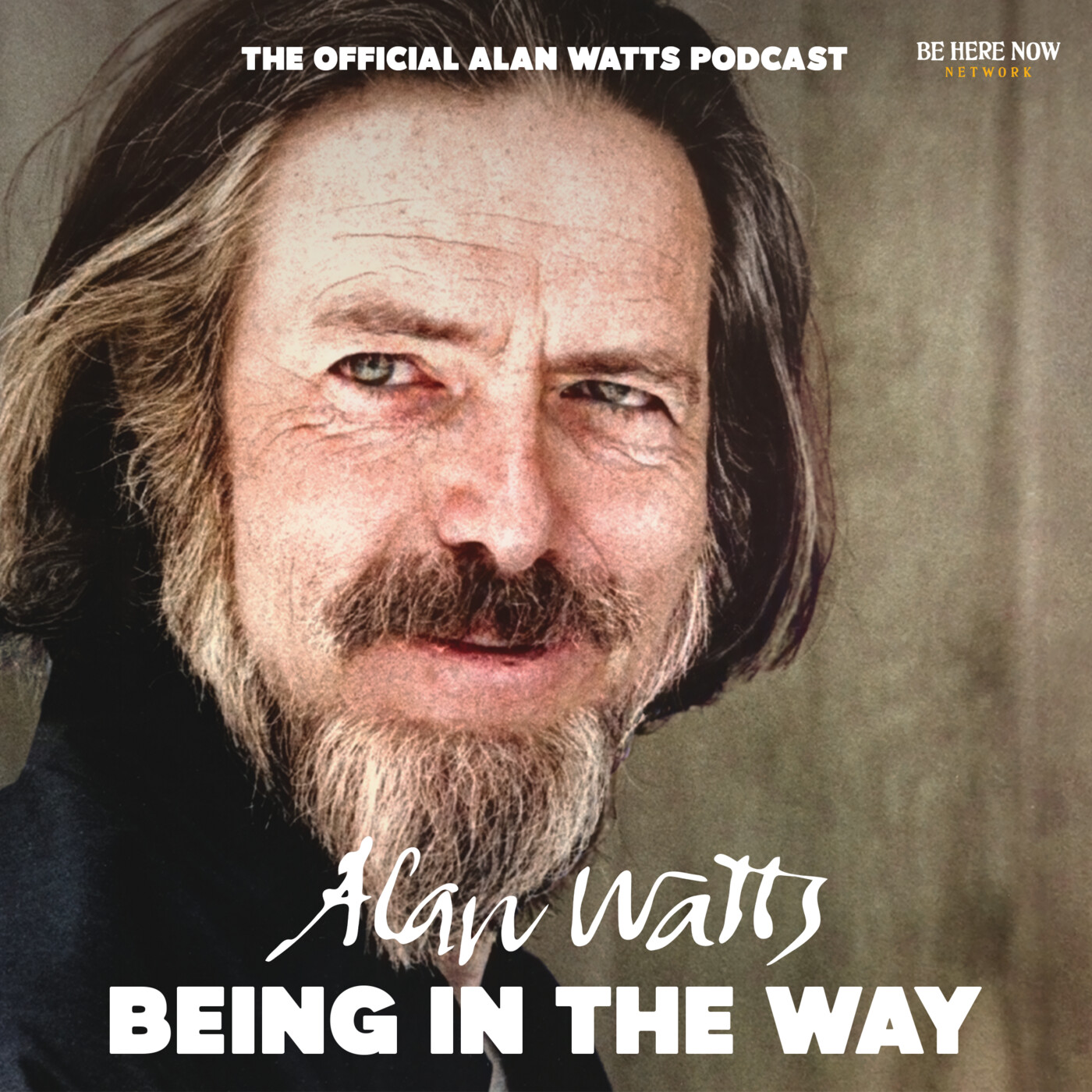
The transcription combines an event announcement with a philosophical lecture by Alan Watts on Taoism. The initial segment promotes a free online talk by David Nickdern, scheduled for August 25th, which will explore the skills needed for effective meditation instruction and introduce a 100-hour teacher training program in partnership with Dharma Moon and Tibet House U.S. This event aims to help attendees understand the nuances of guiding others in mindfulness practice.
The core content is Watts’ discourse on the Tao, or the "way" of nature, which he frames as a fundamental principle of relativity. He argues that the universe is not a collection of solid, separate things, as in Newtonian physics, but an interconnected energy system where patterns and energy are inseparable. Using the analogy of a whirlpool in a stream, he explains that individuals are transient forms through which life flows, not isolated entities to be protected. Watts contrasts the Tao with the Western, monarchical view of God, emphasizing that the Tao has no boss; it operates spontaneously and self-orderingly, akin to a democratic ideal where trust in others replaces authoritarian control. He illustrates interdependence through examples like bees and flowers, showing that opposites arise mutually. Finally, he contends that perception is a collaborative act—our senses evoke the world, and without an observer, phenomena like sound or light do not exist, underscoring the deep unity between self and universe.
A good meditation teacher isn't just someone who meditates a lot. Helping someone work with their own mind is a genuine skill and it requires training. Join Buddhist Teacher David Nickdern for a free online talk on Tuesday, August 25th at 6 p.m. Eastern Time. Drawing on more than 50 years of practice and teaching, David will explore what it takes to offer clear meditation instruction. Listen deeply, guide meaningful discussion, and share the teachings in your own voice. You'll also learn about Dharma Moon's upcoming 100-hour Mindfulness Meditation Teacher Training offered in partnership with Tibet House U.S. the Dalai Lama's Cultural Center in the United States. You'll have a chance to meet the teaching team, ask questions, and find out whether the program is right for you. Visit DharmaMoon.com/path to learn more and reserve your spot for this free online event on August 25th. If you take a worm and bruise it, the worm wiggles both sides of the bruise, but it can't make it a wave wiggle through the whole leg through the worm. And there was a very strange man called Wilhelm Reich who said that most people have a thing like the worms' bruise across their diaphragm so that they find difficulty in wiggling all the way through. So in exactly this way, Darwinism teaches you to wiggle all the way through, not only through him foot to head, but from one end of space to the other. And you are a wiggle in the middle of that, but let it happen, you see. And so this then to learn how to be with the wiggle is to be in the down. Welcome to Being In The Way. I'm your host, Mark Watts. Our new podcast has us diving deep into the archives, in particular to the Dauas and Talks where we come across Being In The Way. This episode explores the individual's position in the universe, in the center, in the place where the self, other, and relativity all converge. Wherever you are, whoever you are, and whatever you are, you are in the middle. The experience or sensation of the self of being I puts us in the center of our perceived world, and yet at the same time the self relies on what it has been to find as others to know its boundaries. And this is also to say that you are interdependent, but in due course the nature of polarity reveals itself as being and not being as two sides of the same coin. And while it's easy to understand that the sensation of self is experienced in relationship to something other, and therefore they have something in common, with that also comes the sensation of being inseparable from everything that you formerly described as other than yourself. And in the end, this shows the necessity of each component in relationship to the whole. And this in turn helps us understand not only the relativity of our particular perspective, but that of every other creature that shares the planet with us. Each experiences itself as human, which is to say as the center. We all realize ourselves in differentiation with another, and this is particularly relevant in today's world where there's a tendency to label groups, populations, and others as good and bad. Our father used to speak about the necessity of in groups, defining out groups in order to know that they are the in one. I'm pointed out that this goes on on all levels of biology, including within our own blood stream where we realize that we wouldn't be a healthy organism, unless all these wars and fights and plots and politics were going on between various cells. But increasingly now, we see the world as an energy system in which both forces are present, a dance of balance and imbalance, and not an amalgamation of things, but instead a system of mutually defining forces. And now here's Alan Watts from part two of being in the way. What I was doing was establishing as the foundation of the philosophy of the Tao, the principle of relativity. And I explained that this was the one absolutely important thing you had to understand in order to get the whole point of what this is about. And all this relativity theory is an explication of the Tao, the T-A-O, or the way or course of nature. This idea of Tao, the flow of life, is really very, very basic to Chinese thinking and is becoming very basic to our thinking too. Because we are more and more aware of the fact that the universe is an energy system. And as to say, it is not an amalgamation of block entities called things. It is not based as the Newtonian universe was based on the analogy of billions. You see, the original idea of an atom is something which is art, Thomas, which means undividable, uncutable. And so you had to feel that if there was material in the world, if there was matter, although you can chop a cake and then you can divide it again and divide it again and divide it again and you know how children divide up the last piece, then you finally are eventually going to get down to an absolutely uncutable crumb. But with very fine instruments, you can still cut that, but we can go down and down until there will be something so fundamentally hard and so tiny that there will be no way of cutting it at all. And that's the original atom. And Newton devised you see a Descartes theory of the universe which was these little billion balls were banging each other around and everything could be explained by cosmic billions until along comes 20th century physics and shows that these atoms are not uncutable at all, but that they are made in an extraordinary way. In fact, perhaps made is quite the wrong word to use for them. When Arthur Eddington, many years ago, discussed the nature of electrons in his book The Nature of the Physical World, he said the time has passed when we even asked the question, what an electron is. Something unknown is doing, we don't know what. That is what our theory amounts to. It is reminiscent of something we have heard before. It was brilliant and the slithy toes did garen gimbal in the waves. So in other words, the transformation which took place in Western thought was this, that the operation of nature is not produced by the operation of force and energy upon stuff or matter. That was thinking about the universe by analogy with ceramics. And you don't need to think about it that way, although the ancient Hebrews did and gave us the idea of God creating Adam by making a clay figurine and then blowing the breath of life into his nostrils. And so ever afterwards it has become Aristotle compounded this with his form and matter. And then it has become common sense for almost every European speaking people to think that the world is fundamentally shaped stuff. And stuff by itself is obviously stupid like clay and therefore it needs to be informed by spirit or energy. But today we don't think about this in this way at all. We think of the universe as a system of energy. And the energy flows in such a way as in a rock to act hard and in water to act liquid and in air to act pretty soft and gassy and so all the way around. Everything is pattern of energy and I don't want you to think of the words pattern of energy as if the pattern were one thing and the energy another, as if a pattern were a thing made of something called energy. Energy and pattern are the same thing because you will never find energy not in a pattern or a pattern that is not energy. And if these things are inextricably associated you can't be sure that some sort of conspiracy underneath the whole thing and that they're really one. So then the course of the world is a constant flow. I used the analogy last night of each person being like a whirlpool in a stream. Now you see the form of a whirlpool as you watch it remains fairly constant. But the water never stays in it you see. So in exactly the same way all things and all people, all plants and whatsoever there is is a form of constant change. It's changing perpetually but it's changing.
in a certain dance, and the form of the dance remains constant until you get bored with it or it falls apart. Now, we are sort of hypnotized by our social institutions and conventions. Into thinking that any given form of energy is by itself. And that, for example, that I am a tremendously important person who has to be looked after and watched and protected from dying and all that sort of thing, or going broke. And so I have to protect this thing as if somehow or other, if I fail in protecting this particular display of energy, all is lost. You see, why it isn't? But we are taught to think that way. And you can be untought. In other words, your mind can be wiped clean. And you can experience yourself as a world pool of energy in a stream, which is the dau, which is the total course of nature, the energy field of the whole cosmos. And so the objective, if you might call it that, of the dauest way of life, the dauest discipline, is to enable people to feel that way. But to become transparent to yourself, to feel, in other words, that you are just like anything else around you, if something through which life is flowing and you are sort of transparent, and you don't constitute a block in it. Like you know, you swallow something that stuck in your throat, or that constitutes a block in the elementary tract. Or if you take a worm and bruise it, the worm wiggles, both sides of the bruise, but it can't make it a wave wiggle through the whole length of the worm. And there was a very strange man called Wilhelm Wright, who said that most people have a thing like the worms' bruise across their diaphragm, so that they find difficulty in wiggling all the way through. So in exactly this way, dauism teaches you to wiggle all the way through, not only from foot to head, but from one end of space to the other. And so this then, to learn how to be with the wiggle, is to be in the dau. So, but you do have here, you see, the idea of an intelligence that is rhythmic, that goes on and stops the pulses. And intelligent, yes. But this is in a curious way quite different from our idea of God. And it's very important to understand at the beginning the difference between the dau and god. The idea of God in the West has a history which is originally political. That is to say, the title, with which the Lord is addressed, very often is King of Kings, Lord of Lords. Now the King of Kings or the Dian Khan is a Persian term, which was applied to the Persian emperors. The word Cyrus is not a personal name. It means the Lord. It's the same as the Greek, curious. So the idea of the great Persian emperors, or before them the Caldian emperors and the Egyptian pharaohs, these tremendous potentate was the original model of the Hebrew idea of Yahweh. He is the ruler in heaven. And so all creatures below him obey his orders. For one of the great things that all these Near Eastern emperors did was to issue laws. And so the laws of the Meeds and Persians, you know the thing about them, why they're always referred to as fundamental laws, they could never be repealed. And so you've got the Code of Hamarabi and you have the Law of Moses, which is based on the Code of Hamarabi. So here is the model of the whole Hebrew Christian notion of God, is the one who lays down the laws of nature, who gives you the word. The word is the law, the command, by the word of the Lord, where the heavens made and all the hosts of them by the breath of his mouth. Now the Chinese simply do not have that conception of the universe. In their thinking they do have a word for law as we use it, that is to say positive law rules. And this word is Sir. And in the original form of this word it looks like this. And that is supposed to be a sacrificial cauldron with a knife beside it. Because in very ancient times there was a certain emperor who did write down laws for the people. And what he did was he had them engraved on the big iron cauldrons to which the people brought sacrifices, so that when they brought the sacrifice they would read the laws. But his sage said this was a very bad idea. Because once you write the law down people will develop a litigious spirit. They will say, "But he doesn't say this. It isn't specific about that. And so come lawyers and all the complications that follow." A good judge is a reasonable man and he has this absolutely necessary quality which is called approximately run in Chinese. And that means human heartedness. It means being a reasonable human being. After all, come off it, Daniel. You can be reasonable. And so it's a spirit of compromise of balancing things out and of generally muddling through. So the model of the political ruler gives orders is not suitable for the idea of Dao. In one chapter of the Dao Day Jing, Lao Tzu says this of the Dao. The great Dao flows everywhere both to the left and to the right. It loves and nourishes all things but does not laud it over them. And when meritorious consequences arise or when merits are accomplished, it lays no claim to them. Now you see the Western God in the popular literature at any rate is always laying claim to things. People bow down before the Lord and say, "Any good that I have done is of you and all the evil I have done is of me." And you, God ought to be thanked for everything you have given us this, you have given us that, you have given us the other and so on. And so you feel that the Lord is sitting up there and receiving all these compliments just like the oriental potentate may receive them very graciously. But nevertheless these compliments are definitely in order. Now for the Daoist philosophy, you have to get used to the idea of thinking of nature as a system which has no boss. That's absolutely fundamental. And that's why the word for nature you see is 'Zirran' or 'What is so of itself?' It's almost automatic except that the word automatic in English has a mechanical feel. But in the same way as your heart beats without your having to govern it, it does it of itself. So the Daoist view of the universe is that everything happens by itself. And yet just because everything happens of itself and you leave it alone and don't try to push it around, it's orderly. Now this is a very democratic theory. I can't understand for the life of me how people can be members of a republic like the United States and think that this is the best form of government and yet hold to a monarchical theory of the universe. If the universe is a monarchy, then that's obviously the best form of government and you all have a monarchy here. But you don't. And because you consider that you had bad experience in past times under the British and other kinds of rulers and to hell with all that, you're going to be self-governing. Well to be self-governing, you have to have a measure of amicage. In other words, you have to trust other people. And this is the country because it consists of people who originally lived under monarchies, finds it very difficult to trust other people. This is the most paranoid country on earth. And it's always saying there ought to be a law against it. And stop people doing this, stop them doing that. Well, you know, it's terrified that they may run a muck. But you've got to take the risk if you want to live in a democracy of your neighbour running a muck. Because democracy is simply based on trusting your neighbour, even though he may be a crook. Otherwise you have to have a police state in your back to a monarchy, of some kind. Whether the individual in charge is one person or a committee, makes no difference. That's what you get back to, if you won't trust your fellow man. So then in the Taoist theory of the universe, everything is let go. It's as if God, you see, had said, "Now, I'm producing everything, but I'm going to disappear. And be invisible and just not there. And let everything happen according to its nature." And the other thing is that the people are not going to be able to live in a democracy of their own.
The thing is, you see, the more you let go, the more things begin to work. This is one of those interesting paradoxes of which Taoism is full. So, you see, when you consider, for example, the human organism as a totality, you remember we were discussing last night, whether the brain was made for the stomach or the stomach was made for the brain. In other words, who's in charge around here? Well, the truth of the matter is, nobody's in charge. You see, the brain and the stomach are not really different. They have the same relationship to each other as bees and flowers. Now, you realize there wouldn't be any flowers unless there were bees, and there wouldn't be any bees unless there were flowers. Nothing could look more different than a bee and a flower, and yet there is single organism. Nothing could look more different than head and feet, and yet it's a single organism. It happens to be tied in a certain way down here, and you can see very simply that it's one. But now bees and flowers are tied by things that are not quite so visible to us. They're very visible to a bee. But there are all sorts of subtle currents in the air, along which drift the smells of flowers. And these connect flowers with bees. It just as effectively as our spinal column connects our head with our hips. So the bee and the flower is a single organism. One part of it doesn't exist without the other part. And so what you can't say is to say, which came the first bee or flower? It's like which came the first day go ahead. They, as in the Chinese way of saying, they arise mutually. And this phrase in Chinese means mutual or reciprocal. And this means to arise, to grow, to produce, or to be born. It's originally an image of a growing plant of some kind. So the world is seen as a system in which all the pairs of opposites and all such symbiotic group relationships, as you get with bees and flowers in groups and out groups, heads and tails of cats, eggs and birds, arise mutually. That simply means that they are aspects of one and the same pattern. And it comes into being together. Now, it may sound odd to say that you, as an individual, arise mutually with the rest of the universe. But you do. And it's very important to realize this, because this is the key to understanding your own individuality. Let me, first of all, make it plain from a purely physiological point of view. The world that you see outside you is a state of your own nervous system. In other words, it is because you have senses and a nervous organization of a certain particular structure that the sky is blue, that the sun is light, and that vibrations in the air are sound. You turn them into color, light, sound, etc. Because supposing I hit on a drum which has no skin, there is no noise. So if air vibrates and pulses, but doesn't encounter an ear drum, there is no sound. That's the answer to the old problem of a tree falling in a forest, whether it makes a noise if nobody is around to hear. The answer is it doesn't, but it makes vibrations in the air if there was something to measure them. As Zen poem says, "The tree shows the bodily power of the wind." See, if the wind blows across nothing, nobody knows it's blowing. But if there's some sand lying around and the sand gets up and drifts, you see the wind. In the same way the sun can shine and shine and shine. But if there are no planets to reflect the light, space will be full of darkness. It takes two. So it takes you as an individual sensitive organism with the particular structure of nerves that you have to evoke what we call nature and the external world. So you say, "What is it outside that we evoke in this way?" Well, the physicist will say, "Ultrism is a system of electricity of quanta," and so on. But that's only what they see through using their instruments. In other words, what's outside in relation to certain instruments that a physicist has? Maybe described in terms of electrical vibrations or quanta. And these, if you analyze any scientific language, electricity, it comes down to some completely superstitious Greek expression. Some mysterious force, that's all it means. And as like doctors, we'll say, "A person has a new rightist, which simply means that his nerves hurt." No, you do, watch out for these scientists. So they don't know what it is. And they can measure it, yes, they can number it. And by measuring and numbering its behavior patterns, they can predict what it'll do next, to a certain extent. But the point is that you, as a pattern of energy, which we call this physical body, you evoke the external world. But at the same moment, you are something in the external world. The each one of you is in my external world, and I'm in your external world. So we are simultaneously in the external world, and yet we are evoking the external world, and turning it into color and shape and hardness and softness and all these things, hot and cold, that we recognize. So the existence of the external world, as anything that can be thought about imagined or whatever, is created by the structure of your organism, and in turn, the structure of your organism is a function of the external world. See? So there is a reciprocal relationship, or what we might call a transaction, between you as an organism and the universe. So that we could say, if the universe were not here, you would not be here. If you were not here, the universe would not be here. And that direction is rather more difficult to understand. Because you say, presumably, I was born at a certain time, and I will die at a certain time. And before I was born, the universe was there, and after I am dead, the universe will still be there for others. How then can you say that the whole universe depends on me? Well, that's very simple indeed. It depends on you, not as something that lasts all the time. But it depends on you having been there some of the time. In other words, eternity is related to the temporal. We contrast the eternal and the temporal as a set of opposites. And you will see that we couldn't have eternity without temporality, and we can't have temporality without eternity. The fact you see that Socrates existed. Tells us a great deal about the world. If the world is capable of Socratesing, it makes it much more interesting. You see, the world once butted, it Jesus, and it shows us the potentialities within the world that these beings did exist. And so, insofar as any manifestation of nature is symptomatic of nature, it shows us that the whole is expressed here in a, I won't say a part, because I don't regard individuals as parts of nature, like you cut up a pie and have parts of it. Individuals are all expressions of nature. But going back, the whole universe depends on the temporal existence of every single one of its expression. This in Buddhist philosophy is called, in Japanese, "Jiji Muge." That is to say, the mutual interpenetration of all things and events. Imagine a spider's web and the dew of dawn upon it. And you look at this.
web and you see in every little drop of dew the reflection of all the other drops of dew. And if you look closer still in every other drop of dew reflected in the first drop of dew you will see again the reflections of all the other drops of dew and so add infinitum. And this is the great Mahayana Buddhist diagram or model of the universe. Each one contains everything. You may be under the influence of a certain kind of 19th century nonsense which said man is after all only a tiny little microbe on a rather on an extremely unimportant planet revolving around a minus star on the fringes of one of the smaller galaxies. What a put down. But how exciting that this being in just that unimportant sort of position discovers that he can evoke the whole thing with his amazing body and furthermore since Einstein started scratching his head. He is quite legitimate to regard any place in the universe as the center of it. See if you take the surface of a sphere, supposing that space is curved, perhaps an ordinary sphere isn't the best model we have to have a thing called a pseudo sphere to get a good model but never mind. If you take a sphere where is the center? Other than the point at the inside, where is the center of the surface of a sphere? Well it's any way you choose. All you have to do is put your finger on it and then move that position so that it lines up with your vision. Take for example a mirror ball and look at it. You will always find that whatever you may do and however you rotate it, the center of the sphere, the mirror sphere is right here. Wherever you look at it, you will be in the middle. So any point in the universe can be regarded truly as the center. So there's no reason why we shouldn't go back in an entirely new way to a kind of telemetic theory of the universe but a sophisticated telemetic theory based on the 20th century where we are still in the center because we know now that space is curved and so we can also go back. See in the 19th century they got very, they got a legend going. You know what the pathetic fallacy is. The pathetic fallacy is the projection of human feelings, intelligence and emotions upon non-human objects. The sea is sying. The wind in the pine trees sounds sad. The sun is happy today. All that sort of thing is called the pathetic fallacy but it's not so wrong after all. See what they wanted to prove in the 19th century was that intelligence resides only inside human skins and that everything else outside is blind force, brute energy, dumb matter and generally stupid. They couldn't see at that point that a human being is symptomatic of his environment and expresses his environment so if you're intelligent you are in an intelligent environment. There's no other way to it. Well then now we see differently. We realize that everything that we see is human. That is to say all that is outside us whatsoever is known to us by being translated into the shape of our brains and therefore is humanized. You may think it anthropomorphic to conceive God as an old gentleman with a white beard sitting on a golden throne but it is just as anthropomorphic to consider the nature of the universe in the formula E equals MC squared because that too is a human rational conception and it's completely human. It's anthropomorphic in other words it is of the form of man. So everywhere you see a human universe in relation to which you exist and it exists in relation to you and it's as big as big can be and you're a small small can be and it's as long as long and goes on forever and ever and you go on for a limited time only but you see just as difference exemplifies unity. So brevity emphasizes and brings out length and time brings out therefore eternity just in the same way as a figure brings out a background and a background is necessary for bringing out a figure. So then the the dial process is not one of government. The relationship between you as the little fellow and the universe is the enormous thing is not one of blah blah blah blah. It isn't that political model. It is mutuality where there is an accord to move together like dancers who are wonderfully partnered so that you don't know which one is leading and which one is following. They just read each other's minds and that's how you act in concord with your environment. You arise together not necessarily in time it may start long before you arrive just as the tree is growing before it produces any fruit but fruit is implied in the tree. So people are implied in the cosmos and so is it where you are there from the beginning by implication just as the apple is implicit in the apple tree. Now when you find a relationship like that you see where the two aspects of it the great and the small the vast and long and the little and short and you don't find one without the other then you know this is not a separation but a union where what we call the long is one end of the same energy pattern of which short is the other end. Imagine a triangle it has a wide base and a tiny point but that's the nature of a triangle. Imagine the ocean it keeps waving and the waves come and the waves go but the ocean keeps on waving. Well we are similarly like that and no ocean without waves you know it's a dynamic system it's moving and so we are the universe waving each one of us is it waving in a particular way. So what you do if you want to find that out is you have to what shall I say deeper in your consciousness. You have to go down to its roots and discover in the point where it ceases to be purely you. Where it ceases to be simply the system of memories and habits that you call your ego. And underneath that system which is it where the crest of the wave going tickle tickle tickle tickle right out on the top or all the spray goes you see. Deep down underneath that is the huge force of the ocean which is present in you at all times operating at the basis of your consciousness which is at the same time the basis of your physical energy muscular power and indeed existence at all. But at that level you are super personal that is to say when you realize that you stand here as a body because you had a father and mother and they passed on to you those genes those DNA and RNA tricks that produce you here as a physical entity. And of course your father and mother had parents and he goes way way way back. It's as if you see there was according to certain cosmological series today a primordial explosion which blew up and created the universe. And you know how
how it is when you take a bottle of ink and you throw it at a white wash wall, smash like that and it goes splat all over the place. There's a big blob in the center and then as it goes out, it gets all sorts of little curly cues and wiggles. So you see, the cosmic explosion is still happening. It takes a long time from that big, essential ban for the whole thing to go, "Wooosh!" takes billions of years for it to happen and it's still happening. And we're the little curly cues out on the edge, see? And we're connected. We are part of the central explosion that originally happened. That in a certain sense is in you. You're still manifesting it, you see? So when you consider yourself as a physical being, consider this hand. It is very ancient. It's like you pick up a stone. How old is this stone? Well scientists will say, "Well, it's about cumstern, the cluster seen age and it's probably four million years old." But then you think, "Well, wait a minute, wait a minute, you mean four million years old. Where did it come from? What was it before it was a stone? What if it was something or other?" And that goes back, back, back, you see? So everything you touch, including yourself, is incredibly ancient. It goes back to the very beginning of time. So if you mind awakens, you suddenly see all your friends sitting around, you're looking incredibly ancient. I don't mean in the sense of old and haggard, but like angels, like eternal beings, who were always there from the beginning. This podcast was produced with the help of the Ramdha, "Spee Here Now" podcast network. Our theme music is by Zakir Hussein and the rhythm experience, courtesy of moment records. And at the end of today's episode, "Sick Around" because we're going to offer a little taste of something to come from the seminar "Sycodelic Explosion." It takes a look at the perception of self and other from a slightly different perspective and seeing how polarity can be merged, courtesy of psychedelic or non-dual experiences. Yesterday afternoon, I was talking about the relationship between psychedelic experiences and mystical experiences. And pointing out that there were really two major features in common. One, the sensation of polarity, of you as a subject, a knower, a centre of action, get this astonishing experience of being inseparable from everything that you had hitherto defined as other than yourself. As you understand that the sensation of self cannot be experienced except in relation to the sensation of something other. And therefore, that there is something in common between everything experienced as other and everything experienced as self. It's as if there was sort of a conspiracy, like Tweedle-Darm and Tweedle D, agreeing to have a battle. And you see and you have the vivid sensation of the motions and behaviours going on inside you, which are voluntary, being simply, is it where the other face of all the motions and behaviours that go on whether inside you or outside you that are involuntary, is that they were two sides of the same coin dancing together. And this is a very fascinating feeling and a very good feeling if you have the, there's something iffy about this which I'll come back to. A very good feeling on the whole because you feel that the whole arrangement of life of the world, of the universe is fundamentally harmonious. Even though you can understand that there are tragedies and agonies, nevertheless for some peculiar reason you see that those are, shall I say, bands on the spectrum of experience. The spectrum of experience is vast, is multi-dimensional. And that the energy of the world is playing on all parts of the spectrum. So it ranges, you see, on the, what we could call a pleasure pain scale, from extremes of ecstasy to extremes of agony. (upbeat music)
Podcast Summary
Key Points:
A free online talk by Buddhist teacher David Nickdern is announced for August 25th, promoting a 100-hour Mindfulness Meditation Teacher Training with Dharma Moon and Tibet House U.S.
The talk emphasizes that teaching meditation is a distinct skill requiring training, not just personal practice.
Alan Watts explores Taoist philosophy, focusing on relativity, the universe as an energy system, and the interdependence of all things.
Watts contrasts the Tao with the Western concept of God, highlighting the Tao as a boss-less, self-regulating natural process versus a monarchical deity.
He uses metaphors like whirlpools, worms, and bees and flowers to illustrate that individuals are inseparable from the whole, arising mutually with the universe.
The concept of democracy is linked to Taoism, arguing that trusting others and letting go leads to order, unlike paranoid control.
Perception is framed as a co-creation
Summary:
The transcription combines an event announcement with a philosophical lecture by Alan Watts on Taoism. The initial segment promotes a free online talk by David Nickdern, scheduled for August 25th, which will explore the skills needed for effective meditation instruction and introduce a 100-hour teacher training program in partnership with Dharma Moon and Tibet House U.S. This event aims to help attendees understand the nuances of guiding others in mindfulness practice.
The core content is Watts’ discourse on the Tao, or the "way" of nature, which he frames as a fundamental principle of relativity. He argues that the universe is not a collection of solid, separate things, as in Newtonian physics, but an interconnected energy system where patterns and energy are inseparable. Using the analogy of a whirlpool in a stream, he explains that individuals are transient forms through which life flows, not isolated entities to be protected. Watts contrasts the Tao with the Western, monarchical view of God, emphasizing that the Tao has no boss; it operates spontaneously and self-orderingly, akin to a democratic ideal where trust in others replaces authoritarian control. He illustrates interdependence through examples like bees and flowers, showing that opposites arise mutually. Finally, he contends that perception is a collaborative act—our senses evoke the world, and without an observer, phenomena like sound or light do not exist, underscoring the deep unity between self and universe.
FAQs
The free online talk features Buddhist Teacher David Nickdern exploring what it takes to offer clear meditation instruction, drawing on over 50 years of practice and teaching.
The talk is on Tuesday, August 25th at 6 p.m. Eastern Time.
Visit DharmaMoon.com/path to learn more and reserve your spot for the free online event on August 25th.
It is an upcoming program offered by Dharma Moon in partnership with Tibet House U.S., the Dalai Lama's Cultural Center in the United States.
The Daoist view is that the universe is a system of energy with no boss, where everything happens by itself and is orderly when left alone.
He says the self arises mutually with the rest of the universe, as aspects of one pattern, and that you are interdependent with everything else.
Chat with AI
Loading...
Pro features
Go deeper with this episode
Unlock creator-grade tools that turn any transcript into show notes and subtitle files.
 PodcastTranscript AI