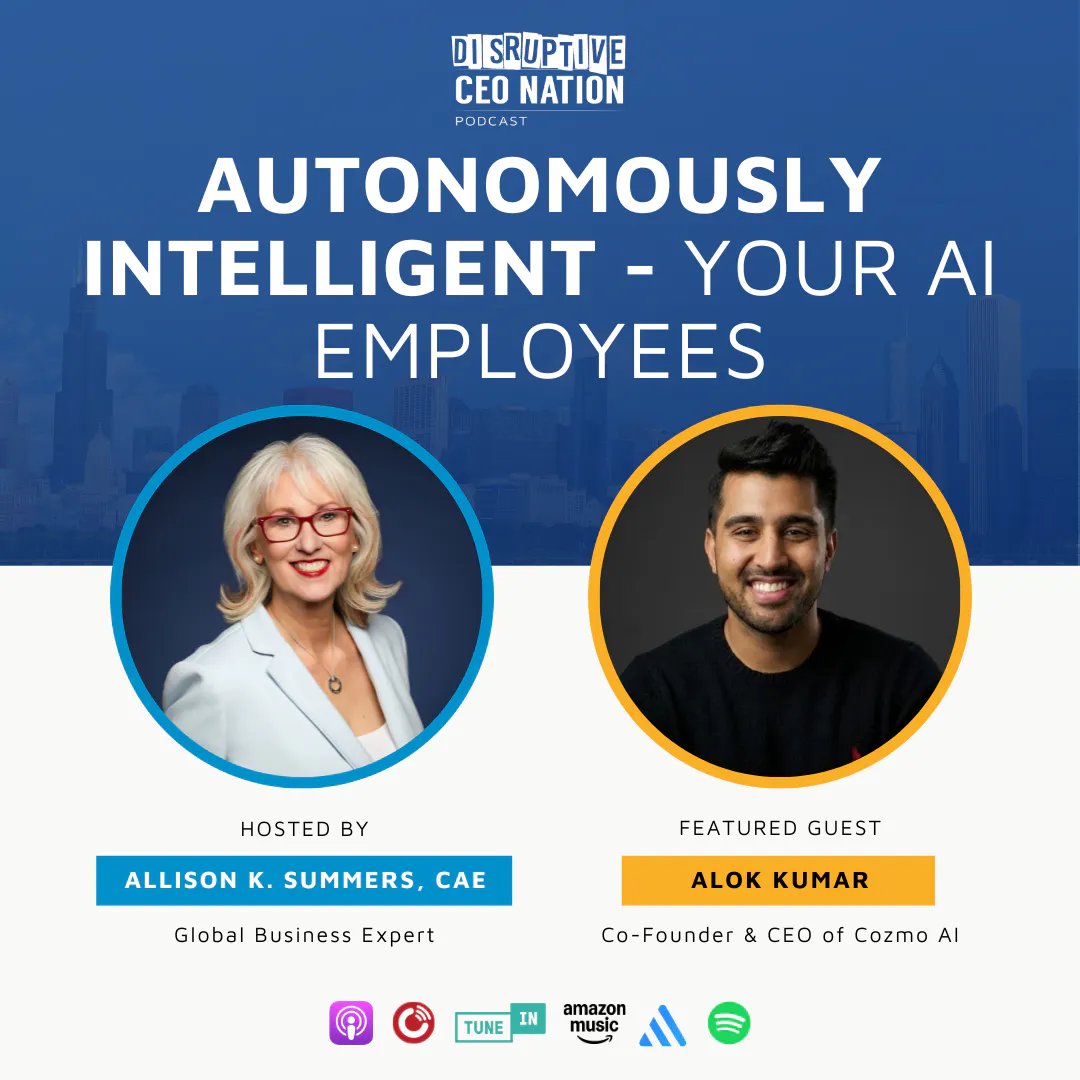
Ep 323 Autonomously Intelligent - Your AI Employees with Alok Kumar, Co-Founder & CEO of Cozmo AI; San Francisco, CA, USA
from Disruptive CEO Nation
31m 41s
In this podcast episode, AK, co-founder and CEO of Cosmo AI, discusses how his company builds an enterprise operating system for regulated industries like banking and insurance. Cosmo AI's multimodal platform allows businesses to create AI agents that can see, speak, text, think, and act—handling tasks like interpreting documents, managing calls in 11 languages, updating CRMs, and providing transparent reasoning through its "A-pension" engine. The company pivoted from a fintech B2C model after an investor wanted to buy their AI call center tool, leading to a focus on enterprise clients. AK highlights key adoption barriers, such as data silos from using multiple point solutions and the difficulty of managing unstructured data. He emphasizes the importance of founder-led sales, cold outreach, events, and referrals, which helped Cosmo AI reach $1 million in revenue quickly. AK credits Y Combinator for instilling a high-urgency DNA and providing invaluable mentorship. He advises founders to carefully choose where to build their businesses, recommending San Francisco for global reach. Ultimately, AK finds joy in shipping technology that elicits "wow" reactions from customers by solving complex problems in minutes.
Welcome to Disruptive CEO Nation, where company founders, entrepreneurs, and cutting-edge thinkers drop in from around the globe to share startup stories, insider insights, and hard earned success lessons. Now here's your host, a woman who mastered business by placing heels on the ground all over the world, having worked with and coached CEOs and senior leaders from over 90 countries and who wants you to build your best business future. Allison K. Summers. Hey everyone, it is so wonderful where I am sitting and I hope it's beautiful where you are as well. We are going to try to give you some new information and knowledge that maybe you don't have and that maybe you need to apply in your business. But we're going to talk about AI and employees and how you can utilize these AI tools to accelerate, build your business, improve customer service, all of these things and not be afraid. So we'll also ask our guests to go through some of the barriers or the things that people are most concerned about. But again, I don't want to tell you about it. I want to get to him so we can tell you about it in his own words. So I want to introduce you to AK who is the co-founder and CEO of Cosmo AI. So AK, welcome to the program. Thank you Allison. It's good to be over here. So in your own words, because you can do it so much better than I can, tell our listeners exactly what Cosmo AI delivers to the world. Sure. So at Cosmo, we are building the enterprise operating system for regulated enterprises primarily. Essentially, we have a multimodal AI which can do four things. So enterprises can come to our platform and build and deploy agents who could see. So they could see and interpret videos, images, documents. They could speak so they could speak in 11 languages, handle both inbound and our bond calls. They can text, they can think, they can do, which means they can update your CRM, what not. And most of the time, Allison for enterprises, all of them are usually non deterministic. So to put the control to chaos, we actually have something called the A-pension, which is the agent for auto call engine, which helps enterprises to actually understand what is going on. Why these policies are happening? Why this output was churned off? So the A-pension really passed our entire system, which has multi-agent system, recursive learning models of sorts. So that's what we do. We are currently launched about Lockstale, live it about 15 plus enterprises, specifically in the banking and financial sales and insurance space. And we work with some Fortune 100 companies. So I love what you got to the website. So I encourage my listeners to go take a look at Cosmo AI, because I think it's a very simple story telling that you do on what the services are and how your clients can utilize the service. So cheers to your marketing team. But really, and you can go and test that AI interface and have that kind of conversation. Like you said, I'm excited to speak to you because the company is fairly new. So let's talk about what was the motivation and why this company and why right now for you. Sure. So we started about a while ago as a fintech initially. And we started building in B2C, fintech or space. While we were building in the B2C fintech space, we built a lot of tools around sales, customer support, collection for, and these were tools which automated dysfunctions at scale. Back in 2024, to September, one of our investors came to us and was like, hey, I have been, I have been calling your call back center. Came across a 20 year old California girl who picked up my phone and answered my question like three minutes. I'm sure you and your co-founder know how to have a California accent. Neither do your engineers who was that. I was like, that's a watery bird. It's like, can I buy it from you guys? I was like, would it pay for it? It's like, yeah, I'll pay you like two, three grand a month for it. And we were barely making two, three grand a month without fintech at that point. So we had something together, sold to him in less than two weeks. And from then to like until March 2025, we went on this journey to understand what enterprises really care about and how to approach the solution. And that's when we realized, hey, enterprises doesn't care. It's AI or not AI. What they care about is does the solution make more money for them or does it reduce cost? And then we also realized that enterprises don't care about point solutions. They care something which works across the system. Right now, most AI and financial services look like a bunch of robots that took their tape to forms. What we do is more like an operating system for them. So they can handle calls, they can handle videos, they can handle images, documents. And so on, just a pile of scripts, it's more about a system working together intact. That's what we, that was a key insight that we had and then we launched that round May 2025. And it has been journey. Yeah, I want you to add Xfinity to next, your next client on your list. No, because I think we, we've moved through the age of chatbots and there are still companies that like particularly I work anchored in nonprofit, right? And we don't even have chatbots across a lot of large nonprofits. And now we're talking about building, you know, custom AI agents to go on our websites. And your steps beyond that, you know, you have what really feels like a comfortable human like interface. But let's talk about that. What are, what are some of the barriers of the concerns to adoption that you hear when people want to shy away from using technology that you offer? So we were in Vegas in December for the AWS conference. We were speaking with the like the city of Aliens insurance. And we were select a low call today we use about 19 tools as an AI application layer and one of our biggest challenges across this is two things. Do you say 19 tools for their AI layers? Yes. Okay. We're using 19 different point solutions. One of the biggest challenges was, hey, how does data communicate with each other? How do you actually make sure once the data communicates with each other, you have an ROI that across your business unit as a whole not as a point unit. In this space, it's one of the biggest modes is how can you make sure that you build a solution which can have a good access to the data of this enterprises. Most of the time the data is unstructured. So you want a structured data access a good data mode is like a castle with a good mode which is deep specific and it's very, very boring to recreate. You can't really just copy five years of messy label conversation in a regulated environment just by having a larger team or having a larger hands on ground. It really takes a lot of effort. So a good data mode is what I would suggest. But to have that data mode, you want to make sure that you have a unified layer of operation or operating system of sort. In fact, if you look at most software which have matured databases, CRMs, all of them as they understand the point solutions, but then they matured into something bigger, something copied, something more like an operating system. I believe that's going to happen in this space very soon. And that's what we are trying to build for which is multi model AI for FSI's super vertical integrated, integrated DB's integrated to carriers, what nots. So that the data mode retains plus enterprises don't have to go for 10 different vendors to actually get a work done. They can go to one platform, build and deploy AI agents at scale who can work with a humans. >> Yeah, I love that. And I think it is a very telling story about how as we keep adopting new technology, it gets very complex and you need partners that can really help walk you through it because anybody will sell you anything, right? Like we know this. Let's talk just a little bit about your background. I'm talking to you today and you happen to be sitting in Dubai. The company is based in San Francisco, but just let our listeners know a little bit about your history before Cosmo AI. >> Sure. So Cosmos HQ that has that. So me and my co-founder know how we were both born and raised in South Raeview and grew up a lot of our life in Dubai and Middle East. We started as a FinTech in 2023, 2022. We pivoted into Cosmo in early 2025. When we pivoted to Cosmo, we realized, listen, the solution needs to be built in the epicenter of everything, which is in San Francisco. So we took a one-way flight ticket to SF round mid-2025. We have been there over the course of the year. We do have clients in the US as well as in Middle East at this point, but both for the base there.
both of us are technical founders. So I lost my mom at age of eight. I used to love gaming and coding a lot. Graduated as an engineer worked two years in management consulting, realized consulting is a bunch of slides would zero impact and then the COVID hit. So I wanted to build something on know how was the post-signal PhD in the US at that point. I took about six months to convince her to drop off her PhD and move to Middle East to build a FinTech. But now it's funny that I'm so identical that she went back to US and now we both are based in US and they're doing all that. Yeah, let's talk about your co-founder and how you compliment each other and what he does versus what you do. So Noah is our engineering genius, she and she is. So when I was in uni at infreshman year, what we were not able to solve for like about three to four months in a student hacking competition, she came in and she was able to solve it in less than three three to four days. It was a bunch of students in freshman undergrad with a couple of students of PhD. She was the only one who was able to solve that in our team and my professor was like at that point, if you have a chance to work for free, just take it. So that stuck in my mind for a long time. So after school, we went in our own ways. But when COVID hit, I was like, you know what, I want to build with somebody who I could really trust and who I really respect from engineering and product perspective. So the first person who's named stuck in my mind was Noah and I called her up, Noah was like, listen, I really don't want to drop out of my PhD but I do not know why I'm doing whatever PhD. So why not, I'll just figure it out. So for the first six months, she was actually doing her PhD and at the same time building with me. And then she was like, you know what, it's pretty cool. I'm really enjoying it. At that point, she decided to drop off. She's right now handling all things engineering product. She's the one who's leading our engineering team of about eight people based between the San Francisco and the San Francisco. And she has been like kicking it since then. Okay, so let's talk about why a coordinator and and what the value is of the support network that you get through being a part of why a coordinator. So why is it for us? It was a game changer. A lot of folks come and ask me, hey, what do you think about YC? I tell you, you get into YC not just for the capital. You go in for the network, you go in for the mentorship. What you could accomplish in YC in three months is like what the people start up so they probably year to accomplish because they give you an environment with a lot of competitive people, really smart people coming and hustling together and having together things and giving you milestones which are super hard to reach. It builds at DNA and you were, hey, you need to learn how to shift fast. Hey, you need to learn how to talk to users better. You look at peers who are amazing individuals in a highly talented environment and you're like, oh my god, if I don't run along with them, I'm just going to be far away. And this kind of form helps you to build a company which is like super fast and then you can translate that into your team. So the high sense of urgency, the high sense of agency second to none, that's something YC teaches you in the advanced program. Plus the network of mentors which comes with it, like we had some group partners who were amazing, who built billions and billions of dollars of business themselves. So you already have like battle tested advises rather than generally advises which you get on their own on the bottles. Yeah, I just want to punctuate that what you said because I really love the phrase that it builds your DNA and you know, it really instills in that on the flip side. You know, this is, you've been a founder before you have been an entrepreneur. What's the advice that you give? What were some of the hard lessons that maybe you learned along the way that you would tell people you got to watch out for this? About YC? Yeah. Why is it kind of hard goods? A couple of things to use like they're the saying right like make something people want. They make sure that you really do make something people want. They even hard call about talking to users every week and the last thing is don't die which means spend little until you figure it out. Everything else like valuation, high PR is more of a phenotype, that ain't gene or type. So essentially YC just engage with severe genes from day zero. That's how I see the YC experience us. Please YC, we were just promising call. YC was more like a really, really, really it was a high-intid slab right that turns that road into something like functioning. You can see that in action and it's it's the energy is crazy that second and none I tell people that if you don't get into YC just reapply until you get into YC rather than getting anywhere else. Okay, I have to ask you know launches, launches everything. What were some of the marketing strategies, the go-to-market strategies in terms of promotion or the way you decided to approach those and secure those first clients? Give us a little insight into what it was looking like for you when you went into launch mode. So that's a good one right? So we do founder let's sales. We went from zero to a million dollars in revenue in kind of like in stealth mode in the first like four months to five months of launch. It was primarily driven by us cold reaching to people, figuring it out, going to events, going to networking, doing whatever it takes to get a customer to say yes and client product. Usually with enterprises, cold emails, cold calls, don't work, you need to be in front of them and show them the value. Usually partners, networking events, conferences, what nots. That's how we were driving our initial first four or five customers. Once we got out first four or five customers and we delivered a really good value, we go up to them shamelessly and be like, hey, who are the next two or three enterprises you could each offer? And that's how we compounded to our first 15 customers. Right now that strategy is working and now we are on boarding more system integrators, partners who can actually help us scale faster. I cried my hands with hiding a couple of like direct sales contractors, what nots. I believe that in the early stage, it's very important to have a founder let sales because every week, until you hit a couple of million ARO, you're learning a lot from customers by being in the sales pitch, by trying to pivot even your sales pitch of what works. What was what nots. Usually if it's a non-founder who starts doing it, they do not have that sense of agency which a founder would have to actually understand what a customer wants and have that real dynamic between the customers, between the engineering, between the product. So in terms of GTM founder, let's sales with going to events and conferences have worked a lot for us. And we can be not only in the US, in other parts of the world including euro and Middle East and African. Hey, I like to ask what brings you joy in your day? Oh, shipping something which makes people go say wow, like I really get excited when people are like wow, like when people go and say oh, this used to take us like seven, nine days and you can do it in what, three minutes, four minutes. People go wow and then that bow happens for me. That's a real joy of like really shipping something and it's impactful. When I was building the Fintech, what used to really frustrate me was it was more about regulatory innovations than technology innovations. And it used to drive me nuts, right? I felt like I was in the store. Me and my co-founder know how we were like listen, people have only built this feature. We were just playing with variations of it. There's nothing great about a technology. We are just packaging some different layers. But in the age of AI and in the age of multi model AI, there's no windows in the market. It's a fair game. And the fact that we are one of the four runners to actually build something and we're pushing it out and enterprises are seeing for the first time and they go wow, the satisfaction of second to none. And the mere joy of building and shipping and seeing real value being created, it's extraordinary. I love that. Hey, is there anything that we love to get tips from our guests? Is there anything that you're reading, watching, listening to, following that you would say to our listeners, hey, check this out. So that's a good one. One of my investors, he told us me know how something back in early 20, 25 and we decided to do it. He was like hello, come, when you're building an AI, it's like you have a ladder. Most of the founders have ladders of similar length. Just be careful of the tree you put up against. Essentially, he was pushing us to go to SFM building.
in the US rather than building anywhere in the world. And that actually opened up and like we went over there, we started building over there and as a friend we were like, oh wow, it opened like it was a calf once, right? It made us go into different rabbit holes, like I figured out a lot of things and I would tell to fellow founders, like does advice from our investors, like just be careful after a tree, you put your ladder against, you don't want to optimize for your local maximum, you want to make sure that if you're putting 10 to a loss of work a day, seven days a week, you want to be in a place where you optimize for a global maximum and that's something which you probably want to think about a lot. And it actually changed a lot of things which I think they lend the out. Now let's go back to the core product for Cosmo AI and let's just, I'd like to just dig into that as we start to wind down. One of the specialties as you shared is the ability of a live voice, use the word live very liberally here, but an interactive voice to answer all of your questions. So just go again if I come to you with my business for the first time and say, I know I need to do this. This is, like you said, it's enterprise, it's to scale, it's to do. What are kind of my options to make sure that this AI that will be interacting with my customers is intelligent and life like and knows when to not hallucinate, not pass along that information, but then move me as a customer someplace. So can you just go and explain that a little bit again for our listeners? Sure. So essentially what we have enterprises with both things, they can come build and deploy AI agents who could see, who could speak, who could think and who could do. Most of the time they're speaking, they're seeing, they're thinking and doing is more human-like. So for example, if you add an enterprise, let's say in an insurance space, right? And you get a call from one of your customers in moderating insurance and be like, hey, I had a car accident and I just want to reclaim for this, right? So during that call, you have literally a human-like AI employee who's going to pick up the phone and respond to your customer in a natural language without 95% of the times. Customers don't realize they're speaking to AI. It can go ahead fetch information about a customer, talk to them about the policies, validate the customer, what nots. The customer can send a cancorder file about, hey, this is how the accident happened and it can actually see through the video interpret who was at fault, what is how many minds per hour the car was traveling at. And then it could send a customer payment link, it could go and it could actually go to the policies and educate the customer on what he saw her rights, what nots. So the entire process which used to take like five to seven days back and forth can be handled in a few minutes to an hour and get a closure. The entire, during that conversation, we have something called the APE Engine, the Agent Protocol Engine. So one of the biggest challenges with running multiple agents at the same time, multi-model is context engineering. A lot of times because of this, the context becomes very clunky, chunky and a lot really, really bad and that can affect the experience. So we tune into something called recursive learning models. So essentially our APE Engine is built on top of recursive learning models, which actually helps to have better context engineer. We actually frame it on company based data. So UNAI employee who is very different from another AI employee because it's trained on your last six months, six years of data, or it's trained on the best industry practices. It can actually think on the spot and actually formulate some policies of variations of it. And then it has an agent model which actually judges during real time of a call. Hey, this one you thought and probably a new information you created has a 90% accuracy because of ABC checks. So these are the real time things which run. So during a typical call, probably 12 agents will be joining the same call and doing all these discussions while the customers feel like they're talking to a human at the same time. So the APE is what really powers and is the secret source to us, which is more multi-model RL and RL and RL architecture. Okay, so I have to ask the question and just get your wisdom and crafting a response and that is, you know, wherever we turn in the media like as a business leader, these things are essential, right? Our ability to respond to our customers faster, to at least get them started, at least get it moving. To to others, they look at this and go, this is just going to be more jobs lost. This is going to take things away from people. Okay, what is your kind of response or a wisdom response when you kind of hear those types of things because a company like yours is is a little bit in I think the crosshairs for some of these conversations. But again, as as business builders and business leaders, we all know we need to leap to the future. So that's a good one, right, Alison? We have an insurance blockage case in points, right? We have an insurance blockage who had a really successful B2C arm and they did not have a established B2VR. They started deploying our platform to build agents to coal coal and reach out to what we call zombie contacts. So they got more than like a possible zombie contacts from the industry in the B2B space. In less than a month, they ended up hiring about three human agents to just handle the sheer volume of qualified leads which came in and to convert them into actual aspects and paying the customers. There was a point in time, service went down for like three or four days and this the founder of this company was like a personal look. I have four humans on my payroll waiting for the AI to be like super active and actually working. I wanted to be back up and get expanding our B2B arm. So essentially what's happening Alison is a lot of redundant manual work is being done by AI at scale right now and new jobs are being created and we see that in real life rather than AI taking away jobs even in the human with our bank clients, right? We would have bank clients like Lost Creek who like deployed our solution and they're one of Lost Banks in the country. They're like it used to take us about seven, 10 days to process this SMA loans and what nots on the platform. The earlier platforms they use right now we're going down to one or two days and the reason why it's still one or two days is still there. Some human in the loop was actually being between the checker and maker whether AI gives it to you. Human just checks and says okay all is good. They're like this is amazing. In fact now the humans are more productive to actually invest into customers and invest in relationship building rather than going through lengths of document telling the customer oh after two days you missed this document. At document right now they upload a drop portal and they get an immediate response and the relationship manager can go down. So net net Alison on the ground the ground reality is new jobs are being created, next things jobs are being more productive. Humans are like becoming really really invested into customers and all the polling tasks about a job is what can be automated and that's what we believe a lot of our platform is being used. In fact that's where I personally tell to our buyers usually see you and see you post. It's not a software budget, it's a human budget. So instead of hiring let's say five to ten mediocre people you could just hire our platform. The media course work could be actually taken care of while great people and like good productivity hacks can be unlocked without platforms. Yeah I love I love that and I again I I appreciate hearing it from your perspective and your words I think I always you know redeployment and I think about even within my own organization. You know there are a lot of tasks that slow people down and it keeps us from developing new it keeps us from growing and launching out and also letting the people that work for me do things and have activities that stir their souls more. You know nobody wants you know death by paperwork. It's terrible it's a terrible thing. So thank you for that. Hey, Aki we're going to wrap up but what can we look for? What are your aspirations and desires when if I were to talk to you 12 months from now and say what's bringing joy on your face today? Where do you see the next year taking you all? Well I think 20 minutes of it's going to be an amazing year. The models have become really really well. The markets are really really mature. People are no more into the POC stage. The solutions which can deliver real value. I think it's the best time to build and if you're a builder like it's like it gives you a lot of accuracy to actually build in the zero where if you know how to code a do like Office 4.5 could be a good city or do you and can help you develop your own.
code really fast. So super excited for this here to build something great, drive value and make something people want. And that's what we're looking for. Fantastic. Hey, if people want to learn more and do more or just find out more about how to connect with you, where should they go and what should they do? My DM is always open on LinkedIn Twitter, even if you reach out to the website, it just locks into my calendar. So happy to always reach out to anybody, like talk to anybody who wants to reach out. Thank you so much. Hey, if you heard something from AK that you want to learn more about, or if you want to look at Cosmo AI, I know that he would absolutely love to hear from you. Pass along a copy of this episode to somebody else who might need to be introduced to this company. And until we speak again, keep your eye on the future and always be disruptive. Thank you, AK. I think I'm heck yeah, listen. This episode, yeah, we made it. The voice you just heard, we helped put them there. And right now, someone's out there thinking, I should have my own podcast. You should, not because it's trendy, not because content is king, but because your voice has weight, your ideas have gravity. And the right people, they're waiting to hear you. We build shows that don't just sound good. They work for your brand, your business, your audience, ready to step up to the mic to see if you could grow your business with a podcast, apply at your drain 50 dot com slash Seth dash green gr e e n e because your story deserves more than just a years.
Podcast Summary
Key Points:
Cosmo AI provides an enterprise operating system for regulated industries, using multimodal AI that can see, speak, text, think, and act.
The company pivoted from a fintech B2C focus after an investor wanted to purchase their AI call center tool, leading to a focus on enterprise solutions that increase revenue or reduce costs.
Key barriers to AI adoption include data fragmentation across multiple point solutions, unstructured data challenges, and the need for a unified operating system.
Founder-led sales, cold outreach, events, and referrals drove Cosmo AI from zero to $1 million in revenue in four to five months.
Y Combinator (YC) provided crucial mentorship, network, and a high-urgency environment that accelerated the company's growth.
The co-founders are technical; Noah leads engineering and product, while AK handles business strategy, and both emphasize building in San Francisco for global maximum impact.
Summary:
In this podcast episode, AK, co-founder and CEO of Cosmo AI, discusses how his company builds an enterprise operating system for regulated industries like banking and insurance. Cosmo AI's multimodal platform allows businesses to create AI agents that can see, speak, text, think, and act—handling tasks like interpreting documents, managing calls in 11 languages, updating CRMs, and providing transparent reasoning through its "A-pension" engine. The company pivoted from a fintech B2C model after an investor wanted to buy their AI call center tool, leading to a focus on enterprise clients.
AK highlights key adoption barriers, such as data silos from using multiple point solutions and the difficulty of managing unstructured data. He emphasizes the importance of founder-led sales, cold outreach, events, and referrals, which helped Cosmo AI reach $1 million in revenue quickly. AK credits Y Combinator for instilling a high-urgency DNA and providing invaluable mentorship.
He advises founders to carefully choose where to build their businesses, recommending San Francisco for global reach. Ultimately, AK finds joy in shipping technology that elicits "wow" reactions from customers by solving complex problems in minutes.
FAQs
Cosmo AI builds an enterprise operating system for regulated enterprises like banking and insurance. It offers a multimodal AI that can see, speak, think, and do tasks such as updating CRMs and handling calls.
It helps enterprises save costs and make money by providing a unified platform to build and deploy AI agents. These agents can handle calls, videos, images, and documents, replacing multiple point solutions.
The founders started as a fintech and pivoted after an investor wanted to buy their AI call agent. They realized enterprises care about solutions that increase revenue or reduce costs, not just AI itself.
Enterprises often struggle with data communication across multiple AI tools and accessing unstructured data. Cosmo AI addresses this by offering a unified operating system that integrates data and provides ROI across business units.
Both founders are technical and met in university. AK, the CEO, has a background in engineering and management consulting, while Noah, the co-founder, is an engineering genius who leads the product and engineering team.
The founders used founder-led sales, cold outreach, events, and networking to secure initial clients. After delivering value, they asked for referrals, growing from 4 to 15 customers in stealth mode.
Chat with AI
Loading...
Pro features
Go deeper with this episode
Unlock creator-grade tools that turn any transcript into show notes and subtitle files.
 PodcastTranscript AI