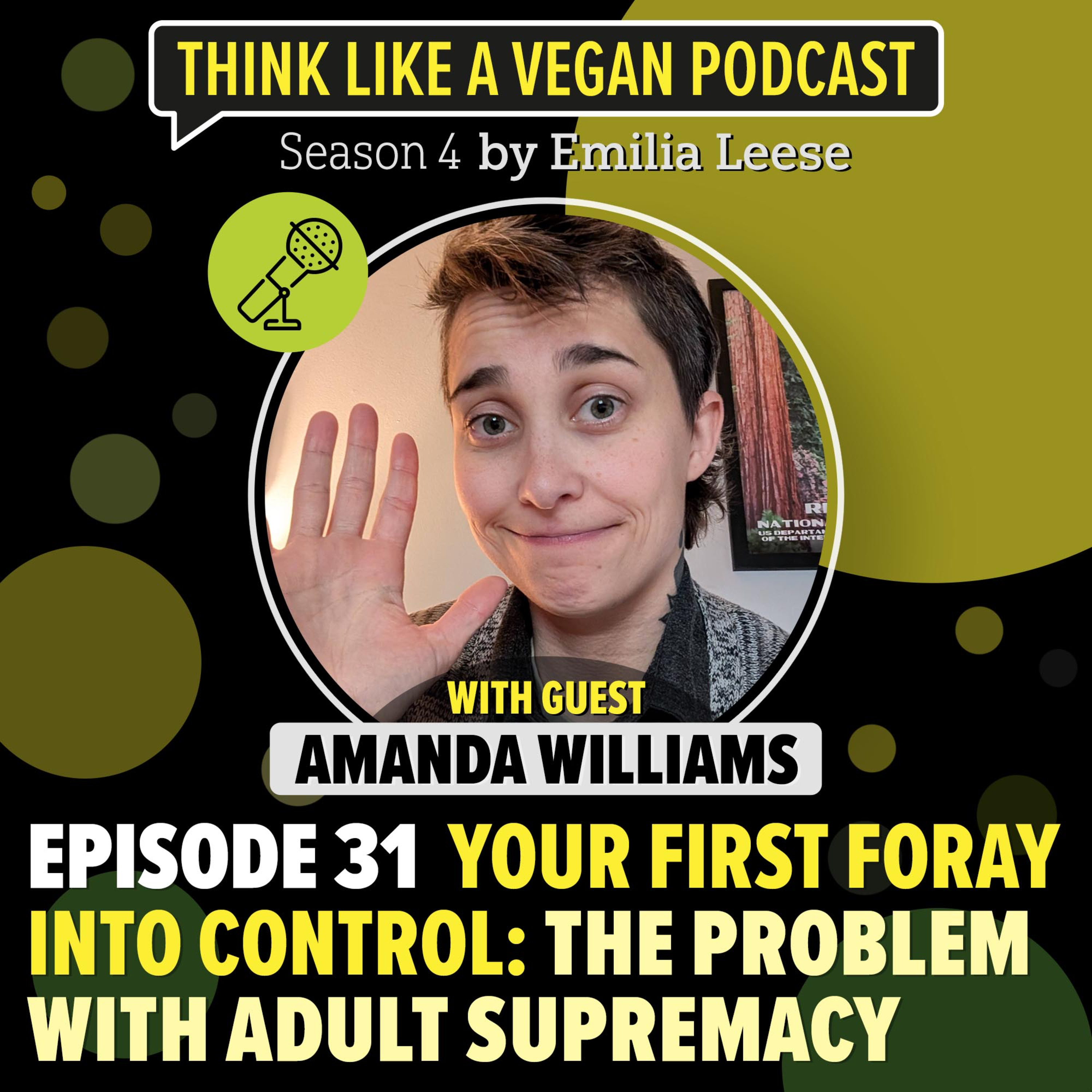
This is another I-roll podcast. [Screams] [Music] Hello, I'm Amelia Lies and welcome to season four of Think Like a Vegan, a companion podcast to my book entitled Think Like a Vegan, which is also available in paperback and audiobook. As is customary on this podcast, I like to look at questions and topics which may seem tangential to veganism, but then they turn out to be pretty relevant. My guest is Amanda Williams, a writer whose work on adult supremacy completely reframed how I see power dynamics in our society. I first found them in a collection called Exploring Topics in Non-Human Coexistence, and then devoured their substack where they argue that controlling children is our first training ground for controlling others. This idea resonated deeply with me, especially after following also Agni Hagabooms' journey of dismantling adult supremacy through unschooling. And for the skeptics, a quick spoiler. Agni's kids are now thriving, independent adults, they're in university and they're happy. I highly recommend their work as well, and the link is in the show notes. Now, who is Amanda Williams? They're a queer, disabled scholar and activist, wholly dedicated to the idea of total liberation. They wear a lot of hats. They're the CEO of the Institute for Critical Animal Studies, where they connect the dots between all struggles against oppression. But they don't just live in the world of theory. Right now, Amanda is on the front lines of a local campaign to free a capuchin monkey named Frankie. This monkey has been trapped in a tiny pet store cage for nearly two decades. I'll have a link in the show notes so you can see how to help. This relentless on the ground action is who Amanda is? They embody a radical refusal to accept the status quo. And that brings us to their powerful new book. What can I do? A guide to challenging your social privilege and taking action to change the world. Which does exactly what it says on the tin. This isn't just a book to read. It's a practical toolkit to turn that feeling of being stuck and overwhelmed into direct and effective action. Hi, Amanda. Thank you so much for joining me today. I really appreciate it. Thank you for having me. And the floor is yours. So I contributed a chapter on Liberty privilege as it relates to species privilege in the recently released book exploring topics in non human coexistence. A lot of my writing thus far has been on social privilege. I wrote two books about it, the overprivileged human and what can I do? Since species privilege has already been explored on the show, I wanted to take this opportunity to discuss a different but deeply related concept, something I'm currently fleshing out in another piece of writing. This one is more personal. Recently, I moved in with my partner who has two elementary age children. Living with and regularly interacting with children is completely new to me. I am in a very real way apparent now. A role I never expected for myself. Parenting has me constantly thinking about power dynamics in my personal life more than usual. How do I give children the freedom, respect and equal footing they deserve while also holding responsibility for their physical intellectual and moral development? It's an ongoing challenge. I find myself questioning how to navigate a system that is structured around control, one that relies on rewards and punishments to shape behavior, often at the expense of autonomy and genuine self discovery. It's an odd position to be in as an anti-hierarchy parent. I observe not only my own children, but others as well, seeing how they are constantly directed, limited and given little space to simply be themselves. Children are not treated as equals. They are often regarded more as pre-humans, objects to be shaped, controlled and rewarded for compliance rather than as full beings nurtured by kindness and compassion. This experience has led me to think deeply about the role of adult supremacy in shaping our society and its various systems of oppression. I now see more clearly than ever how similar the oppression of children is to the oppression of other beings with different bodies and capacities. And yet, I don't see enough people writing about this. Adult supremacy is a foundational issue, one that not enough activism directly addresses. Even though children are quite literally the ones who will create the world in shape its future relationships. And if we want those relationships to be less oppressive than they are now, we have to pay attention to the kids. Today, I want to explore this topic, the first and most pervasive system of domination, adult supremacy, and how it lays the groundwork for hierarchies of power that extend far beyond childhood. Imagine a world where your choice is, your autonomy, your variability to express yourself, were constantly controlled by an external force. A world where you were told when to eat, when to sleep, how to move your body, when to speak, and when to be silent. A world where others assumed they had the right to override your preferences, simply because they were bigger, older, stronger, or new more about taxes. Now, recognize this isn't some dystopian fantasy, it's the lived reality of children in our society. We don't often talk about childhood as a sight of oppression, but I argue that adult supremacy is the foundational structure that gives rise to many forms of hierarchy we recognize today. It is the first cage, and from it we learn how to accept and perpetuate other forms of oppression, including ableism and speciesism, two oppressions I'm directly addressing in my writing. The way we treat human children mirrors the way we treat disabled individuals and other animals. It is a system that grooms us to accept hierarchy, control, and domination as the natural order of things. Adult supremacy is the assumption that adults are inherently superior to children and therefore have the right to control and dictate their lives. This isn't just about parents making decisions for their kids, it's about a deeply ingrained societal structure that devalues children's voices, dismisses their agency, and normalizes coercion under the guise of care. From the moment they are born, children are subject to systems of control that deny them full personhood. Their emotions are trivialized, people say you'll understand when you're older. Their boundaries are ignored, for example, family instructs them to give your uncle a hug. Their autonomy is undermined, parents will demand eat everything on your plate. These messages are not neutral, they train children to accept powerlessness as normal. They teach children that their bodies and choices are not their own, that compliance is more important than consent, that questioning authority leads to punishment. We'll pause for a soundscape interlude after which we'll return with more from Amanda Williams. This is Mushi by longtime collaborator with my podcast, Matthew Gerstemberger. [Music] (upbeat music)
We're back for the second part of Amanda Williams' discussion about society's conditioning of children. These patterns of control and infantilization don't disappear in adulthood. They expand. One of the most direct extensions of adult supremacy is ableism. The way society treats disabled people often mirrors the way we treat children, as people who need to be managed, controlled, and spoken for rather than listened to. Disabled individuals, particularly those with intellectual or developmental disabilities, are frequently infantilized. They are spoken to in condescending tones. Their autonomy is restricted. And their choices are overridden by caregivers, institutions, or medical authorities. They are denied access to spaces, resources, and decision-making power, not because of any inherent inability, but because society deems them incapable. The echoes of childhood oppression are clear. We know what's best for you. You need to follow the rules. You aren't capable of making your own decisions. These phrases could be directed at a five-year-old or disabled adult. And in both cases, they serve to uphold systems of control that dehumanize and disempower. B.C.'sism, too, is rooted in the same logic. Just as children's autonomy is denied and disabled individuals are stripped of agency, other animals are systematically controlled, dominated, and exploited. Their suffering is trivialized. Their voices ignored. Their resistance punished. Consider the way children naturally relate to animals. Young children often feel a deep connection to more than human beings. They see them as friends, not objects. But society trains children to suppress that connection. They are taught that it's normal to eat animals, that it's acceptable to confine and exploit them, that harming them is justified if it serves human interests. This process mirrors the way children are trained to accept other forms of oppression as they age. A child might feel uneasy about eating a pig, but is told that's just the way it is. They might protest when they see an animal in distress, but are reassured. Don't worry, it doesn't hurt them. These lessons numb empathy, normalized violence, and conditioned children to accept hierarchical power structures. By the time they reach adulthood, many have fully internalized these beliefs, making it difficult to question the systems that rely on their compliance. The good news is that these oppressive structures are not inevitable. They are constructed. And therefore they can be dismantled. The eco-ability framework offers also a way to understand these intersections and work toward a more just world by centering interdependence rather than dominance. Interdependence recognizes that autonomy is not about isolation, but about having the ability to exist in relationships of mutual respect. In an interdependent world, children would be valued as full human beings, not as lesser versions of adults. Disabled people would be recognized as whole and capable on their own terms rather than being forced into able-bodied standards. Animals would be seen as individuals with their own inherent worth rather than as resources to be used. To achieve this shift, we need to start by reimagining our relationships, especially the ones we take for granted, especially the ones in our own homes. This means respecting children's autonomy by listening to their voices and valuing their perspectives on their own terms, challenging ableist narratives that equate dependence within furiority and advocate for society built on accessibility and inclusion. It means recognizing the moral worth of other animals and refusing to participate in their exploitation, and of course realizing and vocalizing how all these things are connected. So, where do we start? We start by listening. We start by challenging the power structures in our own homes, our own communities, our own activism. We start by recognizing that adult supremacy is not a natural order. It's a system we've been conditioned to accept. And if we can unlearn it, we can dismantle it. Because the first cage, the cage of childhood oppression, doesn't just imprison children, it builds a blueprint for every cage that follows. And if we truly believe in justice, we must be willing to break them all. I loved this concept about adult supremacy. It really reframed things for me in a way I really hadn't considered. And hearing it further fleshed out, I find it once again so compelling. How do people respond to this idea? People in your community, at the school, where did the kids go? How does it come up? It's really difficult. We live in a society where it is incredibly normalized and encouraged to do, especially reward and punishment relationships with children. And I was so heavily influenced by the writing of Alfie Cohn in his book, Unconditional Parenting, even before I was a parent, this was something that I was interested in. But to accept that rewards and punishments for whatever reason, even if they are in service of achieving, quote unquote, good behavior, our form of manipulation. And are they really achieving the ends we're hoping to achieve? We want to create good people that have intrinsic desire to be good and to be kind in the world, not be kind for a reward or not be kind because they might be punished if they're not, the reward and punishment system works in the short term. But our long term moral development is kind of what I'm trying to get at here and bringing that up, especially with other parents, is really sensitive. Whenever there's any kind of critique or any kind of questioning of normative values and especially around parenting, it's like, oh, so you think I'm a bad parent then. And how do you walk around that kind of wall that's always, you know, everybody's on the defensive for it because everybody feels kind of an insecurity about the way they relate to children and am I doing a good job or my children good people? Like everybody wants that, but they also don't want to hear like critiques about how to maybe actualize it at a deep intrinsic level. And I'm interested because I don't know, we've been doing kind of a similar, like if we take a zoom out look of our relationships with children. We've been doing this, you know, we've been doing this adult supremacy for quite some time now. It's not always existed in quite the form it does now. But is it making our society a more compassionate one? I think there's a pretty good argument against that just because if we're looking at numbers, there are more oppressed people. There is more violence levied against living beings right now by the numbers than at any time in history, right? You know, even though there's a large movement for not eating animals, for example, or for progressive social causes. At the same time, we kill more animals right now than at any other time in history. These are society becoming more compassionate. I think that we have to examine what might be at the heart of that. What might be at the heart of that is what I'm saying. Right now, I want to argue that at the heart of it is our relationships with children because they will either decide to perpetuate injustice or not. And have we trained them to do that or are we training them to reproduce the injustices that already exist today? And I'm really interested in that. I think it's a really sensitive topic to talk to other people about. And yeah, it's, I can imagine it gets people extremely defensive. But just like when you're talking about veganism, just like when you're talking about any kind of idea where you are questioning how, quote unquote, we've always done things. Because you're changing, you're really you're challenging.
how we imagine society and how we actualize society and what you're proposing is actually imagining society differently, which puts everything at play. Everything can be questioned and it doesn't have to be this way. And I think it's also interesting, some of the things that you were saying also remind me of Manisha Deca's work and in the various types of beingness. We just have this one idea of what a person is, what an object is, what property is, and what in all of these things, they're very sort of categories that we believe are immutable and everything has to fit into that. So we have to fit children into that, we have to fit animals into that, and even ourselves. So that society is made up for a non-existent ideal, really. And I agree with you. I think that it hasn't led us to particularly improved justice and fairness and compassion certainly. It hasn't led us there. So I think it's really important to imagine different ways of being and to allow people and animals and everything to be whatever it's meant to be. And you know, the other thing I really like, the idea of the first cage, and I think that's a really powerful image that you've come up with. Did you feel that sort of inherently, that you, when you came up with that term, was that sort of something that you felt deeply, almost as if you recognized it yourself? Yeah, I guess so the image of the first cage is actually like an image that I, you know when you're kind of like doing a brain dump, I was trying to think of a title for a piece, I was originally going to submit to a different book, but I had some personal barriers at the time and I couldn't finish it. So I had this unfinished piece about adult supremacy and its connection to speciesism and I'm like, what do I title this thing and you know, just doing a brain storm on that and that's kind of where I came up with idea, idea of the first cage. I was also reading the ethics of captivity at the time. And so that book was really shaping my thinking or you know, everything in my brain was just about this idea of control and captivity and so it's kind of where that image came from. I think Lori grew and deserved some credit as well to put a cage right on the front of her book. Yeah, do I feel it as the first cage personally? Absolutely. When I like to think back to when I was a kid and how I felt about that time in my life and you know, I'm an autistic person. I was a little bit different as a child than others, but I remember you know wanting to move my body in ways that I wasn't allowed to when I was in school for example or you know, follow my passions, my hyper focuses in my learning. My way of existing was annoying to the adults around me and often I was often just seen as a nuisance, you know, somebody who you know needed to be shaped, somebody who needed to be punished for the way they wanted to be in the world and you know, compliance was number one. It's like, are you're a good kid if you're an obedient kid? You're a good kid if you listen to your teachers, you're a good kid if you sit down and be quiet and don't move. So that, you know, that feels like a cage in its own right, you know, when you're a kid, it feels very oppressive and I don't think that adults are always intentionally thinking, hey, I'm exerting this kind of authoritarian relationship with children, what message is that sending to them? It's not conscious when we're in, I watch adults all the time interacting with kids and like they have the best of intentions and they have love and they have care and they have all that but these kind of behaviors of control, I guess, of trying to shape children into something that maybe isn't what they want or dismissing them for whatever reason. You know, there is a lot to be said and certainly early anarchist thinkers wrote a lot about the relationships between adults and children and there's a lot to be said about, you know, being an authority and having authority over someone. I don't always think that distinction is thought about when it comes to parenting. Just one more question and it relates to what you just said about people don't recognize, adults themselves don't recognize that that's what they're doing because we have all sorts of the best intentions and all of that. And in some ways, they too are in a cage that's set up. So they're responding in the way they too have been trained and thinking that that's the way to be. I mean, in some ways, that's really also when, and also as you said, you know, when we engage in consuming animal products, it's the same thing. We believe that's what we have to do because it's always been done that way. So these are all cages of our own making, if that makes sense. And the question is how do the kids like it? Do they recognize it or they don't recognize it? And do they use it in their own ways? Like what's the experience like? Yeah, I think they do recognize it. One of the most common phrases in our household is everyone has different bodies in different minds. And you know, that extends to human animals and other animals. My, we're working on a fully vegan household right now because that's not the experience that the children had in their, in the first part of their life, but they do understand that there are, there are parallels between the ways that we treat children and the ways that we treat animals. And I try to make those explicit, you know, we, we have all other disabled people in our family as well. They, they do understand that just because someone has a different body or a different experience in the world has a different intellectual capacity, whatever that means, that the treatment doesn't need to be unjust because of that. In their own way, I think they do understand that it, it's hard because they are young. But you know, they come home and they say, I have an awful day at school. My teacher wouldn't let me talk to my friend even though we were just working on a project or it was really hard to sit for eight hours in a chair today and I really wanted to get up and walk around but my teacher yelled at me or it really sucks that I have to ask to use the bathroom even though that's a normal human necessity, you know, we all have. It's just like things like that they express frustration with, particularly in the school system is that is most of their world and they do see when they interact with other adults, it is a little bit different than when they interact with myself or my partner. But you know, we still struggle with the cage as well. It's difficult. I mean.
It's hard when we can't always say yes to 100% of the things kids want to do. Sometimes they're dangerous or sometimes they're unhealthy, whatever. Or sometimes they're just against the values that we have stated in the household. But taking a time to talk to kids and listen to them and when they're mad about something, believe them and engage with them and not just dismiss them outright. Even the things that they get mad about are trivial and annoying and don't make any sense. But that's the experience of childhood. If you can engage with them at their own level and just treat them with the respect that you would treat your adult friends, your adult family members, treat them with the same respect and the same sincerity that you would. The experience of being othered is something that children adopt immediately because the world was not built for them. You go places in your community and children are seen as a burden, as annoying, as too loud. They can't be in this restaurant. They can't do this at this place. They can't run around here. They're too loud. They're too wily, whatever. The world is not built with them in mind. In the same way, the world is not built for disabled people and the world is not built for other animals to coexist. It's not inclusive in that way. Children understand that. But having a world like that, conditions them to expect a world like that. And treating them as lesser conditions them to expect that treatment and then when they become adults to perpetuate that treatment themselves. I think that's the biggest thing I want to communicate in my writing and just to other people is that if we think of children and we treat them as lesser, they are one going to expect that treatment. We don't want that. We want curious thinkers. We want advocates for kindness and compassion. We don't want this kind of apathetic attitude toward hierarchy all the time. And two, we want to stop the progression of relationships of domination and control. And if it's normalized for children, that's what they're going to do in their adults. And if we stop doing that now, we can create an entirely different world. The potential is really limitless. We have no idea. But we've just been stuck. They're in a cage. We're in a cage. It's really hard to get out of once you're in it. We all know how hard it is to change the behaviors and the psychology of adults. They're there. It's almost impossible. So I really, really want to emphasize the importance of addressing the issue of relationships between adults and children. Even if you're a leftist, you're an activist, you're a vegan in your own home. What does that look like? How is the relationships you're having with others going to progress as children age as they become the new world order, right? Yeah, I just think it is an ask of self-reflection, which is a tough ask. But it's a good ask. I love this. I think it's really tremendous. Thank you so much. Before we go, where can people follow your work? Do you have any projects you'd like to promote or talk about? Yeah, definitely. Right now, I am fully engaged with a local pressure campaign. There's a Capuchin Monkeys who's been imprisoned in a pet store for two decades now, and we're trying to get him to a sanctuary here in Kansas City, Missouri. So that's called the Free Frankie campaign. And I've been working on that for a year and a half with some local activists. Everybody can help even if you don't live in the Kansas City area. So I know you're going to put some links in your description, but you can also go to Kansas City Action for Animals.org, learn more about Frankie and how you can help. That's first and foremost. I have writing that I do both scholarly work and more kind of popular nonfiction. I have a link tree with all of those. You can check out in the description as well. And I have a substack too that I write short essays, especially as I'm thinking through certain ideas or if I'm wanting to write a larger piece, I like to write a shorter piece first. So a lot of that is on my substack. I do have a little bit of writing about adult children relationships there that I've started exploring as I'm working through my larger piece on it right now. And then there's two books that I want to recommend to everyone that are not about veganism but are directly applicable in the way I'm arguing in that one is called raising our children raising ourselves. Hold on, I need to double check. Yeah, it's by Naomi Aldort. Naomi Aldort. Raising our children, raising ourselves. I think that that book is touching out a lot of the things I'm saying. It doesn't incorporate this other analysis of speciesism or ableism or anything like that, but it does focus on reimagining adult child relationships. And then the other book that I mentioned earlier was so influential to my thinking, "Alufie Cohen's book called Unconditional Parenting." Those two books, I think, are essential reading for everyone, even if you have children or not. If you don't have children, I think it's still important to think about the ways we relate to children at a societal level and then at the everyday level as well. I will definitely make sure I link to everything and everything. We'll be listed out for sure. Well, thank you again. Thank you so much. Yeah, thank you for having me. I appreciate the opportunity and I love this podcast. You know, one of the comments I hear a lot from non-vegans about how to make more vegans is vegans should get into school and speak to young people. Well, yeah, sure. And there's lots of people already doing that. Thanks for the unsolicited advice. Well, that's all annoying. What really gets to me is the implication of this advice, which has always confounded me. It takes me back to being young myself, hearing the same thing from adults. The young people will change the world. Even then, my very literal brain thought, "But what are you doing?" It's a seductive excuse. This belief that agency belongs to a specific age and it's either too soon or too late to exercise it. But it's all a fallacy. As long as we have any capacity to act and I mean that in the broadest sense, we have a choice. We can choose to live differently. The work and lived experiences I've seen from Amanda Williams and Agnihagbum completely shatters this myth of limited agency. It exposes the nonsense we're sold from day one that we have no power. We don't have to live in the cages that were built for us. And we sure as hell don't need to build new ones. That's it from me, Emileese. Thank you for listening. Subscribe to this podcast, share it with others and leave us a review. Remember you can get in touch by email at
[email protected]. If you have questions, comments or want to suggest a guest or topic for discussion, I'd be happy to hear from you. And you can find more of my work and upcoming events on my website, Emileese.com and on Substac and on social media.
of Bloody Vegan's Productions. The music provided by Jenny Moore's Mystic Business from the eponymous album, The Opening Tune is Flashbacks, and we close with tear things up. The interval music is by Matthew Gerstenberger. (upbeat music) ♪ We're gonna be tears ♪ ♪ We're gonna be tear things up ♪ ♪ We're gonna be tears things up ♪ - Hi, for more great I-Roll Podcasts, visit I-RollPod.com. That's iroarpod.com. (screaming)
 PodcastTranscript AI