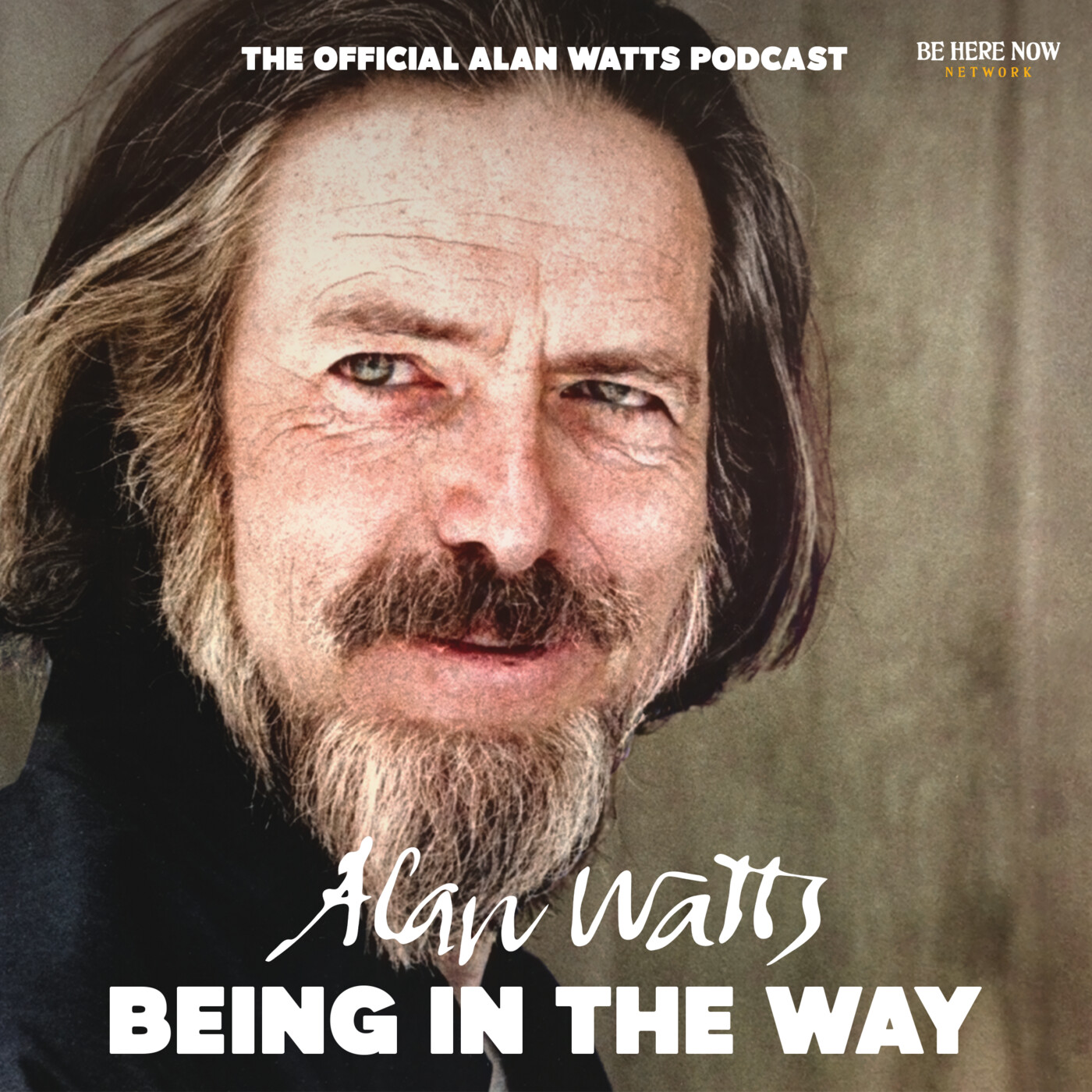
Alan Watts explores the nature of human consciousness and individuality, beginning with the observation that every creature perceives itself as central and "human," with its own unique perspective. He introduces the principle of relativity as key to Daoist philosophy, noting that all beings feel they are in the middle of their world. Watts then discusses humanity's evolution toward creating an external brain—an interlocking network of communications and computers—that may eventually lead to direct brain-computer interfaces and ESP, dissolving privacy but preserving distinct individuality. He distinguishes "distinct" from "separate," arguing that beings are unique patterns within a larger whole, not cut off from it. The sensation of "being in the way" arises from resistance and tension, making us aware of our existence; true transparency, like well-fitting clothes, means being unaware of oneself. Watts criticizes attempts to escape this sensation through alcohol or distraction, instead urging deep experience of loneliness and selfishness. He highlights how culture masks primal realities, such as eating, and how even saintliness can conceal underlying rascality, referencing the Hebrew Yetsahara, the wayward spirit that drives action. Finally, he argues that the feeling of being a lonely center is essential for encountering something other than oneself; total control would render life meaningless, as identity requires resistance and the unexpected.
You see, in science fiction, which was published round about the 1920s, it was always expected that future human beings would have enormous heads because they would have very big brains and they would be very wise. It didn't work that way. What happens is that the human race is building a brain outside its body. That is to say, an interlocking electronic network of telephonic, television, radionic communications, which is rapidly being interlocked with computers so that you will, within a few years, be able to plug your own brain into a computer. Welcome to Being in the Way with Alan Watts and I'm your host Mark Watts and today we're going to hear the title talk for which this podcast was named, Being in the Way. Now in the last episode, I outlined some of my father's early life about how he came to America and ended up teaching Buddhism at the American Academy of Asian Studies in San Francisco. We lived across the Golden Gate Bridge just north of the city and my father was often busy typing away in his study on his numerous books. With the way of Zen in 1957 he set out on the first of many integrative works showing the relationship between the various branches of far Eastern ways of liberation as he described them. The book quickly became a New York Times bestseller and the following year he went on a book tour with speaking stops in Chicago, New York, Philadelphia, and Zurich. At the time he had been speaking on public radio at KPFA in Berkeley for five years and was a reshuring although still somewhat reserved voice on the Bay Area airwaves. But over the next few years he began to interspers his regular radio booth talks with live recordings. The more lively and engaging style of these talks had a dramatic effect on his audience and his programs were soon being re-broadcast in Los Angeles on station KPFK where they still air today. Just around this time KPFA held a fundraiser to buy my father a portable Swiss tape recorder so that he could make more frequent lecture recordings. Working with American Folkways Recording Artist and Audio Pioneer Henry Jacobs, my father began a collection that by 1968 included over 200 recordings. When I began recording in 1968 it was on the East Coast and he was regularly speaking in Chicago, Boston, and Philadelphia. In 1971 I returned to California and at my father's suggestion began to assemble what he described as a collection of his essential lectures which were released in 1972. This time we also produced a series of videos that we called the essentials. Half our talks on specific subjects like God, time, ego, death, nothingness, meditation. And by 1973, looking at the vast collection of seminars, I began to assemble what became electronic college courses from the recordings. When my father passed on in 1973 his final words were "I wish I could figure out how to do all this without my body and I think that he has." This podcast was produced with the help of the Ram Das, be here now, podcast network. Our theme music is by Zakir Hussein and the rhythm experience courtesy of moment records and to find out more about the legacy of Alan Watts, please visit AlanWats.org on the internet. And now here's my father with Being in the Way Part One. One of the first things which everybody should understand is that every creature in the universe that is in any way sensitive and in any manner of speaking conscious regards itself as a human being. One has to say, it knows and is aware of a hierarchy of beings above it and a hierarchy of beings below it. If you take such a tiny creature as a fruit fly, which lives only a few days, it is aware of all sorts of weird little animals and objects and spores floating in the atmosphere which we don't even notice unless we've got a microscope around, very few people have. And it criticizes them as being inferior animals and all that sort of thing. Whereas human beings are things that it doesn't comprehend. As much outside its intellect as a quesar is outside ours. And we see these far off objects floating in the heavens and we have only the vaguest idea of what they may be. Actually we may all be some kind of atoms in another dimension. And all these galaxies being the constituent elements. Who knows? But there is, I think, a fundamental principle that everybody must understand in order to know what is the meaning of the Dao or the Chinese sense of the course of nature and that is the principle of relativity. It's absolutely fundamental to an understanding of Daoist philosophy, relativity. That is to say that wherever you are and whoever you are and whatever you are, you're in the middle. And you see just in the same way as when you stand, say on the deck of a ship and you can see a horizon all around you to exactly the same distance. You are in the center of a circle because your senses extend a certain direction in all directions and therefore give you the impression of being in the middle. Everything in the world feels like that and also it has its own kind which look natural to it. You see spiders and hydras and sea urchins and so on don't look very natural to us. We say, "Well, I would want to look like that." But they say when they see us, "Well, what kind of an awful thing is that?" And what a lot of nonsense it does. But now here is a very strange thing that every creature, therefore, which feels that it is human and which knows that it's there in the same way as you know you're here, experiences, the sensation of a certain tension which constitutes the feeling of 'inus', of 'thearness', of being here. Because after all, every creature is a particular form. Everything is individual, not only you as a total organism standing here, but all the component cells of your body. Each one of them has some sort of a feeling of its own. And it is individual. You can look at a microscope at the right level of magnification and you can see that thing there with its own little life. And if you examine the stream of your blood, you'll find it full of all kinds of organisms that are having all sorts of conspiracies and games and plots and eating each other and doing these things that like we do. Today we realize that we wouldn't be healthy as a total organism unless there were all these wars and fights and plots and politics going on between the various cells in our blood. But from their point of view, you see, they feel a little bit put out. And we're in the same situation because very slowly the human beings on the surface of the planet are realizing themselves into a total planetary organism with an electronic nervous system. That is to say, an interlocking electronic network of telephonic television, radionic communications, which is rapidly being interlocked with computers so that you will within a few years be able to plug your own brain into a computer. You'll have a little gadget here behind the ear, there was like a hearing aid and that will be integrated with your brain in such a way that you can plug in right here. That will only be an intermediate stage because just in the same way as when we thought that all communications by electricity had to go through wires, and then we got rid of the wires and got radio and television. So in exactly the same way, we'll eventually get rid of telephones and radio and television and we'll communicate by some entirely new method that is at present called ESP. But that will mean that absolutely nobody has a private life anymore. You will have no defenses. Everybody else will see right through you and some people will protest and say, "Well, this is terrible, there's no privacy anymore, that means there's no me." Well, that's what's happened to your own cells and your own neurons.
And they objected at some time in the course of evolution, we're getting our private life taken away, we're being organized into a body. And we're doing the same thing. Only we have got to try and see if we can be clever about it. And that is to say, to do two things at once, to have this tremendous openness to each other, whereby I don't care if you read my thoughts, and you don't care if I read yours, but at the same time, nevertheless, each one of us retains a peculiar individuality. Almost in the same way, as nothing could be more unlike a stomach than a heart, despite the fact that it is an organism functioning altogether. So then the problem, though, as I said, is that for each individual, which is outlined, which is a separate thing, or rather, I would instead of using the word separate, I would like to use the word distinct. Separate as I use the word means disjointed, cut off from. Distinct means a feature of something, where an absolutely distinguishable pattern is part of a larger pattern of a whole. So something can be distinct without being separate in just the same way as back and front can be very different and yet inseparable. So then there is then this sensation of practically every living being, of constituting a center of tension and of resistance. That is to say, of being a little bit blocked, or shall I say, of being in the way, being in one's own way. Imagine the opposite. Let us suppose, for example, that you got up in the morning with a feeling of total transparency. There's no resistance in your organism to the external world. You just float through it. You're part of it. It's part of you. And just in the same way, for example, that when you see, if you see well, you aren't aware of your eyes. But if there's something wrong with your eyes, then you see spots in front of you. Then you are looking at your eyes, and your eyes are getting in your own way. So the Taoist sage, Edwongza, says, that when clothes fit well, you are not aware of them. When your girdle or belt fits properly, you are not aware of it. Good shoes, you're unconscious of. And so, in exactly the same way, the perfect form of man is unaware of himself, because he doesn't get in his own way. He is, in this sense, completely transparent. Now, you were thinking, I'm trying to sell you a bill of goods, that I'm going to teach you some technique, so that you can feel perfectly transparent, and that this is the proper way to feel, this is the way you ought to feel. That's not that simple. The point is, to begin with, if you do in a really rather natural way, feel alone, and feel a little bit vulnerable, that you've got a soft skin, and you've got a weak heart, and you've got all those ills that the human body is air to, going on inside you. Let's begin with that. And that fact we hurt a bit, and through hurting a bit, we know we're here. And this is part of the whole meaning of penances, and all sorts of trials that people go through, and all kinds of adventures, and all sorts of very, very difficult massage experiences, and so on, is that, as a result of this, it becomes quite apparent that you do truly exist. You are there. You are a kind of, an obstacle to the flow of life, and as life impinges upon you, wammal, you rebound and you hurt a bit, and so you are there. Now then, although people cultivate this, they say, in general, they rather it would be not that way, we'd like to forget ourselves. And so, ever so many people say, "Well, I want something to lose myself in, I want something to belong to, I want to join a religion where I can sort of feel that I take part, I mean something, or I go to the movies to forget myself, I read a mystery story to forget myself, I get drunk to forget myself, because the peculiar quality of the drug called alcohol is that it turns you off. It makes you increasingly insensitive to pain and to being, and so on, so that you can get a certain vague sense, a rather misty sense of floating. But here it is. So, as things stand, one ordinarily doesn't feel that way, and therefore takes alcohol or something in order to disappear, in order to feel less this sensation of resisting the world. Do you know if you study your body and its dynamics, you will find that you are fighting all the time. Most people are some aren't, but most people are fighting the external world all the time. My friend, Charlotte Selva, often tries an experiment, where she makes a person lie down on the floor and says to them, "Now look, the floor is solid, and it will hold you up. You don't have to do anything to stay where you are, just lie on the floor." Then she looks at the person or may touch them slightly and say, "Do you realize you are making all sorts of efforts to hold yourself together? Because you are basically afraid that if you don't do that, you'll just go 'Brrrrrrr, I'm disappearing to a kind of formless goo, all over the floor'. But you won't, you see. Your skin, bones, your muscle-turned-ness, and everything is all there naturally, and it will hold you together, there's nothing to worry about, and all you have to do is lie on the floor, and you don't have to make any special efforts to stay together. But very many people are afraid that they will fall apart. Or somehow disintegrate. If they don't make efforts to hold themselves together, or else that they will be disintegrated by some outside agency, if they are not constantly on the alert like this, all around you see, to protect themselves. Now, I'm not a preacher. That's the most important thing to understand about me. I'm not saying you shouldn't do that, but I'm inviting you to become immensely aware of the fact that if you do that at all, that you do it. And that you have, therefore, this sense of being alone, of being a particular, separate form that is unlike any other form on earth, that's just you. And concentrate on that. After all, for many people they define this as their problem. So you ought to be able to feel it without the slightest difficulty. Isn't it? I were asking you to feel some transcendental sensation, or something of that kind. This is just a very ordinary sense of being you and being alone. Now, as you focus on that sensation, of distinctness. We even call this one separateness, because we do, we have been brought up to feel separate. We have been brought up to feel actually disjointed from the external world, although that is pure mythology and doesn't exist at all. You're as much part of the external world as a whirlpool is part of a stream. But we're brought up not to notice that. But if you've been brought up that way and you don't notice that you're as much part of the world as a whirlpool as a stream, you feel this intense separateness. The thing to do with all feelings that you don't like is to experience them as deeply as possible. And go into the innmost depths of loneliness. And indeed, let us say the innmost depths of selfishness. Are you selfish? You know, lots of people try to pretend they aren't. And say, "Well, I try not to be, but I guess I don't succeed all the time." And so, Krishna Murti, you know, is a very devil because he always roots it out. He shows all the people who are very good and have the highest ideals and who are doing everything, that they are really doing it for the most. The same sort of motivation as other people are robbing banks. And only they are giving it the name so as to conceal it better. See, that's like culture. Culture is a way of more cleverly concealing the fact that you have to eat. See, like the Queen of Spain, Cool.
In the days of the 1860s, came on with these enormous skirts and floated into the room. And, you know, was sort of coming on like she was an angel. And somebody, when they were first invented, gave her a present of beautiful silk stockings. A dozen pairs and sent them to the queen. And her majesty's chamberlain replied, with the letter returning the stocking room thing, her majesty, the queen of Spain, does not have legs. (audience laughing) I managed to float along just the same, because I'm an angel. So you see, the way in which all kinds of high culture, are subtle ways of concealing and pretending that we do without the things, that the lower classes, whether of humans or of animals do. You see, we pretend that we don't. It's like you don't go around crudely, taking a bull and banging it on the head with a mallet or sticking a knife through it and tearing it apart and eating it. All that's done somewhere off in the stock yard. And it comes to us in the butcher shop as a completely neutral looking thing called a steak. A steak has absolutely nothing to do with a cow. A steak is something wrapped up, packaged, like that. And they're all j-j-j-j-j-j-j-j-j-j-j-j-j-j-j-j-j-j-j-j-j-j-j-j-j-j-j-j-j-j-j-j, like that. And nobody would pick up a steak and test it, thinks, "Boo-a cow." (audience laughing) It doesn't look like a cow. Doesn't remind you of one in any way. So that's culture. (audience laughing) But you see, however much you mask it under lofty ideals, I mean, the most religious people in the world, the greatest saints are the various brascals. I've known lots of them. So when anybody is frighteningly holy, you know that that guy is playing an extremely far out game. (audience laughing) Because he has put so many layers and so many wiggles between what he's outwardly doing and his inward irreducible rascality, that he's a very cultured being indeed and is playing a very complicated game. In Hebrew theology incidentally, it is admitted, quite frankly, that there is a thing called the Yetsahara and in the beginning of time, when God created Adam, he implanted in him the Yetsahara and the Yetsahara means the wayward spirit. He put something funny in man so that man would be a little odd. And it was a result of the Yetsahara that Adam was tempted by Eve, who was tempted by the serpent to eat that famous fruit. And but the Hebrew believes that everything that God created is good, including the Yetsahara. Because if it hadn't been for the Yetsahara, there would have nothing ever happened. Everybody would have obeyed God and God would have said, "Well, this is kind of a poor." (audience laughing) So now, but you see, you can't just get up to someone and say, "Disabae me." Because if they do, they're obeying you. See, that's a double bind. Say to somebody, "Disabae me." But God was much more subtle than that. He didn't tell Adam to disabae him. He told him to obey, but subtly, he put this Yetsahara thing and like that. So that God would say, "Well, I'm not responsible." Well, this thing's gonna happen over its own because what everybody wants is something to happen on its own. In other words, something comes back. And that's, I'm not quite sure what it's gonna do. And it's to the degree that I encounter something like that that I know it's alive. And everybody wants that. Because you see, the sensation of being you, this curious, lonely center of awkward sensitivity, subject to the most peculiar feelings and pains and anxieties and all that sort of thing. All that is an essential prerequisite for feeling something else. These two experiences go together. If you want, in other words, if you want to be omnipotent and you want to live in a universe where nothing happens except what you, exactly what you will to happen. In other words, you say, "I would like to be God." If you think that's the way God is. And everything is therefore totally under my control. Everything is absolutely transparent to my intelligence. I have no problems. A lot of people coming on, like they think they've attained the state. People like Meher Barba, who says he's in charge of the universe and knows everything understands everything and so on and so forth. Well, that's a lot of bunk. Nobody wants to be in that position. Because there wouldn't be anything to it. Because once everything is under your central control, well, just nothing is happening. It's a ball from beginning to end. So what any one or any being whatsoever who has a sense of centrality, who has a sense of selfhood, who has a sense of identity, that sense of identity is inseparable from something else going on. That is defined as not being Me, as not being under my control and that may jump at any time. It might even eat Me. So what I want you first of all to understand is that these two sensations, one of being the lonely, central, sensitive, vulnerable self, living in the midst of a world that feels other that is not under your control. Now, I want to try and show you that these two sensations are really one sensation or rather two aspects of one sensation. You couldn't have the one experience without the other experience. This is a rather good thing to know because it means that you want panic if you discover this. People who suffer from chronic anxiety are always in doubt, you see, about this relationship between what I feel as myself and what I feel as something else. Let's suppose you're anxious about your relationship with other people. You walk into a room and some stranger opposite to you. You know nothing about this stranger and maybe you feel a little reluctant to open conversation. You don't know whether this person is going to be sane or some kind of a crackpot or some kind of an awful, stuffy square or you don't know what it is. So you start fencing around a little but you get the feeling you see of, "Now, I better watch myself because I do, "after all, I want to make a good impression, "I don't want to make an enemy." So you watch yourself and this is a funny thing then begins called self-consciousness and people say sort of to each other and. "Use your way in which strangers come on." And. Also, there is involved in this encounter, the secret games that people are playing all the time to defend themselves by putting other people down. You see, every living being, if the truth be told, is a manifestation of everything that there is. In other words, what we call God in old fashioned language. Every human being is. And every one, as I look around, I can see every one of you as the divine being coming at me in a different way. Crazy. But the thing is that what we do is to try and prevent people from realizing that this is so. By pointing out to them in the most subtle ways, their limitations. And seeing if we can phase them, put a person off a little bit, make them uncertain, make them unsteady. It's like all sorts of games you can play where if a person wavers, he loses. Where it's absolutely essential that he has total nerve in order to win. But people play that with each other all the time. And the reason they do it is not the reason they think. It is that if everybody were perfectly clear that they were a manifestation of the divine being, nothing very much would happen. But so as to keep everybody a little bit unclear about it, the whole thing bugs itself.
(Laughter) and creates these little doubts. So what we are beginning with is these little doubts, you see. These sensations of blockage, of not being very sure of yourself, but knowing very much indeed that you are yourself and that you're alone and it's all up to you. The terrible feeling of responsibility. So what I'm trying to point out to you is if you intensify that feeling and bring it to its highest pitch, you will immediately realize that you are aware of it only by virtue of the entire sensation of something else, something defined as not you. So the feeling of not you and the feeling of you are relative. They go together and you can't have the one without the other. And if you can't have the one without the other, that means there's a secret conspiracy between the two. They are really the same but pretending to be different. Because the whole idea is if there wasn't a difference, you wouldn't know anything was happening. I mean, if it was all the same, it's like that song of Bob Dylan's, which says something like, "Well, I'm just like a guy like you. I'm just like anybody else. No use me taught you. Because you just like me." So the whole point is, I know if everybody was the same and all shared the same ideas exactly and so on, there'd be no, nothing to talk about because everybody would be a bore. There'd be just yourself echoing, back at you, you see, and you'd feel like a madman in a hall of mirrors. Where everything you went, there's just yourself, you see, in all directions, just you. Well, that's no fun. But you may think that I'm speaking in favor of some kind of skit-soid pluralistic universe. No, the whole point is this, that difference and every kind of a variety of differentiation is the way through which unity is discovered. So, however, wherever you notice the difference, the difference has two sides, what it is and what it's not. And these two sides, since you can't have the one side without the other side, they're really one. Because they go together, inseparably. So, when you get this extreme sense of your own existence, as a rather painful fact in the middle of everything else, the everything else feeling and the you feeling are two poles of one and the same process. So, the real you is what lies between these poles and includes both of them. Now, this is the fundamental principle of the whole way in which ancient Chinese thought developed. The philosophy of the Yang and the Yin. This is one of the oldest ideas in the universe. I mean, no, that's a rather too big language on this planet. And the philosophy which I shall have occasion to speak of a little bit more later of the book of changes, the Yi Jing, is based entirely on this. That the universe is the interplay of difference. And the primordial difference is between up and down, back and front, black and white, and isn't male and female, positive and negative. So, the word Yang in Chinese means or refers to the south side of a mountain, which is the sunny side. The word Yin refers to the north side of the mountain, which is the shady side. Did you ever see a south side at mountain only with no north side? Or in it may also Yang may refer to the north bank of a river, which gets the sun, and Yin to the south bank of the river, which gets the shade. And so you will remember this great symbol. In one half, of course, it's colored dark, as it were two fishes interlocked. And they are chasing each other. They actually form, you see, more complicated symbols in which they form a helix. And the spiral nebulae are shaped this way, in the form of a helix. And this is the position of man and woman making love, fundamentally. Well, I am trying to get inside you, and you're trying to get inside me, and we're trying to get into the middle of each other, but there's somehow or other a difference, and we can never quite get there. Just like if I want to see the back of my head, I can go round and round, and I can chase it, but I never quite catch up with it. But that's what makes everything work. It is said in the Vedanta sutras that the Lord, the Supreme Noah of all things, who is the Noah in all of us, doesn't know itself in the same way that fire doesn't burn itself, and a knife doesn't cut itself. So nothing to God even, you see, would be more mysterious than God. Do you know somehow how you surprise yourself, for example, when you feel your own pulse, and you suddenly feel this life going on in you, which you're not willing, or there are all sorts of ways in which you can say you have the belly rumbles, and you didn't intend to have the belly rumbles, and suddenly it happened, or you had hiccups. And now are you having hiccups or not? Is this something you're doing? Or is it merely something that's happening to you, is if it was raining, and the rain was happening to you? This is a very debatable question. Consider breathing. Are you breathing, or is it breathing you? Well you can feel it either way. You can decide to breathe and feel that you're breathing in just the same way that you walk when you want to. On the other hand, when you forget about breathing altogether, it still goes on, and so it seems to be something that happens to you. Which is it? Do you grow your hair, or does your hair just grow by itself? What enables you to make a decision? When you decide, do you first decide to decide, or do you just decide? Now how do you do that? Nobody knows, you see? When Juan Se tells the story that one philosopher asked another, how can one get the Tao, which is the power of nature, so as to have it for one's own? And the other philosopher answers, your life is not your own. It is the delegated adaptability of Tao. For offspring are not your own. They are the outputs of Tao. You move, you know not how. You are addressed, you know not why. These are the operations of Tao. So how could you have it for your own? There is a funny thing then, we can experience ourselves through and through as something that just happens. Look at it this way. If you feel your body, your skin, and the solidity of you, and the regard, what marvelous eyes you have, which are the power, which generate light and color out of all these electrical quanta in the external world. And these ears, these beautiful shells that you wear on the side of your head, with their little spiral bones that are cochlear inside, you know, all that, marvelous. But you feel, you don't feel responsible for this. You don't know how it's made, if it is made. But it's you. That's what you are. That extraordinary pattern. Beautiful, gorgeous, wonderful arabesque of tubes and bones and cartilage and myriads of interconnecting electronics and nervous systems and everything wonderful. See, but the point is, most people. Don't own this. They don't say this is me. They say, well, it's some kind of very clever machine which the Lord God made out of His infinite wisdom and put me in the right place.
me in it. And this is a very limited view because the extraordinary thing is, you see, that this is you, this extraordinary, marvelous going on, you see. But you can feel it all of it as if it was just happening to you. But if you want to feel it that way, then you've got to go the whole way and you've got to feel that your decisions just happen to you. And the thing that you call yourself to which things happen is just something that happens. See? You don't know how you manage to be an ego, how you happen to be conscious. That just happened too. So, happenings happen to happen. So you can feel yourself completely irresponsible like that. See? There's nowhere. Or when you get that way, that's a very interesting road to run. But you can try the other way. You can extend it and say, "Now, look here. If, if, if, if, I really am my eyes. And although I don't understand them, I mean, let us say I can't describe it in lines, in words. This is me. It's extraordinary thing, but it is." Well, I don't understand how it happens. But then you see, that's the whole point. As I made a little while ago, that the very Lord God himself doesn't understand how he happens. Because if he did, what would be the point? There'd be no mystery. There'd be no possibility of surprises. That's why there has to be yang and Yin. Yang is bright and it understands everything. Yin is dark and damned if she'll be understood. But there are two phases of the same being. And so your yang side is your conscious attention and all the bright things you know, and all the information you have, and all the know how, and that you know what to do. And your Yin side is the other side of the Yang, which enables the Yang to function. Because you don't know why the Yang side of you function. That is the conscious, bright, intelligent side of you. It all depends on something you don't understand at all. Because if it didn't, it wouldn't be there. Just like you wouldn't be here unless there was something else. So they move together. And therefore, if you will accept the idea that you are your own eyes and your own heart and your own ears with that wonderful little spiral cochlear inside and all these amazing gadgets here, you're all that. But you don't think about it, but you are it. Now therefore, by a little extension of the imagination, you can very well see that if all those bones and subtleties inside you feel other than your conscious ego. But nevertheless, ah, one with it. The same argument will go for all the other things going on around you. The sun shining, the stars twinkling, the wind blowing, and the great ocean restlessly pounding against these clips. That's you too. You don't control it, of course, because there has to be something about you you don't control or you wouldn't be you. Now you see that, all that is the lessen elementary relativity. And relativity, I've talked about it in this way, which is kind of unscala-lay and so on. But I wanted to get the message across, the idea across, because to understand the principle of relativity is the absolute foundation of the philosophy of the Tao. Lautsert takes it up in his second chapter when he says, "When all the world understands beauty to be beautiful, there is already a glimpses. When all the world understands goodness to be good, there is already evil. Thus to be and not to be arise mutually. High and low are positive mutually. Long and short are compared mutually. And he goes through a whole list of opposites and show how they create each other. It's like that wonderful little parable that the Chinese character for man looks more or less like an upturned-v. And Lafcario Herne in one of his books tells a story of a Japanese girl telling her little sister, the meaning of the character for man by taking two sticks of wood and balancing them together on the ground, two sticks of firewood, so that they form the upturned-v. And she says to her little sister, "This is the character for man, because neither stick will stand up unless it has the other to help it." But the profound meaning underneath this is there's no self without other. And no man, and if you don't forget, get back to the original point. Every creature in the world feels it's a man. I don't mean a male, but a human. And that is because it is in this situation where the thing it feels as itself, as its separate identity, is supported by the equal and opposite sensation of other. Center, periphery. Here, there, now, then, is, isn't, or whatever. These two are the yang and the yin, the two poles that hold each other up. So the Zen poem says, "When misfortune comes, treat it as a blessing." When fortune comes, treat it as a disaster. This podcast was produced with the help of the Ram Das, be here now, podcast network. Our theme music is by Zakir Hussein and the rhythm experience courtesy of moment records, and to find out more about the legacy of Alan Watts, please visit AlanWats.org on the internet. [Music] [BLANK_AUDIO]
Podcast Summary
Key Points:
Alan Watts discusses the evolution of humanity creating an external "brain" through interconnected electronic networks, leading to potential brain-computer integration and eventual ESP-based communication.
The principle of relativity is fundamental to Daoist philosophy, where every being perceives itself as central and "human," with its own natural form and perspective.
Individuality is described as "distinct" rather than "separate," emphasizing that beings are unique patterns within a larger whole, like back and front.
The sensation of "being in the way" arises from resistance and tension, making one aware of existence; perfect transparency, like well-fitting clothes, means being unaware of oneself.
People often try to escape this sensation through alcohol, movies, or religion, but Watts suggests experiencing loneliness and selfishness deeply rather than avoiding them.
Culture masks primal realities, such as eating, and even holiness can hide underlying "rascality," referencing the Hebrew concept of the Yetsahara, the wayward spirit that drives action.
The feeling of being a lonely center is essential for encountering the "other," as total control would result in nothing happening; identity requires something beyond itself.
Summary:
Alan Watts explores the nature of human consciousness and individuality, beginning with the observation that every creature perceives itself as central and "human," with its own unique perspective. He introduces the principle of relativity as key to Daoist philosophy, noting that all beings feel they are in the middle of their world. Watts then discusses humanity's evolution toward creating an external brain—an interlocking network of communications and computers—that may eventually lead to direct brain-computer interfaces and ESP, dissolving privacy but preserving distinct individuality.
He distinguishes "distinct" from "separate," arguing that beings are unique patterns within a larger whole, not cut off from it. The sensation of "being in the way" arises from resistance and tension, making us aware of our existence; true transparency, like well-fitting clothes, means being unaware of oneself. Watts criticizes attempts to escape this sensation through alcohol or distraction, instead urging deep experience of loneliness and selfishness.
He highlights how culture masks primal realities, such as eating, and how even saintliness can conceal underlying rascality, referencing the Hebrew Yetsahara, the wayward spirit that drives action. Finally, he argues that the feeling of being a lonely center is essential for encountering something other than oneself; total control would render life meaningless, as identity requires resistance and the unexpected.
FAQs
Alan Watts predicted that humanity would build a global brain through interconnected telephonic, television, and radionic networks, eventually allowing people to plug their brains into computers, and later communicate via ESP.
The principle of relativity means that wherever you are, you are always in the middle of your own perceived universe, as your senses extend equally in all directions, creating a sense of centrality for every creature.
Being 'in the way' is the sensation of being a distinct, resisting center, like a blocked or awkward sensitivity, which makes you feel separate and vulnerable, but it's essential for experiencing life fully.
Distinctness means being a distinguishable pattern within a larger whole, like back and front, while separateness implies being disjointed or cut off. He argues we are distinct but not truly separate from the world.
He advises experiencing such feelings as deeply as possible because going into the depths of loneliness or selfishness helps you understand and transcend them, rather than avoiding them.
The Yetsahara is the wayward spirit implanted by God in Adam, which caused disobedience and made things happen. Alan Watts uses it to show that a bit of rascality is necessary for life and creativity.
Chat with AI
Loading...
Pro features
Go deeper with this episode
Unlock creator-grade tools that turn any transcript into show notes and subtitle files.
 PodcastTranscript AI