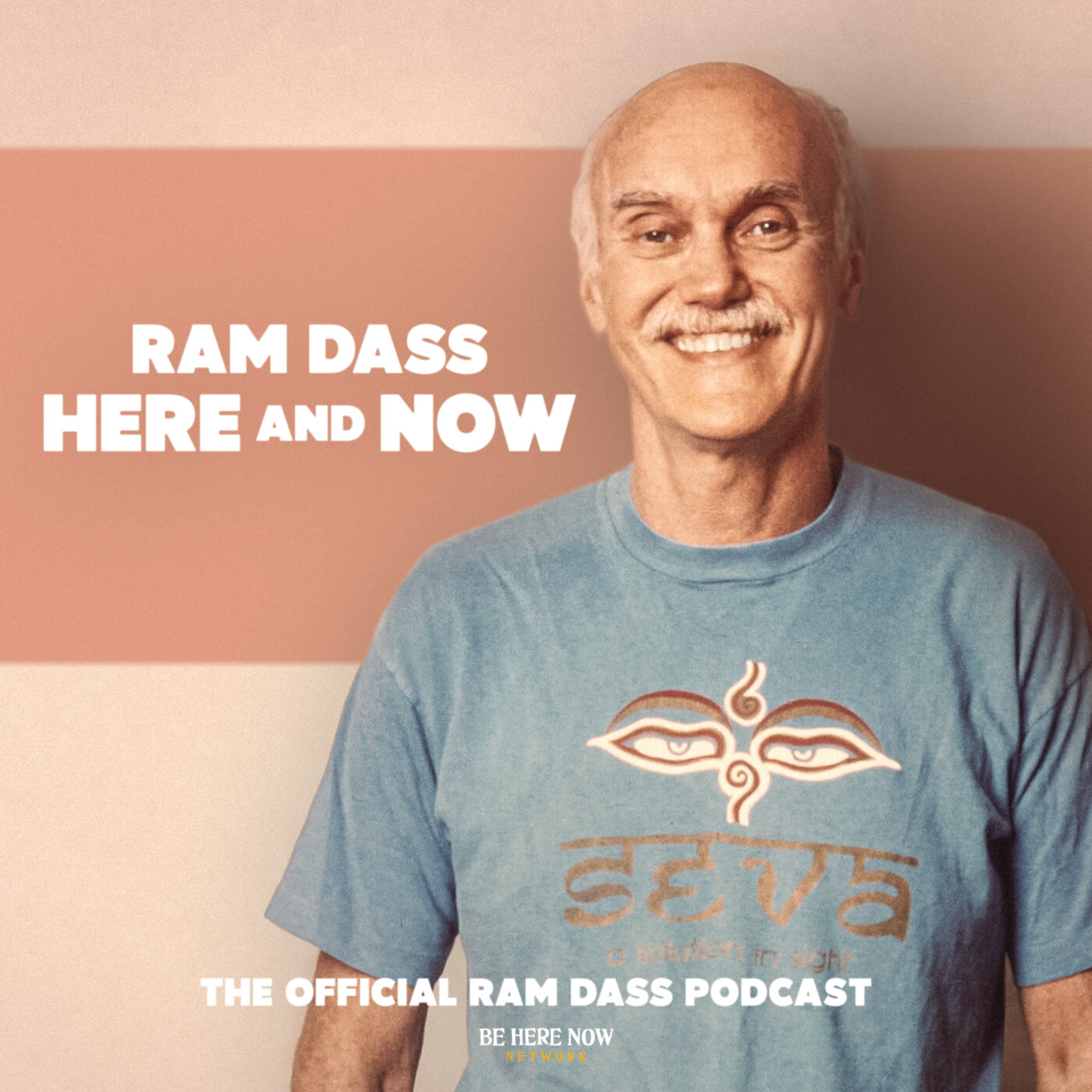
This podcast episode, sponsored by BetterHelp, delves into the teachings of karma yoga as explained by Ram Dass. The core idea is that spiritual liberation is achieved not by withdrawing from life but by fully engaging with one's duties and life circumstances while cultivating a perspective that sees beyond the individual self. The speaker emphasizes that fear arises from being trapped in a single plane of reality—our sense of separateness. True freedom involves balancing this separateness with an awareness of our fundamental unity with all things. The host, Raghunath, introduces the episode as part of a series and acknowledges supporters like Strawberry Moons Media. Ram Dass shares personal anecdotes, including a transformative visit to San Quentin prison, to illustrate how profound connection can dissolve barriers. He recounts his own spiritual evolution, moving from using psychedelics and renunciation to realizing that freedom requires embracing, not avoiding, the full experience of human incarnation. The talk also reflects on societal shifts, likening current turbulent times to the Hindu concept of Kali Yuga, framing them not as mere decline but as a potent opportunity for awakening and growth when met with a spiritual context.
This episode is sponsored by BetterHelp. Between caring for others and managing unseen responsibilities, women's emotional well-being can often be overlooked. Women carry a lot on their shoulders each and every day. Therapy offers women a space for them to take care of themselves in the way they deserve. It's a place to let go of pressure, create balance, and learn how to set healthy boundaries. With over 30,000 therapists, BetterHelp is the world's largest online therapy platform, having served more than 6 million people globally. They do the initial matching work for you, so you can focus on your therapy goals. Your emotional well-being matters. Find support and feel lighter in therapy. Sign up and get 10% off at BetterHelp.com/romdos. That's better, H-E-L-P. com/romdos. At that point, when you see that your next curriculum is honoring what is in your incarnation, so that you end up honoring it as relatively real. You do your Dharma, you do your part, you play your part in it, and yet at the same moment, there is absolute equanimity in your body. What is required in the process of karma yoga is cultivating a context. That's what called a spiritual perspective. That's a term you could use. It's a context so that you see any situation on more than one plane simultaneously. Hey everyone, this is Ramdas here and now, and I'm Raghub Marcus here to introduce the episode a little and also give an idea of a couple of other of our supporters by which this podcast can continue. First of all, this is a two-part podcast and it's exploring the process of karma yoga. I mean, Ramdas was all about having a spiritual perspective or having a perspective that allows us to see all of what we are interacting with and in our situation, whatever it might be, and understand there's more than one plane going on at the same time. This is a very core teaching from Ramdas. But before we get any further into that, I do want to introduce strawberry moons media. It's something that is presented by David Nicktern, who's a good friend and Debbie Nuckley. It blends education and entertainment and integrates wisdom traditions and mindfulness and contemporary creative expression. It's just wonderful channels. You can see them on YouTube. It's SSM mindful living, SSM meditainment, MEDI/tainment, and SSMM, for kids. So it goes across the board. It's really. Just go to strawberry moons within smedia.com and you'll see the call to action. Again, David has a phenomenal meditation platform. He's doing this now. He works with the Krishna Doss and plays guitar in his band. He's a multi-talented guy. He is. So definitely visit strawberry moons media. And back for a moment, just to talk about this particular episode of here and now. And it, as I said, it's two parts. So check back soon for the conclusion of this talk. And again, it's about perspective. It's about how fear is rooted in getting caught in one plane of reality and how we need to find a balance between separateness and unity. So it's as usual, totally rich, full of so much intuitive wisdom, which is what Ramdas is all about. By the way, you can also. We have a fellowship, which Ramdas fellowship. And it's something go to Ramdas.org and look that up because that's a great way. You know, these days are difficult as we all know. And it's wonderful to be able to be in Satsang. We can't always do it in person because of our lives, circumstances. But going online, we have found in creating these things, going online really allows for a communion to happen, even if it's virtual. So we're living, you know, this is again one of the other planes of consciousness, Ramdas talks about. Anyhow, here it is. And from Ramdas, it was in St. Louis, Missouri in 1992. And I'll see you again sometime, Ramdas. Good evening. Good evening. Great. Reminds me about a week ago, two weeks ago, I went to San Quentin, a prison in California, with the Guioto monks, who are a group of Tibetan monks that chant, they chant like, "Boooo!" And they've trained their voices so that they chant on three tones. They each do a chord so they can do three sounds at once. And we went into the prison for a service, a Christian service. And there was the San Quentin choir and the Guioto monks. And it made us come on and said, "We're glad to be here! Yeah!" And everybody went, "Oh, man!" And the whole place just took off. And within about three minutes, it was an incredible revival meeting. And the prison was gone, the whole thing was gone. We were just all there in the spirit. And after the Guioto monks did there, and the glee club of the choir did, it's very swinging gospel. We were all dancing and singing and hugging. And I realized that in that powerful setting, you know, you walk in, you've got to go through all kinds of searches and gates clanging and double locks in this and that, some maximum security prison. Suddenly you're in this room with all these human beings. And for you to get through your model about where you are, in order to be here, it's an intense transformative process you watch inside yourself, until you look in the eyes of another human being, and it's just us. Here we are. And each of us has our own unique predicament, and we're each doing what we have to do. It's like we don't get trapped by the situation if we can. I am what. One of the practices that is a dominant practice in my life is what is called karma yoga, which means the yogh or the root through to union, with it all, with God, with the formless, with pure awareness, with whatever metaphor you'd like. The root through is your karma. Karma yoga. My karma becomes my yoga. That means that what are the givens of my life become my root to liberation? It means that it's not just you're not just when you're doing karma yoga, you're not just going to be doing karma yoga.
church on Sunday or meditating every morning or whatever as your practice. And then the rest of the life is "buh." It's all grist for the mill. You use it all. You use your anger and your enemies and your fear and your confusion and your agitation, your lust and your greed and your love for God and all of it. It's all process stuff that's going on in you. I mean the reason you undertake any yoga is because you have awakened to the realization that there is more to the world and to you and to it than what you think. That the conspiracy of reality you live in most of the time with most of the people around you is just a tiny fragment of what is. William James said, "Our normal waking consciousness is but one type of consciousness. While parted from it by the filmiest avails, they rely other types of consciousness. We may pass our entire lives without knowing of their existence, but apply the requisite stimulus and there they are in their completeness. Whatever they may mean and whatever value they may have, this is paraphrasing, they forbid our premature closing of our accounts with reality. You would only be interested in yoga or in spiritual practice or in all of this if you had started to awaken. If you haven't awakened to the fact that the reality in which your body and your personality are existing is only a relatively real reality. All this yoga nonsense is just that, it's yoga nonsense. It's withdrawal from the world by a lot of fuzzy people. But with awakening comes the realization and people awaken all kinds of ways. All kinds of ways. Comes the realization that your life experiences of your incarnation are your curriculum. When I first began to awaken in the 60s through psychedelics, actually, my intention always because I tasted of these other planes of reality was to get back to them as fast as I could. It was called getting high and I certainly was an adept at getting high. Everything through better living through better chemistry or whatever you have. And then with other spiritual techniques and that led me to follow a renunciation path of pushing away that which brought me down. It's like people say, "I got to live in the country because living in the city brings me down." Hear that one? Seeing you say, "I'm going to get high. I won't live in the city." But then came the dawning, the appreciation that being high wasn't being free. That as long as there was a high and a low, as long as there was a going up and a coming down, as long as you were avoiding one thing and grabbing to something else, you weren't free, you were stuck in your desire system. And I saw that the renunciate system was really only working partially for me anyway because you push away like you, push away as a renunciate, you push away sexual stimuli so you won't lust. But you often end up a horny celibate. You're sort of busy not having sex. It's like people who give up smoking for four years, three months, two days, and 20 minutes, you know, they're. I haven't drank in 14 years and three months. Yeah. So at that point of seeing that high isn't free and you're in to be free because you realize that only when you are free, can you really free another being from suffering? You are driven to work on yourself really out of compassion for the whole situation. And I realized that what I was pushing away was my incarnation was the fact that I'd been born a human. I treated it always like it was some absurd error. What was I doing with all these rascals and irresponsible people? I was much too holy for that. But turning around and realizing that if I was going to start pushing away life, but we're going to really open to life, imagine getting getting free by living life. I'd never thought of that. So I looked at my life and I saw it was as if I saw a whole montage of roles, of parts that my incarnation plays. As a member of a family, as a member of a community, of a nation state, of an ecosystem, of a cosmos, of a religion, of a sexual identity, etc., etc., of an age. And as I could understand it, what being free meant was in each of these aspects not having a version and not having attraction, not grabbing it and holding, saying, I'm this, and not pushing it away, saying, I'm not this. So what it meant was honoring incarnation as the way I put it, the word "honoring." You could say acknowledging, but honoring meaning allow yourself into who you are. It's like getting into a hot tub. No, no, not that. No, I'll be anything, but I won't be but you are. You do your Dharma, you do your part, you play your part in it, and yet at the same moment there is absolute equanimity in you about it. One is required in the process of karma yoga is cultivating a context. And that's what called a spiritual perspective, or, I mean, that's a term you could use. Fear is rooted in getting caught in one plane of reality. Specifically, you took birth out of the one into a separate entity. And what happens is you get caught in your separateness. You not only think you're real, you think you are absolutely real. When all you are is relatively real, because that of you, which wasn't separate from everything else, still is. And it's yelling, hey, and the part of you that's separate saying, shut up. It's like the rational mind versus the intuitive heart. The intuitive heart knows you're connected to everything, you're part of everything, and the intuitive heart always wants to give away everything. You need it, you take it. Take my life, take whatever you need. The mind is always saying, no, wait a minute. You have your health insurance to pay. You know? And you get so, we can
because you go into, actually when you're born, you go into separateness training because everybody, the trains you, thinks they're somebody and so they train you and you're somebody-ness. And they don't remind you of the fact that we're all so all here behind all that because they don't know that, they forgot. 'Cause most people, and they take birth, forget. Unless they're an old llama or something. And then you wake up and you say, "Oh, I was part of it all all the time." And all the time I thought I was separateness. Now that's getting, when we get so preoccupied with our separateness, we are very little and the forces of the universe are very big and it's kind of scary. So you get into power trips to try to feel secure as a tiny little almost non-entity. You try to become somebody. And leave something behind. The objective is not to deny your uniqueness or your separateness, but not to lose the connectedness, the unity. When those get out of balance in either direction, you're not free. If you get too far into the one you're in Lala land, you get too far into the separateness, you're so grounded, you can't fly anymore. And when you look at the sicknesses that we're facing in our lives at this moment, ecological sicknesses, immune sicknesses, economic disparities sicknesses, greed, delusion, violence sicknesses. I mean, we all knew the '90s were going to be interesting, but this is ridiculous. It's like you look around and like in those old Western movies where they've stampeded the herd and they're all running towards the cliff and you're one of them. (laughs) That's our karma. Maybe it would be nicer if you and I lived in the '50s again. The '50s people had homes and they, economics were more stable and there wasn't this much disparity between the rich and the poor and there wasn't so much information. So if there was suffering, you at least didn't know about it. And there was such a simple nice life. Ike was good and you know, is that kind of thing? But these are the '90s and the '90s make the '60s look like a child's tea party. Because what the '60s were was, I don't know what they were, how would I know? But that's a great line. What the '60s were. I heard myself how bizarre. I was just in the South Pacific for boogie boarding for a few months and I was in a French island in the Marquises and there was a girl that worked around the place I was living and she was helping me with my French and I was helping her with her English and I'd point and she'd say, "Flor and table." And then I'd point and she'd say, "I don't know." And the way she said it was so captivating. I just thought that was the mantra I'd bring back with me from my spiritual journey. I don't know. But I didn't think it could sell for the whole evening tonight. So we make believe I know. We should of course have certain. Now what the '60s were. Well, in the early '60s, we came out of a very kind of monolithic value system. I mean, there was science and there was, it was the material upsurge of the '50s after the postwar and rationality was going to win and psychoanalysis would solve all the problems. There was a certain kind of mindset that we could stabilize, we could have an always increasing GNP, everything was fine. And then something happened in the '60s. It could have been precipitated by psychedelics, it could have been precipitated by who knows what. There were, I'm sure it was well over determined, a television, I mean, a lot of things, travel, mobility, a whole thing. And there was an opening into what was possible. And it's as if you're a horizon of the possible expanded immensely. When that reality shifts, if you've got a vested interest in how it was, you get frightened. And when you get frightened, you dig in your heels and push against. And in a way, what you saw by the end of the '60s in the anti-vietnam movement was a polarization in the society, of the people that felt that force of opening and responded to it some by saying, wow, in this opening, we will have justice, we will have love, we will have peace, we will learn how to be together. And others saying, this opening is bad, let's stop it. And digging in the heels. And that polarization took us through Reagan years with still pendulum swings of that process. Now in the '90s, we have exactly, we have a comparable condition in that the relationship between Cosmos and Chaos, between order and anarchy, is the amount of randomness of whatever you call in the system is increasing. And the potential for creativity on one hand or reactivity on the other is enhanced, is exacerbated. So you see a whole move of fundamentalism, ultra-nationalism, a kind of a digging in, hold the line. It's like playing King of the Mountain, we're gonna you keep your place and you just, everybody that's trying to come up. Or the other way is, you respond to the chaos and the excitement and the uncertainty and the fear that your whole lifestyle may change. As a creative situation. As an open situation. Now, see the predicament. If you think you are only your personality in your body and your bank account is meaning less and less because of inflation, your job is less and less stable, your water is less fit to drink, your fish are less safe to eat, your air is less comfortable to breathe, you can't go out without sunblock all of that, you are starting to freak because it looks like the quality of life is going down extremely fast. If on the other hand, you have a context or a perspective saying, oh well, it's just the color yoga, what do you expect? You know, like in Hinduism, they have the four yogis. These are vast periods of time like they last hundreds of thousands of years. They make our written history seem like a flicker. And each of these four yogis, they have the satyuga where everything is very pure, everybody's very truthful. Everybody sees God and everybody. It's the one, it's the Garden of Eden in the biblical analogy. And then the trech yoga, the second yoga, is where it starts to get a little bit, people can start to get a little bit, it's after the bite of the apple. When you start to think for yourself, it's a little bit out of harmony with the whole thing. The image is usually a bowl of truth and in the satyuga, it has all four of its feet on the ground and in the next yoga, it has three feet on the ground and in the dwarth yoga, the third yoga, it has two feet on the ground. And finally, in the kaliyuga, it has one foot on the ground. And that's the time when you have water gate and you just have outright lying by politicians and everybody's expecting everybody's lying and nobody's lying.
trust anybody because you can't afford to because you know they're gonna rip you off because greed is invoked in the 80s you know that's called the colliuga and it's fun isn't it now you can sit around the colliuga and grouse damn it why did I get born in the colliuga she's what lousy karma same or you can say wow i've been born in the colliuga i mean it's when it really hits the fan this is the chance this uncertainty is a chance when i can grow and awaken so fast it's gonna scare the hell out of me but whoa you know it's like the roller coaster yeah here i come you know yeah right you'll find out don't worry we're making it safe for you jeez if you have a perspective that who you are is not just this physical psychological entity but there is a part of you that is else other i'm not saying these are parts like separate i mean they just that's also there if you're busy and your separateness intellectually thinking about that it's not gonna give you much warmth in a cold night but if you've tasted of it that's certainly helpful that begins the process that's the awakening and ultimately you want to simultaneously live in your unitive nature and in your separateness that's the context i'm talking about it's the context where it's all happening within you what happened to me was that in the 60s i opened up to recognize the part of my being that had nothing to do with Richard Alpert's storyline and i got so enamored of my unitive nature that i just wanted to cling to it because i felt at home back at home again and i've spent the last 30 years doing all kinds of spiritual practices attempting to integrate those two planes so that i can be as Christ said in the world but not of the world so that i can be fully present with my human heart breaking under the conditions i find in the world today and the same moment having another part of my heart the deeper intuitive wisdom the wisdom tradition part of me it just looks at it all and says "awesome" that allows for change in metamorphosis yesterday i flew in from San Francisco and the day before i was up in northern california working with 20 people that are HIV positive and are symptomatic with AIDS and i was at the bedside of a fellow who was dying and he died since the night before last and i do that a lot i mean it's stuff i do i'm with dying people and what i experience is that the the intensity of the transformations that they're going through create a window of opportunity for them to awaken so deeply and if i find it extremely exciting to be around somebody who's dying now this fellow i knew very well i'd seen him many times we've been working together for years i helped his lover die four years back three years back been through his grieving the whole process now his death and my human heart felt a lot of pain for this beautiful man's life and the suffering he was going through and he was at the point where he said i really want to die now he said but you know i'd really like a pepsicola but i haven't taken food or drink for days and i realized that's the quickest way to die but i really want a pepsicola but it'll slow down my dying and we sat with that until he could just see the want for the pepsicola without identifying with him we talked about what it would be like after he drank the pepsicola and we'd still be here what i find is that as i'm with people allowing my human heart to hurt because i'm in love with them and at the same moment cultivating a part of me that is not caught in the intense drama of dying i mean you you get roses and you put them in a vase and you look at them and you say aren't they beautiful at that moment they are dying they you just got these dying things there they just look beautiful in death you don't say oh my god the roses die you say how beautiful but somehow the minute you get near humans you kind of lose that perspective don't you don't say oh how beautiful you're dying you say don't go don't go when you begin or when you connect with that part of you that is not separate you are connecting with a component of your being that is that does not change that has nothing to do with change and that change includes birth and death and economics and sickness and health and all of it as haku in the poet says you're coming and going is nowhere but where you are you just hear and then there's coming and going this is a 60 year old body it's decaying it's decaying and it's normal rate no it's incredible it's all this loose flesh and blood veins and bones and spots and i mean that's absolutely it's an absolute essence hand of aging the ability to respond to change with appreciation is a function of finding the part in you that also exists that does not change only then can you look at death without freaking because if you are a philosophical materialist when you die you're dead and the fear of non-existence motivates you to the most bizarre lengths to stay alive such an interesting line to walk to honor life to honor the fullness of the moment and to appreciate that there are rhythms in the universe and the death follows life and it it is true and that in the next 70 years the five billion five billion people will die so it's not just a rare thing that's happening out of prejudice you know to treat it as an era all the time seems rather bizarre so we're talking about cultivating a context in karmayoga that's where why you'd call it karmayoga instead of just living life because karmayoga the term karmayoga reflects the intention to use the life experience in order to awaken to regain the balance between the unity and the diversity this podcast is brought to you by the love serve remember foundation and ramdas.org we appreciate you listening and we appreciate all the support that you've given us please continue that support and donate at ramdas.org we can then continue to share what ramdas has been sharing for all of these years thank you [BLANK_AUDIO]
Podcast Summary
Key Points:
The episode explores karma yoga, which involves using life's circumstances as a path to spiritual liberation by cultivating a balanced perspective.
True freedom comes from honoring one's incarnation and duties (Dharma) while maintaining inner equanimity, avoiding attachment to either separateness or unity.
A spiritual perspective allows one to see reality on multiple planes simultaneously, reducing fear rooted in over-identifying with the separate self.
The speaker shares a personal journey from seeking highs through psychedelics and renunciation to embracing life itself as the means to freedom.
The discussion connects modern societal chaos and the "Kali Yuga" to an opportunity for rapid spiritual growth when approached with the right context.
Summary:
This podcast episode, sponsored by BetterHelp, delves into the teachings of karma yoga as explained by Ram Dass. The core idea is that spiritual liberation is achieved not by withdrawing from life but by fully engaging with one's duties and life circumstances while cultivating a perspective that sees beyond the individual self. The speaker emphasizes that fear arises from being trapped in a single plane of reality—our sense of separateness.
True freedom involves balancing this separateness with an awareness of our fundamental unity with all things. The host, Raghunath, introduces the episode as part of a series and acknowledges supporters like Strawberry Moons Media. Ram Dass shares personal anecdotes, including a transformative visit to San Quentin prison, to illustrate how profound connection can dissolve barriers.
He recounts his own spiritual evolution, moving from using psychedelics and renunciation to realizing that freedom requires embracing, not avoiding, the full experience of human incarnation. The talk also reflects on societal shifts, likening current turbulent times to the Hindu concept of Kali Yuga, framing them not as mere decline but as a potent opportunity for awakening and growth when met with a spiritual context.
FAQs
Karma yoga is a spiritual practice where one's actions and life circumstances become the path to union with the divine or pure awareness, using all aspects of life as material for growth and liberation.
Therapy offers women a dedicated space for self-care, helping them release pressure, create balance, and learn to set healthy boundaries, supporting their emotional well-being.
A spiritual perspective involves cultivating a context to see any situation on multiple planes simultaneously, balancing separateness and unity to avoid getting trapped in a single reality.
Honoring your incarnation means fully embracing and playing your part in life (your Dharma) while maintaining inner equanimity, without pushing away or clinging to any aspect of your existence.
Fear arises from getting caught in one plane of reality, particularly in our sense of separateness, which makes us feel small and vulnerable compared to the vast forces of the universe.
The Kali Yuga is an age in Hindu cosmology characterized by chaos and moral decline, seen as an opportunity for rapid spiritual growth and awakening amidst uncertainty.
Chat with AI
Loading...
Pro features
Go deeper with this episode
Unlock creator-grade tools that turn any transcript into show notes and subtitle files.
 PodcastTranscript AI