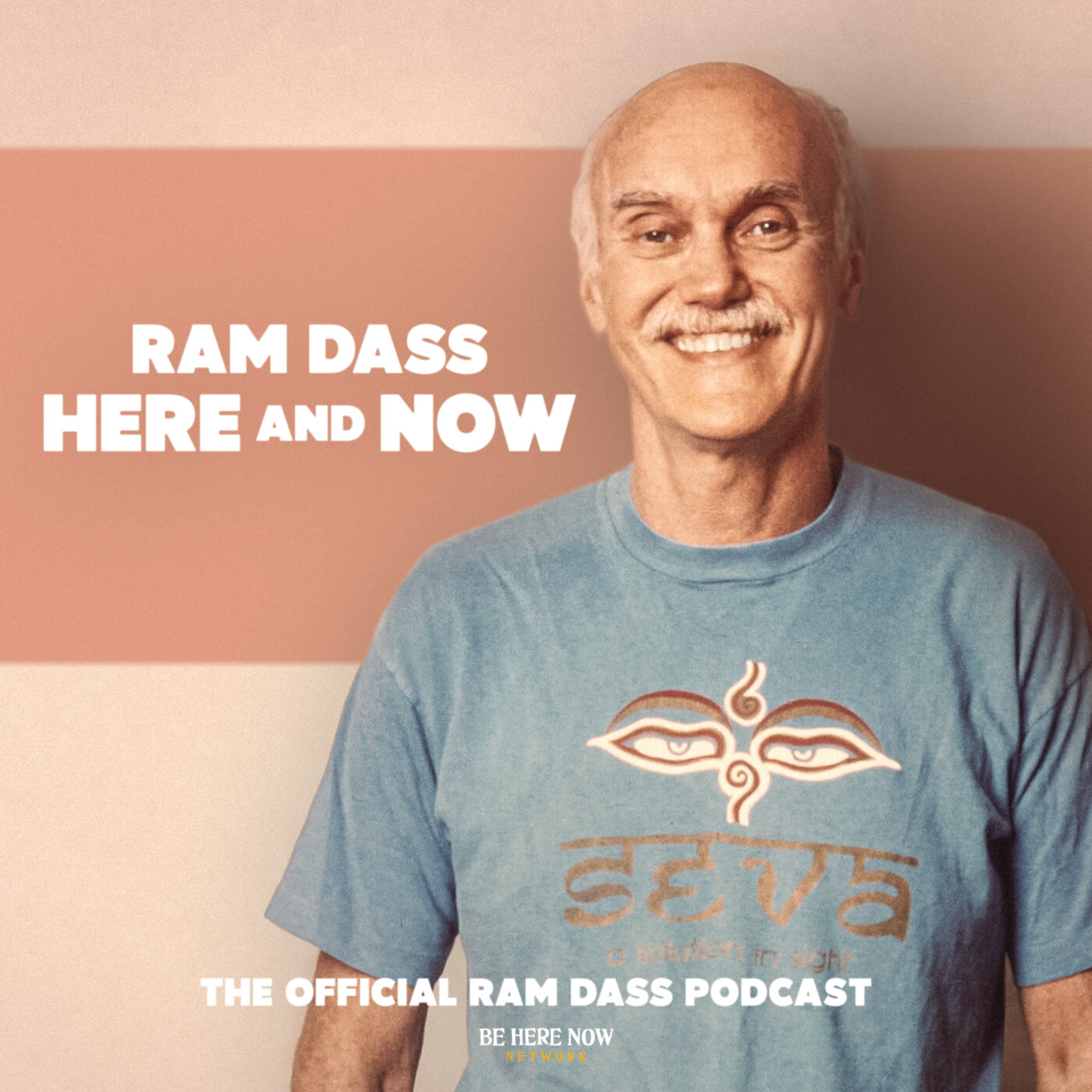
Ep. 296 – The Delight of Simplicity feat. Daniel Goleman
38m 36s
This dialogue between Ram Dass and psychologist Daniel Goleman examines the paradox of modern dissatisfaction amid convenience and technology. It identifies the core issue as our attachment to external identities, achievements, and polarities (like good/bad), which are transient and leave us perpetually striving. True peace, they argue, arises not from rearranging the world but from changing our relationship to our own minds. By shifting from a materialistic focus on "having" to an inward focus on "being," we can discover a deeper, unchanging self—akin to pure awareness or the space between thoughts. Practical steps include meditation, mindfulness (such as breath observation to gain perspective on emotions), and simplifying life to reduce melodrama. The conversation highlights that fulfillment is found internally, through practices that cultivate presence, loving-kindness, and a detachment from clinging to fleeting experiences, ultimately leading to a contentment secure from life's inevitable changes.
One goes beyond the concept of beyond, one goes beyond concepts like this and that, and me and you, all the polarities, dark and light, day and night, good and evil. This doesn't mean one doesn't live, and isn't able to function with polarities. It means one isn't lost in them, and that's the distinction. Welcome to another here, and now, episode with Romdos, this is number 296, the Delight of Simplicity. It doesn't that just feel yummy like it resonates in our bones, and yet how on earth do we get simplicity? That is the heart of this conversation, so it is between Romdos and Daniel Goldman, a psychologist and the author of "Emotional Intelligence." It was recorded many years ago, but per usual, it speaks with remarkable clarity to the moment we are living in right now, and what is this moment? I mean, I don't know, but it feels like it is filled with so much confusion with this relentless pace with constant noise. It feels like we are confronted regularly by fear and inequality and disconnection, and in this striving that never gets anywhere and is never quite enough. We face visible suffering every day. We see it in our personal lives, in the collective, we see it systemically, and it can be hard to know how to stay open without being overwhelmed, how to care deeply and not feel worn down by the caring. So that is the heart of this conversation. It's a simple question with so much progress and convenience and technology. Why do we still feel so unsatisfied? Right? And Romdos, he points us inward as he typically does. He invites us to look at the mind. How are we clinging to our experiences, to our identities, to the stories we tell ourselves about who we are and how we think things are supposed to be? He gently points us to practice that we can't rearrange the world with our outrage or with our striving, but we can change our relationship to our own minds. Their message, Romdos' message is that peace starts inside. We have to put down our phones. We have to practice presence. We have to practice loving kindness and we have to do it over and over again. And that means putting down the things that we cling to that we think are absolutely real all of the time. And so that's the invitation of this talk. Now our nervous systems are pretty jacked in this world because of the things I mentioned earlier. And so it's nice to have some support along the way. The monks, they have some support along the way. Romdos had support along the way. So there's lots of different ways we can get support. We can breathe. We can do yoga, needro. We can hot cold plunge. We can talk with friends. And we can also turn to the plant kingdom. And one of my favorite ways to turn to the plant kingdom is this wonderful shot I've been talking about for a long time now. It's called magic mind. I still love it. So they have a couple different shots. And one of them is I take in the morning. It has a bunch of neutropics and adaptogens and it gives me lots of energy without caffeine and without crashes, it creates stability. And then they have this other shot that helps with sleep without melatonin so you don't feel craggy. It just sort of eases you into that beautiful rest that we all need to be able to face this world well. So check it out. They are right now offering this incredible New Year's sale. It's $327 worth of mental and sleep performance shots for only $74.25 which is less than a cup of coffee a day. So check it out magicmind.com/romdos. So here's to having a mindful life. And here is Romdos, here and now. And as always, whatever good comes from this lecture, may it ripple out into your life and be a benefit for all beings everywhere. And may we all have health and happiness and peace and live a life of ease. Namaste and blessings. Romdos, you have a background as both a psychologist and now you've had training as a yogi. And I wonder what in your own seeking can help you and maybe help us to understand why it is that people aren't happier or more satisfied, more content. There is a common set of experiences that are happening to literally hundreds of thousands perhaps millions of people in this culture at this moment that concerns a certain kind of an awakening, whether you want to call it spiritual or consciousness or I don't know what, that all of the fantasies that we had had as children, even as college students, weren't going to give us the feeling we thought they were. It's like when the child you had a feeling the circus was coming to town and there was tremendous excitement and then the circus came to town and there was the tremendous excitement and it was what you had expected it was and for that moment it was fulfilling. A moment later the circus had left town and there you were again and you quote came down from your high, every lifestyle has its limits, everything has boundaries as long as it's a thing, as long as it's an experience in time and space. When I was in psychology I buy say a big motorcycle and I drive faster and faster in the beautiful hills of California and it would be exquisite for a moment and then later I get kind of bored and the motorcycle would sit at home and then I got an aeroplane and then I went scuba diving in the Caribbean and then I got a Mercedes and I did everything to try to get that feeling of fulfillment and I get it for a moment, always again and again a moment and then it would be gone and as long as I kept looking for things that were in time I kept suffering. I kept having them for a moment and there'd be no suffering and then a moment later they would be the suffering again and so I had a look for something else and of course it wasn't at that time until much later or it wasn't until much later that I connected with things like Christ saying lay not up your treasures where Moth and Rastoth corrupt and where thieves steal, I mean in other words don't invest in that which is in time or Buddhist teachings of the noble truths that said really the cause of suffering is clinging to things or to something which is in time or in space. Then for a while for maybe four or five years I shared a fantasy with many that psychedelics would give me so much more of everything it would intensify my experiences so much my sense experiences that it would be enough that didn't turn out to be the case and that's the case that most of the culture works with now that more is better, more food, more exquisite food, more entertainment, faster cars, more and more and more of every sense that that will do it. Now what we're undergoing at this moment and we're in lies a change in our relation to the universe and thus a change in our suffering is the same thing that Einstein did for physics. We are shifting our perceptions of reality and we are shifting from absolute to relative reality and that makes everything different. When you grew up you parents told you what reality was and some things were reinforced externally that's hot, that's cold, that's good, that's bad, set of values, set of belief systems, set of definitions, discriminations and so on. Education furthered that training, it's called socializing people and you built a model of what a reality was and that reality was in time and space. It had a linearity to it so your life was seen as a timeline and you were moving from one point in space to another. Furthermore you developed a set of definitions of who you are. I am a man or I am a woman, I am an American, I am of this religion, I am of this culture, this economics, this education, I have this kind of a body, I have a variety of different definitions of myself called social roles, psychological roles, I am a happy person, I am a successful person, I am a responsible person, I am a good attorney, I am a good homemaker and so forth and these definitions became part of our reality and we got very invested in this reality as a solid entity with no edge to it, there is no edge that was reality. Now around the beginning of the 60s for me when I first started to take these psychedelic chemicals, I saw that what I had called an absolute reality and what everybody had told me was absolute reality was just another one. It wasn't the only possibility. Have you found anything better, another reality, another way of living, another kind of way of being in the world which answers the predicament that you have outlined for us? The root of the problem as we have pointed out is really in one's mind and who one thinks one is and that's who one thinks one isn't or what one thinks one isn't and the solution or the surceased from suffering is as simple as the changing of one's mind, it's really nothing else than that. Well I spend a lot of time in a very small village in India and there I'd say the average income of the people, I'd say most people make a couple of dollars a day and their living is so simple and so close to the earth, so without frills and so without most of the things we think are almost necessary for survival and yet there is some quality in those people that when I'm around them, I feel more a sense of fulfillment, contentment and peace than I feel in people that are making fifty hundred thousand dollars or at the top of their field in America. Now what's different about those people? Well the key thing is that the source of this satisfaction lies in the nature of their being rather than the nature of their having or doing. Most of us live in what would be called a philosophically materialistic world. I don't mean materialism in the gross sense of more conspicuous consumption of physical stuff. I mean we think of our life, our identity as co-terminus with our physical existence. That is when we're born, we exist and when we die, we cease to exist. That's the first model we have. And death is very frightening because it's an empty space beyond and you push it away as hard as you can and you take your three score in ten years or whatever you have on the earth and you fill them with as much gratification as you possibly can. The people in this village see a lifetime as a very different thing functionally. They see it as first of all part of a chain of lives so that they live within what we would call reincarnation. That is they see an entity that takes birth and dies many many times, in fact many thousands of times and they see that each birth has a certain function. In our society everybody is taught that anybody could be from president. In that society that wouldn't be said because it wouldn't be desirable because each person would be taught that he or she must listen to become who they must be rather than to be an external model of success. That the sweeper in the town can be just as fulfilled and just as happy by being the perfect sweeper without having to be embarrassed or anything. The king will honor the perfect sweeper for being the perfect sweeper and the perfect sweeper may be a more perfect sweeper than the king is the perfect king and thus the perfect sweeper has more fulfillment than the king has been king. But it sounds like such a foreign way of seeing oneself is there anything that we can take from there that would help us get to the kinds of satisfaction they have. What we learn from that and what we're learning from our technology strangely enough as well is that it is possible to delve deeper within ourselves to find an identity or a sense of our self that is not as vulnerable to time and space shifts. If you're young and beautiful or an athlete you make this huge identity in your body and then a few years later it's all over. The most anxiety I ever saw I think were among the top models because it's such an ephemeral thing. They're a top for a moment and then a year later the rose has gone slightly beyond its perfect moment and they're already getting second slide jobs. What I learned from the East was a sense of the depth of the people's identity of their own being. In India they call it like the source that's in each human being and one of the tremendous preoccupations in the West, this preoccupation with meditation, the looking for a deeper sense of oneself that isn't as much open to the shifting definition of time. They talk about an image of a candle flame and for most people the candle flame is with a wind blows it and the flame is always flickering. But when you get a deeper sense of self the candle is as if it were in a niche in the wall where the winds blow by the wall but the candle doesn't flicker. It's very even, it's very quiet, it's very strong and peaceful. I think that as I went through psychedelics and then as I got involved in yoga I slowly meditated my way into an identity in which I saw myself as an entity or a soul or being that fulfilled different social roles like I was a person who was a teacher but I wasn't a teacher as a primary identity. I was a being as a primary identity. I just am, I just am, I am and then I teach, I am and then I'm a man, I am and then I'm balding, I am and so on, I am and then I'm my father's child. So I can see that there'd be an advantage to having that kind of a center and an identity but practically speaking how can a person change? How can you give up all the things that we've been taught to be? Well I think it's a fallacy to think first of all that you change by changing the externals of your life. The fallacy of saying well if my life is so tense and so unsatisfying in this marriage if I leave the marriage or if I leave this job or if I go, if I'm in East Coast, if I go to the west coast or if I go to India or go sit in a cave or something like that, somehow it'll be better because the truth of the matter is if you're neurotic in New York you'll be neurotic in Chicago. Most people they found out they keep creating the hells wherever they go. So perhaps now we're ready to hear that the changes, the freedom we're looking for is inside and the work has to be done inside. We have the nature of our thoughts and we have the nature of our feelings and we have our body chemistry. These are the kinds of things we work with. So that all of yoga for example is working with these aspects, learning how to quiet the mind because if you're busy being a housewife and you're very invested in shopping, cooking, raising the children, etc. You can continue doing all that but by adding in even 15, 20 minutes a day of a different space, which we can call a meditative space, you could gain a perspective on that whole life you lead, which would start to tune you to a sense of yourself that is quite different from that of being a housewife, quiet your mind enough so that you can become attuned to deeper parts of your own identity. The thing that you must do are to work with your feelings, with your emotions, with your heart, with your relationship to the universe so that you get into a flowing relationship with things around you so that you are tuning to them, not trying to control them so much. Lawrence Clocone, an anthropologist, differentiates cultures which are man over nature versus man in nature and we are a man over nature culture, we're always trying to control and manipulate. So we have all of these ecological imbalances in our society while the American Indians for example were a man in nature and they were always listening to hear the harmony of things and when they pulled up something they planted something else, they kept the balances and they felt the harmony of it all and that comes from the heart, most of it comes from tuning, attuning to energies and attuning to feelings of the universe, it's not an intellectual, it's not a conceptual thing at all. So these are some of the things that one does. It starts to perhaps simplify your life a little bit. Most people keep their life at such a fever pitch of melodrama that they can never tune in to the deeper self because they are so busy bailing themselves out of one crisis after another and they keep creating the crises. You can feel that happening in most people's lives and the quality of wise people seems to be the simplicity of their life. When we show success in our society, we show incredible complexity. Somebody like Mahatma Gandhi who walked into parliament, the British parliament barefoot in a simple cloth that he had woven himself and just walked in, we think it's kind of eccentric and delightful and sort of eastern and strange, right? But we don't yet appreciate the delight that comes from simplicity. Some of our poets, people like Whitman and all, have described it, but we've never really bought it yet. We really don't understand that in that simplicity lies a space in which one can plumb one's own depths of being and appreciate that who you are is an entity that has taken birth that is passing through a series of experiences, all of which are useful in order to awaken to one's deeper self, given an ordinary example of how someone can use a life situation to get more calm or simple or centered. If you get angry at somebody and it all is very real and you're very furious at them and they're angry at you and everybody's busy reacting to everybody else and escalating the anger and you sit down for about fifteen minutes and just do something as simple as following your breath, just breathe gently and just bring your attention to your breath. Don't think about the anger at all, just bring your attention to your breath, forget about it for a while. Every time it comes, just notice it, say, yeah, right, of course I'm angry and go back to your breath. First, your breath will be very agitated and very strong because you're so angry and then pretty soon your breath will start to quiet down. Every time you think of what you're angry about, you get angry again. But keep coming back to the breath and back to the breath, they'll come a point when you will become calm enough that when you think about the thing that got you angry, you'll see it from a different perspective. You'll have just a little distance, just a tiny bit of space and that space is like the secret of the whole game. The space that gives you a perspective to see the way you were so caught in the thing that you couldn't appreciate perhaps the humor, perhaps the absurdity of what you've gotten yourself into, perhaps the fact that even though you're angry at the person you really love them, the cause of most suffering is that you get lost completely into one perspective, one perception, attachment to a model, an attachment to a label, an attachment to a definition of the reality and you get stuck in it, even death, physical pain, like there are ways of training people when they're experiencing incredible suffering, physical suffering, to meditate upon the pain until they can just see it as pain and yet have their self separate from that which is in pain and that's very different from somebody who's lost in their pain and it's the space around events, around experiences that gives one the leverage for change and it's in that space that lies the peace and the contentment and the sense of being that is secure from that this is and that's of life. Now if you could imagine a stream where leaves on it fall autumn leaves, floating down the stream and each leaf is a thought and you're sitting by the side of the stream watching the stream and the thoughts the leaves float by one thought at a time and then you see that between the leaves is the stream and that it's as if there is a figure which stands out which are the thoughts and then there is a ground which is the space in which the thoughts exist and that space is like just pure awareness and who we are turns out to be that pure awareness or the space between the thoughts rather than the thoughts. The awareness gets grabbed by a thought and the grabbing is so strong that the identification it locks in and we identify with the thought and we say kogito ergo sum I think therefore I am. We identify totally. The act of meditation is the developing the capacity to identify with the space between the thoughts and that space is very even and very unchanging and very expansive and very outside of time and space. The whole mystical tradition that we are now so fascinated with concerns that space and a being who is identified with the space doesn't lose her or his capacity to think or to act. In fact the thinking and their acting may well be more effective, more optimum to any situation because they are existing in the space that allows them to see more totally the nature of their predicament, they sense the totality and therefore they don't waste their energies identified with one perceptual vantage point or another. It's as if I may have a pain in my leg, I can get so preoccupied with it that I am just a person with a pain in my leg. It's my total reality at that moment or I can just see it as a pain in that leg and I am and then there is the pain in the leg the same way with any social role. If I were a dentist or a homemaker, I can become so lost in my social identity that that's my only reality. That's a set of thoughts. In how did I become a dentist it's a model in my head about being a dentist or I can get into the space that exists just beyond, just beyond that model. One goes beyond the concept of beyond. One goes beyond concepts like this and that and me and you, all the polarities, dark and light, day and night, good and evil. This doesn't mean one doesn't live and isn't able to function with polarities. It means one isn't lost in them and that's the distinction. One is the space that we're talking about that exists behind thought. That space is the closest that we can conceive of what God is. For it is a space that has no form, it has no definition. To say that it's love or to say that it's energy or to say that it's consciousness, those are all true but they're all false because they're limiting conditions. But to be in that space, one is seen by others as loving. One is seen by others as compassionate when it's seen by others as wise. One is seen by others as always intensely involved and present in life. They talk about chopping wood and carrying water of the Zen monk who's just right there simply living in the moment, doing the thing totally. And yet at the same moment has a mind that is so expanded and peaceful and spacious that he's aware of the domain in which he is chopping wood and carrying water. And he is one with that domain as well as being able to function at the level of the daily activities. The fear most people have had is that if they delved into themselves too deeply, they would lose their effectiveness in life. And that's a fallacy. In fact, I'm convinced that meditation makes you a more effective person, but that's not all that does. That's not what it's all about, but that's what it does. I think we're on the edge now of a very much over-determined awakening that is that much economically, technologically, politically. The bomb, all of these things are forcing humanity to become more conscious of itself, in order to survive and in order to find meaning for its existence. And this ultimately brings the spiritual and the worldly domains together. We have spent a lot of time separating church and state in so many levels. And we lost the first commandment. We lost the awareness of the One, God, of the One, space, of the One's source, of the One's presence. We got so fascinated with individual differences, with the power of our own intellect. It's interesting in yoga, along the way, as you do all of these purifications and meditation and work in your body and so on. You develop these powers, like powers to read minds or to know what's going on at distances or to travel out of your body or all that kind of stuff. And they're very seductive to start to do good with them, even, you know, to use them. But when you start to use them, you tend to get lost and you don't go the whole way of yoga, which means union finally with just that space. And you don't become a totally free being or enlightened being. You get seduced by the powers, by fascination with our own power, of our own minds. Einstein, for example, said, "I didn't arrive at my understanding of the fundamental laws of the universe through my rational mind." His intellect allowed him to explain what it was that he understood. But how he understood it was through another way of knowing. We call it intuition, which means we don't understand it. But these are other ways of knowing the universe, and they're available to humanity. Thought alone isn't enough. The intellect is an exquisite servant, but a terrible master. And in a way, the transition that I'm talking about is getting to the point where you have available your intellect to use when it is appropriate. But you aren't trapped into a total identification with it. It's like when I was younger, I was very identified with my body. And as I started to go bald, I had a great deal of anxiety about it. I comb my hair to cover my bald spot. Now I'm identified with the space. And in that space exists a balding man. And I enjoy him. He has a certain humor connected with him. And I'm not any longer uptight because I'm not the balding man. The balding man just exists within my space. When I was at Harvard, I was identified with my intellect. And the more thoughts I could think and the faster I could think them, the better I was at my game. Now, I'm a spacious being who has an intellect. And sometimes I use it when I have a problem to solve, and when I don't need it, it sits on the shelf and my mind is quiet, so that there is a lot of space in my daily life. Most of the time, my mind is very quiet, and I'm just open to what's happening around me. It's like a wild, like a wide eyed infant just opened to stimulate. It's like having sunglasses. Sunglasses are great when it's very blinding brilliance out. But it's nice to take them off when you go into a dark room. Same with your intellect. It's good to have it available, but it would be nice to be able to turn it off a little bit so that you could have peace in sign. And much of the time I live very quietly, and very empty, and very open, and very spacious with just sensations almost at a primitive level of colors and waves of light. And sounds floating. You could define it as a white light or a space of equanimity or homogeneity, if you will. These are all possible only when we break this tremendous identification we have with our intellect, with our senses, and more superficially with our social roles and with our bodies. Because who we are isn't who we think we are. And when our body dies, we're not going to die, because what we are is this space. And this space has nothing to do with our body. And it's in that identification with that space that lies the end of suffering. Suffering comes from attachment or identification or clinging to your senses, to your thoughts, to your models of yourself. Boy, you do it. Boy, you suffer. Simple as that. Each of us has been through lifetime after lifetime after lifetime. If you don't imagine a clock and a 12 o'clock, everything is in perfect harmony. Nothing is separate from anything else. There are, this isn't that, but there is nothing that identifies itself as separate. It's not identified with its separateness. Even human beings are part of the process, part of the flow, part of the harmony. The perfect harmony of all things is all within the Spirit of God. And within that space is the opportunity for a part of the system to choose to be separate. It finally brings us home, is when that identification with the knower, as opposed to that which is known, is broken. We can still know, but primarily we be. We just are. We are, and the tree is, and the stream is. The automobile is, and violence is, and the rose is. It all just is, of which we are a part. And our knowing is, but our identification is with our being. Not with our knowing, not with our doing. The basic fallacy is the identification with the doer, as opposed to the beer. This podcast is brought to you by the Love, Serve, Remember Foundation, and Ramdas.org. We appreciate you listening, and we appreciate all the support that you've given us. Please continue that support, and donate at Ramdas.org. We can then continue to share what Ramdas has been sharing for all of these years. Thank you.
Podcast Summary
Key Points:
The conversation explores why modern life, despite technological progress, often leaves people feeling unsatisfied, overwhelmed by constant noise, fear, and disconnection.
The root of suffering is identified as clinging to identities, stories, and external things in time and space, rather than finding a deeper, stable sense of self.
True contentment comes from shifting focus from "having" and "doing" to "being," cultivating inner peace through practices like meditation, mindfulness, and simplifying one's life.
Practical methods include observing thoughts without attachment, using breath awareness to create mental space, and changing one's relationship to the mind rather than trying to control external circumstances.
The discussion contrasts Western materialistic views with Eastern philosophies that emphasize an enduring self or awareness beyond social roles and transient experiences.
Summary:
This dialogue between Ram Dass and psychologist Daniel Goleman examines the paradox of modern dissatisfaction amid convenience and technology. It identifies the core issue as our attachment to external identities, achievements, and polarities (like good/bad), which are transient and leave us perpetually striving. True peace, they argue, arises not from rearranging the world but from changing our relationship to our own minds.
By shifting from a materialistic focus on "having" to an inward focus on "being," we can discover a deeper, unchanging self—akin to pure awareness or the space between thoughts. Practical steps include meditation, mindfulness (such as breath observation to gain perspective on emotions), and simplifying life to reduce melodrama. The conversation highlights that fulfillment is found internally, through practices that cultivate presence, loving-kindness, and a detachment from clinging to fleeting experiences, ultimately leading to a contentment secure from life's inevitable changes.
FAQs
Romdos emphasizes that peace starts inside by changing our relationship with our own minds, rather than trying to rearrange the external world. This involves practices like presence, loving-kindness, and letting go of clinging to identities and stories.
The root cause of suffering is clinging to things in time and space, such as experiences, identities, or material possessions. This attachment leads to a cycle of temporary fulfillment followed by dissatisfaction.
Romdos shares his personal journey of seeking fulfillment through a motorcycle, an airplane, scuba diving, and a Mercedes, only to find that each provided momentary satisfaction before fading, highlighting that external pursuits in time cannot bring lasting peace.
By focusing on the breath for a short period, such as 15 minutes, one can create space from anger, allowing the mind to calm and gain perspective. This distance helps see the situation more clearly and reduces emotional reactivity.
Simplicity creates space to connect with one's deeper self, moving away from the melodrama and complexity of modern life. It allows for a sense of being that is secure and not dependent on external definitions or achievements.
In the West, identity is often tied to material existence and social roles, leading to anxiety and dissatisfaction. In contrast, Eastern views, like those in an Indian village, focus on being rather than having, with identity rooted in a deeper, timeless self, fostering contentment.
Chat with AI
Loading...
Pro features
Go deeper with this episode
Unlock creator-grade tools that turn any transcript into show notes and subtitle files.
 PodcastTranscript AI