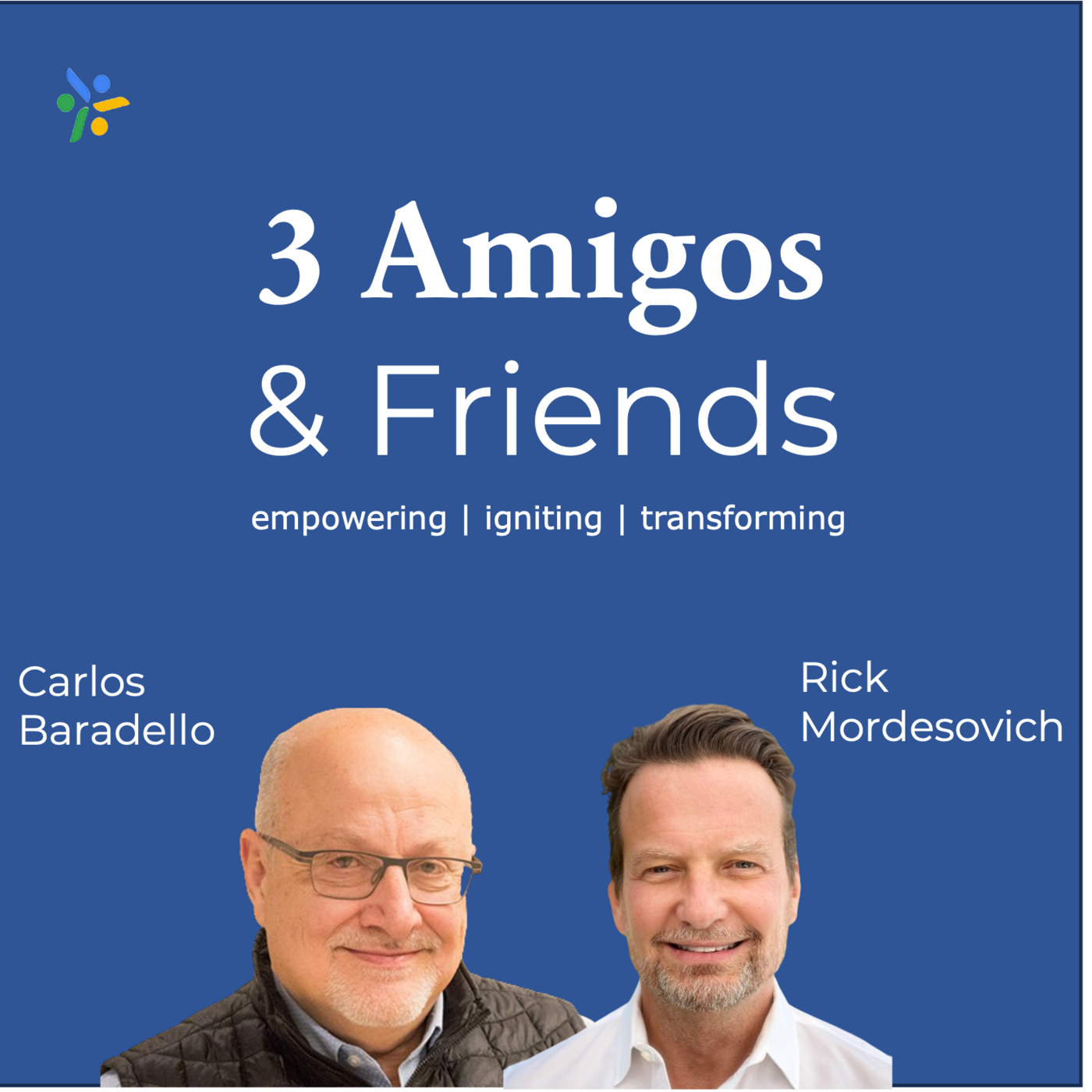
EP 20 | Crafting Your Investment Strategy - Rick Mordesovich
from 3 Amigos & Friends
29m 49s
In this episode of the Three Amigos and Friends podcast, host Carlos Baradelo interviews Rick Mordosevic, CEO and founder of Sonoma Private Wealth. Rick shares personal aspects of his life, such as being a photographer and his support for marriage equality, before delving into wealth management insights. He stresses the importance of having a financial plan with clear short-term and long-term goals, starting as early as possible to benefit from compounding. Common mistakes include not utilizing employer 401(k) matches, chasing past investment performance, and having unrealistic expectations. Reflecting on industry changes, Rick notes the impact of events like the dot-com bubble and COVID-19, highlighting the growing relevance of ESG metrics for risk assessment. Despite global challenges like AI and political uncertainties, he remains optimistic, advocating for diversification, realistic planning, and informed risk management to navigate an evolving financial landscape.
(upbeat music) - Welcome to the Three Amigos and Friends podcast, where we aim to empower, ignite, and transform society by connecting business lessons with our personal touch. - Welcome to a new edition of our podcast, Three Amigos and Friend. Every week, my amigo Paul Campbell, half-cloth, and I, Carlos Baradelo, engaging conversation about a business topic that we have experienced in our career. Our objective is to bring into conversation our diversity of perspective, as we have done in the classroom for over the last decade. Today, we will address the topic of wealth management by a pro and a long-time friend Rick Mordosevic. CEO and founder of Sonoma Private Wealth, based in Sonoma, here in the Bay Area, in Northern California. We will invite Rick to explore his profession and share his experience in this business, which is not often part of our business conversations. Welcome, Rick, to our podcast, Three Amigos and Friends. - Thank you, Carlos. - It's wonderful to have you here, as we engage in the conversation, and we learn more about your background. Let's start with our standard question to our podcast. Share with our audience something most people don't know or expect about you. - Most people don't know that I'm also an artist. I'm actually a photographer, and a fun fact is I just sold two pieces of auctioned bottoms in January. - That's wonderful. I have known you for a long time, and I didn't know that. - Fun fact, that's exciting. And another thing that he gave us more insight into you, tell us a free body quote, and what is the personal connection that you have with it? - It has to be for me, it was a quote from Justice Anthony Kennedy, and it relates to same-sex marriage or marriage equality. So as your listeners may or may not know that, in June 26th of 2015, the Supreme Court ruled that marriage should be allowed to all Americans, regardless of sexual orientation. So my favorite quote is from 2015 from Justice Kennedy, times can blind us to certain truths, and later generations can see that laws once thought necessary and proper, in fact only serve to oppress. He went on to say that civil rights are not supposed to be determined by the whims of the people. Carlos says, "You know, I went on and got married in 2018 to my partner Warren, so it was a very meaningful event for me in my life and a very meaningful quote." - Excellent, thank you, Rick. Taylor, what is in your mind recently that you would like to share with our listeners? - I am a bit of, as you know, a bit of a news junkie, and I have, you know, Bloomberg TV on old day in my office while I'm working, and I think two big things are weighing on my mind right now. Number one, vote for your listeners out there and this is an important year. You know, regardless of your party affiliation, go out and vote, vote, vote and vote. It also brings me to my second favorite quote, which is by Winston Churchill, the best argument against a democracy is a five minute conversation with the average citizen. So it's a little, it can be a little complicated. The other issue that's on my mind is immigration, and you know, what's happening at our southern border, which is in the news cycle every single day, Joe Biden and Donald Trump are down with the border this past week with dueling messages about the border and about immigration. There was a great article last week. I think it was in the Washington Post on February 27th. The title was "The Economy is Ruring Immigration "of the Key Reason." And basically the messages, you know, we need immigration. Immigrants aren't our problem. They're the solution. You know, we need a workforce, and we can't do it organically. We can't do it domestically. We need to have immigration. Immigration is a hot topic. It doesn't matter where you are in the world, Europe, which I am well informed. They are really struggling with demographic trends and so forth. And I'm sure that that topic is going to come into the conversation. But then as to start a little bit about how you got into wealth management, and that is going to give us a little bit more background in terms of who you are and your professional journey. Yeah, I have always had a love for math. You know, growing up, I have a love of planning and being organized. I grew up in a house with four scorpios where there was total chaos and good thing on a Leo and I could take on the challenge. I kind of got into the business. My first job was with Dean Winter Reynolds, which was a great company that was originally founded out of San Francisco, Dean Winter. And it merged with a company on the West Coast called Reynolds, and it became Dean Winter Reynolds. It later in the late '90s was merged in and sold to Morgan Stanley. So that firm no longer exists. It's been folded into Morgan Stanley. I had an investment investment account when I was in my 20s and had a love of stocks and investing. Friends that worked at Maryland said, you'd be a great broker or advisor, you really should. Think about it. And I just had never thought about that as a career path. And I ended up applying for a job and was hired and just really thrived. In my first year at Dean Winter, I won the National Sales Director's Award. Was a bit of a superstar and just it all happened from there. And what that'd be for or after your MBA? Actually, it's before my MBA. I worked at Dean Winter before my MBA. And working in finance, I decided that I needed to go back and get my MBA, the University of Chicago. And I was there before it was called Booth. It was just there a long time ago. It was just Chicago GSB graduate school of business. The Booth brand came later. So I went back and got my MBA and I finished in '99. And then I landed in San Francisco in May of 2000. What principles should the individuals consider in developing an investment strategy? Is this something in your experience that most people overlook or, and when is the right time to start looking into these? Today is the right time, Carlos. Do it today. [LAUGHTER] Yesterday was the best time today's adventure. The biggest obstacle or the biggest failure I see when I meet with people at all different levels and ages is not having a plan. Not having a roadmap. It would be like planning a journey cross country from San Francisco to New York and not mapping out your plan. That might be a bad example because you can just take IAD straight across the country and just head east. But having a plan, having a roadmap, and having a well thought out plan with goals that are both short-term goals and long-term goals. And understanding the difference. Short-term goal, I want to pay off debt or buy a car or long-term goal. I want to buy a house or a condominium. How am I going to achieve these goals? Anything having a strategic plan, financial plan, life plan, the two dovetail together and sticking to that plan. Because circumstances are going to change. There's going to be market volatility. And I think having a plan is the key to that. But typically people have challenge, because what you're looking is to plan the next 20, 30, 40 years. It's a long-term plan. They're thinking about retirement or major events in your life and eventually how you're path, your wealth to children or whoever you will. Typically, people tend to receive, especially younger generation, that they are so short-term or reentered. How do you deal with that? And how do you develop the trust required by your clients to engage in those type of conversation? It's got to be a match, right? I mean, having a good financial advisor, I think a disclaimer, I'm not here to give anyone specific financial advice. This is all general conversation with you Carlos. Everyone should talk to their advisor and CPA or tax planner. But I define short-term as the next 12 to 18 months, 6, 12 to 18 months of short-term. And then long-term of three or five or seven year and beyond. I think to plan for retirement, 30 or 40 years out seems kind of cumbersome. But the early start, there's the compounding factor of wealth building that the younger you start, the higher probability of success. There's a great statistic. I just read it came out from Fidelity Investments last week that in 2023, people who invest in their company before 1K retirement plans, the number of millionaires jumped by 20% in 2023. According to Fidelity, they're now 422,000 401K millionaires in America today. And that's a wonderful statistic to share. You already mentioned that one of the core mistakes that people make is not to have a plan at all. What other mistakes can you think that you have experienced as you look back over your career? One big mistake, I think anyone, any of your listeners that are out there, if you have a company 401K plan and you're not participating in it, you're losing money. You should sign up tomorrow because that money goes in tax deferred, you're saving for your future. And I've seen the mistake where I've met people that they even have a company match in their 401K plan and they're leaving money on the table. So by not contributing, they're not getting the company match. And so it's free money. And if you're growing that wealth, tax deferred. And so that's a huge mistake I see out there. Another one besides not having a plan is chasing the hot dogs.
or chasing last year's good investment performance, whatever fund or ETF or part of the market did well the last year. People this year want to start investing in something that did well last year. And basically they've missed the boat that's not the place you want to be looking to invest in the rearview mirror. You want to be forward looking and have a well diversified portfolio. The other one, which is sort of funny, I would run into these characters over the last, you know, 10 or 15 years of being an advisor. Are people to have unrealistic expectations of what they want and let me tell you a story. I would always meet a guy and I would be referred to me by a client would sit down and I would just have a pad of paper and ask a bunch of questions. I want to learn about them and who they were. Tell me about your family. Tell me about your job career. Tell me about how you created, you know, wealth. And they would say, you know, I really don't believe in paying for investment management services unless you can beat the market. And like, God, you know, I don't want to pay for services as much you can beat the market year over here. We'd chat some more and take some notes getting to each other. It's eight on 65 now. We just retired and you know, this is all the money I have. I can't one. Jevity runs in my family. I could live to be a hundred. I can't run out of money. I can't lose this money. This is my nest. I cannot work anymore. And it's a God it, you know, can't lose money. And then we've chat some more and then the third or last point general would be in the Louis, California. And we're over taxed here. It's so expensive. I really want to minimize taxes and not pay taxes. They got it. Don't want to pay taxes. And at the end of our hour, I'm sort of summarizing this. Let me get this straight. So you have this wealth you've created. You only want to pay if I can beat the market. You can't lose any money because you can live to be a hundred. You can't take out any risk. And you don't want to pay any taxes. And if you're having nine times out of 10, he would get the joke with laugh and I'd say, you know, let's talk about a realistic expectation for your your life plan or your wealth plan. But one time out of 10, the person wouldn't get it. That's a yeah, that's what I want. And that's a great. But you know, get out of my office and you find it. I want to meet that person too. I'm an investment advisor, not a magician. I have a magic wand back here, but being realistic. So the mistake is the original question. You know, the mistakes they see people really being realistic. And again, having that solid relationship with your advisor. You're a team. You're working together. So to set a realistic goals and expectations of each other and what you can achieve. Based on, you know, your own personal situation, your own cash flow need, your own risk tolerance and so forth. So understanding those goals and having realistic expectations and then putting all of that into a short term and long term plan. You know, I'm sure many of our listeners are wondering about the industry where you work. How is this industry of wealth management have changed over the last 10, 20 years? It's funny. I was sort of thinking about that the other day and I've been in the business long enough that I've lived through, you know, three major disruptive events here in our country and markets. You know, I was around working as a young advisor during the dot com boom. And bust, you know, the late 90s 2000 and I was an advisor in 2007, 2008 during the housing bubble. And then of course, you know, the third one we just had, which is the COVID market shock in 2020. And so, you know, things do change and information is moving much, much faster than it ever has technology is moving much, much faster than it ever has. Problem I saw with people like in the Lisa dot com period for an example in 1997, 1998, 1999. You saw investors really start to chase the hot stock, which was a very small tech startup coming generally out of Northern California, out of Silicon Valley. And these companies had no earnings. They had no assets. They had no products and people, the stocks are going crazy. They were brought to the public market. They probably shouldn't have. They probably should have stayed private until they had some earnings or had a more feasible business plan. And when it crashed, people lost a lot of money because they didn't have a diversified portfolio. There were lots of great companies at that time that were established companies that had good product lines. They had real revenue and real profits. And nobody was buying their stock. The stock wasn't going anywhere. So my point is, you know, had you in, you know, 98, 99, 2000 and buying these boring well established companies, you know, along with some of the dot com having a diversified portfolio. You would have done well. And the role that globalization have played in the last 20 years as you reflect on your career. All the jobs that were off short, you know, companies that were headquartered in the Midwest from Detroit, Cleveland, Pittsburgh, that were off short and technology became much, much quicker. And so the world really, really changed over the last 30 years and now we're seeing that tide starting sort of, you know, shift back and started to think about, you know, things we can make in America, and especially just with national security. And so the fact is, and all the technology that's tied specifically to Taiwan. And now trying to figure out how can we protect that intellectual capital and protect it and bring that manufacturing back here to the United States or into safer regions of the world. We have seen globalization as a major phenomenon over the last couple of decades. Today we have a lot of environmental concerns, climate concerns, sustainability concerns. How do you see this plane a role as you make decisions and help individual deciding their investment strategies. Personally, in my firm, I love ESG is she environmental social governance investing, which has become very, very popular over the past several years. Again, disclaimer, you know, always look at the perspectives and talk to you or advise or in tax plan before you invest in anything, but environmental social governance principles are just that they're just principles. In general, accepted risk metrics. I hope that in our lifetime that it's not even a separate category, just it's another metric like a debt to equity ratio that ESG is just another risk metric. There's been a lot of backlash here in the past year or two, mostly coming out of big oil doesn't like it because it's been extract all the all the extractive industries cold big oil. And affiliations with the state of Texas, the state of Florida, basically any red states have really starting to try and destabilize ESG is the viable metric that should be used for portfolio work or portfolio construction. And that's all it is is just a metric or a measurement. Like if you as an investor, wouldn't you want to know before you put your money into a company, how many deaths are there at your factory in 20, 20, 3, 20, 22, 20, 21. That's good data. How many lawsuits has your business settled over, you know, sexual harassment or sexual orientation bullying or, you know, other instances of improper workplace behavior as an investor, you don't want to know that what if a company is dumping chemical waste into a river or into Lake area or Lake Michigan. I don't want to know that before I invest in that company. So I think having those questions answered around environmental social governance issues, we saw some huge governance failures with Enron, Bear Stearns, Lehman Brothers, there's many examples out there were good governance and good governance metrics might have helped to head off some of those catastrophes. The situation today as you look at the multiple forces playing in the United States and in the world, what is your position are you bullish about the future are you you have concerns, do you play extraordinary side with your clients money or is it time to take some risk. What is your position as you view the next the sales you define short term the next 12 to 18 months. I'm an optimist. I'm always optimistic about the future and I always have a very optimistic feel I'm also I'm very measured at risk, I think understanding risk and measuring that risk and saying, you know, what if this happens what if there is another 2008 type event in the stock market drops 40% you know what if you and I know we both have a passion we both like real estate as an investment class. You know what if our building has a major you know problem how will we sustain that what if renters you know don't appear like right now commercial real estate they're sort of struggling with with vacancies rate. And so I think understanding those risks and measuring those risks going forward very worried about AI and it's entering the general public especially as it relates to elections in this country and across the globe we have more democratic elections happening globally this year than we have in. The last 100 years so I think i'm worried about that so there's lots of risk out there and trying to measure those risks and get good information is definitely a challenge but by nature. I am optimistic and I think we are resilient people that you know the United States we will come through for our allies is needed the need in your industry in the job that you perform to be extremely well informed about all the risks and all the potentials It is a concern because in many ways that inform you in terms of taking decisions is that the case I mean how do you keep up and establish the different vectors of the different areas or shifting from emphasis from one area to the other. Given that we live a such an uncertain world clearly so many concerns are playing every day in the news. I mean I think you sort of take a step back and dial the lens back and look throughout our history and going back to you know World War two and coming out of World War two and as things change going into through the 50s you know there's a great economic boom year rebuilding the United States.
in all throughout Europe. And then as we entered the 60s, there was major civil unrest with civil rights with, you know, JFK's assassination, Robert's Kennedy's assassination. It was a very, very turbulent time to be at Namor, Martin Luther King, and moving into the 70s, you know, Watergate and Women's Rights and Gay Rights. And there always seemed to be civil unrest. There's always something happening in the world that was causing disease and causing some chaos. And I think always sifting through that has always been a challenge. I think understanding that, you know, things do go in cycles or economic cycles or political cycles. The pendulum does swing from, you know, left to right and right to left and trying to navigate through that at times does feel like threading a needle. I think we're watching, you know, one example of that right now with the long awaited recession here in the United States that, you know, people have been talking about for the past couple of years, and it's been going into a soft, we've seen a dramatic increase, as you know, last year on interest rates going basically from zero, you know, to five and a half, six and a half percent, home mortgages, you know, or creeping up almost to eight percent. My first home mortgage, I bought my first house in 1986. I had a 10 percent 30 year fixed mortgage back in 1986, and that was cheap money. And so we've seen these types of cycles before, even though they're painful when they're happening. And through that, you know, interest rate rising of 2023, trying to, you know, cool off inflation and slow the economy, it did not push the US into a massive, deep recession as many had predicted. And so we've seen that bad was sort of able to engineer, hopefully, again, like threading a needle, keeping unemployment, you know, very, very low, employment numbers are strong, raising interest rates, trying to cool the economy, stop inflation, bringing gas prices down, bringing food prices down, and really trying to bring rents through a really skyrocketed last couple of years as well. And so I think always trying to thread that needle, US economy, meaning the largest economy trying to navigate that through these really treacherous waters is a massive job. And following all the data is overwhelming, you know, times to a lot of people. You know, we have, there's no shortage of data, opinions to sift through out there. And I think that's the job of a good advisor is to really sort of sift through that and then bring it to their client base in an effective way. Moving back to technology, technology got in multiple ways, your industry. Once I let winner from losers, we have had the spectacular results in the last few weeks on MVF, for example. But also technology, particularly AI, is changing your industry, your area of work. How do you expect AI to be modifying, changing, and enhancing your work in terms of the advice that you provide to your clients? 30 years ago, if you would call my office and say, Rick, I want to buy, you know, 100 shares of Microsoft, I would write it down on a paper ticket and duplicate. I would have to stand up, you know, leave my desk, walk out in the hallway and roll it up into a suction tube. And it would shoot through the office and a woman would be sitting in the operations department and she'd wire it directly, she'd have a stack of tickets on her desk and she was in there, no chain smoking, a pack of cigarettes a day. And we should wire that to to New York to the floor, they exchanged to be executed. Now those trades, I can do them from my MacBook Pro, you know, sitting in my home office here in Sonoma, there's probably been 30 jobs that have been eliminated in financial services just from trading platforms and trading efficiency that have happened over the last 30 years. AI, I think, is going to change the world in ways we haven't even thought of yet. I mean, obvious ways they can just, you know, call through, you know, hundreds and hundreds and thousands of pages of research reports and condense it down areas, maybe in the legal profession, you know, things that are very labor intensive reading through case history where AI might be able to shift through, you know, cases and pull out very relevant things. We've seen some cases. I think it was the Michael Cohen case where his attorney used AI and the cases didn't exist and nobody did a fact check. So AI came out and presented work and cases to support a position that they were in in a legal situation, but you need a human to go back and do a fact check. And I think there's going to be a very bumpy period, the transition. Another for those of your listeners that live in the Bay Area driverless cars that are zipping around the streets of San Francisco right now. There have been a few, you know, bumps in the road, a few accidents. How long does it one stop at a stop sign? If there's blockage, if someone puts an orange cone in front of it, how long will the car sit there? And what is it when will it know how to react to unexpected situations? And so I think there's going to be a transition period. I am worried about where he's starting to see AI election interference in this country and around the world. And I think that's a true fear that we're going to start to see later here in 2024. But do you see in the foreseeable future driving happening because you have an AI robot making investment decisions to semi-state? I think that bubbles are always possible, especially like right now, there is a lot of investment activity happening, which might revitalize San Francisco. There's a lot of money being directed into AI. We saw Apple last week announced they're abandoning their self-driving car technology, they're reallocating those resources into AI. I'm not sure if those jobs are exactly directly transferable from, you know, self-driving cars into AI, some of them might be. But I think we're going to adjust the impency stage of this technology. One thing I wanted to leave your listeners with today, you know, don't go back to my original constructive, you know, having a plan, having a well out strategic plan short-term long-term. The other mistake when you ask about mistakes is I see that people at times, especially these bubbles like the dot-com bubble of late 90s, the housing bubble, people are driven by fear and greed. And when there's greed in place, if an investment or an opportunity sounds too good to be true, it probably is. Or if it is an amazing opportunity with an amazing return, there's got to understand the risk associated with it. It could be a real opportunity, but there could be real risk associated with it all or nothing. Generally, the higher, the return, the higher the risk. And we saw that in the dot-com bubble, the housing bubble, there were lots of greed, people driven by greed. And then when the bubble burst, lots of people driven by fear, and there was an extreme over-reaction to those situations, but Warren Buffett is one of the people that, you know, will be able to take advantage of those situations and good investors. And whenever one else is selling, you know, be buying and taking advantage of those chaotic situations. Right. Right. We're coming to the end of our podcast and I want to end with a fun note. I assume that one of the three, a friend was just one, the powerball, an incredible amount of money, measuring the hundreds of millions of dollars that he came from nowhere from winning the lottery. What would be your advice for one of us who just have this good fortune? Yeah, good news. You just want to know 100 million dollars. Bad news is you just won 100 million dollars. There's a fun fact. I think about winning the lottery and I've had clients that have been lottery winners in the past. There are seven states in the union where lottery winnings are tax-free. And California is one of those states. If you win the lottery in California, you are not subject to California state income tax, which was a very fun fact that I was sort of surprised by people think of California as being a high tax state. Number one advice, get a tax professional and investment professional. If you don't have one call me, SonomaPrivateWealth.com. I would say before the lottery winner, I personally, my advice, again, always talk to your advisor, get the lump sum. Don't take the annuity over 30 years, get the lump sum and have a good investment plan to put that money to work on a wise plan. And not so fun fact. Nearly one third of all lottery winners eventually go bankrupt within the first three to five years after winning the lottery, which is a bit shocking. The other thing that's not so fun in California is you cannot be anonymous if you win the lottery. You must give your name. You cannot do it through a trust, a blind trust, and you cannot do it through L.C. protection. Under California law, they want to know what individual had that winning lottery ticket. I always tell people, money's good for three things. You can spend it, you can save it, and you give it, can give it away. So if you have a very large windfall, whether it's winning the lottery or inheritance, or millions of dollars in stock options, go back to good planning and start thinking about those three categories. How am I going to spend it? How am I going to save and invest it? And how am I going to give it away? Am I going to give it to family members, children, grandchildren, causes I believe in? And doing that in a very tax-efficient way through maybe a foundation or a donor-by-spon. Warning that we've all seen the news from time to time that many professional athletes that make millions or tens of millions of dollars go broke. They make the mistake of matching their spending levels during their peak earnings. And then when the peak earnings end, they keep spending at those same levels with lavish houses and cars and lifestyle. And they fall off a financial cliff. And I think there's a parallel to that with lottery winners or people with sudden wealth. So going back to having a plan, having a budget, short-term long-term, and sticking to it and revisiting that plan. Well, thank you, Rick. We're coming now to the end of the podcast. We are very grateful to you, Joyna, this rainy Sunday afternoon here in Northern California. We have all benefits, especially our audience, in terms of your insights about a business that is not often discussed, which is wealth, management, wealth, advice, which is definitely a global business. You have the characteristic. So a lot of people engage in the industry, working the responsibility of managing the funds of the clients. So with that, thank you so much and we hope to see you soon again. Thank you so much. Thank you very much. Have a great day.
Podcast Summary
Key Points:
The podcast introduces Rick Mordosevic, CEO of Sonoma Private Wealth, who shares personal insights including being an artist and his advocacy for marriage equality.
Key principles for investment strategy include starting financial planning early, having a clear and realistic plan with both short-term and long-term goals, and avoiding common mistakes like not participating in employer 401(k) plans or chasing past performance.
The wealth management industry has evolved through major disruptions (dot-com bubble, 2008 crisis, COVID-19), with increased focus on technology, globalization, and ESG (Environmental, Social, Governance) metrics as important risk factors.
Rick emphasizes optimism for the future while advocating for measured risk management, diversification, and staying informed amid global uncertainties like AI and elections.
Summary:
In this episode of the Three Amigos and Friends podcast, host Carlos Baradelo interviews Rick Mordosevic, CEO and founder of Sonoma Private Wealth. Rick shares personal aspects of his life, such as being a photographer and his support for marriage equality, before delving into wealth management insights. He stresses the importance of having a financial plan with clear short-term and long-term goals, starting as early as possible to benefit from compounding.
Common mistakes include not utilizing employer 401(k) matches, chasing past investment performance, and having unrealistic expectations. Reflecting on industry changes, Rick notes the impact of events like the dot-com bubble and COVID-19, highlighting the growing relevance of ESG metrics for risk assessment. Despite global challenges like AI and political uncertainties, he remains optimistic, advocating for diversification, realistic planning, and informed risk management to navigate an evolving financial landscape.
FAQs
The podcast aims to empower, ignite, and transform society by connecting business lessons with personal experiences, featuring diverse perspectives from hosts with over a decade of classroom and career insights.
A common mistake is not having a financial plan at all. Rick emphasizes that having a roadmap with short-term and long-term goals is crucial for success, similar to planning a cross-country journey.
The right time is today. Rick advises starting as early as possible to benefit from compounding wealth, noting that even small, consistent investments can lead to significant growth over time.
Some expect to beat the market consistently, avoid all risk, and pay no taxes simultaneously. Rick highlights the importance of setting realistic goals and working with an advisor to create a balanced plan.
The industry has evolved with faster information flow and technology, but core principles like diversification remain key. Rick notes lessons from past disruptions like the dot-com bust and 2008 financial crisis.
ESG provides risk metrics that help investors assess factors like environmental impact and corporate governance. Rick views it as a valuable tool for informed decision-making, though it faces some political backlash.
Chat with AI
Loading...
Pro features
Go deeper with this episode
Unlock creator-grade tools that turn any transcript into show notes and subtitle files.
 PodcastTranscript AI