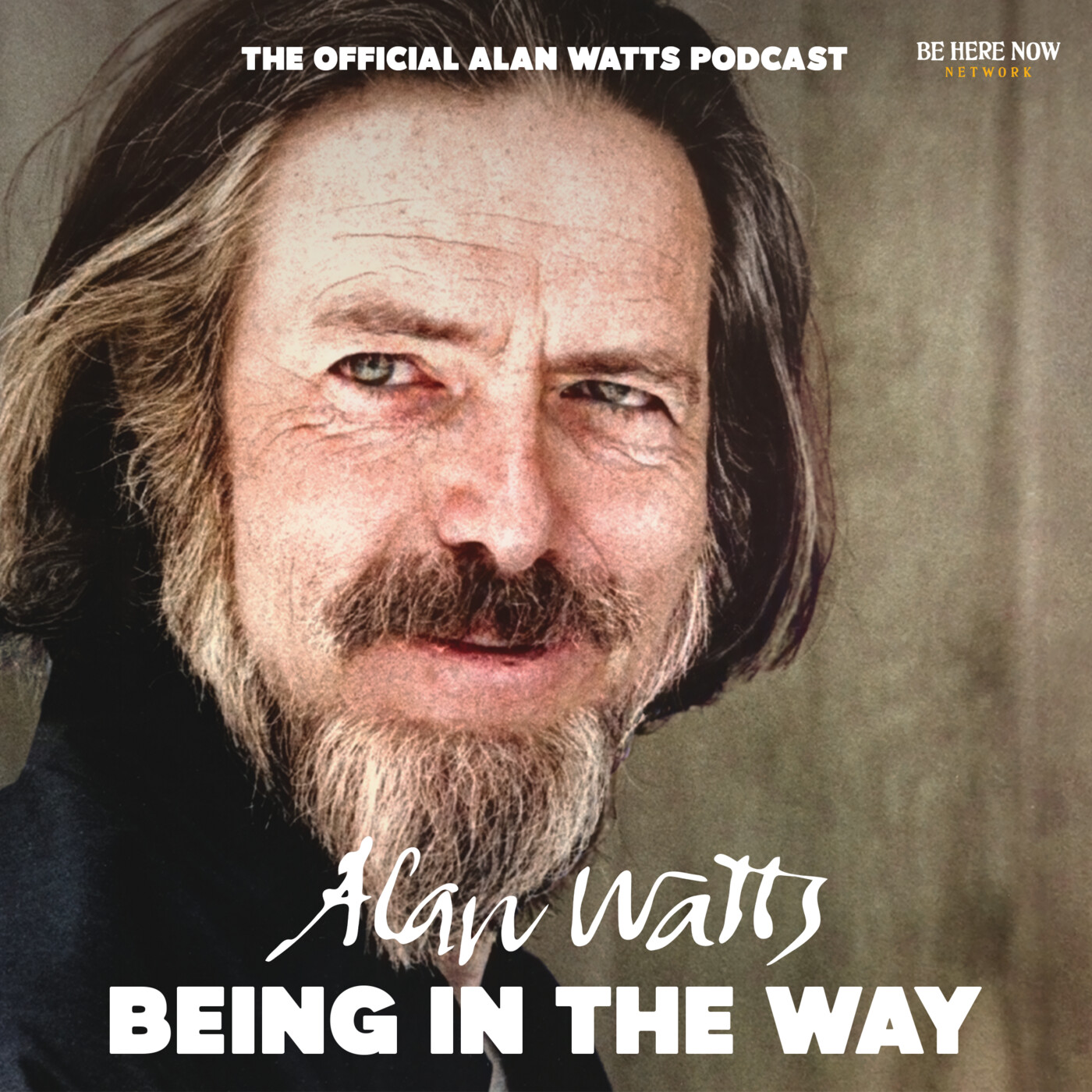
In this podcast episode, Mark Watts introduces part three of Alan Watts' talk "Taoist Way of Dropping Out from Karma" and "The Wisdom of the Ridiculous," while sharing stories about his father's early life. Alan Watts grew up in London, where he was captivated by Eastern art and philosophy, leading him to the Buddhist Lodge, where he impressed members with his knowledge of Zen at a young age. He later moved to New York with his wife, studied under strict Zen masters, but found the rigidity confining. After publishing books and training as an Episcopal priest, he eventually settled in California, where he became involved with the Academy of Asian Studies and later the Esalen Institute. The main talk focuses on Taoist philosophy, emphasizing *wuwei*—acting without forcing—and viewing humanity as part of nature's self-regulating order, as seen in Chinese painting where humans are small within vast landscapes. Watts introduces *li*, the organic pattern in nature, which is orderly yet mysterious and cannot be prescribed. He illustrates this with a story of learning piano from a master who taught him to drop his hands rather than hit keys, emphasizing relaxation and spontaneity. He connects this to Zen's discouragement of over-intellectualization, warning against confusing ideas (maps) with reality (territory). Ultimately, Watts encourages direct engagement with life, suggesting that thoughts are real but should not replace lived experience, and that creativity and wisdom arise from mystery rather than forced effort.
[Music] Welcome to the second edition of the Allen Locks Podcast being in the way, and I'm your host, Mark Watts. Today, we're going to hear part three of Taoist way of dropping out from Karma, and also we're going to hear a talk called The Wisdom of the Ridiculous which comes from the Laozi tradition expressed in the Dowaging. Recently, I've had a few conversations with people that would like to know more about my father's background and are having a hard time reconciling his worldview with the other philosophies that they know about. So I thought I'd do a little bit of storytelling. Talk a little bit about my father's early life today, and then in the next episode we'll talk about when he was traveling a lot and making a lot of recordings and how that morphed into the Electronic University Project, the predecessor to the Allen Watts organization. So we'll start off with his early life in London, what he learned at the Buddhist Lodge and his migration to America. When I was a small boy, I used to haunt that section of London around the British Museum. And one day I came across a shop which had a notice over the window which said philosophical instruments. Even as a boy, I knew something about philosophy, but I couldn't imagine what philosophical instruments could be. So I went up to the window and there displayed were chronometers, slide rules, scales, and all kinds of what we would now call scientific instruments, because science used to be called natural philosophy. Because as Aristotle says, the beginning of philosophy is wonder. Philosophy is man's expression of curiosity about everything, his attempt to make sense of the world primarily through his intellect. That is to say, his faculty for thinking. And thinking, of course, is a word used in extremely many ways and is a very vague word for most people. But I use the word thinking now and hereafter you must understand this in a very precise way. By thinking as distinct from feeling or emoting or sensing, I mean the manipulation of symbols. Whether they be words, whether they be numbers, or whether they be other such signs as say triangle, squares, circles, astrological signs or whatever. These are symbols. But all these things are symbols and the manipulation of symbols to represent events going on in the real world is what I call thinking. I suppose most of you have heard of Zen. But before going on to explain any details about it, I want to make one thing absolutely clear. I am not a Zen Buddhist. I am not advocating Zen Buddhism. I am not trying to convert anyone to it. I have nothing to sell. I am an entertainer. That is to say, in the same sense that when you go to a concert and you listen to someone play Mozart, he has nothing to sell except the sound of the music. He doesn't want to convert you to anything. He doesn't want you to join an organisation in favour of Mozart's music as opposed to say Beethoven's. And I approach you in the same spirit as a musician with his piano or violinist with his violin. I just want you to enjoy a point of view which I enjoy. As a young man, my father was very curious about everything around him and he began to investigate the garden and the woods around the house and was fascinated with the butterflies and the birds. And his mother was a teacher at a boarding school where the missionaries would leave their children when they travelled to China. And when they returned, they often gave her gifts of Chinese and Japanese art. And so Alan was fascinated because the images that he saw in these artworks was different from Western art and particularly in its depictions of nature. Nature was predominant, the figure was secondary. Nature was mystical and not just a background. They lived near London and he was soon going into town to pursue this curiosity and find out about the forest. And there he discovered a book called "Glimpses of Forgotten Japan" by La Fagadio Hurn. And also the Fumant Shibukes, sax romers, stories about mysterious Chinese villains and this really fired up his imagination. And at one point he told his mother that when he grew up he would like to be a Chinese villain which was very amusing to them. A few years later he discovered the Buddhist lodge in London and after writing to them they assumed they were corresponding with one of the senior masters at King's School where he was getting an education. So they invited him to come and speak and they were very surprised when the father sat down and the son got up to speak as they were expecting the older gentleman would be the instructor. But as Christmas Humphreys the head of the lodge said Alan was talking Zen, pure Zen. And so very early he was introduced to this community of people who were very interested in the philosophy of Asia and read books that explored Eastern thought on a very high level and had a really extraordinary upbringing there. After a few years of being the editor of the Middle Way which was the lodge's journal he decided that he would try his hand at writing and produced a pamphlet called outline of Zen Buddhism at the age of 16. It was based on D.C. Suzuki's work but it had its own flavor and organization that was very accessible and was a try out for his book that came five years later the spirit of Zen. After a time he met Eleanor Everett at the lodge's meetings who came there with her mother Ruth who was a very serious student of Zen and soon the three of them were off to New York where they moved. So this she could study with Sokyah and Sasaki who was teaching the Haku in method. Alan found this more rigid form pretty confining and so he eventually wandered off from that study and started frequenting the bookstores as he used to do in London. And before long he was giving talks and meeting people and he got a publishing contract for a book called the Meaning of Happiness. The book was based on his talks and very accessible. However it was published just as war was breaking out in Europe and so there wasn't a lot of market for a book with the title The Meaning of Happiness. So he went to Evanston near Chicago with his wife and he began training to become an episcopal priest at Seabury Western Ecumenical School which was near Northwestern University. During the war he was a clergyman there however by 1950 that had run its course and he left Evanston the church and Chicago and headed for New York where he spent time with Joseph Campbell and John Cage and worked with Luis Acumura Swami on her late husbands papers. In the spring of 1951 responding to an invitation from Frederick Spiegelberg he headed to California traveling the southern route through Los Angeles he was amazed by what he saw there and driving up the Big Sur coast he saw some beautiful land that he would never forget. A few years later after beginning to teach at the Academy of Asian Studies he was returning there regularly and later became involved in the creation of the Eslan Institute. He and Gregory Bateson were among the first speakers there in 1963 and every year thereafter he would head south usually during the summer and give a seminar or two. Dallas way of dropping out from Karma was the opening session for one of these workshops and from the same workshop will also hear wisdom of the ridiculous. This podcast was made possible go with the help of the Ramdas be here now podcast network. We're grateful to Zachier Hussein and moment records for our title track Balinese Fantasy and if you'd like additional information about Alan Watts and his works please visit our website. Alan Watts dot org and now here's Alan Watts. In the philosophy of the Dow it is said it's always being said this is. You read this in every art book about Chinese art that in Chinese painting. Man is always seen as in nature rather than dominating it. You'll get a painting entitled Poet Drinking by Moonlight and you see a great landscape and after some search for the magnifying glass at last you see the poet stuck away in a corner somewhere drinking wine. Whereas if we painted the subject poet drinking by moon light the poet would be the most obvious thing in a picture. There he would be dominating the whole thing and the landscape off somewhere behind him. The Chinese painters put man I mean the painters of the great class.
There are Chinese painters who specialize in family portraits and do these very formal paintings of someone's ancestors sitting on a throne. It's quite a different category, but the Taoist inspired painters, Zen inspired painters. Have this view of man as an integral part of nature, something in it, just as everything else is in it, flowers and birds, and not there, sent into this world commissioned by some sort of supernatural being to come into this world and farm it and dominate it. The whole conception of nature is as a self-regulating, self-governing indeed democratic organism, but it has a totality. It all goes together and this totality is the Tao. When we speak in Taoism of following the course of nature, following the way, what it means is more like this. Doing things in accordance with the grain. It doesn't mean you don't cut wood, but it means that you cut wood along the lines where wood is most easy to cut. And you interact with other people along lines which are the most genial. And this then is the great fundamental principle which is called Wuwei, not to force anything. I think that's the best translation. It's often called not doing, not acting, not interfering, but not to force. It seems to me to hit the nail on the head. Don't ever force a lock. Are you bend the key or break the lock? You jiggle until it revolves. So Wuwei is always to act in accordance with the pattern of things as they exist. Don't impose on any situation a kind of interference that is not really in accordance with the situation. For example, we have a slum and people are in difficulty and so on and they need better housing. Now if you go in with the bulldozer and knock the slum down and you will put in its place a some architects imaginative notions of what is a super efficient high rise apartment building to store people. You create total mess, utter chaos. A slum has what we would call an ecology. It has a very complex system of relationships going in it by which the thing is already a going concern even though it isn't going very well. Anybody who wants to alter that situation must first of all become sensitive to all the conditions and relationships going on there. It's terribly important then to have this feeling of the interdependence of every form of life upon every other form of life. How we for example cultivate animals that we eat and look after them and build them up and see that they breed in reasonable quantities. We don't do it too well as a matter of fact, especially troubles arising about supplies of fish in the ocean. All sorts of things. But you have to see that life that the so-called conflict of various species with each other is not actually a competition. It's a very strange system of interrelationship of things feeding on each other and cultivating each other at the same time. The idea of the friendly enemy, the necessary adversary, who is part of you. You have conflicts going on in your own body. All kinds of microorganisms are eating each other up and if that wasn't happening you wouldn't be healthy. So all those interrelationships, whether they appear to be friendly relationships as between bees and flowers or conflicting relationships as between birds and worms, they are actually forms of cooperation and that is mutual arising. You have to understand this as the basis. Apply this not forcing anything and you get spontaneity. A life which is so of itself which is natural which is not forced which is not unduly self-conscious. Now another term that is important although I'm not aware that this word occurs in Lao Xie's book. It's found in greater use at a much later time in Chinese thought. A philosophy that is called neo-confusion and it's also used in Buddhism. But it is a very useful word for understanding the sort of order that all this constitutes. It's the word Lee and this means originally the markings in jade or perhaps the grainy word or the fiber and muscle. It is translated nowadays in most dictionaries as reason or principle but this isn't a very good translation. Joseph Needham suggested that organic pattern was an ideal translation for this word. Now you see the markings in jade are always regarded as beautiful. You might say if you look down at the water here when you see the waves break there are patterns in the foam. Now if you watch those patterns you know they never make an aesthetic mistake. Never. But they are not symmetrical and they are very difficult to describe. They are wiggly. So the markings in jade. So is the grainy word but we love the grainy word. And you see a jaffle has done these paintings of rocks based on examples I think in the Chinese book called the mustard seed garden. These all exhibit Lee. That is to say they are forms which we know are orderly and we can distinguish them from messes quite clearly and so in the same way the foam patterns, the rock patterns, the patterns of the vegetation are once extraordinarily orderly but they don't have an obvious order. Nobody can ever pin it down. That is what I would like to say. You know that there is order there. There is something quite different from a mess but there is no way of really getting it. Now in order to be able to paint that sort of way or to live that sort of way or to deliver justice that way if you were a judge you have to have it innately. You have to have an essential sense of Lee and there is no way of prescribing it. This is the very devil for teachers because you see all our universities and schools are trying to teach creativity. That is the great thing these days. And you hear the essence and all sorts of people are giving courses and workshops in creativity. Now the trouble is this. If we found out a method whereby we could teach creativity and everybody could just explain how it was done it would no longer be of interest. What always is an essential element in the creative is the mysterious. The dark, it is like the black in lacquer. The impenetrable and yet the profound depth out of which glorious things come but nobody can see why. There is a poem which says that when the bird calls the mountain becomes more mysterious. You imagine for example you are in a mountain valley and everything is very silent and suddenly a crow squawks somewhere. You don't know where that crow is and that little sound emphasizes the silence. Now all those things have in the museum an element of mystery. There is a Chinese poem which puts it this way. It is a poem written by a man who has gone to find a sage in the mountains and the sage has a little hut at the foot of the mountain.
of the mountain and a boy there who is his servant. I asked the boy beneath the pines. He said the master has gone alone, herb gathering somewhere on the mountain, childhood and where about unknown. And so many athletic and artistic skills, you will find a teacher who teaches you how to do it without forcing it. I once studied the piano, I am absolutely no good at it now because I don't practice, I have involved in other things. But I had an absolutely superb teacher for a while. He was a very, very great musicologist. You know, there was nothing sloppy about his standards. They were the highest perfection. But when I first went to him, he said, "Let me see what you can do." So I played him a scullot, he said, "Nata." He said, "Yeah, but the trouble with you is you're trying too hard. You're hitting the piano and you should never hit a piano." He said, "Actually, all you've got to do in order to play a piano is to drop your hands on it. And you need to have relaxed arms." So he made me practice for a while, he felt my muscles to see whether I was relaxed or not. And he said, "I'll just drop your hand on the piano, I don't care what notes you hit, but just drop your hand." Let it fall. He said, "There's enough energy in the weight of your arm to play as loud as you will or as soft as you will." But just let it drop. He said, "That's all you have to do. Drop your hands and you kept feeling my arms." He said, "No, no, you're getting too tense. You must pretend you are loud, sir." And he was a very educated man in New Valley, and then he said, "Now, after dropping your hands, all you've got to do is to hit the right notes." And he said, "You know, the same thing is involved in making a very complex trill, and he demonstrated. He just dropped his hand on the piano. And at the same time, his fingers went fluttered like that. And there was this magnificent ornamentation. Then we went on with practices for some time. He said, "Now, let's get around to hitting the right notes." And he found immediately, I had a block on reading music. Because when I was a small boy and studied piano at the age of roughly eight, I had a testiferous teacher who was a mistress in this private school. I went to in England. And she used to sit beside you and hit your fingers with a pencil every time you made a wrong note. Gregory Bateson, I think, was taught at piano in as a child in such a way. And he has a total block on reading music. He's got a brilliant mind, you know. He's a mathematician and great anthropologist, ethnologist and so on. But he has a total block to reading music. And so this man had to teach me to overcome my block. And he said, "Now, first of all, feel perfectly free to make mistakes. Everybody is going to make some mistakes. And it doesn't matter if you make a mistake. And if you do make a mistake, don't go back and do it over again, but just go on." So play as slowly as you like. Don't hurry. Just so long as you keep the relative rhythm, the relative values of the thing, go slow and take it easy. Another thing is to not to pay so much attention to the notes, but to the distances or intervals between them. Because that is the significant jump. And this sort of overcomes to the difficulty of key signatures. Where we start out with this, we started out learning music with this weird system that the lines on the stave really represent the major scale of C. And that therefore when you put a key signature at the beginning, you remember that every time you're exposing your playing in F, every time you hit B, it should be B flat. Well, that's extremely tedious way of learning music. And you just have to think in different keys. That's the only way to adjust to a key signature and play the thing according to the intervals appropriate for that key. But you see, in this instance, this man, although he was a great perfectionist and was highly skilled in music, he used intelligence, first of all, to give you a shortcut. And then he also used a relaxation to enter into a difficult thing by the easiest route. In Zen training, in its initial stages, the master discourages intellectualization. You know, you come in with a lot of ideas, but this difficulty you have is not going to be solved by ideas. It's not going to be solved by talk and intellectualization. So in the same way, this is discouraged because intellectualization sets up a kind of interval or lack of rapport between you and your life. You think about things so much that you get into the state where you're eating the manual instead of the dinner. You are valuing the money more than the wealth. You are confusing, as Koshybsky would say, the map with the territory. And what they want to do is to get you into the territory, to get you into relationship with what is as distinct from ideas about what is. And this is an important preliminary discipline. But later on, you can realize that the process of thinking is also what is. Thoughts in their own domain are as real as rocks. Words have their own reality as much as sky and water. Thoughts about things are in their own turn. Things. And so they lead you eventually to the point where you intellectualize and think in an immediate way. Let's go on and ask them a further problem. How about thinking about thinking? Wouldn't that be pretty far off? Here is a person removed from life because he's in the intellectual world and he's all in a living in symbols. He's a kind of a living bookworm. Now what about a librarian? A person who writes books about books, a bibliographer, a classifier of classifications. That's a pretty dusty occupation. And as we know, sometimes librarians seem to be very dusty people. They seem way removed from life. All tied up in their categories and catalogs and musts and musts. And, that too, you see, is also its own level of reality. And thinking about thinking can be lived with just as much direct fresh spontaneity as just living without thinking. But in order to live it with full spontaneity, you have to be in a position where you no longer feel the symbol, the thought, the idea, the word, as a block, to life, no longer feel it as something you are using as a sort of means of escape. To be able to use the symbol not as means of escape, you have to know in the first place that you can't escape. And not only that you can't escape, but there is no one to escape. There is no one to be delivered from the prison of life. That then the liberation of the mind from identifying itself with symbols is the same process exactly as breaking up the links between the successive moments.
The illusion of a self, a continuing self that travels from moment to moment and picks them all up, corresponding to the illusion of the moving water in the wave and the moving light, the solid circle created by the moving cigarette point in the dark. This is the meaning then that there is no one who perceives anything, no one who experiences anything, there is simply seeing and experiencing. We introduce all these redundancies through talk. We are about seeing sights, hearing sounds, feeling feelings, all that is irrelevant. There are sights, there are sounds, there are feelings. You don't feel a feeling. The feeling itself already contains the feeling of it. You see, that's very simple. You don't need something to be seen on the one hand and a seer of something to be seen on the other. Then some mysterious way they come together. The seer and the seen, the noer and the known, are what we call terms. Terms mean ends. And they are what in mathematical language are called limits. Now when we take a stick, the stick has its two ends. They are the terms of the stick. But the ends of the stick do not exist as sort of separate points, or each other, on the occasion of meeting it as stick. They are actually abstract points. The ends themselves, considered as themselves, are purely geometrical. They are euclidean imaginations. The reality is the stick. So in the same way with that phenomenon called experience, it is not an encounter of the noer and the known. The reality is an experience which can be turned as having two aspects, two ends, the noer and the known. But that's only a figure of speech. Neurologically, this is true. Everything that you see is yourself. What you are aware of is a state of your nervous system. And there is no other knowledge whatsoever. That doesn't mean that your nervous system is the only existing reality, and that there is nothing beyond your nervous system. But it does mean that all knowledge is knowledge of you. And that therefore in some mysterious way, you are not different from the external world that you know. But what you experience and you are the same thing. Then realize also going beyond that, that you are in the external world you are looking at. You see, I'm in your external world, you're in my external world. But I'm in the same world you are. It is not separable from the outside world. It's something the so-called outside world is doing, just as it's doing the tree and the ocean and everything else that is in the outside world. Now isn't that great, you see? We've completely got rid of the person in the trap. It never was there. And when that happens, you see, you can play any life game you want to. Link the past and the present and the future together. Play roles. But you know you've seen through this great, they call it the great social lie, that one accumulates, owns experiences, memories, sights, sounds, and from that other people, possessions, torn, building up always this idea of oneself the haver of all this. If you think that you've been had. During the last two sessions, I've been talking to you principally about the philosophy of the Laozi book, The Dao Da Jing. And now I want to shift today over to Zhuangzi. So far as we know, lived about 300 BC, maybe a little earlier than that. And he is a very, very remarkable person because the Zhuangzi book, he's also more exactly, his name is Zhuang Zhu. But his book, sometimes called simply the Zhuangzi book, is quite unique in the whole history of philosophy, because he's almost the only philosopher from the whole of antiquity who has real humor. And therefore he's an immensely encouraging person to read. But part of his humor is the art of exaggeration. You always have to allow for that. You always have to realize that he's slightly pulling his own leg. As in a group of people who are enthusiastic for something, but have humor, who very often find that when they're talking among themselves, they carry their own ideas to ludicrous extremes, and raw was laughter about it. Now for example, he has a great deal to say about the value of the useless life. The whole notion of something of life, any moment in life or any event in life being useful, that is to say serving the end of some future event in life, is to a Taoist absurd, because nothing is useful. He's a Taoist who does purposeless and useless through and through, because it's a game. More than that, a game doesn't really convey the sense of this. When a Taoist sage is wandering through the forest, he isn't going anywhere. He's just wandering. When he watches the clouds, he loves them because they have no special destination. He watches the waves lapping on the shore. Just because all this is not busy in the way that human beings are busy, because it serves no end other than being what it is now. It is for that reason that he admires it, and it is for that reason, that you get the peculiar styles of Chinese painting in the Tang Song and later Dynasties, where nature in its way would wander in, nature is the main subject. When we say that something is without purpose, that's a put down phrase, say, "Well, it's no future in it. What's the use?" And we need very much to realize that that question reflects our insanity. What's the future in it? What's the use? The joy for the Taoist is that things have no use, and the future is not important. Now you can exaggerate this, and Zhuang-sah does in a very humorous way, by describing the ideal uselessness
man. He's a hunchback. And he's so deformed that his chin rests on his navel and so on. But he says, "Now this man is very admirable. He's found the secret of life because when the social service workers come around, he's the first to get a free handout. And when the military officers come around to conscript people for the army, he's the first to be rejected. Therefore he lives long." Some travelers came across an enormous tree, fantastic thing. And they said, "Never did anyone see such a tree." So they went up and looked at it and the first they tested the leaves and found that they were rough and disagreeable and no good to eat. Then they looked at the branches and found that they were all twisted and absolutely no good for using a sticks. Then they examined the wood and found it was full of pith and absolutely useless for a carpenter. So nobody had disturbed this tree. It was not used for cutting down on any purpose whatsoever. And so it grew to an enormous size and was of great age. Drongsa is here pulling our legs. He is not exactly asking us to take all that literally, but this is his way of doing things. Then also he describes the behavior of the high form of man. And he says, "The man of character lives at home without exercising his mind and performs actions without worry. The notions of right and wrong and the praise and blame of others do not disturb him. When within the four seas all people can enjoy themselves, that is happiness for him. When all people are well provided, that is peace for him. Sorrowful incontinence, he looks like a baby who has lost its mother. Appearing stupid, he goes about like one who has lost his way. He has plenty of money to spend and does not know where it comes from. He drinks and eats just enough and does not know where the food comes from. This is the demeanor of the man of character. Then by contrast, the hypocrites of those people who regard as good whatever the world acclaims as good and regard as right whatever the world acclaims as right. When you tell them that they are men of Dao, then their condolences change with satisfaction. When you call them hypocrites, then they look displeased. All their lives, they call themselves men of Dao and all their lives, they remain hypocrites. They can tell appropriate anecdotes in order to attract the crowd. But from the very beginning to the very end, they do not know what it is all about. They put on the proper garb and dress in the proper colors and put on a decorative appearance in order to make themselves popular, but refuse to admit that they are hypocrites. But this explanation of the man who is stupid incontinence and appearance and is wondering about as if he had lost his way and does not know anything. Of course, it is based on the text in Lao Tzu where he says, "The people of the world are merry-making as if partaking of the sacrificial feasts, as if mounting the terrace in spring. I alone am mild, like one unemployed, like a newborn babe that cannot yet smile, unattached like one without a home. The people of the world have enough and despair, but I am like one left out. My heart must be that of a fool, being muddled, nebulous." The vulgar are knowing luminous, I alone am dull, confused. The vulgar are clever, selfish, assured, I alone depressed. Patient as the sea, adrift, seemingly aimless. The people of the world all have a purpose. I alone appear stubborn and uncouth. I alone differ from the other people and value drawing sustenance from the mother, capital M, that is Mother Nature. So there is about, you see, the character of the Taoist sage as depicted by Zhuang-sah, something of the fool. Because the fool is the person who doesn't know enough to come in out of the rain, who doesn't compete. Everybody else gets before him to the prizes, the material prizes of life and even to the spiritual prizes. The fool is, you see, the person who isn't going anywhere, who isn't interested in survival. He remains the most wonderfully friendly, swinging kind of a cat, but he has no ambition. He doesn't fight for himself and nobody can ever get into. So the fool has always been used as a kind of analogue of the sage. There's a Hindu verse which says, "Sometimes naked, sometimes mad. Now as a scholar, now as a fool, thus they appear on earth the free man." And if you read the biographies of the early life of Shrirama Krishna, or Shrirama and Maharshi, they are absolutely wild. Now not all of this you see again, just as in reading Zhuang-sah, you mustn't take it too literally. These things are said by way of a kind of overstress to correct another kind of overstress in the opposite direction. When a Japanese scholar many years ago explained the teaching of Buddhism to me, he said something I had never heard anybody else say that the Buddha taught for example that life is suffering in order to correct the wrong view that it ought to be pleasure. He said that everything is impermanent in order to correct the wrong view that reality lasts forever in time. So the idea of the middle way is set up in this fashion by going to one extreme in order to correct another. This is a very common Asian technique and it is found especially in Zen where teachers, when they are asked about something sacred, will always answer in terms of something secular. What is the Buddha, the tree in the garden? Then when you ask about something secular they answer in terms of something sacred, you see, as there's a master and his student working in the field and they are using a knife to prune and the student suddenly says to the master give me the knife and he gives it to him point first. And so he says, "But please let me have the other end." The teacher says, "What would you do with the other end?" You see, the question immediately turns into a kind of a metaphysical thing. So this playback and forth between the extremes has as its interior design the awakening of the mind to polarity, this thing of mutual arising. Drongs are tells a story about this. He says, "A certain keeper of monkeys said with regard to their ration of nuts that each monkey should have three in the morning and four at night, but at this the monkeys were very angry. So the keeper said they might have four in the morning and three at night, with which arrangement they were all well pleased." Now the number of nuts was the same, he goes on to say, but there was an adaptation to the likes and dislikes of those concerned. This then he says, "It's the way of conduct of the sage." Basically, Drongs's philosophy is a philosophy of relativity. There is no absolute standard of great or small, of important or unimportant. There is a story, for example, of a sort of unformed terrible at a banquet and the speeches are being made after dinner. Somebody gets up and says that the human being is the highest of all creatures, that the whole world serves humanity and a lot of pompous nonsense. The small boy gets up and says that since tigers feed on human beings, it's quite obvious therefore that human beings exist for the service of tigers. For Drongser, you must get the point of view that the small things are as big as big things can be and big things are as small as small things can be. Everything can be looked at as great or small, important and unimportant and all the steps between. Because his conception of the world is essentially cyclic, Darwin's and Zen teachers have a whole method of teaching by circles and drawing circles. The center of a circle is any point on this conference. You can begin anywhere. Where do you start? The circle of life, the cycle of life, the interdependence of the bees and the flowers, the interdependence of long and short. You see, it's all circular. And so there is nowhere and there is everywhere.
that it can begin. In the same way, when he discusses the organs of the body, he makes a catalog of all these organs and says, "Now which do you prefer?" It says, "Which one comes first and which one follows? Which one rules and which ones are servants?" He said, "It seems that there may be a governor in all this, but nobody could ever find it." There is this expression, "Chen Rang," which has almost the same meaning as "Zhidran," it's spontaneity of itself, so. This means something is so through the power of heaven. Now heaven, Chen, means simply the universe, as you look out from earth, which is, as it were, the center or the base. Everything else, the whole expanse of the cosmos, is Chen, heaven. And there is no connection in the idea of heaven with some sort of personal ruler of the universe. So the notion of God, you see, as we understand it, is really very foreign indeed to Taoist thought. And when you see somebody translating this as God, it gives a very wrong impression of this teaching. For example, there is a passage in which Chen asked Chen, saying, "Can one get the Taoist so as to have it for one's own?" And the sage answers, "Your body is not your own. It is the delegated image of Chen." And you know, missionaries translate God, because they read in the Bible, "Man is made in the image of God." "Your life is not your own. It is the delegated adaptability of heaven." "Your offspring are not your own. They are the delegated seeds of heaven." "You move, you know not how. You are at rest, you know not why. These are the operations of the ways of Tao, in accord with the spontaneous rhythm of the universe." That's really what it means. There isn't even an idea in Chinese thought of the law of nature as we have it. See, the motions of the body, the harmony of the organism, is not what it is in obedience to a law. The Chinese do have an idea of law. This is the word Tsir. This is a drawing of a sacrificial iron cauldron with a knife beside it. And it comes from a time when the laws were inscribed on the sacrificial cauldrons so that when people came to offer their sacrifices, they would read the laws. A certain sage is objected to this and said that if the people know what the laws are in the fixed terms of writing, they will develop a litigious spirit. That is to say they'll start haggling about what it really says. And as you know, that is the principle occupation of lawyers. They said that the thing is that you mustn't write it down like that. And so the Tao is described as "Wudzu." We would translate literally lawless, but it means of course transcending this kind of law, which is specific law, positive law, I think is the correct legal term. So there is no notion in the Taoist philosophy of the world as responding to a bus. So the body does not have in it a ruling organ. Its order is the consequence of or the operation of every part of it existing together simultaneously, a rising mutually. There's no governor. Now the difficulty you see in John's philosophy, the difficulty with human beings is they begin to think in terms of governing and ruling. And they set out to dominate themselves and their surroundings. And invariably this leads to a mess. So the whole principle then is one of success in life through not pushing it around, through not trying to govern it. He tells a story, as a matter of fact, John has a very funny trick. A lot of his wisdom, he puts into the mouth of Confucius. He said that Confucius was one day doing this and he ran into Laoza and they had an argument and Laoza won. But then the next time he talks about Confucius teaching Laoza's doctrines, this to the immense Confucius of everybody. But it said one day Confucius was standing by a river where there was a tremendous cataract plunging down. And he suddenly saw an old man coming out of the forest who fell into the river and suddenly disappeared into the cataract. And he said, "Oh dear, too bad. Probably some old fellow tired of life who want to put an end to it all." The next moment, way downstream the old man gets out of the water and starts bouncing along. And Confucius is amazed and he sends one of his disciples to catch this fellow before he disappears. He said, "Sir, I was thinking that you were going to commit suicide and I suddenly find that you came out of that cataract alive. Do you have some special method by which you do this?" "No, I have no special method," said the old man. "I just go in with the world and come out with the swell because I don't resist the water. I entirely identify myself with water." So you see here he is utterly relaxed, just rolling around in the torrent and not resisting in any way. And so he is preserved. He goes with the stream, rolls with the punch or whatever you want to call it. Again, of course, there is exaggeration in a story of this kind, just as there is exaggeration in the story of the hunchback and the tree and so on. Because true woo-way or letting go, non-interference, it doesn't mean, for example, flabbyness. A lot of people, when they think they are relaxing, merely become flabby. And if that is so, you know, the perfectly relaxed person would slowly become jello and would spread out on the floor and finally drip through into the basin. Relaxation, you see, is simply something that happens when there is too much yang in you, too much of the positive, you need to balance off with the Yin. And the trouble is that human beings in their anxiety to control things exhibit too much yang, too much aggressiveness, too much of the male principle. They need the balance of the female. And so all these exaggerations in the direction of let things go, let things happen. Don't interfere. Stressing the Yin point of view to compensate for the excess of yang. I remember reading a book called You Must Relax. The difficulty always arises when one feels I must relax, I've got to let go and let things happen. How on earth do I do it? Even in trying to relax, I'm all tense because I'm anxious that it must happen and maybe it won't. And how do you do it? You see? You can't achieve Wu Wei like that. What you have to understand is that you don't have to do anything. There is no method, as the old man said. It means the meaning of Wu Tser, when you call it the Tao, is Wu Tser or Lawless. It means there is no method in it. It's all based on understanding or what our psychologists call insight. You have to find out that there is nothing that you do as a source and cause of action separate from everything else. When you know that, that there is no separate acting you, then there is no need to try to relax.
relax. The thing you have to see is that the flow of the Tao, as I said yesterday with the illustration of the people swimming in a strong stream, that the flow of the Tao goes on anyway, just like the flow of time, for example, you can't get out of the present moment. You can think about the past and you can think about the future. But since you do that thinking now, the present is inescapable. All right, now the present moment, it has a sense of flow. Time is going along, life is going along. Time actually, the clock time, is simply a measure of flow, a way of going tick, tick, tick, tick, and counting the ticks and say, "Well, we've lived through so many ticks." But nevertheless, this real time, as distinct from this ticking thing, is a flowing. And yet it's still. Isn't that fascinating? It moves, but you're always there. It's always now. You never get out of now. All right, now if you can feel that, see, that you can't get out of now and you never will. See? Now, realize that what we call now is the same thing as Tao. The Tao, the course of things, the eternal now, the presence of God, anything you want to call it, see? That's now and you can't get out of it. So there's no need to get with it because you can't get out. See? That's beautiful. You just relax and you're there. So that's the principle of flowing. You can make all kinds of very clever ways of postponing, finding this out. It's terribly simple, but you can say, "Well, this is a very spiritual matter and I'm an unavolved person and it'll take me a great deal of time to realize this in a more than an intellectual way." That's an excuse for playing your own game and not finding this out. There are all sorts of elaborate ways of doing that and you can put it off by indulging in the most complicated systems of spiritual culture and yoga and so on and so forth. And that's all right. I have no objection to you or putting it off if that's what you want to do. But actually, it's always here and now. Just as you can't get away from now, you can't get out of the Tao. That's the humor of the whole thing and that's why Jwancer has his beautiful light touch. He says, "The heron is white without a daily bath. The crow is black without being painted in ink." And this is the same saying, you know, as in Zen. In the spring landscape, there is nothing superior, nothing inferior. Flouring branches grow naturally, some short, some long. Or they say, "A long thing is the long body of Buddha. A short thing is the short body of Buddha." Jwancer has this to say about it. Those who say that they would have right without its correlate wrong or good government without its correlate misrule, do not apprehend the great principles of the universe nor the nature of all creation. One might as well talk of the existence of heaven without that of earth or of the negative principle, in, without the positive, Jan, which is clearly impossible. Yet people keep on discussing it without stop. Such people must be either fools or naves. Of course, one could always reply to Jwancer that they have to be fools and naves so that we can recognise the existence of sages. Speech is not mere blowing of breath. It is intended to say something. Only what it is intended to say cannot yet be determined. Is there speech indeed or is there not? Can we or can we not distinguish it from the chirping of young birds? How can Tao be so obscured that there should be a distinction of true and false? How can speech be so obscured that there should be a distinction of right and wrong? Where can you go and find Tao not to exist? The Tao is obscured by our inadequate understanding and words are obscured by flowery expressions. There is nothing which is not this. There is nothing which is not that. What cannot be seen by that, the other person, can be known by myself. Hence, I say, this emanates from that. That also derives from this. This is the theory of the interdependence of this and that. Nevertheless, life arises from death and vice versa. Possibility arises from impossibility and vice versa. Affirmation is based upon denial and vice versa. Which being the case, the true sage rejects all distinctions and takes his refuge in heaven. That is in the universe. For one may base it on this, yet this is also that and that is also this. This also has its right and wrong and that has its right and wrong. Does then the distinction between this and that really exist or not? When this, the subjective and that, the objective, are both without their correlates. That is the very axis of Tao. And when that axis passes through the center at which all infinities converge, affirmations and denials alike blend into the infinite one. See, the axis of the opposites is the perception of their polarity. The difference between them is explicit. But the unity of them is implicit. The difference, the explicit difference between two ends of a stick. But the implicit unity that they are ends of the same stick, you see. So that's the axis. The axis of Tao is the, you might call it the secret conspiracy that it lies between all poles and all opposites. Which is implicit, esoteric or whatever you want to call it, that they're fundamentally one. So that unity, whether it's between you and the universe or whatever polarity you want to take, is not something that has to be brought into being. If one brings it into being, one assumes that it doesn't exist. That's called in Zen putting legs on a snake or a beard on a eunuch. There's something unnecessary, you see. So it exists. It is always there and you can see it so vividly and actually almost put your finger on it and sense it. If you understand that the movement of the Tao is exactly the same thing as the present moment. Now of course, if you try to grab the present moment and get ready, get ready with your clapper and say, "Now!" It's gone. The finer and finer you draw the hairline on the watch, you don't know exactly when now is. You eventually get to the point where you can't see it at all. But if you leave it alone and you don't try to grab the moment as it flies, but it's always there. See, you don't have to mark it. You don't have to put your finger on it because it's everything that there is. And so the present moment suddenly expands and it contains the whole of time, all past, all future, everything. You never have to hold onto it. You've been listening to "Wisdom of the Ridiculous" with Alan Watts. And before that, Taoist way of dropping out from Karma Part 3. Both of these talks are part of the Taoism album and can be found at AlanWats.org, along with the talk on Lao Tsa reference today, which is titled "Swimming Headless." This podcast is distributed by the Be Here Now podcast network. Our theme music is by Zakir Hussein, courtesy of Moment Records. For additional information, please visit AlanWats.org. [Music]
Podcast Summary
Key Points:
Mark Watts introduces the podcast, discussing Alan Watts' early life, including his childhood in London, fascination with Eastern art, and discovery of the Buddhist Lodge.
Alan Watts' migration to America, his marriage to Eleanor Everett, and his varied pursuits—writing, studying for the Episcopal priesthood, and later connecting with figures like Joseph Campbell and John Cage.
The talk "Taoist Way of Dropping Out from Karma" emphasizes the Taoist principle of *wuwei* (not forcing), viewing nature as a self-regulating whole where humans are integral, not dominant.
The concept of *li* (organic pattern) is explained as an innate, mysterious order in nature, illustrated through Chinese painting, jade markings, and foam patterns.
Alan Watts shares a personal anecdote about learning piano, highlighting the importance of relaxation and spontaneity over forced effort, linking this to Zen's discouragement of intellectualization.
The talk concludes that thinking is a real process, but one must avoid confusing maps (ideas) with territories (reality), emphasizing direct engagement with life.
Summary:
In this podcast episode, Mark Watts introduces part three of Alan Watts' talk "Taoist Way of Dropping Out from Karma" and "The Wisdom of the Ridiculous," while sharing stories about his father's early life. Alan Watts grew up in London, where he was captivated by Eastern art and philosophy, leading him to the Buddhist Lodge, where he impressed members with his knowledge of Zen at a young age. He later moved to New York with his wife, studied under strict Zen masters, but found the rigidity confining.
After publishing books and training as an Episcopal priest, he eventually settled in California, where he became involved with the Academy of Asian Studies and later the Esalen Institute. The main talk focuses on Taoist philosophy, emphasizing *wuwei*—acting without forcing—and viewing humanity as part of nature's self-regulating order, as seen in Chinese painting where humans are small within vast landscapes. Watts introduces *li*, the organic pattern in nature, which is orderly yet mysterious and cannot be prescribed.
He illustrates this with a story of learning piano from a master who taught him to drop his hands rather than hit keys, emphasizing relaxation and spontaneity. He connects this to Zen's discouragement of over-intellectualization, warning against confusing ideas (maps) with reality (territory). Ultimately, Watts encourages direct engagement with life, suggesting that thoughts are real but should not replace lived experience, and that creativity and wisdom arise from mystery rather than forced effort.
FAQs
Alan Watts defined thinking as the manipulation of symbols, such as words, numbers, or signs, to represent events in the real world, distinct from feeling or sensing.
He described himself as an entertainer, like a musician, sharing a point of view for enjoyment rather than trying to convert anyone or sell anything.
As a child, he was fascinated by Chinese and Japanese art gifts, which depicted nature as predominant, and later discovered books like 'Glimpses of Forgotten Japan' that fueled his imagination.
Wuwei means 'not to force anything,' acting in accordance with the natural pattern of things, like cutting wood along its grain or jiggling a lock instead of forcing it.
Li refers to organic pattern, like markings in jade or grain in wood, representing an orderly but indescribable order that is innate and cannot be prescribed.
His teacher taught him to drop his hands on the piano with relaxed arms, emphasizing that the weight provides enough force, and to feel free to make mistakes rather than trying too hard.
Chat with AI
Loading...
Pro features
Go deeper with this episode
Unlock creator-grade tools that turn any transcript into show notes and subtitle files.
 PodcastTranscript AI