If I had to pay you to do it, I wouldn't pay you to teach them better English or teach
them these skills, right? He said because if I did have to pay you to teach them this,
then they will get better as teachers. They will get so much better as teachers and
much more confident and they'll leave next year and I'll have to hire new people.
This is Kompom, welcome to our neighborhood. Our neighborhood a wonderful, weird, frustrating
and fantastic place to learn about learning, growing and that bit in between education.
In this podcast, we talk about everything education, like from learning, teaching, technology,
the science, policy and everything in between. And most importantly, we are going to take you on a
walk in our neighborhood to learn about all the educators around us who inspire us to do more.
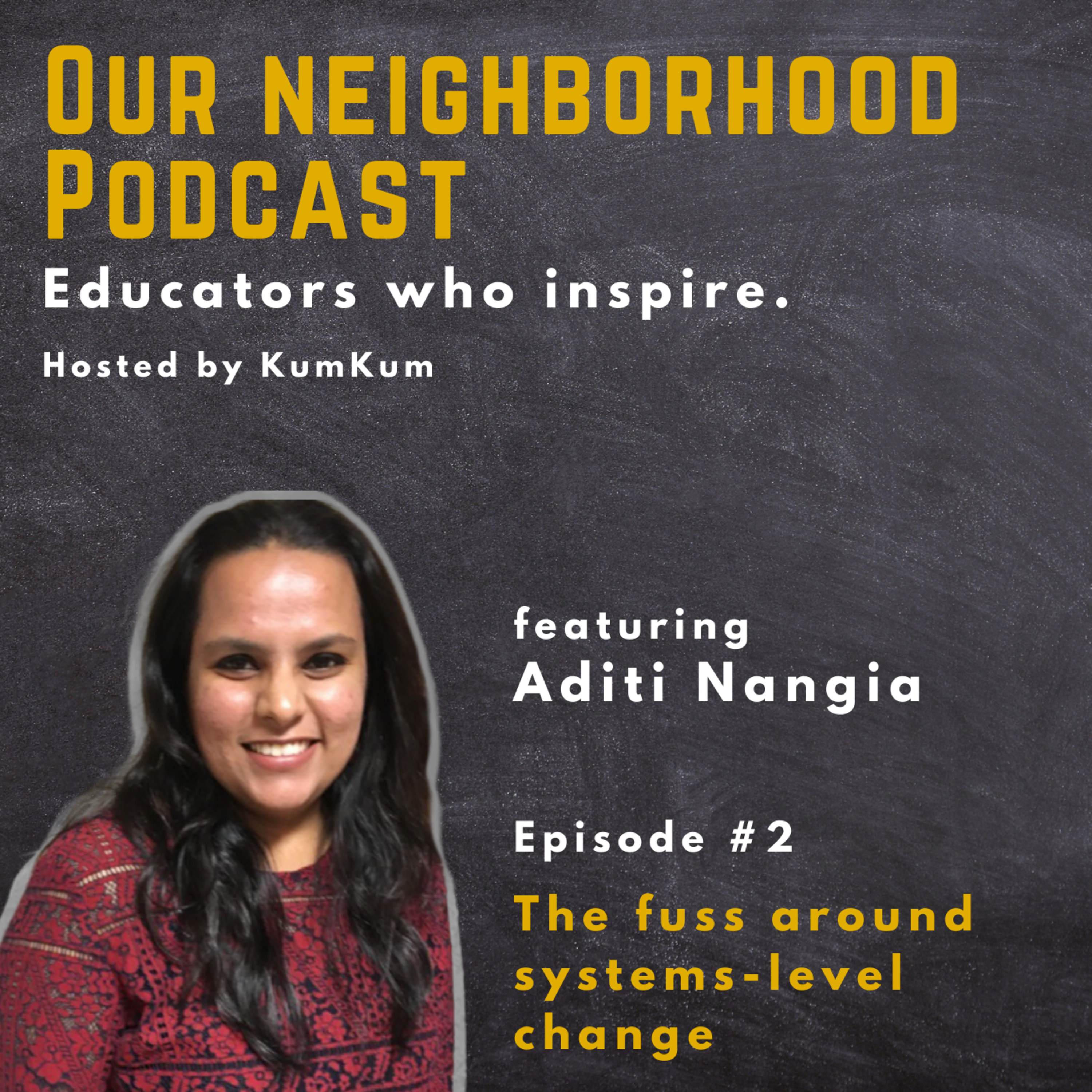
So stay tuned. Today we have with us Aditi Nandya and we are going to talk about Aditi's
foray into the education space. We are going to touch upon government and private schools in
India, feature labor market and also policy and systems level change of education.
Before beginning, I would like to introduce Aditi to all of you.
So Aditi defines herself as an educator, learner, who's been chasing all things unique and local.
She has spent last five years of her life in the development and education space.
She's interested in innovative teaching practices, improving systems of education
and understanding motivation of different stakeholders. She loves math and she loves finding new ways
of doing things. She's also a big believer in the power of children, leaving the world in the future.
After spending couple of years at the grassroots level, she's now switched to working
at a policy level change in education. She's currently working with Central Square Foundation
as a program manager. So hey, Aditi, welcome to our neighborhood. We are so excited to have you here
and thank you so much for joining us. Hi, Comcom. Thanks so much for the introduction.
Glad to be part of this podcast with you and excited about the next one.
Great. So we are going to start by your story. I am always curious to know
how and what drums people to enter this field of education. So for you, when was that
you know, turning point in life or what was that realization that you decided to move
and start your career in this field when you when you joined Teach for India, you started as a
as an engineer who was studying in your college. So just walk us through your story.
Yeah. So I, after 12th grade, when I had to make a decision of which college to go to,
I, you know, given the streams of maths, physics and chemistry that I had taken in level
the 12th grade, I pretty much had the options of doing engineering or pure sciences in India.
And I'd of course applied to, you know, both types of options and the the thought process was,
you know, that given that I have chosen these three subjects, so let's cast the net as wide as
possible. So I got through a couple of colleges, but I wasn't too happy and too sure about only
pursuing, you know, only science without having any access to humanities or social sciences subjects.
So when I got through Bitspilani and I, you know, had the option of going to one of the
Bits campuses, then I said, okay, this is a great opportunity because it gives you some level of
technical training and engineering or sciences. And also it gives you the option of taking electives
outside of, you know, science and outside of STEM basically. So it was a great option for me and
that's how I picked to go to Bitshederabad, also got me to stay closer to home even though I was living
on campus. And that's how I sort of entered engineering. But very quickly, I think after the first
year, one, in the second year, once we started having some courses of electronics and communication
and electrical engineering, that's when I figured that, you know, this is not something that I
definitely want to do long term. And this is not something that I like as much. So I, at that
point, I definitely wanted to move out of the, you know, engineering space as soon as I could. But
given that, you know, Bitshederabad itself is a great place to be in terms of, you know, having a
good set of peers around who were smart in general and are able to, you know, talk about a wide set
of things. It was college itself. It was a good experience. There was, you know, outside of the
courses itself, it wasn't too bad. So it was good. And so the idea was there to move out. And I
think one of the things that I noticed when I was studying at Bitshederabad was even though there was
in my peers, as we did projects or, you know, we were part of teams that worked on several things.
Even though my peers had, you know, all of us have given the same exam and gotten through
Bitshederabad on whatever cut off schools, right? And the exam comprised of English as well
apart from our physics and chemistry. So even though we did the same exam, it felt like, you know,
certain social emotional skills, certain competencies which are outside of academics were very
different among all of us. And that variation was very visible when you'd work on teams with people.
On how confident they were, on how exposed they were to the world, on how much they
were able to work with other people, understand different cultures, understand, you know, where
different people come from. And I realized that people's life experiences, of course, you know,
influence these outcomes and experiences. But also the other thing that I noticed was it was
largely also aligned on people's school life. So how good their school was, how much their school
exposed them to various things apart from just academics. And that's when I realized that, you know,
higher education, we may all be in the same place. But definitely, it is a lot that has come from
when we were children, when we were really young children, that, you know, that even got even now
continues to shape how people view the world and how people are able to access various opportunities.
So that's what got me interested in primary education and in ensuring that when children are in
school, they develop, you know, of course they get the basics in terms of literacy, numeracy,
math, science, whatever, right. But also they need to be able to have the opportunities to develop
to see different things, to experience different things, to develop what we almost now call co-curricular
extracurricular skills and activities. But you know, they should actually be part of the curriculum
for everyone. So that's what got me interested and that's how when I heard of TFI, then I, you know,
chose to apply or to thankfully, I would say and that's how I sort of forayed into education from
engineering immediately after I graduated. Yeah, that's a great, you know, starting point and
after this, you decided that you're going to spend next to yours teaching second graders if that's
correct. Yeah, and that was the government school in Hyderabad, right? Correct. So when I got into TFI,
I got placed in a three-two classroom in a government school in a place called Ambarfeet and Hyderabad.
And I had about 65 or 70 children in my class on day one and, you know, I came in thinking
and you had no experience of teaching. So how scary was that? I was pretty scary. I think TFI does prepare
you in the sense there's a five week training in Puneh where, you know, everything is taught and
and you're prepared in the best way possible. But I think having your own classroom and, you know,
transitioning from a from a private school in my training to a government school in the real
fellowship and also transitioning from, you know, managing 10 to 20 to 30 kids earlier to now teaching
a class of 70 children upwards. That's huge. That's huge. Yeah, it was a complete change. And also,
I realized that many of my children, this was this is probably their first or second year of schooling.
You know, some of them would actually just take a nap in the afternoon because they would just go to
sleep. So it was very different, right? Because when I taught in Puneh in the school where I was
placed for the training period, the kids were much older. They were like eight to 10 years old and
and they had been through pre-primary, you know, three years of pre-primary, nursery, two,
UKG and then they had come to first, second, third. So it was almost a six year of schooling versus
when I taught in second grade, some of my kids, it was like the first year of proper schooling or
second year of proper schooling, right? Because it was a government school. You know, very few of my kids
went to a preschool or an Anganwadi Center consistently before. So they were still getting
used to the concept of what a school is, how, you know, of the routine of a school of, you know,
being then learned for so long. A lot that had to be done other than, you know, just focusing on
teaching. I feel like at that point of time, I had to really teach them. I remember there was a
child who came to school without buttoning his shirt every day. And then finally I just realized,
you know, you have to button your shirt. So you don't know how to and nobody's doing it for you then,
you know, that's where we start. Wow. That's, that's very interesting. And as a teacher in such a setup,
you have so many more responsibilities than just taking care of learning and teaching. And that,
and it also signifies that a school is an entire ecosystem for a child and with so many different
kind of people involved and resources involved and ongoing processes and timelines involved,
it's a complete functioning ecosystem. It's not one variable we are looking at. So that brings me to
my next question to you, which I'm very curious about is to understand from you like how does the
landscape of private versus the government schools look in India. And then we say private schools,
what does it mean? Like is it the private school like a big chain of school, which you and me would
have gone to or is it something else? And what is the scale of these both schooling systems in India
and what are the different kind of outcomes? How different are these in terms of student learning
outcomes in our country? And what are the different incentives and problems? So that's a, that's my,
you know, a very macro level question to you. Yeah, yeah. So I think the whole
private school point, right? It's very interesting because normally when you say private school,
people think of at least mid and you know, high income in the things of the private schools
that they send their children to. Whereas if you look at the numbers, about 48% of children in India
go to privately managed schools and and these could be private aided or like private aided schools
where they get some age on the government or it could be a private unedited school where the school
is soldy done by the the management and it's also financed. Yeah, independently, right? And and
the example of the school that I went to, it was a private unedited school. It was a privately
financed and privately managed both. But the majority of children who go to private schools in India
don't pay very high fees. They pay less than 1500 rupees a month which is less than
interesting. 18,000 rupees a year in terms of animal school course fees, right? Which is,
which is quite nominal if you think about it because the school I went to collected in fees on
average, you know, at that time, which was quite a long time ago, it collected at least 30, 40,000
rupees a year. So it was definitely not a low income or an affordable private school. And the majority
private schools going children in India go to these affordable private schools, which are very,
very different kind of schools that you and I went to. In terms of their facilities, in terms of
teachers who teach there, their qualifications. Yeah, even you know, how much training they've got
in terms of what outcomes these schools have, things like that, right? Most of these schools are
typically affiliated to state boards and not to a CVSE or an ICSE. And they have teachers
who don't necessarily have a graduate degree, an undergraduate degree, don't necessarily have a
beard. They've not been trained in teaching, etc. They're almost like, you know, coming from this
same community as the children who attend these schools most times. So the teachers are not very,
very well qualified or trained. Yeah, that's, I mean, I never thought of it that, you know, half of
the students of our country are going to private schools. I mean, if we just look in our own biased
ways around us, we would think that most of the people who do not belong to the similar socio-economic
class are all, you know, catered by government schools in the country, but that's just half of the
number. So that's a very interesting data point. And I mean, I want to go deeper in this and understand
because you spend time in both of these settings. You work for two years in a government school,
and then you were doing teacher trainings in a affordable private school, which we call APS.
So how are the two places different from each other in terms of the quality of teaching,
quality of learning, infrastructure, and outcomes? Yeah, yeah. So I think the, in the second year of my
fellowship, once I had some experience in the classroom and, you know, once I received a bulk
of the training from TFI on how to teach and how to include outcomes in my own classroom,
I decided that, you know, one good thing could be to ensure that the other classes in my school,
because I have about 500 children in my school in primary grades. So the other, whatever 10-15
classes in my school could also, you know, benefit from some of these lessons that I got at TFI.
And so then I went to my HM, they had teacher in the government school and I said, "Mom, can we
ask the teachers and mind you the teachers in the government school where I taught they were quite old,
they were the age of my parents, definitely more than 35-40." So in terms of age experience,
of course, they had a lot more, but I really felt that, you know, if I could learn from them,
few things, if they could learn from the practices that TFI taught, I think, I thought that it
could definitely benefit all the children in the school. And so I said, "Okay, can we at least do a,
you know, collective sharing of best practices or, you know, share our problems and, you know,
maybe collectively brainstorm solutions towards it." I thought that was a fairly, you know, simple,
non-hierarchic thing to do, given that, you know, it could improve learning both for me and for them,
and eventually for the children in the school. And so I ran it past the teachers and they
want to enthusiastic about it, and because typically in a primary school, the HM doesn't have that much
authority over the other teachers, because they're just a head teacher in some sense. They're just one
among the teachers who speak to be a HM. They don't really have that kind of authority in a government
school set up to be able to say, "Okay, this is what is happening," right? So it sort of paused at
that point, but I really felt that, you know, I could do more than just focusing on my classroom,
and also I wanted to really understand what training looks like to improve learning in other
classrooms, right, and to facilitate that. So there was a private affordable private school behind
my school, right, behind my school, actually. And so I went there and I spoke to the HM, and I said,
"Sir, can I, I was also the owner of the school, and I said, "Sir, can we do the training?" And he
said, "Yes, let's do it." So I said, "Okay, I, you know, want to ask the teachers what they want to be
trained on." And he said, "Yeah, you can ask them, that's fine, but I think they need these four things."
I said, "Okay, fine, let's start with these four things." And he said, "You know, do the first
session, and then you can ask the teachers for their feedback." I mean, did the first session,
along with the co-teacher of mine, we did the first session, and we realized pretty soon that
the sort of training that we had designed was not necessarily meeting any of the requirements
that the teachers had in terms of what their needs were, in terms of the language that they were
comfortable in with, in terms of how much they understand of teaching, and, you know, where we
started off from. And so we went back to the teachers and he said, "Hey, what do you want?" And the
majority of the teachers from the school that we went to, they, you know, had passed 10th grade or 12th
grade, and they had become teachers, and it was sort of a job that they were doing because they were
in some financial need or, you know, they had some time, so they wanted to teach, but it wasn't really
something that they were trained to do, and many of them, even though they were teaching in an
English-medium private school, they did not themselves start reading English, so their English skills
itself were not that good. So they, one of the big requests that came was, "Mama, if you're doing,
you know, teacher training, then do it in a way that our English skills improve, right?" And do it
in this way, and then it'll help us. And so we went back to the HM with, with this feedback and we
said, you know, "Hey, this is what we designed based on what you have asked." But this, but your teachers
are saying something else, they're saying, you know, they want English skills, they want more skills
that they can apply immediately, right? And that will help them as well for professional
development and improving their own skills as opposed to just for improving teaching. And of course,
ultimately, like, better, if you're teaching in English, then you're improving your own English,
but is a, you know, sort of good bet to teach better English. And so we said that, and then he said,
"Okay, this is fine." And of course, there were a couple of more suggestions as well, so he said,
"This is fine." But the other thing that I, he said, "I want you to know," he said, "If I had to
pay you to do it, I wouldn't pay you to teach them better English or teach them these skills,
right?" He said, "Because if I did have to pay you to teach them this, then they will get better
as teachers." They will get so much better as teachers and much more confident and they'll
leave next year. And I'll have to hire you. Wow. This is such a counter-retuitive approach.
Yeah. So there are different incentives. And I think that is very, very crucial, that's a very
crucial learning that I got, that the incentives in a private school system and in our government
school system are very different. And we can't use the same ways to improve outcomes in both.
And, and, or even, even improve teacher capacity. I forget improve learning outcomes,
even improving teacher capacity. Yeah. You can't put the need. Yeah. And like based on,
like how receptive they will be. And also, I mean, this, this is so fascinating to, you know,
here from, from you as an insider who's seen this happening. I mean, nobody would believe that,
you know, the principal doesn't want their own teachers to get trained. And that could be
completely opposite in our government school, where the teachers are getting paid so much more,
maybe 10 times more. And even there, you know, the learning outcomes are quite similar to these
affordable private schools. They're getting paid more. So is, then there's the question that,
what is actually leading to teachers perform better and what is actually then eventually leading
to students learning better? Because if higher salary is being paid in the government school,
and then private school, then there may be like better English speaker speaking teachers. So,
what is this whole mix like I'm, I'm confused right now? Yeah. So, so I think in a government school
setup, teachers definitely, there's a lot more to do on the training front, on the motivation side,
on the, you know, upskilling them, on ensuring that the, the training solutions are scalable,
on ensuring that they're way, you know, targeted because also government school teacher doesn't have
that much time given all the administrative work that they have to do. So, so ensuring that,
you know, whatever is given to them is digestible and usable quickly, right? They don't have to do
tons of other work. And yet it's given in a way that respects their experience and respects their,
you know, individuality because they, they definitely know much more about their contacts and their
classroom and and giving out lesson plans, right? Which are scripted is not a solution. Right?
They have far more experience and expertise than, than a scripted lesson plan could give them.
Whereas on the private school and I think, you know, the, the, the teacher will, if the HM says,
or the principal says that the trainings will happen or the teachers will attend, right? If they call
them on a weekend, they're going to come, or they're calling them on a Sunday for a training,
the teachers will come because there's that whole fear that they lose their job. Yeah, that doesn't
exist on the government school front. But I think on the private school side, again, HM don't want to
invest so heavily on teacher training. They are more willing to invest on, you know, will,
invest on better infrastructure, on, on getting a digital classroom, on getting, you know,
some other NGO to do some other training or special activity or whatever, right? In the school as
an additional thing. But I think the key mode of improving learning, the, you know, whether you go
the ed tech route and use tech and able classrooms or whether you go the direct route of, you know,
the building skills in the teachers. Ultimately, a teacher does need to have a certain set of
skills to be able to teach effective. Right? Whether they are making their own lesson plans,
whether they're using scripted plans or whether they are, you know, using a tech technology enabled
tool to teach, right? So, so I think that incentive to improve teaching in a private school is by
off because agents are scared that, you know, if you build their skills too much, they're going to
leave you and go away. And go and leave you for what? For, for, for a 500 rupees race because
there's not so much to them because of average, you know, and I'm saying anecdotally, the average
salary of a private school teacher who's maybe 10, 12 past, who's teaching primary or secondary grades
wouldn't be more than 10,000 rupees. How much of an experience they have on average? So it's pretty
less in terms of salary, right? And what would be in case of a government teacher first say if you
know it again anecdotally? Again, anecdotally, it could go anywhere between a starting salary of 20,
23,000 going upwards. You know, if you have more, more qualifications, if you have read MAD,
et cetera, to go up to a lack as well, if you're up to two. Wow. Like somewhere from two to ten times.
Yeah. Yeah. Yeah. Yeah. It could, it could go up quite a bit, right? And, and so that's the,
that's the difference. There is also no career path in terms of, I mean, teaching in general doesn't
have a, but you're in part in that sense. We're not in Singapore where teachers go and make policy and
come back and teach. Yeah. Yeah. It doesn't, but I think it's even the gap is worse in a private school
because, because you can start off at five, six thousand, but at most you'll go to ten,
you'll go to 15. And, and then if you want more than you write the, the CTET or the TET exam and
then you, and then you become a government school teacher and then you get paid more. So that,
that's the only exit they have. So the only exit for a private school teacher to have a
petal career trajectories to become a government school teacher. Yeah. Unless you become a teacher
in a mid or high fee paying school, of course, then, then that gives you better salary as well.
But typically these teachers will, will not do that because they, I mean, that's not the type of
school that the IP school is looking for. Definitely. Yeah. That, that's very correct. I mean, they also need,
you know, teachers who can speak English like a Hollywood movie. I remember, of course,
cooling. And we used to get fined for not speaking English in school or if anyone was heard speaking
Hindi, so you'll be fine. And your teachers would be keeping like a surveillance on you for the
entire time you're in school premises. So that's, I think, the gold standard for any kind of, you know,
good private schooling, if we may say. So we are talking a lot about teachers here and they are the
single most important stakeholder. I mean, we think about education or learning for the students.
So, well, can we, you know, move towards talking about each a labor market and a macro level? Like,
what are the barriers teachers face when they are, when, and what's the kind of difference between
demand and supply of getting good teachers, what kind of teachers come into this profession and,
you know, and what leads to teachers performing their best? What are the factors for most important,
for a teacher to perform the best? Yeah. So, again, teacher labor market, if you look at the
private school teacher labor market, I think there's very few studies done on the affordable private
school teacher labor market. And I totally, if I had to say, these teachers come from, you know,
again, the same community is they are either 10th or 12th fast, most of them don't have an undergraduate
degree, they don't have a B.Ed or an M.Ed or any master's degree at all, right? And many of them,
I've heard a common complaint amongst principals is that the teacher may not stay for long, right?
Many of them come to teach because it's a, it's a, you know, fixed time profession, it's considered
little bit. Yeah. Yeah. So, they're coming to teach to, to earn some money to figure out some
financial issues at home and, and the big sort of challenge there is that, you know, they may leave
and go and often I've heard that a teacher will stay for a year or two or maybe three at most,
but many of them, many of the principals worry that when they get married, they may, you know,
ship location or stop teaching altogether. And so, that's a big worry on the APS school front,
which is, again, why they don't want to invest in training, right? Which is so important or any
form of coaching, I mean, training may still be easier. I think each coaching is a little bit more
difficult than you once and, and they don't want to invest in that because if you're investing in
someone, then you would want them to stay and, and, and, you know, grow, but, or improve how they're
performing, but, but if you know that they may not stay, then I don't know if they would want to
invest in, in training or upskilling. So, so that's a difference. In terms of the government schools,
I think once they have a job, their job is more stable in the sense that, you know, it's almost
up to retirement unless you work with somebody stop teaching for some reason. I don't, I don't know
of many government school teachers who have done that, but, but it's almost like, you know, you're,
it's a fixed job and you've got the job till the end of your, you know, till till the end of your
working career to do retire. So, so it's a, and it's a different type of teachers. Of course,
the teachers who join government schools, if they want to grow and improve, then they do take the,
be a once they have taken the be add, then they take the M ad exam, or they take specials, they do
subject specializations, and then they apply to be the middle or high school teachers, or, you know,
there is some sort of space to grow, join as a primary teacher. I think the issues with, with
private schools are, are, affordable private schools are very different in that sense, that the,
the schools want somebody who is teaching for cheap, right, because you're not
that much in terms of fees for you to pay high salaries, like what the art and dates or what a
government school gets. But if you, if you pay that much, then you, you can't keep your fees low.
So, so you pay less to the teachers, and, and then you also don't, as a private school, don't
focus that much on teacher improvement. Yeah, yeah, interesting. In terms of, I think you brought
a part, brought upon a very important aspect here related to teacher coaching and training, and
what, who trains a teacher on a daily basis, or, you know, is there some authority within the
school, which is entitled, or has the duty to do it, teach, coach the teachers on a regular basis.
So, yeah, I mean, that, that brings us to the question of what is the role of a school management,
right? And by school management, I mean, it could include the principal, plus anyone else who's
there. Now, typically, in an affordable private school, the school management, or the principal,
or the HM of the school, is focused on administrative duties, right? Enchoring fees is
collected on time, ensuring, you know, reports are given on time, parents don't have any problems with
the school, you know, doing some random correction and checking of question papers, filing all the
student data, if you have to report back to the government and ensuring that reporting is done
correctly on time, keeping the books of the school. You know, all these are all administrative duties,
they're not less important, they're important, but I think the, the piece that's missing is that
there is very, very little focus on administrative, on education leadership, right? How do you
ensure that children in your school are learning better, they're improving against, you know,
a set benchmark, or set standard, or whatever you want to call them, right? Or certainly learning
outcomes. I think that sort of approach is missing largely in both the government and private school
sector in India, where the HM doesn't have, of course, having one HM gives you very little time to do both
administration and focus on education, but overall in the school, it says that there isn't
that structure, where somebody is assigned to train teachers and coach teachers and, you know,
ensure that professional development is continuing. And there's a quite a different skill, I think,
I don't know if most principals in India have that, and even if they don't have it, I don't think
they recognize that they need to hire somebody, or, you know, groom somebody to get to that piece,
because that's not really an, so if you, this is very, you know, interconnected to the issue of
what parents demand, right? I think in a private school. The type of things that a private,
a part of a private school sells are the infrastructure, the fact that they're English, English medium,
you know, if they have a digital classroom, then they advertise that. So it's more like, you know,
what's visible and what's easy to see for a parent to understand that, hey, this is better than
the government's school next door. But is it really better in terms of actual outcomes for all
children at school? I don't know. I don't think so. Right? If you, if you remove, if you remove the
effects of family background, of socio-economic status, all of that, is the school actually
teaching a child much, much more than that child would have learned elsewhere? Maybe not.
So, so, so those, those are the issues which, which are, it's, you know, that's how the demand is
applies sort of, the demand is for better learning. But yeah, nobody knows what better learning
looks like, especially in primary grades, because there's no, like, you know, what better learning
looks like in terms of board exam, right? If there are five private schools in an area,
then the parent can say, "Okay, this is what the board exam results look like in these five schools."
How many children passed? What is the highest pass, but percentage, etc.
But great time is very ahead of it, right? Like, it's, it's, it's like 10 to 13 years later once a
child starts schooling. A little bit too late. So if they, they did have something to signal this
learning in primary, saying, you know, actually, forget English, this is how much math the child can
do, this is how much language the child knows in grade five, okay? Three, then the parents would have
better data to make that decision. And then schools would also have this, you know, information to
market and signal learning outcome, as opposed to, you know, putting up billboards or, you know,
a lab or that's what typically schools do, right? They'll have some, some outsider, you know, there was
this big trend in Hyderabad at one point in time, but every affordable private school, if they had
a foreigner visit them, they'd have them on their phone. It's just so funny, right? Of course,
that's a selling proposition. Yeah. I mean, the parent thing, this school is going to get foreigners
all the time, right? And maybe it becomes a causation that because of that, my student will get to go
to a foreign country. Yeah, yeah. Or like, you know, sometimes you have these volunteers from abroad
coming and teaching and, you know, to get a certificate. Yeah, there's probably signs that the
advertisement will have this child who's come from you, some outside country who's teaching the
children in the school and the fancy exchange programs. Yeah, so they use all that to market, I think,
and I think the parent, I mean, the point here that I'm trying to make is, you know, when you see the
various, you know, goods in a market, like when you see different shampoos, for example,
there are certain markers on a shampoo that anyone is able to read and tell, you know, it's the
anti-danger, it's anti-danger, it's not in your hair, it's smooth in your hair, right? It's very clear.
And after one or two uses, you know what it is, right? You know whether it's actually anti-danger,
or not, after five years. But for a school, you don't really know what's happening inside those doors.
Yeah. I mean, the station tweeted this maybe like 20 years. Yeah, it's a high-staked decision.
Yeah, and also changing the school is not as easy. You know, after four years of your child is
doing poorly in a school. Yeah, there's so many barriers. Yeah, if you tell the child, I'm going to
change your school. The child is not having my friends at your. Yeah. And there's so much, there's,
I mean, it's not as simple as, you know, I'm going to go to the market and pick another shampoo,
which is anti-danger. I wish it was. I mean, I remember shifting school and for one year, I kept
crying to my parents that please send me back to my old school, which was not even a better one.
But just how, you know, we get invested with our friends in an environment and
we just get comfortable and yeah, that's, and also their external barrier is to changing schools.
I mean, you can't change school in each grade. I mean, there are certain like in ninth grade,
you can switch school and 11th grade, you cannot switch school. So,
too many issues there. And I mean, what you talked about, you know, my, my head is kind of stuck
at the school leader and school leadership. The role, how important that would be because
if we imagine ourselves to be in, let's say, corporate environments and like functioning without
a manager or functioning without a mentor, it's, it's completely insane. And we don't really hear
a lot of conversations about building capacity of school leadership or even just understanding what
the role the school leader would be given the case that a lot of assessment of teachers is being done
by that school leader. So, like, factually that leader should and knows a lot about teacher performance
and what they need in terms of growing and improving in their skills. But, so, I mean,
are there any organizations in the nonprofit space, you know, which are working towards
enabling school leadership and, you know, empowering them?
Yeah, yeah, yeah. So, they used to be an all-called ASLI, which, which used to work on this, spin off of
this called, allocate works on this space. And I'm sure there are others as well who work on.
Kebalya has a school leader improvement program. So, there are people who are working on this. But,
I think, again, the, the ask for it on a government side and a private side is very different.
On a government's pool side, you know, the block officer or, you know, right up to the DO
and the secretary, we want this to happen for all their teachers and then it happens, right?
But, on our private school front, the principal really needs to see value of why he or she needs this,
right? Because the ultimate, again, root of this comes down to what the parent is asking for.
If the parent is asking for improvement in outcomes, then the private school owner will see a need for
this, right? Now the parent is saying, you know, the parent is happy with these, with better discipline,
with better, you know, they come in need of uniforms and things like that. Parents are happy with that.
So, the school owner is also obviously going to say, "Well, should I spend money on, you know,
something which is aspirational, maybe, and not usable?" Yeah, it's not visible, right?
If I had a lack of rupees to spend as an affordable private school owner, as for school improvement
in a year, and I'm not seeing every school has a lack of rupees to spend. I'm just saying, for example,
right? If I had a lack of rupees to spend, and I would want to signal, you know, better fans,
your facilities, I may buy a digital, I may buy a projector, I may make one room, a digital class room,
I may buy a couple of computers or tablets, get Wi-Fi, may not invest in teacher training, right? Because
what's the return on investment? Either return on investment is probably, it's there for
teacher training and coaching and improving teaching, but I think they are not able to see it
because parents don't demand it. That's very important. I mean, if there is no demand for it and
no return for it, why would, you know, a simple, let's say a person who's running a business here,
it's a school, would invest in it, and I mean, do you see any kind of threat that, you know,
private schools won't exist few years from now because of all these challenges and regulations
which they face? Or do you see that there won't be any government schools going forward if private
schools take over the entire market share? So because, you know, this question emerged from what
you were saying about this problem of demand and supply and different things. So, yeah,
what do you think on that? Yeah, so, I mean, I think there's this whole pro-government school
janta, right? And I think the pro-government school argument, everyone who is for government schools
will stand by vehemently and say private schools should not exist and they are being in society and
yet stand by their own very children. Yeah, they're spoiling our culture, they're not making education
free, but, you know, I've gone to private schools. Typically, most times, everyone who says that,
if you look around in the room, all that children are going to private school, going to a private
college, you know, done high education in a private institution, done free school in a private institution.
So, I mean, I don't know what they're talking about. So, at the same time, when you look at the pro-private
school janta, I don't think any of the pro-private school folks are saying that government school shouldn't
exist. Nobody is saying that, you know, they should cease to exist and all government education,
all public education should be privatized. Nobody's saying that. I think the argument is that,
let them see, the truth is that both exist, right? And parents are voting off their feet to send
their children to private schools. You know, if I have this money, I'm going to spend it on children
on their education. And, you know, it may not be better, but I'm sending that my child to a private
school is aspirational. Whatever it is, right? But it is, it is perceivably better, maybe. Yeah, perceivably
better. And they're choosing to send their children to private schools. So, as a system, we can't say,
you know, just because you're choosing to send your child to a private school, I'm going to ignore
your child. Because at the end of the day, I think children in India should learn better, and that
conversation of children in India learning better. Can't exclude children in private schools,
because 50% of them go to private schools, right? Out of that 35%, 35% of all children in India
go to a private school, which doesn't receive any grant from any government, right? You can't say,
I'm including one in every three children in India, and yet talking about, hey, I want this to
improve for all children in India. The conversation doesn't make sense. It's one in three, it's not one in a
hundred. Yeah, you've, you've kind of answered my, in private schools, why? Because
not then there are no private schools, then what kind of burden would it put on the government's
head? Yeah, that's again, you know, a very, very, very scary situation to be in, if suddenly there's
no response tomorrow, or if they're forced to shut down because we also saw in this COVID situation,
you know, that because there are no physical classrooms happening, and teachers have forced to
teach on WhatsApp or on Zoom. So parents community or in general, community thinks that there is no
cost to run a school, or like, how will these kind of schools sustain if they're not getting paid?
They're, you know, new fees. How will they pay their teachers? How will they pay the fixed cost?
So if they suddenly come to a demise, then the government will also be, you know,
looking nowhere of how to treat these all out of school students now. So it's a very tricky
situation to be in at this time also. And like you said, I mean, if really everyone of us should go
to a private school, or sorry, go to a government school, if everyone of us should go to a government
school, then basically what we're actually saying is that 12-throwed children in India will have come
from the private school system to a government school. Does the government have the capacity to
to not just end role? And I think that's the difference in conversation, not just end role,
but a) of to build buildings, get more teachers, all the things that India took into consideration
over the last 10 years to ensure almost universal enrollment in schools, right? Not just that, but also,
you know, do we have the state capacity to be able to improve learning for 12-throwed children,
plus all the children in the government school system who are already there? I don't know.
Yeah, that's a scary question. And since you, you know, brought up this question of state capacity,
I mean, that's a good time for me to, you know, talk about our last big segment. And it's kind of a
difficult segment to talk about, because right now you're working with an organization looking at
a policy level change, policy level governance, and systems change for private schools in the country.
And you're, it's kind of a powerful position to be in. I'm not just saying that you are in a powerful
powerful position, but anyone who's a decision-maker for education, be it the pedagogy, be it the
content, curriculum, syllabus, or be it the, you know, technology adopted, new changes coming up.
So whoever is in a powerful place to make these decisions for all the students of the country,
like what, what kind of training or mindset these kind of people need. And when you, when you
went into Teach for India as a teacher with no, you know, prior experience or knowledge of that
profession, you were an outsider yourself. So how did you battle with this, you know, gap that
you're going as an outsider, you know, these 60 or 70 kids you're going to teach for the next two
years, their, their lives could be greatly impacted by you. And so I want to hear from you that what kind
of tough decisions and conscious decisions you need to make when you are in that powerful position.
I think anyone has been developed in space, right? And this is my, this is something that I've learned
over the last six years, four of which were at the ground level as close to the ground as possible,
is that I think I, in the, in the race to do what is looking better and seeming better to you,
yeah, individual. I think we should never ever lose sight on what is better for that, for the,
for the stakeholder themselves. I think, I mean, it's great to say that teachers should have
whatever 150 hours of training a year, right? But what does that mean? Does that mean you add 150 hours
to their existing professional responsibilities and time spent in office? Or does it mean that it's
replaced? It's great to say that children should have the best opportunities, right? And I remember
one time we, when I was working as a program manager, there was this child who in one of my fellows
classrooms, who had got this opportunity to go to a school in Puna, which is, which is, suppose
we were really good school. And very few girls get selected to go there and so she cleared the first
level of exam. And the next step was that, you know, her parents had to go with her to the school
to do an interview. And she was a belly. She was not a young child. She was 13, 14 years old. So,
so she had to go and, and all of us, the fellow and me, we really believe that, you know,
this is the best opportunity she can get. It's free learning, almost almost fully subsidized,
and the child will get a great education. And after this, it opens up such amazing opportunities,
not just to study in the best colleges in India, but she could also apply abroad, right? And that
was the thought of thinking we went in with and we were vehemently trying to convince the parents,
I think. So, we went in saying this is the best sort of, we went in saying this is the best thing
that can happen for this child. You know, she'll be away, but she, but she will learn and she
become, you know, she'll get a great job and there's a great future in this and things like that.
And I think, and we were at some level, we pushed things that we really believed in. And some of it,
when I look back, it would have been quite absurd because there was a time when at 9, 30, 10,
13, the night we were in her house trying to convince her parents of this. And so you can imagine,
right, we were really, really trying to make sure that she went with them. But, but I think what we
didn't see, which my mother pointed out was, that, that what we're basically telling the parents is,
you know, your child will go away and she will be great without you and probably never return
to be with your family or or do anything for your community or for you.
I think that sort of opened my eyes on people to say, when we're really talking about, you know,
opportunities and change and and thinking big and being ambitious, is that coming at the cost
of what the what the people themselves believe for themselves. If that is, then then of course,
it's not going to happen like in the case that it didn't happen. And somebody's I'm really grateful
that it didn't right because it's always a reminder that, you know, if if I really want something too
much, then there's probably something that I have to do for myself on it. Even even and it's
of use even now, right, even as I think of language of learning for children,
as I think of assessments for children and what that means, assessments or even digital learning,
right? What does that mean for a child who who's in a family with four other children
and has one one phone to share amongst the five of them along with two parents, right? What is
that actually mean? Yeah. I think that sort of level of being connected to your end user and
empathy is required in in any role whether across, right? And I wouldn't say it's required at
yeah, at the place where you're working on systems change, it's required in the classroom,
it's required everywhere. No two child, no two children are different similarly, like no two
communities are different, right? And a simple example of this is, you know, if you're saying
learning in a in a home language is good in early years, learning in a home language is great.
The research has said that, you know, it leads to better learning in early years. If you learn in
a home language, right? And not in English. And so I think when we're saying, you know, Hindi is a good
option for the northern Hindi speaking states. To an outsider, it's a good option. But even if you see
within Mother Pradesh or within Orissa or within Bihar, within, you know, within each of these states,
there's so many dialects, so many. So actually, Hindi is not their mother tongue for many children.
We think that policy and saying, you know, all learning will happen in Hindi. We're actually going
against the research that says, learning will happen in your language, mother tongue or the language
that you're most exposed to. I think the idea of that was to say, the language that you're most
exposed to outside school, the most likely to pick up fast if you learn in that language.
And if you're in a, you know, tribal community, that speaks a certain language. And the child
is learning in Hindi in the school, but the child is not exposed to that. It's not exposed to Hindi
anywhere outside when they go home. Then again, it's the same, whether to that child, whether you
teach in English or in Hindi, especially if no words match between their own language and Hindi,
there's very little connection. Then it's sort of beats the purpose of it in some sense.
Yeah, me. These are fascinating insights. And kind of, I am being pushed to reflect on my past
experiences, where I've been in a position of trainer or coach to students. And yes, it is
tremendously important to be grounded in the context and needs there. I mean, I don't think there is
one one size solution for different problems. And I mean, can't tell you how insightful this is.
So think we talked about a lot of things today to summarize. I think we talked about how your
school experiences or your schooling can determine your life outcomes. We talked about inequity in
those scenarios from where you come from. And we see that how schooling is as
deterministic in your life outcomes as something like a caste or something like a socio-economic
status is or your other privileges. So schooling is as important as any of those factors in your
outcomes of life. So that's something which was a great takeaway to think about.
When we see and when we, you know, analyze other people and their journeys and their lives.
So thanks for sharing that. And then we went on and talked about the whole, you know,
difference between private and government school setups and different incentives and challenges
they face. And they're going to, both of them are going to stay here. So there's no debate. They're like,
if government versus private schools, which of them will thrive or not. So we need both of them.
Then kind of going in, in diving into the teacher's space and like what they need actually needs
to be prioritized and then thinking about that what you feel is right is not right for everyone.
So that's that's a good grounding and take away. I feel our listeners would have and for people
who are trying to get into the space or are currently in the space. So thank you so much Aziti for
sharing all these stories and learnings with us. And before we let you go, we have some random
trivia questions for you to answer. So are you ready for those? Yeah. Yeah. Okay. So what
recommendation you have for our listeners for any of your favorite books or movies?
So I think my all time favorite movie is pretty woman. So yeah, I would recommend it's a very old
movie if I'm sure many people have watched it. I have not. That's a movie that I go back to every time.
I'm feeling low every time. I just want something fun to watch or I mean, I think it's a great movie.
It's a movie that teaches you so much in so little time. And yeah, I think it opened up a different
world for me. A different world you're for me to look at different kinds of professions and different
ways in which people live and choose to work and things like that. So I'd really recommend
pretty woman. The book that I would recommend is actually, it's a very heavy book. It's not a
light read. It's a book called "Systems Thinking" by Peter Sange. It's kind of a "that" run.
Yeah. It's a very dense deep... You're giving grad school readings to our listeners. That's
okay. Yeah. It's a grad school reading. I think it's a light reading, more than a grad school. It's
a grad school in itself. The life school. Yeah, it's like you can get a diploma in systems thinking.
No, but I think it's so useful in different aspects of your life. Again, it makes you think
very differently. At least it made me think very differently about Sean and it. So I would recommend that.
Great. Next question is, "If you have to choose between Delhi or Hyderabad?" And apparently,
between Chola Bhattura and Biryan. Oh, okay. So I would... I like Delhi. I mean, I've been working
in Delhi for the last one year. I really like it. I like the people there. Thankfully, good
experience is going on. But because I'm a Hyderabad girl, I pick Hyderabad any day.
Okay. And what about the food? Food, again, because I'm a Hyderabad girl, like, you know...
But I would only pick Hyderabad in Biryani and not any type of Biryani in general.
For the Biryani. Okay. Great. Last question. So any smart cooking hack for our listeners,
you cook a lot and I've tasted the food. So it's great. Yeah. So I think cooking hack, I'm not sure of like,
you know, export cooking hack. I think one cooking hack that I've been following is just meal prepping
over the weekend. And that's been sort of life saviour in these crazy times. So I meal prepped a little bit
over the weekend and basic building blocks ready. So then, every time I want to make pasta or
dal or something, I have some level prep done. The sauce is done or the dal is boiled or the chola is
ready or whatever, right? So, yeah. So that's... Wow. You're putting all your policy planning skills
in your cooking skills. So great. It was fun talking to you at the end. A lot of learnings. I hope
it was fun for you. And thank you again for joining us. And for our listeners, if you want to get in
touch with Aditi, she is shared her email ID. It's
[email protected]@gmail.com. So you can reach out to her if
you want to learn more about any of her experiences or have any further questions after this podcast.
Thank you all for listening on this episode and we hope to see you again in the next episode.
Till then, take care and bye-bye.
 PodcastTranscript AI