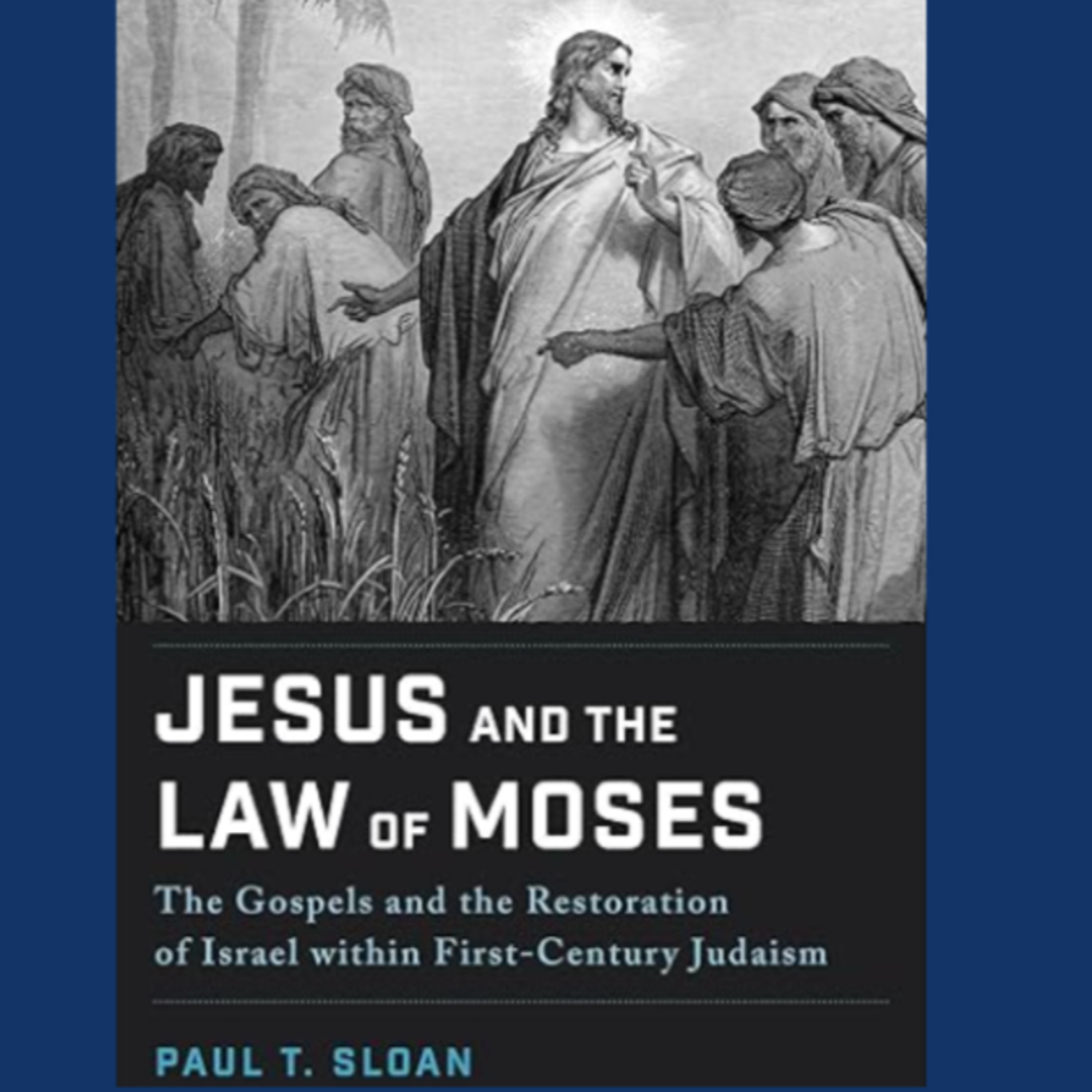
Ep 19- Jesus and the Law of Moses w. Dr. Paul Sloan
86m 29s
In this interview, Dr. Paul Sloan discusses his book *Jesus and the Law of Moses*, which examines how Jesus related to the Torah within first-century Judaism. Sloan begins by addressing Matthew 19:17, where Jesus tells a man to “keep the commandments” for eternal life. He critiques common interpretations that view this as an impossible standard meant to drive people to grace, arguing instead that Jesus genuinely upholds the Law. Sloan emphasizes that Second Temple Judaism was not legalistic; drawing on E.P. Sanders, he describes it as covenantal nomism, where the Law was a gift from God for maintaining relationship, not a burden. He highlights Leviticus 17:10-11, where God gives sacrifices to Israel, showing obedience as receiving what God provides. Sloan explains that misunderstandings like legalism, exclusivism, and nationalism distort the New Testament’s portrayal of Jesus and the Law. His academic path—from wanting to be a pastor to becoming a professor—led him to focus on continuity in God’s purposes. The book aims to make Old Testament concepts accessible and show how Jesus’ teachings fit within their Jewish context. Sloan hopes readers will see that Jesus’ affirmation of the Law is consistent with grace and faith, not opposed to them.
Hi, and welcome to Across the Canon. Today we are joined by Dr. Paul Sloan, who earned his PhD at the University of St. Andrews and his Associate Professor of Early Christianity at Houston Christian University. He's also the author of Mark 13 and the Return of the Shepherd. And this book, Jesus and the Love Moses, The Gospels and the Restoration of Israel within first century Judaism. Dr. Sloan, thank you for coming on today. And thanks very much for having me. I'm really looking forward to the conversation. Absolutely, I've enjoyed this book. This is a, I think one of my takeaways is just a reminder of how little at times I really do understand the complexity of the Old Testament. And I think you do a good job of bringing out a lot of things that, you know, I just sort of take for granted, I think you mentioned this in the book that a lot of us in the West sort of, I just give this overview of the Old Testament and we don't really dive deep in there because it's not a context culturally that we live in. We're not surrounded by Torah laws and things like that. And so I really appreciated that. I appreciated the way that you tie this together, moving forward into the gospel and how Jesus would be interpreting that. And yeah, I've just really enjoyed this book. So I'm excited to talk to you about it. I appreciate it. Yeah, the stuff that is kind of the burden of much of it is both trying to just make plain some of the aspects of the Old Testament that seem quite esoteric to us, particularly stuff from the Vedicists and ritual purity and stuff like that. And then of course, obviously trying to make it work in the gospels or show how it's employed in the gospels. But even if I'm wrong about that, I hope there's at least a service with respect to just making plain some of the Old Testament stuff for a lot of readers. Absolutely. And so tell us a little bit about yourself, right? You are a scholar of scripture. So how did that path work out for you? How did you end up where you are? Yeah, that's a good question. I wanted to be a pastor who I'm growing up. And so sort of going the route of biblical studies just seemed the obvious route. So I did. So I started, I did some masters work and then did the PhD. And then while I was doing that, I just kind of realized, I really like doing this sort of on and so. And I still have sort of a year to the ground as it were in a lot of respects and always had. But even after I got my PhD and then got the post at HCU where I've been since 2016, I just a couple years ago, I became the teaching pastor of a church. So I'm the teaching pastor of a church called Heitz Church here in Houston. And so it is finally sort of wed in that sense, my love of biblical studies and preaching. But in terms of, that's sort of the avenue into it. What once I was in it in biblical studies that is, I kind of gravitated toward, toward the very kind of basic questions about continuity because that's just such a, such a, "queeding heart" and a lot of questions that readers have when they come to the text because I think fueled by an understandable question about sort of is the purposes of God the same. You know, are these the same person or are his purposes the same? And because that, I think that speaks to us about sort of the comprehensibility of it. And so those kinds of questions always attracted me, which once you ask, begin to ask questions about continuity and God's purposes, sort of like not very many hops in that hops, God's game, you're gonna arrive at the question of the law. And so I did that pretty quickly in my PhD. I ended up not doing my PhD on that at all, but then I sort of came back to it as soon as I could after I finished it. So I've kind of been jumping back and forth between research and writing on Paul and these questions and of course Jesus and these questions. So that's how I ended up here. And I mentioned them in the acknowledgements, but Chris Kugler was a colleague at HCU and he was just basically, you know, probably just getting bombarded by these, you know, my sort of almost like being harangued by me, just showing up to his office with a question or a comment or an insight that I felt I had. And finally, he was like, dude, would you please just write the book? Would you please just write this book? Stop bothering me about it, you know. No, he was never bothered, but so he actually kind of nudged me along that direction. So if you, I mentioned this in another interview, but if you really liked or hated this book, you could either thank or blame Chris Kugler for that. Just send your, send your hate mail that direction. Yeah, that's right. That's awesome. And so, you know, with the book itself, right? We're talking Jesus and the law of Moses and very early in the book, you know, you start off with a quote from Matthew 19, 17, right? And so it's someone came to him and said, teacher, what good, what good thing shall I do so that I may obtain eternal life? And Jesus said to him, why are you asking me about what is good? There's only one who is good, but if you want to interlife, keep the commandments. And so, you know, that's sort of the opening volley, so to speak, scripturally, that you're working off of there. So like, what is it you're seeing in that text and how, why is that a good launching point for where this book is going? Yeah, that's a really good question. Why start there? I wanted to start with exegesis because, and I did that pretty consistently across the chapters. I don't think I did it with every chapter, but I wanted pretty consistently to begin with an interpretation of the text, just to kind of sort of set the standard as it were. And the reason, of course, that I chose that text, maybe probably because it's sort of an obvious one, with respect to when you're talking about Jesus in the law, that when someone comes up to Jesus and says, "How do I, you know, how to enter eternal life?" And his response is just kind of straightforwardly instinctively even it seems, keep the commandments, you know. It's just, his response is related to, very clearly the law of Moses. And it strikes me that you can answer that question, or sorry, rather, you could interpret that passage with lots of different frameworks or assumptions that reveal lots of different other presuppositions that you have that are probably going to inform how you take the other law of passages. So the passage, sorry, the interpretation of that passage that I'd come across quite often, both in sort of homological context, preaching context, but also I'd seen it in some commentaries. I think it's Calvin's interpretation, is that, you know, he gives this standard, keep the commandments, but sort of parenthetically, it's an impossible standard, right? And it's given to show you that you can't keep it so that you instead rely on grace and faith, et cetera. And then a lot of people, of course, go straight to Romans three for that. Now, I think what I really really want listeners to be clear about in terms of my own interpretation, is that of course, I think, sort of grace and faith are necessary, both in the Messiah himself and that those are not sort of conjunctive with in Matthew 19, not sort of disjunctive with the law. My point is to say that the whole notion that he's giving an impossible standard, that then he expects to be relieved by something else. It's very odd in the passage itself. The passage doesn't state that. Like you have to then rely on something like Romans three for that, even though actually I think Romans three can be better coordinated with my ring of Matthew 19. And that's probably a different conversation. But the point is that, like, Jesus doesn't tell a guy that, right, like the guy, right, like, if that's your reading, then all of a sudden you have Jesus sort of like, leaving this guy out on a limb, right? He asks the answer, he asks the support and question, Jesus answers, keep the commandments. The guy's like, well, I've done that. Well, that'd been the perfect opportunity, right? For him to be like, no, you haven't. You need, you know, something else. And he does it. He does, of course, and he does say, well, one thing you lack. Yeah. But that's my point is to say one thing you lack, it means that, okay, yeah, I'm taking a break. I'm just trying to figure out what I'm doing. would be kind of a shocking statement to someone to hear, right? The idea. Did you read this book? Yeah. Right. And you know, the idea that, you know, Jesus would be in line with the Torah and want to be in line with the Torah. I think there are some corners that would, would really not like that answer. And, and, you know, fair enough, this is why we have to write books and, and get into these things. So, you know, I think the interpretation that you offered there, is a fairly common interpretation that I know that I have certainly heard, right? That Jesus gives the standard and that the law, this idea that the law exists solely as a standard to show human insufficiency such that grace, you know, can come in. But you give that, I think a really good quote on page 14, discussing Israel's relationship to the law in a way that, well, I'll just read what you said. I think it's good. It says, the depiction, therefore, of Israel living under the law is not that of a people bearing an intolerable burden by which they struggle to earn their salvation, or a burden causing despair of ever finding a gracious God. On the contrary, the law assured them of God's desire to dwell with them, revealed to them God's requirements, and declared to them that a finely prescribed means through which they could regularly commune with God in experiences forgiveness and grace. And I remember the first time I was introduced to that kind of idea, and I was in seminary at the time, I was like, wait a minute. Like this sounds like a really good deal. Sounds like a great deal. I'm excited for that. So, talk to us a little bit about that. Like, what's going on there? Have you always believed that? Was there a paradigm shift for you? And how did that occur? You know, I'm sure I did always believe it. No, I couldn't have come out of the womb with that one. And I don't even think I had a 14-year-old self-view of that. I couldn't quite pinpoint when that became sort of more concretized. I suspect it was probably in my master's days when I was probably first introduced to it through Tom Wright's New Testament to People of God, but he was referring to Sanders, right? Sanders being the watershed moment, P.B. Sanders, Paul Nelson, and Judaism, where he describes sort of the Judaism of secondable period, that way as covenantal numism, the way in which the covenant was maintained by obedience, but also repentance and the sacrificialism that are so just basic to the understanding of what Israel needs in the presence of their God. They didn't assume that they were seamlessly perfect. The other thing was I just thought once that sort of when Sanders said it, I thought, okay, yeah, that's the time when I was hearing that. I was like, oh gosh, yeah, that's really shaking the boat, right? Because if people all think that Judaism is legalistic, and so instead here, here Sanders coming along, right? The funny thing is that Sanders is describing his view in the title of his book, Paul and Palestinian Judaism. So he's describing the Judaism of sort of late to second-tiple Judaism and some early rabbinic literature. Like he's not really trying to describe what other readers might call just sort of like the Old Testament view, right? In the sense of like, all right, well, here's how the system worked in just in the bite, in sort of quote, the Old Testament, right? He's trying to show it in how it's received in this late second-tiple Jewish early rabbinic material. And I think he's on the whole, you know, accurate about that, with some parts where I, in fact, a really important part, where I would disagree with him actually as it comes to sacrifice, which we'll be talking about later. But I think once I had that sort of the Sanders view of sort of Judaism in my head in the Gico, and they just kind of went back and was reading the Bible. I was like, yeah, it's just like God's, like it's been straight on the surface of the page, right? Like God's like, I know you guys are rebellious. I know you guys are stubborn hard, and I know, right? I know, like he already knows Israel's a certain way. The hardheartedness, rebelliousness, whatever, the simple caricurization of Israel itself is just basic to human kind, and he's not surprised by their sin, right? And it's not they that initiate the sacrificial system, it's God. That's sort of like what I was like, started to just really think through the logic of like, it's God who's like, I'm going to do all with you guys. Yeah. But I thought like, okay, this is just, it's God's intention to be with His people. It's God's intention to maintain this. And then Leviticus 17 verse 10-11, which I probably, again, I probably came to this by way of the work of David Moffat who then was talking about Jacob Milgram's work on Leviticus, who then maybe really think hard about Leviticus 17. But that line, right? Like, you know, do not eat blood. So that he, Yahweh tells his people not to eat blood. He says, because I have given it to you, so that you can make atonement for yourselves on the altars, etc. I thought, that's it. I mean, Milgram makes this point. It's reversing all the language, right? All the language of this point is, now, when you bring this, give it, give it to the altar, you're giving it to Yahweh, Yahweh, Yahweh. Then you've got this one sort of foundational text in Leviticus 17-11, where it's sort of all of a sudden, this whole time, right? Israel's been giving the sacrifices to God, but then all of a sudden, it's revealed that, "Oh, but every time you do it, you're actually just giving to me what I've given to you." And so it presents the sacrifices, which are things that we give to God, as ultimately God's gift to us so that we can have something to give. And that just, like, that sort of, that verse could do so much for a person's theology, right? That, like, the end of the reading of the Bible, right? And that when we're obeying God, we're actually just walking on the steps of the things he's given us, right? It's actually funny. I hadn't thought about that. I hadn't paired that with sort of the good works that he's prepared for you to walk in. But it just seems like, that's actually just endemic to Leviticus 17-11, the sacrifices, right? I'm just giving the gifts that he's given you to give. And so that just put me on a different track thinking about the stuff. So that, once I had that roadblock out of the way, like, which would, and it is a roadblock, if you already assume that Judaismly, legalistic, then you got these other issues, and that's a, to me, that's a real roadblock to being able to understand the kinds of actual inter- dialogue or conversation that Jesus is having with the contemporaries about the law, or just sort of about really any of the discourse about the law, particularly in the Gospels. I mean, obviously, the New Testament broadly, but I think particularly in the Gospels. And so it opened up a different set of questions that I could even begin to ask. Sure, because I mean, if you're coming into it with, a law equals bad, and then Jesus is pointing to areas like that, go keep the commandments, you then have to find some framework to reinterpret Jesus in a way that's in line with your presupposition about this negative view of the law. Yeah, right, right. Exactly. Well, exactly. Yeah, if you've already got, yeah, keeping the commandments as this impossible standard or this sort of even the attempt to do it is itself disobedience, right? Yeah. Which is popular in some circles. Well, then, yeah, if you've got Jesus saying, keep the commandments, right? I mean, I'll put it, this is not academic. So, forgive me, this is supposed to be an academic podcast, but I mean, this one was burned into me. So, I was out of this is gosh, this is before my PhD, this is 12, 15 years ago, whatever it was, it was in a Bible study. This guy, um, he asked me, you know, he's like, he was, I'm the biggest question of always had his Matthew 19. I'm like, oh, yeah, what about it? And he brought up this person's comment, you know, hey, how do I get eternal life? His question was, gosh, isn't it so odd? Jesus, the master evangelist, he has a guy right in his hands, he didn't have to go to this guy like, the master evangelist, this guy came up to him and asked him. And Jesus lied to him. Oh, why? And but his question was, why do you think Jesus lied to him? That was his biblical, that was his question for the post Bible study. And it was the crazy thing was, is this was accepted premise, premise was, well, we all know we lied to him. So now that we all agree with that, why? And I thought, oh, I mean, this again was way before I was doing this sort of law stuff that I'm doing now. My point is that like that one for understandable reasons burned in my memory. I thought, oh, okay, yeah, you kind of, you know, there are some readings that you'd have to conclude that. You'd have to conclude that way if you got these other pre-supposition. And so this is where I think like, people can read this book and take, oh, this academic, you're doing an academic enterprise, exercise, good for you. I really do think the way people talk about the law just shapes a lot of your reading of lots of different texts. And of course, downstream, that is your big sort of historical theology type stuff. And I just think it's not an insignificant sort of question that they can have sort of big, big downstream effects. No, and I think it's fair to say that if your pre-suppositions have led you to the conclusion that Jesus broke one of the 10 commandments, it is probably
your presuppositions that should be questioned. Your presuppositions, let's do this. What good were the presuppositions? Yes. Yeah. No, that's great. And no, actually, I appreciate that example. You know, very much like what I want to do here is be able to help be a bridge between the academy and those interested kind of on the ground who want to, you know, grapple with some deeper questions on theology. And so to have people like you come on and bring that here is, it's a blessing. So thank you for doing that. Oh, good to meet you. So you do walk through and we don't have to go through them in detail. You know, some some common misunderstandings of Jesus' relationship with the law and the law itself. You go through three legalism, which we've touched on already. Exclusivism and nationalism. So how do those things create difficulties? Like, you know, with the exclusivist view, right? This idea that, you know, there's Jews and there's non-Jews and the, you know, Nair, but, you know, should the two meet? What kind of issues? Do you see that, probably? I actually had a conversation today with somebody. I was like, no, I actually think the view that you're espousing right now is exclusiveism. And let me tell you why I don't think that works. Let me direct you to page 47. Exactly. Yeah, true. Okay. Yeah. You have a six-year-old, three-year-old, and one-year-old is that right? Yep. I've got a six-year-old, four-year-old and two-year-old. We do a lot of play-doh in our house. And we have those cranks, right? You can crank something through, right? Crank it through, put all the play-doh in there you want. But, right, they have those play-doh, cookie-cutter shapes. You pick that star shape or that heart shape or that square, whatever it doesn't matter. Whatever shape you pick, it doesn't matter how much play-doh you put through. It doesn't matter what color the play-doh is. It doesn't matter if you've mixed-macked, all the different colors there are. Crank it through that shape. It's coming out one shape. No matter how much you put it. If you assume legalism's the issue, that's your cookie-cutter shape. No matter what text you put in there, you crank it out. Results are going to be legalism. So, Jesus is talking with the Pharisees. Matthew 12. Pharisees actually talking to him in his disciples. They say, "Hey, you and your disciples, sorry, your disciples are plucking grain on the Sabbath." And that's not lawful. What's going on? If you've already decided legalism is the framing issue, well, crank that play-doh through big surprise. This controversy is about legalism. And so, then you have Jesus. Then you have a characterization of Pharisees as legalistic and they're being too. Which are then, is never like a never-accompliment. Legalism is always, it's actually one of those things. It's rarely defined but never good. Right? It's never like a compliment. "Yeah, you look really legalistic today." It's like, it's always an insult, right? And so, if you've got that, then, well, Pharisees are legalistic. Then you've got to make Jesus the opposite of that. So, then that means, well, he's defending their actions because they're, well, they're being too legalistic and you guys get a relax. That's one thing. But if you've decided the issue is nationalism. And in which nationalism is, sorry, nationalism in terms of Jewish nationalism. And you think that, okay, the law was given to Israel alone. And the law marks out Israel as Israel. But Israel became too nationalistic in zealous in the late second to bull period. And the doing of the law really marked out this zealous belonging to the law. Then the law itself, and even just keeping the law, could. Could, sort of, inscribe. Could reinforce that Jewish nationalism. That's actually not good because it leads to zealous, you know, actually. It's wrong. So, that's the issue. That's the shape. Now, I met Craig Matthew 12 through that. Well, Pharisees are sticklers about Sabbath. Not because they're legalists, but because they're Jewish nationalists. Right. Who are like, hey, the law marks us out as Jews. And so, like, this is a battery marker that's super important to us. And so if you're not on board with it, you must not be on board with us. And Jesus, and then on this view, Jesus is saying, yeah, you're right. I'm not on board with Jewish nationalism. I'm instead doing something else because the nation ought not be distinct like this anymore. And also your nationalism is leading you to violence. So therefore, I'm just not going to do the law at all because apparently it leads to violence. Like, all of a sudden, then you've got right, right, like, same deal. Right. It's just it. That's the framework. So it's been cranked out that way. And then, and then same, of course, the other one, the compassion was exclusivism. It becomes a contest between Jesus' mercy and their compassion. Or sorry, Jesus' mercy. And they're lack of mercy or compassion. And so I think that those frameworks and then put those frameworks, those cookie cutter shapes. On, on any controversy. And I think we haven't tested it in every single one, but it kind of works out in a lot of them, right? Where, wherever you crank out that, of course, every controversy looks like legalism. When you assume that the problem is that the Pharisees are legalistic and Jesus isn't right. Or of course, every controversy looks like a, a battle of universalism versus nationalism. Because you've already assumed that's the framework here. And so, and to be fair, these readers, particularly I should say Tom, right, I shouldn't say assume he does work to show that he doesn't just assume that he, he, he sort of shows his work as to why he's come to that conviction. I don't agree with that conviction that that's a position. I don't think that Jesus is combating Jewish nationalism, but it's not sort of just like a reflexive assumption on his part. But, but I disagree with those frameworks. I don't think they actually best capture the nature of what his opponents or sort of his conversation partners are assuming. Nor does it, nor does it actually accurately capture what Jesus is actually, where the fault lines are in between them. So, when Jesus does disagree with his contemporaries about a given interpretation of the law, whether it's Sabbath, death, their laws, whatever else, or not that's your last word. Or ritual period laws, whatever it is, the fault lines aren't right. Those things, legalism, etc. There's, there's something else, which then of course the burden of the book is to show like, okay, here's that other thing, right? And so, and so you do provide, you know, you're not just trying to knock down walls, right? You do provide a framework through which to attempt to approach Christ and his interpretation of the law. And that's the framework of restoration at eschatology. So, you know, it gives kind of a short rundown of what is that view, what's the background, what is it, what's the context that's trying to set or create for us as we approach Jesus and these legal controversies? Yeah, thanks. That's a good question. Three things I'd say. One is that I'll just start with restoration of eschatology. And then the three things I'd say is what is what is it? The first is that it restoration eschatology as sort of a label describes a pattern of reading of Israel scriptures and of one's place within it. It assumes a handful of premises, particularly premises that are supplied by the text of Dutronomy 28 to 30 in 26 in which Israel received the law was warned. Hey, if you break it, violate covenant, you're going to experience these punitive curses. And those curses are, you know, exile destruction of temple captivity to the nations, whatever. But that once you've violated the law and experienced that punitive discipline, then if you return to God, then God will restore you, since where the word restoration comes in here. I did not create this label. This is I first heard it from EP Sanders. I don't know where he got it, but EP Sanders is the first monograph that I read that used it. I'm sure he got it from somewhere else, but it's the idea that like after Israel experiences all this punitive discipline, God will restore them. And it that's labeled in Dutronomy 30 and the end of the 26 where, you know, they're going to return to God and he's going to bring them back to the land, return to them, make everything good again, deliver them from their captivity to their enemies. So he'll circumcise their heart, transform their heart so that they can, you know, actually follow God and keep his commandments. Love love the Lord of their God with their whole heart. So my point in then making making this framework work as it were in the gospels is, hey, of course, I'm not.
I hope I'm not trying to just make it work. I spent a good amount of time trying to show the like, "Hey, this framework's pretty widely operative, not only in the Bible, but in second-time "will Jewish literature of the period." And pretty explicitly in Matthew Mark and Luke. And then as such, it provides the framework in which they depict Jesus as the herald of this restoration. And not just the herald of it in the way that John is, but actually the executor of it, in a way that's distinct from John. The reason that's then important is because it has a few things, one of which is it provides an actual framework that I think arises from the text that's distinct from the other isms that Jesus might be opposing. In other words, some have said, "Oh, well, he's probably opposing legalism." Some have said, "Oh, he's opposing whatever Jewish nationalism "or compassionate-exclusivism." The problem with those is that putting it that way, frames Jesus's critique in terms of just a pattern of religion. And you guys are doing it this way. You guys are doing Judaism wrong. Right. You guys are doing Judaism legalistically. Instead, you need to do it this way. You guys are doing Judaism exclusively, but we need to be more inclusive. You guys are doing it compassion that, compassionlessly, and you got to be merciful. Those kinds of patterns have the effect, not always the intention, because actually Tom Wright has the nationalism one, but he's not doing a pattern of religion's approach. He's doing a restoration of the Catholic approach as well. But they can have the effect of distinguishing Jesus from his contemporaries in terms of a pattern of religion. There's another one. You're doing the law just wrong. You're doing our religion wrong. Whereas if you've got the restoration of scotology thing, it's not a pattern of religion distinction. It's a pre-existing plight that other Jews also regard as operative to which he's presented as the divinely offered solution. The herald of the restoration itself, and the executor of it, so that when he's announcing repent, et cetera, he's not saying repent of legalism or repent of whatever. He's saying like, "Hey, repent." Now's the time that God promised he'd rescue us. It's here now, so get on board. Which then helps, which you get to his distinction with his contemporaries. It helps show that I think his distinction is not between himself over against those other isms, legalism, et cetera. But transgression, like the whole, the thing that got them in the mess in the first place was their transgression of the law. Like that's how they got into the covenant plights was their transgression of the law historically. And that it's just the fact of transgression is of course going to be out there just by virtue of human hearts. And so he's saying, all right, look, now's the time for repentance to turn back. And if you don't repent, then of course you're from the perspective of the gospels, you're from the perspective of Jesus. You're not listening to the divinely sent son of God, prophet, et cetera. So that's his own kind of transgression. But also you're gonna, like you're not listening to the guy who's been sent, who has the authoritative interpretation of the law. And so you might end up transgressing the Torah because you just might not be interpreting it wrong in its basic sense. And so I think that's where you've got different kinds of passages in the gospels where sometimes he's dialogue with the Pharisees, 'cause they just have a different interpretation of the Torah. And he thinks they're wrong about it, you know? Over against other times where the disagreement lies on or her hand revolves around, right? Like, hey, I'm the guy that God has sent. And y'all don't recognize that, right? And y'all should. And if you don't, that's not good. So this is helpful. I think one of the areas in the book, as you go into the Restoration of Eskisology, is I think maybe getting an understanding of just how deep that light was for Israel. You know, like how stuck in a punitive cycle were they? And how much did they, were they self-conscious of that? - Yeah, really good question. The self-conscious aspect is the one you, well, at one level it's the one you can't answer at the other level, it's the one you're good. You can't answer it in terms of self-consciousness. You can answer it in terms of, look, did it ever do you think so? I don't know. Do we have lots of text from the second-to-bel period that all basically think, yeah, you guys were, like, we're still in it, like, we're still experiencing this stuff. Yeah, we have a lot of these texts. And so in terms of like self-incentive, like a national self-consciousness, I think is widespread. Okay. So yeah, I mean, you've got, let's just take, let's just take, let's just take, Damascus document. Damascus document, whenever you date it, let's date it, BC, right? BC was second century person to be BC, whatever. Like, they positioned themselves as the people who have finally returned, who have returned to Damascus document as a document written by the cumeron community. So whatever group's out there, whatever the CSC is, remember it is, that is a group responsible for the composition of this document out in the wilderness, and they position themselves as the community, who has finally returned to the law of Moses, according to all that he was written. And that they're doing that during the time of God's wrath against broader Israel. This is, and they're, to use your words self-consciously using the language of, you're trying to be 28, 30, limited to 26, to describe their community as the people who are returning and everyone else as the people who are still experiencing God's wrath because they haven't returned. And this is hundreds of years after Judah's return, to the land, post Babylonian exile. This is hundreds of years after. In fact, they even said, they dated, they say, 390 years after in the Babylonian exile. Right, like, they know it's much later. They know that the restoration didn't, did not obtain with Judah's returns in labor. But even let's fast forward, let's fast forward to Josephus and file. Josephus says, I think it's antiquities for, I'll forget the reference, it's in the book, but he says, like, look, Moses predicted all the stuff that would happen to us. Some of which have happened, some of which is still happening today. Same with another cumeron document to put to that way in 4QMMT. Philo says it, Philo writing the text, probably in the mid-50s in honor of war and punishment, says that, like, look, one day, all these Israelites were scattered, they'll hear this divine whistle and they'll return. And he has, like, a basic-- it's kind of surprising because of how much-- when you read Philo, how much sort of like allegorical exposition he has. He has a pretty non-allegorical exposition of the return of the people to the land. And it's like-- I mean, he can always allegorize anything. But he takes it kind of straightforwardly. He has a pretty straightforward non-allegorical restoration eschatology in his text on the rewards and punishment. And then lots of other texts that I also survey. I think it's pretty widespread. Like, look, we recognize the restoration didn't happen. We recognize the restoration is on the horizon somewhere down the line. We don't know when it's going to happen or who's going to bring it. And actually, importantly, for the book, we don't even know everything we're supposed to do. Like, do we sort of bring it by returning? Or do we wait for the guy? And then we return? Or what-- how do we-- that's actually-- it's actually almost the sub-tot of the book as how shall we return? Because it's the question of, like, look, we all agree with, like, premise one. Restrations are on the horizon. But how do we do that? How do we know we're going to participate? And so my point is to say, like, Jesus is presented as-- by the gospel of Jesus is presented as the one with the authoritative answer to that question. So I mean, yeah, does every Jew think this? I don't know. Sure. But she got a lot of Jewish texts from a lot of major authors that are widely read, who-- yeah, this is the state we're in. Yeah, I think that-- I'm hesitant to say this here. I think that one of the things-- I guess I would say I kind of walked away with is-- I could see people not like this. Almost a sympathy for the Pharisees in some way. Right? I can try to cast them in the best light possible, as saying-- I think they were-- many of them were probably genuinely trying to do the best they could with what they had to do what they could to help bring about that restoration. Yeah, so that's a lot of what causes a lot of the conflict with them in Jesus.
Yeah, so exactly. So a big part of the book is to show that like look, I'm so I'm both as an author who knows that the Gospels are presenting Jesus as the hero. So even if I were just here, biblical studies, not a Christian or anything like it's very clear that the Gospels are presenting Jesus as the hero, right? And so that it's very clear that the Gospels have this sort of bias toward Jesus's legal reasoning everything else over against over against the Pharisees. Also though as a Christian, obviously I agree with Jesus's interpretation over against the Pharisees. Yes, but my point is to say that even taking all that for granted, one of my goals was to say that okay, but the Pharisees like like they're not dumb like they have legal opinions that they didn't create to be mean, right? Like they didn't they weren't like let's figure out how to come up with the cruelest interpretation, right? They had legal opinions and they came to them, I've got to assume they came by them honestly, you know. Jesus thinks some of them are mistaken and famously of course not all of them, but just some of them. And so my part of my goal was to position or to try to describe their outlook and of course yes, their legal opinions as honestly and as as as as as charitable as I could. So that actually when you do get Jesus's disagreement with them, right? It's it's it's it's it's not a straw man. He's not just sort of tearing down something that they're like okay well the Pharisees wouldn't even say it that way, you know. So I'm trying to show like because once you have like that's the deal once once you if you mischaracterize the Pharisees, then you're going to end up mischaracterizing Jesus because you've assumed that he's critiquing some aspect that he may not actually actually actually goes back to the Plato thing, right? If you've assumed that right, their issue is legal, whatever, well then that's just going to be how you interpret this stuff. So unless you can actually accurately represent the position that the Pharisees may well have held, then you're actually I don't think you're actually going to accurately describe Jesus's own position and and disagreement with them. So yeah, and I think that you said something interesting on I'll get to you here in page, page 167, but so much of this really ultimately is going to boil down to you know who is Jesus, right? As that author, you know the author of interpreter, but you said the legitimacy of Jesus's legal arguments depends on the truthfulness of his claim to be the commission's son of man who proclaimed God's kingdom. If he is truly authorized by God, then his legal practice is acceptable given the overriding import of his mission. However, if he is an imposter acting not on God's authority, but on his own, then he is transgressing and worse is leading others to transgress. So I mean that caused me to kind of put myself in the shoes of a Pharisee for a second and that position's terrible. Because you're trying to do good, but like if this guy is who he says he is, awesome. If not, the awful. Right. Yeah. Well, okay. Okay. So I'm thanks, thanks for bringing this up because it's like it really is kind of the beating heart of the book and it comes out of the exposition of Matthew 12 because there I give a really in my in my view, so obviously, of course I would say this, but an important distinction between two different kinds of interpretation, right? He's are two different kinds of controversies for really three, but really two main ones. Right. There sometimes Jesus and the Pharisees will disagree, they'll hash it out. And then that's it. Nothing happens. Then sometimes they'll clash and the Pharisees will leave like, we got to kill this guy or they'll suddenly be like, whoa, who are you? Who do you say that you are? Like that's what it leads to, right? By what authority do you? And so I wanted to be able to count for the difference. In fact, actually, it was it was it was Sanders and Chris Keith's arguments decades apart that were like, look, just standard disagreements between different legal authorities don't lead to them wanting to kill each other. Yeah, right? Like I mean, the mission itself records super heated debates between between different kinds of Pharisees, not even just different because of Jews like different kinds of Pharisees. It's just super heated and they get in tension, but they're like, they weren't they didn't think the other person was leading the other nation's tray and going to be executed. So it's like, what accounts for this? Or I mean, are the Gospels just are they just like painting the wildest picture to just to just make an interesting story or to make the Pharisees look out to be terrible or what? I thought, no, there's got to be something more more more fundamental here. And so what I what I think that I I describe this and I think I described accurately is there different kinds of legal controversies, one of which is what I just called I call it non-eschatological nomism, where it's just sort of standard like no mystic legal disputes like the Pharisees have an opinion on XYZ. It's different than Jesus's opinion and Jesus' opinion doesn't hinge upon sort of his eschatological identity. In other words, for example, Mark 7th, the great example where they're like, hey, Jesus 100 disciples washed their hands and then he gives them the answer about the process of digestion and defecation purifying the foods and that's why he's disciples willing to wash their hands because it won't end up defying the person. Nothing within that argument depends upon Jesus's identity as the Son of Man. It's just sort of like it's his legal reasoning about the directionality of ritual impurity. It's an argument about ritual impurity. That's it. Nothing else. It does not depend upon his identity of him being the Son of Man. You mentioned he does the same thing in one of his healing episodes. Yeah, Luke 14. When he used the guy with drops, he used the guy with drops, he used the guy with the demon or the excessive fluid in his body. He's like, look, who of you wouldn't draw a guy out of the well? If he had a sheep, a son fall into a well, who wouldn't draw it out? He says, he asked the question in such a way that he expects a positive answer. He seems to be reasoning from lesser to greater, like, look, if you would help a sheep or an ox or an animal or your own son to escape them from their watery condition, why are you objecting that I'm helping this guy escape his watery condition? Anema drops his excessive fluid in the body. It's just a legal argument based on what I argue in the book is his legal reading of the Sabbath legislation. It doesn't depend upon his identity as this divinely commissioned figure. Right? But all of a sudden, then you've got other passages where his argument does one of the premises in the argument is, I'm commissioned. I'm commissioned to act this way. If I don't fulfill my commission, then I'm transgressing the divine will for my life and this commissioning is so important, it's so urgent, it's so significant that it overrides, or temporarily suspends, to doing other commandments that might conflict with it, so that I can keep my commission duty. Now, that's a legal argument that Pharisees or other interlocutors would totally agree with. They all agree. They all understand the premise that, yeah, okay, we're all supposed to circumcise, we're all supposed to keep Sabbath, we're all supposed to do whatever you know. But all of a sudden, when there's an alternative duty, it is more important or more significant, or whether that duty is just could suddenly fall upon any of us, like to save a life, or whether it's, for example, the priests who are supposed to be offering sacrifices, and that's their commission duty. Once those ingredients are dropped into the legal question, then it's not simply a question of, well, do I keep this law or don't I? It's not, it's like, oh no, which one do I keep? What do I do here? And they all recognise that the more urgent thing causes the other commandment to be subordinated and temporarily not kept. And this is my point about, like, look, the Sabbath episode of Matthew 12 with the Grainfields, right? Like, like, his argument depends upon it, so that the Pharisees come to the, Jesus disciples and say, like, hey, why do your disciples doing what's not lawful because they're plucking around the Sabbath? And Jesus ends up defending their action, not by saying, hey, you guys are legalistic and you don't understand, this is going to be too strict, and you go, listen up, right? Instead, he says, like, look, hey, the priests who are in the temple, they work on the Sabbath, they profane the Sabbath, but they're innocent. That claim, that claim is a claim that, hey, the priests profane the Sabbath, but to do what? Why are they profane the Sabbath? Because they're doing their commissioned work of sacrificing. And
and if they're doing their commission work of sacrificing, that has to be super-ordinated to all other commitments. - Well, that's-- - Yeah, right. And so he used that as an analogy for himself and his disciples. Look, we're doing our commission work. So if keeping the Sabbath every conflicts with it, then we have the authority to temporarily to spend Sabbath to keep our commission duty. So I think the Pharisees, the point is to answer your question. The Pharisees agree with that legal argument, but the premise that they wouldn't accept or that they have to verify is, okay, but are you commissioning? - Right, and that-- - And that's an issue. - Yeah, and I thought you did a, you gave me an example of that of running a red light. - Right. - Right. - Right, like if I go out and I just run a red light, then, you know, yeah, that's illegal. I broke the law. You know, if a cop runs a red light, sirens blaring in pursuit of somebody. - Yeah. - Now, yeah, I mean, there's technically a law broken, but that gets over it based on his authority and commission. Now, if I am in a false police car with false lights and I run the red light, well, then I'm faking authority. And now this is a problem. - Yep, yep, yep, exactly. And you have to prove it. That's the deal. So in other words, the example I prove is, right? So this sort of example I offer is, okay, priests, like in the argument when he says, okay, priests profane the Sabbath and are interested. Right? The priest has an advantage here. Everyone knows that they're a priest. Everyone can point to a scriptural text that says, okay, but the scriptural text says that they're supposed to offer on the Sabbath. And so, like, come on, they have, like they got the green light here. Actually, yeah, fun intended. They got, they have the override here, right? Like, Jesus doesn't have that. He's claiming that authority, but he doesn't have a publicly attested, sort of proof of identity. Like, he can just whip out his ID that says, well, I'm the son of God, right? So he says right here, right? He has to, in other words, actually, that's precisely what is, miracles and everything else are. They're the validations of his authorization. And so, in other words, to go back to the example that you brought up that I do bring up at the book is the point about an ambulance, right? Just like the priest. The priest gets his override, but the priest has the advantage of a publicly recognized office. They have a uniform. They have scriptural texts that back them up, right? Same with an ambulance. An ambulance says it, but the ambulance has the advantage of being a car that everyone recognizes. It's got the sirens. It's got the word ambulance written all over it, right? And it's got written laws protecting it. If you're just a civilian who runs the light, you might actually have a good reason, right? Yeah. Like, if I get, if I'm, if I'm, if I'm got a phone call that like, hey, my, whatever, you know, some crime, deadly crime happened in my house. I'm racing to my house. Yeah. I get pulled over by a red light. I probably wouldn't even stop. I would just keep going to my house until I copped out of it. If the cop did like actually stop me, I'm like, dude, I'm going, I've got it. You're not, I'm, you're not stopping me. Give me an escort, you know? But like, if that happens, if that happens, like I have to, I have to be able to prove it. Like I can't just assert it. And the cops only, the cop would agree, my, my, potentially agree with my reason. Oh, okay. Yeah. That, that would be a reason. Like, you know, that would be a reason to get to the emergency. That would be a reason to run the red light or whatever, to be going to the speed limit. But you got to be able to prove it. You can't just assert that. And that's the position that Jesus is in. He's making illegal argument that it's true. If you grant the premise, or sorry, it's true in respect but logically, but it's only sort of really driven, right? Valorant or whatever, if he's, if, if the premise that he's authorized, it's true. Then he's got to, he got to verify that. How do you verify that? Well, he, he presents his off, he, he presents his, his miracles and everything else as a verification set. That's actually where the, the interchange between John's disciples and Jesus becomes so important for me, right? John is in prison, since his disciples to Jesus says, are, are you the one to come? Or should we expect someone else? In other words, the question isn't just, right? Is restoration coming? The question is, are you the guy? He says, well, go tell John what you see. The, the dead are raised, one, one, see, etc. So he's presenting his healings as evidence that, yeah, I'm the guy. And, and that's when that, that Matthew 12 scene, right? Right after he, he gives that defense about the, about the grain field episode Matthew 12, where they, you know, where his legal defense depends upon, his identity claim, it's after that, that he then performs an exorcism and the crowds say, oh, could this be the son of David? In the Pharisees say, oh, he's on the same day. Like, he's doing these exorcisms by the power of, you know, the Elzabob or whatever. In other words, they see that he's acting with authority. Then it becomes a question of, by what authority are you doing? If you're doing it by divine authority, well, then yeah, you're the guy, right? But if you're not, then you're a lead, right? - And so I think you do a pretty good job here of establishing that Jesus is not anti law, right? He is not anti-nomian, but that he is acting as the divinely authorized interpreter of the law, such that this, and, you know, correct me if I'm missing you here. It's such that this is how the people of God should live in the restoration. Is that? - Yeah, I mean, yeah, it's, yeah, on the hold, or obviously a bunch of nuances will come in with the book of Acts, yeah, but. - Sure, yeah. - Yeah. - And so, you know, maybe this would be a good time to pivot to, you do what struck me as in my read, and we've chatted about this already, a particularly interesting view on the cross, and the place of the cross and sacrifice. And so, I do wanna give you some time to nuance that, 'cause I think in my talking with you already, I see a slightly different view than what I took away from reading you on your view that the cross is not a sacrifice in and of itself, is that a fair way to say it? - Yeah, yeah. Yeah, so what I say in the book is that one of the things, obviously, you're right, you've got, you've got you, he's rejected by his kind of, and he's still trying to, he's been heralding this restoration. He thinks he sees that they are not accepting it. And so, but he's still determined to restore them. And so, he's going to give himself as a ransom to pay the redemption price to get them out of the captivity. In other words, to effect the restoration that he's been heralding. Now, within that, I make a point that I think it's significant to, I think the language I use in the book is to unhitch Jesus's death from sacrifice. What I mean by that is to say that I think it's a mistake in the synoptic gospels to reduce his crucifixion to a sacrifice in the technical sense of sacrifice. The trouble with ascendence like that is that here's our use to hearing, or use to coupling sacrifice, right, which is death, but also in particular, even when we don't have technical definitions of sacrifice at work, our working definition of sacrifice is when something is sort of self given, giving up the self, right? So when someone is expending a lot of their own time and energy, you might say that that's sacrificial, right? And so we have a cultural lexicon, cultural encyclopedia, in fact, in which sacrifice is associated with selflessness, right? Obviously, I think Jesus is being sort of self giving here. So I'm not denying that. My point is to say is actually to do two things. One, to give sacrifice a very technical and restrict definition, and then to say that it doesn't appear that the synoptic gospels employ that kind of definition and/or association with his crucifixion reductively. What I mean is that his death is, actually quite importantly for hears to understand, his death is self-vific, death is effectual, but I don't think sacrifice is the appropriate metaphorical domain to interpret it. - Yeah, and I've got a quote from you on 208 that I think would maybe help with that a little bit. He said, his death is liberating.
in that his death, his death pays the punitive debt held and exercised by Israel's captors, thereby liberating those held due to this debt. So though his death is not strictly a sacrifice, it is nonetheless salvific. So would that hinge on that statement of it not being strictly a self-sacrifice? Yeah. So here's what I mean with that. When people are like, "Okay, he sounds like I'm hedging." Here's my point. A sacrifice in the way I'm describing it is something that is. It's an object that is transferred from common space to sacred space. It's given from just a lay space into sacred space, it's an outcome sacred property. In other words, there's a directionality to it that it goes from common to sacred space. It is handled and officiated by sacred efficiance designated sacred efficiance. Oftentimes the sacrifice, or all the time, rather, this sacrifice is not reducible to the things slaughter. You could slaughter an animal, but that's not the sacrifice. The sacrifice is actually the presentation of the thing to the sacred space. Or, obviously, to God who is in the sacred space. Also, it. Maybe all of it. It's maybe more there, but that's. It's a. It's a. It's a transformation in. A transformation in eating the sacrifice tends to. Yeah, yeah, a transformation in eating it. And of course the burning of it after the effect. Now, some of that will have come from David Mothat's work. He's got an essay called The Directionality of Sacrifice. And of course, a lot of his work on Hebrews that I've learned a lot from. My point is that in the gospels. Right. No? Got none of that. He's not presented to God in sacred space. He's executed on a cross. He's not presented sort of unblemished in whole. He's. He's thoroughly blemished by his torture and everything else. He's not officiated by by sort of sacred ephensions. Right. And his crosses is sort of the moment of his death. Whereas in sacrifice, the death of the animal is the first process among many steps. And is possibly the least important. Because it can be done by the non-sacrificiant. Whereas everything else has to be done by the sacred ephension. Now, of course, someone can hear that and be like, "Okay, sure. It's not a literal sacrifice in the technical sense, but it still could be functioning metaphorically as a sacrifice." Here's why I think that doesn't work. One is because. and this is kind of the real important thing. Sacrifice doesn't get you out of the broken covenant. Once the covenant is broken, sacrifice is ineffectual to repair the covenant. That's kind of really the main literary and theological. And actually just. Yeah, literally, I mean, as a matter of ex-Jesus. The reason I don't describe Jesus's death, reductively or strictly, rather as an atoning sacrifice. Sacrifices do not get you out of a broken covenant. Now, only to get you out of it. The text I lean on quite a bit is Leviticus 2631, which says, "Look, once you've broken this covenant, I will cease smelling your soothing aromas." In other words, sacrifice is something that not only does it not repair the covenant, God disregards it. He does not regard it. So that's one thing. Sacrificing it of itself cannot amend the broken covenant. Now, only to I think that's accurate from Leviticus and Deuteronomy. I think it's accurate in the prophets. I can't think of a prophet. I know that people will go to Isaiah 53, but I have a long foot to Isaiah 53 on why I think that Isaiah 53 does not present the figure as a sacrifice. Again, leaning heavily on. mough it. And an essay by Janowski. The point there is that I can't think of a prophetic text that depicts the restoration as a product of a sacrifice being given. Now, it gets the gospels. If sacrifice can't repair the covenant, if all these prophets who are talking about restoration don't depict restoration as a product of some sort of sacrifice, then that alone is kind of enough evidence for me to think, "Okay, well, then I don't think the gospels are presenting to use as sacrifice." Because that wouldn't get them out of the mess that they're in, right? Now, on top of it, really importantly, and then I'll pause for your question. Yeah. On top of it, even if we were to assume that, "Okay, yeah, sacrifice works. It works fine." And they're just using that. They're just. it's a metaphorical thing that they're applying to use because sacrifice is this positive imagery that we're trying to associate with Jesus. Then I'd have a different set of problems because in the. breastly literature, you cannot give a sacrifice for the guilt of bloodshed. There are sacrifices for unintentional sin. There are sacrifices for certain kinds of intentional sin, like some of the Leviticus 5, but not bloodshed. And then, of course, in Leviticus 16, you get the sacrifices for the day of atonement that potentially are this sort of grand big reset button. But even if you thought Leviticus 16 atone for sort of everything, even then all it's done is cleanse the sanctuary. Like, it has the effect of cleansing the sanctuary. There is no sacrifice for land cleansing. There's no sacrifice that cleans the land and murder bloodshed defiles the land. In other words, if you're guilty of bloodshed or murder, death defiles the land. Yom Kapoor doesn't take care of that. Other sacrifice doesn't take care of that. And God explicitly says, "I don't accept sacrifice for that." And then that, of course, then becomes not always that in numbers, but it's retrieved that way in some second to Belirutra, like Jubilee says it that way. Look, there's no sacrifice for this. If you try to give sacrifice to get you out of the guilt of murder, then you've actually basically given a bribe. And so my point then is to make that work and see that at work in the Gospels is when Jesus indicts his kinsmen, a bloodshed, and says, "Look, this is what you ought to guilty of." Because you ought to kill me, the son that God said, like, you're becoming guilty of all the righteous blood that has been shed since able to sacrifice. And all the prophets. And so he indicts them for bloodshed. There's no sacrifice for that. So my point is that literally, theologically, if you reduced Jesus's death to have the same effect as metaphorically, until an exact sacrifice would limit its effect. And I think we had shouted about this earlier that I can see the point that you're driving there, especially as you're bringing out the Old Testament text about, they're not being sacrificed for that. But that some debt has to be paid, right? That it wouldn't strictly be sacrifice. Yeah, because that payment isn't sacrifice. Right. And so I see the distinction that you're making there. And we've said about this earlier. But I could also see kind of a both-and category for the Cross as sacrifice in an initiatory sacrifice of the new covenant, because the new covenant is being cut. And it is very common in the Old Testament when a covenant is being cut or initiated, sacrifice happens there. And so this was pretty much like the one spot in the book where I was like, I need some more thought on where you're at there. I love to have somebody else chime in on that. She's more smarter than me. Well, and I totally get that. And that's legitimate. And I think I have a spot that I say something to that effect in the sense of like, look, it is associated with Passover because Passover is this initiatory moment. Sure. My point is to say the pastful am that. And I think that's the point. I was. I was quite careful to say that this is just what I think seeing what I think is going on in the synoptics. I'm not making a claim that this is how every New Testament text speaks. I'm going to take the whole New Testament. When it isn't. And you know, I'm obviously would would bring sacrificial language into different elements from from both death to. To ascension. My point though in the gospels is that I try to I try to distinguish between initiatory sort of covenant ratifying sacrifice and a toning sacrifice. like look it's not an atoning sacrifice because an atoning sacrifice is something that
- Hey, a, initial to recircify says that are coming at ratifying aren't toning typically, as far as I know. I don't think they are in Exodus 24. And also, there, my real point is to get at, like when people would say like, look, okay, well, whatever I see the going on, a little bit of this for with this in offering, must is metaphorically what I should apply to what's going on here. That's what I regard as the mistake. And it's a bilateral mistake. It's a mistake because a, a, Leviticus IV is, is for unintentional sin. So it wouldn't then actually, if you applied that logic to do this and stuff, then it wouldn't actually cover other sins. And then also again, same thing, I already mentioned about bloodshed, I tried to, there's actually no toning sacrifice for that. Then also, it's two a street, right? If you assume that Jesus is death as a sacrifice, then I'd be worried that people look at the cross and retrospect that backward into animal sacrifice. Like, well, all right, the cross at this moment where Jesus is really getting very badly treated. You know, and that sacrifice for us, so that must be what's going on in Leviticus IV. Right. And that'd be a, that'd be the direction towards it. That'd be the mistake, I think, that's an, that's operative, that you're reading a little bit. Reading backwards. I don't think they're, right, like, you know, trying to mistreat this animal for the sake of some sort of substitute, to start back from that. - So maybe let's jump to one more topic, you know, before we land the plane here. And take a look a little bit in Acts, right? So, you presented Jesus as the authoritative interpreter of the law, he's not here to make the law completely go away. And so the early Christians have to kind of flesh out now what does this look like, right? I mean, we've got Gentiles now flooding into the church. Jesus was interpreting the law of Israel. How then shall we live, right? How are we, how are we doing all of this? So what, what do you see happening there in Acts 15? I thought this was an interesting take. - Good, well thank you. I, you know, again, if you don't like this take, you can blame Richard Bachham. (laughing) I, I have a couple of extra friends who are not going to decide into it, I think, but not many, I mean, I think it's largely, largely something I learned from him. Yeah, the take there is that, you know, obviously, Acts 15, Apostolic Jerusalem Council, got these, this influx of the Gentiles, and God love them, but we just don't know what to do with them, right? Like, what do they do now, right? So you got some Pharisees who are like, well, they get circumcised and direct them to keep all of our Moses. They have to debate, it's not the conclusion that the Apostles reach. They say instead, no, they quote these, this democlamation of prophetic texts in which, in which I think they highlight, in my opinion, the fact that they are included as nations, that look, God's always said, right, that he'd rebuild the, you know, the fallen booth of David and restore, you know, restore us. And then all of mankind would see, come in, all the nation would come in. So it seems that they're, they are quoting texts that highlight the influx of nations as a response to the restoration of Israel itself. So that, so that they seem to be highlighting the identity of these nations as nations. In other words, they remain Gentiles. Yeah. And then that leads to, well, what do they do from the law then? And I think they decide upon requirements from ludicists, particularly, Loviticus 17 and 18, that obligate both the Israelite and the foreigner in their midst, because the law itself did not, did not identically obligate all possible hearers, right? The law obligates priests to some things, Israelites to some things, non-Israelites to others. And so they see that these non-Israelites are coming into the fold and they say, okay, then, all right, well, then here's, here's what God's law says to them. They ought to do these things from the law that are obligatory for both us and for non-Israelites. And importantly, this is the sort of the bottom thing that the bottom inside that I thought was helpful, is they don't choose every, at least on my, I mean, again, on my reading of this is highly contested. Obviously. But on my reading, they don't select every possible law from the Old Testament that gets applied to Gentiles. They select more or less work. Things contaminated by atles, blood, things strangled, and sexual morality. And these appear to be a, the order of their appearance, in Leviticus 17 and 18, but also b, they seem to be texts, that Leviticus, they seem to be laws that Leviticus 17 and 18 single out for foreigners who are, quote, in your midst. And that's where Bacchum is argued for a catchword association. One of the quoted texts from Jeremiah 12, mentions that these nations will be built up in your midst. So that language of in your midst becomes the catchword association that helps them decide which laws from Leviticus get applied. They're the ones that also attach that phrase in your midst to them. So that's my reading of that text where, that's where I think if I remember right this subtitle for that section was Leviticus for Gentiles, where it's like this is, you know, it's straightforwardly and comfortably applying Levitical laws to believers. And seems to be assuming a different set of, sort of obligations for two different parties, Jews and Gentiles. To me, I'm comfortable with that. I think others aren't. I don't agree with the discomfort, but I understand the reflex, the reflex. I understand the instinct. Part of it is because it sounds like, well, if you have different obligations, there's any qualities. And that I just don't agree with. That I just think like, wow, no, like, I mean, we're all American citizens, but people got different roles, you know, or everyone right who like, like at one level, if you're just addressing a crowdful of only Israelites, you'd be like, hey, we're all Israelites, right? But the high priest has obligations that are different to the priest. The priest had different obligations and non-prize and then stratified out from there. That I shouldn't say stratified, I should say distinguish, 'cause it's not an issue of social stratification. But it's just baked into the lot itself and so that you could still have unity. Hey, we're all, we're all Israel here. We're all God's people, we're all equally beloved, et cetera. And yet we get different different obligations. It seems like that is actually, of course I would say this, but it seems to be precisely what you have in X 15, right? Like, hey, Jews and Gentiles, both saved on the same basis, right? Both saved by the grace of Jesus, both, you know, in need of Christ and His work and both gonna be judged by the same guy, the Messiah. And so and we're all one, we're all the people of God, but they're here, y'all's obligations and here are. Because the laws that we have distinguish us, quadrues, quadrues, quadrued, relays. And you is real, you non-Jews, you don't have to keep the dietary laws, or at least not all the ones that we do. Right. Yeah, so that's how I shake that out. - No, like I said, if I was an interesting take and I appreciate the way you're really kind of showing a harmony there with the law and, you know, the apostles as sort of taking on the in a thorative interpretive role, post-resurrection, am I saying it's stayed in that too strongly? I mean, is. - Yeah, or that the law still continues to have an authoritative role or that the apostles do or both. - Both. Yeah, I mean, the apostles are right, I mean, that's the point, they're having to meet and Jerusalem and have it hash it out. And then the conclusion that the phrase that's always stuck out in the name, he says, you know, the whole, I guess what you say, that the Holy Spirit has said, actually, and that this is in agreement with the prophets. And I, if they don't take me too long, but he says, and this is in agreement with the prophets. I thought, okay, yeah, they're not just simply saying, right? Well, we did the exodus, here's the exodus notes. But they're also saying that the opinion that they came to by virtue of discussion with one another and guidance by the Spirit is harmonious with what the prophets say, right? In fact, actually, I think harmonious is probably the best word for it, sort of like I think it's with one voice, with the prophets or something like that. So yeah, and then the prophets themselves leads them to an exodus of Leviticus, which is right.
I think is interesting. - And that's a, you know, it's a, coming to land plan around here is one of the things that I must appreciate at this book was that attempt to synthesize and create harmony between the old and the new testaments and Jesus working within the law and that framework. And so again, do I, you know, am I gonna agree with every bitter conclusion? I may have probably not. I mean, but I loved, and we talked about this earlier, you're concluding paragraph, right? Where basically, like you mentioned, like, hey, man, I'm doing my best here. And, yeah, yeah, yeah. - You know, and so now I've, I've enjoyed it. It's given me some things to chew on wrestle with, you know, and kind of sit back within my own faith tradition as a Catholic. I think there's probably some hard lines there that, you know, it's like I gotta stay within these boundaries and I'm good with that. But for you, where do you see, I guess maybe we'll kind of lay down this. What do you see the next steps in this area of research, you know, when it comes to restoration eschatology? Like what more needs to be done to flesh this idea out? - Yeah, a couple of things. Good question. And thanks for that. And actually, that was the last paragraph on purpose. Because I was all too aware of the fact that I made some claims, right? And claims upon big, kind of big topics. And I, you know, I know I'm wrong. I just don't know what I'm wrong about. I know I'm wrong about something. I can't, I hope I'm not good to say I'm not wrong about everything. But I know I'm wrong about something. And so my point there was to say like, look, I've learned so much from other scholars. A lot of Jewish scholars. A year, first and bird, guys at Oliver, and a handful of others. But also just on top of it, just like just a lot of scholarship that I've learned from. And my point there was to say that, look, okay, this work is kind of my own personal foray, but also in academic scholarship, an early foray relative to how much time has been spent on other topics into Jesus' legal reasoning. And I know I'm wrong about something. I just don't know what it is yet. So, you know, I hope this work gets improved on, that and that. And that's not just sort of like a sort of a nice conclusion to that people don't get too mad at me, right? And really, I mean, I really mean it, you know. But I will say that that then also gets toward the actual question you asked, which was, so what's next? I do have the conviction actually that so much time has been spent on understandably, but so much time has been spent on the whole, the topic of X and the law. So Jesus, the gospel's in the law, the gospel and the law, Paul in the law, in terms of a theological systematic topic, that has blinded, blinded, hindered, I don't know, less harsh word for it, slowed the next time just a question that I think people could ask, which is, okay, let's just assume a certain premise about the law, namely that it's not a, it's not a, should we shouldn't we? But it's a, yeah, we should. Or yeah, here, here, it's still authoritative in some respect, in some respect, whatever you think the respect is, right? Now, let's do the next step, which is delve into this author's legal reasoning. What are the kind of arguments, these definitions, both legal and ethical that this person makes to come to the conclusions that they come to? I think that can be revealing at a historical level. It can just be revealing in terms of like, okay, here's Jesus is ruling on X commandment over against other persons. At a theological level, obviously legal reasoning, also intersects quite, quite obviously with ethics. And you're gonna, like, once you are able to think with, not only once you're able to like, sort of exegy to persons legal reasoning, you can kind of pull the curtain back a little bit on some, I think I think you can pull the curtain back a little bit on some sort of ethical presuppositions. But also then once you've established those or at least, a possible reading of them, you can then think with them, so that I can, so that once I've done what I've done on Matthew 12 or whatever text, right? About Jesus legal reasoning. I'm able then to apply that reasoning toward other ethical or legal questions that might arise, even if they're not the ones Jesus faces. Of course, that's gonna be not every, not all, not all of the readership, the gospels, or my book is interested in that question. But for those who are, it's relevant. To be like, okay, I'm gonna think with Jesus here, or Paul, or whatever they're author, right? And so that I don't have their answers everything, but I can work with the premises and the tools and the tools that they've applied me. And so often the premises and tools that apply it is the examples of their engagement with Torah. - With Torah, yeah. - And I think I just think that's an under, I'll put it this way, it's an under-explore an issue in current biblical studies that I would like to keep exploring. - I was gonna say, I mean, if there's anybody listening that's looking for a topic to start diving into, you know, there you go. - There you go, that's a free one. That's a free one, yep. - Awesome. Dr. Sloan, thank you so much for coming on with us. This has been a pleasure to talk about this and kind of pick your brain and see how this process came out for you. Like I said, this is a book worth wrestling with. I've really enjoyed it. And, you know, I hope others do too. So again, it is Jesus and the law of Moses, with Baker Academic, who they just always do awesome work. So, Dr. Sloan, thank you so much for coming on today. - Thanks very much for having me. I really enjoyed the conversation and thanks for talking. - Absolutely.
Podcast Summary
Key Points:
Dr. Paul Sloan’s book explores Jesus’ relationship with the Law of Moses, emphasizing continuity rather than opposition.
A common misinterpretation of Matthew 19
Sloan challenges the view that Second Temple Judaism was legalistic, drawing on E.P. Sanders’ concept of “covenantal nomism,” where the Law was seen as God’s gift for maintaining covenant relationship, not a burden.
Leviticus 17
The book addresses common misunderstandings of Jesus and the Law, including legalism, exclusivism, and nationalism, which distort the original context.
Sloan’s academic journey from pastoral aspirations to biblical scholarship led him to focus on continuity in God’s purposes, culminating in this book after encouragement from a colleague.
Summary:
In this interview, Dr. Paul Sloan discusses his book *Jesus and the Law of Moses*, which examines how Jesus related to the Torah within first-century Judaism. Sloan begins by addressing Matthew 19:17, where Jesus tells a man to “keep the commandments” for eternal life.
He critiques common interpretations that view this as an impossible standard meant to drive people to grace, arguing instead that Jesus genuinely upholds the Law. P. Sanders, he describes it as covenantal nomism, where the Law was a gift from God for maintaining relationship, not a burden.
He highlights Leviticus 17:10-11, where God gives sacrifices to Israel, showing obedience as receiving what God provides. Sloan explains that misunderstandings like legalism, exclusivism, and nationalism distort the New Testament’s portrayal of Jesus and the Law. His academic path—from wanting to be a pastor to becoming a professor—led him to focus on continuity in God’s purposes.
The book aims to make Old Testament concepts accessible and show how Jesus’ teachings fit within their Jewish context. Sloan hopes readers will see that Jesus’ affirmation of the Law is consistent with grace and faith, not opposed to them.
FAQs
The book argues that Jesus and the Gospels affirm continuity with the Old Testament law, challenging common views that the law was an impossible standard or purely legalistic. It emphasizes that the law was God's gift for communion and forgiveness, not a burden.
He starts there to show that Jesus directly affirms the law of Moses, countering interpretations that see the law as an impossible standard meant to drive people to grace alone. The passage highlights Jesus' continuity with the Torah.
He draws on E.P. Sanders' concept of 'covenantal nomism,' where obedience maintains the covenant but is paired with repentance and sacrifice, showing that Judaism was not about earning salvation but about God's grace and provision.
Leviticus 17:11 reveals that sacrifices are God's gift to Israel, given so they can make atonement. This reframes obedience as walking in God's gifts, not human effort, and counters legalistic readings of the law.
He addresses legalism (the law as impossible standard), exclusivism (limiting God's purposes to ethnic Israel), and nationalism (misusing the law for national pride). These create distortions in reading the Gospels.
It opens up the Gospels as a genuine dialogue about the law within Judaism, rather than a rejection of it. This allows readers to see Jesus' commands as consistent with the Torah's intent for restoration and communion with God.
Chat with AI
Loading...
Pro features
Go deeper with this episode
Unlock creator-grade tools that turn any transcript into show notes and subtitle files.
 PodcastTranscript AI