The conversation begins with casual updates, including the host's recovery from dental surgery and holiday anecdotes. They then discuss an upcoming podcast recording plan for an event in Hamburg, aiming to produce six episodes. The hosts reflect on a recent speaking engagement in Tunisia, praising its laid-back, inclusive atmosphere and the value of reaching new audiences, such as students entering the IT industry.
The core discussion centers on a newsletter by Daniel Anderson, which argues that SharePoint sites should be designed primarily for AI optimization—emphasizing metadata and tags for better search and AI processing—while still accommodating human users. This contrasts with traditional human-centric designs that often rely on folders for ease of adoption. The hosts agree on a balanced approach, ensuring both AI and human needs are met, with transparency in AI-generated content. They also touch on broader trends, like Google's human-centered AI guidelines and the ethical use of AI in content creation.
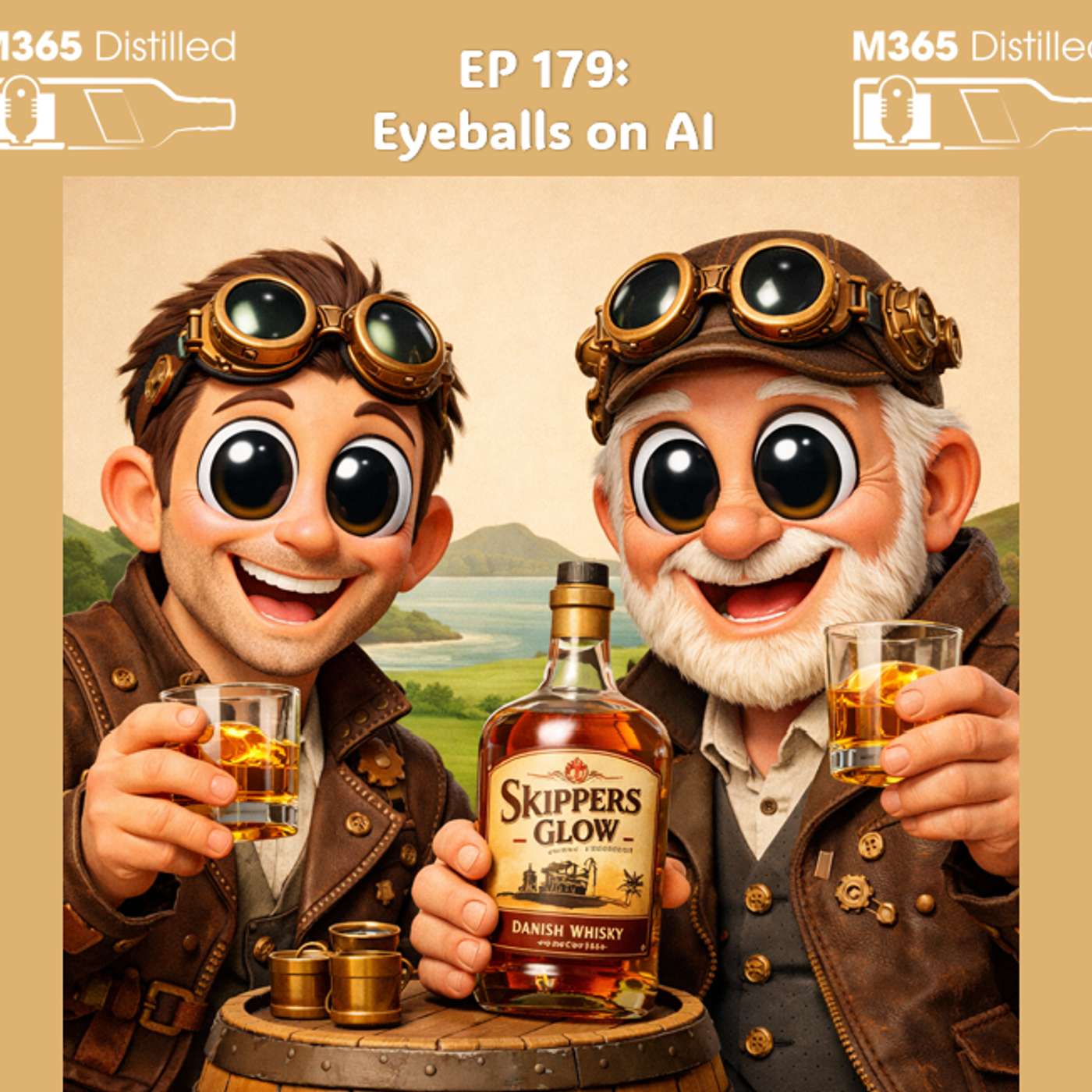
[Music] Hey! 2026, baby! Excellent. Oh, fucksake. I'm all excited. And all I get out of you is a. Yeah, but I just have a half working month after the surgery this morning. Okay. You had surgery on your tooth. Yes. And I had a few whiskeys down already. Actually, I'm a bit the same way, yes. So, we've already been tasting something called the Deenstone Winter Festival, which, yes, Marine bought me a gift. If you remember last time, this is my winter Christmas gift to him, and we had a taste of it too. But Casper, we're going to say thank you a little bit later on, which we will do with pleasure. You'll get more details of that at the end. Yes. Casper and Fiona. Casper and Fiona. Yeah. Yeah. It's. of Fiona. Sorry. Not Fiona. No, not Fiona. Fiona. Okay. Fiona and Fiona. Hmm. I can live with that. Let's not tell this wife. Anyway, happy New Year people. Welcome to Office 365 Distilled or Microsoft 365 Distilled, who gives a shit anymore. People can still find us. So that's good. That's true. Yeah. Casper, I'm looking forward to seeing you in Bremen. I'm wearing still checking his agenda, but I will be there and we'll be able to reciprocating kind. Hmm. That'll be good. Yeah. Oh well. So did you have a good Christmas and New Year? It was okay. It was good. Yeah. Just. See, the thing is, when you get us all this meat, and they all just look alike, they all look the same. They'll feel the same. They feel the same. Yeah, no, no, it feels harder every year. But mainly getting up in the morning. I have no problem getting up in the morning. No, but after this big Christmas then, I didn't even want to go there. Didn't even go there. I didn't even want to go there. Is this a New Year's resolution? No, Christmas vibe is going to become. No, we need more shenanigans. More shenanigans. More shenanigans in 26. All right. I'll have hot women here next time we record the podcast. Sure. Yeah. Now you've got heating in so hot women is going to be. It's not going to be a problem. Yes. That is true. That is true. The house is becoming. A house. A home. Yes. Well, this studio is becoming messy, but we'll work that one out later. Yeah. In the middle of rewiring again, but there you are. Yeah, and at some point we'll put the cameras up. I've got the brackets with there before. I've been thinking about it, and I also started working on the networking for them to the day. Yeah. But yeah, it's weird to having priorities like. Kitchen. I need a kitchen. Exactly. Kitchen first. Camera is later. Yeah. But they're in place. The wonderful, my head pointing at my end, and the one above who said pointing at me. Yeah. It's going to be cool. It's going to make me a busy, busy man, having both video to do and sound to do. Yeah. And actually, folks, if you're going to be in Hamburg in June, we are going to be recording six podcasts throughout. Six? Six podcasts. Yes, I saw. I was in Tunisia. Wait, wait, wait, wait, wait, wait, wait. I was in Tunisia with. Martin. Martin Ravka. I was going to say Martin and I doubled the atmosphere. And we're going to do three in the morning and three in the afternoon. So we're actually going to take a room there. Just to record podcasts with people. So everyone's to come and join us. Three visitors and three speakers maybe. There'll be six whiskies. Yeah, maybe. Whether we do was here every time or not. But they basically were chewing over that idea at the moment of actually doing that. Because we won't be at 200 by then, unfortunately. So should we open up a guest list? I'll let Martin work here. Oh, yeah, because I think the call for speakers is still open. It is, yes. So the way you sold this to me, hey, I'm in Tunisia. I'm with Martin and he wants us to do like a few years ago, like the second. The podcast after the keynote. Yeah, that's right. So I said, yes. And now you came back and you're like, oh, we're going to do all day of podcasting six episodes. Yeah, we were playing around with it. Okay. Actually, I think the way it worked out, we'll do three fusion talk and three M365. So you may not need to be there all six. Oh, yeah, sure. That makes sense because so then I can actually go and watch some sessions. Yes, yes, yes. Maybe give one as well. Yeah, no. Something like that. Again, we're early days playing around. Oh, that's fun. So Tunisia was actually really good. Just before Christmas. And Jamal organized the event, he's doing another one in Tunis. Tunis City is. I don't have to describe it. It is a amazingly vibrant. Energetic, yeah. Yeah, city. It is really so cool. The market is just. Yeah, you've got to go to that. Oh, yeah, yeah, yeah, I can imagine. Yeah, yeah, yeah. So every year, one of my goals of the year is to go to three places I've never been before. How did you know that? And this year, it was. Well, 2025 was Manchester, Athens, and. To. Oh, the Zagreb. Yeah. And there was a fourth one as well. I can't remember. But I haven't been in Africa for years. So I kind of want to do one of his shows. One of the things that he organizes maybe in Saudi Arabia. Or Dubai, or. Got it. Maybe Tunisia. Tunisia was really interesting. So I mean, I've done Africa before, but not for a long time, like you. So that was kind of. But it's like two and a half hours flight. It was less, two hours, ten minutes from here. Yeah. All of a sudden you're in this environment, which is completely different to whatever you're used to. I can't remember that. I've just so laid back. You know? Oh, yeah, we. Not really yet started yet. We're still waiting for some people to turn up. So we started 40 minutes later or something. Oh, I can remember that from Casablanca. Yeah, but nobody bats an eyelid. No, I know. Not so chilled out. The audience just goes, "Okay." And yeah, there was no gaps between the presenters. And I was thinking, "How wrong that is." But it's just taken a little stride. And it really is magic. Jamal, I don't know how you work this out, but it works. You know? Yeah. It really breaks the informalness of the day. You don't kind of finish an end and then everybody goes, "Oh, yeah, yeah." It just, "Hey, the new one guys comes in." They have a chat while you change over from one to another and then you get on to this presentation. Also, it's more like a comedy club. A little bit that way. Yeah, yeah, with a little. Yeah, a little. Compare. But it was. It was cool idea. It was pretty neat. I mean, I spoke three times, I think. I did the keynote on the first day. From the audience. And what I really loved was its students. There was a lot of IT kind of students in there, as well as the younger people. And I wish we'd known about it. And we'd suggested to Jamal because we kind of was pitching this at 100 to 200. Yeah. Because you had people that had very rarely heard of SharePoint. Oh. And so you kind of needed to. To step back. Yeah. The vestigue as well was over there. I've, man, if I don't know, we could have. To re-re-lead the levels. Yeah. But to do these sessions for people that are just entering the industry, I think is awesome. It really was good. Oh, absolutely. Yeah. And it's a good gateway into this whole world and to the whole community of that way. And it was awfully inclusive at the hotel. So the first thing I did was went to the bar and I said, "Oh, really? I'll take one of those chevish regals." Sorry, sir. That's not included in the. Okay, that's interesting. He says, "But don't worry, we do have a local whiskey." Oh, and do you. A local whiskey? You've got a local whiskey. I'll taste that. So he poured the thing in the glass and I took one taste. He went, "Can I have a look at the bottle, please?" So I looked at the bottle and he said, "Do you know what the ingredients were?" So if I take this whiskey and I look at the ingredients. Barley, water. Yeah, so the ingredients. So the ingredients for this one was water, alcohol, whiskey and caramel. I think it wasn't a whiskey at all. And Vasco, as well, got blessed. He fell for the same thing. He was. So I said to the barman, "This is not really whiskey. I couldn't even drink it." I just give it to him back and I went, "You know, why don't you just do that?" And I will pay for. Oh, my God. Yeah, it was so funny. Oh, my God. So I think we all cashed in our bands after a while. I went for the non-alcoholic versions because that's where it was. But it was a really well-organised event in terms of. Once you got used to this laid back approach, it was a very short answer. So how was the turnout? How many people were there? Oh, there was probably 40 or 50 people there. I mean, some of the workshops were eating 50 or 20 people. Nice. So there wasn't hundreds there. There wasn't. No, no, no. But everybody sat down. If you got the audience going, you got some really good questions from them. Yeah. So it was fun considering that we were all English speaking. There's some French speakers and stuff over there. Yeah. There was an amazing French guy, I think, from Tunisia, talked about AI, and talked about how it was thinking. I'm not going to do it now because I think we should go through the slides. And I think it'll make a great podcast about how it works. Because I started feeding the slide into chat G.P.T. and said, "Can you break this down?" And it talks about how we think as humans and how AI thinks as artificial intelligence. It was really clever. So there were some pretty cool sessions there too. But again, it was a bit over. Tunisia was good. I enjoyed it immensely. If you want to do some speaking, I think he's got another event running in February or something in Tunisia. Yeah, but that's a little too close by. Yeah, that's what we should say. To organize all the travel. I also think it was just, I'm going to be going to Malta. I'm going to Malta for a week. And that's probably just, I think that was just in that week. All the day. Yes, interesting. All the day, my mom and my daughter, which we do every year, so we went to Malaga two years ago. Well, it's great. It's a race. Yeah. So now we want to go to Malta. Yeah. Never been there. So it's the first one on my list of three places. I've never been before. So, yeah. Needs, needs, needs. Yep. All right. So that's travel. So yes, we'll be in Bremen in a couple of weeks. And I think. You're going to be in Bremen the week after I'm going to be in Tallinn. Yeah. Or the CTTT. CTTT. TTTT. Conference. Yes. Two days in beautiful Estonia. Yeah. And I think there's something else being enabled as well. But I can't think of what it is. I really need to get my head around where I'm going over the next few days. I think it was so busy. Yeah. So we shall see. And I saw. So if you go to the Community Days website, they also have this leaderboard or speakerboard or something. Here we go. I used to be number one for years. Yeah. But then of course, Jamel was doing all these things nonstop is now number one. I now saw you were on number six. I'm not surprised. And I'm on number 19. No. It's always brassed to it. It's like, oh, there's Steve. And look is on eight or nine or something. Where am I? And I'm scrolling. Scrolling. Scrolling. Oh, number 19. But that's your strategy now. Does this point to do a few big events? No, not really. No. I actually think it's because it's only part organization depending. It's. It's. It didn't. It doesn't matter. It doesn't matter. When I was number one, it was so. It was. It was weird because I felt like there's so many other people doing way more things than I'm doing. But for some reason, I think the algorithm didn't. Didn't refresh or something. I don't know. It was a mistake from the computer. I'm sure. Anyway, it doesn't matter. But. That was funny. It was funny. I saw you like number six. And then I look at number nine. Then me all the way down. It's like, oh. Oh, that was funny. I know. I know. So I saw it. I was thinking like should I take a screenshot? No, they might not notice. So we got a bit of an interesting subject that we want to talk about today. Yes. Exactly. So last week. So I'm on the email list from Daniel Anderson, who's a very brilliant guy from the Australia. I don't really know. I think Australia, but I'm not 100% sure. Did you know that anybody from New Zealand that's called Australian and anybody Australian that's called New Zealand, they will hate you forever. I know. So you just fucked yourself. Absolutely. No, but he's from Down Under. He's from Down Under. Exactly. Yes. From far away. Far, far away. Yeah. And he's got a really good two weekly something newsletter. Very well written. A little thought provoking mainly around how metadata is so much better than folders. But this time he made another case. And I read it. And I just copied it. I sent it to you and I said, yeah, this is going to be your next topic. Yep. So, do you agree with it 100%? I don't think it's an or or, but it's an end and. So basically, so basically what he said in very short form is that we have been developing SharePoint sites mainly for users for human eyeballs. But we have we should we should start thinking about optimizing it for AI. So my not just optimizing what he's saying is we should build them for AI first. Yes, exactly. And humans second. Yeah. So that's what you mean by end and it's not an or or for humans. Or for humans or for AI. Exactly. And it's for both. And then even compromise a little bit on both. Yes, but then the question is should it be 80 20 humans or 80 20 AI or 70 30 or. Because what let's take the common problem. The common problem when you build it for humans is you want to try and make adoption easy. And so we tend to cop out and we use folders instead of metadata. So that's the biggest kind of trend when you come to humans because you say well actually I don't have to train everybody on how to use metadata. Yeah, they can carry on using folders that they use to. As they always done. Yeah. Whereas if you're doing it for AI, then you need to be able to make sure everything is tagged as it is for search because it uses a lot of the same methodology to identify content in the initial stages. Is it needs metadata and tags and keywords which is not so easy with folders. Sure. So for humans you will build with folders to ease adoption but for AI you really should make sure there is metadata and tags. Yeah. Exactly. Yeah, basically that's basically what he said. Yeah. Which brought me to another idea. I know we're going to go through the details in a minute, but I'm kind of jump into the end and maybe I shouldn't but I'll forget it. Whiskey. I'm going to say it. Whiskey is the end. Not that end. Fiona will come to the table. You can of course build for folders but still tag and still add metadata. Oh yeah. Absolutely. So I think that's very much the end and but let's see. Well yeah. So let's work out. So let's see. Fiona's down under. Yes. And under this table. That's fine. Fiona. I'm sure you're giggling already because you know what we're talking about. And nobody else does yet. So that's fine. Alrighty. Go. So yes. The AI stuff with for Google where they said being prepared for being able to questions. They come up with a few things on this didn't we? So they said. Yes. You know. Google is talking about a human-centered AI experience. Yeah. So they're already doing and and. Yeah. Exactly. So basically what they said was designed for humans but don't forget AI. Yes. So that's mainly like 80% humans 20% for AI. So they talk about. Offer a frictionless experience. It looks good and feels good when you're using it. Yeah. You can easily do it that kind of stuff. Exactly. So using AI to write some of the stuff maybe market as a with an icon saying this is written by AI. Maybe. Yeah. That was one of the things that they put on there. Yeah. Simply to make sure that you're building it is open and transparent way as possible. Exactly. Transparency is definitely a very big part of this. Yeah. So I was working on some images when I was in New York just recently. There's a Spanish artist that does these really interesting sculptures of really thin faced. So it does your face but it's really thin and squash and they're about four or five stories high. But when you look at them from the side it looks like a full face. And as you look all the way around it you see it. You've seen these things. I've seen something like this. I was working on this image because when I was in New York walking down the side of the river I take it. There's one on the other side of the river and I was taking pictures of it. So I wanted to be able to sort of show it's different angles. Yeah. And I was playing with the background and I wanted to need this city background. So I used Adobe. I was in Adobe Photoshop. It said you can generate a background. Yeah. So I tried to generate a background. Yeah. Didn't get what I wanted. So in the end I used some of my stuff. I used it. You get me a warning and said hey you've used AI generated stuff so we're going to tag it accordingly. Whether I like it or not. And in fact I deleted the AI generated stuff but it had already tagged it so we delete. So yes, there's a new trend these days as well with AI generated images. I read this morning. It's where you have a picture of a lady fully dressed. And you just say to AI how does she remove her clothes? Interesting. So try that tomorrow. This is for real. You're just walking down the street and you say hey remove her clothes. Is AI progressed that much? I bet the Rayburn AI glasses. The Rayburns. Just make everyone. Make it. Everyone make it. I remember. It's not new. I remember the Sunday newspaper 30 years ago used to sell X-ray specs. Little advert in the corner. X-ray specs. Yeah. Well, anyway we digress. That's unusual for us. So anyway, yes we're talking about making sure that you're transparent and that people know what is human created or what is AI created. Yeah, absolutely. Yes. So build trust, truth and transparency. Let everyone know that this is AI generator. Prioritize. There is a goals. You do. Prioritizing. Use a goals. Oh, user goals. Yes, exactly. You can see that. Surely you can see that's user goals. You see. You could. I wrote the notes and my handwriting gets really. I think it starts thinking of the next word while I'm still writing it. Yeah. All right. shitty. I have that problem as well when I'm thinking faster than I can explain something. So I'm just skipping true sentences. Yeah. And yeah. Well, anyway. So yeah, prioritize. Use a goals. Why are they here? Why? What do they want out of your website? Just because you've got AI, it should all still be focused on the point of the page. Exactly. And to be honest, I hate these web pages where you're looking for something easy and simple, like a conditional formatting rule or something. But they've got this 2000 word page with a very lengthy intro because more words definitely means a better search, a ranking or something. I hate those things. And for those pages, for those websites, so blocks that have more than 20 ads and have more than 20,000 words where they should only be 200. AI is a life saving. Yeah. Point it, shoot it, say hey, give me an update. And I really hope those websites die. I've complained to a few people, said look, I have this newsletter that I send out and you make good blog posts about good topics. But every time I open up your website, there is a gazillion ads all screaming at me. I don't want to point anyone to your website. It is horrible. Yeah. Interesting. But the content is good. So, yeah, well, it doesn't matter. Maybe your newsletter needs to do AI summaries. I don't know how much people would get pissed off with that. No, because I want to drive people to the content of other people because I'm creating all those things. And they're all super clever people. And I want to give those people a little spotlight. If they want to just earn the money from it. Yeah, no, it kind of makes sense. Yeah. Which is what you want to do in your newsletter, isn't it? No, it's not monetized yet because I can't find anyone to pay for it. But maybe I need to talk to a friend to point to something. All right. So, if people start to see more viewpoint content on there, they will know why. Yes. All right. So anyway, yes. So we talk about goals, making sure people understand that. And then we talk about assure accountability. So making sure that you're accountable for what you're teaching people that you're not just being misled and stuff. Exactly what you've just been talking about. And that's also one of the errors as well. Yeah, the accountability is one of the problems with the evergreen SharePoint situation. All the things you're writing today might be obsolete next year. True. Yeah. It's difficult. But then maybe we just need to number five and for errors. Yeah, exactly. Make sure we have an appropriate get out of jail free clause or a way of contacting you if they have questions. Or some way of checking that site to make sure it's updated. Yeah. Or regular, put a lifecycle on it, a page lifecycle on it that you can manage yourself. Yeah. Exactly. Yeah. It's actually one of the things that I've been building for a few customers is automatic revision date and in whole revision process for their documents. Which I think is definitely something you need. No, my great. Take it off. Take it out of search results if the date expires and then send somebody a link to say, "Check this is still valid." Yeah. Exactly. Yeah. So that's how we optimize our site. Well, that was the Google view on where site should be because they're basically moving away from your standard SEO stuff to more AI-focused SEO, AI-EO. Yeah. And it's kind of weird because when AI came out, the first thing I thought was we're never going to use Google again. Google is going to go away. It's going to be, "Oh, I even didn't want to buy any shares from Google because I thought this company is going to be dead in six months." So you sold short on Google? I did not. I'm happy I did. And because this stock is going through the roof because their Gemini is really kicking ass. It's really, really, really good. Well, they always had market advantage just that they were not ready to do the time. Thank you. But now, of course. Exactly. Yeah. So every time you Google something, it's coming up with a Gemini answer. Yeah. So it's beautiful. They have all that. Yeah. Market advantage. So I think a few days ago that people are not going past it, they're just saying, "That's enough for me. Good enough for me." Exactly. Yeah. Most of the time that's good enough for me as well. But of course, Google gets clicks for going to other websites. Yes. So they'll probably have to downgrade the quality of their AI so that they can continue in business. Or do what chat GPs do in find some way of integrating Adverts into the. That's definitely one of the things that they're going to do is get Adverts in the AI. And what do you even know about it? You'll just be reading some information with a subtle. In the 1950s, since I was. Now, suddenly I want to buy some diapers or something. Yeah. Okay. But exactly, in the 1950s, they banned it, of course. But they used to. Subliminal images. Subliminal images of drinks and crisps and stuff to go and buy in the cinema. Yeah. But they banned all of that stuff. Oh, you know that. Or the latest to '70s, I think there was still doing it. I think so, yeah. I read a lot of stories about it. I still think that's. I think Netflix does that as well because every time I'm watching a movie on Netflix, I get the urge to get a whiskey and some M&Ms. Is that right? Every time. Every night. Every night. When I'm watching something, every night it's the same. M&Ms and whiskey. M&Ms and whiskey. So quality makes. It is. And they're just uplifting each other because I'm drinking a whiskey and I think, "Oh, I want some M&Ms." So I grab some M&Ms and then I think, "Oh, my mouth goes a little dry." So I need some more whiskey. And then M&Ms sound like good ideas. And that's how Netflix can afford to buy recently, HBO or whatever it was they bought. Or Universal or whatever it was I can't remember. Anyway, that's Google's view. But of course, what Mr. Anderson was talking about was really about building SharePoint pages, but the Simifraim. So we're building a SharePoint page for a human. Well, a site. We're building a site. Yeah, a site. So the pages are for the human side of things. But we tend to move away from a full structure of content when really that should become a higher priority. That's what is basically key. And basically what he was pointing out was that for the last 20 years. Let's say the main question from customers was make it look like something else in SharePoint. Correct. Make it look like not SharePoint. I do want to do it. And I mean, last few, let's say last two years, Microsoft really made a big effort in making pages look beautiful and make sites look beautiful. So we got all the header things. We got all the colors with the brand center and all everything. But he just says, like stop focusing all your attention and all the money into making it look pretty. But more focus on getting the content right and getting the structure right so that AI can really better. And I definitely believe that. Today, I'm well for the last year, I've been partnering with this organization that is building. Internets. Internet as a platform built on top of SharePoint. And I mean, I work with customers of them and they are sending me mockups of how they want this internet to look. And some of them are just beautiful. I'm working on a beautiful internet. That's going to look absolutely gorgeous. And we can do that in SharePoint. But it's going to cost so much money because you need to do all these HTML, CSS changes. And basically, is it going to be worth it if in 27 or maybe even this year. If instead of going to the internet looking at the news item or an event item or an incident or a procedure, if AI just tells me. Yes. Good, cool. So are we getting back to the point of, you know, the 90s where an internet should just have a search bar in front. Now it should just have a prompt call the Google homepage. Yeah, that's what we used to say. Everybody says, yeah, we just need your internet to have a search bar. But, you know, maybe a prompt page. I was playing with facilitator the other day as well. Faciliteries. But have you seen the setting the templates up for the meetings? I heard about it. It's a pretty new feature. But I haven't done it. So basically you decide how you want to manage the meeting and you prompt facilitator to actually manage the meeting for you like that. So at the moment I'm trying to set it up so you can pre-fill out agendas. But we can't quite do that through an agent. So you've got to combine agents and workflow to make sure people get like shouldn't prompt. But it's a very, very clever way of moving. But again, it's so prompt driven. Everything is so prompt driven. So I mean these sites need to be able to respond to prompts and questions. Yes. That's what people will expect. Yeah. And to be honest, like when all these things came out, when all this AI stuff came out, I thought, "Internets are going to be safe." Because, well, I'm now talking about the internet. But I mean, that's the one that's talking about. Yeah, the U.S. say, "Hey, I will still have a job because of the internet." I will still have a job because of the internet. I go there and it shows me, or it can push information to me. And with the AI, I always need to ask questions. And then I'll get an answer. Until they release the actions, I think it was called, where you can just create a little workflow and say, "Every day at 9 o'clock, send me an email with my most important emails and the most important chats and news of the day." From the internet. Yeah. So then I thought, "Damn, I'm going to be out of a job." And here you are. And here I am. One of the things I talked about at Tunisia was internet and the way that it's changing stuff. And some of the interesting facts that came across is in 2025, how many people were made unemployed that were cited as an AI redundancy? I don't need them anymore. So just the US, the only figures I could get older, what did the number was? I saw it somewhere, but it was quite a big number. Was it 300,000? 414,000 was the number that Holly and I eventually worked out from all the various websites. But equally, the same people are saying, "Ah, we made a mistake. We're having to start to bring some of those people back in." Because even though we did the session and that's what we're getting, we're losing so much knowledge and expertise. So we've got to try and do it too early, in two years time maybe, when the appropriate training's taking place. And that's where we are now. We're basically saying we've got a SharePoint page with knowledge in it, but we don't build it for people to search for it or find it or click on it. We've got to start building it for as AI ready or co-pilot ready. Yeah. It's one of the, so what you've talked about, like the knowledge, the tacit knowledge in people's heads, and that we need to bring that to AI, that is something that Rebecca Isaacson, from the knowledge feedback that Botcos is talking about as well, I think that's going to be a very important thing, but still 80% of all the knowledge is stuck in her head. Still the biggest problem though is we've known this for 30 or 40 years. Absolutely. But AI won't change thisness. No, no, no, no, it's a knowledge management librarian problem. Yes, and it's that problem. I'm not sure, AI will fix that. You still need to have the right processes in place and the willingness to sort of build the change and the drive forward and all that kind of stuff. But what I think will change, and this is a very different topic of course, but I think what will change is that AI will be able to ask you the right kind of questions to drive, to collect the right knowledge. Yeah, I don't disagree with that. But it still needs to drive something forward. It's still near under the pestle water. Oh, yes, thank you. It still needs to know what to trigger it. Yes. But it could maybe look at what is the knowledge that I'm lacking or something like that. How does it know? I don't know. So let's not move on to what we could do with pages. Yeah, potentially we could work that in. So what we're going to talk about just to finish off this podcast in the last 20 minutes or so. Yeah. Please, based upon Mr. Anderson. First name please. Daniel Anderson. Thank you. Still much prefer Mr. Anderson. You've seen too many matrix. I know. I was put it on my list to watch it again. I was talking about it with my daughter that we should watch it because she's now 14 and I think that's the perfect age to introduce her to. Something like this. Yeah. We started watching the Wolf of Wall Street and after a few minutes we decided to turn it off after he was snorring coke out of the ass. She was looking at me like that really. So we decided to turn it off and then we took we put on a perfection. Which we turned off after he stepped during the hot. So she was like a related movies. Yeah, no, well, basically we watched Zootopia 2, the cartoon animation movie, which was very fun. But at some point they also steps someone in the heart with an antidote. And I was like, do you know what movie that's from? So that's why we watched the movie. But I also said we should watch the matrix because that's the origin of so many stories and stuff. Anyway, all right. Cool. So we've got four things that talk about how you should think about building a site and not focusing but to make them copier to wear. And so, um, um, down your Anderson come up with his list and we've kind of much around with it a little bit to bring it down. And we'll post the the URL for his. Oh, absolutely. Yeah. Well, it's an email, but I need to get in touch to see if he has something that we can link it. Yeah, well, as well. All right. So his first comment really was about auditing for agent readability. So you need to make sure that basically you've got constant metadata, everything is fully to complete, common naming, that kind of stuff. Yes. But just to be fair to Daniel and everything else, it is really what you should have done for search to make search work well too. It's why you should have done when you move from your file sharing to SharePoint. Yes. That would have been the perfect time to do it. True. But if people are investing in co-pilot and paying the extra, you need to make sure you're getting the value from it. So that I think is one of the things that drives me. Yeah. So yes, so audit for agent readability. Yes. And not only for your structure of your documents, but also the structure within the document. Correct. Like use H1 titles, H2 titles on your pages in your documents, in your whatever. Markdown is also perfect for that because it's super readable by machines. Because you plug in the bold and the checkpoints and the bullet points and the titles and whatever. Let's just like everybody does for that stuff. Yeah. Yeah. Yeah. I don't even know what Markdown looks like. Okay. But I'm not a dev that don't do any kind of scripting. It tends to be a bit of a nerdy thing. Markdown is still a nerdy thing just like loop is not loved by end users. Markdown is notepad on steroids. Yeah, I get it. So basically. Anyway, so yes, audit for readability. We'll talk about that a little bit later when we talk about testing. Yeah. But think about the facts that you got good headings in place. Yeah. Good structure of your data. Good headings. Just the same as if you're writing a report or a structured email. Yeah. You know, make sure that that is in place. Does it mean that that's the only thing that a human will read? It just means that it needs to be in there for the agent to pick it up. Yeah. You can still do a synopsis or you can still put something on the page using little icons and pictures and images that deliver similar information. So the link that takes you to the full in depth article, which has been written for, you know, AI and co-pilot to be able to understand and read. So audit for agent readability. Yeah. And we'll get to testing on that a little bit later. Yeah. Next, the next interesting one. I'm just going to let you read those. Just that my handwriting. Yeah. You really not read it. Isn't it amazing? I encrypted it, you see? Yeah. Exactly. I encrypted it with my left-handed stroke, standing on my head, writing it down so that only me can do it. You need the key. All right. Treat content as infrastructure. Yes. So I love that. Yeah. It's brilliant. Just like we have our cables for our network infrastructure. This is the basic, the basic stuff. Now, treat content as infrastructure. It is your key message. It is the reason for creating the site. It is the reason for storing in that library or two libraries or three libraries or whatever it takes. The other thing is that some of that structure stuff for AI is don't put a million documents into one library now. Because it needs to be able to scan it and know the changes and stuff. So think about more libraries and smaller libraries than. Yeah. There are so many large libraries or even sites. So the site basically does not need to have an admin overhead. So basically you don't need to be led into that content. You should still be a nice way of accessing that content. Yeah. But I also think that what he meant was more of don't look at filling out metadata as overhead, as extra things. That you need to do. But as something that is really important, it's actually building your infrastructure, filling out the metadata. It's like laying all those cables. It's the same thing. Riding down the metadata on these documents, that's not overhead. It's building your infrastructure. Yeah. So it's just because you have to fill out some metadata. It's not wasting time. You're adding value by doing that. Exactly. That's the message you need today. Yes. And that basically in a SharePoint world means content types, metadata tags, manage metadata, which is obviously a high priority. Absolutely. Yeah. Basically making sure that AI using text is able to be able to decipher that relevant content from that area. Cool. Yeah. All right. Next one. Can you not read that one either? Both AI and humans. Yeah. Exactly. I think that's important because we. It's the adoption curve. I mean, we have people using AI, but we also have people not using AI. Correct. I don't know how long, but we'll see about that. It's like we still have people that are not using Google. True. So, we'll see. And we still have people that don't trust AI and won't just. That's not the only way they work. They need to be able to see, feel, touch, click. Yeah, exactly. Yeah. And that's fine. It's like electric cars and gas cars. I mean, this is what you mean by "and-and". Yeah, exactly. So, I should be able to go to a page and be enticed into that page to be deep-dive and click a few more things and read the content. Yeah. But equally, I should set up the structure for my data behind that page or in that library as a view, whatever, what it behind that view, to be able to have co-pilot or AI read that page on it. Exactly. Yeah. And everything from it. Have metadata, but also create good views. Yes. And so, for example, formatting, use some colors, say, "Oh, this document is active or not active or reviewed date or this choice or whatever. Make it just a peeling. Have good naming conventions for documents, maybe." Yep. Things like that so that a human can see it, but also that an AI can parse it. Agreed. I think that's important. And I think it's, for me, there's a bit of a process here that you need to work through. So, one of the next items is a little bit of a test with co-pilot. But actually, whereas we tend to start a site by deciding what we're going to put on the homepage, we know that the real way of starting a site is by understanding what the content is going to be placed there, what its title is subject, manage is going to be how it's going to who owns it, that kind of stuff. Yeah. Get that in first and then test it with co-pilot to make sure that you can question it. You get the right answers back, it's picking up those things. But also, you can start to use it to build the content of your page. Hey, give me a synopsis on how I enroll a new employee in the organization without having to point them to specific links or specific titles or anything else that goes with me. So, you can test it with co-pilot, start asking it questions. And once you know that structure's correct, then use that co-pilot and say, "Okay, give me a synopsis. What will people want to look at on the main page, what takes or don't need or headings, what don't need?" Yeah. And that brings us back to what Google also says, like, "Frictionless experience and prioritise the user goals. If you're building a site on the trainings that people can do, ask the AI about the trainings that they can find on the site, test it out. Yeah. Awesome. So, let's go to co-pilot, point it at ask questions of it and make sure that actually the page is going to be audited for agent readability. Yeah. What is interesting is that I was thinking about this as we were chewing this over earlier as well. You could create an agent and point it at a site and get some kind of measurement from it. And then you can use the same agent on different sites so that you can compare and say, "Hey, how many subjects have been discussed on this site?" If you've got 17 subjects, hey, maybe it's too much. It's done to split it up. Yeah. You can sit there and go, "Hey, you know, and standard questions." So, tell me what the site is about in two words. That would be a really great prompt to share with other people. Got to build it first. It's just an idea at the moment. Yeah, but I love that idea. I think that's really cool. You can build a prompt or create a prompt. What do you do? Build a prompt, create a prompt. You create an agent. You create an agent. Yeah, but you need to. So you define a prompt. You define a prompt. Okay. You don't prompt a prompt. Okay. Yeah. That does a quality check on your SharePoint sites. Yeah. I like that. Yeah. I think that's a cool idea. Maybe our friends at the CoPilot connection could, uh, the Coco P.P. love it. Yes, the award-winning people from the SPA and this is their space. They should come up with that. Exactly. We need a prompt that we can point to any SharePoint site that will give us a quality rating and a comparator ball, a comparability, sorry, something that you can compare. Don't be able to do that. And actually, you'll be able to say, hey, I've just created a new site. Run the prompt at it and it will tell you whether it's as good as the other pages on the site. Yeah. Sometime that. Yeah, there you go. Cool. So now Kevin's just stopped in the supermarket and went, those boys, what a great idea. I better ride that down before I forget it. Yeah. Right up in the back of the cornflakes. Go to the paper where you can get some big mark pens and just tell them that you have to use it and then write it on the back of the cornflakes. Your kids will tell you all about it when they get their breakfast in the morning. Let's go back to that a little bit later on then and talk about what 2026 means for AI and Coco Pilot pages. Yes. And let's talk about another listener of our podcast. Gasper. Gasper. Gasper lesson. Gasper lesson. Fio Nia, apparently. Yes. Gasper lesson. Huh. I've got the worst information. So, hold it. Just give me the side. I've got that. So we've, I've met him mainly online a number of times. He's also an MVP. He's a dual MVP actually. And the fun thing, we can't talk, we can't discuss anything about anything that happens on our MVP meetings. But what I can say is if we're there with a number of people, Gasper is, most of the time he's one of the only people with his camera on. So I feel like I know him because I'm always seeing him in meetings and I'm always seeing him being in the meeting. But he's also one of the people that asks the really good questions. When he asks the question, I'm always like, why didn't I think of that? That's such a good question. Well, he treated us. He treated us. One thing I still want to say, he's one of the people behind the PMP Modern Search. Oh, thanks. They're not knowing better than I thought. Yeah, I'm using his stuff all day long. Yeah. And he's also one of the people that organizes the monthly PMP community, forgot what the right name was, but they do every month they've got an hour. And you can just come up and ask questions about the PMP search thing. Oh, I want to do this, but I can't figure it out. Or this way. And they'll just happily do an hour or five. I love all of that. Free stuff. But he likes our podcast. He listens to our podcast. He likes our podcast. Yes. He admits, I don't know if he wants us to say that to the whole world, but he did. Today. And so then he decided that at some point he said, what's your address? So I happily gave him the address. My address, because I'm always good for stuff. And he said, I'm going to send you a whiskey that I really like. And this is a Danish whiskey. Yes. So it's called Skipper's Globe. Yes, from the Isle of Fionia. So. And it's from the, it's got a great name for the distillery. It's the Niberg distillery matrix again. Yes. So this is a limited edition, even more thank yous. It's number 72 from nearly 200 bottles. And it's a 52%, which according to Holly is no nonsense, no babysitting. 52%. I love that. No nonsense, no babysitting. It's nonchalant. It's not filtered, natural color. I whiskey with no cosmetics. Nice. And it says it's organic because it's Scandinavia. I've no idea about that. Oh, jeez. She's just too deep for me. But this is story to this whole cask, OK? Yes. So it's a marriage of two casks. Yes. And it's a first full bourbon and a first American virgin. And then, because it's Denmark, she says, one cask spent six months at sea during a sailing season. Yes. So I guess they stick it on the boat and sail it around the sea. Yeah. Exactly. And then when they come back, they married it with a peated bourbon cask. And this is what it is? Excellent. Nice. All right. So what we're supposed to see is get maritime breeze on the nose, salty air and wet rope vibes. All right. OK. Vanilla honey. A gentle peated smoke, not highly shouting, more applied murmuring with fresh apple and orange peel. So I'm really looking forward to that. Absolutely. Yes. Yes, it tastes softwilt rope. No. No. With that oakiness, I think it's probably what she's supposed to say. That oakiness is definitely there. I mean, that orange peel is there. It is a little smoky. It's not too smoky. It's, as she says, it's not alas smoke. But the peatiness is definitely there. Not on the nose, though. I don't get it on the nose. No. But you'll definitely get it on the aftertaste. And I can't imagine. Can you mean by this sort of salty sea breeze? Yeah, but I think that's the peatiness that comes out a little bit. Maybe. Because you see that orange. It's, I love the color. It's beautiful. It's dark yellow. No, it's not orange. It's orange. Can we compare it? Look to the deenstones. You know, deenstones is mellow brown and this is orange. It's bright orange as well. Yes, it is a bit. Is this a radioactive somewhere? Maybe. So it's very, very nice on the nose. Yeah. Alright, taste it. Let's see whether you're right to what Ollie thinks the palette is like. So definitely that peatiness comes out when you drink it on the finish, but also just on the sip of the tongue. It's definitely there. You've got that. For it, I don't really get that bourbon vibe out of this. It's, the vanilla is very dark vanilla. It isn't there at all of it. No, it's, it's, it's more stooot. It's more, yeah, it's got, it's got a bunch of things happening. Alright, look, it's definitely got dried fruit in there. It's quite heavy. Mm-hmm. Nice and oily as well. But there is something on the palette that bit me. You saw my face, I'm sure, that maybe it's just the first taste. Maybe it's that dark chocolate, but there was something on the palette. I didn't swallow it because I was doing, what is that? It's kind of a bit medicinal. It's not creamy for me at all, but I think that's because it's plus 50%. Creamy? Well, it says here that there's a nice gentle spice with vanilla cream on the palette. I don't get that at all. This is a Nokia blocks off kind of drink. Not badly. No, definitely not in a bad way. It's not sharp. It's, it's got a little bite, but it's, it's an elegant bite, I think. I like it very much. There's a lot of complexity there in the, in the finish. A lot of complexity. And the orange just come later, I'm starting to get it now. What's 30 seconds after I put the glass down? Oh, and there's chocolate as well, long last. Yeah. Let's keep sprouting chocolate, but, but not dark chocolate, more milky chocolate. No. Yeah, I agree with that. A kind of a nutty, a all-moody kind of, yeah. Well this is really, really, but very good. Yeah. I haven't tried it with a drop of water to be honest. But my angel is upstairs. You might just get a drop out of it rather than me to pour too much. There's not lot in there, so it will just dribble in. There we go. I think I'll do the same. All right. I should have brought the angel, I saw it earlier when we moved upstairs. I had fun this weekend by you just tasting that. We've gone out, let you finish that one first. Of course it mellows it out, but it rounds it out, it makes it much more elegant. That doesn't take away of the palette at all. No. No, no, it's not like it's suddenly a different drink. You saw the saltiness and sharpness on the palette. Yeah. Well definitely on the palette. And it brings out whatever that thing was that I could. You know what I get once you do this more. I noticed it before, but it was faint, but cough suites. That's kind of, you know, those cough losinges. I don't get that. Yeah, no. That's what I could get earlier. That medicinal stuff, that's exactly what it is. Okay. Mmm, no. Toffee comes out though. Yeah. True? Yeah. Big time more, yeah. And the smoke and finally starting to get the smoke. Really? Okay. Oh, and the chocolate. And the chocolate. Not this, not this. That is definitely a two for one. It makes it much more elegant. This is more like a villain 16 level of elegance, but not in the beatingness, but in the elegance level. Right, yeah. The depth. Yeah. The complexity. Yeah. I love this. I don't know whether you know what I mean when I say bonfire toffee. So in November the 5th, Gryfforx set fire to the Azazapalma. We all have, in the UK there's bonfire thing. And there are a couple of things that come from that. One is the red toffee apple dipped, you know, and it's sweet toffee. And the other thing is bonfire toffee, which is very, very deep, treacle toffee. And it's so you, it's dark, it's nearly black. And it's quite, it's not bitter, it's not to the point where it's got to the point. But that is what I get out of this. That really deep taken to just over the edge, crispy toffee, dry toffee. Okay. Nice. Mr. Anderson. No. Mr. Casper. And I was going with both of these guests. Oh, go, go, go. Mr. Anderson, Mr. Casper, you have made this an incredibly interesting podcast. Yes. But Casper, you have brought a very special whisky. I agree with your taste. If this is on your favourite ones, that is bloody good. It is. Very bloody good. So what I need to do is I need to check up with him to see if he's driving to Hamburg, to Bremen or if he's flying because he's coming from Denmark. Oh, yeah. So it's not that far. No, you may well be driving. So maybe we can give him something and return. Maybe we can. All right. And I would also pay for another bottle of this. Maybe, yeah. Well, you're in touch with him, I guess. So you can negotiate accordingly. Yes. Excellent. Thank you very, very much. I'm just going to finish off this. Oh, yeah. It's very nice. Oh, yeah. There's also a fact that Casper, before he was doing SharePoint, he was actually a skipper on one of the big boats. Oh, really? Yeah, yeah, yeah. So is he the skipper that's mentioned? Oh, that's a good question. Keepers glow. Oh. Yeah, it says in the label Casper used to be a skipper. Wow. That was incredibly. We've always said that we would do whiskies or we tried to do whiskies that are difficult to get older that you wouldn't normally taste. And I think this, I've never heard of I love fiesta. I mean, I looked at it and thought, oh, it must be somewhere off Scotland. Yeah. So that's not the case. So nice touch. Very nice touch indeed. So I love fionia, skippers glow. I would say definitely worth of buying a bottle. Absolutely. Absolutely. I did not look at the price. I have no idea. I don't care. It was a gift. But I would definitely buy another bottle. Well, this is a limited edition. So this if, yeah, if you can get this. Yeah. Definitely, I'm going to take some samples before you disappear off home today. Definitely do that. Because it was a present to the podcast. So we should share it. Yeah. Yeah. Absolutely. That's beautiful. All right. Well, what an interesting podcast. We're at an hour now. Oh, do you do it again? Yeah, we're just two minutes over. Oh, okay. But great subject, my friend. Thank you very, very much indeed. I think that if we talk about Mr. Anderson specifically, he came up with really quite nice sort of closure for his newsletter. So he basically said in 2026, your SharePoint sites are not. Does it look good? Will people go to the site? It's really about can agents read it? Yeah. That's the key. And I'd like you, our view, I think is the end and for now. Well, but I honestly think if you're either never going to go to the site and I don't know we'll ever get to that. That is another conversation on it. And the other thing that I was thinking about a few times already when we were having this conversation is like, this is what AI can do today. And what can it do in six months? What can it do in 12 months? Because we were talking about or the Google thing was talking about when you add images, for example, put an alt tag in. Because AI can't read images. Well, now it can. So, yeah. So what else can it do in some time? I mean, now we're creating documents. So many people are writing blog posts like Fesco, for example, always writes these very long, beautifully written, well taught out blog posts. I stopped doing blog posts a few years ago because it just takes too much time. I now switch to YouTube videos. Yeah. But at some time AI will probably start to be able to recognize bits and bobs from my videos. I know. Here's the data. And if you go to the Google platform, I was a Google world in Amsterdam last week. And one of the guys there did a demo and he played a three minute video of Formula 1, a Formula Electric. And then he said, okay, threw it into the page and then said, oh, good. And at least somebody looked at Formula Electric. Yes, it's true. But then he said, hey, tell me how many products did you find in there? And so it basically went through the whole video and gave him a list of all the products he could find. But not only that, whether it was on the side of the car, on the side of the track, somebody's helmet or whatever. And at what point in the video it was that? So brilliant. You know, that kind of stuff was sort of. Sorry to be around. Yeah. I mean, we scan these labels. And yes, it does a tech search and he already knows about what the bottle is. But I don't need to worry about it anymore. I take the picture. And it says, hey, did you know you've got bottle 190? No, I didn't realize that. I didn't. Now I can read it. So it's telling you both the obvious stuff and the stuff behind it. But what I really find interesting about what you've just said, and I'm hoping it will come back in mind because I can't remember what it was. Shit. Hate it when that happens. I'll just say, die myself, whatever. No, you said something and it dawned on me about the content. A-I-A-I-A-I-E-Pitcher Smarter. The problem is that A-I is not just thinking about attacking a picture anymore. So you've got to go through those many stages of A-I. Hey, what's this picture about? Give me some tags for that picture and then do it. And that's where agents come in again. So you can ask it to explain the picture because I took pictures of the labels and it told me about the whiskey. It's almost as if it says, hey, I'm super intelligent. I can tell you this much about the whiskey, whereas really we just want it to add some search tags onto it so people can find it easier. And so you've got to be very specific about what you need to do again. Yeah. And that's really where part of the knowledge comes into this play. Anyway, basically, basically, 2026, make it the priority to not only make your sharepoints eyes look good, but also to make them look good to A-I. Correct. And we'll see what actually happens 2728. Oh, boy. Yes. What can A-I do? That's a good podcast to be said, right? Maybe next time. Yeah. Yeah. We still got to do a last-minute, a last-inch party. You know, we get really drunk and I don't know if I'm going to say it. Oh, we should. Yes. I got lots of shit. I'm going to finish. So anyway, thank you to our guests, even if they were not here. Yep. And they are. A Casper and Daniel. Yes. That's a good one. That's a good one. Yeah. So that's cool. And Fiona. Fiona. That's good. All right, Steve Dolby is signing out and saying goodbye. And as always, I remember a time in our podcast where Maraine used to do a really long finish. Nowadays, he just freaking says goodbye. Thanks for listening. And learning. Yeah. If you're still here one hour and ten minutes later, we hope you enjoyed the whiskey and our musings. And I'm going to say goodbye and hand over to Maraine. Well, let's definitely not make it a habit in 2026 to make an hour and ten minutes long podcasts. I think nobody's waiting for that. Should I wait for this? I don't know. We'll see. We'll have to look at the analytics. Because basically what the analytics set was that in 24 and 25, we basically got the same amount of less. Yeah, that is true. So I kind of want to see if we can move it around. And I don't really know how to do that yet. I don't want to buy anything or whatever, but I just want to, I don't know, see how we can improve. So are you back into 2026 focused again on increasing the numbers? It's one of the things on my list, yeah, exactly. All right, good, good, good. So maybe just giving it as a video might be the next step. So something we do physically with my looks. Oh, no voice. I mean, awesome. I said, I will talk, but we'll only put you on the video. I can look at that. I'm not that note, thanks very much. And thanks for listening. Ciao. Bye bye. [Music]
Podcast Summary
Key Points:
The hosts discuss personal updates, including recent dental surgery, holiday experiences, and upcoming travel to events in Bremen and Hamburg.
They reflect on a positive speaking experience at a relaxed, community-focused event in Tunisia, highlighting its informal format and engaged audience.
The main topic is a shift in SharePoint design philosophy
Summary:
The conversation begins with casual updates, including the host's recovery from dental surgery and holiday anecdotes. They then discuss an upcoming podcast recording plan for an event in Hamburg, aiming to produce six episodes. The hosts reflect on a recent speaking engagement in Tunisia, praising its laid-back, inclusive atmosphere and the value of reaching new audiences, such as students entering the IT industry.
The core discussion centers on a newsletter by Daniel Anderson, which argues that SharePoint sites should be designed primarily for AI optimization—emphasizing metadata and tags for better search and AI processing—while still accommodating human users. This contrasts with traditional human-centric designs that often rely on folders for ease of adoption. The hosts agree on a balanced approach, ensuring both AI and human needs are met, with transparency in AI-generated content. They also touch on broader trends, like Google's human-centered AI guidelines and the ethical use of AI in content creation.
FAQs
The main topic is about optimizing SharePoint sites for AI first, while still considering human usability, as suggested by Daniel Anderson's newsletter.
They plan to record six podcasts in Hamburg in June, with three focused on Fusion talk and three on Microsoft 365, inviting visitors and speakers to join.
The event in Tunisia was described as laid-back and vibrant, with a unique informal format that felt like a comedy club, and it included many students new to SharePoint.
One speaker aims to visit three new places each year, with past destinations including Manchester, Athens, and Zagreb, and plans for Malta in the future.
They found a local 'whiskey' with ingredients like water, alcohol, and caramel, which wasn't genuine, leading them to switch to non-alcoholic options.
Google emphasizes a human-centered AI experience, focusing on transparency, frictionless design, and clearly labeling AI-generated content to build trust.
Chat with AI
Loading...
Pro features
Go deeper with this episode
Unlock creator-grade tools that turn any transcript into show notes and subtitle files.
 PodcastTranscript AI