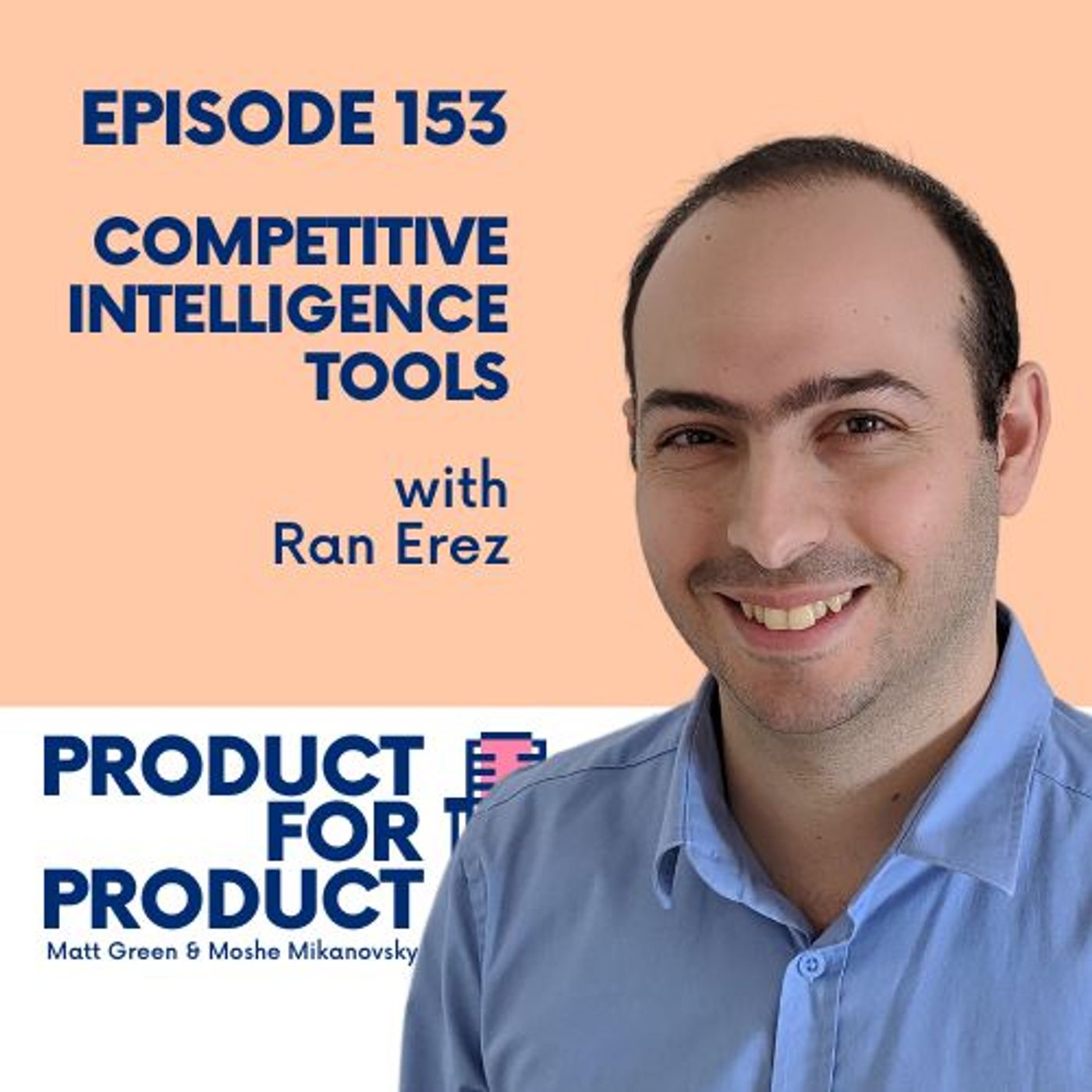
[MUSIC] >> Hello, product people. Welcome to the product for product podcast hosted by Mac Green, Data Advocate and Product Manager and Mushamik Anowski, Product Leader and Author. Our goal is to serve the product community by helping you find products that can help make your work in product management easier. Thanks for joining us on another episode of the product for product podcast. >> Welcome back everyone on today's episode. Meshadeh and I are excited to speak with founder and fellow podcaster, Ron Aries, about competitive intelligence research tools. So let's go ahead and hop in. Welcome to the show, Ron. >> Hi Matt. Hi, Meshadeh. Thank you so much for inviting me. Really excited to be here. >> Thanks for coming on. Hey, Meshadeh. >> Hey, Matt. Hey, Ron. Welcome to the show and today we're talking about a topic that I don't think we ever talked about, which is competition. And how do you really explore and do research on your competition to help you? And you told us before that you are in love with your competitors. And after you speak about it, also people that listen to you get in love with their competitors. So that's awesome. But before we get there, tell us about yourself and how did you get the product? >> Sure. So my name is Ron. I've been in the product management world for over a decade. Had the opportunity to build both B2B products and B2C products. I had cyber experience, but also mobile B2C, launch an app from scratch and also had an app that I led with 10 million daily active users. I've been three years at Monday.com where I led mobile and then the main product, which is called work management. So a billion dollar ARR, two million users on a monthly basis. And that's what I did on my day job. Of course, I also have a podcast like you just said, Matt, so I'll have the productive podcast. It's in Hebrew and I interview product managers that face different problems and how they solve them. So that's a bit about me as a product manager. And I also founded Refocus, which is the company that I lead today. Refocus essentially helps strong product teams become winning product teams. And what I do is I work with product leaders and product teams through either workshops or coaching and help them get to the next level, especially around success metrics and competitive intelligence. This is why we're speaking today. And I think as we said in the end, the intro, the fact that competitors, I love them. And when I say say that I love my competitors, people are shocked. Why do you love your competitors? We're supposed to hate them. They're like the bad guys. No. I think they save us so much time by actually doing a lot of work for us, validating ideas, trying out new things that essentially I only to try out because I can use what they've built and use their development force to actually validate my ideas. And we'll talk about it more in depth today. But to your question, how I got into product management. So it was more than years ago, I was a QA and integration as a cyber company. And I saw an interesting gap. I saw that we had a product, but it wasn't really resonating with our customers. As a QA integration, I did a lot of training and I was seeing a lot of gaps. And I went to my manager's manager nest, who's responsible for these gaps? And she said, no one. And I said, can I take responsibility of these gaps? I really wanted to be a product manager. And I said, let me lead this product. It was a POC. I wanted to take ownership. And within 12 months, let's evaluate the results. Fast forward after 12 months, we got it to millions of dollars in sales. And I really enjoyed the process of actually understanding what's the pain behind our users needs and how we can solve them. And I fell in love with the role. And this is how we got into product management. So it's a bit of luck and a bit of like being able to actually ask for it. And obviously today it's much, much harder to get into product management and we should acknowledge it as well. Like we say, little Hutzpah as well. The good type of Hutzpah. So if you see an opportunity, then go for it. Absolutely. Yeah. Yeah. Amazing. That's a great story. So yeah, let's dive into our topic today of competition. And one thing that you say already kind of trigger in my mind about they are doing the research, they try different things and stuff like that. One of the things that I always say about competition is that the fact that they are doing something doesn't mean they validated it. Yeah, because I've been in many places where we just copied what the competitors did or the increments. And because our clients wanted it, it was on their checklist in their RFPs. So it was like a table stake. If you didn't have it, you're not, they're not talking with us. But then we realized they didn't use it. Yeah. So, well, I want to ask how do you deal with that? But maybe, maybe I'm jumping the gun over here. So tell me how you want to start the discussion, whether we should talk about what is the competition and how should we deal with them? Or should we answer this question first? I think let's answer it. And maybe even broader the scope of like, where are the top mistakes that I see product teams do when they think about competitive intelligence? Let's do it. And I think they would be a great place to start because you mentioned the first mistake is let's copy them or essentially taking what competitors say at face value. And I think this comes through both their messaging of what does their product do, but also in their individual features. The fact that we see a feature in production in a competitor's product or in their website, doesn't mean that A, it's real and B, it's good. And I think that's the key mistake that I see, but there are other other mistakes that I see. And I think maybe like a lot of things in product management, the first mistake that the biggest mistakes outside of just copying blindly is not having a clear outcome of why you're trying to do competitive intelligence. And we'll dive deep into different levels of competitive intelligence. But at the end of the day, you're not asking yourself the basic question of so what? Okay, what information do I need? And what decision am I trying to make for this competitive intelligence research? Like our competitors are out there doing a lot of things. We are asking ourselves what's happening in the outside world, but with a specific reason is like what's our outcome for actually asking this? Are we trying to think of a new feature or are we on a product strategy level thinking of a strategic direction? These would lead to different competitive intelligence work that we need to do. And I think that's the second mistake I see. And I think one mistake that's really key is also thinking that's like this is a one-time thing. Like okay, we did competitive intelligence. That's it. We don't need to go back to it. And as we evolve as a product, I think also our competitors move. And we can treat it as a gate. It's not like, I don't know, like an AB test and we finished the AB test with a winner and that's it. We finished this. It's constant iteration, right? So we can't stop with thinking it's a one-time project. So how do you think about it? I have more mistakes, but I wanted to hear how you see these as well. Yeah, for sure. Some of this stands out to me also on this role in responsibilities. So I've also been in environments where product marketing or marketing in general handled these kinds of operations where you relied on them for this level of intelligence, ongoing intelligence. So that's I think that's another thing to consider here from a product first marketing, product marketing perspectives. Like who is doing it? Yeah, who's doing it? Yeah. I think we do expect like the stream of information to come today. It may be product marketing, but we also have AI agents scanning our competitors and also sending us a lot of information. But I think it's like the role of us as product leaders is to actually define the why and what would be like the golden piece of information that we need to make a decision and that would never come from I think other other departments other than actual product management thinking about the direction going forward. Right. Yeah, that's that's a great point. Yeah, because I've experienced the playing catch-up. So you have a you have a product. You're in a very saturated market with a lot of other competitors. You're basically trying to play catch-up and we we ran to that same thing you mentioned. They have this feature. Do we need to build this feature? People are asking for it, but is it really successful for them? Yeah. So through intelligence through this competitive intelligence we did, we kind of identify like it probably wasn't as viable to them. They probably went off and did it. And it probably wasn't as viable to them. So it kind of reframed how we were approaching it in our own product. Yeah, I think I think as as as the more like as a more junior product manager, I used to do these huge feature checklists of like all our competitors and all our features. And one time I stopped and I looked at this table and looked very blurry and I asked myself how can I actually know what's noise and what's value like if you think about it from a user's perspective they never they never encounter one featuring silo. They always encounter your competitors product as one product and never you can never like put it on a box in a table. That's one thing. And the second thing is like filling out this table was such a subjective experience and such a subjective where did I did that like it's my subjective view of individual features as silos which is never what our actual users are experiencing. And I think that that's really struck me as like we're doing it wrong. We're like if you have a table full of features and competitors then there is no way that you can actually understand what's going on because no user experiences
one feature at a time. We experience everything. And even if they have this feature, it doesn't mean that they actually solve the problem in the correct way. So what do we get from this table? A subjective view of how we think about individual features, our competitors declare they have. That's not competitive intelligence. That's subjective experiences. - Yeah, that's part of it. And part of it is that you also alluded to before is a lot of this information very hard for us to find. And that's a question I would love to answer later on the talk. How do we find the competitive, right competitive information? But a lot of it is very hard for us to find because we can't put our hands on this product itself, their product. And therefore we look at their marketing information. And the marketing information we know that it's not always correct. Either it's outdated or they beautify it to win people into their website or whatever the reason is. So it's more subjective than anything. - Yeah, and I think we'll talk about a lot of ways to find out the real information. But I think maybe the last mistake is focusing only on direct competitors. And I think when we think about competitors, we look in our immediate market. Who are we competing with on a budget level? Or like the direct competitors, but sometimes our product is not competing on a budget. It's competing on attention. Like as Netflix said, we are competing with sleep. Okay, we are not competing with other streaming services. - So we just have to be doing it. - Yeah. - And like, when our user has a specific problem, he can choose us or he can choose a pen and paper, for example. And I think we would never think about a pen and paper as a competitor. But when we do that, when we think about like, what are we competing with in the real world? I think it changes the perspective of how we think about competition as a whole. - That's a great point. 'Cause I've run into this as well, where you can talk to sales, you can talk to marketing, you can talk to operations, and they'll give you a different competitor list. They're like, well, we compete with this person or this person because they've spoken to somebody that has mentioned it, because that somebody was looking for a specific feature. So, you know, and so it's, it can also, you can also be biased in that perspective. Like, hey, I talked to operations. They brought up this market competitor. Are we really competing with them? No, they're actually a different type of tool. I think you have to, I think you have to zoom all the way back out and kind of clarify that as a company. Like, who are we? Who do you want to be when we grow up? - Exactly. And sometimes we don't lose to a direct competitor. We use doing nothing, okay? Like, actually not changing sometimes is the competition, right? It's like not necessarily like a competing product doing exactly like what we do. - Yeah, that's almost like analysis paralysis almost as well. Like, you know, you get into it and you're like, well, I heard from operations this person, I heard from sales this person, this company and it's like, what do we want to do? That's where like a founder or leader, a CEO comes in and goes, this is what we're doing. This is the vision for the product. This is where we need to take this thing because we've identified this market to a go after. So, I think that's where your captain comes in and says the ship is heading this way. - Yeah, so I think the way to think about it and the way to maybe go about actually executing competitive intelligence is thinking about first, we talked about the outcome, but what I find that helps with product teams like do this is understanding what I call the competitive intelligence pyramid. It's essentially where we divide the competitive intelligence into different levels. So the base level of competitive intelligence to me is what I call a feature deep dive is when we ask a simple question. So, how do different competitors solve the same problem? So we have a problem within our product and we take inspiration from other competitors into how they decided to solve the same problem. That's on the feature, let's call it feature deep dive and there are different tools. That's what I call level one. Above that is when we compare product capabilities as a whole. So we wanna analyze the pros and cons of our product versus competitor product. So we don't look at a feature level, we look at the product level. When they use the product as a whole, just like we said with the table, that doesn't tell us a lot about the individual features, we wanna compare the product as a whole. On top of that, we will look at product messaging. So how do competitors actually communicate the value and how does this value change over time? So this is when we will go and look at their marketing messages but also look at how the marketing message changes and we'll talk about tools that can help you. Then if we go to the level above that, is what I call the product strategy competitive intelligence. We're trying to look at the market and see what strategic trends our competitors are taking. So we are seeing that direct competitors are moving into specific things. For example, let's take AI. Is AI being used to simplify the UI or to add deep capabilities? That's different trends that we can see in our competitors and it could indicate different things about the markets. And I think the last or the top level of competitive intelligence is company strategy. So it's both the product and how the competitors are planning to gain market share. So are they doing interesting plays around the GTM? Are they doing moving from PLG to SLG? What are they doing to prepare market share? And that's on top of their product strategy. So called is their company strategy. And I think when we think about the pyramid and these lenses, we can think about different tools and different techniques we have for answering the different things. We would use different tools for feature deep dive versus understanding the product strategy. We wouldn't look at the same things. So as product leaders, we need to ask ourselves, what's the goal? Are we doing a feature deep dive? Are we trying to actually understand their company strategy? So I think that's a key point for, even when we start with the tools, we need to think about the mindset. Where are we in these levels of the pyramid? Now, let me ask you something else, because I do want to get into all of those methods that you're using to help our listeners to each one of those levels, what will be the methods there. But before that, I was thinking about, we have learned through this podcast a lot about products for product teams. We talked with a lot of product managers in the last five years. When this episode is coming out, I think we will already be after our fifth anniversary, which is in March. And yes, and we learned from all of those learnings, I actually put together this, it's a mirror template book on Mirrorverse, so anyone can use that. This kind of a process to choose to select your product. Now, DC is geared to people that are select in the product and many of the things over there are not just about the features and the price, that's actually one of the lowest criteria over there. The higher criteria usually is like, how do we work as an organization? And which product will fit the way we are working? Because part of it is like, do we like one product that tells it all or do we like specific products that will solve specific issue or challenge and then integrate all of them? Those are very two different cultures, actually. And we've seen it with many products that were in our sphere of product management and product tools. What I realized is that we can also use the same criteria in our competitive analysis, because when we compete with other companies and other solutions, we can take the, we should do this empathy to our users. And realize how they think and how they might choose the product that they want to use. And based on that, we can gear to the specific segment of the market. We are aminethed. Right? So is that also jive with what you're saying? Yeah, I think taking a look at the different aspects, like when you come with a question, I think that really puts it in the right mindset to actually what to look for. And I think as you analyze, you have different criteria. And I think when you think about, OK, what do I actually need to achieve? That's the same thing as saying, OK, how does this fit into my day to day? And I think when you think about competitive intelligence, it's like, it fits your day to day in different areas. Are we planning the year or are we planning the sprint? I think that changes the scope of what we are trying to use as a tool. And I think this also shows why there isn't one tool that does all of competitive intelligence really well. I haven't found a tool that does everything because the levels are different. We have great tools for future deep dives. And we have great tools for product strategy, maybe, or messaging, but nothing that combines everything together because I think these are different use cases. But I think it's a good segue to actually deep dive into actual tools, OK? Yeah, let's talk about that. Yeah. So let's start with the basic. You are a product manager. You have a question. You have a problem. And you want to understand how your direct competitors solve the same problem. So our users, even if they're competitor users, usually we have the same problems because they're the same users. They just chose your competitor product instead of yourself. So how do we actually know what are they doing in a real world? We know that if we go into their marketing pages, that doesn't give us a lot of value because it's a lot of fluff. So we can use two tools. The first tool is using user attesting.com.
So this is a tool that we can recruit moderated or unmoderated user interviews. But the trick here is to have a screening before the actual user interview. So user testing.com enables you to have a screener where you can ask which products are you using and only when someone selects the competitor products, do you move them to the actual interview? Why? Because these people are getting paid to answer user interviews. And if you ask, do you use company X product, they would say yes, because they want to get the error in the interview. So the first step is if you have a question, you can use user testing plus a screen question to actually get users using the competitor products and actually seeing it in real evidence, seeing whether and how they solve the problem and actually ask questions about that. So that's level one. Level two, you can use the communities that have a lot of products have product communities, whether on Facebook, on Reddit, on Discord. And you can use this to mine different elements of the competitive intelligence. Of course, you can use NATN and other tools to actually get that in a more structured data and we'll talk about it more in depth. And I think that's a gold mine for product managers. What I usually do is I try to look for a company's feature request port or feature request website where they usually upload voting for actual different features of different problems. That's a great place to find. And I think, so we talked about like user testing.com and a screener and we talked about like communities. And I think the last place that's really interesting for a feature level is mostly you mentioned that the marketing pages don't really tell the truth but you know what does tell the truth? Support pages. So support and guides and walk through actually talk about all the limitations and the actual screenshots. And this is a great place to actually find what is really going on instead of like the marketing fluff. So this is on a feature deep dive feature level. These are like three quick tools that you can use to actually understand what and how competitors are solving the same problem you're trying to solve. - Interesting point about the support pages because one of the companies I worked as a product manager I think this was more than 10 years ago. Their support was all public and I was shocked back then that they put everything publicly and I'm like, because I never saw this happening before that the support pages were public. It was always through the application for the users not publicly available. You know, that's, I guess it became much more available in the last decade than before. So if it is possible to actually put your hands on it otherwise sometimes it's hard. And you know, you can buy a license if it's not that expensive part of the budget can be to buy a license to the product. - Yeah. - Or you know, sign up for a free version if there is an option or things like that. - Yeah, that's a rad out gone before. - Yeah, and I think, I think, so let's move up the pyramid to a product level. I think that's what you're leading to and I think that's a good point. So other than actually having a license to the product and trying to use the free version or the paid version which are great options if you can do it. Sometimes you have questions that are more in-depth about set up complexity and integration. Things like that that you'll not be able to actually validate on like a toy example of a free version. - Right. - And I think this is the cool trick that I learned that it's really interesting is a lot of products have, if they're a complex product, they have partners doing the integration on behalf of these companies. And what the cool thing about it is you can find integration partners on Fiverr and Upwork and actually take them on for an hour of conversation and get a big much broader perspective of how they're implementing these tools in different areas. Of course, you need to understand regulation and legal and what you can say and what you can say in this. But this is a good tool to actually use and actually understand how this product is being implemented across different industries. It could cost about $100 for an hour of conversation, but it's a gold mine. So that's one area that you can use. So which is really, really helpful. It's actually talking with experts that actually sell the product or actually implement the competitor product. So that's a good way to actually take the product and look at it end to end. So they can say, what are the pros? What are the cons? And usually these experts don't only implement just one competitor, they usually implement a few competitors. So they're like a special in B2B SaaS in work tools. They would implement a lot of work tools in the same category. And I think that could give you both a perspective of different products and also of a specific product end to end. So that's one thing that I think is really, really interesting. - What the premise that you engage with them is do you tell them where you're coming from or you tell them you want also to become an implementer of those applications? - So I think there are two, there are a few methods. One is we are doing research and we are paying for research. We're not going to ask you anything confidential. Only things that are probably in your comfortable sharing, that's one area. You know you get sometimes these mails of like, I'll pay you $600 for an hour conversation with one of my clients that goes into databases where you can actually query afterwards. So there are companies actually doing that for you where you can actually get subscription and actually query these transcripts. They are anonymized and you don't know who it came from but you know it's like an implementer of company X. And so you have a lot of things like that. That's a more expensive tool but you can definitely use it. And you can also say like we are doing research around these topics and obviously there's tons of gray area and everyone should consult their own like legal department and see what they can do. But that's definitely a tool that's being used out there via other companies. I think another tool and maybe I'll give it to a case study for one of my products. So just you will see how this goes in a real life situation. So when I was leading a B2C mobile app, we were building a new zap. And as you can imagine a new zap is like a very crowded market. You have Google News, Apple News, Microsoft News, Smart News, News Break, tons of news apps. And we were building another new zap in tabula. And tabula has a lot of publishers so they have a lot of data and algorithms that can actually help you tailor the news feed to your needs. So we had a good algorithm working there but we wanted to build like a B2C app that actually shows news. And we did all the work and we launched the MVP and we asked ourselves, okay, what percentage of users would actually interact with the app in the first session? And we were thinking about interaction when you're like discovering news, you don't necessarily to click on an article to read it. Sometimes just getting the headlines and scrolling is enough value, okay? So we were asking ourselves, okay, during the first session, how many users would actually scroll or click on an article? And we looked at the data and we found it was 23%. Okay, so activation was 23% and we had it with all their stuff. Oh my God, four out of five people opened the app and exit the same moment or what we call disappointment at first sight. And then we asked ourselves, okay, so what's the problem? And then we thought about asking user users about the app. So we did user interviews like a good product manager. And then there really is something really interesting. Like when you ask users to score an app on a scale of one to seven, if you get a seven out of seven, you're in the wild zone, you're doing something great. If you're getting a one out of seven, you're in the fail zone. And this is also great because it's the wrong direction. But what do you do with a 4.2? Is it good? Is it bad? I don't know. It depends on the competition. If everyone is on six, you're doing something bad. If everyone is on two, you're amazing. And this got me thinking that without the context of the competitors, I have no idea of actually evaluating these results. Right. So we thought about how can we actually evaluate that? And this is, we developed a new method, which we called sushi. It's like an acronym. And what we did is we took a group of users and we split them into two groups. One of them got our app. And another group got our competitors app. These are mobile apps you can download, of course. And we asked both these groups to do the same task, try to find an interesting article and read it, scroll through the news, find something you like. And they scored both on a questionnaire and they also recorded themselves as they used. So we got the result when we split the users. And then we saw the difference between the first impression of the product. So we saw how we rank compared to our competitors on different aspects. But we didn't stop there. We asked them to continue to use it as much as they'd like during the week. And we are going to come back in another week. So we came back after a week. And we asked them the same set of questions. How did you find the app is engaging with news? Did you find it interesting? Credit where there are a lot of questions. And at the end of the week, we had two results. So we had our products first impression versus the competitors. And also our product versus the competitors after a week of natural use. And what I learned from this experience is that the more I let my users use the product, the more they hated it, which was really a challenge for me. But when we do that, those deep into the difference the results?
understood that we have a problem with content discovery. Okay? This is something that the competitors did incredible, incredibly, and we had a problem there. So we tried to do a lot of tests around like improving the discoverability of more and more content. So we added a carousel with the content. Then we added the top trending news at the top with like hashtags. And we added an editorial section and a lot of things. And then I had an insight that we can actually run the same test over and over again. So we took the same thing, same test, different groups of people, but doing on the same competitor app, because remember, the competitors also develop as you develop, right? So we tested it again and again and again. And long story short, after six months, we managed to take this 23% to over 85% activation rate, by actually understanding what's the difference, because we continue to improve as our competitors move and learn more things about the market. And why do we call it sushi? So S is the first steps, split users into different groups. You understand the underlying trend lines. Then S, we do this, see the trends after one week. Age, hypothesize what's not working and see what's working with the competitor. And I iterate doing it with every version you release. And with this we get sushi. And this has helped us to actually run what we call a competitive user research. And which was really powerful and helped us move our metric four times, like to quadriple our metric. Ah, that's an amazing story. That's great. Were these users, like, your paying users, or did you use something like user testing outside sources? Yes, so we used user testing.com for doing these different things. And we recruited 15 or 20 users, depending on the version for our product, and an additional 20 users for a competitor product. So they didn't use both products. Okay. Yeah, that's very cool. I love that story and I love how progress with that. It's almost like, A/B testing, but with a different product. So yeah, exactly. One is like, hey, you're the best competitor. Yeah, I think the interesting thing, that's a great insight. But also, like, when you're doing qualitative research, you get scores, obviously, you don't look at the data and the numbers. But we try to see a trend. So we try to see whether the rankings actually move up. It doesn't matter if it's like 4.2 or 4.6. It matters whether there's a trend over time, right? Yeah, if you improve or not, yeah. Exactly. I'm trying to think about how to use this in a BDB situation. I mean, it's a very good situation. I think that's a great point. But sometimes when we sell B2B into a department in another company, usually they don't move all of their users into this product. Like they usually do a pilot. And when they do the pilot, this is a great place to actually try to get a relationship with people using the other product that maybe are switching from. So sometimes like this golden time of actually starting out could be a really interesting way to actually do this type of thing. But obviously it's harder. And I think in competitive research, as a whole, B2B is harder. Obviously. Yeah. Yeah. Oh, I think, like, how do we know, we talked about a deep feature deep dive and product level. Let's talk about messaging because I think marketing messages still have value. But they don't necessarily have value as a snapshot. They have value as a change. Like an interesting signal is when a competitor changes their marketing material, right? We don't know why they changed it. But it's an interesting signal to deep dive and to understand why. And so how do we know that they changed? There are two tools that I use here. So one is with N8N is I take screenshots of our competitors. And I look at two to use them with Gemini to compare different screenshots and notify me when there are changes. But there is also a tool called Wayback Machine where you can input pages of different sites and see how they looked a month ago, a year ago, 10 years ago. And this is a great way to actually look at your competitors homepage and see how this messaging changed. So it's really interesting to do this. The website takes a lot of time to load, but it's worth actually doing that. What's the name of the product again? So it's Wayback Machine. I like the name. Wayback. Wayback. Oh, Wayback. Wayback Machine. Okay. Yeah, it's like a time machine. And I think so I use it for four things. One is like I said, seeing the homepage of different competitors change, like everybody added AI recently, obviously. But there are a lot of other changes, like from focusing on an individual to a group, from focusing on SMBs to enterprise, a lot of interesting changes. So one is the homepage. Two is the support pages. So feature and documentation's walkthrough. This is a great place. Three pricing pages. Unbelievable source of information. Why did they change their pricey? What are they highlighting? What did they remove? These are like ideas for me to actually test out. Okay. If I wanted my product. And fourth, maybe not so easy to think about, but using it for looking at logos of their customers. So if you go to the beginning of their usage, usually they would put logos and they would devolve the logos as they sign more deals. This is a great way to actually see where their customers or who are their first customers. And then you can go and try to check whether they would be open to talk about the product, whether they're still a customer, whether they should move to you because they joined early. A lot of interesting things around that. So these are like four use cases of using the same tool, getting you different results and different insights about the competitors. Even with the customer logos, that could be also a bit misleading or a lot misleading, where you have very no name, but one user receives a need over there and it's in a very remote department that no one really cares about. Just a big logo. What if you could say, let's say you see that they had the logo of Google and now they remove that. You can say, when you are in a sales call, yeah, you know they had Google as a logo, but now it doesn't appear. It's interesting. Yeah. Yeah. Yeah. It's a market. What you don't see. I'm a lot of the market. Yeah. Again, and again, this is why we put it like it's like the third level. We seem to do feature deep dives and product comparisons. That's a great tool when you're thinking about the marketing and it gives you a signal of, it doesn't tell you why things changed, but it tells you that things change and it's a signal for you to insert the third. Right. I love it because it's very proactive. Like it's monitoring things over time. Like I've been in situations where you sign up for a newsletter of a competitor and by then it's almost too late. It's like, you know, it's like, oh gosh, they've pivoted and they made a change somewhere and then you're running off trying to chase them. I think it's a real proactive thing to monitor it over time and look at different pages and having a tool that a way back machine that does that could be pretty valuable. Yeah. I think even using like open-claw or using an A10 to just have it constantly monitor and just ping you the changes that has tons of value in and of itself. So then if we talked about this, I think maybe thinking about like the more higher level, we didn't touch on it, but I think this is still important. It's like talking about product strategy and company strategy. And I think there are like two interesting sources here that like these are public sources. So let's talk about first public companies. The Erning Call reports are an invaluable source of information and when I read an Erning Call transcript, I don't read all of the beginning. I go straight into the analyst questions. This is the goal of mine. The way that analysts ask the CEO about the product, this indicates a great way to think about like product strategies like they are the analysts in the market. They are talking every day with all of the competitors and if they're asking this question on Erning calls, it means something. So to me, this is the immediate thing that I go into and I go into this. The second thing is a use word counting and to see which words are most prevalent in the different Erning calls between different Erning calls. So let's say that we are seeing, do they mention like automation a lot? Do they mention AI a lot? Do they mention specific words that they didn't mention before? Again, it's not looking at this one single transcript. It's looking at the trends. It's like their narrative changes. There is a reason for that. Why? It gives you insights into where to look into. And if it's not a public company, they would usually have like conferences or podcasts that their product leaders actually go on to and talk and there are a lot of interesting things. Like I can tell you, for example, we used product leaders interviews in French from a specific company and we actually transcribed it and got insights about how long does it take them to complete onboarding. Which they shared in a podcast which was an amazing insight for us to actually benchmark and we'd never get there. We just looked for podcasts with their company name. We found something in French. We used that and we found an insight that I would never have access to. So it's also on YouTube. You can see conferences. You can see conversations there. And there's again using, using Proprocity or using Gemini to find these insights is like, now there is no excuses, right? Yes.
- Yeah, you know what I do is like constant scanning. - Right, it's like mining for gold almost, or mining for these things. And that's where an agent I think comes into it. So you mentioned OpenCall. Yeah, I think that's where power of training on agent to find these things. Because, you know, from a product, from a human perspective, like going off and trying to find these things, it could consume most of your day. So, but if you could set an agent up for 24 hour consumption, that's a game changer. - Yeah, and just modify me on changes. Again, the changes are signals. It doesn't mean that we need to change. It means that we need to investigate why this change happened. Like what's the reasons behind this? And when I think about competitors, I'm trying to ask myself, what strategies they cannot take? And when I see, like when I think about my product and my competitive advantage, it's usually because I'm executing on a strategy that they cannot execute on. And I think that's really interesting to actually think about that when you look at the competitive information, is like, is it a strategy that they can actually implement? Like technically, can they do it strategically? Can they go through this direction? I think this is an interesting way to think about like how to find that unique advantages that you have, after you already did this competitive intelligence research. - Yeah, it's even finding the, finding what the financial analyst says, but then it's also like from a quantitative standpoint, like what's the earning per share? It's publicly traded. Like it's like doing some more data analysis. I'm like, hey, they're changing this position because their stock price has been falling for the past six months. And so they're trying to make a pivot in the market. - Yeah, so if you see, for example, a company taking billions of debt to do capital expenditure, it means that either this bet succeeds or they will need to take more debt because this is some cost. And they will have to continue doing that. So it's going to impact their margins. It's going to impact how much they can invest on R&D. There's a lot of things that you can learn from this. By the way, if you're using na10 or make.com, perplexity is API added the ability to search only the SEC's files. So you can just get the financial records and analyze them without having all the news, create blur or anything like that. You can actually use a filter in the API saying, just bring me SEC data and that's invaluable. I find it really, really interesting and really valuable. There are also tools that you can get the transcripts from and get it immediately in your automation and AI agents. - That's, this is gold. All of these tidbits is really, really gold. While you were talking about that, I was thinking and that happens a lot with the type of people that I'm working with, which is an early stage startup founders. Many of them that don't come from product world or in general from building products are don't even know who their competition is. So it's good to know who the competition is so you can apply all of these methods. How do you go even before that? Do we have any go-to tools or methods to actually find in a more organized way who is our competition? - I think obviously you can go and create a prompt and you'll find the list of 10 competitors. If you don't find any competitors, maybe don't have a market. And when I asked founders, when I talk with founders and they say, competitors, no, I'm disruption. No competitors here. And I say, okay, you either don't have a market or you do your research right. Okay, that's the only two options. And when you go, you can create a list but I think you need to ask yourself, okay, what problem am I solving? Who has this problem? And talk with them, what did you try to use before you came to me? How are you solving this problem today? If people tell you, actually, I don't try to solve this problem, then it's not an interesting problem to solve. And if they say, yeah, I have this work around, where I use this and this and this, this is your competition. And as you get more mileage and more sales calls, you will learn where you're losing too. And I think that they will sharpen. And I think this eludes to the key point that, as I said at the beginning, it's not a one-time thing. It's a muscle. Having competitive intelligence as a mindset is a game changer. And I think it doesn't matter what size you are, it doesn't matter how many people are on your team, doesn't matter what stage you're in with your product. You can actually use your competitors to validate even before you build a single line of code, even before you raise your first check. You can use your competitors to validate ideas. You're thinking about an app and there is a competitive app doing something similar. Give that to users and see how they interact with before you build your MVP. Use them. Use them because they invested tons of effort and you can just reap the rewards. And I hope that by using this, I convinced you that you also should love your competitors. Yes. I disclosed the loop, which I had in mind to ask you, but you just did it. So it made so much sense, right? They did it all effort. Like it's like a shame if we don't use it. And they should use us as well, OK? Yeah, yeah, yeah. Absolutely, absolutely. Maybe the only question is, when do you write a book about this? I think when you think about competitive intelligence, there are two things. It's one, it's the tools. And the tools constantly change. And there's a feel like there's an endless variety of tools. And it's just exponential. But one thing that doesn't change is the mindset. And I think if people, our listeners just live with one thing, is that competitive intelligence is a mindset. It's not a toolbox. It's a mindset. And then you can think about the tools that you can use. But it's starting with the outcome. I think there will solve a lot of things. And take it as an experience. That's a muscle. Like discovering the muscle. Like that analysis is a muscle. Competitive intelligence is not like a one-and-dancing you do. It's a muscle. You need to develop it. Absolutely. The book will be out soon, I hope. Yeah, we'll begin to hold that one. Yeah, that'd be my last question of, if a team, product team wants to get better at competitive analysis intelligence, where do they start? Do they just need to zoom all the way out and say, why are we doing this? What's the outcome we hope to achieve? And then it's kind of a decision tree. Do you look at the features? Do you look at the business strategy, product strategy? And then you just go from there. And then you look to incorporate some tool like user testing. So I think start small. I think start with one feature you have today in your own. And ask yourself, what would be the golden piece of information that will either convince me that this is a game changer or do not do it? And then ask yourself, what's the thing I need to see in the external world, are competitors that would give me this golden piece of information. Do I need to see users use an existing product? Do I need to see an expert implementing this? This would delete you into which tool you should use. But I think just test it out. OK, we're in the middle of Q1. Q2 is about to come. You have research starting out. I don't know when this episode will come. But whenever it does, you're going to have planning soon. OK, so just use this planning and choose one feature and say, what do I need to learn about our competitors to actually inform my decision about go, no, go, and what should I do? I think this is the best place to start. Oh, that's great. Yeah, it really is built in a muscle. So as like working out goes, just you know, start small. You got to start with little weights before you to the big weights. Exactly. Yeah, I like that. And if you have problems, we're all here to help. I think the product community as a whole, love sharing information, love sharing this spot. Absolutely. It's evidence of this. So just reach out. If you have a dilemma, reach out, we love to help all of us. Amazing. So in that note, where can people reach out in? So LinkedIn is the best way to reach me out, run areas, or refocus at LinkedIn, feel free. You can also mail me at
[email protected]. And we can leave this information in the show in the description. But really, free to reach out to me. I'd love to help in any way, again. You're talking like a podcaster there. Can you feel it, right? Feel it. Yep. That's absolutely. Absolutely. That's great. Thank you so much, friend. Yeah, Ron. Thank you so much for coming on the show. It's been a pleasure to talk to you about this. Exciting space to look into them. And thank you to all the listeners. And thank you, Masha, as always. And we'll talk to everybody next time. Thank you so much. Thank you. Thank you to all the listeners. We really appreciate the feedback and support. Please leave us a review to help others find the show on Apple or Spotify or anywhere else you're listening to the show. [MUSIC PLAYING] [MUSIC PLAYING]
 PodcastTranscript AI