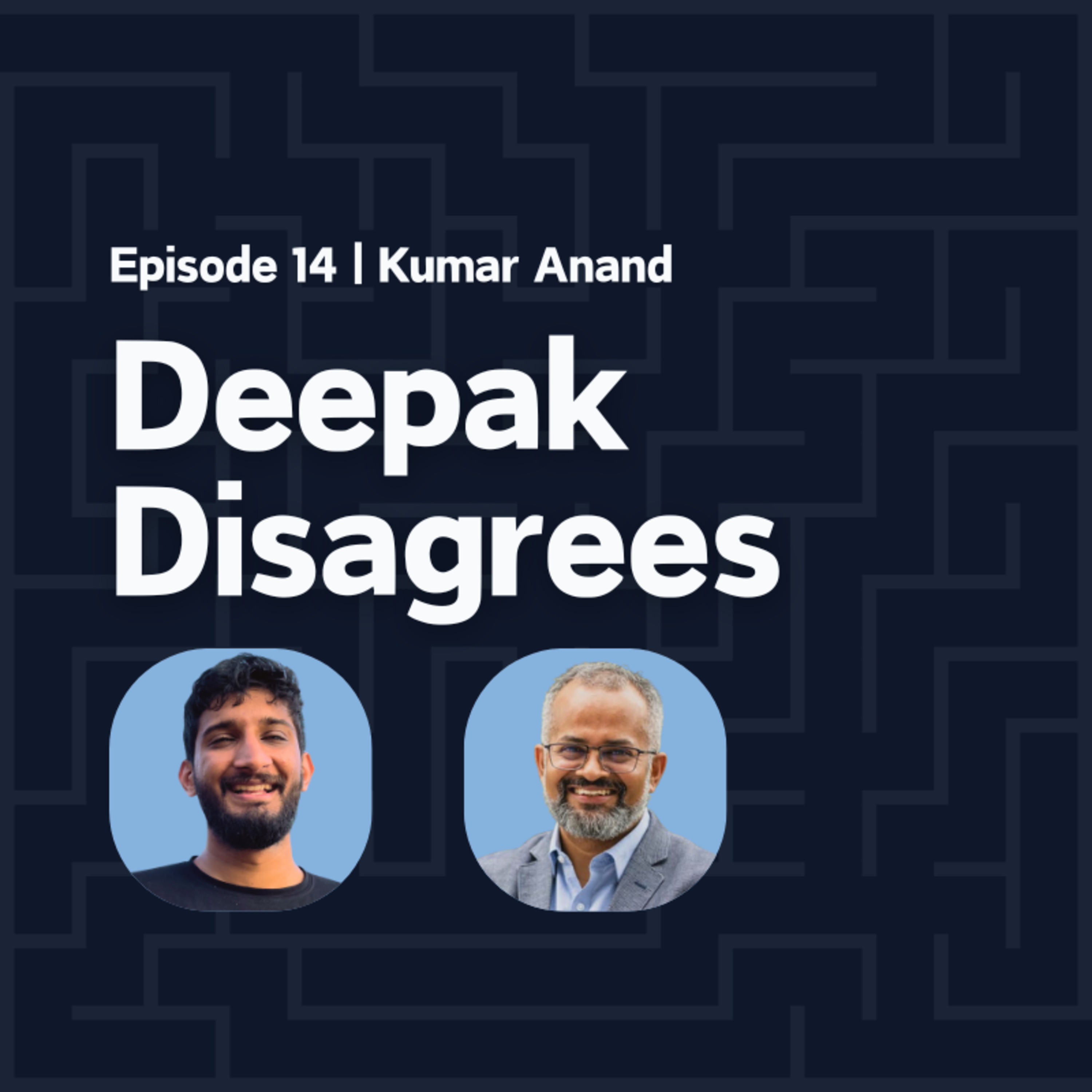
Ep 14: More liberty is always better! | Kumar Anand on freedom, coercion and the role of the state
from Deepak Disagrees
148m 23s
In this podcast conversation, host Deepak engages with economist Kumar Anand on the principle that "more liberty is better than less liberty." Anand defines liberty as the absence of coercion, allowing individuals to pursue their interests without interference, provided they do not harm others. The dialogue delves into the nuances of coercion, debating whether conditions like poverty qualify as coercive and distinguishing between negative rights (inherent freedoms) and positive rights (requiring provision by others). The discussion then examines why more liberty is considered "better," with Anand suggesting it leads to human flourishing and is an end in itself, though people often trade liberty for security. A practical example about traffic rules illustrates the tension between spontaneous social order and state-enforced laws, questioning whether codified regulations are essential for freedom or if organic societal norms suffice. The conversation highlights the complexity of applying libertarian ideals in real-world contexts where collective action and individual freedoms intersect.
Kumar Anand is a senior fellow at the Center for Civil Society. He is an economist, with now over 15 years of experience in public policy. And my excitement in wanting to speak with Kumar comes from his political beliefs. He is a libertarian who believes that the idea of liberty is good. Not just now and then, but as a fundamental, axiomatic truth. Liberty he says is always good. As always, I push back and I hope you enjoy listening to us. Disegree. Hi Kumar, welcome to the podcast. Thank you very much Deepak. Glad to be here. I want to take a few minutes to introduce for the listener what you and I already discussed. Because it's taken us a few steps to get here. Now usually when I have a guest come on the podcast, I ask them something like, do you have a belief that you hold deep in your heart that you think is just true? Some of these are just axiomatic beliefs. I believe it to be true because it cannot be questioned. And some of these are very well considered. You know, it's a case of thinking all of that. But it takes me maybe about 30 minutes of talking to somebody before we arrive at this place, you know, where they say, okay, this is what I believe in. And what we've arrived at is this idea, this notion that more liberty is better than less liberty. Right? I feel like for almost everybody listening, they will instinctively agree. They will say, yeah, that makes sense more liberties, better than less liberty. But obviously in my role, I'm going to push back on two things, I think from just the statement, one, what does the word liberty mean? Right? When we use the phrase, what does it mean? And then second, what does the word better mean? Like if we say something is better than something else, what is the measure on which it is better? And why is that measure a reasonable measure? Something like this. And I think because you're an economist and that is explicitly a background, I want to try and play into that. And try and, you know, discuss as many economic, centric examples as we can for you to make the case and for me to try and make the antiques for what you're saying, right? So I'll pause here. But you can tell us who is Kumar and also why do you believe this? Have I characterized it well if I've not, then what have I missed? No, I think that's correct characterization of it. And I was also not sure exactly what the line will be of which will probably end up as the title for the podcast. I'm comfortable with this. Like you mentioned that this is a line which instinctively you'd assume most people will agree with. And but once you start digging deeper, you realize that it is not so. If that were so, I think the world would be very, very different rather than us seeking most of the time in our own voice key. Some kind of intervention is required. This is a subject and topic. I haven't think too much from a philosophical point of view. But more in terms of practice and practical and how it works in the marketplace, how it operates, especially when the political decision making, the collective action problems. So on those friends I have thought for years now about in terms of especially in my day job as trying to communicate these ideas to young and curious people. So yeah, I'm glad to be talking about this phrase, this topic. Yeah, likewise. Somehow, I think you probably are episode number 14. And in the last 13 episodes, at least half of them have been something around this topic of liberty, freedom. So it feels like when I'm also gravitating towards and intellectually something that I do want to think about even privately. I want to help out through this definition, but let's try and flesh out what the word liberty means. And you can do this from economics point of view. It doesn't have to be purely philosophical if you want to avoid that. But what is liberty? I mean, there could be multiple definitions of it. For me, maybe it is philosophy a little bit, but I will say absence of caution is what I would call liberty, your ability to go about your life, you know, business without coercion from anyone is liberty. I was telling you before we started the podcast that I'm currently reading debt by Graber. I love the fact that he has the same definition. He just replaces the word coercion with domination. So the absence of domination is liberty. I also want to read out because I had it in my notes, the definition that John Stuart Mill put in on liberty. So Stuart Mill says, liberty, he defines liberty as you are free to do anything unless it harms others. The state may restrict freedoms only to prevent harm, not enforce morality. So I don't stuck out to me when I was reading his and I was doing a read of my notes from on liberty just to prepare for this podcast. I think it's a good enough definition. So broadly what we're saying is the boundary condition is harm. So we must not use our liberty in a way to harm somebody else at that point. It ceases to be an exercise of liberty and an encroachment of liberty of somebody else of the body. And then second that liberty is that condition under which I am not co-est or dominated. I agree with that broadly. I think on the same page for this. Yeah. Okay. Great. Then the fun question I think is what is coercion or domination. And the reason to me this is such an interesting question is when I was preparing for this I was trying to understand what are all the points of view. It's not like for example somebody on the left is pro domination pro coercion. Very few people will come out and say what I want is to coerce people. Instead they will they will vary their definition of what domination of coercion is. So for example somebody may say that I am coerced by poverty. The condition of poverty that I find myself in is so coercive in nature that we must tax other individuals to alleviate my poverty such that I am no longer dominated. And one may think about each political fragment left right whatever authoritative liberty and etc. Finding their own definition of domination such that it then fits the definition of liberty so that collectively you all agree that liberty is valuable. But we end up in very different places in terms of what we think liberty is. So again from you are trying to bring this sort of pragmatic economist lens to what is coercion and domination that and then what is liberty. Why would for I am assuming that you would say that somebody who says poverty is domination or coercion is a bad example of what is coercion or domination right. So how do we define this what is good coercion or what is good definition of coercion. Just coming back to your example about poverty. That is always a reference point. You have to see everyone is poor compared to someone else. So what essentially is where you draw the line, where does the poverty start from or who is poor. Those definitions become arbitrary at some point of time and most of the time is arbitrary. So coercion is just like the definition of liberty like we kind of agreed on which is the absence of coercion. And coercion is that interference or intervention where someone's pursuit of whatever the business there is, they themselves going about that business or them cooperating with anyone else. It could be an individual, it could be a corporation or a firm. Whatever there is intervention, then that would be called coercion. And anyway you are interfering, putting an intervention, putting roadblocks barriers in two people or one individual going about their business, their pursuit. Right. I want to just remind listeners that there is a similar discussion that I had with Amit Farman. And so I want to bring his POV because I think both he and you are taking very similar sides where he delineated positive and negative rights. And then broadly said that look, there are some of these things that we simply have naturally as a consequence of our existence, our life or ability to move, to transact, etc. And so those things when impeded is an example of coercive behaviour. Right. Versus things I don't have naturally. I'm not already educated, I'm not already having access to healthcare or whatever. And so those things where I have to go out and cause other people to use their labour to provide the financing required for me to have access to education or those positive rights are things that we don't call coercion. That is I'm not caused by my lack of education, our access to education because I didn't already have it. Something like that. So far, do you think that his definition still holds? Yeah, absolutely. And any provision of any of those property rights requires you to, by definition, unnecessarily call someone else because you will have to take it from someone and then give it to someone else. And that taking a quote and quote is coercion there. Yeah. Okay, great. So we've done two definitions already. All this is really helpful because then through the rest of the podcast, we can keep pointing back at this stuff, right? We've spoken about liberty. We've spoken about domination coercion. And the third is this use of the word better. So we're talking about like a vertical access. And one end of the access is a deeply authoritarian place or a deeply coercive place where there is some other entity that entity could be the state, could be your community, could be a social group is co-using you into doing something that you do not otherwise quote unquote want to do. And then the other end of the spectrum is this liberty place where one acts as they want to without impediment from others around them, whether the state or society.
Now we're saying one is better than the other. What is a good way to think about why it is better? What is the measure of better? So recently, a lot of conversations I have had where people try to place themselves on a spectrum which is horizontal, left, center, left, center, right, all of that. And that is where I think this reminds me probably one of the first articulation and conversation I had on this was with Amit. And there we talked about how instead there's a vertical axis is what we should be considering where every act or action or a policy which does it adds to or subtracts from the freedom that you have. So therefore in that sense it is not horizontal is what we are looking at but rather vertical. So I'll be sliding up the scale more freedom or going down the scale which is less freedom. And in that sense better will be anything that gets you go up a stair and less better or poorer situation will be where wherever that gets subtracted from and you slides back. Okay I'm going to apologize in advance because this is a little bit of a philosophy question okay but I still want to know why why is more freedom better than less freedom. We've defined that in this framework you're saying that if we move more towards freedom and liberty that is better but I'm trying to understand why and I would love to do a real-world example as a way to think this through right very often we know that people vote against their own liberty or make choices that impede on their own liberty if it means more security if it means something else in the trade-off spectrum. So it's not like the natural truth is that for all people they will always choose more liberty. Very often we may be happy to relinquish these liberties in return for some of our safety security although you have a Franklin till you know I'm thinking about the farm laws this seems to be the case. So why is it better and one way again I'm trying to offer you know an answer is it's a utility question right it is resulting in more welfare where welfare is probably wrong word. In Bhuvana's podcast we use the word human flourishing right but it results in more flourishing for more people that's a better you know livable outcomes for more people as a consequence of more liberty. So it could be utility argument but is that what you're thinking as well that we are measuring it based on flourishing. Partly yes but also in my mind to a large extent freedom and liberty is an ending itself. So and like I said this is something that I am not asking that it should be forced down someone's throat you know you also have to believe in this it is something that my articulation that if a world with more freedom is better than one world with less freedom in all aspects of life I do not know or for I can't think of many examples and I think that is a conversation we are going to have today where less freedom probably is better. So yeah I mean both for both reasons one is freedom gives you prosperity we call it human flourishing call it more agency etc or and at the same time freedom is an ending itself that is absence of coercion if is that what you want or if someone is inviting that coercion because they want more security then that trade off on individual basis can be looked at and for each it's their choice to make the issue then becomes the problem that problem comes when those choices are generalized and made forced upon everyone else. Right you're not afraid to choose your own coercion if you want to choose to be coarsed you can so choose to but that's still within the framework of liberty that is an unpublished episode of Deepak Disegrees with Anupam this was episode 0 so pilot episode where he wanted to defend free markets and I wanted to go up against the idea of free market right and it will remain unpublished but one of the examples because it's just terrible and it was the first recording but one of the examples that I had prepped for that to try and trouble him was that I don't know if the concept of a free market exists without coercion and the example I want to share here is just driving so I drive freely in Indian city streets in as much as one can give in the traffic and the part holes but it clearly is a consequence of the coercive enterprise that the state has put into building the roads right so you have lanes and you have traffic you know stops and you have dimensions that a car can be so car can't be too big or too small in fact there are so many regulations that govern my ability to drive that then allow me to drive freely right and in one way it is an encroachment of my liberties in that I would love to be able to to drive at 200 kilometers per hour through the streets because it is you know my vehicle you know my body I chose to drive like this and I have not killed anybody yet so what crime I've committed except driving past which is not a crime but then on the other hand clearly for the world operated like that never everybody did this there would be no this would be pure anarchy so isn't there inherent in the the idea of freedom the idea of coercion that we must in some way constrict what you can and can't do so that then we allow you to drive freely and it's not just harm for example having like a well maybe it could be harm like you could say that the ultimate thing thought here is harm but you know a turn signal usage of signs speed breakers many of these things are limits on liberty so that we can drive freely I think that can apply to almost everything that we are part of life right I mean say usbc usbb you know they have also come about in a particular manner that brings efficiency of sorts I think their the argument becomes so you were born you grew up and you realize that's a traffic outside and it has not come about overnight you know there is so there are two kinds of order in society one is planned order another is spontaneous order you know and I would say that and again it's not zero and one you know there is a sort of in my mind I think it is sort of again is spectrum and then you realize traffic light if you look at it as a as a snapshot in time it looks like a planned order you know but at the same time almost everything that has gone into it the example that you were giving the size dimension of the car the left signal the right the red light red green yellow etc are all examples have all evolved over time and different societies will have different neighborhoods will have different you know way of doing you know or organizing themselves going about from point A to point B in their own manner and that if you take time long enough is an example of a spontaneous order and order that emerges and everyone is kind of participating in cooperating in it for its two kind of come about and and be there example I'll give you that I'm a new driver about a year and a half I've been driving and people say that driving behavior is very different in India compared to other countries driving very very different in Delhi and Mumbai for example you know I remember when I will used to live in Mumbai you can just point your hand to the car and walk you know for sure without looking at the car that the car has stopped and your your pedestrian has more lot more respect while in Delhi chances are that if you do that people are going to run you over so you have to look at the car whether they are stopping or not while you're crossing the road not only that once I have happened to be not Delhi and then you realize that driving behavior in not Delhi is very very different from behavior in South Delhi so if you are not calibrated for that then it's going to be tricky and difficult you might hit someone those things can happen so as you keep going into different neighborhoods you realize that culture evolves so while yes to your original question there is a certain amount of depending upon the way you say it there's certain amount of thing that you accept you know certain amount of restrictions on you because it is more efficient in some manner you're you can go on the road at 200 kilometers per hour at one point of time everyone does that no one is going to go at 200 you know the traffic will come to a standstill and no one is going anywhere you know everyone is stopped and there are a lot of accidents everywhere the other way is when you know over time through trial and error experiences and through cultures you know adopting maybe sometimes through policies you know and more localize that they are at better it is you know and if you look at it through a long enough time span of time you will realize what you see outside has not come about overnight and has that long history behind it and in that sense I find it example spontaneous order and that goes along more with the idea of you know voluntary cooperation between people rather than coercion so the argument and that sounds fair to me is that there are norms and then those norms probably getting codified but by and large just starting starting at our socialized norms that we all collectively agree on some ways that we can we can do things but there is no way to break a norm in the sense that if it's a community enforced thing the community broadly agrees that you put your hand out and you take a turn that's fine but this will not stand up in a court of law this is not what is codified in the Motovacal Act and so the law still continues to be the law and I think that's the twist right? Let's assume we didn't have a Motovacal Act do you think that the roads would still be in this would allow you to drive a
as freely without the law, with just the norms that society holds together. - You know, what came first, the rules that you have are motor vehicle act. People going about from point A to point V, I think motor vehicle act would be a latter addition to it, you know, and they definitely never keep up with, you know, the behavior of people. - Right, so the argument would be that the act is unnecessary. - To a large extent, yes. Sometimes you want to codify it so that people have a certain amount of expectations, and they would all know, okay, this is, so when you go to good, get a driving license, now some of those things you are tested upon, you know, and then your knowledge of those basic things is what allows you to get a license and then you can drive. - Right, but what do we do? So if I build a car, that is five times the size of a regular car and eats up all the lanes, and I introduce it in this street. Now, sure, I'm violating social norms, but it is not illegal to violate a social norm. What would happen to me in that world? You know, in a world where I excise my liberty to have a very large car. And my thinking here is that I'm not harmed anybody. I'm not broadly harmed. It's not, I can't, maybe there's a way to really push the argument to reach a place of harm, right? You are preventing me from getting to my office. If I don't get there, then I lose some money and all that. But for the sake of efficiency, sometimes we kill each other's liberties. And we say, you can't have a big car with this, and SUV is as big as it gets. Is that reasonable, maybe? - Yeah, that's right. And the libertarian me and me would fall back to the idea of property rights here, that, okay, you're driving, if you suppose you're a land owner and you own 100,000 acres, you know, please feel free to build a road inside, then you know, and build as big a car as possible, you know, that'll be a plane as possible and then drive the way you want. Moment you are on a property that is not yours, in which case, then you start to abide by the rules of someone else. And that case, on a private road, you know, there are rules about entry, exit, you know, and then they can be prescribed. And same thing for the public road, you know, currently majority of the roads in India are owned by the government. And then they get to prescribe, okay, this is the rule. Imagine a world even with private roads, you know, and if I own the roads and then multiple people individually or corporations are owning different sections of road, then they get to decide, okay, for efficiency purposes or for the purposes of maximizing profits, okay. What size of, you know, vehicles to allow in a manner that maximizes the number of people passing through and therefore might have any. And you'll get to the answer. And if you allow a car off as big a size which it eats up for lands, in which case, you know, those things that I'm assuming will not be efficient and will not be allowed. Right. And also requires the cooperation of multiple private entities because since we all split up land, if we have to build a road, then multiple private entities have to all come to a consortium of some sort. And then say, look, we all collectively agree that we're going to govern roads in this manner. And then these are the regulations we're going to, still is a regulation, but is voluntary. In that, all these entities are voluntarily offering their private property for road construction and for the regulatory environment. Yeah, a friend of mine, Barun, you may have heard of a me as been looking at the vehicles which are called Jagard. If you have seen those, those vehicles have been around forever. I mean, here he calls looking at seeing them in 80s on the roads. These are vehicles which are not manufactured by anyone, you know, automaker. And you resume that there was a time pre-1991 when the economic reforms had not happened. There was one or two producers and manufacturers of cars. But even today, when there are plenty of options and there are a lot of corporations building cars and they are available, you can just walk into a showroom and start driving. Even then today, Jagard's I'm not going to be, actually there is, and they are coming in much, sort of evolved version of it. And their shape and size will always, you know, buffer you. It is made to opt, you know, probably, I don't know what they're optimizing for. Probably they are optimizing for their ability to carry a number of people, or they're ability to carry the number of load that they are, you know, they're hauling, whatever they're optimizing for, but that shape and size is funny. And, but still they are keeping, it will never be bigger than size of a big truck. And it will go as small as an auto-dicture. And so somewhere it falls between those lines and I don't think they are, you know, kind of quote unquote, get covered under motor vehicles act or they ring to those rules, but play on the road and the same, you know. And you'll find them around, especially go outside of Delhi and on the highways, sometimes when inside Delhi, you see them, you know, going about their business. So just because their cars, the companies are available, not only because it was out of necessity, those were there when there was a monopoly supplier or only one or two suppliers providers of it. But even today, those are there. And voluntarily they have chosen to put it off of the size, which is optimum for whatever purpose they are doing. Otherwise, they themselves won't be able to go anywhere. Yeah, that may be the best argument against why my car can't be three lanes wide because it's not that nobody else can go somewhere. It's that I myself cannot go somewhere given that this car doesn't meet. Because I'll also get stuck. Yeah, and all kinds of things. So I'm assuming it is a rubber. So you, wherever you want to park it, your parking will be difficult. You're able to walk into a petrol pump and trying to get fuel. All of that you can privatize for yourself, you know, in a piece of land. But still, moment you need it outside, you won't be able to fit in. Right, right. OK. And so we've discussed, you know, whether the state can use its coercive enterprise to decrease your liberties, but to provide either more of quote unquote freedom like this, you know, we have a we have an organized driving space and organized market those sorts of things. But I want to think of the same example when it comes to private institutions. OK. So I'm presuming that you would agree that it's OK for you as a private individual to place bounds on what I can and can't do on your private property. Right. So if you say, Deepak, you can come into my 100-day car farm, but on this farm, you're not allowed to wear clothes. Then that is simply what you and I have agreed on. And I can also choose not to come on your private land, at which point I get to keep my clothes. Right. So that's our agreement. We could codify this into law and we have a contract. And in an ideal state, the state will even uphold the contract. Now, one of the interesting things I think is like-- and this came up on the conversation at Shelby as well. We were talking about what happens in the case of what we call discrimination. So very frequently, you will have instances where like a person may refuse to hire somebody from a caste or a religion or a gender simply because these themselves are bigoted by a biased arbitrary-- could be any reason at all. In the private world, we don't have to justify our reasons for why we choose the things that we choose. In this case, do you think the state should step in and say, look, if you are a business and unwilling to hire women or unwilling to hire from a certain subset of the population, we will coerce into action the fact that you should or that you can get ladygated against. I do not think so. Could you please repeat the reason why you think-- so discrimination is the reason that you are trying to correct for? So if I was to argue from the point of view of somebody who is discriminated against, they would say that I unfortunately am born into an India. Let's take India as an example. And let's make the assumption that India is a heavily casteist society, whether true or not is not relevant to the example. And so given the extremely casteist nature of this country that I'm living in or racist in the US, whatever, I simply do not have the same job opportunities or opportunity for work as everybody else. And the discrimination is fairly arbitrary. It's based on skin color or patronage, whatever. And not a meaningful distinction that applies to my actual work. And so we must not allow this distinction to be something that private parties can even use, for example, in offering or selecting labor, buying labor. That's an example of an argument that we may hear it. Do you feel like here the state should come in and say, entrepreneur's liberty to discriminate or to select labor based on skin color? Is something we simply do not permit? No, not at all. Not at all. Couple of things here. One, if you're discriminating against someone, marketplace is something that will make the discrimination costly and much more sort of prohibitive for someone. Imagine a world where-- and mostly this happens in cities much more than in smaller cities or villages, where people often do not look at someone else's caste or color or they generally try to look at your ability to perform a task or not. And if I start discriminating, then it will become costly for me to hire someone. Because I'm trying to optimize. I'm trying to optimize on time. I'm trying to optimize on getting the service done by the best person possible, best person suitable for the job. In a small enough neighborhood or a society, it becomes easy for you to cost. The ability for you to discriminate against someone happens only when the number of people providing the service is limited and is limited. Not only if there is a long queue of people outside my factory and I'm the one hiring, then I can discriminate a number of things. And discrimination happens all the time. We all discriminate. We all discriminate all the time. We all discriminate in terms of who do we want to engage in. So you're going to be at a conference. You're a conference.
limited time, there are a lot of number of people who are you going to talk to. You choose someone to walk up to and speak to. You are discriminating against everyone else. And such kind of discrimination happen all the time. Your ability to start a particular business, you choose one business to start. You choose to reach out and partner with one organization and not anyone else. So you are optimizing for something. The only association between individuals, corporations is the only solution I see here, which not only is right in its own regard, but also is the only system which minimizes discrimination. You putting up a law or a state coming and saying that this part of discrimination is outlawed is you look through the unseen part of it, you know, second and third degree consequences of any of those things and you will realize it ends up perpetuating the discrimination rather than sort of alleviating it or removing it. Classic example is people saying, maybe largely true as well, that payment gets pays less than men for the same work. Reminds me of a quote on briefly somewhere on YouTube if I am not wrong many years ago, Milton Friedman saying that for women, their ability to offer the same task at a lower price is the best weapon that they have to compete against some kind of discrimination. And you keep performing the same job at a, this doesn't mean that if you come up with a law and no amount of fine printing of the law is going to take away the description number 2, what essentially as a employee, the what I want and anyone should be wanting is lot of employers looking to get my services. As an employer, what you would want is lot of employee queuing up outside your firm or a factory and then you can, you know, one pay of course pay the person bidding for the lowest wages, I am willing to work for you at this lowest price and you able to discriminate in terms of their looks, shapes, size, caste, name, whatever, you know, their ethnicity, all of that, you know, that's good right for you as a from an employer point of view. And from an employee point of view, what I want is lot of employers looking for my services. In which case, I can discriminate against them and start begging up my price because those employers are going to bid for me, you know, so and that happens in a market economy which has sort of free entry exit, does not have a unencumbered, does not have a lot of intervention. Right. I really want to dig into the like the economics of this. I am, I feel like this is exactly what people on people who, let's say who are who are starting within an unbate, right, literature, start point of view or a feminist literature point of view are all saying, in fact, they agree with you. They just disagreeing on, on their conclusion. So let's say that you are a man and I'm a woman and both of us are competing for the same job, right? Because the employer is discriminating based on gender, which employers have done for a long time historically. I end up getting paid less than you. Simply as a consequence of me having to drop my per our, you know, wage price to be able to be competitive enough. So that is, if you are at 100 rupees an hour, I have to go to 80 and then, you know, 50 and then 40. And at some point, we look at it enough for the employer to overlook their discrimination, to instead pick me as the source of labor because it adds the bottom line. But the end conclusion is that women get paid less than men for the same job at the same place at the same time, simply because the employer is discriminatory in the show. So from a feminist literature standpoint, they would say that this is exactly the problem and justifies the state in intervening because you and I are different in no way out of gender. And so should not receive different wages. This is an unreasonable grounds for discrimination. That's what the argument would be, right? Like why should, if I was worse at the job, that makes sense. And if I'm just as good at the job as the job, but get paid less on gender, then that is why the state shouldn't do it. Multiple points of disagreement. First, I don't think the state exists for that reason. But that was an aside. You say that there is discrimination and therefore there is a necessary role for the state to come in, make regulations and outlaw it or find some way to correct for it. Number one, outlawing it will not solve for it. It will only be driven underground. Second, like we talked about, everyone discriminates all the time. So discrimination is kind of inbuilt in human nature. That's not going to go away. What you want as a policy prescription and what you are suggesting and what many people generally tend to sort of gravitate towards is make a law. Make a law, pass a law and that will solve for it. But the spontaneous order nature of the solution to the problem is that you want to make that discrimination costly. What currently is happening is that discrimination is very, very easy. It's very, very cheap. And like we were talking about earlier, that as an employee, if there are too many choices in front of me, me, me, then I can discriminate among the employer and my wage rates goes up. So what is a system that allows you to be in that position rather than in a position where there are too many employees looking for a job and there are not enough opportunities. Then you will have to find a way in which to discriminate one or against another. Okay, you will say which of the most fair system, probably the most fair system is some kind of point-based mediator currency where you say, okay, I have a number of examiner, you know, whatever your job experiences, whatever you add those up and then you come up with whichever is the top most candidate for a particular suitable job. And fewer opportunities will mean that that thing is reachable only for a few number of people, you know, and a private enterprise assuming that they are in working in the self-interest and that self-interest, suppose, boils down to at the end of the day, maximizing profits in the long run, sometimes in the short-short run, especially venture capitalist type, you know, in which case, if you are optimizing and maximizing for profits, then what do you want to do? You want to hire the person who can do the job at the lowest possible. So there is this inherent conflict, you know, there's opposing forces between the two. And I would assume that a system and which is borne by the fact that a system where the discrimination does not go away or reduces by a law or a policy, but rather by more choices and more competition in front of you, you know. One classic example is that of Indali in Mumbai, other places when you are moving to a city and you are looking for a rented house and apartment, you know, you know, currently what happens is in South Delhi, I know, it was a few years ago, I had moved from Mumbai to Delhi and then I realized that landlords are not asking for your basic information in terms of, you know, your rented card, your name, etc. whether you have a family or not, but the things on which they can discriminate keeps on has gone up, you know. Now they are, of course, in Mumbai, it's very, very important that you will also ask for whether a vegetarian or non-vegetarian or you are a bachelor or a single. They have now started asking for your resume, the place that you work for, you know, LinkedIn accounts are looked at, you know, very, very carefully. So, multiple of those things information I need and is because that even after I discriminated on all those factors, male, female, family, bachelor, veg, non-vegetarian, you know, are you working for a government or are you working in the private sector. So, you discriminated on all those factors, even then after discriminating on all those five, seven different criteria, the number of people queuing up to get my apartment on rent is very, very long, you know. And if the city, so it's very, very easy and very, very low cost for me to discriminate and then find the, you know, the whatever ideal kind of tenant I have in mind to rent out the place, you know. Imagine if the situation were reversed, where you have moved into a house, moved into a city and certainly there are too many landlords trying to get your move, you moving as a tenant, you know, in which case they are going to compete and say, okay, my house has a services, these services and it is a proximity to these many hospitals or schools, etc. And this is a safe neighborhood and of course, at the end of the day, having all those things normalized, then they are all going to compete to lower the rent, you know, rather than the other way. So I don't think it ever is going to be a situation where passing a law, making regulations, asking that inspectors and the government is going to correct for it will take away the description. A long-term solution for this always is that how do you create a system where there are more choices available for people. Right. I think super interesting. I want to add a few things to what you've said, right, on the driven underground bit. This interestingly is very similar to what companies are doing today, when it comes to, for example, having to hire employees versus consultants. You'll notice that companies have a huge part of their payroll sitting in consultant hires as opposed to employee hires. Now with the new label of, you know, regulations proposed, I think they want to categorize these folks as long-term employees, something like this,
the same as the common with the phrase for this, but the idea being that you know they've recognized that this is how you're getting on the system. But when you say underground, I think it means things like this, right? Like you'll find a way to hire that subset of people that you want to hire without breaking the law because you'll have them under some of the part of the books. So that's probably true. The way I would think about like that bit of it is that or I mean anybody on the left board, right, is it just needs more regulation. So every loophole will have to be plugged by a little bit. You're just missing, you know, you just need five more lines of writing, right? There's just a little bit more in the law that's missing. And I used to think this is totally absurd, right? But as an entrepreneur who's been now building for some time, I look at the GSE Tegutations, right? To me, it was unfathomable that the Indian state could make a list of every imaginable product, right? Like every product that exists, every consumer product, right? Like you'll have, you know, questions like, uh, is Almond Milk Milk, right? And this is because Almond Milk is a type of product and you have to have a percentage of age to rate to it. Sure. But it's actually happened here. Like as of this morning, the Indian state has tens of thousands of or lacks of products that they have formally categorized, right? And so clearly their approach is if we just throw few bureaucrats at this and more manpower, we will plug all the holes. Now it may sound like I'm making the argument ingest, but I'm not. I'm saying that we want to hold, we want to hold our end point in place, right? Like your end point is liberty. I'm saying ultimately my, my, the place of sacred, the utopian world I want to arrive at is liberty. And what is the arrow that points me in that direction is the arrow I must follow. And as a way to further the point, I would say, if you, if you think about harm, right? Today, it is true that murder's take place. Now I will say that look, even in a, in a libertarian world, murders will happen, right? So, and then you will say, no, no, the state will get better. It will get better and better at preventing harm in an ideal world. The state is able to prevent all harm, right? That's, that's a good state where we've given them the monopoly of violence and the state is able to, to enact its monopoly of violence in a hundred percent ratio, right? Always preventing harm. Now you could argue that that's never possible, right? You only need more cops, more army, whatever. But then you will say, no, the pocket suburban progress, but you know, over time, we will get there. And that's the same case I'm making here. It's a work in progress. But the end goal is that we can't have arbitrary discrimination. You may have the mind virus of being a sexist, a casteist, whatever. You may so well choose to keep your mind virus, but we will simply not allow you to enact this virus into practice. And the way that we know we have succeeded is over time, we will look at our country and see equal representation across different jobs, positions of power. When we end up in that world where equal number of parliamentarians are women, where equal number of board members are women or across caste, right? There's an approximately natural distribution of the population projected onto different roles of power or not power, right? Just across the country. Then we will know that discrimination no longer, it may so exist in your mind, but it no longer exists in practice. But until the day arrives, clearly it is, it is, you people are finding loopholes, whatever it is, but they're ultimately enacting their discrimination. And so we will not stop, we will not stop regulating and furthering that regulation and adding more and more lines to perfect it to get to that end goal. What do we say to this? This is, to this I will say that this is doubling down on your mistake that you made one error and to correct for that, you will make more error. Actually, only yesterday I saw a particular code put up by someone and I'll try to find it. If that code does exist, okay, which essentially says that, there is an act of the, done, which creates a problem and then you further create, act more and to make the problem bigger and then you continue repeating the same thing and you are not headed in the direction that you think that you are headed. An economist will tell you that there are no solutions or need trade-offs and then you will have to see what kind of trade-off you are making. Your assumption is that more regulations and more lines and more bureaucrats is going to correct for it while the real world will be exactly opposite of it. You will be moving further, further away from many of this and like earlier we were saying that none of this is, you know, any kind of proportional representation that you was talking about in terms of parliament, you know, and then there is an arbitrariness to it all in which you are assuming, what do you think society composes of, you know, in terms of, okay, on male and female, you know, that kind of proportion you want, you know, in terms of whatever the population is composing of and similarly that should be represented in the parliament. And then different kinds of caste, you know, and, you know, what caste, why not the language that people speak, you know, and then once you start doing on that and what about skin color, you know. So if there are multiple variables to it and all of them have, there could be, you know, right kind of justification for it, maybe in the minds of you. And then you keep doing that and does that mark math work out that way? I would think so. So again, from this point of view, right, making an argument, but I would think so because today when I look at parliament, for example, I don't see a skin color discrimination. I don't see that darker skinned politicians are winning or losing compared to lighter skin politicians. But if I did, if I did look in at my television at a parliamentary proceeding and see that all those politicians were all extremely dark skinned and no light skinned politicians were being hired, I would ask that question because clearly it looks like those politicians or those, those Indian citizens who are born with a light skin seems to have an extremely low probability of ending up in parliament. Something is broken here, right? In that many of them may have the right ideas. They may be great parliamentarians, but simply don't end up there. It reminds me of a conversation that I had with one of the municipal councillors. He was from Shiv Sehna in Mumbai and the elections was around the corner and that person having worked very, very hard for the last five years, four and a half years at the time was very, very rejected. The reason being that election commission by stroke of lottery had just declared his constancy to win the reserve for women. Now all the hard work that you had done is down the drain. The people that you worked for, you were hoping that they will reward you for your hard work. Do not have a chance to reward you because now it has been declared for women and only women candidates can stand. No, I don't think he was looking for his wife to, you know, and become a Pradhan Pati of sorts and get his wife stand as a candidate. But yeah, I mean, you'll have to look at what kind of incentives that system is creating. We almost everyone including every media house, every public, intellectual, intellectual and all politicians. No political party can go against the women reservation bill that was passed in the parliament, you know, everyone. Yeah. I mean, they did push forward the, kicked the can down the road saying that the application of it will be at some point later time. Yeah. They passed the law but it's not getting implemented now. At some point of time, it will happen. So there's only one member of parliament who, when it came up many years ago, Rasabha member Sarajoshi, who stood against it and said no. So five and a 45 member, if I'm not wrong, member of parliament. So five, 44 voted yes and only one no. And that was his argument that you are essentially saying that doing hard work and all the hard work that you have put in, anyone who has put in is forget that you're here for as a one-term MP or a one-term consular or one-term representative of people to solve for that problem. And if you know that there is no second term and there is no reward for your hard work, then unlikely that anyone is going to kind of, I don't think that's the kind of system that you want to create. Right. Again, the argument would be something like hard work is not exclusive to men. Women simply working hard as well. Clearly they do not have any less of an ability to work hard. But for some reason, we're going to end up getting into positions of power. And the question is, if they were losing their access to power or any position, it could be even a low level employee at a company, right, doesn't matter what the position is. But they were losing access to a place or position on the basis of their meritocratic insufficiency. That would be legitimate. But if the basis is there, is something they cannot control, something like gender or caste, then that is a reason. So it is not outlawed, right? I don't think it is outlawed that women cannot stand for election and win. So what's the reason for reserving it? So let's work backwards, you know, right? Given that it is not outlawed, we still see that in the world today, there aren't barely any women parliamentarians. Why? And the only answer that somebody from a feminist background will come up with is clearly this is discrimination. What other reason could there be? The only other reason that it could be the claim that from a competency standpoint, women lack in comparison to men, but we know this is not true because in other countries outside of India, they seem to be women parliamentarians who are great. So it cannot be that the Indian women are specifically unprepared to be a parliamentarian. And so we must conclude that the only reason left is discrimination. Now what do we do? That year's as a republic that has allowed women to stand under this guise of liberty. And they have simply not been allowed to win as a consequence of the discrimination. Mindvirus that you and I have in our minds. What do we do now? Yeah. Okay. So you saying that voters are not to be trusted. They are, you know, not, they do not have enough agency and they cannot decide what is right for them. So let's decide on their behalf. Right. And this would come from the same social strain that outlawed slavery or outlawed, you know, the selling of children, right. That social strain is just something like, sure, people may so choose to want to sell their children into slavery, right?
or may so choose to want to own slaves. But we will simply outlaw it. Now, there's a difference. There are the differences. - What I say, yeah. - Right? I can hear it coming, right? Because you're saying there that person is specifically being harmed. You can point an individual and say, "The slave is a human and is being harmed." And it's a violation of the harm principle. Whereas here, there is no specific harm. Which is why I thought it's a great example to bring up here. Actually, somebody on the left of the spectrum would explicitly say what you just said. Which is that we don't trust the water. It's too close to those years of explicit discrimination. Not enough generations have passed that the mind-wire is still alive. Right? It's a gene. When I say gene, I mean like a. Like a mimetic object. Right? It is transmitted from my brain to your brain as an idea. But it's a bad idea. Now, I can't wait my generation out for this idea to die. I will be dead. I do not want to live in a coercive state. Please bring the state into regulate. And I am as meritoriuses the other party. That's the basis of this argument. And, sorry, just to quote an economist I heard. We don't have solutions on the trade-offs. And that is the trade-off. The trade-off is, I'm willing to let go of my liberty. I'm volunteering myself into less liberty. So that I may participate in this democratic enterprise and also be a parliamentarian. Sure. I mean, in that case, and all the examples that I have in mind, whatever I've seen almost all the time, wherever you have let go of liberty, the thing that you're hoping to trade off trade for and what you are getting, you are not going to get that. So you have lost both. You have lost liberty. And the thing that you thought you'll get in exchange, that's not coming to you. Right. Okay. Here, I partially agree with you. Okay. So you're saying that there are unseen effects. Sometimes we can't see it. When we erect a wall, we don't know what we are preventing across the wall. It's only 50 years later that we can do the math. And usually the math results in something like, oh, this was not a good idea. We shouldn't have erected that wall in the first place. You know, freedom typically drives. Okay. Which is why I'm adding the layer of an extremely proactive government, let's say, when that existed, that constantly tweaked. So you are collecting data and you're coming back. So for example, you may say that politicians will have their wives stand. So they will still be the source of power, but their wives will hold the actual seat. So that you tick the box of having female parliamentarians, but the root of power is still with a man. And so then you may, you may regulate against that. You may find some way to write the literature, some collection of English sentences, right? That prevents this from being the case. And you keep doing that over and over and over, which is the body of law, which is what, you know, we've all sort of concentrated too. And maybe what you're saying is that in theory, I've made an argument, but in practice, it really never bears fruition that way. Yeah. My question is, what is it earlier? It's just a matter of enough revisions to the law. So every time you find a loophole, that this is how it's being driven underground. You further, imagine you had a team of feminists who were elected into power, right? Like the government is now with the singular mind that we must enact equality of representation. Then would they not constantly keep tweaking and tweaking and tweaking until we came to this place of, yeah, here we are. Now everything is equal representation. Yeah. Reminds me of what happened during central planning in India. So every time planners wanted to plan and wanted to centralize planning, by definition, it was trying to have all planning done at the time. And at the level of the planning commission and for the entire country for the next five years. And there were people who were looking for loopholes, you know, bureaucrats running to plug those loopholes. And this term and jury game continued for long. And what you'd lose essentially is whatever you're planning for, you don't get. And you lost 40 years of your time. And then you had to make correction for it. And whatever correction you have done was how hard did he and not, you know, purposeful. And therefore not that we have gone down that economic freedom route and be done with planning, planning still continues, except it may in some cases have become even more centralized and much more obscure and very very hard difficult to kind of. And planning itself has kind of been driven underground and opaque. At least it was done earlier on the face of it and publicly announced and spoken in the parliament and planning was there in the name itself. Now all of that is underground. But yeah, I mean, you keep doing it and the outcomes is I think there is an analogy here. There is a parallel that you're trying to plug loopholes people will find a way to go around it and you plug that and then you keep going around the circle. And the robust system, any kind of robust and sustainable and long term solution to this discrimination, et cetera, whatever, whatever you would. Whatever example you want to have me there is proportional representation equal pay for women all of that it comes from in economic incentives if they are aligned right and market takes care of that not. Go mid intervention and second is persuasion in society. So if you persuade society in a manner that they agree. For example, people of certain caste not allowed to enter a particular temple, you make a law for it that everyone is allowed. I don't know what kind of if that's and that's was a Gandhian kind of pursuit that instead of and that's definitely Gandhian a bit. You want to pass a law and outlaw discrimination and make sure that there's a certain kind of reservation or whatever you try to build back into the system that at some point of time. Those gaps, et cetera will be filled and then you have a kind of even playing field at which everyone is operating real world has not turned out that like that, you know, you know, whatever reservation or any kind of affirmative action that you wanted to do has benefited a very, very small percentage of people not to the group of people that you wanted to benefit any kind of such. Through law that you were going to discrepan outlaw discrimination is not sustainable and if you give society a chance and now there is what is expected of people is some kind of patients that is not and it will sometimes also kind of come come about through maybe a supreme court judgment here, a particular law there, but society needs to get ready and when it is ready, then those changes are long term and robust lot of examples from around the world including, you know, gay rights for example, or rights for, you know, same sex, marriage or relationships and so you would say that when 18th century you want to do it, you know, no, franchise for women. Now there is a push and pull that you want to push in terms of no, no, the time is now and it needs to be done now, let's make a law for it, you know, the second group of people probably on the Gandhi side will say, no, no, let's persuade society now this one is quick and now the other one is lot more time taking and probably sometime in the future and I don't think that you should do only one or the other maybe there is a there is a mixture of the two, but almost always the long term solutions are the ones which are the sustainable ones and robust ones are the ones which comes through persuasion and on the economic side, aligning of the right set of incentives. I want to ask one final question, well it's not a question, enter one new domain before head off into a break. Okay, so in the current example, let me discuss, I tried to argue that one should limit the liberty of somebody else to help oneself. So for example, women may vote overwhelmingly to limit the liberty of entrepreneurs to hire only men if they so wanted to so that as a group under that group identity of being a woman, they collectively do better or at least they think that they will do better. So this is one example, but I want to make up an example where one limits the liberty of oneself to be able to get better outcomes and here I want to explicit discuss the farm regulations. So 2020 the BJP comes up with what I thought was a collection of regulations that politically various parties have argued for and broadly the intellectual base in India has agreed is required for many years now. Now the regulation has has been positive as for the good of farmers, right, like ultimately the winners here are going to be farmers. That's why the regulation comes into play. I mean most intellectuals I speak with who have studied the documentation literature, the plight of farmers in India all collectively agreed that more liberalization means better outcomes of farmers. The people on the streets making the most noise protesting against the regulations are the farmers, right, so what's happening here, that is if more liberty is better and what the state is offering in one rare instance is more liberty to those farmers, then why are they coming out as a signal we don't want it. I'm not most familiar with the details of it, so I will I kind of follow it it from but from a distance I have not read the formulas themselves, but of course everyone knows about the protest, you know, so I'll make certain assumptions in in my reply. So they want to have your maybe then we should just take a zoom out and do the theory which is we know they must be proposition so doesn't have to be specific to this farm loss, but you get the idea. So I'm going to therefore those some of the assumption that I'm going to make probably is on the lines of the point that you are trying to kind of discuss one is
these farm laws are for the benefit of the farmers. I'm not entirely sure about that. These farm laws are going to be in the benefit of a large number of people. I think, but in the short term, so there's short term, medium term, long term, in the short term, many of the farmers are going to be the losers. One of the reasons, and I don't know, by way of communication, et cetera, one biggest criticism of the farm laws was that it was not communicated well, that how it is beneficial for the farmers themselves, but more importantly, or for that matter for the consumers. So, ability and economic literature, and especially public choice, et cetera, I will tell you that ability of a small group of people who have similar incentives for them to align is very, very, when it is strong, then it's easy for them to come together. In this case, surprisingly, that group was 100,000 large, maybe hundreds of thousands of large. And if they see that there is a direct affront to their livelihood, in the short term, then they will have something to say about it. They will protest. They will close the roads to Delhi, et cetera, all of that will happen. The group of people who are not going to be able to kind of organize and make a union and ask for the laws themselves and protest that, no, no, these laws should be passed, are 1.4 billion consumers. Everyone thinks, everyone else will do it. The classic free rider problem and therefore no one is going to organize. So, like I mentioned, all the time, the three groups of people that actually know four groups of people that you will never find a union of consumers, taxpayers, voters, and pedestrians. And all Indians are by definition, consumers, voters, if they are not today, then they're going to be tomorrow. Taxpayers and pedestrians at one point of time or another. So, their union will never be able to organize. My understanding is that they were able to organize and kind of push back against it, is in the spirit that in the short term, they see themselves to be losing. And mind you, this was a small group of farmers who are particularly beneficiaries of the existing regime. And the regime is going to be tweaked and changed in a manner that is going to benefit all farmers around the country, probably and more importantly, all consumers around the country. And those are the ones who are not protesting because the gains which are going to accrue to groups of people are, those are gains exist in theory, exist as a kind of distancing, which and it is not real, it's not felt, it's not touchable, it's not banking, lying in your bank account or you're not already, do not have a skin, you have a skin in the game, but that is more theoretical and some time apart, away. While people who are going to lose those benefits, it is going to happen with real terms and they know what is happening for the last few years, the policy or last few decades, the benefits that the way it has been accruing to them, you are going to take it away. Now, how real and how much imagined it is, I'm not sure, but overall that is the perspective I have on this. One of the feeling, the feelings I get when I talk to folks who are willing to trade their liberty for security is, sure, we could always accuse them of doing this because they are already winners in the current system, in the current status quo, for example, farmers have access to an MSP and so there's guaranteed income, but also it is the fear of having to partake in the market and be responsible for one's own success and that's a very legitimate fear, where if the state ceases to provide MSPs to me, then I have to decide what to grow, then I have to grow it, then I have to go and find a buyer and every season changes. It's a very human, very legitimate fear, tens of thousands of years, as we've grown from ape to human, we've constantly been afraid of this unknown. Tomorrow, I don't know what's going to happen, where is my next source of food, what's going to attack me from the bushes, it has been constant ever present fear and everything that we've done has been an attempt to eradicate that fear, build cities, build houses, better building materials, means I can sleep at night without something actually physically coming into my space, building entities like states where we have standing army so that I don't have to worry about being attacked tonight since somebody else is taking a look at it, becoming cooperative beings, right? And then we go from small tribes to now large countries that do things like trade on the stock market. But there's little monkeys and shoes. And clearly we have had this arrow pointed towards more security and more stability as being the primary metric that we want to solve for. All of our volunteer interactions have been trying to drive towards, how do we get to a more stable place, where I can sleep peacefully at night and not worry about being dead tomorrow morning. And from that standpoint, that rationalization, what the farmer is doing makes complete sense, because what he is saying is that I would love to go to sleep in a world where I'm simply told what to grow, I can grow it. And I know that it will be sold and the state will pay me for it. Then the state will worry about what they have to do. Is this argument not legitimate? And legitimate in such a way that we want to expand this. So not just the farmers. As many professions as we can find and provide more stability to, we should, if I read you know Marcus Littlecher, you could take the view of the means of production, the classes between the workers and the employees. That's one way to read the material. But the second is fundamentally this language of comfort and lack of fear that when an employer and employer in their relationship, the fact that the employer can terminate the employee's job and then within 30 days leave them without a job is a source of ever-present fear. It's the hanging, it's a hanging ax above your head, right? And so it always exists. And rarely is the worker able to implement this sort of damage or destruction on the employer. It's almost impossible because you could always be quickly replaced and the firm will survive because 99% of the employees are still there, which is why unions and all those things to try and balance out the power struggle. But it's so understandable that perhaps the state should be involved in saying that yes, we want to try and guarantee more comfort and more stability to more people. So it's not just the farmers. In fact, we should be protesting for more than the farmers. So last few minutes I was very, very enthralling. The one word that I was hoping that you will say, you will say, you will say, you came very, very close to it multiple times. But you almost were there is the word uncertainty. That's the story here. And it's quite natural for anyone to avoid uncertainty is probably equally so or more so for farmers. So if I know that what I am growing and I know that in advance and there is going to be a definite market for that. For that and the price is not that is fluctuating. But there is a set price and that price is given and chances are that there will be small fluctuation. During election year, if it's close then MSP will be higher. If the election is just taking place and MSP will go down a little bit and depending upon how much pressure you can put on the government and where you are from. So with that everyone would want to have more certainty than less. Of course, that is the system that comes at a cost and this cost is less freedom for everyone else because someone else is putting the bill here. And your ability to take risk depends on multiple things. Of course, it is quite very, very cultural as well. Therefore, you probably sometimes see that the broad generalization that people do, the people in Gujarat and maybe other some Karnataka, maybe few other places are much more entrepreneurial and a much more risk-taking compared to say people in Behar and UP will are more looking for seeking government jobs. And it's quite rational. Government jobs are the best kind of certainty that you can get. Every month there will be a paycheck and when you retire, chances are I don't know about the rules now but there will be a pension or some kind of security baked into the system. So a central government job, you are taking care of insurance. So how do you remove uncertainty from your life is where you want to go. So that there's that kind of uncertainty and your ability to take risks go up. As you, your basic needs are met. So for example, you know for a fact that your basic needs like Roti Kapra Makan and some of the other things that you are, you know that, otherwise we've worried about are taking care of, then you can go out take risks. So for example, a person who is say has a very low income and does not have a lot of savings, their ability to take risk is very, very low if they are rational. But a person who has, you know, so opposed a bigger bank balance and family to fall back upon and very good set of friends, etc. then they can take bigger risks as an entrepreneur. There is one risk and uncertainty of that kind. The second which is that one I would say probably is a lot more natural. You see, you feel you observe it all the time and you may have little control over it, you know, and you can, you know, a lot of people kind of find, try to find a way around it, which is, you work hard for the few years, try to build a saving and you're, now you are setting your ways or at least you know that you have a mask enough, then you can go out and take risks and become an entrepreneur of sorts. The other one, the other kind of uncertainty is where we have made it ourselves, you know, and that uncertainty generally comes from intervention, you know, intervention more often than not probably by the government, you know, and that intervention can increase uncertainty or decrease uncertainty. And if you ask me what is the role
for the government and what you know proper role for the government. Other way to put it is one way like you like we have talked about is to prevent harm, you know, to protect your body and property against cohesion or aggression, domestic or foreign. And the other way to put it is to reduce that uncertainty, the uncertainty that you will be harmed against. The uncertainty that comes that if you know that state is doing its job well, the one job that it has at least in my mind is to protect your body and property. In which case you know if free of that burden you can do other things. And if but in our current system the way where we operate where we live that uncertainty not only is very very high but there are new sets of uncertainties continues to get plugged in. You know, so you know and different pressure groups will go to government and well demand favors and government generally oblige and that essentially is giving creating uncertainty for one group of people which chances are that you are able to convince the government are going to be your competitors. They are now living in that uncertain world and therefore investment will be pulled out you know, the example we were talking about earlier while in the other case you would want more uncertainty for years for yourself which is how do you are that happens only when you are pals with the government. So these are the two kinds of uncertainty and I think that was you that is what you were driving at. It is the I have two subsets here right. So first you are right that groups may lobby the state for to increase certainty for their own subset. So for example an auto union may talk to the you know local government and say look we want to make sure that this part is zoned only for auto rickshaw so that we have a consistent access to clients here. There is no competition from an Ola or an Uber right. So that's one way to do it. And then because you have competing groups here the winners are the auto union but the losers are the Ola and Uber cap drivers right. Somebody won and somebody lost and all the consumers and all the consumers. Sure. Then the benevolent state a good state in the leftist mind would say something like we want to proactively balance interest here because what is the end goal the end goal is we want to increase certainty. We want for this Roti Kapadam account to be guarantees that is you are always earning enough that you are always able to at least not worry about you know tomorrow. You always have enough money that there is no sense of shame from having you know not not being able to provide the bare minimum for your for your family. I think a lot of this is a deeply emotional argument about what it means to be human in society and that we do not want for you to suffer under capitalist regime simply because you do not you are unmeritorious. Your lack of meritocracy is not something you chose. You are born into the family you are born into and having a high degree of uncertainty as a consequence of that is something we do not accept as the state and so we will balance it out. So we will zone some parts of the city for caps some part of the city for auto-exhaurs we will listen to both sides we will try and find a pragmatic solution but by and large all cap drivers and auto drivers should be in a fairly decent place. None of them should have to wake up as long as you go and ride your extra or drive your car none of that should in fact I mean post break I want to go into cases where one is not able to drive a cab or ride a rickshaw right where they are in such a place where they simply cannot participate in the labor force that capitalism offers even those people the state will say that pragmatically we are going to try and figure out how to get you to a place of reasonable certainty. Now that definition of reasonable will change but we know that it can't be it won't be extreme on both sides that is you know a decent ruler in a democracy when elected into power will do a decent job across the board. That's sort of point number one where I'm trying to understand why not take what the state is offered to farmers and expand it right that we take this sort of certainty because clearly as human beings we are afraid of uncertainty and why have it at all why not keep consistently driving okay you take my liberties away that's fine and I don't want the right to drive in some other part of town I don't want that right I would much more happily trade that to be able to be sure that there is no concern about tomorrow day after five years from now. Yeah. So in all aspects so just like for farmers all businesses what they are selling should be taken care of. Yeah. So their MSP's decided they have a guaranteed market for it and what they want whatever they are selling there is a buyer for it. I don't know if you listen to my episode with Murali but Murali in the content wrote a paper about this with Ashish Fakartan's last name who also spoke about how the state has to be a monopsonist when it comes to healthcare provisions. So single bio for primary secondary tertiary care and the broad idea being that if you fall sick tomorrow you should be able to walk into any hospital anywhere in the country avail the service that you want as long as the competent lawyers competent doctors able to say yeah you need this healthcare you know offering and then walk out of there without having to open up a wallet whether you are poor or rich you should be able to access healthcare. Any sites for example what's happening in London or the UK and says look they have accomplished that. Maybe inefficient but so many poor people who otherwise have no access to healthcare are not being driven out because the market has priced these you know the services are too high. Somebody having a heart attack shouldn't have to ask the question can I pay for this and in his mind that is the state this whole collective enterprise that we have embarked on where I am my brothers keeper you know we are all part of one nation building enterprise together implied in that in that whole contract is this claim that if you are having a heart attack and you show up at a hospital nobody has to ask the question do you have the money to pay for this or are you in short these are absurd questions to ask clearly we place human value at such a premium that we must solve this for you we must for save you and in fact not even ask you to pay for it when it is done it is already paid for by the collective of everybody else who at some point may have their own heart attack and will show up at the same hospital right and this is leftist literature right this is this is the communist ideal this is Marxist Lenin this so what's wrong here like why not trade liberty for certainty does that not make my life so much less anxious and I want to add one more caveat here in 2025 I think one of the most prevalent quote unquote disorders is anxiety now a lot of this may be social right I like somebody she doesn't like me okay so there are a lot of other social anxiety but if you talk to lots of young people like you look at the US and the Mammadan election common narrative was that cost of living is my primary concern and it's just scary to live in a world where I may not be able to make rent next month I may not be able to make groceries next month and it's constant anxiety and if it means a leader is going to come in who's going to solve this for me I'm happy to trade it off now one would be the pragmatism is it truly possible to solve all these problems but in the example of the UK and their health care system yeah they have you know in part resolved a lot of this may have longer waiting times but no question whether I will get the service so why not expand it what's what's the argument for liberty here as opposed to eradicating uncertainty and then we'll go to break welcome to the health care a bit so after this but just to answer the question about the cost of living and other kind of certainty that we are hoping to get you know and hoping that the state will provide the problem there is that almost always if you start to diagnose the problem and try to see why the cost of living going up you know why the housing is in such a short supply you know and why my grocery bill is so high or for that matter the kind of certainty that we are looking for as a producer you know for your whatever you're selling and you want a definite buyer you know almost all at least in those cost of living kind of situations if you diagnose the problem almost always the cause is the intervention that has come before and the solution just like earlier we were talking about we are now asking that a more set of intervention will solve for it it's exactly the opposite of what you would want so if you diagnose the problem essentially what you're saying is that now I have diagnosed a problem if you diagnose problem you know in a more objective way the problem that you see you see okay this particular say a is causing the problem B then you say let's do more of a is essentially what you're saying or what anyone who is arguing for that will see the cost of living going up you know or any kind of the so essentially what is happening is that a particular good service with that is housing or groceries or whatever is becoming scarce the prices are going up you know how do you get abundance from scarcity you know and then almost everything that has led you to that place which is which has made these things scarce we are saying let's do more of it and that will solve for the scarcity and we will move to abundance I hear you that in that's completely reasonable argument I still want to point to the losers right so we'll go back to the farmer example there is a farmer under a truly free market sand state intervention sands MSPs I wake up and make the bet that you know 12 months from now or 8 months from now wheat is what will will bring me the sort of price required for me to break even on my transaction my transaction is I have to you know farm and then half is the I make the bet I you know so my wheat and then 8 months later turns out my bet is incorrect right what are the markets have failed me in general okay so I made a loss that farmer is not struggling from some regulatory you know burden right it's not like a exists is a free market but the farmer saying I no longer want to play this game this is a stupid game this game where I have to keep guessing what's going to happen 12 months from now and then not know if I can send my kid to school or make enough money to pay for food whatever I want the state to intervene and offer an MSP that's the answer.
certain diameters. That's the, that's true for all businesses, right? If you consider a farmer to be an entrepreneur and agriculture to be a business, which I don't know why we should not. I mean, there is no reason why you should not consider that, although in pop culture, we do not it and consider agriculture and farmer to be something outside of that entrepreneurial activity. So, you know, if you extend that argument to any business, then you would say whatever any producer producing should not have to live with that uncertainty. Exactly. Yeah. So, okay, who is buying the state? The state, everything. The economist Tim Hufford has this quote from one of the book which says, I think it's a factoid. It says that the total number of goods on the planet is more than the number of unique goods mind you. Unique goods on the planet is more than the people. So, suppose there are 8 billion people and when he wrote the book, probably it was 7 or maybe 6.5 billion people on the planet, the number of unique goods and I'm considering every phone that you have, that particular brand phone considered that to be only one, right? And the number of goods, you know, for all those 6, 7 billion unique goods, the person who is producing you are essentially saying that, okay, let's have a certain definite buyer for it. Yeah. So, the government is procuring that. I want to have a good price. At the price with, you know, like they are doing for agriculture, total cost plus a little bit of profit. Correct. So, here I want to add a caveat. I'm not prescribing the solution be that the government is the monopsensit. It may so be that the government, for example, in the previous example that I give you says that I'm okay with zoning, right? So, this part of town only, all three short drivers, that part of town only, cab drivers, right? But basically the government is, is answering one simple question. How do I guarantee the decrease of uncertainty over time? That is, in as much as possible. So, it may not be that I'm a monopsensit. In some cases, I may say, cool. Let people choose to pay for, you know, traveling from point of view to point B. Because I know for a fact that mobility has to happen. So, people will travel from here to there. I will simply monopolize the market for a small union of, of, you know, drivers. I'll even control who can become a driver, right? So, but I will be an active participant in the market and actively make central planning decisions. So, that I'm decreasing uncertainty. And any mistake I make can be resolved one year from today because we'll keep tweaking and we'll keep changing. Let me ask you this question. So, for example, the T that you're having or any T that you go, what is the percentage of thing that it has, the price of any particular good has to do with cost? To what extent does cost determine price? Let me put it another way. 50%, 60%, 10%, 100%. I would love to have like a learned answer, but my instinctive answer is that they're completely underrated. Yeah. So, you're absolutely right. It has zero thing, zero percent to do with it. So, cost has nothing to do with price, you know. And then you say, okay, what gives anything value? My mind. Your mind? So, absolutely right. So, you are any individual, basically a consumer is what giving value to anything. In which case, someone producing a particular good service, you know, which no one wants is essentially we are saying that let's value that because people are not valuing it, you know, enough people are not valuing it. That's is what we are saying. Right. So, people have chosen not to buy a particular product or someone has invented something or someone has come up with a new good or a service. They're not in a buyers for it, you know, and you being an entrepreneur, know that they are new businesses opening up all the time and also closing up all the time in the current system that we have. We want to move away from that system because we do not like some businesses shutting shop, you know. So, what essentially we want is anyone who is selling, trying to sell anything, there should be a ready-made market for it. People are not buying it. So, let's make sure that there is someone else in this case, the entity called government is ensuring that there is a buyer for no matter whatever you produce, whether other people like it or not, there is one entity which is buying it. Right. And that's the thing we are going with. Just to make things clear in my own mind. Yeah. I mean, it's very possible that that's one of the possible ways this plays out. But more realistic to me is that most people will simply start a business. So, I may decide to, okay, this is part of town doesn't have a T shop and I want to, you know, make T and so I start a business. And then I end up in a place where I'm clearly not making cost of living. That I'm reaching a place where I'm not making any money at all. At which point I should be able to walk into a government office somewhere and ask the question, what should I do? That is, you, the government, exist to prevent me from having to deal with uncertainty. That is, I don't know how I'm going to, you know, buy myself food tomorrow, right. And clearly, I'm an idiot like I made some poor decisions and so I ended up here. What should I do? Now, it's possible that the government's look will help you out in the T business or maybe they don't have policy for this yet, right. They don't have a T business policy, but they can give me a bunch of options. They can say, look, you can become an auto driver. Here's the policy for being an auto driver or you can, you know, do do labor here. And so here's the plan for labor, right. That is the government proactively attempts to solve this question off. My life is truly uncertain. How do I resolve this? Yeah. So first premise that I think we already talked about where we're going wrong is that the government's primary job is to reduce uncertainty of the kind that we are talking about. That's not the job of the government at all. It's to ensure that there is a certain amount of security in you not being able to defend your body and property. Someone else is going to, you have outsourced that job. Nothing else. You know, the kind of uncertainty we are talking about that may be being a T seller, trying to sell T and not finding consumers. And therefore, trying to walk into the government job, government office and saying, hey, find me new customers or tell me what else to do. Yeah. First, I mean, there's a classic example of the knowledge problem that government does not have that requisite knowledge and that knowledge exists is unique to individuals, unique to society unique to more important individuals. And only those people know, you know, what you are good at, you know whether you can ride a bicycle or an auto-diction or not or maybe there's other things that you're good at, you know, you are a very good gardener, you know, whatever, you know, job, you can perform in the marketplace and make a living. And we are trying to outsource all of these things to an entity which cannot do its, you know, basic job first, but we are saying, let's do all these other kinds of fix those issues as well. I think that is a world which I'm finding so hilariously interesting and funny that I wonder if it requires a response of any kind or it does it at all. I don't think even any kind of utopia that you build, you know, it, it would be an interesting exercise actually to think through this and see, okay, why kind of society that comes about out of this. Yeah. You know, the uncertainty that the other kind of uncertainty that you said, you know, about farmers not at the beginning of the sewing season, trying to so a crop and not it, make sure about, you know, whether I'm going to all the cost that I will incur through this season, through the entire crop cycle, at the end when I go to the market, whether I'm going to kind of recuperate and make a living on this or not. Market has an answer to it, right? That's called futures, you know, so you, what you essentially you do is you try to agree with another buyer, a cost, a price in advance, sign a contract on that and then you can in your own peaceful mind decide, okay, whether at this particular price which we have fixed in advance, you know, whether I'm going to make a living or not and they're accordingly you optimize and try to minimize the cost while you are sort of going through those few months of, you know, crop cycle. And at the end, if you're able to economize and you will make a profit, you are not able to economize, the next time you will move to a different kind of crop. Yeah, okay, as we all close our eyes and think about the sytopia, we'll take a quick break and we'll see listeners on the other side. Cool. Come on, welcome back. Thank you. Now, I want to do a small segue from Bevyward earlier. We built this sort of absurdist world where the state is trying to solve for uncertainty to whatever degree it takes, right? That's for some reason the role of the state and then they're going about attempting to resolve uncertainty and whatever, whatever means, including for a T seller or a farmer or anybody else at all. The way that I think in the real world this has presented itself isn't the form of a social, social, social security net. So usually it is that sure you can be a T seller, but if for some reason you are unable to sell your T and, you know, it's unfortunate, but your business idea didn't work out or you've not found gainful employment. In the interim, as you figure out how you can be a more valuable member of society, you shouldn't have to worry about those basic things and we collectively define, so we have a liberal democracy that democratic enterprise leads to political leaders, those political leaders we trust to be able to think this idea through and then decide what are those basic things that we want to make sure you have access to while you're figuring out your next steps in life. And that could include things like food, housing, clothing to some degree, access to healthcare, things that you would otherwise have been able to pay for. When you were, I mean if you were the sort of member of society that was making a profit at the end of the day or owning a salary or whatever. And in some ways the capitalist in me can see the merit in this because it allows for more risk
taking behavior that you can take more risks in a 4 to fail. If when those things work really well then good for you. But in the instance that it doesn't work well, you do have a fallback. And that fallback is that we collectively pour into a single pool and we ensure your various needs. Now, one way to argue is that from it make a rational argument for why society is better off if there are more risk tickers and because there is more risky behavior, we'll actually see much more great leaps forward. And then we sort of subsidize the downside of it. But on the other side, I can also make the impassioned human case that we cannot simply allow for the world to be such that if somebody is not able to sell enough of something, then they just die. Or if you fall sick enough, then you have nothing else. And the outcome is just that you perish or that you suffer. And so there is also that human aspect of this that we must-- even if it's a small social security, we must provide for it. It is required. How does somebody who argues for more liberty address this sort of social security concern? If we take a step back here and think about, say, 100 years ago, 200 years ago, would people in say 1925 or 1825 were thinking about similar things? It says, let's say 200 years ago, 1825. The way it is on top of our minds, it's probably for a large number of people, that there has to be a certain amount of social security net. And different societies define it differently. For some, it is very, very wide definition, broad definition. It includes a lot of things. For others, it includes very minimal amount of things. So one day in 1825, what kind of societies do you think were having this at the top of your mind, as well as what kind of definition they had for such a safety net? That's a really interesting question. I don't know the anthropology here. I will provide a poor response. But let me try. I think 200 years ago, the world was much more politically fragmented in that you didn't really have a pervasive system of simply liberal democracies. You had a lot of autocracies, a lot of Wali Garkees. So just different countries built more differently than they are today. And so the answer would vary based on that. Very frequently, it would be that I go to my brother. I go to my neighbor, I go to my brother, and I say, look, this is what I'm currently going through. Can you please help me? And it is the philanthropy of a person, I know personally who would attempt to help me solve that. And then as I move to-- it's also possible I can see myself in the code of a king, saying, please take pity on me because this is what I'm struggling with. And then the philanthropy of the king would say, cool, I'm willing to help you out here. So that's sort of what I can think of. And then if it were more liberal democracies, I don't have any evidence for this. But it does seem like we've become part of the parliamentary discourse. I can-- I really should look this up. But I can imagine, for example, in Rome, where you did have a more parliamentary system that some of the conversations that did come up were around, how do we school the populace? How do we provide health care for the populace? Those sorts of questions come up because inevitably, these are people who represent the population. And the population is asking for these things. I think in all the cases, one important part and aspect of this is that these questions and these thoughts and these ideas occupy our mind. Once you have a certain amount of material prosperity. So prosperity comes first in that sense. So in 1825, this was not in people's mind that state's role has an active role to play in providing everyone else with a certain amount of safety net because there was not enough for everyone to go around to begin with. There was enough poverty and scarcity all around you that this idea would be laughable. And then you start thinking about, OK, so what creates that prosperity that we have begun to think about, these things keeping front and center. I personally would not worry too much about-- and I know this is not your direct answer to your question. Personally, you would not too much care for about what state, what kind of welfare role the state is playing. I would want, sure, if you want to perform a welfare role through parliamentary democracy and a liberal democracy where people have found a way to engage in, go ahead and do it. Let's try to not interfere into the market. So if you are providing a subsidy, the classic sound principle of public policy will tell you that there's a particular way in which you go about providing the subsidy or providing that safety net, which is least distortionary in the market. So prices should not be fiddled with. It has an important role to play if you do that than you're shooting yourself in the food, because that is creating scarcity. And it should be self-targeting. So people who need it really, they should get and they should not be leakages into the system and self-liquidating. Moment the need for it goes away, then that policy or the safety net which you are spending money on is also kind of stops rather than you can, just like most of the government programs, once they start, they hardly ever closed down. So you abide by these three rules, which is don't distort the market, self-targeting and self-liquidating. And therefore, you can go ahead and do that. So that's one part which I'm fine with. And if you do in that particular manner, you can go about doing it. But and more importantly, overall, you should not fiddle at all in what have caused you to get to a place where you start thinking about social safety net and starting to broaden the definition of it. So India has a very narrow definition of it. People in 50 years ago or 80 years, 70 years ago at the time of independence was, this was not on the top of our mind. Everyone was poor, to think about, OK, do you want universal education for school education for everyone or health care or whatever have you? Those were not on the minds because there was not-- whether in the minds of parliamentarians, in the minds of citizens, in the mind of the most person who is advocating for such a welfare, none of the mind, because it was not feasible. Maybe not so even so at the turn of 1991 when we started those reforms. These things have started to come about now because you see wealth around you. And then you also see the start difference between those with wealth and those without wealth. And number, start to work up. And therefore you want to say, OK, let's do a little bit of it. Sure, if you can abide by those on principle of public policy, you can do a little bit of that. But do not at all hinder what has caused you to become prosperous. And that without a shadow of doubt is voluntary association among people which happens in the marketplace, which happens in free markets. Got it. I would still think that two types of encroachments on liberty take place when you do something like this. The first is, of course, taxation. To pay for this, we must tax. And so there is the encroachment on the liberty of the individual because taxation happens at gunpoint would be the sort of liberty in which we look at this. And then the second would be, I don't know if there is a way to do this without truly distorting a market. Whenever you provide a service, an entrepreneur could provide that instead. And so that entrepreneur is now not able to provide that service because the state has taken away that section of the demand space and solved that problem by subsidizing it themselves. I mean, is this truly possible? Is it possible for the stage to have a non-distortionary effect? I mean, you can provide for welfare. For example, I think research in evidence will suggest to you that cash transfers are one way. There is a lot of debate about universal basic income. So essentially, what you're trying to do is there is distortion, but there's a least distortionary way because distortion comes in the form of you taking away savings of some people or through taxes and then distributing it to people that you think need it. So there's that distortion, but other kind of distortion, which is price distortion is what you do not want. So there will be certain amount of distortion in this case, but not that interferes with the natural operation of the market, price is an essential role to play, which is a signal which is a rapid-roader source. And incentive, you want that role to perform. And if you start subsidizing through prices by changing the price, through price caps or price floors, in those cases, I think you have already discussed it at length. And those distortions is what you do not want. This is like a voucher-like system, for example, that addresses-- You give cash, you give vouchers, et cetera, and essentially, even then there is a small distortion, but less compared to if you start regulating prices itself. Got it, understood. I want to try and give you a chance to say to Muruli what I would have missed out on saying. So I'm sure that arguments that I was not able to make, because I was trying to defend a moral libertarian point of view when I was discussing with him. His argument is that there should be a single monopsonist. That monopsonist must be the state. And they must be the single buyer of all health care services. You still have private enterprise. You can start a hospital. You can become a pharmacist. You can do whatever you want. But the single buyer for everything is going to be the government. And for the consumer, they simply walk in, provide the services, provide it to the consumer. They walk away. That is, the citizen. And you raise the bill to the government. And the government says, OK. And rates are pre-prescribed. That is, we pre-agree or we pre-negotiate these rates across-- could be regional, could be across the country, but this is all pre-agreeed on so that it's much more-- and his argument is actually efficiency. This is significantly more efficient. And you waste less money. And in fact, he is looking at schemes that we already provide. The CGHS, the PMJ, multiple funds already exist. And at least the paper argues that this would be prohibitively less expensive than the money we already are spending.
and guarantee coverage and that we ought to do this. This is a moral right and a role of the state. So what would we say to somebody like that who has this sort of an argument? Again on the margin, I personally probably, till the time that you have not outlawed it for private entrepreneurs and me, my ability to, so my choice has not been taken away, my ability to trying to find the healthcare of my choosing. If that is there, and go ahead, sure do it again, but it goes against the principle of liberty because it is being paid for by someone. I'm not entirely sure if it is probably going to be the most efficient one. Essentially, what you're saying is that a private insurance company, if they are negotiating with, say, hospital or any other service provider, then they have an incentive to maximize profit and, therefore, ability to kind of keep a tight check that they are not overbuilt. I wonder if that same incentive also applies to the government because government is not maximizing for profit, they are not optimizing, trying to optimize and optimize in a manner that, this is the system that we are building which is most efficient. They are never ever has any government that said that, it is some kind of public code or social welfare is what they are trying to arrive at. In which case, it is definitely not going to be economical, whatever service that is being provided, private corporations or hospitals and service providers are going to enter into contract with bureaucrats, essentially, which is not guided by both parties trying to find a way to find the least cost way. There are two things here, one that you cannot sell to anybody else since there's only a single bio, you only have one part of the negotiated with. And second, that the, you mean the hospitals are not able to sell their services to anyone else, they are selling their services only to the government. The state. So the state pre-pairscribes, for example, that, and by that definition, I do not have a choice to, I cannot go to a private hospital and T because I am. So, Motley argues that there should be an allowance for private hospitals, but in a utopian world, it's a very small fraction of net hospitals. By and large, almost all hospitals are managed, well, not managed, it's still privately run, but their payments come in from the government. So, you just tell the government that, hey, look, I did, you know, two CT scans today and then the pre-pairscribed rate for the CT scans shows up in your bank account at a prescribed 30 days, 60 days interval for the citizen. They simply walk in and of the service and walk out. And his argument is that one because the large bio is going to be the government, they have massive negotiating power. So, unlike multiple private entities negotiating, one large bio can actually do a much better job, procuring the same medicines and services at a lower price. And second, they can do a cost plus. So, since they know what the input costs are going to be, they'll be able to say that, look, I'm going to give you a 10% margin and that's that. Versus typical pharmaceutical companies being able to lobby 100% to 100% margins or having a monopoly on a certain drug. And so, being able to use that monopoly to buy a patent or some sort of a IP to mark up prices, all of that will be something that the state can reduce. And his argument again is that in the UK, we see this. We see this in practice in the UK where it does happen. The price of drugs in the UK, the procurement prices are lower than multiple private companies procuring in the US, for example. So, I'm not familiar with the UK example and I do not know much about it. I would like to question the premise itself. So, one of the premise that you laid out was that government has a single buyer has this huge ability to negotiate and try to arrive at a and that I think is not tenable because, you know, what is the interest incentive of the bureaucrat in this or for that matter of politician. I do not think it aligns well the way we think it will compare to say a private corporation when negotiating, so the private hospital when negotiating with her insurance. In that case, both of them have an incentive. So, private corporation will insurance companies will try to ensure that there is no overbilling because they are the ones paying. Premium will go up and these corporations themselves are competing with other insurance companies and hospitals would also, you know, would like to see, okay. There is a close watch on both from both hands. So, that premise is quite, you know, I'm not sure that works out. I should put a pin here and as an aside, I think it makes sense to attempt episodes where I bring two people who are not me, right? And then I can actually sit in the middle because it will be so fun for here I'm making my best-prey argument on both sides and I may fail at it, but it may be so so fun otherwise. But I hear you. I mean, I understand at least what the what the responses. This drives to the heart of what I was one of my notes that I had, I want to bring up, right? Earlier in our conversation, you said, that's not what the state does, that's not what the role of the state is. And this to me seems like a large part of the disagreement between the different factions who have different political ideas. They simply seem to disagree on what the state is supposed to do, right? And each of them has their own justification for why the state ought to do what they think the state ought to do. Now, from a libertarian point of view, the state is, and you can tell me if I'm wrong, simply protecting those negative rights that you already have. So you have the right to life, if someone were to link the issue from your life, from your life, the state would either intervene or penalize later. And then so on and so forth, but it's just those negative rights that I own myself, I own my property, I own my labor, and then from there everything flows. Otherwise, everything is accomplished through private contracts. And then the contract has to be on or if it's not on or the state steps in, that's sort of how the liberty looks at it. But there's no sort of objective reason why that is what the state should do. And in practice, we see that that's never what the state does. There has never existed a single state anywhere in the world, in the history of the world that has done what a libertarian thinks that the state should do. One of the possible reasons is that it is politically inexperient. Like one of the questions I have is, is libertarianism even consistent with liberal democracies? Because in a democracy, you should be able to get people to step in and give you a vote. And as a politician, I have to make a case for how I'll make their lives better. The libertarian politician will say, I do nothing. Right? Like that's the that's the big banal statement. What are you going to do? Nothing. What did it tomorrow, day after, day after, nothing at all. In fact, I'm going to make sure that nothing at all happens. Right? My whole existence as part of the government. That's being a little uncharitable actually, but they're saying that I'm going to ensure that your body property is protected and there's enforcement of contract happening. And once that happens, nothing more. Nothing more. Yeah. Every subsequent politician will just say, I'm going to maintain status quo. Right? For everybody who's disenfranchised in any possible imaginable way, that is a that is a meaningless argument. Like they will they will say, look, for all the shit that I'm going through in life, I'm not voting for this dude who says that he's going to do nothing else, that the status quo works because it's not working for me. And then either liberal journalism exists. Well, there are three options. Okay. There are coming to mind. First, it exists in a world where we have pre redistributed. That is, you acquire a country in 1947. The first act that you do as the new government is that you redistribute all assets. So everybody has an equal starting point. And then you say, look, nobody can complain about anything. That also is a little bit unfair because you can still complain. For example, I can complain that Kumar has an IQ of 200 and my IQ is 80 and I didn't choose my IQ being 80. So I can't do what he does. So, you gave him X money and he multiplied it. You gave me X money and I lost all of it and it's not my fault. Okay. But that's one way to argue it. The second is to say that we don't have a democracy, but we do have a libertarian state because clearly the democratic aspect of our state ruins libertarianism. Like the minute you ask people, what do you want? They come up with a huge list of things that they want. Then ask politicians to go and do that and we lose the classic liberalism. Or third, you have a liberal democracy, but then you give up all these libertarian values and you see, I find it's a big push and pull. We play this tug of war, but the world that I'm envisioning is not at all possible. Yeah. So essentially, the question that you're driving at is what is the role of the state in this? One of the first sessions that we do in our training programs is to talk about the way economists define their four kinds of goods and you classify them in terms of whether they are rivaled or not and whether they are excludable or not. So on that criteria, the four kids are good. There's private code which are highly rivaled or as highly excludable. I'm drinking this coffee, then only I'm drinking and my consuming of this coffee reduces quantity for everyone else. And that by definition, you go to the good which is very, very completely non-rival and non-excludable. And a classic example of that is probably national defense, or police and criminal justice system that services that we all enjoy. Maybe not in practice, but at least in theory, it should be able to all in equal amounts. So Indian Army Navy and Air Force is protecting our borders and everyone living within that border is protected and that is, by definition, public good and therefore, that's why you will say that these are the things that people or the market individual societies cannot do themselves and therefore we have outsourced this job to the government. All other job is something that can be done at the level of individual themselves or a society, community or in private exchanges in the marketplace. You're absolutely right. If you look at the history, hardly ever there has been any government that has
done only public code and not any other kind of code. A few years ago I was reading the union budget and realized for the many, many pages that I was in almost everything that the finance minister was talking about are all classic example of something which is rival and excludable that is private goods. So I don't think I want what time into the budget speech the finance minister went into you know public code any classic public but they were all talking about private code. So these many number of LPG cylinders we have distributed these many houses we have built these many private toilets mind you private toilets we have built for people these many solar lanterns we have given to people you know so all very very extremely classic example of of private goods. And again I'll I'll bring I'll try to point out that if one these things do not appear out of thin air you know you are taking something away from something and providing it somewhere else and the way Indian state or further matter any other state is trying to provide it. It is going to be much more inefficient and costly and does not meet the criteria of the subsidy that we talked about. These are not very good way of targeted you know they are not targeted very well they are not self-liquidating programs when they start they continue to exist forever and many a times are distorting market which essentially will do is you start going down the slippery slope because you doing all this reduces the wealth that could have been created the prosperity that could have been had for the masses. And so on the one hand you are doing redistribution and you are doing redistribution in a manner that is not making you richer the way you think it would be. So the opportunity cost of these you know government engaging in these you know provision of goods and services is keeping you poorer or is preventing you from becoming richer the way you could be. I want to pick a brain on this. I have two options I am not sure which is true okay first it is a lack of education like we have been unable or you know folks on your side of the spectrum have been unable to make the case despite yours of shouting this from rooftops right from a Friedman to a high act to a best year all these folks have been writing and shouting but been unable to convince people that the best case scenario for you and for all of us collectively is this non interventionist state and you should proactively vote for that right now that is the first that for some reason the correct collection of words the right string has not been created yet that clicks that switch in their brains and then they all say yeah of course I see the light right like this is true and I see the light or two that is it is not politically expedient so we are all just monkeys and shows like at some point we were all single cell you know our ancestors were single cell more dry and then slowly over time we became monkeys and okay true yeah and there is no obligation for perfect solutions like there is a little blue planet in the middle of the Milky Way and then there are so many animals here what are the animals is us and sure we can speak and are slightly more complex than all the other animals but you cannot organize bees in a democracy or you know for example there are so many animals are just not organizational in so many different ways and the political philosophy for the human animal the human ape given the fact that we have emotions and feelings and are irrational sometimes given all the variables that go into what it means to be a human being libertarianism is just not the answer like time and time again you can keep making the nationalist case but it just will never have a better version which of the two do you think or do you think it's like we've just not said the right collection of words and not been able to convince people but there is a day when we will say it in exact the right way that they will all be cup or that is just not the right answer. Yeah it's absolutely absolutely without wonder that ideas of liberalism ideas of you know libertarianism less government intervention is not been popular will not be popular unlikely to be popular I will not say not will not be popular but unlikely to be popular for exactly the reasons that you mentioned and other friends of ours have talked about you know extremely unintuitive you know the world that we live in to say that prosperity comes about through these particular ways and not by redistribution is extremely unintuitive no wonder that amongst you know multi party democracy that we live in hardly any party advocates for less government intervention the choice always between intervention of a kind or intervention of be kind and you choose your poison and at some point of time you start distinguishing between the policies of say two major parties two major political parties in India and I don't think you will be able to distinguish between them there is almost nothing to distinguish you know it is only at the end of the day who leads those individual parties are the only two two faces or two people you know different names who occupy the chair and by their patronage once they are in power a different sets of people are going to be the winners and others are going to be the losers outside of that there is hardly any difference so the reason that you're right the reason that we have not been able to make a very strong case or have a popular kind of thing on our side is that these are extremely counterintuitive ideas of spontaneous order ideas of planned order is very very visible sometimes it looks very choreographed people walking down you know Raj birth and doing parade on 26 January looks amazing you know and once you walk into a very very crowded marketplace looks very very chaotic between the two people would say that the other one looks very very nice and interesting and fun and those other pictures that you will post you will not post a picture of a very very chaotic you know marketplace or my favorite example is oval madana outside church gate so on a weekend you see 22 pictures and 22 cricket games happening simultaneously on one contigo's piece of land you know if you're passing by a car and you're seeing it for the first time it looks extremely chaotic while people are finding ways to get around together and have multiple games of cricket on one same ground you know I multiply 22 by you know so more than 300 400 people are having are enjoying game on a on a weekend and that looks chaotic so our instinct will tell us that okay there is something needs to be done about that so you do not find very very you know sorry a marvel or a beauty in it but rather you find beauty in something which is much more choreographed and top down rather than bottom up and the big difference between there is that one is a product of human design which is there's one center planner so imagine if you have seen pictures of people on roll in fit bikes doing some kind of acrobatic move you know 10 rower until bikes and there is a particular kind of frangle people are sitting on each others shoulders and it looks amazing right going down a very very broad road right down from Rashidhiva one to India gate looks amazing on television you know if you have seen those pictures and at least after 26 generally those pictures are there on the front of the newspaper not a single person from that can make their own plan if anyone makes start making their own plan the whole thing collapses right so everyone has to follow a path they practice for all day long you know and that's the kind of world if you want to live in in which case you are not free to make any kind of choice moment you start making decision for yourself that thing falls apart while the other one which looks chaotic every individual is making their own choices so that distinction is between human design on the other hand on the one hand and the other part is human action you know and that human action is what will get you the things that you want it comes with freedom it comes with prosperity it comes with uncertainty of course but it also comes with all the good things that you want you know and but they are extremely counter intuitive not very very you know the uncertainty part in particular is something that is way to you from it you know and then and not clearly seen those are all unseen kind of effects you know and what is seen for you is a state trying to pass a law and play an active role and then you see something is doing someone is doing something about this particular problem you know and forget about the outcome the outcome is almost always not going to be what you you know thought it will be you know so outcomes are always going to be down the road on the wrong side and the kind of moves and people's action which will get you the right kind of outcomes are the exactly the ones which is for a you know I don't know probably the way we have evolved is for us to very very hard to envisage and therefore it's our natural probably instinct to start asking for you know more top down thing rather than bottom up I have brought us up on the podcast before but I think about the idea of the secret a lot humans seem to have this this instinctive draw to place something in the center of their little bucket of secret stuff right which simply cannot be touched to questions a question it is a primary it is an axiomatic truth it is it is not something we bring under question and if you think about the Indian constitution as an example the idea that you and I are equal men and women are equal all humans are equal this idea is a secret idea why is it true why is it true that men should be equal to women is not even a question that we attempt to answer we've just arrived at this place of this is an a priori
axiomatic truth that all people are equal. And so they're equal under the law. They're not un-equal under the law. And we can put lots of things in these buckets. Once you put a thing, so for example, if every single, let's say, Hindu in India assembled and said that every single Hindu and said that we want to massacre all the Muslims. Now technically by majority rule we win because there are more votes for this massacre than against this massacre. But then there'll be a judge somewhere and we expect the state to point at the constitution and say, no, we've actually put this thing into the constitution, this sacredness of human life. And that you cannot take it away from somebody else. And under no circumstances, circumstances can I allow for this to happen. Right? So we will, it doesn't matter if everybody in the world wants the thing to be true. We will simply not be able to enact it. Is libertarianism or these ideas of maximal liberty the sort of idea that is, that needs to be shoved down people's, people's thoughts, that is, it needs to be secret. You put it in a box and you say that even if every single person in this country assembles and says that what I want is a social security net. I want, you know, collectively a tax lab that is imposed on all of us and a person is of that tax, so that says to go towards a pool. Even if every single person in this country were to think that way, constitutionally, it is simply not allowed for. That is the only way to deliver liberty is to coerce it on people. Am I making sense? Yes. Sorry, I don't mean to cut you off, I'm very sorry, but just to extend that a little bit, my feeling is that if you don't do that, if you don't make it a coercive part of the constitutional design, there will always be a politician who makes a promise to do something and always be a vote base, a vote a bank that will vote that politician into power and you're simply a matter of years away from that libertarian state being dissolved into what we currently have in states today. I think this has to be an exercise in persuasion and that persuasion, like you said, correctly pointed out, classical liberal libertarians have not done a very good job of it, you know. There is a handicap that we have and that handicap is these ideas are counterintuitive and I don't think any kind of constitution, you can build in, you know. Even if you put say, you know, 78% of that for any amendments to happen to that constitution, you require say 95, 99% of a population to vote in a particular manner and if you lose that particular group of people and they want to go the other way, then that change will happen. Constitution again is not something is outside of people, people themselves are have come together and brought in or written that and whatever they have written is kind of reflective of the, whatever the, you know, going prevailing sort of median cultural values, economic values, people possess at one point and human life is one of those. When it goes away, probably it will be taken away from the constitution and therefore it is not an exercise that ends ever. So your job to persuade people that, okay, what kind of a society you want to live in, you want to live in a society which is comes with individual freedom but also comes with individual responsibility is uncertain, has puts a lot of values on spontaneous order rather than planned order. If you lay down all the rules and list it all out, yeah, in the way if you can do it in a particular manner, there will not be many takers for it, you know, and because the other part will look more appealing because someone will say your food, your shelter, your, you know, what you produce, etc. will be procured at a particular price, all these things are guaranteed, you know, so between the two you're all definitely going to be a loser. But and that's, therefore absolutely no surprise, we are where we are in the sense that there are very small minority people who believe in this particular manner. But going back to your original question, I don't think it has definitely has to be an exercise in persuasion and the persuasion needs to be relentless in the sense that even if you get a libertarian constitution does not mean that you stop that job of persuasion that will need to be continued because things which are more obvious are going to be which is state needs to do something about it, you know, is going to be the fallback most of the time for most number of people and to say that no stop pause, think about it, what are the second third four degree consequences of anything state doing this, which are all negative is not many people do and the first degree consequence where you feel good about because you said state should something do something about it and state does something about it because state is always more than happy to oblige in terms of you granting state more power, right. And therefore this tussle is probably will continue and we do have a handicap, we are starting with a lot of baggage but maybe I am hopeful at some point of time you will find a way to communicate in a manner, show the future world a libertarian world, you know, a utopia with a lot of government intervention, a lot of extremely small fewer amount of government intervention, these are the two kind of worlds, you know, maybe time travel is there and then you see and the other two timelines that you can travel in and then you see, okay, this is the one, you know, there is certain small amount of pain that exists at the beginning but this is the world that we are headed towards, the other one is you will feel good at the beginning but we are headed down this road which looks quite dismal and then I would assume hopefully even people might prefer the thing but I want to avoid the pain at the beginning but I'm hopeful, you know, whether it's better communication with that, it is time travel or different timelines or whatever, you know, what have you, we can pick, simulate accurate simulations. I mean there are people who are working on stuff like this so agent based modeling if I'm not wrong is about that. So I think economists working on this and you create agents and who have behavior and act and purposeful behavior in a particular manner and you give certain constraints and you explain it, okay, and what kind of outcomes are you going to get? Again, you will have to be demonstrated in a very, very compelling manner. I hear you. The, I mean the that question, I mean comes from a place of sort of like even among the intellectual class that is folks who think about public policy, political design, etc. A number of people who agree with you are so very small that, I mean this act begins first in intellectual persuasion. People who have read the literature for example disagree, right? And then it goes from there to the persuasion of the public who are not for example reading Adam Smith or have not read Stuart Mill or whatever but are now have to be introduced to these these sort of ideas. Anyway, so just sometimes it's been hovering you know at the back of my mind, right? I've been asking myself that clearly as a consequence of a biological makeup, we are certain kinds of animals like a hand can never can never understand Beethoven's music. It's simply not possible. The brain of the ant is not built in any way to comprehend this right or can never write computer code. And so the human brain must have some limitations that is there must be certain things that are so incomprehensible to the human mind simply as a consequence of compute that exists inside our skulls that that being limited. And so is there a consequence on political structure? Are there some political structures that if you had a perfectly rational a race of robots, then they would all say, yeah cool, obviously we have to be libertarians. But given that we are not that given that we are this human creature, does that change the political? I don't think this is a good answer. I'm just sort of like you know sharing. I want to end on one final sort of like digression. One of the critics I have for the libertarian position could come from the difference between harm and the likelihood of harm. And we discuss this briefly before you know we got into the podcast. But harm is easy to quantify. If I chop your arm off, it is obvious. That is the government can look and see the apache has chopped off you know comar's hand. And this meets the definition of harm because bodily harm is very easy to quantify. And then the encroachment on liberty begins. That is when I approach you with a knife, the government will put a policeman between us to prevent me from chopping off your arm. And in that way my I mean I have not encroached in your liberty. So the original definition that less more liberty is better than less liberty. And the definition of liberty is that there is no coercion. And so this meets all that. If we're on the same page. Then you suddenly slip into this world of what if there is a possibility of harm but no guarantee of harm. And the example I give you was around drunk driving. But for the listener, the idea is broadly that you know we don't allow people to drive drunk. But the person who's driving drunk has not yet committed a crime. It's not like they run somebody over or harmed somebody as of yet. It's just that there's a likelihood that they can run somebody over and that likelihood is higher than the likelihood of somebody who's not a drunk driver. But even somebody who's not a drunk driver can run somebody over. Yeah. Right. Anybody can run somebody over simply the statistical likelihood of harm has gone up. And somehow we all seem to agree that this is reasonable. It's reasonable that you know we place limits on who can once you're drunk and you do a breathaly that test and you don't pass the test. You're not allowed to drive and we'll penalize you if you find your
driving. Now, the encroachment of liberty here, first there is an encroachment liberty, that this person's liberty to drive has been encroached upon because they have consumed alcohol, but have not harmed anybody yet. Simply this is a likelihood of harm. If you take that premise that we can use the likelihood of harm to justify regulation that encroaching on liberty, you end up everywhere. You can end up as left of the spectrum as you want. You can go all the way to a fully communist state simply by changing the percentage likelihood of harm. You know, you can prevent alcohol from being consumed, you can prevent all types of drugs from being consumed. I used to, and when I was in college, I was running a college club and so would travel back at like 2 a.m. in the morning and I would always get stopped by a policeman on my way back to my hostel and he would say, why are you out at night? And he was just making a statistical argument that frequently the men out at night are out to do something that is a crime. And it makes sense if you go home by 10 p.m. A curfew can be justified by statistically more crimes are committed at night and so it's statistically possible. And since we're both recording in Delhi and after this podcast ends, I have the horror of having to travel through Delhi air again. Delhi air is a good example of this likelihood of harm. No particular polluter is harming a particular person on the other side. He's just sort of manufacturing his goods or driving his car or whatever and then the pollution effects you in me, but we not really show who to blame. And so the state steps and answers look we're going to implement an odd event rule where on odd days you can't drive your car. Right. Now that's an encroachment of my liberty but based on a statistic-like uniform. Am I is my slippery slope making sense that once you enter the world of statistical harm, then you can justify basically anything. It does make make sense. Here the first principle argument that I can probably provide is that in these situations, many of them are examples, classic examples of negative externality. So I drive my car. It emits toxic materials which in a large enough environment does not create any harm for anyone, but in a small enough environment and many, many people doing it and creates a does add up. And in all those cases, what the first principles will tell you, those are many, most of them are examples where you have not internalized the cost. So the benefits that accrue is my private and the cost is what I'm putting on everyone else. So I drink, I had fun, I had a good time, the cost or the potential harm is on everyone else. I drive, I find a very, very in my own private car getting from point A to point B in a comfortable manner, but cost I'm imposing on everyone else. I run a factory, it produces food which goes into the air, private, privatized gains, gains belong to me, profits belong to me, and cost I'm imposing with others. Here the solution is that for us to find a way to ensure that the cost that I'm imposing on everyone says internalized. If you find a way in which the cost is borne by the person who is trying to get away with it, trying to put the cost on the society or the environment or pedestrians in the evening or nights when they are crossing the road. Those are the examples through which those are the ways in which you can prevent for that. But that exists now. It does exist and it can be corrected for in multiple ways. For example, suppose and I'm here many ways, spitballing or thinking out loud. So suppose that insurance company is saying that I will subsidize your license or I'll find a way to, I will give you your car, will have insurance, etc. Only if you meet these criteria, which is one of them is your drink or do you not drink. If you drink then the likelihood goes up and therefore your premium will be higher, etc. And there are different kinds of driving. You're getting from point A to point B. For example, if it is run by a motorist, bikers chances are that the harm is coming to you rather than everyone else. It's just that when you are traveling in a car, it is with the mass of the car and the speed at which you are traveling the entire momentum. So the total force with which you will hit something and chances are that the harm is going to accrue to someone else and you will be protected by the airbag probably. In which case, if we can think of whether it's through technology or whether through designing of incentives in a particular manner that the cost is borne by the person who is causing the harm, then the likelihood of those activities will go down and till the extent that I can get away by imposing cost on everyone else and only the gains are mine, then such instances will continue to go up. So how do you design a system in which you are incentivizing for cost to be enterprise or you continue with a system where it is easy for me to get away by putting cost on everyone else. I would think that if I drove drunk and ran over somebody, then I bear the cost which is I have to go to jail because once I commit the crime, once the one's harm has been done, then the state will impose on me a relevant penalty for the crime that I have committed. So in any case, it exists. As of today morning, if I drink and I enjoy my drink a little bit too much, then go driving and I hit somebody, then the cost is borne on me. So that already exists. And there's the reason you are careful about not running over. Most people are careful about not running over. Not running over. And only those people who are not careful chances are and from little bit anecdotal evidence that you see are the ones who think their likelihood of getting away with it is very high. So probability of you getting caught and convicted multiplied by the cost of the crimes. Suppose you get 10 years or five years. It is, I don't know whatever the legal term of it. If you know that your probability of getting caught and convicted is small enough that multiplied by the cost of crime five years, 10 years or amount of money boils down to if you multiply those two things, it comes to almost zero. That again creates a system that perpetuates it. And that is again, state not doing his job. States could strong effective state is the one which is going to protect my body and property. Or most of the time like you said, if I you're coming at me with a knife, then the state is going to put a policeman in between. It will almost always happen after the fact. So my hand is gone. And only then the state is going to, I mean, and I'm not going to get my hand back. So the cost has been incurred by me. And what benefit do I get by depagating and incarcerated? So a friend of mine has to have this example, but unfortunately India doesn't have one loss. It's just a gun in hand is always better than policemen on phone. But that aside, on this particular point, I think, internalizing cost kind of cares for it. And if a strong enough incentive state doing one job effectively would ensure that the probability of you getting caught and convicted if you are imposing such cost on others is close to one. Almost always if you commit it, then you will get caught and you will get convicted. No matter how rich you are or how famous you are, like we see in our pop culture examples. And your driver is not going to take blame for it. Then you will be careful. Your parents will be careful. They're not going to hand over keys to offer RE2 to teenage kids. Okay, just so that we're on the same page. Are you then agreeing with me that harm should be limited only to bodily harm? What other harms do you have to? We can do both examples, but let's say the drunk driving case. Body property. Driving drunk should be legal, because no crime has been committed. So no harm has been done. Basically, what we're saying is when we regulate, we're not using the likelihood of harm as a basis for regulation, but only going to account for harm in the instance where it actually happens. On the margin, I'm not against someone outlawing drunk driving, chances and likelihood of this drunk driving causing an accident is very, very high. But I'm saying there are two scenarios. One scenario in which you make a law and the state is ineffective. In which case, the accident will continue to happen and people will continue to get away with it and the costs are not getting internalized. Of course. And the other system is where you create an incentive, which is a strong effective state is ensuring that everyone, the cost is getting internalized by everyone. No, absolutely. These are the two scenarios. And on the margin, I'm not going to split here. So if you want to outlaw it, I mean, yeah, so multiple jurisdiction hopefully will give me opportunity to live in a society where one that drinking drinking driving, if I know that I have a high threshold of being able to drive from one place to another safely without causing harm to others. And then that's fine. Yeah. The original point I was trying to make was that it is an endless slope. For example, we say we are prominent drunk driving. But why not just being drunk? Because statistically, more drunk people commit crimes than people who are not drunk. Exactly. So then if you are saying, okay, I'm splitting hairs in on the margin, it's fine if you want to prevent drunk driving. Then you're just waiting for the next politician who will step in and say I'm also preventing
thing being drunk at all. And so you have prohibition. And then from there, you can see how the slope endlessly slips, right? Because almost any action, the example will be driving itself, right? If tomorrow we said that driving is not allowed because it is possible, I mean every day thousands of people die on Indian streets. So we're not going to allow driving at all. Please only walk everywhere. Why would that not be, why would that not be reasonable? I'm saying that from a harm's standpoint, the state is doing what you, the libertarian claim the state ought to do, which is protecting my liberty. And it's saying that if you drive around, you're going to kill people. So no more driving. Please walk everywhere. Why would that be unreasonable? But I still don't step out of house. You know, you're likelihood of hurting yourself is high. If you start stepping out, right? But the liberty, you allow to hurt yourself. Or maybe hurting someone else inside your house, chances of you hurting yourself is high, which is fine. You know, feel free to do that if you're stepping out. Correct. So you basically ended up, right? I'm saying we agree. You can justify anything with the likelihood of harm. So either we pick a binary, we say if there is physical bodily harm, then we penalize that activity. But if there's any likelihood of harm, we don't care. Even if it's a 99.99999% chance that this should be allowed to own a bomb zooka. Can you build your own nuclear plant in your backyard? Right? Yes, absolutely. Because you haven't harmed anybody yet. Yeah, a lot of people are advocating for it. So, nuclear power plant in everyone's pocket. No, nuclear bomb. Why can't I have my own nuclear bomb in my backyard? Technically, you haven't harmed anybody. So in a libertarian utopian state, we're going to say, yes, please go ahead and have five. But the date blows up. Then we'll come after you because then harm has actually happened. But then everyone is gone as well. The people who are going to come after you. That's the element of the philosophy. The philosophy is that no harm has happened? It's gone with you. Yeah. Yeah. I'm saying once the accident has taken place or the purposeful detonation of the bomb is taking place, everyone is gone together. Correct. So what do we do here? Like, I mean, are we okay with likelihood of harm? Now, I think the pragmatic answer is if it's an extremely high likelihood of harm. And you have a lot of science backing the claim, right? Like a lot of studies, a lot of science. Then a competent libertarian state authority will take the call that the risk is so high of this activity that it makes sense to regulate it. But again, it's harkening back to my previous concern with this. As soon as you enter this, this gradient of likelihood of harm, it's just a matter of lobbying. You just need more and more people to come and lobby their own case. Like we have the absurdity of having to wear a helmet today, right in bank, two helmets actually. Both people have to wear a helmet. It's compulsory. The billionaire has to wear a helmet. There's not enough enough space inside the scooty to place two helmets. But what has happened is effectively somebody who has lost their child in an accident has gone to a chief minister and said, look, you really have to prevent more children from dying because they forgot to wear helmets. And so now, you know, it's a source of revenue for the state and you have to wear two helmets, right? And it's likelihood of harm. So what do you do here? What does the libertarian do here? I like the two jurisdictions. For example, if I'm not wrong, city of Pune does not as a helmet's mandatory or maybe even Mumbai, yeah, yeah, body. It has no helmets at all. Yeah, exactly. In which case as a biker, if that's what you care most about, then your pick a choose and decide what place you, you know, you would buy your feet, move to a place in jurisdiction where such, you know, such incumbenances are not put upon you. But to your broader and larger point, without and because we are splitting his, I, yeah, and going back to the original theme of this entire episode of sorts is more freedom is better, you know, and on the margin, if there are situations and chances on which, you know, you want to put some kind of restrictions where there is owning of nuclear bombs or outlawing off drunken driving, those are ones. I personally, you know, if I say I'm okay with it, then you start to, you know, go down this slope and then you have. Yeah, you've caught me. That's exactly what I'm hoping to do. Yeah, exactly. So I'm caught. I'm caught. While I find it very difficult to say it, and everyone should have a nuclear bomb in their pockets, you know, which they can free. Therefore, you detonate anytime that they want. And there should be no, you know, sort of limits on it. Yeah. Yeah. I don't know. Over the last like 10 to 12 episodes, I haven't thinking a lot about this stuff, which is why I'm bringing it up because it's a pleasure to be able to chat with somebody who intellectually has thought about this, right? And then say that this is, this is the stuff that has been in the back of my mind. Okay. Yeah, there are some people who I know who have spent a large amount of time thinking about these issues. Please introduce me to them. Yeah, I will. I will. And those are the questions that you should be speaking to on. I wouldn't call them hypothetical, but interesting questions to think about, you know, hypothetically and trying to take the argument to it. So, you know, like an off logical extremes. I know I'm running off time here. So I want to now do like the thing I always do with all guests. So I want you to step into my shows. So you are now on a podcast where you host the disagrees and you are disagreeing with somebody who holds all the views you hold. What is the best case against your point of view? You know, all the years that you've been, you've been thinking about this and again, from an economic standpoint is anything. But if you had to make the best case argument for why you may be wrong, what is that? I think the last five minutes that we talked about those who could be the bomb Zuka, the bomb Zuka or the drunken driving case. Those are the two very good examples of and you think, okay, where do you start to draw the limits of it? So, yeah, from that point of view, the steel manning is thankfully done by you and I don't need to do it. I just point back to the principle itself again that in most amount of cases, more freedom is going to get you the outcomes that you desire and you decide one number one and number two that those are the outcomes also which will come about which you think are going to come about from intervention. And while second and third degree consequences will tell you that intervention is not going to bring you those outcomes, but rather will give you more reasons to keep going down that slippery path where more interventions will demand more interventions and the outcomes that you hoped for is not there. I hear you. I had promised you when we started that I wouldn't go too much into the philosophy of ideas of liberalism, but it's been so hard and I've clearly failed like too many times I've ended up in a philosophical domain and I'm grateful that you know, accommodated me and sort of like, you know, gave me the responses nonetheless. I wish we'd done more on the economics front. No, no, thank you very much. I know I also enjoyed it because this is even though I my day job involves me to thinking about ideas all the time. These are the questions that I don't think too much. So go to have the luxury of thinking about it. Like I was telling you earlier, I have a deeper respect and appreciation of all things philosophy. Now, you know, I used to think, okay, these are good things to have, but also on the fringes, on the margin, there is. But I realized that almost all things emanate from there. And in the structure of production of ideas, you know, I have to, that's the first degree, you know, and then things start to flow from there. And the consequences of getting things right at the beginning is very, very high. It's very, very, you know, large. So we need to get that right at the beginning. Otherwise, down the stream, whether you think economic policies, laws, what you put into, you know, what lawmakers come together and decide all are downstream of that, you know. So you get to get that thing at the right at the beginning is important. And in that pursuit, what you are doing is very, very important. So real pleasure to be able to do this. Kumar, thank you for coming to the podcast. Thanks a lot Deepak. Glad to be here.
Podcast Summary
Key Points:
Kumar Anand, a libertarian economist, defines liberty as the absence of coercion or domination, where individuals can act freely as long as they do not harm others.
The discussion explores whether more liberty is inherently better, examining definitions of coercion (e.g., whether poverty constitutes coercion) and how liberty relates to concepts like positive vs. negative rights.
Using the example of traffic rules, the conversation contrasts spontaneous social order with planned legal order, debating if codified laws are necessary for freedom or if societal norms alone can sustain cooperative liberty.
Summary:
" Anand defines liberty as the absence of coercion, allowing individuals to pursue their interests without interference, provided they do not harm others. The dialogue delves into the nuances of coercion, debating whether conditions like poverty qualify as coercive and distinguishing between negative rights (inherent freedoms) and positive rights (requiring provision by others). The discussion then examines why more liberty is considered "better," with Anand suggesting it leads to human flourishing and is an end in itself, though people often trade liberty for security.
A practical example about traffic rules illustrates the tension between spontaneous social order and state-enforced laws, questioning whether codified regulations are essential for freedom or if organic societal norms suffice. The conversation highlights the complexity of applying libertarian ideals in real-world contexts where collective action and individual freedoms intersect.
FAQs
Kumar defines liberty as the absence of coercion or domination, meaning the ability to go about your life and business without interference from others.
He aligns with the view that negative rights, like freedom from interference, are inherent, while positive rights, like access to education or healthcare, often require taking from others, which he sees as coercive.
He argues that liberty is both an end in itself, promoting absence of coercion, and a means to greater prosperity and human flourishing, though individuals may choose to trade some liberty for security.
Driving regulations, such as traffic laws and vehicle standards, are discussed as seemingly coercive but necessary for orderly and safe driving, illustrating how norms and laws can evolve from spontaneous social cooperation.
He is skeptical of government intervention, seeing it as coercive, and prefers voluntary cooperation and spontaneous order that emerge naturally in society over planned regulations.
It refers to evaluating policies or actions based on whether they increase or decrease individual freedom, rather than placing them on a traditional left-right political spectrum.
Chat with AI
Loading...
Pro features
Go deeper with this episode
Unlock creator-grade tools that turn any transcript into show notes and subtitle files.
 PodcastTranscript AI