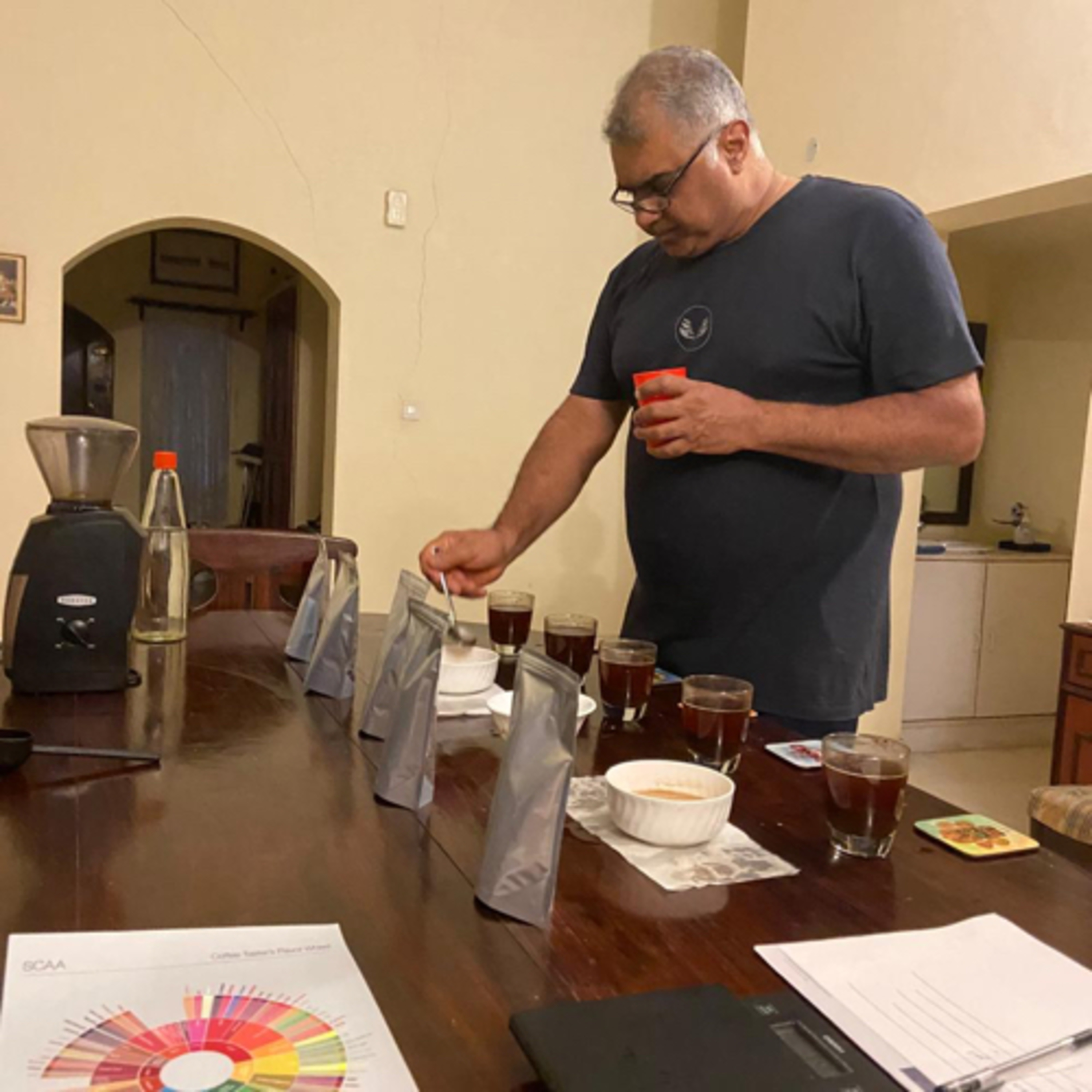
Ep.14 Conversation with a Coffee Planter - Contd. the episode with Ajoy (pt2)from Kerehaklu Estate
44m 25s
The podcast features Ajoy’s personal insights into India’s pre-decentralized coffee industry, particularly during the 1990s. Under strict central excise regulations, coffee could only be sold through authorized curing centers and was pooled into a centralized system, limiting market diversity and quality control. Labor was abundant and cheap, with daily wages as low as ₹3.25, and inputs like fuel and fertilizers were subsidized, enabling high productivity. Diversified crops such as paddy, cardamom, and oranges helped stabilize farm incomes. However, after decentralization, labor became scarce, productivity declined, and coffee prices surged—now reaching ₹200 per kilo, far above the former ₹10, driven largely by intermediaries. Ajoy emphasizes that today’s coffee success depends on understanding local climate, elevation (minimum 2,400 feet), and soil, with shade-grown systems vital for sustainability. He warns against over-shading, which weakens Arabica resilience. He also recalls cherished rural traditions, like paddy harvests and community fishing, now fading. Despite challenges, Ajoy remains optimistic about Arabica’s future through mindful, climate-resilient farming. The episode highlights a transformation in India’s coffee economy—from state-controlled, labor-intensive production to a fragmented, market-driven system where growers face rising costs and reduced profitability.
Hello everybody, so welcome back to Coffee Protocol Podcast.
This is your host, Buristan Bikes.
We will continue the episode where we left last time in the last episode.
Now we will speak with Ajoy in this episode more about how his childhood was, how his upbringing
at the estate was, and more importantly his stake and his side of the story about
coffee and coffee plantation during the era before coffee got decentralized.
Let's catch up with Mr. Ajoy again. Here we go.
How things were before coffee got decentralized?
So there is a 1992, 1993.
You say "stental exercise" is almost like your liquor.
That's how strict they were.
So you had to account for every beat that came out of your transition.
What is it that you drink in terms of coffee?
I typically drink a blend of coffee powder which has I think between 15-20% of Chikari.
And it's a medium roast of Arabic and very fine ground powder.
It's not coarse, very fine.
And typically I like to add, like if I were to make a cup, a quarter of the cup would be the coffee decoction.
The rest would be milk and I would have it with sugar.
Correct. Yes.
And it tastes amazing. I like that.
Now one question is about when you were younger.
Because most of us, even when I grew up, probably coffee came into my life pretty late.
Most of the current generation, like for example Pranoy, for example he is the fifth generation.
He is now getting into coffee and obviously the scenario of coffee now is different and probably back then it was very different.
I only know about the state verbally of how things were before coffee got decentralized.
So that is in 1992-93.
How was it back then?
Like when I say how was it, what would be the major differences between then and now?
See one of the most glaring differences would be since we were a completely controlled market.
We were under the central excise, coffee being an exciseable commodity.
It was highly regulated.
And when you say central excise it's almost like your liquor.
So you had to account for every being that came out of your transition.
You couldn't sell it anywhere else but through an authorized coffee board agent which was the curing works.
And they were authorized for a coffee curing centers.
You could not go out and sell it in the market anywhere.
If you were caught then there you could be criminally prosecuted.
So you had to maintain a whole lot of these ledgers and books and forms which were put in place by the central excise.
And so on and so forth.
So that was how strict the. So at the end of the day if you grew in any given year.
So if you like out of 50 acre plantation.
If you produced about 20 tons.
The 20 tons that you sent to the coffee curing works.
That you were free to send it to any coffee curing works.
It had just had to be here.
It had to be an authorized representative.
Authorized licensed curing works of the coffee board.
If you sent it there.
Now if you sent it there you sent a lorry loan which is 10 tons.
Now as you don't payment you got just what a lack of rupees.
That's it. One lack.
And then the coffee was supposed to have gone into a pool.
It was called the pooling system.
As and when you know the sales of the coffee happened.
When India in those days used to do a bottle system with the Soviet Union.
Because India were needed aircraft parts for their defence forces.
So what they would do they would butter.
They would send coffee there and get aircraft parts.
Wow. I know that.
So in many ways at that point of time coffee was one of the biggest foreign exchange earners for India.
Although it was just 1500 crores.
It was big money in the old days.
Big foreign exchange.
Today it's pittance.
It's probably not even you could say expecting the drop in the ocean literally.
But in those days it was like that.
So that being the case you know we were so regulated.
There was abundance of labor.
I still remember when I first started coming into plantation working.
I remember we paid daily salary a daily wage of I think 325.
3 rupees 25.
That was I think the run that 8889.
That's just hardly 32 years ago.
That's when I was born.
So 3 rupees 25.
That's the daily wage for one.
That was a norm at that point.
That was a government basic wage.
So because of that the availability of abundance of labor.
And in those days you didn't have all these small settlements near towns and villages and all that.
So what would people do?
You had to construct labor quarters for them.
And each plantation would have depending on the size or on average of one labor for every two acres.
So over here for instance I used to have even up to 120 permanent laborers, 120.
During the power season it went up to almost 300.
So that was what it was.
So all your work was done like clockwork.
There was no backlog.
There was no delays in anything.
So we were looking at very high productivity as far as Indian conditions were concerned.
Very very high productivity because we were able to even with the pitils that we got from the coffee board.
We were able to manage the show.
Because the labor cost went down.
Input cost went down.
Fertilizer was subsidized by the government of India.
Subsidies, fertilizers, subsidies, subsequently were all lifted and thrown out.
So all these what was the cost of petrol in those days?
It is hardly I think if I remember right diesel was around two rupees and maybe petrol was around three rupees.
I remember when I was doing when I studied I was doing my B-com in Bangalore.
For 400 bucks I could get a week's allowance of petrol into my vehicle.
So that is what the cost of fuel was.
So if you take that entire situation then it was a lot and then most importantly your climate,
your weather was very good, very very ideal. You got the monsoon on the first of June and it would retreat in the end of September.
Come middle of October you get the northeast, no unseasonal rain, no excessive rain, no less rain, nothing.
Everything was like clockwork.
So as you said when you are only allowed to sell to these licensed agents which are basically the clearing units,
which then goes into the pool.
So does that also mean that at that particular point quality of coffee did not really matter?
You could say that because everybody is just processing quantities of coffee and just giving it to the audience.
See in those days we were still following this British unit system.
What was called a bushel? You know it was a measure.
We used it just for as a convenience sector, pour it into the baskets.
It is not used as a measure anymore. It is used as a bucket.
So a bushel had to waste so much.
for you to start packing it, like a bushel of parchment, if the weight came down to around say
15 and a half to 16 kgs, then you say okay the coffee is dry now, you pack it into guanis.
So if it was slightly higher, say 16 kgs, you will say oh it's got another day to dry.
Okay, just how we measure the muscle today. Yeah, okay, that makes sense, yeah.
So that was what it was, and then there was not much of care that was taken towards the
not kind, not you won't say not much, you could say you know cherry the natural is what we talk about
today. We're really not very popular, okay, you had to do batchments and you know for so like you
rightly said you know as far as the quality aspects of it were probably not great.
Maybe not the most part of the best. Yes, how we look at it today, and so when it
decentralised, I mean you were not allowed to sell coffee anywhere else, you were allowed
to sell coffee there. But at that point also did you guys have like different other crops to make
or generate money from? Yes. And that was not centralised. Yes, yes. Like for instance,
pepper had not even made a appearance on the way back. Yeah, pepper, I think if I'm not mistaken,
pepper started appearing in these areas, you could say in the early 90s. Okay. And what was the
price of pepper even in the first 10 years? I don't think it was more than 80 rupees to 90 rupees
a kg. So nobody really bothered about pepper. Cardamom, Paddy and Arachnid subsequently came in,
you know, Subhari came in in a big way. Okay. But mainly Paddy and Cardamom. And to a great
extent those days we also grew a lot of good orange. Okay. Yeah, orange crops were very good.
That's why you may see a lot of the old orange trees. Okay. So these were some of the things that
helped, you know, kind of helped you tide over your financial requirements. And the other thing was
also that if you look at it, you know, the rate of interest we paid in those days were so high
on crop loans, we almost 18, 19 percent. Wow. Yeah. I mean, if I think back, there is a phenomenal amount
of money to pay for a crop loan, you know. But banks were more liberal. Okay. In the sense like,
you know, you would get like for instance, once your loans were all exhausted, in a sense,
you get a crop loan, you run the shuttle or what, remember, now before you start picking,
you need additional money to run the show, you get more labor to help your hours. So you would ask,
you write them right to them and say again, can you give me a bridge loan? Just for two months,
until the crop comes in, then you pay it back. So those kind of things were a lot more,
were where, were available a lot more easily. Yes. Yes. Okay. Because one thing is they were sitting
on your property documents, which were almost 20 times the value of the loan that you've taken.
They were totally secure. Yeah. You know, so they had no comps about, you know, lending.
It's only today where, because of all these camps here and there, you know, the wrong people
get all the big loans. Correct. And the people who actually who are bona fide,
are the people who suffer. Correct. Yeah. So you're making a lot of copy, you're giving it to
the agents, you are growing a lot of other crops alongside copy. The labor is extremely,
extremely cheap at that point, because of the cost of living at that point, how government has
put and the environmental weather factor was pretty good. Yes. So everything was good. It was good.
Definitely. Yes. So do you think after decitalizing copy, did the challenges go out?
See market, once the market forces to cover, see what has also happened is,
if you look at the GDP of India, how it grows substantially. So what happened is the disposable
income in the hands of, you know, people who lived in rural India increased tremendously.
So you definitely saw a big shift in the socio-economic pattern, like people who could not afford,
I'm not talking about, you know, guys who owned land, I'm talking about the daily wage laborers.
Correct. Yeah. The daily wage laborers could afford a lot more. Correct. And so once that, you know, you saw,
it's kind of a ripple effect, you know, this led to that led to something else. So once the coffee
prices started going up and then you saw this, you know, very slow migration of rural youth towards
cities, you know, cities, big towns. Correct. You suddenly were left with not very,
become a, you know, large school of laborers who were available in these areas. Correct.
So what, what were you left with? You were left with, left to compete with your neighbor.
If you pay 10 rupees more, you'll get more labor, that's all the thing. Correct.
And the other thing also is you saw a drop in the efficiency of labor.
Aha. See what, what a laborer who has paid a daily wage, three rupees a day. Now he would
probably bring in those three rupees worth of work in a day. Correct. As, you know, things got
better, the productivity fell. Now to even get 50% of worth of what you paid, if you are getting
50%, you're a lucky person in a plantation today. So currently we have, so the entire market
is based on the sea price. As people talk about and you go to Kaukegoor, you can check the sea price
there. What is like an average sea price currently for Arabica and Rovester? Average? Yeah.
If I can say it in wash coffee terms of say, like, say, washed Arabica,
it is around 20,000 between 20 and 21,400 kgs. For 100 kgs? Yes. That's 200 to be a kilo.
Yeah. Okay. And so this is 200 to be a kilo. Let's say, let's take a hypothetical number.
But now which is an average, 200 to be a kilo. During or before the
distillation of coffee, what was like a price for coffee that you got from the government?
I think we got about 10 rupees. 10 rupees a kilo. Yeah. So 10 rupees a kilo? Yeah.
To now 200 rupees a kilo. Yeah. So 10 to 200, that's a huge jump. Yeah. Okay. Now I just want to
put in perspective at that point. Yeah. The cost of labor was three rupees in 25 rupees.
That is one third of per kilo cost of coffee. Now the labor cost is approximately how much?
It's above your cost of production. Yeah. Which does not make sense. Yeah. And
subsequently the cost of coffee is not increased. Yes. Yes. When people already have a thought
that coffee is expensive, but actually it is not even coming from the cost. So it's not the
grower who's making the money. Yeah. Definitely. It's all the intermediaries who are. So there was in
fact a year ago there was this big push, especially in the ICO where a lot of the governments were
saying now, you know, big roasters worldwide, even coffee chains should and must start supporting
a higher price for coffee. What they would, what I think it's called a fair price. Fair trade price.
Fair trade price. Fair.
So yeah, exactly. So to give back to the coffee growing community by way of buying at higher levels, you know, you don't want the undergo because overall at the end of the day it's a leverage which everybody wants a day.
So there was this big push but unfortunately I don't think the you know how it is when it comes to these sort of things, you know, to get everybody on board is the most difficult thing.
And when you are a corporate, I don't know how you if you can look it in those same eyes of, you know, it's difficult very difficult.
But yes, I mean it is definitely a very big challenge.
As a younger self, I would probably I don't even think if I can imagine but imagine when you were younger, probably a little older than a kid or probably in the teenage, you would still be surrounded with coffee and all of the places.
And at that point when you were a kid or a teenage living with your family,
was the situation similar like was it like so competitive, was the life stressful, was it not stressful?
No, I don't think so. Was it way better?
You could say it was more, you know, everything was, you know, very set plan, you know, everything happened like clockwork, you know, you really didn't go too far.
But the other thing also, we had a lot more time to do a lot of other things, other than this coffee, like if I look at it, my family had a lot of padding.
Now if I think bang and I say to myself, how would they hell that we manage to do paddy, to cultivate it and to harvest it and to go through the thrushing, you know, with the kind of labor that we had.
But we still managed it, we still managed our coffee, cultivation, harvest everything and then we finished our paper was negligible, other things like cardamom, oranges and everything.
That basically it was the availability of labor, you know, so it is just that this labor has been weeded away from plantations because of the people, you could say, that sort of society had no longer willing to, you know, do that kind of backbreaking work.
Correct, which is the evidence you have to cover. Yes, correct, correct, correct, correct. What is it one thing that you missed the most as a kid?
It was definitely paddy harvest time, yeah. It was a very interesting time. I have always told a pronoun, you know, when you did your paddy harvest, before your paddy harvest,
what you do is if you have a rice field, you would empty out the water. So you do it when the paddy on the rice stock has matured.
Correct. So how you do it is you take a grain out and you just feel it, it should not have any liquid container, that is maturing.
Now to accelerate that maturing process, you would drain out the water, which is, you know, paddy is water lot, correct, correct, correct.
You drain out the water from the paddy field. And now as you're draining out, we would get this small fish and here they were called merrily menum.
It was almost like thin, small things and these guys would put baskets to catch them.
So that was one thing because at that time of the year, we used to have akirotes and that fish curry.
And then the nicest part was after the harvest was over and the rice was cut and then it was all transported to this field.
And then you would have the threshing, you know, where you segregate the paddy from the stock.
You had a tractor going around on it. The evening, the people who do it, they were all local guys, you know, they were not, you know, they were all specialised in only this.
They would come in the evening, every evening to take their food for the night.
So they used to be a nice sambar which is made. And I still love having that sambar with the rice they, my mother would make for them. Very simple but very tasty.
And you used to go with them, sit on the haystacks and they would be a fire burning and everybody would sit around the fire and have, you know, a simple rice sambar.
A small rustic thing, those things are all drawn in a distant memory, you know.
How do you see the current and the future of coffee plantations in the country?
It is difficult, no doubt about it, you know, especially Arabic.
But I have always been very, very optimistic about Arabic. Because although you hear all the doomsday stories about Arabic, I still feel, you know, there are certain varietals of Arabic which will be found to be resistant to white stambora.
Yes, there will be incidents of white stambora. And also, you know, you have to play around with what you have, whether it's being one thing.
And then, so you have to, you can't do your shade lopping like how you did in the old days.
Now, if you want a fantastic paper crop, you will all up everything. Then what happens? You get a good paper crop, you won't have any coffee.
So, it has to be a very juracious mixture of everything. So, you need to apply your mind to it. But then at the end of the day, also, there are times when you say that, you know, God, I've tried everything like, for instance, those rains that we got over four or five days.
Now, what can you do? You'll just help us, you know, in the face of nature. But you go on, you say, let's hang in there, you know, and say that, you know, there will always be a better tomorrow.
And I have hope that, you know, Arabic will be there, yes.
Okay, last few questions. So, one of them, you didn't mention a couple of times just that. So, when we talk about shade grown coffee, when we talk specifically about the shade.
So, I have read it. I know there is something, some terminology is like, there is a primary, secondary and a tertiary shade. What does it mean?
See, basically, now, if you look at, especially areas where you don't have silver oak, okay, you may have a few.
But if you look at the indigenous trees, like what we have here, especially in our area, we will look at all the fig trees.
Like you have the jamao near the nandi. Now, if you look at the canopy, they are all at 50, 60 feet plus.
Okay. All right. Now, you have certain species of trees which defoliate during summer, some which don't defoliate in summer and which defoliate in monsoon.
So, when you have that, you need to have something to allow some of the sunlight to penetrate through the canopy into your planted area.
Then again, what happens is, sometimes the year you could have temperatures on certain days just going up.
So, what happens is that, mediocre shade, which is of the height of, say, between, say, 8 to 15 feet, that definitely helps maintain soil level ground moisture.
You know, retain retention of ground moisture is very important to robustness, especially, you know.
So, the, and the other thing is, of course, your lower shade, which creates again a microclimate.
But what happens is, now the microclimate creating plants that we have all hit by vicin over here.
So, we hardly have any of that.
So, it's basically this, we have just a two-tier shade pattern over here.
And I, quite frankly, I feel that it's very, very essential.
A lot of people go in for heavy, heavy shade lopping just to, you know, increase their pepper productivity.
But I think it's very, very dangerous because if you are a robust plant, you can't, because there are a number of trees.
The population of the trees is a lot less.
But if you are an Arabica plant, and God forbid, if you have an off year with a monsoon, you are in for deep trouble, you know.
So, you know, you need to be very, very judicious in your thought process.
Okay. So, the shade lopping is basically when you are cutting the shade off or when you are making space for the plant.
But what happens is, if you take a regular tree, it does tend to put out a lot of, you know, branches.
Which are at the lower part of the main canopy, which you can take off.
And just what we call as the crown, you know, it's usually three branches or four branches,
which are supposed to be crowned.
So you'll have all these that are growing like this, so you just chop this off.
But there are certain areas where they take off one limb completely.
I personally feel that time has gone, you can't do that anymore, you know.
You're just inviting trouble onto your own.
So it's better to have a good one, yeah, 100 percent, yeah.
I mean, people may say that you're being too cautious and all that.
But at the end of the day, your coffee plants are like your planted missionary.
Correct.
Now if your planted missionary goes, where's your production going to come from?
Right?
Yeah, so you can have your planted missionary, okay, you can work at a 50 percent capacity.
Meaning your production is down.
Correct.
You're better off than not having that plant missionary, right?
Correct.
So having shared is very important because you know coffee is there and you have to make sure
that you nurture the coffee.
Now one thing that you have mentioned, I think you have mentioned with Kaviri when he's planning
that Kaviri tends to have this yield of fruits which is more like, you know, less one year
and more on the other year.
Is this what you call as bopper crops?
Could be and could be not also because in the old days when, like I said, when the weather
was more, you know, what you would say very predictable, not like what it is today.
So you would have, I still remember when I was growing up as a young boy, I would hear my
grandfather telling some of the staff to knock off some of the buds from young plants.
Yeah. Basically because the thought process was that you don't stress out a young plant.
Correct.
You should let it grow, come of a certain age before it will come into bearing.
Oh, we let it go into bearing.
Correct.
So if you had a bud, you would have lay labor to just take off the bud to ensure that it
didn't blossom.
So why I said that was that there were certain years where, you know, it could be varying factors.
Of course, most of these areas here were not irrigated and they were never been irrigated
for the blossom shah.
Correct.
Your blossom shah happened on time.
But there were certain species of arbica which had a biennial cropping pattern.
One year or another.
You wouldn't say low, but one year is regular and the other year is correct.
So when somebody says next year is going to be a bumper year, that means there is an expectation
that most of the plants in this particular farm are going to give more than regular years coming here.
So this is normally either looked at the buds and spoken.
Or it is looked at the yield that is given to the current year.
Yes.
That's right.
Yeah.
That is one thing that I think a lot of people would not know that is.
Okay.
So if somebody was to take up coffee planting as his or her main career choice in the current scenario,
what would be the top two or three advice that you would give?
See, first and foremost, since the nature pays such a huge part and especially in a country like India,
which is totally dependent on the southwest monsoon for most of the agrarian areas in India,
I would suggest that person first looks at the rainfall pattern starting from the month of January,
right after December.
Okay.
You know, look at the history of rainfall in that area.
Okay.
And the other thing is the first range of the, if he is not able to just say if he doesn't have a stream or a river or a tank,
now in a year where you're not going to get your summer rains on time,
now you need to induce slarring.
Now you irrigate.
Correct.
Now where you're going to get your water from is something that you need.
No.
All right.
You can't just say, okay, it's going to rain some time.
Some points are going to rain.
No.
No, you can't do that anymore.
All right.
Especially in an area where you're going to go in for a new plantation.
Ah.
Yeah.
All right.
So just say, like you said, okay, Nagaland, what is the rainfall pattern?
Correct.
When does the monsoon scent?
Yeah.
When does it kind of retreat?
And what are the mean average rainfall of every month?
Okay.
Is you have to do a study backwards of say at least 20 years I feel.
To understand.
Yes.
That is one of the most basic problems.
Okay.
Issues that you have to think about.
The other thing is your elevation.
Now, you, any, any coffee which is which you would call as good coffee can only be grown
at 2,400, 2500 feet above maximum sea level.
Never below that.
Okay.
Below that you may get something, but I don't think it will be the greatest coffee.
Okay.
All right.
Because that's how coffee.
Yeah.
Yeah.
Coffee and tea, high elevation, the better the quality.
All right.
Okay.
That is another thing.
The third thing is the soil of that area.
Now, there are a lot of areas, especially in the Northeast, which have a lot of good volcanic
soil.
You know, red soil, which is red soil is the best for any, any crop.
Correct.
Now, you need to know what the kind of soil composition is in that area.
So, I think with these basic things and also, you know, other, of course, subsequently
the availability of labor as how you want to train your labor to, you know, go about your
years.
Correct.
So, but these, I think, these first three things what I mentioned would be the most important
model.
Yeah.
Okay.
Is there any, about you, apart from coffee, is there any other, or do you have any other interest
of passion?
Because as a, as a third, third, fourth, fifth generation, normally you're born into coffee.
You are so consumed in doing coffee.
Yeah.
That you only have probably one or two other interests or passions.
So, what about you?
Yeah.
I've always played a lot of sport, but in the last ten years you were so many injuries
that I had.
I was a, I was a fairly good badminton player.
I went up to state level in Connecticut.
Oh, nice.
College.
And then subsequently, after my bad career because of my injuries, I took up golf more seriously.
Okay.
So, golf is hobby that I like to say that I'm fairly all right.
I'm not very good at it.
I'm good at it.
Okay.
So, that is one thing.
And the other thing is, you know, all of us, Prussian, Panoi and me, we've always been very keen
about fishing.
Yeah.
So, that is one thing that I would like to do probably is go to the North, Ram Ganga.
Oh, nice.
River and do some massive fishing at some point of time, you know.
Is that something also that you did when you were younger?
Yeah.
I did because I did have a lot of family who were very keen anglers.
Okay.
So, we used to fish in rivers and in fact, we used to go to, now what is the very high security
area, which is the joke falls.
Downstream joke, upstream joke, those areas you could just go and fish.
Now, you can't go anywhere.
You get shot.
So, you get arrested.
You're not shot.
You get arrested.
Because you can't step in there.
So, you know, and then we all grew up with these stories of Jim Cobbett and all that.
So, I've read all these stories about his escapades in, you know, the Common Hills.
And, you know, in 90's all and all that.
So, those areas are something that one day before I'm not down there, if I'm not too old,
I would like to go and probably go fishing trips somewhere there, like, you know.
So, even in fishing, as far as I remember last time in the rivers here, we had a talk.
So, there are two types of fishing, is it?
One is angling and the other is called fishing, is it?
No, it's actually, basically, it's just sport fishing.
Now, if you're doing sport fishing, like, if you're fishing for bigger species like the masir,
masir is an indigenous species of India.
It's only found in India, it's not found anywhere else.
And, in the north, you have the golden masir and the south, you have the regular wing.
But, they grow up to sizes of almost 150 pounds and all that.
Of course.
Yeah, Lord of it, unfortunately, you know, they. been dynamited and you know you don't get the big but I've heard of stories where you
know people have caught big fish. Now when you go for that kind of sport fishing what you do is if
you do happen to catch a fish of the you catch it to take it out of the water you take your photographs
and you learn it back into the day. Now you have other kind of fishing where you're just fishing for
small fish which is like which you want to eat. So that is you have to be really very you need to
have a bit of knowledge as to what you should do for that fish because it's not as simple as just
casting and you may have a pond full of fish but they'll never bite. You need to know what to put
in there to relit it. So it's a very tricky thing but it's also you know you could say it's very
therapy but it's not. You need to have a lot of patience and it it it helps you you know revitalize
yourself. Is it I mean so I know like I've done angling or one the angling the type of fishing
that we spoke about just once in my life when I was in Kareh glue last but the regular fishing
that we say which is done along with the family doesn't look like how we see in the movies where
you're sitting with a beer in your hand and you're like you put the you cast it your
fishing net or the pen or whatever it is and you just waiting and you'll get one big fish
in the end of the day. No there'll be days when you get nothing. So it's the pleasure of
just being in the outdoors just being by a reverse side and the peace and quiet and the pleasure of
just casting that fishing line into the water and maybe even you know sometimes you get nibbles.
Yeah but you know you can feel it in your hand so those are small thrills that you get of course
the biggest thrill of course if you happen to but there are many many days where you will not
get anything. Yeah so it's not for the people who say that you know oh yeah it's useless
but it's nothing happened. Nothing happened. Nothing happened. Yeah. Just like coffee I guess.
Well thank you very much for speaking with speaking at me for this episode. I had a lot of fun.
A lot of knowledge that I got. Thank you very much for my pleasure. I've been done this
many and it was a pleasure hosting you here. A wonderful knowledge and also that whatever you
have been able to share it has made with us has been a joy for Pranay and thank you for taking so
much of your time to be here and we look forward to having you here again whenever you please do
come down wherever you can. Definitely. We love to have you here again. That's not great. Thank you very
much. Thank you. Thank you. So yes that was it from this episode as well and this was the end with
our discussion and our topic with Mr. Joy from Karyaklu. I hope you guys enjoyed it. It was a lot
of knowledge. I personally enjoyed a lot. It is one of my really favorite episodes. I hope you guys are enjoying the content in general. If you do have feedback please
feel free to write back to me. And remember let's make coffee simple.
[Music]
Podcast Summary
Key Points:
Before decentralization, coffee in India was heavily regulated under central excise, with all sales restricted to authorized coffee curing works and a strict pooling system.
Labor was abundant and extremely cheap—daily wages were around 3 rupees 25—leading to high productivity and low input costs, including subsidized fertilizers and fuel.
Coffee quality was less prioritized due to uniform processing and lack of market differentiation, with quality measured in outdated British units like the bushel.
Diversified crops like paddy, cardamom, oranges, and pepper provided financial stability, while crop loans were accessible with high interest rates and strong collateral security.
After decentralization, labor shortages, rising costs, and shifting rural economies led to reduced productivity and a significant increase in coffee prices—from 10 to 200 rupees per kilo—driven more by intermediaries than growers.
Shade-grown coffee systems were vital for microclimate and soil moisture, but excessive shade lopping risks plant vulnerability, especially during monsoon anomalies.
A successful coffee plantation today requires careful assessment of rainfall patterns, elevation (above 2,400 feet), soil type, and long-term climate data over at least 20 years.
Ajoy reflects on the loss of traditional rural life, especially paddy harvests and community gatherings, and expresses hope for the resilience of Arabica through sustainable, nature-respecting practices.
Summary:
The podcast features Ajoy’s personal insights into India’s pre-decentralized coffee industry, particularly during the 1990s. Under strict central excise regulations, coffee could only be sold through authorized curing centers and was pooled into a centralized system, limiting market diversity and quality control. 25, and inputs like fuel and fertilizers were subsidized, enabling high productivity.
Diversified crops such as paddy, cardamom, and oranges helped stabilize farm incomes. However, after decentralization, labor became scarce, productivity declined, and coffee prices surged—now reaching ₹200 per kilo, far above the former ₹10, driven largely by intermediaries. Ajoy emphasizes that today’s coffee success depends on understanding local climate, elevation (minimum 2,400 feet), and soil, with shade-grown systems vital for sustainability.
He warns against over-shading, which weakens Arabica resilience. He also recalls cherished rural traditions, like paddy harvests and community fishing, now fading. Despite challenges, Ajoy remains optimistic about Arabica’s future through mindful, climate-resilient farming.
The episode highlights a transformation in India’s coffee economy—from state-controlled, labor-intensive production to a fragmented, market-driven system where growers face rising costs and reduced profitability.
FAQs
The coffee market was highly regulated under central excise, with all sales restricted to authorized coffee curing centers. Coffee had to be sent to these licensed agents and entered a pooling system, where it was sold through a centralized system, often tied to foreign exchange earnings with the Soviet Union.
Daily wages were very low, around 3 rupees 25, and labor was abundant due to the availability of land and government support. Plantations had to construct labor quarters, with one laborer per two acres, and laborers were available in large numbers due to the lack of urbanization and high productivity.
Quality was not a major focus due to the pooling system and standardized processing. Coffee was measured in bushels with minimal attention to varietals or processing methods, and quality differences were largely ignored in favor of volume and compliance with regulations.
Coffee prices increased dramatically—from about 10 rupees per kilo in the past to around 200 rupees per kilo today—reflecting a significant shift in market dynamics and rising costs, despite labor and input costs rising sharply.
Shade lopping was used to manage sunlight and soil moisture, especially in areas with indigenous trees. However, over-pruning was seen as risky, as it could weaken Arabica plants and reduce resilience during off-years or monsoon delays.
Pepper, cardamom, paddy (rice), and oranges were commonly grown alongside coffee. These crops provided additional income and helped meet the financial needs of plantations during periods of low coffee prices or poor yields.
Chat with AI
Loading...
Pro features
Go deeper with this episode
Unlock creator-grade tools that turn any transcript into show notes and subtitle files.
 PodcastTranscript AI