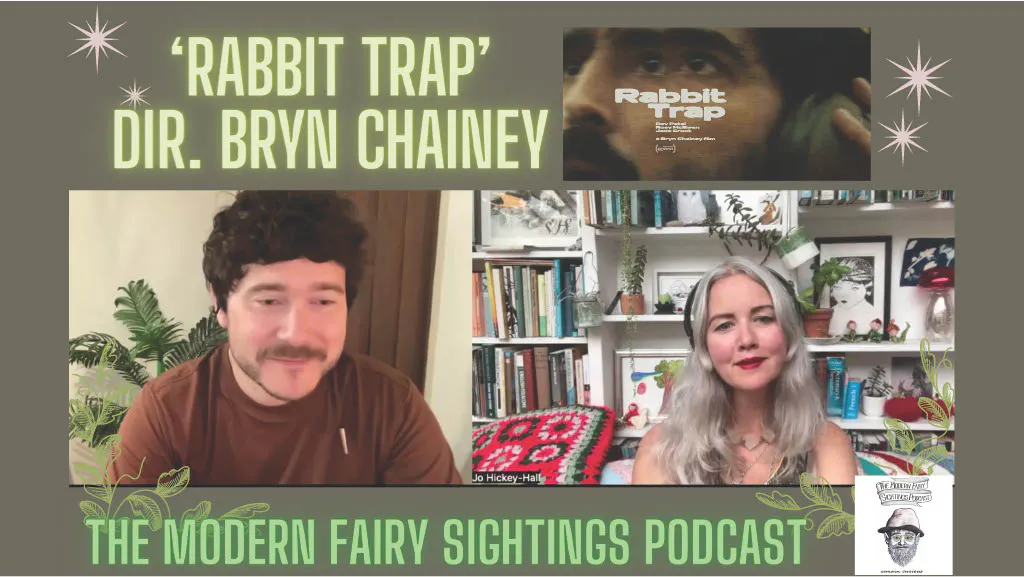
In this episode of the Modern Fairy Sightings Podcast, host Jo Hickey Hall interviews Bryn, director of the film "Rabbit Trap," which is set to release in the US. The film is a horror-love story set in 1970s Wales, focusing on a musician couple, Daffney and Darcy. Darcy, plagued by sleep paralysis and visions, ventures into the woods to collect sounds for his wife’s music. There, he discovers a strange signal and follows it into a fairy circle, unleashing supernatural forces that infiltrate their lives in psychedelic, transformative ways. Bryn explains that the film explores themes of disintegration and regrowth, using fairy folklore as a metaphor for psychological healing. Shot on 35mm film in Yorkshire due to smoking regulations in Wales, the film’s naturalistic, lingering visuals immerse viewers in the characters’ journey. Bryn’s inspiration stems from his childhood night terrors, his father’s introduction to Brian Froud’s fairy books, and a family that treated the supernatural as natural. He approaches folklore as a way to connect internal and external realms, avoiding concrete answers in favor of open exploration. The producer, an experiencer himself, ensured the film honored fairy traditions authentically, aiming to create a story that even the fair folk would appreciate. Overall, the film blends horror, love, and folklore to examine human connection with nature and the otherworldly.
*Spaat on semmoinen radio* *Spaat on semmoinen radio* Hello and welcome to the modern fairy sightings podcast where we listen to people's fairy encounters but take heed, we're not talking about winged tinkerbells here these are real fairies, real encounters that took people like you and I by surprise stay a while and hear their stories my name is Jo Hickey Hall and I'm a folklore researcher Hello everybody and welcome to the modern fairy sightings podcast and I'm delighted to have with me this time Bryn, Cainy, director, writer and director of rabbit trap film that's just about to release in the US next Friday, so 12th of September welcome Bryn, how you doing? Hi, thanks for having me. That was a really lovely calm intro that sets a really nice energy for a podcast you know, I've got an association of podcasts of like "Hi, welcome to the show, wing bang boom!" So it's nice to come somewhere where we can settle in and have a calm insightful conversation. I'm new to this whole thing obviously, so Yeah and I'm just thinking it was out of bit British As it should be, why not I'm British or British? Let's do it British should need to introduce some possess but yeah no it's great to it's great to have you on I have just watched your film over the last week I've watched it twice and I absolutely loved it I really loved it and I and the reason we're talking about it here on this podcast is because it very much both reaches into the other world and you follow the journey of the reaching out from the other world to to us and the film is completely chock full of folkloric motifs and anybody that's been following you know the kinds of experiences we've been looking at on this podcast and the folklore we look at will recognise all of this in your film so can you tell us a little bit about what about the film to begin with and we're not going to go into any spoilers today of course but now it came about about in the first place. Yeah okay well yeah to give your listeners just a broad understanding of what the film is it's a story about a pair of musicians this is it's the movie set in Britain in the mid 70s and it's about a they work with field recordings as well as created anilog electronically they have recently relocated to the Welsh countryside for undisclosed reasons and one of the characters are called Daffney and Darcy and Darcy one of his jobs is to collect sounds in nature for his wife to incorporate into her music he's someone that's wrestling with some internal demons at the beginning of the film that's not a spoiler we see that he's suffering from strange visions at night he's suffering from sleep paralysis which seems to be pointing to something in his unconscious that is bubbling to the surface or trying to get out and he's desperately trying to push it down that's the state of mind he's in as he goes into the woods to collect sounds of his wife and when he's deep in the woods he he is through his microphone a strange signal it's music it's music like but possibly a strange garbled language that's coming through the static I mean the waves and he follows it deeper into the woods until he encounters a fairy circle and he follows it all the way inside the fairy circle and probably your listeners know that's a bad idea don't ever step inside the fairy circle yeah and from there the encounters with the other side how did you put it like the other side is reaching out well you know yeah the other world kind of reaching reaching through you know you have these places where either we can stumble into their world or you know they stumble into ours or intentionally enter into ours potentially and of course we can intentionally attempt at least to enter into there so yeah there are these such as the fair yeah and so this character of this character the main character he unintentionally I think stumbles across a way in or an access point and yeah so from their fairy forces or I mean I think it's no it's not going to be a shock to anyone who listens to this podcast when they watch the film that these are fairy forces infiltrate this couple's lives in increasingly psychedelic ways that leads them on an emotional psychological journey of destruction and healing at all at once yeah so in some ways it's a horror film and some mostly I think it's a love story that is incorporated elements of fairy tale and folklore and myth is that kind of I don't know if that's enough you've watched it twice how would you describe the film as you're as you're talking about it I'm just kind of led back to the film you know I'm really tied back to the film I'm thinking about you know it's I was kind of really agreeing with internally around the the destruction and healing and how that works together because you know if you've listened to some of the actual experiences that people have with these worlds they can be they can come in very unnerving packages they can be experienced at these kind of profound levels deep profoundly deep levels within ourselves that really shake us to the core and yet afterwards as a result of those you know we are changed and healing can take place you know healing healing isn't always you know a beautiful kind of lullaby experience at all in my experience you know it's it's more regularly you you you kind of suffer in some way and you come out the other side a better person for it and and you know you really captured that and it and it all the way through I was wondering yeah what inspired you what because I've seen your previous film as well so short films this is my first feature but yeah I appreciate that you dug in and found one of my short films appreciate that no it's really cool and I have actually shared it with my patreon group because I knew they would really love it oh cool oh thanks is marites and the the woodwows the woodwows sparked my interest they're usually connected with you know the wild men yes and you know these have been documented throughout throughout throughout history in fact that one of the most famous the wild man of warford was documented by Ralph Kogershaw who we know also brought us the green children of Woolpit so which is something that you can about on the show love that story yeah oh it's really amazing really interesting story that I don't know I always hope that we might find out find out more about that that somehow some manuscript might turn up at some point to tell us what happened to those two children but um so so the woodwows really led me in and I wasn't disappointed when you know you you see this being um kind of yeah I mean it was important for us to it ultimately it was a low budget short film you know I made it while I was living in Germany um and yeah we couldn't show it for practical reasons as well but it was a you know that's also a film about going into the going into the woods metaphorically and physically and then nature dragging you even deeper dragging you under the soil where actually the real death and rebirth happens like again literally and metaphorically I mean I'm kind of this is the theme of most of my films I think to do with um disintegration and then kind of read
regrowth, you know. Yeah, and we've been to a guess reintegration in a new way into that realm. And hopefully reintegration with the natural world, or you know, the films have made generally about characters you feel disconnected to their social environment for various reasons and are struggling with finding a place, a sense of connection with the world beyond there and beyond the internal. And then nature is what drags them into a place of connection. You know, so by the end of their journey, they find a sense of place and home through nature. And I would count supernatural or like pre-tunateral or folkloric forces as part of nature. The way that my films look and feel is hopefully very grounded in naturalism. And I mean, that in a kind of a nature-based kind of naturalism. We've got a friend that's just going to have that. Who's this? This is a beautiful void. Aren't you? The first lady of fluff. Yeah, I mean, I want to park something for a moment because I really want to come back in a minute and speak to you about the fact that you know, you use 35 millimeter film to create this. On rabbit trap, yeah. Rabbit trap, sorry, I should say on rabbit trap for the future film. So I want to park that in a moment because the visual is really something, the visuals are really something. I mean, and the spaciousness to me, it just was such a pleasure to watch because of the spaciousness of the film, which is something that you don't always get. It's always, you know, like I said at the beginning, wow, bam, and you know, there's so fast moving, you don't get a chance to actually breathe and get a sense of the experience within the film. And so what I found with rabbit trap was it really allowed you to do that. And I also just want to respond to, you know, seeing the being in Moritz and the WoodWows. I believe you kind of did see the being in a much more, it kind of felt like a more realistic way than if you had some kind of CGI character, the leap out, and that'd be there in the forest. Actually, I thought it was brilliantly done. It left me wondering how you managed to do that. I don't know. I see that, but I really liked it. So that is the kind of something that people that are into this are more likely to get that than they would something kind of CGI. But anyway, ultimately, I really wanted to ask you, you know, what's inspired you? So I'm getting around kind of nature, but whether, whether there was anything else and whether, you know, you had any of your own experiences that inspired you? Big question. One that I'm still trying to figure out, the answer to, I mean, I do I do count it make the process of making a film for me as a bit of a tent to solve the mystery of why I'm drawn to make that film, that makes sense. So I can I can't answer the question like rabbit trap in a way actually started as an extension of Moritz and the Woodwoes, which is the short film you sent to your Patreon subscribers. And it was a continuation of those themes that I felt I felt I wasn't done with personally. Like I do start with the psychological I start with a journey that I feel I need to go on as a writer. And then I kept finding a character that can be kind of my proxy for that or that can do that journey into the woods with me. And so I actually do start with a lot of journaling to myself and asking, okay, so where are you at? What's what's scaring you right now? What are you not wanting to look at? And try to answer that question to myself. And since I was a kid, it's just been very natural for me to build narratives around symbolic forces and supernatural encounters. Even though I don't think I've had any concrete supernatural experiences, I'm really very interested in open and people who's in the experiences of those who have. And I think I've come close and I've got a long, complicated history with the supernatural that would take up maybe too much time. But it's just always felt very natural to me. And I think that comes from my childhood is that I'm half Welsh, half English. And I was a very introverted child and I had some health problems as a kid and some kind of emotional things I didn't know how to deal with. And from young age, I was from a very young age, I had night terrors and very vivid hallucinations that would last for hours. And I would see creatures of all different kinds like giants and kind of demons and things. And so I would, the most intense emotional experiences in my childhood or some of the most encounters with beings that I didn't, I had not invited into my room. And I think that that did a number on me. And you tie that with my father introduced me to the work of Brian Fraud when I was a kid. Brian Fraud remains a huge influence on me, not just his illustrations about fairies, but the way that his books about fairies treated them like it in Cyclopedia. Oh, these are pixies and this is how they act, deal with it. Oh, these are trolls. They get annoyed by this, this move on. And they won't treat it as anything other than fact. Not that much information to go on. So if you encounter one good luck, that was an overall feeling I get from Brian Fraud's looking at his books about fairies and so on. And as a kid, I read them in a very interesting time, a pivotal time where the boundary between the imagination and empirical truth wasn't fully formed. And I think that's a really exciting age for a kid. And the things that have media or experiences that you encounter at that time go in deep. And for me, it was the intense hallucinations because of overheating and night terrors mixed with loving to sit with my dad and go through Brian Fraud books. And also the fact that I grew up in England, but half my family as well. Should we do these trips over to Wales and go through the woods. And I was also there was also this idea of a place that my family was from, but I'm not from. And it created this Wales of the mind maybe that I think birthed a longing in me for a place, you know, like the Welsh had this word for it here, Ith, which is like nostalgia for a place that you haven't even been. Or that may not ever exist. You know, I think I was, that was putting me young. And I think a lot of my films are actually born out of these these early experiences. That's that's really beautiful. And I totally resonate with that similar experience with kind of going over to Ireland as a child and and building the sense of Ireland, you know, my dad's Irish and actually my mum's parents were Irish as well from Northern Ireland, but growing up in in Jersey. And yeah, it beds deep, doesn't it? That's really beautiful, particularly the sense of going through the forest. And you know, you you really feel that with this film. There are plenty of trips into the forest, you know, physical trips into the forest in in the film. It makes me wonder also, you know, what, what was the opening for your father around these worlds? I don't know and you don't need to, you don't you don't need to talk about that if you were not too, but how open was he to other world? It sounds like he was pretty open to be showing you. Yeah, the whole side of my dad's side of the family are, they are, yeah, they're quite, they're quite spiritual people in very in various ways. And definitely he would talk about fairies and supernatural forces as real potentials, real potentialities in life, you know, they weren't treated as a silly superstition. It was probably they are just a part of what it was to be a person, you know? And my mother, my mother is more of a kind of church of England, Christian. And that also probably helped because I grew up with two parents who both took the supernatural as natural, you know? Yeah. And so I think that was really helpful for me as well. I mean, now my relationship to the supernatural is one of great curiosity and openness, but in terms of the work that I do, I'm more approached
I'm more approaching it from a kind of a folklore and kind of symbolism side of things or ways to dig into the unconscious. Not to suggest that I think all nature, spirits, or things are just metaphors. I think it's actually much richer than that. I think it's more mysterious and entangled with the internal life of the person and the external kind of other realms. I just basically haven't got a concrete answer for any of it other than I'm interested in finding the connections between things, internal external, this world, other world, material, spiritual. This is what we find most meaningful as well then with this project is that exploring this and in your film you do that and allow others to kind of lean into that as well. It's in the exploring and the finding meaning in that that actually starts to open up rather than kind of chasing down concrete answers. We're never going to find that. That's not what the other world, the other realms are about. In the film they come into contact with this being, well, this person and things start to unfold and from the very beginning they are, I guess, a bit lost in nature themselves. They've gone to this house. It's in the middle of nowhere. It was actually set in Wales as your film, but it was filmed in North York, shall I believe? Yes, it was. Originally I wanted to shoot everything in Wales with Welsh crew and do that, but for some financial reasons it wasn't possible to shoot in Wales. There's a very particular strange law in Wales that you. So all across the UK it's illegal to smoke in any workplace, including vaping, including herbal cigarettes. But there are special dispensation given to theatres and film sets because characters need to smoke. That's true all over the UK except the way except in Wales. Actors aren't allowed to even smoke herbal cigarettes on set. My two characters are chain smokers and there's a lot of pot smoking in the film. The option I was given was, if you want to shoot in Wales we have to do CG smoke. Number one we couldn't afford CG smoke and two that would look rubbish. It would go against the spirit of the film which is to do things organically and analog. Anyway it's unfortunately to expensive to shoot in Wales so we went up to Yorkshire and it worked out beautifully actually. The landscape's up there are so varied and rich and we saw in some places that have never been filmed before. We had great access to the environments that I needed. So yeah so it's a stand-in for Wales but anyone who's travelled around Yorkshire knows what he's spotted and go, "Okay that's skipped." It looks like weathering heights because we shot it down the road from the Emileee Branties house. Goodness me because there's one scene where it's this kind of stony landscape. It's limestone, this kind of limestone pavement which goes, it's like an ocean of rock which has been dried up. Yeah. Oh it's really incredible and because of the shots and the fact that you've used 35mm and because the shots are lingering as I say you really kind of get sucked into the stories that you're there with the characters when they come across you know this being that they kind of strike up some kind of communication with. So I asked you before we began, did anything strange happen on the map? (Spanish) (Spanish) (Spanish) (Spanish) (Spanish) (Spanish) must organize that obviously it was going to be
day and so we'll just have another excuse to have a chat to him and other time because it's always really great to speak to him. But how did it come about that you were working together then? Yeah, it was a great experience working with the spectrification. I mean, those guys, it was very cool to have a producer on the film who on one hand understood what the film was, what kind of film I wanted to make, which is a very particular kind of film. It's got a certain kind of sensibility that is definitely not to everyone's liking. But you know, he got that. At the same time, he's an experiencer and is someone who's just got a rabid curiosity for people's experiences. So it was really, it helped it while we were tweaking the story in the script because he would give feedback and notes and we dig through it and try to improve the story where we could talk about berries and he wasn't like sitting back cynically going, yeah, but how does that serve the story? He'd ask that, well, how does that, what's real? What really happens? Or what does that mean? And we really felt that we would try and make a film that would do just, like this might sound silly, but we wanted to make a film that the fair folk would be proud of, that they would see themselves identified. And he told me once that he, I think it was a dreamy head or a psychic, yeah, I was like, where'd he go see a psychic? And she said to him, like the beings, they're happy, they feel like the films you're making are doing them justice. And that's my comp out of his mission, I think, with the production company is make films about the supernatural, but which don't treat it like it's some game for it's some just malevolent, invasive force, but instead to treat it as a part of what this, what it means to be a human in this world and what it means to be natural. So that was on one element, that was great. And I didn't know that about him or the company when I first reached out to them. I had just seen a few of their films and particularly their film Mandy was just as a movie struck me so strongly. And I thought whoever made that, they clearly trust their filmmakers and are willing to go to some strange places. So I really would love them to read Rabbit Trap. So it took, it was a very securitous kind of difficult journey to get them to read the script because I was an unbrid, like I've made short films, didn't have an agent, had no real contacts in the film industry. So it was through some really general, like some friends of friends, and all that. Eventually got it to them and then they just responded to it immediately. I've got a text from Elijah going, like, I just said, like, what the fuck is this? Who is this guy? We've got to meet. You know, they were fully in as soon as they read it because they thought this is what we're looking for. Yes, oh god, that's such a lovely success story as well. And yeah, it is hard, isn't it? Because you know, you really want to do something that is, it's mean something to you. You know, it's like with what I'm doing, mean something to you. And if somebody doesn't get it, they don't get it. And you know, there's no point in trying to twist something that you're doing into something that's going to be digestible to someone else who doesn't get it because it's going to be the thing that needs to be made. And it sounds like, you know, as it seems to be with Daniel as well, that you're being called to do this. This is what I would think. This is the way that I think there's a sense of being called to do this for whatever reason at this time, because I truly believe we are opening to these worlds. And what you're doing with your film, what Daniel's doing with the platform, what I'm doing, it's kind of, it's aiding others to be able to open to that too in all sorts of different ways. And so yeah, I feel like it definitely found the right for juices then with them. That's brilliant to hear. And when you talked about wanting to have a sense that this was welcome, that this was being done in a way that was acceptable to these other realms, which is again, how I work too. Did you ever feel, how did that work when you introduced yourself to the landscape that you were working with? Do you have a sense of that that you were being aided in any way by the landscape or that you had a sense? I mean, I guess the hair is a biggie, right? That hair. Potentially. It felt, it felt very meaningful on the ground and it definitely put the hairs on the back of our neck, pun, not intended up. And that definitely gave us a sense of excitement and so because I mean, it's odd, I find it quite, I find it quite specific where I get a feeling in the blood, you know, like I get it in a certain woodlands and I don't in others, I can't explain it. And there are certain woods where I wrote the movie because I would, I mean, obviously I set the computer and I write the movie, but there are sequences and and and character decisions and so on, but I do while walking and thinking and so I would go through particular woodlands where I'd be living it different times and I would be drawn more towards woodlands where I feel a little bit watched a little bit and you know, something, not unsettled because that I would turn around quickly, but on a person, yeah, by me personally, I'm sort of looking with those spaces. On the shoot, I mean, all I can suggest that we had, we were absolutely blessed with the weather because it was a, it was a four week shoot and the first two weeks or worse, were mostly outdoors and then the second two were indoors and the first, those first two weeks, we would got clear skies, some, some, some like overcast, but it didn't rain and then the second two weeks was an absolute deluge like the set was flooding mud everywhere, but thankfully we were indoors by that point. So we, I think it had been all around, we wouldn't have finished the movie, it would have been kind of delayed and then budget would have blown out, who knows what would have happened, but we really felt very looked after in terms of the weather at least, which was the camera department was thrilled. The window is with you. It felt like that sometimes. And we just, also, we just tried to be very, respectful wherever we go. I mean, whenever I'm in the woods, I don't trample and I look out with things and I sort of quietly to myself, you know, say thank you or apologise for backstabbing crush something and on set we just, we were very mindful of not hurting the landscape that we were shooting and, you know, regardless whether that's but a sake of a fair phone call if it's just for the respectful of the land we're shooting on, like you do it. Hopefully sets a kind of precedent because it does like it feels there's a quality to your film that feels different to other films and I think it's because the sensitivity not only towards the subject but a real, there's a real kind of honesty in your in what you're trying to portray as a say with the kind of the spaciousness. And so I think it you come away with the with the sense that you've you've had an experience by watching the film rather than you know, you've had something kind of placed upon you. It's more like you, you have, yeah, you've that you've had an experience and so. I'm really happy here that because that was as a filmmaker that was a decision. So I mean, almost every film that deals with fairies or goblins or any kind of known supernatural entity, there's also a moment where the characters who are being kind of accosted or kind of confronted with these forces, at some point they go to a library or something and they pull a book off the shelf and then they go, oh it turns out fairies, you shouldn't give them milk. And then they explain what's happening and then the rest it plays out that way the audience knows what's going on. And we consciously decided not to do that. That this was going to be a film where the two main characters are being confronted with forces that they don't have a context for. You know, they they're there, it's beyond their comprehension. And so it should also be beyond our comprehension as an audience unless you've got some prior knowledge of Welsh fairy law. Because and the hope is that if people are open to it, then the experience of that interaction is enough. You don't need to fully, you don't have to have it taught to you, you don't have to explain. Like you said, put upon you, you should ideally go on the ride or go on the experience with the characters. And that was a conscious decision all the way along and it was one I had to fight with and kind of balance at every stage of the production, you know, from writing to the shooting to the editing all the way through to like, you know, the poster and the trailer and the way we talk about the film. And it's definitely hasn't been to everyone's liking and it won't be to everyone's liking and not even everyone on the team would agree, you know, that this was the right way to do it. Exposition is always a debate.
on every movie and especially if you're doing a movie that's kind of surreal or mysterious. But for me, the principle behind it was, I want this to be about the experience of dealing with spiritual forces and I think those forces are beyond rationality. So there should not be rationally thought away or explained away on screen. No, definitely. You know, the thing is when you're doing something differently, it takes people the world to catch up. Right? So I mean, you know, I hope they catch up in my lifetime. That'd be nice. You know, yeah, I've been really nice. Yeah. Yeah. So it's really nice when you say you actually genuinely felt moved by the movie to the point where you wanted to watch it again to get more details or just to share it with your husband. You know, I enjoyed it. It's beautiful. Actually, the second time I watched it, I enjoyed it even more than I did the first time. And do you know the performance by particularly Jade Crute, who is this kind of otherworldly being? Oh my god. Yeah. I mean, she's absolutely amazing. Yeah. So Jade Crute plays the nameless, ageless, genderless, possibly speciesless child at the heart of the film. Yeah, she's amazing. I mean, we went through a long casting process. I wrote the film for a boy of about 14. I wanted it to be a boy because without too many giving too much away, but there's this kind of semi-ferral or possibly local child who had been gracious himself into Daphne and Darcy's lives. And this child clearly has some sort of connection to the theory forces that are also bothering them. And it didn't make particularly in the 70s out characters. If it was a little girl running around the countryside, there would have been like, no, no, no, no, we're taking you home. Like, we cannot be left to wander the moors at night. But if it's a 14 year old boy who's a country kid, bed late at slide. So there was a practical reason to write as a boy. But then casting was quite difficult. You know, we auditioned easily 100 kids and kids of all genders and ended up landing on Jade when she came in right at the end. I mean, she's actually, she was 25, or we shot the film, which is 25 year old woman, playing ostensibly a 14 year old boy. She just had such an emotional range that she could just tap into. She could be really vulnerable and sweet and then easily switch into a cold animal lector kind of tone. I mean, her favourite actor is Anthony Hopkins. Her favourite performance is Anthony Hopkins as Hannibal Lector. So on set she'd be with a little shorthand, she'd be like, "But in how Anthony Hopkins would you like me to get for this take?" Let's go for Lector. I've got you, but I've got you. She's a funny little very kind of grounded fun little Welsh-less. And then she can just inhabit quite strange characters. She was great. I'm really excited for people to see this, like, to see her as, to see her performance and just to go on the ride with her. Because I think what she did is really the heart of the film. Absolutely. And, you know, we can't forget to mention, obviously, Dev Patel and Rodine Meeky and as well. Oh my goodness. I mean, that was a treat. Dev Patel, he's splendid. He does look splendid. The man looks splendid. And Rosie Meeky and his just fantastic in it too. So it's just such a treat for the eyes from from the landscape shots, you know, to the actors involved. And of course, the soundscape because the stories is focused on, you know, these artists that are playing with analogue sound technology. I'm probably, you can explain that in a minute better than me. But it's an audio treat as well. And I watched it first of all. I watched it on my laptop. And then when I listened with my husband, when we had it into the TV and the lounge, "Ah, yeah, this is just incredible." Can you talk a little bit about that please? Yeah, sure. I'm glad you got to that. Because it was a huge part of the film is making this an auditorous experience. I mean, I interact with the world a lot through sound. I'm very sensitive to certain sounds and something that's just a big part of my life. And what I was researching Welsh fairy law, music and sound just kept coming up over and over again. There's a kind of a particularity of Welsh fairies that of music and sound, like non-language-based sound being so important to them. And I thought it was interesting, even that your podcast is called Modern Fairy Sightings, you know, because the movie is kind of about a fairy hearing. You know, what it means to hear the other side, because I think a sound is so spectral. It's like sound is already evidence of a non-physical world. You know, it's the spectral world that we deal with every day in normal life. A sound will come in from next door. It'll drift in and it'll go into your body and in fact how you're feeling long before you figure it out, oh, there's a broken air conditioner next door. You know, why do I feel, why do I feel gross? Oh, it's because it's a strange hum coming from the refrigerator. You know, well, you go into the woods and you think you've heard a voice and now what? You know, and it can drive you mad trying to figure out if the voice you've heard is your mind playing tricks when you, or if it's actually, you know, the bird has spoken language for one, that's what something, you know. So anyway, the factual sound design of the film was obviously a huge part because these are musicians and sound recordists who are led into the fairy realm through sound and it's through sound that sound as a as a vibration event that actually unlocks a psychedelic experience that brings about most of the film. Besides stepping spoilers here. Yeah, I thought that was. Yeah, and I just, and we're, we just put some my sound designer Graham, I lived with him for a while in the NLA while he was working on it, he worked in it for months, like every, every single shot has been meticulously constructed sound wise to create a feeling of the other realm creeping in and manipulating reality and like it's just a beautiful sonic experience. So I'm really glad you got to watch it with some speakers on and headphones is also great. And the psychedelic aspect of it, we won't talk about how unfolds, but yeah, it's, I mean, I'm, you know, looking forward to watching it a third time. I'll probably watch it with my son or my daughter actually, because I think that they would really appreciate it too. And is it, so the release is going to be, is it an miracle on the 12th September, but what about the year? I would love to know. I don't know yet. I mean, I think I think it's a nation anywhere. So yeah, what has it hasn't been decided? I mean, this was a, this was always intended as a very small niche movie. It just, along the way, got slightly bigger and bigger, you know, we managed to get, like you said, death, the tell signed on quite, like after I'd written it after it was financed, he got the, we, I sent the script to him through his agent as a bit of a long shot. And then it turns that he loved it and came on board that day. So, um, was my point that this was always meant to be a small movie. And it's kind of a miracle that we, you know, got into Sundance earlier this year. And it's, it's, it's another miracle that we sold the film. And it's going to get any theatrical release. So it's getting a, it's getting a short, a short run in the US. I think it's 100 screens for two weeks, which is great. And then hope we have sold it around the world. We're just waiting to find out what that plan is. Maybe it depends on how the US release goes. So if you have any US listeners, please go and watch the movie because it might actually help if it does okay, then it might help us get to release it in the UK and overseas. I've always thought this was a movie that would play the best for British and European and Japanese audiences, I think. Yeah. And any, any, any cultures who are a bit more connected to their kind of fairy folk, the little ones, you know. So I really hope it plays in the UK. I do too. And I know that when, um, so Wendy and my group, she's going along to the release in LA, she lives in LA, which I believe is next, well, yeah, next Friday. So she's really excited about that and I only wish that, you know, more of us could be there for that. But whereabouts else in the US for, for watches and listeners? Because I'm going to release this. We're talking today, which is Friday, and it releases a week today. So I'm going to get this out as soon as possible. So folks will have
time to go in and catch it. Do you know what the case is? It's being screened. Other than LA in New York, I don't know. Okay. I'm not privy to that information. That's fine. If we can find out that. We can find out. We can find out. I'll put it on the show notes so that people can check out if they're showing near them. And you know, I've got to ask, what's next? Are you? Are you? I'm writing now. I'm writing the next couple of projects. I'm doing a, I'm writing a few things at once. And I'm continuing along along the lines of doing grounded of journeys across the veil. That's possible to be grounded and going across the veil. But I want to keep exploring myth and folklore, you know, in a way that feels earthy and psychologically linked, you know. So hopefully I'll get another movie made at some point in my life. I like it to be in the next couple of years. That's what I'm doing next. Yeah, I really hope so too. And I salute you. Congratulations on the film. Rabbit trap is an absolute triumph. I'm really excited to hear, you know, what other thing to when they go and see it. So yeah, you know, it's been nice to welcome you back for your next film too. And I'll be there. Yeah, cool. With, you know, how things unfold from here on in. And it's been really great to talk to you as well. It has been great. Thank you so much for having me on. Thanks. Thanks so much for listening and watching. If you enjoy the podcast, please consider joining us on Patreon for dozens more episodes of unreleased bonus content monthly online events and a private chat. We are a warm supportive community and it really helps to support project. Find us on patreon.com/themodernfairycitingspodcast Now receiving frequency transmission. What scares me is getting stuck really late at night in an unfamiliar town at some intersection that has an inexplicable red light that shouldn't even be red because there's no one around for miles. It's three in the morning yet there I am. The engine idling and the seconds are ticking and I'm looking to the left and looking to the right and the shadows. At that moment, I'm always convinced that I've been set up by the forces of darkness and this is the moment when something is going to come out of the dark at my car and that thing is going to be, I don't know, let's just say the one to go. Sure. Transmission complete. Stay tuned to Spectrivision Radio. Stay stay.
Podcast Summary
Key Points:
The podcast features Bryn, director of the film "Rabbit Trap," which explores fairy folklore and supernatural encounters in the Welsh countryside.
The film follows a couple, Daffney and Darcy, who move to rural Wales; Darcy experiences sleep paralysis and visions, then stumbles into a fairy circle while collecting field recordings.
The director emphasizes themes of disintegration, healing, and reintegration with nature, using folklore as a lens for psychological and spiritual exploration.
The film was shot on 35mm film in Yorkshire due to legal restrictions on smoking in Welsh workplaces, but it visually captures a naturalistic, atmospheric style.
Bryn’s inspiration draws from childhood night terrors, Brian Froud’s fairy books, and a family openness to the supernatural, blending personal experience with folklore.
The film aims to honor fairy folklore authentically, with a producer who is an experiencer, ensuring the story resonates with those who have had supernatural encounters.
Summary:
In this episode of the Modern Fairy Sightings Podcast, host Jo Hickey Hall interviews Bryn, director of the film "Rabbit Trap," which is set to release in the US. The film is a horror-love story set in 1970s Wales, focusing on a musician couple, Daffney and Darcy. Darcy, plagued by sleep paralysis and visions, ventures into the woods to collect sounds for his wife’s music.
There, he discovers a strange signal and follows it into a fairy circle, unleashing supernatural forces that infiltrate their lives in psychedelic, transformative ways. Bryn explains that the film explores themes of disintegration and regrowth, using fairy folklore as a metaphor for psychological healing. Shot on 35mm film in Yorkshire due to smoking regulations in Wales, the film’s naturalistic, lingering visuals immerse viewers in the characters’ journey.
Bryn’s inspiration stems from his childhood night terrors, his father’s introduction to Brian Froud’s fairy books, and a family that treated the supernatural as natural. He approaches folklore as a way to connect internal and external realms, avoiding concrete answers in favor of open exploration. The producer, an experiencer himself, ensured the film honored fairy traditions authentically, aiming to create a story that even the fair folk would appreciate.
Overall, the film blends horror, love, and folklore to examine human connection with nature and the otherworldly.
FAQs
It's a podcast where people share their real-life encounters with fairies, not the winged Tinkerbell type, but genuine experiences that surprised them.
The guest is Bryn, the director and writer of the film 'Rabbit Trap,' which is set to release in the US on September 12th.
It follows a pair of musicians in 1970s Wales who encounter a fairy circle in the woods, leading to increasingly psychedelic and transformative fairy forces infiltrating their lives.
The director chose 35mm film and spacious shots to create a naturalistic, immersive experience that allows viewers to breathe and feel present in the film's world.
It was inspired by his childhood night terrors and vivid hallucinations, his father introducing him to Brian Froud's fairy books, and a longing for a place like Wales (hiraeth).
It was filmed in North Yorkshire due to a Welsh law banning actors from smoking herbal cigarettes on set, which would have required expensive and low-quality CG smoke.
Chat with AI
Loading...
Pro features
Go deeper with this episode
Unlock creator-grade tools that turn any transcript into show notes and subtitle files.
 PodcastTranscript AI