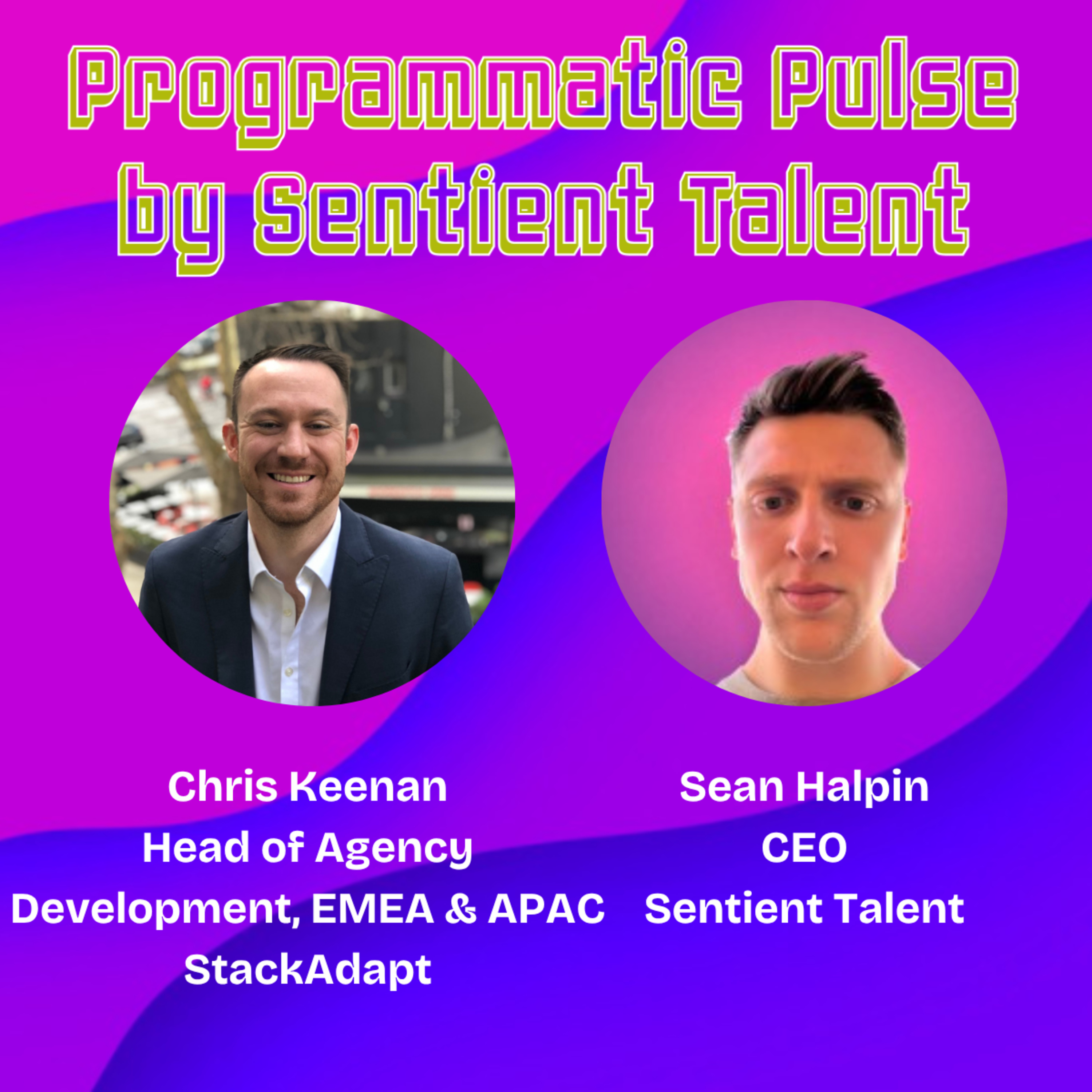
Ep.111 | Chris Keenan | Head of Agency Development EMEA & APAC at StackAdapt
from Programmatic Pulse
27m 38s
Chris Keenan, head of agency development at StackItUp, shares his journey in ad tech, starting from a high school educational website that earned money via Google AdSense. This supply-side experience gave him unique insights into the industry. After university, he worked at Johnson & Johnson and McKinsey in non-ad-tech roles, but his passion for digital advertising led him to MediaMath in 2013. Over a decade, he held roles in product management, solution engineering, and sales, moving to London and gaining deep knowledge of both DSP and DMP platforms. He emphasizes that consultative sales, built on product expertise and credibility, enables faster client decision-making. Attracted by StackItUp’s "speed and specialization" approach, he now focuses on verticals such as B2B, travel, and healthcare, where the company goes deeper than competitors. He highlights the importance of rapid product development, citing an example where a feature was built in two weeks versus six months elsewhere. Keenan advocates for decision-making principles like "ground truth" (empowering those closest to problems) and "obligation to the scent" (following insights), which foster agility. His current role involves building relationships with holding companies, engaging with client leadership, product teams, and investment groups to differentiate StackItUp through specialized solutions and quick execution.
[MUSIC] This week on the show we welcome Chris Keenan, who is the head of agency development in Amia and A Park for Stuck It Up. Let's take a listen to the episode now. [MUSIC] >> It's kind of really appreciate you coming on to the podcast today. >> Yeah, of course. We're happy to be here. Thanks for coming by. >> That's awesome. >> So we're going to start as we usually do. Just by getting the guest to explain how they're going to advertise in and then just a top-line view of their sort of origin. >> Yeah, since then. >> All right, let's see. So I actually started probably close to 20 something years ago. I started in a bit of a roundabout way in that. I actually created an educational resource website as a class project for I was in high school at, where I put my notes, outlines, practice quizzes, etc. online. I got community service hours for it. It was a small project. Then one day I got an offer to buy the website for $1,000. I'm like, "Why would anyone pay me $1,000 by the site?" So it turns out you can actually make money online. Who knew? I was like, "All right, I'm looking to Google Adsense. I was starting getting my first check for someone who was like $30 that month." I was like, "That requires them actually click on the ads." I learned about display advertising, different ad networks like Tribal Fusion, and burst media, and Cassali Media, which is out in that exchange, and joined all the different ad networks, and learned the ins and outs of the digital advertising space. So I continued to grow the website, added new subjects to it, and then just that has been my playground for anything on the supply side of the world, whereas my actual professional career with an ad tech has been on the demand side or on the agency side. It's always been super valuable for me to have an understanding of as many aspects and sides of the industry to understand what are at pain points, what are their incentives. That's been super interesting for me. I still have the site today. I used it to launch pre-bid when that came out. It's been five, seven years ago, so yeah, that's how I got into ad tech. That's insane. So from there, you know, numerous different companies, a quick snapshot of from there to something like that today. Yeah, so actually after university, I actually didn't go into ad tech or anything really advertising related. I did a rotational program at Johnson Johnson, which I loved the idea of kind of like I was just saying, learning many different kind of roles in a very short period of time. So I did everything from like program management to internal audit, which was incredibly boring and checklist oriented, but I got to travel the world. So I was in Japan. I was in Antwerp. I was traveling throughout the US. And so having an appreciation for travel and the ways in which companies do business in different parts of the world at a very young age for me was super impactful. And then I went to McKinsey and I did healthcare consulting. And it was, I learned a ton, but I realized that healthcare was not for me. And I found myself reading all the same type of publications I read now, so whether it's AtticChanger, Campaign, et cetera. I found myself reading those publications instead of healthcare related publications. Oh, is that because of the website? That was still because of the website. Yeah, and it just, that's where I was interested. And that's where my passions lied. And so there was, there was an event put on by MediaMath. It was called the Future Series. And I was living in Boston at the time. And I went to the event. I was chatting with some of the people there. And I was actually looking to hire someone who's focused on building another data manager platform. And so I joined MediaMath back in 2013. I was there for a good 10 years, but I changed, changed roles, changed countries. My head just, for what it's worth, I had an amazing experience. Yeah, MediaMath, yeah. That's awesome. And then if I'm correct, was it MediaMath to WP? Yeah, MediaMath to WP. So, when I left MediaMath, I did, started on the product management side, the debt for four years. I wanted to have, we were launching our DNP. So I was going with our sales team, with our client service team, got the trouble of the world and the trainings and sales pitches and whatnot. And kind of fell in love with London along the way. And then we were looking to start our solution engineering team for the international region. And so they needed someone to join the team, found the team in London. I was like, can I please do that? That would be great. Because I hear we also have a DSP as well. I've been so focused on the DNP for my first four years that I want to expand my view into the DSP side of the world. So doing both the threat and the depth from a technical perspective and working with like some of our most sophisticated clients that build solutions specific to them, future rewarding in that regard. And then we had an opening on our sales team to lead sales for first UK and Danny Mea. And so raised my hand for that because I was like, I enjoyed the commercial aspects of the solution engineering role. And I had found that when you have the depth of knowledge of your product and the industry, you don't cut the old sales like what you might think of a sales career. It may not be the case. You don't need to be having the the stake lunches every day of the week. It's not entirely relationship driven. Relationships come through trust and through credibility. And when you're able to bring a unique perspective and an educated perspective to your clients, that's where those relationships are formed. That's really interesting. And when I go into Art Talk recruitment, especially the commercial, the sales side of things, I initially thought like I was expecting sellers and sales to be very much the stake lunch here. And I thought it was going to be very much built around your relationships and how many people you can meet in a given day. And then just speaking to people in those sort of commercial roles, I was like, wait, hunger set. You know like the ins, the outs of all the technology. And that's what really surprised me. It's like, it's got this very consultative way of selling 100 pounds. How important do you think that actually was for your career in order to understand the product like in and out of there? And then being a, is it more like that being able to help the client understand your solutions too? Because yeah, go it inside out. Yeah. And so it's exactly that. But it also allows you to move faster as within kind of the decision making process that the client is running because if you need to pull in a solution engineering team member, a client service team member, someone from the ad ops team, coordinating fork calendars alone internally, as well as your client's calendar. You're now looking at like the next meeting being in two weeks time. And then even if you don't get all the questions answered then in the two weeks time. So if you're able to answer 90% of the questions that come up in the first meeting, you're off to the races. And speed is like one of those things that like time kills all deals is one of those kind of quotes that's kind of live with me is if you're able to move fast, bring credibility, bring education, consultative sales process, but do so at speed? That's going to, that's going to win the day for you. The other thing I feel is that there's always kind of a limit in terms of like the ceiling of your company's credibility. If you need to be bringing in five different people to answer standard questions, if you can take that to, if you can take your response as the sales lead up to it, then you bring in people to kind of get you to final way there. I think that kind of speaks a lot to just the overall companies approach where if the sales person can be answering technical questions, just imagine what the actual technical person and then did it help us well being able to translate, you know, especially being able to speak the language in software engineering and the engineers, be knows that there's like the conduit with the computer too, like it's the speed, it's the progression. I guess actually not everybody does come from that sort of background. Yeah. I guess what sort of advice could you offer to someone who doesn't necessarily come from that technical background, but understands the value of being able to speak and understand the technology, would there be any sort of like tips to you know those coming through the industry right now where you'd say, okay, you need to be pinpoint on this given thing when speaking to products, when speaking to engineers in between the claddy too. I mean, just in terms of like learning, it's I personally learned to like osmosis. And so being around the people who are talking about the technical things, so whether you're working remotely or whether you're in office, like if you're working remotely, join the Slack channel where people are talking about product related things and technical related challenges, and you'll learn so much about you.
your product and how it's built and like things that only come up when they're the edge cases. And see if you can join the product stand up. See if you can join different team meetings. This is an area that's important to you. Also come up with as like, we've made at least five minutes in where we haven't said the word AI yet. But like, AI provides you with so much information that's really available at your fingertips at all points in time. If you want to learn how product people think, you can say, hey, my client is experiencing this challenge. I would like to kind of frame this in a way that a product person would be able to understand. And so whether it's using a job to be done type framework or there's kind of standard product requirements, documents or product strategy documents, you can kind of build out the user stories. And we've worked with the AI agent, whether it's cloud or chat GPT or Gemini to frame your client challenges into a way that a product person would be able to take down and run with it. And so you can kind of take it much further internally that you've been able to before without having a product management experience or background. That's brilliant explanation. I guess we're talking about the speed and being able to be agile with solutions you could offer clients. Is that one of the big reasons that brought you to stuck it up? Yeah. So like, stack it up. I think after my first month after I joined, I post on LinkedIn. I like the two words I used to describe stack it up or speed and specialization. And so within the first month, I saw how quickly we operate and how quickly we made decisions. And that is a true differentiator for us as a business across the entire industry. But then the specialization piece, kind of joke, I speak to it with new clients and all agency friends like no one needs another on the channel DSP with pre access to premium inventory and proprietary AI and great customer service. They already have seven of them on the roster. If anything, agencies are looking to reduce the number of platforms that we work with, not increase that. And so as a challenger brand entering the cold co and the enterprise base over the past few years, the way we've been able to bring value and incremental kind of differentiation is through specialization. And so we have been focused on key verticals. So whether it's B2B, travel, auto, healthcare and political, we go deeper than any other DSP out there in those. We've organized our product team not just by functional areas, so reporting, creative, targeting audiences, etc. But take that and then it's a matrix where we also have solutions leaders and vertical leaders as well. So they go deep across all of those. And so it's going deeper than any other platform does. And so if anything, we want to make sure we don't be seen as a point solution because we're not. We're also on the channel DSP, but we go deeper than the point solutions do. But we have the benefits of a scaled on the channel DSP where we have access to more inventory and channels than anyone else does in the point solution space. So it's that combination of the two there. Even if you think about it, three ahead, like the horizontal load or versus the like vertical load, like you can go more deeper, way more in depth in that given sort of channel. But I guess the importance of having a strong engineering, strong product and if I'm correct, like you may an incredible amount of highs in those sort of departments to be able to be able to implement, you know, really fast solution given to those. And just kind of like has that been able to make a big impact with trying to break into those like, yeah, surprise, whole code. Yeah, I mean, even like within the first month that I've joined, so a few things here. One, if I'm not mistaken, I want to say 60% of our hires last year were in the product and engineering R&D kind of department. Interesting. And so really doubling down on engineering and product and the R&D to provide us with the scale to be able to move at velocity. And like, we have a whole code that needs something built. We are able to move quickly to support their needs. And so I have an example of that was we were, we stayed in R5 from one of the major hold codes. We didn't have one of the capabilities I knew would be impactful to respond back to with. The engineering team built that in two weeks time. And I know for a fact that other companies, it took them when I was at the hold code, took them six months to build. And there's so much back and forth where we just made the decision, we are going to build this because the whole code needs it. And this is a resupport hold codes. It was so quick. There was no, well, the next print review cycle is in four weeks time. We'll review the feedback and we'll come back to you. And then after that, we'll need to properly move quickly. It was actually scary how quickly we moved. Like, do we have all the information we need? I was like, yeah, yeah, we do. Okay, great. Let's go. Yeah. You know what you're talking about speed to how, how important, what's the experience like for this, you know, since Johnny stuck it out, you know, how is that whole experience being basically, you know, you said that very much early on, but is it really like ground breaking some of the things that you've seen? You know, because when you even talk about the first course, I just can't think of anything anyone else really doing that sort of thing. It's just not been the approach that other players in the space have taken. And everyone is differentiated their own way. Speed and specialization is kind of the way stack it up to this approach that. But within, so second app started as a, as a native platform 12 years ago, we then scaled into kind of an omnichannel DSP, but we're not stopping there. Many, many other platforms stopped there. They're like, okay, we got on the channel DSP. That is, that is our swim lane and we'll stay in there. We're going much further or bridge into Martek and the orchestration across paid and own channel. So email direct mail, building our own data hub to incorporate kind of clients. First party data they have within their, whether it's sales force, no flag, they're different that their own kind of first party aspects. And then bringing all those different triggers that we can see from has the client or the user opened an email and click through was their car abandonment rate. There's so many different signals that we can bring into our platform that simply just don't exist in other platforms because they've stopped at omnichannel DSP with premium inventory and proprietary AI. That was, that was us years ago and we've just kept moving and innovating beyond that. That's awesome. You know, I think we were talking a little bit more about beforehand, you know, those sort of coming through the industry and the importance of being able to, you know, work in its scale, working at speed. Yeah. And this all, you know, rainbow, which I'm talking about, what the importance of decision-making. And just remember, you know, some of the things we discussed just really resonated a lot. So I was just hoping you could sort of break down with the methods and the tools that you found useful when I'm coming down to decision-making. So if there's anything McKinsey taught me, it was speaking threes. So three things here. I would say one is ground truth, the concept of ground truth, the second one being obligation to the scent. And that was also a big concept that was incorporated at McKinsey and they're kind of famous for that. And then the third would be disagreeing commit. So with ground truth, it's really the idea that the person closest to the problem has the most context and should therefore be the person who is bringing the solution to market essentially. And so it's not the leader's role to make all the decisions. It's for them to provide the context to everyone within the organization so that they know what the North Star is. And so if they are able to see both the ground truth as in like the team members speaking to the clients, building the technology, if they're able to see the North Star is where we're going as a company, but also understanding the day to day, they are able to then make decisions and provide solutions to move us faster. And so if we rely on leaders to make every decision in the company where everything needs to flow all the way up to the top to flow all the way back to the bottom, that is going to slow down the company. We need to provide team members with all the context possible so that they are able to make decisions, act in a company's best interest, act in a client's best interest and move quickly. And so just a communication pipelines to get from the ground truth to leadership, setting the direction. Yeah. So that's something is just making sure leader's job, like I was saying, is like most important thing is providing the context. Because then if I think usually nine times out of 10, if someone comes to your team or from a different department, it's like, well, what should we do? And then if you turn the question around, like, what do you think we should do? Nine times out of 10, they'll typically have the answer ready. So how do you empower those team members to feel one comfortable with making these decisions, to give them the information that they need to make those decisions? So yeah. Brilliant. I guess, you know, before we bring me a moment, let's talk it out.
It's a bit good to understand what sort of on the cards for Stakadarts, what are the sort of goals, especially that you've been brought into to do. What does your role sort of evolve around when it comes to Stakadarts? So my role is primarily focused on building up our relationships with the holding companies. And within holding companies, you have many different roles and team members. And so you have the client leadership who are responsible for either a single client or a few different clients within a book of business. You have the product and technology teams. Many of the holding companies are either building their own technology, acquiring other technology platforms, but they are now building like they now have their own in-house technology. They're becoming much more technology companies than solely media companies as they were in the past. And so you have technology and product people that don't have a specific client remit. What they are building is to scale across all of their clients. You have of course the investment and the partnerships teams. You have many different roles within an agency that every partner like a Stakadab needs to engage with, but how you engage with them and the ways in which you engage with them are very different. We'll have team members who are focused on specific client activations and adoption of selling and stack it up to vision for B2B and our different verticals. But then in my world, I'm really focused on helping agencies solve agency specific challenges, helping amplify their differentiators and their strategy. So whether their strategy is to build everything in-house or whether their strategy is to make acquisitions, whether their strategy is to have as much data in a deterministic fashion or whether their data strategy is to use more cohorts, there are ways for Stakadab to help them amplify their differentiation strategy. So we don't take a one-size-fits-all approach to how agencies choose to differentiate. We don't tell them that you should differentiate by doing exactly what we are saying you should do. And this is our strategy. You should adopt it. We really take that consultative approach where we seek to understand what their strategy is, how Stakadab can bring our wrong gradients or technology or expertise to the table to help them amplify their strategy. Awesome. I mean, it's been a while. If you just hear across the market, stack it up to the killing. And then I'm apparently the special and independent scene too. Yeah. The brands just seem to be doing really well. I mean, so I would say Stakadab started 12 years ago really focused on the mid-market. And they've done incredibly well-servicing mid-size agencies and brands. And it focused on North America, but when you look at today, we have a local presence in 15 different markets. We have 1,400 employees globally. We're hiring 400 more people this year. We are still growing. And the offering that we have is compelling. And this is why we're having the success that we're having is that we're not trying to do the same thing that everyone else is doing. We are creating kind of our own lane. And we won't really refer to ourselves solely as a DSP anymore. So creating space, a new space for us to operate. That's hugely important. That's awesome. We are getting short of time. So big part of this podcast is to get sort of career advice. For those looking to sprawl, excelling the industry. So I'm not sure if there's a quote, if there's a story that you can sort of attribute to, you know, career advice for those looking to make a mark in the industry. I mean, I think this kind of comes back to the different decision making kind of themes. There are so ground truth, disagree, or obligation to the Senate and disagree and commit. And quote that I found from Andy Grove, who was the founder of CEO of Intel. If you disagree with an idea, you should work especially hard to implement it well because that way when it fails, you'll know it was a bad idea, not bad execution. And so the idea there is that ultimately you need to think about how do we make the company go faster. And you don't want to know, you don't want to leave any question to mind whether the idea was bad or the implementation was bad. You want to know why the idea failed. So you can avoid doing something like that in the future. When you leave things open to interpretation, there's no learnings possible from that. And failure is only okay if you have to learn something from it. Yeah, it's interesting. I'm not sure. You saw a thing back to a time where maybe there were a certain case where you had your assert beliefs and you thought, there's probably some ways we should be heading. How do you push it very much is okay to say, you know, like, you need to go into it like whole hearted, like, but there must be a lot of part of you that is saying it's just not going to work. How do you put that aside and make sure you show up and make sure like, that is always the forefront, like to put the business needs ahead of, I guess, your personal needs and that is. I think that is a great question because I think when you're, if you ask yourself why you don't like whatever idea is being put forward and has been decided on, you have to have a very clear reason. I can't, if you don't have a clear reason, it likely just comes down to ego. And so if it's your ego driving your decision making and not the client need, not the business need, that's a challenge and it does something you should reflect on. But that's where like the, this green commit part comes in is like, when you disagree, you should be bringing the client lens, the business lens, your own kind of personal experience to the conversation. And that should be what it would kind of drives your decision making process and your kind of contribution to the business. I can ever, even back at media map or building out the DMP, there was a question of how are we going to charge for this? And like we didn't have the commercial model figured out, like there are arguments to be made, we should charge a flat fee. There was arguments to be made to give it away for free. There are arguments made charge on usage basis. I was like, let's encourage adoption. Let's give away for free. And I was, I was going to ho on that, but we agreed as a business that we were going to charge for it and we were going to charge on usage based model. Now imagine if I were to go into the client meeting, like I wanted to give it to you for free, but we decided we were going to charge for it. I disagree with that. How do you think that would land with the client? You needed to disagree and commit. You needed to be committed to believe in your product enough that it is worth paying for in this, in this case. And that was ultimately the right decision. We wouldn't have known that if we didn't fully commit to that. If I sold it short and we didn't have to give it away for free, we would have been loose down on a massive commercial opportunity there. Yeah, go as much as there's no I.M. team. Yeah, yeah, Mr. Keenan. That was awesome. Yeah, thanks Johnson. Really enjoyed that.
Podcast Summary
Key Points:
Chris Keenan began his career by creating an educational website as a high school project, which introduced him to digital advertising through Google AdSense and various ad networks, giving him a supply-side perspective.
After university, he worked at Johnson & Johnson and McKinsey in non-ad-tech roles, but his passion for ad tech led him to MediaMath in 2013, where he held multiple roles over 10 years, including product management, solution engineering, and sales.
At MediaMath, he moved to London and gained expertise in both DSP and DMP sides, emphasizing the value of deep product knowledge for consultative sales.
He joined StackItUp, attracted by its "speed and specialization" philosophy, focusing on verticals like B2B, travel, and healthcare, and leveraging rapid product development to meet client needs.
Key decision-making principles include "ground truth" (empowering those closest to problems), "obligation to the scent" (following insights), and "disagree and commit" (moving forward despite disagreements).
His current role involves building relationships with holding companies, engaging with various agency roles (client leadership, product, investment teams) to differentiate StackItUp through deep specialization and speed.
Summary:
Chris Keenan, head of agency development at StackItUp, shares his journey in ad tech, starting from a high school educational website that earned money via Google AdSense. This supply-side experience gave him unique insights into the industry. After university, he worked at Johnson & Johnson and McKinsey in non-ad-tech roles, but his passion for digital advertising led him to MediaMath in 2013.
Over a decade, he held roles in product management, solution engineering, and sales, moving to London and gaining deep knowledge of both DSP and DMP platforms. He emphasizes that consultative sales, built on product expertise and credibility, enables faster client decision-making. Attracted by StackItUp’s "speed and specialization" approach, he now focuses on verticals such as B2B, travel, and healthcare, where the company goes deeper than competitors.
He highlights the importance of rapid product development, citing an example where a feature was built in two weeks versus six months elsewhere. Keenan advocates for decision-making principles like "ground truth" (empowering those closest to problems) and "obligation to the scent" (following insights), which foster agility. His current role involves building relationships with holding companies, engaging with client leadership, product teams, and investment groups to differentiate StackItUp through specialized solutions and quick execution.
FAQs
Chris started by creating an educational resource website in high school, which he later sold for $1,000. He then learned about Google AdSense and display advertising, growing the site and gaining supply-side experience while working on the demand side professionally.
Chris worked at Johnson & Johnson in a rotational program, then at McKinsey in healthcare consulting. He joined MediaMath in 2013, where he held roles in product management, solution engineering, and sales, before moving to Stack It Up.
It allows salespeople to answer most client questions quickly, reducing the need to coordinate multiple internal teams and accelerating deal closure. This speed and credibility build trust and differentiate the sales process.
He recommends learning through osmosis by joining technical Slack channels, product stand-ups, and team meetings. He also suggests using AI tools to frame client challenges in a product-oriented way.
Stack It Up differentiates through speed and specialization, focusing deeply on verticals like B2B, travel, and healthcare. It also extends beyond omnichannel DSP into Martech and orchestration across paid and owned channels.
The company makes decisions quickly, such as building a needed capability for a holding company in two weeks, whereas competitors might take six months. This agility helps win and retain clients.
Chat with AI
Loading...
Pro features
Go deeper with this episode
Unlock creator-grade tools that turn any transcript into show notes and subtitle files.
 PodcastTranscript AI