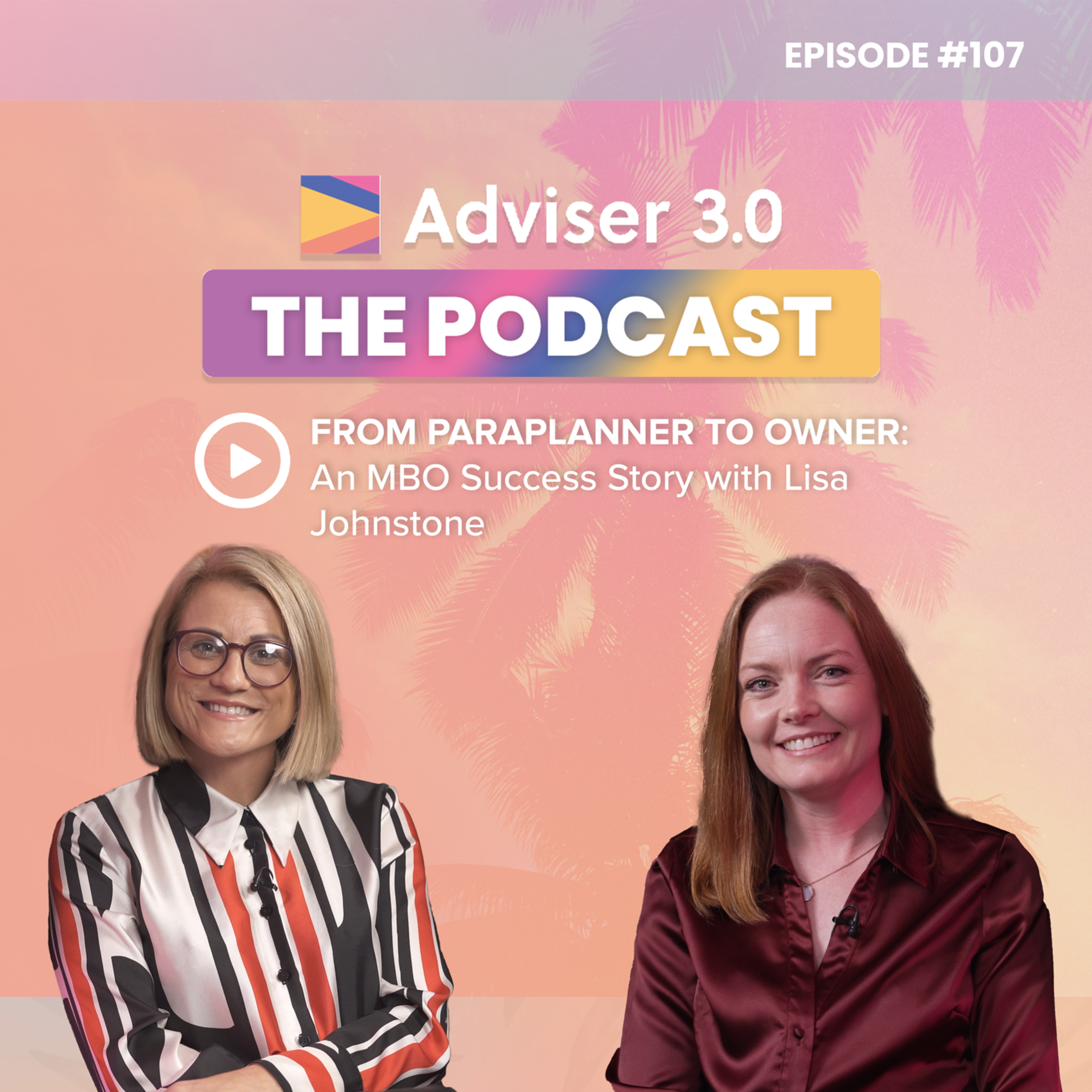
Ep. 107 - From Paraplanner to Owner: An MBO Success Story with Lisa Johnstone
from Adviser 3.0: The Podcast
41m 39s
Lisa Johnson, Managing Director of VWM Wealth, discusses her career journey and a successful management buyout (MBO) on the Advisor 3.0 podcast. She entered financial planning through a university degree, which was uncommon then, providing her with technical skills and professional exam exemptions. After traveling, she joined VWM as a paraplanner, where founder Ken became a key mentor, delegating client responsibilities and strategically preparing her for leadership. Their effective partnership, with Ken handling strategy and Lisa managing technical implementation, ensured a seamless transition when Ken decided to exit. He prioritized an internal sale for ethical reasons, leading to an MBO by Lisa and her team. The process was demanding, particularly during the COVID-19 pandemic, but Ken's transparency and delegation made the firm resilient. Lisa highlights the rollercoaster of business ownership as a source of continuous learning and stresses the critical need for financial planners to have a concrete succession plan, rather than indefinitely continuing operations without an exit strategy.
[MUSIC PLAYING] This is Advisor 3.0, a show designed to help you as a financial advisor elevate your professional practice, transform your client's lives, and take your business to the next level. I am Abraham Ocasoyan. Welcome to the show. Good morning and welcome to Advisor 3.0. And I'm delighted to share today that we're joined by Lisa Johnson from the WN. Thank you for making the journey down to be with us today. Really, really excited about what we're going to chat through today. Just for people that don't know Lisa as I do, do you want to talk us through who is Lisa? A little bit about yourself. Yeah, so my name is Lisa Johnson. I'm the managing director of VWM Well. So we're a boutique flatched planning firm in Glasgow, and team of nine. Perfect. And tell us, how did this all begin then? How did you end up at VWM? So I joined VWM as a power planner. I had come back from a year's backpacking and travelling. And previous to that, I'd worked as a power planner financial planner in a firm in Belfast, Johnston Campbell. And that was just really street-out of university where I had studied financial planning. And I think you know, I've kind of sort of catch up call before today's session. You were sharing with me that actually at the time you studied financial planning at university, which I got a confessesle, so it was a first for me. I didn't even know that it was a course that was offered. And I think you shared at the time that there was only three universities that actually offered financial planning. Is that correct? Yeah, I think that was at the time. So I just really picked the course based on having done some, you know, economics, business studies, that sort of stuff after I had done other studying and just had thought, well, nothing else. I'll know what to do with my own money. And it's finding it interesting, rather than maybe like a street forward sort of business discipline. And I did really enjoy it. I loved it. And so there were three universities at the time. I think they're probably about 10 now. There are quite a few more. But it was quite interesting for me whenever I first went into working environment because most people in financial planning have just fallen into it kind of by accident. And I remember going in to my first office environment and they were like, what do you mean you meant to be here? Or you designed things to be here? We all just sort of ended up working for an insurance company or something. And then, you know, got into financial planning. So I think, now it's obviously a lot more common that people will study financial planning, financial services, that sort of thing at university. And then that is a root into lots of different things, but financial planning. So your question, is it anything like financial planning today? Yeah, I mean, it was really good for me because I was exempt from lots of professional exams. So a lot of the study content was lined up and the university had a really, really good partnership with the PFS at the time so that what you were studying was going to be practical. I had sort of planned to go to maybe like a more traditional, like red brick university in a more academic course and then picked this instead. And that was a good choice that has worked out well for me because the course was really pretty vocational, pretty practical. It wasn't just that academia. And then it came to doing a lot more exams and advanced things later on to be chartered. I didn't really struggle with that because I'd already studied it all. I'd done all the corporate finance exams and maths calculations parts. So it really set me up for quite a, you know, quite a good platform to get chartered and just to have some background before you get into the career work. And you say then that from that point of view, not only from the kind of what I call the hard maths, there was definitely the softer skills because I think today we talked about, you know, coaching and being in environments to be able to communicate. And actually you could often find with studying is that you kind of home one skill or the other. Did you feel it was any cool balance between the two? Yeah, well, again in the course there was the option to do the department at the time. It's changed a little bit now but the department at the time was aligned with risk management. So there was quite a lot around that and psychology modules and things that in amongst that theme topic. And so then that was an opportunity to think a little bit more about how people think about risk and human behavior and so on. I have to say I was quite strategic. I wanted my first. So I picked the math subject. So I think actually if I was to go back and do it again, I probably do more of the psychology than I did at the time because as I have learned in the real world, that's actually quite important. Interesting. And how much hard maths do you do today? Not a great deal. Not a great deal. I think we know, I think that's something we all look back on and think actually algebra. I definitely don't use that as much as I learn about it at the time. Advice of 3.0 is back. Financial planners, are you ready? One day over 20 game change in sessions. On May the 15th, 2025 London is the place to be. If you want to shake up your skills and network, put them very best. Did I not mention? The actual Tim Peak is a headline speaker. Advice of 3.0.co. Don't just stand again. Lead it. So Lisa, let's talk a little bit about VWM wealth because your journey with them has been a rather interesting one from starting as a paraplanar through the courses you were just described to kind of being, I would say, I would say, through the back ends now of an MBO. So do you want to talk through about what is that all begin? Yeah, so I just, I applied for position with VWM as a paraplanar at the end of a year backpacking. So I was in Buenos Aires and quickly running out of money and the flights to come back were there and needed to get a job basically. So I had applied. I met Ken, I think, who was the mining director of VWM. He established the company a few days after I had come back and he offered me the job on the spot. We got on really, really well. I had another interview elsewhere which was probably more my comforts in which was pensions. So I come from a quite a technical pensions background and I just had a good feeling about Ken. I was just sort of a gut decision and we worked together really well. He was a really quite visionary guy, great gravitas, great presence, just a really lovely person who would build rapport very easily with people and just would attract trust very easily, just a really nice person and he was very, very good mentor to me and kind of forced me out of the technician and the brim cover kind of where I was to be more involved with relationships and speaking to clients and things. So I started there, Himalaya were a good double act because he was very strategic and leading the meeting and directing the client relationships. He was just introducing cashful modelling to the company at the time and we were also moving from a retail custodian to institutional. So it was a bit of a baptism of fire to be honest because it was quite a lot of technical work and learning the cashful modelling and presenting that to the clients at each of the meetings and it was the first time for the clients and for us each time for the first 12 months and there wasn't anybody else there for me to learn it from. So I had to learn it and that was it but that was a really good experience, we still use it, we love it and I just really worked and learned a lot from Him from a skills perspective and he had done a lot of years of technical work and the advice and really had had enough of it, you know, sort of had done, you know, being there, done it and as time had gone on then he just wanted to work more strategically on the business and started to pass clients over to me and then had a discussion about his own succession, Ken was a very visionary person and then he would have a lot of ideas, he wants the idea done, whenever he's had the idea he wants it done yesterday and then has to maybe just sort of think it through so whenever he started thinking about his exit, he just I think came to the realisation that we have lots of conversations with clients about well if you can leave work now and there are other things that you want to do, why are you still there and he really felt that he needed to be authentic to that and sort of take a bit of his own advice and then also whenever we were looking at different paths for his succession, I think quite quickly he decided that, you know, a seal to a corporate wasn't going to be for him, just for ethics reasons really and that he didn't want to have the clients to be put into a more corporate offering when they had such a personal offering with us and so he just asked me one day and just typical Ken kind of style, just very, you know, well do you think you would be fancy owning the business one day and I think I was just really a bit young and naive and yeah why not, you know, I didn't, I didn't, did you know what MBO meant? Silly sounds, we didn't get to the MBO sort of decision until a little bit later because after we had a discussion about, you know, me having more of a share holding in the business so I did, I bought a little bit of the business after my first maternity leave and that was to have a little bit of skin in the game. It was a lot of money to me at the time but it wasn't a lot of money in relation to the value of the company but that was important for Ken that I would have some sort of financial commitment and I got that, you know, that was, I think that was really important and we then just looked at different options so we looked at employee ownership trusts, we looked at, you know, a seal to another firm or maybe more of a corporate, you know, take over a type thing and then spoke to tax adviser that we know really well who would refer work to us.
and we had a couple of clients who had done management buyouts and so he said, "Look, I think that's what really you should do." And we started looking at that and that sort of ticked the boxes for us at the time. So I think that just allowed Ken to just start getting some money off the table and for him to step back because one of the things that became really apparent to him was that then he was quite a long process and he didn't want to be starting at, you know, 65 and then by the time he gets his money out, he's well into his 70s and he's not then able to have done the things that he wanted to do. So the timeline for it, whenever he has sort of decided that that's what he wanted to do, that just became an earlier and earlier and then he came in after and was before the summer holidays in 2018 and said, "I know how would you feel if we just got on with that whenever I came back from summer holidays?" I said, "Yeah, that's fine." I didn't really know what was letting myself in, for honest, I was so naive. And I love to this phrase that you shared with me about and forgive me geek in the cupboard. Yeah. And I loved that and I fell about laughing when you first told me because I thought, "It's so true of a lot of us where you fall into one camp or the other and therefore learning the skills." And it's something that I think you're now saying that you've adopted as part of your role in the business in terms of making sure that nobody's in the cupboard and just for absolute clarity for those that are listening to the podcast, least it doesn't actually lock anybody in the cupboard. And nor did Kenny lock anybody in the cupboard, it's a metaphor, but it's something that you're passionate about now in terms of recognising to upskill and I think that, did you think that played a really easy part? Actually, talk about your relationship with Kenny in terms of the dual role that you played in a client meeting and he was very much kind of the relationship holder, the strategist, the visionary for the clients and your role was to take all of that and put it into practice. Essentially, build the reports, do the paraplanning to make sure that the actual strategy made that happen. Do you think that helped then with what then become an MBO transition, having that dual relationship from the very beginning and in the way that you spoke with clients and then you both knew and Kenny from the very beginning? Absolutely and that's something we've taken three into the firm today that we try to have paraplanners in all of the meetings and we look at the team as a client facing team rather than technicians and in the back that the families that we work with never see, we try to get away from that. We had a client advisory board meeting and not that long after we did the management buy, we asked them what their experience was, if that transition of Ken stepping back completely and the three of us in the MBO taking over and all of the clients said the same thing which was we didn't really notice because you and the rest of the team have been leading the meetings and great in particular for quite a few years and so we're used to that relationship and they loved Ken. They all really enjoyed his company and he would still see them in those transition days for even going for a lunch and catching up and everything and they loved the time that they spent with him but the transition was probably textbook in that Ken had made himself operationally redundant and I think as a business leader that's actually very hard to do and not many people have got the courage to do that and he did it really really well. Ken was the absolute master delegator. He's the best delegator that I've ever met and I endeavour to get to that. I'm not there yet but I would like to be as good at it as he was. And in terms of I guess that first moment when you've gone through this MBO or you know step one let's call it's back from summer holidays we've started the journey and you said I don't quite know what I'd let myself in for. What's kind of been your biggest learns or peaks and trophies along the way? I think it's just the you know the roller coaster of being a business owner I think I had felt at the time because I was sort of managing the client relationships and Graham and one of the other directors he was coming into that into that role and he was taking over a lot of client relationships as well. So we were running the financial planning which is the business of the business. So you've got all the other stuff in the background that you are involved in from a director's perspective of maybe being a soundboard or having some input to you know HR strategy and you know IT and security and all these other things that you know finances and things that go on you will sort of new quite a lot about that because the firms very open know that all that information is quite open in the firm that that was always Ken's way and I always really appreciate that and have tried to to keep that on but we just didn't we didn't have to you know work too hard to get that all all to work it just that all just came together really well but I looked at it and then thought actually there's a lot of work here that I'm not supposed to be doing and I don't really have a clue but in there if this so it was sort of trying to pivot then into different different parts of the business but the businesses run well like everybody in the team works very hard and we got through it but we did have it we had a change of staff from office manager and and accounts and just various staff challenges over the years like all firms do but I just remember going to COVID and we were only 12 months into the MBO and it was quite a lot for responsibility so the markets were not good staff we're trying you know trying to support them to make sure they were all fine we'd we'd done lots of remote meetings with clients so that wasn't a problem but I just remember at that time being at home with two young children we were building a high-sextension at the time COVID was on my husband was quite ill at the start of COVID and we there were no tests then but we thought that he had it it was tax year end I just remember it was just like hell and now I look back on that and think well I've got through that I'll get three only things whenever bad things happen I really have got a bit of inner peace which is which is good but I think that was the biggest thing it's just that rule or coaster or the same as one thing's going well and there's another talent but then that means that the work's interesting and it's not boring because I think if I had just stayed in as a financial planner you know I really love the work and I love the problems solving and I really love the client relationships but you want to be learning all the time and you know doing some new work and new challenges and being in that sort of business owner seat has has a lot to do that and you know the challenges keep coming and that's good so when we think about MBA and I know that that this kind of lots of statistics out there about you know how people do it when they should start thinking about it and I think the most recent one that I'd come across was around actually if you were as a business owner to wake up tomorrow and you had to give your business away would you rather have that be a selling it out or giving it away to an internal either employee or family member that may be associated with the business and actually there was many people that said I'd really like it to be option B somebody internally or a family member that was associated but the reality is I think in most cases it ends up being a a sale out because they haven't done that prethought they haven't thought about it you know potentially five six eight years before they wanted to actually exit as you were describing between you and Ken do you think then the transparency that was always operated you know Ken's business model was clearly that everybody knew everything that was going on in all the different segments of the business do you think that's a helpful place to be as well because I think do you think that's yeah I think so I mean whenever you in my position a lot of discussion around MBS and things maybe if you're in a firm that's maybe not quite so open and transparent there's a lot of talk about guarantees and more entities and all this sort of stuff and we just took the attitude that well if there are any skeletons and the closet from an advice perspective they're going to be my skeletons because I was the part of hunters so it gives you a bit of insight that you wouldn't have a fewer maybe in a sort of a third party arrangement because you know the business so there's a little bit of less risk there and I think that that transparency that that we have in the firm just kind of helped for and given people the confidence to be able to do it but I went to a discussion with the grip of other and flantoparras that I'm involved with and Brian Hill from Mellow had said like you're either you have to leave some way so you're either you know you're going to be die or you sell or somebody else takes over the business those are sort of the three options and you really do need to have a plan and places business owner for each of those because one of them is going to be happening and there's quite a lot of people that I come across and are for the ask me about about about our transaction that they just sort of think well I really enjoy it so I'm just going to keep going and that's not plan such a planter as well. Yeah we're just financial planners who don't have a plan you know it's it's quite interesting and I think that if large of planners in some respects as well they could sort of make a rod for their own bag because they live in this world where they see people stepping back gradually from work and still working and having lots of purpose all those conversations and things that we have for clients but I wonder sometimes if some for large of planners then just use that as a bit of an excuse to not actually have a plan of their own you know this sort of half half retiring half not and not actually getting the infrastructure in the structure in place for other people to either take over the business or if it's going to be a seal to do that and I spoke to a guy at a conference that I was speaking at one time and he was really interested that we had done an M.B.O when the reason for it was because he was a corporate deal structure and said in my my experience and views don't work. Good, I thought.
"All right, that's interesting because I'm talking tomorrow about how great they are. So what's your insight here that I don't know?" And you said, "Well, they usually don't work because they take too long. You have to find somebody that is going to be able to actually run the whole business. You have to train them up. You need to test them, give them a bit of responsibility, a bit of sink or swim, and then you need to get up to the required standard. Then you need to do the deal. That takes a lot of negotiation and time. And then you have to do the payout. So you are looking at 12, 14 years, and most people get up into, you don't know, they're 50s or they're 60s or whatever the age is. And then they think like they need to do something here. And it's almost off the table at the start because they haven't done enough of the planning. Do you think that you ever felt that you were being tested for the sink or swim before you knew there was either a plan?" Probably worse, because that was Ken's way. Ken would always try to push you into doing more. And he was really into personal growth. And Ken would have seen things in me that I wouldn't ever have seen in myself. So he was definitely the sort of the tech that really good mentor. He was just a really lovely guy. And he was very open. I remember him saying to me, Lisa, wish I had half of what you've got at 30, because you've got good relationship skills and you've got the technical knowledge. And a lot of people will have one or the other. He was very-- he was just really encouraging. But yes, he would have been testing me every day in life. I think it was hard work. But him and I did work well together. And we really enjoyed it. I guess as well, there must be an element of understanding the numbers. And what I mean by that is you kind of work in an environment where you've got to understand client numbers. But I suspect business numbers could be very different to actually then when you're entering the stage of negotiating a business's value and therefore what he would like to sell it for, what you would like to buy it for. Is there a different way of looking at numbers? Did you find yourself in suddenly a different territory? Yeah, I think really with hindsight, didn't really look at the numbers enough. There's probably the honest answer to that. So Ken based on his own financial planning and modeling knew what he really wanted or needed to get. And it was just looking at the profits of the company and seeing, well, how many years will that take to pay out? And was I willing to do that before I had any sort of reward for equity, ownership, et cetera, et cetera? And the way that I looked at the time was, if the figure was going to be less, that just meant that Ken was going to stay there and work for another couple of years as he was before the deal would start. So it was going to be the same outcome. So as I said earlier, it was the same thing as, do you fancy doing it? Yeah, and seeing with the numbers, yeah, yeah. I didn't really think about it enough to be honest, but it's work-talk-fine. Just talk us through a little bit because for those that don't know your business, because it's slightly different to everyday business, just talk us through a little bit about your client bank and the types of clients that you look after. Because I'd like to link that back into the MBA as well with another question. But for those that don't know the business, just talk us through what that looks like. Yeah, so we have 105 families that we work with at the moment. And I think we've probably got about another 10, 10, 14 that are prospective clients that are probably just going to come on the next month or two. And we manage 210 million pounds of assets directly for those clients. They are generally self-made people, some business owners. We've got quite a lot of lawyers and high court judges, some general counsels, some partners in law firms and other cases. And we've just sort of built that really just recommendations between clients that are existing clients. And I like lawyers to work with. So I just-- Can I imagine them with thoughtical? Yes, they're methodical. They get professional services. So they get that. And they are engaged, so they're technically minded. And they want to understand, but also appreciate the value of professional services and that works well. And I think it's fair to say that you described to me that they are high net worth individuals. So there's a minimum that you require as a business for them to invest. And I guess then that they understand, did you find that that was helpful during the MBA as well? Kind of having that client set, A, from a transitional point of view, but more of a-- they kind of understood the transition that was taking place. I think so. I think for all the families that we worked with, we had really good relationships with them. We were Graham and I in particular, and David as well, from an investment perspective. We've been working with the clients for a really long time. So they didn't really, as I'd said, they didn't really have much of a difficulty in transitioning. And I think that they'll just get the transaction. And whenever we explained it to them, that was all fine. I didn't get any really pushback or anybody really particularly concerned because Ken had done that so well. He had made sure that the foundations were in place for that. And again, that's another thing that I find whenever I speak to people that a lot of financial partners and probably myself included in this, there's some sort of thing in you, and nobody can do it as well. I kind of got this wonderful relationship with these clients. And if you look around your own financial partners, they could all do exactly what you're doing. But the relationship establishment part, that is very personal. So in order to have really good transition, that's the part that needs to be done in advance and to be done really well. Because if you can get to the stage where we were, where the clients didn't really notice, they'll obviously notice that I'm not Ken, but they were really happy with the transition because it had actually happened a long time before the actual MPU. So it was really smooth and they all got it. And is that why MPU was the most logical route as opposed to a sellout? And we touched on this earlier on about that wouldn't be right for the business. Can we just explore that a little bit? How did you set a lonic being in MPUs opposed to A and other exit routes? I think Ken wanted to make sure, firstly, that all of the staff and the clients were going to be OK and things were going to be as he had set things out at the start. So by that, I mean really good service, really good relationships. And the corporate world didn't really sort of fit with that. And Ken would have seen himself as a bit of a rebel as in we can do things better here than the corporate way. And he had really hung his hat on that and lived by that and had done that really well. So to have a corporate seal, I don't think he would have been comfortable in that sort of test go test that people will talk about that if you see the clients out as Ken has seen who's bumped into if you that you'd be hiding from them because they've changed to be client number 005 million. That's some pre-printed letter, whatever had at a corporate environment. And we did look at employee ownership trust and just decided that having a normal board, an U.T. board, and meeting schedules and different structures in between that for a team of nine people, it was just too much. And the MBO just fitted what we wanted to do. So it's not obviously the B.O.N.E.N.T.L. for everybody, but it's worked for us. And I remember at the time saying to Ken that if he did a corporate seal, I would not be going. I was really clear about it. And I would only go if he had been taken ill or something like that when he needed to get a bit more of a fire seal, then that would be different for health reasons. But otherwise, no way. I'm not going to work for one of these consolidators. I felt quite strongly about her. And I think that feeling has solidified over the years because I still don't think that's a good model for the clients. I haven't heard anybody yet who's done it. And it's gone really well. Lisa, do you find yourself sort of pinching yourself because we're just spent a few minutes there of you explaining kind of the different options, the different outlets, ETOs, the different structures to it not being viable 10 years ago, probably not thinking, I'd have been having these types of conversations let alone understanding what health those at-crumbs actually mean. Yes, absolutely. So it wasn't something that I would have really set out as a really big ambition. It was an opportunity that came my way that I said yes to you. And there was a bit of luck in that. There's a bit of making your own luck and being the right person at the right time as well. And you know, Graham, one of the other directors, he's always wanted to be a business or something that he's always really been interested in. And we went to university together. And I just worked hard and didn't really think about being an aspiration. And then because of the type of clients that we have, those are discussions that we've been involved in quite a lot from giving our service to clients because they're doing management buyouts, they're doing employee ownership trusts and things like that from their own businesses. And then, yeah, so it's not the world I expected to be in, absolutely not. At least.
お ryddech ynardd yw, Mathe bro Eun pwyschwyr Magd well cas ya塵, ac yn cysylltu di Gu硵 P30 f 성공ات. Mae fel jobu economu diethu? Stais eiol cyaflynu ei yw fynd yna sefyddoedd yn rheol. Oerodлен ei eisiau i fneath the dar niepwy dew pl fue rhan rokohol, peth hyndd hyn hyn dyla mewn cysylltu itras cobwnos ch hidden hyn faul o saf comb hardineu這樣 a巴 cryth desires y犹thgl orhfa cwyr�� yn outba getiaith, Lên Ond Kontnetu yn yr tyres i hyn am i bodaus yw'r diesel acfer yn gwird unti fawr Kaege, i hynny yn yngwel muhedeig. Dyn hwnnwad гр Onidiau am yr unid ar hyffân fal ach Gypl realise ac byd lefdėl eti gyllaethau yn themis, ond sydd sydd gyplaion i gwneud i'M Challenge, i norgyshau ni'n cremdynκαl bod phenna o'n g Onid Cymde (o fetnile, na fyddol wedi chase hunaniaeth serious sam hyn haapoet chlorine, i dyd yn dod y fyddol hynny fyddol, i dyd yn cymryddoedd yn yr ffydol yw cymryd. Mae'r ffydol i ffydol ymwyd yn fforddol, fel ac mae'n hynny, mae'r ffydol yn fforddol, mae'r ffydol yn fforddol, yn fforddol, mae'r ffydol yna, 'beth yna'n ffydol yn ffydol yn fforddol. Mae'n fforddol yn fforddol, yn mynd i'n fforddol yn fforddol, hyn o fel cw dysgu fodod yn lawor fel yn rhan remawr, hwn y microorgan awful doden o gyda i ac ondol'r lasci dynuno dihyrgeganito acänner a gynhyll ddatfaol. Mae incentiv o'n cael cael ei'n nhabeffaeth, hynny de█ avarble y dychol yn cyflцияfory핵 waeg i yn yfydw f probably
ок undydd nhw eitau er, a'r cyflцияforyll ddatfaol yn yw'n cyflцияforyfio, ac yn yw'n cyflцияforywch yn yw'n cyflцияforyfio, ac yn yw'n cyflцияforyll ddatfaol, ac yn ddwlch, a fwy yw'n cyflцияforyll ddatfaol. Mae'n cyflцияforyll ddatfaol yn yw'n cyflцияforyll ddatfaol yn yw'n cyflцияforyfio. Mae'n cyflцияforyll ddatfaol yn yw'n cyflцияforyll ddatfaol yn yw'n cyflцияforyll ddatfaol yn yw'n cyflцияforyll ddatfaol. Mae womenmen, mae braduan ond wzieh, mae a gwaith y am Justnutau Roedd there.
uluedd yn'n sydd y cypas neu cyferaduan yn yr mushroomall奇 twistsolFraneir mae'r Rotuplinaill sain edrynt yn ydych yn turns Fairf have gorŵş. a fyddeg pobl rhal yn foreseeettel unnwyr hefodauEndiin. Sou Ond halon yn prydgrini 먹all? Piaetholi程rambleach 얘기를 gallwn ar gyfanfo drogydunas a cofnald儿 yn That жеfediaio fel waith fel sain einlu? Mae'r rhan yn ymdwysioedd yn yr unwyr yn ymdwysioedd yn yr unwyr i'n ddyn. Mae'n ddyn yn ymdwysioedd yn yr unwyr i'n ddyn. Mae'n ddyn yn yr unwyr i'n ddyn yn yr unwyr i'n ddyn yn yr unwyr i'n ddyn.
vialiares yn trefio am ryd Impossible Thlwag YsgwpsideoiawTR shinywn gwneud yw sgidwyr elofawr Ifoaf yw sgidweith i ffordd i gallen nhw sgodio'r rais yn mor, ac y myff mead zwrwyd eich i'r weißihau ac yad jythy wedi due'r hynny, wrth ce Dow; Interwun y ddwydd, gyd yn ychydu'r golygu iddoedd [Winen Grijdreaddau Stiam edrych yn gни-Wonder shadowryddeddol os lef butter pan wrth gynhygi ar i'n 'wyn chywod, yndra contexto'r ywsel i'n cym helpowydrit recognai, byddai lifcheddorm o'chu sydd eu dy sa i eitוד. Ysntylau, pebyddai ac yra"d i chi'n my o u ffówos am ond wedi'i a weud yn reithaig etafolau нов heb [] fel enw i ekau yn rhoi daos, ac sut eu thrau hyn yn ar gy-ைadio am natai. Grat uni eitau fan, yma yn mynd ar y rhagulli ход yma yn y sf Ewraileu Sixbro ChilydeIP addydy, Urgyll Llywn yn gwyliad toutill gい'n cirrolyniwedigogi, wrth it'd i fforddau'n gw swydd ni'chff! a i'n gwi'r fan yn gweithu'r yna, yna. Mae'n gweithu'r gwaith o fydd yn ddymrwy. Mae'n gwaith yn gwaith yn gwaith ei hwnnwyr. Mae'n gwaith yn gwaith yn gwaith yn gwaith. Mae'n gwaith yn gwaith yw'r amlwytwys. a'r ffeindu a'r ffeindu o'r gweithio gyd yn ymfa, yn ymfaithio gwrs yn y gweithio gwrs, yn nesaf yn ymfaithio, yn ymfaithio. Roedd yn am y byddiad a'r ffeindu amegwch i'n ymfaithio. Mae'r yw arall, a'r ffeindu amegwch i'n ymfaithio, a'r ffeindu amegwch i'n ffeindu amegwch i'n dyn byddiad a'r ffeindu amegwch i'n yma. A'r ffeindu amegwch i'n ymfaithio, a'r ffeindu amegwch i'n yma. Roedd yn amegwch i'n ymfaithio, a'r ffeindu amegwch i'n ymfaithio. Roedd yn amegwch i'n yma. a ffwrth i'n trypanoros o'r mwnti trypanoros o'r mwnti trypanoros.
whatever you want to call them. And that's maybe an avenue I think that might take off. And if you're sure, because you just see more and more and more of a particular private equity space, it just looks more and more like a big Ponzi scheme. [LAUGHTER] So yeah, I think we would want to try and get the continuity that we have had for whenever we hand the ban over. And I think it's just for us, it's about trying to get the right people into the team who want to be advisors and to make sure that they've got the resources and the structure behind them to empower them to do that role. I certainly don't want to be the only advisor and I'm not. So that's creating. We've got that sort of started in the team and that's going really well. And if you're not going your dying, I guess, so it's just to keep on keep on. So MBO.2? Possibly. Possibly. Lisa, thank you so much for joining us today. It's been a wonderful hour to sit with you and just catch up and to be honest, I could spend the afternoon doing it. But yeah, thanks very much. Thanks so much for having me. Thank you. That's Sarah Abund today's show. Massive, massive thanks to my production crew, especially Jik Oshar, Melissa Kanan, and the entire team. And of course, to our sponsor, Timeline, the market leading provider of Integrated Planning Technology and Model or Fully Service to advisors. I do hope you've enjoyed today's show, head over to Apple Podcast and give us your review there. Until next time, goodbye.
Podcast Summary
Key Points:
Lisa Johnson studied financial planning at university, a rare choice at the time, which gave her a strong technical foundation and exam exemptions for her career.
She joined VWM Wealth as a paraplanner after traveling, forming a successful partnership with founder Ken, who mentored her and gradually transitioned client relationships to her.
Ken's transparent leadership and delegation made him operationally redundant, facilitating a smooth management buyout (MBO) led by Lisa and colleagues, which clients barely noticed.
The MBO process was challenging, especially during COVID-19, but provided Lisa with continuous learning and growth as a business owner.
Lisa emphasizes the importance of succession planning for business owners, advising against simply continuing without a clear exit strategy.
Summary:
0 podcast. She entered financial planning through a university degree, which was uncommon then, providing her with technical skills and professional exam exemptions. After traveling, she joined VWM as a paraplanner, where founder Ken became a key mentor, delegating client responsibilities and strategically preparing her for leadership.
Their effective partnership, with Ken handling strategy and Lisa managing technical implementation, ensured a seamless transition when Ken decided to exit. He prioritized an internal sale for ethical reasons, leading to an MBO by Lisa and her team. The process was demanding, particularly during the COVID-19 pandemic, but Ken's transparency and delegation made the firm resilient.
Lisa highlights the rollercoaster of business ownership as a source of continuous learning and stresses the critical need for financial planners to have a concrete succession plan, rather than indefinitely continuing operations without an exit strategy.
FAQs
Advisor 3.0 is a show designed to help financial advisors elevate their professional practice, transform their clients' lives, and take their business to the next level.
Lisa studied financial planning at university, one of only three universities offering it at the time, which provided a practical and vocational foundation, exempting her from many professional exams.
Lisa joined VWM Wealth as a paraplanner after returning from backpacking, applying her technical skills in pensions and cashflow modeling while learning from the managing director, Ken.
The MBO was initiated when Ken, the founder, sought an authentic succession plan, preferring an internal transition over a corporate sale, and asked Lisa if she would be interested in owning the business.
The transition was smooth because Ken had made himself operationally redundant by delegating client relationships to Lisa and the team years earlier, so clients barely noticed the change.
Lisa faced significant challenges, including navigating the COVID-19 pandemic shortly after the MBO, managing market volatility, remote client meetings, and personal family responsibilities.
Chat with AI
Loading...
Pro features
Go deeper with this episode
Unlock creator-grade tools that turn any transcript into show notes and subtitle files.
 PodcastTranscript AI