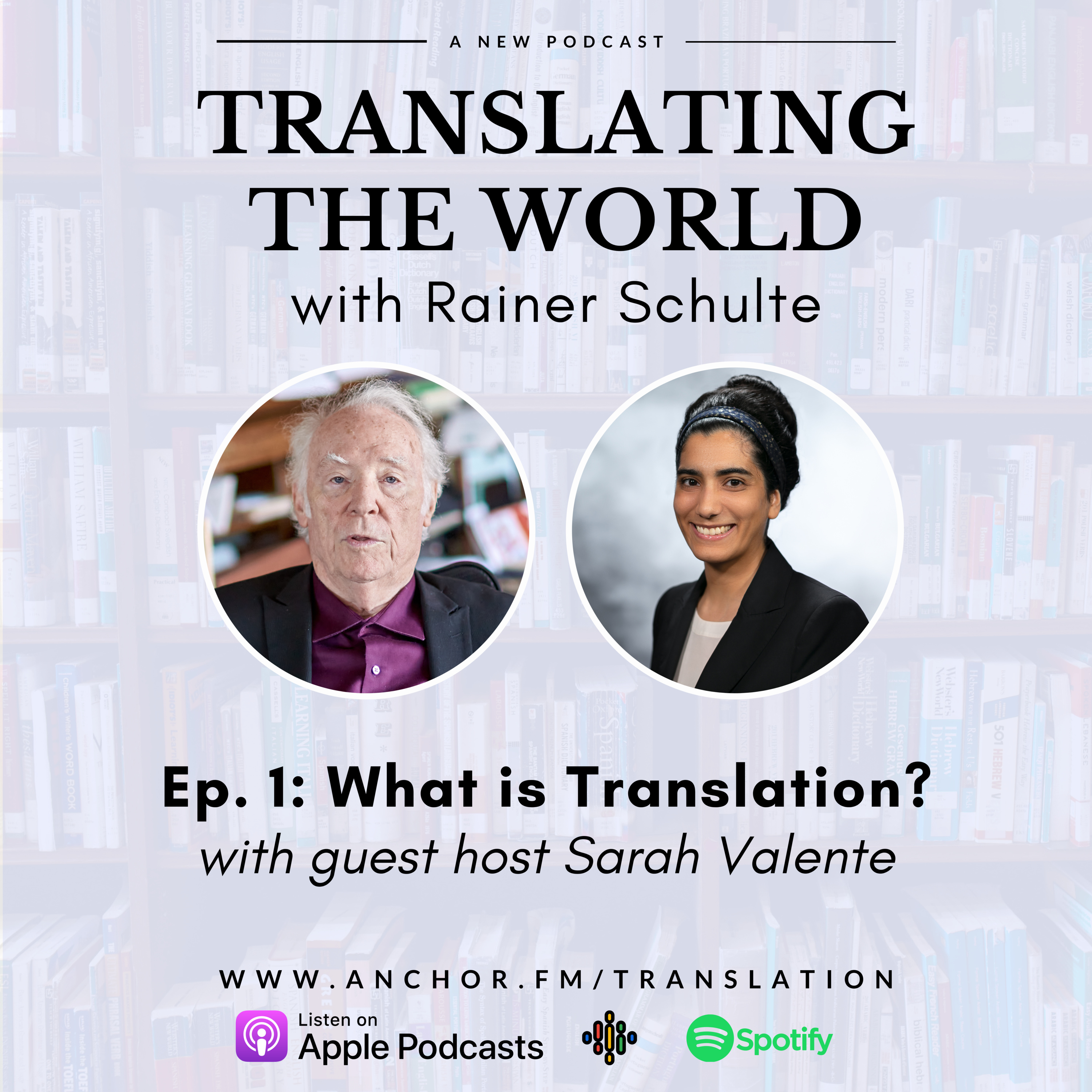
The conversation highlights Dr. Rainer Schulte's foundational role in translation studies, having established the American Literary Translators Association and *Translation Review* in 1978. He describes translation as a creative, performative act essential for intercultural dialogue, where translators must shed preconceptions to authentically engage with other cultures. Schulte critiques machine translation for its inability to grasp contextual nuances, advocating instead for the translator's artistic sensitivity to words' associative meanings and situational depth. Drawing from his background in music, he emphasizes visualization and the interpretive recreation of textual "silence" as key to translation. Ultimately, he frames translation not as a technical task but as a vital, creative force that enriches reading, fosters interdisciplinary thinking, and revitalizes human connection across languages.
[music] Hello, welcome to Translating the World with Rainer Sholta. I'm Sarah Valenti, visiting a system professor at University of Texas at Dallas, and it is my pleasure to be a guest host for the first episode of Translating the World with Rainer Sholta. [music] Dr. Rainer Sholta is an endowed professor of arts and humanities, the founder and director of the Center for Translation Studies at the University of Texas at Dallas, and the editor of Translation Review. Dr. Sholta is a specialist in comparative literature, contemporary international literature, and in interdisciplinary studies in the arts and humanities. He has translated poetry and fiction of writers from Latin America, Germany, and France. His most recent monograph traveling between languages, the geography of translation and interpretation, demonstrates how translation methodologies can promote the reading and interpretation of literary and humanistic texts and foster interdisciplinary thinking and research. And it is my pleasure to be with him here today. Hello, Rainer. Thank you for having me on your show. I'm delighted to be on the first podcast that is under the umbrella of the translation center, and thank you for having arranged it and hosting it. Of course, it's my pleasure. I am really excited that you are creating this new podcast that is completely focused on translation to introduce translators, writers, and publishers to the audience at large. I want us to actually go back a little bit in time. You have had a long-established career in translation studies. In fact, you were the founder of translation review, the only journal devoted exclusively to the art and craft of translation, which you started in 1978. That same year, you co-founded the American Literary Translators Association, ALTA, to support the work of literary translators. And so, take me back to 1978. What prompted you to create the journal and the association that would become such a foundational organization to advancing literary translation? And it is to this day. I mean, years later, it is the largest gathering of literary translators in the United States. Every year, at the annual conference, there are more than 500 translators, writers, and editors that come to the conference. I see the translation review in ALTA as really a testament to your foresight and ability to see into the future in the role the translation would actually play in the academic setting. But if you could please take me back to 1978. What prompted you to actually go into this field? There are three things that happened in 1978. First, I was able to start the translation center, and I will talk about that. Then, I was able to start the translation review and also at the same time, the American Literary Translators Association. It came really to a certain extent, first of all, out of my musical training, and also one of the outstanding professors that I had at the University of Michigan, Austin Warren. He was at that time the best known or one of the best known comparative literature scholars in this country. I took a seminar with him, and he, all of a sudden, started talking about what translation can do to the understanding of culture. That's why I did my first translation of a poem by Gottfried Ben called Chopin. I was attracted, obviously, by the title. Whether the translation was good or bad, I cannot judge this. But that got me going of transferring some of my musical training to the reconstruction of a poem that I read and how I could transfer it as a performance, as a performance into another language. Because I think translation is performance. And then I had that idea when I came to, I had started at Ohio University, the comparative literature and the translation. And the interdisciplinary studies to a certain extent. And when I saw the advertisement at UGD, two of my best students, I thought I told them they should apply. They are both of them were made offers, but they decided not to take them. One of them then became for 10 years the chair of comparative literature at the University of Michigan. So having had this then, I went to a comparative literature association meeting. And I wanted to talk about translation. I said, for me, this was new, but very comfortable. And I told them I wanted to talk about translation. And they told me that had nothing to do with what they were doing. And they called me the young pusher and what I please leave. That was my entrance into translation. So I think that negation actually gave me the impetus to really continue to establish this. And so there were certain coincidences in 1978. And partly that I was the then academic vice president for the university. I proposed to him that we should have a translation center. And he was in full support and supported it very, very well through it. And then since I had edited before, Mundus Artsjum, a journal of international literature and the arts, I thought what should happen would be the integration, the juxtaposition of the creative and the practice of translation. And the theoretical translation that the journal has never accomplished. And that's a shortcoming of the journal because the journal then became for my point of view more and more academically oriented. And I'm trying right now, whether by any chance I can redirect this. It's important that all theoretical theoretical comments about translation should come out of the practice. The practice is the anchor. It's not the theory. You can develop any kind of theoretical level of abstraction, but that is not communicable. But if you have the practice and you then talk about how this can be talked about, that's the theory of translation. And that's unfortunately, we have too many also in the translation area, scholarly texts that not even I can understand. So the language has taken over, but the language is no longer connected to the flow of an internal thought development that that was killed. It's all static. So that's so these three things came together. I was in 1977 in Austin and that's where I was teaching a summer workshop. And that's where the idea of the translation center came up to really also make a place for it in the academic world. Because to this day, they are quite a few academic institutions, literature institutions, literature departments who think not very highly at all about translation. And many of the programs are still reluctant to promote faculty members who have done good work, published and so on to promote them to the next level of academic standard. Why do you think that is? Well, that I think partly because the respective administrators or the professors who are then, they don't understand the power that translation can have to revitalize the study of literature and the humanities. That's part of it. And then there's the other side which to a certain extent I don't totally disagree. Well, there is no definitive translation of any text. You cannot recreate all the aspects of a foreign text in a new language. But here I come in. If since I don't know Russian, I would have never been able to read Dostoevsky. But the intriguing part is and that's where I particularly interested in that I begin to read different translations of Dostoevsky or whatever it might be especially in poetry to see how the poem was perceived as an interpretive act by the translator. The same way there is no definitive interpretation of a text. You have professors to say, this is what this poem mean. Well, that doesn't exist. And if you don't repeat it in your test at the end, you don't get the grade. I think this is it.
This is the rethinking, the rethinking of translation in all areas. We translate the language of somebody we talk to, we translate the facial expressions, we translate images, etc. So translation is a foundation, foundation of our existence. Civilization cannot exist without translation. What I love about the function of translation is that we as translators by default, we are building bridges between here and there. As you have written before, you've said, you know, our thought process undergoes an intriguing change. We leave some of our prejudice and preconceived notions behind us and we begin to think about ourselves into the situation on the other side of the bridge. In other words, translators is stepping into the shoes of others and walk a mile in them. While at the same time, when we think, when most people think about translation, what comes to their mind is this exchange of information in a very globalized 21st century of, you know, Google Translate type of world. How do you define translation? And how can our audience change their perspective about translation? I think the image of crossing the bridge into other cultures is a very appropriate image and also statement to begin to understand what translation actually is. Translation has to be a revitalization of the interaction and the dialogue with other cultures and languages. Especially in the 21st century, there are too many languages, different languages in one place. If we just think for one second, there are about 230 languages in Dallas itself. So what the translation has to do is to revitalize the dialogue with other cultures to begin to think after we cross the bridge, to think that the world is being differently perceived in other cultures and languages. And by leaving some of our prejudices behind us, we also begin to understand how we think in our own language. And the interaction and the dialogue with other cultures can only happen through the function, the intelligence and the craft of the translator. That is the basic interaction that we establish. In recent years, we also have communication on a more global level, that is, with the digital translation technology, basically machine translation, which still has a very long way to go, because the machine translation has in no way the possibility of thinking situationally. You have words in one language that have different meanings. For example, if you use culture, then it's the culture of a country, of a language, but at the same time, I just put the culture in the refrigerator. So until such time that AI will develop more extensive rules, regulations and techniques to tune into the sensitivity, in the particular context of a text to read contextually, I think we still have to rely for the translation of aesthetics and the sensitivity and sensibility of other cultures through the function of the translator. This is now much more important than it was 30, 40 years ago, and we have to understand that interaction with another culture is not just learning the words and the language. So the building of the bridges, I have used that image many times that as you cross the bridge, you have to lose for a moment your prejudices of the cultural things that you bring with it because some of them do not function in another language. I'm always reminded of the disaster that when Americans cross the ocean and go to Europe and they can't get iced tea and ice in the tea, that has been a continuous problem to the extent when I have taken a group of guests over to Europe, especially to Germany, that it has caused some tears in some of the people who could not get the iced tea or the ice in the tea. This is just a small example of how we as travelers from one culture to the other, we have to begin to understand that the perceptions are different as we enter into the new culture. That you can also transfer very easily and we come to this in a minute, you can transfer it to the multiple translations of texts that come from other cultures and maybe we talk a little more about this in a minute. You touched on some really interesting things, the first one that I want to go back to, you mentioned about how AI lacks this kind of situational thinking that is so central to translation. So you have edited and published many works throughout your long career, including two foundational texts in the field of translation studies. The first being the craft of translation, which you co-edited with Joe Biggerna, and he was published in 1989 by Chicago Press and then the second book, which is Theories of Translation and Anthology of Essays from Dryden to Derrida, which was published in 1992. And in the introduction of the first book, you state that the word itself becomes a creative power to explore new ways of meaning that the translation process affirms the how and not the what of reading and understanding. And so this type of situational thinking goes beyond language to language exchanges or this kind of very word for word dictionary types of translation that oftentimes people have in mind when they think about translation. And so translation then becomes a type of performance as an exchange, right, between the performer and the spectator or the writer in the reader. How does this understanding innovate our pre-conceived ideas of the role of translation in everyday life? I think that is an extremely important aspect of translation. I come to this from my musical training as a pianist you frequently listen to the same tone 20 times. And each time as you listen it, the associations that sound associations are being increased. I transfer that. The translation, the revitalization and the beauty of translation reconnects us to the word to the environment of word. We always sat and don't see the word as an object, but we see the word as a series of associations. And the more we think about the word and the associations, the more we understand the power of the word. So translation reintegrates and relives and revives the power of the word itself. No two people will ever have the same associations of the same word. So if you see a word in a literary text especially, the author, the writer had his or her own associations with the word. And for me, the translator, I have to get inside the visualization of the word that is in tune with the visualization that the writer has. So you frequently have translations that addictionary translations, the word predictionary is correct, but the word in terms of the associations that the writer has created in the original text is not the same. So and especially as pass says, when a word comes into contact with the next word, then meaning is being liberated that was not there. And so therefore, I think especially for students who engage in the art and craft of translation, they have to learn to recreate the internal movement of a word. The same way that if a tone on the piano is connected to another node, it creates a different kind of sound effect. And it also to a certain extent will allow us to recreate the silence that is behind the word. We have lost that in our contemporary society that is extremely noisy. And I think we see the results of this right now that people have a very hard time living with their own silence in a moment of crisis. Amen.
Add this, when you want to judge a pianist or a performer, how do we judge him or her? We judge them how they play the rest. And the rest is the silence. And I think a translator has to fill in the silence of the words in order to produce a comfortable and convincing translation in the recreation of the original text. So therefore, it is very clear that there is no definitive translation of any text. If you think it's very easy to find 20, 30, 40 different translations of Dante inferno. And if you look at other pieces from the past that have been translated five or ten times, each time it is a different kind of interpretation that is based on how the author thought out the text. And that makes it interesting. And that's what I think students have to learn to get the joy again, the creativity that each text brings to us. It's a really good point. And I think that when we think about having a musical training, I think it is really important when we're thinking about understanding language because music is a language. And so having that kind of understanding of not only translating from culture to culture, language to language, but translating from the piece of paper to the performative function. And so it sounds like from an early age you were already quite attuned to movements as markers of translation. Even before you came to the US, even before you were exposed to different languages, let's say. How do you think that you developed this ability to interpret movements, whether it was the soldier's foot that story that you tell when it was open, when it was closed, to the movement on the piano key. How did you develop this ability to interpret movements influenced by your understanding and now conceptualization of literary translation? I would say that the key word in this case is visualisation. I have thought a great deal about this. How do we visualize a situation that we come to? The visualisation, for example, when the two American soldiers were standing in front of our house and didn't want, couldn't talk to us. Then I had to visualise what it meant, why are they shoes directed in this way and suddenly they're directed in a different way. So I saw two different movements and situations of the shoes and that generated in me a moment to have to think about it, to have to visualise this. What the visualisation does is to bring us into a connection and a dialogue with the word, with the situation and therefore from early on, I realised that when I was learning musical pieces, that it was very successful to visualise the score without the playing. So what you begin to learn then is how structures come together. The famous German pianist, one of the most famous, perhaps, Giza King, Walter Giza King, he has written about this. He said, "The worst thing you can do is that if you sit at the piano and continuously repeat, continuously just repeat, repeat, repeat without understanding the visualisation of the score, you will never be a very good pianist." So I transferred that to the reading that you have a word when I read the first paragraph of a text, I have a word and I ask myself, "Why is this word there?" So I visualise the word within myself. Then I go further on through the text on C, whether this word is coming up again. When it comes 10 or 15 times thereafter, you have to begin to think what is the visualisation of the writer who created this. And that also brings me something else that a repetition is always a key point of any good writing. But the good writing is that each time a repetition comes back, it is slightly modified. And so what we have lost in a great deal in our reading, that we think when we read something, we summarise it and that's the destruction of the text itself and the interpretation of the text. And translation is the counterpart, because translation teaches us how to interact with each word. And we don't make the word an object, but we make the word a point in the text that I have to interact with and I have to see how I visualise it. And that's the huge revitalisation of translation that it can bring to reading and interpretation. And it also for our students recreate the pleasure of writing and interpretation. So would you say that creativity is the first and foremost force that prompts a person to really become engaged in thinking about translation? Yes. And creativity, and by the way, translation means always establishing a relationship. So having that curiosity, right? Because the curiosity has to be the first ingredient, let's say. Yes. So if you look at an object, we have a tendency to describe it and the translation moves that to a different level because I interact with the object of how I see it. And I represent and in my writing and my visualisation how I see it. If you see the same object and you do this, we have two different visualisation and that's why all translations are the recreation of the interpretive perspective of the translator. And that's what makes them vital, creative. And therefore if a translation is nothing, then a technical translation, it is not going to be very successful. You have the same, if a pianist has nothing but the technique, an excellent technique, and no musicality, which is the interpretive act, then it becomes very boring. Yes. And I think it's something that comes through very quickly into a performance or into a text. We as the audience are always able to notice these things, right? And that performance, it becomes really, really apparent. I have a, whenever I go to a concert and the audience begins to cough, then I have the feeling that the musicality of the interpreter, the performer is not there. Exactly. And I do think you don't have to have a musical training or a literary training in that sense to really become emotionally sensibility wise involved in recreating from your point of view, your interpretation of the text, in this case, frequently a musical text. Yes. And this actually reminds me the last that Dallas Symphony Orchestra, Gaila, it's one that Joshua Bell came. And at the end of that performance, you could have heard a pin drop. It was absolute, I mean, that moment, you know, like for that split, it was incredible to see, because everyone I think was so enthralled with that performance. It was so beautifully done, that it was as if everything had, you know, everything was still. I mean, that silence that we talked about a few minutes ago, you could feel that silence. And then everybody, of course, erupted into clapping. But it's exactly that what you're saying. You don't have to have a musical training in order to become emotionally, internally involved and elevated by the musical performance. And everybody knows when it's there. Yes. And that's the beautiful part. I offer sometimes compare it. And that's the difference, maybe. The comparison sometimes, it makes that a little clearer. I know very little about the American football. But I can, for example, see a throw of a ball. And I said, "Oh, this is really beautiful." But the coach, his or her experience of that throw is so much more intense than mine. So I transfer that if you have a musical training,
then somebody who doesn't have the musical training is enthralled with the experience, but because of my training, I have a much higher intensity of the experience. And that's what we need to get into the students when they begin to interpret texts of whatever it is, that they get inside of this and increase the creative recreation of the text. And that's what's missing right now, and that's why from my point of view, a lot of students look so sad. And I see this over and over again. Yes, that is true. I think that somehow we live in a very fast-paced kind of world, where it is very easy to become disconnected from this kind of creativity and curiosity, because as I'm listening to you speak, I think that a lot of the curiosity that translators must have is the kind of curiosity we had when we were children, when we were learning the world, looking at the world for the first time, like you were saying, looking at movements and trying to understand what does this mean. That kind of curiosity, sometimes we grow older, we sort of grow out of that for some reason, right? Well, it's a reestablishment of me with the interaction of the text. Yes. That's what we have to, that I am inside the movement towards the text and don't see the text about which I preach. On the sideline, my neighbor here who has a small farm, every night she sits down and reads to her animals and all the animals around her and listen. That's beautiful. That is. And it's a horse and it's a sheep and it's a goose and also a lot of chickens. Sounds fantastic. Sounds like Charlotte's web. Yes. I mean, there again you see that on a different level, we do relate also to the sound. And this is the major portion that we have lost in the area of poetry. A lot of people don't know how to read poetry or how to enjoy poetry. And this is where I think, eventually, the digital technology will come into focus because the digital can recreate the interaction, the tension between me and the text which to a great extent we have lost. The sounds, you know, when you go and when you hear, you heard, I should say, "Publin a Ruder," read his poetry in Spanish. In many cases, you didn't need the translation because the sound of his voice which can hardly ever be reproduced told you communicated to you what this poem was about. And that's why I think it's very important when we have practiced that students who write poetry, who are translate poetry, that they also have to learn how to recreate through their own sound, through their sound presentation, what the level of aesthetic experience is in that poem. It's very difficult for people to do that, especially for students. So how do you think digital technologies of the 21st century will change in impact our understanding of translation? Well, the foremost characteristic of digital is that it is always in movement, the interaction with the text. As soon as you begin to, what did I call it, to save digital, it has lost its original energy and becomes static. So the digital is the performance, the same way that if I play something on the piano is different than recording it and you listen to it afterwards. No two performances of the pianist will be the same, if a pianist performs something today, whatever sonata, whatever it is, and he or she performs the same thing tomorrow night, it's a different performance. And that's extremely important to understand, because once you record the performance, it's always the same, and after a while you say, "I can't listen to that recording anymore." And the digital is, whenever it is implemented or in action, it is that moment of the interaction that we enjoy, but as soon as I save it, it becomes static. And that's why I think the digital can be a major contribution to revitalize the reading of poetry, which I think we have had two dissertations so far that have demonstrated that, and have implemented this. How the digital technology can revive the reading, the understanding and the enjoyment of a poem. And we're now in the process, obviously, of preparing an app that would do this for one poem of the 19th century French-powered ramble, Artur Ramble. And what does the app seem to do? The app seems to present various interactions with the poem from all angles, whether it is descriptive, whether it is images, whether it's musical, whether it's recreation the poem by the reader, which is very helpful, especially in high schools, when the students are asked to recreate the poem from their own point of view and write the poem on the poem. It's very successful. And so the young pusher keeps pushing into the future. What can our listeners expect in upcoming episodes of the new podcast? Well, there are several things that I would like to see happen. One that I profile new writers who come from various languages. And they are translators, the interview of the translator with the author, some of those have been extremely successful. And I hope that we can do this to energize the present moment with the interaction of the various perceptions that cultures and their arts produce. And I hope that more and more of these interviews with authors and translators become evident and are being present either in electronic format or in written format. I would like for the reading, especially of bilingual reading of poets that are being performed, that is to say the original language, then followed by the translation. So I'm particularly interested in finding very good readers for the bilingual readings of poetry. And I'm engaged in that right now that revitalizes the interest in poetry. Then I hope that with the publication of translation, the translation review, I hope that I will be able to have more representations of how translators think about their translations, how they revive the substance of other cultures through the act of translation. And I would like for the translator very much interested in giving us an idea of how the translator writes, which I call the reconstruction of the translation process. And I hope that we will have dissertations in that area too. And one area that is totally neglected is the reviewing of translations. So I would like to know when I see a new translation where they can trust the translation. In many cases, we know that translations are unacceptable because the translator was living on a different planet and didn't really understand what he or she was doing in terms of transferring a text from another language into English. I am also particularly interested in focusing on the countries that are on the trend of the writing of the writing in countries that are not that well known. We are bringing out right now a special issue on Korean translation in translation and in writers in translation from Korea. And I would like for that to be expanded. We did some already on Chinese on Arabic and Swedish published quite a few writers when I added a bit of the translation.
Mondeus Azium, about 3, 4, or 500, very contemporary writers at that time coming from different languages. We need to activate the interaction with other countries through the art of translation and the art of writing, and at the same time create in our own country a comfortable atmosphere to interact and communicate with other countries and their languages and their cultures. This is become more and more important right now and I also want to establish a more active interaction with the various language groups in Dallas. If you think, for example, Urdu, the statistics tell me that there are 5,000 people in Dallas who speak Urdu. I think that will re-energize also the cultural perception and the dialogue that we can establish with other cultures. It sounds like a really rich programming that we have ahead of ourselves. Really exciting new areas that will be able to, this podcast will really be able to inform our audience to look into translation, to understand translation, to interpret translation in different ways. I am really excited about this and I would like to actually conclude by reading a quote that you wrote in the National Endowment for the Arts booklet called The Art of Empathy a few years back. This one was on Celebrating Literature in Translation where you stated, "Translators never come to rest. They are constantly in two places at the same time by building associations that carry the foreign into the known of their own languages. I hope that this is also what the podcast will be able to accomplish as we feature contemporary translations, introduce the audience to international writers and their translators, and create an experience of connection and understanding for those listening, especially in a time when we really need to have this kind of connection with one another. In a time when more and more we see actually the rise of nativism, which is the ill of our time, is something that immediately threatens translation or any kind of effort into translation studies. I mean, the first step has to be dialogue. We have to be able to step out of our comfort zones and be able to do that. And I think that is exactly what the translator does. Yeah. Right now we don't have any dialogue. We just have a dictator. And shouting. And shouting, yes. That's what I say. We are at a time, everything is very, very noisy when you listen to the radio, when you listen to those things. And the people don't know what to do when the noise stops. Exactly. So I thank you for this initiative. This is wonderful and I'm really looking forward to it. Many thanks to you and we'll be going on to the future. Thanks for listening. To learn more about the translation center, please visit translation.utdallas.edu and keep up with us on our social media accounts, which can be found on our website. We invite you to tune in to our upcoming second episode of translating the world with Rainer Sholta, where we feature one of the greatest authorities in Bosnia and Croatia and in Serbian translation, Dr. Alan Elias Bursack, the current president of Ulta, the American Literary Translators Association. Stay safe and take care. We'll see you next time.
Podcast Summary
Key Points:
Dr. Rainer Schulte founded key translation institutions in 1978, including the American Literary Translators Association (ALTA) and the journal *Translation Review*, driven by a belief in translation's cultural and interdisciplinary importance.
He views translation as a creative performance and interpretive act that builds bridges between cultures, requiring the translator to leave prejudices behind and understand different cultural perceptions.
Schulte emphasizes that translation revitalizes the power of words through their associative meanings and contextual interactions, contrasting this with the limitations of machine translation, which lacks situational and cultural sensitivity.
His perspective is influenced by musical training, highlighting the importance of visualization, the recreation of internal textual movement, and the interpretive silence behind words in the translation process.
Summary:
The conversation highlights Dr. Rainer Schulte's foundational role in translation studies, having established the American Literary Translators Association and *Translation Review* in 1978. He describes translation as a creative, performative act essential for intercultural dialogue, where translators must shed preconceptions to authentically engage with other cultures.
Schulte critiques machine translation for its inability to grasp contextual nuances, advocating instead for the translator's artistic sensitivity to words' associative meanings and situational depth. Drawing from his background in music, he emphasizes visualization and the interpretive recreation of textual "silence" as key to translation. Ultimately, he frames translation not as a technical task but as a vital, creative force that enriches reading, fosters interdisciplinary thinking, and revitalizes human connection across languages.
FAQs
He was inspired by his musical training and a professor's insight on translation's role in understanding culture, coupled with a desire to integrate creative practice with translation theory after facing initial academic resistance.
He defines translation as a revitalization of dialogue between cultures, involving crossing a bridge to understand different perceptions while leaving prejudices behind, and emphasizes it as a foundational, creative performance rather than just word-for-word exchange.
AI lacks situational thinking and contextual sensitivity, unable to grasp nuances like word meanings that vary by context or the aesthetic and cultural subtleties essential for true translation.
Creativity is central, as translation involves visualizing and interacting with words to recreate the writer's associations and the internal movement of a text, making it a vital, interpretive act rather than a technical task.
He relates musical performance to translation by emphasizing visualization, the importance of silence (like rests in music), and how both involve recreating internal movements and associations to convey meaning beyond mere notes or words.
Multiple translations showcase different interpretive perspectives, similar to varied performances of music, highlighting that there is no definitive translation and each offers unique insights based on the translator's visualization and context.
Chat with AI
Loading...
Pro features
Go deeper with this episode
Unlock creator-grade tools that turn any transcript into show notes and subtitle files.
 PodcastTranscript AI