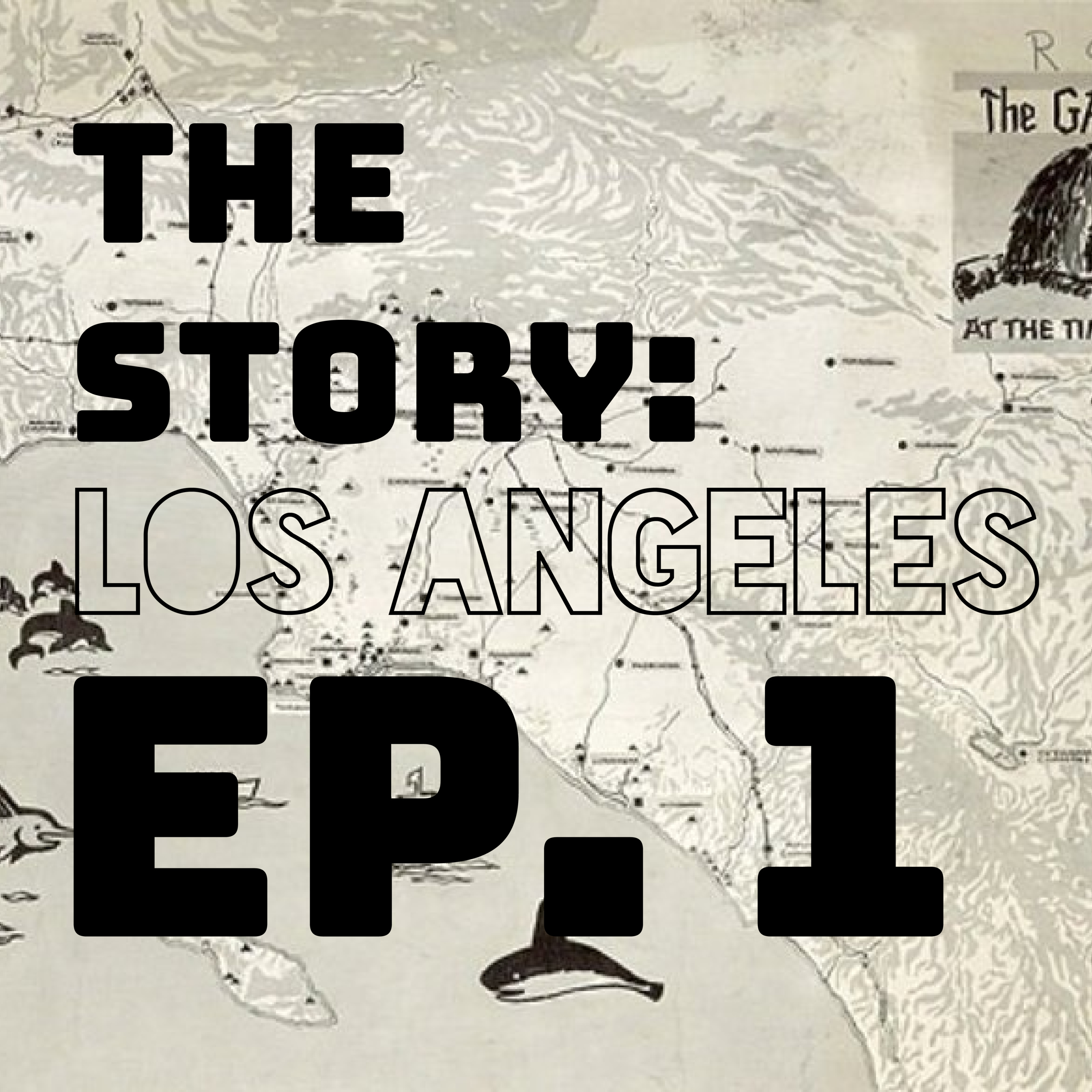
Ep. 1: The Pueblo, the Rancheros, and the Americans
18m 32s
Los Angeles has a diverse and complex history, from Spanish exploration in 1542 impacting the native Tongva people to the establishment of Pueblo Los Angeles and slow growth under Mexican governance. The Mexican-American War saw Los Angeles becoming a U.S. territory, setting the stage for industrial development. The transition of power and land distribution influenced the city's trajectory, leading to its eventual growth into one of the world's largest and most successful cities. The interplay between native populations, Spanish colonization, Mexican governance, and American expansion shaped Los Angeles into the vibrant metropolis it is today, with a legacy rooted in diverse cultural influences and historical events.
Transcription
2229 Words, 13766 Characters
Los Angeles, the city of angels, sprawling across America's most populous county, its roots
stretched back centuries, before Jamestown was ever even a whisper.
From sun-baked deserts to mountain peaks, this is a land of dreams and endless possibility.
The story of Los Angeles is woven with triumph and conflict, where a native tribes once
thrived, empires rose and fell, leaving echoes in the very heart of the metropolis.
Hollywood painted silver-screen fantasies while freeways unfurled a tangle of ambition.
Join us on the story, Los Angeles, as we unfurl its vibrant history.
We'll explore the glories, the shadows, and the spirit that relentlessly forged the
city we know today.
This is the heartbeat of Los Angeles, past, present, and future.
Today's episode was written and produced by David Bryan, free teacher and student resources
available at thestory.LA.
The year was 1542.
The Spanish had just conquered the Aztecs in what is today Mexico, and Jamestown would
not be founded by the English for another 65 years.
The promise of the New World was slowly being exploited and colonized for the benefit of
the kings and queens of Europe.
With their recent victory over the Aztecs, the Spanish king and his vice-warrily appointed
leader Antonio de Mendoza were eager to explore the newly conquered territory, which included
a region known as Alta California, a vast area just north of present-day Mexico.
They sent their lead explorer Juan Guadriga's Cabrillo on a mission out the Pacific Coast
to claim the land in the name of Spain.
And what he found laid the foundation for what would become one of the largest economic
powerhouses and population centers in the world.
This is the story Los Angeles, episode 1, the Tongva, the Pueblo, and the Ward.
Searching for suitable inlets to develop a port, explorer Juan Cabrillo first discovered
a beautiful protected bay that he called San Miguel.
We know it as San Diego.
He saved just six days before continuing up the coast of what is now Southern California.
When he arrived at present-day San Pedro, he was astonished.
There was, as he discovered in San Diego, another perfect location for a protected seaport.
But as he peered past the bay across the vast basin of Los Angeles, huge, fragrant plumes
of smoke billowed in blue across the landscape, a curious, but incredible sight, Cabrillo
named it Bahia de los Fumos or Bay of Smokes.
Cabrillo was witnessing, was a result of an estimated two dozen Native American fires burning
in the distance.
Some of them small campfires, some that had become large wild brush fires sweeping the
plants.
On that day in 1542, Cabrillo laid claim to the region for new Spain and the Spanish King.
While the land was claimed, no one told the natives for almost 227 years.
During that time, the native people who called themselves the Tongva thrived as a primitive
and simple tribe, sustained by fishing, hunting small game, and acorn flower, with rich ritual
celebrating the cycles of life and their god Chinig Chinich.
Their larger settlement, named Yangna, sits on the site of today's Los Angeles City Hall.
It wasn't that the Tongva people didn't see the Spanish, who now laid claim to their land.
In two centuries, Spain did little to nothing to colonize and develop the region.
The Tongva didn't even know Spain existed, or that the land had been claimed out from
under them.
That is until 1781.
At that time, the Spanish King and vice were growing increasingly nervous about rumors
of Russian fur trappers, encroaching from the north.
Without any outposts or claim to protect the land, the possibility of a Russian foothold
in the new world was becoming an untenable reality.
Spain felt that alter California was at risk of being colonized by foreign powers and appointed
the first governor, Gaspar de Porto La, charging him with developing a means to protect Spain's
claim to the land.
But Porto La did not envision a military presence for this vast region.
He felt it would be too difficult to maintain, and instead, he installed a spiritual army
of Franciscan friars along an Indian path, spanning 500 miles from San Diego, up to present
a San Francisco.
Spain called it the Camino Rhea, royal.
Along that road, 21 missions would be constructed, spreading religion, agriculture, and flexing
Spain's strength to those that encounter.
Though it took 42 years to complete, the Spanish met no resistance from local inhabitants
while building their missions, and instead, found a compliant and willing population of
natives throughout the land.
The closest mission to the tongue of this primary settlement was the San Gabriel mission,
six miles northeast from the youngest main settlement, and just south of present-day
Pasadena.
The friars influence an eventual dominance of the natives was all but inevitable.
During the early years, Governor Porto La christened the local river El Río de Nuestra
Signora la reña de Los Angeles, or River of Our Lady, Queen of the Angels.
Quite a mouthful, but over time, the settlement would eventually be referred to as Cuebolo de
Los Angeles.
As the new governor Felipe de Neve took over Porto Azuis in 1779, he worked to recruit Mexican
pobladores, or settlers, to move to the youngness settlement, rebuilding it into a traditional
style pueblo centered around a central plaza.
And on September 4, 1781, El Crablo de Los Angeles was officially born.
The influence of the friars and pobladores on the native Tongas started as a seemingly
benevolent exchange between cultures and languages, with the friars introducing new plants
and crops, agriculture, animal husbandry, and providing shelter to the Tongvas.
In exchange, the Tongva provided labor, but at a high cost of losing their religion, their
land, and their culture.
A visiting French sea captain once lamented.
The moment the Indian allowed himself to be baptized, he relinquished every particle
of his body, and sold to tyranny, from which there was no escape.
The Franciscans baptized the Tongva, in the name of their Christian God, and erased every
aspect of conva culture, while enslaving them to build the early foundations of the Pueblo
and the mission.
Tongvas who ran away were hunted down by the Presidio, a military encampment attached
to the mission, and returned for brutal last years in the punishment.
In addition, the Spaniards brought European diseases, which ravaged the Tongva population,
killing an estimated 6,000.
Today, descendants of the Tongva continued to play an important role in Southern California
community.
But the legacy of their contributions paved the way for the building of one of the world's
largest and most successful cities.
The foundation of a future megalopolis had been born.
Pueblo Los Angeles, a small, inland agrarian community, built on the banks of the river and
on the backs of the Tongva people.
In its early days, the Pueblo was possibly one of the slowest growing and most unprogressive
towns on the continent.
According to historian James Miller, at its founding, it had a mere 44 occupants, and
in 40 years grew only to 650, on average, adding a mere 16 new citizens per year.
During this time, the head families of the Pueblo established rudimentary homes around
the main plaza near present-day city hall, but in 1818, torrential rains caused the Los
Angeles River to flood, forcing the Pueblo to be rebuilt on higher ground.
The second plaza can still be seen near today's Union Station.
The early settlement was an agrarian society, with locals tending to fields and herds of
cattle and horses.
Only minor public improvements had been built, including a guard house, the plaza, and
the mother ditch, in irrigation canal connected to today's Los Angeles River.
In addition, the friars built the old plaza church, a satellite to the Mission San Gabriel,
which further cemented the mission's prominent footing in the new Pueblo.
During these early days, each Mexican seller or public Dorian was rewarded with a small
plot facing the plaza for a home, an expansive tract of land for farming and livestock, and
a branding item.
These massive tracts were farming, were known as ranchos, and development throughout the
centuries saw them grow into many of the familiar cities and townships we knew today.
Ranchos and Pedro, Rancho Santa Anita, Rancho Los Cerritos, Rancho De Hunga, and Rancho
La Brea, just to name a few.
With their massive tracts of land, the rancheros raised roaming herds of cattle and horses, identifying
their livestock with branding irons.
They also built their own self-contained communities, employing everything from housekeepers and
teenstresses to craftsmen and leather walkers.
But importantly, they also utilized free labor provided by enslaved or indentured natives.
With so much land, free labor, and endless opportunity, the rancheros lived exuberant lifestyles
with fine clothing, jewelry, and a routine centered around fiestas and celebrations called
"fendingos".
By 1821, Mexico had declared its independence from Spain and ordered all the Spanish-born
Franciscan friars out of California, abandoning 3,000 native workers, 20,000 horses, and 100,000
cattle, as well as 8 million acres of land.
While half of the acreage was supposed to go back to the native Tongva, the governor instead
divided the land and awarded grants to 800 families, now able to build their own ranchers.
As the ranchers continued to grow and expand, so did the Pueblo, with its first store by John
Temple, at present day temple in Main Street, gambling houses, saloons.
But no buildings for public governance.
The judge of the day, Judge Olvera, held court in his own living room, despite the nascent
qualities of the Pueblo.
The governor declared Los Angeles a city, and it became the new capital of Alta California
in 1835.
While the city began to thrive, an englo is from the United States trickle-in, a storm was
brewing between Mexico, now free from Spanish rule, and its northern neighbor.
Since the Louisiana Purchase in 1803, the U.S.-Mexico border had been murky, and a constant
point of contention between the two countries.
With pressure growing to increase U.S. crop exports to industrialized Europe, presidential
candidate James Polk looked westward, campaigning on a platform that promised to expand the country
from coast to coast.
The term "manifest destiny" was often used by journalists and intellectuals, proclaiming
that the United States had a god-given right to expand endlessly across the continent,
in order to advance the economic prosperity of the country.
Polk won the presidential election, and first attended the Purchase to northern Mexin
territories, north of the Rio Grande, but the Mexican government refused.
pressure was not only growing from the United States, the Mexican territories of Texas and
California were growing increasingly dissatisfied with what they perceived as a weak, central
Mexican government, fueling desires to secede from Mexico altogether.
In California, the citizens were angry with what they saw as an overreach by the federal
government in Mexico.
The government removed the popular California governor Juan Alvarado, replacing him with
their own loyal henchman, Manuel Mikkel Torina.
When Mikkel Torina arrived with his army, made up of mostly former convicts, Californios
were livid.
The citizens abhorred his policies and resented the fact that he was not alone.
In response, the former governor, Alvarado, organized a revolt and in 1845 with the help
of the rancheros, they fought Mikkel Torina in the battle of Providencia at the Cahuenga
pass.
There, Alvarado and the rancheros successfully defeated Mikkel Torina and installed their
own leader, Governor Pio Pico.
Pico, yes, as in Pico Boulevard, was in favor of succession and hoped to create an independent
state more closely aligned with the developed economies in England and France.
But he was not able to garner enough support and his efforts failed.
Instead of succession, invasion was on the horizon.
Permissions between the United T10 Mexico resulted in the U.S. Congress declaring war and invading
parts of Texas and Alta California.
While Polk was criticized for the loss of life, just 90 days from the start of the war, Los
Angeles was captured by American troops.
Despite a handful of sermishes, the city leaders surrendered without a single, shot, fired,
on the condition that property and people were to be respected.
The bicometer Robert Stockton and Captain John Fremont, instead of waging battle with
Angelinos, the army won over the people with promises of economic prosperity.
They even provided a public concert in the Plaza with their military band.
The Mexican-American War ended in 1848, with the United States prevailing and Stockton
and Fremont went on to be the state's second and third governors under U.S. rule.
Now as a territory of the United States, California and Los Angeles were poised for growth and development
by the industrialists building up the country's eastern cities.
Statehood was on the horizon.
Next time on The Story.
We explored the early days of statehood, racial tensions, and the gold rush.
The story Los Angeles is a free podcast written and produced by David Bryant.
Free student and future resources are available at TheStory.L.A.
Hey there, listener!
If you love this episode of The Story, subscribing or donating is the best way to help us keep
uncovering the past.
Your support lets us create more incredible podcasts and provide amazing free resources to teachers
and students nationwide.
Learn more, subscribe, or donate at TheStory.L.A.
Podcast Summary
Key Points:
Los Angeles has a rich history dating back centuries, marked by triumphs and conflicts.
Spanish explorers claimed the region in 1542, impacting the native Tongva people.
The establishment of Pueblo Los Angeles led to slow growth and development, influenced by rancheros and friars.
Mexico's independence in 1821 led to changes in governance and land distribution in Los Angeles.
The Mexican-American War resulted in Los Angeles becoming a U.S. territory, setting the stage for growth and industrial development.
Summary:
Los Angeles has a diverse and complex history, from Spanish exploration in 1542 impacting the native Tongva people to the establishment of Pueblo Los Angeles and slow growth under Mexican governance. S. territory, setting the stage for industrial development.
The transition of power and land distribution influenced the city's trajectory, leading to its eventual growth into one of the world's largest and most successful cities. The interplay between native populations, Spanish colonization, Mexican governance, and American expansion shaped Los Angeles into the vibrant metropolis it is today, with a legacy rooted in diverse cultural influences and historical events.
FAQs
The original inhabitants were the Tongva people, who thrived as a primitive tribe before the arrival of the Spanish.
The Tongva people were baptized, enslaved, and forced to abandon their religion and culture by the Spanish colonizers.
Los Angeles evolved from a small agrarian community into a city through the efforts of Mexican pobladores and the establishment of a traditional pueblo.
Los Angeles became the new capital of Alta California in 1835, after the city began to thrive and grow.
During the Mexican-American War, American troops captured Los Angeles without bloodshed, leading to the city's transition to U.S. rule.
Chat with AI
Loading...
Pro features
Go deeper with this episode
Unlock creator-grade tools that turn any transcript into show notes and subtitle files.
 PodcastTranscript AI