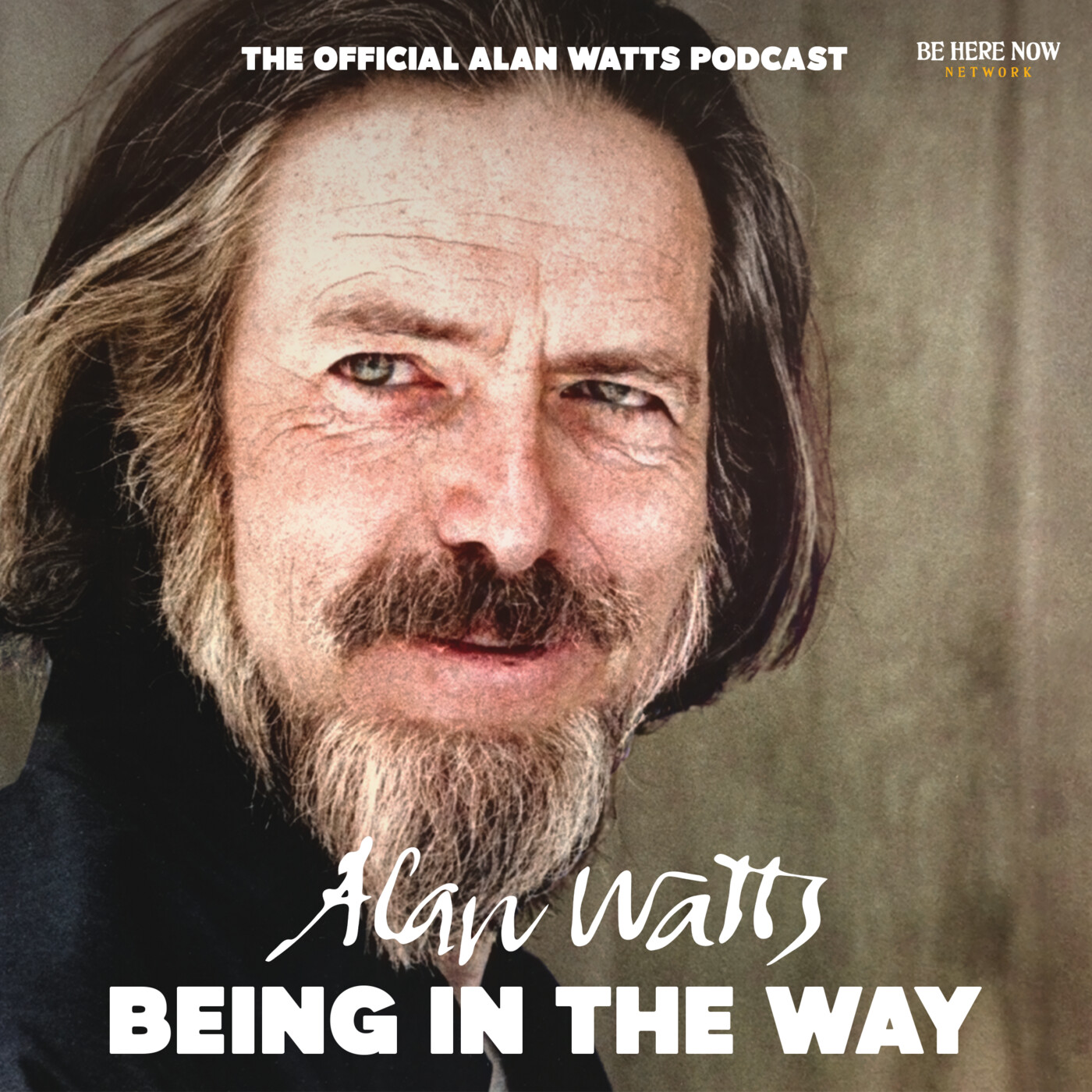
In this inaugural episode of "Being in the Way," host Mark Watts introduces a deep dive into his father Alan Watts' extensive archive of 400 spoken recordings, supported by the Romdos Foundation and Be Here Now Network. Joined by guest Ragu Marquez, they discuss the relevance of Watts' teachings amid the pandemic, framing it as a forced opportunity to reassess technology's role—valuable as a tool but harmful as a master—and to witness nature's recovery when human activity slows. Mark highlights a 1971 Watts recording, "Man in Nature," where Watts argued that overactivity causes problems and that allowing natural homeostasis is key, a message echoed in recent environmental observations. The focus turns to Taoism, which Watts presents as a philosophy for disentanglement from societal norms, contrasting it with Confucianism's worldly engagement. Central to Taoism is the Tao, the organic way of nature, not a divine ruler, where all phenomena "arise mutually" in interdependence, like bees and flowers. Watts critiques Western cause-effect models, aligning Taoist thought with modern relational science. He begins the seminar "Taoist Way of Dropping Out from Karma," emphasizing that the Tao cannot be defined or prescribed, only understood through atmosphere and attitude, setting the stage for future explorations of Watts' teachings on interconnectedness and balance.
[Music] Welcome to Being in the Way with Alan Watts, and I'm your host, Mark Watts. And today and in the following weeks, together we're going to take a deep dive into 400 hours of spoken recordings by my father, the late Alan Watts. We're also going to learn a little of the history behind how these recordings were made. And in future episodes, we'll meet some of the people being influenced by his works today. We're going to see how his words are resonating with current events and how they're changing our outlook as we emerge from a deep sleep as a culture. This podcast was made possible with the help of the Romdos Foundation and the Be Here Now Network. Our theme music is by Zakir Hussein and his friends from the Track Bollini's Fantasy, courtesy of Moment Records. And here for our first session, we have a special guest from the Romdos Foundation, Ragu Marquez, who's joining us in the studios for the inaugural episode of Being in the Way. Well, Ragu, thank you for coming by. The first time we met and talked, it was on your podcast. And this is actually the first time we got to be together in person. Yeah, thank you. Thank you. It's great to be here. We are looking at the beginning of a great adventure here with a deep dive into the Alan Watts Archives, a collection of over 400 original recordings. But we're going to start out with his talks on Dauism for which this podcast is named, Being in the Way. And. Great, great, name, Dublantom, as they would say in French. Yeah, that title, when I recorded the seminar at the Estlund Institute, and I first wrote it on the box, it alerted me to the double meaning of my father's autobiography in my own way. Of course, he always talked about how the ego could get in the way of what you're doing. And so it was a great little moment there. And as we were talking about earlier, my father would have loved these technologies, the ability to conference and record himself so easily. As we have now, he was actually a very early advocate of telecommuting and said that we need to stop roaring around in these fake rocket ships and take advantage of the tools at hand. And while the last year and a half has been a really hard lesson in many ways, I think the one positive thing that has come out of it is people really tried different technologies for working and getting together. And we knew that we needed a course correction, and this wasn't the way we wanted to get it. But stopping driving 90% of the cars around and letting nature take a foothold again in many areas has been a positive development. Absolutely. And both these men represent Alan and Ramdas, a wholesale return to knowing oneself in a way that we just left that, you know, and as a result, this pandemic is a representation of nature going, "Wait a minute, stop. You gotta stop." And gotta go inside because we had no other choice. We were all sitting alone in our homes or with our loved ones. And then of course, as you just said, the communication process just took a abrupt turnaround, 360. And it was for the best, because the best of both worlds allowed us to communicate in ways that we hadn't been communicating before. And it also allowed us to return to the idea that we have to go inside and connect with that place that's behind us, both Alan and Ramdas used to say, "Ego, terrible master, a great, great servant." And to be able to go behind all of that, so as you say, this last year in change has been so beneficial in so many ways, and so horrible. It's like the 100,000 beautiful visions and 100,000 horrible visions. Exactly. And even though this is a very painful way to get to a new way of doing things, I think that as we go forward and we're able to look at the use of technology from a positive perspective, because my father would say of thinking in his meditation talks that it was a good tool but a poor master. And the same applies to technology. These are great tools. They're just terrible masters. And I think we were in a period where to an increasing extent, technology was becoming the master of what we were doing. And we saw it in the tech boom, but more that people. The social media thing can be very and has been very destructive in many different ways. And yet at the same time, the exact opposite is true. I think the tendency was more and more and more. We were talking earlier about Ramdas and his book that came out in 1970. Yeah, it'd be here now. The 50th anniversary of it in 2021, where we are right now. Exactly. And in the same year, my father did a recording up on Mount Temele Pius. It was supposed to be the pilot program for a show on PBS. It was called a conversation with myself. He referred to it as "Man in Nature" because that was the theme of what he was addressing. And he had just been to what he described as a planetary alarm conference in Los Angeles, where a lot of people were saying, "Allen, what should we do? We've got to jump in action. We've got to do something." And like the period preceding the pandemic, we were doing so much. And as he pointed out back then in 1971, it's hard for us to accept this. It's really rough news for our pride, but there's really nothing we can do. The problem is, we have been doing too much. It's our activity that is actually causing so much of the problems. And so the question becomes, how do you let natural homeostasis take over and recover all by itself? And of course, that was something that we were able to see in practice as bears began to roam suburban communities. And a lot of changes. The night sky was suddenly much more visible because of the levels of elimination dropped. And it was really pretty remarkable from that perspective. So we get a glimpse. We got a glimpse in the last year and change. Wow, there maybe there is a direction that we can go in. And you're talking about direction meaning a way for us to change and understand that that is so absolutely necessary. And then you're bringing in the Dow and your father's work around that as the first talks that are going to be featured. I mean, that's just absolutely perfect. Yeah, I think the philosophy of the Dow or the way as it is in Chinese was uniquely elegant, very simple. And it's based on everything having its own path or course, the Dow of things. And it originated as a form of folk wisdom or what we might describe as kitchen table wisdom. And in early rural culture in China, it was observed that there were better and worse approaches to things. Or let's just say ones that were more effective. And these are typically described as splitting wood with the grain. Or even putting up a sail instead of rowing. There's a lot of ingenuity in the way that these practices were explained to people. And so finally, after probably many generations of existing as an oral tradition, these were codified theoretically as a manual for the rulers. Who at that time during the warring states period were not doing much of a job of it creating wars, not taking care of the population. Sounds familiar? Yeah, they think it sounds so, yeah. And it's all about me, me, me, the individual. And it's what we're dealing with right now, especially in our country with this polarization of there's a certain segment of people that have been a natural so that the American heritage of individualism. And I think that's part of what we're dealing with, which is why what you represent here with your father's work is so important, getting back into the idea of interconnectivity, balance, the Dow is all about that. Getting to know ourselves a little bit better. So this is just a beautiful combination now that we have the two of them on this network. So, you know, I'm really happy. Well, I'm very thankful. This is for us, it's a major effort to pull these materials out of the archive and restore the old machines. And so we're going to delight in sharing both these newly discovered works and also some of the classics, some of the things that have been lighting up the internet in recent years. And we're going to begin with a seminar that was recorded at the Estlund Institute, doused way of dropping out from karma. And in the second session, you'll hear him talking about the Indian idea of karma and how it relates to our participation in the world.
And then after a couple of weeks of that, we're going to go on to being in the way. Another Taoism seminar. This one deals uniquely with the individual and the role of the individual in a way that I don't often hear him do. It's a little bit more hands-on. So that's in three weeks from now and enjoy the show. We start today with Taoist way of dropping out from karma. The philosophy of the Tao is one of the two great principle components of Chinese thought. There are of course quite a number of forms of Chinese philosophy, but there are two great currents which have thoroughly molded the culture of China and they are Taoism and Confucianism. And they play a curious game with each other. Confucius said the goody-goodies are the thieves of virtue. Meaning that to try to be holy righteous is to go beyond humanity, to try to be something that isn't human. So this gives Confucian approach to life and justice and all those sort of things, a kind of queer humor. Sort of boys will be boys' attitude, which is nevertheless a very mature way of handling human problems. It was of course for this reason that the Japanese Buddhist priests who visited China to study Buddhism, especially Zen priests, introduced Confucianism into Japan. Because despite certain limitations that Confucianism has, and it always needs the Tao philosophy as a counterbalance, Confucianism has been one of the most successful philosophies in all history for the regulation of governmental and family relationships. But of course it is concerned with formality. Confucianism prescribes all kinds of formal relationships, linguistic, ceremonial, musical, and etiquette in all the spheres of morals. And for this reason has always been twisted by the Taoists for being unnatural. You need these two components, you see, and they play against each other beautifully in Chinese society. Roughly speaking, you see, the Confucian way of life is for people involved in the world. The Taoist way of life is for people who get disentangled. Now as we know in our modern times, there are various ways of getting disentangled from the regular lifestyle, say, of the United States. If you want to go through the regular lifestyle of the United States, you go to high school and college, and then you go into a profession or a business. And you own a standard house and you raise a family and you have a car or two cars and do all that jazz. But a lot of people don't want to live that way. And there are lots of other ways of living besides that. So you could say that those of us who go along with the pattern correspond to the Confucians. And those who are Bohemians or Bums or Beatniks or whatever, don't correspond with the pattern. They are more like the Taoists. Because the Taoist is really actually in Chinese history. Taoism is a way of life for older people. Lao Dzu, the name given to the founder of Taoism, means the old boy. And the legend is that when he was born, he was already had a white beard. So it's sort of like this, that when you have contributed to society, when you've contributed children and brought them up, and you have assumed a certain role in social life. You then say, now it's time for me to find out what it's all about. Who am I ultimately behind my outward personality? What is the secret source of things? And the latter half of life is the preeminently excellent time to find this out. It's something to do when you have finished with the family business. I'm not saying that that is an unavoidable strict rule. Of course one can study the Tao when very young, because it contains all kinds of secrets in it as to the performance of every kind of art or craft or business or any occupation whatsoever. But it does in China in a way it plays that role of a kind of safety valve for the restricted more restricted way of life that Confucianism prescribes. And there is a sort of type in China who's known as the old rogue. He's a sort of intellectual bum often found among scholars who is admired very much and who type of character which had an enormous influence on the development of the ideals of Zen Buddhist life. He is one you see who goes with nature rather than against nature. Well now, first of all I'm going to talk about ideas which come strictly out of Lao Tzu's book, The Tao Adegin. And of course the basic thing in the whole philosophy is the conception of Tao. This word has many meanings and the book of Lao Tzu starts out by saying that the Tao which can be spoken is not the eternal Tao or there's a pun in there which you can't quite put into English. You can't give all the meanings because the word Tao means both the way or course of nature or of everything, it also means to speak. So the actual opening phrase of the book following this word Tao, this this, you see, and this character means can be or can able something like that. So the way which can be then give it its second meaning spoken, described, uttered, but it also means the way that can be weighed, not w e i g h but w a y e d, you know, you'd have to invent that word. The way that can be travelled perhaps is not the eternal way. In other words, there is no way in which the Tao or following the Tao can, there's no recipe for it. I can't give you any, do it yourself instructions, ABCD as to how it's done. It was like when Louis Armstrong was asked what is jazz. He said if you have to ask you don't know. Now that's awkward, isn't it? But we can gather what it is by absorbing certain atmospheres and attitudes connected with those who follow it. And from the art and the poetry and all the expressions and the anecdotes and stories that illustrate the philosophy of the way. So this word then, the way or the course of things, is not, you must understand this, some Christian missionaries translated Tao as the Logos. Taking as their point of departure the opening passage of St John's Gospel in the beginning was the word. Now if you look up a Chinese translation, I'll be back.
the Bible. It says in the beginning was the Tao, and the Tao was with God and the Tao was God. The same was in the beginning with God. All things were made by it, and without it was not anything made that was made. So they've substituted Tao there. Now that made a very funny effect on a Chinese philosopher, because the idea of things being made by the Tao is absurd. The Tao is not a manufacturer, and it's not a governor. It doesn't rule as it were in the position of a king. Although the book, The Dowder Jane, is written for many purposes, but one of its important purposes is as a manual of guidance for a ruler. And what it tells him is essentially, rule by not ruling. Don't laud it over the people, and so he says the great Tao flows everywhere, both to the left and to the right. It loves and nourishes all things, but does not laud it over them. And when good things are accomplished, it lays no claim to them. In other words, the Tao doesn't stand up and say, "I have made all of you, I have filled this earth with its beauty and glory, fall down before me and worship." The Tao, having done anything, always escapes, and is not around to receive any thanks, or acknowledgement, because it loves obscurity. And Laudzer said, "The Tao is like water. It's always seeks the low level which human beings abhor." So it's a very mysterious idea. Dao then is not really equivalent with any Western or Hindu idea of God, because God is always associated with being the Lord. Even in India, the Brahman is often called the Supreme Lord, although that with the term more strictly applicable to Isvara, the manifestation of Brahman in the form of a personal God. But Bhagavan, the Lord, a Krishna, his song is the Bhagavad Gita, the song of the Lord. There's always the idea of the King and the ruler attached, but not in the Chinese Dao philosophy. The Tao is not something different from nature, from ourselves, from our surrounding trees and waters and air. The Tao is the way all that behaves. And so the Chinese, the basic Chinese idea of the universe is really that it's an organism. And as we shall see when we get onto Dhuanzha, who is the sort of elaborator of Laudzer, he sees everything operating together so that nowhere can you find the controlling center. There isn't any. The world is a system of interrelated components, none of which can survive without each other. Just as in the case of bees and flowers, you will never find bees around in a place where there aren't flowers and you will never find flowers around in a place where there aren't bees or insects that do the equivalent job. And what that tells us secretly is that although bees and flowers look different from each other, they're inseparable. To use a very important Taoist expression, they arise mutually. This is one of the great phrases from the second chapter of Laudzer's book, where he says, "This character means to have or to be." And this next one is a very important character in Taoist philosophy. It means no negative, whoo in Chinese, not to be. And then this curious expression for which we don't have a really good corresponding idea in traditional Western thought. So to be and not to be mutually arise, this character is based on the picture of a plant, something that grows out of the ground. So you could say positive and negative, to be and not to be. Yes and no, light and dark arise mutually, come into being. There's none is cause and effect. It's not that relationship at all. It's like the egg in the hen. So as the bees and the flowers, coexist in the same way as high and low, back and front, long and short, loud and soft. All those experiences are experienceable only in terms of their polar experience. So the Chinese idea of nature is that all the various species arise mutually because they interdepend. And this total system of interdependence is the Tao. It involves certain other things that go along with Tao. But this is this mutual arising is the key idea to the whole thing. And if you want to understand Chinese and oriental thought in general, it is the most important thing to grasp. Because you see we think so much in terms of cause and effect. We think of the universe today in Aristotelian and Newtonian ways. And in that philosophy, the world is all separated. It's like a huge amalgamation of billiard balls. And they don't move until struck by another or by a cue. And so everything is going, tuk tuk tuk tuk tuk tuk tuk tuk tuk all over the place. One thing starting off another in a mechanical way. But of course from the standpoint of 20th century science, we know perfectly well now that that's not the way it works. We know enough about relationships to see that that mechanical model which Newton devised was all right for certain purposes. But it breaks down now because we understand relativity. And we see how things go together in a kind of connected net rather than in a chain of billiard balls banging each other around. So in the philosophy of the Tao, it is always being said, you read this in every art book about Chinese art. That in Chinese painting, man is always seen as in nature rather than dominating it. You get a painting entitled Poet Drinking by Moonlight. And you see a great landscape. And after some search for the magnifying glass, at last you see the poet stuck away in a corner somewhere drinking wine. Whereas if we painted the subject poet drinking by Moonlight, the poet would be the most obvious thing in a picture. There he would be dominating the whole thing and the landscape off somewhere behind him. But all the Chinese painters put man. I mean the painters of the great classical tradition, there are Chinese painters who specialize in family portraits and do these very formal paintings of someone's ancestors sitting on a throne. It's quite a different category. But the Taoists inspired painters, Zen inspired painters, have this view of man as an integral part of nature, something in it just as everything else is in it. Flowers and birds. And not their scent into this world commissioned by some sort of supernatural being to come into this world and farm it and dominate it.
And so then, the whole conception of nature is as a self-regulating, self-governing, indeed democratic organism. But it has a totality. It all goes together, and this totality is the dow. So then we move to a second term that is extremely important. The expression that Zirran is the term that we translate nature when we translate Chinese. But this term expresses this whole point of view. It doesn't say nature, natura, which means in a way, class of things. It means literally self-so. What is so of itself? What happens of itself? And thus spontaneity. And in the Dowder-Jing early on, Laozza says, the Dow's method is to be so of itself. Now we might translate that automatic. Were it not that the word automatic has a mechanical flavor? Zirran, as this is called, or shizan in Japanese, means spontaneous, yes. It happens as your heart beats. You don't do anything about it. You don't force your heart to beat. You don't make it beat. It does it by itself. Now figure a world in which everything happens by itself. It doesn't have to be controlled. It's allowed. Whereas you might say the idea of God involves the control of everything going on. The idea of the Dow is the ruler who abdicates and lets all the people, trusts all the people to conduct their own affairs, to let it all happen. So this doesn't mean you see that there isn't a unified organism and everything is in chaos. It means that the more liberty you give, the more love you give, the more you allow things in yourself and in your surroundings to take place, the more order you will have. We now join Alan Watson, part two of Dauest Way of Dropping Out from Karma. It is believed generally in India that when a person sets out on the way of liberation, his first problem is to become free from his past karma. The popular theory of karma, the word that literally means action or doing in Sanskrit, so that when we say that something that happens to you is your karma, it's like saying in English it's your own doing. But in popular Indian belief, karma is a sort of built in moral law or a law of retribution, such that all the bad things you do and all the good things you do have consequences which you have to inherit. And so long as karmic energy remains stored up, you have to work it out. And what the sage endeavours to do is a kind of action which in Sanskrit is called nishkama karma. Nishkama means without passion or without attachment karma action. And so whether he whatever action he does, he renounces the fruits of the action so that he acts in a way that doesn't generate future karma because future karma continues you in the wheel of becoming, Sangsara, the round and keeps you being reincarnated. Now then in that case, when the time comes that you start to get out of the chain of karma, all the creditors that you have start presenting themselves for payment. In other words, a person who begins to study yoga is felt that he will suddenly get sick or that his children will die or that he loses money or all sorts of catastrophes will occur because the karmic debt is being cleared up. And there's no hurry to be cleared up if you're just living along like anybody. If you embark on the spiritual life a certain hurry occurs. And therefore since this is known, it's rather discouraging to start these things. The Christian way of saying the same thing is that if you plan to be to change your life, shall we say, to turn over a new leaf, you mustn't let the devil know because he will oppose you with all his might if he suddenly discovers that you're going to escape from his power. So for example, if you have a bad habit, say you drink too much and you make a new year's resolution that during this coming year you'll stop drinking. That's a very, very dangerous thing to do because the devil will immediately know about it and what will happen will be this. So he will confront you with the prospect of 365 drinkless days. And that will be awful, you know, just overwhelming and you won't be able to make much more than three days on the wagon. So in that case you compromise with the devil and say, "Just today I'm not going to drink receive but tomorrow maybe, you know, we'll go back." Then when tomorrow comes you say, "Oh just another day let's try out, that's all." And the next day you say, "Oh one more day won't make much difference." So you only do it for the moment and you don't let the devil know that you have a secret intention of going on day after day after day after day. But of course there's something still better than that and that is not to let the devil know anything. That means of course not to let yourself know. One of the many meanings of that saying, "Let not your left hand know what your right hand doeth is just this." And that was why in Zen discipline great deal of it centers around acting without premeditation. As those of you know who read Herrigal's book Zen in the Art of Archery, it was necessary to release the bowstring without first saying now. There's a wonderful story who may also have read by a German writer von Kleist about a boxing match with a bear. The man can never defeat this bear because the bear always knows his plans in advance and is ready to deal with any situation. The only way to get through to the bear would be to hit the bear without having first intended to do so. That would catch him. And so this is one of the great great problems in the spiritual life or whatever you want to call it, is to be able to have intention and act simultaneous. By this means you escape karma and you escape the devil. So you might say that the Taoist is exemplary in this respect, that this is getting free from karma without making any previous announcement. Off simply, supposing we have a train and we want to unload the train of its freight cars, you can go to the back end and you can unload them one by one and shunt them into the siding. But the simplest of all ways of unloading is to uncouple between the engine and the first car and that gets rid of the whole bunch at once. And it is in that sort of way you see that the Taoist gets rid of karma without challenging it. And so it has the reputation you see of being the easy way. There are all kinds of yoghurt and
ways for people who want to be difficult. And one of the great gambits of a man like Gurjev was to make it all seem as difficult as possible because that challenged the vanity of his students. If some teacher, some guru says, "Really, this isn't difficult at all, that's perfectly easy." Some people will say, "Oh, he's not really the real thing. We want something tough and difficult." When we see somebody starts out giving you a discipline that's very, very weird and rigid, people think, "Now there is the thing." That man means business, see? And so they flatter themselves by going to such a guy that they are serious students, whereas the other people are only dabblers and so on. All right, if you have to do it that way, that's the way you have to do it. But the Taoist has, is the kind of person who shows you the shortcut and shows you how to do it by intelligence rather than effort, because that's what it is. Taoism is in that sense what everybody is looking for. The easy way in, the shortcut, using cleverness instead of muscle. So the question naturally arises, isn't it cheating? When in any game somebody really starts using his intelligence, he will very likely be accused of cheating. And to draw the line between skill and cheating is a very difficult thing to do. You see, the inferior intelligence will always accuse a superior intelligence of cheating. That's its way of saving face. You beat me by means that weren't fair. We were originally having a contest to find out who had the strongest muscles. And you know, we were pushing against it like this, this, this, this. And this was proof who had the strongest muscles. But then you introduced some gimmick into it, some judo trick or something like that, you see. And you're not playing fair. So in the whole domain of ways of liberation, there are roots for the stupid people and roots for the intelligent people. And the latter are faster. This was perfectly clearly explained by Hoi Nang, the six-patreon arc of Zen in China, in his sutra, where he says the difference between the gradual school and the sudden school is they both arrive at the same point, but the gradual is for slow-witted people and the sudden is for fast-witted people. Can you, in other words, find a way that sees into your own nature, that sees into the Tao immediately. And at the end of this morning's talk, I pointed out to you the immediate way, the way through now, when you know that this moment is the Tao and this moment is by its, considered by itself, without past and without future, eternal, neither coming into being nor going out of being, there is Nirvana. And there is a whole Chinese philosophy of time based on this. It hasn't to my knowledge been very much discussed by Taoist writers. It's been more discussed by Buddhist writers, but it's all based on the same thing. Dogehn, the great 13th century Japanese Zen Buddhist, studied in China, and he wrote a book called Shobou Genzo, a Roshi recently said to me in Japan, "That's a terrible book, because it tells you everything. It gives the whole secret away, but in the course of this book he says, you don't, there is no such thing as a progression in time. The spring does not become the summer. There is first spring and then there is summer. So in the same way, you now do not become you later. This is T. S. Eliot's idea in four quartets, where he says that the person who was settled down in the train to read the newspaper is not the same person who stepped onto the train from the platform. And therefore also you who sit here are not the same people who came in at the door. These states are separate, each in its own place. There was the coming in at the door person, but there is actually only the here and now sitting person. And the person sitting here and now is not the person who will die. Because we are all a constant flux and the continuity of the person from past through present to future is as illusory in its own way as the upward movement of the red lines on a revolving barber pole. You know it goes round and round and round and the whole thing seems to be going up or going down, whichever the case may be. But actually nothing is going up or down. So when you throw a pebble into the pond and you make a concentric rings of waves, there is an illusion that the water is flowing upwards and no water is flowing upwards at all. Water is only going up and down. What appears to move outward is the wave, not the water. So this kind of philosophical argument says that our seeming to go along in a course of time doesn't really happen. The Buddhists say suffering exists but no one who suffers. Deeds exist but no doers are found. A path there is but no one who follows it and Nirvana is but no one who attains it. So in this way they look upon the continuity of life as the same sort of illusion that is produced when you take a cigarette and in the dark world it and the illusion of a circle is created whereas there is only the one point of fire. The argument then is so long as you are in the present there aren't any problems. The problems exist only when you allow presence to amalgamate. There is a way of putting this in Chinese which is rather interesting. They have a very interesting sign. This is pronounced Nian in Japanese Ninh and the top part of the character means now and the bottom part means the mind heart, the shin. And so this is as it were an instant of thought in Sanskrit they use this character as the equivalent for the Sanskrit word "shana". Then if you double this character but it twice or three times and I'll write the Chinese for ditto. Nyan, nyan, nyan. Means, thought,
thought after thought after thought. Now the Zen Master, Joe Shou, was once asked, what is the mind of a child? And he said, a ball in a mountain stream. What do you mean by a ball in a mountain stream? He said, thought after thought after thought with no block. So, he was using, of course, the mind of the child as the innocent mind, the mind of a person who's enlightened. One thought follows another without hesitation. The thought arises, it doesn't wait to arise. As when you clap your hands, the sound issues without hesitation. When you strike flint, the spark comes out, it doesn't wait to come out. And that means that there's no block. So thought thought thought, nyan nyan, describes what we call in our world, the stream of consciousness. Blocking consists in letting the stream become connected, changed together. In such a way that when the present thought arises, it seems to be dragging its past. Or resisting its future, saying, I don't want to go. When then the connection, the dragging, it's better to call it, of these thoughts, drops. You've broken the chain of karma. If you think of this in comparison with certain problems in music, it's very interesting. Because when we listen to music, we hear melody only because we remember the sequence. We hear the intervals between the tones, but more than that, we remember the tones that led up to the one we are now hearing, and we are trained musically to anticipate certain consequences. And to the extent that we get the consequences we anticipate, we feel that we understand the music. But to the extent that the composer does not adhere to the rules, and gives us unexpected consequences, we feel that we don't understand the music. And if he gives us harmonic relationships, which we are not trained to accept, that is to say, to expect, we say, well, this man is just writing garbage. But of course, it becomes apparent that the perception of music, the ability to hear melody, will depend upon a relationship between past, present, and future sounds. And you might say, well, you're talking about a way of living that would be equivalent to listening to music with a tone-deaf mind, so that you would eliminate the melody and have only noise. And so in your darkest way of life, you would eliminate all meaning and have only senseless, present moments. Up to a point that's true. That is, in a way, what Buddhists also mean by seeing things in their suchness. What is so bad about dying, for example? It's really no problem. When you die, you just drop dead. That's all there is to it. But what makes it a problem is that you're dragging a past. And all those things you've done, all those achievements you've made, all these relationships and people that you've accumulated as your friends. All that has to go. See, it isn't here now. I mean, a few friends might be around you, but all that past that identifies you as who you are, which is simply memory. All that has to go. And we feel just terrible about that. But if we didn't, if we were just dying, that's all death wouldn't be a problem. So likewise, the chores of everyday life, they become intolerable, when everything ties together, all the past and the future, you feel it dragging at you every way. Supposing you wake up in the morning, and it's a lovely morning, let's take today, right here and now, here we are in this paradise of a place. Big sir. And some of us have got to go to work on Monday. Is that a problem? For many people it is. It spoils the taste of what's going on now. When we wake up in bed on Monday morning and think of the various hurdles we've got to jump that day, immediately we feel sad and bored and bothered, whereas actually we're just lying in bed. So the Taoist trick says, simply live now and there will be no problems. That's the meaning of the Zen saying, when you are hungry, eat, when you are tired, sleep. When you walk, walk, when you sit, sit. Rinsai, the great Tang Dynasty master, said, in the practice of Buddhism there is no place for using effort. Sleep when you are tired, move your bowels, eat when you are hungry. That's all. The ignorant will laugh at me, but the wise will understand. And so also the meaning of this wonderful Zen saying, "Day," that's the character of the Sun, "Day." That is, "Good day." "Every day is a good day." On condition, you see, that day-day is like nian-nian. They come one after another and yet there's only this one. You don't link them. This as I intimately just a moment ago seems to be an atomization of life. Things just do what they do. The flower goes poof and people go this way, go that way and so on, and that's what's happening. It has no meaning, it has no destination, it has no value, it's just like that. And when you see that, you see, it's a great relief. That's all it is. But then when you are firmly established in suchness, in that it's just this moment, you can begin again to play with the connections. Only you've seen through them. But now you see, they don't haunt you. Because you know that there isn't any continuous you running on from moment to moment who originated at some time in the past and will die at some time in the future. All that's disappeared. So you can have enormous fun anticipating the future, remembering the past and playing all kinds of continuities. This is the meaning of that famous Zen saying about mountains are mountains. To the naive man mountains are mountains, waters are waters. To the intermediate student mountains are no longer mountains, waters are no longer waters. In other words, they've all dissolved into the point instant to the Kshana. But for the fully perfected student mountains are again mountains and waters are again waters.
Thank you for joining us today for Alan Watts and Dallist Way of Dropping Out from Karma, Parts 1 and 2. Next week we'll be hearing Part 3 and another talk from the same seminar on the wisdom of the ridiculous. This podcast is brought to you in cooperation with the Ram Das B here now Network and the Alan Watts organization. And to learn more about the life and works of Alan Watts, please go to AlanWats.org. (upbeat music)
Podcast Summary
Key Points:
The podcast "Being in the Way" explores 400 hours of Alan Watts' spoken recordings, hosted by his son Mark Watts.
The inaugural episode features a guest, Ragu Marquez, and focuses on Taoism, with plans to share restored archive materials.
The pandemic is discussed as a forced pause, highlighting technology as a tool, not a master, and nature's recovery as a lesson in reducing human activity.
Alan Watts' 1971 "Man in Nature" recording is referenced, emphasizing that overactivity causes problems and natural homeostasis should take over.
Taoism is introduced as a counterbalance to Confucianism—Confucianism for worldly engagement, Taoism for disentanglement and later-life reflection.
The Tao (the Way) is not a ruler or creator; it is the organic, interdependent course of nature, where opposites like being and non-being "arise mutually."
Watts contrasts Western cause-and-effect thinking with Taoist mutual arising, using examples like bees and flowers, and notes modern science aligns with this interconnected view.
The first seminar, "Taoist Way of Dropping Out from Karma," begins, with future episodes planned on "Being in the Way."
Summary:
In this inaugural episode of "Being in the Way," host Mark Watts introduces a deep dive into his father Alan Watts' extensive archive of 400 spoken recordings, supported by the Romdos Foundation and Be Here Now Network. Joined by guest Ragu Marquez, they discuss the relevance of Watts' teachings amid the pandemic, framing it as a forced opportunity to reassess technology's role—valuable as a tool but harmful as a master—and to witness nature's recovery when human activity slows. Mark highlights a 1971 Watts recording, "Man in Nature," where Watts argued that overactivity causes problems and that allowing natural homeostasis is key, a message echoed in recent environmental observations.
The focus turns to Taoism, which Watts presents as a philosophy for disentanglement from societal norms, contrasting it with Confucianism's worldly engagement. Central to Taoism is the Tao, the organic way of nature, not a divine ruler, where all phenomena "arise mutually" in interdependence, like bees and flowers. Watts critiques Western cause-effect models, aligning Taoist thought with modern relational science.
He begins the seminar "Taoist Way of Dropping Out from Karma," emphasizing that the Tao cannot be defined or prescribed, only understood through atmosphere and attitude, setting the stage for future explorations of Watts' teachings on interconnectedness and balance.
FAQs
It's a deep dive into 400 hours of Alan Watts' spoken recordings, exploring his philosophy, the history of the recordings, and their relevance to current events.
Mark Watts hosts, and Ragu Marquez from the Romdos Foundation joins as a special guest for the inaugural episode.
It comes from a seminar Alan Watts recorded at the Estlund Institute, highlighting how the ego can get in the way, and it also echoes his autobiography 'In My Own Way'.
He was an early advocate of telecommuting and saw technology as a good tool but a poor master, cautioning against it becoming dominant.
The Tao is the way or course of nature, where all things arise mutually and interdependently, unlike a mechanical cause-and-effect model.
Confucianism focuses on formal relationships and social order for those involved in the world, while Taoism is for those who get disentangled and follow nature.
Chat with AI
Loading...
Pro features
Go deeper with this episode
Unlock creator-grade tools that turn any transcript into show notes and subtitle files.
 PodcastTranscript AI