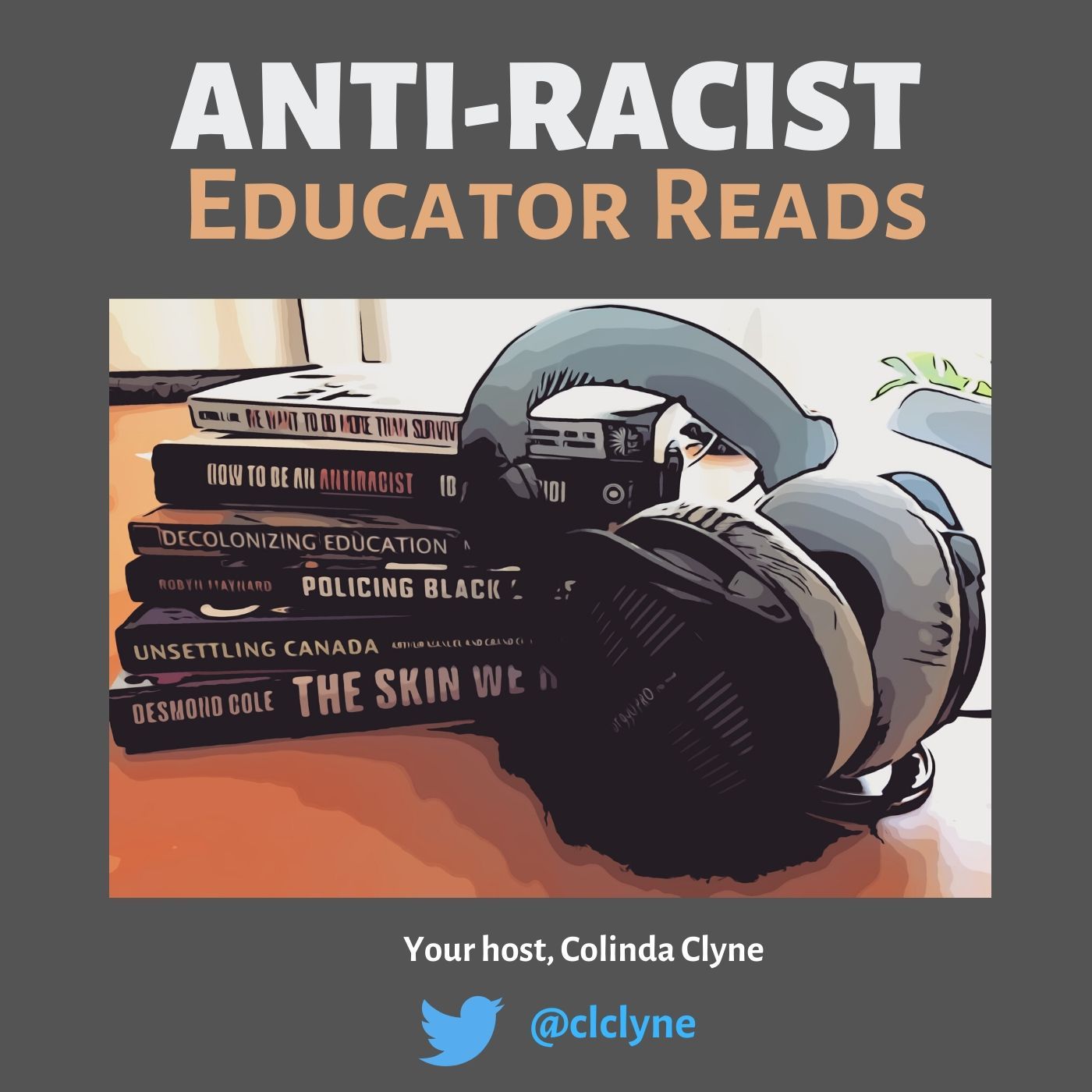
In this episode of Anti-Racist Educator Reads, host Kalinda Klein interviews Dr. Marie Battiste, author of *Decolonizing Education*. Battiste explains the book’s origin as a personal liberation project, written during a sabbatical, to share her Indigenous story and research. She introduces cognitive imperialism, which describes how colonial structures like residential schools imposed Eurocentric education, erasing Indigenous languages and literacies while creating illiteracy and dysfunction. Battiste critiques narrow definitions of success, arguing that true success involves Indigenous well-being, identity, and knowledge systems, not just English fluency or academic achievement. She outlines the dual process of deconstruction—critiquing colonialism and white supremacy—and reconstruction, which recovers and revitalizes Indigenous knowledge, languages, and traditions. For educators, she recommends teaching treaties to foster understanding of relationships and reciprocity, and centering each student’s unique gifts and learning spirit over memorization. Battiste emphasizes that reconciliation and indigenization benefit all, as Indigenous knowledge systems prioritize sustainability and global well-being. The conversation underscores the need to move beyond Eurocentric frameworks to create transformative, culturally affirming education.
[Music] Welcome to Anti-Racist Educator Reads. The broadcast for educators who understand that we need to be talking about race and racism in schools now. We will learn and unlearn through a great book on racial justice. I'm your host, Kalinda Klein. Welcome to the last night of book four decolonizing education. Bend again. [Music] Kwe Nabi Buadjik and Kwe Injushna Khaos Makwa and Dodam. Kiddigan Zeebi Nishinabe and Injubha Nishinabe Kwe. And now I'm Kalinda. And I use the pronouns that she and her. I am so excited to have McMaw Scholar, educator, mom and grandma. Dr. Maria Batist with us tonight. Such an honor to be speaking with the person who literally wrote the book. And has been a guiding Indigenous education across the country for years. Welcome, Marie. Kwe, Madalwa and Octioc. And so pleased to be here myself with you. And many others on the Twitter line. I'm just so excited to have this conversation. Thanks, Marie. So I'm just going to remind everyone about the protocols that we use first. When we start the conversations. And we use them from Glenn Singleton's courageous conversations about race. That we stay engaged. We speak our truth. Know that we may experience discomfort. And expect and accept a lack of closure. I'm wondering, Marie, if you want to start off, I've had the honor of a number of times. Being in workshops and presentations that you've facilitated. And you always start with protocols of place. So I'm wondering if you'd like to start off that way right now. Indeed, I would. I'd like to recognize that I am on the territories, treaty six territories. And the homelands of the Métis. I am in Saskatoon at the moment. My home is Mégmagi. And I'm from the Borla dek First Nations. Thank you. So I'm coming to you from Michi Saguik territory. And it's that when we're talking about acknowledging the territories that we're in. We've had a little bit of this conversation in the past. It's imperative that we're also mindful of what are our relationships with treaty partners, wherever we are located. So it's one thing to acknowledge the land where we live. And also to think about what are our relationships. And I can say that I have a solid relationship with their treaty partner. The Michi Saguik from New Credit. Pam is also on the line. My friend Pam Aguwa is on the line. And I'm wondering if Pam, if you could just introduce yourself. She's going to be managing questions for us tonight. And anything else that she feels inclined to discuss. Thank you. What's the same end of the condition of cause? I'm looking forward to our conversation. And please, friends, post your questions. DM, text or Facebook. And I'd happy to share and ask Marie. We go. Thanks, Pam. So over the past two or four weeks, educators who've been tuning in have been reading, listening in and participating on Twitter and Facebook. And in some districts, I was excited to hear they have their own study groups unpacking the work that we've been discussing, which is this is so exciting for me. We've talked about legacies of colonialism that indigenous peoples are still reconciling with. We've talked about cognitive imperialism. We've also talked about resilience, resistance and resurgence, the importance and connection of languages and recommendations for moving forward in reconciliation. The only chapter that we haven't discussed yet as a group is chapter 10, the possibilities of educational transformations. And I'm wondering, Marie, before we get to that point, if you could start us off by talking a little bit about where the book came from. And thank you very much for giving me this opportunity to talk about this book. It has been a long time in the making. I once I started writing from the time I started doing, I did my dissertation at Stanford University. I've been in a journey of trying to educate people to many different kinds of issues around cognitive imperialism, about your centrism, about colonialism, about education in general. And I had always the desire to speak from my own location. But I didn't come from a tradition in the university. I graduated from the university in 1984. And at that time, feminism and feminist writing was just starting as a way of coming from your own story and your own voice. And that wasn't yet comfortable for me. And I didn't get to that comfort until I actually started writing this book. And I wanted to tell my story. And I wanted to start off with my own people and my own research. So when I started this book, it was kind of my liberation moment. And it was put together in many pieces over time until I took my sabbatical. And I decided that in my sabbatical, I was going to write this. And I did. So basically I spent lots of time traveling in the West Coast and going from hotel to hotel along the beach fronts. And me and my husband, we would just spend the day writing. And so, you know, it just kept evolving chapter after chapter. And so basically that's how it all came about. And we're also grateful for that. I'm wondering if you can talk a little bit about cognitive imperialism. Well, I think that cognitive imperialism was the very structure of my own doctoral education, my study that I did. I was looking at the ways in which Mick Mack literacy by virtue of writing systems were developed and passed on and diffused among Migma people. And who did it? Who were the actors involved in all of that? And in the course of all of that, I realized that Migma people had their own literacies. They had their own writing. They had their own language. They had their own way of educating each other. And only when we got to residential schools and having a education only in one language did my people actually develop illiteracy. And so that illiteracy that went on for several years until they began to develop again, unawareness of themselves did literacies now flourish. And so Migma people are much more versatile in their own language and their own literacies in that language. And because of that, they can begin to understand other literacies. So cognitive imperialism was the kind of structures of hegemonic systems that were put on to our people through public education, through residential schools, day schools, and all of the kinds of colonial structures that were imposed on us. And it was actually what I call brainwashing. So brainwashing was taking away their language, taking them away from their homes, taking them outside of their cultures and so on, in order to brainwash them. And so cognitive imperialism was the way in which I understood then how public education works. And I followed that public education as part of my study to look at how public education and illiteracies and lack of self esteem and the kind of dysfunctions within our own communities that occur because we don't know who we are occur. And I began to think about through my own education, I had a background at Stanford in my language of cultural education. And when I went home, I saw that it was very desperately needed at that time to revive, to rethink, to actually unpack what had gone on and to help people see the cognitive imperialism that they had lived. I think of that, I remember when you were talking about the cognitive and
around that whole idea of success. And we as people working in education, no matter in what capacity, we're all always focused on success and defining student success. I think of one particular student that wasn't succeeding in that Eurocentric way. We weren't getting good marks. The student, they weren't doing well with even attendance. And I remember coming and meeting with mom who was talking to me about her concerns about how they weren't meeting these any success from her perspective. And at that time, I was working in special education and that student had come in the week before to spend some time with me and they had long hair that covered over their eyes and they would not usually give eye contact. And that week, they'd taken their bulk cap off and moved push their hair back and looked me in the eye for a conversation. So I felt like that was success and why were we not talking about how we define success in our systems? Can you talk about how you would work with educators for helping to do that defining of success? Well, that's the kind of thing that, you know, I think that part of what we've been led to believe in a system that we have had to absorb in our marination in cognitive imperialism is that we've had to absorb this notion that success was speaking English. Success was a way of life. Talking like I'm talking without an accent. It was learning the language of the empire, the colonial language. And that was what success came to look like and people would look to me and say, "You're very successful, you're a great model to your people." And I began to realize that what they were saying was that everything that we are, everything that we speak, everything that we know does not fit the notions of success in this society. And so it was important to me after doing my dissertation and my research was to face that in my community and in other places to say, "These are not the success categories for us." If you want to go in that direction and indeed I did and I lost my language for it, I lost my connections to the land base that my mother and father knew and grew up in. So I did gain something, but at the same time we have to now recognize that we can develop successes differently. And successes should be built upon our own well-being, our own growing well in that being and developing a sense of ourselves moving forward with both our own indigeneity, our own identities and also our knowledge systems as well as a Western knowledge system. And I think we can do that. Thank you. I know that I catch myself because I like to think that I have decolonized my own mind and my own definitions of success. And then I catch myself and I'm catching myself right now because my son is very bright and very strong academically and he's at university in a program that he hates and that he doesn't want to carry on doing it. And I'm struggling because that's success is doing that. And so I'm catching myself within that. Can you talk about that deconstruction and reconstruction because I think of that's sort of what I'm trying to work through for myself and I know that other educators would be wanting to understand that a bit better too. Well, the term deconstruction and reconstruction comes from actually Linda Smith's book and the ways in which she has talked about what decolonization has meant to her. And I think it's a two-pronged process that she talks about. And it's really been a very simple one to me that I often try to help people to understand is both the deconstruction and the reconstruction. The deconstruction comes with has its roots from various post-colonial writers that critiqued and solidified the post-modern doubt of the value of universalizing and colonizing languages and their self-serving grand narratives of superiority of your centrism and all of its derivatives. There's many writers that have been part of that deconstruction movement in the post-modern post-colonial. J.J. Derrida is probably most well known for it, although Pala Freire and Cune Foucault, Dewey Shiva, are among many others who have done that work. But basically what deconstruction is is really about a form of critique of your centrism, colonialism and imperialism, white supremacy, contested, contesting the status quo and hegemony that exists, as well as developing an awareness of how all of those have created multiple layers of oppressions on peoples, on women, on youth children, on people of color, of minorities, of all kinds. Those whose sexual identities and gender identities differed from the quasi-norm, all of those are ways we begin to see how when we have a bias, when we have a prejudice, that it comes from ideologies that came within patriarchy, Christianity, colonialism, white supremacy, and so on. And so understanding that is the first step to be able to do anything about change. That is why anti-racist and antiopressive and anti-colonial educators get so taken up with that and are working very hard in that particular area. But I see that it can't stop there because basically you're unpacking your eccentric, white supremacy and so on, and that can't be the end product. The end product for indigenous people is really about the recovery, the strength of our own indigenous identities, our knowledge systems that still exist different from and as equal to in terms of their expertise and their ability to function over millennia's of time on territories very diverse, with situations and weather that have been the most severe. And so what the reconstruction is a recovery notion, it's the resurgence, it's the renaissance, it's the recovery of indigenous peoples and their knowledge and their languages, and their ability to pass that on again in ways that were done in the past through the forms of culture, through forms of ceremony, traditions, and other things. And all of those things have been either marginalized or have been in where people have been removed or separated from their land. So there's a time that needs to be to, as in reconciliation, to understand the harm, but then after you understand the harm and the problem it's created for people, then to recover, restore, renew. But I think this is not just for indigenous people. Like I've often said, you know, reconciliation is not for indigenous people and indigenization is not just for indigenous people. Because the indigenous people's knowledge systems have carried through multiple ages through time and carry in it sustainability as a very framework and foundation of that knowledge system. And when we did our work with the Canadian Council on Learning and the Aboriginal Learning Knowledge Center, and we created these models of learning, indigenous people, first nations came together, and they put together a framework Framework.
to which this core of that is sustainability. It's sustainability of land, it's sustainability of cultures, it's sustainability of us through multiple generations with the wealth we can hold on to. In the May-T tradition, the center of that was similar, but their notions of identity was the source of their particular, the center of things. For indigenous people, it was a mix of both indigenous knowledge and Western knowledge systems. So when we think about these as sort of the core of learning in and through knowledgees and in the inuit and the north had theirs and theirs was a combination of Cila, the land, the life force in the land and the ancestors and generations over time on the land living in through respectfully with that land. So all of that said, I think that that isn't a strong foundation for the future of all of our generations throughout the world. And so it has global foundations, as opposed to some of the current kinds of structures that are more erasing and taking away and diminishing water and land and other kinds of things that indigenous people are struggling with in terms of the modern systems and society. - Thanks Maria. If there's someone who's listening who knows those learning models, which I do, but I can't tweet them out, it's just so folks who maybe haven't seen them before and put them in the hashtag so people can. And if not, I'll do it after the show. Marie, I'm wondering when you were talking about the recover, restore, renew in a practical sense, what could that look like in a teacher's classroom? - Well, I think that in the, there are many ways that we need to help ourselves to understand what's going on and what happened. And I think kicking up treaties is a wonderful place to begin whatever classroom, whatever grade and age you're in is to understanding of what relationships are about because that's what we need to understand, not just relationships to our environment or relationships with each other, relationships with animals and plants and relationships over time because it's relationships that hold all of our foundations of sustainability or our notions of identities, our notions of being together on the land. All of relationships is the key core along with reciprocity. It's sort of the reciprocal relationships that we make with and beyond each other. So if we can begin anywhere, it's to begin there is understanding relationships, understanding our historical relationships, understanding the, that indigenous people are not the same groups of people in Canada as all other people, as today we're faced with, Megmagi and the issues around the exercise of Megmagi people's rights on the water to fish because people think that everyone is the same. And equity and equality have taught us over time that we're all the same and all alike, except that about our relationships and our relationships to our treaties are have marks, indigenous peoples in Canada with a very different relationship than those in a individualistic society of all people being alike. And so treaties are one thing, you're earning to think historically is another which we are as a project that I'm working on and helping people to understand how do we understand history? And it isn't a list of your centric dates and times and people and places, but rather as we understand that everyone has history and then how are historical, significant things happening and how do they have residents over time in change and continuity as well as through the ways in which it has cause and consequences that go through multiple years that just because an event happens doesn't mean it ended, residential schools ended but they will not end until all the people who have lived that experience have had an opportunity to deconstruct what they have gone through and that they will then be able to understand that those relationships that they've had in Canada with the people who made that possible. So there's some things that we can do in terms of teaching in the classroom students about themselves. Oftentimes in education, we disregard the individual. We want them so much to get literacy and get numeracy and be able to write and so on that the skills take on the reason for being there. When the reason for being there is to take every child from where they are to another place for them to understand who they are, understand what they have for gifts and understand that they are in a journey to share those. And so part of that journey is to learn how to grow with them as well as to build new skills with them so that they can take their place in society with that, with those gifts and talents and share them because even after you graduate from high school, very few of us will remember anything we learned in grade nine, anybody will remember anything they learned in grade two. So why do we have as in the Alberta curriculum that is being proposed nowadays is to have a memorization as a rule for how you take up social studies? I wouldn't do very well with my masters of history if I had to rely on memory, especially now, that thank you for really talking about that learning spirit, right? That's what you're talking about at the end, nourishing the learning spirit. And I think in each of our conversations, we've cycled back around to that again and again and it's about putting that student at the center and making sure that we know who they are and beyond just the person who's sitting there taking notes in our class or doing a reading a text or participating, but who are they and helping them to find their gifts? So that's the path that we're helping them to find. So thank you. And I love how right before we got on, we were talking about Marie was asking about starting the show and we were talking about the learning spirit with me because this doing these conversations with everyone feeds my soul. And so it doesn't stop. And we know we're at the end, we're going to talk about what Marie is still working on now, which of course shows that it doesn't stop again. So thank you for outlining that. I'm wondering if you could talk a little bit. I had never heard this until that last presentation that I was able to be part of with the Indigenous Education Leads for Ontario. And you talked about the term cognitive justice. Can you speak a little bit about that? Yeah, that was actually, after years of talking about cognitive imperialism, I had a friend by the name of Dr. Catherine Hopper's. And she is a scholar from Africa. And she is one of the people who after the apartheid of Africa, when Africa went through a reconstruction of all of their education systems. And all of their education system, all their universities had to go back and they said, "If you aren't going to change your curriculum, we're not going to give you any money." And so they assigned this lovely lady, Dr. Catherine Hopper's to Catherine O'Dora Hopper's, you can look up her name. And Catherine began to meet with all of the universities. And it was in that process after they had been denied themselves as people have been with the people.
with the apartheid systems of South Africa, they changed everything and cognitive justice was her call. And so I have used that in a same kind of call arms, if you will, in education, is that we need to now think about how do we balance knowledge systems. And part of my journey right now is decolonizing, not just education or the university, but rather I'm also looking at decolonizing the Royal Society of Canada itself, the Social Science and Mande Research Council, the Congress activities through decolonization. And so all of these things are happening and it is around how do we take indigenous knowledge systems and Western knowledge systems as they exist and build something what I call trans-systemic. So trans-systemic is recognizing there's these multiple knowledge systems and how do we work to bring the indigenous knowledge systems in their methodologies, in their own research, theory, and so on, how do we bring those to share with non-indigenous peoples in ways that they can learn to learn from those systems in their ways without having to make them become a disciplinary tradition like history or like native studies is, and to recognize that a knowledge system is complete. And it just needs to, we need to find ways to communicate respectfully, appropriately and ethically across these boundaries of knowledge systems. So for me, cognitive justice is in part to learn how to do that as well as to have the systems recognize that indigenous knowledge is have their own experts, they have their own ways of identifying their experts and that it is different from Western knowledge systems and disciplinary traditions, which by the way are Western knowledge traditions and I tell my, you know, the people there, you can't confuse interdisciplinarity because that's still Western knowledge. Interdisciplinarity is not what I'm talking about. And what I'm talking about is within our communities, within our own communities, we have our own experts, we can identify them, others can identify them and they come from both their relationships, their knowledge, their place on the land, their ability to generate new knowledge as well as to drop on old knowledgees and so on. So that, you know, this kind of justice system of both social justice and cognitive justice is a way of bringing multiple, I would say, knowledge pluralism to education. - Thank you. At the end of chapter 10, and this leads into, there was one question that I had left with the folks who are participants and that was about schools specifically. At the end of the chapter 10, you'd said, this is an important time for change. So that that was when your book was published in 2013 and we look at today as being an important time for change that we know we're seeing this. There's things have changed because we've all had to pivot the way that we do our work in education with COVID-19 and those restrictions. We've also seen an awareness that I didn't think that I would see in my educational career around anti-indigenous racism, anti-black racism. I've never thought we'd see the conversations like we are today, which is really exciting. And I'm wondering how could a school, so not like beyond just a classroom what an individual teacher may do with their students, how can schools be sites of change? - Well, I think it really begins with the people who's in it, and many schools are working on trying to do something different. And the contemporary notions of diversity and equity and inclusion of recognizing the diverse groups of people and the respect for them and the respect for how they want to be identified and to be acknowledged and to have a voice and a presence in the school are all things that are a contemporary building block to cognitive justice. And so I think that we will, you know, in the course of following with this the post-colonial, post-modern kind of critique and the recognition that knowledge is not held in some central place to which we get diffused to us. I think that that is a clear revelation to how we can begin to build knowledgees in our schools that are multiple and recognize that those multiple knowledgees and even the skills that we can build through them is going to help everyone to, or at least those people in that community to stay connected to their communities, to have respect and love for their communities and that they will be able to drop on that as well as come back to that when they finish their education. So we cannot be building an education that sends students away that just pushes them into places where they might be able to make money. So what we have to do is see that all our communities have the right to economically develop so that their families can stay together and stay as a community together and build their futures with each other. And that's why it's so important that treaty rights include the economic rights to build their own livelihood to be able to drop on their own resources in order to be able to build their foundation. And with that, I think that you're going to find that people will not only stay around but they will help build those communities strong with education and their health and their safety and their housing and so on. So it's a long process, but at the same time, I think that for all of the teachers that are out there, they just need to contextualize the education to the communities and the knowledges and to the cultures and languages that are in their area. - Yeah, I think of that part where you had spoken before about reconciliation being a commonly defined within that workplace. So if folks are working towards something that everyone understands, what is it that we are working on? Because I think of using that word reconciliation, what that means, we could talk to 10 different people, we could talk to 10 different indigenous people and they would all define it differently. So I try to imagine within a school, how can we say, and I'll give an example of school improvement plans may say, a commitment to reconciliation, but if the 65 staff who work on that school, in that school don't know how people are defining reconciliation that how can we actually move forward? How can we create what you'd said, like a baseline of where we're working from? - Yeah, well, you're quite right. Everyone seems to have their various notions and all of them are correct because there are many places, there's never a one story, one narrative, one explanation for any of these things. But I think that one of the things that I got from my daughter who works with the Office of Treaty Commission and they go out and talk about treaties all the time to people all around the province through their speakers bureau. And she talks about it as head heart,
hand. And understanding what has happened to people through the colonial system, through the losses of our children, taking away our children from our communities. So the head can get that. We can probably even remember the narratives of things that have happened, but until those narratives of what happened to indigenous people actually hit your heart, where you begin to understand, not just understand as in, I call it, but I understand what happened, but I feel it. I understand it from my heart. I understand the pain, the anguish. I understand the need for change and the desire for change and the hope for the future. All of that then would suggest that that the hand is us, each one of us, maybe in our organizations, maybe in our schools, maybe in the families we are part of, that each one of us can have our own reconciliation plan that is different from the person beside us or the school across the way. And that is that we have our hand to make change. It's what we bring into the classroom, is what we bring in in terms of the evidence we want to share. It's about the stories, the testimonies from our communities. It is about what we give, how we reciprocate. It's what we are willing to learn of other people so that we never let what happened in the past happen again. And at the moment, our country is split along many lines and there are political lines that are building each day around increasing racism, increasing oppressions, and that many people are looking sideways and even joining into those particular movements. So I think it's really important that we all begin to think about how we have internalized our head and our heart and our hands to do something that's going to make a change not just in school, but in our families and then our own path and our own journey forward. Oh, Miqwetch, I think that that's the perfect place to transition into our question. So Pam, could you read a question for us if there are any? You bet. I'm going to break this question into two parts. So it comes from our good sister, Anika. In chapter 10, Marie, you write, "Understanding Dominance and Superiority within the context of history and their continued dominance and contemporary knowledge is foundational." In your opinion and based on your experience, where's the start for building this foundation? Well, that is coming all together with, you know, you could take up a topic like reconciliation or residential schools or even the Migma fisheries. I keep on bringing that up because that's on my mind almost every day. But if you take and look at that, any one thing, you can begin to unpack what's going on. For example, if I'd like to just take this moment to say about the Migma, treaties is that those treaties are the foundation of Canada today. That we don't understand today that treaties are the foundation of Canada. Canada could not have become Canada without treaties and because there were people already on this land. You can't go to another territory and then set up camp until you say, "Who's there? They're not going to allow you to do that." And so what they did, those people who came to camp here, set up these arrangements and agreements with the people and they were the peace and friendship treaties that were set up. And they were that would they, Migma people were given the right to hunt fish, trade, to take up their, to continue their lives to their best advantage as was written in the treaty. Not moderate livelihood, that was the Supreme Court saying that. The white judges said that. This is not in the treaties. So treaties said they would be able to do this unprotected, unhindered, unmolisted and that that were the clear language in the treaty. So when we look at that, we then think about, "Oh, well, how does dominance play into what's going on right now in terms of the fight on the water?" And you begin to see that the Supreme Court interpreted rightly that Migma people had a treaty. And that was the, that was the only sole thing that they asked to be given in that court case and that was decided. But the second court case came or the Marshall too came in when Nova Fisheries, the coalition of white fishermen said, "Hey, you can't have that. You've got to be conserving the land or conserving the water." And of course, Migma people knew conservation long before. It was even a word. And so what we're doing is beginning to need to look at where dominance plays into these particular kinds of events and how they are being used and narrated through social media, through the press, through these kinds of things to teach us, things that we should think twice about and begin to think about how does dominance and superiority of certain systems of knowledge play out over indigenous people and how does it disadvantage them and who gets advantage by a notion of modern livelihood. Thank you, Pam. They said there's a part two. Just before we move on to the part two for folks who are listening in Ontario, I hope everyone, if you're listening live or before next that first week of November, it is a treaty's recognition week in Ontario so we can be spending that time within our classrooms talking about exactly what Marie was just talking about. So what's the second part of that question, Pam? Well, I'm going to be honest because there's a question that came up that ties into perfectly what Marie's talking about that I want to continue the conversation and then I'll come back to part two because it's all interconnected. So omit asks us if leaders in education systems get promoted by replicating those currently in power, can we ever move past a colonial notion of power toward one that embraces in indigenous systems of knowledge? Well, part of what I'm also doing and have done is at the University of Saskatchewan, is to include and get included indigenous knowledge, methodologies and systems as a way for people to move through their renewal, their tenure, their promotion. In other words, in the old system, there was only one way to go through and that was through doing it solely and only through the disciplinary traditions of history, math, science, whatever it was that they did. Now at the University of Saskatchewan, we have now instituted indigenous knowledge and methodologies and systems as a way for indigenous scholars to be able to move through the university to get promoted around those foundations, which would look different than those who are in the Western knowledge systems. Similarly, I would say that if when we are looking at school systems and people get promoted at what they do where they do, well usually, promotion is to become a principle or vice-presuel, as amount people think that's a promotion. But basically, it can be empowering if it is a way in which you can take and have some voice with your community and making changes that are needed, which is why indigenous people should be moving into those particular kinds of systems to be able to make those changes. But not often are they given those free reigns to do so, because you're quite right.
There is a education act. There are policies that go with it. And pretty much there's a whole lot of gatekeepers in that particular kind of system, unfortunately. - Well, I mean, you're making me really think about I've been kind of criticizing, not kind of, I have been criticizing mentorship programs and how those, like, who are they really mentoring and are they looking for folks who follow or are they looking for folks who truly lead? And when I say truly lead, I mean, leading with their identity, leading within the being that they are. And as you're saying, like, just decolonizing the idea of leadership. - And I think that a lot of systems begin to think that change can be disruptive when people kind of buckle down and say I'm not changing, moving, doing the same thing I've done, it's working perfectly well. But I think that each system needs to be connected with their communities and with not just a trustee board but connected to communities and connected to cultures and communities and connected to the way in which you build social systems within a school network. And I think that will, you know, that's the kind of system and education leadership that enables those things to work well. The gatekeepers, those people are still holding on to the old ways, those are still problematic. And I'm not sure how we're going to move past that, especially if we don't have political parties that help us move in those directions. - And I think before I get to the other part of the other question, I'm thinking a lot about, I mean, throughout the book that we're talking about right now, relationships is so at the core of everything that you do and everything that you speak about. And I've often said, you know, the legacies of colonial education is really driven by taking other people's ideas and claiming them as their own, right? And you've modeled so well in the way that you move, or the way that you talk, you identify your teachers, these are human beings, they're not texts, right? And these are folks that you sit in relationship with and you continue to nurture your relationship. And I know, you know, that's something sometimes I may get a little criticized about, but I don't think folks understand the value of that relationship and how when you feed it in a healthy way, there's so much to be learned that you can then pass on, and that can be through your leadership or through your parenting or through how you work with community, you know, like there's just, you don't value relationship the way that we should. - Yeah. And it's long lasting. It's not a short-term process to get an end. It's a long-term process to keep things going. - Exactly. Like I just think about this talk right now, like with Klinga, we don't work in the same role anymore, but we meet up and we go for walks, and we can lean on each other and the relationships really important to me, right? And with Anika and Jody and Nick and all of the friends that we have. But, so Anika's second part to her question, just for those of us working within these systems in leadership roles with respect to Indigenous education, we're looking to you for some advice, maybe, on where do you think we should be prioritizing the investment of our time and resources? Is it teachers, students, through community, relationship engagement, senior admin trustees? Like where do you think we should invest our time and energy? - Wow. (laughs) That is built on the assumption that there's a small resource pool, right? - True. - Because I would put my resources in all of them. I think that, I think the students should be first. And it is a way of thinking about students and student need and student need related to resources. And so sometimes I think that if we want to say that we want to build a strength of relationships with students and students with each other, what would we have to prioritize to make a society in which people work with and for each other? And what do they need to know about each other in order to get there? And what would be the kinds of things that to equitably distribute resources so that those who have greatest need also will get it, but at the same time it's not like I'm taking away from someone who has less need. But rather to understand how resources are played in a society, but it isn't about, and again I go back to the notion of the way in which a lot of the narratives are, is that if you get something then I get less. And we can't be building a society that constantly does that looking at me and my own needs, but rather how might others be equal in terms of being able to have the maximum resources that they need in order to be all together, building an education together in which we are building a society. And so I think then you focus on what is your object of what you wanna do? What kind of society do you want to build, and how do you help people to get there? I think that when we put it on all of everyone's gotta go to university, that's our object, then you basically have left the society out of the equation because you are just assuming that people will simply move forward and get money and build a house and have kids, and they will be good citizens, and that's not gonna happen. I think we make citizens by virtue of how we treat them and how we engage them and how we respect them and how we acknowledge the historical oppressions that have created multiple different needs for different groups of people. And then by doing that, by focusing our resources on the ideology of living well, working well, being well, then you have everyone then take a different kind of responsibility. It isn't just about money, it's about each one helping each other based upon their own resources that they bring as in their own learning and their own learning spirit. - Ooh, thank you. And now we all know those of us who are in those sorts of positions, like Anika had said, when we go back to our bosses, we're gonna say, well, Marie said. - That kind of society do we want. - That's exactly what we're going to. But before we close off, I'm wondering if you could tell folks a little bit about some of the projects that you have on the go right now. - Well, I've got a couple of the big huge committees that are working on decolonizing the rural society of Canada and helping them to understand how their membership is deeply flawed. And we are beginning to work on how that we can change that because in New Zealand, for example, they have been able to decolonize their royal society. And part of that has been to recognize the nature of research in communities and the role that communities have in deciding who is excellent in their field. The second thing is to working with a Shirk with the Social Science Humanity Research Council on building a good conference that's, and which is the EDID committee, the equity inclusion, diversity, and decolonization committee. And that, again, is also helping them to understand the role that indigenous people have in building a very safe environment people together can meet as many as 10, 15,000 people all at one time. And then the third thing is,
Another thing is I'm working on a research project, a seven-year project called Think in Historically. Think in Historically, I have a website that I can share with you. We are learning not only about how to teach history in a different kind of method, build it on six concepts that, you know, I think Ontario is taking it up already at other places, but it's not across Canada for sure. So we're looking at and trying to understand how history, social studies, native studies are being taught across the country. And one of the best practices that we can draw upon that are coming from Indigenous knowledge, traditions, and methodologies, as well as from the Think in Historical Project, as well as civic engagements. So those three themes across another three layers of teachers and resources and curriculum guides and so on are all the things we're doing and we'll be doing over the next seven years. So those projects are ongoing. And in the same time, I'm trying to figure out how I can get some space to play piano. So I've had a piano since 1979, I never knew how to play it. My kids learned how to play it a little bit here and there. But it's sad in my house that it's always been here and I decided to take lessons. So I'm now taking up piano lessons. That's amazing. I love that. Meekwetch Marie, thank you so much for your time today. I'm really honored to be in this space with you. I wanted to tell people that in the past, at the end of the series, I've always asked folks to do a donation because all of us who do this work are all volunteering our time. And so and and Stephen Hurley hosts us on voice at radio. And so if people can help support through his go fund me. And tonight, because of Marie's here, I'm asking you to also consider what actions that you can take in addition to what we've been reading and discussing in decolonizing education for Mick Ma folks and the fisheries in particular. So I tweeted out some resources that Marie shared with me of different actions you can take people that you can follow on social media, people you can write letters to and different organizations that also need financial support. So anything that you can do to help support there, that would be fantastic. So I'm inviting folks to also remember to put whatever you're doing that the next session that we have starting November 18th. This is an opportunity for folks who've been engaging in the conversations that we've been having on any of the four books to then talk to us about in a practical way, how are you actioning the learnings that that you've done through one or more than one of the books. So Mick, we'll go to the folks who've already put their names forward. That's awesome. You're going to hear from me starting next week, but there's room for more people. So please consider sharing whatever it is that you're doing. That'll be starting on November 18th. And January's book for folks who want to get ahead of the game is Dr. Bettina Loves. We want to do more than survive. Migwetch. [BLANK_AUDIO]
Podcast Summary
Key Points:
Dr. Marie Battiste discusses her book *Decolonizing Education*, emphasizing its origin from her personal liberation and desire to speak from her Indigenous identity.
Cognitive imperialism is defined as the hegemonic, colonial structures (e.g., residential schools) that imposed Eurocentric education, stripping Indigenous peoples of their languages, literacies, and self-esteem.
Success is redefined beyond Eurocentric norms (e.g., English fluency, academic grades) to include Indigenous well-being, identity, and connection to land and knowledge systems.
Deconstruction involves critiquing colonialism, white supremacy, and Eurocentrism, while reconstruction focuses on recovering and revitalizing Indigenous knowledge, languages, and identities.
Practical classroom applications include teaching treaties, understanding relationships (with land, history, and each other), and centering each student’s gifts and learning spirit over rote memorization.
Summary:
In this episode of Anti-Racist Educator Reads, host Kalinda Klein interviews Dr. Marie Battiste, author of *Decolonizing Education*. Battiste explains the book’s origin as a personal liberation project, written during a sabbatical, to share her Indigenous story and research.
She introduces cognitive imperialism, which describes how colonial structures like residential schools imposed Eurocentric education, erasing Indigenous languages and literacies while creating illiteracy and dysfunction. Battiste critiques narrow definitions of success, arguing that true success involves Indigenous well-being, identity, and knowledge systems, not just English fluency or academic achievement. She outlines the dual process of deconstruction—critiquing colonialism and white supremacy—and reconstruction, which recovers and revitalizes Indigenous knowledge, languages, and traditions.
For educators, she recommends teaching treaties to foster understanding of relationships and reciprocity, and centering each student’s unique gifts and learning spirit over memorization. Battiste emphasizes that reconciliation and indigenization benefit all, as Indigenous knowledge systems prioritize sustainability and global well-being. The conversation underscores the need to move beyond Eurocentric frameworks to create transformative, culturally affirming education.
FAQs
The broadcast is for educators who understand the need to discuss race and racism in schools, focusing on learning and unlearning through books on racial justice.
The book evolved from her dissertation at Stanford University and her journey to educate about cognitive imperialism and colonialism. She wrote it during a sabbatical, traveling and writing chapter by chapter.
Cognitive imperialism refers to the hegemonic systems imposed on Indigenous peoples through public education, residential schools, and colonial structures, which she describes as a form of brainwashing that strips language, culture, and identity.
Success should be based on well-being, identity, and a balance of Indigenous and Western knowledge systems, rather than Eurocentric metrics like speaking English or academic achievement.
Deconstruction involves critiquing Eurocentrism, colonialism, and white supremacy, while reconstruction focuses on recovering and renewing Indigenous identities, knowledge systems, and languages.
Teachers can start by teaching about treaties and relationships, including historical and reciprocal connections with land, people, and nature, and by focusing on each student's gifts and learning spirit.
Chat with AI
Loading...
Pro features
Go deeper with this episode
Unlock creator-grade tools that turn any transcript into show notes and subtitle files.
 PodcastTranscript AI