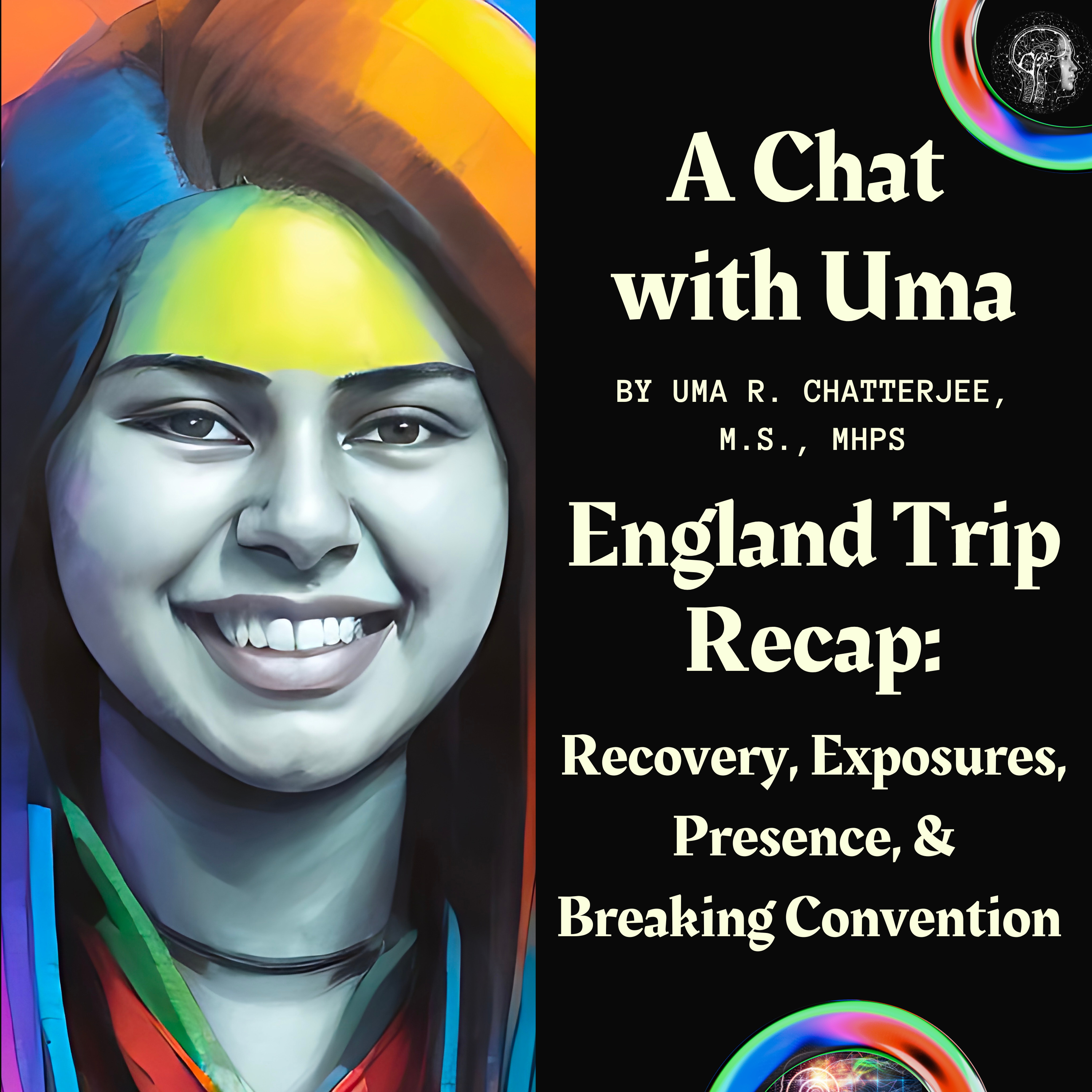
14. England Trip Recap: Recovery, Exposures, Presence, & Breaking Convention
71m 16s
In this episode, Uma R. Chatterjee reflects on her recent trip to England, which was centered around her invited talk at Breaking Convention, a major psychedelic science conference. She describes the opportunity as a profound milestone in her unconventional career, as she presented her independent research on MDMA-assisted therapy for PTSD and comorbid OCD in a full-length talk format, a significant step up from her previous poster presentations. The trip was fueled by a travel grant from Source Research Foundation, without which it would not have been possible. However, the journey was far more than a professional achievement; it became a powerful personal exposure and growth experience. Uma explains that she had to overcome intense fears of not being good enough or misrepresenting her field, and she made the conscious choice to face those fears rather than decline the opportunity. Traveling with her husband for the first time internationally also added layers of novelty and challenge. Despite logistical hurdles—such as a sleepless flight due to a screaming child and the need to balance work and exploration—she leaned into uncertainty and spontaneity, breaking her usual patterns of rigidity. Ultimately, the trip reinforced her commitment to recovery, values-based action, and embracing discomfort as a path to growth. She expresses gratitude to her listeners for their support and encourages community engagement through a new podcast idea submission form.
(upbeat music) - Hello and welcome to a chat with Uma, with me, your host, Uma R. Chatterjee. On this podcast, I bring together all of my roles as a neuroscientist, researcher, board certified mental health peer specialist, mental health advocate, community builder, and a survivor with lived experience to bring you honest and unfiltered conversations, exploring our true human experiences in their fullest form. Every week, I'm bringing you conversations bridging the gap on all things neuroscience, psychology, mental health, lived experience, advocacy, psychedelics, and more. This is a space for raw unfiltered truth, to truly explore ourselves for who we are and how we are. I cannot wait to connect with you, answer all of your questions and co-create this with you. Welcome to a chat with Uma. Hello everyone and welcome back to another week with me on a chat with Uma. And today's episode, I really want to just take the time to recap and process everything that was for me, a huge experience, a huge trip to England, a trip in every sense of the word. And all that came about for me, it was so much. And to me, it was just such a example and testament to recovery and nuance and shame and fear and exposures. And of course, most of the purpose of going to England was the massive, incredible opportunity I had to give a presentation at Breaking Convention and just downloading and processing everything that came from that because it was just so profound for me. And yeah, just giving a recap of so many of the things that I've been asked in so many of the things that I've kind of touched on or wanted to talk about, but I just wanted to get it all out here. And I think in that processing also just comes some hindsight and awareness and where I was at that time just amidst a lot of chaos and navigating and just having so much going on all at once, just from every standpoint, especially just taking on more than ever thought possible. And also approaching by 27th birthday and my cancer of her three, which were both last week. And also, thank you so much. Thank you all so much for all of the love and all of the extra kindness and love and well wishes for my birthday and my cancer of her three and for listening to my impromptu, just robberthay episode and just getting to know how many people feel the same way and have felt so much of that in their life and just knowing that maybe I'm giving a voice to y'all who also experience so much of that spectrum and nuance of existence and gratitude and pain and being able to experience and voice it all in a safe space because that's literally the point of what I do. So just thank you for your vulnerability and your unending kindness and connection with me. It just truly blows me away every week that when I show up so do y'all and we really, really truly co-create this together. So, hmm, I'm so excited to recap so much of this trip and so many of the things that I experienced and learned and realized and traversed and everything in between. And as always, before we get into the episode, just a few quick exciting announcements and things to share from me to you. So I'll start with that this Thursday on May 4th at 415 Central time, so that's 215 Pacific or 515 Eastern. I am so excited to be giving a neuroscience seminar at UT Dallas where I'm about to graduate from and in this seminar, I will be sharing a full deep dive analysis and everything about my independent research project that I've been working on for the past year. I'm sure you've heard of me talking about it before on social media, everything I've been presenting at all these conferences. And I'll be presenting it to the Department of Neuroscience and other related departments at UTD. And it's going to be, of course, on the effects of MDMA assisted therapy and psychedelic assisted therapy for PTSD on comorbid OCD. And the fun part is, it's going to be streamed live. So if you would like to attend and just join in virtually and ask questions at the end and engage in the seminar, I would love to have you. So if you want to do that, if you want the link to that, just go to the show notes and fill out the form linked there. And I will send you the special link to the seminar. And I'd love to see you on Thursday. I'd love to share this with beyond the department and also the community and anybody who's interested in joining in. So let me know about that. Also, I'm so excited to share that after so many of y'all have taken your time to send me messages and tell me all about the different kinds of people you want on the show, make recommendations for guests, send connections, and even topics. I figured a way to make this super streamlined and easy for everyone to get in contact and share their feedback would be through a form. So from now on, there is going to be a podcast, referral, and idea form that is linked in the show notes. So if you ever have a request or a nomination for someone who you think I should interview and bring on the show or even nominating yourself or just also sharing ideas and things in general that you really, really want me to cover, of course, totally down to so receive messages and comments and your beautiful messages. I love them, but a really official and cool way to be able to specifically nominate people and make really detailed recommendations would be through this form. So I will link that in the show notes from now on starting this episode and please feel free to go in and share all of your thoughts. I really, really can't wait to take them in. I have so many amazing interviews coming up, dropping on the podcast so soon. And I'm so, so thrilled for you to hear them. And I'd love to also just expand that to people beyond whom I have thought of myself. So if you have any ideas and just someone you're burning to have me talk onto the podcast to let me know in that form. (upbeat music) All right, so my trip to England and the whole recap, the whole truth, nothing but the truth, is not how that phrase goes. I so help me God or something. I don't fully remember, but the whole unfiltered experience of England and of course on surface that sounds like just talking about what I did where I went and like that is a tiny part of it. It was super exciting and fun, but it's really just about how much came up during that trip, before that trip, after that trip, that being such a catalyst and an exposure for so much and just all the realizations and, you know, just from the standpoint of behavioral action, being in a totally different environment, especially a very novel environment and being removed from one's familiarity and habits and routines just really creates a space for so much more awareness and autonomy and being tuned into, you know, the things that come up in different environments still and making new choices and there's just so much there. And so I think a trip for anyone is fertile ground for awareness and growth and noticing and all of those beautiful things as painful as they can be sometimes, especially though for just the nature of the trip for me and the direct exposure they were to so many things that challenge me and so many deeply intrusive fears I have and just breaking so many patterns and facing so much of my shit, so that's why this is coming up. So just to recap, the reason I went to England at all was because I was selected, accepted to speak at Breaking Convention, which is Europe's biggest threat.
the largest psychedelic science and research conference and I was given the opportunity to share my research project in long form as a full talk at one of their main sessions, which was so incredibly wild to me because up to this point other than the initial talk I gave on this for the psychedelics conference last year, which was really such a spearheading you know stage incubator for my research, that talk was for a student talk conference and so I definitely fit the bill in that outside of you know not having formal mentorship, but I was a student and I had a novel idea and the conference was for people like me. And outside of that after that I have been presenting my research at lots of academic conferences, so many and they've been in the form of a poster because that's typically what happens in research, student, trainees do it presenting in progress research, present them as posters and poster sessions, which are a huge deal of conferences and they're amazing to get me wrong and it's been such a catalyst for me and my growth in my research. What that being said, that is very different from giving a talk in that it's based upon if people come to the poster and it's going through the poster for different people or groups of people as they come to you and there's so much going on all at once and it's you know basically an adult science fair is the best way I can think to describe it. And then at these conferences generally speaking and conferences in general, there are general sessions and breakout sessions where there are talks and people get up and talk for however like the time anywhere for you know I've seen three minute ones all the way to hour long ones or even beyond. Sometimes there's even panels and so typically speaking for research and someone giving a talk on their research it's a high level trainee or above oftentimes it's you know a full blown principal investigator or just someone super notable or even postdoctoral associates, even again like higher level doctoral students, someone like much more established giving their research talk and it's a much more fuller form and so the opportunity for me at this stage in my career I mean it's already super unconventional like my project is independent and it's just I'm in an unconventional place in my career to have you know gotten the traction I have with a independent project like it's still something that I cannot wrap my head around with all the posters and the awards I've had the absolute bonkers privilege of having so far so then to get a talk to get a 30-minute talk at one of the biggest conferences in the field in the world was just something that I still cannot believe happened and yet it did and once I was confirmed for that I meant I mean that meant either doing it and taking the trip to England or not and so I did take it and I have to mention here that a huge part of being able to make this trip happen and fun this trip was a incredibly generous travel grant award from source research foundation and I plan to talk about them far more in the podcast in the future and have some of their co-founders and leadership on which is super exciting and down the pipeline but for now just to briefly share source research foundation is this really wonderful organization founded to help fund the research and the development of students and people in the psychedelic field doing research doing work to an organization so they have a program to fund trainees presenting their research or even investigators presenting their psychedelic research at conferences and there's a whole application process for each conference and based on that you know people are selected and given awards to help make their presentation more possible and for me I would not have been able to make this presentation happen with having to fly all the way to England and fund this whole trip without the support and they made that completely possible with such a generous and kind award which I've received an award from them in the past and so I've been helped by them so much and this is all to say that thank you source research foundation and for anyone who fits the bill at all of being in this space whether you're presenting or not and looking to enrich your experience or education and especially if you are presenting like source research foundation is so supportive they have different conferences and different calls for applications as well as different kinds of applications for actual research that I hope to apply for in the future and community grants and just they're doing amazing things so that was a huge part of what also catalyzed me to be able to go and so with those factors all coming together I thought about it very hard and I was terrified to say yes and it really came down to you know I could point at logistics all day long because I'm still in the middle of the semester although I knew that I was in consideration for this so I had already made arrangements to not have experiments planned for the days I'd be there as well as to do class online so like really it was a more of a superficial excuse than it was reality I could have pointed to logistics and of course the financial side which was also supported by source research foundation so that wasn't really a valid full excuse so it really came down to me making the decision to face my deeply debilitating fears of what if I'm not good enough what if I am completely incorrect about my research what if I'm making everything up what if I'm just completely incapable of doing this but if I totally mess up what if I miss represent OCD and I ruin the field just like so many very strong intrusive thoughts that have always played me in doing this stuff but of course the higher the stakes the louder they are and these are the highest stakes I've ever faced the most robust opportunity I've had and frankly it would have been easy to to say no and to forego it and to just feel excited and pledge on to the fact that I even had the opportunity but you know it's just not possible whatever but I knew that would be making that decision from fear and there is something to being in a place to be able to face fears and that's something that's in ever lasting journey for me to figure out if I'm actually in a place to face them but at that point with the information I had I felt like it was worth facing and I was probably in a place where as much as it would put me into stress I could probably handle it so we decided to go and by we I mean me and my husband because he came along to have a trip in England with me and to just get the most we could for making the entire trek there and back and it was so beautiful and so worth it but I'll get more into that so me and my husband made it work to be like a 10 day trip I mean two of those were fully traveling and then also adjusting to all the jet lag and all of that stuff but we made it work to where we basically planned to go there and then spend our days doing the exploration and experiencing and presence and all of that beautiful stuff and then at night because it six hours ahead from our time we would do all of our work and I do class and like we wrote lab stuff and my meetings and like whatever I needed to do so not a vacation but definitely a trip and that was just again like so much for me and so many ways because it was predicated on my talk and you know rooted in the idea like because I was going to give the talk and then that also included my husband and his whole life and deciding to join me and make this a trip where we get to experience things and be in Europe for the first time together and also his specifically first time as well as mine and also traveling internationally for the first time together and like seven years of being together for various reasons I mean hello pandemic and also like cancer and all those reasons and just this was the first time so that just like inherently came with for me a lot of exposure to the gravity of what I was doing and facing all of my fears and claiming this step of my evolution as a scientist and human and it was just a lot but
But it happened and I was really, really nervous for so much going awry and just being in a not great mental state for the trip and just being really triggered and not exactly able to engage in all of my exposures and just like being really not present and dissociated for simply because of all of the fear that was already coming with like the crux of this trip but also because of traveling internationally and being in a brand new place and being under a lot of pressure with everything going on right now with all the roles and responsibilities and juggling and just all of that and also just the inherent notion of life in general especially with travel though of like things not going perfectly and things not going as planned in my way and not necessarily knowing the capability I had to cope with that stress and being unsure of where I was in my recovery and really being uncertain and being unsure and this trip was an act towards my values and giving myself the chance to figure that out and it could have been a complete chit-chou but I was taking bets and I was guessing and leaning into the uncertainty and letting myself find out and that was huge for me because I actually, I'm not very good at that and I think I've been stepping up to that and progressing to that with all of the amazing incredible opportunities I've had to travel like endlessly I think I took like 22 flights in six months last year for all of the conferences and advocacy opportunities and things I was doing just like all of a sudden but this was a whole new level, a whole new amount of money and a whole new award and gravity to it and I just like didn't want it to all go to shit with the way my brain and system worked and I still tried and I'm really proud of myself for that so we flew in and I in particular leaned in the kind of trying to find a balance but more so leaning toward the opposite side of rigidity and planning and creating you know like expectations of what should and it shouldn't be done and what is the best way to maximize my time and the way to fill all my time and whatever and just like really lean toward uncertainty and spontaneity and impulsivity yet also sometimes I do find myself going completely in the opposite direction and also creating havoc and stress and you know there's lessons in all of it but also being with my husband was awesome because you know he has his own way of traveling and he is very very well traveled so he has a lot of you know insights and ways and how to navigate we were really able to co-create our trip together with the different things that we wanted to see and do and how we wanted to experience it and so we landed in London and a little bit of backstory we tried to preemptively work on the time change and the jet lags that we could be like perfectly set by the time we got there by the past week before that waking up super early and going to bed as early as we could which wasn't flea feasible given this year number of things I had to do that week like I had four presentations that week if you if you all recall me rambling about that on the podcast like four presentations top of all of my lab work and all my classes and doing everything I could to get ahead for this trip and yet I was still going to bed as early as I could and we had to drop our dog off several hours away around trip and then we just like really sleep deprived ourselves the last night and the hope was that we would get on our flight in the afternoon and be sunk out and we'd wake up and be morning in London and we'd be good to go and that all went great except for then we got on the flight and there was a child not like an infant or toddler but like a full grown child probably seven or eight years old who for nine hours screamed the entire time and sat next to us and was screaming for his mom who for whatever reason wasn't giving attention and no judgment or anything it's just that the result was literally nine hours of screaming and there was absolutely no sleep involved even with our headphones and everything so we landed and I already had to surrender to the fact that things were not going to plan and my time would not be maximized in that way and I would quote unquote lose time and lose money and it just is what it was and I literally had to sleep so we did and then we just surrendered to what was and started walking around and we really most of our trip in terms of London was walking around and exploring and going to different museums that call to us and trying different coffees and foods and just being really present and making decisions on the spot and doing things that were unconventional rather than the things that one typically does as a tourist and also doing some things that were touristy because I wanted to even if it was cheesy like the London Eye and well I mean I guess we went to museums tons of museums I'll get to that because that's a whole thing on presence but you know just trying typical foods and whatever but also not doing the things that we really didn't align with that like we just personally didn't care to do like the stuff with visiting the castles and the royal family and the garden all that and you know different exhibits and stuff it just wasn't didn't go to us we just really immersed ourselves in the culture and we're just present and experiencing what London was like and we got really lucky that the weather was pristine and just sunny and cool and perfect the whole time and I remember the first few days like being so present relatively compared to my normal life and I remember just having this moment of peace like going up in the elevator back to our room after a long day and just telling my husband that like I felt the profundity and impact of recovery in such a beautiful way in those like two days I think it was and I noticed the sadness that came with it of like you know what if it goes away which like of course it was going to go away because even people without the issues I struggle with like there are good days and bad days and I was noticing getting myself so attached to once I noticed that recovery and just more presence and more joy and more excitement and peace and less constant distress I was just I started becoming you know fixated on like when it goes away like how bad it's going to be and all these things and then I realized and I had this like visceral realization of but right now and what I do have is so beautiful and just hang out there and I can wake up tomorrow and it could be completely shit and I still had today and I still had yesterday and the expectation of it lasting is where so much disappointment and extra pain would come from and so that was really cool to experience because I tend to be that way in terms of clinging on to any moments and of not total distress or you know dare I say like joy or positive feelings whatever and I also do that with like time passing and the more time passes just like being so afraid of like when it's going to end and it being over and just like counting down the days and being sad about it already and just like losing so much of the presence to the finality of it all yet just embracing the finality and accepting it as a foregone conclusion and not being in denial of it just it there was some version of my April 2023 26 year old self that was able to tolerate that and navigate that a little differently and that was so beautiful to me and I got to really relish in moments of recovery and to me again that is just being able to be mostly present and tolerate the thoughts and fears and exist in the moment anyway and engage in and relish in the parts that were beautiful and also acknowledge the parts that were not amazing and just ebb and flow with all of it and go roll with the punches more and I was able to be present for things like museums I had a really negative valence to in the past because I would just be miserable like every aspect of my life and so that often was museums growing up like or really traveling in general was all miserable to me I thought I'd
I just didn't like traveling, I didn't like museums, I didn't like anything because I was just always horribly miserable. But I wasn't this time and I found appreciation for art that didn't know existed within me and different types of music. I was eating different foods than I normally amuse to or with try, which is very not a thing for me normally. I have a lot of fear and just interests of thoughts about new things and I got to have so many new experiences and they weren't perfect but they were so expansive and so that was just really beautiful for me. And on top of that I had a really interesting experience with my body and physical action, physical activity and my chronic pain because I guess for context I mean I live in Dallas, Texas for not much longer but for right now. And unless there's a massively concerted effort to walk a ton like within a building or on a treadmill or maybe during decent weather outside, it's really not a part of life here. Everybody is a car. We get a car, so we're 16, we're going to permit when we're 15, we get our license at 16, we have a car and everything's 20 minutes away. It's a joke in Texas but it's kind of reality. Everywhere is by car, there really isn't public transport for the most part. I mean there is but nobody uses it and it's very bad. It's just driving and people don't walk and so I mean as much as I may try to get my steps and it's really a concerted effort at a gym or walking at home or like walking around the block or something like that. You know once in a blue moon going apart but then there's another element to it which is that the heat is hellish here and so for much of the year it's just not feasible especially for me and my heat tolerance to go outside. So it's even harder and so needless to say walking is not a part of life here. And then layer on the fact that I live with severe chronic pain and it's really hard to engage in movement in through that. I try my best but it's just hard. It's just it's just is. And also I mean I've talked about this at length in previous episodes about my mental health and physical health, ketamine, all of the things. But a huge part of my existence has been just general dissociation from my body because of the not only the chronic pain I constantly live with and my brain trying not to perceive and feel that all the time but also the trauma, the physical and sexual abuse and just like a lot of unprocessed memories from that and the natural response would be to try to dissociate from my body and everything I feel physically and emotionally to not feel it as much. And a huge part of my recovery and healing journey has been to start bridging that gaps slowly and becoming more present in my body and feeling it more. And I definitely know that I've done a lot of that as much as there is such a long way to go. I do know that a lot of that has happened for me because I actually feel my pain far more intensely now which is such an interesting conundrum because the more I work on presence, the more I work on coming back to my body and working on the physical and psychological dysfunction that has contributed to being you know dissociated fatigue. All of that, the more I feel my pain and even when I take substances that make me more alert, it tends to make my pain intensify which one could think maybe those alerting substances just drive pain in the system and perhaps but I think more importantly it just makes me more alert and more aware of my pain. And so all of that to say I go to London and I'm walking like 15, 20,000 steps a day just walking nonstop and it's so painful. It's so painful but I was able to do a lot of it for most of the days until like my body just started shutting down but also sort of my husband so it's like and he's very active and then great shape so it's just like in general fatiguing for a number of reasons but especially with me like I it was just such a surprise to me that I was able to handle it as much as I was in so much pain and I was so tired I still was able to do it in ways that I didn't really know I was able to do and I didn't really push myself to do it home and I think there was something about being able to be present with all of it and in spite of that amidst that stretching my limits of what I thought was possible to coexist with it and keep going and I think I was more compelled to do so because I was in a novel environment and I loved walking around there and getting to be mobile and experiencing all of that and having the capability and even the physical capability to do so because there were points in my life where even if I wanted to and even if I could tolerate the pain like I was just my body was too broken and too dysfunctional to even handle anything like that so that was so beautiful and just sitting with all of that and seeing that being compelled and being engaged and being excited about being somewhere could bring parts of that out in me and increase my tolerance and capability of engaging with all of that that comes with that which was just that gave me a spark in life honestly because I'm really really really excited to move to Madison was constantly where number one it's the freaking bike capital of the country if not the world I forget and everyone walks everywhere there and it's so beautiful and I really I'm so excited to be more physically present and active there and be amongst nature and to be able to build up my body to do more of that as much as it maybe won't be perfect and as much as other people it's far more than I've ever been able to do and so that was so amazing and exciting and we went like on a pedal boat and we went biking and scootering and it was a lot of that was really really beautiful there was also some really hard moments I actually to you know super open and transparent a lot of it was great and then I also I tried to ride a bike on a busy street and there's a combination of things I think it was toward it was the last day of our trip actually I'm skipping ahead for this example and then I'll go back in chronological order but I was trying to ride a bike in a public road for the first time I had not done that in like a public road by that point I had done scooters and somehow that was okay and obviously I'd walked but a bike was just different and I think it's a combination of my balance and also it was so stressful for me to have to navigate like being on the opposite side of the road and the way the bike lanes worked I wasn't used to bike lanes in general and then also the opposite side of the road and the traffic and just being so disoriented and I also have a really big or I don't know if that's right word just like a really profound or it impacts me a lot a visual motor spatial disability deficit thing that I didn't know about for a while and it's very clear to me how much that affects me now because just I don't process and compute visual like moving things properly and so it was just really really stressful and I was trying to ride my bike like one of those lime bikes like on the road and I just like I had a stop and I just had like a panic attack and I was basically just trying to do an exposure and it was way too much for me and I was so afraid of like running into the road or like hitting someone or getting hit and of course some of it's logical some of it's illogical but it compounded and it was too much and overwhelming and like I had a panic situation and I had to try to learn how to feel rather than dissociate and like cry and take a moment and my husband was amazing of course and dealt with that and then we ended up just you know ubering to the restaurant that we were trying to bike to and that was that sucked and that was just one example of things being hard yet that was not the totality of a hill experience and I got to try and experience that amongst all the beautiful things that I talked about and I got to be present for the spectrum of existence and try and it's easy to look at color my whole experience but I won't let it and I'm claiming that on the podcast by talking about it so coming back to just being in London and experiencing more presence and more activity and more awareness and just a higher threshold for experience overall was so beautiful and there was a part of me that was growing also in fear of the actual talk and I co-existed with that but it did start growing more and more and progressively made things harder for me being present and I also let it in a sense keep growing because part of my mo in general for things that scare me which is most things I do is to procrastinate and avoid and wait till the last moment I'm not the only person in that but how that manifested for me with the talk was to literally not even think about it or
my slides or like practice or do anything until like right before the talk and so we were there from like that Saturday and London me landed and then the conference was a two and a half hour train ride to Exeter so we you know I told that and we were gonna go there that Thursday my talk was on Friday morning and the conference went through Saturday and then we were gonna fly back Sunday morning so we're gonna come back to London that Saturday or Friday so I waited until right before the train ride to start working on my slides and for better or for worse it built up and was terrifying and felt like a massive exposure and I had to deal with all of my fears going into it but at least I got this slide sun before the talk and I did it anyway I was also lucky in that I got to meet with my therapist on Wednesday before the train ride virtually of course and I got to just I was actually really triggered that day in general and I got to process that with her and also talk about my fears about my talk and the conference and namely navigating which parts were things I just couldn't get reassurance on or prepare for I just like prepare for tolerating it versus the things that were maybe more founded fears that I could actually do tangible things to prepare for so for example like there are certain responses I get to my research for people who are hesitant toward parts of it because it challenges their notions and they like to argue with the established research that exists I'm being vague right now but we can talk about that another day and I just get really triggered about it because it I'm very personally invested in the implications of rejecting the current research out there because I live with the things I'm talking about and so it feels very personal even though it's not and it was just really nice to actually talk with my therapist about that and process which are the parts are just my interest of fears that I had to live with and the parts where like literally I could have coping strategies of you know putting my personal hat aside for those parts of the talk and just showing up as a scientist and responding with the science and letting myself have the feelings before and after rather than during and literally like making slides addressing their arguments head on which actually worked really really well and I don't know why I didn't think about that before just everything that people asked me just having slides to address that anyway and expedite the question answer process so that was really awesome and as a side note before I get into London too I also got to meet up with some of my collaborators at UCL at University College London because I am working on a project actually with UCL it's called OCD in the Brain it's a really amazing toolkit about OCD neuroscience that's going to be disseminated to the public and I am collaborating to create that as both someone with lived experience and as a neurobiologist and sharing my perspective on so many aspects of it and just sharing the information I know so I got to meet with two of the main people who've been facilitating the community for this project and it was just so nice and felt like such a beautiful thing to experience going to London and came you know connecting to the OCD community and the research community again and just getting to reflect on the amazing beautiful opportunities I have to engage in my interests and my passions and my advocacy's and transforming my lived experience in in this iteration and part of my life which released at the stage for going to breaking convention and giving my talk okay so then that night before that Wednesday night before my and our train ride to Exeter the next day I finally started working on my slides I got a decent amount done but nowhere near close to done and then I worked on it more on the train ride and then I got to the actual conference and you know got settled in the hotel and actually my husband kind of got sick which it wasn't like a contagious thing it was like an immune response and nonetheless he was on the struggle bus so just navigating that and making sure he was settled and you know had enough substance to take get taken care of and then I that like later that day on Thursday I went to the conference picked up my badge that's some of my friends that were already there which was super exciting and I didn't really go to any sessions because I just got there toward the end but just got settled and then that evening after the conference ended I actually had this really exciting dinner with Source Research Foundation and all of the travel grant awardees so it was a combination of people who were presenting at the conference as well as people who were attending the conference that were all supported by SRF with travel grant awards and that was just such a joy to be at there were so many amazing people people I knew people I didn't know and we just had this really awesome British dinner and got to connect with everyone at SRF and our peers and it was just beautiful and it was so surreal being surrounded by so many people who I admire and who are doing such incredible work and just being amongst them as a peer as someone who is also doing stuff too and it just I had to check reality hopefully not a compulsive way just so many times of like who am I in it how the how did I get here and that was a huge theme across the whole trip but especially when I got really real being in Exeter at the Conferenson like walking around with a like a badge saying speaker and like being at that dinner and just it's just such a it's so surreal and I don't even know how to put into words but it was it was beautiful and I in particular got to spend time with one of my dear friends Haley who is also speaker at the conference and gave one of the most amazing talks I've ever seen and her name is Haley Doron just a phenomenal psychedelics researcher and PhD candidate and also we're both in leadership team at IPN danger collegiate psychedelics network and actually fun fact she is also the founder and like person who spearheaded the psychedelics conference a few years ago so without her and the groundwork she laid I would not have gotten to participate or win or get all the opportunities I have since then so she is a huge part of my life not just as a friend and someone who I really love but also in the beautiful fractal ways that life works in a professional sense and also Dr. Nishie Davino who is just beyond incredible as human and everything she does and she she's she was presenting several times at the conference which she had just phenomenal presentations especially at the intersection of being percy deluxe and anti-hype and just having such nuance and allowing space for critique which is what so much of my project is and she just has made such a massive impact in my life of helping me feel like I belong and can take space and have permission to speak about the space candidly and have nuanced critiques when sometimes it might feel unsafe to do so in a research environment where there's a lot of desire for things to just be clean positive and good and anyway I'm rambling but the point is she was there and I love seeing her that night and just talking to her more and I can't wait to have her on the podcast for conversations that you're gonna hear so that's really really really exciting and hailey do anyway so that was just that was Thursday night and then I came back pretty late I think it was like 11 or 12 p.m. my talk was at 10.30 a.m. the next day but I sold it and finished my slides so I did that that night and sent them over later than I was supposed to but I did and just tried to sleep and surrender to the fact that that was happening tomorrow and then it came that morning of the conference that Friday and I wish I could tell you that it was all swimmingly well and smooth and I just did it but no of course not the case everything that had been building up really really belt up I was so afraid and I was just cooking in a beer and it felt like any excuse I had to get out of it I should take and you know I legit had an excuse with my husband but no I did obviously didn't take it and I wasn't really going to but
but it felt like I should. And just I cared about the talk so much, not only because it's me and my research, I should make that clear. It's like duh, and I feel a moral responsibility toward my research and being a scientist. But far more than that, my talk was a entire talk of advocacy and awareness for OCD and dispelling misrepresentations and bringing OCD awareness to a population of people who mostly did not know about OCD, I could guarantee that pretty much just so many clinicians, psychiatrists, therapists, assessment psychologists, regular psychologists, and researchers and scientists and people who run clinical trials and pharmaceutical companies and pharmacologists and so many people in the psychedelic space, into therapeutic space, who have never learned about or understood but really OCD is and there's so much, you've heard me since a million times, but there's so much misrepresentation and misunderstanding of what OCD is. So in order to explain my research, I had to go back and give a thorough overview of what it really is, including mental compulsions and evidence-based treatment for OCD, which is exposure and response prevention and dispelling all the myths. And so my research and my presentations are their OCD advocacy and awareness. And that is so important to me and carries so much, just a weight to me because I want to do it right and I want to do justice and I want to do it well. And the opportunity I have, I want to get my point across into raise awareness in spaces that don't have awareness. And that's a lot to me because obviously I have OCD and I have comorbid PTSD, which is part of my, also the research and having to explain the comorbidity of PTSD and OCD and when they're statically related versus functionally dynamic in relationship and parsing all that out and then getting to all of my analysis of my project with all those contexts and prefrains and awareness. That's just, that means so much to me. And it was so nerve-wracking and terrifying to be on the stage in front of thousands of people at a conference doing that and being recorded because this is gonna be publicly available, which I will definitely share with that is the case. But to do that at the biggest psychedelic conference in Europe, like that's a lot. And it was far beyond like me and what people think of me and just like stage fright, right? It was just this moral weight of, and then all the insurance that's glomming on to my capability of doing this justice and doing it properly and doing it right and even being right in my research. And there's no amount of validation or reassurance that would get me to not feel that, just to be clear. Like I was very clear what this was. And it was, it was a lot. It was a lot. And yet, I'm in install of that. I'm just waking up and feeling the weight and avoiding waking up and getting ready and making sure my husband is okay and then getting myself to the conference and getting myself to the room and getting my tub and sitting there and all those things. I was feeling the weight of all of that and there were certain glimpses and moments amidst all of that of just sheer awe, of holy shit. I get to be here and I get to advocate and share my research in this incredible space to all of these people, like me, somehow I find myself here, I was supported in getting here and I get to do this and I carry this privilege and this immense amount of joy and purpose in turning my pain into advocacy and research and bringing all of my experience together and my lived experience. And I mean, literally my talk the way I give it is to explain how I got to my question. I have a timeline of a case study myself and navigating the realities of having coma, bidoCD, PTSD clinically and how it turned into a science question. Anyway, I had like moments of just awe and like I would be brought to tears. Like the fear didn't bring me to tears, but the awe did and then, you know, of course to be tempered by the fear, like the interest of thoughts and come back and whatever. That's fine, it happened, but the awe and the presence and like the moments of that I felt was very new to me because I have given talks before not research wise, but I've given a keynote at a mass of converse before, like last year at CancerCon and that experience, I mean, I am so exciting and valid and amazing and I was just like mostly dissociated. I had to hardly remember it and it was just, it's the best I could do at the time. I could contrast that though to this year and just feeling so like just this presence that I have not had before and being a little more grounded and having access a little more to the spectrum of feelings within me beyond just living in my head and being in that petrifying interest of that fear, lubing, doing mental compulsions and all those things. So that was really cool and then we get to the actual talk and it was 30 minutes. I spoke for 28 of those minutes and then I had two minutes to spare to give the opportunity for questions and the conference people let it go over 'cause there were so many people who had questions and we got to like two or three and then I had to stop but my gosh, that presentation was everything and more that could have ever dreamed of. It like being able to give it and seeing just the light bulb moments on people's faces in front of me, like it was a packed house and there were so many people to look at and I was already blown away by that because this conference had four different talks going on at the same time. So there were like three other options outside of me and it was still just packed and I was amazed that people cared about the topic or the session and then to be present enough to be giving my talk and to still look at a people's faces and get energy and just presence back from them and seeing those light bulb moments, getting them to laugh, getting them to gasp, getting them to just start, like for them to click within them in whatever perspective they had of like what OCD actually was and how much they had been misled by the world and the media and the misperception and the implications of comorbid OCD and PTSD in the context of psychedelicocyst therapy and just like building my case and sharing and seeing people getting along with me and understanding what I was saying. It was just an experience that I've never been present enough to have before or to execute before. And there was a part of the presentation while there were two. There was one part where I revealed the case study was me and seeing people's compassion. I mean, it's not conventional in science and research to be fully outing yourself as someone with psychiatric illness and here I was at the very beginning just setting this up for people and there was the chance or the fear of it discrediting me as a scientist and yet that didn't happen and I just received compassion and care from people just from looking at them and their responses during the talk and then I don't know if that makes sense for people who haven't given a talk but if you have then you kind of get what I'm saying just like the relationship you have with the crowd and the people who are feeding into your energy and then there's another moment that I hadn't really realized would be this intentional place to pause and take in things and have presence for about two minutes but it ended up being that which was part of my presence and my presentation was sharing a two minute clip of the 4/32nd commercials of the National OCD Commercial Awareness series that I was a part of that my incredible friend Ethan Smith directed with by Hiven Pharmaceuticals and those are now airing nationally everywhere and that was an opportunity for me to share them in succession for the purpose of illustrating the wide range of obsessions and fears that people with OCD have as well as putting faces to OCD in a way that doesn't currently exist and really just a powerful engaging way of dispelling the myth of what people think OCD is versus what it actually is and so I played that two minute clip and that gave me a second to really just look into the crowd and taking people's reactions and drink some water and re-ground myself and just drink in the fact that this was actually happening and side note that is when I saw some people in the crowd that I kind of believe actually came to my talk some people who have been my heroes for a very long time namely Paul Stamets and Dr. Pamela Crisco and that was wild and it was kind of hard because I had to see that and then just kind of tell myself that's not actually them. I mean, it was definitely them and Paul Samson's completely recognized.
recognizable smushroom hat, but I just told myself that it wasn't them and carried down with my presentation. And we'll get back to that later because that came full circle. But I gave my talk, I finished it, I was met with the audience after the talk with so much support. And it got questions that were beautiful and then the talk ended, the session ended, and there was a break actually in the session to then the next part of the session. And in that break, I just had countless people come up with questions, so many clinicians learning about ERP asking how to be trained in it, having revelations and sharing case studies with me about people who they thought were treatment resistant, but actually probably had OCD. And the implications of people running clinical trials, not screening out for OCD when they are working with PTSD populations, just countless conversations in people, which just blew me away and gave me so much fuel and purpose for what I do and what I'm doing and facing my fears. And that was wild. And then I think even if that wasn't prevent enough, and there were also people who were coming up to me telling me that they didn't know what OCD was until they heard me and they realized that that might be something that they have because of experiencing effectively everything I shared for most of their life and not having a label of thinking that they were crazy and trying to solve it via trauma and like just not ever being able to share those intrusive thoughts and the content of them that they were with anybody else in fear of them being a bad person and mental compulsions and the things people felt stuck in and like not realizing that was OCD or even physical compulsions that don't look like typical compulsions people think of. And it was just the most rewarding thing to experience to just be raising awareness for something that's so in cities and pervasive and treatable and just making it different in so many ways just and also being met with so much care and gratitude and compassion for my lived experience and being seen for my whole self and that's just something I never thought was possible and beyond the talk, beyond the aftermath of the questions, I mean navigating the rest of the conference, the rest of the day, just so many people coming up to me at like different sessions and while eating and with my friends and just there were so many like random witnesses to people that would come up and say that you know this was the best talk they had heard of the conference or one of the best talks they'd ever heard and like I my brain has me like doubting all of those things and like thinking I'm making it up and just like all the research thoughts and things that happened with my memory and my OCD and like the most meta way possible and yet there are people who were witness to that not that I need to be compulsively reassuring and making sure it actually happened in reality testing but all of that was happening and something for me that I'm still really really working through is that anything kind, anything loving, anything positive like literally feels like fire burning me and I tend to avoid it and just deflect it, turn it back around to associate from it. I mean I did find myself hiding a little bit at the conference like in the bathroom but then someone literally found me in the bathroom too like and I realized that this is an opportunity for me to try to honor how I'm feeling and try to wire that differently within me and create a new experience and so I was just trying to connect to my heart more and just be in presence with people and like honor their reality which was all the kindness that they were sharing within me and just take it as much as I could and it does help that there were people around to like reflect that back to me and help me process that a little bit and that was yeah I was just it was life changing it was to be so on purpose and to be channeling and bringing together my lived experience and my research to just raise awareness and make a difference and reduce harm and just bring more awareness and healing to people who may not have had access to it up to this point just is why I do what I do and it's the other side of facing and continuing to face the depilitating fear and the crushing interest of thoughts that really try to keep you from doing these things and try to protect me from the irrational and illogical fear of being a horrible person and just just all of the things that front in my brain as someone who in the meta way lives at the very things I'm advocating for and talking about and I guess to cap all that off I mean I found out it indeed was Paul Stamitz because my friends were messaging me telling me that it was him and they were in the audience watching and some of them were sitting near him and heard him vigorously nodding and like saying wow to the things I was saying which is just so cool to hear and that night there was a speaker event there was like a little speaker dinner thing and I went and I had no expectations I didn't know anybody I didn't know what I was doing and of course he was Arab because he was all speaking and there had me one chair available to sit at and I didn't know anybody and I decided to just go talk to him and Dr. Chris go and just be humans and we did we talked for like three hours and it was amazing just to just be humans and geek out and talk about life and talk about research and talk about existing and being a person on this planet and doing what we do and all that comes with it and it was also just amazing to hear reflections back about my talk and about them learning about OCD in a way that they didn't before know anything about and how fascinating was in the potential for different psychedelics to impact OCD's symptomology as therapeutics which is literally what you know I'm going to be studying and by PhD and what I want to dedicate a lot of my life to and that just I it's surreal that happened to and I just get to geek out and share that with the podcast here with you all because that happened and it's wild and that was cool but beyond that I mean what I come away with and what I am just sitting in awe of still is just the people that as a result of me facing my fears and showing up as I am for better or worse and risking all the things that I thought would go horribly and doing it anyway like they're just I can't describe the joy and purpose and infigration and hope and and everything that comes with being able to just advocate for my heart and do research that not only is impactful as research but races awareness for things and for people who matter and their suffering matters and their healing matters and I just I'm so grateful for being alive and being here to be able to do this and to have the privilege that I have of getting to share my research in this way and more is coming to more conferences and more advocacy and more research and more awareness and I can't believe this is my life and I am just so grateful to be in a place where I was able to take this trip and to experience the full spectrum of everything that came with it the pain the fear the joy the excitement the exhilaration the despair all of it because I get to share this with you and I have this full story and I'm so fueled up and filled up for so much more and this is what recovery and progress looks like because I have such a long way to go and I am I know means doing amazingly well far from it actually and I mean you know I'm open about it on the show and I continue to be and it absentee in flows and yet amidst all that this is what recovery can look like in progress in a non-linear non-binary way so thank you for holding space for me to share all these parts of my experience it's so far beyond just going to England which is already amazing but it's everything that came with engaging in treatment and taking bets on myself and living through my values and trying my best in no perfect way and being uncertain and moving forward anyway and allowing and risking things to go differently and if I can you can too and I'm here for you to navigate through that all it's not fast it's not easy it's taking me a long time to get to this point I mean my whole life really right and I'm just grateful to share this whole process and to be on this journey with you so thank you for showing up for another
week of a chat with Uma. And if you love this episode, if you love this show as always, it would mean the world to just take five seconds and subscribe to the show wherever you're listening to your podcast and more places to better. You'll be the first to get episodes and you've really really support the show that way. Also, if you can leave a five-star rating in review, that makes a huge difference for the show too. And it helps us grow and helps more people feel safe to be here and to engage with everything we're talking about and the conversations we're having. And if you share this or any other episode on your social media, waiting for your friends, with anyone you think would love it, it would mean so much to me and I appreciate you so much. And I can't wait to hear more from you to co-create this with you to continue. I'm so honored to be in this journey with you and I can't wait for next week and for more episodes. There are some interviews coming next week. I can't wait for you to hear these conversations. They are epic and everything I dream of and more and I can't believe this is my life pinch me. I can't believe that I get to do this with you. So if you're being here, so much love to you and I will see you next week on a chat with you.
Podcast Summary
Key Points:
The host, Uma R. Chatterjee, recaps her transformative trip to England, primarily to present at Breaking Convention, Europe's largest psychedelic science conference, where she gave a 30-minute talk on her independent research on MDMA-assisted therapy for PTSD and comorbid OCD.
The trip was a major exposure and catalyst for personal growth, forcing her to confront deep-seated fears of inadequacy, imposter syndrome, and uncertainty, while also challenging her rigidity and need for control.
She emphasizes the importance of making decisions aligned with her values rather than fear, and acknowledges the support of Source Research Foundation, which provided a travel grant that made the trip possible.
Despite significant stressors—including a nine-hour flight with a screaming child, jet lag, and juggling multiple responsibilities—she embraced spontaneity and leaned into uncertainty, ultimately finding the experience rewarding and affirming of her recovery journey.
Summary:
In this episode, Uma R. Chatterjee reflects on her recent trip to England, which was centered around her invited talk at Breaking Convention, a major psychedelic science conference. She describes the opportunity as a profound milestone in her unconventional career, as she presented her independent research on MDMA-assisted therapy for PTSD and comorbid OCD in a full-length talk format, a significant step up from her previous poster presentations.
The trip was fueled by a travel grant from Source Research Foundation, without which it would not have been possible. However, the journey was far more than a professional achievement; it became a powerful personal exposure and growth experience. Uma explains that she had to overcome intense fears of not being good enough or misrepresenting her field, and she made the conscious choice to face those fears rather than decline the opportunity.
Traveling with her husband for the first time internationally also added layers of novelty and challenge. Despite logistical hurdles—such as a sleepless flight due to a screaming child and the need to balance work and exploration—she leaned into uncertainty and spontaneity, breaking her usual patterns of rigidity. Ultimately, the trip reinforced her commitment to recovery, values-based action, and embracing discomfort as a path to growth.
She expresses gratitude to her listeners for their support and encourages community engagement through a new podcast idea submission form.
FAQs
It is a podcast hosted by Uma R. Chatterjee that explores neuroscience, psychology, mental health, lived experience, advocacy, psychedelics, and more through honest and unfiltered conversations.
Uma traveled to England to give a 30-minute talk at Breaking Convention, Europe's largest psychedelic science and research conference, about her research on MDMA-assisted therapy for PTSD and comorbid OCD.
She received a generous travel grant from the Source Research Foundation, which supports students and investigators presenting psychedelic research at conferences.
She dealt with fears of not being good enough, intrusive thoughts about her research, jet lag, a screaming child on the flight, and the stress of balancing multiple roles and responsibilities.
She leaned into uncertainty and spontaneity, trying to balance planning with flexibility, and used the trip as an exposure to face her fears and test her recovery.
The trip served as a catalyst for awareness and growth, challenging her deeply intrusive fears, breaking patterns, and allowing her to face her mental health struggles in a novel environment.
Chat with AI
Loading...
Pro features
Go deeper with this episode
Unlock creator-grade tools that turn any transcript into show notes and subtitle files.
 PodcastTranscript AI