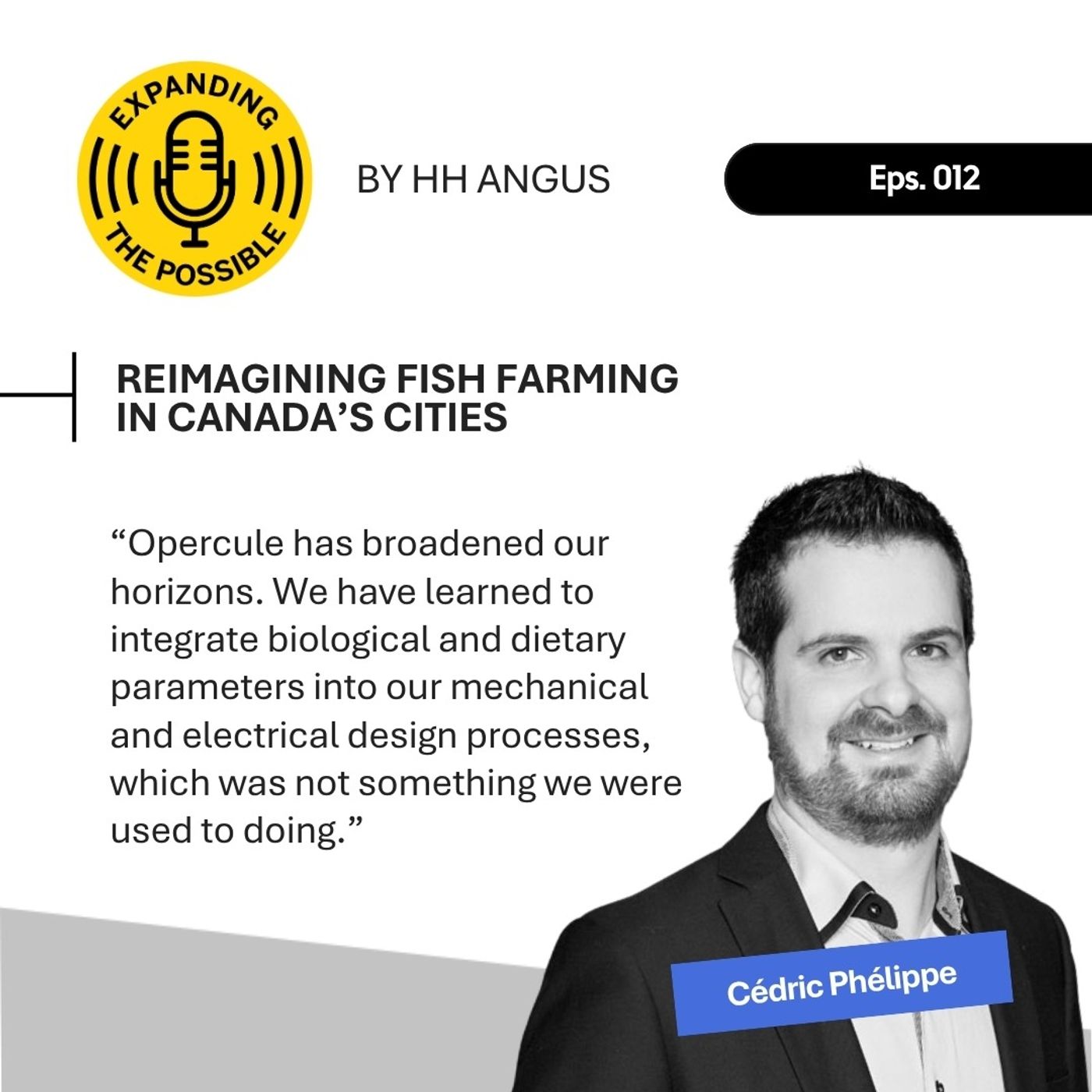
Opérucule is a pioneering urban fish farm in Montreal, recognized with the Visionary Award for its innovative engineering. Founded by Nikola Paquette, it is Canada's first commercial operation of its kind, raising Arctic char in a recirculating system that reuses 99.5% of its water, saving about a billion liters annually. The project faced significant challenges, including a multi-year permit process and technical hurdles like heat management, addressed with the engineering expertise of H.H. Angus & Associates. Located downtown, it delivers ultra-fresh fish locally via electric bikes, uses city water and sewer systems to minimize environmental impact, and avoids antibiotics through strict biosecurity. The farm emphasizes sustainability by repurposing unsold fish and using recycled materials. This model not only reduces food waste and transportation emissions but also sets a precedent for future urban aquaculture projects, with plans to expand by converting fish waste into resources like fertilizer.
[Music] Hello and welcome to Expanding the Possible. I'm Kirsten Nelson. Today we're featuring a very unique engineering project on the podcast. La Femme operacle or the operacle fish farm is located in Montreal and is a pioneering aquaculture project that has just recently been honored with the Visionary Award from the Association of Consulting Engineering Firms in Quebec. Opercule is the country's first commercial urban fish farm and is changing the face of aquaculture in Canada and in particular in Quebec. I'd like to welcome Nikola Paquette, owner of Opercule along with Siddler Kphilipe, project lead for H.H. Angus and Associates which provided mechanical and electrical design engineering to the project as well as serving as prime consultant. Nikola and Siddler Kha are here to share some of the innovative engineering that went into the project and how it's achieving some very ambitious sustainability goals. Welcome Nikola and Siddler. First of all I want to congratulate you both on winning the Grand Prize, the Visionary Award from AFG. That's an incredibly prestigious honor to be selected as the top prize winner from among all the engineering entries this year. You must be very gratified. Nikola what does that mean to you? Well it's kind of fun because like this project is the first one in Quebec like it was a bit of a crazy idea that we had and see that it works and that it's been recognized by like the AFG. It's really like gratifying to say like we were not crazy into doing that. It was hard but at the end it's worth it. So yes indeed it was really a nice surprise. We saw all the project being presented to this contest and when we get call on stage to receive the prize it was a big surprise because the projects were high quality in our opinion. It was a really nice presentation and a nice evening to have. We appreciate that AFG recognize our artwork for this project and we're thankful. Thank you very much. Nikola let me start with you. Before we get into the how and why describe for us what operacle is today. We are a fish farm. We raise our chart into a risk-clitting system so we use we use 99.5 percent of our water. So that's about 1 hundred two hundred less one hundred two hundred times less water than a traditional fish farm. So that's about a billion liter of water per year that we save. The system is in Montreal we are at the corner of like the Metropolis 10 the 15 so it's pretty much downtown we're close to our clients. We are in an industrial building like in a basement so like it's not where you would see some farming activities. So it was a long time that we started that and we're really happy with where we are now. When you say a billion liters of water that's it's even hard to wrap your head around that kind of number that's really incredibly impressive. Let's go back a few years then to when the idea for operacle existed only in your head you were a mechanical engineering graduate from LaValle University and you had worked in engineering. How did you know or what did you know back then that led you to think you could make a fish farm work in a big urban environment like Montreal. Actually I didn't know like it was a process. We started thinking about that I could decay the zone at Decay to go now. I knew I wanted to like reinvent myself get into a new work path and everything so I decided to go into a quad culture I went back to school I don't know to farm fish. Then with a guy that I've met at school we decided okay let's start the fish farm and then we started to ask question and every time like the answer was if we're in Montreal that problem goes away. Like we use the city water which is clean we use the city sewer which is well not clean but like it's it's really useful to have that. We are close to your client we use like an electric delivery bike. We we are able to like talk to the clients directly get the order and bring them like super fresh fish every week so it was a really long process and we're happy to have done it. At that time what did you think we're going to be the main kind of obstacles to success for you. Well we didn't knew all the obstacles we would face. Like we started to talk with the city of Montreal then we needed to talk with the agriculture ministry then we talked with the the phone I'm in sorry we talked with the environment ministry we've talked with the food one and so everyone needed to say yeah or nay. So like it took us multiple years to get all the permit and start the farming and we started the farming while we started the business in 2019 we got all the permit in 2021 the first fish in 2021 and we only started selling February 2023 so like it was mostly like a super long marathon like it's not a sprint if you want to do like crazy project don't expect it to be done in one year or two years like always give yourself time to do it like pace yourself. You decided to call in H.H. Angus and full disclosure here for our listeners you had worked at H.H. Angus why did you what did you know about the company that made you think it was going to be a good fit and what would they bring to the project. Person like I knew those guys like I knew how they were working I I was trusting them to do a good job I knew where they were coming from I knew how they were working and I knew that I would be listen and like bringing a crazy idea like that like not everybody would say yes I want to work on that like it's so out of the left field that it would be really easy to just dismiss it and the listening to me the listen to what I needed and we worked on a project that yeah we brought it on. So like what was your first reaction when you heard about the project were you keen on it from the beginning. Almost you know I know from a while and I always bring out some crazy ideas but this one was a good one right at the beginning it looks like we start like on the white page because you know fish farm we did few projects you know labs and pools but now you have to bring both together like I mean a pool and farm together and that was we thought at the beginning we started with white page however when we discuss Nikolas you know he's acting like expert client so he knows when you need like a person wise life wise so on our side we figure out that it's mainly more you know classic MEP work at this point yes to bring more you know innovative idea or specific equipment like the the gas or bio fields things like that but we managed to understand what he mean what he want it was pretty clear we spoke the same language and then we figured out that yeah it's not it's not that bad so yeah we we jump into both pretty quickly and I work with him until the completion of the project. The concept that Nikola described to you was very new in sort of in totality that in that there were no engineering specs that you could turn to to help you kind of figure out how it should be designed what skills would you say H.H. Angus has that made you believe the team could deliver on the special challenges around this project. Yeah the skills I was mixed skills so we need to reach a few people I H.H.H. Angus that have a different type of experience so in that case we reached the team of the the health care division which is that they're doing labs mainly like to raise animals for labs we did the project for a small aquarium and then you reach someone like Jeff Bellows to you know understand how Nikola can you know put all this waste fish waste in the Montreal sewer safely and not to clog the sewers and then we bring the electrical team for his operation because of course he means like to have emergency power if the hydro will drop down it's a major loss where I mean you lost the business in fold because the fishes are his business so yeah we bring a lot of knowledge different portion of all the division or most division in H.H.H. Angus to bring something together to realize that yeah it's not that out of out of our range of knowledge and together we can bring you know the project to the final. This question is really for both of you but Nikola I'll ask you first what was really technically challenging in the context of what had to happen in order to make the fish farm operational and for you to ready to sell to clients? Well the main part was like getting all the permit like we were talking with so many people like in the city of Montreal
We are not known for agriculture. So we were talking with people that were used to work with paint shop or big building or condos or offices, like bringing like a fish farm like to them is like crazy. Like what in the water like is the water going to be polluted? But like I'm raising fish in them like the water is not bad for the environment. It's just in use. So like that was the main concern from the city. And they were a big part of the reason why it took a long time. Just because they wanted to make sure that this crazy project would not break their system. And just to go a bit on the back of the first question earlier, like what we've done is not new technology. It's just like the way we are using it. So like you affirm like it's a shingles all the tool in their tool belt to be able to bring this project to completion. They just needed to tweak their understanding on how to use those things. So like then let's let's look at it then from the engineering point of view and H.H. Angus's interest. What did you experience as key challenges? Because I think you were mentioning there was something about heat management. So when you and I were talking. Yeah, the management was one and now we're you know it's a main design criteria here because it doesn't look like but fish. Generator of heat. And you know we that was part of our calculation. Arbor what an other item was pretty good listen learn. You have a necklace. I have something called a decaster that's a unit that acts like a little bit like a cooling tower. Right. So the water falls on media and then you know technically should remove some heat. And the goal of this decaster is to remove the CO2 from the fish tanks. So they can have like nice O2 to breed unless I cast in their water. So what happens? Those the gasser don't really you know extract the heat as expected. In fact it was like the opposite. So Nicholas and that one we got to go back on discussion and calculation. At the end we need to raise the Jiller capacity by a few tons to achieve the water temperature required for this type of fish with the Arctic char fish. Arctic means cold water. He needs a lot of cooling. So yeah that was one of the lessons learned to take everything in your environment in consideration for eating alone and including life. So. I'm not sure which of you wants to answer this question but what do you see is being the main environmental benefits that comes from how the fish farm operates today and is there room to increase those benefits. The farm is very big in Montreal which means that we are in the city city water which is clean water. We are using the city sewer so we're not having like water going to a river or into something that you don't want. So like those parts like it's really clean. Also it means that we're really close to the restaurant to our clients. So we can offer like super fresh fish that's like directly from the farm to the table. Like my fish like it's harvested on the Tuesday we deliver them on the Wednesday which are still in rigor mortis. So they are as if they were frozen but it's just like a process of aging the meat. And the fish can last like easily a week to weeks in the fridge. So like there is a way less food waste by this process. Also something that I didn't really mention is that we every fish that were not about sell because they don't have the proper size or shape or whatever. We gave them food bank to make sure that no fish is wasted. Like every decision that we take is like what can we do to make it better. Like by being the city of Montreal we use electric bike to do the delivery. We use recycled cardboard boxes to do the insulation instead of a cell phone which is not recyclable. Like we always ask the question like what would be the good way to do it and that's how we go about it. And you also I believe don't use any hormones or chemicals? Well by using the city water like the water is clean it's portable it's without any pathogen in them so we don't have any antibiotic and chemical product in the hormone for the fish. What we do is a good bio safety. Like if you were to ask me like can I go and visit the farm. And the question the answer would mostly be no because that's a big risk for the life for the fish. Like animal safety welfare. The way that we work is like we always want to make the fish happy and make give them the best condition for them to grow well. Yeah that's great I mean it's wonderful to put the animal welfare first and we all know how important that is in responsible farming. I said like now that upper crew is up and running successfully. What do you think has been the impact on H.A. Jango's sustainable engineering practices? I mean the impact was you know all those lessons we have with this project you know as the Nikolas explained to me. So you know you have to sit like a big pool you have to to check your pH you know a quality your gas concentration contaminants things like that. So I think in the future it is going to impact our design on how we going to manage when the zero carbon on this one as well the eating the trick of course the cooling. You said of course and also we go and we're looking forward right. You know we speaking already for phase two what we can do with the fish ways right we don't open cold don't sell the old fish you prepare it so some some ways been created we discuss about can we do food plant with that and on dry food plants also this journey to all the eat all right so can we keep this eat to sell it to a neighbor you know just nearby is a vegetable farm so in the winter can be very useful to keep this eat for them and sell it. So you know that's not only right now that we learn for you know the successful for the sustainability of the for a vocal also in the future we still in discussion let's call it maybe a phase two we're going to see. It's very exciting this certainly sounds like there's lots of room for future development so like what does this AFG visionary award mean to H.H. Angus. And being part of the AVG for a few years and then present a project like this which you know let's be racially it's not a huge project but I think the award visionary is really well suit for our project since you know it's not something we see. Yeah. So we're really really grateful for that we expect also to show that our expertise in the future for what it's going to have a project especially you know when you know that it's going to be more and more common to have a fish farm let's say if you take the example of why you don't have like classic in the classic farm why you don't you cannot find you know cows in the wild because you know there's no more you need to raise them in a farm which soon enough with over fishing and you know some species going to be extent we have to find alternatives and I think Operkiel and H.H. Angus having this expertise can be really grateful and we really be thankful to AFG to show this because it won't stop locally it can be international national first end but we think world wide maybe right so that's really grateful for that opportunity. Nikola I understand there's a lot of interest in both your expertise with Operkiel and H.H. Angus and how to successfully get up and running a project like like your fish farm if our listeners want to know more about how this works how how can they do that who can they contact. The best way would be to contact H.H. Angus like the best way to start a project that is where an air is like to surround yourself with like professional know their stuff like even if you start with a crazy idea like they can be done you're just going to be the first one to do it get a good team around you try to do it like I know the fish farming is like interesting and everything but there is so much more like I work with people who do like Mikko material which is like material made of mushroom which is kind of crazy but it can be done like just try it and get yourself sort of like a fish farm.
around that with like good people like each thing is. That's great. Thank you, Nikolas, for your confidence. It was a pleasure to work with you. And it was a challenging one. And we really, really appreciate that. And we learned a lot. The FEMO PORCULA, it's a fascinating business. It's an engineering success with a certain sounds like a bright future and lots of opportunity for growth for expanding the possible. I just want to share our thanks with Nikola Paque, who is the owner of the FEMO PORCULA and set like Philippe, who is a project lead for HH&X. Thank you both, gentlemen, for joining us today and sharing your story on such a unique project. Thanks for the invite. Thank you. And to our listeners, we look forward to connecting with you next time on expanding the possible. Have a great day. [Music]
Podcast Summary
Key Points:
Opérucule is Canada's first commercial urban fish farm, located in Montreal, and recently won a prestigious Visionary Award for engineering.
The farm uses a recirculating aquaculture system that saves over a billion liters of water annually compared to traditional farms, operates without antibiotics, and prioritizes animal welfare.
Key engineering challenges included obtaining permits, managing heat from fish and equipment, and integrating systems in an urban industrial setting.
Environmental benefits include proximity to clients reducing transport emissions, minimal water waste, use of electric delivery bikes, and partnerships to eliminate food waste.
The project demonstrates innovative sustainable engineering with potential for future expansion, such as utilizing fish waste for agriculture.
Summary:
Opérucule is a pioneering urban fish farm in Montreal, recognized with the Visionary Award for its innovative engineering. 5% of its water, saving about a billion liters annually. H.
Angus & Associates. Located downtown, it delivers ultra-fresh fish locally via electric bikes, uses city water and sewer systems to minimize environmental impact, and avoids antibiotics through strict biosecurity. The farm emphasizes sustainability by repurposing unsold fish and using recycled materials.
This model not only reduces food waste and transportation emissions but also sets a precedent for future urban aquaculture projects, with plans to expand by converting fish waste into resources like fertilizer.
FAQs
Opéracule is Canada's first commercial urban fish farm, located in Montreal. It uses a recirculating aquaculture system that saves about a billion liters of water annually compared to traditional fish farms.
It uses clean city water and the municipal sewer, reducing pollution. Being in an urban area also allows for local delivery via electric bikes, cutting transportation emissions and food waste.
They avoid antibiotics and chemicals by using pathogen-free city water and prioritize bio-security. Unsold fish are donated to food banks to minimize waste.
Managing heat from the fish and adjusting equipment like de-gassers for cooling was a major challenge. Permitting with city authorities unfamiliar with urban aquaculture also took several years.
Nikola Paquette, a former employee, trusted their collaborative approach. H.H. Angus combined expertise from healthcare, aquariums, and utilities to design mechanical, electrical, and waste management systems.
It validates the project's innovation and feasibility, encouraging future urban aquaculture. For H.H. Angus, it showcases their ability to tackle unique, sustainable engineering challenges globally.
Chat with AI
Loading...
Pro features
Go deeper with this episode
Unlock creator-grade tools that turn any transcript into show notes and subtitle files.
 PodcastTranscript AI