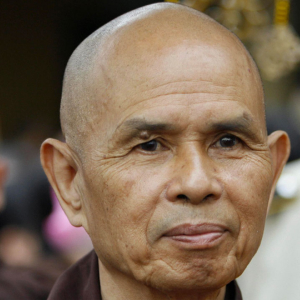
Ending the Vicious Circle of Negative Habits — Thich Nhat Hanh
84m 17s
The text describes a profound mindfulness practice centered on listening to a bell. The ritual requires the bell master to prepare with mindful breathing before offering a half-sound, alerting the community to stop and breathe, ready to receive the full sound as the "voice of the Buddha" calling them back to their true home in the present moment. This practice extends to everyday life, where sounds like telephones and clocks become cues for "Telephone Meditation" and mindful breathing.
The speaker then shares a personal journey, recounting his exile and peace activism during the Vietnam War. He describes how his community, opposing the war, was silenced by both sides, leading to dramatic acts of protest like self-immolation to convey a message of love and reconciliation. Despite being banned from his homeland and facing visa denials for 38 years, he explains that he ceased suffering by realizing his "true home" is not a physical place like Vietnam, but the mindful, peaceful present moment accessible anywhere. He concludes that by deeply touching the present, one can heal the past and live fully alive, transforming the now into the most wonderful moment of life.
[Bell] [Bell] [Bell] Dear friends, whenever we hear the sound of the bell, we practice listening to the bell deeply. Usually when someone invites the bell to sound, we don't say, "Hit the bell." We say, "Invite the bell to sound." He or she should wake the bell up first, with a half sound, like this. [Bell] That is a half sound. But before he does that, she does that. She has to practice mindful breathing first, to prepare himself. And then it is the first for the bellmaster to use for breathing in and breathing out and to make himself or herself. Available, qualified as a bellmaster, you just cannot pick up the instrument and then make the sound. You have to prepare yourself. So holding the, like I borrowed it, holding the stick like this, you will practice mindful breathing. A few times, in order to calm himself down, to make him or her into a real bellmaster and the verse is like this. Body, speech and mind in perfect oneness. I send my heart along with the sound of this bell. May the hearers awaken from their forgetfulness and transcend the path of anxiety and sorrow. And then you are calm. You are fully aware, you are fully penned. And now you can invite the bell to sound. You invite, you, you offer half a sound. So that the whole community become aware that a real sound, a full sound is going to be heard. And everyone stop thinking, stop talking, prepare themselves to receive the full sound, the voice of the Buddha, calling you back to your true home. In a practice center, the sound of the bell is the voice of the Buddha from within, calling you back to your true home. And so the bell must make a half sound and allow you the time to prepare yourself for the reception of the full sound, the voice of the Buddha. You stop what you are saying. You finish what you are saying in a few seconds. You stop your thinking. Not only you are talking, but you stop also your thinking. And you go home to yourself with your in-breath. And you enjoy breathing to get prepared for the sound. The sound as the voice of the Buddha from within calling you back to your true home. And then the bell must still go around you the time to for one in-breath, one out-breath, at least. And then he or she will invite the bell so that a full sound will be offered to the whole community. And then everyone will enjoy breathing in and breathing out, at least three times. And when you breathe in, you say, "I listen, I listen." And when you breathe out, you say, "Wonderful sound brings me back to my true home." Listen, listen, this wonderful sound brings me back to my true home. No thinking. Just listening, listening very deeply to the sound of the bell that will bring you back to your true home in the heat of the bell. And the one who speaks, stops speaking, and thinking about what to say next. And enjoy deeply his in-breath and out-breath. Enjoy his being in his true home. That is the living Dharma. Being in your true home. And the one who listen to the talk also stops listening. And enjoy his in-breath, in out-breath, very nourishing, very in. In population France. Not only we enjoy the sound of the great bell within our center, but whenever the bell, the touch bell nearby, sound will also stop and enjoy the touch bell. Not only we enjoy the touch bell, but every time the clock plays music, every quarter of the hour, we also stop thinking, stop talking, and we go back to our breath, and we enjoy breathing in and out. In the dining hall or in the kitchen, we do the same, so the clock. It's like the mindfulness mail helps us to come home and to enjoy our home. Also, when you hear the telephone ringing, you practice. You are supposed not to run to the telephone. You are supposed to stay away if you are, because the sound of the telephone is also the voice of the Buddha, holding back your back to your home. Stay away wherever you are and go back to your in-breath. Listen, listen. This wonderful sound brings me back to my truth. Then after having practiced like that two times, you do walking meditation to the telephone and answer. And if you are the one who is called, who wants to make a phone call, you prepare yourself before making the number. You practice going home to yourself, and there is also a verse for you to practice. Verses, words can travel thousands of kilometers. They are to bring about more understanding, mutual understanding. I vow that what I am going to say will be beautiful like flowers and embroideries. I vow that everything I am going to say will help with more mutual understanding and compassion. And then now you are qualified to make a phone call. And when you hear the sound of the other end of the line, you know that the other person is listening, breathing in and out, and you know that you have a chance to practice breathing in and out with her. So both of you are breathing in and out, mindfully, at the same time. It is a very beautiful practice. We call it "Mail Telephone Meditation." And then in Plum Village, in the Deep Park monastery also, if we use the computer, the computer is a program so that every quarter of the hour there will be a bell of mindfulness so that you can stop your work and go home and enjoy your in-rate and out breath. And you know that when you call Plum Village or Deep Park, you don't expect them to answer right away after the first wing. They are breathing in and out. Listen, listen. This wonderful sound brings me back to my true home. And you enjoy deeply your in-bred and out-bred three times. The bellmaster tonight is a monk from New Zealand. More of the Papdi and the field of the Dharma. Enjoy the mindfulness bell. Enjoy your in-bred and out breath three times. [Bell] You may use the verse "I have arrived," I move. I have arrived. I move. And you might like to say, "I listen deeply." This wonderful sound brings me back to my true home. And you might say, "Breathing in, I feel calm, I relax." Breathing out, I smile. Coming, smiling. Breathing in, I establish myself in a present moment. Breathing out, I know this is a wonderful moment. Coming, smiling. Present moment. Wonderful moment. When you come home to the present moment, with your in-bred, you become fully alive, fully present. You can touch life in the hand and now. You feel that you are alive. You touch the miracle that you are alive. It was to be alive. That is the greatest world of miracles. And with only one in-breath, you can touch that miracle. That is why you can say present moment. Wonderful moment. If someone asks you, my dear friend, has the most wonderful moment of your life arrived. He wants to know whether the most wonderful moment of your life has arrived. It would be a pity if such a moment does not arrive at all. Then you may have the tendency to say, "Oh, it does not seem that it has arrived." That wonderful moment. But I am sure that it will arrive soon some time in the future. That is our tendency to answer. But if we keep living like the way we have lived our life in the past twenty years, it will not arrive in the next twenty years. It might not arrive at all that moment we call the most wonderful moment of our life. And for many, many of us, that moment does not arrive at all until we die. The Buddha said, "You have to make the present moment into the most wonderful moment of your life." And this is possible. Because if you are able to go home to the present moment today and now, become fully alive, become fully present, you can touch all the wonders of life within yourself and around you. Everything belonging to you is a wonder. Your eyes, your ears, your nose, your body, your mind. And because you are not mindful, you don't touch them deeply. You don't know that there are wonders. Until you die and you begin to regret that you have not lived at all. That is why our true home must be sought in the end of now. It can be touched in the end of now. My true home is not limited to a place. To a time, my true home is not with now. My true home is not with friends. My true home is not America. My true home is not Africa. My true home is not the palestine. My true home is not Israel. Although they don't let me go back to Vietnam, I still have my true home available in the end of now. And maybe they are in Vietnam, but they don't have a home. That is why I don't feel as a victim. And I don't feel that they are my enemies. They are victims of fear. They believe that if I go home, I will create an atmosphere of solidarity, a friendship, a brotherhood that may be threatening to their power. And it is fear. That is an obstacle. I want to help them to be free from fear. They are not my enemies, they are the ones I want to help. They are object of my practice of compassion and understanding. I have no enemies. During the war, during the Vietnam war. It was so difficult for us to voice our concern. Many of us, most of us, did not want the war. The war put us in a situation where brothers have to kill brothers. And kill with foreign weapons and ideologies. Communism and anti-communism are important. We are important. Also, weapons, used by the communists, were important. We used the anti-communists were important. So they gave us guns and ideologies and urges to fight each other and kill each other. We started a movement called Don't Shoot Your Brother. Our voice was silenced by both sides of the warring parties. We tried to speak out. We tried to tell you in a war that we don't want to war. We don't want killing each other with foreign weapons and ideologies. And yet we were forced to do so. So those of us who practiced mindfulness, understanding and compassion, we did not want to accept the war. And our voice was not allowed to be heard. Sometimes we have to burn ourselves alive in order to get the message across. Tid Quang Duk, a friend of mine, one day he burned himself and his picture appeared in an international press. I was in New York. And I saw that picture in a New York time, front page. It was a friend of mine. Duk Timae, one of the first six members of the order into being my disciple. She burned herself, calling for reconciliation. She went to the Tinian Temple in very early in the morning about two or three o'clock in the morning. She put the statue of a version Mary. And Quang Duk, she left behind a set of letters calling for the president of North Vietnam, president of South Vietnam, for everyone to come together and stop the act of killing each others. And then she doused herself with gasoline and she burned herself. Duk Timae is a very close sister, callous friend of she could younger. She is a younger, true emptiness. I was in Paris. She left behind a letter, "Tai, don't worry. Peace will come, don't worry." She was about to die and then but she tried to comfort her teacher. It's very difficult for us to voice our concern. Although we are the majority in the country, we didn't want to do it. My book was poetry. Peace poetry. I like to call it peace poetry rather than anti-war, anti-war poetry. It was condemned by the North and confiscated by the South. So when Cornell University invited me to come and make a series and give a series of letters, I took the opportunity to go out and to call for peace. And in June the 1st, the year to the year 1966. '65, '66. I met Martin Luther King in Chicago. Exactly one year before. On June the 1st, '65, I wrote him a letter explaining to him why we had burned ourselves. This is not an act of suicide. This is an act of love. You want to transmit the message, but you have no other ways. You have to burn yourself in order for your message to get across. So the suffering of the monk burn itself to get the message across, message of love and compassion. It's not the same nature of the act of Jesus Christ dying on the cross. Then with no hate, no anger only with compassion, living behind a compassionate call for peace or brotherhood. So exactly one year after I met him in Chicago, we talked for some time and then after that, we went out to meet with the press and then he came out against the war in Vietnam. And that is the day when we combine our efforts, working for peace in Vietnam and fighting for civil rights in America. Two years later, I met him again in Geneva. In a conference called "Pasemitaris" organized by the World Council of Chuchus, and people like Lannes Bowling at the conference. He stayed in the 11th floor. I was on the 4th floor. He invited me up for breakfast. He was retained by the press. I came up late and he kept the breakfast warm for me and waited for me. I told him, "Martin, you know something in Vietnam? They call you a Bodhisattva. They call you a Bodhisattva, an enlightened being, trying to awaken other living beings, and help them grow in a direction of compassion and understanding. I'm glad I had the chance to tell him. Because a few months later, he was assassinated in Memphis, Memphis. We were in France. We had a bureau office representing the Buddhist community in Vietnam. We wanted to represent the mass of people who did not have a voice. We did not have a chance to speak out. So we live as a community in Paris. And I'm office in a poor quarter of Paris. Number 11. Like Wooddale Street. And that quarters were inhabited more by the people of Arab origin. Every time I applied for a visa to go to America, it was turned down automatically. They didn't want me to come to America, because they believe that I am, I may be harmful. I may be an obstacle for the war efforts in Vietnam. I was not allowed to go to America. I was not allowed to go to England. Every time I wanted to go to America to speak to her, I had to write a letter to someone like Senator Macron, or Senator Robert Kennedy asking them to send me a letter of invitation. The letter is something like this. I would like to know more about the situation of the war in Vietnam. Please come and inform me. And if you have difficulties concerning the visa, please telephone me at this number. Only with such a letter that I could have a visa otherwise, snowy. I remember one day I flew from Japan back to Paris. I did not have a visa for transit. In Seattle, I flew from Tokyo to New York via Seattle, and then to Paris. I want to stop in New York, in order to meet with a friend in a peace movement, Alfred Hasler, on the fellowship of reconciliation. And when I landed in Seattle, then I was locked in a place where I could not see anyone. I looked around and saw many pictures, wanted, wanted, wanted. They took my passport. They didn't allow me to be in touch with anyone. And then when the plane is about to take off, they gave me my passport back. It was very difficult. One day, when I was in Washington, DC, I told you already. The Baltimore San reporter came and informed me that there is a dispatch, dispatch from Sion, informing the government of the United States of America, of France, of England, United Kingdom, and of Japan, asking them not to unknow the passport of the Mexican. Because he has been saying things that are not helpful to the world efforts against communism. In Vietnam, my books, my articles, my poetry was banned by both the communist and anti-communist. I risk deportation and put in jail because I have done, I have done, calling for peace and speaking against the world. It was my intention to go only three months to give the series of lecture in Ghana and then to make a tour of America and Europe and go home. I was working with my friends in the School of Youth for Social Service. One day, this university that I found it, I found it in '64. All my friends, coworkers who in Vietnam, I didn't want to go very long. I intended to come here only for three months. But it has been 38 years already. I have not been able to go 38 years. And that is why I have been sharing the practice with friends in Europe, in America, in other countries. But because I have found my true home, I don't suffer. The truth is that during the first year of my war in exile, it was difficult, quite difficult. Although I was already 40, although I was already a Dharma teacher, having many monks and nuns as students, disciples. And yet I have not found my true home. I can give very good lectures on Buddhism, on the practice of Buddhism. But I had not truly arrived. Intellectually, I had a lot of Buddhism. I had been trained several years in a Buddhist institute. And practicing in the time I was 16. And during the time I was young, I tried my best to renew Buddhism, update Buddhism. So that Buddhism can respond to the real situation of suffering, called engage Buddhism. The kind of Buddhism that can offer you the answers to the burning question of society. Questions like war, social injustice, political suppression, poverty, violence and so on. It was very difficult for me during the first two years. Because my intention was to bring about information to the kind of information that was not available to people. Because the war in parties, they had all the mass media. And in speaking to them, I slept one or two nights in HCT, in America, in Europe, in Australia, and so on. The whole time when I woke up in there at the night, I did not know where I was. It was very difficult, very hard. And after, well, I had to breathe in and out and to find out where I was, what city, what country. And I dream of going home to my root temple in Central Vietnam, climbing a hill, green hill, with full trees. And half the way to the top of the hill, I woke up and realized that I was in exile. And the same kind of dream repeated again and again. I was very active. I was making friends with many people, Catholic priests, Protestant ministers, professors, young people, children. And my practice was a practice of mindfulness. I tried to live in the here and now, and touch the wonders of life in my daily life. I survived by a bit of practice. The trees in Europe were so different from the trees in Vietnam, the fruits, the flowers, they are all different. And the people also, so I learned to make friends and play with German children, French children. American children, British children, I am a big friend with an African priest, Catholic priest, Protestant ministers and so on. Thanks to that practice, I was able to find my two home in the here and then now. And I stopped suffering, and the dream did not come back anymore. People think that I suffer when I cannot go back to Vietnam, but that's not the case. If I go to Vietnam, that will be a joy to be able to offer the teaching to the monks, the nuns, the laypeople there, and talk to the artists, to the writers and others. But if I cannot go, I don't have to suffer. I can meet with people, other people in other countries like in China, in Korea, in Japan, in Spain, in England, in Canada, and so on. And the formula I have arrived at home is the embodiment, the expression of my practice. It express my understanding of the teaching of the Buddha. It is the crib of my practice. I have arrived at home. And since the time I found my dream, I didn't suffer anymore. The past is no longer a present for me. The future is no longer a present for me. I'm able to live in a here and a now. I'm able to touch my true home. And I know that the future is available to the present. This is what I have found. When you touch the present moment deeply, you touch the past. And if you know how to handle the present moment properly, you heal the past. Many things that the past is already gone, you cannot do anything. You cannot go back to the past and fix things and repair things, according to the teaching of the Buddha. The past is still there with all the pain and suffering. And if you know how to come home to the present moment, and touch the present moment deeply, you touch the past and you can heal the past. And when you heal yourself, you heal your ancestors. And this is possible. My ancestors have suffered in me. I have also suffered. And since I'm able to touch the present moment deeply, I heal myself and I heal my ancestors, including my parents, my father, my mother. My brother, my sister, my grandfather, my grandmother. When I practice walking, I generate energy of freedom and solidarity. And I feel that all my ancestors enjoy the freedom and the solidarity that I generate with the practice of walking. Because to me, my ancestors are always alive in me. It's fully present in me, in every cell of my body. And if I am free, there are free. If I am here, there are here. When I take a step with solidarity and freedom, all of them take that step with me. And you have to take that step with all your being, full awareness, full concentration in order for the step to be really solid, to be free, in order for you to be able to touch the life, the wonders of life in that moment that is healing and nourishing. So the act of making a step is an act of freedom, act of liberation. You liberate yourself, you liberate your ancestors. It's an act of revolution. Please believe me. You cannot make such a step unless you invest entirely your body in your mind, 100%. When you breathe in, you bring all yourself together, body and mind. You become one, and equipped with the energy of mindfulness and concentration, you make a step. And you have inside that, this is your true home. This is your life, you are fully present, you are touching life as a reality. Your true home is not an abstract idea. It is a solidarity that you can touch with your feet, with your hand and with your mind. The kingdom of God, on a pure land of no other, for me, they are not abstract ideas. That is something you can touch in every moment, you can live in every moment. It is available in the kingdom now. If you know how to make yourself available, and the kingdom is available, the pure land is available, your true home is available. And nobody can take away your true home. They can occupy your country, yes. They can put you in prison, yes. But they cannot take away your true home and your freedom. So it is very important, it is very fundamental, it is very basic, that you touch your true home, that you will realize your true in the hand now. And the energy with which you can do so is mindfulness and concentration, and these are energies of the Buddha. All of us have the seed of mindfulness and concentration in us. This is something, this is a fact, because all of us are capable of drinking our tea my full day. When I drink my tea, I want to really drink my tea. I may like to breathe in in order to bring my mind home to my body and establish myself fully in the hand now. You have to be there fully. And when you are there fully, the tea will be there for you fully. If you are not there, the tea is just something like a roast, not very real. Mindfulness helps you to become fully present and fully alive in the hand now. It does not take long, it might take just one step or one in rest. And by making a step or breathing in, you bring your mind back to your body. In your daily life, your body may be here, but your mind may be there. They go into different directions. And you are in the state of destruction. Mind and body are away from each other. Your mind may be occupied by your project, your fear, your anger. Caught in the past, caught in the future. But within your mind and your body, there is something, your breath. And as soon as you go home to your breath and you breathe, breathing in, I know I am breathing in. And then your body and your mind come together, very quickly. While breathing in, you don't think of anything, you just focus your attention to your in-breath. You focus, you invest one percent of yourself into your in-breath, you become your in-breath. There is a concentration, mindfulness of your in-breath, concentration of your in-breath, that will make body and mind come in together in just one moment, and suddenly you become fully present for your life. And in that state of being, you pick up your tea and the tea becomes a reality, not a ghost. And when you drink your tea, you are just drinking your tea. Let's call mindful drinking. There is no thinking. There is a drinking, deep drinking. You are real, and the tea is real. And when you are real, the tea is real, life is real. And many people live in a dream because they are not in the present moment. They don't know what is going on in the present moment. But because you are able to bring your mind back to your body, you are fully present, and you become aware of what is going on. What is going on is that I enjoy my tea. There is no drinking. There is no thinking at all. It's only drinking of tea. In that moment I live deeply the moment drinking my tea. When I breathe in, I become fully aware of my in-breath. My in-breath becomes the object of my fullness. My in-breath becomes the object of my concentration. And that is why my body comes home to my body right away, and I become fully present. Suppose you a group of people stand there and contemplate a beautiful sunset. If you keep thinking about the past, or thinking about the future and your project, you are not really there contemplating the sunset. The sunset is not for you. So if you practice breathing in and out and become available in the here and now, and a beautiful sunset is for you, breathing in, I know the sunset is there, with and out, I smile to the beautiful sunset. In that moment, life is a real. And you have your cool. When you go back to the present moment, you may encounter the wonders of life that are refreshing and healing. You may encounter suffering, violence, health, fear, discrimination. And if you are a good practitioner, you have enough mindfulness in order to handle whatever needs to be handled. Suppose anger is coming up in you as an energy. As a practitioner, you don't allow anger to be alone. In you, because if you let anger to be alone in you, anger will cause a lot of damage in your body, in your mind. And maybe around you, that is why you practice mindfulness of anger. Breathing in, I know anger is in me. Breathing out, I smile to my anger. I embrace my anger. You have a seat of anger, deep in yourself. But you also have a seat of mindfulness, deep in yourself. You have a seat of compassion in yourself. When anger is touched, when the seat of anger is touched, it manifests into a kind of energy called anger. Suppose this is your consciousness. And it has two layers. The lower layer is called "store consciousness". And the upper layer is called "mind consciousness". You have a seat of anger here. You also have a seat of joy of mindfulness, of compassion, of non-discrimination. You have a seat of anger, of despair, of jealousy, of discrimination in the depth of your consciousness. But when the seat of anger is left alone there, in the store consciousness, you don't water it. No one comes and touch it. You are okay. You can laugh, you may have a good time. But that does not mean that you don't have the seat of anger in you. As soon as you hear someone saying something, doing something, the seat of anger in you is touched. It becomes a zone of energy in the realm of mind consciousness. In Buddhism, we call it a mental formation. Anger is a mental formation. In my tradition, we speak of 51 categories of mental formations. We have a seat of discrimination in us. We have a seat of non-discrimination in us. That is true. If the seat of discrimination is water every day, it becomes very important. And it doesn't allow the seat of non-discrimination to manifest. If the seat of anger becomes stronger and stronger every day, the seat of compassion has less chance. And that is why every time a negative seat is touched and manifest, we have to take care of it. That is why I spoke about mindfulness of anger. When mindfulness is the capacity of knowing what is happening, what is happening is anger has manifest. As a practitioner, you ask the seat of mindfulness to manifest at the same time. And if you are a diligent practitioner, the seat of mindfulness in you is strong enough and it's very easy for you to touch and invite it to come up. And it comes up with a zone of energy. Mindfulness is energy too. Mindfulness is mindfulness of something. And here, mindfulness of anger. Mindfulness here has the following functions. Recognizing, recognizing, and as anger, mindfulness of breathing, breathing in, I know this is my in breath. I know this is my out breath. Recognizing in breath as in breath. Recognizing in breath as out breath. Recognizing drinking as a drinking. Recognizing walking as a walking. That's the nature, the function of mindfulness. So, the energy of mindfulness generated by your breathing, your walking, has the capacity of recognizing anger as anger, breathing in. I know anger is in me. Breathing now, I take good care of my anger. Recognizing anger and embracing anger. This is an art. This is a practice. There's no fighting. Mindfulness is generated not to fight anger, but to recognize anger and to hold anger very tenderly. That is Buddhist practice. You do not transform yourself into a battlefield. The good fight in the evil. That's not Buddhism. Because you are mindfulness, but you are also anger. And mindfulness played the role of a big sister, holding the angry, the suffering younger sister and help her to transform. A mother was walking in a kitchen and she heard a baby crying. She very much cared for her baby. So, she stopped walking in a kitchen. She put down whatever she is holding and she goes to the room of the baby. The first thing she does is to pick up a baby and hold a baby 10 days into her arms. That's the mother. She does not know what is wrong with the baby yet, but the first thing she does is to pick up a baby and hold her mouth. Mindfully. We do the same thing as a practitioner. Every time anger or despair comes up, we generate the energy of mindfulness in order to recognize and to embrace tenderly. And if we know how to practice mindful walking or mindful breathing, we continue to generate mindfulness. And we have that energy in order to recognize and to embrace. And we can bring a relief. Because mindfulness as an energy, I'm embracing anger as another source of energy, tenderly. Big brother, younger brother. Although the mother has not realized what is wrong with the baby, but the fact that she is holding the baby tenderly can already bring a relief to the baby and the baby may stop crying. And if the mother continues to hold the baby tenderly with mindfulness, she will find out what is wrong. The baby may be hungry, the baby may have a fever. The diaper may be too tight. As a mother, she can find it out very quickly. As a practitioner, you can find out very easily why this anger. You can see the roots of the tender. You find out the nature of the tender. If the mother found out what is wrong with the baby, she can fix the situation very quickly. If the baby is hungry, she can give her some milk. If the diaper is too tight, she just undo it and do it again. So after having embraced tenderly your anger, you might like to continue the practice of mindful breathing, the practice of mindful walking and look deeply into the nature of your anger. And find out what is the root of your anger, recognizing, embracing and looking deeply. Because mindfulness is the kind of energy that carries with her the energy of concentration. Whenever mindfulness is, concentration is answer. When you are mindful of your in-breath, you are concentrated in your in-breath. When you are mindful of your tea, you concentrate on the tea. That is why the more powerful mindfulness is, the more concentration you get. And with that mindfulness and concentration, you practice looking deeply and you get the inside. And that inside is going to liberate you, transform your anger. There is a story of a young boy who used to come to Plum Village every summer with his younger sister. And they practice mindfulness as children. The boy had difficulty with his father. He blamed his father. Every time he fell down and get hurt, his father always sheltered the team instead of coming and help him. So his relationship with his father was difficult. And he vowed that when he grew up, he would not be like his father. If he had children and then if he tried to fall down and get hurt, he would not shelter the team instead he would come and try to help. That is his determination. One day he was playing in the lower hamlet, the Plum Village and her sister, while playing with another little other hamlet, fell down and get hurt. And the blood was coming down. Suddenly he found himself very angry. He wanted to shelter, stupid. How could you do something like that? And because he had been practicing mindfulness, he was able to refrain from shelter. And he recognized that he was exactly like his father. Instead of time to come and help his sister away, he had the tendency to shout at her. He hated what he has within himself. So when he practiced mindful breathing, he knew that this is the continuation of his father inside of him, he is not different from his father. And with that insight, he turned around and practiced slow walking when he had seen someone coming to have his sister. And during slow walking, he recognized that he is a continuation of his father. The energy of anger has been transmitted by his father. And if he does not practice, he is going to become exactly like his father. And he will treat his children in the future in the same way. That is called samsara, continuation. And suddenly he had a desire that he had to home and tell his father that he has exactly the same kind of energy. And he would invite his father to practice with him. And when that intention was born in him, his anger, resentment to his father began to dissolve. What kind of insight did he get? He got inside that he is exactly like his father. He has the same kind of habit energy. And that is why he wanted to practice. And he saw himself as a victim of that energy, victim of the transmission of that habit energy. And he saw that his father also was a victim of that transmission. His father might have got it from his own father. And when he had that insight, his anger vis-à-vis his father just stopped. He got the transformation. I think for a young man of twelve, that is a remarkable achievement. It is insight that transforms our afflictions. And myfulness has the power of recognizing, embracing, looking deeply, getting the insight that transforms you, that gets you free. The transformation, and healing, and freedom. And when the young man is laid liberated, the father in him was liberated, and the ancestors in him are liberated, he ended the circle around Samsara. What the young man realized is that he is not a victim of his father. He is a victim of that habit energy. And his father also is a victim of that habit energy. And when you are able to transform you, you are in a situation to help transform him, the one that you have believed that to be your oppressor, the source of your suffering. And that is my practice. I do not have enemies. Even they have created a lot of suffering, a lot of injustice. They have tried to kill me, to suppress me. But they are not my enemies. They are those I want to help. Because I have become free. I have changed myself. I have transformed myself. That is why I am no longer. I do not know how to see myself as a victim. I know that if I can transform myself, I can transform them. I can help transform them. If you practice, and if you can transform your mind, your heart, you will become a Buddha's Alpha. And then you will be in a position to help them transform those. You use to consider as oppressors, abuses. Those who consider to be the one who discriminates against you, trying to suppress you and kill you. And they are also victims of their own ignorance, their own anger. They do not know how to handle their craving, their anger, their violence, their fear. So the path is to transform yourself into a Buddha's Alpha. With plenty of understanding, insight and compassion. And when you have these energies, you are free. And you are in a position of helping other people to become free also. This is the path shown to us by the Buddha. And as every one of us has the seed of mindfulness, concentration, and insight in himself or in yourself, you are able to cultivate these three kinds of energies for our own liberation and healing. And we shall use the same kind of energies to help the transformation and healing of the world. When you look up, you see a temple. The temple is in your heart, the lotus in your heart. And underneath there was the word "smarty", "smarty" means mindfulness. And then there is the word "somebody" means concentration. And there is the word "praashnaya" that is insight. And that is the kind of energy that are in us to be cultivated, to develop. That is the energy of the Buddha in us. The energy of transformation and healing. During our retreat, we practice mindful breathing, mindful walking. And that is why we are encouraged to use our time for the practice. If we talk a lot, there will be no time to enjoy our in-breath, our breath, our walking. There will be time when we are encouraged to talk to each other. That is my discussion. We will be sharing our insight, our way of overcoming our suffering. And when we practice eating our lunch or our breakfast, we refrain from thinking. We establish ourselves in the he and the now, and we pay attention only to the fruit that we eat. When we pick up a piece of our bread, we do not think of the past of the future. We just touch the piece of bread deeply. And we are able to see that the piece of bread. So if you look deeply into the piece of bread, you see everything in it. And the piece of bread you hold in your hand is the body of the cosmos. And with a little bit of mindfulness, you can see that the piece of bread is an ambassador for the form of the cosmos coming to you. And if you can see the piece of bread in its true nature, then you can put it in your mouth. Don't put anything else in your mouth like your projects, your fear, your anger is not healthy. Just put the bread. And when you shoot the bread, just shoot the bread. Mindfully, with joy, don't shoot your sorrow or your anger, it's not good for your health. There is no thinking, just the practice of mindfulness is chewy. And we take our time to enjoy our breakfast. From time to time, we pose and smile. The brother in front of you is you. The sister on your left is you. They all belong to the Sangha. And together we generate the mindfulness of the energy of mindfulness. The collective energy of mindfulness while walking, while sitting, while eating will be powerful. And it will penetrate into each of us. We will be healed by the collective energy and nourished by the collective energy. Alone in our living room, we can generate the energy of mindfulness. But compare to the collective energy of mindfulness. Well, it's not much, therefore to be in a Sangha. And to allow ourselves to be penetrated by the collective energy of mindfulness with Sangha is a very important. So, the coming together of a Sangha is a very important fact. It's a miracle. And we should profit from the opportunity. Allow ourselves to be transported by the collective energy of Sangha. Allow the Sangha to embrace our pain and sorrow. The Sangha is the boat that helps you to float on the river of suffering. Allow yourself to be transported by the Sangha, by the collective energy of mindfulness. And while eating, you enjoy the time being the Sangha. You smile your brother and sister in the practice. You allow yourself to be nourished by the collective energy of the Sangha. And every moment of our daily life, the mindfulness helps us to be in the here and the now. And the real practice, the true practice, is to allow every moment of our everyday life to be a joyful moment. That is, that will be possible thanks to the power of mindfulness and concentration generated by yourself and generated by Sangha Sangha. Tomorrow, we shall have mindfulness work in the morning. We shall be working together. We work in such a way that make the Kingdom of God real available in the here and now. The several of us are very used to the practice. We will work together and generate the collective energy of mindfulness together. And you will see that the Kingdom, the Pure Land, is available. [Bell] [BLANK_AUDIO]
Podcast Summary
Key Points:
The practice of mindful bell-listening involves preparation, a half-sound to alert the community, and deep listening to bring one back to their "true home" in the present moment.
This mindfulness can extend to daily sounds like telephones and clocks, transforming them into opportunities for meditation and return to the present.
The speaker shares a personal narrative of exile and peace activism during the Vietnam War, highlighting the difficulty of voicing dissent and acts of compassionate protest, such as self-immolation.
Despite decades of exile and political suppression, the speaker found freedom from suffering by discovering that one's "true home" is not a physical location but the mindful, peaceful present moment.
The core teaching is that by deeply touching the present moment through mindfulness, one can heal past wounds and live fully alive, making the present the most wonderful moment.
Summary:
The text describes a profound mindfulness practice centered on listening to a bell. The ritual requires the bell master to prepare with mindful breathing before offering a half-sound, alerting the community to stop and breathe, ready to receive the full sound as the "voice of the Buddha" calling them back to their true home in the present moment. This practice extends to everyday life, where sounds like telephones and clocks become cues for "Telephone Meditation" and mindful breathing.
The speaker then shares a personal journey, recounting his exile and peace activism during the Vietnam War. He describes how his community, opposing the war, was silenced by both sides, leading to dramatic acts of protest like self-immolation to convey a message of love and reconciliation. Despite being banned from his homeland and facing visa denials for 38 years, he explains that he ceased suffering by realizing his "true home" is not a physical place like Vietnam, but the mindful, peaceful present moment accessible anywhere. He concludes that by deeply touching the present, one can heal the past and live fully alive, transforming the now into the most wonderful moment of life.
FAQs
The half sound alerts the community to prepare for the full sound, allowing everyone to stop thinking and talking and ready themselves to receive the voice of the Buddha.
The bellmaster must practice mindful breathing first to calm themselves and become fully present, ensuring they are qualified to offer the sound.
The sound of the bell is considered the voice of the Buddha, calling practitioners back to their true home and helping them awaken from forgetfulness.
Sounds like a telephone ring are seen as opportunities to pause, breathe mindfully, and return to the present moment, treating them as the voice of the Buddha.
It means returning to the present moment through mindful breathing, where you become fully alive and can touch the wonders of life here and now.
By practicing mindfulness and finding his true home in the present moment, he stopped suffering and no longer felt like a victim, despite the challenges.
Chat with AI
Loading...
Pro features
Go deeper with this episode
Unlock creator-grade tools that turn any transcript into show notes and subtitle files.
 PodcastTranscript AI