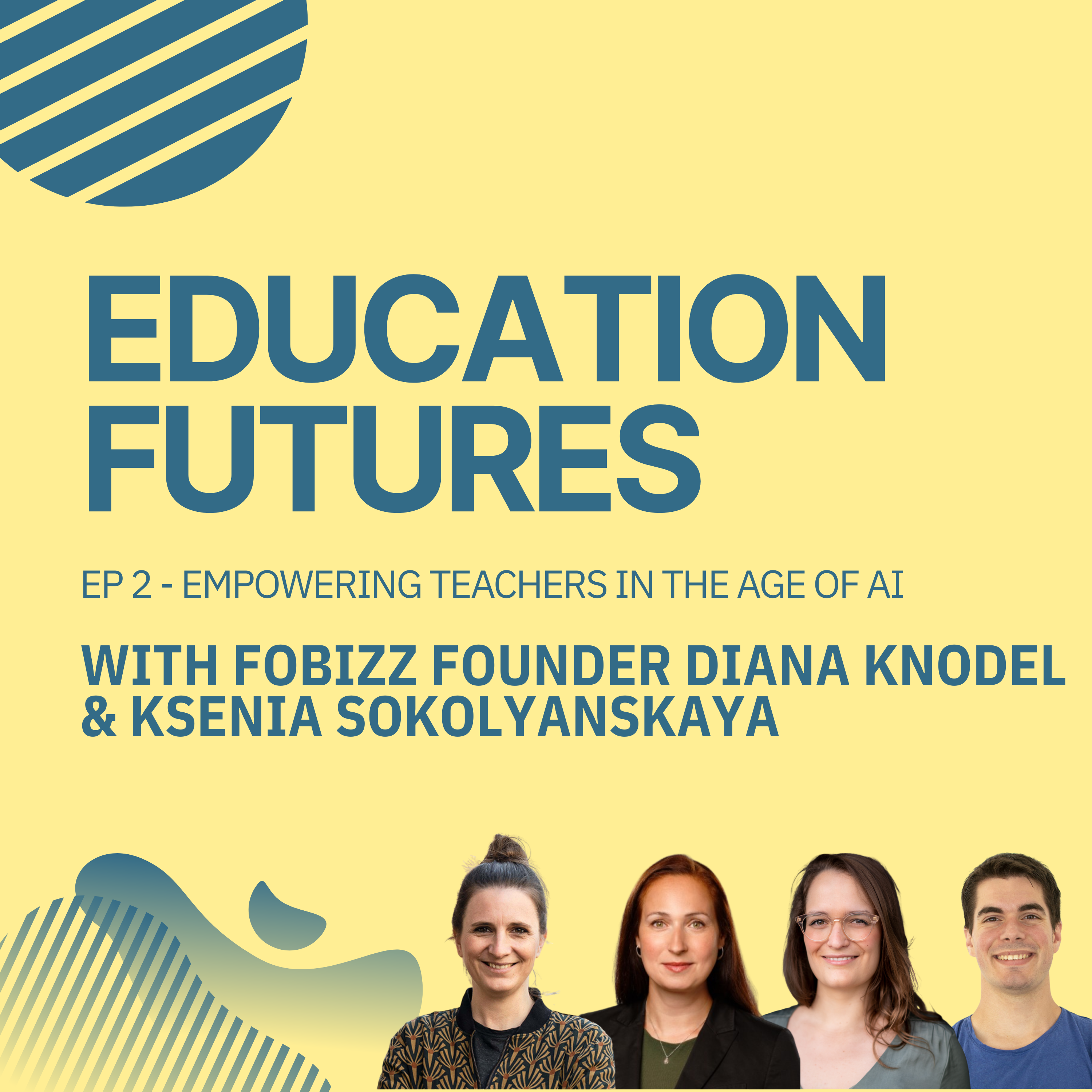
Fobis, co-founded by Diana and joined by Xenia, is an edtech company that supports educators in the age of AI. It began as a teacher professional development platform and evolved to offer GDPR-compliant digital tools and AI resources following ChatGPT's emergence. A key initiative is their free, global AI literacy training program, which has engaged thousands of educators, focusing on foundational knowledge, practical classroom integration, and critical evaluation of AI's benefits and risks, such as misinformation. The discussion highlights that future essential skills include lifelong learning, adaptability, and heightened media literacy for all. Predictions about education's future suggest a spectrum of school models will coexist, from low-tech to AI-driven, rather than a single standard. Globally, AI adoption in education varies in approach and support, but a universal need is building AI literacy to mitigate fears. Fobis adopts a practical, ethical, and human-centric methodology, providing adaptable teaching materials and direct human support, while stressing the importance of transparent, inclusive guidelines for ethical AI use in schools, ensuring human oversight remains central.
Hello and welcome on this episode of Education Futures and very, very happy to have Xenia and Diana from the Fobis team with us today. Loha and I are so excited about this conversation because you ladies are really shaping up the future of education at the age of AI with Fobis and you're going to tell us a bit more about what you do. We work a lot with teachers, you're preparing them for an education, an age of AI-driven education. So thank you so much for being our guest today. Maybe you want to start introducing yourselves. Sure, so first of all, thanks for having us. We are honored to be on this podcast. So my name is Diana. I am the co-founder and CEO. My background actually is in computer science and education. So I studied both. And yeah, so I mean, Xenia, we've met many years ago. I remember when I was still working only for AppCamps, my first company. It's a non-profit and it was all about computer science education. It's still out there. It's a small team. And while doing this, we had many more ideas. We talked to a lot of teachers and this is how Fobis was started in 2018. So seven years ago. And I think we'll talk more about Fobis later. But I would like to let Xenia, my colleague, introduce herself now. Thank you. Thank you, Diana. Yes, so my name is Xenia. And I joined Fobis a couple of years ago and I'm heading up international expansion of Fobis. I actually come from a different background. I worked in financial services for over for about 20 years in both US and Germany. But I was so impressed by Diana's mission and the vision for Fobis that I decided that I absolutely had to join her. I fully get that because Diana is such a driving force in the space in European etek. And I fully understand why you would want to join the cause that she's serving. Yeah, that's awesome. And maybe following this introduction, you can give us some examples of concrete projects at Fobis. Maybe that already points towards the future you're imaging. Okay, sure. So with Fobis, we started, like I said, seven years ago as a professional development platform. So teachers who did already create work, we asked them to record what they're doing to share the knowledge and what they're doing through online trainings. This is how we got started. It went well from the beginning and then when a COVID hit, we had so many requests from schools and all over the place. And then it really took off. We've been there before, which was really great. But then it really took off and the good thing is people, you know, like it was not only COVID, but they came back and they're even coming back more and more. So it's not that we only had the COVID effect. And so it was a professional development for educators and then we added digital tools, you know, in Europe and in Germany, we have the GDPR and you cannot just use any tool in school, especially if you're working with students with parents and so on. So we started to build a GDPR compliant tool suite. We offered to teachers and educators and then end of 2022 when chat GPT came along. We started to offer AI tools as well. So this is pretty much how we developed and we always try to be very close to the teachers, to educators. We talk to them every day. We want to know how we can help them, how we can support them. And that's pretty much what we try to do every day. And then besides what I just said, we have special programs. And I think I would like to hand over to Xenia because we just started a new cohort of our AI literacy training. And this is actually an international program. So we do have it in Germany for German speaking or like in in-dax for German speaking teachers, but we also started to offer it internationally, which is really exciting. And I think Xenia can tell you a little bit more about this. Yes, absolutely. It's been really rewarding, expanding from a German speaking audience to a global audience. At this point with this cohort, we have participants from over 60 different countries with all sorts of different backgrounds and teaching different subjects, school administrators are there as well. It's a really, really diverse, fun group. And we're just delighted about the exchange to come. In general, we've been offering this program for several years. As Diana said, first started out just in Germany and now it's expanded. And this is a program that we offer for free for educators around the world because we think that AI literacy is such an important topic that it's not something that should be prohibitive or have barrier. So we want to make it accessible for everyone and we run this multiple times a year and two languages. Amazing. How many teachers take part and what do you do concretely? What do you teach these teachers? As far as taking part, I mean, we have thousands in our German program every year. We're still in the hundreds globally because we're not as well known on English speaking market, but that's changing, of course, with every passing month. But as to what we focus on, we first focus on understanding about use of AI and education, what are the opportunities? What are the risk where it can be go with this? We don't try to prescribe to everyone one specific formula. We want everyone to understand the basics. We also don't force anyone to use any specific tools. What we talk about is something that can be applied across the board. So that's where we start. We try to get this baseline knowledge. So everyone has a good solid foundation to jump off of. After that, we have some courses that we recommend, some are mandatory, some are optional. We let people decide what best fits their interests. And then they also have to complete a project. And for the project, we do give them free access to our own tools. But that's just, you know, a means to an end at the end of the day. It's about the concepts and how they set it up using AI and using what they've learned throughout the course. And that's exactly what we are interested at education's features. We want to understand how technology is going to impact the life in schools and teachers are a big part of that. And maybe you have an insight about what are the skills that teachers didn't need to have until now and need to have now. And maybe the opposite also is there some skills you think teachers needed to have until now. But now are going to be a bit obsolete or useless. Well, I think it's not that it's only needed now, but I think it's needed more than ever is on the one hand lifelong learning skills that everyone understands. You know, we need to learn our whole life. You know, if we look at what's happening right now, the things are developing so fast. The world is changing, you know, and we just need to make sure that every teacher, every student and anyone understands that we need to adapt to new situations. So that's the one thing, the life of learning and the adaptability to new situations. And I think this, yeah, like has always been important, but it's probably more important today. And of course, with all the AI and the things that are happening, you know, we need to make sure that people understand what's happening that you can. You know, you have a lot of opportunities when working with AI, but we also have the downside to know there are fake news. You can easily create them and spread them. And everyone needs to understand that you need to be more critical that you need to double check if the news you see, especially if it's not from a like a new publisher like in Germany, Tagshow, where you would assume that it is of course double checked. But that you really need to be conscious with the information you see in the internet. And I think if we say that something like media or news competency, I think this is more important than ever, but it has been important in the past as well. That's interesting because I feel like these skills you are talking about are not only needed for teachers, but like for students too. Oh, yeah, both, but absolutely, absolutely. And I think, yeah, totally. And not only for also for parents, for anyone, you know, it's for us. So we're living in a world that's changing quickly and AI is everywhere and we need to understand what's happening. Absolutely. And when we look at the future, we would be very curious to know what a day in a teacher's life will look like in 15 years time. If we had to really imagine the future, we know that AI is going to take a huge role in our lives and in the education.
of our students. So what is your bet on the future? I know it's hard to predict the future, but what is your bet? How is it going to evolve in your perspective? You know teachers today in 2025. You work with them every day. How will they work in 10, 15 years time? So I think this is a really hard question, especially looking back even three years ago, you know, before all these chat GPT came into our lives. So I can't really see one future about the thing. You know, we have a podcast ourselves and we just had, I don't know if you know him, Yuran Musmeaholds. He's a German educational scientist and he just published a book. It's called Schools in 2035. So in 10 years and it's called Learning After AI. So and what he does in his book, and I really like it, he comes up with five different school scenarios. We could imagine, you know, and they could be like going back very traditional, nothing digital in the school up to like schools that are fully driven by technology, teachers are only AI robots and everything. You know, like it could be either R and I think on the other hand, you know, if we look at our population today and maybe even more in the future, it is very diverse and usually parents play a huge role in selecting schools for students. So I think there will not be one perfect school that fits everyone, but rather different schools and hopefully we have more diverse schools. So students and parents can choose the right schools for themselves. And so maybe some people would like to work more with with technology and AI and others, maybe want to work less with it. And I think it should be okay in all directions, you know. So for me, it's really hard to look into the future and to predict it, but I can and what I also liked about the book and the five visionary schools, Yuran came up with, you know, you have all these positive aspects about the schools, but then on the other hand, you always have the things maybe like some kind of schools, they are not unfair, they are only first a privileged group of people, you know, and not everyone is able to work well in the schools, you know, and you need to consider all of this, I think. So I think it's really hard to say this, this should be the future for schools because it's just two diverse. And yeah, and it's just like in general, it's hard to look into the future and to predict it, especially nowadays. I know, I know, it's the toughest. I know. Jumping on this idea that just jump on this idea that schools could look differently across the world, you would love to have your views, the Exynia on do you think there are in different areas of the world, different directions that are taken, or just everything is blurred now and everybody is just trying to figure out what to do. Now there are certainly differences that we're seeing, but at the same time, some things remain the same. So we can see if we look at different areas of the world, as far as if we're looking at AI specifically and how AI is affecting education, if we just look at that portion of it. In some areas, you see a strong backing by the government and strong initiatives that are really pushing for it, where in other areas, it's a bit more of a grounds up approach where you have some early adopters that are jumping on the bandwagon and then kind of raise it up to their schools and then push the states and then, you know, eventually, hopefully the countries will come around. I think probably in Europe, it's a little bit more ground up this drive. You definitely see Beacons, whereas other parts of the world, we've seen huge initiatives come out of Singapore on country level, United Arab Emirates are pushing very hard and providing a lot of resources. US recently started voicing very clear opinions in that direction. I think even within those three examples, we see a vast difference between just setting a wish or direction versus actual funding title, which we know, of course, is the difference between an idea and actually implementing it and being able to provide this to schools. You see a difference also in approach. Some are focused more on tools. First, then literacy. Some are talking about literacy first, AI literacy, then tools. I'm not saying there's a right way or the wrong way, but there are certainly differences across the landscape. One thing that is 100% the same, regardless of where you are and whom you're speaking with, you always have teachers who are a pro AI and really excited about it, educators who are really excited about using it and others who are absolutely terrified of it. And within that, you always see the same patterns and that is those who are terrified of it and don't want to use it and more resistant or the ones who've had the least exposure to it. So the percentage waits within these groups vary across the world, but I think at the end of the day we're human beings and it is human nature to fear that unknown. And I think, in that sense, it just makes emphasizes the fact that we just need to create that baseline of education of AI literacy in order for everyone to form an educated opinion because you don't know what you don't know at the end of the day. Absolutely. Are you also teaching at Fobiz? Are you also teaching and helping teachers to prepare courses or their classes with these tools? Or is it just pure AI literacy? What is AI? What is an algorithm? How can I navigate it correctly while keeping a critical mind? We are very practical in our approach. We do have courses that give you that foundation, but we always give you examples of how you can literally take this new knowledge and bring it into your classroom tomorrow. We have courses that are very subject-specific for AI or non-AI, and we have courses that are more broad. The catalog is really large, so you have a lot to choose from. But teaching AI and primary school or elementary school is going to need a different approach than teaching AI in other classes or using it in your course. Of course, we discuss that in various courses that are offered on our platform. It is important to acknowledge that it's not one size fits all. To add on this, we also actually do have prepared course material for teachers that they can use and adapt, and we have it as open educational resources. They can look through our catalog and then they find things and then they can decide if they like it or not and if they want to adapt it. Here is also where AppCams comes into play again because with AppCams, we're doing a lot of teaching materials. We start with computer science and of course AI is not only computer science, but it's very connected to computer science on the technical part. It also has a lot of ethical and other aspects to it. We are also developing AI literacy materials for teachers that they can use ready-made in the classroom or adapt to their needs. I think this whole package, like Sina said, we start with the foundation, have some basic trainings. We have the literacy trainings that are like running for several weeks, which are really great because they can really dive deep into the topic and develop their own teaching material and then share it with others. I think this is also really important to learn from and with each other on this journey because it's a learning journey for all of us. We try to support teachers on every aspect, like on the learning side for them, but also on the teaching side if they want it and if they're interested. Thank you and I just want to, sorry, do you know, I know you have a question, but I just want to add. I have a lot. Yeah, I know. Me too. I just want to add that. Fubis is currently selling these programs to governments, right? And that's quite exceptional in the world of education technology. It's quite hard, especially in Europe, to sell directly to governments or to states so that teachers do not have to pay a single euro or dollar from their own pocket. And so I'm quite impressed with that actually, ladies and I wanted to say congrats because what you're doing is really accessible to the many, accessible to all the teachers in a particular state that you're working in. Yeah, and I think this is an important aspect because we see that like some teachers are still paying it out of their own pocket. And it's, you know, it's they're not using it for fun, they're using it for their work, you know, it shouldn't be something they they they are provided with. But then like you said, we are selling to states and to ministries, but we are also selling to schools directly. So I think what I wish for is to give schools more freedom and power to decide what they need, you know. And so we are actually like selling on different levels and I know, I mean, you know, we know it every day, it's extremely hard, you know, like the target group we, we,
like teachers and educators and schools and ministries of education. It's not easy, but it's very rewarding on the other hand. We get like, we internally call them laugh letters, everything from our users because they're so thankful to have this support and to have someone sometimes like, they feel like they have someone they can rely on, they can actually call us if they have questions. And if our line is busy, they will get like a call, like we will call them back and everything. And oftentimes, you know, they don't know this, they don't have the experience and we just want to make sure that they feel good, that they feel confident, and that they are, yeah, that they feel safe using AI and other technologies in the classroom. We're probably a good example of a human-centric approach to AI. We use AI and all our products, but in customer support, we want to make sure you can reach a person and talk to a human being because at the end of the day, we know how busy educators are, we know how precious their time is. We want them, when they give us the call, they're talking to a person, and if the line is busy, a person will call them back. Beautiful. That leads towards a big thing with AI. You mentioned ethics. I think all governments are also trying to navigate what is the right way to use AI in classrooms. Obviously, in Europe, we have the AI Act. But on top of that, everybody has to invent and have ethics. So what does it mean? Do you have some clues about what are the ethical ways of using AI as an educator? I think there are a lot of states and schools. They have their rules and boundaries, their guardrails. And I think this is really important that everyone knows what they're supposed to do, what they're not supposed to do, and of course, you know, a human in the loop, you cannot use AI to do the grading for a student, you know. But you can maybe use it to help prepare it, but you're not allowed to use it for the final grading and stuff like this. And I think a lot is probably common sense, you know, what we did in the past and what we should also do in the future. But I think it's very important to have the conversation and to have those guidelines and rules within every school and to talk about how are we using AI, what is okay, what is not okay, and then make sure to involve especially students into the discussion and the educators, the parents, to be really transparent about it. And also see this as an opportunity to learn together, you know. I think this is also really important, yeah. You mentioned human in the loop, you also say transparency. And you say you don't teach a very specific AI tool, but do you also think that some tools are more ethical than others? I don't know, some can be more biased. Do you think choosing the right tool is also part of the escalony of a teacher? Absolutely. And of course, you know, we are not teaching specific tools. We do offer our own AI tools, of course, you know. And they are GDPR compliant. We try to use as few data as needed, you know, to make sure, also to like make sure teachers understand not to put in personal information. We have these warnings that come up if they do and they like didn't, maybe didn't know about it. So I think there are different tools out there. And I think everyone knows that you're not supposed to use, for example, chat GBT in the classroom with your students, at least in Germany and Europe. I think it's not possible to do to GDPR and also age restrictions. But there are tools like ours that make sure that no personal data is being sent. Every prompt is just only coming from phobies and never from Diana or from the user, you know. We are not sending a meta information with the prompt. And I think there's a lot you can do today already to make sure to have a safe environment for educators and students. But it always has to go along with the trainings and with the information, which is actually ongoing. You know, everything is developing so fast. So I think it's really important to make sure to have the whole, like school community involved in the process to talk about it, to make sure to have time to learn about it, to try it out, to do experiments and everything. And this is also what we're trying to do. So not only sell the tool, but sell the whole package about AI, and that they know they can also book us for workshops for their schools, for example. And yeah, this is, I think it's important to see this as something bigger than only a tool. Absolutely. If you were to be called to basically advise policymakers and school leaders on that transition, to an AI driven education model in 10 years' time, if we imagine that AI is going to be much more present in our lives, what would the top priorities be? Like, what would you say are the top priorities for policymakers and school leaders to prepare for this future? What would you tell them? So I think we need to start with AI literacy, making sure everyone has a basic knowledge, has the opportunity to try it out. Of course, they need tools they can use. I think we also need to make sure to involve the whole school community to give them more freedom. I think, you know, I mean, Europe is big and the world is even bigger. There are so many different types of schools and everything. But I think we have still a lot of like, maybe too many subjects and it's like just so full, you know, the curriculum. So maybe we need to make space for more like project-based learning, more new topics that can of course be combined with the subjects and the expert knowledge that's still very important. But I think it could be a little bit more flexible on the one hand. And then I think what I would really wish for is that the school principals and the schools and the districts, they know best what's important for their schools, you know, because they work with the students and with the teachers every day. And that they are more in responsibility and power and they have more budget to decide what they actually need and how they spend the money. Yeah, that makes sense. And I think a lot of tools are offering the opportunity for teachers to be more efficient if teachers are trained by you and now use AI and are more efficient. Maybe they are going to spend less time preparing their courses, spending less time evaluating students. Like, how should we use this time that the teachers are winning, earning by being more efficient? Should they spend more hours inside the classrooms with the students? How do we, as a society, I mean, how do we leverage this efficiency that we are earning with AI? So I think everyone currently is talking about AI making schools more efficient and everything. I think what we really need is to have empirical studies that show, you know, what's actually where and how AI can help save time and make teachers and professionals and everyone more efficient. That's on the one hand because right now, you know, you need to invest time to learn and probably so one aspect if we actually, and we, I believe that we can make schools and teachers more efficient through AI. But so far, it's not, it's not enough proof and I would say. But of course, we see and we got a lot of feedback that teachers feel that AI can help them in many ways. And so what I would wish for on the one hand, we see that a lot of teachers are currently overworked. So maybe they have more freedom, more space, also to work together with colleagues, to learn for themselves. And of course, to have more time to actually work with the students, to support individual students who might need more support. And I think we all need to learn and see how this develops. Yeah, these are just my ideas how we could use extra time if we actually have it right now since we're still in the beginning. I don't see that there's, I don't think a lot of teachers say, yeah, I'm using AI.
I have so much free time. I don't see it yet. Not yet, for sure. Xenia, you wanted to add something? - I just wanted to kind of echo what Diana was saying. I think that right now, teachers are globally so overworked and schools are so understaffed that talking about this extra free time is kind of a pipe dream at this stage. If we look at, you know, just most, UNESCO study alone said that by 2030, we need to add 44 million more teachers in order to just meet primary and secondary educational needs. That shows us the gap that we have right now. And if AI helps us close that gap by maybe giving teachers just room to breathe, that would be, I think, step one. And then I think yes, step two, of course, allowing them to focus on whatever they feel is best for their students and focusing on why they enter the teaching profession in the first place, which is probably better out-con shaping your minds and so on. - Absolutely, absolutely. We hear a lot of talk around AI and the future of jobs, employments that might, I mean, jobs that might disappear because they might be optimized by AI. And so this is on my mind a lot at the moment. I'm reading a book about the topic right now and I would love to have your perspective on what we should teach to kids. Like, what should we teach them in schools? What should they learn? And for what purpose? Because if we're going to a world where people are gonna be less and less employed, because AI is taking their jobs, what should they study for? Like, I'm really thinking about the topic a lot at the moment and I would love to hear your opinion on that. What should they study? And maybe, yeah, are there some key skills that they need to learn in school to prepare them for that uncertainty? - So I'm not an expert in this area, of course. I can only share my own thoughts on this. And I, like what I said earlier, is like lifelong learning is really important, adaptability. You said we are learning in a very insecure world, how to deal with insecurity. And then, a lot of things you said they can be automated. And there are actually those websites where you can put in a job and then you see how much can already be automated today. But it just gives you an idea and a lot of things that are repeating itself, they can be easily automated. And one example is software engineers' programs, they are suddenly facing the situation that a lot of what they were like the experts in, they were like very still, they very high salaries really hard to find them, to hire them, and all the sudden they have tools. And you like especially if you are junior programmer and or engineer, AI can probably do a lot, you know. And so we, what I'm worrying about a little bit is how we deal with the situation from graduates of let's say universities or they did like this work internship thing, we did the dual thing in Germany. And then they enter the first job, you know, they are junior and usually as a junior, you need to learn, you need to do the basic things. But maybe AI is better and of course cheaper. And so how do we deal with this because in order to become an expert, you need to be a junior first, you know, and I think especially if you look at some numbers, you know, for college graduates, it's harder to find a job already. So I think we really need to think about how we deal with this. And of course everyone wants to only hire the really good experts and everything, but that's not possible. So we need to make sure that everyone has a fair chance to learn to develop. And I think these are the things we need to prepare students for. And yeah, so if we, and we are also hiring people and for me it's like mindset and motivation and self-study. And I think these are really important aspects today for the workforce. Lu, how I saw you laugh. Like, what are your thoughts? No, I just really agree with that. It's just that I consider myself as a junior developer and indeed I feel my life has changed. But actually, I also feel that I'm learning a lot by using AI because I try to have this ethics of not validating anything and I is doing that I don't understand. And so I need to understand what the, what Cloud Code is actually doing in my job. So that's why I was a low thing. What I would like to change a bit is that we, and you say that we are going to earn inefficiency is going to be cheaper to do things. But actually, a lot of schools can see AI as an additional cost on top of a lot of already existing costs. And what I personally see, but I don't know if you share this view with that, for now, the schools that are using AI are mostly rich schools, advanced schools. Or like, I don't see the low income area schools. I don't think that there is no teacher in those areas that are taking AI for the job. But I think it's harder for the schools to be able to include AI in their teaching because there are a lot of other challenges. Do you have ideas about how we can make AI available for everyone and not just for the rich? So I think this is why we need to make sure that states, for example, provide AI to schools and teachers and potentially students. And that it's seen as a necessity for everyone. And it should definitely not be the case that let's say rich parents by the good AI tools that are chatepi are compliant for their students so they can learn and benefit from it. So I think this is actually one challenge we face to make sure that it is distributed evenly to everyone, everyone has the opportunity to learn about it, to use it. Yeah, I don't have a solution. Of course, I only say we need to make sure that schools and states have the money to offer it and to provide it because we need it. There's no way around. Yeah, absolutely. I don't see a way around. I'm trying also for this podcast to invite people who are 100% against AI adoption in schools. And they are some. They are some and very, very clever people. So I would love to invite them have their point of view. They say it's possible to not use it or to choose to not use it in schools. But when I see how fast things go, I would prefer the option where we're all prepared for it. Like, and that we all understand what's at stake. We all teachers, students alike also understand the risks and the benefits of it. So I would naturally always prefer that solution than to say we're not using it and we ban it. But it's also a trend. Yeah, but the thing is, you know, at least, I mean, I know, of course, the German numbers the best because we have different studies here and we are very involved in the community. But, you know, students are using it. If you teach it or if you don't teach it, if you ban it in schools, they're still using it. And we all, you know, we know about great benefits, but there are so many risks that come with using AI and banning it and ignoring it and telling, we are not, you know, that's just not the right way. I mean, often they say, okay, we can talk about it, but we cannot use it. But that's on a very like theoretical level. So, yeah, I think it's part of our life now if we want it or not, but there's no, yeah, there won't ever be a world without AI anymore if we ban it or not, you know. There's, yeah. More than that. As Diana said, we know the students are using it outside of school and school on their personal devices. It's integrated into various games. It's integrated into social media. We can't get away from it, but bringing it into the school allows us to kind of control the conversation, or let's say pivot and shape the conversation, maybe preparing the students with the knowledge to not just be consumers of AI, but actually future creators and engineers. And with that, you're empowering them and giving them extra skills for this ever changing world that we're in right now. Just one more thing to add, you know, some kids are lucky.
they have parents, they use AI with them, they talk about it, but not everyone has the opportunity to talk about it with the parents and the families. And again, we have like this, we call it in Germany, I don't know, the English at Cicero, you know, like we have, that's widening, you know. And the gap is widening. And that's why I believe we need to make sure it is talked about and it is used in schools, of course, in a safe and secure way. Absolutely, absolutely, fully, fully aligned with that. All right, Le Hong, you want to ask a last question maybe? If there is a, no, I just found first to second everything you are saying. I actually think that teachers are, a lot of teachers are using AI because their students are using AI. What we see in high school and in higher education, it like there are a lot of numbers, like 90% of students are using AI at home. And only like, I think it has evolved, but I have this 30% of teachers using it for the professional job. And when you know that your students are using it, you want to be at the right page, right? You don't want to be late on students. So maybe that's the question I would be the most interested with as a rest question. What is the first, like when you are teaching teachers in your training, what is the best thing that they learn? Like after a few lessons, I don't know if it's towards lessons, but like, what is the one thing that they say, oh, I didn't know that about AI and now I'm so happy that I've learned that with you. Let me think real quick, maybe senior, you can also, you're also working with a lot of teachers. So one thing I sometimes experience, if I, you know, like I sit down with teachers, we look at it together and they are just really surprised by the output and the quality they get with a simple prompt, you know. And I think this is, if you're seeing this for the first time, maybe you remember when you first work with AI, you know, I was like just like, wow, this is next level and this can really help. Of course, you know, I mean, you can improve so much if you learn about prompting, if you give more context, you know, like there's a lot more you can do, but I think only this is really something that surprises them. And then, you know, that makes them curious and then they want to learn more and then they're into it, you know, and you just need to go the first step and have some kind of security that you are safe, that it's okay to use. And of course, you always need to know and then we always put this like on our like whenever you enter something, you tell them, you know, you need to double check, it can come up with wrong facts, be aware of biases and stereotypes and everything, you know, this is also part of the learning curve, but I think it's important to be curious, to be open to it. And when you see what it can actually do for you know, the thing is teachers, they know exactly what they need to do and they become creative and they come up with the best use cases. Yeah, you have to agree. And as you say, the first step is not that hard to make. I think the biggest thing that we've seen is just the change in their attitude towards the whole topic and also the level of confidence. More than that, we've been working for years with the University of Cologne who's been doing a study on the participants in our certification training, our in our A.I. literacy training. And the study has also shown that there's this drastic change in their attitudes and just you know, outlook on this whole topic. So it just emphasizes the fact that as long as we're educating everyone, as long as we're giving everyone the means to succeed, we can really encourage a positive conversation around this a constructive way to move forward. You know, we know that A.I. is not perfect but not many things are. This gives us all the tools to have a constructive conversation to do the most with it in the future. Thank you for sharing that wonderful that you're doing this study. And yeah, maybe too close. This episode we would love to ask you, who should we invite? Who should we are? And next guest, do you have anyone in mind who is thinking about the future of education, who is working towards, you know, you know, finding ways to integrate A.I. in a meaningful way? Anyone you have in mind? Okay, so I talked about him earlier about his book. So I think Joran Muhts-Mahals, he's great. It's not only about technology and A.I. of course, but I think he's really great. And then in the US, I know Amanda Pickerstaff, she's doing a lot of great work, especially in the training area. And so I think these could be two great guests. Mayor, maybe Exena, you have someone else in mind? Sure, I think, you know, if you want a look at A.I. or conversation about A.I. in education with both discussing, you know, the positives and the negatives and what to be aware of, I've had really interesting conversations with Ken Shelton, who also has a book, the promises and perils of A.I. in education. So I would recommend talking to him. I think his user is really interesting and definitely something that requires a broader deeper look at. Amazing. Wow, thank you so much for these recommendations. We're going to look into them and invite them on your behalf, ladies. Thank you so much. And thank you so much for being our guest today. It was a pleasure talking to you about such an important topic. So thank you for taking the time. Thank you for having us. Thank you. Thank you so much.
Podcast Summary
Key Points:
Fobis is an education technology company founded in 2018, initially offering a professional development platform for teachers and later expanding to provide GDPR-compliant digital tools and AI resources.
The company runs a free, international AI literacy training program for educators, focusing on foundational understanding, practical application, and critical thinking about AI's opportunities and risks in education.
Essential skills for the future include lifelong learning, adaptability, and enhanced media literacy for both teachers and students to navigate a rapidly changing, AI-integrated world.
The future of education is predicted to be diverse, with various school models coexisting, ranging from traditional to highly technology-driven, rather than a single standardized approach.
Global adoption of AI in education varies, with differences in government support, funding, and implementation strategies (e.g., tools-first vs. literacy-first), but a common need is foundational AI literacy to address educator apprehension.
Fobis emphasizes a practical, human-centric approach, providing ready-made teaching materials and direct human support, while advocating for ethical AI use guided by transparency, human oversight, and inclusive discussions within school communities.
Summary:
Fobis, co-founded by Diana and joined by Xenia, is an edtech company that supports educators in the age of AI. It began as a teacher professional development platform and evolved to offer GDPR-compliant digital tools and AI resources following ChatGPT's emergence. A key initiative is their free, global AI literacy training program, which has engaged thousands of educators, focusing on foundational knowledge, practical classroom integration, and critical evaluation of AI's benefits and risks, such as misinformation.
The discussion highlights that future essential skills include lifelong learning, adaptability, and heightened media literacy for all. Predictions about education's future suggest a spectrum of school models will coexist, from low-tech to AI-driven, rather than a single standard. Globally, AI adoption in education varies in approach and support, but a universal need is building AI literacy to mitigate fears.
Fobis adopts a practical, ethical, and human-centric methodology, providing adaptable teaching materials and direct human support, while stressing the importance of transparent, inclusive guidelines for ethical AI use in schools, ensuring human oversight remains central.
FAQs
Fobis is a professional development platform for educators, offering online trainings, digital tools, and AI literacy programs to support teachers in adapting to AI-driven education.
Fobis provides free AI literacy training for educators globally, focusing on understanding AI opportunities and risks, foundational knowledge, and practical application in the classroom without prescribing specific tools.
Fobis offers GDPR-compliant AI tools and prepared course materials as open educational resources, allowing teachers to adapt and use them in their classrooms while ensuring practical, subject-specific approaches.
Lifelong learning, adaptability, and media literacy are crucial, as teachers need to critically evaluate information, understand AI's impact, and navigate rapidly changing educational technologies.
Fobis sells programs to governments and schools, often making them free for teachers, and emphasizes human-centric customer support to ensure educators feel confident and supported without personal cost.
Fobis highlights the importance of human-in-the-loop practices, transparency, and school-specific guidelines, ensuring AI is used responsibly with input from students, parents, and educators.
Chat with AI
Loading...
Pro features
Go deeper with this episode
Unlock creator-grade tools that turn any transcript into show notes and subtitle files.
 PodcastTranscript AI