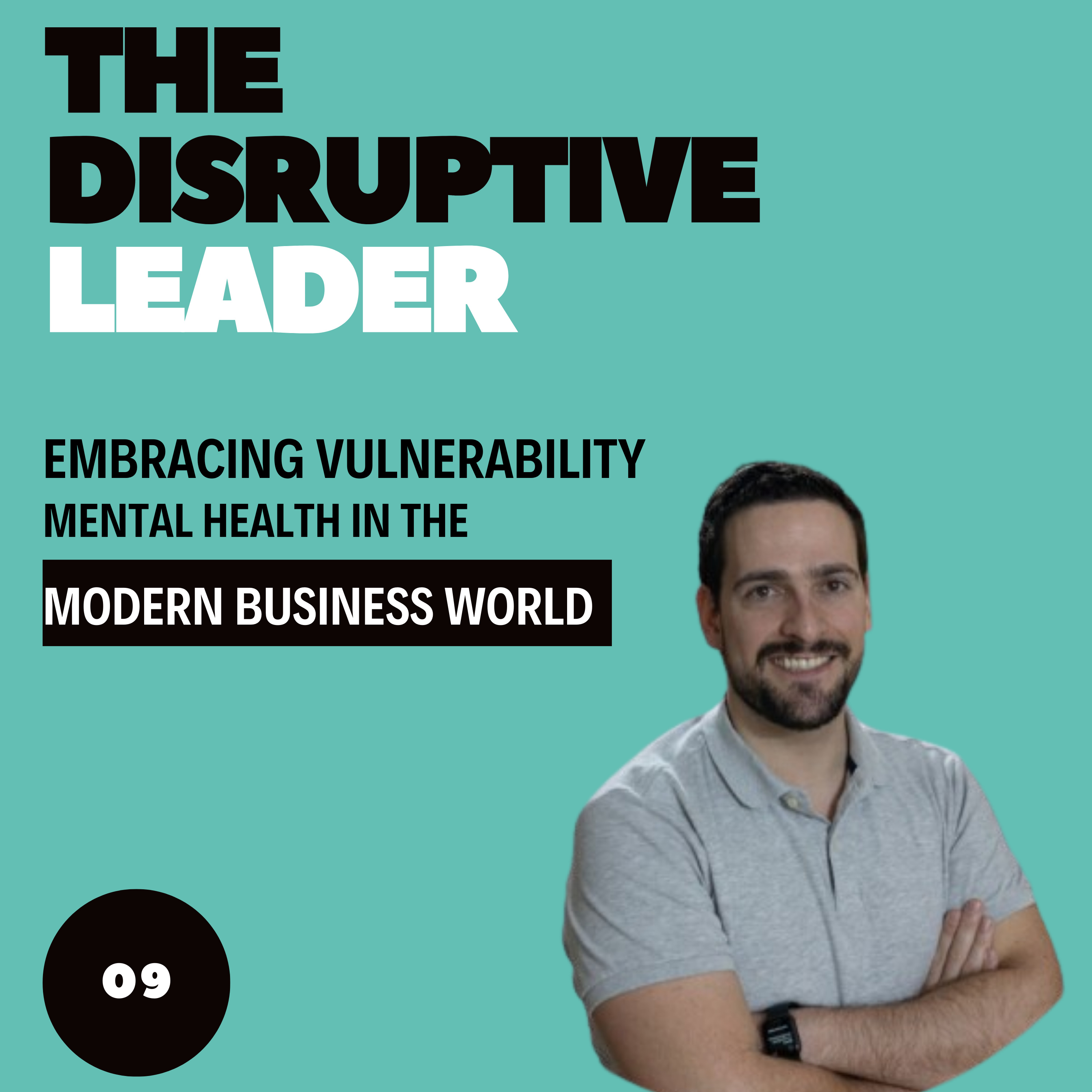
Embracing Vulnerability: Mental Health in the Modern Business World
from The Disruptive Leader
39m 6s
In this conversation, Maurizio and Rania discuss mental health in the workplace and society, building on a prior episode. Maurizio opens up about his personal struggles, revealing that his wife's love sustained him during dark times, and he wears a purple t-shirt—symbolizing Suicide Prevention Month—with affirmations like "You are enough" to remind others of their worth. He notes a recent trend of increased vulnerability on LinkedIn, which he attributes to people growing tired of fake positivity and brave individuals starting conversations, though he stresses that more openness is needed from both individuals and companies. The pandemic helped normalize mental health discussions, but Maurizio argues that waiting for crises is insufficient; proactive support in schools, homes, and workplaces is essential. He connects adult mental health issues to childhood trauma and criticizes the "never enough" corporate mindset, where achievements are never celebrated and emotions are seen as unprofessional. Rania shares her own experience of quitting a corporate job after a CEO dismissed her 300% growth, highlighting the toxic nature of such environments. The discussion challenges the notion of the "A game," suggesting that showing vulnerability, like athletes Simone Biles and Naomi Osaka, is a form of strength. To improve workplace culture, Maurizio proposes implementing mental health days, talks, and wellness activities like running or yoga, and reducing meeting overload, creating environments where employees feel safe and valued.
(upbeat music) - Good morning, Maurizio. How are you today? - Hi, Rania. I'm very excited for episode two. And I'm recording again. This is gonna be an awesome episode. - I'm super happy that we are continuing this conversation because in our previous conversation, we tapped into a topic that is critical for human success being mental health. One that is, I feel in 2024, not where it needs to be in the business world. Yet, I don't think people are just there yet. So I appreciate you being so open, so transparent and advocate someone who's pushing for this. Because this is how we can help other people. So thank you for that, Maurizio. And with that, I wanna ask you my first question. Purple really suits you, hey. What's the story behind your purple t-shirt? - I think this is the only, actually, I think this is the only purple t-shirt that I own. And it's my favorite t-shirt because I got it recently. But it's been funny enough, like over the past couple of months, the conversations about mental health have skyrocketed and also the unfortunate news. Like I've lost a couple of people in my network, people that I knew, people that I used to work with, which is suicide this year. So I think that as a society, I think we need to be more vocal about what people are going through. And I'm not saying for people to share whatever's happening to them with the world, what I'm saying is to allow those people to understand that they're loved, that they have a place in the world, that what happened with me, right? And it's funny because it got to a point in my life, in my mental health journey. It got to a point where my wife loved me more than I loved myself. Yeah. And I think that in this path, sorry for choking up there a little bit in this path, I think it's crucial to try to tap into those, like very deep emotions and that person that is like living very deep within you. And if we're able, if people that are struggling and also people that are not are able to do that, that sort of gives you superpowers. And so, with this shirt, it says nothing in the front because the point of the shirt, and I like my shirt a little bit baggy, so I'm just gonna turn this around on video. I'm not gonna undress on video, I'm just gonna turn this around. I'm like, yeah. So it says, - What does it say on it? - Do you mean, - Oh yeah, you read it. - Do you read it? - Do your person behind me check this with me. You are amazing, check. You are alone, check. You are worthy, check. You are beautiful, check. You are enough, check. Don't ever forget that. Oh my God, it's so beautiful. Yes. - And I think that's all of that. - And I think that's important. And I think that's important for people to, not just to realize, but to never forget, because I think that we're in a world and we talked about LinkedIn, I think, in our previous conversation, like we're in a world where technology has made our lives so much easier, but I think that it also has exposed a bunch of lies that personally, it doesn't help people that are struggling. You see what happened with Facebook. Then you thought Facebook, people only posted happy things, right? And everybody thought that it was people around you were having the perfect life. And then you saw it with Instagram. And then you saw it with TikTok. And now you're seeing it with LinkedIn. - Yep. - A couple of years ago. And so LinkedIn has lived through this transformation that I'm all for it, right? I'm all for, because at the end of the day, the business person, or the person behind the business person is a human and it has personal motivations. So I'm all for posting and talking about your personal life and personal achievements, but it's interesting, like over the past three to six months, it's the first time that I started to see people being very vulnerable on LinkedIn. And I think we need more of that, not just from the people, but also from companies because behind all the success, there are many strikeouts. And I'm no baseball fan, but I know this statistic. If you have a 0.3-batter average, you're like the best of the best. So that means that the misses are gonna be more than the hits. And if you do that, you are gonna be like best in history, polyfan. So I think we need to talk more about that. And sorry, I'll shut up for a second. I know that I've been talking a lot, but like the whole idea of a purple, of the support of the month is suicide awareness month. I hope that it was like suicide prevention, rather than awareness, but I think these things like these at the end of the day are the things that really matter. Definitely. A, purple really suits you and you're everything on that t-shirt and more. B, thank you for the openness, the vulnerability. And just putting yourself out there. I have a couple of follow up questions that I think might be interesting. The first one is, like you said, you've started to see on LinkedIn that some people are getting more vulnerable, more open, even companies. What do you think is driving that change? What's changed in the world? Why is this happening? Why do you think someone can be vulnerable today, whereas a couple of months or years ago, it was like, oh no, let me pretend it's all, I shit together. I don't know. I would love to know, but I think that, I don't know. I think that people got tired of all the fake positivity. And I guess, it took a lot of. A couple of, like it took some people to be very brave to start the avalanche of putting themselves out there and talking about the things that everybody knew that we needed to talk about, but nobody had the courage to do so. And I think it's. Even me with my mental health journey, I just started talking about this of something that I've been dealing with for years. So I think that people, myself included, or at least I'll just speak about personal experience, I was scared to talk about this because I didn't know how. people around me were going to react. So I guess that that fear of failure or like fear of rejection or feeling like labeled or tagged or like talking about something that that is a stigma. That's a crazy part. Yeah so I guess that with Foxes you got to I guess give that to technology too. Like the fact that now we can you know in our pocket we can find stories of people around the globe that we've never met that have a similar story than ours. I think that gives people the sense of feeling that they're not alone and helps them pull through and talk about the things that they feel they need to talk about but they don't know how. Yeah I think that of course there are positive things about about technology that have helped and I think on the company side it's this element of the transition in the very very interesting culture shift or I don't know how to call it. I know it has like a better word for it. It's funny because I guess when I started to work I lived the cooler and like the water cooler and just like the cubicle kind of life and then lived and the phone and the stationary computer and then went through this phase and transition that I guess with the pandemic helped to talk about things that we weren't used to. I think that was the first time that I spoke to a psychologist but it was specifically to cope about stuff that was going on with the pandemic but I think that people caught on to that and companies too and then I guess it became hard of the benefits package. Yeah because I I guess that enough people talked about it that it just started to resonate. Yeah that makes a lot of sense and I think around the time of the pandemic there was so much fear and so much change and so much death really just all over the place and I think that kind of triggered a conversation and what sort of I'm happy that it started. What baffles me a little bit is like why wait for a pandemic to be able to talk about mental health. Mental health has been around since forever. It's not like it's a new topic and it's even in schools like we we got an email recently last year a little boy in my daughter's class took his life and when I lived in Chile a I think she was 14 or 15 a girl she was in middle school she also took her life and it makes you wonder what is it that is happening and I think you touched on it things like social media like cyberbullying be it in the workspace or in schools what needs to change so that teenagers and young adults don't feel so helpless where suicide becomes the only way out. You're like you're someone who's been on both sides what do you think companies or your community or your network could have done differently to not wait till you reach that state of you know what I'm done. What could have helped avoid you reaching that point. Yeah it's something external because maybe it's something internal. I think it's internal but I also think that it's it's definitely external. I think that companies and and schools could be doing better in terms of even I remember when I was at school like elementary middle school high school I had a little bit more of that in college but it was access to a therapist. And it's I think that still society we were very dismissive with with people's feelings. It's I won't mention his name to protect his privacy. There's this gentleman that I've never met but I follow and recently he and his family they had a pre-bite car accident and his kid miraculously recovered and he's proactively giving his kid mental health dates no questions asked and I think that's awesome that's a awesome initiative for that kid by his parents. So I think that parents need to be more proactive in how they help their kids. And as an adult you then when you start to be more aware of your mental health you just crack it back and it all has to do 99% of it has to do with child trauma that you had just so deep within you and that that developed you as a person like your addictions your vices your personality like every your fears and so I think that access to the kids should not only be more we should have more of it but it should be everywhere and just telling a kid is hey if the kid says hey I'm feeling depressed or I'm feeling anxious it's I've seen yeah but you don't even know what that is like your kid you're a mature and you could see have that you can have a kid that that's in mature that doesn't know what depression is or what it looks like or what it feels like but that doesn't mean that you should be dismissive and not not try to guide that kid in understanding what they're feeling because there might be something deep there so I think that we should be doing more of that and in schools and then from an early age at households and then also companies like have like counselors and I know that HR is like there for you and there to help but I haven't seen the first company that has like mental health professionals as a team being part of the company and I think it's critical because at the end of the day if you think you know we're in the software, more attack industry so we typically serve humans on a software regardless what that software does but if we are hurting inside or unable to express or identify it's very difficult to have a health
the relationship with your customer and with your teammate and with your boss. And so if I was to grattle the cage, people have described me as before, for example statements like, oh, people who quiet work are too emotional. What does that even mean? If someone is having a day that is just they're done and they the only way of expressing it is through tears. And my dad says tears are the unspoken words. Why is that a bad thing? If someone says I need to take the time out because I need to just let this out, why is that a weakness? And most companies will tell you, oh, crying out workers, unprofessional? Is it? Is the assumption that I should or anyone know how to manage my emotions, but if what if I can? Is that something that should be held against someone? Like where? Why is there this notion that human beings have to be so on top of it in a workplace when a lot of the time, pretty 98% of the time most people are known and it's an act. Yeah. I think that's one of the things that have helped me just be more mindful of myself with remote work, for example. I can't remember the last time when I was like hybrid or in office that I saw, of course, I saw anger, but that I saw anything else besides anger, happiness, and stress. The anger to the point, it wasn't rage. There were no fights. Everybody was like happy all the time and if it wasn't happiness, they just poke her face. And it felt weird and it feels weird because I think you're right. I think that people try to bring their A game every single day, maybe because they don't want to be judged and they don't want to seem like you mentioned, I'm professional. And sometimes it gets a hold of us that you can't control it. And we tear up and we choke up and I did that in this session when I said that it got to the point in my life where it wasn't for my wife, I would probably not be here. Not be here, yeah. Because let me ask another way just to make it even more confusing. Someone likes Mona Biles or Naomi Osaka. These are world champs, Olympians, crushing it. You mentioned the A game. Both those athletes pulled the plug and said, we need to take a break and burst into tears and took a break for mental health purposes. Does that mean they're not in their A game or does that mean they're very more so in their A game than anyone else for being strong enough to even do that? You know what I mean? Yeah. And if we tie that to what you were saying about the batter in baseball, if the 0.7% is the ones you miss and the 0.3 are the good hits, does that mean the A game is the 0.3 or the 0.7 and the 0.3 to make a complete, you know what I mean? Like, why does A game not include the meltdown or the breakdown or the tearing up or the choking up? Why have human beings positioned A game means strength? But what if it means strength and weakness or good and bad? Because you need both sides of the coin, right? I can say it's you win some deals, you lose some deals. That doesn't make you a bad salesperson. It makes you realistic, right? Same thing with our emotions. Good days, bad days. Why is it in the work environment and human being has to hide the bad days? Like, cool. Yeah. Just food for thought. Yeah, and I think it, and I go back to the social media thing. I think it's this element that we're being indoctrinated that we can't show weakness. And that's something that scares me a lot because I don't have kids, but what I do is like how is technology or the access to technology going to get worse? Because I want to say that it won't, but ideally it won't, but be surprised if it doesn't get worse. And I think that as a society, we expect, like when you see somebody do well once, and then there's, I think there's a quote. If it's, if they do it once, it's, oh, they did it great, but did it why, if they do it twice, like they're onto something. If it's three times, it's like they're, you know, they're on a high tide or whatever. They're writing, you know, writing away whatever the term is. And like after the fourth and the fifth, it's like the expectation. Yeah. So the moment you ex-like you, you, you haven't even started. And then everybody expects you to just rake records again, or on the sales side, hit your target again. You hit your target, or you broke records the year before. All right, do it again. And you hit 200%, 200% is not good enough. Now you're going to do 220 and your quota is higher and your territory is smaller. So it's, it's this indoctrination that, that there's never nothing is ever enough. Exactly. Spot on. That's exactly it. I remember my first corporate job. I was 22 maybe, 23 at the time. I was very young. I had this really big role in a big corporate. And in my role, I had hit 300% growth for the product I was managing. And I was really like, you are a young person, joy building your career. And you want to feel good about what you're doing. And I remember I was presenting in the field in the CFO and lots of men and suits. And I was like, yeah, I got the 300% growth. And I remember the CEO said, that's not good enough. It's like what? What? And he said, yeah, that's not good enough. It can be 350 and 400%. And it just, I think that was a turning point in my life. That was actually when I quit the corporate world. I just, I looked at him. I closed my laptop. I resigned and I walked out. And I became an entrepreneur. Because I was not going to deal with that. I was not going to put myself in this situation where I have some CEO who deals with human beings that way. Because it's, it's either it's not made for me. Maybe some people love that and do better in that environment. But at least with my personality, I was like, this is not right. This is morally, emotionally, psychologically. This is just not right. And I'm not doing this anymore. I even left the city and moved to a beach town. It was very life altering. It was very traumatizing. I still talk about it maybe 25, 30 years later. But yeah, to echo what you're saying.
all it's never enough. I think if human beings learn and define their own capacity of enough, then perhaps that could also enable a more healthy, balanced, mentally healthy work environment. Because without it, there's going to be more and more people trying to take their lives. And it shouldn't be that way because no job is bigger than your whole life. Yeah. I'm going to throw a curveball at the conversation. And I think this element of people not knowing when to stop or when enough is enough. Yeah. I think deep, deep, deep down is directly correlated to childhood trauma. Start on because they want that validation. They need, they feel they need to do more. They need that it's not enough that they're not enough for themselves, that they're not enough for their parents, that they're not enough for their grandparents, that's going to make them feel loved, make them feel accepted. Oh, if I close this big deal, then I'm going to be seen as the best rap or hey, I'm going to get that promotion and I'm going to get that paycheck and I'm going to do this. I'm going to do that. And it's all I feel and I think that it's all correlated directly to childhood trauma. It all goes back to mental health. And I think that's one of the things that that not just talking about openly about my journey, but also just realizing internally and accepting myself, but also running and specifically running has helped me be more accepting, more realistic, and also more more there's a word for it. You're in the words word. I can't think of the word, but understanding that I'm enough. Yeah. Understanding you're enough in knowing what your threshold is, what your pace is, what your stamina is, and just what makes you feel good that you are enough. And I think you hit a really important point. It's about you defining that you are enough. You don't need external validation. It's not a quota. It's not a title. It's not a deal, as you were saying. It's none of that. That's also superficial. That's just to fill in the empty void inside. I definitely think so. And just last question before we wrap up, if you were to set up a startup or a company or join a company, when it comes to building that corporate culture or your startup culture, what would you do differently to make sure that your team, your crew, your customers have the safe environment where mental health is something that's taken into consideration. To go question, I would do things like this. I like to podcast. Mental health days, mental health talks, benefits to doing Pilates, yoga, running club, painting, writing, however people like to express themselves. Not inundating something that for example we did at Melon, that was amazing. Was no meeting when days that really helped to just if you need to take the day or if you feel overwhelmed with meetings and stuff, just take the day to strategize. Be very understanding and protective of people's time. So try to avoid opinion people like over the weekend or after a certain hour. And I think that just consistently talking about openness, not just saying, hey we're open or hey we're accepting hey we're an ally, hey we value you as you, but walking the walk like respect people's time, respect people's decisions, respect, yeah, understand that there's something behind that. And treating people like human beings. I think that's something that's that would be very powerful. And setting up early. Like you see it all the time, it's like you have an early stage startup, they have their salesperson, the marketing person, the success person, the support person, revops, IT engineering. Five years ago, no AI engineer, five, 10 years ago, no AI engineer or no chief AI officer role existed. True. 15 years ago, revops didn't exist. So how about a mental health, chief mental health officer, chief health officer, just ensuring, because if we're not physically emotionally and mentally and psychologically, that is going to affect our life and our performance. I would set up a shop of a mental health team. I love that. I love that. It's giving me a lot of food for full. We have no meeting Friday. I even put that in setting the expectation with the prospect we do not meet on Friday. It's a mental health initiative and we I will not budge. I also think leading by example, I think if leadership show that weakness and vulnerability is part of human nature and it's okay to express that vulnerability, I think that's a really good way to enable the wider team. I definitely think having a mental health professional on board adds a lot of value. And the awareness, I think just the awareness and the openness as you were saying is critical. Super. This has been a great conversation, Maritio. I am really happy that you're advocating your open. You're talking about this. I'm sure there's a lot of people out there that will listen to this and realize they're not on their own. They're not the only ones. There's thousands, millions of other people but feel and think this way. It's just a matter of finding them. So thank you for that and stay tuned for part three everybody. Thank you for the end by linea. Always thank you Maritio for your time. And thank you for everybody that's listening. Yep. And for the people that think, whoa, these guys are out there. They talk about these topics. That's also okay. We can have different opinions. There's enough for everybody in the world. So that's cool. Yeah, have a beautiful day everybody. Thank you, Maritio. Have a wonderful day and I will see you soon. Likewise. [MUSIC]
Podcast Summary
Key Points:
Maurizio shares his mental health journey, including a point where his wife loved him more than he loved himself, and emphasizes the importance of vulnerability and self-worth.
His purple t-shirt, worn for Suicide Prevention Month, carries affirmations like "You are amazing" and "You are enough," highlighting the need for people to feel loved and valued.
There's a shift toward more vulnerability on platforms like LinkedIn, driven by fatigue with fake positivity and brave individuals starting conversations about mental health.
Technology and the pandemic have helped normalize mental health discussions, but Maurizio argues that waiting for crises like a pandemic is insufficient.
Childhood trauma is linked to adult mental health struggles, and there's a need for proactive mental health support in schools, homes, and companies.
The "A game" concept is challenged—showing emotion or taking breaks (e.g., Simone Biles, Naomi Osaka) should be seen as strength, not weakness.
Corporate culture often demands constant success, leading to burnout and a "never enough" mindset, as illustrated by Rania's experience with a CEO dismissing her 300% growth.
Maurizio suggests creating supportive cultures with mental health days, talks, and activities like running or yoga, and reducing meeting overload.
Summary:
In this conversation, Maurizio and Rania discuss mental health in the workplace and society, building on a prior episode. Maurizio opens up about his personal struggles, revealing that his wife's love sustained him during dark times, and he wears a purple t-shirt—symbolizing Suicide Prevention Month—with affirmations like "You are enough" to remind others of their worth. He notes a recent trend of increased vulnerability on LinkedIn, which he attributes to people growing tired of fake positivity and brave individuals starting conversations, though he stresses that more openness is needed from both individuals and companies.
The pandemic helped normalize mental health discussions, but Maurizio argues that waiting for crises is insufficient; proactive support in schools, homes, and workplaces is essential. He connects adult mental health issues to childhood trauma and criticizes the "never enough" corporate mindset, where achievements are never celebrated and emotions are seen as unprofessional. Rania shares her own experience of quitting a corporate job after a CEO dismissed her 300% growth, highlighting the toxic nature of such environments.
The discussion challenges the notion of the "A game," suggesting that showing vulnerability, like athletes Simone Biles and Naomi Osaka, is a form of strength. To improve workplace culture, Maurizio proposes implementing mental health days, talks, and wellness activities like running or yoga, and reducing meeting overload, creating environments where employees feel safe and valued.
FAQs
The purple t-shirt is his favorite and is tied to suicide awareness and prevention month. It has positive affirmations on the back, like 'You are amazing' and 'You are enough,' to remind people of their worth.
He believes people are tired of fake positivity and that brave individuals started an 'avalanche' of openness. Technology also helps by connecting people with similar stories, making them feel less alone.
He suggests parents and schools should be more proactive, providing access to therapists and guiding kids to understand their feelings. He emphasizes not being dismissive when a child expresses depression or anxiety.
He challenges the idea that 'A game' means only showing strength and happiness. He argues that showing vulnerability, like tears or taking breaks for mental health, should be part of a complete performance, not a weakness.
Maurizio believes that the constant need to do more and seek validation, like closing deals or getting promotions, often stems from childhood trauma. It's a way to feel loved and accepted, but true acceptance comes from within.
He would implement mental health days, talks, and benefits like Pilates, yoga, running, painting, or writing. He also values initiatives like no-meeting days to reduce overwhelm.
Chat with AI
Loading...
Pro features
Go deeper with this episode
Unlock creator-grade tools that turn any transcript into show notes and subtitle files.
 PodcastTranscript AI