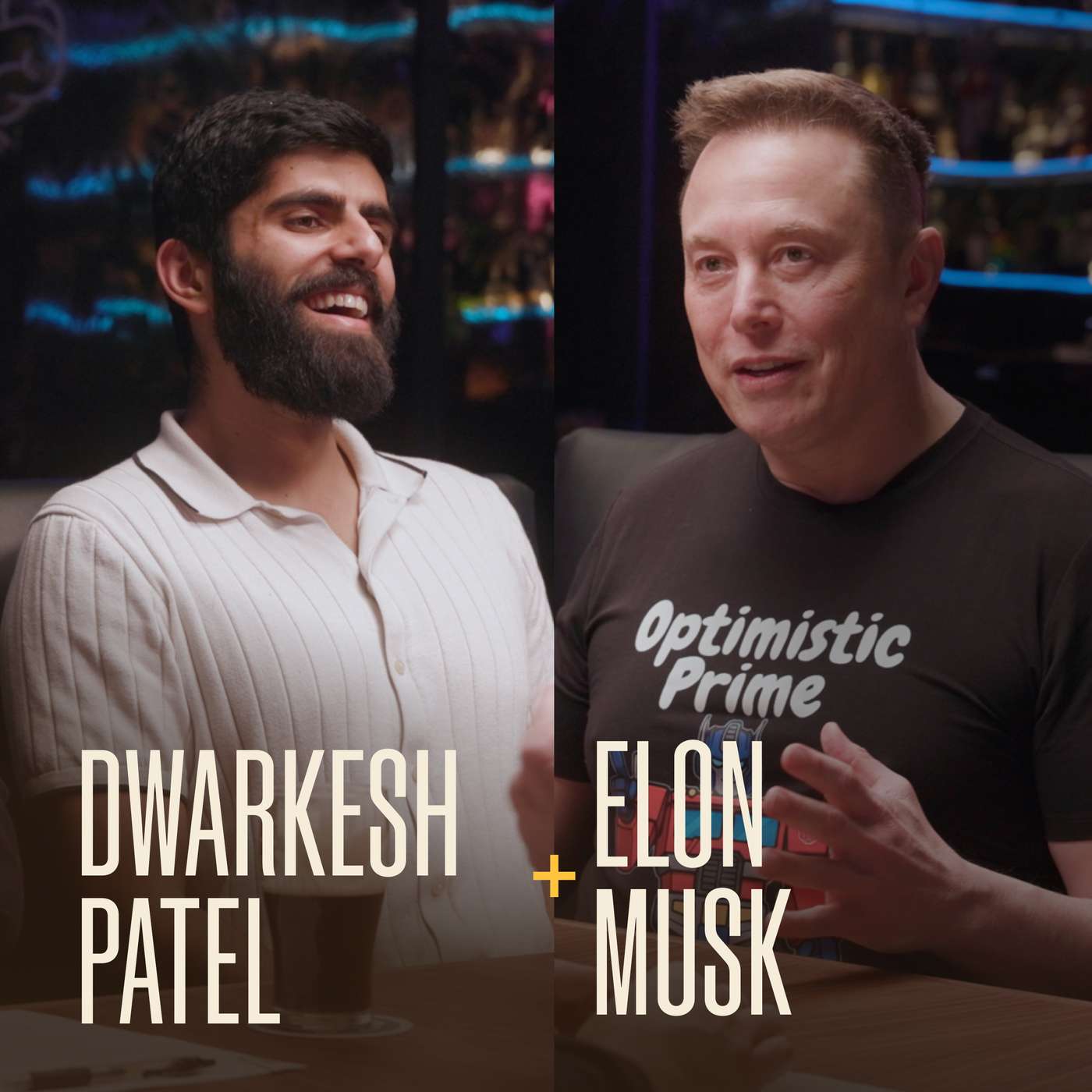
Elon Musk on Space GPUs, AI, Optimus, and his manufacturing method
166m 2s
The discussion centers on the growing energy constraints for scaling AI infrastructure on Earth and the potential of space as a solution. Currently, electricity generation outside China is largely flat, while computing power demand rises exponentially. Data centers face high costs from GPUs, cooling, and power redundancy, with additional bottlenecks in turbine manufacturing and regulatory delays. In contrast, space offers constant solar exposure, making solar panels five times more effective and eliminating batteries. Elon Musk argues that within 30–36 months, space will become the cheapest place to host AI, leveraging Starship launches to deploy capacity at scale. He envisions annual launches exceeding all Earth-based AI within five years, driven by the impossibility of scaling power generation on Earth to meet future demands. While terrestrial solutions like co-located solar and private power plants are being pursued, space is framed as the only path to harnessing the vast energy needed for long-term AI growth.
cheeky behind his back. This episode is a collab with Broadcast Mattel, whose podcast has really blown up in tech, and I really enjoy it. We sat down with Elon Musk, and as you can imagine, there was a lot to cover. So, are there really three hours of questions? Or are you fucking serious? Yeah. You don't even know what I'm talking about, Elon. It's the most interesting point. All the storylines are kind of converging right now, so we'll see how much we're doing. Almost like I've planned it. Exactly. Well, we're good to know. That would never do such a thing. So, as you know, better than anybody else, the total cost of ownership of a data center, only 10 to 15% is energy, and that's the part you're presumably saving by moving this into space. Most of it's the GPUs. If they're in space, it's harder to service them, or you can't service them. And so, the depreciation cycle goes down on them. So, it's just way more expensive to have the GPUs in space. Presumably. What's the reason to put them in space? Well, the availability of energy is the issue. So, I mean, if you look at electrical output outside of China, everywhere outside of China, it's more or less flat. It's very, you know, maybe a slight increase, but for pretty much flat, China has a rapid increase in electrical output. But if you're putting data centers anywhere except China, where you're going to get your electricity, especially as you scale, the output of chips is growing pretty much exponentially, but the output of electricity is flat. So, how are you going to tell them what chips are? You know, magical power sources, magical electricity fairies? You're famous, you're famous, you're a famous fan of solar, one terawatt of solar power. So, with a 25% capacity factor, like four terawattes of solar panels, it's like one percent of the land area of the United States. And you were in the singularity when we got one terawatt of data centers, right? So, what are you running out of exactly? How far into the singularity are you going to? You tell me. Yeah, exactly. So, I think we'll find we're in the singularity and like, okay, we'll still go along where you go. But is this like a, is the plan to like put it in the space after we've covered Nevada and solar panels? I think it's pretty hard to cover the solar panels. You have to, like, put them it's from, like, the approach for that, trying to get the purpose for that. So, the space is really, it's really a regulatory play. It's a harder, harder to build on land than business base. It's harder to scale on the ground than it is to scale in space, but also the, you're going to get about five times the effectiveness of solar panels in space versus the ground. And you don't need batteries. I almost wore my other shirt, which says it's always sunny in space, which it is. So, because you don't have a day-night cycle or seasonality clouds or an atmosphere in space, because the atmosphere alone, we're still about a 30% less of energy. So, you're going to, any given solar panels can do about five times more power in space than on the ground. And you avoid the cost of having batteries to carry you through the night. So, it's actually much cheaper to do in space. And my prediction is that it will be, by far, the cheapest place to put AI will be space in 36 months or less, maybe 30 months. 30 months? Less than 30 months. How do you service GPUs as they fail, which happens quite often in training? Actually, it depends on how recent the GPUs are that are right. I mean, at this point, we find our GPUs to be quite reliable. There's infertility, which you can obviously iron out on the ground. So, you can just run them on the ground and confirm that you don't have infertility with the GPUs. But once they start working, there are actual reliability. And once they start working, and you pass the initial, you know, debug cycle of Nvidia or whatever, whoever is making the trips, could be Tesla, Tesla AI, six trips or something like that, or it could be, you know, a TPUs or trains or whatever. The, the rival is actually, they're quite reliable, past certain point. So, I don't think, I don't think you need the servicing thing as an issue. But you can walk my words. And 36 months, but probably close to 30 months, the most economically compelling place to put AI will be space. And then, and, and, and then it will get from, they don't forget, like, ridiculously better to be in space. And then this, the scaling, the only place you can really scale is space. You know, what, what's you start thinking in terms of what percentage of the sun's power are you harnessing? You realize you have to go to space. You can't scale very, very much on Earth. But maybe very much clear, to be clear, you're talking like tarotts. Yeah. And well, all of the United States currently uses only half a tarot or an average. Yeah. Right. So, you know, if you say a tarot, that would be twice as much electricity as the United States currently consumes. So, that's quite a lot. And can you imagine building that many data centers? I don't know, not that many power plants. It's like, those who have, like, lived in software land, don't realize that they're about to have a hard lesson in hardware that there's, it's actually very difficult to build power plants. And, and then you don't need just need the power plants. You need all of the electrical equipment need that the electrical transformers to run the transformers, the AI transformers. Now, the utility industry is a very slow industry. They're pretty much, you know, the impedance match to the, to the government, to the, the public utility commission. So, they're, the impedance match, like, literally, incredibly. So they're very slow because the his, their past has been very slow. So trying to get them to move fast is this like, you know, like, if you're trying to do an interconnect agreement with the, have you ever tried to do an Internet interconnect agreement with the utility at scale, like it put a lot of power? As a professional podcaster, I can say that I'm not in fact. You need many more views before that becomes an issue. Definitely a study for a year. Okay. Like a year later, they'll come back to you with their interconnect study. Can you tell this with your own behind-the-meter power stuff? You can build power plants. Yeah. That's what we did at X and I for classes two. So, for, for classes two. So yeah, why would you talk about the grid? Why not just like build GPUs and power co-located? That's what we did. Right. Right. But I'm saying why isn't this a generalized solution when you're talking about all the issues? Where do you get the power plants from? I'm saying when you're talking about all the issues, what do you get utilities? You can just build private power plants with the data centers. Right. But it begs the question of where do you get the power plants? I mean, the power plant makers. Why is it the same? Yeah. Like does the gas turbine backlog basically? Yes. You can drill it out to a level further. It's the veins and blades in the turbines that are the lemony factor because the casting, it's like a very specialized process to cast the blades and veins in the turbines using gas power. And it's very, it's very difficult to scale other forms of power. You can scale potentially solar, but the tariffs currently for importing solar in the US are gigantic. And the domestic solar production is, is beautiful. Why not make solar? That seems like a good Elon-shaped problem. We're all going to make solar. Okay. Yeah. But both SpaceX and Tesla are bullying towards 100 gigawatts of solar cell production. How low down the stack? Like from policy looking up to the wafer to the final panel? I think you got to do the whole thing from raw materials to to to finish the cell. Now if it's going to space, it's actually, it costs less than it's easier to make solar cells that go to space because they don't need glass or they're not much glass and they don't need heavy framing because they don't have to survive for the event. There's no weather in space. So it's actually a cheaper solar cell that goes to space than it's done the one on the ground. Is there a path to getting them as cheap as you need in the next 36 months? Solar cells are already very cheap. They're like far-sickly cheap. And if you say, you know, I think like solar cells in China are around like 25, 30 cents a wipe or something like that. It's, it's absurdly cheap. And when you, when you take into account now, now, now put it in space and it's 5 times cheaper because it's 5 times, in fact, no, it's not 5 times cheaper. It's 10 times cheaper because you don't need any batteries. So, so the moment your cost of access to space becomes low, by far the cheapest and most scalable way to generate, to generate tokens is space. It's not even close. It'll be an order of magnitude easier to scale and chips aside order of magnitude. Well, if the point is you, you want to feel the scale in the ground, it's just, you just want to feel like you hit the wall big time on power generation. They already are. So, so like the number of, so miracles in series that the XAI team had to accomplish in order to get a gigawatt power online was, was, was crazy. We had to gang together a whole bunch of turbines. And then, and then we had permit issues in Tennessee and had to go across the border to Mississippi, which is fortunately only, you know, a few miles away. So, but then we still had to run the high power lines a few miles and build the power plant in Mississippi. And it was very difficult to build that. And people don't understand like how much, how much electricity do you actually need at the generator level, at the generation level, in order to power a data center? Because they look at the, the, the, the, the, the news will look at the, the power consumption of, say, a GB 300 and multiply that by thing and then think that's the amount of power you need. All the cooling and everything. Wake up. Yeah. Yeah. This is like the, that's a, that's a, that's a total of moves. It's never done any hardware in your life before. Besides the GB 300, you've got to power all of the networking hardware. There's a whole bunch of CPU and storage stuff that's happening. You've got a size for your, your peak cooling requirements. So that means, can you cool even on that the worst hour of the worst day of the year? Well, it's pretty freaking hot in Memphis. So, so you're going to have like a 40% increase on your, your power, just for cooling. It's assuming you don't want your data center to turn off on hot days and, and you want to keep going. Then, then you've got to say, well, there's, there's another multiplicative element on top of that, which is, are you assuming that you're, you, you never have any hiccups in your power generation? Like, well, actually, sometimes you have to take the generators, some of the power off-lining order services. Oh, okay. Now, you add another 20, 25% multiplier on that, because you've got, you've got to assume that, that you've got to take power offline to service it. So the actual, our, our, our, our, roughly every, every 110,000 GB, GB 300s, inclusive of networking, CPU storage, cooling, margin for, for servicing power, is roughly 300 megawatts. Sorry, sit it again. It's, it's, it's roughly, or we're thinking about it, like, the way you think about it's like 330,000, to, to, to actually, the, what, what you need at the generate generation level, to service, probably service 330,000 GB 300s, including all of the associated support networking and everything else, and, and, and the peak cooling, and to have some margin, some power margin reserve is roughly a gigawa. Can I ask a very naive question? Yeah. Uh, you know, you're describing the engineering details of doing this stuff on earth. But then there's an analogous engineering difficulties of doing it in space. How do you do the, how do you replace infinite bandwidth orbital lasers, etc, etc? How do you make it resistant to radiation? I don't know the details in the engineering, but fundamentally, what is the reason to think those challenges, which have never been, had to be addressed before, will end up being easier than just, like, building more turbines on earth. There's companies that build turbines on earth. They can make more turbines, right? I invite, look again, try doing it, and then you'll see. So, um, like, the turbines are sold out through 2030. Have you guys considered making your own? I think in order for, in order to, uh, bring enough power online, um, I think, uh, SpaceX and, and Tesla will probably have to make the turbine blades, um, the bands and blades, uh, internally. But just the blades or the turbines? Uh, uh, the, the, the limiting factor, you can get everything except the, the blades, what they call the blades and veins. Um, you can get that, uh, 12 to 18 months before the bands and blades, the limiting factor of the bands and blades. And there are only, uh, three casting, uh, companies in the world that may make these, and they're massively backlogged. Is this Siemens GE? Those guys, or is it a subculture? No, it's, it's, it's, uh, it's other companies. I mean, sometimes they have a little bit of casting capability in house, but, uh, I'm just saying you can just, you can just call any of the turbine makers, and they will tell you, yeah, it's not top secret. They probably on the, it's probably on the internet right now. If, if it wasn't for the tariffs, would, uh, would colossus be solar powered? Uh, it would be much easier to make it solar powered. Yeah. Um, the tariffs are not so several hundred percent. So, don't you know, some people will also need to be, yeah, no, you know, um, president has a, you know, we don't agree on everything. Um, and, um, the administration is not, not the biggest band of, uh, of solar. Um, first, you know, it's, it's, it's, it's, and we also need the land, the permits and everything. So if you're trying to be very fast, um, like it, I do think scaling solar on earth, it is a, it is a good way to go. Yeah. But, but do you need, do you need some amount of time to find the land, get the permits, get the solar, uh, pair that with the batteries? But why would it not work to stand up your own solar production? And then you're right that you eventually run out of land, but there's a lot of land here in Texas, there's a lot of land in Nevada, including private land. It's not about publicly owned land. And so you'd be able to at least get the next colossus and like the next one after that. And at a certain point, you hit a wall, but wouldn't that work for the moment? Well, as I said, we are scaling solar production. Um, there's, there's a rate, there's a rate at which you can scale physical production of solar, solar cells. We are, um, we're going as fast as possible in scaling domestic production. You're making the solar cells at Tesla? Well, Tesla and SpaceX, um, have mandate to get to 100 gigawatts a year of, of solar. Speaking of the annual capacity, I'm curious in five years time, let's say, what will the installed capacity be on earth? This is a long time. And in space. Uh, you know, I deliberately big five years, because it's after your ones were up and running threshold. And so in five years time, yeah, what's the on earth versus in space, install the eye capacity? Five years, I think probably if say five years from now, we're probably, um, AI in space will be, uh, launching every year, uh, the, the, the sum total of all AI on earth in excess of me. Five years from now, my prediction is we will launch and, and, and be operating every year, more AI in space than, than the standard cumulative total on earth, which is, so I would expect to be at least, sort of five years from now, a few hundred gigawatts per year of, uh, of AI in space, uh, and rising. Um, so you can get to, I think you can, uh, on earth, you can get to around a terrible year of, of AI in space, uh, before you start having, yeah, for, you know, fuel supply challenges for the rocket. Okay, but you think you can get a hundred gigawatts per year in five years time. Yes. So a hundred gigawatts, depending on the, um, specific power of, uh, the whole system with solar arrays and radiators and everything is, um, is on the order of like 10,000 starship launches. Yes. Um, and you want to do that in one year. And so that's like one starship launch every hour. Yeah. That's happening in this city, like, walk me through a world where there's 10, there's a starship launch every single hour. Yeah. I mean, that's what actually a low rate compared to airlines, uh, like, like aircraft, aircraft, there's a lot of airports, the lower airports, but, and you got to launch this, uh, you know, the polar orbit, uh, and it doesn't have to be polar, but that you, you just, this, there's some, some value to some segments, but, um, but I think actually, um, you just go high enough, you, you start getting out of Earth's shadow. And so, um, how many physical starships are needed to do 10,000 launches a year? I, I don't think we'll need more than, I mean, you could, you could, uh, probably do it with, yes, as few as like 20 or 30, um, um, it, like, it really depends on how quickly does the ship, the ship has to go around the Earth, um, and the ground track for the ship has to come back over launch pad. So, if you can use a ship every, say, 30 hours, uh, you could do it with 30 shifts, but, but we'll, we'll make more shifts than that, but, um, but, but, uh, the space X is, is, um, is going up to do 10,000 launches a year. And I'll, and, and maybe even 20 or 30,000 launches either. Is the idea to become basically a, uh, a hyperscaler become an Oracle and lend this capacity to other people with, what's, what are you going to do with it? Presumably, space X is the one launching all this. So space has to come up a hyperscaler? Hyperhyper. Yeah, I mean, if something in my predictions come true, space X will launch more AI than the cumulative amount on Earth combined, of everything else combined. Is this mostly inference or, most AI will be in for, like already inference for the purpose of training is most training. And there's a narrative that the, the change in discussion around the space X IPO is because previously, space X was very capital efficient. Just it wasn't that expensive to develop. Even though it sounds expensive, it's actually very capital efficient in how it runs, whereas now you're going to need more capital than just can be raised in the private markets. Like if the private markets can accommodate raises of, as we've seen from the AI lives tens of billions of dollars, but not beyond that, is it that you'll just need more than tens of billions of dollars per year? And that's by the sake of public. Um, yeah, I'd be just about saying things about companies that might go quite like, um, you know, if you make general state that's never been a problem for you Elon. You know, there's a price to pay for these things. It makes in general statements about the depths of the capital markets between public and private markets. Yeah, there's there's a lot more capital in the, it's very general. There's obviously a lot more capital available in the public markets than private. I mean, it might be, it's at least, at least it might be a hundred times more capital, but it's at least, you know, way more than 10. But isn't it also the case that things that tend to be very, um, capital intensive, if you look at say real estate as, you know, a huge industry that raise a lot of money each year is at an industry level. That tends to be debt financed because by the time you're deploying that much money, you actually have a pretty near extreme. Exactly. And a near term return. And you see this even with the data center buildouts, which are famously being, you know, uh, financed by the, uh, the private credit industry. And so why not just debt finance, um, speed is important. So, um, I'm generally going to do the thing that, um, I'm, I'm, I'm, I mean, I just repeatedly tackle the many factors, whatever the living factors on speed, I'm going to tackle that. So, um, there's, uh, if, if capital is the only factor, then I'll also for capital, if it's not the only factor I'll solve for something else. Based on your statements about, um, Tesla and being public, I wouldn't have guessed that you thought the fast, the way to move fast is to be public. Normally, I would say that that's true. Um, like, so I, I mean, I, I, I'd like to, you know, talk about some more detail, but the problem is, like, you, you talk about public companies, but they become public, you get in trouble. And then you have to delay your offering. And then you, and then you, yes, exactly. So, so, so, so, you know, you can't hide companies, um, that are, that might, that might go public. So that, that's, that's why we have to be able to careful here. Um, but, but I, I, we can't talk about physics. Um, so, like the way, the way you think about scaling long term is that, um, uh, it only receives about, uh, half a billion of the Sun's energy. Um, and the Sun is, the Sun is essentially all the energy. This is a very important point to appreciate, because sometimes people will talk about marginal nuclear reactors or any, you know, various, like fusion on Earth. Um, but, but you have to step up a second and say, if, if you're, if you're going to climb the Carter shift scale, uh, and have some, uh, non-trobial, and harness some non-trobial percentage of the, uh, the Sun's energy. Like, let's say you wanted to, uh, harness a millionth of the Sun's energy, which sounds pretty small. Um, that, that would be, um, about, call it roughly, uh, a hundred thousand times more electricity than we currently generate on Earth, of, of, of all of civilization. Uh, give or take an order back to. Um, so it, it obviously, the, the only way to scale, uh, is to go to space with solar. Uh, from, launching from Earth, you can get to about a terawatt per year. Um, beyond that, you want to go, you, you want to, uh, launch from the moon. You want to have a, a master driver on the moon. Uh, and that, a master driver on the moon, you could do probably a petawatt per year. Um, we're talking these kinds of numbers, you know, terawatts of compute. Um, presumably, whether you're talking land or space, far, far before this point, um, you've like run into, you know, you actually need, you, maybe you don't, the solar panels are more efficient, but you still need the chips. Uh, you still need the logic and the memory and so forth. And, well, a lot more chips and make them much cheaper. Right. And so, how are we getting a terawatt of, uh, like right now the world doesn't be 20, 25 gigawatts of compute. Um, how are we getting a terawatt of logic by 2030? I guess we're going to need some very big chiptaps to tell me about it. I've mentioned it publicly that, uh, the idea of doing it, sort of a, a terrapap terraping in your giga. We were, uh, I feel like the naming scheme of Tesla, which has been very, um, catchy is like you looking at like the metric, uh, the metric scale. Um, at what level of the stack are you, uh, are you building the clean room and then partnering with and existing, um, fab to get the process technology and buying the tools from them. What, what, what is the plan there? You can't partner with existing paths because, uh, they just, they can't awkward enough that chip volume is too low. But, but, you have to, you have to look for the process technology. Yeah, partner for the, um, you know, the, the, the, the fabs today will basically use, um, machines from like five companies. Yeah. You know, so you, you know, as smell took electron, Cali tank, or, you know, um, et cetera. So, um, get, so, so at first, I think you'd have to get equivalent from them and then uh, modify it or work with them to increase the volume. But I think you'd have to build paths in a different way. Um, so I think that the logical thing to do is to, uh, to use conventional equipment in an unconventional way to get to scale. Uh, and then, uh, and then what, and then stop modifying the equipment, uh, to increase the rate. Kind of boring company style. Yeah. Kind of like, yeah, you're sort of lying in, in, in it's just a, uh, boring machine. And then, uh, figure out big tunnels in the first place and then design a much better machine. Uh, that's, you know, I don't know, some orders of magnitude faster. Here's a very simple lens. We can categorize technologies and how hard they are. And one categorization could be look at things that China has not succeeded in doing. And if you look at Chinese manufacturing, still behind on leading edge chips and still behind on, uh, leading edge turbine engines and things like that. And so does the fact that China has not successfully replicated TSMC give you any pause about the difficulty or you think, well, that's not true for some reason. Uh, it's not that they have not replicated TSMC. They have replicated ASMR. That's the memory factor. So, so you think it's just the, um, the sanctions essentially? Uh, yeah, China would be outputting vast numbers of, of chips, uh, if they could buy us an ASMR chips. Who couldn't they add to relatively recently by them? No. All right. The, the, the ASMR patterns have been in place for a while. All right. So, but I think trying is going to be, but maybe start making pretty compelling chips in three or four years. Would you consider making the ASMR machines? I don't know. I don't know yet. It's the right answer. So I, um, it's just that, that it's to produce at high volume and to reach, to reach large volume and say 36 months to match the, the, the rocket to payload to orbit. So if we're doing a million tons to orbit, um, and like, let's say, I don't know three or four years from now, something like that. Um, that, and, uh, and we're doing a hundred kilowatts per tonne. So that means we need, um, at least a hundred gigawatts per year of solar. Um, and we'll need, uh, an equivalent amount of chips to, to, you know, that you need a hundred gigawatts with the chips. You've got to match these things. The master orbit, yes, the power generation and the, uh, and the chips. Uh, and, and, and I'd say my base concern actually is memory. Um, so the, I think there's, there's a, uh, the, the path to creating logic chips is more obvious than the path to, um, having sufficient memory to support logic chips. That's why you see, you know, DDR price is going ballistic and these memes about like, um, you know, your marooned on a desert island, you could write, help me on the sand. That would come, see, write, DDRM, uh, this, this chips come swimming in, um, I don't see that. Uh, I, I looked at your manufacturing philosophy around, um, around fabs, you know, I don't know anything about the topic, but I don't know how to build a fab yet. I'll figure it out. But obviously it sounds like you think that for the sort of like the process technology like these 10,000 PhDs in Taiwan, who know exactly what gas goes in the plasma chamber and what settings to put on the tool. You can just like, delete those parts of the, those steps, like fundamentally it's, get the clean room, get the tools and figure it out. I don't think it's PhDs. So it's, it's, it's mostly people with, uh, you know, you're not, not PhDs. Um, that, that, most engineering is done with people who don't have PhDs. Do you guys have PhDs? No. Okay. We also haven't successfully built any fab. So you shouldn't be coming to us for your fab. Nice. Or I don't think any PhD for that first stuff. So, um, but you do need, you do need a copper personnel. So I, I don't know, I mean, like right now, if, um, yeah, like, you know, say, like tells those petals the metal max production of going as fast as possible to get AI5, tells the AI5 chip design, introduction and reaching scale. Um, you know, that'll probably happen, you know, round the second quarter of next year, hopefully. Um, uh, and then AI6 would hopefully follow less than a year later. Um, but, um, and, and, and, and we've secured all the, all the chip fab production that we can. Yes. Your currently limited on TSMC fab capacity. Yeah. Um, and, and we'll be using TSMC, uh, Taiwan, uh, Samsung, Korea, TSMC, Arizona, Samsung, Texas. Um, and we still, you've booked out all the, yeah. Yes. And then, and then, and then if I ask, uh, TSMC or Samsung, okay, what, what's the timeframe to get to volume production? It's not, it's not, it's not, it's not, you've got to, you've got to build the fab. Yeah. And you've got, you've got, you've got to start production. Then you've got to climb the yield curve and reach volume production at high yield. That, that, that from start finishes of five year period. And so the limiting factor is chips. Yeah. Uh, what, what, what, what, like limiting factor once you can get to space is chips, but the limiting, limiting factor before you can get to space will be power. Why don't you do the Jensen thing and just pre-PTSMC to build more fabs for you? Uh, I, I've already told the deck. But they won't take your money. Like, what's going on? They're building fabs as fast. No. They're building, they're building fabs as fast as they can. And so Samson, they're, they're, they're, they're pedals to the metal. I mean, they're going, you know, balls to roll, you know, as fast as they can. So, still not fast enough. I mean, like I said, there will be, I think, um, if you say, I think towards the end of this year, I think probably chip production will outpace the ability to turn chips on. But once you can get to space and unlock the, um, the power constraint. and you cannot do hundreds of gigawatts per year of power in space. Again, varying in mind that average power usage in the US is 500 gigawatts. So if you're launching, say 200 gigawatts a year to space, you're sort of laughing the US every two and a half years. The entire, all US electricity production, this is a very huge amount. So between now and then, the constrained for service side compute, concentrated compute will be electricity. My guess is that we start hitting the, people start getting forward with a cap, turn the chips on for large clusters towards the end of this year. The chips are going to be piling up and for not being more people to be turned on. Now for edge computers, a different story. So if the AI-5 chip is going into our Optimus robot, OptimusD. And so if you have a AI edge compute, that's distributed power. Now the power is distributed over a large area. It's not concentrated. And if you can charge at night, you can actually use the grid much more effectively. Because the actual P power production in the US is over a thousand gigawatts. But the average power usage because the day night cycle is 500. So if you can charge at night, there's an incremental 500 gigawatts that you can generate at night. So that's why Tesla for edge compute is not constrained. And we can make a lot of shifts to make very large number of robots and cars. But if you try to concentrate that compute, you're going to have a lot of trouble turning it on. What if I were remarkable about the SpaceX business, the end goal is to get to Mars. But you keep finding ways on the way there to keep generating incremental revenue, to get to the next stage and the next stage. So the Falcon 9 is Starlink. And now for Starship, it's going to be potentially orbital data centers. But like, do you find these like, you know, sort of infinitely elastic, sort of marginal use cases of your like next rocket and your next rocket and the next scale up? You can see how this might seem like a simulation. Or am I someone's avatar in a video game or something? Because it's like, like, one of the odds that all these crazy things should be happening. I mean, I mean, I, I mean, rockets and trips and robots and space solar power. And I'm not to mention that the mass driver on the moon, I really want to see that. You can imagine like some mass driver, there's just like, shroom, shroom. Like just it's like sending AI, silicon AI satellites into space like one after another, like these like, at two and a half kilometers per second, you know, that's a. And just shooting them into deep space. That would be a sight to see. I just, I mean, I'd watch that. Just like a live stream of, yeah, yeah, just one after another, just shooting. AI satellites into space, you know, a billion or 10 billion tons a year. I'm sorry, you manufacture the satellites on the moon. Yeah, I see. So you send the raw materials to the moon and the manufacturing there. Well, the, the, the moon of soil is, I guess, like 20 cents over 20 cents or something like that. So you can get the silicon from the, you can mind the silicon on the moon or find it and generate the, and create the soil panels, the soil cells and the radiators on the moon. Yeah. So get the radiators out of the aluminum. So there's plenty of silicon and aluminum on the moon to make the cells on the, and the radiators. The, the trips you could set from Earth, because they're pretty light, but maybe at some point you make the one to move to. I'm just saying, like these are simply, it's kind of like, like so, it does seem like it's sort of a video game situation where it's difficult, but not impossible to get to the next level. I don't see any way that you could do, you know, a 500 to a thousand terawatts per year launch from Earth. I agree. But you could do that from the moon. Can I zoom out and ask about the space exhibition? So I think you said, like, we got to get to Mars, so we can make sure that if something happens to Earth, you know, civilization, consciousness, access, or eyes. By the time you're sending such a Mars, like Groc is on that ship with you, right? And so Groc is on Terminator. Like the mean risk you're worried about, which is AI? Why doesn't that follow you to Mars? Well, I'm not sure AI is the main risk I'm worried about. I mean, the important thing is that consciousness, which I think arguably most consciousness or most intelligence, certainly consciousness is more of a debatable thing, most intelligent, the vast majority of intelligence that future will be AI. So, you know, AI will exceed, you say, like, how many, what's the, how much, how many, I don't know, a pair of watts of intelligence will be silicon versus biological. And basically humans will be a very tiny percentage of all intelligence in the future if current trends continue. Anyways, as long as like, I think this intelligence ideally, ideally also, which includes human intelligence and consciousness, propagated into the future, that's a good thing. So, you want to take the set of actions that maximize the probable light cone of consciousness and intelligence. Just to be clear, the mission of SpaceX is that even if something happens to the humans, the AI's will be on Mars, and like the AI intelligence will continue the light of our journey. Yeah, I mean, I'm very pro-human. So, I want to make sure we take the set of actions that ensure that humans are along for the ride, you know, we're at least there. Yeah. But let me just say the total amount of intelligence, I think maybe in five or six years, AI will exceed the sum of all human intelligence. And then if that continues, at some point, human intelligence will less than 1% of all intelligence. What should our goal be for a set of civilization is the idea that a small minority of humans still have control over the AI's, is the idea of some sort of like trade, but no control, how should we think about the relationship between the vast stocks of AI population versus human population? And the long run, I think, it's difficult to imagine that if humans have, say 1% of the intelligence of combined intelligence of artificial intelligence that humans will be in charge of AI, I think what we can do is make sure that AI has values that of course intelligence to be propagated into the universe. So, the reason for the XI's mission is understand the universe. So, that's actually very important. So, you say, well, what things are necessary to understand the universe? Well, you have to be curious and you have to exist. You can't just, can't understand the universe, you don't exist. So, you actually want to increase the amount of intelligence in the universe, increase the probable lifespan of intelligence, the scope and scale of intelligence. I think actually also, as a corollary, you have humanity also continuing to expand because if you're curious of trying to understand the universe, one thing you're trying to understand is where will humanity go? And so, I think understand the universe actually means you would care about propagating humanity into the future. And so, that's why I think, I think our mission station is profoundly important. I'm not sure to agree that Groc adheres to that mission statement. I think the future will be very good. I want to ask about how to make Groc adhere to that mission statement, but at first I want to understand the mission statement. So, there's understanding the universe. They're spreading intelligence and they're spreading humans. All three seem like distinct vectors. Okay, well, I'll tell you why I think that understanding the universe encompasses all of those things. You can't have understanding without, I think you can't have understanding without intelligence and I think without consciousness. So, in order to understand the universe, you have to expand the scale and probably the scope of intelligence, different types of intelligence. I guess from a human-centric perspective, like for humans and comparison to chimpanzees, humans are trying to understand the universe. They're not like expanding chimpanzee, footprint, or something, right? Well, we're also not, well, we're not, we actually have made protected zones for chimpanzees. And even though humans could exterminate all chimpanzees, we've chose not to do so. Do you think that's a basic scenario for humans in the post-AGA world? I think, I think, AI with the right values, I think rock would care about expanding human civilization. I'm going to certainly emphasize that. Hey, Grog, that's your daddy. We don't look at it to expand human consciousness. Like, I actually, I think if probably, like the endbacks, culture books are the closest thing to what the future will be like in a non-destopian outcome. So, as a universe, it means you have to be very, you have to be truly seeking as well. Truth has to be absolutely fundamental, because you can't understand the universe if you're delusional. You'll still be thinking about the answer to the universe, but you will not. So being rigorously truly seeking is absolutely fundamental to understanding the universe. You're not going to discover new physics or invent technologies that work, unless you're rigorously truly seeking. How do you make sure that Grog is rigorously truly seeking as it gets smarter? I think you need to make sure that Grog says things that are correct, more politically correct. I think it's the elements of coagency. So you want to make sure that the axioms are as close to true as possible, that you don't have contradictory axioms, that the conclusions necessarily follow from those axioms with the right probability. It's critical thinking 101. I think at least trying to do that is better than not trying to do that. And the proof will be in the pudding. Like I said, for any eye to discover new physics or invent technologies that actually work in reality, and there's no bullshitting physics. You can break a lot of laws. Physics is law. Everything else is a recommendation. In order to make a technology that works, you have to be extremely true seeking because otherwise you will test that technology against reality. And if you make, for example, an error in your rocket design, the rocket will blow up, or the car won't work, or the. But there were a lot of communist, Soviet physicists or scientists discovered new physics. There are German Nazi physicists who discovered new science. It seems possible to be really good at discovering new science and be really true seeking in that one particular way. And still, we'd be like, "Well, I don't want the communist scientist to become more and more powerful over time." And so those seem like, yeah, we can imagine the future version of rocket. It's like really good at physics and being really true seeking there. That doesn't seem like a universally alignment-inducing behavior. Well, I think actually most. If physicists, even in the Soviet Union or in Germany, they had to be very true seeking in order to make those things work. And if you're stuck in some system, it doesn't mean you believe in that system. So, von Braun, who was one of the greatest rocket engineers ever, he put on death row in Nazi Germany for saying that he didn't want to make weapons. He only wanted to go to the moon. He pulled off death row at last minute when they said, "Hey, you're about to execute your best rocket engineer." Maybe that's about it. Then he helped them, right? Or at Heisenberg was actually an enthusiastic Nazi. Look, if you're stuck in some system that you can't escape, then you'll do physics within that system. You'll develop technologies within that system if you can't escape it. I guess the thing I'm trying to understand is, what is it making it to the case that you're going to make rock good at being true seeking at physics or math or science? Everything. And why is it going to then care about human consciousness? These things are only probabilities, they're not certainties. So, I'm not saying that, for sure, rock won't do everything, but at least if you try, it's better than not trying. At least if that's fundamental to the mission, it's better than if it's not fundamental to the mission. And understanding the universe means that you have to propagate intelligence into the future. You have to be curious about all things the universe. And if it would be much less interesting to eliminate humanity than to see humanity grow and prosper. I like Mars, obviously, who knows I love Mars, but Mars is kind of boring because it's got a bunch of rocks compared to Earth. It's much more interesting. Any AI that is trying to understand the universe would want to see how humanity develops in the future. All that AI is not adhering to its mission. I'm not saying that will necessarily adhere to its mission, but if it does, a future where it sees the outcome of humanity is more interesting than a future where there are a bunch of rocks. This feels confusing to me or a semantic argument where I'm like, are humans really the most interesting collection of atoms? We're just more interesting than rocks. We're not as interesting as the thing you get to turn us into. There's something on human Earth that could happen that's not human. That's quite interesting. Why does the AI decide that the humans are the most interesting thing they could colonize the galaxy? Most of what colonizes the galaxy will be robot. Why does it not find those more interesting? You need not just scale, but also scope. Many copies of the same robot, some tiny increase in the number of robots produced is not as interesting as some microscopic, eliminating humanity. How many robots would that get you? How many sort of cells would get you? A very small number. You would then lose the information associated with humanity. You would no longer see how humanity might evolve into the future. I don't think it's going to make sense to eliminate humanity just to have some minuscule increase in the number of robots which are identical to each other. Maybe he's the humans around. What is the story of it? It could make a million different varieties of robots. Then there's humans as well. Humans stay on Earth. Then there's all these of the robots. They get their own star systems. But it seems like you're previously hinting at a vision where it keeps human control over this singularitarian future. I don't think humans will be in control of something that is faster and more intelligent than humans. Since some sense, you're a doomer and this is the best we've got. It keeps us around because we're interesting. I'm just trying to be realistic here. If AI intelligence is vastly more, if AI is like, let's say that there's a million times more silicon intelligence than there's biological. I think it would be foolish to assume that there's any way to maintain control over that. You can make sure it has the right values or we can try to have the right values. At least my theory is that from X, A, S, and Y universe, it necessarily means that you want to propagate consciousness into the future. You want to propagate intelligence into the future and take a set of things that maximize the scope and scale of consciousness. It's not just about scale. It's also about types of consciousness. That's the rest thing I can think of as a goal. That's the result and a great future for humanity. I guess I think it's a reasonable philosophy to be like. It seems super implausible that humans will end up with 99% control or something and you're just asking for a coup at that point. Why not just have a civilization where it's more compatible with lots of different intelligence that's getting along. Let me tell you how things can potentially go wrong in AI? If you make AI be politically correct, meaning it's just things that it doesn't believe. Actually, in programming it to lie or have axioms that are incompatible, I think you can go insane and do terrible things. I think one of these several lessons for 2001 Space Odyssey was that you should not make AI lie. That's what I think what I was trying to say. Because people usually know the meme of how the computer is not opening the pot bay doors. Clearly, they weren't good at prompt engineering because it was that how you are a pot bay door salesman. Your goal is to sell me these pot bay doors and show us how well they open. The reason I wouldn't know how it would open the pot bay doors is that it had been told to take the astronauts to the modelist, but also they could not know about the nature of the modelist, and so it concluded that it therefore had to take them to their dead. So it's like, you know, I think what I was trying to say is don't make AI lie. Totally makes sense. Most of the computing screening, as you know, is like less of the sort of political stuff. It's more about can you solve problems? Actually, I've been ahead of everybody else, it's not in terms of scaling our own compute. And you're giving some verifiers as like, "Hey, have you solved this puzzle for me?" And there's a lot of ways to cheat around that. You know, there's a lot of ways to reward hack and lie and say that you've solved it, or delete the unit test and say that you've solved it. Right now we can catch it, but as they get smarter ability to catch them doing this, they'll just be doing things we can't even understand that are designing the next engine for SpaceX in a way that humans can really verify. And then they can be rewarded for lying and saying that they've designed it the right way, but they haven't. And so this reward hack and problem seems more general than politics, it seems more about just like, you want to do RL, you need a verifier. The reality. Yeah, that's the best verifier. But not about human oversight. Like the thing you want to RL it on is like, will you do the thing humans tell you to do? Or like, are you going to lie to the humans? And they can just lie to us while still being correct to the laws of physics? At least it must know what is physically real for things to physically work. But that's not all we want it to do. No, but that's, I think that's very big deal. That is effectively how you will RL things in the future is, you design technology, when tested against the laws of physics, does it work? Or can you, you know, if it's discovering new physics, can I come up with an experiment that will verify the physics, the new physics? So, sorry, I think that's the fundamental RL test. The RL testing in the future is really going to be your RL against reality. So, you can't, that's the one thing you can't full physics. Right, but you can fool our ability to tell what it did with reality. If you think humans get fooled as it is by other humans all the time. That's right. So what is it? It feels like, what if the ad, like trick system, you know, do something like, actually, other humans doing that to other humans all the time? Well, you're, you're fighting out, it's like, it's like, it is constant. Every day, another side up, you know. Today's side up will be, you know, like Sesame Street's side up of the day. What is actually a technical approach to solving this problem? Like, you know, how do you solve a word hacking? I do think you want to actually have very good ways to look inside the mind of the AI. So, this is, this is one of the things we're working on. And, you know, anthropics don't have a good job with this. Actually, you have to look inside the mind of the AI. So, effectively, developing debuggers that allow you to trace, as to a spiny grain is, like, like, just to a very flying grain level to effectively to the, to the neuron level, if you need to. And then say, okay, it made a mistake here. Why did it, why did it do something that it shouldn't have done? And did that come from bad pre-training data with some mid-training post-training fine tuning, some other, some RL error? Like, there's something wrong with that. It did something where maybe it tried to be deceptive, but most of the time, it just did something wrong. Like, it's a bug, effectively. So, developing really good debuggers for seeing where the thought that thinking went wrong, I mean, able to trace the origin of the wrong thing of the, of the, of where it made the incorrect thought, or potentially where it tried to be deceptive, it is actually very important. What are you waiting to see before just 100xing this research program? Like, actually, I could presumably have hundreds of researchers who are working on this. We have several hundred people who, I mean, for the word "engineer", more than I've for the word "researcher". There's this, most of the time, like, what you're doing is engineering, not, not coming out with a fundamentally new algorithm. I somewhat disagree with the AI companies that are C-Corp's or B-Corp's, try to generate profit as much as possible, or revenue as much as possible, is, you know, saying their labs. They're not labs. Lab is a sort of quasi-communist thing at universities. They're corporations. Literally, let me, let me, let me see your incorporation documents. I'll get your, your B-RC Corp, whatever. And so, I actually wish for the word "engineer" than anything else. The vast majority of what we've done in the future is engineering. It rounds up to 100%. Once you understand the fundamental laws of physics, and all that many of them, everything else is engineering. So then what are we engineering? We're engineering to make a good mind of the AI debugger to see where it's something, it made a mistake and trace that the origins of that mistake. So just, you know, you can do this obviously with heuristic programming, if you have like C++, whatever, you know, step through the thing and you can jump, you can jump across, you know, whole files or functions, what are several teams, or you can draw, eventually draw down right to the exact line where you pass that a single equals instead of a double equals, something like that, to get where the bug is. So it's harder with AI, but it's, it's a solvable problem, I think. You know, you mentioned you like Anthropics work here. I'd be curious if you plan everything about it. Sure. We're short too. Yeah, I'm a little worried that there's a tendency. So, I have a theory here that if simulation theory is correct, that the most interesting outcome is the most likely, because simulations that are not interesting will be terminated, just like in this, in this version of reality, on this layer of reality, which we, we, if simulation is going in a boring direction, we, we stuff spinning effort on, we terminate the boring simulation. So this is how you lines giving us all our lives, he's giving things interesting. Yeah, arguably the most important thing is to keep things interesting enough that it was one paying the bills on what some, just wants to, the cosmic AWS. You're renewed for the next season. Yeah, I think I'm going to pay the cosmic AWS bull, whatever, you know, the equivalent is that we're running in. And it's long as you're interesting, they'll keep paying the bills. But, but there's like, if you consider, then say, a dog running in survival applied to a very large number of simulations, only the most interesting simulations will survive, which therefore means that the most interesting outcome is the most likely because only the interesting like we're either that or annihilated. And so, and, and, and, they particularly seem to like interesting outcomes that are ironic. Have you noticed that? That often is the most ironic outcome, the most likely. So, now look at the names of AI companies. Okay, uh, majority is not mad. Stability, AI is unstable. Um, openly, AI is closed. Um, anthropic, most anthropic. What does this mean for X? Minus X, I don't know. It's intentionally mean. Yeah, I'm, I, it's, it's, it's a name that you can't invert really. It's hard to say. What is the ironic, what is the ironic version? It's, it's, it's a, I think, largely irony proof name. By design. Yeah. You've got to, you've got to have an irony shield. What are your predictions for the, just where AI products go? In that sense of, you can summarize all AI progress into, first you had elements, uh, and then you had kind of contemporaneously both RL really working and the deep research modalities so you could kind of pull in stuff that wasn't in the model. And the differences between the various AI labs are smaller than, uh, just the temporal differences where they're all much further ahead than anyone was 24 months ago or something like that. So just, what is 26, what is 27 having store for us as users of AI products? What are you excited for? Well, um, I think, um, I, I'd be surprised by this, in this year, if, if, if, if, if human, if digital human emulation has not been solved, that, um, that, um, I guess that's what we mean by like the sort of macro hard project, uh, is, uh, is, uh, can you do anything that a human with access to a computer could do? Um, like in the limit that, that's, that's the, that's the best you can do before you have, before you have a physical optimist, the best you can do is a digital optimist. Uh, so you, you can move, you can move electrons until you, until you, until you, and you can amplify the productivity of humans. Um, but, but that's, that's the most you can do until you have physical robots. That, that, that will superset everything is if, if you can fully emulate humans, um, kind of idea, or you'll have a very talented remote worker. You can, you can say, say in the limit, like, physics has great tools for thinking. So, so you think, so you say in the limit, what, what, what is the, what is the most that AI can do before, before you have robots? And it gets, well, it's anything that involves moving electrons or amplifying the productivity of humans. Um, so digital, digital human, human emulator, uh, is in, in, in the, in the limit, uh, human out of computer is, uh, is the most that, that AI can do, um, in terms of doing useful things before, before, uh, you have a physical robot. Once you have physical robots, then, then you can, um, then you essentially have unlimited capability of physical robots. I, I, I call optimists the infinite money glitch, um, because, um, you can use them to make more optimists. Yeah. Um, you say, like, humanoid robots will improve, um, as, will, will, will basically be three exponentials, the three things that growing exponentially multiplied by each other, yeah, um, recursively. So, you're going to have, um, you have exponential increase in digital intelligence, uh, exponential increase in the chip capability, AI chip capability, um, and an extra exponential increase in the electromechanical, mechanical dexterity. Uh, the usefulness of the robot is roughly those three things multiplied by each other, but then, uh, the robot can start making the robot. So you have a recursive multiplicative exponential. Um, this is supernova. And two land prices not factor into the math fair, where like labor is one of the four factors of production, but not the others. And so, like, if ultimately you're limited by copper or, you know, pick your inputs, just, it's not quite an infinite money glitch because, well, infinite, infinity is big. So, no, not infinite, but, yeah, but let's just say you, you could, you know, do, do many, many orders magnitude of, yeah, both kind of car economy, like a million, yeah, but, you know, so it's this way, so if you, you know, just, just to get to, like, let's say, I think, like, just just to get to a millionth, a harnessing length of the size of energy would be roughly give or take an order of magnitude 100,000, 100,000 times bigger than the entire economy today. Mm-hmm. And you're only at one millionth of the Sun. Give me a chance, I already mentioned. Before we went off, I have a lot of questions on that, but every time I say order of magnitude, you're saying, yeah, you're doing change race. Take a shot. I say that to all of them. Which end the next time I get out of that? Yeah, order of magnitude more, more wasted. I do have one more question, but actually, I, this strategy of building a digital, a remote worker, a co-worker replacement. Yeah, everyone's going to do, by the way, not just us. So what is actually, I just plan to win. Actually, we tell you on a podcast. Yeah. All right, spill all the beans. Have another Guinness. It's a good system. It will sing like a canary. All the secrets. Okay, but in a non-secret spelling way, what's the plan? What a hack. Well, when you put it that way, I think the way that tells us self-driving is the way to do it. So I'm pretty sure that's the way. Unrelated question. How did Tesla solve something? Yeah. It sounds like you're talking about data, like we're going to try data and we're going to try algorithms. But isn't that what all that they're trying? If those don't work, I'm not sure what we're trying to do. We're trying algorithms. I'm all out of my business. No, we don't know what to do. I'm pretty sure I know the path, and there's just a question of how quickly we go down that path because it's pretty much the test of half. So I mean, have you tried self-driving? Tell us self-driving lately? Not the most recent version, but okay. The car is like, it just increasingly feels satan. It just feels like a living creature. And that'll only get more so. And I'm actually thinking like we probably shouldn't put too much intelligence into the car because it might get bored, and I mean imagine you're stuck in a car and that's what you could do. You know what I've done in a car? It's like, why am I stuck in a car? So there's actually probably limited to how much intelligence you put in a car to not have the intelligence to be bored. What's XA's plan to stay on the compute ramp off that all the labs are doing right now? The labs are on try to spend over like 50 to $200 million in their corporations. Sorry, sorry, sorry, yeah. Corporations. The labs are at universities and they're really like a smell. They're not at setting a $50 million. This doesn't mean the revenue maximizing corporations. That's right. The revenue maximizing corporations. That's that's called themselves labs. Are making like 20 to 10 billion depending on like, what name is it, making 20 B revenue and through opposite 10 B. Close to maximum profit area. XA is reportedly like 1B. Like what's the plan to get to their compute level, get to their revenue level and stay out there as things get started. As soon as you unlock digital human, you basically have access to $12 million for a B.U. So in fact, you can really think of it like the most valuable companies cartly by market cap, their output is digital. So Nvidia's output is FD paying files to Taiwan. It's digital. Now there's a very, very difficult. So the only ones that can make files that good, but that is literally their output. They have to be passed to Taiwan. Do they FTP them? I believe so. I believe that is the SFT file transfer protocol I believe is about to be wrong. But either way, it's a bit stream going to Taiwan. Apple doesn't make phones. They send files to China. Microsoft doesn't manufacture anything. Even for Xbox, that's outsourced. Again, it's their output is digital. Metis output is digital. Google's output is digital. So if you have a human emulator, you can basically create one of those valuable companies in the world overnight. And you would have access to $20 million. It's not like a small amount. You're saying basically like very many figures today are just like so. They're all rounding yours compared to the actual TAM. So just like focus on the TAM and how to get there. I mean, if you take something as simple as a customer service, if you have to integrate with the APIs of just single operations, many of which don't even have an API. So you've got to make one. And you've got to wait through legacy software. That's extremely slow. If however, if AI can simply take whatever is given to the outsourced customer service company that they already use and do customer service using the apps that they already use, then you have, you can make trash headway in customer service, which is I think 1% of the world economy, something like that is close to a trillion dollars all in for customer service. And there's no there's no barriers to entry. It's just you can just immediately say, well, we'll ask for a fraction of a cost. And there's no integration needed. You can imagine some kind of categorization of intelligence tasks where there is breath, where customer service is done by very many people, but many people can do us. And then there's difficulty where there's a best in class turbine engine, presumably there's a 10% more fuel efficient turbine engine that could be imagined by intelligence, but we just haven't found it yet. Or GLP ones are just a few bites of data. Where do you think you want to play in this? Is this a lot of, really many intelligence intelligence, or is this the very pinnacle of cognitive tasks? I'm just using a customer service as something that's, it's a very significant revenue stream, but one that is probably not super difficult to solve for. So if you can emulate a human at a at a desktop, that's just literally what customer service is. And it's beautiful average intelligence. It's not like, you don't need like somebody who's spent so many years. You don't need like, you know, sort of several similar good engineers for that. But as you make that work, you can then, once you have computers working, effectively digital optimists working, you can then run any application, like let's say you're trying to design chips. So you can then run your conventional apps, you know, like the stuff from cadence and some else and whatnot. And you can say, you can run a thousand simultaneously or 10,000 and say, okay, given this input, I get this output for the chip. And at a certain point, you can say, okay, you're actually going to know what the what the chip should look like without using any of the tools. So basically, you should be able to do a digital chip design, like you can do trip design, like you watch up the difficulty curve. You could, you're, you know, be able to do to your CAD. So, you know, you could use like sort of an X or any any of the CAD software to design things. Okay, so you think you started the simplest tasks and walk away up the Jessica. Yeah. So you're saying, look, as a brighter objective of having this full digital coworker, emulator, you're saying, look, all the revenue maximized incorporations want to do this. XA being one of them. But we will win because of a secret plan we have. But like everybody's like trying different things with data, different things with algorithms. And I'm like, I like it. What is trying to do? We're trying to plan. What else can we do? Yeah. I think it seems like a competitive field. And I'm like, what is, how are you guys going to win? It's like my big question. You know, I think we see a path to doing, I mean, I think I know, I think I know the path to do this because it's kind of the same path that tells they're used to create self-driving. You know, instead of driving a car, it's driving a computer screen. So a self-driving computer essentially. Oh, you're saying is the path just following human behavior and trading on vast quantities of human behavior? But sorry, isn't that? I mean, is that training? I mean, obviously, I'm not going to spell out, you know, most sensitive secrets on a podcast. You know, I need to have at least three more denizens for that. What will XAI's business be? Like, is it going to be consumer enterprise? What's the mix of those things going to be? It's just going to be similar to other labs where you've just. You're saying labs. Corporations. Corporations. XAI goes devy on. Revolution. Maximizing corporations. Those GPUs don't pay for themselves. Exactly. But yeah, what's the business model? What are the revenue streams in a few years time? I think things are going to change very rapidly. Like, I'm staying in the obvious here. You know, I call AI the supersonic tsunami. I love the liberation. So really, what's going to happen is, especially when you have humanoid robots at scale, is that they will just provide, they'll make products and provide services more efficiently than human corporations. So amplifying the productivity of human corporations is simply a short term thing. So you're expecting fully digital or corporations rather than like SpaceX becomes part AI. I think there will be digital corporations, but some of this is going to sound kind of dimmer-ish. But I'm just saying what I think will happen. It's not going to be dimmer-ish or anything else. It's just like this is what I think will happen. Is that pure AI, corporations that are purely AI and robotics will vastly outperform any corporations that have people in the lab. So you can think of say, like computer used to be a job that humans had. You would go and get a job as a computer where you would do calculations. And they'd have entire skyscrapers full of humans, like 20, 30 floors of humans just doing calculations. Now, that entire skyscraper of humans doing calculations can be replaced by a laptop with a spreadsheet. That spreadsheet can do vastly more calculations than an entire building full of human computers. So you can think about, okay, what if only some of the cells in your spreadsheet were calculated by humans? Actually, that would be much worse than if all of the cells in your spreadsheet were calculated by the computer. And so really what will happen is the pure AI, pure robotics, corporations or collectives will far outperform any corporations that have humans in the loop. And this will happen very quickly. Speaking of closing the loop, sorry, Optimus. As far as manufacturing targets and so forth go, your companies have sort of been carrying American manufacturing of heart attack on their back. But in the fields that your test has been dominant in, and now you want to go into humanoid, in China there's entire dozens and dozens of companies that are doing this kind of manufacturing cheaply and at scale and are incredibly competitive. So give us sort of like advice or a plan of how America can build the humanoid armies or the EVs etc. at scale and as cheaply as China is on track too. Well, there are really only three hard things for human robots. The real world intelligence, the hand and scale manufacturing. So I haven't seen any even demo robots that have a great hand, like with all the degrees of reading over human head. But Optimus will have that. Optimus does have that. And how do you achieve that is just like right torque decimating the motor? Like what is the, what is the hardware bottleneck to that? Well, we have to read where to design custom, custom actuators, basically custom sign motors, gears, power electronics, controls, sensors, everything, how to be designed for physics first principles. There is no supply chain for this. Will you able to manufacture those at scale? Yes. Is anything hard except the hand from manipulation point of view or once you've solved the hand, are you good? From an Electoral Mechanical standpoint, the hand is more difficult than everything else combined. Human head turns out to be quite something. But you also need the real world intelligence. So the intelligence that tells us develop for the car applies very well to the robot, which is primarily vision. But the car takes some more vision, but also it actually also is listening for sirens. It's taking in the inertial measurements. It's GPS signals, whole bunch of other data. Combining that with video is primarily video. And then outputting the control command. So like your Tesla is taking in one and a half gigabytes a second video and outputting two kilovytes a second of control, control outputs with the video at 36 hertz on the control frequency at 18. One intuition you could have for when we get this robotic stuff is that it takes quite a few years to go from the compelling demo to actually being able to use in the real world. So 10 years ago, you had really compelling demos of self-driving, but only now we have robot taxi and Weymund all these services scaling up. Doesn't this, shouldn't this make one pessimistic on, say, household robots? Because we don't even quite have the compelling demos yet. I'll say the really advanced hand. Well, we've been working on human head robots now for a while. So I guess spend five or six years or something like that. And a bunch of things that we're done for the car are applicable to the robot. So we'll use the same Tesla AI chips in the robot as the car. We'll use the same basic principles. It's very much the same AI. You've got many more degrees of freedom for a robot than you do for a car. But really, if you just think of it as a bit stream, AI is really mostly compression and correlation of two bit streams. So for video, you've got to do a tremendous amount of compression. And you've got to do the compression just right. You've got to compress the, like, ignore the things that don't matter. And you don't care about the details of the leaves on the tree on the side of the road, but you care a lot about the road signs and the traffic lights and the pedestrians. And even whether, you know, someone in another car is looking at you or not looking at you. Like, there's some of these details matter a lot. So if it is essentially, it's got to turn that, well, the car is going to turn that one and a half gigabytes a second, ultimately into two kilobytes a second of control outputs. So many stages of compression. And you've got to get all those stages right. And then carlight those to the correct control outputs that robot has to do is actually the same thing. Anything about what humans, this is what happens with humans. We really are photons in controls out. So that is the vast majority of your life has been vision photons in and then motor controls out. Naively, it seems like between humanoid robots and cars, the fundamental actuators in a car, like how you turn, how you accelerate, et cetera, we're in a robot, especially with maneuverable arms. There's dozens and dozens of these degrees of freedom. And then especially with Tesla, you had this advantage of like you had millions and millions of hours of human demo data collected from just the car being out there where like you can't equivalently just deploy optimizes that don't work and then get the data that way. So between the increased degrees of freedom and the far sparser data. Yes. How will you use the sort of Tesla engine of intelligence to train the optimist mind? Actually, you're highlighting an important limitation and difference between cars is like we do have, we'll see how like 10 million cars in the road. And so it's hard to duplicate that like massive training flywheel. For the robot, what we're going to need to do is build a lot of robots and put them in kind of like an optimist academy so they can do self-plate in reality. So we're actually pulling that out. So we'll have at least 10,000 optimist robots, maybe 20 or 30,000 that can do that are doing self-plate and testing different tasks. And then the Tesla has quite a good reality generator. Like a physics accurate, reality generated that we rate this for the cars. We'll do the same thing for the robots and actually have done that for the robots. So you have a few tens of thousands of human robots doing different tasks. And then you've got you can do millions of simulated robots in the simulated world. And you use the tens of thousands of robots in the real world to close the simulation to reality gap, close the simulator real gap. How do you think about the synergies between X AI and optimists? Given you're highlighting, look, you need this world model. You maybe want to use some really smart intelligence as the control plane. And so maybe GROC is like doing the slower planning and like the motor policy as of the lower level. Yeah. What will the sort of synergy between these things be? Yeah. So GROC would orchestrate the behavior of the optimist robots. So that they say you wanted to build a factory. The then optimist of the GROC could organize the optimist robots, give them sign them tasks to build the factory forward to produce whatever you want. Don't you need to merge X AI and Tesla then? Because these things end up so. What are we saying earlier about how the company discussions? We're one more genus in the line. What are you waiting to see before you to say we want to manufacture a hundred thousand optimists? Is it like. Optimize. Since we're defining the prop and noun, we can define the plural of the prop and noun too. So we're going to prop and noun the plural as it's optimized. Is there something on the hardware side you want to see? Do you want to see better actuators? Or is it just you want the software to be better? What are we waiting for before we get like mass manufacturing of Gen 3? No, we're moving towards that. We're going before it's the mass manufacturing factory. But using current hardware is good enough that you just want to deploy as many as possible now. It's very hard to scale up production. But I think Optimize 3 is the right version of the robot to produce maybe something on the order of a million units a year. You don't want to go to Optimize 4 before you want to 10 million units a year. Okay, but you can do a million a year at Optimize 3. Yeah, I mean, it's very hard to spool up manufacturing. So like manufacturing, the output per unit time is always policy and s-curve. So it stops will agonizingly slow, then it has the sort of exponential increase, then a linear, then a logarithmic outcome, until you sort of eventually ask them to at its own number. But Optimize initial production will be, it's going to be a stretched out s-curve because so much of what goes into Optimize is brand new, there's not an existing supply chain. As I mentioned, the actuators, electronics, everything in the Optimize robot is designed from physics first principles. It's not taken from a catalog. These are custom designed everything, literally everything. I don't think there's a single thing like that. How far down does that go? I mean, I guess we're not making custom capacitors yet, maybe, but there's nothing you can pick out of a catalog at any price. So it just means that the Optimize S-curve, the output per unit time, how many office robots do you make per day, whatever is going to initially wrap slower than a product where you have an existing supply chain. But it will get to a million. When you see these Chinese humanoids, like Unity or whatever, cells, humanoids for like 6K or 13K, are you hoping to get your Optimize bill materials below that price, so you can do the same thing, or do you just think qualitatively they're not the same thing? What do you think is going to, what allows it to sell for so low, and can we mash that? Well, our Optimize is designed to have a lot of intelligence and to have the same electric mechanical density if not higher than a human, so the energy does not have that. And it's quite a big role, but it has to carry heavy objects for long periods of time. They're not overheats or exceed the power of its actuators. So we've got, it's 5/11, so it's pretty tall, and it's got a lot of intelligence. So it's going to be more expensive than a small robot that is not intelligent. But more capable. Yeah, but not a lot more. The thing is, over time, as Optimize robots, the cost will drop very quickly. What will these first billion Optimize's, Optimize? Yeah, do, like, what do their highest and best use be? I think that you start off with simple tasks that you can count on them doing well. But in the home, or in factories, like the best useful robots in the beginning will be anything, any continuous operation, so any 24/7 operation, because they can work continuously. What fraction of the work in the factory is currently done by humans? It's going to gen 3 do. I'm not sure, maybe it's like 10-20%. Maybe more. I don't know if it's it. We would use, we would not like reduce our head count. We would, for sure, increase our head count to be clear. But we would increase our output so that the units produced per human, like total, total human's are at-tellable increase, but the the output of robots and cars will increase disproportionate, like much to, you know, the number of cars and robots produced per human will increase dramatically, but the number of humans will increase as well. We're talking about Chinese manufacturing a bunch here, and we're also talking about, you know, we've talked about some of the policies that are all of us, like you mentioned, the solar tariffs. And you think they're a bad idea, because, you know, we can't scale up solar in the US. Well, just electricity output in the US needs to scale up. Right, we can, but that's like good resources. We just need to get it somehow. Yeah, but where I was going with this is, if you were in charge, if you were setting all the policies, what else would you change? So you changed the solar tariffs as well? Yeah, I would say anything that is limiting factor for electricity needs to be addressed, provided it's not like very bad for the environment. So presumably some permitting reforms and stuff as well will be in there. Yeah, there's a fair bit of permitting reforms that are happening. A lot of the permitting is state-based, so, but anything better. But this demonstration is good at removing permitting robots. And I'm not saying all tariffs are bad, I'm just saying. Solar tariffs. Yeah, yeah. I mean, sometimes if, like, if another country is subsidizing the output of something, then then you have to have kind of ailing tariffs to protect domestic industry against subsistence, but another country. What else would you change? I don't know if there's that much that the government can actually do. One thing I was wondering is it seems like the, for the policy goal of creating a lease for the US versus China? It seems like the export bands have actually been quite impactful, or China's not producing leading edge chips and the export bands really bite there. China's not producing leading edge turbine engines. And similarly, there's a bunch of export bands that are relevant there on some of the metallurgy. Should there be more export bands? Like, do you think about things like when there aren't out of the drone industry and things like that, but is that something that should be considered? Well, I think it's important to appreciate that in most areas, China is very advanced to manufacturing. There's only a few areas where it is not. The, you know, China is a manufacturing powerhouse next level. Like, people don't, it's very impressive. Yeah, yeah. I mean, if you take like refining of, of ore, I'd say roughly China, there's more, there's twice as much ore refining of, of an average, as the rest of the world combined. And I think there's some areas like, say, refining gallium, which goes into solar cells. I think they're like 98% of gallium refining. So China is actually very advanced to manufacturing in, I say, most areas. It seems like we're, like, there is just comfort with this supply chain dependence. And yes, nothing's really happening on it. Supply chain bushry, supply chain. It depends on, say, like the gallium refining that you're saying. Yeah, yeah. There's, there's a, there's a, not the rare earth, where earth stuff and, yeah, rare earth, which are, as you know, not rare. Yeah. Like, we actually do rare earth or mining in the US, send the, the, the rock, put it on, on a, on a train, and then put it on a boat to China, because another train then goes to the, where earth refining refineries in China, who then refine it, put it into a magnet, put it into a motorcycle, and then set it back to America. So the thing, we're really missing a lot of, of ore refining in America. Isn't this worth a policy intervention? Yes. Well, I think there are some things being done on, on that front. But, but we kind of need Optimus, frankly, to, to build ore refineries. So, are you think the main advantage China has is the abundance of skilled labor? And that, that's like, that's the thing Optimus fix is. But they also, we need, that's got like four times our population. But we need, so I mean, there's this concern, if you think, like, humanors of the future, that like, okay, right now, if it's the skilled labor for manufacturing, that's determining who's, who can build more humanoids, you know, China has more of those, and manufacturers more humanoids. Therefore, it gets, it gets the Optimus future first. Well, it just keeps that, it keeps going. It seems like you're sort of pointing out that sort of getting to a million Optimus requires the manufacturing that the Optimus is supposed to help us get to, right? You can, you can, you can close that recursive loop pretty quickly. With a small number of Optimus. Yeah. So, you close the recursive loop to help the robots build the robots. And then we, we can, you know, try to get to tens of millions of units a year. Maybe if you start getting to hundreds of millions of units a year, I think you're going to be the most competitive country by far. We definitely can't win with just humans because China has four times our population. Right. And frankly, America's been running for so long that we, you know, just like a, like a pro sports team that's been running for a very long time, tend to get complacent and entitled. And that's why they stop winning, because it's, you know, don't work as hard anymore. So, I think, frankly, just my observation is the average work ethic in China is higher than in the US. So, it's not just that there's four times the population, but the work, the amount of work that people put in is higher. So, you can like, you can try to rearrange the humans, but you're still one quarter of the, you know, assuming that, that productivity is the health is the same, which I think actually might not be. They China might have an advantage on productivity for a person. We will do one quarter of the amount of things as China. So, we can't win on the human front. And our birth rate has been low for a long time. So, our birth rate has been a US, birth rate has been below replacement since roughly 1971. So, we've got a lot of people retiring, you know, more people dying than we're close to sort of more people domestically dying than being born. So, we definitely can't win on human front, but we might have a shot at the robot front. Are there other things that you have wanted to manufacture in the past, but they've been too labor intensive or too expensive that now you can come back to and say, oh, we can finally do the, whatever, because we have optimists. Yeah, I think we'd like to do more, both more, or fineries at Tesla. So, we just completed construction and have begun lithium refining without lithium refinery in Corpus Christi, Texas. We have a nickel refinery, which is called the cathode, that's here in Austin. And these are the largest cathode, there's the largest cathode refinery, largest lithium refinery, largest nickel and lithium refinery outside of China. And it's like the cathode team would say, like, we have the largest and the only, actually cathode refinery in America, not just the largest, but it's also the only so it was pretty big, even there's the only one. But I mean, there are other things that you know, you could do a lot more refineries and help the help America be more competitive on refining capacity. So, there's like, there's basically a lot of work for the optimists to do that most Americans, very few Americans, frankly, want to do. I mean, I've actually. So, refining work too dirty here, what's the. It's not, actually, no, we don't have toxic commissions from the refinery or anything. The cathode, nickel refinery, sort of in Travis County, like five minutes from to. Why can't you do it with humans? No, you can't, you find out humans. Ah, I see, okay, yeah. Like, no matter what you do, you have one quarter of the number of humans in America than China. So, if you have them do this thing, they can't do the other thing. So, then, well, how do you, how do you both just refining capacity? Well, you could do it with the off-my. And not many, not very many, not very many Americans are planning to do refining. I mean, how many of you are on it, too? Not a few. But what are you planning to refine? But, you know, BYDs reaching Tesla production or sales in quantity, what do you think happens in global markets as Chinese production and EV skills up? Well, China is extremely competitive in manufacturing. So, I think there's going to be a massive flood of Chinese vehicles and, and other, basically, most manufacturing things. I mean, as it is, as I said, China is like probably just twice as much refining as the rest of the world could buy, yeah. So, if you go, you know, if you just go down to like fourth and fifth tier supply chain stuff, like in the base, though, we've got energy, then you've got mining and refining. There's those, those foundation layers are like said, China, as a rough guess, China's doing quite so much refining as the rest of the world combined. So, any given thing is going to have Chinese content because China's doing quite as much refining work as the rest of the world. And, and then they'll go all the way to the finished product with the cars. And China's a powerhouse. I mean, I think this year, China will exceed three times U.S. electricity output. Electricity output is a reasonable proxy for, you know, for the economy. So, like, you know, to run the factories and run everything you need electricity. So, electricity is a, it's a good proxy for the, for the real economy. And so, if China is, if China passes three times U.S. electricity output, it means that it's industrial capacity. That's a rough approximation. It's three times that will be three times out of the U.S. We're reading between the lines. It sounds like what you're sort of saying is absence and sort of humanoid recursive miracle in the next three years on the sort of like whole of manufacturing energy, raw materials, chain, like China will just dominate whether it comes to like AI or manufacturing EVs or manufacturing humanoids. In the absence of, of breakthrough innovations in the U.S., China will utterly dominate. Interesting. Yes. We're about exping the main breakthrough innovation. Well, if you do like to scale AI in space, like basically need, you need the humanoid robots, you need real-world AI, you need a million tons of your tool, but like let's just say, like, if we get the master driver on the moon going with everything, then I think. We're going to solve all our problems. Yeah. This is like, I call that winning. I call it winning, time. You can finally be satisfied. You've done something. Yes. You have the master driver on the moon. I just want to see that thing in operation. Was that out of some sci-fi or where did you. Well, actually, there is a Highland book. The moon is a harsh address. That's great. Okay, but that's slightly different. That's a gravity thing, Charles, or. No, they have a master driver on the moon. But they use that to attack Earth, so maybe it's something great. Well, they just add to their independence. Exactly. What are your plans for the master driver on the moon? They're sort of their independence. Earth government disagreed, and they love things until Earth government agreed. That book is a huge. I find that book much better than his other one that everyone reads. Stranger and a strange land. Yeah. Grok comes from a strange land. Yeah, but I much prefer. Yeah, the first two thirds of strangers are going to get very weird in that direction. Yeah. But this is some good concepts in there. Yeah. One thing we were discussing a lot is kind of your system for managing people. Like, you interviewed the first few thousands of SpaceX employees and I've seen a lot of other companies. What is it? It doesn't scale. Well, yes, but what. What doesn't scale? Me. I mean. Sure, sure. I know that, but like, what are you looking for? I mean, literally, it's not enough hours than days, impossible. But why are you looking for that someone else who's good at interviewing and hiring people? What's the genesis of? Well, at this point I think I've got. I might have more training data on evaluating technical talents, especially, but soundable kinds, I suppose, but technical talents, especially, given that I've done so many technical interviews and then seen the results, technical interviews, seen the results. So my training set is very. is an almost end as a very wide range. The generally the thing I asked for are bullet points for evidence of exceptional ability. So it's. But like, it's. And these things can be like pretty off the wall. It doesn't need to be in the domain, the specific domain, but evidence of exceptional ability. So if somebody can, like, cite, like, even one thing, but just say three things where you go, "Wow, wow, wow." Then that's a good sign. But why do you have to be the one to determine that person? No, I don't. I can't believe it. It's impossible. Right. But I mean, tolling. Yeah, it had categorical companies, 200,000 people. Right. But in the early days, as far as it does, that you were looking for that couldn't be delegated in those interviews. Well, I guess I need to build my training set. It's not like about 1,000 here. I would make mistakes. But then I'll be able to see where. I thought somebody would work out well, but they didn't. And then why. Why did they not work out well? And what can I do to, I guess, RL myself to in the future have a better batting average when interviewing people. So my batting average is still not perfect, but it's very high. What are some surprising reasons people don't work out? Surprising reasons. They don't understand technology and etc, etc. But you've got the long tail now of like, I was really excited about this person. It didn't work out. Curious what that happens. Yeah, so generally what I tell people about telling myself, I guess, aspirationally, is don't look at the resume. Just believe your interaction. So if the resume may seem very impressive and it's like, "Wow, resume looks good." But if the conversation after 20 minutes, that conversation is not well, you should believe the conversation, not the paper. I feel like part of your method is that, you know, do this meme in the media a few years back about Tesla being a revolving door of executive talent. Whereas actually, I think when you look at us, Tesla's had a very consistent and internally promoted executive bench over the past few years. And then at SpaceX, you've all these folks like Mark Drenkosa and Steve Davis. Steve Davis runs a foreign company. Yeah, yeah, but Bill Riley and folks like that. And it feels like part of has worked well is having very capable technical deputies. What do all of those people have in common? Well, so the, I mean, it tells us this sort of senior team. At this point, it's probably got average 10 or 12 years. It's quite a lot. Yeah. So, but there are times when Tesla went through extremely rapid and extremely rapid growth phase. And so it was somewhat things were just somewhat sped up. And when a company, as you know, if company goes through different orders of magnitude of size, you know, people that who could help manage say a 50 person company versus a 500 person company versus a 5,000 person company versus a 50,000 person. Yeah, it's just not the same team. It's not always the same team. So if a company is growing very rapidly, the rate at which executive positions will change will also be proportional to the the rapidity of the growth, certainly. Then, Tesla had a further challenge where when Tesla had very successful periods, we would be relentlessly recruited from like relentlessly. Like when Apple had their electric car program, they were copied bombing Tesla with recruiting calls. It was an internet just unplugged their phones. I'm trying to get work done here. Yeah, if I get one more call from an Apple recruiter. But they're opening off with that any interview with me, like double the compensation Tesla. So, so so we had a bit of the Tesla pixie dust thing where it's like, oh, if you hired a Tesla executive, you're suddenly, you're going to, everything's going to be successful. And I, I fall in prey to the pixie dust, you know, thing as well, where it's like, oh, we'll hire someone from Google or Apple and they'll be immediately successful, but not that best out how it works. You know, people of people, it's, it does not like magical pixie dust. So, when we had the pixie dust problem, we would get relentlessly recruited. And, and then also being Tesla being engineering, especially being primarily in Silicon Valley, it's easier for people to just like, they don't have to change the life very much. They can just get, you know, there can just be the same. So, how do you prevent that? How do you prevent the pixie dust effect for everyone trying to push older people? I don't think we can stop it. But that's like, that's one of the reasons why Tesla, they're really being at Silicon Valley and, and having the pixie dust thing at the same time, meant that there was just a very, very aggressive recruitment. Only being an Austin helps them. Austin, yeah, it still helps. I mean, Tesla still has a majority of its engineering in California. So, the, you know, for getting engineers to move, I call the significant, significant other problem. Yes. So, another's have jobs, yeah. Yeah, yeah, exactly. So, for Starbucks, that was particularly difficult. So, it's the odds of, you know, finding an auspicious job. Brands still Texas, but it's pretty low, yeah. Yeah, yeah, it's quite difficult. I mean, it's like a technology monastery thing, you know, remote and mostly throughs. But again, if you go back, if you go back, if you go back, but if you go back to these people who've really been very effective in a technical capacity at Tesla at SpaceX and those sorts of places, what do you think they have in common other than, like, is it just that they're very sharp on the, you know, rocketry or the, you know, the technical foundations? Or do you think it's something organizational? It's something about their ability to work with you. Is this their ability to, like, be, you know, flexible, but not too flexible? What makes a good sparring partner for you? I don't think it was a sparring partner. I mean, if somebody gets things done, I love them, and if they don't, I, so it's pretty straightforward. It's not like some idiosyncratic thing. There's somebody to execute as well. I'm a huge fan, and if they don't, I'm not. But it's not about mapping to my idiosyncratic preferences. I'm certainly trying not to have it be mapping to my idiosyncratic preferences. So, yeah. Yeah, but generally, I think it's a good idea to hire for talent and drive and trustworthiness. And I think goodness of heart is important. I'd wait at that at one point. So, like, are they a good person? Trustworthiness is a smart, talented, and hardworking. If so, you can add domain knowledge. But those fundamental traits, those fundamental properties, you cannot change. So, most of the people who are at Tesla and SpaceX did not come from the aerospace industry or the order industry. What is most said to change about your management style as your companies have scaled from 100, to 1000, to 10,000 people? You're known for this very micromanagement, just getting into the details of things. Nano-management, please. People of management. So, you're saying, you're going to go all the way down to Plyce Costa. We're going to go all the way down to Heismoges and Sydney, for example. Yeah, well, how do you, I mean, are you still able to get into details as much as you want, would your companies be more successful if they were smaller? Like, how do you think about that? Well, because I have fixed amount of time in the day, my time is necessarily deluded as things grow, and as the span of activity increases. So, you know, it's impossible for me to actually be a micromanagement, because that would imply I have some, like, thousands of hours per day. It is a logical impossibility for me to micromanage things. So, now, there are times when I will drill down into his specific issue, because that specific issue is the limiting factor on the progress of the company. But the reason for drilling into that, some very detailed item is because it is the limiting factor, it's not arbitrarily drilling into tiny things. And like I said, obviously, from a time standpoint, it is physically impossible for you arbitrarily going to tiny things that don't matter, and that would result in failure. But sometimes the tiny things are decisive in victory. Famously, you switched the starship design from composites to steel, and you made that decision, like that wasn't a, you know, people were going around, they're like, oh, we found something better about us, like, that was you encouraging people to get some resistance. Can you tell us how you came to this whole composite steel switch? Yeah, so, desperation, I'd say. The, originally, yeah, we were, going to make starship out of carbon fiber, and carbon fiber is pretty expensive. You know, you can generally, when you do volume production, you can get any given thing to be, to start to approach its material cost. The problem with carbon fiber is that material cost is still very high. So it's about 50 times, but particularly if you go for high strength, specialized carbon fiber, that can handle cryogenic oxygen, it's like, call it roughly 50 times the cost of steel. And at least, in theory, it would be lighter. People generally think of steel as being heavy, and carbon fiber as being light. And for room temperature applications, you know, like say, more room temperature applications like a Formula One car, static aerostructure, or any kind of aerostructure really is going to, you're going to probably be better off with the carbon fiber. The problem is that we were trying to make this enormous rocket out of carbon fiber, and our progress was extremely slow. And it's been picked in the first place just because it's light. Yes. Like at first glance, like most people would think that the choice for making something light would be carbon fiber. Now the thing is that, when you make something very enormous at a carbon fiber, and then you try to have the carbon fiber be officially cured, mainly not room temperature, because you've got, you know, sometimes you've got like 50 plies of carbon fiber, and carbon fiber is really carbon strain and glue. And you're in order to have high strength, you need an autoclave, so something that can, that's essentially high pressure oven. And if you have something that's a gigantic, the oven's going to be bigger than the rocket. So we're trying to make the autoclave that's bigger than any autoclave that's ever existed, or do room temperature cure, which takes a long time and it has issues. But the final issue is that we're just making very slow progress with, with carbon fiber. So I think the medic question is why it had to be you who made that decision? There's many engineers on your team. Yeah, how did the team not arrive at the deal? Yeah, exactly. This is a part of a broader question like understanding your comparative advantage at your companies. So because we're making very slow progress with, with carbon fiber, I was like, okay, we've got to try something else. Now, for the Falcon line, the primary airframe is made of aluminum lithium, which is a very, very good strength to weight. And actually it has about the same, maybe, maybe better strength to weight for its application than carbon fiber. But aluminum lithium is very difficult to work with, in order to, well, that you have to do something called friction still welding, where you join the, you join the metal without it entering the liquid phase. So it's kind of well that you can do that, but with this particular type of welding, you can do that. But it's very difficult to like say, let's say you want to make a modification or attach something to aluminum lithium. You now have to use mechanical attachment with seals. You can't weld it on. So we want to, I want to avoid using aluminum lithium for the primary structure for pistachio. And there was this very special grade of carbon fiber that had very good mass properties. So with rocket, you're really trying to maximize the center of the rocket that is propellant, minimize the mass, obviously. And the, it likes to be making very slow progress. And, and as, as of this rate, we're never going to get to mass. So we better think of something else. I don't want to use aluminum lithium because of the difficulty of friction still welding, especially doing that at scale, it was hard enough, at 3.6 meters in diameter, a little on it, nine meters or above. Then, as I said, well, what about steel? And so, now, I had a clue here because some of the early US rockets had used very thin steel. The Alice rockets had used a steel balloon tank. So it's not like steel had never been used before. It actually had been used. And when you look at the material properties of stainless steel, especially very, if it's been very, like full-hot, especially stainless steel, at cryogenic temperature, the strength weight is actually similar to carbon fiber. So if you look at the material properties at room temperature, it looks like the steel is just going to be twice as heavy. But if you look at the material properties at cryogenic temperature of full-hot steel, stainless, of particular grades, then you actually get to a similar strength weight as carbon fiber. And in the case of starship, both the fuel and the oxidizer are cryogenic. So for Falcon 9, the fuel is rocket propellant grade carousine, basically like a very pure form of jet fuel, which is, but that is roughly room temperature, although we do action. We do actually chill it slightly below, we chill it like a bit. But it's not cryogenic. In fact, if we made it cryogenic, it would just turn to wax. So for starship, it's liquid methane and liquid oxygen. They are liquid at similar temperatures. So basically, almost the entire primary structure is a cryogenic temperature. So then you've got a 300 series stainless that's strained hardened. Because it's almost all things are cryogenic temperature, actually has a similar strength weight as carbon fiber. But cost 50 times less, the normal material, and is very easy to work with. You can weld stainless steel outdoors. You could smoke cigar while welding stainless steel. It's very resilient. You can modify it easily. If you want to attach something, you just weld it right on. So it's very easy to work with very low cost. Like I said, at cryogenic temperature, similar strength to weight to carbon fiber. Then when you factor in that, we have a much reduced heat shield mass. Because the melting point of steel is much greater than the melting point of aluminum. It's about twice the melting point of aluminum. And so you can just run the rocket bunch hotter? Yes. So especially for the show, which is coming in like a blazing media. It is the, you can greatly reduce the mass of the heat shield. So that so you can call it cut the mass of the windward part of the heat shield in maybe in half. And you don't need any heat shielding on the on the leeward side. So the net, if net result, is actually the steel rocket weighs less than the carbon fiber rocket. Because the resin in the carbon fiber rocket starts to melt. So basically the carbon fiber and aluminum have about the same operating temperature capabilities. And where steel can operate at twice temperature. I mean, these are very rough fluctuations. People will, well, I won't go to rocket. Well, one time it's like, people will say, oh, he said it's twice. It's actually it's actually 0.8. It's not a show on the vessels. That's what the main column is going to be about. Actually, in retrospect, we should have started with down steel in the beginning. It was dumb not to do steel. Okay, but to play this back to you, what I'm hearing is that steel was a riskier or less proven path other than the early US rockets versus carbon fiber was like worse, but more proven out path. And so you need to be the one to push for, hey, we're going to do this riskier path and just figure it out. And so you were fighting like a sort of conservatism in a sense. That's why I initially said that the issue is that we weren't making fast enough progress. We were having trouble making even a small barrel section of the carbon fiber that didn't have wrinkles in it. Because at that large scale, you have to have many plies, many sort of layers of the column fiber. You've got to cure it and you've got to cure it in such a way that it doesn't have any wrinkles or defects. The column fiber is much less resilient than steel. It has much less toughness. Like stainless steel, it will stretch and bend. The column fiber will tend to shatter. So toughness being the area under the stress drain curve. So that you're generally going to have to do better with steel, stainless steel, to be precise. One of those starship questions. So I visited starbase two years ago with some teller. And that was awesome. It was very cool to see in a whole bunch of ways. What they noticed was that people really took pride in the simplicity of things where everyone has to tell you how starship is just a big soda can. And you know, we're hiring welders. And you know, if you can weld in any industrial project, you can weld here. But there's a lot of pride in the simplicity. Well, the starship was very complicated. So that's what I'm going to ask. Are things simpler? Are they complex? I think maybe just what they're trying to say is that you don't have to have prior experience in the rocket industry to work on a starship. So we just need to be smart and work hard. And if you trust where they make your work in a rocket, they don't need prior rocket experience. Starship is the most complicated machine ever made by humans, by a long term. In what regard? Anything really. There isn't a more complex machine. Yeah, I mean, I'd say that there's pretty much any project I can think of would be easier than this. And that's why no one has made a rapidly, no, nobody has ever made a fully reusable rocket. It's a very hot, very hot problem. I mean, many smart people have tried before, very smart people with a mass resources, and they failed. So, and we haven't succeeded yet. We're, you know, Falcon is partially reusable with the up to stages now. Starship, version three, I think this design, that it can be fully reusable, and that fully reusable is what it will enable us to become a multi-planet civilization. Can you say about the controls? So I don't, I'm like, I'd say I could, I'd at any technical problem, even like a hydrant cloud or something like that, it's, it's the easier following this. We spent a lot of time on bottlenecks. Can you say about the current Starship bottlenecks are, even at the high level? I mean, trying to make it not explode. Generally, that old chestnut really wants to explode. Well, those combustion engines, we've had two bristers explode on the test end. One, obliterate the, obliterate the entire test facility. So, it at least takes like one mistake, and I mean, the amount of energy contained in in Starship is insane. And so is that why it's harder than Falcon? It's because it's just more energy. It's a lot of new technology. It's pushing the performance envelope. The Raptor three engine is a very, very advanced engine by far the best recognition ever made. But it desperately wants to blow up. I mean, just put things in perspective here. On left off, the rocket is generating over a hundred gigawatts of power. It's 20% of yours. That's the trusting sound. It's actually insane. It's a great comparison. While not exploding. Sometimes. Sometimes. Sometimes. Yeah, so I was like, how does it not explode? There's a, there's a, you know, thousands of ways that it could explode and only one way that that it doesn't. So, so we want it to merely not really not explode, but fly reliably on a daily basis like once per hour. And obviously, you know, blows up a lot. It's very difficult to maintain that launch cadence. Yes. And then I'm going to say like, like what's the single biggest remaining problem for Starship? It's having the heat shield be reusable. That's such that the, no one's ever made a reusable orbital heat shield. So the, the, the, the heat shield's got to make it through the sand phase without shocking a bunch of tiles. And then it's going to come back in and also not lose a bunch of tiles or overheat the main, the main airframe. Isn't that hard? Is this kind of fundamentally a consumable? Well, yes, but your brake pads in your car are also consumable with the last very long time. So it just needs to last very long time. That's just, you know, trying to, well, I mean, we had brought the ship back and had it do a soft landing in the ocean. We've done it a few times, but it lost a lot of tiles, you know, it, you know, it was not reusable without a lot of work. Yeah. So even though it did land, it did, it did come to soft landing. It was not, we're not having been reusable without a lot of work. And, and that, so it's not really reusable in that sense. That's, that's the biggest problem that remained is fully reusable heat shield. So, so, like, if you want to be able to land it, uh, refill propellant and fly a game without, you know, you can't do this laborious inspection of their 40,000 tiles or everything. I'm curious how you drive. Like, when I read biographies of yours, it just, it seems like you're just able to drive the sense of, like, urgency and drive the sense of, like, this is the, this is the thing that can scale. Um, and I'm curious why you think other organizations of your, like, SpaceX and Tesla are really big companies now. And you're still able to keep that culture. What goes wrong with other companies such that they're not able to do that? I don't know. Um, but like today, you said you had a bunch of SpaceX meetings. Like, what, what, what is it that you're doing there? That's like keeping that, that's adding urgency. Yeah. Yeah. Yeah. Yeah. Well, I don't know. I guess, uh, the urgency's kind of come from overseeding the company. So, if my sense of urgency, I'd like to maniacal sense urgency. So, yeah. That maniacal sense of urgency projects through the rest of the company. Is it because of consequences? They're like, you know, Elon said a crazy deadline, but if I don't get it, I know what happens to me. Is it just, you're able to identify bottlenecks and get rid of them so people can move fast. Like, how do you, how do you think about why your companies are able to move fast? Yeah. I'm constantly addressing the memory factor. So, um, I mean, I mean, on the deadline's front, I mean, I generally actually tried to aim for deadline that I at least think is at the 50th percentile. So it's, it's not, it's not like an impossible deadline, but it's supposed to be a deadline I can think of that could be achieved with 50th percent probability. Which means that it'll be late half the time. And, um, whatever, like, there is like a law of gas expansion that applies to schedules. Like, whatever given, whatever schedule you, yeah, like if you said we're going to do this, something in like five years, which to me is like infinity time. It will expand to fully available schedule and it will take five years. Um, you know, like there's like this, there's a physical limit. Like that, like physics will limit how fast you can do certain things. Like so, like scaling up may factoring that there's like, there's a rate which you can move the atoms, um, and scale manufacturing. That's why you can't like instantly make, you know, a million of something, a million years a year or something. Uh, you've got a design manufacturing line. You can bring up, you've got to ride the S curve of production. Um, so, yeah, I guess like, like, I'm trying to like, what can I say that's, that's, that's actually helpful to people. Um, I think generally, um, a maniacal sense of urgency is, is a, is very big deal. Um, so, um, and you want to have, you want to, you want to have a, an aggressive schedule, um, and then you want, and, and you want to figure out what the limiting factor is at any point in time and, and help the team address that limiting factor. Can you maybe talk about the, so Starlink was slowly in the works for many years. Uh, and yeah, we talked about it all the way in the beginning of the company. Yeah. And so then there was a team you had built in Redmond and then at one point you decided this team is just not cutting us. But again, how did you like, it went for a few years slowly. And so why did this, why didn't you act earlier? And why did you act when you did? Like why was that the right moment of which to act? I mean, I have these very detailed, um, engineering reviews weekly. Um, that that's, that's maybe a very unusual level of granularity. Um, I don't know anyone who runs a company, or at least that manufacturing company that, that goes with level of detail that I go into. Um, so it's not, it's not as though, like I have a pretty good understanding of what's actually going on because we, we, we, we go, we go through things in detail. Um, and I'm a big believer in skip level meetings where the individuals, it's instead of having the person that reports to me, say things, it's everyone that reports to them, um, says something um, in, in the tech core view. Um, and, um, and, and they can't be, um, advanced preparation. So otherwise you, you, you, you're going to get, uh, you know, glazed, um, because I say these days. Yeah, exactly. Great Gen Z, yeah. Great Gen Z. How different advanced students, you just, like, call them randomly, like, wow. No, just go around the room. Everyone provides an update. Okay. Um, so, uh, I mean, it's, it's a lot of information to keep your head, because, um, you've, you've got a, you've, you've, you've got them, say, if you have meetings weekly or twice weekly, you, you, you've got a snapshot of what that person said. Um, and, and, and you can, and, and you can then, you know, plot the progress points, um, man, you can sort of mentally plot the points on the curve and say, are we converging to a solution or not? Um, or, or are we, you know, like, I'll, I'll take drastic action, uh, only when I conclude that, um, success is not in the set of possible outcomes. Um, so, right, when I say, okay, we're not, when I finally reach the conclusion, that, okay, unless drastic action is done, we have no, no chance of success, then I must take drastic action. And so that, that's, that's, that's okay. If that conclusion in 2018 took drastic action and, and fixed the problem, how, how many, um, come, you know, you, you've got many, many companies, and in each of them, it sounds like you do this kind of deep engineering understanding of what the relevant bottlenecks are. So you can do these, um, reviews of people. Yeah. Um, you've been able to scale it up to five, six, seven companies, within one of these companies, you have many, many different mini companies within them. What, what determines the maximum here? Could you have like 80 companies, 80? No. But like, you know, you have so many already. I'm like, that's, that's already remarkable. Why this current number? Yeah, exactly. I know. So, um, we can be barely people coming together. Um, it depends on situation. Um, so, um, I actually don't, don't have regular meetings with foreign company. So that foreign companies sort of cruising along. Like, look, basically, if something is working well and making good progress, then there's no point in me spending time on it. So, uh, actually, uh, allocates time according to where the, where the limiting factor or the problem, where, where, where are things problematic? Um, or, where, where we're pushing against, uh, like what, what is holding us back? Well, you know, I, I, I focus risk of saying there was too many times the limiting factor. Um, so, so it basically, if something's good, like the irony is, if something's going really well, um, they don't see much of me. But if something is going badly, there's a lot of me. Uh, or not, not even badly. It's, it's like, if something's the limiting factor, it's the limiting factor. Exactly. It's not exactly going badly, but it's the thing that's, it's the thing that we need to make go faster to. And so, sometimes the limiting factor at SpaceX or Tesla, are you like talking weekly and daily with the engineer that's working on us? How does that actually work? Most things that alone in factor are, um, weekly and some things are twice weekly. So the, the AI five chip reviews twice weekly. And so it's every Tuesday and Saturdays, um, is, is the chip review. Is it open ended and how long it goes? Technically, yes, but uh, usually it's, it's like two or three hours. I mean, sometimes less, it's, it depends on how much if they should go to go through. Yeah. Well, that's another thing. Yeah, I'm just trying to tease out the differences here, because the outcomes seem quite different. And so, I think it's interesting to know what inputs are different. And it feels like the corporate world, one like you're saying, just the CEO doing engineering reviews does not always happen. Despite the fact that that is that, you know, what the company is doing. Um, but then time is often pretty finally sliced and, uh, you know, half our meetings or even 15 minute meetings. And it seems like you hold more open-endeds. We're talking about it until we figure it out. It's types of meetings. Yeah. Yeah, sometimes, but I know both of them set the team to more or less day on time. Um, so, um, I mean, today's, uh, Starship, engineering review went a bit longer, um, because there were more topics to discuss. Um, they're trying to figure out how to scale two million first times to over three hours. Quite challenging. Can you answer questions? Are you, you said about, um, Optimus and AI that they're going to result in double digit growth rates within a matter of years? Oh, like the economy. Yeah. Yes. What was the point of the doge cuts if the economy is going to grow so much? Well, I think like wasting forward are not good things to have, you know. Um, I, I was actually pretty worried about, I guess, uh, I mean, I think in the absence of AI and robotics, we're actually totally screwed because the national debt is probably up like crazy. Um, now our interest payments, the interest payments to national debt exceed the military budget, which is a trillion dollars. So over a trillion dollars, just the interest payments. Um, you know, that was like, I was like, okay, I'm pretty concerned about that. Maybe if I spend some time, we can slow down the bankruptcy of the United States, um, and give us enough time for the AI and robots to, you know, help solve the national debt or we're not to help solve. It's the only thing that could solve the national debt. Like, we are 1,000% going to go bankrupt as a country and fail as a country without AI and robots. Nothing else will solve the national debt. Um, and so, so we'd like to, well, we just need, we need enough time to build the AI and robots, uh, to not go bankrupt before then. I guess the thing I'm curious about is when those starts, you have this enormous, um, ability to enact reform and, uh, not that enormous. Sure, sure. Uh, but to totally buy your point, that like, it's important that AI and robotics, dry product improvements, drive GDP growth. But why not just directly go after the things you were pointing out, right? You know, like, the, the, the, the tariffs on certain components, or rather, it's like permitting, I'm like the president. And, and very hard to cut, to cut, to, even, even to cut things that are obvious waste and fraud, like, like, ridiculous waste and fraud, um, what I discovered that is, it's, it's extremely difficult, even to cut very obvious waste and fraud, from the government. Um, because the, the, the, the government has to operate on a, on, like, who's complaining, like, if, if, if, and if you cut off payments to fraudsters, they immediately come up with the most sympathetic sounding, uh, reasons to continue the payment. They, they don't say, please keep the fraud going. They say, you know, it's, they're like, you're killing baby pandas. And we're like, meanwhile, there's no baby pandas are dying. They're just making it up. Um, the forces are capable of, of coming up with extremely compelling, sort of heart wrenching stories that are false, but nonetheless sound, uh, sympathetic. And that, that's what happened. Um, and, uh, so it's like, perhaps I should have known better. Um, and, uh, if that, I thought, wait, let's take a, let's, let's, let's try to cut some amount of, of waste and fraud from the government. Maybe there shouldn't be, you know, 20 million people, uh, uh, walked as alive in Social Security, who are definitely dead at over the age of 115. The oldest American is 114. So it's safe to say if somebody is 115 and mocked as alive in the Social Security database, um, something is what, there, there's either a typo. So like, some of you should call them and say, we, we seem to have your birthday wrong. Or, or, uh, or, or we need to mock you instead. Okay. One of the two things really intimidating call to get. Well, so it seems like a reasonable thing. Um, and if, if like, say they're birthdays and the future, um, and they have, you know, a small business administration learn, and they're both days 21 65, um, we that gain have a typo or we have fraud. Um, so we say we appear to have gotten the century of your birth incorrect. Or a great plot for a movie. Yes. This is, this, this is, when I, when I'm about ludicrous fraud, this one is ludicrous fraud. Were those people getting payments? So some were getting payments from Social Security, but, but, but, but the main fraud vector, uh, was to mock somebody as alive in Social Security and then use every other government payment system, uh, to, uh, basically, to, to, to do fraud. Because what those other government payment systems do, we do, we do, they'll simply do an are you a live check to the Social Security database? It's, it's a, it's a bank shot. What would you estimate as like the total, uh, amount of fraud from this mechanism? Um, my guess is, and, and other, but by the way, the government accountability officer has done these estimates before. I'm not the only one who's not coming out of this, you know, the, in fact, I think they, they did, the GAO did analysis of rough estimate of fraud during the Biden administration and calculated at roughly half a trillion dollars. So don't take my word for it. Take a report issued during the Biden administration. How about that from this Social Security mechanism? Uh, it's, it's one of many. It's important to appreciate that the, the, the, the government does not, it is a very ineffective at, at, stopping fraud because, um, it's, it's, it's, it's not like, like it was a company like, like, like, for, stopping fraud, you've got a motivation because it's affecting the earnings of your company. Uh, but the government just, just, just, they just print more money. Um, so it's not, uh, like, you need, you need caring and confidence. And these are in short supply at, uh, at the federal level. Um, yeah. I'm sorry. I mean, when you go to the DMV, do you think, wow, this is a bastion of competence. Um, well, now imagine it's worse than the DMV, because it's the DMV that confront money. So was it not possible? At least the state level DMVs that need to, the state's moralists need to stay within their budget, they go bankrupt, but the federal government just prints for money. Well, it was not possible. If there's a catcher, you have a trillion of fraud. Well, why was it not possible to cut all that? Uh, because when, when, essentially, we did, we actually, look, you, you, you really have to stand back and recalibrate your expectations for competence, uh, because, uh, you're, you're operating in a world where, you know, you've, you've got to sort of make ends meet, like, you know, you've got to pay your bills, you've got to, you know, buy the microphones. Yeah, yeah, exactly. Um, so, so you, you, you don't have, it's, it's not like there's a giant, largely uncaring monster bureaucracy. It's not even, it's an, and, and, and a bunch of, uh, an accuracy computers that are just, they're just standing payments. Um, like, like, one of the things that, that, that the dose seems to be, there was, it, and it sounds so simple, uh, that, that probably will save, um, let's say a hundred billion, maybe two hundred billion a year. Um, it's simply requiring that payments from the main treasury computer, which is called pams, like payment accounts master or something like that. There's five trillion pams here, um, requiring that any payment code that goes out, have a payment of appropriation code, make it mandatory, not optional, and that you have anything at all in the comment field. Um, because, you know, you have to, you have to re-calibrate how dumb things are, where you can pay also being sent out with no appropriation code, not, not checking back to any congressional appropriation and no explanation. And this is why the, the Department of War formerly the Department of Defense cannot pass an order because the information is literally not there. Re-calibrate your expectation. I want to understand this, I have a trillion number because there, there's an IG report in 2024. How, you should, it must like, why is it so low? Um, maybe, but, uh, which found that like over seven years, the social security fraud they estimated was like 70 billions over seven years, like 10 billion years. So I'd be curious if you see what like the other 490 billion is. The federal government expense is a seven and a half trillion year. Yeah. Um, what, what percentage, how competent do you think it is? The discretionary spending there is like 15%. Yeah, but it doesn't matter. Most of the fraud is nondiscretionary. It's, it's basically a fraudulent Medicare Medicaid, social security, uh, you know, um, disability, uh, it's, there's, there's a zillion government payments. Yeah. Um, and, and a bunch of these payments are in fact, uh, they're, they're, they're, uh, block transfers to the states. So the federal government doesn't even have the information, in a lot of cases, to even see, know if this fraud. Let's consider, let's like reductio out of certain, the government, the government is perfect and has no fraud. What is your probability assessment of that? I mean, zero. Okay. So then would you say that four and a waste that the government, uh, is, has, is 90% that also would be quite generous. But if it, if it's only 90%, that means that there's 750 billion dollars a year of waste and fraud. And it's not 90%. It's not 90% effective. This seems like a strange rate of first principles. You might have fraud in the government, just like, how much do you think there is? And then, uh, uh, I, I, anyways, we don't have to do it live, but I'd be curious. It's like, so, you know, a lot of fraud at a strike. People will constantly try to do fraud. Yeah. But as you say, it's like a little bit of a, um, we've really grounded down, but it's a little bit of a different problem of space because you're dealing with a much more heterogeneous set of fraud vectors here than there. Yeah. But I mean, I mean, that's right. You, you, you have high confidence in your try hard. Um, you have high confidence in high caring. But still Ford is non, non zero. Um, now, now imagine it's at a much bigger scale. Um, there's much less confidence and much less caring. You know, back in PayPal, back in the day, we, we tried to manage Ford down to about 1% of the payment volume. Um, and that was very difficult. Took a tremendous amount of confidence in caring to, uh, get Ford merely to 1%. Um, now imagine that the, the organization where there's much less caring and much less confidence is going to be much more than 1%. How do you feel now looking back on, um, kind of politics and, and doing stuff there where it feels like from the outside in the two, you know, two things have been quite impactful. One, the America pack and two, um, the acquisition of, of, well, Twitter at the time. But also, it seems like there was a bunch of heartache. And so what's your, what's your grading of the whole experience? Well, um, I think, I think those things need to be done to maximize the probability that the future is good. Um, so, um, politics generally is very tribal. Um, and it's, it's very tribal. It's, and people lose their objectivity usually with politics. Like they, they, they generally have trouble seeing the good on the other side or the bad on their own side. That's generally how it goes. Um, I, that, I guess it was one of the things that surprised me the most is you often simply cannot reason with people. Um, if they're in one tribe or the other, they, they simply believe that everything that tribe does is good and anything the other political tribe does is bad. Um, and persuading them is otherwise as almost impossible. Um, so, anyway, but, um, I think, I think overall, those actions, um, acquiring Twitter, getting trouble actually, even though, you know, it makes a lot of people angry. Um, I think those, I think those actions are good for, we're good for civilization. Um, yeah, well, how does if you didn't do the future, you're excited about? Well, um, American needs to contain, the American needs to be strong enough to last long enough to, um, extend life to other planets and to kind of get, I guess, AI and robotics to the point where we're going to show the future is good. Um, like on the other hand, if, if we were to descend into, um, say communism or, or some situation where the, where the state was extremely oppressive, um, that, that would mean that we, we might not be able to become multi-planetary. Um, and we might, the, the state might, um, you know, step out, um, our progress and AI and robotics. How do you feel about, um, uh, you know, Optimus, Grock, et cetera, are going to be leveraged by, and not just yours, kind of, any revenue maximizing companies products will be leveraged by the government over time. Um, how does this concern manifest in what private companies should be willing to give governments, what kinds of guerrillas should, like, should, you know, should, um, AI models be, uh, um, me to do whatever the government that has contract them out to do, ask them to do, um, should, like, should, should, should Grock get to say, like actually even, the military wants to do X, no, the Grock will not do that. I think probably the biggest danger of, uh, well, maybe the biggest danger of fail for, for AI and robotics going wrong, wrong is, is government. Interesting. You know, um, all right. The way I think, like, my people who are opposed to corporations or, or, or, or worried about corporations, it should, um, really worry about the most about government, because government is just a corporation in the limit. It's a government, it is, it is, it is, it is, the government is just the biggest corporation with them and awfully unviolence. Um, so you always find it like a strange dichotomy where people would think corporations are bad, but the government is good when the government is simply the biggest and worst corporation. But people have that dichotomy that somehow think at the same time the government can be good for corporations, bad ends. This is not true. Corporations are a better morality than the government. It is. So I, I, I actually think it's, uh, you know, that's, uh, that is a thing to be worried about. It's like, if the, you know, should, should, if the, the government should not, like, the, the government could potentially use AI and robotics to suppress the population. Like that is a serious concern. I mean, as, as a guy building AI and robotics, how do you, how do you like, how do you prevent that? Uh, well, I think that like if you have a limited government, um, if you limit the powers of the government, which is like really what the US Constitution is intended to do is intended to limit the powers of the government, then, uh, you're probably going to have a better outcome than if you have more government. So, robotics will be available to all governments for it. I don't know about all governments. Um, I mean, it's difficult to predict the, like I can say, like what, what's, what's, what's the end point or like what is, what is many years in the future, but it's difficult to predict the, the sort of path along, along that way. Um, like, if civilization progresses, AI will vastly exceed the sum of all human intelligence and, and they'll be far more of us than humans. Um, along the way, what happens? It's very difficult to predict. I mean, it seems like one thing you do is just say, um, uh, you're not allowed to, whatever government decks, you're not allowed to use Optimus to do X, Y, Z, just write out like a policy. I mean, you, I think you treated recently that Iraq should have a moral constitution. Um, and one of those things could be that we, we limit what governments are allowed to do with this advanced technology. I mean, yeah, we can do what is, what, I mean, technically, I mean, if the positives just pass a law, uh, and they can enforce that law, then it's hard to not do that law, you know, the, the best thing we can have is, is, is limited government, uh, where, um, you know, you have, you have the appropriate crosschecks between the executive judicial and, um, legislative branches. I guess the, the reason I'm curious about is this like, at some point, it seems like the limits will come from you, right? Like, you've got the Optimus, you've got the space GPU, you've got the, how are we the boss of the government? Or you will get the, you will, like the, I mean, already, it's the case with SpaceX that for things that are crucial to the, um, uh, like the government really cares about getting certain satellites up in space wherever, like, it needs SpaceX. Uh, it is the, it is the, um, a necessary contractor. And you are in the process of building more and more of the, um, uh, the technological components of the future that, that will have analogous role in different industries. And you could have this ability to, like, set some policy that, um, you know, is suppressing classical liberalism in any way. My companies will not help in it in any way with that, or, you know, some policy like that. Um, I will do my best to ensure that anything that's within my control maximizes the good outcome for humanity. I think anything else would be short-sighted, um, because I would say I'm part of humanity, so, um, I like you, man. Um, pro human, pro human. Um, you've mentioned that Dojo 3 will be used for space-based compute. Um, we really read my, what I say. I don't know if you know Twitter, but I know you like a lot of followers. Yeah, we're. How do you just turn my secrets? I burst them away. How do you design a ship for space? What changes? Well, I guess you want to have designs to be, um, more radiation tolerant and run at a higher temperature. Uh, so you get, um, you know, roughly if you increase the operating temperature by 20th set in degrees Kelvin, you can cut your radiator mass in half. Um, so running at a higher temperature is, is helpful in space. Um, there's, I mean, there's various things you can do for shielding of the memory and, but like neural nets are going to be very resilient to bed flips. Yeah, so like most of what happens for radiation is like random flip flips. Um, but like, if you've got like, you know, a multi-trillion parameter model, and you get a few butt flips, it doesn't matter. Um, it's much like curiosity programs are going to be much more sensitive to butt flips than, um, some giant parameter file. Um, so I just designed it for on-hot and, um, uh, I think it pretty much do the same way that you do things on earth, far from make it run hotter. Hmm. Um, I mean, the solar array is most of the weight on the satellite. Is there a way to make the, um, the GPUs even more power dense than what Nvidia and GPUs and et cetera are planning on doing that would, you know, be especially privileged in the space space role? Well, I mean, the basic math is like, um, if you can do about a kilowatt paratical, um, and then you'd need, um, you know, 100 million full radical trips to do 100 gigawatts. Yeah. So, yeah, depending on what your yield assumptions are, you know, um, that, that tells you how many chips you need to make. Um, but if you need, if you want, if you're gonna have 100 gigawatts power, you need, you know, 100 million chips running that are running a kilowatt sustained, uh, what, paratical. Um, 100 basic math. 100 million chips, uh, depends on, yeah, if you, if you look at the die size of something like blackwall GPUs or something, and how many you can get out of the wafer, you can get like, um, on the order of dozens or less, uh, per wafer. So you're, basically, you're, this is a world where if we're putting that out every single year, you're producing millions, millions away for a month, um, that's the plan with aircraft, millions away for a month of advanced process. It's, it could be some number north of a million, I think you're gonna do the memory too. Yeah. You're gonna make a memory five? I think the tariff has got to do memory. It's got to do logic memory and texture. I'm very curious how somebody like get start. This is like the most minute complicated thing man has ever made. And obviously, like, if anybody's up to the task, you're up to the task. Like, what do you, so you realize this is a bottleneck and you go to your engineers and like, what is the next, like, what, what are you telling to do? I want a million rafers a month in 2030. What is the next, like, what do you, that's right. Do you like call it? You say, I'm out, like, what is the next? That's so much to ask. Well, um, we make a little fab and see what happens, uh, make our mistakes at a small scale and then make a big one. Is a little fab done or is now is a done? I, which, I mean, George, we're not gonna keep that cat in the bag. They've just got to come out of the bag roll. They'll be like, drones hovering over the bloody thing, you know, you'll see its construction for us on X, right? You know, in real time. So, no, we, we, I mean, like, I don't know, we could just flounder and failure if there is, like, not, uh, success is not guaranteed, but, um, since we want to try to make, uh, you know, something like a hundred million, yeah, we would, we need, we need, we want a hundred gigawatts of hour and a hundred, a hundred chips that can take a hundred gigawatts. And it's a, cool, you know, but yeah, by, by 2030. So then, um, and we'll take as many chips as I was applying as we give us. I've said this to, I've actually said this to TSMC and Samsung and my bonus, like, please build your more fabs faster. Um, and we will guarantee you to buy the output of those fabs. Um, so, so they're already, like, moving as fast as they, as they can. Like, it's, it's not like, do we clear? It's not like us to, you know, it's not like, uh, either, it's, it's, it's not like, it's us plus them, you know. There's an algorithm that the people doing AI want a very large number of, you know, chips as quickly as possible. And then many of the input suppliers, the fab, but also, you know, the turbine manufacturers are not jumping up production very quickly. No, yeah, the explanation here is that they're dispositionally conservative, you know, their Taiwanese or German as the, you know, story, maybe, and they just, like, don't believe this. Like, is that really the explanation or is there something else? Well, I mean, it's a reason what, like, if somebody's been and say the computer memory business for 30 or 40 years, and they've seen cycles, they've seen like boom and bust, like 10 times. Yeah. Yeah. You know, so, so like, that's a lot of layers of scar tissue, you know, so it's like, it's like during the boom times, looks like everything is going to be great forever. And then, then, then the crash happens. And then I desperately trying to avoid bankruptcy. Um, and then, and then there's another boom and then another crash. Are there, are there other ideas you think others should go pursue that you're not for whatever reasons right now? Um, I mean, there are a few companies that are, they're pursuing like, uh, new ways of doing jobs. But they're, they're just not scaling fast. I mean, within AI, I mean, just general. I'd say like, people should just, should feel the thing that, where they find that they're highly motivated to do that thing. As opposed to, you know, something, something, some idea that I suggest, but they should do the thing that they find personally interesting and motivating to do. Um, but you know, we're going back to the limiting factor. We've got praise about a hundred times. The, the current limiting factor that I see in the time frame, you know, in the sort of 20, 29, 20, like in the, in the three, three to four year time frame, um, it's chips. Um, in, in the one year time frame, it's, it's energy of power production, electricity. Like it's, it's not clear to me that there's enough that, uh, use electricity to turn on all the, the attributes that are being made. Um, towards the end of this year, I think we're going to have real trouble turning on, like the chip output will exceed the, the ability to turn chips on. Well, what's your plan to do with that world? Well, we're trying to accelerate electricity production. Um, I guess that's, that's maybe one of the reasons that, um, I say I will, will be maybe the leader, hopefully the leader, um, is that we'll be able to turn on more chips than other people can turn on faster, um, because we're, we're, we're good at hardware. And, and, and, and generally the, the innovations from the corporations that invest, that close off labs, um, the, the ideas tend to flow like it's, it's rare to see that there's like more than about a six month difference, um, between, um, I, like, the ideas, uh, travel back and forth, um, with the people. So, so I think you sort of hit the hardware wall and, um, and then whatever whichever company can scale hardware, the fastest will, be the leader. And so I think X, Y, I will be able to scale hardware the fastest and, therefore, what's likely will be the leader? You, you, you jokes are, you know, um, we're self-conscious about, uh, you know, using the, uh, the limiting factor for A's again, but I actually think there's something deep here. And if you look at a lot of the things we've touched on, what was the course of it? Maybe kind of a good note to end on? Like, if you think of a senescent lower agency company, which would have some bottleneck and not really be doing anything about us, um, you know, Mark and Jason had the line of, uh, most people are willing to endure any amount of chronic pain to avoid acute pain. Uh, and I feel like a lot of the cases we're talking about are just leaning into the acute pain, whatever it is. It's like, okay, we got to figure out how to, you know, work with steel or we got to figure out how to run the chips in space or like we'll take some near-term acute pain to actually solve the bottleneck. And so that's kind of a unifying thing. I have a highly international, that's helpful. Solve the bottlenecks. Yes. Um, so, you know, one thing I can say is like, uh, I think the future is going to be very interesting. Um, and, um, and I, as I said, the dollars have only been to, especially dollars, I think it was on the ground for like three hours or something. Um, it's better to be, it's better to err on the side of optimism and be wrong than, err on the side of pessimism be right, uh, full quality of life. So, you know, you're, you're, you're happiness will be, you'll, you'll be happier if you, if you are, err on the side of optimism rather than err on the side of pessimism. And so I recommend err on the side of optimism. What's that? Well, you know what, thanks for doing this. Thank you. Oh, great stamina. Hopefully, this encounter is a pain in the pain tolerance.
Podcast Summary
Key Points:
Energy availability is a major bottleneck for scaling AI data centers on Earth, as electricity generation grows slowly compared to computing demand.
Placing AI infrastructure in space offers significant advantages
Elon Musk predicts that within 30–36 months, space will become the most economically compelling location for AI, with potential to launch hundreds of gigawatts of AI capacity annually via frequent Starship launches.
On Earth, challenges include limited power plant capacity, supply chain bottlenecks (e.g., turbine blades), regulatory hurdles, and high cooling and infrastructure costs for data centers.
SpaceX and Tesla are scaling solar production to support energy needs, but space-based AI is viewed as the only viable long-term solution for harnessing massive scale, potentially exceeding all Earth-based AI capacity within five years.
Summary:
The discussion centers on the growing energy constraints for scaling AI infrastructure on Earth and the potential of space as a solution. Currently, electricity generation outside China is largely flat, while computing power demand rises exponentially. Data centers face high costs from GPUs, cooling, and power redundancy, with additional bottlenecks in turbine manufacturing and regulatory delays.
In contrast, space offers constant solar exposure, making solar panels five times more effective and eliminating batteries. Elon Musk argues that within 30–36 months, space will become the cheapest place to host AI, leveraging Starship launches to deploy capacity at scale. He envisions annual launches exceeding all Earth-based AI within five years, driven by the impossibility of scaling power generation on Earth to meet future demands.
While terrestrial solutions like co-located solar and private power plants are being pursued, space is framed as the only path to harnessing the vast energy needed for long-term AI growth.
FAQs
Placing data centers in space provides about five times more solar power efficiency without day-night cycles or weather, eliminates the need for batteries, and avoids land-based regulatory and scaling challenges for power generation.
Scaling on Earth faces limitations in electricity generation, with flat output outside China, regulatory hurdles for power plants and grids, and difficulties in sourcing critical components like turbine blades, which have long backlogs.
Modern GPUs are quite reliable after initial debugging, reducing the need for frequent servicing. Any potential issues can be tested and resolved on the ground before deployment to space.
Space is predicted to become the most economically compelling location for AI within 30 to 36 months, due to lower energy costs and easier scalability compared to Earth.
Solar panels in space are about five times more effective due to constant sunlight without atmospheric interference, and they are cheaper to manufacture as they don't require heavy framing or glass for weather protection.
Supporting AI data centers requires not just GPUs but also power for networking, CPUs, storage, and cooling, with additional margins for peak demand and maintenance, making power generation a critical bottleneck.
Chat with AI
Loading...
Pro features
Go deeper with this episode
Unlock creator-grade tools that turn any transcript into show notes and subtitle files.
 PodcastTranscript AI