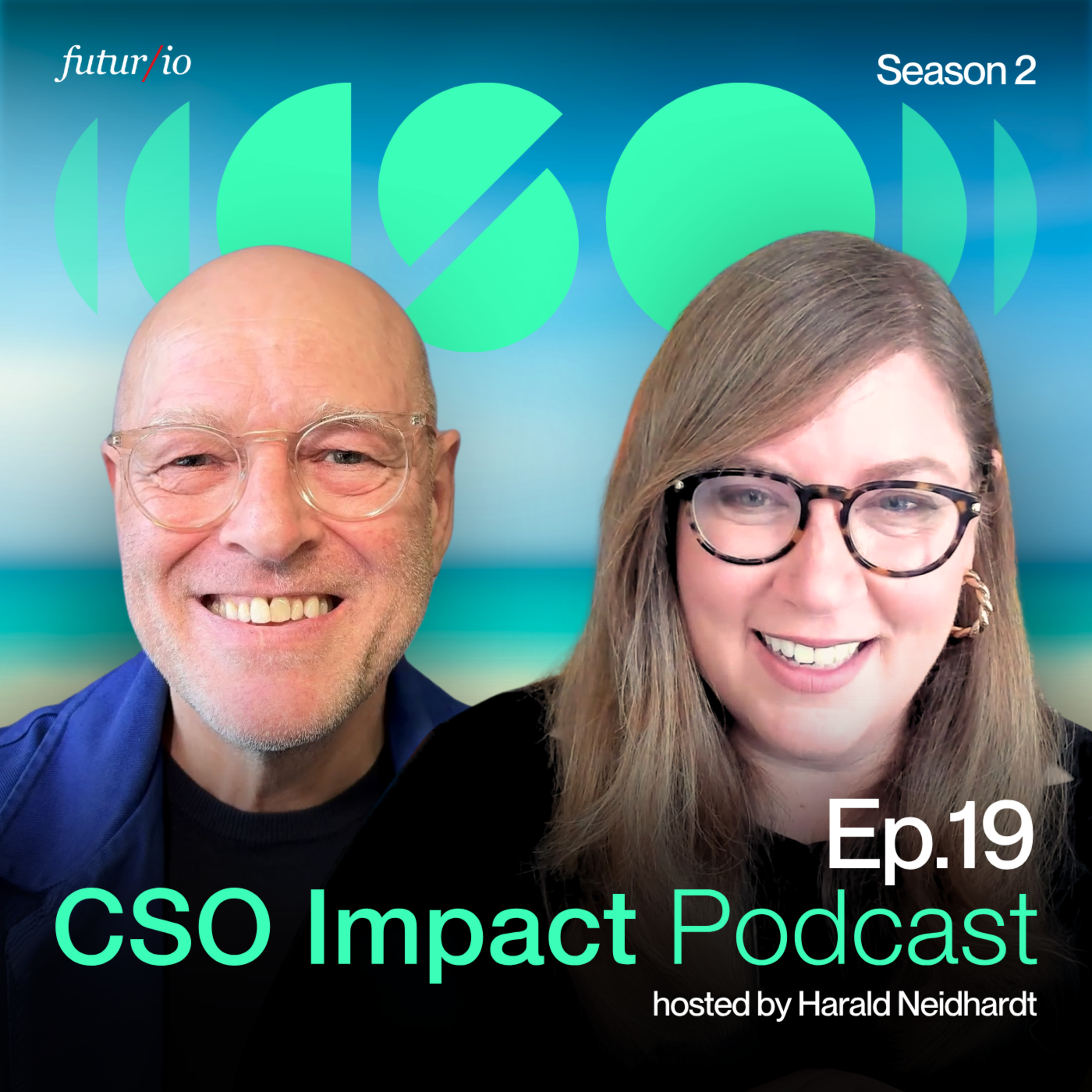
Ellen Jackowski, from Mastercard, on Empowering Sustainable Choices Through Technology
33m 36s
In this podcast interview, Ellen Jackowski, Chief Sustainability Officer at MasterCard, discusses the company's role as a payments technology firm and its sustainability strategy. MasterCard leverages its position at the center of the global economy to connect merchants and cardholders interested in sustainable products. The company's theory of change is threefold: to inspire, inform, and enable sustainable choices. Examples include partnering with celebrities like Celine Dion to promote reforestation, offering a carbon calculator tool to banks for cardholders, and implementing "tap-and-go" technology in transit systems to encourage low-carbon mobility. Additionally, MasterCard is driving circular economy initiatives, such as a reusable cup program at Blenheim Palace that reduces waste and costs. The company is also addressing its own product lifecycle by mandating sustainable materials for all cards by 2028 and piloting card recycling kiosks. Throughout, Jackowski emphasizes how sustainability and business innovation are interconnected, creating value for both the planet and the company's growth.
there are certainly ways for regulation to help speed up the shift that many of our merchants are interested in as well as many of our card holders. So I think staying very attuned, you know, I work very closely with our policy team, looking, you know, across the globe of where's the next regulation coming, where the market, it's going to force a market shift that we need to, you know, help enable. Hello and welcome to the CSO Impact Podcast, where we talk to leaders in sustainability and we're discussing how we can work in a way to have a positive impact on our planet and on people. I'm Johos Harad-Nightard and then the CEO of FutureO Institute and in this episode we talk to Ellen Jarkowski, the Chief Sustainability Officer and Executive VP of MasterCard and one of our top 20 CSOs of North America that we selected at our CSO Awards last year, September in New York. Ellen, how are you? Thank you for being with us here in the podcast. Thanks so much for having me. All right, let's ride away dive in and we are probably 99 percent are all familiar with the logo and the brand, but why don't you tell us a little bit about MasterCard and your role in the company? Sure, well, first of all, again, thanks for having me really excited for this discussion. So, you know, MasterCard is payments technology. Oftentimes people think of MasterCard as a credit card company, but really we're a technology company that facilitates a lot of your transactions across the globe. When we think about the scale and scope of the company, we have more than 150 million merchants on our network, so 150 million places all around the world where you can use your MasterCard. We have thousands of banking partners all around the world and we have over three and a half billion cards in circulation. So, to put that in perspective, when you think about eight billion people on the planet and we have three and a half billion cards all around the world, the scale is quite enormous. Fantastic, and tell us a little bit about maybe the history. Is this a hundred-year-old company and how did it start? Sure, well, it started many decades ago and it's really evolved into being one of the most kind of powerful companies sitting at the center of the global economy. So, we have lots of products that are focused kind of on the core in terms of, you know, the transactions that you're familiar with every single day, you know, when you go to tap and pay with your card. We also have many services that we provide as well. We're always looking to innovate in terms of adding kind of new technology, new easier ways to facilitate payments and to help our customers in terms of cardholders, but as well, all of the merchants on our network. I think the convenience, obviously, of payment is one of the key drivers. As you mentioned, tap and go. I lived in New York for seven years and now returning either for climate week or others. All of a sudden, you know, you can use the tap and go and the metro is so cool. For German people, it's actually a little bit of, you know, you actually, for Germany, you still need a receipt. So, you don't get a receipt and it's all practical and convenient. So, that means sometimes innovation is driving, obviously, much further than government frameworks and so on. So, maybe that's an example how you are driving as an innovation leader, how finance works, money works, and he is maybe my next question. So, what are sort of the challenges and opportunities of finance, moving money, and commerce in regards to sustainability? Well, the example that you just mentioned in terms of, you know, how you can tap and go in certain cities around the world like New York or London or Amsterdam or Rome, there are many cities all over the world where we've enabled that type of kind of efficient user experience, right? That's an exactly like the perfect example of how sustainability and our business growth kind of go hand in hand, right? So, as you mentioned as a user, like, it's so much better, right? To just go into the turn style tap and walk through, you don't have to stand in line and get in New York, it was called a metro card or in London that will the oyster card. You just need your phone or your card and you can move throughout. When we do that, right? It's called open loop technology. When we implement that in a transit system like New York, what that also does, of course, is help encourage people to take low carbon transit, like, you know, the metro system or like a bus, which is lower carbon than, for example, driving your own car. So, of course, there's war work for us to do, like you mentioned in Germany, there are some cities that we need to deploy open loop as well as in my home town San Francisco. You still need a clipper card. We're working on that or in discussions, but that's a perfect example of where sustainability and product innovation at MasterCard and driving our business growth go hand in hand. And, I mean, as we know, finance and money moves so much around the world with 3.9 billion people and users, how can, and in a way, you are, let's say, steering consumers and commerce. You're not necessarily the direct contact because that's sometimes banks and other people in the middle. Maybe you can tell us a little bit about that ecosystem. Who are the players in there? And how could you maybe help? Let's say steer the consumption or, yeah, in either more sustainable ways. So, we've got mobility, other maybe other ways that there could be examples like that. Well, when we think about how markets are shifting, there's a lot going on with sustainability, right? So, we see more and more merchants on our network who are interested in producing and selling more sustainable products and services. And we've certainly seen more card holders who are interested in buying more sustainable products and services. So, really, for us, it's about how do we connect those things? And how do we help facilitate more sustainable choices? So, our theory of change is threefold. How do we help, where we sit in the center of this economic system? How can we help inspire, inform, and enable more sustainable choices? So, an example of inspire. For example, MasterCard has been a 17-year sponsor of the Grammys. So, those are the big musical wards that happened in the United States over a year. A couple years ago, we partnered with CISA, who was the most Grammy-dominated artist that year. She created a new song called "Saturday" and dropped it on the Sunday night of the Grammys. She filmed her video for "Saturday" in a forest. She wore a green dress that had seeds sewn in all over it. Seeds that conservation international are key partner for our Priceless Planet Coalition, which is aimed to restore 100 million trees. They helped us pick out those seeds, right? Now, why did we do this? Why it was CISA wearing the dress with seeds on it? It was so all of her millions and millions of followers could have access to win those seeds. So, we opened up a big competition for how can you get access to the seeds on CISA's dress. Her followers loved it. Once they won, they got sent an eco package of the seeds with a signframe photo of CISA and then started posting about how they were planting the seeds and their yards and their communities. So, this was a way to inspire leverage an incredible influence or like CISA and have her show her audience, show her fans and all of her followers what's important to her and a simple act that her fan base could take part of. It's part of this mindset change of how do we help inspire people to think a little bit differently about what they're doing every day, the choices that they're making. In form is that second pillar. An example of what we're doing there is our carbon calculator. So, MasterCard offers to all of our bank, banking partners, a carbon calculator that they can make available to our card holders. So, at the end of the month, you get your bill and you have a list of everything you've bought and the financial impact of those decisions. And then you also have an estimate for the carbon impact of what you've bought. Now, again, more work needs to be done to get more granular in that detail. And we're also working on bringing that information to the beginning of the transaction cycle. So, right now you get it after you purchase something. It would be useful to also have it as you're considering the purchase. But the point is we're working to help inform the card holder of their choices and the carbon impact of that. And then the third, so you've got inspired, you want to choose something more sustainable, you're informed, you know what might be more sustainable. And then how do we enable? And back to your example, with the Metro, that's a great way that we're enabling more sustainable choices. So, now that you don't have to carry that extra card, the Metro card, you don't have to stand in line to get the Metro card. It's easier, it's faster, it's more convenient to take the subway or the bus. That's a way that MasterCard can help enable more sustainable choices. We're also, by the way, working on that tap and go technology for bike sharing. With free bike in Finland, we now offer where you can tap on the back of a bike share, hop on and go. You don't have to wait. The 10 minutes where you enter in all your information, and your payments, and your address, and wait for it to sink. Literally, you tap your card, and you get on the bike saving time, saving effort, getting there faster, and in a low carbon way. I think that also works in Paris, if I recollect, is that possible? Well, we're working on spreading the technology and working with other bike sharing companies all around the world. So, more to come, you'll be seeing that ease of use in many cities as time moves on. Yeah, I think that's definitely, cities, let's say, provided these things, but in every city, you had to have a different subscription and partnership as well. That's right, it's a different one more convenience in there. Now, if you have this three-pronged approach, it's super great. And you say that you help with a carbon calculation or so for the banks. Is there like a global branding? Or is this sort of a, say, white label product? Every bank can do their own with the software, the service you provided? Yeah, the banks can customize it. So, it's up to the banks, you know, if they want to offer it to the car holders, and they can customize it in whatever makes sense, you know, for their customer base. So, it's been an exciting product. And of course, you know, it's one that continues to evolve. So, as certain geographies are more interested in that type of information or different views of it, we work with the bank to make sure that we've got the right implementation for them and their customers. Maybe, I mean, I guess in the last, or in your role, you already had a couple of other initiatives that you focused on. Is there maybe one or two other examples that you can help us with in these, say, Inspire, the Hollywood, the Grammy was already a great example. And other things. So, because where does, let's say, sustainability come to the forefront. How, and basically the question is probably, how do you engage across the board? So, you are in the sustainability part, then there's marketing, that's a finance people, they're product people. How do you help these initiatives to, you know, come to fruition? Yeah. Well, so another example where we're really focused, and this is also in the Enable Pillar, is, you know, how can MasterCard help enable more circularity? And a good example that we've got running right now is in Blenheim Palace in the United Kingdom. So, if you're not familiar with Blenheim Palace, it's where Winston Churchill was born, it's located just outside of Oxford in the UK. And, you know, as Blenheim Palace being a very, you know, historic site at UNESCO's Heritage Site, they have strong sustainability goals and ambitions and principles in terms of how they want to operate. So, one day their head of innovation was kind of looking at the garbage bags that were being pulled out of the trash cans, and he was noticing how many single-use cups were in the garbage. So, he, you know, wanted to start tackling, how can we eliminate these single-use cups? So, he partnered with MasterCard and some other organizations, and we've implemented this new process. So, today if you go to Blenheim Palace and you want to grab a coffee or a tea and tour the palace, tour its gorgeous grounds and the pond and see all the wildlife, you go into the cafe, you order your coffee, the barista tells you, I'm going to hand you this reusable cup, we're going to charge you an extra two pounds for your feel free to enjoy your coffee all around the grounds, and when you're finished you'll notice these reverse vending machines. These smart kiosks that are on the property, when you're finished you drop your cup, your reusable cup into that kiosk, there's an RFID chip in it. So, the smart kiosk recognizes the cup, you tap your MasterCard or other credit card, and the two pounds comes back, so essentially you're renting that cup, right, eliminating the need for single-use cups. After we've gone through several iterations of the pilot with Blenheim Palace, what we've been able to do now is help them reduce their cup cost by almost half. So, you just spend about 100,000 pounds on single-use cups every year, they're now spending 50,000 pounds on the reusable cups, right? So, this is an perfect example of what we call doing well by doing good, the doing well piece, right? How are we helping their business, their organization thrive financially by cutting those costs, as well as doing good, right? Their customer experience is better. They've seen an uplift in their survey results because there's something about, it's a small action, right, dropping that cup, but it's just enough for people to feel really good about what they're doing. So, their customer experience is better, and of course the reduced waste in the reduced carbon is fantastic. So, doing well by helping their business, and obviously for MasterCard, same thing, right, it was one tap with the credit card to purchase the coffee and one tap to return the cup. So, doing well by doing good. This is a great example and being in the circular, maybe we come a little bit closer to your product. Obviously, it's also plastic, there's a chip in there, it's resources, it can be recycled, I guess. Are there already initiatives that this can be taking back, because I know, similar to all the great cell phones I still have, I think I have an iPhone for a generation in my drawer, and I have a couple of other things that you somehow have your own museum. Similarly, you have your credit cards lying around because, yes, I can cut them up, but then I have to, where do I recycle? Is it really only plastic? No, it's metal, and then you just either keep them in the drawer, or at least I, as a consumer, might be confused or lazy, and I just keep it here. Obviously, the very good question, and obviously, the system is designed for that cup to be returned, so you should not be taking that reusable cup and keeping it in your drawer. Consumers shouldn't be taking it home, they should be returning it back to Blatt and Palace in this case. In terms of what happens at end of life, first of all, the cups are created to last for 100 uses. So, versus a single use cup, you use ones, you throw it away, that's it. So, 100 times, at least. And by the way, just an interesting kind of funny fact. The first iteration of those cups had the Blatt and Palace logo on them, and what the palace found was people wanted to take them home because they saw them into any of the cups, because they had the logo. So, as opposed to buying, in the gift shop, they were taking the cups that were part of the program. So, while marketing at Blatt and Palace was really happy about the logo, our program was not. So, we stripped the logo off and made it look much more generic, not like something you would want to take home as a gift or a memory. So, anyway, I think that's just kind of an interesting point for those who are out there trying to drive more circularity. But anyway, at end of life, yes, making sure that the material the cup is made of is able to be recycled, that the chip can come out of it. And interestingly, it's quite similar to end of life of a credit card, where you've got a chip in the credit card, and you've got the plastic. So, there are processes for disassembly of that, just like in regular recycling processes. But obviously, all of that goes into consideration, and the recycling and the ability to get the plastic back, to take the metal out, to copper out, all those things, and put them in the right metal streams for resale and reuse, and plastic reuse are in process. But that was also what I was referring to. So, can I bring my credit card, maybe to the bank, back to the bank, you know, if you're going to conferences, you have the badge, and you basically drop them at the reception, so they can recycle it for the next year or the other conference. Sometimes, it's a part of these elements or the linear attempts. So, now in the credit card case, we have the chip, we have a antenna, we have the plastic, other ways that you engage already in kind of trying to make this in a circular way, that you bring back, or even let the banks produce from sexual plastic. Yeah, again, very good question. So, first of all, one of the things that we did a couple of years ago is there are rules, right, for how banks and issuers can function on the mastercard network, right, and they need to follow the rules. So, we created a rule change that by 2028, all of the cards that are produced with mastercard, and the mastercard logo must be made of non-virgin material, either recycled or biobased material. So, we were first, and I think so far, still the only in the industry to have created a rule change like that. So, we're working with all of our issuers of the credit cards to make sure that they are sourcing to create the mastercard from recycled or biobased materials. And in fact, today we've got over 900 million cards on our network that have phased out virgin plastic. So, that's kind of step one. How are we creating the cards to consider the planet and using more sustainable materials? But then to your point, what happens end of life? So, we have a pilot that we started with HSBC, a couple years ago as well, where kind of like the blood and palace example, we have these kiosks that are in the HSBC banks where people could take back their credit cards, especially if they have, you know, hit end of life. So, they've expired, and you know, they don't work anymore. So, you can put them in the kiosk, they're immediately shredded, and then we partnered with the company to come pick up that recycled material, and then put it back into the work and into the plastic stream as appropriate. So, we're working on trying to figure out how do we scale this process and make sure that all of our cards, you know, have a process and are able to be recycled end of life. Lots of innovation going on. Yeah, I bet, because isn't what about the rare earth parts or the metal and some of these precious little metal chip? Now, the chip is small, right? So, it's not a huge amount of metal. And again, when you think about, you know, credit cards, even though we do have three and a half billion or so in circulation, when you think about all the plastic in the world, it's quite small, but that said, there's still we still certainly have a responsibility and an opportunity to make sure that we're driving circulary and reusing all that, particularly the metals which are the most valuable. So, just like any sort of recycling stream, once it goes through the shredder that I mentioned, for example, like at the HSBC kiosk, there's recycling process where big magnets come, pull the metal pieces out, so the metal can go into a reuse stream for metal. The plastic goes into a reuse stream for plastic. And so, if I have my, let's say, master card in my wallet on my iPhone, and I don't have a physical card anymore, that plays into your hands, right? I mean, you still the processor or the money flows through your system, there's branding on the thing, and ideally, there's less physical cards in circulation at one point. Is that Yeah, and I think that's really not only the future, right? Where our strategy is a digital first strategy. If our issuers and our customers, the card holders don't need the physical card, and just want to load it on their phone, like that's perfectly fine with us, right? We don't mandate that you have to have a physical card. So, it's a digital first strategy, but in most cases, people still need, you know, the systems aren't as advanced, people still need the physical card, but that will change over time, right? People are getting much more comfortable in terms of using their phones and wearables to pay for things, and merchants are, you know, kind of increasing their technology to be able to accept payments that way too. So, I think that is absolutely the future where we're going to dematerialize credit cards altogether. Last question for this part. Let me go to the all of the other end. So, I guess, I mean, we hear a lot about the AI data centers right now, and obviously there's sustainability issues with water and cooling, energy usage. You must have also a lot of data centers, either yourself or run it. They're initiatives. I think your net zero goal is 2014, I guess, is a data center's part of, let's say, this longer journey. Yes, so you're right. Mastercard has a net zero goal to be net zero by 2040 a decade ahead of climate science. In 2023, we reported that the company grew by 13% net revenue, and meanwhile, our emissions reduced by 1%. So, we are seeing the signs of decoupling. In 2024, we're reporting that the company grew by 12% net revenue, and our emissions reduced by 7%. Pretty significant trajectory. Now, in terms of our expectations, we don't expect our full trajectory to net zero to be linear, but that said, we're making significant progress. And to your point about data centers, they are the largest contributor to our carbon footprint, both in terms of scope one two, as well as scope three through the suppliers where we outsource data centers in the cloud. And the good news is we're partnering with some incredible innovators in that space to make sure we stay on the right trajectory, because as we do need to continue to increase our compute power, because of AI and other factors, our growth, etc. We need to also be very aware of the decisions that we're making as we increase that compute power. How do we do it in a way where we stay on the trajectory towards net zero? And again, very fortunate to be working with our chief technology officer and our whole technology team that really understands our goal there, why we need to do it, how we can do it, and they're really pushing the boundaries of innovation to make sure we're doing everything we can to stay on that trajectory to hit net zero. Fantastic. I think this is exactly a good segue to the next question, because you are sort of at this, in the middle, say sustainability was in a technology company, in a banking company, FinTech, but tell us about your journey. So how did you start in this role? Maybe tell us a little bit about the journey and your background, which landed you where you are today. Sure. Well, I came to Mastercard from HP where I had been for about 14 or 15 years, always in sustainability. So eventually I became their chief impact officer and head of sustainable impact. And one day I got a phone call with interest of coming to Mastercard. And what was so interesting is at HP, a company that makes a lot of printers, PCs, 3D printing, lots of stuff, has a huge supply chain. HP is really more on the supply side of the sustainability problem, an aspect, whereas Mastercard isn't a big manufacturer or payments technology. So not a big supply chain in comparison to a company like Mastercard, but has those three and a half billion cards and all those card holders out in the ecosystem. So Mastercard really being more on the demand side. So for me, it was just an incredible opportunity to shift and tackle kind of a different aspect of the problem that I had already spent the majority of my career focused on. Congrats for the HP career because you or the team or the company want a lot of awards for their work, especially in what you do or did in channels, a little bit familiar with that. So kudos to that. I think it's an unsung hero and not a lot of people know about it because we talk more about IBM and Microsoft and so on, but I think HP is very well up there and recognized, so congrats to that. Tell me just a little bit about your background. So when we talk to CSOs, there's a legal background, there's a marketing background, there's technology people or even chemists. What is sort of the one thing that you started with which now maybe changed over time? Right out of college, I was a management consultant, but that was pretty short lived because one of our one of our customers, one of our clients was HP. And the one at the senior leader we were working with was asked to take on sustainability so that I jumped over to sustainability quite early in my career. So that's been kind of where I have focused very good. Talking about the role of the CSO, what would you say maybe some of the important characteristics or skills in your daily life, or what you also see maybe within your peers that are important for the role of the two sustainability office or chief in type office. Yeah, well you mentioned earlier kind of like, oh well you're in the middle. And that's exactly right, right? Like sustainability needs to be embedded throughout the entire company. So when you think about who makes the most significant decisions inside the company to address your sustainability vision and ambition or make progress against your goals. Like in the case of MasterCard, it's probably somebody like our chief technology officer, given the data centers are at the core of our carbon footprint, right? Or it could be somebody like our chief product officer who's developing technology like MasterCard Move, which is the functionality that I mentioned to do the payments disbursement of those two pounds from the smart kiosk back to the credit card, right? My job really is about influencing. And how do I work across the organization to bring people on board both senior leaders as well as the general employee base to understand that for us to reach the ambitions that we have in this space to grow the company to continue to be able to do well by doing good, especially as market shift, we really need the power of the whole company. And everybody needs to understand kind of how they fit in. So I spent a lot of my time kind of influencing, educating, exciting, motivating, and kind of brainstorming of what could the next step in our path be to do well by doing good? So interesting and inspiring obviously that you jump in and being an influencer. There are people who talk about CSOs as chief sustainability orchestrator, basically bringing a whole different violence and so on together. What would you say other things, let's say, would make a good leader in sustainability? Well, I mean, I do think this space is evolving very, very fast, right? This position hasn't existed for many decades, for example, like a CEO position or a CFO position or a CMO. This is a relatively new kind of C level occupation. So with that and with all of the regulation that's shifting, with all the technology, that's coming all of the data and the science that, you know, continues to help point us to where the solutions are, I think it's really important to always just stay on top of the latest technology, the latest opportunities, the latest tools that are being innovated out there because the market shifts radically. Once that I'll share with you, our MasterCard Economics Institute just did a study and this was in support of, you know, us trying to work through how are we going to enable circularity, you know, where we sit in the global economy. And so they studied online retail spend at looking at everything that crosses, you know, the MasterCard Network, which is quite vast. And what they understood was 27% of online luxury retail is circular, right? So people are buying second-hand, 27% when I initially kind of saw that data, I thought, oh, there's no way that can be right. That's too high. But so they went back and showed me the calculation and it's true, right? That's pretty amazing for mass purchases, right? Mass online purchases. It's about 5%, which is also higher than I would have expected. So, you know, this market is changing people's behaviors and their wants, you know, their actions are shifting, their preferences are shifting and the merchants on our network also want something different. So I think really staying attuned to how things are moving, especially, you know, this pace of change, which is, which is pretty extraordinary and making sure that you're always kind of keeping up with where things are headed and staying one step ahead. We already had a closing question. It went so fast. Let's say if we look a little bit at, you know, you are in a global role. This is a huge global brand. We see that there's obviously you talked about regulations that are different in Europe versus, you know, North America. There might be regulations different in California where you are, spend some of your time versus other states. You have Asia, obviously under your belt. How do you see regulation policy and, and I combined with another question, the role of the CSO in the next five years. So how do you see, you know, so the future evolving, surfing on these kind of currents, you know, incorporating policy changes and so on, as well as influencing your stakeholders. Let's put it maybe that as a memorable question at the end. Yeah. Well, one of the interesting things, again, I'll go back to Blanem Palace about those cups, right? Why cups? You know, cups happen to be one of the things that your pens are focused on in terms of regulation, right? A lot of the packaging that you see in certain grocery store items as well. So regulation in certain cases is helping to create these markets and drive faster a job adoption of circularity in some cases. So I think again, like it's interesting to think about how regulation can open the door to opportunity and to, you know, shifts like what we're working on with the pilot we've got going of Blanem Palace. So obviously, you know, there's lots of pros and cons to each of the laws that are being considered. But there's certainly ways for regulation to help speed up the shift that many of our merchants are interested in as well as many of our card holders. So lots of exciting things going on. And again, you know, back to the transit example that we started with, you know, in some of the standards we talked about tap and go on bikes and tap and go on subways. But the same thing applies to EVs as well, right? There's now a new standard that's been created for charging stations. And that's a good thing that's a good thing for MasterCard 2 to be able to then help service more effectively and efficiency and efficiently with, you know, enabling cars with our credit cards, right, with the technology. So when the car drives up to the charging station, the charging station knows the car, the car knows the charging station, you don't need to get out and funnel with buttons in your card and all that stuff. So I think it's an exciting future ahead with lots of innovation, lots of efficiency and happier customers. I see you are obviously not far from Silicon Valley and you have this enthusiasm for innovation in the roles and the gigantic markets, your brand or the brand touches. So congratulations so far for your role, for a kudos for some of the achievements you do and the initiatives that you started. I hope I see you during climate week in New York and other places. Thank you so much for being on the podcast today. Thanks, it was fun.
Podcast Summary
Key Points:
MasterCard positions itself as a global payments technology company facilitating transactions, with a network of over 150 million merchants and 3.5 billion cards.
The company's sustainability strategy focuses on inspiring, informing, and enabling sustainable consumer choices through partnerships, product innovation, and technology.
Key initiatives include promoting low-carbon transit via "tap-and-go" systems, providing banks with a carbon calculator tool, and enabling circular economy models like reusable cup programs.
MasterCard is innovating in sustainable materials, mandating that cards be made from recycled or bio-based materials by 2028, and piloting card recycling kiosks with partners like HSBC.
The approach integrates sustainability with business growth, demonstrating how convenience and environmental benefits can align, such as in transit and circular systems.
Summary:
In this podcast interview, Ellen Jackowski, Chief Sustainability Officer at MasterCard, discusses the company's role as a payments technology firm and its sustainability strategy. MasterCard leverages its position at the center of the global economy to connect merchants and cardholders interested in sustainable products. The company's theory of change is threefold: to inspire, inform, and enable sustainable choices.
Examples include partnering with celebrities like Celine Dion to promote reforestation, offering a carbon calculator tool to banks for cardholders, and implementing "tap-and-go" technology in transit systems to encourage low-carbon mobility. Additionally, MasterCard is driving circular economy initiatives, such as a reusable cup program at Blenheim Palace that reduces waste and costs. The company is also addressing its own product lifecycle by mandating sustainable materials for all cards by 2028 and piloting card recycling kiosks.
Throughout, Jackowski emphasizes how sustainability and business innovation are interconnected, creating value for both the planet and the company's growth.
FAQs
MasterCard is a payments technology company that facilitates transactions globally, connecting over 150 million merchants, thousands of banking partners, and more than 3.5 billion cards in circulation.
MasterCard focuses on inspiring, informing, and enabling sustainable choices through initiatives like the Priceless Planet Coalition, carbon calculators for banks, and promoting low-carbon transit options.
The Priceless Planet Coalition is a MasterCard initiative aimed at restoring 100 million trees, often promoted through partnerships with influencers and events like the Grammys to raise awareness and engagement.
MasterCard offers a carbon calculator tool to banking partners, which provides cardholders with estimates of the carbon footprint associated with their transactions, helping inform more sustainable choices.
MasterCard enables sustainable choices through technologies like open-loop transit systems, allowing tap-and-go payments for metros and buses, and similar systems for bike-sharing to encourage low-carbon transportation.
MasterCard supports circularity through initiatives like reusable cup programs with RFID technology, as seen at Blenheim Palace, and by mandating that all MasterCard-branded cards be made from recycled or bio-based materials by 2028.
Chat with AI
Loading...
Pro features
Go deeper with this episode
Unlock creator-grade tools that turn any transcript into show notes and subtitle files.
 PodcastTranscript AI