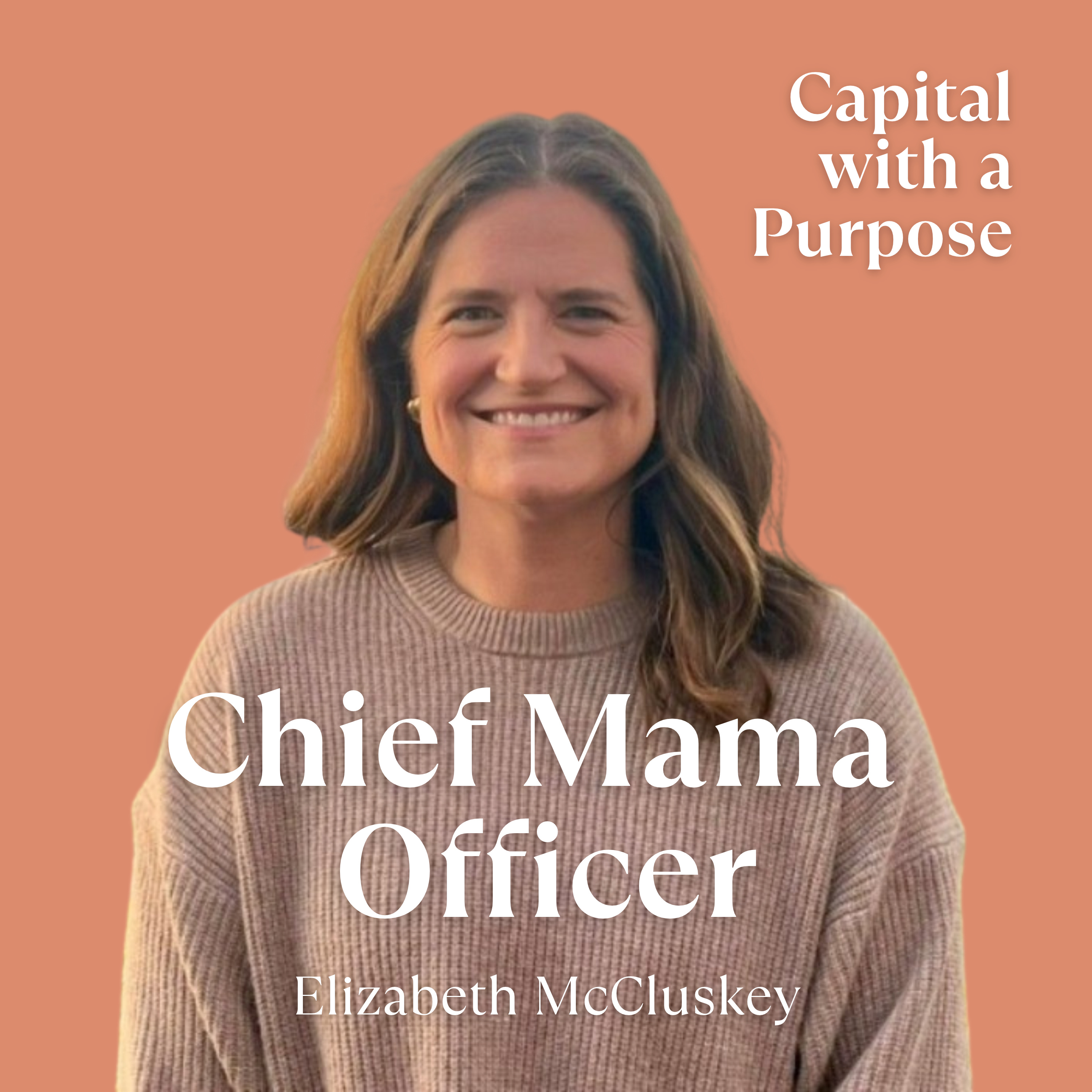
Elizabeth McClucksky shares her journey from investment banking and finance into purpose-driven angel investing, motivated by personal experiences, ethical concerns, and a desire for meaningful impact. Her path began with a pivotal moment involving her grandmother's health, leading her to explore impact investing during business school. She now invests in over 35 early-stage companies focused on family, community, and health, with a strong emphasis on female founders. She highlights that mission-driven founders have a higher chance of long-term success due to sustained motivation through challenging years. Elizabeth advocates for angel investing as a collaborative, relationship-based endeavor, urging new investors to join networks, start small, and prioritize values over profit. She also emphasizes the importance of founders being visible and transparent—building public presence through platforms like LinkedIn or Substack to demonstrate authenticity and community engagement. Her advice to women founders is to share their stories and experiences openly, while encouraging women funders to form supportive communities. For both groups, she underscores that investing in purpose, relationships, and real-world impact is not just a financial decision but a long-term commitment to creating a more equitable and human-centered economy.
This is Chief Mama Officer, where we envision more women in the boardroom, behind the capital and building the companies that change what power looks like, so that toxic or places become obsolete.
I'm Jenny Yang, your host.
It's an honor to have Elizabeth McClucksky as today's guest on the Chief Mama Officer piecast.
Elizabeth is a venture capitalist, an angel investor and a startup advisor.
She focuses on early stage purpose driven companies building to support families, strengthen community and improve financial, physical and mental health.
Welcome to Chief Mama Officer, Elizabeth.
Thank you, Jenny. It's an honor and a pleasure to be here.
Amazing. Elizabeth, I am wanting to learn what were the formative experiences in your childhood or even adulthood that led you down the path of venture capital and angel investing.
Yeah, I would say that I didn't even have sort of an idea of what venture capital was for much of my life, so this is definitely not a path that I was like marching towards from a young age.
I was always interested in finance and analytical business oriented. I studied economics and college. My first job out of college was investment banking because I was part of a women a business club, someone gave a presentation and they said, you know, this is going to be extremely hard.
But it's a great training ground for pretty much anything else you want to go into and I was like, well, if I don't really know what I want to do, that sounds like a good place to start.
But I, you know, one of the things I really did even in that first couple of years of my career was look at people who were 10 or 15 years, my senior and say, did I want to become them one day, like did I want to be them when I grew up.
And when I was working in investment banking, my answer was categorically no.
People did not have any work like balance, they were kind of consumed by their jobs. And I mean, whether they were passionate about it, happy about it, good for them, but I could just tell like that's not where I wanted to kind of build my identity.
And so still was figuring it out, spent a couple of years in wealth management, working for an incredible female mentor who had sort of blazed her way in the, you know, male dominated field of finance in her era.
And so admired what she had built, like basically she had built a business for herself. So I liked that kind of entrepreneurialism.
But was still missing that kind of values aligned piece and part of the time that I was in wealth management, I was helping my grandmother, who was a widow, you know, live on her kind of retirement savings and her social security income.
And we were investing on behalf of our clients into a range of stocks, including at one point tobacco stocks and she had been a smoker and she ended up having lung cancer.
And I said, I don't want to buy a tobacco stock for my grandmother. And I don't really want to buy a tobacco stock for anyone's grandmother or for anyone's parent.
And that's really what prompted me to go to business school to figure out how to integrate impact into my career. And I thought that I would be outside of the world of finance because to that point I had had two different career experiences and finance that didn't show me kind of impact.
But ended up learning about impact investing while I was at the University of Michigan. I was on a team that did a student consulting project where we got to work with the acumen fund, which had been historically focused on international.
Impact investing and they were actually launching their first domestic fund focused on US companies and they were looking to us to sort of do a landscape analysis of, you know, what early stage venture funds existed in the US that were focused on impact, where were their opportunities to invest we ended up sort of doing a deep dive into the financial services landscape and finding that there were opportunities for
successful financial services and fintech companies and investment, an investment thesis built around that.
And what was just incredibly rewarding that I think we got, you know, a lot of luck mixed with a little bit of good quality work and timing was they they did end up launching that fund.
It's still an existence today. It's called acumen America. And I have closely collaborated with and actually co invested with the guy who runs that fund who was our liaison for that project when I was in business school.
So that was like a great entree into impact investing.
And I think impact investing has sort of taken different shapes and forms and kind of gone in and out of favor as a term.
You know, where that has evolved for me is that I do kind of frame it more as purpose driven companies purpose driven founders these days, which means, you know, the person has sort of a dedicated mission to solving a particular problem.
But I would say it's maybe less well defined than it was kind of in my impact investing era.
And wow, what a full circle story there. What's coming up for me is this underlying tone around purpose and impact and the correlation between the two and the reason why it's pulling on my heartstrings here is because, you know, a lot of companies are on a venture path for the exit for the money.
And when a purposeful company comes to life with a mission driven founder and team, I'm curious for you, how did this lens of purpose come up for you over time.
Like what is it that denotes your experience between someone who is motivated by purpose versus someone who's motivated by something else.
Well, I think when most entrepreneurs take a good hard look at sort of the stats and the odds of success, you know, most companies don't end up becoming unicorns many times over like I think if you're only in it for the profit.
First of all, you have a very long road to go before you achieve financial success, but secondly, the odds are not in your favor that it's going to turn out that way anyway. So I like to see and actually think they have a better chance of succeeding if a founder is really driven by some sort of purpose or some sort of mission beyond just financial returns because, you know, especially today, it's anywhere from like 14 to 17 years on average for a company to exit.
So you have to have something that gets you motivated every day for over a decade to build something and there's going to be, you know, some great highs.
Along the way, but there's going to be a lot of very low days and if all you're doing is thinking about how big this company could be from a financial perspective, you're not going to make it.
Absolutely, yeah, it is quite a long journey building a company and I'm curious for you specifically Elizabeth about a moment in childhood when you first notice in clings of purpose, what did that look like for you or like how does has that manifested in your adulthood.
I always felt very fortunate and I think, you know, my parents have always kind of reminded me to be grateful and to appreciate what we have.
And I just, I think from them, from an early age, kind of had this notion that we need to share with others and like, you know, share our talents, share our fortune.
So I never did it, but I remember when I was younger thinking maybe I would want to join the Peace Corps, maybe I would want to become a teacher or a doctor like I was definitely oriented towards these kind of giving professions where you are, you know, a caretaker or a helper or you're contributing back to society.
Like that, that was just a frame of mind and an orientation that I had from a young age, it is sort of ironic that I ended up in finance because it doesn't necessarily feel like that sort of helper profession initially, but I think I have been able to carve a path within finance that enables me to have that sort of same fulfillment that I am helping people like one of my greatest passions is connecting underrepresented founders, particularly female founders with.
Not just capital, but really the networks that help open doors for them. So, you know, helping them understand how do you fundraise, how do you build a company that's going to be able to succeed in the long run, connecting them to people that they need to hire or that they need to build partnerships with.
And then I think the newer layer of that for me has been helping bring other women into angel investing too. So, you know, I think I've kind of been an ambassador to female founders and now I'm trying to be an ambassador to female funders as well.
And I think by bringing them to the equation more intentionally, you know, we'll get more founders funded also.
Absolutely. Yeah. In 2024, you started angel investing on your own and you've got a portfolio of 35 plus companies rooted in family community and health. And I'm curious what shifted in your life back then in 2024 or the years before that that made you want to write personal checks.
Yeah. And it gives a combination of experience. I had been in venture for almost, I don't know, seven or eight years, nine years at that point.
So I felt ironically like even though I had been a professional investor, I still actually didn't
feel confident becoming an angel investor until that time because it still felt like it was kind
of a totally different category of investing. And so I felt like, okay, I'm ready to take that
step from a, you know, confidence and skill set perspective. But also personally, I had my first
child in 2020, you know, COVID baby, kind of an entire like first year bubble for her first year
of life. And then I had my second son in January 2023. And so really I sort of like truly started
to emerge from the post newborn post like adjusting to having two kids haze when he was about a
year old. And that's when like I had been working that whole time I had taken maternity leave with
each kid, but I had gone back to my full time job. But it was only when he was one that I kind of
felt like, okay, I'm ready to actually bite off something new and something that I want to explore
both because I believe from a sort of mission driven personal perspective that I want to deploy
more capital into female founders and into companies that I want to see exist in the world.
But also I kind of had the mental capacity to be curious again. And to be learning oriented
and to say like, I mean, I never have a handle on things, but you know, I feel like I kind of know
what I'm doing enough with raising two kids that I can take something new onto my plate and sort of
explore this whole new world of angel investing. That is such a neat story. And I'm curious as
you have been investing in female funders and those who are new to the angel investing journey.
I'm curious what advice you would have for folks just getting into it or contemplating
getting into angel investing, especially because you've had years in terms of building the skills
and identifying, you know, viable investments and writing checks. I guess I would maybe have
three pieces of advice. One is you don't have to do it on your own and I would encourage you not
to do it on your own. Think of it as kind of a team endeavor. I mean, ultimately you're making
that final decision as to whether you want to invest in any particular company. But I would highly
encourage people who are just starting to find a group or a network that resonates with you.
You know, whether you're coming from a healthcare background and you find like a healthcare-focused
angel group or you really want to invest in female founders. So you join an angel group that's
comprised of mostly women or you want to invest in your local ecosystem and support, you know,
founders in your area. You can join a regional angel network. I think you can learn a lot from
other people's perspective. They also can, you know, bring deals to the table that you wouldn't
normally see. And when you have questions, both about the process of being an angel investor,
but also about a specific company that you're diligenceing, it's just always helpful to have other
people to kind of have a two-way dialogue with and bounce ideas off of. So, and that's how I started
to was I joined some angel groups and like some I joined and I ended up leaving because my interest
shifted, some I, you know, found sort of in my second iteration of looking at groups and have stuck
with. So, you know, be experimental, be open-minded, join a few groups and kind of stay with the ones
that serve you. My second piece of advice is start very small because if you decide you do want to
do an angel investing, you want to be able to kind of sustain a decent pace, you know, a lot of the
research shows that the best angel portfolios have at least 25 or more investments. And so,
you don't need to make those all in the first year and you definitely shouldn't make those all
in the first year, but you want to be able to write a check size such that you're comfortable with
writing, you know, 30 of those checks over the course of like three to four years. And I think
I made that mistake actually early on. I wrote checks that were too large. And after a couple
of checks, I was like, oh boy, like I got to slow down my pace of investing here because I only have,
you know, two or three companies in my portfolio. And I've sort of exhausted a good portion of my budget
pretty quickly. So, I kind of drastically downsized my check. And now I've kind of re-stabilized
to what I feel is my happy medium. But that would definitely be a piece of advice, I would say.
It's like there's no such thing as too small of a check to start with. And I think if you're
embarrassed about the size of your check, that's where again, the power of groups comes into play
because typically in an angel group, everyone can roll up small checks into an SPV, which enables
a lot of small check writers to show up as one line on a cap table. And that's much more palatable
to a founder to accept a group check. That's larger. And then the third thing I would say is have fun.
And again, think about your why. Think about your reason for doing this beyond just financial
returns. I think I'm not, you know, I'm not doing angel investing as a charitable endeavor. Like,
I do want to make money from this long term. But I also am doing it because of the value I'm getting
along the way. And for me, that is building relationships with an incredible kind of array of people
from the founders that I'm investing in to the other fellow angel investors I'm meeting along the
way to the other funds and people who are supporting those types of companies that I'm interested in.
So I've gotten a ton of fulfillment and value just from, you know, kind of the relationship side
of things that I think even if all of my investments go to zero, I will still say it was worth it.
I don't want them to go to zero. And I hope and expect, you know, that some of them will be
incredibly successful. But sort of I would just think about your why and do it for the right reasons
because it's going to be a long time until you see the financial returns.
That's right. Like you mentioned earlier, sometimes it can even be upwards of a 13 to 15-year journey.
So yeah, for sure. Yes, that's how we know each other actually is through a collective of female
angels in Bridge Club. And I think what's been highly beneficial to being a part of an angel group
is the deal flow that comes from the collective. And so I'm curious Elizabeth, how do you build and
cultivate your network of founders and deal flow, especially because your focus has been supporting
underrepresented founders, especially female founders. Where do you find these incredible founders?
I do have a bit of an advantage having been in venture for over a decade. So I have a lot of
relationships with other early-stage venture fund managers, venture capitalists who, you know,
historically would send me FinTech deal flow because that's what kind of my day job is is doing
early-stage FinTech investing. But every time I have an update or an email exchange with them,
I say, you know, by the way, I'm also doing more angel investing these days, especially for the
funds who are more generalist investors, like, hey, if you're looking at a really cool healthcare
deal or something that, you know, serves families, feel free to send it my way. I'm always happy
to take a look. So I kind of am priming people and reminding them that I'm looking at things beyond
FinTech. And then I think also a very intentional part of my strategy that has yielded, you know,
a lot of unexpected, great things has been just talking about it more publicly. So, you know,
trying to post on LinkedIn with a relatively regular cadence. And it feels like you're repetitive,
sometimes, because you're like, oh, I said something about this like two weeks ago. But the way
LinkedIn's algorithms work, you know, only a very small portion of your network is ever seeing
any of your posts on any given time. So just continually talking about those are the three pillars
that I invest in. Here's some of the great companies that I've already invested in. I'm always
looking for more highlighting the work of companies that I'm really proud to be a part of and sort of
sharing their success stories or what their needs are. You know, you just, you kind of never know
who's watching or who's listening. And I've had a ton of really interesting founders approach me
directly. I've had other angels who are like, hey, I'm interested in these same areas. How can we
stay in touch about deals? And I'll send them things. They'll send me things. So it's sort of,
it's kind of like a mystery. You don't exactly know what's going to come out of it, but I know
what I put in and what I, you know, what I get out has, has made it worth it.
That's incredible. This is an extremely tactical question that I hope this is helpful,
helpful for the audience, but I've been wondering about the operations of it and CRM that you use
to keep track of who you meet and the relationships that you have. That's kind of an ongoing work in
progress for me. It definitely has been something that I have been much more focused on and thinking
about how do I stay organized because the more and more people I meet, the more potential
connections I can make between people, but also the harder it gets to keep track of just in my head.
So for now, I'm doing a combination of using a platform called town, which is a newer kind of
AI assistant mixed with notion. So I have town create and maintain databases in notion.
You know, I have one for my pipeline of deals I'm looking at. I have one for my portfolio
companies. I have one for, you know, angels who are actively kind of exchanging deal flow with me.
So yeah, using town plus notion and kind of creating dedicated databases for different
groups that I'm trying to keep track of, but it's definitely an ongoing battle work in progress.
I just saw that HubSpot has created some kind of solo CRM like intentionally for
or solo founders or solo operators.
So I was thinking about looking at that too.
'Cause there is a lot that you can do with AI these days,
but if there's an existing platform
that's sort of tailored towards CRM, you know,
I'm open, like I don't need to be a hero.
I don't need to build something on my own just to say,
I did it, I'm happy to work with something
that suits the purposes that I'm trying to achieve.
Do you have lots on that?
- Yeah, I haven't used it yet,
but the recommendation that I received from a consultant
was DEX, EEX, and so--
- How do you do that?
- Effectively it connects email, LinkedIn,
and other sources to be able to surface relationships,
to cultivate and to nurture.
So yeah, I'm curious to try it out at some point.
- Yeah, another one that I've come across I haven't used,
but I think a lot of people have been excited about
as a company called Good Word, which I think is also
trying to help people nurture, you know,
relationships that might have gone dormant
or people they wanna stay in touch with.
So I think yeah, there's probably more interesting stuff
on the horizon as everybody realizes, you know,
I think distribution is a huge part of success
for any company, and I think just relationships
and network have always been important,
but are going to continue to sort of increase
in importance and having better systems to figure out
how to take advantage of your network are needed.
Like I feel like LinkedIn is breaking
in a lot of ways these days, and people are trying to figure out
either, you know, ways to take data from LinkedIn
or actually even develop alternative.
I saw one really interesting company the other day
that's sort of trying to disrupt LinkedIn.
So we'll see where that all goes.
Mm-hmm, for sure, yeah, and, you know, venture investing,
it's all very relationship driven in terms of connecting
people to one another, whether it's intros
to investors for founders in vice versa.
And so I'm curious looking at a founder.
What makes a founder a 10 out of 10 for you?
Because one of your LinkedIn posts I loved
where you had done due diligence on a founder,
and the referral that you had reached out to categorize
this founder as a six out of a 10.
And so that was illuminating.
And so what makes a founder a 10 out of 10 for you?
And who's a founder you believed in before anyone else did?
What did you see in them?
Yeah, that post was funny because it got a lot more
challenge than I expected to.
Like, you know, my question was, would you invest
in a six out of 10 founder?
And my answer is no.
And all these other people were like, well, you don't know,
you know, a six to one person could be another person's 10.
And, you know, my context for that is the person who I spoke to
who gave them that rating was an advisor to the company.
So they were choosing to spend their time
helping support this company.
And they were seeing the inner workings of the founders
and their assessment of sort of the founders potential
and entrepreneurial orientation was a six.
So that was what gave me pause was like,
it wasn't that their execution was a six
or the product today was a six.
It was that this person's kind of aura as an entrepreneur
wasn't, you know, one of the best that they'd encountered.
And I think so much of startup success is luck.
I think we all need to be very honest about that.
But you have to sort of diligence
and manage for what is controllable.
And so if I have a choice and these are my dollars,
you know, I want to invest in founders
that I feel total conviction for
and who have attracted people to them
who also feel that total conviction and devotion.
And so if there was an advisor working with this company
who was sort of doubting the potential of that founder,
that was enough to make me say, you know what,
I have a finite amount of capital.
I'm gonna put my capital into another company.
In terms of a founder, I invested in before anybody else
or believed in before anybody else.
I mean, I think I'm rarely the very first check
into a company so I don't want to take credit for that.
But, you know, among the early believers,
maybe a company called Moxie, Cory Fane Forest
is the CEO and founder there.
She is building a childcare software business
but started with brick and mortar locations
to kind of prove the concept
which actually is a path that several other businesses
in the childcare space have done as well.
Like, you oftentimes need to sort of eat your own cooking
in that space and show that your product
makes sense within a daycare setting.
So, she's a female founder.
She's based in Birmingham, Alabama.
She's, you know, starting with a brick and mortar
daycare location.
There's a lot of things where it's easy for people to say,
"No, like that's too hard or that's not a fit."
But I just, I see her vision and I see her passion
and she had been in the childcare industry
before she started this company.
And I just know like no matter what it is going to take,
she will be successful in this company.
- That's incredible.
Yes, the founder market fit is so necessary nowadays
in terms of criteria and being a full yes.
And so that's great.
I love the focus on families in childcare
and I feel very aligned to your investment thesis.
And yeah, actually, you had your first exit
from your angel portfolio recently.
And so one to one congratulate you and behind the veil,
what did that feel like to you?
Like was it validation?
Was it relieved?
Something you didn't expect?
- Yeah, so this one, the company's called Playground.
And they are also in the childcare space.
This was an interesting one
because I hadn't been invested in this one
from the beginning, the way I have
with many of my other companies.
They had already kind of started to take off
and really had some very strong traction,
very healthy pipeline.
And we're sort of a later stage company.
So in terms of why I invested,
it was very much a thesis fit
in terms of the impact areas that I like to invest in.
I thought this actually offered some nice diversification
to my angel portfolio
because most of these investments
I've made over the last three years
have been into pre-seat and seed stage company.
So they're all going to kind of have
that same maturity life cycle,
whereas having something that's a bit of a later stage deal
that had a chance of exit sooner
could kind of help me feeling like,
maybe getting some wins along the way
and recycling that capital into future investments.
The acquisition came way earlier than I
or I think anybody expected
and I think was a reflection of just how well
the company was doing that it was an incumbent that bought them.
So I think the incumbent got nervous enough
or saw enough potential in what they were doing
that they're like we need to have this team
and this technology and this customer base
within our ranks.
So it was really exciting to see the news
and I think a validation of you know,
not just how I've been selecting companies
but kind of this whole thesis around.
Like there is money to be made
and there is M&A potential
in supporting families focusing on childcare
which has historically just been a very tough space
to make things work
because unodeconomics are always difficult in childcare
but I mean, I'm sure your feed is similar to mine
in this respect.
I feel like there has never been more conversation
about how difficult it is to have, you know,
two working parents these days,
the school schedules have just gotten insane to manage
where kids are out of school
for like over a third of the year when you count, you know,
holidays and parent-teacher conference days
and everything in between.
I think once again, women are dropping out of the workforce
kind of new record numbers lately and so this problem
is not going away.
It's just getting more challenging to solve
and I think we just need as many solutions
or attempted solutions as possible.
So it just gave me more conviction
that this is the right place to be spending my time
from an investment perspective.
- Absolutely, especially if the government
and public sectors aren't necessarily subsidizing
childcare, right?
That's where the responsibility then
falls under private companies and so yeah,
there is significant room for opportunity there
and it's really interesting because as I started my own
Angel Investment journey and also saying different pitches
from various sectors of founders,
I am always curious about the exit comps
and so you mentioned that historically
the unit economics for childcare haven't been,
there hasn't been necessarily a huge payoff
but because the opportunity is growing in the market
I'm curious what other sectors do you feel like
are like childcare where there's actually
a growing market and growing opportunity?
- Well, I think generally speaking,
a lot of tech enabled services are ripe for kind of opportunity.
so I think that, you know, venture has typically
shied away from services businesses because there's only so much margin you can get, right?
Like if it's dependent upon people and humans delivering some, you know, some form of service,
there's only so much you can kind of optimize that from a margin perspective. I do think the
presence and sort of the ability of AI has unlocked a lot of back office and operational efficiencies
so that everything that doesn't touch the humans in a service oriented business can be optimized
and you can bring those margins up higher. But I think also in an age of AI, people are realizing
that there are certain things that you can never outsource to technology. And so I actually think
there's an increasing sort of premium on services and like, you know, where people say I don't want
to talk to a bot about this or like I want real customer service on the phone or I need somebody
to come into my house and cook a meal for me or do my laundry for me like I know these robots
are coming. But for today, I think there's still a lot of value and potentially even kind of an
increased value on services. One of my portfolio companies is called Rosie. They are enabling
families to get access to household helpers, whether that's people who are coming in again and
doing food prep laundry, tidying, whatever and/or child care. You know, those are things that people
want kind of trusted, vetted, high quality people in their homes to do. On the back end, Rosie is
using a lot more AI and technology to kind of keep track of what a family's needs and preferences
and schedules are so that you don't have to tell somebody five times. This is where we store
the paper towels and like, when this runs out, this is the store we like to buy it from. Like,
there's just so much that exists in our kind of memory that you have to recite each time you
hire a new babysitter or a new cleaning person or something. And so they're trying to
help sort of create that memory around it. And then on the flip side for the Rosie pros,
you know, they're giving people who are looking for more flexible hours, but consistent work,
the opportunity to plug into these, you know, networks and ecosystems that might have been
difficult for them to tap into before. So, and they've done really well, like their growth has been
incredible over the last year. They're based in Seattle. So unfortunately, I can't use their services
yet today, but I expect that they will be in many other cities pretty quickly. And I don't
think it's public yet, although it should be soon, just the details of the round they raised. They
had a lot of really great venture funds investing in the in the round. So I think venture is
starting to take note of sort of tech enabled services being an area of opportunity again.
Amazing. I actually had an opportunity to hang out with the Rosie team. In person,
last week in Seattle, it was really fun. And they brought together a community of women founders
and they sent a Rosie pro to each of the attendees' homes. And what I thought was really neat was,
you know, not only do the Rosie pros support with child care or household management, but even
writing addressing letters. And, you know, there were just so many of these activities,
the bajillion things that we all own and have to take care of. And being able to have that taken
off of our plate is incredible. And I, of course, planted seeds with love for Rosie to come to Montana.
We'll fight over what, who they expand to first. Yeah. Yeah. Yeah. So I believe it was on a post
where you shared the idea that women founders get met through a risk lens and men through an
opportunity lens. And for the woman founder who's about to pitch this quarter because we know that
fundraising is huge right now in Q4, what does she do with that bias that she might potentially face?
Yeah. I think going in just knowing that probably is helpful. So you just, you know, you're prepared
that you might get more questions on sort of the risk or the downside or the, you know, how could
this not work? Like, I think you need to be prepared to answer those questions because they are
going to come up consistently trying to reposition the conversation to say, this is why we're so excited.
This is the size of the market opportunity. This is the white space we're moving into. Like,
this is how big we think we can be. So I do think if, if those concerns exist and there is going
to be a focus on risk, you can't just totally dismiss them. And, you know, unfortunately, like, maybe
that is different to how a male founder would be treated. But I think you kind of answer those
questions as succinctly and confidently as possible and then continue to shift towards like the
growth story and the reframe. But yeah, I mean, it's definitely a frustrating and unfair situation.
And I think there's even been some studies that show even female investors have some of those
unconscious biases too. So, you know, my advice isn't even like to go pitch a female investor because
I don't think that necessarily solves all of the problem. But just kind of being aware that
it is potentially a different environment or a different conversation that you would have
than a male founder would have. And we cannot change the entire system with one conversation.
So there's only so much you can do in your individual pitch, but just try to prepare yourself
and position yourself the best you can. I'm curious for you having had your career
primarily in, you know, financial services and Fintech and investing. What have you had to
unlearn throughout that time, especially, and my assumption is that it was a pretty male-dominant
space really on in your career? What have you had to unlearn from that time?
I have always been in male-dominated industries, but I have always been fortunate to have, like,
a very close female mentor or boss. So I just, I feel very fortunate that I don't think my
experience has been typical of a woman who has risen through the ranks in finance and in venture
capital. But having said that, I have talked to so many fellow investors, fellow founders for
whom that is not the case. And so I just think even though my experience, like I recognize how
a typical my experience is and that just makes me feel like I want to give other people the experience
that I have had, which is like that you do know female founders, that you do know female investors
that they come to mind, that they're top of mind, that they're part of your network and part of
who people are talking about. So just trying to create that that opportunity. I mean, I do remember
a moment when I was in investment banking. So I was like 22 maybe and a senior guy who was on our
team was trying to get my attention and he was like snapping at me like, hey, hey, hey you come
here. And I was like, I don't think that you should be snapping at me. I don't think you'd be
snapping at a guy. So just, you know, I guess, I mean, I didn't, I never found that to be acceptable
behavior, but just a good reminder that you need to treat all people with respect and dignity.
Absolutely. Yeah, yeah. And how, how would you say that has shaped
your mindset, then perception of being in this field of backing underrepresented founders?
And I really appreciate your focus on noticing unconscious bias. I would agree that it's just
because there is a female investor, right? That they might not have biases as well. I agree with
that point. So yeah, like what work have you had to do to be able to notice like if anything's
coming up for you? Yeah, I have stopped myself on occasion after a call with a founder and just said,
like, am I thinking about this critically because it is a female founder? Like would I have asked
those same questions to a guy? And as I'm looking at, you know, especially when I'm simultaneously
looking at multiple deals that are all very early stage, like it's really easy to pick holes in
any company. And so I think it is just important to ask myself regularly, like, am I kind of being
an equal opportunity hole picker? Am I, you know, am I dismissing these companies because
that their risks that I don't think can be overcome? Or is there some element of like, oh,
well, I don't think other investors are going to get on board with this. So I don't want to put my
money in and know that other people are going to doubt that founder. So I think that is,
you know, that's something that I just have to continue to think about. And that's part of why, again,
the way I help myself, but also help my founders is building a larger community of investors,
whether they're angels or venture investors who are interested in the same themes as me, whether
or not they're led by women. And, you know, bringing to them the strongest companies that I see in
those spaces and saying, like, I have conviction in these founders. And I want you to have that
conviction too. And like, let's come together and support these companies with our investment capital
in our connections. Great. I love it. Yeah, I definitely appreciate your ability to mobilize.
And in terms of that, that conviction, like, how, how do you know? Obviously, there's going to have
to be alignment with your investment thesis. But how do you know when there is that full conviction,
right? That full belief in the founder and what they're building is that something that happens
internally.
I'm curious to learn a bit more about your mental processes there.
It is a little bit different for every company and it does depend, you know, on are they selling
to enterprises, are they selling to consumers?
Like, one of the things I like to look for when a business is selling to consumers is just
how well they know their prospective customer and how much time they've taken to incorporate
their feedback into the product in the earliest stages.
I don't think you can necessarily be as in the weeds with your customer forever, but
like when you're just getting started for consumer products, whether it's consumer tech
or CPG, I think just truly understanding who you are serving and what they're looking
for is a very worthy investment of your time.
And it's something that like I really value significantly when I'm waiting kind of
with whether to invest in a company, so I'll give you two examples, Ava is another company
I invested in.
It's an AI kind of household family assistant tool.
Basically all of your nightmares about like, oh my god, the school email came through and
I missed these three important dates for like the fall pump can patch and then I needed
to sign up to volunteer to bring cupcakes to my kids back to school, bake sale, like Ava
pulls all of that stuff out of your email and surfaces it and it gives you, hey, do you
want to add this to your calendar?
Hey, here's a reminder of this is do then, you know, here's the form you need to fill
out.
It basically is just kind of acting in the background at all times.
So the product is meant for families, but obviously the heavy users are going to be moms.
So Laura, the founder, convened a group of beta testers very early on where, you know,
the product had a lot of flaws, a lot of bugs, a lot of slow reactions, it didn't look
as visually nice, but these women were all like, we're game to try this out.
And we will give you our feedback.
And so I'm in this WhatsApp group with them where people are just giving feedback all
the time.
Like, can I do this?
I would love it if they could do that and she is really good about teasing things out
of them and saying like, when you say this, what do you mean?
Like, would this be enough or would you want it to have this functionality?
And it has just hugely shaped the product roadmap for the company.
So I think it's given really good insight for her into what it does and does not need
to be, but it has also created a community of like several hundred evangelists for the
company and for the product.
Like, all of these women are now going out and telling their friends, they're telling
their PTAs, they're telling their neighborhood groups, you know, you've got to try and me
too.
Like, I'm sharing this with, you know, fellow moms in my neighborhood who I don't really
know yet because we're new in our area that I'm like, you need to try this because someone
just sends a text in our, I'm one of our mom threads the other day saying like, wait a
second, do we have Wednesday, November 3rd off from school?
How can that be like?
And then someone was trying to send this video of, you know, how do you doubt Mother's calendar
into your calendar and I was like, here's an even easier, try a type of close interaction
with your Twitter is really powerful.
And on the CPG side, similarly I invest in a company called Jubilee's, which is a super
milk.
So she's selling chocolate milk, like banana flavored milk, she's coming out with strawberry
soon, which instead of being sweetened with sugar is sweetened with fruit and vegetable
juices.
So it's a lot less kind of added bad sugar, but also has a lot of fortification from the
vitamins and minerals that you would get in fruits and veggies.
So she's kind of trying to create a whole new product category.
And again, in order to do that, she knows she's going to be selling two moms.
So she's also using moms to help herself.
So she has created a mom squad, which is women who are trying to earn a little bit of extra
income and just like want to be motivated to be part of this company's success.
And she's sending them, you know, coupons, she's sending them merch.
And they're going into their local stores and like putting coupons on the shelf where
the product is or they're talking to the store managers and saying, Hey, I noticed that
the placement isn't where it was supposed to be.
And they're getting some, you know, some fees from the work that they're doing.
But it's significantly less than Jubilee's would be paying if they were doing the in-store
promotions by like a third party company where they just don't have great real-time data
on who's trying and who's sampling and the prices are high, you know, for things like
that.
So she basically was like, instead of making this a huge cost center for me, I'm going
to make it an asset where it's less money to me.
And also it's going to give me a lot of insight into my users.
So those are the types of things that I'm looking for in the founders that I'm backing
is not just that I have had great conversations and I see where they're going and I like
them as a person.
But that they've been able to build or kind of tap into some sort of ecosystem that, you
know, speaks to how much they truly want to be embedded in the community that they're
serving.
That's brilliant and it's critical for distribution as well.
Yeah.
Yeah.
Brilliant.
So, Lizbeth, we're nearing our time and I am curious if you were to zoom out in time
as your kiddos get older, how do you want to steward your wealth and what does wealth
mean to you personally now?
How has that shifted over the course of your career?
Yeah.
I mean, I think probably for a few more years, the idea of me being an investor is still
sort of an opaque concept to my young kids, right?
But I do hope that over time, especially because I am investing more now in companies and
products and services that we either are already using or potentially could use as a family,
just sort of showing them in those everyday life moments like, hey, for example, we, I invested
in tin can.
We have a tin can phone.
Like, did you guys know mom gave money to this company so that they could build more
phones and get those phones into people's houses?
And we think that's really important because this is a great way for you guys to stay connected
with your friends and to have more independence and coordinate your own play dates.
So just, I think because I'm investing in these themes that are so close to home and so
close to my family's experience, being able to use that as kind of a teaching moment
of like, this is what is important to me.
I'm actually giving these companies our family's money because I believe in the products that
they're building and I want them to be able to serve you and your friends and the rest
of our family.
And in terms of what wealth means to me, I mean, I think this is probably the progression
that many people experience as they get older, which is there is financial wealth, but there's,
I mean, time is the biggest form of wealth in my mind.
So, you know, time with my kids, time for my own interests and self-care, time with my
husband, and so just thinking about how I can buy more time is what is my form of wealth
these days?
Yeah, that's right, time is wealth, it's our greatest asset.
Yeah, so two audiences here, right?
So we've got the women who are interested in angel investing or they're new to their angel
investing journey, and then there's the women founders.
So what one piece of advice would you give each of those personas?
For women who are interested in angel investing, I would say just find a group.
It doesn't have to be your forever group, but just join a group, you know, some of them
have no fees, some of them have low fees like hopefully it shouldn't be a huge capital commitment
for you to just join a group and start to learn.
Just listen to their webinars or read the decks of companies that are coming through.
That's, you know, that's my best piece of advice for the angel investors.
For the founders, I think my best piece of advice is if you're not already doing it,
build in public in whatever way feels the most comfortable to you.
It's probably never going to feel totally comfortable, but like there are so many different
platforms these days, just pick one and start, you know?
If you're more of like a visual person, go launch an Instagram page.
If you want to write kind of to a business audience, do some LinkedIn posting.
If you want to write more long form, you can do sub stack, like, but I think you have
to be somewhere because that is the expectation of investors these days is I'm going to look
at your pitch deck, but I'm also going to go search you on the internet and see kind
of what is your, what is your digital identity?
What is your history?
What have you stood for?
What have you learned, like how have you changed and grown and how has your business evolved?
Even if it hasn't been around for that long, just, you know, maybe giving some explanation
as to how you started the business or where it came from, what professional or personal
experiences led you to that.
I think that is becoming sort of table stakes today.
So even if it scares you, you got to do it and it scares everybody else too.
And you know, if you fail, at least you tried, but like, that is part of how you have
to get yourself out there these days.
Absolutely.
So on the female funder side, I'm finding community in an angel group.
And then on the female funder side, putting yourself out there in digital.
Yeah.
Amazing.
Hosting a podcast.
Yeah.
Exactly.
and getting on the chief mom officer by gas.
- Yeah, yeah, yeah, yeah.
- Amazing.
Well, it's been such a joy and delight getting to know you better today and so grateful for your stories and insights.
Likewise, I'm happy to be a resource to anybody at any time, so feel free to follow up and find me if you have more questions.
Incredible and along with your links in the show notes.
Okay, thank you.
Thank you.
If you enjoyed today's episode, find us on Instagram and TikTok at chief.mama.officeer.
Podcast Summary
Key Points:
Elizabeth McClucksky transitioned from finance to angel investing after realizing that traditional paths lacked purpose, balance, and alignment with values.
Her personal experience with her grandmother’s health and a strong ethical stance against tobacco stocks led her to pursue impact-driven investing.
She focuses on early-stage, purpose-driven companies serving families, communities, and health—particularly those founded by women.
A key insight is that founders driven by a clear mission have a stronger chance of long-term success than those motivated solely by financial returns.
She emphasizes building networks through angel groups and public engagement to increase visibility, access to deal flow, and community support.
Her investment philosophy centers on founder conviction, community integration, and real-world customer feedback as indicators of success.
She advises new angel investors to start small, join networks, and prioritize relationships over returns, viewing it as a long-term, values-based journey.
For founders, she stresses the importance of building a public digital presence to establish credibility and visibility in investor-driven ecosystems.
Summary:
Elizabeth McClucksky shares her journey from investment banking and finance into purpose-driven angel investing, motivated by personal experiences, ethical concerns, and a desire for meaningful impact. Her path began with a pivotal moment involving her grandmother's health, leading her to explore impact investing during business school. She now invests in over 35 early-stage companies focused on family, community, and health, with a strong emphasis on female founders.
She highlights that mission-driven founders have a higher chance of long-term success due to sustained motivation through challenging years. Elizabeth advocates for angel investing as a collaborative, relationship-based endeavor, urging new investors to join networks, start small, and prioritize values over profit. She also emphasizes the importance of founders being visible and transparent—building public presence through platforms like LinkedIn or Substack to demonstrate authenticity and community engagement.
Her advice to women founders is to share their stories and experiences openly, while encouraging women funders to form supportive communities. For both groups, she underscores that investing in purpose, relationships, and real-world impact is not just a financial decision but a long-term commitment to creating a more equitable and human-centered economy.
FAQs
Elizabeth was drawn to finance through economics and investment banking, but rejected high-pressure, unbalanced careers. Her experience helping her grandmother avoid tobacco stocks and her interest in values-aligned work led her to pursue impact investing, which shaped her path into venture capital and angel investing.
She defines purpose-driven companies as those founded by individuals with a clear mission to solve a meaningful problem—like improving family or community health—rather than solely pursuing financial returns. This mission drives long-term resilience and daily motivation.
She argues that building a successful company over a long timeline (13–17 years) requires daily motivation beyond financial gain. Founders driven by a purpose are more resilient through low points and better equipped to sustain their vision over time.
She advises joining an angel group—whether focused on gender, location, or sector—to learn from others, gain deal flow, and build networks. She emphasizes starting small, staying experimental, and prioritizing fun and personal values over financial returns.
A founder shows deep conviction, strong alignment with customer needs, and has built a community of supporters—including advisors and early users—who believe in their vision. She values founders who demonstrate real customer insight and passion for their mission.
She actively shares her investment focus on public platforms like LinkedIn, connects with venture partners who send her deal flow, and joins angel groups to access curated deal pipelines and real-time founder insights.
Chat with AI
Loading...
Pro features
Go deeper with this episode
Unlock creator-grade tools that turn any transcript into show notes and subtitle files.
 PodcastTranscript AI