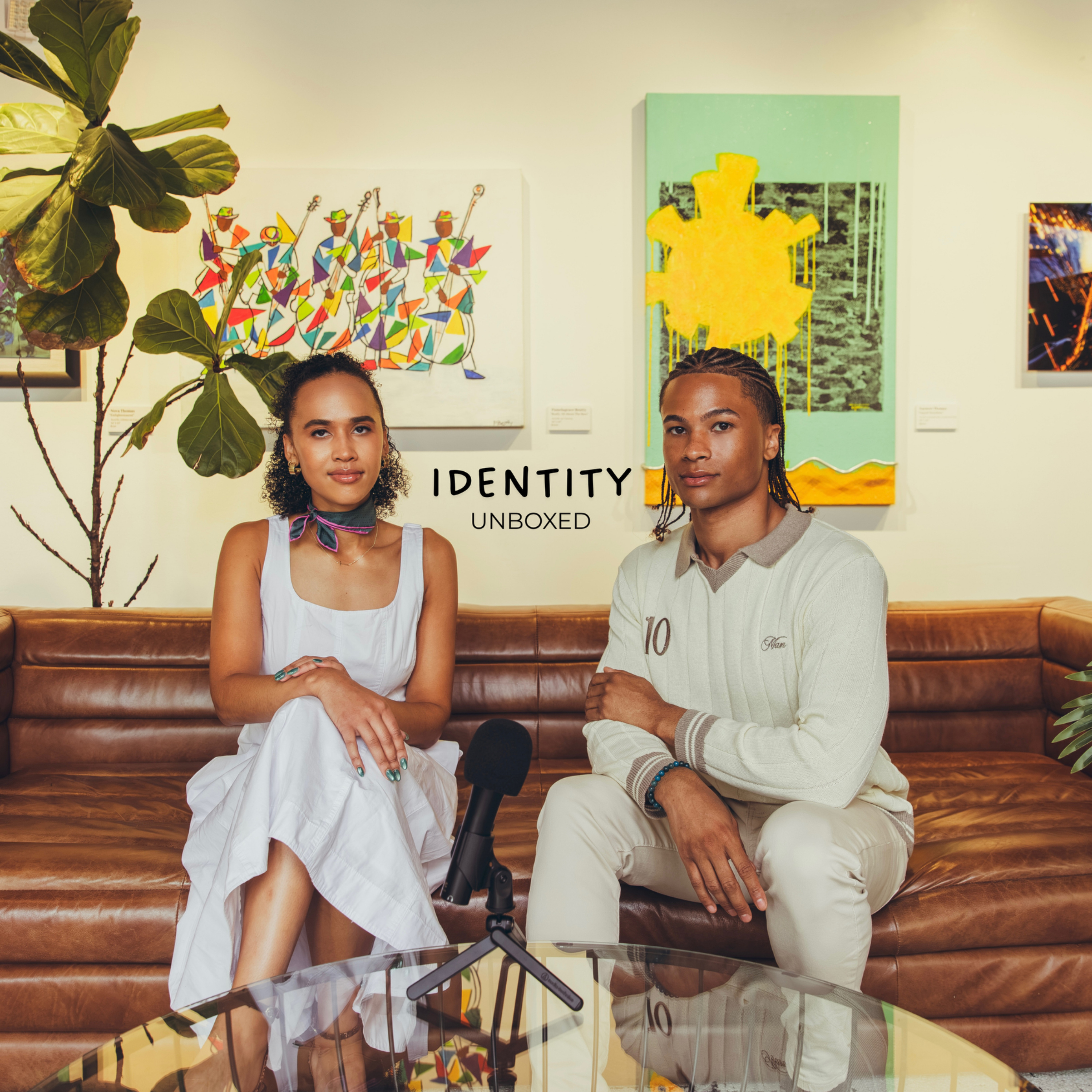
Welcome to Identity Unboxed, the culmination of our lived experiences as Black professionals seeking
mentorship and representation in the spaces we inhabit. From the corporate world to creatives,
we are committed to documenting Black contributions that elevate Black community across the diaspora
while preserving our narratives with engaging conversations intended to ignite change makers
advocating for justice in all forms. This is an infinity space for Black individuals to engage
in vibrant discussions meant to ignite the audacious leaders innate within us to move towards
sustained prosperity for our community. All are welcome to listen, learn and reflect on Black
contributions to our global tapestry. This is a safe space for Black individuals to unpack
adversity and center restoration through offering reflection on the healing of ancestral trauma.
We hope that one conversation can inspire you to take that step towards your goals and continue
to define your narrative on your own terms.
Well, Remy, first off, just wanted to thank you so much for coming to Identity Unboxed.
For our listeners today, we are going to be talking about elevating expansive possibilities
through art. Remy Sturk is a catalyst for transformation reinvigorating the capacity for
vision by treating philosophy methods of support in our shared community as interconnected elements
of a syndemic. He serves as the primary director and creator of halogen, a fiscally-backed entity
dedicated to elevating awareness regarding suicide prevention within Black and brown change
gender communities, a Black trans man with a distinguished career spanning more than 15 years.
He is a celebrated musician, filmmaker and humanist. His contributions were recently recognized
when he was honored as a recipient of the 2024 Walk of Young Professionals Top 7 under 40 award.
Remy's professional portfolio includes collaborations with major corporations like Microsoft
and HBO, as well as educational institutions and advocacy groups like North Sound,
HCH and the Washington State Syndemic Planning Group. His work focuses on exploring the
intersecting of storytelling, cultural anthropology, and creative participation to develop specialized
programming. He also established and managed the inaugural year of the Omni Center, a certified
digital media laboratory for Bipop Youth. His broader impact includes partnerships with BH1,
the Kansas City Ballet, the Granby Museum, and various public health and housing initiatives.
He observes human beings, and I quote, "human beings are inherently fluid yet our current
service structures remain rigid and fixed. There is a lack of synergy between the static and the
dynamic between the forces that ground us and those that lift us. Understanding human needs is
impossible with individuals like the space to envision or experiment. Rest is the prerequisite for
dreaming and authentic play only occurs when people can exercise their own flexibility free from
outside pressures." Ultimately, Remy remains sedicated to the protection of joy and fairness,
acting as a steward for the narratives of individuals finding their way back to their true selves.
And with that introduction, our ice maker is What Is Your Favorite Movie Directed by a Black
filmmaker or that had a black lead actor? Oh, that's a really good question. Okay, I think recently
it has to be centers. That is one movie that every time I watch it, it's the same as because one of
my favorite albums, I know this is not a question, but one of my favorite albums is a Stevie Wonder
Songs on the Key of Life. And every time I listen to that album, I discovered it when I was a kid,
probably middle school, and I still listen to it to this day, and every time I listen to it, I hear
something different, or I discover a new instrument, or a new layer, and centers is the same way.
The first time I watched it, I was like, okay, this is Steve, they understand this,
and I kept watching it. There's so many layers that I am finding and learning out about,
and just so many things. So I think it's going to be centers.
That's an amazing option. I love centers. I saw it three times. So I would see it again and again.
Ryan Kugler is a genius. We're hoping to get him on the podcast. So Ryan, if you hear this, please
come on. We know you're busy making the next Black Panther. There's apparently that just came
out, or the news came out about it. But yeah, I would say for me, my favorite movie, or
by Black filmmaker or Black conductor, I think get out. I love Jordan Keele. I love horror movies.
So same with centers, the same kind of themes. But get out, I loved it because it was such a
psychological thriller, and I'll never be able to go back to that first time I watched it in the
absolute sheer panic when the TSA agent pulls up at the end. And I'm like, it's done. His life's all
over all because of this one unfortunate situation. And it just, yeah, it was like a jump scare. So I
love that movie. And I think I see Miss Daniel Kaluah. Is that his name? The main actor.
Brad, you know, Daniel Kaluah. I think so. I think so. He's awesome. He was in nope as well. So I like
him a lot. Yeah. I'll pass it to you, Brad. Yeah, both of those films 10 out of 10.
Similarly to Tiana, I would say my favorite is us by Jordan Peele. That was mind-boggling to me.
I just loved it through and through all the symbolism. The plot twist at the end. That was the
biggest plot twist. I was like, whoa, I was stunned. I don't know. People have seen them. It's been
out for a long time now. But Lupita, oh my gosh, the multiple characters, the way she just really
embodied that. It was just phenomenal. So we have a horror movie theme going on here. I love that.
We have good taste. Yeah. Perfect. Okay. Well, moving into our first official question,
can you take us back to young Remy growing up and show how your background influenced how you
navigated your identity? I know that's a big question. Yes. Okay. I can definitely do that. Yeah. So
I was my story's crazy. And I think the older I get, I developed a new relationship with a
story of what was the origin or the source of my joy. What was what's inspiring me now?
But yeah, so I was born in New Jersey immediately went into foster care. It's my birth family
was a bit of a hot mess in the most respectful way of. And yes, I spent my first years or the first
couple months in the hospital just because my mom was a heroin addict. And so I had to go through
a bunch of tests. And my birth family visited me in the hospital a couple times. And then my adopted
family came to visit and found me. And they I really don't remember the the timeline. I believe
I was definitely under one when I got adopted. Yeah. So I got adopted by them. Their white
grew up in Summit, New Jersey. So it's suburbs of northern and central New Jersey. Just 45
minutes across the river from New York City. And grew up there. Then moved to upstate New York for
a little bit, which I really like I love that area that is definitely where my heart and home is.
And then we were living in upstate New York. My adopted parents had their own business. And they
had their their big X number of clients. And of course, then 9/11 happened. And they lost
most of their big income clients. And so my dad got offered a job at Hallmark, which is all
the enough headquartered in Kansas. So that is so random. I was like out of all the the state. So I
guess it makes sense because you're right in the middle of the map. You can get to coast to coast.
But also, yeah, very random pull. And so he's we moved to Kansas. And I was young. One of
us living on the east coast. But I definitely had a sense of like I am different. I don't fit in.
But then Kansas was the first like in your face moment of oh shit. This really is like
I I'm an outlier in this equation right now. Yes, I grew up. Most in Kansas was there
from age five to 21. So yeah, a lot of my life has been spent in Kansas. Yeah, it's the majority
of your childhood in young adulthood. So the very formative years in Kansas, which I think
was a I don't want to say a blessing in a curse because it's like that there's so much more nuance
than just a blessing in a curse. But I don't think I would change anything. I definitely,
if I could go back, I would do things differently. And I would have better boundaries and have
better trust my intuition more. But yes, we moved there in about
and I think under not even a year of living there, my adoptive mom passed away. And then that's
what's the catalyst for trying to piece my identity together and trying to erase myself. That's my mom.
My adoptive mom was the I think one of the first people to really know that I was trans before I
even had language around it before I even had any sort of inkling of like this is not my true form
or the form I'm supposed to be. And so that was definitely a setback in its own way of here's
a person that saw you in your previous form or your most serious form or saw you at home
and they're no longer here. So I think that changed the trajectory of my transition,
but still had a wonderful transition. So yeah, there was a lot of trauma very young,
but also a lot of really great creative energy, a lot of supportive energy, a fully supported
transition, which was I think one of the most lifesaving things in my life. If I wasn't able to access
gender from a care and be able to really see myself the way that I see myself and bring that
from the inside out, oh yeah, I definitely would not be here today. Yeah, and so started playing
music when I was six and it started as just a way to cope with things and the way to make sense
of the world that I'm in and just really felt like this is it felt too natural. And so I just
kept going and kept going and kept pushing and kept being curious and kept wanting to learn more
and express more. And yeah, obviously now it's my career, but it never feels like work. It just feels
like, well, what else am I supposed to do? This is the only thing that comes from me and I honestly
described my work as something being done to me. I don't feel like I do a lot of work. I feel like
I just reflect something that a process that's being done to
to me. And I feel like that's also been my journey growing up, is there's been a lot of
things done to me that I've reflected in my art, reflected in the work, and reflected
in the people that I choose to work with and serve and uplift. Yeah, it's just, and it's
also weird every time I talk about my past, my perception of it changes or something like
hang on a minute. There's things that are happening and things that I remember that
I did not remember the last time I told my story. Yeah, so, so childhood was definitely
was rough, absolutely not good. Went through, went through public school for the first
bit of school, and that was just like bullying every day because I was one of maybe five
black kids in the entire school district, went through bullying, got death threats, got
physically assaulted, basically started acting out more so I could spend class in the office
or out of school suspension, just for my own safety. And so it's like all these things
that are feeding into the narrative of the bad black kid or whatever. I was like, all right,
I'm going to use this to my advantage and protect myself, which I wish there was a better
way to do that, but we're here now. Yeah, so that was all of elementary school, middle
school, and then I switched to a private school in eighth grade. And that also changed my
life because it was a performing art school, but not really officially a performing art
school, but was able to really tap into music. We had a full recording studio, we had a
full art studio, a dark room, we had private chef, so I was able to like cook the meals
for the school lunches and make menus. It just really was you have agency, you have autonomy,
you get to explore side of you, that obviously public schools want to stifle, I want to suppress.
And yeah, and so looking back at my journey of, and I'll go a little bit into my journey
growing up in music and working with people at different ages, but on the purely kid side,
it was like my identity, I came into the world with this unknown identity, at least to
me, and then it was taken away. And then I feel like I've just been on the continual journey
of reclaiming my identity in new ways. And even today, I'm like, okay, how can I actually
reclaim my identity? Now that I'm an adult, I am fully on my own. What part of what part of
me do I want to celebrate? And how can I effectively celebrate that and celebrate it in a way
that young Remy never got to celebrate? So that's been very interesting. Going back to elementary
school, was playing in and out of bands all the time, was writing with folks, was making
dumb little music videos with my friends, doing all this stuff, all the kids stuff, and then
middle school got a bit more serious. I was serious in elementary school, but middle school
was really, I got serious. I got to do the Grammy Museum put on this camp called the Grammy Music
Revolution Project. And it's a three month long camp. This is the second year they had done it
when I was in eighth grade. And they bring in a bunch of music industry people. So anywhere from
artists to producers to the music business side to the event production side to the legal side,
the financial side of things. And you get to spend three months learning from everybody and working
with everybody. And so that's where I got to study with Fall Out Boy and Seven Dust and got to
make Katy Perry and all these people and really write and learn with these folks and see the inside
and see also the humanity of the artists. It's like we have an idea of these artists, but it's like
until you sit down with them, you don't really know who they are. And even then it was like,
I'm sure some of them were on their best behavior because it's like a bunch of kids around. But
it was really cool to see all your real human. I can have a conversation with you. We can actually
form ideas in real time together. So that was really pivotal and that led into a slew of
other opportunities. And then I got to go, I think this is a couple of years after this.
They were one or two. It was in Nashville visiting some family and ended up playing at the
Bluebird Cafe, which is like one of the most famous cafes for songwriters in the US.
And then just going out to LA, just going, I feel very fortunate that I got to travel and got to
explore new opportunities for my music in my art. That is definitely something I recognize as a privilege.
And something that was a huge piece in my career being what it is today to
I feel like I've always known who I am. And to then also have opportunities that matched that
energy. If I am Bremmy, I am this artist, this is my vision at a very young age, was that is,
I feel like that's very, very rare. Yeah, and now I'm like, as an adult, I'm like,
okay, how do I get back to Little Ribby? How do I tap into that confidence and that vision?
Because now that I know more and I've done more, I think I apply more fake rules to myself.
There's like, I want to break the boundaries. I want to ignore the rules. I want to explore more.
I want that unharnessed energy and creativity and risk taking that young ribby hat.
Wow, that is remarkable. Your answer was just so elaborate and it's amazing to see how confident you
are in your identity today and knowing I had no idea. I remember you had mentioned you were adopted
in a couple of the events that you had spoken about your story, but I didn't know the extent of
the trauma that you had to overcome. And it's very inspiring for folks to see all that you've
been able to do, especially being able to nourish your art. And I think that's so amazing that you
had that opportunity to be in the performing arts school and also to connect with a huge industry.
People at a young age and see that you're actually capable. And I'm sure that probably
sparked that belief in yourself, knowing that I'm able to connect with these people like Katie
Carey and Fallout Boy and now you're Remi Sturgh. And it's like you'll continue to get bigger and
bigger and share your art with the world. But I think it's so beautiful too, like you said.
It doesn't feel like you're working, which they say is the goal that works. You just feel like
you love it. It's your passion. It's outpouring from you. And it seems like that's what you've
been able to do. It's like you'd mentioned you're existing in doing this, but it's like you're living
the work. So it doesn't feel like work. And I think that's really rare for a lot of people. So that's
very, very cool. Yeah, it's I feel very fortunate about that. And whenever I because I still go
through phases of I'm not doing enough or I want to do more or I look at because all of my mentors
and representation growing up have always been older. My adoptive family is much older. My
my dad is oh god, he's going to kill me if I get his birthday wrong. He's 76 76.
And so yeah, all of my mentors and all of my advice was from generations older than me.
And so it always felt like I'm the one that's behind. And part of that is like I like to put
myself in rooms with people that are at the stages or beyond the stages that I want to be at. So
I can always push for something. And as an adult, I'm like, okay, maybe we went a little too far
because now I'm like always comparing myself to something which I'm like, damn, I did it to myself,
but I still I want to be better. It's like I genuinely want to learn more. I want to grow.
But then it's also that weird space of like, okay, now I'm not doing enough. I take a week
vacation somewhere and I'm like, oh my god, I have to now work overtime or do something. That's
why. Yeah, that's the productivity culture. Yeah, sometimes you'd have to know, okay, I've done
enough and I don't need to earn my rest and I can just live my life and come back to this. It's okay.
I get that too though. Yeah, yeah. So I really have to sit down and remember, not dog, you have
you've been pushing for, I guess it's been a 21 year since middle school. Yeah, so just it's okay,
it's rest and then I look at people my age and it's like, oh yeah, dog, I'm fine. You, your perception
of yourself and your body and your time, the way experience time, chill out, you're okay. You're
right on track. Thank you so much for sharing everything. I was wondering too. You mentioned being
bullied early on in school, being one of the few black kids in the school having to navigate
that in a way and protect yourself where you would potentially get in trouble on purpose.
If you were having a hard time and I was wondering, did those early experiences of bullying impact
you coming out in a sense or accepting your trans identity because of what you had experienced
prior or were you able to just push through that and block out the noise? Yeah, yeah. I think it
did early age because I remember in elementary school, I was still going by my dead name,
which I can tell a story about that too later on. I was still going by my dead name,
but I was like, 'cause I never really looked feminine. I always just looked like this chubby
black boy, which I was like, okay, I guess they're real me. No, they're real me. I looked like
subject to entertainer. It's just like, that's crazy. Love stuff. I don't know for real for real,
but I was like, I was, I did dress very similarly. It was a weird time where it was like
the plaid shorts with the also striped shirt and the the the shorts that go nearly to
the ankle where I'm like dog urine capris and crocs. There's no saving you right now, but yeah,
I remember in elementary school, I was dressing like that. It was still like masculine. Obviously
had not gone through puberty yet. So it was very androgynous, ambiguous vibe, and obviously my
voice was a lot higher. And I remember there was a very distinct period of time where I've always
had to as I introduced myself and I could tell people wanted to say he but at the time I was like
didn't have the language to describe why that felt right but also how to explore that so I always
had to introduce myself as like I'm this name and I'm actually a girl and it was like this weird
period of why do I actually why do I have to say it actually I can just be this person and I think
bullying with a lot of an influence on doing that to get ahead of the bullies or just no this is
me I just look like this it's fine and then it reached the point of both now that I am presenting
or masculine I'm binding I don't think I was on I think I was on hormone blockers by middle school
wow so you were young yeah that okay so I started handling blockers when I was 10 or 11
hmm okay I was wondering about that how they subordinate the care I guess are you accessing the care
yeah I had a wonderful doctor that did my transition and she is still a family friend but yeah
so I started hormone blockers because I had I started puberty early due to some other health
things and then when I was on hormone blockers enough and started seeing not the puberty stopping
and I was like this is to you this is I feel great and the doctor was like hmm not this we should
get that so funny yes I was like I was like the hair tug and I'm like um this is great and the doctor's
like huh let's explore this a little bit more see that was also another pivotal moment on my journey
you we already know what's happening it's just you you're learning language or learning terms
you're learning resources and things that are out there that's so cool to hear and I love those
stories because I don't think people first off are exposed that much to like what it was for folks
that are trans a pre-transition and also that journey so it seems like you had a supportive
community of people at least within your family and the providers and so I'm sure that helped you
feel less maybe fearful about the transition and you just were like I already am leaning into this
identity especially hearing how young you were and that you recognized the body you were in was not
the body that you felt and so I think that's really profound for folks to to think about and I read
this book I forget what it was called it was gosh it was about a young kid transitioning and I'm
gonna find out what it was called I read it like a couple years ago but it really opened my eyes to
how young some of the kids are when they do recognize that they I guess they call it gender dysphoria
but just recognize that their identity is not congruent with how they're presenting to the world and
yeah it was very yeah just very eye-opening and shifted my perspective entirely on how kids
recognize that I guess they just know who they are we know who we are as kids thinking back to
when I was a kid I'm like man getting back to your inner child that core right and it's like what
what brings you joy what makes you happy so that's so cool yeah yeah kids always always know
absolutely you know yourself sooner than people realize but I feel like society tries to mold you
into what you should be but rather than guide you into who you are becoming if that makes sense
and so I think it's so cool that you had a supportive family early on and you were able to embark
on that journey and step into your true self sooner because I'm sure that benefited you a lot
it's unfortunate I'm sure a lot of people don't transition and then they're in their forties
and they're finally I can be myself and so it's unfortunate that a lot of people aren't able to
fully come into themselves until later once they feel like it's safe so it's amazing and moving
forward a little bit we were wondering at what point did you feel compelled to found halogen
an organization that raises suicide awareness in black and brown trans gender expansive communities
through art and when did you begin to notice the tangible impacts you were having on your community
for sure yeah so I started it in 2022 I'd moved back to New Jersey from Kansas at the start of
not really the start it was like it was that weird period in COVID where everybody was like COVID's gone
but it was like the worst it's ever been and just they just stop talking about it and so I moved
back to New Jersey because the plan was to move to New York once I got there and I spent a lot
of time so I would go back every summer to work and to see friends and family and then the summer
of 2017 2018 and 2019 spent extensive time there really on the ground working and then the plan
was to actually move in 2020 and then obviously the world shut down and so yeah like
stating Kansas trying to just make things work really plan okay once the right time to move and
then it was that period early the late winter early spring 2022 and so I moved there
and it's like I just didn't feel the same because all my time had been spent there pre-pandemic the
energy of the city was pre-pandemic so it just felt like it wasn't I didn't really see myself
there and it's like I want to I want to do something I want a new project to work on
and how it just started as a docky series I just knew that I wanted to do more film work and
because I had a little bit of a tangent psych west of the conversation I had taught myself filmmaking
during the pandemic because I was doing film scoring just a little bit on yeah just something
just a little bit of light and fun and yes I was doing film scoring and then obviously the studio shut down
and there weren't a lot of like I wasn't really vibing with the independent projects around Kansas
City and I was just like you know what I have a very strong visual sense I have a very strong
sense of my art I score films so I know the anatomy of films in a sense and committed to doing
one short film a month in 2021 on my phone and teaching myself filmmaking and that was a lot but it
also I think was a perfect catalyst into really developing the way I see things the way I tell
stories and so that sparked my level of film so fast forward to 2022 living in New Jersey
wanting to do more film work wanting to take it up a notch I had bought my first camera by then
and then I think I don't even remember because it was such a short weird little timeline
in the span of four months of living in New Jersey was moved to New Jersey in February with 2022
and then got called out to Ferndale Washington in May of 2022 to direct a documentary about Juneteenth
and then some whole family stuff went down because it was I was one I knew no history of the area
no context of anything was just like sure I'll come out I've never been in Washington
and I was doing Ferndale's random that's definitely country I don't know if there's much diversity
out there so no no no there is but it's like it's not it's not black diversity it's yeah but yeah very
random another random poll in my lore honestly it's so I go out there I'm working on this documentary
it's I'm interviewing a bunch of black students and community leaders and I was doing I remember
doing an interview with the now sheriff tank of Walkham County and I was interviewing him and I
realized I was like holy shit I don't think I've ever had any representation of an older black man
I don't think I've ever pictured myself getting old and being able to do things that I want and to
have a life that I want and it was like it felt like like a Disney Channel original movie when the
world falls apart I was like what the fuck just happened this is crazy and so I'm sitting there
in the interview I'm like trying not to cry as my entire inner world is falling apart and I finished
the interview and I'm like okay I I just got to take a minute and a couple days passed and I told
my dad I was like hey I just had this interview and it really made me realize I feel like I missed
out on my culture growing up I feel like I missed out on who I am and learning about my people
and really having representation for who I am and who I'm becoming and this just was like
met with we did the best we could I don't know what you want and yeah it just it became a really
really dark rocky period of I'm not grateful enough for I should just be good with what I've had
of the remember it was I think it was a news interview where a guy was talking about
living in America and black I was talking about it just trying to raise his family and the white
news counterpart was like well you have a beautiful life and it was like that tone of well there's
sure but also there's a slew of other things going on and see how that like it it factory
resetted myself honestly that was that was a moment and so I was like I can't I'm mentally not
able to go back to New Jersey I can't be I can't have this many unknowns in my life right now so
I ended up moving to Ferrandale because my cousin lives in Ferrandale and was like okay this is fun
it was cute because it was summer and I was like oh this is beautiful I'm familiar with this terrain
you have the water you have the mountains I grew up with that and then two months in it like oh the
culture is what did I do you're like I can't be her long term yeah I was like yeah yeah literally
get this summer vacation yeah and I was like hmm okay interesting yeah so I just made it work
yeah and then I just feel like I got I got trapped up here in a sense but yeah so did that but in
that same time frame was like I had flown to Chicago to do the pilot episode of the docu series
and also a crazy time where all that stuff just happened with my family and then the same thing
with and I'll never forget this so have the phone call with my dad then we went to my brother
and his wife were graduating from business school in Chicago and so I had flown to that and I was
like I just like this is a
really soon time for us to all be in the same room. I just like do not want to do this because it was
like two weeks after that phone call. And so I show up and I'm obviously in not a good mood. I am
trying to just survive. And of course that gets played until well, Remy just doesn't want to be
here. You have to be grateful. This is graduation. Let's just all get along. Or I'm like, no,
I'm going to be over here. Y'all can chill. And so then because at that time my brother didn't
really know what was going on. He just knew that my energy was off. I didn't tell him about that
conversation. And so I tried to talk to him and just talk about the conversation and talk about
what I was feeling. And again, he was like, well, it's easier for me to understand dad's perspective
because we're both white. And I was like, cool. Great. That's not when I was open to hear.
Right. And I was like, can we, can we run it back? Can we get another try? Yeah. And so all that
happened. And I was like, y'all, I can't do this. This is a crazy time. And it was still
still hadn't really talked about George Floyd. None of that none of those conversations were happening.
And yeah, so it was all of these things. So did the halogen episode in Chicago as a kind of a
distraction and just how can I really do something that I want to do and celebrate the people that
I'm going to celebrate. And then Ferndale happened and Halogen took the back burner. And then in 2024,
it was just like, damn, I really need work that feeds me. Sure, I'm stable. I'm financially
independent. I have a good job. But it's like, I'm not happy. I just need work that feeds my soul.
And so I took one of my, I took my journal and I took it to one of my favorite lookout spots
in walking county. I just started journaling about where I see myself in the work where I want
the work to go. What is halogen at its core? If you take away any medium of art, what is halogen?
And it really, like I came to the realization that suicide forced me to come face to face with
the things I love most about myself. So in wanting to end things in moments that I didn't like
or very temporary situations, I realized that I'd have to give up a lifetime of love for my
music, my art, my family, even though it's nobody's family's perfect. But all of that stuff,
the relationships I'm building, all these things. And it was really another pivotal moment.
And it's also one of the first times I've really looked at my life critically like that of
really looking at all the nuances, really looking at the balance of things. Yeah, sure,
you've been through a lot. You've had to navigate a lot. You've basically had to
raise yourself at a lot of ways and decide what life you want to live.
But also you've had really beautiful experiences. You have seen things that people can only dream
and you've done things and you've been able to like
grow your outer world starting from the inside. And so it was just like this moment
I've been looking at my life. I don't want to say wrong, but I've been looking at my life from
an outside perspective. And it's just like the outside perspective is just like this very,
very narrow tunnel of light shining into the darkness. And it's like there's so much more
in there. There is so much more that is blocked behind the darkness that you're eliminating.
And yeah, so it's okay. This is, I feel like I should talk to more people about this. I feel like
this might be something that other people would resonate with. And so I just started asking people
this is how I feel about talking about suicide and all these things. What is your experience? Do
you feel similarly? Yeah, if you resonate with any of this and a lot of people said yes. Okay,
that's really interesting. How let's take this up a notch. How can I go deeper into this? And so I
started thinking about, okay, where does what part of me does my art, my music, my general
curiosity about things and the way I see things? What part of me does that live with? And it really
came down to my soul. I was like, okay, now we're getting some early. How can we take this even
a step further? And I was like, okay, well, when somebody dies, what happens? Not in the biological
sense or the physical sense of what happens to the body, but culturally what happens when somebody
dies? And it was like, okay, we say they loved this. They love to do this. They love spending time
with this person. Their routine was like XYZ. It's like, okay, all of that is suicide prevention.
If we can nourish that while somebody's still alive, those are key factors in building a sustainable
life. So I started talking to more people like, what does it feel like when you are aligned with
your visions and your dreams and your goals? And what does it feel like? How is that feeling
reflected in your body? And it just led to this whole thing. Obviously, the soul is separate from
the body and really saying, if we can figure out how to make sure that the soul is at home,
we have a better chance of keeping people alive. And so yeah, that just birthed this new 2.0
version of halogen. And I was getting ready because like the plan was to do a nonprofit. And then
it was just like, this is a lot of extra trauma that this work doesn't need. It doesn't need to
jump through hoops. It doesn't need to. I hate just I actually hate to say it. I'll say it. Like
it does not need to dumb itself down to fit into a nonprofit model. Right. Because the non-profits,
a lot of times, well, we've talked about this before, but they introduced so much bureaucracy
into just solving the problem. And sometimes they don't want to solve the problem because that's
a no keeping them going. But so yeah, we've had many conversations. That's like Brad told
background into the public sector and nonprofits. So yeah, we could definitely criticize the
nonprofit industrial complex for hours on this point. Yes. So I'm glad that you made that decision
to pivot. Yeah. Yes. Because it's like, yeah, I don't like nonprofits. And it's like, this is
this structure works as a physically sponsored setup. But yeah, nonprofits are never going to be
radical. They are never going to be the cycle breaker or the change maker. They are the problem.
They make money off the problem. They recreate the problem in new ways that they re brand
as innovation. And it's like, you're not doing anything. You're the roadblock. You are the darkness.
You step away from the light. Band-Aid solutions most of the time, not fixing the problems
and getting to the root cause, which is our systems. But unfortunately, because of the system,
it's one of the only ways that you can make a little difference. So it's all backwards.
Right. It really is. And that's like, there are good, there are good nonprofits.
There are good people out there. But it's the structure and it's the whole culture where I'm like,
the work that you're doing is beautiful. But also, you got to shift. You got to do a for-profit.
You can have a charitable arm. But just, you got to get-- Exactly. Yeah.
Just do your thing independently. Just do what you want to do to get back to the community.
And it's not bad to make a profit with what you're doing. And I think the nonprofits,
they obviously pay these big salaries to their execs and stuff. And so I'm like,
is the money really getting to the people if that need it?
No. Often, more times than, yeah, often, no. No. Which is very unfortunate.
Yeah. So I was like, I don't want to deal with any of that. Especially this, what halogen is,
and this work is like, it's too close to people to implement something that directly harms people.
So I was like, okay, what if let's just do something physically sponsored? So I can get some
grant funds. So I'm not having to fund all this out of pocket. And yeah, so I just started writing
about that. And then, yeah, I didn't want to do division, mission, values, whatever I think.
So I was like, this is so-- I can't fit what this work is into a little--
Corporate. Yeah. It's very corporate where I'm like, we're going to reuse the same 10 bus
words and recycle, like, we're going to foster whatever fucking shit. I'm like, we're not going to say
what you're going to do. Be honest about it. Stand for what you want. Don't hide behind all this
language is not getting us anywhere. I really, like, I could go on for hours. I really don't like them.
And so I was like, okay, I'm going to do a manifesto because it's like, odd as work is storytelling.
So I need something that's going to tell the story of why this work has been birthed or why this
work is taking on a life of its own. And so I did a bunch of research. And because I've always been like,
I'm obviously very creative, but I'm also academically pretty smart, I think, now, maybe not so much
in its own way. But yeah, always, I've always been interested in biology and ecology,
and especially as it relates to anthropology. And so I was reading-- and my chemistry as well.
And so I was reading about-- because when I chose the name halogen, I had no idea really any insight
into halogens or what they are. And so I was like, okay, there has to be a reason why I chose this name.
Looking back at my life, there's nothing that I've done that hasn't been connected to something
deeper or something higher. And I was like, okay, so I'm doing some research about halogens and
really reaching-- reading about the soul and the stages of the soul and how it encompasses
birth, life, and death. Those three do not exist outside the context of one another.
And so writing the manifesto, I'm just saying that at the broadest level, if you zoom out,
trans is about where the soul needs to live to have the most ethical, most sustainable,
most meaningful life. And halogens are extremely electronegative, meaning the smaller the atom,
or the closer the atom, the easier it is to attract. And so it's like it's saying that the more--
the closer we are to observing the soul, the more life we can attract. And it just really--
It really put the work back into perspective of like, this is about-- I think Brad,
you said something about this earlier, too. Like, this work is about helping people become
who they're already becoming or providing a space for people to become who they're already
becoming. It's not-- I'm not doing anything. I'm not really providing services in that sense.
The direct service is just acts like creating a little bit of space and really just seeing people
and helping people see themselves the way that they see themselves. And so the work was really
born of.
Wanting to create a space that I didn't really have when I was a kid of
How can I explain transition was pretty like I mean, it was in Kansas
So it was like my transition to be stealth and hide and blend in and not really celebrate my transness and my identity
And so as an adult I'm like damn. I really like I really want to celebrate myself
I really want to explore my femininity. I really want to explore all these parts of me that I had to fit in in
Republican Kansas. It's like, oh my god, I like this is a space where people can define what autonomy means to them
Define what a visible what visibility means to them and celebrate themselves and
Really be able to experience what it is to see themselves the way that they've always known and the way that they feel inside
So really I would say that housing in my work is really just a celebration of life
Whether that is in the context of the end of life the birth of life
Yeah, the celebration of whole humans for sure
Wow, I can tell you're a storyteller because you provide such rich detail to explain the whole narrative of this
And I feel like we were like with you as you were building it and you're talking about preserving the soul and that you want to help others
Feel like they can just go out into the world and be who they are and so yeah, I think that's just so amazing and also
To see that you actually transform that pain that you had from having to sever that old self, especially with your family
Those are people that had raised you and protected you in some way like you had mentioned you were adopted and they saved you as a young baby
Right, and so I'm sure that was probably a bit of a death, right no longer had the relationship that you thought you would have with them
Or that you had to come to terms with and reconcile who you thought your family was to who they really are and how they can't really
Understand you in the way that you would hope they could and it was actually odd as you are explaining your story
I definitely related in so many ways because I was raised by the white side of my family
I'm biracial, but I wasn't adopted or anything
But I have a very similar experience to those that have been adopted as I've had conversations with people and I also have that
Awakening of my black consciousness as you were describing where you were like
Man, I missed out on a lot of my culture as a kid and I don't even get to learn about that
And you didn't have people nurturing you or helping guide you to it and so for you now
I'm sure you're just constantly uncovering because that's what I feel I've just been as I've been getting older realizing man
I want to have representation, right?
I want to be representation for young black girls and like you said you hadn't even imagined what it'd be like to be an older black man
And growing up, I didn't know a single black woman who was a professional black woman
I didn't meet any older black women. I didn't know any successful black women
And I was like, that's actually mind-boggling to think about that and how that is robbed from you as a kid
But you don't recognize it because that's just also for you now to be able to see that evolution
That is just so profound and also remarkable to see that you've been able to get here and now just be as out
In-loud and proud as you are and unapologetic. So yeah props to you. Honestly, that's a lot of work to get from the most
spot to now being in this celebratory mindset that you're in. Yeah, thank you. Yeah, I say I'm definitely still working on it
because it's still like
It's yeah, because it feels like I sometimes I feel like a stranger in my own body
Because it's like this is nothing like I grew up with this is you have to learn a whole new world. It's crazy
Thank you for speaking to the importance of mental health and your experiences of
Flipping how you view life and understanding that I've been through a lot of adversity
But there are also so many beautiful things that you've experienced and so we're gonna move forward to our next question
I wanted to share a trigger warning just in case it's a sensitive topic
But according to the human rights campaign the nation's largest civil rights organization working to achieve LGBTQ+ equality
Trans people live in poverty at elevated rates and for trans people of color these rates are even higher
Around 29% of trans adults live in poverty as well as 39% of black trans adults and 48% of Latina
Trans adults and 35% of Alaska Native Asian and Native American and Native Hawaiian or Pacific Islander trans adults
Additionally trans people experience violence at higher rates and the average person
Over a majority 54% of trans people have experienced some form of intimate partner violence
37% have been sexually assaulted in their lifetime and nearly one in ten were physically assaulted between
2014 and 2015
Reflecting on these statistics. What would you like to say to those who are not in support of the LGBTQ+ community and can you share any
Instances of discrimination or adversity you faced in your life if you are comfortable sharing
Absolutely
I think kind of a lot that I would want to say and I think that
I think it's very evident in
This era that we're in and Trump right now and all of the absolute idiots that follow him and support him
Is like I could sit up here and I could say all these things and I'll give a whole message to people that
blatantly don't support trans youth or trans folks and I know that it's gonna go over their head. I know that
What I say it's sure it's gonna it's gonna reach some people
But it's like
If there is if you don't support if you are actively violent against trans folks if you are
Insigating things if you are
Delivertly making choices that you know will kill us and you are doing it loudly and proudly and even more so
If you are doing it behind closed doors if you have trans folks in your life
And you go out and vote against them or you do things that put their lives our lives in direct harm
All I can say is that I hope that you get what you deserve and
I hope that you live the life that you deserve and I hope that you have the day that you deserve and
I you are not entitled to my time
My voice my experience and whatever they whatever you do that outcome is yours
To the people that want to support the people that have made mistakes and want to learn more and or I can't remember
What the actual name of the graph is but it's there's people on one side that are like
They know what they're doing is wrong. They're not gonna change. They just want to do more of it
There's people that maybe know what they're doing is wrong, but they want to change or just can't
Swing to the other side or whatever there's people that
Generally don't know what they have done is wrong and want to change and then you know those people here
So the people in that middle part I think my message is that
Yeah, kids always know I knew who I was from a very young age I
The only time that I question my identity or question my life or question wanting to leave this earth is when someone challenged the fact that I knew who I was and when somebody took my autonomy away
To parents of trans kids it parents in general you don't know if you're doing a good job until your kids in a dull
So
Trying to dictate what you're who your kids going to become that was already set the minute they enter the world
It is your job as a parent to
Nersh them to go along on the journey with them to
Sit with them and guide them through things that they're unsure about that
Obviously, there's going to be bumps in the road
But at the end of the day your kid knows what's best for them and I promise you that even if you're uncomfortable
Well, there's two things if you're uncomfortable just remember that
A couple years of being uncomfortable a couple years of learning a couple years of
De-coupling yourself from the idea of a life that you thought you would have
Is far better than bearing your kid
It is far better than
Seeing your kid permanently disabled themselves in hopes to end the pain that you've played part in
And
On the other side of that you get the joy of seeing a human become who they're truly meant to be you get the joy of seeing someone
Discover life and truly appreciate life in a way that is probably one of the most purest forms. I think I've ever seen
So yeah to that middle group as your child is who they are you need to let go you need to support them and
Life goes on and
Yeah, and so the people on that far side they I don't think anybody's ever got it 100% right
But I will say to to all to the white people on that side it's over here
And you better specify
Yeah, they need to hear it
And they listen to the pot believe it or not
We do have we believe so so okay a white people tap in tap in turn that volume up
Yeah to the white people
A very very firm reminder that you are not the blueprint black trans women are the blueprint black trans men are the blueprint
And I would be like to say a lot our liberation is linked
But our liberation is not is linked but we can't all celebrate if you're gonna sit around here and turn your back on those every chance that you get
So all white people on the spectrum especially if you labor yourself as a white progressive queer or white liberal queer
I guarantee you and I will put money on it that you are upholding white supremacy in the patriarchy take a long look in the mirror
Now this is not to say that all white people are like this shout out the ones that have done the work or putting in the work
but
Just remember you are not the blueprint we have the blueprint for liberation we have the blueprint for freedom
And if you would have listened to us we would
would not be in the situation.
And yeah, I think for especially now,
as things are getting more physical.
Also, this is not the worst president
that black people have had.
I'll just say that.
This is the worst president that you've had.
- Ronald Reagan.
- Holy shit.
- We were getting back to the upon gas
about how we were getting armed
to light community in so many different ways.
So maybe we need a historian on.
- No, we really do 'cause yeah, oh my God.
I felt like, I felt like when you first turn on the oven,
or when you're like baking something,
you open the oven door and all that hot air just comes out.
That's what they just brought up to me.
- Yeah, just do some like, I don't even know what you need
to do because we've suggested books.
We've suggested learning for people
and every time you seem to just go
and talk to your black friend.
So I just, you gotta figure something out.
But just let you know, we are moving forward.
It is a choice if you want to come along or not,
which is also another thing that I'm like,
really in the season of my career in life,
really working on and working through is like,
I can still love people even if they don't love me.
I can still care and want the best for people
if they don't want that for me.
At a very human level, at a human's rights level,
but at the same time, you need to get your shit together.
I cannot save you.
I cannot hold your hand.
I cannot do the work for you.
I can love you as a human because you are a human.
But even then, some of you all are some demons,
but that's beside the point.
So yeah, I think my-
- I'm sorry.
And I won't say the quote 'cause it is crazy,
but you won't look it up.
Look it up.
That's not too much about white people.
- Yep, yeah.
Okay, yeah, I won't say the quote,
but yeah, please do your reading and do your,
do your research homework.
- They're gonna cancel us.
- Hey.
- And?
- Well, maybe we did something right.
- No, truly, but I will say yeah.
In following Malcolm X, stop hiding behind labels.
Just because we, at this point, at this time,
at this political climate, at this, like,
it's not even a political climate 'cause it's like,
we have, we've peaked behind the curtain
and we're seeing the birth of America.
This is the America that it's always been.
But the label is not going to save you.
You're, you being a liberal is nothing,
nothing more, nothing less than just a blue conservative.
If you wanna be progressive,
you need to deal with the people.
You need to sit with the people.
You need to stand in front of the people.
You need to put your body on the line.
I see this a lot with every day.
There's a new video of ICE kidnapping somebody.
And it's like a bunch of white people recording.
I'm like, dog, if you wanna be progressive,
put your body out there.
You have the resources.
If you get kidnapped or detained,
you have the resources to get out.
You have a network of families.
You have finances to get out of the situation.
You have the money to deter.
Yeah, you use your resources and get uncomfortable.
There's so much more I wanna say,
but I don't wanna get canceled.
I've like, no, everything you said is so real though.
I feel like people have been needy to say it,
but you're just like, you know what?
I'm gonna let it all out.
And as you should.
That I, to walk up, the shit I hear is crazy.
Yes, there are real, and it's even like,
I'm hearing myself saying this and it's even like,
why do I have to say that there's nuance?
'Cause we all know there's nuance,
but it's like, we live in a very,
thanks to AI and the internet of like,
we live in a very matter-of-fact world of like,
because I say one thing, it must mean
that at least 10 other things.
So like, yes, I am not saying,
I'm not talking about people that have real things
that would prevent them from doing that.
But to the people that can do that, you need to step up.
You can, you no longer get to hide.
You no longer get to be comfortable.
We've given you more than enough grace.
We've given you over 400 years of grace.
And yeah, I'd say, sorry, but not sorry,
it's your time.
You gotta really start owning up
and really putting yourself out there.
- Yeah, I love the call to action.
And honestly, what white people really need to do
is talk to other white people.
Because they wanna talk to us and they wanna take our time,
I'm not getting compensated for educating you.
And a lot of these people have an education
and they have resources.
So I don't know why they're acting like this is brand new.
I'm like, okay, open up a history book.
Let's take a look, this is not, this is the blueprint.
They've been doing this.
The racial terror in all of this,
literally dismantling rights for people.
They've done this time and time again.
They know exactly how to do it and they're executing it.
But people wanna act so shocked.
Can you believe it?
And I'm like, yes, I've figured this out.
- Yeah.
- A while back.
Kamala wasn't done or went in.
We already knew, even though a little bit in me,
I was like, okay, let me have some of the whole.
But at the end of the day, like you said,
honestly, Democrats are conservatives in disguise.
And they just wave BLM flags in use pronouns.
So.
- I know that's automatic to say, I'm sorry,
but I'll keep it.
- No, keep it.
- What's community by it?
- Keep it going.
- But I'll just say it.
Okay.
- Keep it going.
- They do, they love them little signs.
- They love little signs.
It's also the biggest red flag for me is like,
okay, everybody in Seattle has a black Lives Matter sign.
Where are the black people?
Where are they?
- Where are they?
And exactly in the nicest neighborhoods mind you.
And then South Seattle, no resources.
People getting pushed out of their homes, gentrification,
left and right.
The CD, black businesses closing every single year
at alarming rates.
No one does a thing.
- No, and the minute that light rail station opened up,
I'm telling you, I'm telling you.
- They were so mad in Mercer Island.
They were pushing back.
Yeah.
- And then, but the funny part is,
I went to the opening and I've never seen
that many white families with young kids in that neighborhood.
Where I'm like, so.
- Well, they're gonna benefit because public transportation
is good for everyone and the environment.
- It sucks, yes.
- Yeah, it's crazy.
It's really crazy.
Yeah, honestly, another serious note.
The World Cup, pushing all of the unhoused folks south
where we know there are no resources.
There's no hospitals.
It's very, if you look even like a centimeter deep
into what's happening, it's like,
oh, this is all very calculated.
This makes perfect sense.
Even the new bathrooms that got installed for FIFA,
you have to have an app to access them.
Where it's like, why are we?
- Yeah, what?
- Why do you have to have an app to go to the bathroom?
- Yeah.
- She's gone too far.
- Yeah, and it's like, just be,
oh, that's my other message.
Just because you live in Seattle does not make you progressive.
This is a bubble in a very problematic state.
Do your history.
- Yeah, no, there's a lot of red lining that happened here.
Obviously, the internment camps for Japanese folks.
They don't talk about that history,
but yeah, if you start uncovering,
there's racial covenants in a lot of these people's homes
these in the United States to present Seattle.
So everyone, pull out your deeds if you own a house,
especially our white listeners.
- I'm just calling them out today.
I'm feeling a little extra crazy.
- Yeah, it's just wild.
But yeah, everything you're saying is so valuable.
I feel like we can talk to you for hours and hours
about this, but moving forward.
I wanted to talk to you a little bit more
about accessing care.
And it sounds like you honestly had a pretty,
it seems like seamless journey accessing healthcare
as a young kid, even in Kansas.
So the John Hopkins Bloomberg School of Public Health
noted that most U.S. health insurance policies
still contain transgender exclusions,
even though a treatment of gender identities order
is neither cosmetic nor experimental.
The analysis reported that the cost of a transgender people
would be fewer than two pennies per month
for every person with a health insurance coverage
in the United States.
It was also estimated in this report
that between 3,000 and 9,000 Americans
undergo sex reassignment surgery each year.
Transition medical care can include hormone
replacement therapy, mastectomy, plastic surgery,
psychotherapy, and more.
And then yeah, we just wanted to dive a little bit more
into if you're comfortable, can you share any barriers?
I guess you didn't have as many accessing medical care,
but I guess any immediate changes you'd like to see
for trans patients accessing medical care is someone
that clearly interfaces with this community so much.
You're a part of the community.
If you have an organization that's supporting
and uplifting the community of trans people.
So yeah, is there anything I guess
that we want to share with folks that we might not know
that aren't in the community?
- For sure, yeah, a couple things.
So yeah, I had a pretty easy
from the medical system standpoint, easy transition.
I had a doctor that advocated for me the entire way.
Both my primary care physician and my endocrinologist
that also handled my transition were wonderful,
which like I do want to say that they are family friends
and I think the white privilege also helped my journey.
I will say that outright.
These are two white doctors that were friends of the family
and I definitely use the white privilege
to get my transition.
So I want to name that because that is rare
and also something that I am really processing of.
Oh yeah, that is a privilege.
That is not what everybody has.
So just want to name that.
But still even in that had barriers to care.
And it was also because Kansas has such a weird history
it used to be one of the easiest states to transition in.
I think they just left people alone.
Had changed my name in Kansas, I don't know.
And now they're just on one.
So that is also another privilege of a time
where you got very, very lucky
in a very, very conservative state.
Even I remember getting,
this was like a full hysterectomy, right?
The week after I graduated high school
and I remember coming out of surgery
and waking up from anesthesia
and just being in a lot, a lot of pain
and overhearing that the nurse or the whoever was there
was like, oh yeah, they didn't give me any pain meds
coming out of surgery.
They let me just wake up with no pain meds.
And so I was, is that normal for a hysterectomy?
Oh, for a full hysterectomy, though.
You're supposed to be, like, that's insane.
You're supposed to be like, you can't,
you don't even know what time it is.
You're supposed to be bouncing.
better be in the clouds. You should know about nine. Yeah, I'm up there with Whitney Houston. I
can't say that. That's so crazy. I'm there with MJ. Yeah. Yeah. So we I was not supposed to you're
not supposed to wake up real quick. Yeah. But I was like, I'm not getting canceled with YouTube.
I'm safe. Shout out Whitney. We love you. Shout out Michael. He has no business being
being gone. Best movie I've seen in years, by the way. Yeah. So yeah, you're not supposed to
wake up with no payments. And so I was like, I need more pain meds and because when I was like
conscious, but still waking up. So I think they thought that I was still out. So I'm like, I'm
hearing all this. And finally, my dad comes back to like see me and I'm telling him like, I am in
so much pain, I need pain meds. They just said I had no payments in my system. And so I first
try telling the, I don't know what their title is. Whoever is supposed to, if it's a nurse,
if it's doctor, I'm just saying I need pain meds. I'm in a lot of pain. And then immediately
being like, well, why do you, why do you need more pain meds? Why do you want more pain meds?
And so that was definitely another moment of this is going to be a barrier like this. So medical
service system. Yeah. Yeah. Wow. Did I pay meds? That's crazy. Yeah. So that was. And I finally
got some first they tried to just give me the super strength Tylenol or ibuprofen or whatever.
And I was like, this is not cutting it. Y'all just cut me open. And we, we need something. So yeah,
it was a solid hour and a half of just feeling every incision, feeling every stitch, feeling
like everything being rearranged to take it out. And then. And then finally they gave me pain meds.
So that was one of the more traumatic things in my in my journey. And I think after that,
I think more things happen. I think I just locked it out after that because it was like, I know I'm
just going to experience pain and it's not going to be taken seriously, which I've had a lot of
that. It's not related to my transition of just general things. I think I shared at the health
equity thing. Yeah. I think you did. Yeah. I've just going in for one thing and being same.
These are my symptoms. Obviously, you can see that my vitals, if this is not good, to then just
being like, well, why do you need pain meds here? Just here. But then also having something really
serious, if they didn't catch it, it could have been like day to four cancer. Yeah. That happens
to people. It's like, sick mean literally, or they've had the chronic illness and they've just
been misdiagnosed numerous times because they're young or whatever or racism. But yeah. Yeah.
Yeah. Yeah. So I think like, and also what I'm seeing, the other thing is my research and learning
about just how can we set people up for success as they're starting formal therapy? And how can we
really make sure that we know that physical health translates to mental health? And obviously,
if there are compounding physical health things like your mental health is just going to keep deteriorating.
Or is that a greater risk of falling apart? And so it's like, okay, how can we help folks and how
can we set people up for success to have a healthy body, healthy mind, healthy soul, healthy spirit,
and student research on insurance rates for black folks. And it came across that black folks are
the most uninsured in their early 20s. And also putting that up against the fact that most people
start to transition in their early 20s when they have a bit more autonomy. Maybe they've
grouped out of the house or maybe with the rising age of gender-forming care, especially in
Washington, of like, that's when they would start transitioning. And if they're uninsured,
maybe they're doing, they're getting testosterone from their friend, they're getting estrogen from
their friend or DIY hormone therapy. Okay. If you are doing that, here are some things that you can
talk to your doctor about of just saying, Hey, let's, we're starting testosterone. Hey, let's
ask about my red blood cell count. Let's talk about my cardiovascular health. Let's talk about
my blood pressure or things like that where it's like going back to speaking to folks that don't
support and beg group of people that do support. And maybe the kids are trans. And then trying to
figure out what to do is like, you have to look both in the present and the future of your kid is
going to transition. That is going to happen in one way or another, whether you know about it or
not. And it's like all these things that you need to think about, this is a whole person. You
can't just say, no, you can't identify as that. There are so many other factors that go into it.
How can we help people reach their desired level of transition, but also keep them healthy through
that process and be able to sustain and become adults and grow older? So I guess, yeah, my
advice or ask is to really just believe trans folks believe people when they say that
this is wrong or they feel this pain or something doesn't feel right because it's like
it's your body. You shouldn't like, you will know what feels right and what feels wrong.
This is just belief them because it's like you, I think now, especially we,
everybody loves to play the devil's advocate a little bit too much or it's like we have a
somebody says something that's like, well, I have this antidible evidence about this. It's like it,
but you're not that person. You don't know what that person went through.
Yeah, so just making sure that if you have resources, use them. Yeah, do everything that you
can to keep your trans loved ones safe physically, mentally, spiritually, emotionally, all that.
Thank you so much for that. I was wondering too. If you could share your personal thoughts,
because I know you started your transition a bit early. You were on hormone blockers. I believe
when you were 10, can you share your thoughts on the argument that, oh, kids shouldn't be able to
make those kinds of decisions because they're too young. Some people say, oh, well, I know kids
that have done that and then they got older and regretted it and committed suicide. Can you share
your thoughts on that and just provide any from your lived experience? Yeah. So what I started,
maybe this was about the same time I started a hormone blockers is I loved watching
doctor shows growing up. Obviously not anything from real doctor stuff to the untold stories of
the ER reality. I didn't know I was pregnant, that type of stuff. And I remember I was watching
the stomach flu at some point and was home from school and was watching. I didn't know I was pregnant.
So I was like, I love a little bit of drama. I love a little bit of show. It was crazy. I used to
watch it too. Yeah, right. It monsters inside me and stuff. Crazy. I'm also like that is an era of
television where we need to revisit. I think we moved on. I'm sick. Yeah. I feel like it was a
little problematic too, but entirely entirely. Yeah. Yeah. Sorry. Yeah. I remember watching until
or I didn't know I was pregnant. And there was one episode in particular that it was a black woman
who I think she gave birth in the back of her car. And I remember watching that episode and I
had the most visceral reaction of like, I don't ever want that for myself. I don't ever want to
give birth that the way that this body is operating does not reflect the way that I want my body to
operate. And it was like that is I still think about that. I had no language of being like what
trans was what gender identity was. I didn't know, but something in me knew that the way that
I didn't see myself in that way. Yeah. So it's like it's very I don't even know how to explain it.
It's just something that you end. I would say that the majority of obviously there are folks that
detransition and that's okay. That is a part of the journey. Some oftentimes you never know
until you try. And it's like sure there are problematic things within some folks that detransition.
But that's like for the for the most part folks that detransition generally just did not
vibe with that. So some folks they do transition detransition and that's okay. But a bulk of folks
I'll say the majority of folks that detransition or stop transitioning is due to not having support
is due to people bullying them and saying that it gets to a point where they think that life would be
easier if they can just conform to something that they're not. And that is definitely where I like
in the people that I photograph the people that I talk to the people that I work with through
halogen is like that seems to be the the theme of yeah whether it's the time spent with me in halogen
or it's just like through their friend groups or things it's like these are moments that are
affirming to them these are moments that affirm and illuminate the fact that they're living aligned
with their true self. So yeah it's often due to the regret is not really regret. It's the
it's reaching who you feel on the inside on the outside and then being met with just utter hatred
and religious shame or death threats or just general lack of recognition as even a human.
I think you summed it up very well honestly just listen to people I don't know your experience
I can't be you I can't be in your shoes but I can try to listen and understand and also
perspective shifts so I just love that you shared that and I also because I mentioned that there
was a book that I read that completely opened my mind to all this and when it comes to understanding
folks and listening to especially you that are trans it was called this is how it always is.
by Lori Frank-Fool. Have you read that?
I have not.
It's really good. Yeah. So anyways, I just, yeah, I definitely like love everything you said
about, yeah, just listen to people, believe them, believe their experiences, even if their kids,
you shared those anecdotes about how you had felt the way you felt is a young girl, right? And so
I think, yeah, just let people have their honest experience to where we criticize them.
Right. Absolutely.
Absolutely. Well, thank you so much. Switching gears a little bit. In recent years, there have been
more shows featuring LGBTQ+ stars, including Lever and Cox, Michaela J. Rodriguez, and RuPaul.
And we were wondering if you could share the importance of representation on the screen
for those who identify as being a part of the trans community and especially for youth.
Absolutely. Yeah. So both speaking from having multiple mentors and then becoming an unofficial
mentor for a lot of folks, just kind of like, I think, yeah, we also talked about that. Like,
it doesn't, it's not like a formal thing. It just kind of happens where the same folks keep coming
to me for things. And I say the biggest thing about representation is like, truly all that it
takes sometimes is to see somebody doing something that you want to do. Does he see somebody that
looks like you're doing something that you want to do to even imagine it possible? And it could be,
maybe you don't truly or fully align with somebody's like a person that you've seen
on TV, but it's like the fact that a black trans woman could be on TV and is in a role that is
like groundbreaking and culture shifting, does something to you. It changes the way that you see
things and it changes your perception of the world and your impact on the world of.
Like, I never thought that I could be in academic spaces around medicine.
I've always been like, I'm an artist. I capture the world in a very conceptual and
multi-layered way. But then to go and talk about my experience and start to see the connections
and talk to doctors and do things around continuing education. I never picture that possible
until I saw black doctors that are not, I don't want to say, learning the lines, but incorporating
more holistic things into medicine. And especially even art, I remember when I was talking to studying
with seven dust of like, that was a black man with dreads who's in a giant band that has changed
rock music forever. And I was like, I did not experience that growing up because obviously,
I grew up with the idea that it was the Beatles, which sure, the Beatles are good, but also,
they're just taking things. But also giving them tricks. And we don't even think about him. Yeah.
Yeah. So it's like, if you can, it is really a glimpse into your power and I've not to get to
spiritual or, but I really see it as a very spiritual, by the way. So nothing sounds too bad.
Yeah. No, you think it's super cool on this podcast. Okay. Definitely got there multiple times.
So everybody, everybody put their seatbelt on. We're going in. So it really is like whenever I
connect a new piece of knowledge or I meet a new prominent person, a new prominent black person,
and not even prominent in the sense of things that they've done of just their energy and the way
that they see the world, it feels like in middle school, you have to do the experiments and the
volcanoes and everything. It feels like when you pour the lava and it goes into all the cracks,
Indiana Jones or whatever, or Madison Museum, where it just feels like the energy spreads.
It feels like a new piece is connected and a new core memory of me is unlocked. And
because I mean, I feel like I'm always in ritual. I go, I spend all of my time by the water.
I always am giving offerings to the water and the water spirits. And in return,
I like think of my life and the way that I communicate with water spirits and just my ancestors
in general is that I do the work that I do to also help my ancestors see the world that they
have not gotten to see. It really feels like every time I can make a new connection or see somebody
doing something that I want to do or somebody's thinking in a way that I've been thinking.
Just recently, I have been having a lot of new film ideas, new project ideas as I heal from
coming or working in nonprofit spaces and corporate spaces and really pushing the boundaries.
How can I really think outside the box and really reclaim my way of thought? And there was
another artist who his name is Arter Jaffa and was talking about when you are, if you're an artist
and your art is centered around people and stories, you are often excluded or removed from the
community because it is a cannibalizing act of you, your job is to consume these stories and
create a plant matter to put them out. And it was like as soon as I heard that, I was like,
that's how I feel. I feel like my work is both very life-giving of loving people to life,
but also consuming people as well. And it was just this whole new way of seeing my work was illuminated
and it just felt like all these pieces are making sense and getting tapped into something deeper,
more like ancestral, more like, yeah, it just feels like I'm getting more connected to the ancestors
through all these people that I meet and being able to see myself and know that
I'm able to see a bit of the blueprint in myself as well.
I love hearing that and we talked about that with this podcast where it gets the ancestors,
they're speaking through us and we're helping them live out their dreams too through us,
right? And so I love that you're not only paying homage, but you're also creating life like
you said with the art that you're doing. And that probably is sometimes a little bit exhausting
to like you said, you're also consuming all these stories and having to compartmentalize that
and then turn into something beautiful, which takes energy. And so, yeah, I just love that you
talked about that and just tapping into that deeper inner self that it's hard to grasp. I don't
think you really can because it's like, it's not tangible. I think it's like a figment, but you're
like, I feel it. I feel the spirit in the energy. Yeah. And so I think that's, yeah, just beautiful.
And then moving to our last question, which is wilds, I can't believe that this interview has
already got to the end. And it's been so illuminating for me. But you've already got into it just
with your last answer. But this is a question that we ask all of our guests and it's just about
our identity and how we relate to the diaspora and our culture. And so it is what does blackness
mean to you? Wow. Okay. I want to what first comes to my mind is I think of blackness as almost
like a proper in a sense of I feel like to be black is to always be in a ceremony of discovery
of awareness of observing. And then also to be black is to always hold blackness. And I think
it also requires it feels like I could hold it with my hands, but at the same time, it feels like
I just want to go into it and jump into it and be enveloped by it.
But yeah, I think blackness for me is a proper of it is a way of seeing it as a language. It is like
something that I kind of like the image I see in my head is if you are, if you're sitting down
and you kind of like put your picture arms out and it feels like something
deeper and higher. I don't know if it's like mother earth or the water or
the any combination of the elements, but it just feels like that that mothering force turns your
hands outwards. And then it's just like this giant ray of light that gets propelled into your body.
And it just illuminates so many different stories and so many different experiences.
And then the light stops and you feel your hands being turned back in. And then it's like this
energy to go and do. You've seen the glimpse of us and you've seen the glimpse of where you've come
from, where you're going. And then the go and celebrate that. It's a go and be joyful with your
people to go and dance with your ancestors to go and make sure that you are living your life
to the fullest knowing that that's also your ancestors looking through your eyes. It's also your
ancestors like touching things with your hands. It's also your ancestors communicating with your
loved ones like it is. I think it's a process of doing of being done upon to go and do and
shift and move forward, but also do the lens of celebration.
That's great. Yeah, I know I always am so amazed by everyone's answers because they're so
different. And I love that yours talks about there's a symbiotic relationship between the world
and what it is to be a black person. And I don't really like the way you describe it makes perfect
sense because I feel like we are nourished, but then we're also giving and then we're
being informed constantly and when we show up, we're also creating blackness, but we are blackness,
but it's already been creative. It's just a lot. So yeah, no, you definitely, you were able to
describe that in a way that I feel like it's very difficult. So yeah, amazing job. Thank you.
Anything else to add, Brad? That was just a beautiful answer. I just just done.
No, I really do appreciate you and, you know, how you infuse your spirituality into your
blackness and just holistically your story, all that you've been through and how you've become
who you are today. So just super grateful that you came on and I know this is going to be a very
important episode given all the topics that we touched on from mental health and suicide awareness
to transitioning and your journey. And I hope that someone listens to this and feels inspired
to take that next step on their journey and embrace their truth in both authentic self.
So thank you.
- Yeah, of course, thank you for having me.
It's like, yeah.
- You're good at this, by the way.
You're good at podcasts.
You're like, you're the perfect interviewee
because I interviewed a lot of people, Brad has to,
but yeah, just listening to how you describe things
like that, you're the perfect interviewee
because you give all the information we want.
We don't even have to ask all of us.
So yeah.
- We love that.
- You should do more.
- Yeah.
- Listen, I will happily talk.
I'm sure people will be like, please, please don't.
- Yeah, no, no, we want to hear you talk more.
- Yeah, but yeah, I think also adding on to the answer
about blackness is like, I'm a very serious person.
I think it goes to say, I don't want to say,
I get shit done, I move things forward,
I'm very serious, but also, I think because my life
is so serious, I like to have fun.
I will tell a joke, I will go on a tangent, I will.
Yeah, my sense of humor is definitely unhinged riffing.
- Yeah, but dark sense of humor too.
- Yeah, yeah, yeah, we'll start with, yeah.
And it will morph into something unrelated
in something much darker than what we started with.
But it's like, I think that's also another,
another signifier of blackness is like,
because our lives are so serious.
And I did a film about this too,
and one of the quotes from the film was,
I'm gonna tell a joke right before I die.
My life is so serious that I have to be a little,
I have to be un-serious, I have to tell jokes,
I have to, because you never know, you really never know.
And I'm gonna be unhinged, I'm gonna tell a joke,
I'm gonna get canceled a couple of times along the way,
but I owe it to myself to, how fun?
- Exactly.
- That's goofy too.
I feel like that too, for sure.
- I am.
- He has a really dark sense of humor.
- Yeah, I try to be politically correct, but.
- Not on the pod, it's okay.
This is the most honest version of it.
- I think it's important to, I'm a little un-serious too.
And so, I want to be the person that's like,
people are so soft these days,
but sometimes I'm just someone.
- Yeah, it's the truth.
- And they say comedians,
some of them are some of the darkest people
that you'll ever meet.
And I think they're able to capture the human condition
and the irony of it, and also give it a satirical spin.
And so, yeah, I'm also fascinated by that,
'cause I feel like it's like a very intellectual take
on existing in the world, but making it funny.
- Yes.
- Yeah.
- That's a whole debate with comedians and joke,
and it's like a whole thing.
I feel like-- - It should tell.
- I understand.
'Cause I like the shock factor.
Honestly, if you say something offensive,
I understand you're a comedian,
and it's for the shock factor.
Oh my God.
- But maybe it wasn't okay.
Maybe it was politically correct,
but I get for the joke, I see where they were going with it.
Sometimes.
- Sometimes.
I, yeah, but I think also a lot of that is like the,
they're, I don't know actually when,
I can't really pinpoint what happened to maybe you two can,
but I think, obviously, there's comedy that's gone,
we've crossed the line.
There's definitely some problematic stuff.
But it was like, it also was at a time where people did the work.
There wasn't as much of a few signaling or like,
I'm this like, I must be good because I'm this.
It was a lot of like, I'm going to fuck up,
but I'm also going to stand 10 toes down for my people
and do the work and learn.
And now it's like, everybody just has to be super politically correct,
but then it's also like a demon at their personal life.
- Yeah, no, I think there's been,
I don't know how to describe it, it's almost like a whiplash
because I feel like before I need to say something
like problematic and be like, you know what?
I'm going to listen and I'm going to learn and be accountable,
but now I think they've just decided some of them
that they just don't care anymore.
And I don't know what that is.
I don't know if it's because of the current political environment
that we're in and now people are a little bit more comfortable
being divisive and polarizing.
And they think they can say grace and things
without repercussions is much.
- Yeah, I feel the same, Brad.
- I feel like it did a 360.
I feel like way back when comedians would say things
and people would--
- How landish.
- They would say outlandish things
and it was normalizing in a sense.
And I don't know, I feel like 2020, George Floyd,
there was this mass awakening of people.
And not even before then, I think when Donald Trump came into office,
there was, as people should, just with how misogynistic he was,
how racist he was.
I feel like a lot of people in society were like, shut it down.
Give them that political climate.
And I think--
- Yeah, don't normalize it.
- Yeah, that was the whole era.
And now I think 10 years after 2016, when Trump came into office
and we were so divided, I think people are circling back
to like, is it that serious?
I don't care.
So I think it's-- - Right.
- Did a circle.
- You can see that.
Compendium swung.
It's one the wrong way where we were in the Trump era
and then anything went and people were embracing it.
But I think it got to a point two where now it's like,
no one can joke about anything.
But so it's like, where do we find comedy?
And because we still want it, it is funny when people,
you're poking fun at what it is to be a person.
But that's what comedians do.
And so I think it's like, be respectful though.
Especially if it's like not your community.
- Yes.
- Yeah, that's important.
This has been great.
I really love the conversation.
It went so much longer than we thought.
But like Brad said, I think this is one of be very valuable
because I do think you're one of the only,
yeah, LGBTQ folks we've had on to speak
to the trans experience.
And also to talk about the health side of it too,
like you mentioned, you never thought you'd be in academia
or working with academics and doctors,
but just naturally with your lived experience,
that makes sense.
And so I hope that gets to be the direction
more of some of these institutions
where everything's been so formal and research driven
and that they start incorporating more narratives
from people like you.
So yeah, thank you.
It's been great.
- It's been amazing.
Yeah, we've had a lot of people in the LGBTQ+ community on,
but like she said,
no one that specifically spoke to their trans experience.
And so I feel like this is going to be like a super valuable
episode and just really appreciate your vulnerability.
And sharing all your thoughts,
even if you get canceled or not, just thank you.
- Even if the feds might be in your door app.
- No.
- We heard you say some of our Michael Megs,
they were like, they said, black.
- Yeah.
- Their ancestors flagged it.
- Yeah.
- No, for real, I'm about to like,
about to start getting phone calls from numbers,
about to get logins from different.
- No, we've gotten them.
- The spam calls, the random logins, password reset,
what's going on?
- Yeah, but yeah, my life is an open book.
I love talking about my story.
I think definitely my relationship with talking about my stories
only getting stronger of giving credit to myself more of,
damn, you really survived a lot.
And it doesn't always have to be like a,
the negative doesn't always have to be the dominant story driver.
Here you, yeah, I think it's just,
it's very valuable, both to myself and then to other people,
just, yeah, my life is an open book.
And I don't know, life is serious,
but at the same time, fuck it, have fun.
- Yeah.
- As a human, you are meant to just explore and live and learn
and fuck up and yeah, 'cause it's very limited time.
And I think it's only more limited for black folks.
So yeah, I'm just very grateful to be here
and grateful to both my knowledge and my bullshit
on the screen.
So no, this is the perfect platform for it.
I feel like you got to be yourself.
And also, I think you're like a testament to what you said
about all the negativity that you had to go through.
But just, you're not yours, just so joyful, right?
And so that's wild to see that you've been able to not only
overcome that, but just see who are now.
And you're happy and you're living and that's, yeah,
and you're inspiring others to do it.
So amazing, thank you.
- Yeah, of course, thank you.
- Thank you for tuning into this episode of Identity Unboxed
as our platform continues to evolve.
We are focused on growing our national network
of black professionals and community organizations
focused on eliminating barriers to access and opportunity.
- We are grateful for your continued support
as Identity Unboxed grows and we invite you to stay connected
by submitting nominations for future guests
for partnership and queries to
[email protected].
Authenticity is your guide to cast an impact
on the world that you will be proud of.
Signing off with pride, Tiana.
- And Brad.
(upbeat music)
 PodcastTranscript AI