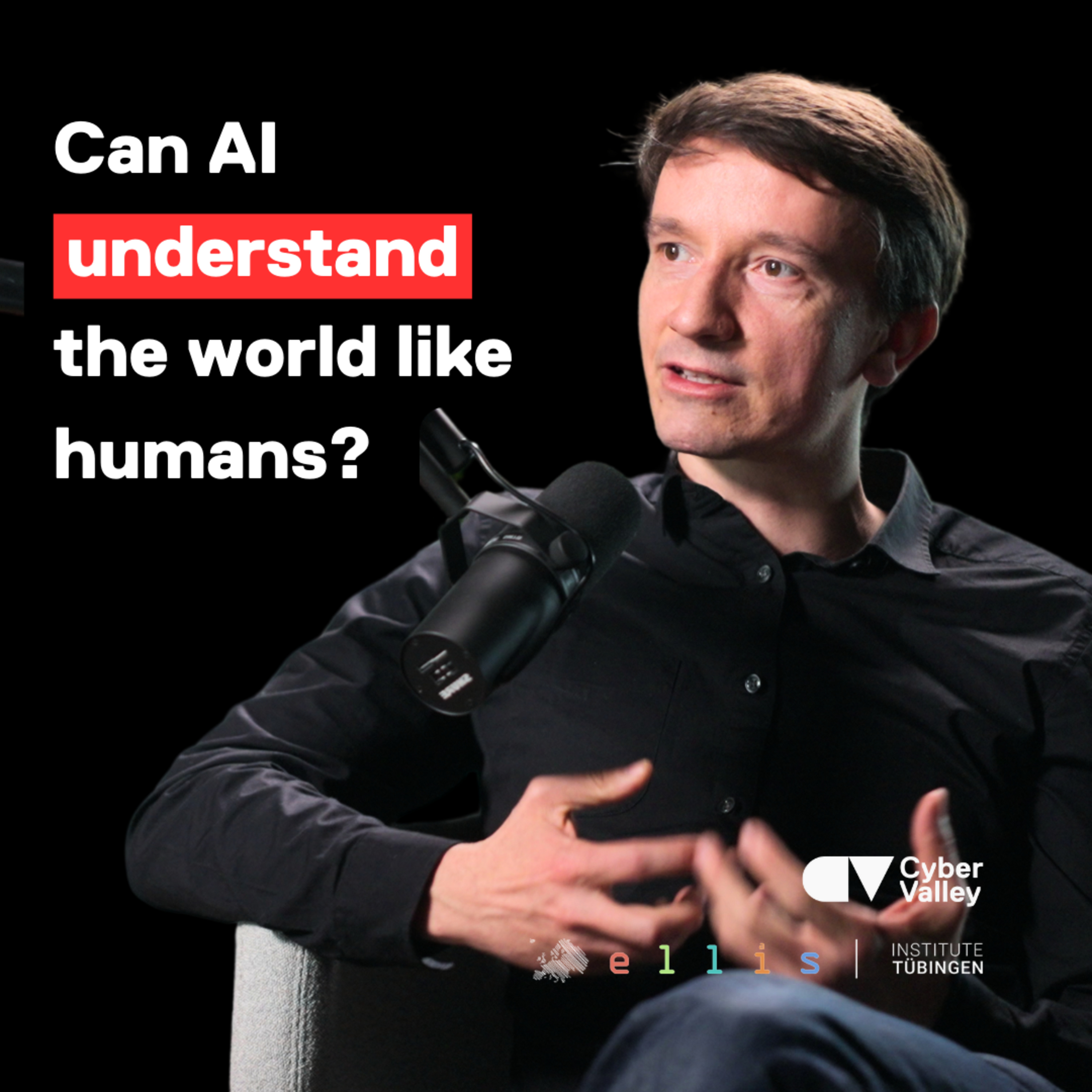
"Education & farming will completely change with AI!" - Wieland Brendel // Cyber Valley Podcast #4
69m 44s
Vynand Bränden, a leading figure in robust machine learning and a principal investigator at the Ellis Institute Tubingen, is deeply involved in reshaping industries with AI. Co-founding Maddox AI, a startup focusing on visual quality control for manufacturing, Bränden bridges the gap between academia and industry. He also spearheads the Polybot project, aimed at transforming farming practices. Bränden's work emphasizes enhancing machine intelligence to achieve human-like reasoning and reliability. His contributions highlight the potential of AI in revolutionizing diverse sectors like education and food production. Through collaborative initiatives like the Ellis Institute and Cyber Valley, Bränden thrives in Tubingen's vibrant research community, fostering innovation and impactful research efforts.
Transcription
11980 Words, 64931 Characters
farming and education have one thing in common, which is that they completely change with AI. If we replace large machines by autonomous, flexible machines, which can work year-long, can we use it to improve education? Can we use it to make our food sector much more sustainable? And I think the answer is yes, doctor. Is the principal investigator and group leader of the robust machine learning team at the Allyson C2 tubing? His work is focused on building machine vision systems that see and understand the world like humans. After receiving his physics diploma, he obtained his PhD in computation and neuroscience in Paris. He is a co-founder of the Visual Equality Control startup Maddox AI and the initiator and lead of the Polybot project. In 2023, he received the German Patent Recognition Award for his substantial contributions on robust, generalizable and interpretable machine vision. But we are really just starting to understand how AI can help us build a better education system, build a more sustainable food production system. AI can really enable us to rethink these areas in a way that benefits society and our planet. Welcome everyone to the fourth episode of the Cyber Valley podcast. This entire series is really the first time where Cyber Valley gets a glimpse into the minds that are shaping the future of AI. I am Charlene, your host and the Content Creation Manager for Cyber Valley. So throughout the series, we've been talking to principal investigators from the first ever established Ellis Institute tubing in. For those who don't know what Ellis is, it stands for the European Laboratory for Learning and Intelligent Systems. And it's basically just a network of excellent minds in AI that are scattered throughout Europe. But the PIs that we've been talking to are part of the institute that's located right here in tubing in Germany. So whether you're a season tech enthusiast or a curious newcomer, join us as we delve into machine learning, intelligent systems and the profound impact AI has on our lives. So our guest today is Vynand Brinden, a principal investigator of Ellis Institute tubing in. Vynand, welcome. Thank you. So just a quick background for our listeners out there. You are a hector and doubt fellow at the Ellis Institute tubing in. A team lead in the tubing in AI center. And you are also part of the Max Planck Institute for Intelligent Systems as an independent group leader for robust machine learning. That is very impressive. But before we dive into that, I've started all my episodes this way where I really want to talk about the hype of AI, especially ever since chat GPT came out. The overall awareness has really increased a lot. And I want to know how has your life on a personal or even work level? How has it been impacted ever since chat GPT came out? Yeah, that's a really interesting question, because yeah, it has definitely shaking up a lot in the sense that I think with chat GPT, it was the first time we really, I mean, the whole field has been working towards a moment where we see kind of like much more complex reasoning abilities in machine learning models like. And this was kind of the first time that we really saw this happening on a scale, which was actually usable in practice by a wide amount of people. And yeah, so I mean, I wouldn't say it has really impacted the way, let's say we work. I mean, obviously, let's say we use chat GPT to support coding, programming of new experiments, maybe writing, proofreading, things, that's where chat GPT is very useful. But I think the main part really about chat GPT is that it just raised a lot of awareness on like how the field is moving and it also basically helped like basically move a lot of the research trajectory right now into these large scale models. And that has just accelerated enormously. And so I think the exciting part right now is that there's so many open possibilities right now of like how AI is going to change so many facets of our lives. And that we haven't had this before. Before it was always like this theoretical, oh, maybe we, you know, reach this intelligence system at some point. But now we have something that is seems pretty close. And that I think sets free a lot of creativity. Yeah, definitely. And obviously, AI is way more than just a large language model. But there isn't one concrete definition out there. And sometimes the term AI is not even used. Some people use it, use intelligent systems or machine learning. So for you, what is the one definition of AI? It's true. It's really different for everyone. My personal maybe definition of what I consider to be modern AI, let's say, is kind of like all the systems that solve tasks, cognitive tasks, we haven't been able to do let's say 10 years ago. So because that kind of like everything which we could do until then was kind of like mostly solved by more classical AI systems or rule basis systems or just, you know, software engineering. And basically the modern AI has unlocked like a range of new use cases that we weren't able to automate before. And so I would call modern AI basically anything that basically solves these challenges that were unsolved before. But that's still a very vague definition in part because what you consider intelligent is very vague. There's not like one clear cut definition. And so it's also kind of like seems to be shifting over time of what we consider AI. Okay. And you actually use the term AI? I personally prefer machine learning as kind of because I feel that's kind of what really modern AI is all about. I mean, modern AI is all about teaching, let's say, computers to learn from data. Yeah. And that's different from classic AI which were basically humans programmed along set of rules and how to do something which for things like translation never really worked. Like, I mean, we had like hundreds of linguists writing down rules and how to translate from German to English. But that was mostly funny than actually helpful. So and now with these modern systems that can actually learn to translate between these languages purely from data. That is basically what modern AI is all about. But I mean, AI is I think is the term that the general public basically uses. So it's useful. Machine learning is not kind of the most established term in the general population. So I prefer using AI in these contexts. Okay. And like we said, it's this field is really discussed everywhere. It's in the media and the governance. You know, it's every it's at every corporate fair. But what is most exciting for you as an AI expert right now? That there are two things I'm excited about. One is kind of more on the research level because they basically the questions we can ask and can work on an AI have drastically changed in the last two years, I would say. Also the things that let's say my group is working on has changed a lot. And that's great. I mean, it's like there's so many interesting opportunities on that we probably will talk later about that we can we can now think about and approach. But I think the other part is really about kind of thinking ahead on it on how AI is going to change certain verticals. Meaning certain like let's say applications in farming, education, research itself actually is going to change with AI. And I feel like this I mean, this is I feel kind of what I excites me most aside of the research questions about like rethinking really how the world is going to work with AI. And I feel like we are still kind of in the infancy of that of really trying to imagine how the world will work. Yeah. Okay. And you said that in the past two years, there's been so many changes and so many like evolve, so many things that have evolved in the past two years. Do you see this continuing? So such a quick change continuously happening within the next five years? Let's just say. I always had to predict, but I would I mean, I think yes. So I mean, honestly, I'm, you know, it's all I mean, I'm if I talk with people or I look into the news of like technical news, it's like almost like every second or third day, there's kind of like a kind of major announcement about, you know, this model or from this startup being really able to do something that is just, you know, absolutely mind blowing. And that pays, I don't see decreasing yet. I mean, last week, for example, Mata has been releasing their new model series and now, you know, which seems to be performing really, really well, much better than what we had before. So probably in summer, OpenAI is going to open up a GPT-5 to the public, which will be super interesting to see. So right now, I feel like the capabilities keep increasing and that's implied also about, you know, due to the insane amounts of investments which are done in this area. And this is, you know, if you think about that these investments have been, you know, really ramping up over the last two years, like, dramatically, I think it's easy to imagine that at least the development speed is going to keep up like that for some time. What will be interesting is to see whether at some point, we kind of hit like a glass roof. And that somehow, I mean, if you look at GPT and similar models today, I mean, they are amazing, but they also fail a lot. And that makes them, because in many applications, makes them difficult to use. And then they're not kind of really reliable in that way. And, and, you know, also, if you look at hallucinations and things like that, they are still problems. We're kind of like still in this, it feels a bit like we are in this early phase of, let's say, the motor engine, right? We built kind of the first cars. I mean, yeah, they kind of work. I mean, you can kind of start to see the future. Like, we don't need horses anymore, but we can actually use motors. Or like with the electric bulb, right? You see kind of the first electric houses and like the first light bulbs. They're not really reliable yet, right? Their lifespan is kind of short. But you see it now. And now it, I mean, it's hard to predict how it will develop, but it's clear that a lot of development will go on into kind of making the systems better. And with every step, their use cases will kind of widen up and there will be more application areas. And it's hard, I feel it's hard to predict when it's going to stop. Yeah. Okay. So let's go back to you. Tell us a little bit about yourself. How did you become an AI expert or an AI researcher? By accident. So, I mean, my path was, so I studied physics first. And I was really focused about physics. I wanted to do physics. But then somehow at the end of my studies, I felt like, oh, you know, it's kind of not, I'm not excited about it. It's like, it's, it doesn't feel like the field, at least I was interested in really have going to have a big impact in the in the next 10, 20 years. So, and then I asked myself, okay, you know, what do I want to work on? Like, what is the, what do I feel like kind of the most interesting research questions that I would also be capable of contributing to? And so that was still, you know, 2010. So, you know, sometime before the eye wave kind of started. And so I decided actually for neuroscience at the time. And the reason being that I felt that the brain and intelligence itself is kind of this big open question that humanity hasn't really been able to light up in a way. It's kind of this big white spot on the on our map of the world or knowledge. And so I felt this is super exciting. And the most obvious choice at the time I felt was to go into neuroscience because they study the brain, right? So that's what we should be doing. So I did my PhD in neuroscience. And, and then when I finished it, I came to the group of Matthias Bittke here in Tubingen, which was working at the intersection of competition neuroscience and machine learning. So that's how I got my kind of my first glimpse into machine learning. And actually, that was 2014. And that was exactly the moment where kind of this AI wave kind of started to hit the German research landscape. And I think Matthias kind of like realized early on that this is kind of happening. And he kind of moved the group towards that. And also myself, I kind of like looked at this and I found it exciting to have kind of a system which runs completely on a computer and and it shows some kind of intelligent behavior. It's still it's 2014. It's not CHGPT, but it was still interesting. In particular, if you come from neuroscience because neuroscience has this issue that, you know, yeah, you want to look into a brain, but then we don't really see much of the brain. I can see a few neurons, maybe a hundred or two hundred. But I never have a full view of the whole brain and how all these signals are basically passing through the brain. So it's very hard to study in a way. It's very noisy. It's very limited in the amounts of experiments we can do. And so, yeah, machine learning was this thing. It is intelligent, but we can see everything that's going on inside, right? Because we simulated on a computer. And that just gives us so many other ways of studying the system. That's how I went into AI machine learning. Okay. And you said what attracts you to come to tubing, but what makes you want to stay here in Baton Wunberg, you know, in the land, especially in tubing. Yeah, that's actually, I would say that's community in a way. Okay. I think that's what I really enjoy a lot here in tubing. And so, really, I mean, at the end of the day, research is a community effort, right? Nobody's alone in that. And what I really liked in tubing is that it's this very open, very friendly and collegial set of colleagues, which are, you know, have all kind of started their groups in the, you know, in the last 10, 15 years. Many of them, I mean, few of them are here longer, but it's a relatively young community of people. It's a large community. It's growing a lot. It's very friendly community. It's like people help each other. We meet each other a lot. We collaborate a lot. And that's super valuable being in this environment, because, you know, it gives us all visibility. It gives us all ways to, you know, build up new initiatives. And this is, you know, there are many things you cannot do if you're alone, working yourself in your own little group, in your own little environment. But it needs this kind of, you know, community spirit, especially in AI, which develops so quickly. And where things are shifting so quickly, you need this kind of feedback and interplay and your colleagues to kind of, you know, navigate jointly together in this space. Yeah. I think you're totally right with that, especially since you were part of the Elles Institute tubing in, you know, part of the cyber Valley community. Here is really the best part or the best place to be able to talk to everyone. Exactly. And I think tubing is also special in many ways in that we are also bringing together not only a great research community. But also, you know, initiatives like the cyber Valley, which kind of dedicate themselves more towards this kind of, like, you know, transfer of AI into the actual world, into the into society. But we are also, I mean, I've been, for example, also part of this initiative of, you know, let's say, doing outreach in terms of a competition for pubels, which we are running here from tubing in for the whole, for all of Germany, which has been super fun. And also, let's say, I mean, the Elles Institute is this, this other kind of light tower initiative. We're really trying to change the rules on like how we perform research. And, you know, being trying to be flexible, fast, adaptive, because that's what AI currently is all about. It's such a fast pace that, you know, you need institutions and rules, which are able to, you know, to really follow this pace and really give, also, build attractive conditions, which can attract the best talent from all over the world, because that's ultimately what the community is about, having great people to work with. Absolutely. And now you're leading the robust machine learning department or group. If you were at a family lunch or talking to a friend that is not in this field whatsoever, how would you just describe that in simple terms? Because I don't think it's very clear what robust machine learning is. If I'm really trying to explain what I'm doing, what I'm, I think the core really of my group is trying to, kind of, reduce the gap between human and machine intelligence, like trying to move machine intelligence closer towards human intelligence. And, and that is, to me, kind of an essence of robustness, because ultimately speaking, humans are are pretty good in solving many real reasoning tasks in a kind of reliable way. And various machines, I think one of the main reasons why I like CHGPT are still not super useful in many tasks is because they are not reliable. Like they work oftentimes, but then also often they just completely fail and give you whatever else, right? And, and give you funny reasonings. And so you would maybe not trust CHGPT in the way you would maybe trust a radiologist, which, you know, you might still feel it's kind of more reliable, more trustworthy. This might change, yeah, but I think it's still kind of the state of affairs. And I call this robustness because today's machine learning systems, unless they're trained on really huge amounts of data, they're not really good at generalizing to new situations that they haven't really seen before. And that's what I call robustness. Okay. And you're also a co-founder of Maddox AI. Am I saying that right? Maddox? Yes. It is a startup. And can you, I guess, give us a little bit more details about this startup? Yes. So it's a startup which does visual quality control. So we started this actually many years ago, 2018. And I mean, we started it because kind of we wanted to kind of like build somewhat more of a bridge between industry and academia. Because industry has a lot of interesting problems that academia is not even aware of, but which might also be interesting research topics. And we felt like, well, you know, there's some value in also, let's say, giving students a possibility to look into some of these questions. And you know, maybe take something away for them or maybe do we start up later on? Okay. And so it was actually originally called layer seven AI. And so we were doing some consultants, some consultancy for companies here in the region. And what we saw back then was, I mean, there's a lot of manufacturing industry here in the region. And what we saw was that lots of them have quality control where, you know, really people stand for hours on end on a conveyor belt, you know, looking at each individual part, seeing if it's broken, whether it's okay. And it's trocut as is odd because that's something that we felt AI should be should be able to do right now. And so yeah, that's kind of what Glad ultimately speaking to a product, which was then called Maddox AI. And at some point, we renamed the company, which basically focuses on visual quality control for manufacturing companies. And it's a big, it's a big need because even like many companies even struggle to get enough people for quality control. It was a hard job because you need to be very attentive for long stretches of time. And, and so it's, it's, I think it's one of these examples where in which AI can already be very, very useful today. Yeah. While there are, of course, many other use cases, which, you know, might only be viable in the future with more development of AI. Okay. And you also brought up the robot. And I definitely want to talk about this because you are the initiator and the lead of the Polybot project. Please tell us more about the Polybot. And what does it do exactly? Yes. I'm very happy to. It's a, I think it's a great project, which basically is, is, is all about trying to rethink how farming could look like in, let's say, 10 years. And what I mean with that is the following. So far, if you look in the last and the past five, six decades of industrial farming, as we do it in, let's say, Western Europe, it's, it's basically completely shaped by machines. Because, I mean, yeah, it needs to, we need to produce food cheaply, right? And that means we shouldn't use too much labor in producing it, which means you build large machines. Yeah. But if you use large machines, then at least classically speaking, you would need large monocultures to in order otherwise the machines don't match. So we basically, we use large monocultures today everywhere because we have these large machines to automate them. Yeah. And, and the question which, with which this whole project started was to ask, well, what if we had a different kind, a set of machine, right? What if we had a much more flexible machine? How would we then actually plan to produce our food? Like, would we still have monocultures or would we maybe use much more diverse systems? Because what is, what is important is that monocultures as we use them today are a problem. We need a lot of pesticides and fertilizer to stabilize these systems. They harm biodiversity. They need a lot of water. And, you know, if you, if you talk with farmers, if you talk with organizations, they will all tell you, yeah, we know this system comes to an end because we have more droughts now. We have a lot of climate change events. And we have, you know, things are not working anymore. And we have to change the problem is they don't know how to change or to what system to change. Okay. And that's, so if you compare this to the energy sector, for example, we also know we have to change our energy sector, but we know where we have to go. We have to move to solar cells. We have to move to wind power and so on. But in farming, there's no alternative really. You just have monocultures, right? That's it. And, and so the whole project started with the question, well, if we replace large machines and replace it by autonomous, flexible machines, which can work year-long using the latest of AI and robotics, can we maybe completely rethink how farming is done? And basically we'd use the harms we're doing in our food sector. And that's what this project is all about. So we have actually a small, you know, lacked robot. You can imagine it like a robotic dog in a sense, but it has an arm on top. And we teach this robot to perform different tasks in a farming environment from seeding to weeding to harvesting. And, yeah, and with that, basically, we're trying to basically put an alternative on the table of how farming might be done in the future. Can the polybot be used in more in a private way, so we'll ever be sold for private use? That's a, yeah, we get this question a lot. And, yeah, I mean, maybe ultimately at some point, but, you know, right now we are concentrating, getting it into a farming environment. And that is already, I mean, super challenging. Because, see, I mean, maybe gardening for us is not so hard, right? We go there and, you know, we pick out, like say some onions or, you know, we do some weeding. And, you know, I mean, it's maybe a laborious task, but it's not hard in that sense, right? But in robotics, that is something that has until recently been almost impossible. Like, because it involves, basically, I mean, you see these industry robots, right? They are programmed to do exactly one kind of movement. And, you know, that's all fine and good. We can program that. But now we need a robot, which actually has something like a hand and can basically interact with these soft plans for this, like, really different, like small features. And it's, we call this dexterous manipulation. And it's like in the actual real world, which is like, I mean, the real world is complicated. Fires are complicated. There are thousands of plans where there's mud, there are weather conditions. And, you know, it's a very complicated world. And we are only starting to be at this point now that we might be able to solve this. And robotics, luckily for us, is evolving quickly because with the state of robotics, let's say, one year ago, nothing of what we are trying to achieve would actually be possible if, let's say, the development would completely stop at this point. Now, we are, in some sense, also batting on the current development in the field and that we are now basically getting to this point. And we're, of course, pushing along, basically. But it's, it's really something that is, that is really, really complicated. And so, yeah, we need to solve these challenges first. And then we hope that, you know, we can basically get this into, you know, push this towards, let's say, regenerative farming to be actually be used on farms in a productive way, 24/7 in a way, which is a challenge in itself, right? And eventually, in many years, maybe we see this technology. I think we actually will see it in the backyards, maybe from us, maybe from someone else. But I think, let's say, the kind of more gardening robots, they really wolf. And over the next years, and, you know, don't, I don't know if it's five or 10 years or whatnot, I don't know, but at some point, yes, we will see much more intelligent robots also in our backyards. Okay. So it's going to happen. Yeah. And you said this robot is about the size of a large medium-sized dog. You're saying that this will replace or can replace these huge machines that you're also talking about? Yes, of course, not one machine, but fleets of machines. So, so we'll have, I think the idea basically is that you have fleets of these small, flexible robots and that they will replace large machines, at least in many settings. All settings, I don't know. But the thing is, you know, I mean, for that to work, you need much more mixed up systems. If you only have one crop, yeah, you still might want to just use one large machine because this machine has to, let's say, harvest everything within, let's say, one day just because before the rain comes. Yeah, probably no fleet of robots, unless it's super large, we'll ever be able to achieve that. Okay. But that's not the point. I think what we are really targeting is what we consider a more regenerative way of farming, where you basically use synergies between plants and where you use basically multiple plants together. So it's not like one monoculture, but let's say, call this polyculture, where you mix up a lot of different plans. And then, of course, the needs of these plans basically, you know, it's kind of year round. And so, yeah, one plant might be harvested right now, but then you use your fleet of robots and it's a relatively small area you have to harvest. So that kind of works. So yeah, it's, I think big machines will be replaced at some point. But let's see about this. Well, we'll, I mean, let's see, we feel the need to try it. Yeah. Because otherwise, we will not know whether it's possible or not. Okay. So more to come in the near future, yes. So I kind of want to step away from the research questions for a little bit. And I want to really talk about the misconceptions and, you know, the concerns that people may have about AI. And one, one misconception that we haven't discussed yet in this podcast is the potential impact AI has on job displacement. What do you, what are your thoughts about this? It's a difficult one. And it's again about a free prediction is hard in a sense that, I mean, I think, I mean, AI is a, is a kind of industrial revolution. Yeah. So, and we have had two or three industrial revolutions before. And I think every time there were people saying, oh, you know, jobs are going to be lost and cut. And every time they were proven wrong, because jobs move somewhere else. Now, is it, is, is it going to be the same this time around? I honestly don't know, because, um, I mean, what has to be clear is that AI is going to automate a lot of knowledge work. And knowledge work, ultimately speaking, was the one area that no machine so far was able to approach humans. And so I feel like over time, basically humans, you can say, retracted more away, basically for manual labor, which was automated by machines, more towards basically knowledge work. And now, obviously, I do see, um, why people basically warn that AI may cut a lot of jobs, because yeah, now we are starting to automate knowledge work. And I'm not sure what other area there is for humans, where humans are so superior that they cannot be replaced by a machine to some degree. Yeah. And, um, I mean, obviously, this is going to take a lot of time, because, you know, we're going to, I mean, first augment humans in many different ways. And I think right now, if you just look at, you know, we don't have enough teachers, we don't have enough doctors, right? We need this augmentation, even, you know, just to keep up our current, uh, our current system. So I don't think there's any imminent risk of, you know, job, of large scale job losses in, in that sense. Yeah. Um, but, you know, it's hard to predict how things are going to pan out, uh, in, let's say, 10 years. It's hard to, because, A, because it's hard to tell how AI is to develop in 10, within 10 years. Yeah. And second of all, it's very hard to tell how society will react to these changes. True. Um, and so, um, it's going to be interesting. Um, and it might mean that we might have to change somewhat our perception on, you know, how a society is going to work in a, in, in a new, in a, in the kind of this new era. But it's also really hard to predict how far AI is going to be pushed. We talked about this glass wall before. Yeah. We might just be hitting this very soon and then realize, like, okay, you know, well, there's still a lot of stuff just where humans can, and this is going to go on for a while. But maybe also there is no glass wall in the next five, 10 years, we actually can automate a lot of knowledge work for humans. I find this super hard to predict. And, um, and so I would say, let's sit tight and, and, uh, and let's, let's look at it. I think what for me personally is most important is that, yes, there are dangers with AI, you can say, with AI development, as with any other technology, yeah. Um, any AI in itself is not good or bad. It's depends on how we use it. And, um, in that regard, I'm trying to focus also in the debates more about how can AI help society? How can it help us, you know, um, live healthy lives, um, you know, educate our kids? That these are kind of the things that I feel, um, we should right now focus on, on how we use AI. Not ignoring the risks, obviously. We have to deal with them and, and they are there. But we shouldn't just, you know, uh, sit there and watch the risks without also, you know, considering how we can use AI for general social good. Um, another misconception I want to talk about is the, um, AI's ability to seamlessly interact with the physical world. Can you shed some light on the challenges in bridging the gap between AI software capabilities and the hardware limitations? Yeah. Yeah. That's a very easy one, which apparently, like, in particular, we see in the, in this polybot project right now, which is exactly trying to do this. Now, the thing is, um, machine learning is really good when it, when a lot of data is available. And the more data, basically, uh, you throw these models, the better they are. I mean, this is kind of a lot. Open AI has been betting on for many years, uh, from GPT-1, 2, 3, like their language models. Uh, they increased like the size of the models and the data, accordingly. Uh, and it's like, right now, it's a, it's an enormous scale of, you know, how much data is being used. Um, and, and that's why these systems started to work. Now, the problem is you can do this as long as everything is in software, right? For language models, you can train them on just on, you just scrape the whole internet and all posts and block posts and news articles and whatnot. You just throw it together in one database and then you train your language model on it. Okay, great. The problem is as soon as you go to hardware, none of these approaches actually work because now you have to do something in the real world and that it's not just a database, which, you know, runs on some HPC cluster, but you are like some, some storage or a high performance data center. But now you actually need to do something in the actual world and there's some things you can do in simulation. But for example, when it comes to, oh, how do I, how would I, um, how risk, um, strawberries? That's something you cannot easily simulate in a computer. Yeah. And now you have to do this in the real world, which means that you can do a few hundred trials, you can, a few hundred data points and then, you know, if you come from large language models, you know, this is a joke because it's like, it's nowhere close to anything you need to train these models. And so it needs a completely different way of training these algorithms, which are very different from this high data regime. And that's something we, um, I'd say, I think robotics is starting to get a handle on. Okay. But it's, it is still very difficult because you need to extract so much from so little data at the end of the day. Yeah. And that's just a, that's just a big challenge. And that's exactly what we see in the polyboard project. Um, like training a new task needs more data and it's, it is tough to get it to a point where it's really reliable. And so it's a very different space basically from, uh, from large language models. At the same time, this combination of AI and hardware to degree is promising because, you know, if you look at a large language model, I mean, the large language model just reads a lot of text. But it's not really grounded in our real world. And that's why we believe in, in at least some things, human are still superior because we know how the actual world works. We know how things are causally connected in some sense, right? We know what a table is. We know, uh, what a camera is and so on. So, um, we have an actual physical image of what these things are and how they interact. And large language models are not really able to get this. They just read like a lot of text and then piece together that, oh, well, a table is maybe something you put stuff on, right? And the camera, you know, takes videos or whatever. But, um, it's, um, that's why it's seen, we believe at least, there's a certain amount of reasoning errors also hallucinations because these models have never really experienced what the actual world is all about physically speaking. And, um, and so, I think the hope is that kind of, you know, eventually these kind of embodied systems are able to like where you pair AI with kind of a physical realization, like a robot, that these systems jointly can learn, uh, much more basically, much more closely to how humans learn about the world. And thereby basically grounding their intelligence in the actual physical world, which will help them, for example, reasoning. Um, but let's see, these are all hopes and dreams so far. So, uh, we're going to see how the, whether it pans out this way. You say it's hopes and dreams and I feel like the hardware, the hardware limitations are a little bit less nowadays because even Boston Dynamics recently came out with, um, they released a video of the new Atlas. For those who don't know what it all says, it's the all electric robot that they're calling the world's most dynamic humanoid robot. And when you look at the video, it's this robot that's on the floor and seamlessly gets up without any problems and can rotate and move and, you know, it just seems super easy. So, are there limitations today with the hardware? I mean, I can hardly judge the hardware itself because I'm not a hardware engineer. I mean, yeah, it's true. I mean, the, the latest generations of, of robots in terms of hardware is super impressive. Um, and I mean, that's why, for example, I mean, if you look into, to both China and the US, they're completely betting on these humanoid robots like the, the new Atlas. But there are many actually startups right now working in this space, building basically human size robots on two lags, two arms, and, uh, and they're betting that this is the future and that in just a few years, we're going to have them in our homes and, you know, doing breakfast for us or cleaning, yeah. And it's, I mean, it is definitely going to happen. Um, but, uh, so I'm, I'm absolutely not questioning that. But I think this intersection between, you know, a hardware-based robot and AI, I think that's kind of like where a lot of exploration is going on right now. Like how to fit together these pieces. Like, yeah, you have a language model, which understands, which can basically kind of reason about the world, and it can, you can use, like, say a vision model, which tells the language model, oh, you know, in front of me is a table. Yeah. And, you know, uh, there's a cooking stove. And now, you know, language model, tell me what to do, basically. And then the language model gives out commands. But, you know, how to kind of, it's kind of like this, it's, it evolves in this kind of direction of kind of a cognitive architecture, a bit like, you know, I mean, the human brain is also composed of different modules, you know, one part is more concerned about acting in the world, the other one reasons about the world, the other one perceives the world. Um, and, and, you know, we are starting to see these systems, you know, plucked together in different ways, but we are still kind of like trying to figure out how to fit together all the pieces in order to really make them work reliably again, right? And then now we are talking about robustness again, because yeah, I can make this work in, let's say, one particular kitchen under one particular lighting. But now, how do I make a system that really can generalize to new home? So I just chip it off to your home, let's say, and it's still able to perform the task and understand where everything is, uh, and doesn't, you know, slips every second step. So, you know, this is, uh, I mean, there's a lot of development right now in this direction, and I think it's super interesting, and it's going to change a lot because it breaks AI basically free from this digital domain into the real world, and that's going to be a really shaping moment, in many areas of our lives, but it's not there yet. So it's, we're getting there, but it's not there yet. So let's, let's see how quick this, uh, this is going to happen. Um, so another misconception, misconception that I want to talk about is how AI will surpass human intelligence. There's a sphere that, um, you know, AI will, will potentially be posing like, or will potentially have unpredictable or uncontrollable risks. And there's just an uncertainty of how AI systems make decisions. What are your thoughts on that? Um, yeah, I mean, how AI systems are making decisions. I mean, that's actually one of the kind of research questions that I'm most excited about, because yes, despite all the progress, I think we still know relatively little on how exactly the systems actually work, and based on what they're actually making their decisions. Okay. Um, and that's, I mean, like, like a part of my group is actually working exactly on that, trying to basically, we call this opening the black box in a way. It's like, like, really trying to look into these models, both in vision, but also, you know, now a bit in language, where we are trying to understand how exactly, you know, the systems work, um, you know, what aspects of the input they're actually looking at, how they make decisions or come up with a decision. And, um, I mean, for me, there's also a deeper reason for that, because I mean, I said at the beginning, I ultimately started, um, with the hope to better understand human intelligence. That's kind of like how my research career in that regard kind of started. And, um, it's still something that I feel, or I hope to shed some light on by basically studying machine learning systems. Okay. So obviously not super clear, like, how close the, let's say, the reasoning process right now is between humans and machines, but, um, I also feel like if we don't understand, um, machine intelligence, there's even less hope that we will actually understand human intelligence. Yeah. So, um, that's why I try, you know, we, we try in the group to basically find models and AI systems where you can basically better explain, um, what's going on inside. And, um, and that's still, I feel a field, which is rather in its infancy, like we don't completely understand AI systems. At the same time, I have to say, I also don't understand the human reasoning system. And yet, you know, I'm working together with a lot of humans to, uh, and I, I, I don't have a problem with that. So I feel in terms of just the application, understanding the reasoning process of AI is not necessarily super important, um, because we do this all the time. But, um, um, of course, I understand, you know, um, that, um, we'd like to get a better sense of this and also align basically how AI works with, you know, what humans want out of these systems. But, um, you know, really right now, AI behaves mostly in the way that we basically predefined in a way, you know, how we train it and so on. I mean, they're not like, um, super human beings, but they can augment us and help us in lots of ways. Yeah. And, um, you know, how it evolves will evolve in the long run, that's, again, it's kind of hard to tell and depends on how we use it. Um, and, um, it's, um, so one of the kind of analogies I'm trying to make here, because I know this is a lot about is, is about prediction, right? How is the, how is the future of society or our economy is actually looking, you know, how does it look like with AI? But I'm, I'm really careful about making predictions just because I feel we humans are really, really bad at predicting, um, how such a key technology is going to play out. And I think we've seen that, for example, with the internet, right? We think it's, yeah, I'm sorry, because you think that we're exaggerating predictions or because we, no, no, no, no, no, I'm not, I mean, it's, I, I just feel it's hard to predict. So in, in a sense, what I mean is like, I mean, society is a very complex fabric, right? With lots of interacting parts. Yeah. And humans are not good at predicting complex dynamical systems. In the sense that, I mean, you know, see, we, we basically perturb the system, we perturb our, we have a new technology, AI, which is going to change a lot of facets of our lives. Yes. And, um, so it's going to change a lot in our society. And, and it's, and you know, it's going to change the dynamics in our society. And it's very, very hard to predict on how, you know, how this dynamics is going to basically evolve in a society, in how society, maybe as a whole, is going to, to go about this. And the prime example I have in mind is the internet. I mean, the internet is a simpler technology almost like the, the AI, I would say, but of course, a very profound effect on society. And for a long time, we all thought, like, at least I thought, oh, you know, this is great. You know, it's going to, you know, free spread of information. And, you know, dictatorships cannot, you know, hold their information silos, right? And everything is free. And, and then suddenly you realize, like, oh, yeah, well, it can also used against a free society. Yeah. And, um, and we can get manipulated by this and so on. And we can create these echo chambers, all, you know, facilitated by the internet. So, um, and I'm not sure how, I mean, I'm sure some people saw that coming, but at least many didn't. So, and I feel we are kind of in a similar situation here. We know AI is going to change a lot. But, um, at least personally, I feel it's very, very hard for any of us to really predict how society is going to change and in what ways. For the same reasons that it's very hard to miss many of these dynamics that are just playing out while basically humans learn to use this technology. And then we think about things that we haven't really thought about before. And, um, so I would say, let's see about this. And, um, uh, but AI is there to stay. So we, uh, you know, the best thing we can do right now, I feel, is to, um, to really think about how AI is going to help us and to, you know, really trying to detect misuses of AI and trying to detect where AI is actually harming our society and trying to basically act quickly once we see any of these developments. Yeah. And that's already tough enough, but I feel that is kind of the, the most important thing we should do right now. Yeah. And that's currently being worked on. Yeah. Absolutely. Yeah. Um, and Sam Altman, going back to the example of, um, when he was on the podium discussion, the podium discussion, he also talked about how AI will soon be able to explain its reasoning. I feel like that's a pretty important topic to discuss just because, um, there's always this fear about how is AI processing things? How is it, um, making decisions? But if it can explain these things, I feel like we'll be even better off. We'll get to a better understanding. Um, yes and no, I would say, you know, I mean, it depends on basically on what level you mean reasoning. Um, I mean, I would say, let's say, generally speaking, humans are not necessarily good at reasoning, like really, I mean, in the sense of explaining their own reasoning, like their own thought process. Um, I mean, just a simple ask, I mean, I'm coming from vision. So we've been, you know, thinking a lot about, let's say, how humans, for example, recognize certain objects, let's say an elephant, yeah. Um, but ask people how they recognize an elephant and you'll get lots of different answers, none of which probably is actually due to the way we really detect an elephant in the first place, because we don't even have a good introspection into that. Yeah. Um, so, and there have been lots of, lots of methods in vision to, you know, kind of get a better sense of the reasoning, internal reasoning of, let's say, machine vision systems, most of which actually, uh, you know, look nice to humans. Humans were like, oh, you know, oh, you know, oh, I see, I see these visualizations. Oh, and that's how it, you know, detects dogs. And later it turned out that no, it didn't actually. It was just, it looked appealing to humans, but it had very little relationship to how, you know, the network actually works. And I mean, right now you can ask a language model to reason. You can ask, you know, well, you know, reason about the situation and how you want to act next, yeah. And it will tell you, you know, it will give you an explanation, an explanation, whether this explanation has anything to do with how it decides, I think it's a totally different question. Okay. Um, so, you know, it's hard, but again, I feel it's maybe not even, I mean, it obviously to some level language models should be able to give some of their reasonings and to degree they already do. But just like in humans, how much that is actually related to what they're doing, I'm not so sure, but I still trust humans. So, you know, it's maybe still okay. It's maybe not even the most key part of it. The next topic that I want to talk about is the bias. So in our previous guests that have been on this podcast, we discussed how challenging it is to create unbiased algorithms. What do you think about this? Yeah, that's true. I mean, I remember this, this, there's this nice example about Amazon and their hiring procedure. Was that part of the purpose? No. Okay. So they apparently Amazon, because they have a lot of factory workers or like warehouse workers, and they try to automate their hiring system. So that basically people hand in their applications and then NAI is basically screening the whole, all the applications, and then I'm pretty much decides whether someone is going to be hired or not. Based on skill? Based on their CVs and previous data. So they basically, they took apparently lots of historical data about whom they hired and the CVs and then they basically try to make a prediction on, you know, for new CVs on whether, you know, this person would be hired or not. And I mean, we are talking really about hundreds of thousands of applications here on millions even, right? So it's a large scale. Okay. And yes, but the problem that they found was bias because, well, I mean, it was trained on human decisions, obviously, and humans were biased, yeah, depending on gender, depending on race, depending on, you know, area, whatever, right? So and obviously, the AI system picked this up, right? It learned that, you know, certain, you know, genders, let's say, you know, have a lower chance of being accepted than others, right? Despite maybe the rest of the CV being completely the same. And and and they tried apparently pretty hard to avoid this. So for example, I mean, they did the obvious thing of just removing gender from the CV, easy one, right? The problem is the AI was able to pick up, for example, gender from just other aspects, which school have you been in? Is that a school that has primarily is primarily female or not, right? From what area are you coming from? Basically, yeah. How do you write your, let's say, application letter, right? And so it was able to pick up many of these cues that it, you know, deemed relevant to predict decisions, because that's ultimately what I was trained on. And it was able to pick this up from the CV anyhow. And they pretty much abandoned the process at some point, because they were not able to unbiased the model. So and I think that's I feel I don't think it would pan out right now with even, I mean, this is like two, three years ago or three, four. So, you know, you could say things might have changed and maybe did somewhat, but I'm not sure this would actually be different these days so much, because at the end of the day, we are still training on human derived data and hence retrain on human biases. And it's just very, unless you have a better sense of the reasoning process, it's not super easy to get rid of this. I mean, lots of people work actively on this. So, you know, maybe at some point, we we get to this, but it's really part of the reasoning process in the way we train these models. So it's not easy to mitigate. Okay. And one topic that I really want to focus on that we haven't discussed at all yet is the integrating AI in education. There's obviously a lot of misconceptions or, you know, challenges that will come with this. This includes people think that if we include AI in education, it will completely remove the classroom-based education, or it will completely remove the lack of human interaction or personal connection, or even it can have like an AI that will only deliver one standardized, one-size-fits-all learning experience. What are your thoughts about AI and education? Yes. So, education, I feel, is a really, really fascinating topic. And I mean, I have three small kids, the first one, the oldest one is going to first grade now. So it's obviously something that is kind of top of mind. And yeah, I think AI is a big opportunity for our education system. For several reasons. Now, I think the way I like to think about what opportunity AI offers or will offer in the future is to think about what would you do or what would you change if you have, let's say, infinite labor and infinite skills in one domain. So let's just imagine a world where we could have, we could hire one teacher for every single child. And hypothetical world will never happen, of course, and it's not for human teachers, but let's think about this. And so basically, you can go around and ask this question. And then it's often the first time people even think about this because it wasn't a possibility in our current system. People never thought about how you would draft an education system if you had one teacher per child. It will probably not mean that every child just sits alone with their teacher at home and do their thing completely in social isolation. That's very likely not the best way to, you know, educate our next generation. So, you know, school would also not look like this. But probably, you know, you would try to use it in a maybe combination of like where you can really, you have this maybe one-on-one phases, very really try to support a student. But you will also have, let's say, group work, you will have, you know, in smaller groups, larger groups, different activities. And, you know, there would just be much more flexibility in the system to shape it in the, to give basically every child the best experience and to really convey, you know, fun of learning, support every student individually, you know, because, yeah, every one of us is different. And everyone needs a different support. But that's something you cannot give if you have one teacher for 30 students in an standard classroom as we have today. But you would need this one-on-one kind of thing at least sometimes or at least many more teachers for the same amount of students. And so, if you think about it in this way, well, yeah, we, obviously, we cannot have like one teacher for every student. But maybe we can have one AI teacher or an AI assistant for every student. It's not replacing the teacher, but it can help the teacher basically cater every child in a much more individual fashion. And so that's how I kind of think about it in a sense, like the vision that, I mean, we also kind of following right now with a kind of group of institutions, is to basically build AI systems that can really support every student individually in, you know, in many subjects that people might or students face at school. And basically, yeah, kind of like really like a small human, like human-like teacher or, you know, at least a warm and supportive teacher that can really guide students through materials, can really help students in a very warm and friendly way. And I think there's a lot has to be explored on how to do this right just because, yeah, as I said, nobody has so far explored what it would mean if we had one teacher for every student. So it's actually something we have to learn how the best system actually would look like. Especially since you said every student does learn differently. So there shouldn't be one one way of teaching 30 students. Exactly. It would really be beneficial for each student to have this AI assistant. Yeah. Exactly. Because every student has also their own interests, right, where they were things that they really like doing, yeah, which they really like to push, whether really good at or whether really interested in. And some others, you know, they're just not so interested in and, you know, but, you know, you just keep like a base level and, you know, really catering. I mean, right now in our school system, we pretty much have to, you know, every student kind of has to have the same learning path because that's all kind of what our system can really support. And that's, I think, where AI can really change the game in a way and that it can really provide much more individualized learning path, which are much more catered and tailored to the individual students. And that can be, I mean, a game changer in also on like how we can approach the whole education system. I mean, if I look back basically at school, you know, I definitely had like a small number of teachers, which were just absolutely great. Like I, for example, I was really not into German classes at all, right? I really didn't like it. And then I had this one teacher, which was really, really good at it. And I absolutely enjoyed that subject again. And I mean, what I really would like to have is that we, that these adaptive teaching systems can really help students discover the joy in the various subjects they have. And that is maybe, you know, but you really have to tailor it to how each student thinks. Yeah. I think everyone can think of their favorite teacher. Yes. And that would be great if that would actually happen for every every single student out there. Yeah. Yeah. Actually, one, I can maybe talk two minutes about one related us subject, because they, I mean, it's the one thing is really about this tutoring aspect, so really trying to build this AI tutor in a way or AI assistant for teaching. There is also the other part, which I fear we also have, we'll have to talk about more, which is how will AI actually change what pupils should learn in school in the first place? Like what are the skills we need in the future? And I don't have an answer for that. Okay. But I think it needs discussion because yeah, what we need is going to change because the jobs we are going to do in the future are going to change. And I don't know how exactly. The tools we have at our disposal tool, you know, soft tasks are going to change. Like it's kind of funny that, you know, we started out at the LGBT, you know, trying to forbid it at school, but it seems senseless because LGBT is in the world and we're going to use it anyhow. So it's like, why should I educate students at school, not using LGBT, but then as soon as they enter kind of the real world, right, everyone is using it, right? So it's like, I mean, start using it at school, right? Because if there's something you can easily solve as LGBT, maybe that's not even the right homework to start with, right? So, um, anyway, so it's like, um, the like the school system also content wise will have to change. And I'm exactly, again, I'm not even sure how it has to change, but it's clear that the skills we need to learn are different and maybe it's also kind of in the future also a lot about resilience and actually discovering what am I interested in? What do I want to do? Because we are not going to be in a world which is kind of like, let's say, static, you learn something, you do it for the rest of your life and then it's done. But AI is going to, you know, radically change the dynamics also on like how our society and our knowledge evolves will just speed up. And so I think it will be super important that our next generation really gains the resilience to, you know, cope with these changes and, you know, adapt to them and also embrace them actually because I mean, change can be fun if you learn how to use it for your own interests. Yeah. So that's going to be an interesting challenge. So do you think that AI can actually make schools less biased? Is that possible? Yeah, I would hope so. I mean, I said before, we're not going to easily get rid of all biases, obviously, but I mean, there are a lot of biases in the school system that I think we can mitigate some degree with AI. And I mean, for one, schools or also the learning experience hinges a lot on single teachers, right? And how they perform in the classroom and how you like them and how much they like you and what biases each individual human have. And I mean, it's very hard to get biases out of humans, obviously, in a way. It takes a lot of time and effort. Yeah. And so whereas for an AI system, at least, it's at least much more transparent in a way. I mean, in a sense that you can measure biases, you can study biases, you can make an update to your AI tutor in order to get rid of certain biases once you detect them. Yeah, detect them. So basically, the iteration cycle, the improvement cycle of these systems can be much faster than in a traditional educational system. And thereby, it's also to some degree easier to mitigate biases. And that's not only on the individual teacher level, but also, you know, when it comes down to, you know, what educational resources students from different regions have. Yeah. That's because, I mean, schools are very different. Districts are very different. How much they actually spend on schools and how they attractive they are to teachers and so on. And that already, like early on, can kind of like change opportunities and how you navigate the school system. And AI, to a certain degree, could be useful to somewhat, you know, equalize the playing field in that sense that everyone would have access to their personal tutor and AI tutor. And so everyone can kind of like wherever they are in the learning journey and wherever they live can basically get like the same kind of assistance and support for them individually speaking, which I think will help everyone like starting from students which are more challenged by the current educational system towards students which might be completely excel and then are not kind of like nourished enough in our current school system. I think every student at the end can benefit from such a system in very similar ways. I think it's also important to note that we need to make these systems as well. Like you said, available for everyone and not just in the education system, but also on all playing fields where not maybe not one country gets more or more access compared to another, for example. So I think it's also important to emphasize that intelligent systems should be available for everyone. Yes, absolutely. And I think for example, I mean education is a nice example. And that's why I also set out to basically build this in the open as an open source thing everyone can use because I feel like open source like AI and education shouldn't really be in the hands of any one company and locked behind closed doors. And then the company decides who gets access and for what amount of money. But it should really be open. Like education is too sensitive and it's too central also for our society to be dependent basically on let's say one, two, three big players. So yeah, I think it's super important. Yeah. So we talked about so many different aspects of AI. The hype and the misconceptions as well as the capabilities and the limitations, especially with hardware and software. And now we even talked about the integration of AI in the education system. So I want to know what is your overall opinion on AI? Is AI good or bad for the future? It depends on how we use it at the end of the day. So no, I mean, again, I think I said that before it's AI in itself is neither good or bad. It depends on how we use it. Just like it depends on how we use motor and how we use electricity at the end. So I think that's all there is. And we have to decide how we use it and how we regulate AI and how we let it change our personal lives. And that's a choice we to some degree make jointly as a society. And that's what it's all about. I think AI can be hugely beneficial for our society in some aspects. They are risks some of which we might not even be aware. And we just have to adapt to it and in particularly be fast. I think that's the, that's maybe my only concern I have. I mean, many of the previous industrial revolutions basically played out over a long stretch of time. And it also took society very long to adapt to them. Let's say, I mean, let's say cars, for example, to just make use that example right now. I think it, I mean, the first cars were invented around 1890 or something. That's where the first commercial cars went out. And it took pretty much until around 1940 until 1950s to really for society to embrace cars. And it looks absurd, you know, if you look back to it. But until that point in time, the majority of society was actually against general usage of cars. Yeah. Why? Because there were many like people were dying. Like there were lots of death in the streets because cities were not adapted to cars. Right. So you had to basically change the whole infrastructure and how you think about travel and, you know, how to, how you basically regulate this whole technology. And it all, you know, took a long time basically until everything was kind of like shaped in a way that society could really embrace that technology and work with it and regulate it. And I mean, my only concern maybe is that society isn't quick enough to adapt to it because I think the AI is basically evolving much more quickly than previous revolutions in a way. Okay. So that's going to be interesting. But let's see. Thank you so much, VLAN, for all of your input and sharing your knowledge with us. It was really informative. Thanks. It was really fun. Remember everyone, the conversation doesn't end here. Let's continue the dialogue. And until next time, let's keep exploring, staring curious, and embracing the ever-evolving world of AI. The future is literally unfolding before our eyes. And I hope this exploration has left you inspired and informed. So thank you for being part of the future with us.
Podcast Summary
Key Points:
Vynand Bränden is a principal investigator at the Ellis Institute Tubingen and a leader in robust machine learning.
He co-founded the startup Maddox AI for visual quality control in manufacturing.
Bränden initiated the Polybot project aimed at revolutionizing farming practices.
Summary:
Vynand Bränden, a leading figure in robust machine learning and a principal investigator at the Ellis Institute Tubingen, is deeply involved in reshaping industries with AI. Co-founding Maddox AI, a startup focusing on visual quality control for manufacturing, Bränden bridges the gap between academia and industry. He also spearheads the Polybot project, aimed at transforming farming practices.
Bränden's work emphasizes enhancing machine intelligence to achieve human-like reasoning and reliability. His contributions highlight the potential of AI in revolutionizing diverse sectors like education and food production. Through collaborative initiatives like the Ellis Institute and Cyber Valley, Bränden thrives in Tubingen's vibrant research community, fostering innovation and impactful research efforts.
FAQs
Modern AI is defined as systems that solve cognitive tasks previously unsolvable. It unlocks new use cases that classical AI couldn't automate.
AI experts are excited about the changing research questions and opportunities in AI, as well as rethinking how AI will impact various sectors like farming and education.
Vynand Brinden studied physics and later neuroscience, leading him to the intersection of computational neuroscience and machine learning, sparking his interest in AI research.
Robust machine learning aims to reduce the gap between human and machine intelligence, making machine intelligence more reliable and capable of generalizing to new situations.
Maddox AI focuses on visual quality control for manufacturing companies, aiming to automate quality control processes using AI technology.
The Polybot project aims to rethink farming practices by developing innovative solutions for agriculture. It explores new ways to enhance farming efficiency and sustainability using AI and robotics.
Chat with AI
Loading...
Pro features
Go deeper with this episode
Unlock creator-grade tools that turn any transcript into show notes and subtitle files.
 PodcastTranscript AI