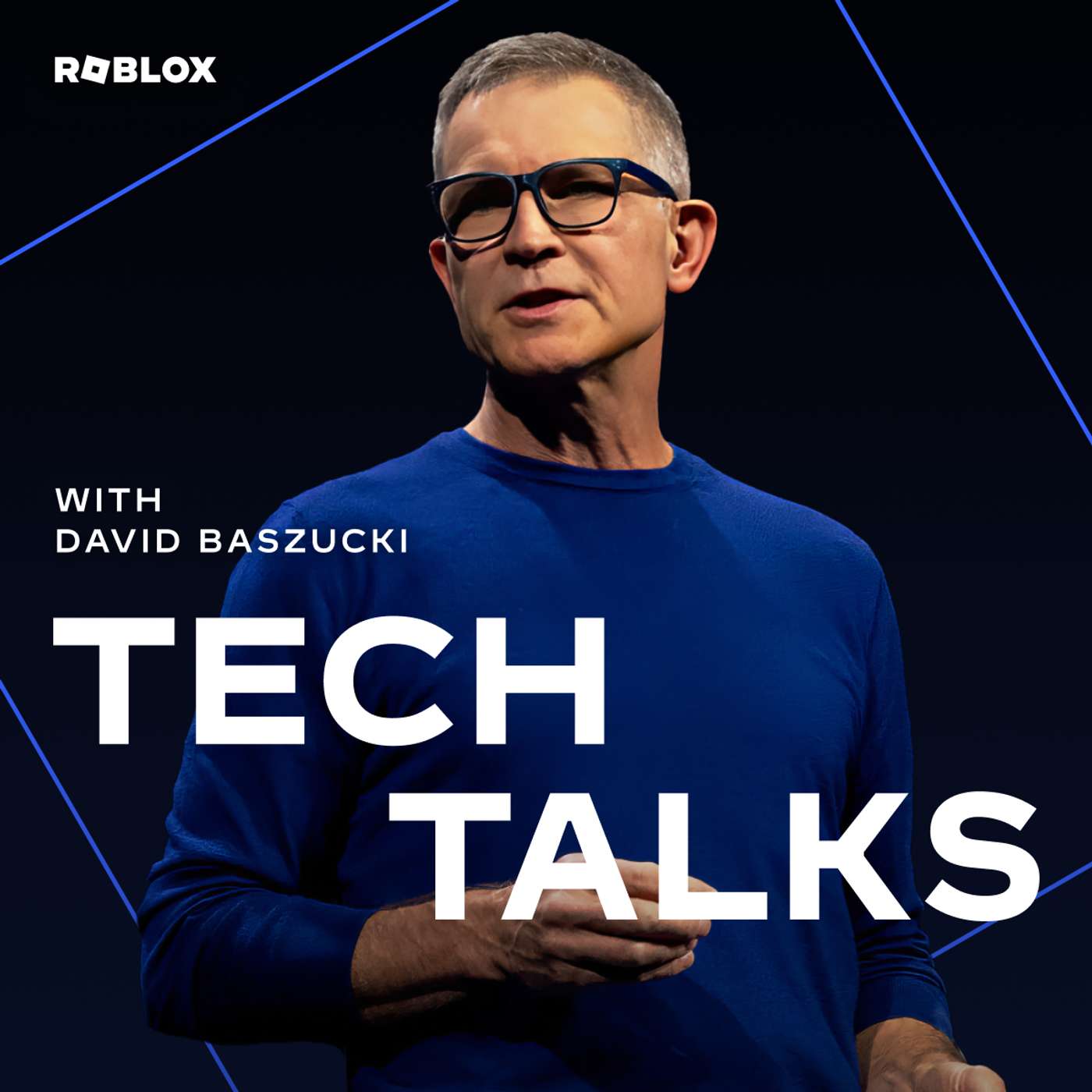
In a podcast discussion between Dave Bazuki and Enrico DeAngelo, the focus was on Roblox's economy vision, technical challenges, and evolution. They emphasized fostering creators' financial well-being and engaging users through various economic roles like sellers and affiliates. The conversation delved into democratized creation, envisioning a diverse marketplace on Roblox. The stability and adaptability of Roblox's economy system were highlighted, with a reflection on scale and growth, akin to measuring a country's GDP. The discussion showcased how Roblox's economy has evolved from simple systems to complex yet adaptable structures, aiming to create a vibrant and inclusive virtual economy mirroring the real world.
Transcription
6566 Words, 37604 Characters
Hi, I'm Dave Bazuki, founder and CEO at Roblox.
You're listening to Tech Talks, a podcast about the people and ideas that are shaping
the future of immersive co-experience.
In this series, we'll be exploring some of the most innovative technologies that have
emerged in this new category and sharing stories with the Robloxians that are building them.
Today, I'm joined by Enrico DeAngelo, VP of Product on Roblox's economy team.
We'll be talking about our vision for the Roblox economy and the technical challenges
we'll need to solve as we create a vibrant, first-of-its-kind virtual economy that mirrors
the real world.
Let's get started, Enrico, welcome.
Hey, Dave.
Thank you for having me.
Really excited to be here.
It's a pleasure, Enrico, and it's interesting in that this chat today is going to mirror
probably something we've done naturally every few weeks for the last many, many, many years,
which is really brainstorming about this economy on Roblox that's continuing to emerge, continuing
to get more interesting, continuing to mirror the real world more.
Can you share just a little about the team, what the philosophy is, and what our vision
is about Roblox ultimately being a utility?
Sure.
I like to think about Roblox as a real place back to your idea of us being a utility and
really mirroring the real world.
I think that metaphor works really well when we describe our economy.
I think of Roblox as a country with its citizens that perform economic activities such as producing
and selling goods, service, entertainment, and a country that is visited by more than
65 million tourists every day.
The citizens in that metaphor are our creators who make experiences in virtual goods, and
the tourists are our users who come from all over the world to enjoy what a platform has
to offer.
What is economy?
Economy is the function that is responsible for infrastructure enabling on one end our
users to convert fiat currency to virtual currency and use it on the platform, and on
the other, our creators to create, promote, monetize goods and services.
At a high level, what does this infrastructure include?
First and foremost, all the abstract economic rules that power our economy, essentially
how value is distributed across the entirety of the Roblox value chain from our platform
down to our creators, our marketplace, which is where our users purchase virtual items
from creators and customize our avatar, our advertising infrastructure, our subscription
products, our payments infrastructure, which enables the conversion of fiat currency into
Roblox and vice versa, and our fraud infrastructure.
In a nutshell, essentially, we are the economy engine powering the Roblox creation loop.
Creators make engaging experiences, they earn, they reinvest in their experiences, making
them more engaging, they make more money, and so on and so forth.
Oh my gosh, you sound like you could be running the Federal Reserve, thank you, Enrico.
So I want to roll back the clock for the audience.
There was a time really early on when Roblox had four or five people that the very first
economic thing we did on the platform was a very small sampling of banner ads.
We got rid of those banner ads and we replaced them with something called Builders Club.
That was a very primeval club membership.
And since then, the economy has really matured and gotten much more complex.
One of the things, and you might have feedback on this, Enrico, that we are proud of in the
early days is we were always driving the economy to a vision that it made Roblox more fun rather
than less fun, and it made Roblox more engaging rather than less engaging.
What was it like running the economy team for three or four years where all you were
hearing from the executive suite was increase engagement, increase fun, even though you're
running the economy team?
Yeah, it was actually an interesting challenge, especially for somebody like me that actually
comes from a traditional gaming background where economies are typically built, I would
say in a self-referential way, meaning that economies are meant and exist solely to generate
revenues for the company that runs the economy.
And Roblox, I had to sort of reprogram my brain to really think about economy really
as a tool and a set of systems to foster the financial well-being of our creators.
So that's essentially how we control for engagement.
We want creators to be successful, to be engaged, to be excited about Roblox and about making
manual Roblox.
And by doing that, they actually spend more time developing, they hire bigger teams.
And when they are successful, we are successful, but our success is a byproduct of the success
of our creators.
And I think it was a big shift in my thinking.
And this is also, by the way, why we call this team economy.
We don't call it monetization.
We don't call it revenue generation.
Oh, you're right.
We don't have a head of product for revenue.
We have a head of product for economy.
Right.
There was a time, it was before you were here in Rico, where we had a much more primitive
economy, and the economy was based on club memberships, more primitive type constructs.
And we could see that getting a bit nonscalable.
And so one of the things we did is we had always known that there was a much bigger systems
approach, which was taking the first step of the economy.
And that meant a virtual currency.
It meant the ability for our users to buy that virtual currency, the ability for developers
to bring in that virtual currency and ultimately create economic livelihood for that.
And we had this surprising set of discussions.
We were concerned that if we moved our creators from being hobbyists to being people who make
money, the platform might lose some fun or lose some of the organic energy.
And what I think we found, and you might comment on it, is it's been exactly the opposite in
that as people can make a living building Roblox creations, we probably did one of those things
we've asked you to do, which is let's increase the fun and let's increase the engagement
with a good economy.
Yeah, absolutely.
I think the way we think about economy is a way to A, make sure that more people are
successful, but also to make sure that more people are part of our economy because the
more participation exists, the more we can engage a new set of constituents, for example,
the more our economy is successful.
So for example, at some point, we had this very simple system where you are a creator,
you can make an item and then you sell it and then you get a cut.
And then at some point we said, okay, what if the individual that is hosting the experience
in which this item is sold also participates in that revenue stream.
And so we did that and now we create a new role set, which is a role set of the seller
or the affiliate.
So what happens after we did that is that now we have developers that create marketplace
experiences where people go just to buy items.
These creators don't make the items, but they're very, very successful.
And actually we see a lot of our users enjoying buying their items in those experiences more
than buying items in our marketplace because our creators know the community, they know
what they want, they're able to offer items in an interesting, immersive way, in a social
way.
And so by creating new participation avenues, we see our community thriving, our user having
a better time.
And that actually, this is the beginning, I think that as we go forward, we are really
pushing on that vector of inclusivity.
And so for example, we're talking a lot about creation everywhere as one of the big sort
of initiatives and big pieces of the vision for Roblox and economy will support that by
allowing all the participants in creation everywhere to actually participate in the
economy.
So you can think about an experience where people can make hats and then these hats can
be limited, for example, and they can be acquired by a user and then the user will sell it to
somebody else, and then somebody else will sell it to somebody else.
And then you see the creator of the creation experience taking a cut, which will incentivize
more creation experience to exist on the platform.
And then you see the creator of the experience with the item is resold taking cut, the reseller
taking the cut.
So all of a sudden we're spreading the wealth across the value chain, and each individual
will start earning and will start doing more of what it's doing.
And that's how we think about economy more than how much money should we make.
Maybe to give our audience a bit of perspective on the types of creators we have immersive
3D experiences, as well as all of the items around avatars and creation.
We definitely have a lot of hobbyist creator developers.
But we also have some fairly big companies, studios, maybe to share roughly how big they're
starting to get as far as number of people.
I mean, the bigger studios on Roblox are north of 100 people now.
And it's not uncommon to see studios or five to 10 people starting to actually grow and
to earn meaningful revenues on the platform.
And the interesting thing is that we're actually seeing a lot of differentiation.
So you see the more traditional Roblox experiences, but we've seen very recently really high quality
aged up experiences also appearing on the platform.
I encourage everybody who's listening to go and check out Frontlines, which is a new
aged up experience is 13 plus.
It's a military sort of theme experience, incredibly high production values, super fun
gameplay.
It's becoming a phenomenon on social media because of how good this is and it's being
compared to the big names of other AAA games out there.
This really shows that a small team can start getting traction and with a few people can
actually create something really, really powerful.
I remember when I joined adding a studio of five to 10 people was the exception and now
it's becoming more and more of the rule.
Now if instead of wanting to have a studio that makes either interesting new or large
immersive experiences with either one or a hundred people, I want to make clothing or
I want to make accessories or things like that.
Can you share a bit about that avenue for really making a living or even having a studio
that makes a living?
What are we seeing there?
Yeah.
I mean, we are seeing creators that are incredibly successful.
They definitely are making a living.
I mean, in some cases they're making six-figure, seven-figure type earnings.
This is money that they receive in their pocket after all of our cuts.
We are seeing a lot of interesting entrepreneurial spirit, a lot of interesting strategies.
I remember when I joined, we were the only player in the marketplace.
We were making 3D items and users would buy them.
In retrospect, we were not doing such a great job in that respect.
We see creators really caring about their craft.
They partner with influencers.
They go out on Twitter and do polls on what items should be published next.
They really understand their audience and I think that is really the key of their success.
We went from a model where we were the one marketer of our items to having a thousand
people and a thousand marketers of their own creations.
We're seeing more partnerships, more interesting distribution strategies where a creator decides
to distribute on other people's experiences.
The more we provide these tools, the more combinatorial explosions we see as far as
how people approach the market.
Very early on, we had a similar learning around 3D experiences themselves, which were relatively
easy to build in Roblox Studio originally.
There's a magic day when we turned on Roblox Studio and rather than us building the one
or two places on Roblox, all of a sudden thousands and millions of people started building 3D.
We're going through that same transition in our catalog right now.
We've almost completed it so that everything in the catalog is user-generated, which I'm
quite excited about.
What's interesting is, most of our creators are using relatively sophisticated 3D modeling
tools.
I'm assuming they're using Blender and Maya and Max and stuff like that, but then when
we talk about creation everywhere, I'd just like to look to the future because what we're
talking about with creation everywhere is rather than using one of those tools, you or I might
make the, I don't know, call it project runway, build your own dress experience.
Even if I'm not an expert in one of those 3D modelers, I'll be able to go and do an experience
and either using a sewing machine and scissors or using generative AI even with my words,
build a wonderful dress and then sell it.
That's really exciting because then we could imagine millions and millions of creators.
What do you think that'll do?
Enrico, do you think more variety, more active economy, what happens when millions and millions
of people can make things for sale in the Roblox catalog?
I think that we're going to see an exponential explosion of diversity of content and I would
add to that that as we combine that capability with our scarcity system where now not only
you can make a dress, but you can make a dress in a few limited units that will also allow
creators to really think about what they want to make.
Do they want to make something very exclusive and very rare, very expensive or something
that is more like mass market and both are entirely viable strategies?
So I think the combination of democratization of creation on one end, which is what creation
everywhere enables and then on the other side, our economy systems providing more and more
levers to distribute, to price, to sell, to resell.
I think the combination of both will create a marketplace that will be diverse and it
will be very, very vibrant and very dynamic.
So I think this is like it's going to be a killer combination.
And again, you often, Dave, you talk about the best and more exciting features being
those where you have the feeling that by planting a seed, something is going to happen, but you
know exactly what it's going to be.
And I think both creation everywhere and scarcity are those features where we know it's going
to be big, but we cannot even imagine how big it's going to be and how our community
will use them.
Who's the author of that song "Anything Can Happen" because we use that sometime when
we're talking about innovation at Roblox.
And I think it's the same innovation a lot of times is a big bet with the feeling that
there could be a five or 10 X to that bet, but you can't really test the bet.
You have to build the bet.
Your intuition can be very powerful.
It's probably similar to what the Disney Company felt when they were going to build Disneyland.
There was no way to measure it, but I'm pretty sure while they were building it, they were
saying, oh my gosh, this could be crazy.
I agree with that anything can happen feeling with what we're doing with both UGC and creation
anywhere and these aspects.
Do you have a vibe on why the economy has been so stable at on Roblox or enduring because
the current economy has probably scaled with us over 10 or 15 X growth really.
And it's been very stable and reliable.
Do you have any thoughts on why it's been so enduring?
Yeah, so I think one of the reasons is because it's built as a set of systems as opposed
to on a feature by feature basis and all these systems are essentially connected to the rest
of the platform and work across all of our creators content.
And so obviously the most obvious of the system is our currency, the Roblox, which is accepted
anywhere in Roblox for the purchase of everything from virtual clothing to plugins to sponsor
placements.
And there's more than just that.
So for example, what I was talking about before, which is the idea that an avatar item is really
this atomic unit that can be sold anywhere in our marketplace, of course, but it can
be sold in a creator's place.
It can be sold anywhere else in our economy.
And if you think if you take that approach and you fast forward to, for example, when
we will enable real world commerce, that's going to be the same thing as a brand.
I can create an item, a real world item, and I can sell it anywhere on Roblox because
everything talks to everywhere else, which is why our economy is maintained fresh by
the fact that it applies to everything that exists on the platform and everything that
our creators built.
And the other thing that I really like about our economy is how adaptable it is.
For example, I mentioned the idea of us introducing new road sets all the time.
And I can see that evolving as we come up with new use cases, creators of creation experiences,
seller, resellers, IP owners, traders, people that curate items.
So even if I make nothing, I can create a look and I want to sell that look.
That's a new road set.
Our economy enables for the addition of all of these road sets.
So it's new all the time.
And as behaviors evolve in our community, our economy will evolve with those behaviors.
That's why I think our economy is so timeless, it always changes.
Yeah, it mimics the real world quite a bit.
It's in a sense very simple and very systemic.
It's closed loop in that it reacts.
I remember when we first launched in-game purchases and the economy, it was one of those
"anything can happen" moments.
We thought if there is one place in Roblox where you can see which experiences are starting
to be places where people can use virtual currency, where are people spending the most
overall or spending the most within the hour?
That was part of closing the loop on that feedback system.
And within a day of launching that virtual economy with in-game spending, everyone knew,
"This is the developer that's really pushing it here, experimenting," and that kind of
took off from there.
So yeah, I would agree with you, the simplicity mirroring the real world has been super important.
We have tried and made mistakes in the past where rather than falling back to core economic
theory and principle, we tried to bolt on a lot of complexity and we found out the raw
economy was better.
So let's pop over to scale a bit.
Right now, we're in March 2023.
People can read our earnings statement from Q4.
We're just shy of $900 million in bookings in Q4 of 2022 when we did this.
That's a lot of scale.
And when we imagine most of that's made up with $5 and $10 and $15 scale purchases, that's
a lot of scale.
Any thoughts or color on the scale and some of the difficulties of managing that?
Sure.
So yeah, as you mentioned, our scale, the scale of our economy is pretty material.
I actually like to think about it in a couple of different ways.
So going back to my country metaphor in the beginning of our conversation, a while ago,
we started measuring Roblox's GDP using the same criteria and definitions that are typically
used to measure the real country's GDP.
And by that measure, Roblox would be a small country, not the smallest country, larger
than Belize and close to Greenland and Aruba.
So respectable.
And if you compare the number of active accounts in a major consumer wallet to the number of
accounts that interact with our economy, our economy is probably 3 to 5x plus that number,
if not more, depending on what consumer wallet you choose.
So by all measures, our economy is pretty massive and very, very active.
So one of the main ways we support our growth and scale is through our payments gateway,
which is essentially a generic payment platform.
So payments are often considered a commodity area, and for their reason, they're overlooked
as an innovation area, but for us, they're actually highly strategic.
So we've built this generic payment platform, which provides us with things like centralized
logging, fraud, metrics, and security, and allows us to be in control of our destiny,
essentially.
So we support party payments providers without being married to any of them necessarily.
So these allow us to be very nimble when it comes to testing and swapping payment providers,
plugging new ones in and out, and allowing for fullback scenarios if one provider fails.
And another area where the payment gateway is really critical is subscriptions, because
there are a few different models payment providers use to charge recurrently, and you need a
central data pipeline with generic renewals, cancellations, and grace periods.
And this in particular is very important for us, because leaving a subscription going for
too long, for example, might have a real monetary impact.
Another system that allows us to manage scale is our ability to enable distributed transactions
across multiple microservices through our workflow orchestration system, which essentially
coordinates across all the systems within Roblox to ensure the transactions happen in
a reliable manner.
So think about the case of our new limited system that we mentioned before, where every
individual item will have a unique serial number.
So this system will have two old payments, reserve specific serials for specific items,
manage debit and credit wallets, and also allow the transfer of items reliable.
And also, obviously, our architecture allows us to be agnostic of data centers across region.
That's another benefit of our system.
That's totally cool.
Okay.
Now, one really interesting economic thing is when we look at the real world, there ends
up being either a white cotton t-shirt or a Gucci purse.
The white cotton t-shirt is pretty much a commodity.
We can buy it from 80 different brands.
There's some variation in quality.
And then you name the luxury good.
They're always produced in limited supply, and they're very different than the commodity
thing.
Now, historically, Roblox has supported a few limited items.
They were items that we made, the famous Dominus crown, I think trades on Roblox.
Last time I looked, it was $20,000, but you might know better than--
Yeah, I think it goes up to $40,000, and some of these items can be that expensive.
Yeah.
So that's really interesting, and in a sense, it tends to mirror the real world, where very
rare baseball cards trade for a lot, and other times, I can buy a bunch for a couple bucks.
So what's your thought about this on-- like, we've announced that we're going to start
allowing creators to mimic this real-world behavior and have some things that are more
commodity, some that are more rare, valuable, and scarce.
This sounds really technically complex.
Any thoughts or color on where we're going to go with this?
Yeah.
So I think you captured the essence of this, but we think that scarcity in our economy is
going to be revolutionary, and probably one of the biggest innovation in our economy in
a long time.
And it will really provide-- the way I like to think about this is it provides a way not
only for creators to capture value, but also for users to capture value, because what comes
with scarcity is inherent value of an item.
Obviously, if an item is very scarce, it will be more valuable, and so if you own it, you
can resell it and make money from it.
Then the user will actually be the party that makes money, also in addition to the original
creator.
So that's a very powerful economic concept, I think, but one of the major challenges with
introducing scarcity in a UGC platform as large as Roblox is the fact that there might
be bad actors trying to counterfeit items like in the real world and undercut the original
creator.
And this is a big issue that, if not addressed, can really cause significant damage to our
community.
And so when it comes to 3D items, proliferation, in a platform like ours, you will be seeing
massive numbers.
So potentially tens or hundreds of thousands every day when we are operating at scale.
And so simple moderation is not going to cut it, and using 2D image recognition of thumbnails,
for example, is not going to be good enough because lighting, the rotation of the item,
image noise can be a confounding factor, so it's going to be hard to really spot these
duplicates.
And so in order to address that, we're building technology to assess 3D assets similarity,
and our approach is able to measure similarity regardless of lighting, scale, so items of
different sizes, and materials used, and understand really small details anywhere in the object.
And so we do that by generating hundreds of custom views of the 3D object with the object
occupying a fixed percentage of the render image, so we control for scale.
And at that point, we generate a vector representation for each of the images, and then we concatenate
these images to create a vector of the full object.
And at that point, we have these vector represented clean object without any noise, and we can
compare that precisely with any other object in our cloud and determine to the extent to
which that item is a duplicative version of another item.
And this provide a way more precise understanding of the object than approaches such as semantic
comparisons or training computer vision models using attributes or tags.
So that actually I think is something pretty neat that we're working on.
Yeah, I think we're going to see a common thing within Roblox that because we have so much
scale and we can have human feedback incorporated with our user interface, essentially.
We have ability to harvest AI in a way that is just going to change the whole complexion.
And I love the idea of using it to drive scarcity in the economy and support that as well.
There's another interesting thing that we've been talking about for a while, which is what
is the future of advertising on our platform?
Some fun trivia facts.
The very first way we monetized on Roblox was some banner advertising.
We eliminated that over time.
And for a long time, Roblox fans, there was a time when we had pre-roll video before you
could play a game or experience on Roblox.
And we got rid of that as well.
It was essentially getting between players and their experience parallel to that probably
for over 10 years.
People have been imagining the notion of a 3D ad server.
There's been a couple of companies that were funded over 10 years ago to build 3D ad servers.
They had a rough time of it because they didn't have one place with the scale we've got.
But now we're starting to have this enormous scale, billions and billions and billions
of hours per month and an opportunity for immersive advertising.
Can you share a bit about what is our vision for a new immersive ad format?
How would it work?
And let's just kind of help our listeners imagine what this might be.
Sure.
So this is another one of the big initiatives that economy is really busy, really excited
about.
So immersive advertising, essentially, is the idea that any developer on the platform can
add an ad unit to their experience.
And this ad unit will serve relevant, high quality ads to user over the age of 13.
The ad unit will be immersive, meaning that it will be part of the 3D environment.
And so what's really exciting about this model is that because the 3D environment is so malleable
and we have full control over it, we can really reinvent how ads are displayed and experienced.
And we can make them more engaging than anything people have experienced with advertising on
other platforms.
So we have publicly discussed billboards and portals.
In particular, is this idea that a user can travel from place A to place B, place B being
the brand's place where they want to have user experience their products.
But this is just the beginning.
And for example, one idea that I really love is the one where we could serve interactive
billboards that allow users to perform transactions without leaving the experience right from
the billboard.
By the way, these transactions could be virtual item transactions, or in the future, real
world transactions.
So because you're in an immersive environment, you would do this with your friends and anywhere
because this unit can be served dynamically.
Now the foundation of any ad format, obviously, is the concept of an impression and an impression
in 3D is very different and much more nuanced than a traditional 2D impression.
And because it needs to take into consideration things like time, viewability requirements,
such as distance, angle, and also occlusion, so we built technology to calculate the ad
unit geometry dynamically to determine whether it meets the pixel requirements to qualify
as an impression.
And one interesting fact is occlusion and obstructions is a particularly tricky problem to solve
because if you use the traditional ray casting approach, that can be hard on performance because
you need to cast many rays to actually identify what part of the ad unit is visible.
And so we have addressed this by using a sampling approach based on a randomized ray casting,
which means that instead of ray casting, of casting rays to fixed points in the ad object,
we cast rays to random points and use each ray as a sample.
So that allows us to still understand how much of the ad unit is covered while at the same
time go easy on the performance side.
Yeah, there's probably, if we wanted to gather a list of science fiction movies with funny
crazy future ad units that happen in 50 or 100 years, all of those we could start to
imagine in Roblox well before they happen in the physical world.
And many of those formats I actually think will be things that people find fun and interesting
rather than something that gets between them and your experience.
So this is really interesting technology.
You share a bit about the parallels to a regular ad server in that will there be a marketplace?
Will someone be able to, if they really wanted it on a particular day, send a lot of impressions
throughout Roblox?
Say I'm Dave Bazuki and I just have a new movie that I produced.
And in one day, I'd like many people, half of the people on Roblox to see my an impression
of my new movie.
How would I do that?
How would that work?
So from the point of view of the advertiser, they would as far as submitting or as far
as expressing the requirements as far as number of views, the time, the type of segments that
they want their ads to be shown to, that would feel fairly familiar.
However, where the innovation is really in the format.
So for example, if you want to create a billboard, that's fine.
But if you want, for example, if you create an experience around your movie, and maybe
that experience has some pure cause that can be redeemed to go and get a discount when
you go watch a movie, you would actually then buy teleports, not buy impressions.
And so this is where I think the innovation comes in, because of our formats, we can actually
sell different concepts that do not exist necessarily in outside of our platform.
The foundation of our ad infrastructure is still an auction.
If you want to pay for a specific time window, you can.
If you want to pay for a specific demographic and time window, you can.
Obviously, if other advertisers are competing with you, then the price for that teleport,
for example, if you're talking about teleports, will go up.
So it is a marketplace based system.
It's going to be really exciting.
I'm optimistic.
Just like over the last four years, where we've said, let's increase fun and engagement.
We're going to see the same with these exciting units.
Okay.
So fast forward.
We mentioned sci-fi movies, fast forward, Roblox, I don't know, 10, 20, 30, 50 years.
What do you think our economy looks like?
That's a great question.
So if the metaverse is a place where people spend a significant portion of their time
being social, entertained, expressing themselves, I think the economy should match that and
enable any participant to engage on both sides of any economic activity.
So any user can be a buyer, can also be a creator and a seller.
And any economic activity should be present on the platform.
We'll continue seeing new forms of virtual goods and services, including items beyond
cosmetics and currencies.
I think that's going to be a big deal.
We will see users identify more and more with their digital identity to a point where that
will matter almost as much as their physical identity and in that world, I think the interplay
between virtual and physical items will be really compelling.
So a simple example is trying out or making an item in an immersive experience and then
getting the physical version of what you made shipped to your house.
For example, I think the promotion of all of the above will take new forms with brands
integrating deeply in experiences and providing value to users just beyond items.
I think major brands will replicate their business model on our platform, not just for
promotional purposes, but also as revenue generating activities.
So the long term, you will have a Roblox place and you will have a website and you will have
your physical business.
And these three pillars will be all as important or arguably your Roblox presence will at some
point surpass your digital presence.
That will be the place for you to conduct digital business.
I also imagine new brands being born out of the creator economy.
So creation everywhere, I think is going to be one way where normal, regular users will
start getting a flavor for what it means to be a creator.
And some of these users will actually rise to the occasion and become a big deal.
It will become followed, will make a lot of money by just monetizing their presence on
our platform.
Enrico, while you're talking about avatar items, this is a common theme, physical digital
duality where maybe starting with the phone system where we spent some time hanging out
on the telephone and some time with our friends in the real world, those both felt kind of
real to us.
And so if we're having a phone call or we're together, one is more virtual and one is real.
And they both seem somewhat real.
We're communicating.
We're doing things either in a 3D immersive environment like Roblox or in the real world.
Do you think there will ever be a time where rather than we think about what we're wearing
in the real world and then we say, oh, could we wear that in digital world where for some
people what they wear in the digital world, they go the other direction.
And they say, OK, because I can pick any type of clothing, any type of outfit, I can create
it automatically.
I can buy it from someone that they'll, on certain days or times, they'll lead with
what they're wearing digitally.
And then they'll say, oh, now I need a physical version of this.
And it'll almost go in reverse where you prototype digitally.
And then you try to map your physical appearance to that digital appearance.
Yeah, absolutely.
I mean, you start seeing this already with cosplay.
I think it's something where people borrow digital identities in the cosplay situation
or digital identities of characters they are very attached to, although they're not necessarily
themselves.
But if you take that to the extreme, why should I cosplay like somebody else, some character
for some game, where I can actually create my own digital identity that is uniquely mine
and I can essentially be myself?
And then at some point, I can actually rebuild that digital identity in the physical world.
So I absolutely think that's going to be huge.
And maybe we're ahead of it because I constantly share with the Roblox employees, we're a 100%
costume-friendly environment at work, no matter what the day, not just Halloween.
So maybe in the future, we'll see more outrageous clothing every day rather than just for a
few days.
And any other closing thoughts on the future, Enrico, I think you painted it in a really
elegant way.
Maybe one other thought, you know, going back to the idea that payments are not just like
a commodity area, but an area where we can really innovate.
I think that payments in particular will become a major area of convergence between digital
and physical world.
For example, you can imagine at some point, virtual and real items being purchased with
the same currency and maybe a metaverse wallet being used in the metaverse and really off
platform.
And so to me, that's almost like the ultimate convergence product where you can move in
and out of digital, physical, you have the same balance.
Maybe you have a card, a debit card that taps into your metaverse wallet.
That's also something that I, you know, an idea that I'm very excited about.
I am too.
And it's a good closing of the loop all the way back to all the time we spent together
really, Enrico, about focusing on engagement and having this interesting economy platform
that drives everything we do on Roblox, even though our first principle has been engagement.
So it's been wonderful working with you under that principle.
Thank you, David.
Thank you for having me.
Hey, it's been great having you today, Enrico.
And that's all for another episode of Tech Talks.
Thanks for listening.
And if you'd like to find out more about careers at Roblox, check out roblox.com/careers.
I'm your host, Dave Bazuki.
See you again next time.
Podcast Summary
Key Points:
Discussion between Dave Bazuki and Enrico DeAngelo on Roblox's economy vision and challenges.
Evolution of Roblox's economy from banner ads to complex systems.
Focus on fostering financial well-being of creators and engaging users.
Introduction of new roles like sellers and affiliates to enhance economy participation.
Future vision of democratized creation and diverse marketplace on Roblox.
Stability and adaptability of Roblox's economy system.
Handling scale and growth of Roblox's economy, with comparisons to real-world GDP.
Summary:
In a podcast discussion between Dave Bazuki and Enrico DeAngelo, the focus was on Roblox's economy vision, technical challenges, and evolution. They emphasized fostering creators' financial well-being and engaging users through various economic roles like sellers and affiliates. The conversation delved into democratized creation, envisioning a diverse marketplace on Roblox.
The stability and adaptability of Roblox's economy system were highlighted, with a reflection on scale and growth, akin to measuring a country's GDP. The discussion showcased how Roblox's economy has evolved from simple systems to complex yet adaptable structures, aiming to create a vibrant and inclusive virtual economy mirroring the real world.
FAQs
The team envisions Roblox as a virtual country where creators produce goods and services, and users visit to enjoy experiences.
The economy enables users to convert fiat currency to virtual currency and creators to create, promote, and monetize goods and services.
The economy empowers creators to earn revenue, reinvest in their work, and create engaging experiences, fostering their financial well-being.
The economy has transitioned from primitive club memberships to a complex system that supports creators in making a living and driving engagement.
Enabling millions of creators to make and sell items will lead to a diverse and dynamic marketplace, with various strategies for pricing and distribution.
The economy is built as a set of interconnected systems that evolve with user behaviors and new use cases, ensuring it remains adaptable and timeless.
Chat with AI
Loading...
Pro features
Go deeper with this episode
Unlock creator-grade tools that turn any transcript into show notes and subtitle files.
 PodcastTranscript AI