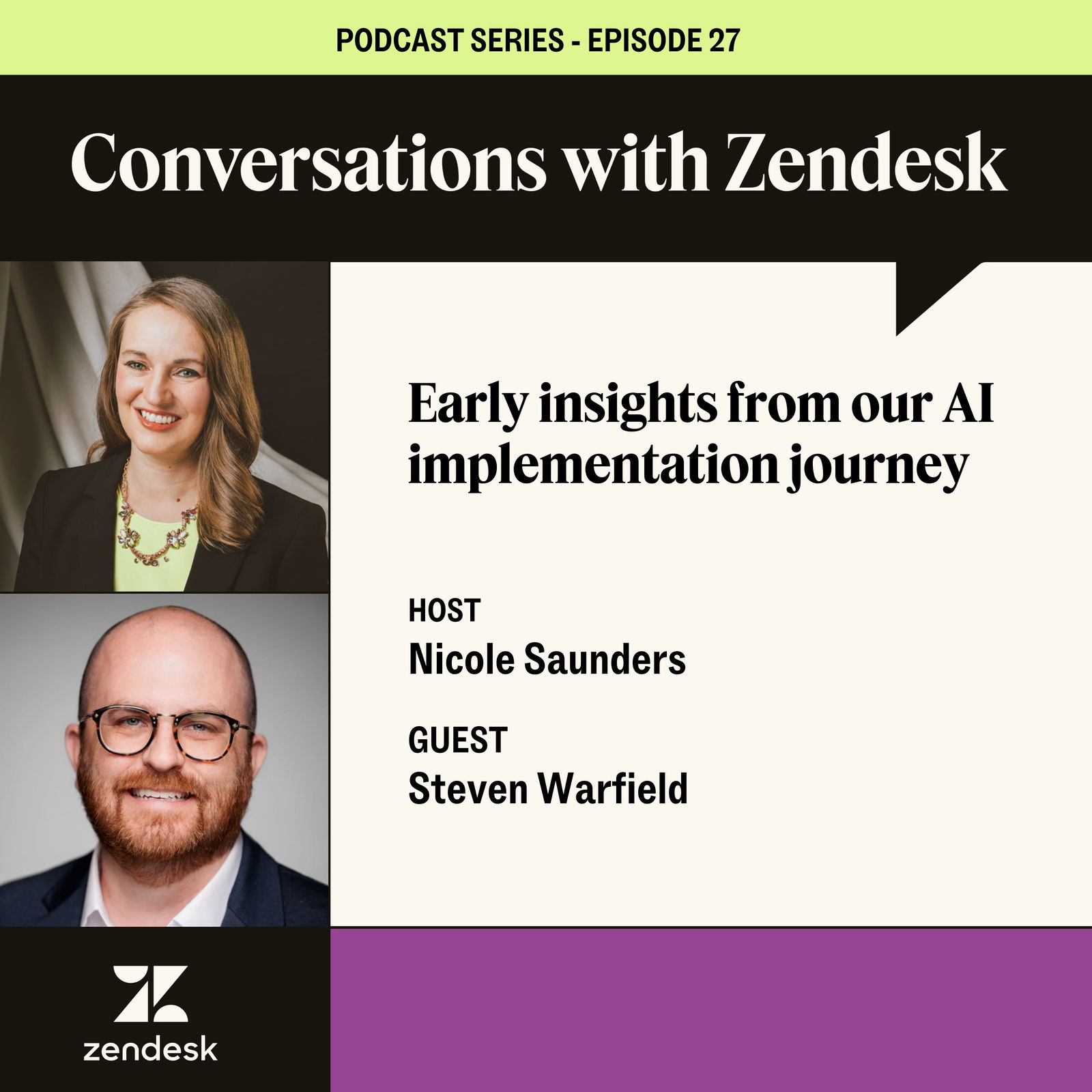
Early insights from our AI implementation journey with Zendesk's Steven Warfield
23m 3s
The podcast discusses Zendesk's approach to integrating AI into customer support teams, led by VP Steven Warfield. AI automates common queries, reducing response times and allowing agents to focus on complex, problem-solving tasks that require human empathy. Retraining programs emphasize critical thinking, digital literacy, and emotional intelligence, with agents reporting overwhelmingly positive feedback as AI reduces frustration and enhances work balance. Warfield highlights that AI transforms agents from generalists into specialists, enabling more fulfilling roles and tailored customer interactions. Key lessons for leaders include treating AI implementation as a journey, starting with pilot programs, and establishing feedback mechanisms for continuous improvement. AI also provides predictive analytics to optimize staffing and match technical inquiries with appropriate experts. The shift reshapes hiring priorities toward candidates with strong emotional intelligence and technical expertise, as AI handles simpler interactions. Warfield stresses that AI augments rather than replaces humans, increasing the value of human interactions by making them more meaningful. Overall, the transformation creates space for agents to focus on passions and complex challenges, improving both employee and customer experiences.
Now that we've unlocked this extra time, I think makes all the difference in the world. And it allows people to space to think about the things that they're most passionate about. Hello and welcome to Conversations with Zendesk. I'm your host, Nicole Saunders. Today, we are tackling a big topic, change, and how to manage it. It's no secret that there are enormous changes happening in the world of CX. And as more and more teams begin to integrate AI into their operations, they're having to figure out what that means for the structure of their existing teams and their workflows. We're going to do things a little bit differently for this week's episode and turn the mic on ourselves. Steven Warfield, our new VP of customer service, will be joining us to discuss how Zendesk is thinking about the impacts of AI on our internal support teams, what our roadmap looks like, and a few lessons that we can share at the stage in our journey. For those CX leaders who are just getting started with AI, or already on their way, I wanted to share a new guide that we have that covers all of our best practices and tips for AI implementation. It's free and it's available at zendesk.com/intelligent-cx. Okay, before we dive into our conversation with Steven, we wanted to hear from some of you. What are some of the things that you're currently doing to plan or prepare your team for an AI-powered future? So, here's some of what we heard. When it comes to our future, I think, first and foremost, what we're looking to do is be curious about what AI is and what the potential is. We're also experimenting and trying to soak up as much information as we can and really push the limits to see what AI potential is out there. Both professionally and personally, and then where we can adapt that back into our workflows. And then we're also on the bleeding edge with zendesk and utilizing these tools in a safe environment inside of our customer care contact centers for a better user experience that's powered by AI. For me, preparing agents for AI is all about empowering them. It's about giving agents the power to update knowledge base, filling gaps, update content. It's also about giving them power to handle or execute on those tickets that an AI bot cannot solve, meaning an agent should be allowed and empowered to make refunds, make changes in customer accounts, exchange products, and actually do something with the tickets that do reach them. And finally, if you want to prepare your team for AI, it's important to ask them what hinders them in their job, what makes their job difficult, and see if you can leverage AI to fix those items and make their job easier. Those are the three things. Many thanks to listeners for sharing those insights. If you're interested in joining the conversation or just following the latest from zendesk in this podcast, please follow us on LinkedIn at zendesk.com/li. Now, without further delay, here's our conversation with Stephen Warfield. Stephen Warfield, welcome to the Conversations with zendesk podcast. How are you today? I'm doing well. Happy to be here. Well, I would love to start with you just explaining a little bit about tell us who you are, your role, your title, and what you do at zendesk. Yeah, my name is Steve Warfield. I'm the vice president of customer service and technical support. I am what you could call NOG. I am on about day 60 here at zendesk. That's a long time, Emily. Yeah, long tenure. Well, Stephen, within that capacity, so you oversee and manage our support teams. Obviously, you're thinking a lot about how our teams are evolving. The hot topic this year has been AI. Tell me a little bit about how you are thinking about the role that AI may begin to play with our support teams. If there's anything that we've implemented so far in how people might want to hear about. Yeah, absolutely. I think the integration of AI within support teams primarily enhances the operational efficiency and customer satisfaction. By automating responses to common queries, AI really reduces the response times and frees up agents to handle more complex, intricate customer issues that require human intervention. As I think about AI and it's talked about so frequently now, it's not just the customer facing side to, it can also analyze large volumes of data and it identifies trends in predict customer issues before they become really widespread. And it enables that proactive enablements for it. By using our own AI tools, we can really fine tune their performance and ultimately their reliability, which not only improves the overall support capabilities, but I also think it really showcases the effectiveness of our products to potential and quite frankly, existing customers. So this has been a fairly rapid change. Well, it feels like we've been talking about AI for a while now. It's really been like a year, which is a really quick turnaround time to shift how you work, what your agents are doing, how are you approaching retraining and upskilling agents and what changes have you seen in their roles so far and what changes you expect to see in the coming months and years? Yeah, you know, I think as AI reshapes the nature of support queries, the focus shifts from the repetitive tasks that I was talking about earlier to handling problem solving and complex interactions. So to prepare agents and as we call them advocates for these changes, retraining program really needs to focus on the critical thinking aspects, digital literacy. I would say a lot about emotional intelligence and upskilling agents to use AI tools effectively is also really essential. So this might involve training on new software platforms, understanding AI driven analytics and learning how to intervene when AI solutions require a human oversight. You know, that type of training really ensures our agents feel confident. They feel competent in a tech enhanced workplace and a special shout out and plug to our WFM and operations and training team. We've got a world class one. And so we have some really exciting trainings up on deck right now. Our team is loving it so far. Well, great to hear that they're loving the trainings and things. What have you heard about using the AI tools is is this in fact making agent jobs more fun, more interesting, more efficient, or is there some change management that's having to go on? Yeah, I would say yes to all of the above. The feedback has been really good. Yeah, both. Yes, the answer is yes, next question. But the feedback has been really good. You know, I think one of the most important parts about this though is the fundamentals of providing a world class customer experience need to be incorporated first before you really go headfirst into AI. You want a great coaching and inspection process. You want to have teams where I lead involved in the mission, the drive, and you want to have teams that are fully focused on providing an incredible best work experience and a really good employee experience. After that, once deploying AI and you've got the fundamentals in place, that's where the magic really starts to happen, right? You've got predictive analysis. You're getting the right people in the right places. And you've got a lot of focus on providing AI enhanced customer interactions, but you're not losing that human element or as I call it, the sugar of the interaction. So I love that the sugar of the interaction. That's really what it comes down to you, right? Is what is the thing that moves it from a transactional engagement into a meaningful one? Something where somebody walks away from it says, "Wow, that was really helpful and I feel good about it, not just that I got what I needed, but I felt hurt and I felt supported." Kind of thing. You know, absolutely. You want to feel like you're talking to a human being because you are talking to a human being, the AI augments that experience and makes it a seamless one if you're doing it correctly. And I think that's a critical thing to call out. So much of the conversation and the fears I think have been around AI replacing humans. But the optimal situation is actually AI augmenting the experience and improving upon it. Yeah. You know, I think that's the number one fear that I hear frequently, especially being a support leader, right? And I think AI's in fact really extends beyond just efficiency, right? It's transforming what the work looks like. So as agents are increasingly becoming specialists and dealing with complex issues that AI can't fully resolve, this is where that magic happens, right? It elevates the role of the agent to that of a problem solver, of a consultant, and you know, roles that require a deeper level of expertise and customer engagement. And this transition leads to a more fulfilling work life. But it requires a lot of clear communication. Leaders have to be super dialed in to help agents understand and adapt their evolving roles. So I think it's as long as you have those fundamentals and your team has the psychological safety to bring those things forward. Magic really starts happening. That psychological safety is important, right? We need to have a good way to support people through change so that they feel comfortable. They feel safe trying something new and maybe failing or maybe finding it frustrating, but learning those skills, learning is a process that's not always a straight line. And we all know that. Totally. Are your agents finding that it is removing frustration from their job to have these new tools? I think so. I think sometimes it can also be frustrating, right? So the vast majority of the feedback we get is overall very positive. This allows for advocates to have a really strong focus on providing a world class experience. It allows for information to pop up a lot faster on their screen. They can find the things that they need to find much more quickly.
the information is a lot more relevant. It also allows on the back end a much better experience. It allows for us to have a lot of analytics in the background to ensure that we've got those right people, the more technical individuals focusing on the more technical inquiries. So it provides for a better work balance, right? So instead of a really technical person who sometimes gets over full volume, we're allowed to really keep that mix healthy and provide real time technical expertise to really technical inquiries. So the feedback is overall, but I would say overwhelmingly positive. Do you have any specific examples or stories or things that have been surprising to you that you'd like to share? Yeah, you know, I don't know that it would be surprising, but something that's really cool is we think about like the follow the Sun model and we have support all over the planet. We have AI that's really predictive, right? We can actually see and predict what's going to happen. We can tailor our responses. We can see tone. We can see intonation. It allows for us to really map out how do you have a really great conversation and convey what you're trying to convey in a succinct nonverbal way. And AI has been really helpful there. It's been cool. And so the team is like, wow, this is a great way to phrase this, but it still allows for their true voice to be delivered across the interaction. So it creates that relationship, but refines it. Great. So of course, as in us, we're using our own tools. In the industry, it's known as eating your own dog food and we like to talk about it as drinking our own champagne. But right eating our own ice cream. That's my favorite matter for what. Have you learned that you would share with other support leaders who are working on implementing these tools and capabilities and workflows into their support organizations? Yeah, absolutely. And this is a continual learning process too. But I would say implementing AI should be really seen truly as a journey and not as sprint. And I know that's common, but it's really applicable in this space. And it's important to manage expectations and set really realistic goals with your team, right? Starting with a pilot program that can allow you to gauge the effectiveness of the tool in your specific environment. You can make adjustments before you do a full rollouts. Yeah, it's crucial to have a feedback mechanism in place for agents to report back on AI's performance. And I think this can help in fine tuning the AI tools to better suit the practical needs of the team and the customers they support. Having that ability and a carved out free defined space to talk about these things, I think has been one of the biggest parts for us. And that's still early in the evolution. It's moving really fast, but sizing a space for people to deliver feedback and really defining what are we looking for? What are the things that are working really well? And what are the things that need to have improvement is really critical. And leaders need to be trained. I'm going to do that. That is such a like nice map of the different pieces and elements, right? We talked about creating psychological safety that you've got a feedback loop in place. Not only do you know how you're going to collect it from people, but you also know how you're going to act on it and use it as you go through and expecting this to be a process that's going to require some tweaking and adjusting, you know, just as we're training bots, we're training the humans in parallel with that. Absolutely. I'm curious about what you foresee as some of the long-term structural changes to career opportunities or job architecture. How was this shifting landscape potentially reshaping the organization as a whole? Yeah, you know, I think I tend to have a very support-focused lens sometimes in this, but it is reshaping everything. When you look at our operations, when you look at, you know, I'll be going to old school for just a minute, but we used to have back in my day, we have like early- Steve, which were like these mathematical equate formula that we would use to staff and place agents. And it was like on whiteboards. And then we had Google Docs. It was amazing. It's shaping all of that. It's clean. It's clear. It's crisp. And not only does it shape like where you should be putting the right people, but it's allowing the people that are being placed to be really specifically focused on subject matter expertise, right? As you think about the old days of like the jack-of-all trades and the master of none, this really unlocks the ability to have super dialed-in specific subject matter experts into really focused areas. So it allows for us to have awesome conversations with our customers. It allows for us to pair a really specific inquiry with a really specifically trained advocate, which I think makes a really big difference, right? So we're allowing for a much more tailored fit for purpose interaction. And I think it's really cool that way. So I see the landscape is really shifting towards the onesy-to-z interactions that could be done by anyone. I think are going away. And AI's taking those off. And quite frankly, I was a tier one analyst. Those weren't fulfilling engagements for me. I wanted to do cool stuff. And one of the biggest pieces of feedback that we're getting now is people are able to focus on cooler things, things that are challenging, things that are fun, and things that customers care about the most. It sounds like what you're doing is really creating more specialists where. Exactly. Maybe previous tiered models or swarming models of support had a lot of people that were generalists needed to have a lot of broad knowledge to cross to product base. And then when you got into those in-depth questions, you had a handful of technical specialists started at the top tier. Now everybody's got an opportunity to become more of that specialist because those lowered. Exactly. Lower tiers are the AI. How are you really leaning into helping people develop those specialist skills? If you've got a workforce that's been generalists for several years, maybe a handful of experts, how are you starting to think about we gets to pick which expertise and how are we giving them that depth of knowledge so they can handle those more challenging questions? Yeah, it's a great question. As I think about our training team, our operations team, the first is the size where you need the need, right? Where does that need come from so we can see our overall capacity? And then I think a big part of that comes into actually managing the change, right? Which has historically been one of the harder parts. But that effective communication we talked about earlier is key when you're introducing significant changes like AI integration. So it's really important to create a really transparent environment where they can express those concerns and ask those questions and say these are the things that I care about and this is what I want to do more of and allowing for us to give immediate feedback, which is this is where the need is for the business, right? So regular updates about how AI is impacting workflows and overall results can help gain the buy-in from the team and highlighting stories about how AI is helping, how it's helping solve problems and improve service. It mitigates a lot of those fears. So people are willing to dive in and say, this is awesome. There's more capacity to do these things and I'm in, right? And I think the last part is I would say illustrating a really clear path for career advancement that involves working alongside AI can help motivate the staff, your team to engage in those new technologies really enthusiastically, proving to them, right? You've got to prove it to your team, which is like, this is what we're allowed to do now that we've unlocked this extra time. I think makes all the difference in the world and it allows people to space to think about the things that they're most passionate about. Well, who doesn't want to be thinking about things that they are more passionate about at work? Right. And who doesn't want to have technology that enables you to do that? How do you think this is going to change the way that you've hired in the future? Will you be looking for agents that have deeper expertise and skill sets in a specific area? Do you think it's going to shift your job descriptions? What would that look like? Yeah, absolutely. I do think it's going to shift the job description, right? When you think about like, what is the profile? Again, I'd go back to a really support focused question, which is like, well, I'd hurt this question. Actually, it was posed at relate by one of our speakers, which I've loved. It was tell me about a time when you helped someone when you didn't have to, right? And getting the profile of what I think about like customer service and advocacy, I want a person who's really into that. And now we can really start seeing who we're bringing into the team and what we really need for the organization. So it changes a lot of that. We're not going to be focused on really passive interactions with customers. We're going to be focused on people who are not only technically adept, but have the EQ to have real meaningful, longer engagements. I think that's going to change the profile of the type of person we're looking for. There's a big fear factor that's, oh, we're looking for less. I think it's going to be we're looking for different. And like, that different is going to make all the difference in the world to these interactions. I've been thinking a lot about how AI is actually going to increase the value of actual human interactions because ultimately people will recognize, okay, I can just talk to a chatbot or a little AI agent can help point me in the direction of the right documentation. And so when I do talk to a human, it's going to be that much more valuable. And so it sounds like that's what you're going to see play out with the agents of the future that they're going to be people that you're looking for. High EQ, excellent communication skills. Not that you weren't looking for these things already in your agent is going to become even more imperative. But then also pairing that with deeper technical knowledge because the questions they're getting aren't, you know, how do I reset my path's word and how do I log in? AI will cover that. It's going to be the deeper troubleshooting. So you have to have the technical knowledge and the troubleshooting skills to really kind of unpack that puzzle and put it together. Yeah, I think you hit the nail on the head. And it also really helps the people who are currently here, right? And allows us to focus. So people who are already here, people who are providing incredible support experience as is, right? And maybe there aren't a lot of like some of those easier interactions. And as those go away, those people who are providing like world-class experiences, we can unlock them to do new things, right? We can unlock them to focus on a different type of experience, one that is maybe a little bit more technical complex, but also a little bit more consultative, creating an experience where we're really holistically approaching the root cause of why some of these inquiries are coming in in the first place. And what I found is a lot of those advocates are some of the
very best customer experience advocates, right? They're the ones who are like, hey, this is what I saw in the days of old and this is what I'm seeing as news. And the people, the boots on the ground, the people who are our most trusted assets, the ones who are interacting with their customers each day, they're now providing that feedback. They're literally driving the strategy of what we should be focusing on for our interactions. So it's pretty amazing. It's real world, real time feedback that we get to incorporate. So it's an exciting horizon. What has been the biggest challenge for you in implementing this and going through these changes? Yeah, you know, I feel like since I'm only 60 days in, I have to really shout out our operations, our workforce team, they've been working so hard to get this done. So like, I get the benefit, right? A lot of this stuff has been done. Like I'm in like, well, we did a great job. Our operations team, our advocates have gone through a lot of change. I would say the change management piece is I think about what I've done at previous companies and now still doing here, the change management piece is going to be one of the harder parts. Being really purposeful and setting really clear expectations and timeline, specifically owners, is like the key to salvation, right? You want the buy-in from your team. You want the team to be able to share those things. So the change is hard. The training is easier when you've got purpose and quite frankly, a really great team behind what you're wanting to push out. And then a great way to inspect and measure that your team understands what we've done. Well, Steven, you sound so energized and so excited about this. You've definitely made implementing AI and thinking about how to reskill and upskill agents sound less scary and more exciting. And like, it's really creating more fulfillment for a lot of people. Any last thoughts or key takeaways that you'd want to make sure that other support leaders are walking away from this conversation with? Yeah, I would say, you know, the last piece is embracing change. It can be a little bit scary. There's a lot of ambiguity. And in support, ambiguity tolerance is one of the most important pieces of being just an awesome advocate. I would say that the ability to embrace that change and really broaden your horizons is credible. And you don't have to do it all at once, right? You can do this by my bite as long as you're keeping up. So I would say that was where my parting words love that. Well, thank you again so much for joining us today. Steven and I'm sure we'll have you back in the future as our lead of support and big thought leader in this space. Excellent. Thank you so much. A big thank you to Steven for joining us and those listeners who sent in their thoughts. Be sure to join us in two weeks for an extra special episode with Andre Heller of the International Rescue Committee ahead of World Refugee Day. Please be sure that you're following the show on your favorite platform so that you don't miss it. And as always, if you like what you hear, please consider giving us a five star rating, sharing with a friend or leaving us a review. We really appreciate your support. Until next time, I'm Nicole Saunders-Fresendesk, the intelligent heart of customer experience.
Podcast Summary
Key Points:
AI integration in CX enhances operational efficiency by automating routine queries, freeing agents for complex issues.
Retraining focuses on critical thinking, digital literacy, and emotional intelligence to upskill agents for AI-augmented roles.
AI elevates agent roles from generalists to specialists, enabling more fulfilling work and tailored customer interactions.
Successful AI implementation requires a journey approach
AI predicts trends and improves work balance by matching technical inquiries with appropriate experts.
Future hiring will prioritize emotional intelligence and technical expertise over generalist skills, as AI handles simpler tasks.
Summary:
The podcast discusses Zendesk's approach to integrating AI into customer support teams, led by VP Steven Warfield. AI automates common queries, reducing response times and allowing agents to focus on complex, problem-solving tasks that require human empathy. Retraining programs emphasize critical thinking, digital literacy, and emotional intelligence, with agents reporting overwhelmingly positive feedback as AI reduces frustration and enhances work balance.
Warfield highlights that AI transforms agents from generalists into specialists, enabling more fulfilling roles and tailored customer interactions. Key lessons for leaders include treating AI implementation as a journey, starting with pilot programs, and establishing feedback mechanisms for continuous improvement. AI also provides predictive analytics to optimize staffing and match technical inquiries with appropriate experts.
The shift reshapes hiring priorities toward candidates with strong emotional intelligence and technical expertise, as AI handles simpler interactions. Warfield stresses that AI augments rather than replaces humans, increasing the value of human interactions by making them more meaningful. Overall, the transformation creates space for agents to focus on passions and complex challenges, improving both employee and customer experiences.
FAQs
AI enhances operational efficiency and customer satisfaction by automating responses to common queries, reducing response times, and freeing agents to handle complex issues. It also analyzes data to identify trends and predict customer issues.
Retraining should focus on critical thinking, digital literacy, and emotional intelligence. Upskilling agents to use AI tools effectively, including training on new software and understanding AI-driven analytics, is essential.
Feedback is overwhelmingly positive, as AI allows agents to focus on complex, fulfilling tasks and provides faster, more relevant information. However, some initial frustration can occur, which is mitigated by clear communication and psychological safety.
Treat AI implementation as a journey, not a sprint. Start with a pilot program, set realistic goals, and establish a feedback mechanism for agents to report on AI's performance for fine-tuning.
AI shifts roles from generalists to specialists, allowing agents to focus on subject matter expertise and complex issues. This creates more fulfilling work and tailored customer interactions.
Job descriptions will shift to prioritize candidates with technical skills and high emotional intelligence for meaningful engagements. The focus is on finding different, not fewer, people who excel in problem-solving and customer connection.
Chat with AI
Loading...
Pro features
Go deeper with this episode
Unlock creator-grade tools that turn any transcript into show notes and subtitle files.
 PodcastTranscript AI