The primary curriculum is changing, but why? Why now? What's new and what opportunities
does this change offer?
Hello and welcome, my name is Tracy Kern, a member of the team at the National Council
for Curriculum Assessment.
The redevelopment of the Irish Primary Curriculum presents a fresh vision for learning teaching
and assessment in Irish Primary Schools, to bring it in line with contemporary developments
and the most cutting edge thinking in education.
In this podcast, we cast a spotlight on assessment to consider contemporary thinking in this
space, where we are with our assessment practices currently and the opportunities and challenges
that are redeveloped curriculum presents.
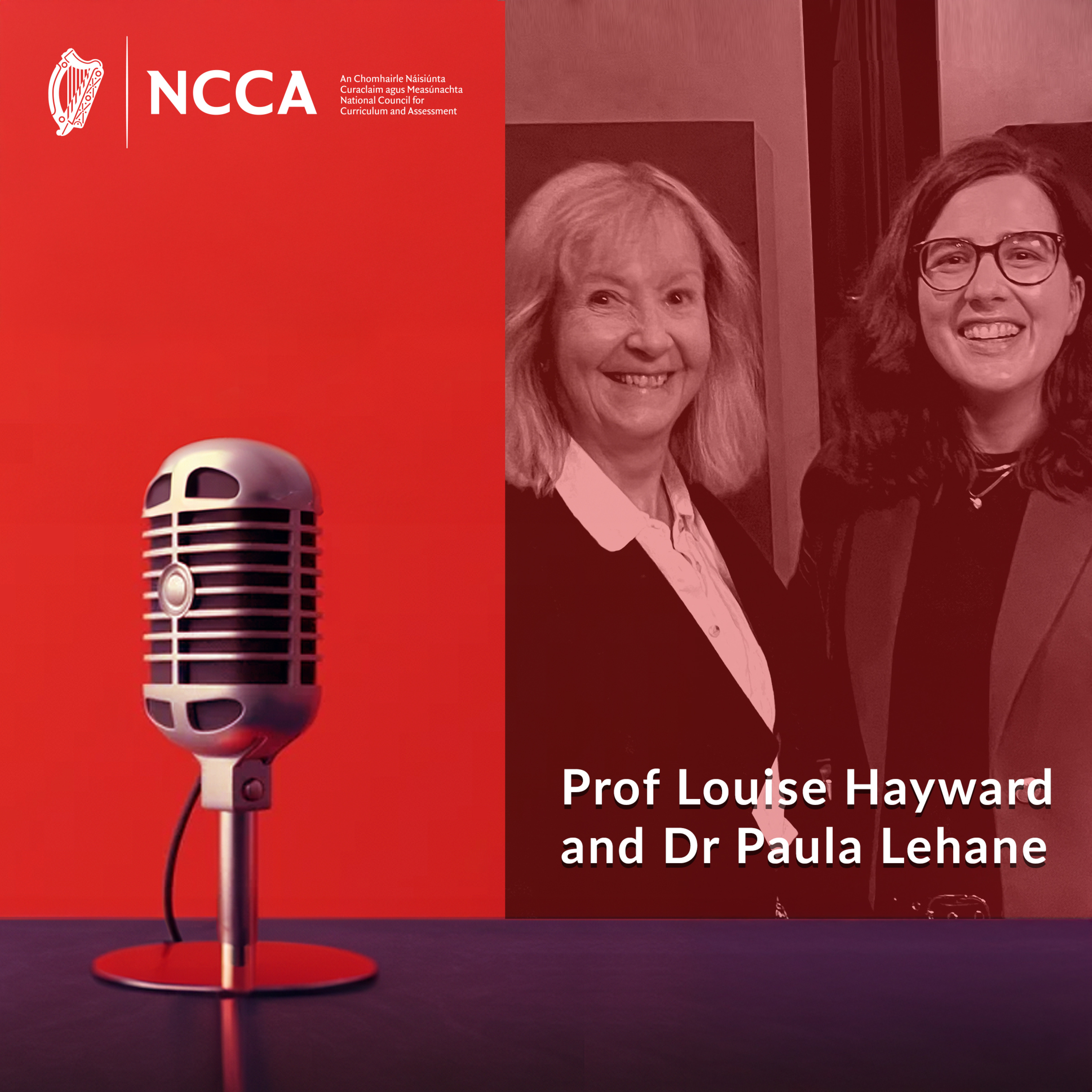
For this podcast, I'm joined by my guest, Professor Louise Hayward and Dr. Paula Lehan.
Louise is a professor of education assessment and of innovation at the University of Glasgow,
an undisputed authority on the topic of assessment. She was a member of the International
Renowned Assessment Reform Group and is currently a member of the Curriculum Assessment
and Pedagogy Educational Reform Group and the International Symposium on Format of Assessment.
As well as playing an important role as a member of the Advisory Panel supporting the
development of the new Irish Primary Curriculum.
Louise's interests include assessment and social justice and she is committed to the centrality
of researchers, policymakers and practitioners working together to ensure both high quality
policy and policy enactment that remains consistent with policy aspirations.
Louise is joined today by Dr. Paula Lehan.
After graduating from the Education and Psychology Program in Merriamacular College Limric,
Paula taught in a developing school in North Dublin for a number of years where she worked
in both mainstream and special education roles.
Paula completed her master's in University College Dublin, where she developed an interest
in assessment that later became the subject of her PhD, where she studied the topic of
digital assessments and examinations.
She is currently assistant professor in the School of Inclusive and Special Education
with the GCU, where she lectures in the area of assessment, inclusive pedagogy, literacy
and research methods.
Louise and Paula, you're both very welcome.
Thank you.
Thank you.
So, we know that the primary curriculum is changing and, as mentioned in the introduction,
we really want to focus in on the topic of assessment and what curriculum change might
mean for assessment going forward.
The guidelines for assessment we currently use were published in 2007, but that's 17 years
ago.
So what's new since then?
What have we learned, and how does this relate to primary school in particular?
And I'll put that question to either of you.
Well, I might come in there because I would have done my teacher training with the 2007
guidelines, all of my career in the classroom is with the 2007 guidelines.
And I think to their credit, a lot of what is in there has stood the test of time.
I think that needs to be acknowledged.
It gives very clear guidelines.
In terms of the new primary curriculum framework, I think one of the really positive moves
forward is the language we're using.
In the 2007 guidelines, there was a very strong emphasis on formative assessment, AFL,
assessment for learning, assessment of learning.
And encouraging people to classify their assessments according to the purpose.
And that's very constricting, I think, because when I was teaching and when I was nearly
qualified in the 10 plates, you might be asked to classify your spelling test, your maths
test at the end of the week, where it's a formative or for summative purposes.
And I'd be very confused how to classify them.
Because yes, I'd use them to get a score, to make a judgment, but I'd also use them
to guide my own teaching in the future.
So I think that classification is really useful from a theoretical perspective, but not necessarily
maybe from a practical one.
So the new language there where it acknowledges that assessment can be really intuitive.
I really like that because it allows us to see that assessment often happens through observation,
through planned interactions, actually talking to the children, and not just those really
formal events.
So I think that's a really good move forward, that maybe away from that really harsh classification,
this new terminology could be very positive.
And Louise, for you, what's new?
I think I would share a lot of what Paula has just said, that the phrase in my mind was
a lot of this, has stood the test of time.
I think there are things about the actual document that I really like, that the way it
links, it begins from practice, and it links ideas to practice, and I think these are really
important things to hold on to.
I think maybe over time, we've realised that some of the glib-freezes we used are actually
much more complicated, you know, next steps in learning.
Gosh, doesn't that sound simple, but actually in order to identify good next steps in learning,
you need to understand the curriculum, you need to understand progression, you need to
have a good relationship with the learner, you need to be able to analyse the data.
So I think a lot of what we learned is around making ways to make these ideas real, rather
than to have them as just nice ideas, or as you said, nice theoretical classifications.
I mean, when we think about making ideas real, I'm thinking about, you know, the principles
that are in the curriculum framework, and one in particular that talks about assessment,
describing it as collaborative and integral to high quality learning and teaching, but,
you know, you talk about phrases that we use that sound simple.
What does that actually mean in real terms when we talk about assessment being collaborative
and integral?
And, you know, how can this actually be achieved in practice?
I think it's a very interesting question, Tracy, because there's a glib-freeze we use,
which is, you know, assessment is an integral part of learning and teaching.
So what does that actually mean?
So it means, first of all, that the curriculum is absolutely everything because that curriculum
is, I like to think of it as, it's a conversation across generations in a country about what matters
for a child to be educated.
So what does it mean to be educated in Ireland as, in primary school?
And then you identify the areas that matter for that child to be educated.
So when you're in the classroom, the curriculum and what matters for learning becomes the
focus of everything that goes on.
And then that phrase pedagogy is about, so how do you provide opportunities for children
to develop their knowledge, their skills, their understanding, their competences in relation
to these big things that are really important?
Also wonder, then, if we should keep the word assessment, because assessment sounds hard
and clinical and joyless.
But if we think about it as learning, how do we discern how much and how well young people
are learning in relation to what matters?
And how do we do it in a way where young people not only enjoy the experience, find success
and the experience, but actually learn from the experience.
Then I think that's the different kind of zeitgeist of the new assessment that I think the
primary curriculum is proposing.
And I mean, what you describe there is assessment and learning being inseparable to each other
in that regard.
And yet there can be perceptions of assessment as sitting outside or separate to teaching
and learning.
I'm just curious, Paula, what are your thoughts and what contributes to this idea and what
is the antidote to this?
I think in terms of assessment being seen outside of learning and teaching.
I think from an Irish perspective, a lot of that has to do with the fact that we do have
a very strong emphasis on formal assessment events in Irish culture.
We think about the leaving certificate in June in August where the media coverage is exceptional
and not comparable to any other place.
We have the junior cycle.
We have the standardized tests for a second, fourth and sixth class, the mandatory reporting.
So oftentimes when we talk about assessment, because of that emphasis in the media, in
our own policy documents, we automatically go to those assessment events.
There is, for me, and certainly when I was in the class for myself, that over time I began
to realise, like what Louise said, assessment is what I needed for next steps.
They were my guiding points.
And it was all about, well, assessment and learning being often very difficult to distinguish
from each other.
So I remember when I was teaching fifth class, I was a set teacher, a special education
teacher, and I did a lot of collaborative teaching in the classroom.
And I remember doing a little bit of professional development, one of the summer courses, and
there was just a really small section on whole class assessment approaches, and it was all
about hinge questions.
And I'd never really seen some of these before, and what it is is basically, you might have
a question 8.2 by 10, okay?
So again, you're thinking about place value,
you're thinking about the progression.
But if you put the decimal point so that you make 82,
or you make point A2 or point zero is two,
and ask the children, which of those answers is right?
And they put off a mini-wife border.
They use their bunny ears to indicate if they think
it's answer one, answer two, or answer three.
You can see the misconceptions immediately.
And then my lesson plan would change in response
to the needs of the children in front of me.
And I remember doing that with my co-teacher.
And he said, oh, Paul, we don't have anything
at the end of this for assessment.
And I was like, well, the assessment
is at different points there.
That's why I chose Fred and Henrietta.
Not their real names.
There'd be people from area I listening
of a certain vintage that will know the origin of those examples.
But I say, that's why I took Fred and Henrietta aside,
because I knew that they had a misconception.
And the rest of the kids didn't.
But you kept them on.
So it was that idea that assessment and learning
was really difficult to distinguish.
And I didn't get that until I was teaching
maybe three or four years.
So you know, some of that, I think there
needs to be an acknowledgement as you progress in your career,
as you progress in your classroom.
You might see assessment in different ways.
You move away from this idea that you might have been taught,
or you might have only seen assessment as these big events.
Whereas when you're in the classroom,
trying to decide those next steps,
I think assessment and learning become quite blended.
And having knowledge of those really sort of intuitive approaches
can be very powerful for that.
And listening to the example that you've given,
I think you'll agree Louise, that's a really good example
of a teacher using their agency
to use assessment to support learning.
And of course, we know that the primary curriculum framework
places a huge emphasis on agency and behalf of the teacher
and to the child to put them in the driving seat
for teaching and learning in the classroom.
And Louise, I wonder, what are your thoughts
and what this actually means for assessment going forward?
Its purpose, how it's enacted, how it's experienced,
what it looks like.
It's not a small question.
That's a big question, but what do you think?
I think that at the beginning you asked,
what are the big differences over time?
And I think that's one of the big differences over time
that we've realised how important learner agency
is within this whole process.
I think as a teacher, I always found it comforting
that I thought when I'd covered the curriculum,
then I'd done my bit, whereas I think the thinking now
is actually correctly that it isn't
about covering the curriculum as of what children have learned
in relation to what it is that you're supporting them towards.
There are certain things about that
that are really become really important.
So the first one is, as Paula said,
that often people associate assessment
with the kind of hardcore technical end of things.
So you think about exams, you think about tests.
And if you say to people that actually,
in order to assess well, first of all,
you have to have really good relationships with the learners.
And people are surprised at that.
But it's because that people matter
and that relationship that you have with the learner
is absolutely crucial in allowing them
to have the confidence to demonstrate
what it is that they're learning.
So that's a really kind of important feature
I think that we've learned.
I think we also have learned.
You can't actually learn four people.
So the teacher might understand something.
But if the learner isn't able to articulate that understanding,
then it means that the learner hasn't learned.
So in that context, then assessment becomes really important
in that the learner has to understand what it is
that they're expected to learn and why it matters.
So that idea of agency when you start to take it apart
means that it's learners having a much clearer idea
of the purpose of their learning.
Why does it matter that I'm learning about decimal points?
What's important about that?
What would good learning look like?
To give them the tools then to be able to say,
okay, I know why this is important.
You're helping me.
You've given out ways of how I might get into this,
how I might actually approach it.
But then also you've given me ideas of how I might look
at what I've learned and decide how good that learning is
and perhaps what I have to do next.
And it's that sense of agency that actually encourages
the deeper learning as teachers we know that often
if you say to children, why are you learning this,
they'll say me a copa because you told us to.
And that isn't a good enough reason.
They have to understand the purpose of what they're doing.
They have to have practical strategies.
This is how I'm going to make progress here.
And then they need the ability to look at their own progress
and to decide what has gone well
and what might they go onto next
because that's the deep learning that they will take with them.
And so as a teacher, your role has changed
from someone who simply sets up opportunities
to someone who actually engages in giving learners
these powerful tools in order to support their learning over time.
And the second part of that is that it is the peer group,
the other learners who are all often
the most powerful supports in that process.
So learners talking with one another about what they're learning,
looking at what one another has done
and saying, I think you've done this well here,
maybe you could work a bit on that,
is a way of embedding these deeper approaches to learning
within a learner's psyche that they can then take on
to the next thing that they do.
- Yeah, I think there's some really interesting points
in terms of the learners being these people that other learners
can work with that collaborative element
that you spoke before.
I think that's really, really important
because it's ensuring that there's a dialogue
in the classroom.
And oftentimes sometimes when I'm working with teachers
or when I was in school as well,
that that idea of language being really, really important
and having to give the students the language
that they need to have those conversations
and not assuming that they will know.
So if you said, oh, I want you to talk to your partner
about the character traits of this person in the novel,
well, what is a character trait?
That needs to be really clearly bought out to them.
And oftentimes, they say, oh, well,
they do a thing per share and I'm delighted.
And then I'm listening and the children aren't actually
using any of the language you want them to use.
Have you given them a scaffold to support them,
those strategies?
Have you told them, when you're talking to your partner
about what we learned about the Normans,
I want you to use these three words in your answers.
And then you go and said, what did Paul say to you, Tracy,
about this word, about crannogues
or something along those lines?
So again, exactly as Louise said, what
support are you giving to them, to allow them to engage
in a dialogue that's actually meaningful?
I'm making what you're learning really clear and explicit
that you're not assuming that they have that vocabulary,
that they don't have that language.
You actually tell them, because that's
the only way they will be confident enough
to have some agency.
If you give them the knowledge and the skills and the strategies
that they need that you explicitly show them
how to make those links, I think the other element there
that was really interesting to me was the children
looking at their progress over time
and actually seeing what they've learned
and not keeping it to something that only teacher looks at
or that parents look at.
So I was really lucky to work with a child one-to-one
to develop his reading skills.
He was an older learner.
He hadn't developed the fundamental decoding skills
necessary for him to engage with a fifth-class novel, for example.
And again, we did a very traditional program.
We did Toe By Toe.
There will be a lot of teachers listening
to this to be very familiar with it.
Quite a robust program, not perfect,
but has a good enough evidence base
for what I was working with at the time.
And what we did was that he saw the book every day,
but when we used the book, when we had finished a section,
we would highlight it in yellow.
And then over time, over the 250 or 60 pages of that book,
he could flick through it and he could see,
well, I actually got these section pages really quickly.
Look how little yellows on that page are, where it is,
where it's in the later ones, oh, I actually
to work really hard to get these ones down,
but I got there.
And that sense of achievement led to motivation.
So that idea that assessment isn't just to say what
they can't do.
It's a record of what they can do as well,
that they can't do.
the hard work that they can see, the progress. And I think that goes also back to that idea
of collaboration, learner agency, that that information is very powerful to that learner
at that age because he could see success in reading where he may not have seen it before.
And he was so good, yeah. And I can see Louise nodding really strongly here because if I'm
correct Louise, I think what you're giving us is a really good example of eliciting what matters
in the context of that child's learning. And you know, you've spoken about this already,
but I just want to pick it apart a little bit more if that's okay Louise. So when you talk about,
you know, assessing and learning what matters, what do you mean by this? And you know,
how can this actually be determined in the context of a classroom or a lesson?
I think what matters is it's one of these simple phrases that actually is it's quite complicated,
it's helpful, Tracy, I think to start to kind of think about it. So there is a sense in which what
matters has been agreed as the new primary curriculum. That's what matters to Ireland in terms of
the education of children. Within that, then there's what matters in terms of, as I said before,
how are teachers and learners together going to develop thinking and ideas through
these different areas of the curriculum? So that's the kind of basis of what matters.
Then there's what matters in terms of progression. So as a teacher, can I describe that journey from
what happened when someone comes into primary school at the beginning? What might you expect
someone to be able to do? But by the time they leave, what would you expect? So there's that kind
of learning journey and that matters because that's the way in which you then situate what you do.
So what can the learner do now? And how am I going to support them on that learner journey with
that kind of bigger term aspiration towards that future? And I think that unless we make these
connections between these other kind of big ideas, between these big ideas and the day-to-day stuff
that we do in classrooms, then children will always see the day-to-day stuff simply as hoops to
jump through. You know, I'm doing this because it's the next thing on the white board that the
teachers listed that I do, but they don't make these connections. So it matters that children
understand progress in learning and they can only do that in a world where teachers understand
progress in learning. So there's what matters in terms of the relationships, there's what matters
in terms of learning, that kind of big picture stuff, and then there's what matters in terms of
progression. Where is the learner on this learning journey and how can I support them through that?
And I think there is a subset of that idea of progression which is connections.
There was a lovely description, I remember that David Holman used where he talked about STEM education
and he said that there's a big difference between fought children learning schools and the real world.
So what children learn in schools is they see the word science. So they've got a big S.
They've got a little T for technology. There's no E often in schools at all and there's a massive M
for mathematics. If you go into the real world then there's a small S for science. People use the
principles of science and mathematics and they use the tools of technology in order to engineer
solutions for society. So there's a small S, a bigger T, a massive E for engineering and a small M
for mathematics. So the idea is that if school is really going to educate in inverted commas
young people then for what? And it has to be for life and so therefore there have to be connections
between what happens in school and what happens in life. And in life it isn't organised in areas
of the curriculum. So it's across the curriculum. It's the connections we make across different areas.
It's the competences that we develop in order to be able to use the knowledge to make things happen
in the world. And these are ways in which I think the new primary curriculum tackles some of the
very traditional problems that exist internationally about the relationship between what children
learn and what matters to them in their lives. Can I build on what you've just described there?
Because it's so important and to ask you that when we think about what matters in terms of people
and learning and progress and that central to this is about making connections. What would you
pinpoint as the role of assessment in the making of those connections and also the role of the
teacher in doing so? I think that let me start with the role of the teacher first of all because
I think in a sense the teacher is the planner. You know the teacher is the person who
actually organises the learning in partnership often with the young people and the more that you
can organise with young people in terms of planning the better because what you're really doing
if you get into the the the theory of the brain you're preparing conditions where neuro connections
can be made you know so you're activating children's thinking. So for example there's an example
that I often use where I saw it was actually it was a young teacher do this and I wish I'd
thought of it you know as a teacher it was so simple and it was so good but she was about
to start a topic it was a fairly ordinary topic on farming and so three weeks before the topic
started she spoke with the class and said okay we're about to do a topic on farming what other
things you'd like to learn about and they started coming up she said okay well I'm going to put a
big poster on the wall and over the next couple of weeks add things to it and I'll put things up
and then by the end of it you know we'll decide what is the topic is going to be about. So of course
what she did was on the wall she put up the things that were in the curriculum that she was determined
we're going to be part of that process and the young people added to that. By the end of it she took
it down turned it into a presentation and then said to the young people have I got this right okay
this is what I think the topic is going to be about am I on the right lines here now what she'd
done there was really clever because it meant the young people were thinking about what it is
they were bringing the existing knowledge and skills and expertise that they had to play into this
they felt they were contributing what they were contributing to its development and so by the time
started they were ready to learn you know so collaboration isn't simply about so getting the right
assessment evidence isn't simply about collaborating around assessment activities it's about that
process of collaboration that feeds right in from the beginning that activates and offers young
people the best opportunities to develop their thinking and shoulder skills there had an
understanding of what the children already knew as well so she could see well there are there are
gaps there because we you know you always have to be very careful you want and you need the
children to offer their own perspectives and their life experiences but you also want to broaden
us correct you don't just want to focus on what they already know so by she can see well they
already know these topics I want these topics so I know I know where they're at I know the starting
point I know where the other things I need to get from the curriculum to I can now use these two
endpoints to chart a path so I think that's like that's a really lovely example because it's an
efficient way to gather prior knowledge to see where the class is at and it's collaborative the
children involved they're activating and they're really thinking about it isn't the teacher can use
that information but I also think it's really important that the connections are meaningful that
they're not just there for the sake of it and as Louise said that means the teacher has to be
like planning ahead so if you're doing a unit on farming you might need to develop a lot of
background knowledge if you're in an urban area and they haven't seen a farm before but you still
want to do the farm so you might have to be very careful what books you bring in if it's a younger
classroom what topics or what articles for an older class you might bring in from the media
and make those links there as well so that if you want them by the end to do a reading comprehend
to the by farming well you've given them some background knowledge to work with so they can engage
with that and you've gathered this assessment evidence to know what path do I need to chart with
it as well and that's driven and that's driven by your intuitive sense of what matters for the child
in terms of their interests what the curriculum says about their learning building on their prior
knowledge and it's it's like this intricate dance but that the teacher is I suppose assessing all
the time in making their decisions and I think the assumption there might be that that's very
complicates is but I'm inclined to.
I find to think that as you described it, if teachers are not maybe constrained but what they think they should be assessing or how they should be assessing and actually just follow their intuitive sense as to what would fit best in this context or be best for the child or be best in terms of informing my teaching learning that maybe it's less complicated actually maybe it brings it back to its roots and it keeps it quite simple.
But that was still planned though, like that teacher went in there with a plan so it was a planned event if we use the vernacular in the new curriculum but there wasn't in two developments to us.
That's absolutely right. And her thinking was all about how best can I gather evidence and about what?
So the connections would be that farming might be seen as a topic where there are opportunities to develop understanding of, I don't know, crop rotation or geographical location or all these things but also it was an opportunity to develop literacy skills, it was an opportunity to develop drama, it was an opportunity to develop art.
So the thinking is about what is it that it's really important that young people learn here and then the assessment questions then become how might I best gather evidence in ways that are as real to life as possible that will allow me to make informed decisions about how best to support different children.
So I think it's really important to, that's why I keep coming back to the phrase what matters because I think it really is so important.
It's what matters to a particular child, a particular time. So as a teacher with a number of people in the class, could be 30, could be more.
Then there will be some young people for whom the priorities, what matters for them is very different from others.
So for some it might be about bringing evidence from different sources in order to synthesize information for another child, it might be about decoding text.
The teacher has these different priorities in mind for these different children in these circumstances but all children will be making progress.
There's a lovely piece of work by Gauk called Bjork talks about that the tasks that the better children do in a task, the less likely they are to remember it.
So I think it's a very important achievement being that if you set assessment tasks that children do easily, they don't have to think and if they don't have to think then actually they're not learning.
They're performing and they might be performing well but they're not learning and if the focus of what we're talking about is learning.
So what you said was really important there and I think which was around the change in thinking, the fact that the young people, what is learning?
Learning is about where there has been a permanent change in the way that people think.
And in order for that to happen then it has to be at that kind of boundary between what they already know and that next step that will move them on beyond that.
And the next steps again have to go back to be in what are the big ideas here, what really matters for that next stage in learning. So it's not the next page in the textbook, it's not the next topic, it's ingrained in what it is for that particular child that will help them make progress on that learning journey.
And I want to pick up on that point that you're talking about the opportunity and importance of attending to what matters for individual children and that maybe different for for for money and that gives me an opportunity to talk about a topic that's very close to your heart Paula around inclusion.
And if we think about the relationship between assessment and inclusion, what opportunities do you see, and I know it's a core principle within the new curriculum framework as well, but what opportunities do you see to promote and support inclusion through assessment or assessment practices?
Yeah, that's probably a podcast topic in and of itself, so this is just like a very truncated version. And I think like there's lots of different elements that you could talk about and there's lots of kind of new ways of approaching assessment.
And I suppose for me one of the one of the things that was really important as I gained knowledge about assessment and practical experience is like what Louie said, it's I need to know the foundation I'm working from.
So oftentimes when we talk about assess and particularly in the field, I'm inclusion is very deficit focused. The child can't do a full stop, they can't do a capture letter, they can't do this, they can't do that, they can't do that.
From a teaching perspective, that's only half the story, because I know what they can't do, but I don't know what base I'm working from.
So I think assessment allows me to identify where they're at now. So I often encourage and it was probably I was really fortunate to be able to avail of professional development from University College Dublin. I was on the eight week, you know, you get released for eight weeks over the course of the year.
There and they kind of talked about this idea of present level statements, where is the child at now so that, you know, Fred is able to add within 100 without renaming with the visual scaffold, so the tens and units are in different colors.
Okay, I know where he's at now, I know he can add and subtract, I know he's still needs a visual scaffold, so what matters next to this learner doesn't matter that I start increasing automaticity and removing the scaffold or is the priority to move on to addition and subtraction renaming.
And by having a present level statement instead of saying, oh well, Fred can't add and subtract with renaming at the moment within 100 and I go, okay, I don't go, okay, so I'm going to move on to that.
Whereas if I know exactly what he can do now, I can make a far better decision. And it's that idea that if we think about assessment as a way of knowing our learners better so that we can have a clear foundation to work from, and I think that's a guiding principle across all subjects that is only by knowing where they're at now.
Can you do the next developmental set that's just out of their reach, whereas if you're constantly saying they can't do this, they can't do this, they can't do this, it's really difficult.
I think that's a lovely statement because it's again back to this notion of changing the culture and the ethos of assessment from something that's negative to something that's actually joyful.
And there's a strange word to say for assessment, because it is, it's about, why do we come into teaching?
You know, we came in because we wanted to help the next generation to grow and to become an assessment is simply the way that it's the range of strategies that we have in order to support people to become more than either you or they believe possible.
And for that, we've got to start from where they are, we've got to work with them so that they have the confidence to grow and to develop.
And then all the technical stuff in a sense are only the tools of the trade.
You know, so rather than thinking, oh, have I used peer assessment, have you self-assessment, have I used formative, is it summative, is it diagnostic, is it?
No, the important thing is, what is it that this child needs to learn? How am I going to help them? How am I going to work with them to do that? What can they tell me about how best they might support me as I help them to learn?
And at the end of it, how can we all be delighted together as we watch progress being made and we watch children building their confidence and believing that they can and they will?
I mean, you're talking about working with children from where they are. So if we do a little self-assessment in terms of where we are as teachers and within the context of Irish primary schools, where are we with assessment?
Well, reviews of kind of whole school evaluations in more recent years.
Pain is actually a really positive picture of assessment practices in primary schools. And in particularly, it suggests that our strengths lie in the range of methods and approaches that teachers use.
We seem to do that really, really well. But the reports and recommendations do also raise some questions about, you know, our assessment literacy as teachers and, you know, how we use assessment information or data.
And that is actually generated through these methods. Just wondering, you know, Louise, what do you think about that in terms of where we are and, you know, how we might address that in the years to come?
I think there's a wonderful base in Ireland to build from.
Mae'n bywch i'n gwaithio, mae'n gwaithio'n gwaithio'n gwaithio'n gwaithio'n gwaithio'n gwaithio'n gwaithio'n gwaithio'n gwaithio
o'r gwybod i'n gwybod ac mae'r gwybod ac mae'r gwybod ac mae'r gwybod ac mae'r gwybod ac mae'r gwybod ac mae'r
o ffordd o ffordd o ffordd o ffordd o ffordd o ffordd o fford
i'n gweithio yn gweith i'n gweithio yn gweithio yn gweithio yn gweithio yn gweithio yn gweithio yn
ymdwch i'n gweithio'r ymdwch i'n gweithio.
I'n gweithio'r ymdwch i'n gweithio'r ymdwch i'n gweithio.
Mae'r gweithio'r ymdwch i'n gweithio.
Mae'r gweithio.
Mae'r gweithio.
Mae'r gweithio.
Mae'r gwaithio'r gwaithio'r gwaithio.
Mae'r gwaithio'r gwaithio.
Mae'r gweithio'r ymwch i'n gweithio'r ymwch i'n gweithio.
Mae'r gweithio'r ymwch i'n gweithio.
Mae'n fwy'r gwaithio, mae'r gweithio'r gwaithio'r gwaithio'r gwaithio'r gwaithio'r gwaithio'r gwaithio'r gwaithio'r gwaithio'r
Yn yn ymwyr i'r llwysd yw i'r llwyr i'r llunor i'r llunor i'r llunor i'r llunor i'r llunor i'r llunor i'r llunor i'r llun
i'wch i'wch i'wch i'wch i'wch i'wch i'wch i'wch i'wch i'w
Mae hynny. Mae hynny, mae hynny. Mae hynny. Mae hynny. Mae hynny. Mae hynny. Mae hynny. Mae hynny
Mae'n hynny. Mae'n hynny hynny. Mae'n hynny. Mae'n hynny. Mae'n hynny. Mae'n hynny. Mae'n hynny
Mae'n yw'n gwybod yw'n gwybod yw'n gwybod yw'n gwybod yw'n gwybod yw'n gwy
So, focus on that single source of information to guide what you're doing isn't best assess and practice.
Use it in contact with what you see in the class, what you see in the interactions,
how they do and that micro-test, the English reading, may not match up what you see in writing.
Mae'n iawn i'w i'n i'w i'w i'w i'w i'w i'w i'w i'w i'w i'w i'w i'w i'w i'w i'w i'w i'w i
'Porticular approach' to assessment.
So standardised testing, again, has its place.
But you can't discern everything that matters in that test.
Because tests measure what they can measure.
They don't necessarily measure all that matters.
And so, if you go back to that phrase of what matters,
that has to drive everything.
What matters?
What is important?
Mae'n ddyn sydd yng Nghymru yn gwybod sydd hynny i'n gwybod sydd yma.
Mae'n gwybod sydd hynny i'n gwybod sydd hynny i'n gwybod sydd hynny i'n gwybod sydd hynny i'n gwybod sydd hynny.
a'r ffocus o fysysysysysysysysysysysysysysysysysysysysysysysysysysysysysysysysysysys
'O, oes, at the start of the year, we were only reading CVC words.
Whereas now we're sort of engaging in multi-syllabic words.
He still doesn't have, or he or she might still not have the Vilediograph or something,
but that's where we're going to go next.'
I was like, 'Okay, from an assessment perspective, you have multiple sources of information.
You can see where you've come, you know where you need to go.
Yes, you have this one source of information that allows you see how this learner is doing
i'n rhaid o'r pyrs a'r pyrs a'r pyrs a'r pyrs a'r pyrs a'r pyrs a'r pyrs a'r pyrs a'r pyrs a'r pyrs a'r pyrs a'r pyrs.
I'm thinking about the teacher who's listening to this podcast and is thinking to themselves,
that sounds all well and good to put it all in perspective.
Felly, mae'n yw'n gwi'n gyfer yng Nghymru o'n gwaith yna'n gwaith sy'n gwaith yng Nghymru o'n gwaith yng Nghymru o'n gwaith yng Nghymru o'n gwaith yng Nghymru yn gwaith yng Nghymru yn gwaith yng Nghymru yn gwaith yng Nghymru yn gwaith yng Nghymru yn gwaith yng
a'r stress, a'r stress that they're not, maybe, meeting expectations from parents
that they're not doing their job well enough.
And whilst, you know, they're also told this message, you know,
it's just a snapshot in an album.
Yet this pressure still exists.
And also children talk about their experiences of standardized testing as well.
Very next.
Yeah, and that contend to also impact on their learning experience,
o'r sfyseptions yn yr unrhyw i'r unrhyw'r sfyseptions yn yr unrhyw'r sfyseptions yn yr unrhyw'r sfyseptions.
how well their child is doing in school.
- I think you kind of said,
like I don't really think,
unfortunately education doesn't have any single shot antidotes.
They always need to be multi-layered,
multi-faceted, multi-component.
But one thing that I do always think about is messaging.
And maybe we need to be better,
and I include myself and this as a teacher,
at communicating what these particular tests mean.
So it is important that we share this information with parents
that we have this understanding.
But oftentimes,
is this the only assessment information we share with them?
Do we show them their examples of their work in September and May?
And also include that as an important piece of information.
So I think some of it has to do with messaging and communicating,
what do these tests actually mean?
And this is always something that was really important to me
because I would have met parents a lot one-on-one
to talk about psychological testing reports.
And like they're very difficult to read.
Very difficult to read.
And then we're having to explain that the 50th percentile
is not the same as 50 percent, it's average, et cetera.
And then having to explain that one to one.
So I think there's a job of where to actually explain
what the numbers mean.
Because depending on your background,
you may never have to encounter something like that.
But also from as a community, as a teaching community,
as people in an education,
that we need to go back to that messaging that standardized tests
are just a snapshot.
Could we maybe add maybe more pictures to the album
that we sent home at the end of the year?
Louise, to bring assessment practices in line with contemporary thinking,
what do you consider to be the most important key messages
for school leaders and teachers to consider
over the coming years when it comes to assessment?
I think the clear messages about assessment
are get beyond all the jargon.
Get beyond all the jargon and think about really simply,
what is it that I want this child to learn
and have I engaged with him in a conversation about that
so it becomes a shared learning objective?
Beyond that, how are we best going to gather that information
and how can I draw from all these different ways
of gathering evidence that will give me the best information
to help that child make most progress?
And then how am I going to act on that?
And I think that if we keep the ideas really simple,
then we start to see assessment
as integral to learning and teaching,
as a means of motivating, of helping children to make progress
and seeing as fundamental to all of it
are our relationships with learners.
Children don't learn from people they don't like.
You could change that to people don't learn
from or with people they don't like.
There is a bedrock of our relationship of trust
that has to underpin all of that.
And I think Paula, maybe the issue you raised
about teachers and the stress, Tracy,
that you also raised about teacher stress,
is a sense of how do we work with teachers
so that teachers feel trusted?
They feel supported as we go through this process.
Learning is learning, whether it's with a five-year-old
or whether it's with a teacher or whether it's with someone
who's eating.
I mean, Paula, would you add anything to that in terms of
what you think will be important to message
around assessment over the coming years
to bring it in line with the kind of contemporary thinking?
I think in primary, the trust element is quite important.
And I know myself that there may have been children
who didn't like me when they dealt with me.
But I know that they trusted me
because they knew I was reliable.
I was predictable.
Paula said something was going to happen.
And I think that trust element, as we said throughout,
learning who you're working with is really important.
And for me, I would trust the teachers in the classroom
to make the decisions they need to know personally.
And again, like that means that we need to be on top of it
in terms of initial teacher education,
that we give them the knowledge that they need
to have the confidence, to make those decisions,
to be confident enough to gather the information,
to know that it's good information,
to know when they've gathered enough information as well.
To say, I don't need to do that.
I have enough to know next steps in learning
because it is the teacher ultimately in Ireland
who makes a lot of those classroom-based decisions.
And I would be reluctant to add in more accountability measures
or more reporting measures or more paperwork.
It's not necessary for good assessment.
So teachers need to have control of the decisions
they make in the classroom because they're very contextualized
for them.
So we need to be able to trust them.
We need to ensure that they have the confidence
by having strong initial teacher education
and having a range of professional learnings
that are suitable to where they are in their journey.
So we often talk about the progression for learners.
Teachers engage in progression as well.
And I'll say this, how I thought
on what I needed to know about assessment,
the first year I was teaching,
was very different to what I needed to know five years in.
It was very different to what I needed to know
just before I left the classroom.
At the start I was very focused on,
"Oh, how do I gather information efficiently?"
"Oh my word, there's a lot of children in this room."
And I have to individual phonics screeners, but.
So I was like, how do I do this efficiently?
How do I apply?
I know a couple of years later it was like,
"Oh, how do I actually understand all this information
so that I don't overemphasize the number?"
And then for me in the last few years I was in the classroom,
I had to do a lot of learning about communication.
And how do I talk about assessment to partners in education, parents?
How do I talk about it to younger learners who are frustrated
that they're coming out to me in my set room again
and they're sick of the sight of me?
So I think we need that acknowledgement as well.
The teachers have a progression and that,
depending where they're at, they may have different ideas.
And that's okay as well that teachers aren't a homogenous group either.
And we need to acknowledge that in the same way
we acknowledge what happens in the classroom.
Now I have one final question.
And this is a tradition that we're trying to build into the podcast,
which is just to ask a very general question to each of our guests.
What is curriculum and what does it mean for you?
That's a really hard question.
For the simple reason,
I don't think it's something when you're in the classroom
you spend a lot of time reflecting on because you're simply too busy.
You're just going, "Okay, let's do this, let's do this."
I think I only really started to think about curriculum when I left the classroom,
which is really a pity because it's quite an important part of the job.
And you know, when you do the readings,
they talk a lot about always origins,
it's from the Latin word, career to run, the race course.
And I was like, "Okay, so something to do, something to get through."
And, you know, I was trying to think of analogies.
I failed miserably to be perfectly honest,
but the closest thing, and for me listening to Louise talk and other people
and the podcast would be that curriculum's often a compromise.
And, you know, at a national level,
you have to make a compromise of what matters and where do we go?
And then there's a compromise in the classroom and, you know,
you might want to do the same lesson with the same group of kids every year,
but it's different every time.
And you might have to make compromises that you might love this part of the class
or the recipe that you're trying to do,
but you'll have to change things or you don't have particular resources
or spices or whatever next to you,
but I think at the moment where I'm at,
is curriculum is often a compromise and compromises are hard,
and they're not easy.
And I think that's about as far as I can go with a question as complex as that
in three minutes and less.
Thank you.
That is a perfectly good answer.
Thank you very much.
Louise, what is curriculum and what does it mean for you?
Curriculum for me is what a society decides is the conversation
that they want to have with the next generation.
What does it mean to be an educated citizen in Ireland?
What matters?
And therefore, there are questions there for me about what kind of society
do I want to be part of in the future?
And therefore, what kinds of knowledge, skills, understandings, competences
do learners have to have in order to belong and to contribute to that kind of society?
And then it comes back into the curriculum as defined in schools.
So what's the learning journey that children go on in order to become
become the kinds of citizens for the kind of society.
of which we would all like to be part.
I think you said earlier in the podcast that, you know, any one of these topics we could
probably have a podcast in and of themselves on just those alone and what we have done
is skimmed the surface around the topic of assessment and there's lots more we need
to explore in this and actually, you know, your contributions today have got me thinking
and I know we'll have got the team thinking about what would be useful in terms of exploring
this further.
So I really want to take this opportunity to thank you Louise and Paula so much for
your time and your generosity and contributing your ideas and your perspectives on the topic
of assessment and really importantly to provide an opportunity for the listener to now think
about, you know, what is my perspective?
How do I think and feel about assessment and how it's going to change and evolve over
the coming years as curriculum changes introduced to primary schools?
Thank you both very much.
Thank you.
Thank you.
Thank you for joining us for this conversation and we hope that this podcast will spark
your own thinking and further conversations around curriculum.
At NCCA all voices matter and we would love to hear from you.
If you have any thoughts and response to this podcast episode or even some ideas for what
we might explore in further episodes, please do get in touch by emailing us at
[email protected]
or by using the hashtag #nccapodcast to continue the conversation on social media.
You can support the podcast to grow by liking and subscribing.
Thank you for listening.
 PodcastTranscript AI